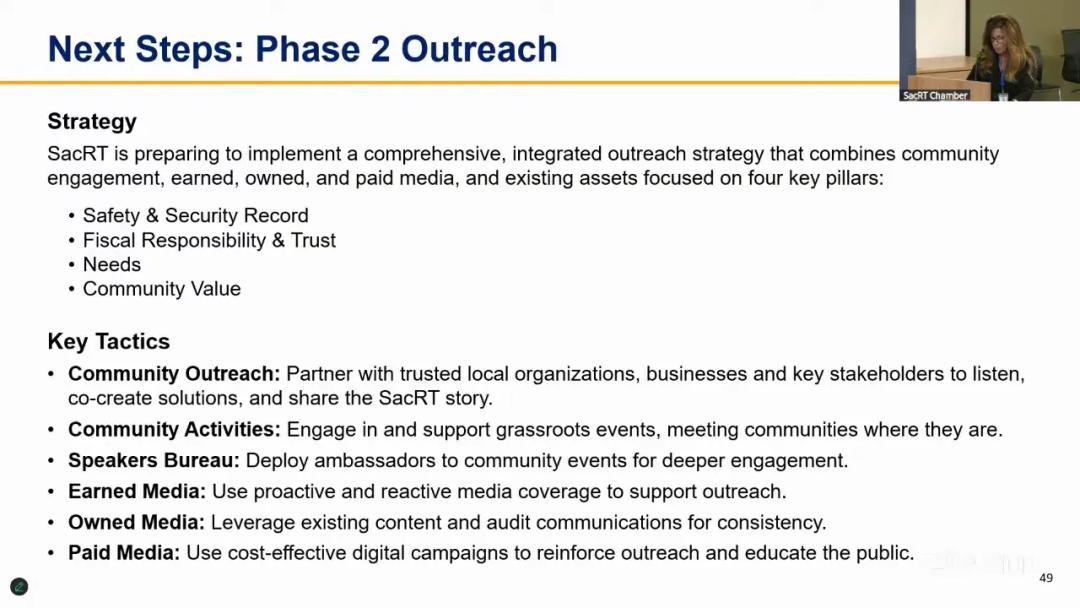
This meeting of the Sacramento Regional Transit District (SacRT) Board of Directors was held on October 27, 2025, with a quorum of seven votes present. Directors Hume, Kennedy, Maple, and Cerna were absent. The meeting included a consent calendar, discussion items on customer service, a joint powers agreement, and a funding strategy update, along with extensive public testimony. Consent Calendar - Items 2.1 through 2.6 were approved unanimously after public comment. - Public Comment on Consent Calendar: - Helen O'Connell spoke on Item 2.2 (budget amendment for Connect Card replacement) urging that new materials be reviewed by the Mobility Advisory Council before implementation. On Item 2.3 (security service budget), she expressed hope that security personnel are paid fairly but noted some riders feel intimidated by officers. - Crystal McGee Lee (President, ATU Local 256) thanked RT for helping enforce a passenger ban under SB 616 but raised concerns about how security funding is allocated, arguing that transit ambassadors (starting at $23.19/hr) should receive a larger share. - Tamika Atterbury Scrivens (Transit Ambassador/Fare Inspector) stated that ambassadors deserve higher pay due to dangerous duties, including dealing with weapons, spitting, and assault. - Brandon Gibson (Transit Ambassador) supported hiring more ambassadors and increasing pay to reduce turnover, noting the high-risk environment. Discussion Item 3.1: Customer Service Response to Feedback - Lisa Heinz (VP of Security, Safety, and Customer Satisfaction) presented responses to public comments: - Bus router failures cause buses not to appear on dispatch; 5G router upgrades are underway with completion expected in 6–12 months. - Holiday service software issues are being investigated with the provider. - Transit ambassador performance: perception of low fare-checking is being addressed with new app feedback alerts and increased supervision. - A video highlighted ambassadors' roles beyond fare enforcement: customer service, safety, assisting with bikes, priority seating, and bus bridges. - At Watt/I-80, pedestrian circulation detours will be in place until mid-November 2025; station reopening set for November 2026. - Bike share and charging hubs: three pilot “Sac Hub” locations at Marconi, Globe, and Alpali Flat; SACOG grant sought for scooter subsidy. - Airport connectivity: improving Route 11 frequency to every 15 minutes and extending to airport would require funding. - Elk Grove: better bus frequency is needed before BRT or light rail. - A permanent restraining order was obtained against a passenger who harassed employees, thanks to RT’s attorney and union collaboration. - Board Questions: - Director Maple asked about the time delay in law enforcement response to problem passengers. Heinz acknowledged delays and said remaining police resources will be focused on supporting transit ambassadors, with calls for service dispatched to local agencies. - Director Brewer inquired about banning policies. Heinz reported a banning policy will be brought to the board in a few months, with 30–90 day bans after three offenses. - Public Comment on Item 3.1: Several transit ambassadors and operators spoke, emphasizing the dangerous conditions they face, insufficient pay, lack of timely police backup, and the need for more ambassadors and compensation. Discussion Item 3.2: Approval of Amended JPA for Sacramento Placerville Transportation Corridor - Chris Flores (Chief of Staff) presented a resolution to approve an amended Joint Powers Agreement adding the City of Rancho Cordova as a member. The JPA preserves the rail corridor for future transportation uses. - Board Discussion: - Director Dickinson questioned the value to RT of continued membership, suggesting the JPA may have outlived its usefulness. He supported approval but asked for future reexamination. - Vote: The motion to approve passed unanimously (all ayes, no abstentions). Discussion Item 5.1: Educational Outreach and Funding Strategy Update - Deborah Salinas presented an update on outreach efforts and polling results. SacRT contracted with Meraki Public Affairs (led by Cherry Sprigs) to gauge community support for a potential funding measure. - Key Findings from Community Outreach (Phase 1): - Seven “Transit Idea Exchanges” and tabling at 30+ events. Top priorities: frequency/reliability, affordable fares for seniors/disabled/veterans/students, service expansion (airport, Elk Grove), air quality, and transit-oriented housing. - Quantitative Polling (August–September 2025): - Survey of 1,000 likely 2026 voters in Sacramento County. - 68% see some or great need for transportation funding. - Initial support for a two-thirds sales tax measure was 49%; after follow-up, total yes at 56%, still far from the required 67%. - Support is highest in Sacramento City (61%) and lower in suburban areas. - Top investment priorities: repairing streets in worst condition (87%), emergency responder access (82%), keeping senior/disabled/veteran/student fares affordable (77%). - Conclusions: - A countywide measure at two-thirds is not viable in 2026; a city-only measure might be closer but still challenges exist. - STA and SacRT subcommittees agreed to explore a potential city of Sacramento half-cent sales tax with 50% for transit, 50% for roads; further polling recommended. - Board Comments: - Director Maple (funding subcommittee chair) noted the data shows no path for a countywide measure soon and urged caution. - Director Schaefer highlighted voter fatigue and the need to “tell our story.” - Director Sing Allen noted Elk Grove’s existing 1% sales tax meeting local needs, but stressed regional cooperation. - Public Comment on Item 5.1: - Steve Cohn (Sacramento Transit Advocates and Riders) expressed willingness to help with a citizen-led initiative if financial support and volunteers materialize. - Helen O’Connell urged sticking to realistic, local promises. - Dan Allison urged inclusion of sidewalk repairs in any measure and opposed large capital projects. - Glenda Marsh and others praised RT’s recent work and called for more public outreach and transparency. Public Comments on Non-Agenda Items - Margie Donovan (paratransit user) criticized the service of contractor UZURV, citing language barriers, missed pickups, and safety concerns. - Helen O’Connell raised accessibility issues with new security doors on buses that block wheelchair controllers; stated 170 doors were purchased without vetting by the Mobility Advisory Council. - Kay Crum reported several no-show incidents on Bus 81, asking for real-time cancellation alerts. - Troy Wilkinson and Jenny Meidel urged prioritizing reliability and addressing known issues before new projects. - Dan Allison criticized cancelled board meetings and urged stronger governance. - Jeffrey Tartaglia asked about bus operator safety devices (OSHA approval) and low-floor vehicle door signage issues. - Michael Bevins encouraged incremental transit-oriented development at stations like Marconi. - Aaron Jefferson asked for more school bus service in his neighborhood. - Robert Copeland noted the difficulty of citizen-led ballot measures and called for strong oversight. Key Outcomes - The Consent Calendar (Items 2.1–2.6) was approved unanimously. - Resolution 2025-10-114 approving the amended JPA for the Sacramento Placerville Transportation Corridor was adopted unanimously. - Item 3.1 and Item 5.1 were informational; no votes taken. - The board directed staff to continue educational outreach and to explore a potential city of Sacramento ballot measure in coordination with STA. - Next steps include further polling in Sacramento City and development of a banning policy for disruptive passengers (to be presented at a future meeting).
Public Meetings - Sacramento County, California
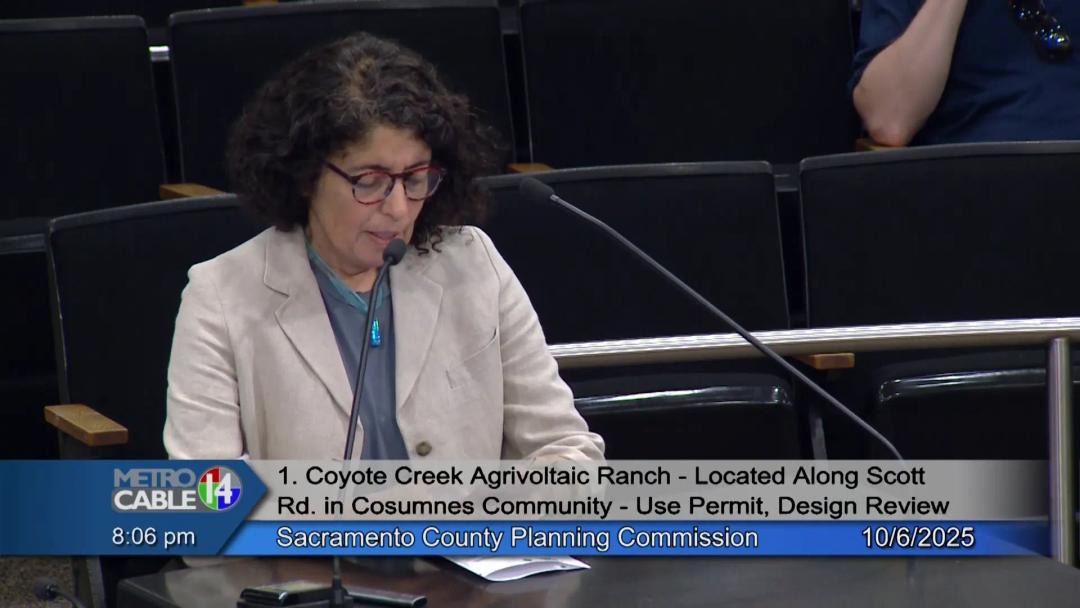
Public Meetings - Sacramento County, CaliforniaOn Monday, October 6, 2005, the Sacramento County Planning Commission held a hearing to consider the Coyote Creek Agro Voltaic Ranch Project (PLMP 2021-00191), a proposal for a 200 MW solar facility and 100 MW battery storage system on 2,700 acres of Barton Ranch in the Consumnes community. Staff presented the project alongside a Final Environmental Impact Report (FEIR) identifying three significant and unavoidable impacts: aesthetics (visual impacts to Scott Road and Prairie City SVRA), cumulative oak woodland loss, and tribal cultural resources. Despite these findings, staff recommended approval, citing alignment with the County's Climate Action Plan and SMUD's Zero Carbon Plan, and a robust mitigation strategy involving conservation easements and tree replanting. Consent Calendar - No specific consent calendar items were listed or discussed in this transcript segment. Public Comments & Testimony - Position Supporting Approval: - Logan Reed, Michaela Weber, Marcus Gomez, and Sean Worth supported the project, citing the trade-off of removing 3,500 trees for clean energy and the importance of preserving the ranch from housing development. - Barton Ranch family members (Herb Garmin, Melanie Mosier, Caitlin Smith, Jackie Hamford) expressed full support for the project as a necessary evolution to maintain the family's 150-year agricultural legacy and keep the land under the Williamson Act. - Van Vleck Ranch representatives (Stan Van Vleck) voiced strong support for the project as it secured a conservation easement for their neighboring land that was previously slated for development. - Local farmers (Greta LeChin, Callie Dietrich, Ken Nowak Jr.) and union labor representatives (Troy Arnson, Doyle Radford Jr., Matt Newton Boom) expressed support for the project's job creation, tax revenue benefits ($67-90 million), and its ability to support agricultural operations alongside energy generation. - Dr. Jessica Sanders of the Sacramento Tree Foundation expressed support for the partnership and the seven-year tree monitoring plan. - Position Opposing Approval: - Tom Bernardo (retired State Park Ranger), Amy Granit (wheelchair user and OHV advocate), and the California State Park Rangers Association (SEASPRAY) expressed strong opposition, stating the project is incompatible with the Prairie City SVRA and will permanently damage the visitor experience and visual corridor. - Environmental groups and individuals (Sierra Club, California Native Plant Society, Defenders of Wildlife, Sacramento 350, CNPS) expressed full opposition or concern, characterizing the loss of 3,500+ mature blue oak trees as irreversible and arguing the location is inappropriate compared to brownfields or disturbed lands. - Rose Wayne (California Four-Wheel Drive Association) expressed opposition based on procedural violations regarding the Off-Highway Motor Vehicle Recreation Commission and the economic trade-off between the solar project and the park's tourism revenue. - Steven Schurdett and Ann Feinkner expressed strong opposition to the tree removal and argued that conservation easements (valued at $10,000/acre) were a viable alternative to development that was not properly explored. - Several speakers (Paul Smith, Gail Merchant) supported solar generally but argued the location was inconsistent with county general plan policies and that the project was not essential to SMUD's goals. Discussion Items - Project Description and Evolution: Staff (Kimber Gutierrez) detailed the project's three iterations, noting a 55-acre reduction in the solar footprint in the final iteration to avoid denser tree canopies. The project proposes a 200 MW solar array, 100 MW battery storage, and a tie-line connecting to the existing SMUD infrastructure. - Impact Analysis: Staff (Julie Newton) and the applicant (Jim Gillam) addressed the three unavoidable impacts: - Aesthetics: Impacts on Scott Road (candidate scenic corridor) and Prairie City SVRA viewers were acknowledged as unavoidable despite a "softening" landscape plan. - Oak Woodlands: The removal of 3,493 trees was identified as a cumulative significant impact; mitigation includes a 1-to-1 replacement ratio plus 15% surplus planting and 1,150 acres of conservation easement. - Tribal Resources: Impacts on the Tosuen tribal cultural landscape were significant; mitigation involves a robust avoidance plan and on-site monitors, though some tribal concerns regarding the adequacy of deferred implementation were raised. - SMUD and Regional Goals: Staff noted the project accounts for approximately 15% of SMUD's 2030 clean energy needs. Commissioner Virgo questioned if alternative sites or if the project was strictly necessary, noting SMUD's reported 3,100 MW pipeline. - Procedural Concerns: Commissioner Virgo and Commissioner Devlin discussed discrepancies between the staff report and the FEIR regarding tree counts, with staff clarifying the numbers were consistent via a preface in the FEIR. Commissioner Virgo also raised concerns about the OHMVR Commission's engagement, which the applicant attributed to a misunderstanding of statutory citation. - Decommissioning: Staff confirmed a decommissioning plan with a bond or letter of credit is required, mandating site restoration within 24 months of cessation. Key Outcomes - Motion: Commissioner Virgo made a motion to adopt Resolution One (certifying the Final EIR) and Resolution Two (recommending the issuance of a Use Permit and Special Development Permit to the Board of Supervisors). - Second: The motion was seconded by Commissioner Borja. - Vote: The motion passed unanimously with all five commission members voting yes. - Recommendation: The Planning Commission recommended the Board of Supervisors certify the FEIR, adopt the Mitigation Monitoring and Reporting Program, and issue the necessary permits subject to findings and conditions. - Next Steps: The case was scheduled for the Board of Supervisors to make the final decision. - Adjournment: The meeting adjourned at 8:50 PM with brief notes on the Planning Director's Report regarding rooster zoning amendments and the next agenda.
The October 16, 2025, meeting of the Secretary of Flood Control Agency (Safca) Board of Directors convened with an 11-member quorum to address routine matters, review the Executive Director's report on federal funding and state legislative updates, and hear the status of the Sweeney Ranch Pump Station project. The meeting proceeded smoothly with the approval of consent items and a brief report on the current federal government shutdown. Consent Calendar - The board voted unanimously to drop Item 4 from the agenda upon staff recommendation. - Items 1, 2, 3, 5, and 6 were approved en bloc following the motion and second without public comments or pulls. Public Comments & Testimony - No members of the public submitted comments on agenda items or spoke during the open forum. - A formal recognition was made of former council member Jeff Harris (former chair) for his presence and historical contribution as a champion of flood control. Discussion Items - Federal Fiscal Situation: Executive Director Jason Campbell reported that the federal fiscal budget remains delayed with no Continuing Resolution (CR) passed by the Senate, placing the agency in "shutdown mode." There is a potential impact on the Bureau of Reclamation, specifically regarding staff furloughs related to work with the Corps of Engineers at Folsom Dam, though most other operations continue as needed. The board noted the need to monitor areas where assistance could be provided to the Corps of Engineers. - Legislative Update (SB 639): The director confirmed that Governor Newsom signed Senate Bill 639, securing an extension of the Level of Protection (ULOP) certification deadline for levy systems to 2030. The agency will continue to provide these certifications and adequate progress findings as required. - Project Status (Sweeney Ranch Pump Station): The board reviewed the Sweeney Ranch Pump Station project, noting that the foundation work on the left side of the original station is complete and that the project is currently "finally out of the ground" with the right side's levee being backfilled. The director stated the project is making "great progress." - Budget & Travel: Discussion noted the rescheduling of meetings in Washington, D.C., with plans to proceed depending on the federal budget situation, aiming to secure travel before the Thanksgiving break. The Fiscal Year 27 budget process remains pending the resolution of the current fiscal year. Key Outcomes - Motion Approved: Item 4 was formally dropped from the agenda. - Action Items: The board received information on the furlough of Bureau of Reclamation staff and the potential impact on coordination with the Corps of Engineers; continued monitoring of federal shutdown impacts was directed. - Legislative Confirmation: SB 639 (certification extension to 2030) was officially confirmed as passed and signed. - Project Monitoring: Status updates on the Sweeney Ranch Pump Station backfilling progress were accepted.
On October 20, 2025, the League of Women Voters of Sacramento County and the Sacramento Metro Cable Television Commission hosted a statewide special election forum to explain California's Proposition 50. Outlined as a nonpartisan event, the session provided details on the proposal to temporarily redraw congressional districts through 2030, the definition of gerrymandering, the role of the Citizens Redistricting Commission, and practical voting instructions for the special election. Consent Calendar - No items recorded in the transcript. Public Comments & Testimony - Forum Speakers (League of Women Voters Representatives): - Pro-Prop 50 Positions: Speaker stated that Proposition 50 "creates fair maps that reflect California's diverse communities," "protects our voices from partisan gerrymandering," and "keeps California a leader in fair elections by preserving its independent redistricting system." The speaker argued Prop 50 "strengthens democracy by making sure that Republicans don't have an unfair advantage in Congress" and noted the fiscal impact is "less than one-tenth of a percent of its 220 billion dollar budget" (specifically $200,000 for the state, with additional millions for the election). - Anti-Prop 50 Positions: Speaker summarized counter-arguments stating that opponents "say Prop 50 is a power grab by politicians that undoes fair election reforms" and "returns California to gerrymandered districts that benefit politicians over voters." Opposition points include that Prop 50 "replaces an open public process with secretive political backroom deals," "hurts fair representation by dividing neighborhoods and weakening minority voices in elections," and "lets politicians control district lines for years" potentially leading to "permanent, not temporary, control." Opposition also highlighted cost concerns, stating Prop 50 "costs taxpayers 200 million dollars when the state is cutting funding to important programs because of budget problems." Discussion Items - Context of Election: Explained that President Trump asked Texas to redraw districts for Republican advantage, prompting Governor Newsom to ask the California legislature to do the same for Democrats. The proposal involves temporarily changing maps through 2030. - District Mechanics: Clarified that California has 52 congressional districts, each electing one representative with two-year terms. Current districts were drawn in 2021 by the independent Citizens Redistricting Commission and are set to stay until 2031. - Definitions Provided: - Gerrymandering: Defined as drawing lines to "favor one political party over another to give that party a better chance of electing candidates they prefer." - Citizens Redistricting Commission: Described as an independent body with five Republicans, five Democrats, and four unaffiliated members, prohibited from drawing districts favoring candidates/parties and required to use public input to keep neighborhoods together. - Procedural Information: Detailed steps for voting, including registration deadlines, mail-in options, and locations for dropping off ballots or voting in person at vote centers. Key Outcomes - Educational Clarification: The forum successfully detailed the two main arguments regarding Proposition 50: supporters view it as a democratic safeguard against partisan gerrymandering, while opponents view it as a partisan power grab. - Informational Directives: Provided specific resources for voters to register, find polling places, view old and new proposed district maps, and inquire about ballots (SOS dot ca slash elections slash polling dash place; statewide database dot org slash D25 slash draft districts; vote 411.org). - No Formal Vote Taken: As an informational forum, no formal council vote or resolution was recorded in the transcript.
The First Five Sacramento Commission convened on Monday, October 6, 2025, to address strategic planning for the 2027-2030 implementation plan, approve new funding agreements for airport child care research and Spanish-language parent leadership training, and receive updates on equity initiatives. The meeting featured presentations on community trends, racial equity progress, and new grant processes designed to support underserved families and organizations. Consent Calendar - Approved the draft action summary from the August 4, 2025, meeting with unanimous support. Public Comments & Testimony Advisory Committee & Equity in Action Updates - Junior Goris (Chair, Advisory Committee): Reported that the advisory committee met on August 22nd to review a "Black Child Legacy Campaign" and that the strategic planning ad hoc committee met on September 12th to discuss Phase 2 community feedback, including parent surveys and focus groups. The next meeting is scheduled for October 10th. - Yasmin Herrera Vilches (Equity in Action Committee Member): Stated the committee has reached the "performing" stage of team development. The committee is currently designing a consensus-based process to fund programs serving family, intermediate individual, and system-level needs, as well as parent leadership. They emphasized that previous outreach lacked inclusivity and that the new process aims to remove structural barriers like insurance audits and advance payment policies that hinder small CBOs. Provider & Community Perspectives - Commissioner Wesley: Expressed strong concern regarding provider well-being, noting that child care providers often care for their own families while serving vulnerable populations. She highlighted research suggesting 25% of the child care community relies on Medi-Cal and 50% on housing support, describing providers as "vulnerable providers caring for the vulnerable." She advocated for specific support systems to address vicarious trauma and mental health needs for providers. - Commissioner Gordon: Asked for clarification on the grant tiers presented by Yasmin, specifically reconciling the $5,000-$9,999 one-time grants mentioned with the reference to $500,000 maximums, seeking to understand the funding structure for different scales of projects. - Commissioner Mook (Commissioner Moak): Provided input on the methodology for reporting community themes, arguing that qualitative research should avoid ranking themes as equal or distinct priorities statistically unless explicitly requested, while accepting that the commission will ask the community to rank strategies later. He also noted the current community trend data relies on 2022 figures, which he feels are an anomaly due to the tail end of the pandemic, and urged the use of more current community conversations to supplement the data. - Commissioner Guerra: Suggested that the airport child care feasibility study should explore a "split model" involving Head Start to manage operational and maintenance costs, noting that Head Start can cover overhead costs which typically aren't covered by capital grants. - Maria Lopez (Equity in Action Committee Member): Expressed excitement about the new grant process, emphasizing the importance of "questioning the answers" to identify gaps in accessibility. She noted that the new process allows grassroots agencies to challenge existing barriers and that policy updates may be needed regarding advance payment requirements (capping at 20%) and insurance thresholds (currently $2 million) to better serve small organizations. Discussion Items 2027-2030 Implementation Plan and Spending Strategy - Lindsay Dunkel and Kristen (Staff): Presented a proposed spending plan totaling $35.7 million over three years ($11.9 million annually), representing a 20% reduction from current levels due to declining Prop 10 revenues and birth rates. They reported that 84% of funds are allocated to programs, 11% to administration, and 5% to evaluation. Commissioner Cerna and staff discussed the administrative cost cap, noting the proposal exceeds the 2016 10% cap (at 11%) but falls within it (8%) when including leverage funding. - Community Input Analysis: Staff reported on six community conversations involving diverse demographics, including Afghan parents, fathers, and women experiencing homelessness. Key themes emerged regarding family stability, healthy lifestyles (including recreational needs), community gathering, and the need for better navigation of resources. Commissioner Cerna sought clarification on "impossible eligibility requirements," with staff explaining this referred to the frustration families face regarding income cutoffs for subsidized child care where small income increases render families ineligible for support. Airport Child Care Research - Lindsay Dunkel and Stephen Clark (Deputy Director of Operations, SMF): Discussed a proposed revenue agreement with the Sacramento County Department of Airports to conduct a feasibility study ($55,000) for a mixed-age child care center, potentially utilizing interim space in Terminal B. The study aims to serve airport employees and vendors. Commissioner Guerra and staff discussed the potential for a Head Start component to assist lower-income workers. Commissioner Moak clarified that First Five's role is strategic and system-changing rather than direct funding for the facility, aiming to leverage existing state funding ($1.5M from Senator Ashby) for capital improvements while ensuring the facility is sustained by the airport enterprise fund and employer contributions, not permanent public dollars. Funding Reallocations and Administrative Actions - Spanish Language PLTI Cohort: Approved an agreement with the Department of Health Services ($48,000) and an amendment to the Sacramento Children's Home contract ($48,000) to fund a dedicated Spanish-language Parent Leadership Training Institute cohort, to be implemented before May 30th using CDCFAS funds. - Birth and Beyond Program Stabilization: Approved contract amendments to reallocate funds following the termination of the AmeriCorps contract for Birth and Beyond Home Visiting. This includes a $192,472 increase in the fiscal agent contract for oversight and $774,000 in total reallocations to the nine Family Resource Centers to maintain staffing capacity ($43,000 per center annually for 2025-2027). - Meeting Calendar: Approved the 2026 meeting calendar, noting flexibility to add a February meeting or cancel existing ones depending on the pace of the Equity in Action Committee's recommendations, with a target to present funding recommendations by January 12th. Key Outcomes - 2027-2030 Spending Plan: Approved in principle for high-level structure ($35.7M total), with a directive for staff to develop detailed allocations through further community collaboration. The plan acknowledges a 20% revenue reduction and prioritizes 84% of funds for direct services. - Airport Feasibility Study: Approved a revenue agreement ($55,000) and expenditure agreement with Child Action Inc ($25,000) to study the feasibility of an employer-based child care center at SMF, with a directive to design a sustainable, mixed-delivery model that is not reliant on permanent public funding. - Equity in Action Grants: The Equity in Action Committee identified a demand exceeding $21 million for their $4.2 million pool. The committee clarified funding tiers: $5,000-$9,999 for one-time needs, $125,000-$300,000 for medium projects, and $301,000-$500,000 for large-scale system change. A directive was issued to review internal policies (advance payments, insurance, auditing) to ensure they do not disenfranchise small grassroots agencies. - 2026 Calendar: Approved as skeleton, with a commitment to schedule a February 2026 meeting if necessary to accommodate the Equity in Action Committee's timeline, with the goal of funding decisions in January 2026 for a July 2027 contract start. - Vote Counts: All agenda items involving funding approvals and the spending plan were passed unanimously by the voting commission members present.
The Board of Supervisors convened on Tuesday, October 7th, 2025, with Vice Chair Rodriguez presiding in the absence of Chair Cerna. The meeting featured routine consent calendar approvals, public hearings on service charges and alcohol licenses, and updates on county homelessness initiatives and community awards. Consent Calendar - Items 2 through 33 were approved unanimously, with specific notes on two ordinances: Item 2 amended the County Code to establish new departments (Clerk of the Board, Public Information Office, Office of Economic Development), and Item 27 continued the adoption of an ordinance regarding correctional health services payment authority to October 21st, 2025. - Supervisor Kennedy highlighted that $947,940 approved in Item 28 (retroactive authority for a contract with Forenza Clean LLC for homeless encampment cleanup) represents a significant direct expenditure on homelessness efforts. - Supervisor Hume recused themselves from Item 6 (Job Order Contracts) due to campaign contributions, but the full consent item passed unanimously with remaining members present. - Item 37 (appointments to CSAO and Urban Counties Caucus) was approved unanimously to retain Supervisor Desmond and Patrick Hume. Public Comments & Testimony - Mr. Chuck Shaw (retired operating officer of Fight Development Company) expressed strong opposition to Item 39 (Smile Market, PCN) regarding the issuance of a Type 21 (full liquor) license. Mr. Shaw stated he could not support the application while it remains a Type 21 license, citing concerns about the shared parking lot with a 30+ year old roller skating rink, the presence of minors, and past difficulties the community has had managing on-house population and safety issues. He reiterated that the community has attempted to meet with the applicant and requested a Type 20 beer and wine license instead. - Supervisor Kennedy noted that they had heard from stakeholders that difficulties in meeting between the applicant and neighbors have occurred, with neighbors making attempts that yielded no luck. Supervisor Kennedy expressed openness to meeting with the applicant team once they have met with neighbors and shown good faith. - Supervisor Hume agreed with the position of Supervisor Kennedy regarding the need for the applicant to demonstrate good faith through neighbor meetings before reconsideration. Discussion Items - Item 39 (Smile Market License): The Board deliberated on the application for a Type 21 ABC license for a property in the Cordova community. Based on the public testimony regarding safety concerns and the lack of neighbor consensus, the Board voted to continue the item to November 18th to allow for further discussion and potential modification of the application terms. - Item 38 (Appointments): Nominations and continuations for various boards and commissions were discussed. The Board continued several nominations to future meetings (November 4th, 18th, or October 21st) and appointed specific individuals where consensus was reached, including Sharon Davis, Brett Hogue, Greg Smith, Martin Ross, Cecily Williams, Kimberly Grimes, Tara Taylor, John Durbin, and Austin Ashe. County Executive Comments - Chair Cerna (via Executive Staff): Announced plans for the first joint meeting between the County and City of Sacramento to address homelessness, scheduled for October 28th at the Library Galleria. The agenda will include updates on behavioral health, federal funding impacts, and a facilitated visioning session. - Supervisor Desmond: Expressed being extremely impressed with the progress of the new Safe Stay site on Watt Avenue and stated that the project is signature for the county, advocating for it to be showcased statewide. - Vice Chair Rodriguez: Recognized Zittle Farms for its 50-year community service, praised the Sheriff POP team, CHP, and District Attorney for their work on Watt Avenue safety, and honored Michelle Setcher for her gold medal win at the 2025 World Rowing Championships. Key Outcomes - Unanimous Approval: Item 6 (Job Order Contracts), Item 37 (CSAC/Appointments), and the Tobacco Securitization Corporation budget and financial reports. - Unanimous Approval: Resolution for Item 35 (Sacramento Metro Fire District Station 67), confirming the benefit category change and levy of increased service charges. Despite 100% of the protest ballot (from the legal owner) being in favor of the category change, the levy is confirmed as there was no majority opposition. - Continuance: Item 39 (Smile Market Type 21 License) was unanimously continued to November 18, 2025, pending further engagement with neighbors and potential change in license type. - Continuances: Multiple board and commission nominations (Item 38) were continued to November 4th, 18th, or October 21st to accommodate vacancy filling. - Adjournment: The meeting adjourned at 10:15 AM.
The Sacramento Area Sewer District Board of Directors convened on October 8, 2025, with Director Dickinson presiding as acting chair in the absence of Chair Karpinsky Costa. The meeting proceeded with a full agenda despite initial discussions regarding the timing of non-voting items to manage efficiency. Key topics included the approval of employee memorandums of understanding (MOUs), the presentation of the annual report for the Confluence Regional Partnership Program, and strategic discussions regarding future meeting consolidation. Consent Calendar - Items 1 & 2: Approved unanimously. Items included the Echo Road Septage Station project, which staff commended for being completed in-house with no external engineering costs. Public Comments & Testimony - No public comments were received for the posted agenda items nor for items not on the posted agenda. No speaker slips were filed for the public comment period. Discussion Items - Meeting Efficiency Strategy: Director Dickinson requested a dedicated to-do list to minimize the total number of meetings in 2026. In response, the Executive Director confirmed that the executive team meets weekly to review the long-range agenda and consolidate critical items, though financial impacts sometimes prevent rescheduling. The Board expressed a desire for a formal check-in if line items (like American River Parkway) are under-subscribed before year-end closure. - Confluence Regional Partnership Program (FY 2024-25): - Awards: The program received the National Environmental Achievement Award and the Utility of the Future Today Award. - Financials: Total grants awarded exceeded $4.9 million across seven categories, utilizing discretionary funding from asset sales (biogas, recycled water) rather than rates. - American River Parkway: Received $272,000 in funding (below the $600,000 allocation). Director Dickinson requested proactive outreach to stakeholders and a mid-year check-in process before reallocating surplus funds to other categories. - Sewer Lifeline Rate Assistance: Enrollment increased due to coordination with SMUD and PG&E; over $2 million was distributed to low-income homeowners, renters, and shelters. - Economic Development: 25 grants totaling $650,000 were approved, creating 763 jobs. The program provides a 50% discount on sewer impact fees in exchange for creating at least one full-time job. - Public Education: A grant of over $200,000 was awarded to the Center for Land Based Learning for hands-on habitat restoration for high school students. - MOSAC: $1.5 million was approved for the Museum of Science and Curiosity. - Educational Outreach & Engineering Recruitment: Director Viegas and Director Guerra criticized current exhibits at MOSAC for failing to connect students to the sewer district's technology (e.g., biogas generation, toilet systems). They expressed strong support for enhancing exhibits to inspire youth toward public engineering careers, noting that current displays focus too heavily on water quality and riparian habitat rather than the district's core infrastructure operations. - MOU Approvals: - Group 2 (Administrative Employees): Approved with provisions for market-based equity adjustments over three years, a 2.5% longevity pay at 15 years of service, and 90% Kaiser medical subsidies. Positions were noted that employees currently above market rates would not receive pay cuts but would not receive COLA adjustments until the market caught up. - Group 3 (Supervisors): Approved as the final MOU for recognized employee organizations. Key Outcomes - Consent Matters: Motion passed unanimously (Directors Dickinson moved, Supervisor Diegus seconded). - MOU with Group 2: Motion to approve passed unanimously. - MOU with Group 3: Motion to approve passed unanimously. - Strategic Directives: The Board directed staff to consider a quarterly status report or mid-year check-in regarding under-subscribed Confluence funds to ensure stakeholders are aware of available resources before funds roll over or close. - Staff Recognition: Director Dickinson publicly thanked SAC Sewer staff and government relations for their effective engagement during recent contentious state mandate (CARB) proceedings regarding rate impacts. - Adjournment: The meeting concluded with appreciation for the staff's efforts in efficiency and outreach.
The Sacramento Transportation Authority (STA) Board of Directors convened for a meeting on October 9, 2025. Due to a lack of an initial quorum, the board proceeded with items that do not require a vote, including receiving an executive director's report and public comments, before a quorum was established to vote on the consent calendar and the prioritization agenda item. Consent Calendar - Items 2 through 5: The board moved to approve the routine consent items. A roll call vote was taken after a request to ensure all members were voting. The motion passed with all voting members (Dickinson, Gera, Hume, Kennedy, Kent, Maple, Raffel, Rethelel, Spees, Vang, and Chair Cerna) voting "Aye". Public Comments & Testimony - Item 1 (Matters not on the agenda): No speaker slips were submitted for off-agenda matters. - Item 6 (Debt Program Presentation): No public comment was received for this presentation. - Item 7 (SACOG Prioritization): No public comment was received for this presentation. - Executive Director's Report (Item 8): No public comment was received. Discussion Items - Debt Program Status Update (Item 6): CFO Dustin Purenton presented the annual debt program status. - Project Description: The STA portfolio is 100% fixed-rate, with annual debt service payments ranging from $20.3 million to $35.3 million. - Position Summary: Pureston reported that the STA is in compliance with all bond covenants. Current debt service coverage is 8.6x (under the 2022 series) and 4.9x (when larger debts begin repayment), both well under the maximum annual debt service limit of 2x. A 2023 refunding is projected to generate $6.7 million in net savings, with a break-even interest rate increase of 1.47%. - SACOG Regional Project Prioritization (Item 7): Kevin Busey presented the process for identifying countywide priorities for federal (e.g., BIL, RAISE, INFRA) and state (SB1) grants, as well as projects in development. - Purpose: SACOG seeks to narrow multiple competing projects to a single regional priority per grant category to enhance competitiveness for Congressional and State funding. - Positions and Discussion: - Director Kent: Expressed full support for the proposal to identify consolidated priorities and coordinate with SACOG, noting it is highly advisable to accept the proposal assuming resources are covered by current administrative costs. - Director Dickinson: Raised questions regarding the scope of the prioritization process. - Clarified that the process focuses on regional serving projects. A solely local project (e.g., a sidewalk project in Oak Park) would likely be at a disadvantage and proceed separately through local channels or other SACOG rounds. - Noted that if a local project is part of a larger regional corridor (e.g., along U.S. 50 or the Plaza Sacrament Gateway Plan), it can be incorporated into the regional priority discussion. - Suggested that the committee consider including Capital Corridor in future meetings due to potential overlaps (e.g., Sacramento Gateway) and the potential third main line track between Sacramento Valley Station and Roseville, stating there is "no downside" to including them and an "upside" to their perspective. - Clarified the distinction between the regional fund round (RTIP) and this prioritization effort, noting the efforts are connected but separate; the RTIP is a programming document for funded projects, whereas this is a pre-award strategic prioritization. - Director Maple: Noted the importance of directing resources to "fix it first" regarding deteriorating PCIs and acknowledged SB1 as a significant consideration, not just an ancillary one. - Executive Director: Discussed the potential for STA to act as a co-applicant or applicant on multi-agency projects (e.g., Stockton Boulevard BRT, Farm to Market Routes) to demonstrate regional significance and leverage Measure A funds. - Director Hume: Stated they have nothing to report from the Region Committee. - Director Guerra: Reported on the new Transportation Funding Subcommittee activities, noting that stakeholder survey results are both "heartbreaking but extremely fascinating." He confirmed results will be available at the city level and noted that cross-tabulations for smaller cities may be limited due to variance. Key Outcomes - Consent Calendar: Approved unanimously (11-0). - Executive Director's Report: Accepted without motion; legislative updates (AB 1223) and VMT strategy workshops noted as ongoing. - Item 7 (SACOG Prioritization): The board authorized the Executive Director to submit a letter to SACOG establishing countywide priorities and to submit applications for multi-agency projects for prioritization. The item passed with a unanimous vote (11-0) with members present. - Next Steps: The Transportation Funding Subcommittee plans to provide a deeper dive into survey results and a full board report by the end of the month. The VMT mitigation strategy recommendations are expected to be presented in November or potentially February.
Date discrepancy note: The chair called the meeting to order as September 25, 2025, but the user-provided meeting date is October 6, 2025. The summary follows the user-provided date. The board convened to discuss sustainable mobility programs and leaded aviation fuels, approve a contract extension for the community car share program, and receive the Air Pollution Control Officer's report. The meeting included presentations, public comment, and board deliberation. Consent Calendar - Approved unanimously via voice roll call: The consent calendar passed without objection. Directors participating remotely (Dickinson, Geta, Hume, Kennedy, Lopez Taff, Maple, Robles, Sander, Sandu, Cerna, Vang) voted aye or said yes. Chair Aquino also voted aye. Public Comments & Testimony - Cameron Belton, manager of the Green Tech Mobility Hub in Del Paso Heights, spoke in support of the community car share program. He highlighted workforce development: 46 individuals aged 16–24 have been trained on EV charging maintenance and lifestyle shifts. The hub serves as a training center and has created jobs, including service technicians for EV chargers. He noted the program's role in helping the community transition to zero-emission vehicles. Discussion Items - Item 6.2: Sustainable Mobility in the Capital Region – Paul Philly, Program Manager for Transportation and Climate Change, presented on the community car share program (OCCS). He reviewed the program's history (started 2017), impact of the pandemic, and shift to a cost-share model ($4/hour for subsidized members, $8/hour for public). Key metrics: 60,000 zero-emission miles in one pre-pandemic quarter; post-pandemic recovery with revenue from public users supporting sustainability. The program has reached nearly 45,000 EV miles in the current quarter and is approaching one million cumulative zero-emission miles (expected by November 2025). Next steps include extending service contracts through July 2027, leveraging an EV blueprint grant from the city of Sacramento, and opening more sites to the public. Staff recommended authorizing the executive director to extend the contract and raise the amount, funded by state grants. - Board discussion: Director Hume raised concerns that federal transportation funding metrics use gas tax revenue as a benchmark, penalizing regions with successful EV adoption. She noted the irony that reduced gas tax revenue (due to EVs) could hinder infrastructure repair. Vice Chair Maple praised the program's creativity and noted international interest from a recent study mission to the Netherlands. - Motion: Moved by Chair Aquino to approve the staff recommendation. Approved unanimously. - Item 6.1: Lead and General Aviation Fuels – Amy Roberts, Division Director for Engineering and Compliance, presented a white paper on lead in aviation fuel, focusing on Sacramento Executive Airport. Key points: Lead is a neurotoxin with serious health impacts; small aircraft using leaded AvGas are one of the largest remaining lead sources. Federal and state actions: EPA endangerment finding (2023), FAA reauthorization act (2024) targeting 2030, and California SB 1193 (bans leaded fuel by Jan 1, 2031). Monitoring data (Del Paso Manor, AB 617 community, United Latinos) show ambient lead levels well below federal standard (0.15 µg/m³). SAC Executive emits 0.5 tons of lead per year. Other airports (Reed Hillview, Livermore, Santa Monica) have taken early actions such as fuel bans or subsidies for unleaded fuel, but FAA grant assurances prevent outright bans until alternatives are certified. Staff recommended receiving and filing the report and continuing discussions with the community and airport. - Board discussion: Director Cerna questioned the viability of alternatives by 2031, noting most general aviation aircraft are older models and fuel-side innovation is ahead of engine retrofits. He expressed concern that the state ban might lack preemption if no safe alternative exists. Director Lopez Taff questioned the completeness of health impact data in the presentation. Director Maple and Director Hume raised concerns about the planned placement of a portable air monitoring lab at a site near the former gun range at Mangum Park, which could conflate AvGas lead with legacy soil contamination. Director Cerna noted the monitoring site is directly atop a known historical lead contamination area. Dr. Ayala (APCO) assured the board that staff will re-evaluate the location to avoid data distortion and will inform the board before deployment. The board agreed to reassess. - Item 6.3: Community Air Protection Plan Progress – Postponed to October at the request of Chair Aquino. - APCO Report: Mr. Lemos Lucing presented on two items: 1. Ribbon cutting for the first hydrogen locomotive switcher in the U.S., operated by Sierra Northern Railway. The district contributed $5 million from the California Energy Commission and won an additional $15 million from CalSTA for three more locomotives. Each hydrogen locomotive reduces NOx emissions by 3 tons/year, equivalent to removing about 2,000 cars. 2. SB 88 (co-sponsored by the district) is awaiting the governor’s signature (deadline Oct 12). The bill supports reducing agricultural burning and promoting alternative uses for biomass. It passed with bipartisan support. - Directors praised the hydrogen locomotive achievement. Director Cerna asked about hydrogen storage on the locomotive; Mr. Lemos Lucing confirmed it is stored on board adjacent to the fuel cell stack. - Board Ideas and AB 1234 Reports: Vice Chair Maple reported on a study mission to the Netherlands funded by the Air District. She highlighted the Netherlands' emphasis on public transit, autonomous shuttles, and electric aircraft. She advocated for increased investment in public transit as the top priority for meeting climate goals. She also noted interest from Caltrans and NASA in exploring electric aircraft training in Sacramento. Key Outcomes - Contract extension for community car share program approved (Item 6.2). - White paper on lead and aviation fuels received and filed (Item 6.1); no formal action taken. - Monitoring location reassessment: Dr. Ayala committed to re-evaluating the portable air lab placement due to concerns about conflating lead sources. The board will be informed before deployment. - APCO report received. - Next meeting: Scheduled for October 2025; no meetings in November and December.
The Sacramento Public Library Authority Board convened on October 6, 2025, at 9:35 AM with a quorum of eight members. The meeting featured public comment, presentations from the Friends of the Library and the Sacramento County Office of Education, approval of the FY2025-26 final budget, and authorization of supplemental funding for the Isleton Library abatement project. Consent Calendar - Item 6.1 Action Summary: Approved unanimously with nine votes. Public Comments & Testimony - Martin Rosenberg expressed support for library staff and urged the city to expedite the reopening of the Colonial Heights Library, which has been closed for over a year due to repairs. He commended Library Director Peter Coyle and the administrative team. Presentations - Friends of the Sacramento Public Library (Devon Graves, Diane Gregory): Reported on September board meeting activities, including an upcoming antiquarian book sale on October 19, efforts on succession planning among affiliates, and a resolution honoring the late Barbara Munro. The Friends presented a check for more than $120,000 raised during the Big Day of Giving campaign to support library programs. - Summer Reading and Lunch at the Library (Amanda Falk): Celebrated a 12% increase in summer reading participation. Nearly 260,000 books were read, and over 6,000 medals were awarded to readers of all ages. Thousands of meals were served through the Lunch at the Library program. - Sacramento County Office of Education Reads Literacy Initiative (Becky Selvin): Overview of the Sacramento County Reads initiative, which focuses on teaching and learning, family engagement, and community partnerships. Data showed that 56% of county students are not reading at grade level, with even lower rates among low-income, Black, and Hispanic students. The initiative is grounded in the science of reading and includes a community of practice, professional development, and partnerships with the Dolly Parton Imagination Library (2,800 children enrolled). Board members expressed support and discussed ways to collaborate further. Discussion Items - Executive Team Report (Deputy Director Keller): Highlighted upcoming 50th anniversary celebrations for Southgate and Rancho Cordova libraries, the October 8 appearance of Pulitzer Prize-winning journalist Jodi Cantor, and voting locations for the November special election. Facility updates included HVAC and ADA repairs at multiple libraries, closures at North Sacramento/Hagginwood and Del Paso Heights, and ongoing work at Colonial Heights. Staff confirmed that closure notifications are sent to library users and posted on the library website. Discussion included the possibility of bookmobile services for long-term closures, though mobile fleet capacity is limited. - Isleton Library Supplemental Funding (Item 7.1): Deputy Director Keller presented a request for $27,526 from the Isleton supplemental fund to cover cost overruns for the Isleton Library abatement project. The overrun resulted from unexpected dry rot and additional abatement of old materials. The total deficit was $27,739, with River Delta Unified School District covering the remaining $213. The board adopted Resolution 25-49 authorizing the allocation. - FY2025-26 Final Budget, Position Control, and Fee Structure (Item 7.2, Johnny Ear): The final budget shows total revenues of $63.3 million and total expenditures of $69.9 million, a net increase of $940,000 from the adopted May budget. The deficit is covered by fund balances. Key expenditures include $2.3 million for one-time projects (signage, security cameras, automated material handling systems, IT upgrades), $1.7 million for supplemental fund uses, $2 million for the city of Sacramento’s general fund diversion for MLK and North Sacramento projects, and $600,000 for reopening-day collections at MLK and Elk Grove. Position control increases by 1 FTE to 343.5 FTEs, with reclassifications and one new management associate. Fee structure remains unchanged. The board adopted Resolution 25-50 approving the budget. Key Outcomes - Adopted Resolution 25-49: Authorized $27,526 in supplemental funding from the Isleton fund to address costs for the Isleton Library abatement project. - Adopted Resolution 25-50: Approved the FY2025-26 final budget, position control listing, and fee structure. - The meeting adjourned at 4:43 PM.