The Economic Development and Intergovernmental Relations Committee of the San Diego City Council met on Wednesday, February 10, 2021, at 10:00 AM via Zoom due to the COVID-19 pandemic. The meeting was chaired by Councilmember Campillo, with Vice Chair Kate, Councilmember Moreno, and Councilmember Ilo Rivera present. Key actions included approval of the 2021 committee work plan, a corporate partnership with California Coast Credit Union, and a controversial relocation plan for the Via Victoria Apartments. The committee also received informational presentations on anchor institutions and federal stimulus updates. Consent Calendar - January 13, 2021 Meeting Actions: Unanimously approved. Public Comments & Testimony - Non-Agenda Public Comment: No speakers. - Item 1 – 2021 Work Plan: Fifteen speakers offered comments. Representatives from the Port of San Diego, Cross Border Business Group, Downtown San Diego Partnership, Every Child San Diego, San Diego Coastkeeper, San Diego Performing Arts League, Balboa Park Cultural Partnership, Fern Street Circus, San Diego Regional Arts and Culture Coalition, San Diego Regional Chamber of Commerce, YMCA Community Support Services, and others expressed support for the work plan, emphasizing child care, arts and culture, border economy, small business recovery, and equity. Some speakers urged the committee to address sidewalk vending regulation and child care access. - Item 2 – Corporate Partnership: No public comments. - Item 3 – Via Victoria Relocation Plan: No public comments. - Item 4 – Anchor Institutions Report: No public comments. - Item 5 – Federal Stimulus Update: No public comments. Discussion Items - 2021 Committee Work Plan: Chair Campillo presented the plan with quarterly themes: small business support and recovery, industry review, border economy, and trade expansion. Councilmembers praised the focus on equity, child care, arts, and border infrastructure. Motion to adopt passed unanimously. - Corporate Partnership with California Coast Credit Union: Sarah Brennan, program manager, outlined a five-year partnership including $100,000 annual general fund payments, $75,000 for community programs, and $495,000 in-kind support. Benefits to city employees include loan programs, financial counseling, ATMs, and scholarship contributions. Councilmembers supported the partnership, with questions about equity in program targeting. Motion to forward to full council passed unanimously. - Via Victoria Apartments Relocation Plan: Monica Hardman presented the plan to relocate 22-unit SRO building to make way for East Village Green Park. Only two of twelve tenants qualify for state relocation benefits; ten tenants receive SRO ordinance benefits (lump sum of two months' rent plus $210). Councilmember Moreno opposed, citing inadequate housing guarantees during a pandemic and insufficient replacement units. Councilmember Kate moved to amend the motion to require a plan for all twelve tenants before council action. The amendment passed 3-1 (Moreno opposed). The amended motion forwarded to full council. - Anchor Institutions Leveraging Procurement for Small Business: Eduardo Velasquez from San Diego Regional EDC presented findings that 14 anchor institutions spend $10 billion annually, with only 14% going to small businesses and 11% to minority-owned businesses. Recommendations included consistent definitions, streamlined certification, and leveraging prime contractors. Councilmembers supported further analysis and city leadership in data collection. - Federal Stimulus Update: Adrian Granda and team briefed on the American Rescue Plan, focusing on $350 billion in state and local aid. The city’s top priority is flexible funding for revenue replacement. The bill is moving through budget reconciliation; House committees are drafting. Councilmembers appreciated transparency and advocacy efforts. Key Outcomes - 2021 Work Plan: Unanimously adopted. - California Coast Credit Union Partnership: Unanimously approved (3-0) to forward to full council. - Via Victoria Relocation Plan: Approved as amended (3-1) to require a relocation plan covering all twelve tenants before council consideration. Councilmember Moreno voted no. - Anchor Institutions Report: Received as information; no action needed. - Federal Stimulus Update: Received as information; continued advocacy at city and federal levels. The meeting adjourned at approximately 12:30 PM. The next meeting is scheduled for March 10, 2021.

Public Meetings - San Diego, California
Public Meetings - San Diego, CaliforniaThe Budget and Government Efficiency Committee met virtually on February 3, 2021, to consider a mid-year budget monitoring report showing an $85.4 million general fund deficit, approve a $27 million Clean Water SRF loan for stormwater improvements in South Mission Beach, authorize a $15.5 million cooperative procurement contract for heavy construction equipment, and receive the 2021 committee work plan. The meeting was chaired by Councilmember King, with Councilmembers Whitburn, Montgomery Steppe, and Campillo participating. The public called in to comment on police funding, homelessness, and other issues. Consent Calendar - The committee approved the minutes of the January 20, 2021, meeting by a 3-0 vote (Vice Chair Whitburn absent). Public Comments & Testimony - Non-Agenda Public Comments: - Alejandra Meriteran (OTI Mesa Chamber of Commerce) called for increased police resources, citing slow response times and lack of traffic management. - Joy Sunyata (District 3) commented on the budget word “equity” and thanked the chair for humility. - Miguel Ageary (property owner near the border) urged increased police funding, citing public safety threats at the National Gateway, including wildcatting and human trafficking. - Amanda Broadnax criticized spending $15 million at the Convention Center for homeless shelter, arguing funds should go directly to housing. - Marcella Turan (Pacific Beach/Mission Beach Neighborhood Watch) was redirected to speak on the budget item; she later supported police funding. - Public Comments on Item 1 (Mid-Year Budget Report): - Michael Friedman, Matthew Gardner (Mission Beach Town Council), Linda Pennington (City Heights), Parissa Dajadi (Disability Rights California), Glenn Volk, Cassandra Ferguson (high school student), Kathy Ives, Marshall Anderson (Downtown San Diego Partnership), Miguel Ageary (again), Carol Tosaku (Rancho Peñasquitos), Mrs. Grant, Maria Cortez, Greg Knight (Mission Beach), Barbara Gellman (University City), Marcella Turan, Michael Volk (District 8), Dale Ganzau (San Diego Employers Association), and James Lively all spoke in support of maintaining or increasing police funding. Parissa Dajadi urged the city to pursue its own non-congregate shelter funding via FEMA. James Lively called for budget transparency and investment in community engagement. - Public Comments on Item 2 (SRF Loan): None. - Public Comments on Item 3 (Hawthorne Contract): None. - Public Comments on Item 4 (Work Plan): - Haney Hong (San Diego County Taxpayers Association) recommended reducing operating costs proportionate to revenue loss, tying new programs to cost reductions, and exploring common pay scales with other jurisdictions. - Joy Sunyata (District 3) requested information on overall service-level percentages. Discussion Items - Fiscal Year 2021 Mid-Year Budget Monitoring Report: - Department of Finance (Rolanda Chavel, Sarah Mayan, Adam Jones) presented: General fund revenues are projected $86 million below budget (TOT shortfall of $65.5 million, sales tax $30 million below pre-pandemic estimates, department revenues $55.7 million short). Expenditures are nearly on budget. Net deficit is $85.4 million, partially offset by $14.5 million in unassigned fund balance, leaving $71 million to mitigate. Mitigation options include federal stimulus (uncertain), operational/capital reductions, and reserve use. The mayor’s office is not recommending immediate adjustments, waiting for potential federal aid. The committee was asked to forward the report to full council with a recommendation to delay action until the third-quarter report (due May 18). - San Diego Police Department (Executive Chief Al Guadarama) reported on overtime and Neighborhood Policing Division (NPD) expenditures. Police overtime through Period 5 (November) was $13.47 million (40% of budget); projected to exceed the $17 million threshold by Period 7. NPD expenditures through November were $9.54 million (39% of budget); projected to stay at budget. NPD responded to 10,245 Get It Done calls and 9,000 radio calls; Clean San Diego abated 713 tons of trash; HOT connected over 1,000 individuals to shelter. - IBA (Andrea Teblin) expressed concern over the $85 million deficit with only five months left, noted the mayor’s decision not to recommend mitigations, and highlighted the council’s authority under the municipal code to propose budget changes after receiving the mayor’s report. - Clean Water SRF Loan for South Mission Beach Storm Drain and Green Infrastructure ($27 million): - Debt Management (Kevin Warner, Lakshmi Fomi) presented: The loan carries a 0.9% interest rate over 30 years, with first payment due in FY2026. The project will reduce flood risk and improve water quality in Mission Bay. Staff are evaluating the revenue pledge and repayment structure. The committee was asked to authorize the mayor to execute the loan agreement. - Councilmember Montgomery Steppe requested that contracts for the project be brought to committee. The motion passed unanimously. - Cooperative Procurement Contract with Hawthorne Equipment Company ($15.5 million): - Fleet Operations (Casey Smith) presented: The contract will replace approximately 78 pieces of heavy equipment (34 general fund, 44 enterprise/internal service). Funding comes from assignment fees. The contract is through SourceWell and expires May 2024. Councilmember Montgomery Steppe noted deficiencies in the contractor’s EEO report and requested an EEO compliance review. The motion passed unanimously. - 2021 Committee Work Plan (Informational): - Chair King presented the draft work plan, incorporating priorities from committee members: vacancy savings presentation (March), monitoring revenue projections and COVID-19 relief, small business technical assistance program, review of real estate contracts, and service-level analysis. Committee members expressed support. Key Outcomes - Mid-Year Budget Report: Moved to forward to full City Council with a recommendation to delay proposing budget adjustments (including use of reserves) until the third-quarter report. Vote: 3–1 (Councilmember Montgomery Steppe dissented, citing the appropriation ordinance not being honored). - SRF Loan (South Mission Beach): Authorized the mayor to implement the $27 million loan and establish necessary funds. Vote: 4–0. - Hawthorne Contract: Authorized execution of the cooperative procurement contract not to exceed $15.5 million and approval of future budget appropriations. Vote: 4–0. - Committee Work Plan: Received as informational; no vote required. The next committee meeting was set for March 3, 2021, at 9:00 a.m.
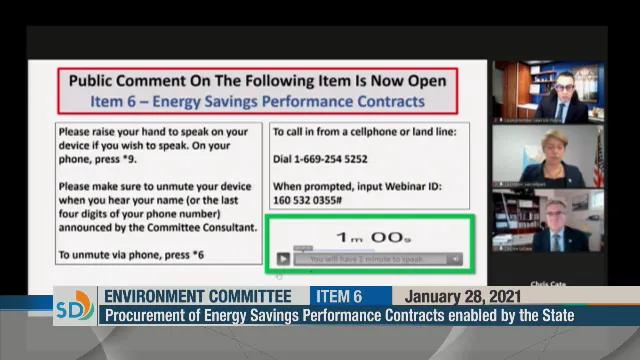
The Environment Committee met virtually on January 28, 2021, chaired by Councilmember Sean Elo-Rivera, with Vice Chair Marnie Von Wilpert, Councilmember Joe LaCava, and Councilmember Chris Kate (arriving late). The meeting covered a wide range of environmental issues, including the SDG&E franchise bid process, stormwater funding, energy performance contracts, recycling ordinance updates, and committee priorities for 2021. Public comment was extensive on several items. Consent Calendar - Approved items 1, 2, and 4 (Mission Trails Park and other routine matters) unanimously (3-0). Items 3 (Pure Water insurance fund) and 7 (microgrid projects) were returned to staff at their request. Public Comments & Testimony - Non-agenda public comment included calls for flood control improvements in District 4, support for the Rewild Mission Bay project, concerns about contractors avoiding city policies, a request for diverse environmental advisory boards, and complaints about stormwater liability issues. - On Item 10 (SDG&E Franchise): Over 40 speakers. Supporters (e.g., Neighborhood House Association, San Diego Taxpayers Association, Ronald McDonald House, 211 San Diego, Cordova Corporation, Asian Business Association) praised SDG&E’s community partnerships, supplier diversity, and worker safety. Critics (e.g., San Diego 350, Sunrise Movement, Public Power San Diego, Sierra Club, Law Students) argued SDG&E breached the current franchise, failed to pay relocation costs for Pure Water, blocked clean energy, and demanded a public power study. Many urged short-term agreements (≤5 years), a climate equity fund, and separation of gas and electric contracts. - On Item 5 (Stormwater Funding): 28 speakers. Supporters (e.g., San Diego Audubon, Surfrider, Climate Action Campaign, Building Trades, San Diego Coastkeeper, Chamber of Commerce) backed a 2022 ballot measure, citing flood risks, pollution, and deferred maintenance. Residents from District 4 and 9 described flooding impacts. Some urged green infrastructure and equitable fee structures. Only one speaker, a resident, opposed additional costs. - On Item 6 (ESPCs): Four speakers (Center for Sustainable Energy, SEAB member, Climate Action Campaign, Chamber, NRDC) supported the code amendment, noting proven model and no upfront costs. - On Item 8 (Recycling Ordinance): One speaker (California Native Plant Society) raised concerns about compost pathogen spread. - On Item 9 (Priorities): 14 speakers urged prioritizing the CAP update, environmental advisory board reform, Rewild Mission Bay, Proposition 12 compliance, transit, and climate equity fund. Discussion Items - Item 10 – SDG&E Franchise Update (Informational): Mayor’s Policy Director Jessica Lawrence presented the history, current franchise terms (expiring June 2021), and community outreach. Goals include protecting ratepayers, meeting CAP goals, and flexibility. Committee members (Von Wilpert, LaCava, Kate, Elo-Rivera) thanked speakers and stressed transparency, all options (including public power), and need for accountability. No vote; item was informational. - Item 5 – Stormwater Funding Strategy: Staff presented the funding gap ($274M/year, $1.4B shortfall over 5 years), need for a dedicated source, and plan for a November 2022 ballot measure. IBA and City Auditor supported. Motion by Von Wilpert, seconded by LaCava. Councilmember Kate voted no, citing cumulative costs to residents and high water bills. Motion passed 3-1. - Item 6 – Energy Savings Performance Contracts (ESPCs): Staff proposed amending municipal code to allow streamlined procurement (state code §4217). Nearly 50 city buildings identified for retrofits. Motion by Von Wilpert, seconded by LaCava. Unanimously approved (4-0). - Item 8 – Recycling Ordinance Amendments: Staff Ken Prue and CalRecycle’s Jill Larner explained alignment with state laws (AB 341, AB 1826) and groundwork for SB 1383. Requires commercial/multifamily recycling of organics and blue-bin materials. Motion by Von Wilpert, seconded by LaCava. Unanimously approved (4-0). - Item 9 – Environment Committee 2021 Priorities: Chair Elo-Rivera sought input on work plan. Members highlighted franchise agreement, stormwater, CAP update, climate equity fund, wildfire, community power, zero waste, water issues, and board reform. Motion by Von Wilpert, seconded by LaCava. Approved (4-0) to finalize work plan for next meeting. Key Outcomes - Consent agenda approved (3-0). - Stormwater funding strategy and ballot measure exploration approved (3-1). - ESPC municipal code amendment approved (4-0). - Recycling ordinance amendments approved (4-0). - Committee work plan to be developed from member and public input (4-0). - Items 3 and 7 returned to staff. - Public comment on Item 10 recorded but no action taken. The next committee meeting is scheduled for Thursday, February 25, 2021, at 1:00 PM.
The Audit Committee of the San Diego City Council met virtually on January 27, 2021, via Zoom, under Executive Order 2920. The committee reviewed the FY 2020 Comprehensive Annual Financial Report, an IT performance audit of legacy applications, the City Auditor's proposed FY 2022 budget, and informational reports. All votes were unanimous. Consent Calendar - Approved the committee actions of December 2, 2020, unanimously. Public Comments & Testimony - No members of the public spoke during non-agenda public comment or on any agenda items. Discussion Items Fiscal Year 2020 Comprehensive Annual Financial Report (CAFR) - Rolanda Trevel, Director of Finance and City Controller, presented with Jeff Peel and Amy Pinion; Peter George of MGO presented the external audit. - The general fund ended FY20 with a $220 million fund balance; emergency reserve at $106.1 million; stability reserve at $99.5 million. Of the $248 million in federal coronavirus relief funds, $93.4 million was expended by the end of FY20. Water and sewer funds ended with net positions of $2.1 billion and $2.6 billion. - MGO issued an unmodified (clean) opinion with no material weaknesses or significant deficiencies. The city early-implemented GASB Statement 84, removing certain pension trust funds and creating custodial funds. - MGO reported no difficulties, no disagreements with management, and full cooperation. - Vice Chair LaCava moved to forward the report to the City Council to be received and filed; seconded by Member Halpern. Passed unanimously. IT Performance Audit of Legacy Applications - Steve Gomez and Wendy Manert presented the audit findings: DOIT's N-minus-one methodology does not capture true legacy systems or facilitate a citywide risk-based approach, and the city does not track full costs of legacy systems. - The audit made 11 recommendations, including developing a standard definition, centralized inventory, risk assessment policies, high-cost metrics, and an annual confidential City Council report on high-risk legacy applications. - CIO Jonathan Banke agreed to implement all recommendations, with most completed within six months. - Members discussed cost-benefit analysis and Brown Act constraints on reviewing the confidential report. City Attorney Joan Dawson advised that closed session likely is not permitted for the audit committee; she will provide a memo. Members expressed concerns and asked for a solution. - Vice Chair LaCava moved to forward the report to the City Council as an information item; seconded by Member Halpern. Passed unanimously. City Auditor FY 2022 Proposed Budget - City Auditor Andy Henao requested an FY 2022 budget substantially unchanged from FY 2021: approximately $3.6 million, 22 FTEs, plus $350,000 for the MGO CAFR contract. - The administration proposed an 8% cut ($312,000), which Henao said would force a vacant position and four weeks of furloughs, reducing audits by two to three per year. The 2.6% contracting reduction ($19,000) could be absorbed. - Members argued the office provides a positive return on investment and cuts would be counterproductive. - Vice Chair LaCava moved to recommend adopting the proposed budget with no changes except the 2.6% contract reduction; seconded by Member Halpern. Passed unanimously. Informational Items Fraud Hotline Quarterly Report (Q2 FY2021) - Andy Jorita reported 52 reports received in Q2, 112 half-year total; 33 assigned for investigation and 19 not in purview; 30 closed, 44 open. - Substantiated allegations included improper use of recycling proceeds, hiring abuse, improper cash handling, get-it-done work order processing, improper mailings, and failure to follow COVID-19 health protocols. No motion required. City Auditor's Monthly Activity Report - Henao reported three reports issued; audits in process include climate action plan implementation (February), industrial wastewater control program part 2 (March), and real estate assets acquisition including 101 Ash Street. Four audits in planning, ten not started; eight reports with 60 recommendations issued so far in FY2021. - Henao is updating the audit report template and developing a recommendation implementation plan template. No motion required. Key Outcomes - All four motions passed unanimously: prior actions approval; CAFR forwarded to City Council; IT legacy audit forwarded as information; FY 2022 City Auditor budget recommended with no cuts except 2.6% contracting reduction. - Chair Moreno will issue a call memo for committee priorities and will docket a discussion at the February 24, 2021 meeting. - Chair Moreno will follow up with the City Attorney on Brown Act concerns regarding confidential legacy systems reporting. - Next meeting: Wednesday, February 24, 2021, at 9:00 a.m.
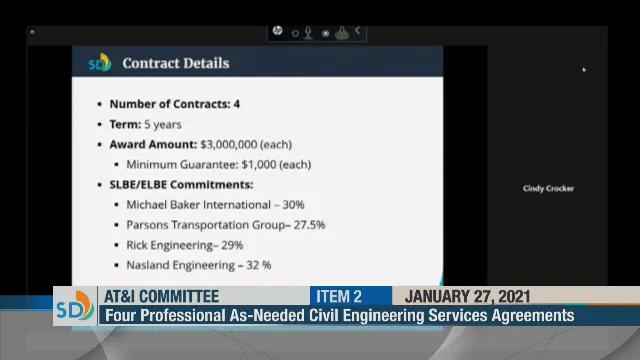
The Active Transportation and Infrastructure Committee convened virtually on January 27, 2021, at 10:00 AM, due to the COVID-19 pandemic. The meeting covered approval of previous actions, consent agenda items, discussion of committee priorities for 2021, a presentation on the five-year capital infrastructure planning outlook, and approval of civil engineering services agreements. Key themes included infrastructure funding gaps, equity, climate action, stormwater needs, and capacity challenges. Consent Calendar - Approval of Committee Actions (November 18, 2020): Approved unanimously (3-0) with Vice Chair Lacava, Committee Member Montgomery Stepp, and Chair von Wilpert voting yes. - Consent Agenda Item 1 - First Amendment to As-Needed Civil Engineering Agreement with Kleinfelder Inc.: Approved 3-1. Committee Member Montgomery Stepp voted no, expressing concerns about the contract being expired and the contractor achieving only 24.3% of its 42% Small Local Business Enterprise (SLBE) commitment. Other members supported but noted the issues. Public Comments & Testimony - Non-Agenda Public Comment: Andy Hanshaw, chair of the city's Mobility Board and executive director of the San Diego County Bicycle Coalition, introduced himself and expressed support for the committee's work on Vision Zero, mobility action plan, and bike master plan. - Item 4 (Committee Priorities): Four speakers: - Sally Small (Choice Valley Community Planning Group and Emerald Hills Neighborhood Council) urged equitable sidewalk coverage, storm drains, and park equity, noting the 50-50 cost sharing for sidewalks is too difficult for communities of concern. - Matthew Vasilakis (Climate Action Campaign) supported priorities for infrastructure investments in historically underserved communities, equitable implementation of complete communities and quick build programs, and meeting mode share targets. - Lucero Sanchez (San Diego Coastkeeper) thanked the committee for including stormwater infrastructure, noting all beaches were closed after recent rain due to failing infrastructure. She called for a ballot initiative to raise the stormwater fee to address the $1.4 billion deficit. - Andy Hanshaw (San Diego County Bicycle Coalition) emphasized safe, connected infrastructure for bicycling, Vision Zero strategies, prioritization of communities of concern, class four bikeway design guidelines, and monitoring mode share. - Item 5 (Five-Year Capital Outlook): No public comments. - Item 2 (Civil Engineering Services Agreements): Kathleen Higgins on behalf of MEA expressed appreciation for reducing contract terms to two years but urged the city to rely less on costly consultants and more on in-house forces. Discussion Items - Item 4 - Committee Priorities for Calendar Year 2021: Councilmembers presented their priorities based on memos submitted to the Chair. Common themes included: - Comprehensive review of the capital infrastructure deficit and unbuilt community plan facilities. - Addressing the stormwater funding gap (noted as $1.4 billion or more) and meeting water quality obligations. - Updating Council Policies 800-14 (capital improvement prioritization) and 000-31 (transparency) to incorporate equity and climate action goals. - Prioritizing infrastructure in historically underserved communities (District 4, District 9, District 8). - Sidewalk repair reform (eliminating property owner cost-share for communities of concern). - Youth Opportunity Passes, Vision Zero, complete streets, quick build policies, EV charging stations, and street tree programs. - Councilmember Montgomery Stepp highlighted that District 4 received no overlay work in the last $27 million state allocation. Councilmember Ilo Rivera emphasized applying a racial equity and justice framework. Chair von Wilpert noted the need for a new street condition assessment and long-term infrastructure financing. - Item 5 - Five-Year Capital Infrastructure Planning Outlook (FY22-FY26): Presentation by James Nagelboard (Director, Engineering and Capital Projects) and Mark Nassar (Deputy Director). Key points: - Total needs: $6.94 billion; available funding: $3.92 billion; gap: $3.02 billion. - Priority needs (risk to life/health, legal mandates, core services): $5.7 billion; priority funding gap: $2.3 billion (up $1 billion from last year, 40% driven by stormwater). - Stormwater is the largest need at $1.5 billion (21% of total), surpassing Pure Water and other enterprise-funded assets. - Enterprise-funded assets (water, wastewater) are largely met through rates; unmet needs are concentrated in stormwater, streets/roadways ($430M), existing buildings ($595M), street lights, and parks ($316M). - Capacity constraints: city has 20% vacancy rate in Engineering & Capital Projects (164 positions), 24% vacancy in surveyors. Regional competition for contractors and consultants limits ability to spend. Annual CIP expenditures grew from $263M (2014) to $600M currently. - Assumptions: no convention center expansion, no 101 Ash building improvements, pending coastal erosion and library master plans. Revenue assumptions include $30M/year from Facilities Benefit Assessment and $25M/year from Development Impact Fees. - IBA representative Gillian Kissey noted the gap for priority needs is $2.3 billion, with stormwater now the greatest need, and emergency projects are more expensive than planned ones. - Item 2 - Professional As-Needed Civil Engineering Services Agreements (H207140-H207143): Presentation by James Nagelboard and Cindy Crocker (Acting Deputy Director). Four contracts (each $3M) for as-needed civil engineering services to augment city staff. Firms: Michael Baker International (30% SLBE), Parsing Transportation Group (27.5%), BRIC Engineering (29%), and NAS and Engineering (32%). Term reduced from 5 years to 2 years after MEA request. Work assigned on rotational basis. Councilmember Montgomery Stepp raised concerns about gaps in workforce representation and recommended outreach to minority engineering organizations and community college programs. Key Outcomes - Approved: Item 1 (consent agenda) with a 3-1 vote; Councilmember Montgomery Stepp opposed. - Approved: Motion to direct the committee chair to issue a 2021 work plan based on input received (unanimous 3-0). The work plan will be drafted and brought back in February 2021. - Approved: Item 2 (civil engineering services agreements) with term reduced from 5 to 2 years (unanimous 4-0). - Noted: Item 3 (Alvarado Second Pipeline Extension) was returned to staff and will come back in future months. - Referrals: Chair von Wilpert committed to bringing forward updates to Council Policies 800-14 and 000-31 in about two months. Staff to provide additional details on asset management planning and state of the CIP report (due April 2021). The city's stormwater funding strategy will be discussed at the Environment Committee meeting on January 28, 2021. - Next Meeting: Scheduled for Wednesday, February 24, 2021, at 2:00 PM.
This meeting of the San Diego City Council’s Land Use and Housing Committee, chaired by Councilmember Whitburn, was held virtually. The committee approved its November 12, 2020 actions, heard non-agenda public comment, received general comments from members, and then took up the primary agenda item: establishing committee priorities for 2021. A motion to direct the chair to draft a work plan based on those priorities passed unanimously. The meeting transcript opens with a statement that the meeting was called to order on January 21, 2021, but the provided meeting date is January 25, 2021; this discrepancy is noted. Consent Calendar - Approval of November 12, 2020 Committee Actions: Motion by Councilmember La Cava, seconded by Vice Chair Ilo Rivera. Approved unanimously (4-0). Public Comments & Testimony Non-Agenda Public Comment: - Terry Ann Skelly (San Diego resident, mother of three) expressed concern about marijuana billboards near schools in City Heights and urged the committee to dial back predatory advertising and the proliferation of marijuana businesses. - Becky Repp (lifetime resident, mother) cited a recent hash oil explosion in City Heights and urged policies for smoke-free apartment buildings (tobacco and marijuana), referencing San Francisco’s policy. - Kathleen Lippett (concerned community member) stated that past councils listened to marijuana industry voices while ignoring community voices. She urged the committee to put action behind priorities that support communities, not just permit more marijuana businesses. Public Comment on 2021 Priorities: - Juliana Maxim (District 9, member of DSA Housing Justice Work Group) called for an expanded vacancy inventory that counts homes deliberately held off the market (second homes, vacation homes, wealth storage) and advocated for taxing units unoccupied over six months. She urged better data on vacancies to diagnose the housing crisis. - Kelly McCormick (director of a youth mentoring program) welcomed focus on equity and affordable housing but urged caution on cannabis equity due to health, safety, and social justice harms. She stated that communities of color already overburdened with unhealthy businesses, and that racial disparities in arrests persist even in regulated marijuana states. - Becky Repp again spoke, thanking Councilmember La Cava for child care facility concerns, but opposing Councilmember Ilo Rivera’s cannabis equity priority, citing a Mount Hope community’s strong opposition to a proposed marijuana outlet and collection of over 1,000 signatures against it. - Andre Leon noted that from 2011–2020 the city fell 46,000 units short of its housing element target; most units built were only affordable to those at 120% AMI. He urged aggressive expansion of social housing, acquisition of buildings, and support for Councilmember La Cava’s proposal to update the right-to-know ordinance and expand relocation payments for no-fault evictions (citing Portland, San Francisco, Seattle as examples). - Joy Sanyata (District 3) requested another report from the Real Estate Asset Management Department on city properties available for affordable housing, and urged prioritization of preservation, prevention, and powering (3 Ps) for housing, referencing a previous preservation report by the Housing Commission. - Scott Barr (District 2) supported many proposals, emphasized tough decisions on resources, and doubled down on recommendations for a vacancy survey and establishing a Department of Housing and Community Development. - Mark Wells argued that HUD is missing, the Housing Commission doesn’t do its job because financial audits are lacking, and more housing for low- and moderate-income and seniors is needed. Discussion Items Chair Whitburn opened the discussion, thanking colleagues for their memoranda. He stated his priorities include robust review of real estate contracts (in wake of 101 Ash and Navigation Center issues), speeding up entitlements while pursuing on-site affordable units, expanding permanent supportive housing citywide, identifying city-owned property near transit for affordable housing, and emphasizing that over half of renter households spend more than 30% of income on housing. Vice Chair Ilo Rivera framed his priorities with a racial equity and justice lens, noting historical racism in San Diego’s built environment. He highlighted preventing displacement during the pandemic, providing homes for unsheltered neighbors, preserving affordability, creating homeownership opportunities, and shaping land use for equitable outcomes. He expressed interest in modular construction (responding to Councilmember La Cava), innovative funding like land value capture, and expansion of child care facilities. He also echoed Councilmember Moreno’s concerns about protecting tenants during the pandemic and building infrastructure in underinvested communities. Councilmember La Cava acknowledged the city’s failure to deliver moderate- and low-income housing. His priorities included: (1) consolidating city office space to save rent; (2) re-evaluating third-party leases for compliance; (3) holding a “Housing Day” narrowly focused on delivering moderate- and low-income housing; (4) tracking the homelessness Community Action Plan and maintaining momentum from the Convention Center shelter; (5) updating tenant protections (right-to-know ordinance, relocation payments); (6) regulatory reform to expand child care facilities; (7) completing a street vending ordinance; (8) updating Council Policy 600-24 for community planning groups and recreational advisory groups. Councilmember Moreno emphasized increasing housing supply and aiding those hit hardest by the pandemic. Her stated priorities included: (1) monitoring the eviction moratorium; (2) expediting the emergency rental assistance program—criticizing the Housing Commission’s planned three-month delay of $5 million in CARES Act CDBG funds, urging release by February 1; (3) developing rental assistance for immigrants ineligible for federal funds; (4) a vacancy tax feasibility study; (5) affordable housing preservation updates; (6) expanding the first-time home buyer program—noting only 18 people assisted in Q4 FY20, and pressing for more state/federal funding (e.g., CalHome) and help for Section 8 voucher holders to become homeowners; (7) engaging with CalHFA; (8) creating an incentive program for infrastructure tied to affordable housing; (9) receiving updates on housing production relative to the 108,036-home RHNA target; (10) creating an economist position in the Planning Department to analyze zoning impacts. General Comment: Earlier in the meeting, Councilmember Moreno stated that the San Diego Housing Commission was delaying the release of $5 million in rental assistance by up to three months, which she called unacceptable. She released a memo requesting the funds be made available by February 1. Chair Whitburn echoed the need for haste. Key Outcomes - Motion to direct the chair to draft a committee work plan on 2021 priorities was made by Councilmember La Cava, seconded by Vice Chair Ilo Rivera, and passed unanimously (4-0). - The work plan will be based on the priorities discussed and is expected to be brought back to the committee for consideration. - No other votes were taken.
The Budget and Government Efficiency Committee of the San Diego City Council met virtually on January 20, 2021, at 9:00 AM local time (18:00 UTC) via Zoom, in compliance with executive order 29-20 due to the COVID-19 pandemic. The meeting was televised and live‑streamed. Committee members present were Vice Chair Whitburn, Councilmember Montgomery Stepp, and Councilmember Campillo. Also attending were IBA Director Andrea Tevlin, Angela Colton (IBA), Chief Financial Officer Matthew Vespy, Brittany Bailey (Mayor’s office), and Brett Bartelata (City Attorney’s office). The committee considered three agenda items: a new sales tax audit agreement, the FY2022 Council Budget Priorities resolution, and the committee’s own 2021 work plan priorities. Consent Calendar - No consent calendar items were discussed. The committee approved routine committee actions (motion by Councilmember Montgomery Stepp, seconded by Chair Kate) unanimously. Public Comments & Testimony Non‑Agenda Public Comment (two speakers): - Sal Espinoza (San Diego Communications Workers of America) expressed support for the San Diego Access for All Initiative but recommended it be extended through FY2022, creation of an Office of Digital Equality, stronger broadband provider partnerships, culturally sensitive outreach, and a public evaluation of the Verizon deal for impacts on city departments and digital inclusion goals. - Laura Barry (Claremont neighborhood) requested street repairs, noting that her neighborhood’s streets had not been repaved in 30 years and that previous budget allocations had been rescinded. She asked for a meeting with city staff to inspect the streets. Item 2 – FY2022 Council Budget Priorities (five speakers): - Peter Kaminsky (Arts & Culture San Diego, representing over 100 organizations) thanked the six council members who prioritized arts and culture funding and urged continued support for the Penny for the Arts commitment. - Christopher Olson (Jewish Family Service of San Diego) thanked council members for prioritizing the Office of Child and Youth Success and the Community Action Plan on Homelessness, and urged support for the IBA’s recommendations. - Aaron Hogaboom (San Diego for Every Child, representing 40+ organizations) expressed strong support for the Office of Child and Youth Success, highlighting its potential to coordinate services, facilitate intergovernmental relations, and incorporate youth and family input. - Joy Sunyata (District 3 resident) thanked the council and IBA for the budget memo and report, and listed her macro priorities: core services, homelessness/housing, and equity/relief. - Angeli Kallanog (Circulate San Diego, Vision Zero Coalition member) thanked the council for prioritizing transportation, safe streets, and sidewalks, and urged continued Vision Zero funding. - Courtney Baltiski (YMCA Community Support Services, representing 40+ human service agencies) thanked council members for including the Office of Child and Youth Success and affordable child care, and urged approval of the IBA’s recommendations. Item 3 – Committee Priorities for 2021 (one speaker): - Joy Sunyata (District 3) praised the committee members’ memos, supported a review of city‑owned properties for affordable housing, requested more user‑friendly FDS calculations, and advocated for policy revisions, citing the library pool fund policy as an example. Discussion Items 1. Agreement with Muni Services LLC for Sales Tax Audit and Recovery Services - Staff (Adrian Del Rio, Assistant Director of Finance; Nicole Chalfant, Financial Operations Manager) presented the proposed five‑year agreement. Key points: The contingency fee would drop from 14% to 8% of recovered revenue, saving an estimated $2.5 million over five years (assuming past recovery levels). The number of compensated quarters for each misallocation would decrease from 10 to 9. Quarterly reporting services, previously $3,000 per report, would now be complementary. The contract is retroactive to July 1, 2020, to avoid gaps. Over 30 years, Muni Services has recovered over $190 million for the city; in the most recent contract, $7 million was recovered with $3.5 million pending. The RFP evaluation scored Muni Services at 88.67 vs. HDL Companies at 76.92. The committee unanimously approved the agreement. 2. Fiscal Year 2022 Council Budget Priorities - IBA Director Andrea Tevlin and Angela Colton presented the IBA Report 21‑01, summarizing 16 budget priority topics that received majority support from the nine council members. Topics included maintaining core services (library, parks, code enforcement, brush management, lead abatement), homelessness/housing, equity/COVID relief (police practices commission, rental relief, small business relief, police reform, youth services, digital equity, Office of Race and Equity, public bank feasibility, labor standards office), climate action plan (including a climate equity fund and urban forestry), employee compensation, arts and culture, transportation safety, sidewalks/streets, stormwater, libraries, fire stations, and transit infrastructure. Budget mitigation measures mentioned by six council members included using general fund reserves and the pension payment stabilization reserve. Committee members discussed and added an amendment (moved by Chair Kate, seconded by Vice Chair Whitburn) to allocate $15,000 in one‑time funding per council office for a constituent relations management platform to replace the IQ system. The amended priorities were forwarded to the full city council for adoption on February 2, 2021. 3. Committee Priorities for Calendar Year 2021 - Committee members discussed their individual memos outlining priorities for the committee’s work plan. Common themes included vacancy savings review, city real estate contract oversight, small business insurance requirements, disparity study implementation, climate grant writer funding, public safety overtime reduction, performance measures/analytics, local hire ordinance, and stormwater financing. The committee directed the Chair to draft a work plan based on these priorities. Key Outcomes - Item 1 (Muni Services Agreement): Approved unanimously (3‑0). The mayor or designee authorized to execute the five‑year contract; CFO authorized to pay the 8% contingency fee. - Item 2 (FY2022 Budget Priorities): Approved with amendment (unanimous 3‑0). The resolution, including the $15,000 per office for constituent management platform, will be forwarded to the full city council for adoption on February 2, 2021. - Item 3 (Committee 2021 Work Plan): Motion passed unanimously (3‑0) directing the Chair to draft a work plan incorporating the members’ priorities. The committee will meet next on Wednesday, February 3, 2021, at 9:00 AM.
The San Diego City Council Rules Committee met virtually on January 20, 2021, at 2:00 PM via Zoom, in compliance with Executive Order 29‑20 suspending certain Brown Act requirements due to the COVID‑19 pandemic. The sole substantive agenda item was the discussion and adoption of the committee’s 2021 priorities. The meeting included public comment, deliberation by committee members, and unanimous approval of both the consent calendar and a motion to direct the Council President to draft the 2021 work plan, which is to be finalized by February 1, 2021. Consent Calendar - Approval of Committee Actions (October 9, 2020): The minutes from the previous meeting were approved unanimously (5‑0). Public Comments & Testimony - Non‑Agenda Public Comment: - Kathleen Lippitt (first caller) raised concerns about public access to virtual meetings, noting that many lower‑income residents lack computer technology or technical skills to participate. She also questioned the integrity of committee assignments used as rewards or punishment and argued that consistent unanimous voting suggests groupthink, which is patronizing to the public. - Second caller didn’t connect (Kathleen Lippitt had already spoken). - Public Comment on Item 1 (2021 Priorities): - Becky Rapp (District 5 resident, mother) thanked Councilmember Von Wilpert for focusing on improving resident and business access to Development Services Department (DSD) reports. She specifically requested clarity on conflict‑of‑interest rules for DSD advisory committees to help communities protect churches and youth‑oriented facilities from inappropriate marijuana business locations. - Joy Sonata (District 3) thanked committee members for their memos and expressed support for policy revisions that promote equity, open government, communications, customer service, and public outreach. She praised the “Get It Done” program and suggested creating an app to survey homeless individuals to gather their voices, calling it “baby steps toward more equity.” Discussion Items - Discussion of the 2021 Rules Committee Priorities Committee members each offered comments on the priorities they submitted in memos dated December 30, 2020. Key themes included: - Vice Chair Campillo (motion maker): Emphasized ranked‑choice voting (RCV) and its reverberating effects on campaign finance and election administration; streamlining boards and commissions with the Mayor’s Office; and supporting an ad‑hoc COVID‑19 committee (proposed by Councilmember Von Wilpert). Also stressed lowering barriers for candidates and improving transparency. - Councilmember Whitburn (seconded motion): Highlighted language accessibility for public meetings, protecting voting rights, and initiatives for LGBTQ employees. He supported the COVID‑19 ad‑hoc committee and Councilmember Kate’s idea of minimum public outreach standards for city projects. - Councilmember Von Wilpert: Cited her experience with the AIDS epidemic in Africa as inspiration for creating an ad‑hoc COVID‑19 response and recovery committee. Emphasized equitable distribution of relief funds, better coordination with the county, and the need for a transparent DSD permitting process. Also noted the need for diverse representation on boards and commissions. - Councilmember Kate: Called for exploring charter amendments to allow educational and childcare uses in park spaces while avoiding over‑commercialization. Agreed with colleagues on RCV, COVID‑19 response, and language accessibility. Key Outcomes - Motion (by Councilmember Campillo, seconded by Councilmember Whitburn) to direct the Council President to draft the 2021 work plan, incorporating committee members’ priorities and public input — passed unanimously (5‑0). - The final 2021 Rules Committee work plan is to be posted and finalized by February 1, 2021. - The next regular Rules Committee meeting is scheduled for Wednesday, February 17, 2021 at 2:00 PM.
The Public Safety and Livable Neighborhoods Committee of the San Diego City Council met virtually on January 13, 2021, due to public health and safety concerns related to the COVID-19 pandemic. The meeting was televised and live-streamed. Committee members present were Chair Montgomery Stepp, Vice Chair Campillo, Council President Pro Tem Whitburn, and Councilmember Von Wilpert. The main agenda item was a discussion of the committee's priorities for 2021, with the goal of receiving public input to inform the work plan to be presented at the February 10, 2021 meeting. Consent Calendar - The committee unanimously approved the committee actions from November 18, 2020. Vice Chair Campillo specifically thanked the Chair for actions that included renewing an agreement with San Diego Unified School District to open green spaces to schools in District 7. Public Comments & Testimony Non-agenda public comment (approximately 15 callers in queue): - Samantha Jenkins (District 4 resident) asked the city council to push the San Diego Police Department to investigate whether any active-duty officers participated in the January 6 Capitol insurrection. - Marisa Talbot (District 7 resident, co-chair of Pandy Higgins Progested) welcomed the committee and expressed hope for a transparent process. - Tasha Williamson called for firing SDPD Chief Nisleit due to biased policing and excessive force, investigation into police conduct at Pacific Beach protests, public reporting of police training spending, and a return to name tags. She also criticized the city council for disregarding public voice. - Luis Rodolico (Dirac Street resident) complained about repeated liquid garbage spills from city trash trucks, requiring residents to hose down the street. - Blair Overstreet (Showing Up for Racial Justice, San Diego) highlighted the need for police accountability and called for reallocating police funding to community services. - Amy Zimudio (homeless outreach representative, Central Beach) expressed fear among unhoused community members after a protest in Pacific Beach, stating that some protesters were known to despise the unhoused. - Several callers (e.g., Joy Sanyata, senior advocate) welcomed the committee and offered suggestions for senior safety and inclusion. Public comment on Item 1 (committee priorities): - Kierra Pina (Center on Policy Initiatives, Community Budget Alliance) argued that policing is a racist institution and urged divestment, investment in community resources, dismantling street gang units, creating alternatives to police, funding community groups for emergency response, developing youth violence prevention, creating a transitional age unit, and passing the Protect Ordinance. - Doug Case (First Vice Chair of the Community Review Board, soon to be Commission on Police Practices) urged adequate funding and a two-phase implementation ordinance to expedite commissioner selection. - Blair Overstreet (City Heights resident) described police harassment of Black and brown youth and advocated for mental health crisis response without police, noting the lack of a non-police option for mental health emergencies in San Diego. - Regina Sinski Crosby (Pacific Beach resident) reported witnessing excessive police force and biased policing at the Pacific Beach protest, noting police wore more riot gear than Capitol police during the January 6 coup attempt. - Tasha Williamson called for rooting out racist police officers and reallocating unused training funds back to the community. - Lori Saldania (former Assembly Speaker Pro Tempore) urged policies to address white supremacist groups, citing law enforcement’s failure to separate groups and protect counter-protesters. - Ariana (District 4 resident, youth organizer at Mid City Kent) supported Community Budget Alliance priorities and called for decriminalizing low-level offenses and fully funding the Commission on Police Practices. - Joy Sanyata (District 3) welcomed the committee and emphasized senior safety, pedestrian issues, and inclusion in CDBG grants. - Adina Weinick (District 3) urged divestment from policing and adoption of Community Budget Alliance priorities. - Sally Small (Emerald Hills Neighborhood Council) supported funding mental health and drug abuse services, and safe parks. - Martha Welp complained about overtime and pension issues for officers and lack of complaint accessibility. - Tarek Osafor (La Mesa resident) said residents no longer feel safe due to police failure to address white supremacists and are turning to private security. - Bellin Hernandez thanked committee for prioritizing the Commission on Police Practices and urged inclusion of youth violence prevention and transitional age unit. - Becky Rapp (mother and youth mentor) opposed expanding marijuana dispensaries near churches and urged upholding regulations to protect youth. - Julie Hendrix (District 7) called for diverting police funding to mental health and youth outreach services. - Katie Hallett (District 2) supported Community Budget Alliance priorities including dismantling street gang units, creating alternatives to policing, and fully funding the Commission on Police Practices. Discussion Items Item 1: Discussion of the Public Safety and Livable Neighborhoods Committee Priorities for 2021 Chair Montgomery Stepp noted that the committee had received input from members and the public, and that a work plan would be presented at the February 10 meeting. She thanked the public for their comments and emphasized that they do not fall on deaf ears. She highlighted the Office of Race and Equity, which will intersect with many issues but is not yet assigned to this committee. She affirmed that the committee will address implementation of the Independent Commission on Police Practices, community-oriented policing, diverse recruitment for police and fire, park equity, EMS response times, safe parking program, and the Community Action Plan on homelessness. Vice Chair Campillo thanked callers and acknowledged specific priorities: towing and impounding policies (raised by Councilmember Whitburn), urban community gardens (from Councilmember Von Wilpert), opioid crisis, mental health resources for homelessness, expansion of home buyer down payment assistance for all first responders, a public safety training facility for fire, and firefighter wellness programs. Council President Pro Tem Whitburn seconded the motion and stressed the need for efficient implementation and funding of the Independent Commission on Police Practices, updates on racial bias training, and consistent treatment of protesters. He also highlighted vehicle towing and impounding policies as a critical equity issue, homelessness, park equity, and the opioid crisis. Councilmember Von Wilpert thanked the Chair for her leadership on Measure B and racial equity. She emphasized fully funding the Commission on Police Practices, implementing a 988 mental health crisis number, de-escalation tactics, wildfire safety, opioid abatement funds for medication-assisted treatment, park equity including community gardens, support for arts and culture, and addressing racial disparities in homelessness (noting that 28% of San Diego's homeless population is Black, compared to 5% of the overall population). She also called for re-evaluating the rule limiting non-agenda public comment to eight speakers. Key Outcomes - The committee unanimously approved a motion (moved by Vice Chair Campillo, seconded by Council President Pro Tem Whitburn) directing the Chair to draft the 2021 committee work plan incorporating member priorities and public input. The work plan will be presented at the next meeting on February 10, 2021. - The committee will incorporate a broad range of priorities including police reform, implementation of Measure B, alternatives to policing, mental health crisis response, towing policy reform, wildfire safety, opioid treatment, park equity, and racial equity in homelessness services.
The Economic Development and Intergovernmental Relations Committee of the San Diego City Council met virtually on January 13, 2021, at 10:00 AM PST, via Zoom due to the COVID-19 pandemic. The meeting was chaired by Councilmember Raul Campillo, with Vice Chair Chris Kate, Councilmember Vivian Moreno, and Councilmember Sean Elo-Rivera present. The committee addressed the 2021 state and federal legislative platform, authorized option years for legislative consulting contracts, and discussed committee priorities for the year. All votes were unanimous. Consent Calendar - Approval of Committee Actions (November 20, 2020): Unanimously approved. Public Comments & Testimony - Non-Agenda Public Comment: Carrie Ann Skelly, a San Diego resident and mother, urged the committee to focus on youth development, workforce development, and drug use prevention, specifically calling for the removal of marijuana billboards near schools in City Heights. - Item 1 – 2021 Legislative Platform: - Joy Sanyata (District 3) praised the platform's 344 priorities and the word "support," emphasizing the need for clear government communication during the pandemic. - Laura Nunn, on behalf of the San Diego Housing Federation, expressed support for the platform's homelessness and housing affordability priorities, and requested that the city include legislation to lower the voter threshold for revenue measures funding affordable housing and infrastructure, noting that Measure A received nearly 58% support but failed due to the two-thirds requirement. - Item 3 – Committee Priorities: - Austin Evans, a small business attorney and member of Business for Good San Diego, highlighted the need for COVID relief that avoids further debt for businesses, supported the Promise Zone Equity Investment Fund and public bank concepts, and urged prioritizing grants for true small businesses and new businesses. - Joy Sanyata again spoke, urging the committee to focus on grants, leave no money on the table, and give more attention to the working waterfront and port district. Discussion Items - Item 1 – 2021 State and Federal Legislative Platform: Adrian Granda, Director of Governmental Affairs, presented the proposed platform, which includes a new guiding principle on social justice, equity, and inclusive economic development. The platform covers COVID-19 response, housing, homelessness, border infrastructure (Tijuana River Valley), Pure Water program, NAVWAR redevelopment, and federal priorities like stimulus funding and immigration. Councilmembers discussed the importance of anti-displacement legislation, early childhood education, K-12 support, and ensuring police technology investments align with equity principles. The platform was adopted unanimously. - Item 2 – Authorization of Option Years for Legislative Consulting Contracts: The committee considered two sub-items (A and B) to authorize the mayor to execute option years four and five of existing contracts with Platinum Advisors (state) and Squire Patton Boggs (federal). No public comment was received. Councilmembers noted the importance of advocacy in Sacramento and Washington, D.C. Both sub-items were approved unanimously. - Item 3 – Committee Priorities for 2021: Councilmembers presented their priority memos, covering COVID-19 relief, small business support, homelessness, border economy, equity, child care, outdoor dining, youth employment, and education partnerships. Chair Campillo proposed developing a work plan with quarterly themes and a racial equity tool. The committee directed the chair to form the work plan, which was unanimously approved. Key Outcomes - Item 1: The 2021 state and federal legislative platform was adopted unanimously (4-0). - Item 2A: Authorization for Platinum Advisors state contract option years approved unanimously (4-0). - Item 2B: Authorization for Squire Patton Boggs federal contract option years approved unanimously (4-0). - Item 3: Motion to direct the chair to develop a 2021 committee work plan incorporating member priorities and public input passed unanimously (4-0). Next Meeting: The committee will reconvene on Wednesday, February 10, 2021.