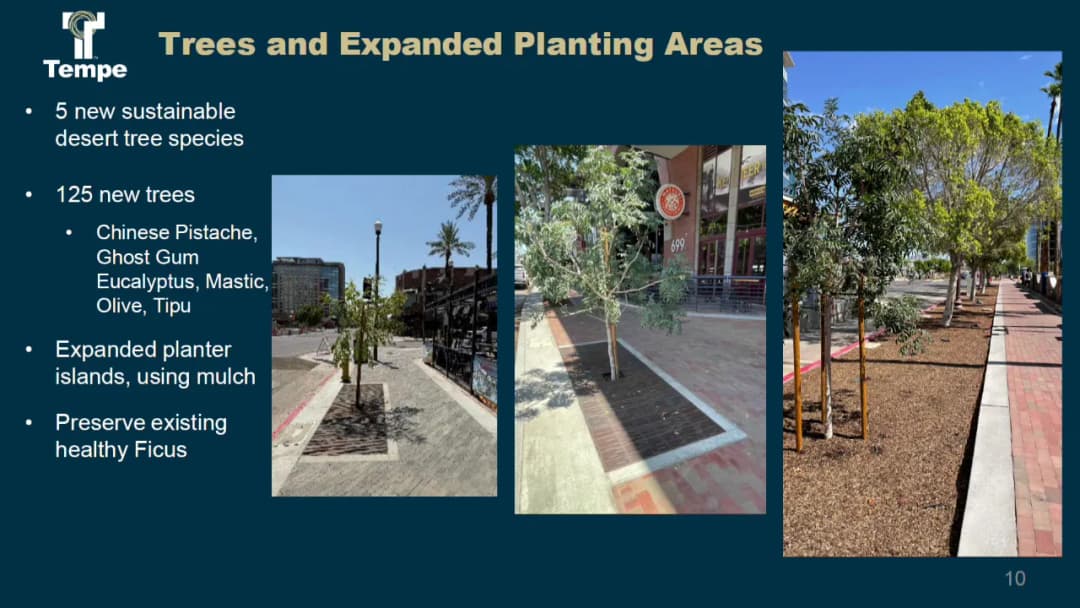
The Tempe City Council held a work study session on January 15, 2026, at approximately 11:00 AM (meeting convened in the afternoon and adjourned at 5:14 PM). The meeting included presentations on the Downtown Tempe Historic Core Plan and the Mill Avenue Streetscape project, updates from council subcommittees, and mayoral announcements. No public comments were made during the call to audience periods. Public Comments & Testimony - No members of the public addressed the council during either call to audience segment. Discussion Items Downtown Tempe Historic Core Plan - Consultants Stephen Davidovis (MIG) and Corky Poster (PMM) presented the plan, which aims to balance historic preservation with development in the downtown core. The plan is a key implementation item of the General Plan 2050. Since summer 2025, the team has conducted engagement with stakeholders, commissions, and the public. A draft plan is expected by late March/early April 2026, with final adoption anticipated in late June 2026. - Five principal goals were outlined: celebrate Tempe's history, expand historic resource protections, promote context-sensitive development, enhance economic vitality, and strengthen downtown identity. - Councilmembers raised several points: - Councilmember Perhaj asked whether the consultant team had examples from landlocked cities (since Tempe cannot expand outward); the team agreed to seek additional examples. - Councilmember Chin requested specifics on which developers have been engaged and asked that future updates include that information. She also inquired about outreach to downtown businesses, noting that the Downtown Tempe Authority (DTA) could help. - Councilmember Amberg expressed the need for sustainability elements in design guidelines. He also raised concerns about property owners who may feel uninformed about the plan and its potential impact on their development rights. Councilmember Adams offered to help contact property owners to ensure broad engagement. - Councilmember Spahr-Garcia appreciated the advisory nature of the plan and the emphasis on balancing historic preservation with new development. - Councilmember Amberg further noted that the Tucson example (Fourth Avenue district) relies on a tax increment financing district (Rio Nuevo) that Tempe does not have, making direct replication unlikely. Mill Avenue Streetscape Project Update - Eric Iverson (Transportation and Sustainability Director) and Tara Ford (Public Works Director) provided an update on the $18 million streetscape project from University Drive to Rio Salado Parkway. The project began in summer 2024 and is now 90% complete. - Key accomplishments include: underground electrical and irrigation upgrades, ADA improvements (cross-slope corrections from 7-13% to under 2%), new bulbouts and paver sidewalks, new trees (five desert-adapted species, 20 existing ficus retained), overhead string lights at three blocks, historic medallions at corners, new bus shelters with indigenous art, and a gateway sign (expected March-April 2026). - Remaining work includes punch list items, warranty work, and full mill-and-overlay paving of Mill Avenue and side streets, scheduled for summer 2026 after school ends (taking 2-3 months). The team emphasized minimizing disruption to businesses and events. - Councilmember Spahr-Garcia praised the project's sustainability elements and increased shade canopy. Councilmember Chin (Vice Mayor) requested an update on bus stop shade shelters, which was accepted as a future agenda item. - Councilmember Adams noted a dangerous pothole on northbound Mill Avenue north of the lake; staff will address it. - Councilmember Keating asked about repaving of Mill Avenue north of the bridge; staff responded it is scheduled for 2028. - Councilmember Hodge questioned the timing of data collection on the Fifth and Mill intersection. Staff recommended completing construction first, then gathering data and reporting back. - Mayor Woods and other councilmembers commended staff for perseverance and the positive reception from the community now that the vision is becoming visible. Council Subcommittee Updates - Age-Friendly Tempe (Vice Mayor Garland): Final five-year plan in progress; subcommittee report scheduled for May 4, 2026 work study. - Animal Welfare and Cruelty (Councilmember Hodge): Next meeting January 23, 2026. - Community Engagement and Connection (Vice Mayor Garland): Public input sessions begin in February. - Drink Spiking Education and Prevention (Councilmember Keating): In-depth update at January 22, 2026 first read. - Federal and State Advocacy Review (Councilmember Amberg): First meeting February 20, 2026. - Mixed Use Space (Councilmember Chin): No update. - Motorized and Electric Mobility Device (Councilmember Adams): Next meeting February 18, 2026. - Revitalization of Tempe Town Lake (Councilmember Amberg): Next meeting February 6, 2026. - Tempe Term Limits Policy Review (Mayor Woods): Meeting to be scheduled. Key Outcomes - No formal votes were taken. The council received information and provided direction to staff. - The Historic Core Plan team will seek additional landlocked city examples and improve outreach to developers and property owners. - The Mill Avenue paving will proceed in summer 2026; the Fifth and Mill intersection analysis will occur after construction is complete. - Staff will provide a written update on bus stop shade shelters via the Friday information packet. - Subcommittee chairs reported upcoming meeting schedules; all subcommittees remain active. - Meeting adjourned at 5:14 PM; the next work study session is scheduled for February 12, 2026.
Public Meetings - Tempe, Arizona
Public Meetings - Tempe, ArizonaThe Development Review Commission convened on January 13, 2026, for its regular meeting to review consent agenda items and hear specific use permit requests. Following a unanimous approval of the minutes from the December 9, 2025 meeting, the Commission processed several routine applications before diving into detailed deliberations on proposed property modifications and zoning amendments. All discussed items were resolved via unanimous vote. Consent Calendar - Item 4A: Use permit request for a vehicle service station/fuel sales (Quick Corner) in the CSS zoning district. - Item 4B: Use permit request for a fitness center (Pure Balance Pilates) in the GID zoning district. - Item 4C: Use permit request for wood products manufacturing (A1 Cabinetry) in the GID zoning district. - Item 4F: Use permit request for a drive-thru restaurant (Black Rock Coffee) in the GID zoning district. - Item 4G: Use permit request to allow two required parking spaces within the front yard setback for Orange Street residents. - Item 5B: General plan and zoning map amendment for Priest and Alameda (25 acres) changing land use from mixed-use moderate (20 du/acre) to mixed-use industrial moderate (45 du/acre). Note: Item 4D was pulled from this agenda for separate discussion. Public Comments & Testimony - Tom Dare (resident, 2 doors from 1234 House Street): Expressed partial non-objection to the House Street parking request but voiced skepticism regarding the accuracy of submitted site photos. He noted discrepancies in landscaping (irrigation changes, paved areas) suggesting the property owner was making modifications without full transparency. He questioned the necessity of a variance given the new "middle neighborhood" provisions. - Applicant (1804 East Alameda Drive): Clarified that while the property is registered as a rental with a history of short-term and long-term tenants (including students), her own multi-generational family does not reside there. She advocated on behalf of the property, arguing that three-vehicle parking needs are common in the neighborhood due to caregiving and work requirements, and emphasized that the permit is necessary to bring the 7-bedroom home into code compliance regarding violations discovered in 2022. - Commissioner Lloyd (1804 East Alameda Drive discussion context): Expressed a strong desire to see the Marlot's Garage project activate the interior retail space in the garage to avoid a scenario where the site functions merely as a parking lot for food trucks, emphasizing the need for an exciting retail component. Discussion Items - Item 4D (House Street Property): Staff presented a request for one required parking space in the front yard setback. They affirmed the property retains single-family use with sufficient capacity in the garage and driveway to accommodate traffic without nuisances. Staff recommended approval subject to planting a tree near the driveway. Commissioner Tom clarified the request is for one space to meet current standards, not an additional space. - Item 4E (Overo Residents / 1804 East Alameda Drive): Staff reviewed a request for three parking spaces in the front yard setback for a 7-bedroom home. They noted the home was partially unpermitted and is currently being brought into compliance. Staff recommended approval with conditions including the planting of three shade trees and restrictions on parking in landscaping areas. Commissioner Spears inquired about the occupancy; staff confirmed rental registration but noted no official data on multi-generational vs. student occupancy. - Item 5A (Marlot's Garage): The applicant, representing 8 Street Filling Station, presented an adaptive reuse of a 1922 historic garage. They indicated the retail use is currently undecided but leaning toward a pizza restaurant with an adjacent food truck plaza. Staff noted the building is historic-eligible but not registered. Staff recommended approval of the General Plan amendment (from Mixed Use High to Commercial) and Zoning Map amendment (from R4 TOD to CSS TOD) based on the fully commercial nature of the proposed use. Conditions were proposed regarding archaeological sensitivity and cultural sensitivity training completion. Key Outcomes - Consent Agenda: Approved unanimously with Item 4D removed. - Item 4D (House Street Property): Approved unanimously. Approved with the condition that one tree with a 1.5-inch caliper be planted within 5 feet of the driveway prior to final inspection. - Item 4E (1804 East Alameda Drive): Approved unanimously with a modification to conditions: Condition 7 (submission of final site plan) was struck as it had already been completed. - Item 5A (Marlot's Garage): Approved unanimously. Approved subject to standard conditions and two non-standard conditions: reporting of any archaeological findings to the historic preservation office and completion/evidence submission of Salt River Pima-Maricopa Indian Community Online Cultural Sensitivity Training. - Meeting Adjournment: Next meeting scheduled for January 27, 2026.
The Tempe City Council convened its regular meeting on January 8, 2026, to address routine consent items, public announcements, and non-consent agenda items including new housing developments and municipal leases. The meeting featured public testimony regarding the potential rezoning of the Shalomar Golf Course and the preservation of live music venues in downtown Tempe, alongside discussions on a new high-density residential project at 250 West Rio Salado. Several ordinances were introduced for public hearing, with a specific rescheduling of the drink spiking prevention ordinance. Consent Calendar - Approved minutes from items 4A1 and 4B1-4B10 unanimously (7-0). - Approved the renewal of multiple contracts for city facility repair and maintenance (Item 8A1) unanimously (7-0). - Approved the one-year contract renewal with Humana for group Medicare Advantage plans (Item 8A2) unanimously (7-0). - Awarded a construction contract to Felix Construction Company for well improvements at the South Tempe Water Treatment Plant (Item 8A3) unanimously (7-0). - Authorized the city manager to execute a purchase and sale agreement for properties at 520 and 526 South Mill Avenue (Item 8A4) unanimously (7-0). Public Comments & Testimony - Walt Dubois (Tempe Resident): Expressed opposition to high-density housing in his neighborhood, citing obstructed exit visibility due to existing wall height violations and concerns regarding increased traffic on local streets like Balboa and Alameda. Position: Opposed high-density development in his area. - Nathan Beaver (Tempe Resident, Shalomar Neighborhood): Opposed the rezoning of the Shalomar Golf Course, stating the proposal would eviscerate the community, increase traffic, and lead to residents moving away. Position: Strongly opposed rezoning Shalomar. Compared the developer's lack of foresight to historical Midwest land developers. - Mario Martinez (Tempe Resident): Condemned statements by City Chief Kenneth McCoy regarding a recent bomb threat (Queen Curtis case), calling the statements false and a violation of First Amendment rights. Position: Supported the accused individual's rights and opposed the Chief's handling of the case. - David Alter (Homeless Resident): Delivered a speech advocating for the city to look inward regarding its treatment of vulnerable populations, the unhoused, and the poor. Position: Urged the council to prioritize compassion, mercy, and justice over development and profit, asking the city to be a place where no one is cast aside. - Kathy Holland (Shalomar Resident): Opposed the rezoning of Shalomar Golf Course, warning it would ruin the quiet character of the neighborhood by turning it into a "crowded" environment comparable to the 101 freeway. Position: Strongly opposed rezoning and stated she would move if approved. - Stephen Bercy (Tempe Resident): Opposed the rezoning, questioning where children would play in high-rise complexes and arguing that rezoning for one family (the new Heisels) is unfair. Position: Opposed rezoning and suggested current zoning be maintained or the land sold without rezoning. - Cole Lightfoot (Shalomar Resident): Opposed the rezoning, citing loss of property values, backyard views, and neighborhood character. Position: Strongly opposed rezoning of the golf course area. - Steve Norris: Expressed support for golf courses as community hubs for socialization and fundraising. Position: Opposed rezoning Shalomar to preserve the golf course. - David Stewart (Shalomar Resident): Opposed the rezoning, arguing the current owners bought the land at a lower price reflecting the AG1 zoning and have no right to request rezoning for profit at the expense of neighbors' property values and lifestyle. Position: Strongly opposed rezoning. - Lauren Whitaker (Shalomar Resident): Opposed the rezoning, raising three concerns: failing infrastructure (cracks, sewer lines) that cannot support additional density, the neglect of the golf course ecosystem allowing pests and odors, and the high concentration of rentals (70-75%) changing neighborhood stability. Position: Strongly opposed rezoning. - Lori Herman (Tempe Resident): Supported the residents of Shalomar and opposed the development, citing the need for trees at bus stops for shade and the importance of the golf course ecosystem for cooling the city. Position: Opposed rezoning and opposed new housing demand. Discussion Items - Shalomar Golf Course Rezoning: Several council members acknowledged the public's strong opposition to the rezoning proposed by the current owners (Heisels). The discussion focused on the residents' concerns regarding traffic, infrastructure, and neighborhood character. - 520 and 526 South Mill Avenue Acquisition: The City Manager and Council discussed the acquisition of these historic properties. Councilmember Hodge asked about the future of the Darkstar music venue. Staff responded that the primary goals are preserving history and providing affordable market-rate leases to local small businesses. Councilman Hodge expressed strong support for maintaining the live music culture. Councilmember Adams noted that current owners Mr. Seifer and Wexford Developments are already supporting local tenants. - 250 West Rio Salado Parkway (Item 8B1): Applicant Gavage & Vurnham PLC presented a plan to rezone from office to residential (1210 dwelling units). Staff and Council discussed the preservation of the historic Ash Avenue roadbed, the integration of a veterans memorial with a "dog tag tree," and the use of triple-pane windows to mitigate airport noise. Developers confirmed the units will be owner-occupied and short-term rentals are prohibited. Councilmember Hodge asked about parking mitigation for Tempe Beach Park visitors, with developers outlining a plan for an interior garage and using adjacent parking structures managed by the developer. - Ordinances Introduced for First Hearing: - Item 8B2: Proposed amendments to Tempe City Code regarding sewers and sewage disposal. - Item 8B3: Proposal to abandon three waterline easements and one sewer and one water easement. - Item 8B4: Drink Spiking Education and Prevention Ordinance (continued to Jan 22 due to stakeholder meetings). Key Outcomes - Adjournment of Drink Spiking Ordinance: The first public hearing for the Drink Spiking Education and Prevention Ordinance (Item 8B4) was rescheduled to January 22, 2026; no testimony was taken this evening. - Approval of 250 West Rio Salado Presentation: The Planned Area Development (PAD) for 250 Rio was presented and scheduled for a second hearing and vote on January 22, 2026. - Approval of Sewer Code Amendments: The first public hearing for sewer code amendments (Item 8B2) was held and scheduled for final adoption on January 22, 2026. - Approval of Easement Abandonment: The first public hearing for easement abandonment (Item 8B3) was held and scheduled for final adoption on January 22, 2026. - Short-Term Rental Ordinance (Item 8C1): Adopted the ordinance amending short-term rental regulations to conform to Arizona State Legislature changes; passed unanimously (7-0). - Future Agenda Item: Added Re-examination of the crosswalk at Mill and Fifth Street (requested by Councilmember Adams). - Council Announcements: - Tempe Public Library: Launching "Lend a Rock and Roll" recycled art series. - Tempe Leadership Class 41: Hosting a live music fundraiser for the Storm to Shade initiative. - Tribute: Councilmember Hodge honored the late Ron Denny for his work in youth emotional wellness. - Heist: Preview of the opening night production at the Tempe Center for the Arts. - Next Meeting: Scheduled for January 22nd, 2026. Meeting adjourned at 7:23 p.m.
The City of Tempe Hearing Officer, Vanessa McDonald, presided over a hearing on January 6, 2026, to review public nuisance abatement requests brought forward by the Code Compliance Division. The meeting covered two specific properties where violations included junk, trash, debris, and inoperable items. Both cases involved a history of non-compliance by the respective property owners despite multiple inspections, notices, and extensions granted by the city. The Hearing Officer emphasized the importance of code enforcement for neighborhood safety and property values while explaining the abatement process, including potential costs and liens. Consent Calendar - Approval of the minutes from the November 18, 2025, hearing was implicitly confirmed as the Hearing Officer reviewed them and found them to accurately reflect the previous proceedings. Public Comments & Testimony - Mr. Keith Kelly (Property Owner, 321 East Beatrice Street): Mr. Kelly expressed gratitude toward the Code Compliance team, stating, "The code compliance people have done a great job working with me on this issue." He acknowledged that the violation of trash and debris was caused by squatters he had allowed to move into his backyard. He explained that the situation was exacerbated by his recent 70th birthday, noting, "I'm not quite as fast or as strong as I used to be." He expressed a strong desire to get into compliance, stating, "I want to get in compliance as quickly as possible" and pledged to use the two-week grace period to remove as much debris as possible to reduce the abatement cost. Discussion Items - Request for Abatement at 501 East Pegasus Drive (Jasinski Property): Code Inspector John Fido presented evidence of junk, trash, debris, and a deteriorated green pool. He detailed a timeline starting in May 2025 involving multiple inspections and extensions, noting that the owner, Jeffrey Jasinski, failed to appear for a court date and made only "minimal progress." The Hearing Officer noted the lack of communication and responsiveness. Inspector Fido described the current condition as strewn with carpet, garbage bags, wood, and plastic throughout the front, sides, and rear of the property. - Request for Abatement at 321 East Beatrice Street (Kelly Property): Code Inspector Michael Moreno presented evidence of trash, debris, and makeshift shelters built by squatters in the rear yard. He described the accumulation of suitcases, scrap metal, and household items scattered throughout the rear yard and alleyways. Inspector Moreno confirmed that while the owner had rented a dumpster, a significant amount of debris remained. The Hearing Officer noted that the squatters issue was resolved, leaving only the debris to be addressed. Key Outcomes - Approval of Abatement for 501 East Pegasus Drive: The Hearing Officer approved a 180-day open abatement for case CE252852. This decision was based on the owner's lack of communication, failure to appear in court, and insufficient remediation of violations after eight months. - Approval of Abatement for 321 East Beatrice Street: The Hearing Officer approved a 180-day open abatement for case KCE253490. The Hearing Officer explained that the abatement allows the city to hire a contractor to clean the property if compliance is not achieved within two weeks, with costs placed as a lien on the property upon sale if unpaid. - Next Meeting: The next hearing is scheduled for January 20, 2026, at 5:00 PM, to be held live in the Tempe City Council Chambers and on Tempe 11.
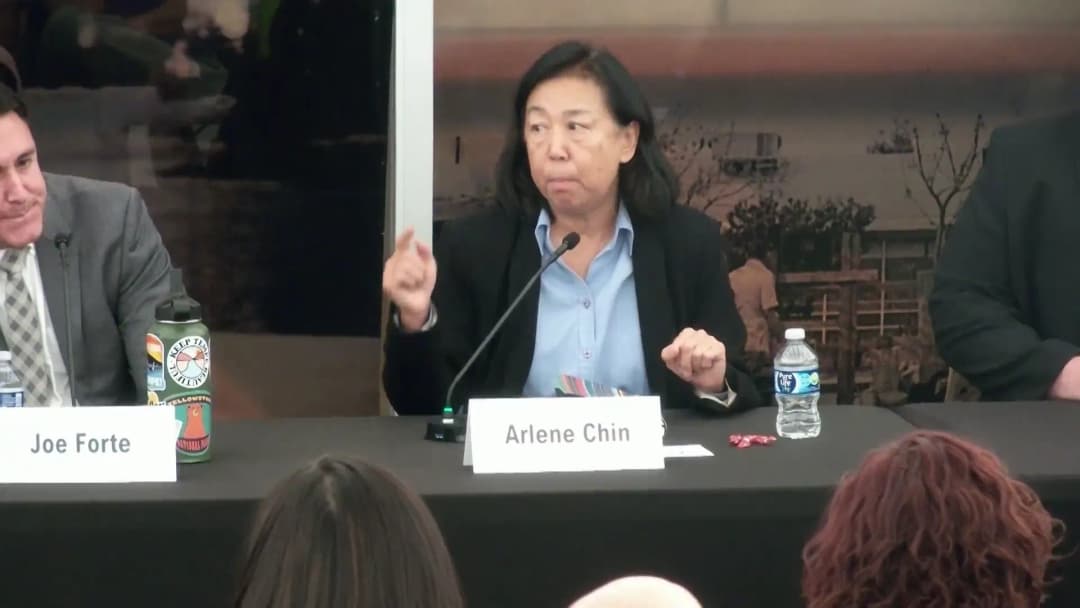
On December 19, 2025, the Tempe Chamber of Commerce hosted a candidate forum for the upcoming March 10th primary election, which is a vote-by-mail only election. Seven candidates—incumbents Jennifer Adams, Arlene Chin, and Burdetta Hodge, along with challengers Bobby Nichols, Joe Forte, Brooke St. George, and Elvis Tesca—took part in a structured discussion moderated by Matt Heil. The forum focused on economic development, public safety, housing, and fiscal responsibility, providing voters with direct access to each candidate's vision and positions. Consent Calendar - No items. (This is a candidate forum; no official council actions or approvals were taken.) Public Comments & Testimony - No public comment period was held; the forum format restricted audience questions to ensure equal speaking time for candidates. All questions were drafted in advance by the Tempe Chamber of Commerce's Good Governance Committee. Discussion Items Minimum Wage Policy - Elvis Tesca: Expressed full support for raising wages above the state minimum to ensure residents and workers are honored for their labor as the city's cost of living increases. - Berdetta Hodge: Expressed a balanced position, stating the need for livable wages while emphasizing the necessity of protecting small businesses through grants and funding if wages are raised. - Brooke St. George: Expressed conditional support, arguing that while workers need livable wages (citing a $600/week calculation), businesses also need support; she advocated for a circular economy approach using grants to ensure small businesses can pay livable wages without failing. - Joe Forte: Expressed opposition to raising the minimum wage, arguing that it discourages the hiring of entry-level workers (e.g., 16-year-olds) and encourages automation, citing California's fast-food industry as an example of job loss. - Arlene Chin: Expressed a preference for moving away from a narrow focus on minimum wage toward upskilling opportunities, advocating for high-wage, high-skill jobs through partnerships. - Bobby Nichols: Expressed full support for a higher minimum wage, arguing that if it had kept pace with productivity since the 1970s, it should be closer to $25/hour to match Tempe's elevated costs for housing, transportation, and groceries; he believes this increases purchasing power that benefits local businesses. - Jennifer Adams: Expressed support for maintaining the current voter-approved minimum wage level without raising it further, arguing that improving housing affordability would be a more effective way to increase residents' expendable income. Budget Priorities and Taxation - Berdetta Hodge: Expressed opposition to routinely raising city taxes, suggesting the city should prioritize securing federal and state grants and lobbying state partners rather than increasing the tax burden on residents, noting that the state already raises taxes annually. - Brooke St. George: Expressed a position against raising taxes on citizens, advocating for smarter resource allocation (sending mental health professionals to non-violent calls) and adopting a "Housing First" model to reduce long-term costs and avoid tax increases. - Joe Forte: Expressed opposition to raising taxes, questioning the return on investment for the increased budget and suggesting revenue should be generated through large-scale events like bringing back a bowl game to Tempe. - Arlene Chin: Expressed concern over a projected $140 million loss in sales tax and a $21 million hit in rental tax, stating clearly that new or increased taxes are not the answer to preserve services. - Bobby Nichols: Expressed support for implementing a 2% transaction privilege tax increase specifically targeting short-term rentals (Airbnbs), commercial shipping, leases, and construction projects to raise approximately $40 million to offset deficits and fund universal pre-k. - Jennifer Adams: Expressed strong opposition to raising taxes, citing her past fiscal responsibility running departmental budgets in the black and her experience navigating three economic downturns; she advocates for budget management over tax hikes. - Elvis Tesca: Expressed a conditional position supporting taxes only if they clearly improve safety, infrastructure, or public education, suggesting that taxes should be levied on large businesses that do not live in Tempe rather than on neighbors, single mothers, or those on fixed incomes. Drink Spiking Mandates - Brooke St. George: Expressed support for the goal of protecting patrons but expressed caution regarding mandates without financial support; she supports subsidies or grants if businesses are required to provide kits. - Joe Forte: Expressed opposition to a blanket mandate, arguing the solution is flawed for different drink containers; he suggested a trial period in a few bars to test efficacy before proceeding. - Arlene Chin: Expressed a position favoring education and partnership with businesses first, stating mandates should be the very last resort. - Bobby Nichols: Expressed full support for the ordinance as currently proposed (where the city pays for tests/covers), viewing it as a necessary protection for ASU students and vulnerable individuals. - Jennifer Adams: Expressed opposition to mandates on businesses, suggesting low-cost DIY solutions (drink tops) and education, viewing mandates as the last resort due to thin business margins. - Elvis Tesca: Expressed a position that high-margin alcohol businesses should bear the responsibility for safety and consent, rather than a blanket mandate on all businesses, while acknowledging the changing culture of drinking. - Berdetta Hodge: Expressed a position of listening and collaboration, serving on the sub-committee where the goal is to ensure safety without financially burdening businesses; she noted current efforts to survey business impacts and utilize grants. Streetcar Expansion to Mesa - Joe Forte: Expressed conditional support, stating he would support the project only if it increases economic activity, specifically citing the Cubs Stadium as a destination. - Arlene Chin: Expressed support for the expansion if it aligns with existing transportation and includes fair funding contributions from Mesa and federal/state partners. - Bobby Nichols: Expressed full support, citing studies that show a $4 return on every dollar invested in public transportation, and advocating for expanded transit to reduce the cost of car culture. - Jennifer Adams: Expressed full support, citing her chairmanship of Valley Metro, federal funding secured by Congressman Stanton, and the economic success of the Apache corridor after light rail installation. - Elvis Tesca: Expressed full support for public transportation infrastructure, highlighting its importance for disabled individuals and college students, and advocating for expanded access to South Tempe. - Berdetta Hodge: Expressed support for expansion but emphasized the need for strong communication and subsidies to protect small businesses along the corridor from closing during construction. - Brooke St. George: Expressed full support, noting the requirement for housing density to secure federal funding and the economic benefits of increased mobility and tourism between Tempe and Mesa. Business License Incentives - Arlene Chin: Expressed full support for incentives similar to Mesa's model, which includes workforce training and development for registered businesses. - Bobby Nichols: Expressed support for incentives focused on assisting with business rentals and wage assistance to support new and local businesses. - Jennifer Adams: Expressed support for the $25 annual fee increase as a means to track businesses and mentor them, stating that successful businesses are the heart of the community. - Elvis Tesca: Echoed support but expressed that incentives should be determined via a survey of small business owners rather than set by the council. - Brooke St. George: Expressed support for dedicating portions of the license fee revenue to workforce development programs like "Career Ready Tempe." - Joe Forte: Expressed opposition to the business license itself, calling it misguided government overreach, though noted he wouldn't fight to undo it; he argued it would not significantly benefit small business owners. - Berdetta Hodge: Expressed support for incentives but emphasized the need for a survey of small business owners to determine what incentives would be most effective. Workforce Development - Bobby Nichols: Expressed support for expanding programs that connect ASU students and the unhoused to local jobs, emphasizing collaboration between the city, university, and chamber. - Jennifer Adams: Expressed support for leveraging local educational institutions like EVIT and the Career Ready program to prepare the next generation. - Elvis Tesca: Expressed concern about the future of jobs due to AI and robotics, advocating for expanded trade skills and collaborative learning between schools and nonprofits. - Berdetta Hodge: Expressed full commitment to integrating AI into schools and connecting the education community with the workforce through her dual role on the Council and the High School District Board. - Brooke St. George: Expressed support for educating youth on non-college pathways, including union training and company training centers. - Joe Forte: Expressed support for existing workforce development partnerships. - Arlene Chin: Expressed a position that workforce development must include upskilling and reskilling for adults, not just students, and highlighted the need to promote apprenticeship programs. Candidate Differentiators - Jennifer Adams: Highlighted her 37 years of service, leadership in annexation and Valley Metro, creating the park ranger program, and securing the Clark Park bond. - Elvis Tesca: Highlighted his local family roots, community legacy, and focus on protecting vulnerable populations like the unhoused and seniors. - Berdetta Hodge: Highlighted her unique dual role as a City Council member and Tempe Union High School District governing board member, plus her state and national lobbying connections. - Brooke St. George: Highlighted her local roots, volunteerism (YMCA, PTO, STEM trips), and experience inside city government. - Joe Forte: Highlighted his work founding "Keep Tempe Beautiful," volunteer coordination for Oktoberfest, and service on the Development Review Commission. - Arlene Chin: Highlighted her 50+ years as a resident, direct communication style, and dedication to studying issues and being fair. - Bobby Nichols: Highlighted his state-level policy experience protecting domestic violence survivors and his position as a public policy advocate changing the political discourse. Key Outcomes - No Voting or Formal Decisions: As this was a candidate forum, no votes, resolutions, or formal directives were adopted. - Election Context Established: The forum clarified that the primary election is on March 10, 2025, with a potential general election on May 19, 2025, if no candidate secures a majority vote. - Platform Divergence Noted: The transcript reveals significant divergence on fiscal policy (specifically the 2% tax increase proposed by Nichols vs. the opposition from Adams, Chin, and Forte) and social mandates (drink spiking kits and minimum wage). - Public Safety Consensus: All candidates acknowledged the seriousness of public safety issues, though they diverged on specific implementation strategies (e.g., streetcar funding, drink spiking mandates, and crime reduction statistics attributed to current council actions by Adams). - Next Steps: Candidates are expected to campaign leading up to the February 9 voter registration deadline. The Tempe Chamber of Commerce Good Governance Committee will later decide which candidates to endorse.
The City of Tempe Board of Adjustment convened to deliberate on an appeal regarding a special zoning administrator's opinion that declared the City legally unable to require a use permit for a detached, two-story accessory dwelling unit (ADU). The central legal dispute involved whether the Arizona state ADU statute preempts the City's local zoning code requirement for a use permit when adding a second story to an existing structure in the neighborhood. Consent Calendar - The Board voted to accept the meeting minutes from November 19, 2025, with five members voting in favor and two members (Kevin Morrow and Ron Keggy) abstaining as they were not present at the prior session. Public Comments & Testimony - Cameron Varbo, a neighborhood resident and supporter of the original zoning restrictions, expressed strong opposition to the new ADU design. He stated he purchased his home specifically because the Broadmore neighborhood consists entirely of single-story homes and emphasized a desire to maintain that character. He characterized the appointment of the special zoning administrator as hiring a "hired gun" to override the existing legal opinions. - Jana Lynn Granillo, a neighborhood advocate, addressed the legislative intent. She argued that it is an error to assume a single, unified legislative intent regarding ADU statutes, noting that individual legislators hold different opinions and agendas. - Don Sinclair (Appellant) provided a rebuttal to the special zoning administrator's testimony. She expressed a clear position of support for the City Attorney's and the original Zoning Administrator's interpretation that a use permit is required for a second story on an ADU built on a lot with an existing single-family home. She argued that the state statute does not explicitly preempt the city from requiring a use permit for a second story if such a permit is required for a similar action on a primary residence. Discussion Items - Legal Interpretation of Second Stories: Don Sinclair argued that the state statute's prohibition on "height" restrictions does not explicitly ban use permits for a second story, especially when a second story adds to an existing structure. She maintained that the City Attorney and original Zoning Administrator provided consistent, four-to-six instances of legal advice over seven months stating the City can require a use permit in this specific context. - Special Zoning Administrator's Opinion: Judge Gary Donahoe presented his independent opinion, asserting that the state legislature intended to eliminate "red tape," including use permits and public hearings, for all ADUs. He argued that requiring a use permit for a second story effectively imposes a restriction not found in the state statute and constitutes an abuse of discretion. He stated his opinion that the statute is "crystal clear" that ADUs are permitted uses and cannot be subject to the public hearing process inherent in use permits. - Standard of Review: Board members questioned whether the standard of review should be de novo or deferential. City Attorney Eric Anderson clarified that while this is a legal question, the standard of review remains whether the special zoning administrator's decision was arbitrary, capricious, or an abuse of discretion, or based on clear error. - City Code Discrepancies: Board members noted that Tempe's requirement for a use permit to build a second story on an existing single-family home is unique to the city. This distinction raised concerns about whether the state law was intended to override this specific local procedural hurdle or if the code conflict needs to be resolved with the City Council. - Precedent Concerns: Some Board members expressed concern about setting a precedent that might allow any ADU to be built without design review if the special administrator's opinion were upheld, potentially affecting neighborhood character. Key Outcomes - Motion to Approve the Appeal: Board members voted to approve the appeal of the special zoning administrator's opinion. - Vote Tally: The motion passed with a vote of 6 to 1. (Members: Kelly Morrow, Lily Drosos, Mary Foy, Kevin Morrow, Katie Cross, Ron Keggy voted Yes; Andrea Samushka voted Nay). - Final Ruling: The Board found that the special zoning administrator's opinion (that a use permit is not required for a two-story ADU) was incorrectly determined. The Board overturned Judge Donahoe's opinion. - Referral: The matter is referred back to the City Council to reconsider the requirement for a use permit for the two-story detached ADU, as the City's original determination that a use permit is required is now the prevailing position of the Board of Adjustment.
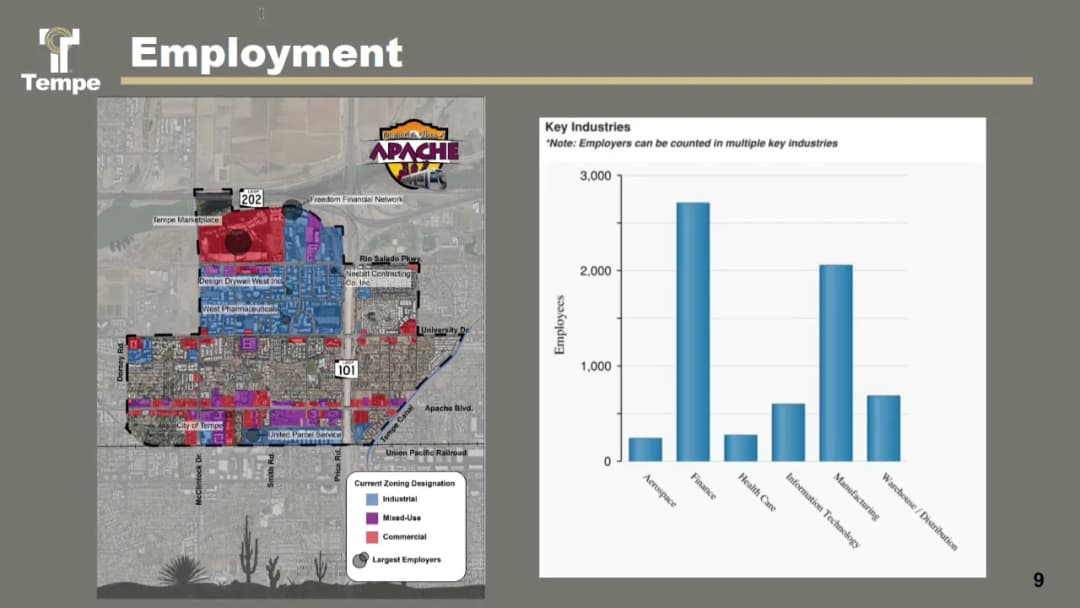
The Tempe City Council convened on December 11, 2025, to address routine administrative approvals, commemorative proclamations, and significant development and ordinance items. The meeting featured tributes to late community leaders Jennifer Johnson and Kevin Daly, recognition of local business Bumblebee Air Conditioning, and updates on recovery efforts following the October 13th microburst. Public comments highlighted strong opposition to specific development proposals and requests for enforcement of noise ordinances. The Council proceeded with unanimous votes on the majority of agenda items, with Councilmember Keating absent due to surgery. Consent Calendar - Approved City Council meeting minutes (6-0, Councilmember Keating absent). - Accepted board, commission, and committee meeting minutes (items 4B1-4B11) (6-0). - Approved the entire consent agenda, including contracts, awards, and miscellaneous items (6-0). Public Comments & Testimony - Mario Martinez (Tempe Resident): Expressed strong opposition to and criticism of Mayor Corey Woods and the City Manager, labeling the City Manager a "puppet" and alleging illegal social media monitoring by the Council; stated full lack of support for the Mayor's administration regarding the arrest of a citizen over a social media post. - Janilyn Granillo (Tempe Resident): Expressed full opposition to a proposed 24-7 autonomous car charging and distribution facility at 2105 South Terrace, arguing the site is inappropriate for single-family and apartment zones; requested a community meeting to explain the implications of HB 2447. - David Alter (Tempe Resident, Homeless): Expressed concern that loud mufflers and backfiring engines are causing physical distress to his dog, Maxie; urged the Council to enforce the 50-decibel noise limit more strictly. - Curtis Wood (Tempe Resident): Expressed firm opposition to the rezoning of the Shalomar Golf Course, noting thousands of signatures are collected against the development and urging the Council to oppose the rezoning. - Carolyn Nelson (Tempe Resident): Expressed full opposition to the rezoning of Shalomar Golf Course, citing safety risks for children and loss of green space; stated support for affordable housing but argued this specific high-density proposal is unsuitable for the location. - Patrick Michelson (Tempe Resident): Expressed strong support for protecting Shalomar as a green space and local landmark; argued the community should decide the fate of the land rather than out-of-town developers. Discussion Items - Climate Action Proclamation (5A1): Mayor Woods declared 2026 a "Year of Recommitment to Climate Action," focusing on heat vulnerability, sustainable building, and carbon neutrality. Staff and Commission member Kendon Young provided testimony, with Young expressing appreciation for the city's recommitment and noting the 70 days of temperatures over 110°F in 2024. - Bumblebee Air Conditioning Appreciation Day (5A2): Mayor Woods declared December 11, 2025, as appreciation day for Bumblebee Air Conditioning after the company donated a free AC unit to the Tempe Women's Club. Owner Lisa Bain expressed gratitude and described the company's philosophy of generosity. - Jennifer Johnson Remembrance (5A3): Mayor Woods declared December 31, 2025, as Jennifer Johnson Day. Council members and the public expressed deep support for Johnson's legacy in early childhood education and her impact on the community. - Kevin Daly Remembrance (5A4): Mayor Woods declared December 11, 2025, as Kevin Daly Day, honoring the late musician. The community expressed support for Daly's legacy in music and recovery support. - Care Inc. Award (5A5): Recognition was given to visionary leaders Hugh Hallman, Corey Woods, and Parrish Spice for founding the "For Our Cities and Towns" movement. - Tempe Needs You Campaign (5A5B): Report stated the campaign raised over $23,000 in three weeks for storm recovery; the community expressed gratitude for the support. - SBA Recovery Updates (City Manager): Danielle Haywood (SBA) and Monique Rodriguez (Emergency Ops) discussed recovery resources, including loans for homeowners, renters, and businesses, and the new Tempe Tree Donation Program; no specific positions taken other than informational advocacy for loan applications. - Apache Character Area Plan (8A1): Staff proposed and presented an update to the Apache plan. Councilmember Garland expressed support and noted the unique history of flood irrigation in South Tempe. Staff proposed amendments to include flood irrigation history; the Council expressed support for the amendment and the plan. - Photovoltaic Ordinance (8C2): Held second public hearing; staff recommended approval to align zoning with state legislation. - Ordinances for Final Adoption: Discussions and votes held on utility easements (8C3, 8C4) and commercial property lease (8C5). - Continuance (8C1): Motion made to continue the short-term rental ordinance discussion to April 16, 2026. Key Outcomes - Approved Resolution: Adopted the updated Apache Character Area Plan, inclusive of staff-proposed amendments regarding flood irrigation history and objectives (6-0). - Contracts Approved: - State cooperative contract for maintenance/repair equipment (8A2). - Contracts for police 911 dispatch furniture (8A3). - Contract for graffiti protection on city facilities (8A4). - Pre-construction contract for South Tempe Water Treatment Plant (8A5). - Construction contract for Grand Canal Multi-Use Path (8A6). - Professional services contracts for pavement quality index acceleration (8A7, 8A9). - Professional services contract for Fire Station No. 8 (8A8). - Park infrastructure improvement contracts (8A10). - Ordinances Adopted: - Ordinance amending photovoltaic use and zoning standards (8C2) (6-0). - Ordinance authorizing partial abandonment of public utility easement (8C3) (6-0). - Ordinance authorizing power distribution easement to Salt River Project (8C4) (6-0). - Ordinance authorizing lease of 125 East Fifth Street (Walker House) (8C5) (6-0). - Continuance: Short-term rental ordinance (8C1) continued to the regular meeting on April 16, 2026 (6-0). - Proclamations Issued: Decrees for Climate Action (2026), Bumblebee Appreciation Day, Jennifer Johnson Day, Kevin Daly Day, and Care Inc. recognition. - Voting: All items passed with a 6-0 vote; Councilmember Keating was absent.
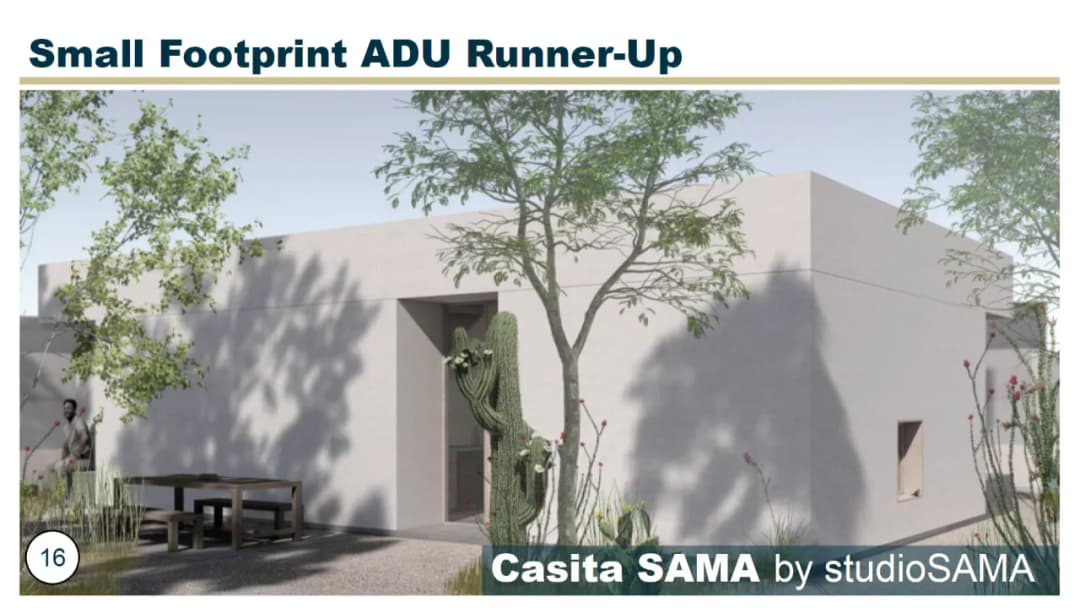
This work study session focused on strategic resource alignment, housing design initiatives, and subcommittee coordination. The meeting included an introductory video on council conduct protocols, a reminder to candidates regarding neutrality during the 2026 election season, and updates on five key strategic performance measures. Public comment was limited to specific agenda items, with one speaker offering data-driven concerns regarding housing shortages. The session concluded with the establishment of a new subcommittee and status reports from existing groups. Consent Calendar - No routine consent calendar items were discussed or voted on during this transcript. Public Comments & Testimony - David Sokoleski: An applicant/resident expressed strong support for preserving existing housing and creating new low-income units. Mr. Sokoleski argued that Tempe must preserve 11,000 low-income units and create at least 6,000 additional units now, estimating a need for 30,000 to 40,000 units by 2050 to address homelessness, particularly among seniors. He criticized the city for ignoring data showing 80% of the homeless population are seniors unable to afford rent due to Social Security limits. He expressed concern that filling buckets of water on a sinking boat (displacing homeless individuals to other municipalities) is not a solution and warned that failing to act will have political costs at the state and national levels. Discussion Items - STRAT Tool Results (Resource Alignment): The Strategic Management and Innovation Director presented the results of the "STRAT" tool exercise where council members allocated 100 theoretical points to 101 performance measures. Five measures received the highest collective totals and averages, identified for acceleration in the performance-led budgeting and TAMP programs: feeling of safety in parks, safety in neighborhoods, ending homelessness, tree and shade canopy, and quality of business services. The Director clarified that these results do not represent a resource allocation but rather a focus for future strategy development, with specific strategies to be presented at the March 23rd work study session. - Accessory Dwelling Unit (ADU) Design Challenge: A report was delivered on the ADU Design Challenge, for which the city received a $20,000 AARP grant. The project selected 10 winning designs across four categories: small footprint, sustainable, accessible, and low-cost. Winners received up to $2,000 awards, fee waivers, and their designs will be featured in a new public plan library. Council members noted the success of using community-designed plans to speed up the permitting process. A new ADU tracking dashboard was also launched, showing 77 total applications since 2020, with the majority occurring after the 2024 ordinance expansion. - Subcommittee Proposals and Updates: - Councilmember Amberg proposed a new subcommittee to evaluate and modernize federal and legislative priorities; Councilmember Keating (by proxy) and Vice Mayor Garland agreed to join. The council granted consensus to form this committee. - Updates provided: - Age-Friendly Tempe: Working on a five-year action plan; next meeting January 27th. - Animal Welfare: Next meeting January 23rd. - Community Engagement: Hosting listening sessions in February and March; next meeting January 20th. - Drug Education (Drink Spiking): No update (Councilmember Keating absent). - Mixed Use Space: Meeting rescheduled to January. - Motorized Mobility: First meeting scheduled for January 7th. - Tempe Town Lake Revitalization: Discussed special events and RFPs; next meeting likely in February. - Term Limits: No update (Councilmember Keating absent). Key Outcomes - Consensus Established: Council approved the formation of a new subcommittee to evaluate federal and legislative priorities. - Strategic Focus Set: Council directed staff to accelerate strategies for five performance measures: park safety, neighborhood safety, ending homelessness, tree canopy, and business services quality. - ADU Program Launched: The ADU Design Challenge 10 winning designs were officially selected and integrated into the city's plan library and tracking dashboard. - Adjournment: The meeting adjourned with the next work study session scheduled for January 15, 2026.
The City of Tempe Board of Adjustment convened at 6:00 PM on November 19, 2025, to conduct administrative review, including the approval of meeting minutes and deliberation on an administrative appeal regarding a reasonable accommodation waiver for a group home. The Board unanimously accepted the minutes before addressing the appeal filed by Umavera Living LLC, represented by Kimberly Rodriguez, concerning the property at 1354 East Benthrop Drive. The core dispute involved a request to increase the maximum occupancy of the residential home from five to ten residents, excluding staff. Consent Calendar - Approval of Minutes: The Board voted 5-0 with one abstention to accept the minutes of the previous meeting (originally scheduled for January 2025 but corrected to October 29, 2025, by the Chair). Public Comments & Testimony - Kimberly Rodriguez (Applicant Representative for Mr. Bayless): - Position: Expressed full support for increasing occupancy to ten residents, arguing that a group of ten is clinically necessary for the residents to "thrive" rather than merely exist in a state of isolation or supervision. Rodriguez positioned the waiver as essential to provide a "loving, comfortable, intimate setting" and ensure meaningful therapeutic peer interactions. - Key Arguments: - Therapeutic Necessity: Cited clinical research and nurse testimony stating that ten residents provide the "critical mass" needed for dynamic group activities, social engagement to slow cognitive decline, and stability for residents with similar functioning levels. Rodriguez contrasted the decline experienced when placed in smaller groups (referencing personal experience with hearing loss) versus larger groups. - Compliance: Stated that the property is in full compliance with all fire life safety codes, has installed fire alarms and emergency lighting, and has adequate parking (three spaces) via driveway and garage, noting that residents do not drive as they have physician orders prohibiting it. - Residential Character: Asserted that the home will remain residential in character, with no institutional appearance, and that the interior changes (converting four bedrooms to eight) do not alter the exterior look of the home. - Precedent: Claimed that the request is materially identical to four recently approved applications, arguing for consistent application of city standards. Discussion Items - Robert Mansolillo (Senior Planner, City of Tempe): - Position: Stated that the City staff does not support granting the waiver. Mansolillo argued that the applicant failed to meet the approval criteria, specifically regarding the nexus between the disability and the specific need for the larger group size and the impact on neighborhood character. - Key Points: - Lack of Nexus: Expressed the opinion that the therapeutic benefits cited by the applicant could be achieved with five residents and that the evidence provided was largely anecdotal or based on financial considerations, which are not valid grounds for a reasonable accommodation waiver. - Neighborhood Character: Contended that changing the property from a four-bedroom to an eight-bedroom configuration would fundamentally alter the residential character of the neighborhood, increasing impacts on parking, water, and sewer systems, even if residents do not drive (due to visitor traffic). - Parking: Noted that an additional parking space would fall within the 20-foot front yard setback, requiring a separate use permit, though the Board was advised this parking issue is procedural and separate from the Board's current scope. - Precedent: Clarified that three of the cited "approved" cases were grandfathered in prior to the 2021 ordinance change, while the fourth approval was unique and reviewed on a case-by-case basis; therefore, they were not considered "materially identical" to this request. - Board Member Miller: - Position: Expressed concern that the evidence presented regarding the therapeutic necessity of ten versus five residents was insufficiently specific to the individual population or backed by empirical data, rather than general opinions or anecdotal evidence. Noted that without specific proof that the condition required a group of that size, the request does not meet the "necessary" criterion. - Board Member Foy: - Position: Expressed uncertainty, noting a personal background in group home management where smaller groups (six or fewer) were standard. While acknowledging the compelling nature of the therapeutic arguments, Foy felt the link between the disability and the specific need for ten residents was not adequately demonstrated, fearing that granting the waiver might negate the intent of the city's recent code change (reducing the standard from ten to five). - Board Member Ap (implied by context of "Eric" and discussions on precedent): - Position: Questioned the consistency of the Board's previous decisions and the lack of specific data supporting the claim that ten is required over five. Raised concerns that generalizing that ten is "clinically better" could effectively undo the statutory change. Key Outcomes - Motion to Deny: Board Member Ap (implied) made a motion to deny the appeal with personal reluctance; the motion was seconded by a member (identified as Robert in the roll call). All members present stated their positions during the deliberation. - Vote Result: The Board voted 6-0 to deny the appeal. - Decision: The request for an appeal of the denial of a reasonable accommodation waiver to exceed the maximum number of residents (no more than five, excluding staff) for Umavera Living LLC at 1354 East Bentrop Drive is denied. The Board concluded that the applicant failed to demonstrate the necessary nexus between the disability and the specific need for a ten-resident capacity. - Next Steps: The Chair noted that the decision does not preclude the applicant from reapplying in one year or pursuing legal action in court, as the Board's decision does not bind external legal proceedings.
The Development Review Commission (DRC) convened on November 18, 2025, to review the commission's 2025 Annual Report, approve the consent agenda, and adjudicate a quasi-judicial appeal regarding address number placement and aesthetics for the Kirene Commerce Plex. Consent Calendar - Unanimously accepted the 2025 Annual Report upon motion by Commissioner Spears and second by Commissioner Tom. - Unanimously approved the Consent Agenda consisting of: - Item 3A: Approved request for a time extension for a development plan review for an addition to Ashley Furniture Edition. - Item 4A: Approved a use permit allowing two required parking spaces within the front yard setback for the Cubisco residents. - Item 5B: Approved the updated recommendation for design and placemaking principles for the Apache Character Area Plan (November 2025). Public Comments & Testimony - Applicant Representative (Kirene Commerce Plex): Expressed full support for the existing address number placement, stating that the numbers meet the 80% background coverage code requirement and the 50% contrast standard. The speaker argued that lowering the numbers to the mid-band would require crossing score lines on two buildings and obstructed visibility due to dense landscaping (Palo Verde and Live Oak trees) mandated by the city's approved landscape plans. The applicant expressed willingness to change the color of the numbers to a uniform "Connors Lakeside" blue and repaint one building background, but opposed the cost and structural damage of relocating the numbers or reducing their size. - Staff (Diana Kaminsky): Stated that while the Commission acknowledges the numbers are legally compliant, the design review process allows for adjustments to enhance compatibility and neighborhood visibility. Staff expressed strong support for uniformity in color, background, and horizontal orientation, and recommended lowering the numbers to the established sign band to mitigate visibility, acknowledging the size could remain large as a concession. - Commissioner Spears: Expressed a position that locating numbers at the top of the building is "more pleasant to the eye" compared to the mid-band location, questioning the aesthetic rationale for lowering them. - Commissioner Tom: Highlighted that there is currently no code requirement for maximum size or location of address numbers, noting that existing large numbers in the city were not previously caught as design review issues, and questioned if the staff's current position was based on code or subjective aesthetic criteria. Discussion Items - Address Number Aesthetics and Location: The Commission deliberated on the appeal to deny the administrative decision regarding the Kirene Commerce Plex address numbers. The applicant presented evidence (including site videos and calculations) that the current 12-inch numbers are functional, visible at night without causing light glare to neighbors (due to upgraded fixtures), and comply with the 80% background code. Staff reiterated that while code was met, the numbers were too large for the scale and proposed lowering them to reduce residential visibility. The discussion clarified that while the applicant and staff agreed on changing the color of numbers and backgrounds to ensure uniformity, the Commission ultimately decided on the location. - Vegetation Visibility Concerns: The applicant argued that the 23 additional trees specified in the city's landscape plan (including Palo Verde and Live Oaks) would obstruct the numbers if lowered to the mid-band. Staff countered that transparent trees like Palo Verde could be strategically placed to avoid obstruction. - Procedural Clarifications: The Commission clarified that the appeal was against a staff denial, and the motion required approval of the appeal (potentially with conditions). The Chair noted that address numbers should be subject to approval during the design review phase to avoid such extended debates in the future. Key Outcomes - Vote Outcome: The Commission voted 4-1 to grant the appeal regarding the Kirene Commerce Plex address numbers. - Commissioner Vote Tally: All Commission members voted in favor except Vice Chair Michelle Schwartz, who voted against the motion. - Decisions and Conditions: The appeal was granted, allowing the applicant to retain the existing size and vertical location of the address numbers. Conditions of approval required the applicant to: - Paint all address numbers the same color ("Connors Lakeside" blue). - Paint one building background to match the others for uniformity. - Ensure all horizontal orientations are consistent. - Install code-compliant lighting fixtures with a finish that matches the building background to reduce visual prominence. - Next Steps: The Commission will move to the next meeting, scheduled for December 9, 2025.