Browse by city
Date range
Search help

Search titles, summaries, topics and stored transcripts together. Keywords may match separately; put the whole query in double quotes for a phrase. Matching follows word analysis, so punctuation is not exact. Both dates are included. Documents are not searched.

SHOWING 21–30 ENTRIES
21
SEP 22, 2026 · TOLEDO, OHIO · CITY COUNCIL
Toledo City Council Formal Meeting — September 22, 2026

The Toledo City Council met in formal session at 4:00 PM on Tuesday, September 22, 2026, in the Council Chambers at One Government Center, Toledo, Ohio. All ordinance and resolution items on the agenda were approved, most unanimously. Items included two recognition resolutions, an audit request for the Flock automated license plate reader system, hotel/motel licensing, a new municipal code chapter, multiple funding and contracting ordinances from the Administration, and council discussion of a Toledo Zoo program change. No official minutes for this meeting were available; this summary is based on the agenda and the meeting transcript. Consent Calendar & Recognitions - R-395-26 (sponsored by Councilwoman Kramer): Recognized Susie's Coats for Kids & Hannah's Socks on their 20th anniversary. The Council noted that the organization, inspired by Susan “Susie” Perry and founded on the belief that no child should go without warm clothing, began with 50 coats, merged with Hannah's Socks in 2023, distributes more than 200,000 new items annually (coats, hats, gloves, socks, pajamas, underwear, shoes, hygiene items, and snack bags) at no charge with no proof of need, and has been named Best of Toledo in the public charity category for two consecutive years. Representatives said the annual distribution day functions like a birthday party where caregivers receive free items, and that 57,000 pairs of Bombas socks will be distributed across the tri-state area next week. Adopted unanimously. - R-396-26 (sponsored by Councilmembers Morris, Gadus, and McPherson): Recognized and honored the Toledo Troopers for their historic contributions to professional football. Councilmembers cited the team's record as the winningest professional football team of all time (58–4–1), its documentary available on Amazon Prime Video, and noted that Trooper Sister Jefferson, a Liberty High School graduate, was previously inducted into the African American Legacy. A Troopers representative said the team was proud to represent the City of Toledo and that the players “wouldn't change it for the world.” Adopted unanimously. Excusals & Approvals - Dispensed with the reading of the Toledo City Journal for the September 8, 2026 meeting. - Granted excused absences to multiple council members for non-attendance at agenda review meetings and committees held September 15–16, 2026, including Zoning and Planning, Public Safety and Criminal Justice Reform, Transportation, and Economic Development and Innovation committees. New Items from Council - O-397-26 (Martinez, Gadus, Morris): Amended Toledo Municipal Code Title 7 to create Chapter 741, adding licensing requirements for motels and hotels. Adopted. - R-398-26 (Williams, Hobbs): Requested an audit of the City's use and oversight of the Flock system, with an emergency clause. Councilman Martinez stated he was not opposed to doing the audit but believed it had “been done prior” and that “funds should be better spent for actually implementation strategies,” and he voted no. Adopted with Martinez dissenting. - O-399-26 (Jones, Gadus, McPherson): Enacted new Toledo Municipal Code Chapter 1766. Adopted. New Items from the Administration - Authorized expenditure of $55,765 from the Capital Improvement Fund to the Lake Erie West Regional Council for the City of Toledo's 2026 transportation planning assessment fee, and payment of not to exceed $82,000 and $79 from the general fund for the 2026 membership fee, with an emergency clause. Adopted. - Councilmember Komives presented four items from the Department of Public Service waiving competitive bidding provisions of TMC Chapter 187, authorizing a two-year contract for services, and declaring an emergency. Adopted. - O-404-26: Amended TMC Chapter 917 (Trees), repealing eight sections and reenacting them with amended language. Adopted. - A budget ordinance increasing the municipal garage revenue fund revenue estimate was adopted. Councilman Martinez observed that no savings were found elsewhere in the budget and that the measure “just increases our expenditures by 1.4 million dollars,” noting an attempt to find savings might be made at year-end closeout. Discussion Items - Toledo Zoo program change: Council members discussed the Toledo Zoo's decision to end a program serving participants with disabilities. One member, describing himself as a longtime Toledo Zoo member, stated the program has 63 participants, of whom only 24 are able to schedule and volunteer independently and may continue with the “zoo teams”; the majority will not continue. He also noted the Zoo has had a major construction project almost every year. Another member echoed the concern, saying it was not clear the Zoo has “operational or financial issues” and that the Zoo “owes it to the community to explain why they would have ended such an important program so suddenly and affected a few dozen kids.” No formal action was taken. - High school engagement: A council member reported that after addressing high school youth, the students raised a matter they described as disturbing; no details or action were captured in the transcript. - Announcements: Councilwoman Kramer announced that Toledo was named Safe Community of the Year by the Ohio chapter of the American Academy of Pediatrics. A council member also indicated that a formal memorial resolution for a recently deceased individual would be brought forward at a future meeting with the family present. Key Outcomes - All submitted measures were approved; only R-398-26 had a recorded dissenting vote (Councilman Martinez). - The Council expressed concern (without a vote) about the Toledo Zoo's termination of a program for participants with disabilities and indicated the administration should look into the situation. - No public comment period or public testimony appears in the transcript for this meeting.
COMMUNITY ENGAGEMENT 26% · PROCEDURAL 24% · PUBLIC HEALTH 14% · ARTS AND CULTURE 9%
22
SEP 21, 2026 · TOLEDO, OHIO · CITY COUNCIL
Toledo Administrative Board of Zoning Appeals Meeting - September 21, 2026

The Toledo Administrative Board of Zoning Appeals (BZA) held a public hearing on Monday, September 21, 2026, at 10:00 AM in City Council Chambers. The board considered four variance cases, including storage of recreational vehicles, signage height, fence height, and driveway/accessory structure compliance. Planning Commission staff recommended disapproval on all cases, but the board did not always follow that recommendation. Public Comments & Testimony - Case 1 (Boat/Trailer Storage): Kathleen Bradley, the applicant, testified that her property is 150 years old and has been in her family for 70 years. She argued that the area where she stores her boat and trailer is historically her backyard, though it faces a street due to dual frontage. She stated that three of four neighbors in the cul-de-sac consider it a backyard and that she never knew it was a front yard until receiving a violation letter. She offered to plant more arborvities to block views. - Charles Dunn (neighbor, 5231 Ottawa River Road) opposed the variance, stating that the boat and trailer are an eyesore and violate city code (1107.802 C) because they are not positioned behind the main residence. He argued that the hardship was self-created and that the boat could be moved to a compliant area on the property. - Sharon Dunn (neighbor) also opposed, calling the boat and trailer a detriment to the neighborhood and embarrassing for guests. - Amanda Liparado (neighbor, 5220 Ottawa River Road) testified that the boat and trailer have been there for five years without moving, creating an eyesore from her front door and office window. - Michelle Sprat (neighbor, 2332 Shoreland Avenue) supported the applicant, stating that moving the boat to the front yard would block the river view for others and that the applicant's property is well kept. - Case 2 (Sign Variance): Brian Heil, owner/developer of Here on Yards (27 North Huron Street), testified that the sign is on a pergola, not a building, and that the pergola is 10 feet tall surrounded by 40-foot buildings. He argued that the spirit of the height restriction applies to buildings, not pergolas, and that he had received multiple approvals from other city departments. He noted confusion between Planning Commission's initial disapproval recommendation and an email received that morning recommending approval. - Case 3 (Fence Variance): Kelly Brown (5151 Angola Road) explained that the 8-foot fence is needed for visual screening, security, and to prevent inoperable vehicles from being parked on their property by a neighboring used car lot. She expressed openness to a 6-foot fence and concern about safety on the curved road. - Case 4 (Driveway and Accessory Structures): Michelle Sprat (2332 Shoreland Avenue) described a five-year history of confusion with city permits, including receiving approvals then later being cited for non-compliance. She stated that her driveway was not enlarged, only resurfaced from stone to concrete per city instructions, and that she had certificates of occupancy for a gazebo and detached garage. She felt harassed by the city. Discussion Items - Case 1: Variance for Boat/Trailer Storage (Failure to Provide Case Number, Located on Ottawa River Road) The applicant requested a variance to store a boat and trailer in what she considered her backyard but which is legally a front yard due to dual frontage. Planning Commission staff (Esther) clarified that the code prohibits storage of recreational vehicles in front yards and that the applicant has sufficient room behind her garage to store both items, so no true hardship exists. After hearing from all parties, a board member stated she would not allow the variance because the boat can go in the back. The variance was denied. - Case 2: Variance for Sign Height (BZA26-00034, 27 North Huron Street) The applicant requested a variance to allow a sign on a pergola to extend above the height of the structure (per Toledo Municipal Code 1113.0304B). Planning Commission staff explained that pergola is considered a building under zoning definitions, so a sign permit is required and the variance is needed. The applicant argued that the pergola is not a building and that lowering the sign would change the approved aesthetic. The board voted to approve the variance. - Case 3: Variance for Fence Height (BZA26-00038, 5151 Angola Road) The applicant requested an 8-foot fence in the front yard of a double frontage lot in an IL zone. Planning Commission staff noted that a 3.5-foot fence is allowed without a variance. The board discussed safety concerns on the curved road, potential for fence damage, and the possibility of a compromise with a 6-foot fence further from the street. A motion to defer the case to allow the applicant to work with Planning Commission on an alternative plan was made and seconded. - Case 4: Variance for Driveway Width and Additional Accessory Structures (BZA26-00039, 2332 Shoreland Avenue) The applicant sought variances for a driveway exceeding maximum width and for additional accessory structures (sheds). Planning Commission staff stated the driveway was not installed per approved plans (missing a required 3-foot separation) and that the curb was not cut for the new portion. The board expressed confusion due to conflicting records, permits, and certifications. Council Member Gloria Shepherd offered to personally investigate the matter. A motion to defer the case was made and seconded. Key Outcomes - Case 1: The board voted to deny the variance for boat/trailer storage. (Vote: majority denied; one member abstained? The transcript indicates "Denied" and "Variance has not been approved." No explicit tally was recorded.) - Case 2: The board voted to approve the sign height variance. (Motion approved with all members voting yes: Chris, Denise Williams, Devon Overton, Robert Pasker, Gloria Shepherd.) - Case 3: The fence variance case was deferred to allow the applicant to work with Planning Commission on a revised plan (e.g., 6-foot fence or graduated heights). - Case 4: The driveway and accessory structure variance case was deferred, with Council Member Shepherd undertaking an internal review of the city's permitting history. - The board also approved the minutes from the previous August meeting.

ZONING AND PLANNING 86% · PROCEDURAL 11% · PUBLIC SAFETY 2% · ECONOMIC DEVELOPMENT 1%
24
SEP 17, 2026 · TOLEDO, OHIO · CITY COUNCIL
Toledo Public Safety Committee Reviews Diversion Study and Flock Cameras on Sept. 17, 2026

The Public Safety & Criminal Justice Reform Committee met on Thursday, September 17, 2026, at 4:00 PM in City Council Chambers. The agenda included two primary topics: an update on the Toledo Municipal Court Diversion Study and a discussion regarding the use of Flock license plate readers and surveillance cameras. Presentations were given by the Access to Justice Lab at Harvard Law School, Toledo Municipal Court, the Toledo Police Department, and Common Pleas Judge Lindsay Navarre. The meeting concluded with extensive public comment, with the majority of speakers opposing the continued use or expansion of Flock technology. Consent Calendar - No consent calendar items were presented. Public Comments & Testimony - Richard Arnold urged council to avoid rash decisions and instead conduct an independent audit before any termination or disruption of Flock cameras. - Janice Flaherty opposed Flock cameras, arguing they violate Fourth Amendment rights and constitute unconstitutional surveillance without a warrant. - John Dorn spoke against Flock, alleging disingenuous talking points and pointing to misuse in other jurisdictions; he claimed the system allows searches with nonsensical reasons and is linked to broader databases (LEADS, NCIC). - Paul Via Franco (Abriendo Puertas para Soluciones / Privacy First) opposed the technology, arguing it shifts the presumption of innocence to guilt and enriches a corporation with no stake in Toledo; he advocated funding after-school programs, job training, and community policing instead. - Enrique Garcia opposed Flock, stating it is an unpopular surveillance tool with no room for mistakes and that outside agencies have access to data. - Susan Keene (Northwest Ohio Peace Coalition / Privacy First) strongly opposed Flock expansion, claiming TPD shares data with 269 jurisdictions in 27 states that have 287(g) agreements with ICE, thereby violating Toledo Ordinance O-094-26 designed to protect immigrants. - Baltimore Velasquez (representing the other "Flock" – a community organization) stated the benefits of Flock cameras do not outweigh the risks, especially for mixed-immigration-status families, and that federal agencies can easily access the data. - Sean Nestor expressed offense at council's handling of the issue, alleging misrepresentation of concerns and ignoring constituents; he urged council to do soul-searching. - Alison Pritchard (certified internal auditor, city advisory audit committee) called for independent, ongoing audits rather than vendor-configured flags; she noted TPD is not reviewing access beyond automated flags. - Jessica Molina (El Centro Hub) argued that Flock data sharing violates the promise of Ordinance O-094-26 because data flows to jurisdictions with 287(g) agreements, and that an audit only shows what has already happened. - Anita Rios (resident of District 4) stated she does not feel safer despite Flock cameras in her area, calling the technology an illusion of a solution. - Peggy Masterson cited Orwell's 1984 and warned that liberty is lost incrementally through surveillance. - Austin Gray (computer science graduate) shared his own FOIA audit of Oregon, Ohio, showing that federal agencies including ICE (3,700 searches), FBI (36,000), and USPS (39,000) searched Oregon's Flock data; he submitted a FOIA to Toledo and offered to discuss results. - David Geddert accused Flock of lying about capabilities, noting features like geo-search and convoy analysis; he argued that tracking by bumper sticker equates to tracking by belief, violating freedom of association (NAACP v. Alabama). - Maurice Morris raised privacy concerns and referenced Carpenter v. United States regarding historical location data; he doubted that deleted data is truly gone. - Gavin Moss stated there is no public data showing Flock reduces crime, citing false-positive rates in other cities (e.g., 70% in one California town). - Lewis Vailhorst questioned the lack of a clear vision for Flock (license plate reader vs. broader surveillance) and warned that Flock as a company ultimately seeks data for profit. - Joe (roommate of Gavin) urged strong oversight if cameras remain, noting that Flock is part of a larger surveillance state. - Michael Haynes (Toledo Police Patrolman's Association) expressed split views: police need Flock to offset manpower losses and solve crimes, but he acknowledged privacy concerns and urged council to implement proper safeguards. - Mandy Lehman (crime victim and former foster youth) valued privacy as a protection; she opposed Flock because it invades privacy and data can be shared across state lines, harming vulnerable communities. Discussion Items Toledo Municipal Court Diversion Study Update - Renee Dancer (Access to Justice Lab, Harvard Law School) and Lisa Falgiano (Court Administrator) presented preliminary data from the ongoing evaluation of the court's persistent low-level offender diversion program and a community service condition. - Enrollment: As of early September 2026, 744 participants had enrolled, well ahead of the expected 648 (60% of the target vs. 51% expected). The projected enrollment completion moved from March 2028 to December 2027. - Demographics: Random assignment is working; participants are similar across groups by race and age (mean age 35). - Completion rates are high; most cases are dismissed upon successful completion. Mean case length is about seven weeks. - Preliminary data (not yet causal) show very low post-enrollment recidivism in both groups. Participants are also not yet engaging heavily with community housing services (HMIS), but follow-up is ongoing. - Successes: Strong local partnerships (law department, public defender, prosecutor, mayor's office, clerk of court, court). Regular data collection with ODRC (monthly) and HMIS (quarterly). - Challenges: Labor data from Job and Family Services and OLDA is not yet available due to data-sharing agreement delays and staff turnover. Minor referral/re-referral errors have been addressed through training. - Judge Coleman emphasized that the program holds people accountable without a conviction, and early data suggest both groups are not re-offending. He noted the program costs less than $40,000 per year. - Council President Williams praised the program, noting 60% of participants had charges dismissed and recidivism is low. - Councilman Sarantou asked about the program's start (2017), non-completion rates (less than one-third), and overall criminal caseload decline (estimated 35% since Judge Coleman started 20 years ago). - The committee expressed strong support for the study and looked forward to final results. Flock Camera Discussion - George Kral (Chief of Safety and Internal Services) opened by stating the city supports Flock as a modern investigative tool with clear policies and oversight. - Chief Trentley emphasized that Flock cameras act as a deterrent and help solve homicides quickly; Toledo's homicide clearance rate is 86% (national average 61%), up from under 60% before Flock (2022). He warned that removing cameras would likely increase crime and victims. - Assistant Chief Braun provided specifics: since 2022, Flock has helped recover over 100 stolen vehicles, cleared 48 missing persons cases, and was used in 68% of 210 homicides; 17 solved homicides would likely have gone unsolved without Flock. He gave examples of locating missing elderly individuals with dementia. - Lieutenant Cook explained system capabilities: images are retained 30 days, then automatically deleted. All searches require an offense type and reason; the system logs all activity. Only 0.4% of captured plates are ever searched. Top search reasons: stolen motor vehicles, hit-and-run, wanted persons, homicide/death investigations, drug investigations. - Audit tools flag suspicious behavior (e.g., single user searching the same plate repeatedly, only searching outside Toledo). Flags are reviewed by supervisors. No misuse by TPD officers has been found. - Data sharing: TPD shares with 2,235 organizations; 437 in Ohio. Federal sharing requests are turned off. Immigration and reproductive care searches are blocked from hitting TPD's network. - Transparency page: Available online with search counts, offense types, and data retention information. - Councilman Driscoll expressed concerns about third-party control of data and AI risks; he suggested a system like LEADS (regulated by Ohio AG) and proposed a pause pending an audit. - Councilwoman Gaddis noted she submitted a public records request 78 days ago with no response; she stated her constituents oppose mass surveillance and want a pause. - Councilman Sarantou clarified that Flock identifies only license plates, not drivers, and that misuse leads to discipline up to termination; he read supportive communications from a Washington Township resident and Judge Navarre's editorial. - Councilwoman Kramer stressed the need for oversight and regular audit information, noting she and Gaddis had requested an audit but received nothing in 78 days. She asked about school safety deterrent effect; TPD said they cannot guarantee prevention but the system aids response. - Council President Williams (District 4) expressed strong support, citing Flock's role in solving the murders of Joseph Johnson (age 16) and an 8-month-old baby in her district. She called for an audit but opposed a pause. - Councilman Martinez described his District 2 Safety Initiative: voluntary participation by schools, exterior cameras only, activated via 911 call, plus additional public-right-of-way cameras. He noted District 2 has the fewest cameras in the city. After hearing concerns, he stated he would hold the proposal in committee until an independent audit is complete and any recommendations are incorporated. - Judge Lindsay Navarre (Lucas County Common Pleas Court) testified that Flock technology was pivotal in solving several high-profile murders (Jasmine Queen, Jediah Carter, Charles Walker/Brent Kohlehofer, Darnell Jones). She argued that courts have found no reasonable expectation of privacy in a license plate on a public roadway and that the community would be less safe without Flock. She suggested a framework similar to LEADS for oversight. Key Outcomes - No formal votes were taken during the committee meeting. - Councilman Martinez voluntarily agreed to hold his District 2 Safety Initiative (O-286-26, O-307-26, R-398-26) in committee pending the completion of an independent audit of Flock camera use by the city auditor. - Multiple council members (Gaddis, Kramer, Driscoll) expressed support for an independent audit; Council President Williams had already introduced a resolution for an audit. - The committee received the diversion study update with strong praise and will continue to monitor progress toward completion in late 2027. - The meeting was adjourned after public comments.

PUBLIC SAFETY 41% · PRIVACY RIGHTS 23% · TECHNOLOGY AND INNOVATION 14% · PENDING LITIGATION 8%
25
SEP 16, 2026 · TOLEDO, OHIO · CITY COUNCIL
Toledo Transportation Committee Meeting: Lake Erie West Regional Council – September 16, 2026

The Transportation Committee of the Toledo City Council held a formal agenda meeting on Wednesday, September 16, 2026. The sole substantive agenda item was a presentation on the Lake Erie West Regional Council. Because of the meeting location, no livestream was available. This summary is based solely on the agenda, as no minutes or transcript were available. Meeting Details - Agenda-listed time and location: 2:00 PM, 21st Floor Large Conference Room, One Government Center, Toledo, OH 43604. - The source materials' timestamp records the meeting as taking place at 2026-09-16 19:00:00+00:00 (3:00 PM EDT), a one-hour discrepancy from the agenda-listed time. This conflict is noted rather than resolved. - The agenda included an Americans with Disabilities Act accommodations notice, requesting 48 hours' advance notice by calling 419-245-1060. Agenda Items - Presentation on Lake Erie West Regional Council (agenda item TRANSP20260916). The stated purpose of the meeting was to discuss this item. The agenda does not describe the content of the presentation. - Any other matter that may properly come before the Committee. Records Note - No meeting minutes were available. - The raw transcript was empty. - As a result, no public comments, committee discussion, or speaker positions can be reported. Key Outcomes - No decisions, votes, directives, referrals, or next steps are recorded in the available materials.

26
SEP 16, 2026 · TOLEDO, OHIO · CITY COUNCIL
Zoning and Planning Committee Meeting - September 16, 2026

The Zoning and Planning Committee considered six items: two zone changes, three special use permits (SUP), and one local landmark designation. The committee made recommendations to the full City Council, including approval for most cases and disapproval for a proposed gas station SUP after strong community opposition. Public Comments & Testimony - Case 5 (Gas Station SUP): Multiple residents from the Old West End neighborhood spoke in opposition. Gregory Kane (411 Boston Place) noted the applicant owns multiple gas stations in Detroit and does not live in Toledo, and argued the area already has five gas stations within a mile. Carol Couchet (2483 Scottwood Ave), a 30-year resident, cited concerns about gang activity and violence near existing gas stations. Sue Jones (2516 North Detroit, Detroit Stop) spoke in favor, stating the neighborhood needs a gas station and that negative activity is not exclusive to her store. Tammy Mikelack (2056 Scottwood Ave) presented on behalf of the Women of the Old West End Association, arguing the proposal fails to meet approval criteria under Toledo Municipal Code Section 1111.0706, including incompatibility with the Forward Toledo plan, lack of public need (six gas stations and six convenience stores within one mile), negative impacts on safety, property values, and environmental concerns. Tony Moore (2369 Robinwood) and Lori Hammond (921 Nessawood) also opposed, with Hammond questioning transparency and noting the owner did not provide renderings. Lynn Sheehan (444 Kenilworth Ave) raised safety concerns about unregistered fuel tanks and urged support for thoughtful planning. Joyce Singer (662 Collins St) listed 14 gas stations/convenience stores within a two-mile radius, arguing these businesses take advantage of the underserved community. - Final Public Comment: Richard Arnold (3305 Middlesex) addressed a recent settlement (Singletary v. City of Toledo) related to a group home, urging the committee to revisit group home policies to avoid future litigation. Discussion Items - Case 1 – Zone Change (1302 Kelsey Ave): Applicant Macy Obu requested a change from CO (Office Commercial) to RD6 (Duplex Residential) to convert a legacy commercial building back to residential use. The property was previously residential and is surrounded by residential. Plan Commission recommended approval with no opposition. Councilmember Gaddis recommended approval. - Case 2 – Zone Change (3910 Haverhill Dr): Applicant Craig Joseph requested a change from IL (Limited Industrial) to CR (Regional Commercial) to restore an existing commercial use. The property had been changed to industrial but plans for a warehouse fell through. A tenant plans a used car business. Plan Commission recommended approval with no opposition. The committee member representing the district (Chair Gaddis? – unclear) recommended approval. - Case 5 – Special Use Permit – Gas Station (2485 N Detroit Ave): Applicant Boron Gobo requested an SUP to reopen a gas station with convenience store (no alcohol, no lottery initially). Plan Commission recommended approval in a 3-2 split vote with 38 conditions. Two neighborhood meetings were held; the second was well attended with concerns about traffic safety and land use. Councilmember Driscoll argued the use is not walkable and contradicts the Forward Toledo plan, and questioned how the transportation department approved the site without a left-turn lane. Councilmember McPherson expressed concern that the applicant lives in Michigan, does not know the community, and has unpaid taxes. President Williams recommended disapproval based on code criteria (safety, property values, environmental impact). No objection was raised. - Case 3 – Special Use Permit – Tow-Away Vehicle Storage (5825 Angola Rd): Applicant Eric Stearns (PySecki Towing) requested an SUP for storage of tow-away vehicles. The property has a long history of transportation-related use. Plan Commission staff recommended disapproval due to a spacing requirement near residential, but Plan Commission recommended approval (5-0) with 29 conditions and two waivers. No public opposition. Councilmember Martinez recommended approval with a one-year review to ensure compliance. - Case 4 – Special Use Permit – Scrap and Salvage Facility (4103 LeGrange St): Applicant Gary Gersick (on behalf of RM Recycling) requested an SUP to expand an existing operation. Plan Commission recommended approval with 44 conditions and three waivers. The applicant requested modifications to waive conditions on parking, gravel surfacing, sewer inspection, and a sign. Director Catrell noted the sign should be brought down per code. Councilmember Driscoll supported retaining the sign condition. Councilwoman Morris visited the site and recommended approval with most waivers approved but sign condition retained and parking waiver disapproved. - Case 6 – Local Landmark Designation – Dura Building (4500 N Detroit Ave): Ellen Rodriguez (Thomas Porter Architects) presented the history of the Dura Manufacturing Company, a major automotive parts manufacturer with over 300 patents, which operated from 1928. The building is proposed for warehousing and light industrial reuse. Plan Commission staff supported the designation to enable state tax credits. No opposition. Councilmember Gaddis expressed enthusiasm for preserving history. The committee member for District 6 recommended approval. - Director’s Report: Director Catrell previewed upcoming studies: modifications to industrial site plan review thresholds for small additions, a gas station study (likely November), the zoning code rewrite (consultant Code Studio to present in third week of October with community engagement), progress on stock designations, group home reasonable accommodation policies (in coordination with Ability Center and Fair Housing Center), an industrial study, and a complete streets guide. Key Outcomes - Case 1: Recommended approval by committee. Will go to full City Council on October 6, 2026, at 4 p.m. The applicant does not need to attend. - Case 2: Recommended approval by committee. Will go to full City Council on October 6. - Case 5: Recommended disapproval by committee (based on safety, property values, environmental impacts). Will go to full City Council on October 6. - Case 3: Recommended approval with conditions and waivers, plus a one-year review. Will go to full City Council on October 6. - Case 4: Recommended approval with conditions, with specific recommendations on waivers: the sign waiver (Condition 40) was recommended to be retained (sign must be brought down), the parking waiver (TMC 1107.1202) was recommended for disapproval, the gravel waiver for the southern area (TMC 1107.1906) was recommended for disapproval (the applicant accepted this), while other waivers were approved. Will go to full City Council on October 6. - Case 6: Recommended approval for local landmark designation. Will go to full City Council on October 6.

ZONING AND PLANNING 37% · COMMUNITY ENGAGEMENT 26% · PROCEDURAL 10% · PUBLIC SAFETY 8%
27
SEP 15, 2026 · TOLEDO, OHIO · CITY COUNCIL
Toledo City Council Agenda Review: September 15, 2026

The Toledo City Council held its agenda review meeting on Tuesday, September 15, 2026, in Council Chambers at One Government Center. The agenda listed a 2:00 PM start; the meeting record timestamp indicates 19:00 UTC (3:00 PM EDT), and the record notes that no minutes are available. The session reviewed items scheduled for the September 22, 2026 full council meeting; no formal votes were taken, as final action occurs at the subsequent council meeting. Participants included Council President Williams and Councilmembers Morris, Kramer, McPherson, and Driscoll, along with Commissioner of Government Affairs Simon Neek, Director McColaichik, and Department of Public Service staff. Consent Calendar - TMP-12882: Recognizing Susie's Coats for Kids and Hannah's Socks on the occasion of their 20th year anniversary (sponsor: Kramer). - TMP-12883: Recognizing and honoring the Toledo Troopers (sponsors: Gadus, Morris, and McPherson; the transcript spells the first sponsor's name “Gaddis”). - Both recognition resolutions were reviewed without objection and are scheduled for the September 22 council meeting. Discussion Items 1. Summit Street Embankment Stabilization Grants (Item 1) - The administration presented legislation authorizing the mayor to accept and enter into grant agreements for an embankment stabilization project on Summit Street, described as one of the most important routes in and out of the Point Place neighborhood and the northern end of a future continuous multi-use corridor. Councilmember McPherson stated that whoever is selected to do the work should hold a public meeting so citizens can see what will happen. 2. Recycling Contamination Audit (Item 2, Department of Public Service) - The Department of Public Service requested a waiver of competitive bidding to contract with GT Environmental for a contamination audit, with the goal of gaining additional data on contamination and identifying improvements to reduce overall costs. Fieldwork would collect five samples per district, approximately 30 samples citywide. - Multiple councilmembers questioned whether a full audit is the highest and best use of funds when prior audits had already identified issues, and suggested a modified audit with some funds redirected to marketing and education. Several members agreed that residents do not go to the city website for information; one member noted the city spends about $1 million annually on its marketing and communications department and questioned why water-bill inserts could not promote recycling guidance. - The administration responded that the previous effort was a “snapshot audit” and that the proposed audit would provide substantially more data. Council requested, by referral, that the administration provide the prior audit's recommendations and details on whether full recycling has been implemented at all city facilities. 3. Smart Tree Inventory Contract (Items 3–5, Department of Public Service) - The administration presented a professional services contract to create a smart tree inventory using LIDAR data, which it said would provide a more accurate and consistent way to document and manage tree assets and prioritize maintenance. The contract would run two years with up to three one-year renewals. - Councilmembers asked whether the effort duplicates LIDAR data previously presented (the presenter is transcribed as “Lee Kiry West”) and whether existing LIDAR could be shared. The administration said the RFP process had addressed whether existing LIDAR would be compatible. - The administration stated that no full in-person tree census or inventory had been conducted in more than 15 to 20 years; the last known asset data transfer to the city's operations occurred in 2012. - Procedural outcome: The administration will attempt to provide answers by the next council meeting. If the questions are not resolved, the item will remain at first reading rather than being advanced through the SCP procedure. 4. TMC Chapter 917 (Trees) Amendment: Permit Fee - A council sponsor introduced an amendment to remove the clause in Toledo Municipal Code Chapter 917 providing that permits under the chapter “shall be issued without requirement of any fee.” The sponsor and staff clarified that the change does not create new permits; it removes a no-fee provision. - Multiple councilmembers expressed concern that residents may not know a permit is required, that the fee amount is unknown, or whether the fee would be scaled, and that homeowners who had already suffered tree damage would have no recourse to recover costs and could face stop-work orders. One member stated reluctance to add a fee without knowing the amount. - Staff said notification should be the city's responsibility only when the city performs the inspection directly or receives a direct service request or concern. 5. TMP-12885: Motel and Hotel Licensing - The legislation adds TMC Chapter 741 to require licensing of motels and hotels. A sponsor explained that Ohio currently issues these licenses and that the city had tried unsuccessfully to work with the state on problem properties. - The sponsor stated that people have been living in some motels and hotels as their primary residence for more than two years, contrary to state code, and that the city has brought in nonprofits (including 211, the Ability Center, the veteran center, and the homelessness board) to connect residents to services. - The proposed $400 fee matches the city's convenience-store licensing approach. The sponsor said the city is “not trying to overregulate, but the reality is the state won't do anything and it's best at the local level” to enforce local regulations. 6. TMP-12884: Audit of the Flock License Plate Reader System - Council President Williams and Councilmember Hobbes sponsored an emergency resolution requesting an audit of the city's use and oversight of the Flock system, citing resident concerns about the use, access, and sharing of information under city control or supervision. - A sponsor described the goal as providing clarity about how city employees interact with the Flock system. A public safety committee meeting was announced for the following Thursday and will include a discussion of the Flock system. 7. TMP-12894: Retaliation Prohibited (TMC Chapter 1766) - The ordinance was sponsored by Councilmember Brittany Jones and Councilmember Teresa Gadus (spelled “Gaddis” in the transcript); co-sponsors were not present. It was developed with the Fair Housing Center, whose “very patient members” attended. - A speaker reported that the Fair Housing Center texted individuals who had contacted the organization, drew just under 200 responses, and found that more than 50 percent of respondents rated their experience at the maximum level on a 1-to-5 scale (the transcript cuts off before stating what was rated). - The ordinance is closely modeled on Cincinnati's retaliation rule. A speaker noted that Cincinnati, Columbus, and Cleveland have all updated their local housing codes and that local housing code is “one thing that we can control locally.” The speaker also said tenants “might have rights under the landlord-tenant act, but they are afraid to say anything.” - In the surrounding housing discussion, a speaker cited Durant saying that Toledo Public Schools has over 2,000 students who are homeless. Key Outcomes - No formal votes were taken; the session produced referrals and procedural direction for the September 22 council meeting. - Summit Street grant item: reviewed, with a council request that a public meeting accompany the project work. - Recycling audit: council requested, by referral, the prior audit's recommendations and information on full recycling at city facilities; several members indicated the audit could be scaled back in favor of marketing and education. - Tree inventory contract: deferred pending administration answers by September 22; if unanswered, the item continues at first reading. - TMC 917 amendment: no action; concerns raised about unknown fees and public awareness. - TMP-12885 (motel/hotel licensing), TMP-12884 (Flock audit), and TMP-12894 (retaliation) were reviewed and will proceed to the September 22 council meeting; the Flock audit is an emergency resolution.

SOLID WASTE MANAGEMENT 18% · WATER AND WASTEWATER MANAGEMENT 16% · ENGINEERING AND INFRASTRUCTURE 12% · PUBLIC ENGAGEMENT 11%
28
SEP 15, 2026 · TOLEDO, OHIO · CITY COUNCIL
Economic Development & Innovation Committee Hearing on AI Strategy - September 15, 2026

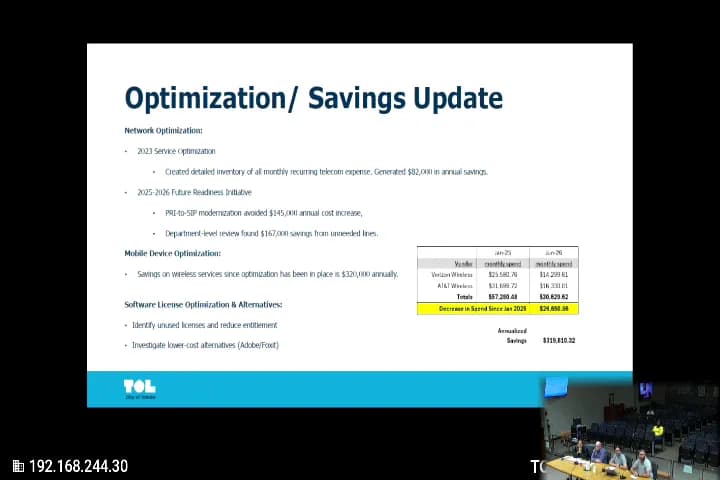
The City of Toledo's Economic Development & Innovation Committee met on Tuesday, September 15, 2026, at 4:00 PM in City Council Chambers to discuss the city's evolving AI strategy, including workforce technology updates, data governance, and the responsible use of artificial intelligence. The meeting was led by committee members and featured a detailed presentation from the city's IT and HR leadership. Public Comments & Testimony - One member of the public spoke, expressing frustration that workers and their representatives are often brought in "for the money" but not included in the decision-making process. The speaker emphasized the need for the public and labor to be part of the conversation around technology changes. Discussion Items - Employee Portal & Time/Pay System: The administration provided an update on the forthcoming employee portal, noting that employees will gain access to self-service features, including direct deposit updates. The time and pay system will launch slightly before the portal to allow IT, HR, and payroll teams to manage the go-live process effectively. - CityWorks Upgrade: The administration reported on the upgrade to the CityWorks environment, transitioning users to 'CityWorks Respond,' which will replace the current 'CityWorks Office Companion.' This on-premise upgrade is intended to provide a smooth transition rather than forcing a direct move to the cloud. - Network Optimization & Phone Systems: Officials reported on the ongoing network optimization project. They are disconnecting unused cell phone lines (e.g., devices with 90 days of inactivity) and evaluating the use of soft phones to save costs. The administration noted that replacing the phone system would be a significant expense and that they would consult department heads before making decisions. - AI Policy Framework: The administration walked the committee through the new administrative AI policy. Key components include restrictions on AI agents that take autonomous action, a section for exceptions (which would require approval from the Mayor's office and the Law Department), and a requirement for vendors to disclose AI use in their security policies. - Data Governance Concerns: A council member expressed concern about the role of the Clerk of Council in data governance, particularly regarding historical physical records and how the policy treats data owners and stewards. The council member asked whether data definitions should include both digital and analog formats. The administration acknowledged the issue and agreed it was an important topic for future consideration. - Judicial and Court Data: The discussion briefly touched on whether the AI policy applies to the court system, specifically regarding jury candidate screening. It was noted that courts under the city's purview would not be permitted to use AI for this purpose without an exception. - Training & Development: The administration outlined a two-way approach to employee development, preparing employees for changing job roles through partnerships with external resources, including JobsOhio and the University of Toledo. A council member praised the strategy, comparing the impact of AI to previous technological shifts such as the tractor, and stressed the importance of preparing employees for new-economy jobs. - Human Interaction in Government: A council member emphasized that regardless of technology, maintaining human interaction is critical, especially in government, citing feedback from a resident who wanted to feel heard. Key Outcomes - The committee received the AI strategy update and provided direction to continue refining the administrative policy. - The administration will work with council members to address data governance, records retention, and the role of the Clerk of Council. - A future committee hearing will be scheduled to continue the discussion, with notice to be provided by the committee chair. The meeting adjourned without any formal votes or resolutions.

TECHNOLOGY AND INNOVATION 70% · PUBLIC SAFETY 6% · DATA GOVERNANCE 6% · WORKFORCE DEVELOPMENT 5%
29
SEP 10, 2026 · TOLEDO, OHIO · CITY COUNCIL
Toledo City Plan Commission Meeting - September 10, 2026

The Toledo City Plan Commission held a formal meeting on Thursday, September 10, 2026, at 2:00 PM in Council Chambers at One Government Center. The meeting addressed multiple zone changes, a text amendment, and three local landmark designation requests. Several cases were deferred or withdrawn, and landmark designations for two Catholic churches generated significant public comment and debate. Consent Calendar (Procedural Actions) - Z26-0015 – Zone change at 2517 Fulton Street: The applicant requested and was granted a 60-day deferral to the November agenda, carried unanimously. - V-325-26 – Alley vacation north of Western Avenue: Withdrawn by the applicant. - SUP26-0019 – Special use permit for a daycare center at 662 Phillips Avenue: Postponed for 30 days. Discussion Items & Public Comments Z26-0016 – Zone Change for Toledo Zoo Parking Lot (866 Bartley Place) - Staff recommended approval, citing compatibility with existing land uses and nearby zoning. The applicant (Nathan Decker, 2700 Broadway) stated the change would bring a newly developed parking lot into the zoo's institutional campus master plan. One neighbor had general questions but no objection; a neighborhood meeting also drew no objections. The commission unanimously approved the zone change. M-5-26 – Text Amendment for Industrial Site Plan Review Threshold - The Plan Commission acted as applicant. Staff proposed exempting industrial site expansions disturbing less than 2,500 square feet from minor site plan review, replacing it with a certificate of zoning compliance. The amendment includes a clause allowing the planning director to require review when appropriate. No public correspondence was received, and the commission unanimously approved. The case goes to City Council on October 21, 2026. M-15-26 – Local Landmark Designation: Viking Lodge (1623–1627 Broadway) - The applicant (Julie Apt, 8 North St. Clair) requested designation for the building, built in 1916 and formerly a lodge. The owner (Mosaic Ministries) seeks historic tax credits for redevelopment into an early childhood education center and food pantry. One public speaker (John Doty) supported the designation in memory of his wife. No other correspondence was received. The commission unanimously approved, sending the case to City Council on October 21. M-16-26 – Local Landmark Designation: Sacred Heart Catholic Church (509 Oswald Street) - This case was initiated by City Council. Staff (Bill Harbert) presented the historic and architectural significance (German Gothic Romanesque, limestone construction, built 1900). The Diocese of Toledo, owner of the property, opposed the designation. Attorney Tom Antonini read a statement arguing the church had not been consulted, that the process interfered with religious property decisions under canon law and the First Amendment, and that the diocese would pursue legal remedies if the designation proceeded. The diocese stated Sacred Heart was in poor condition (basement issues) and that they had not requested this action. Public testimony was heavily in favor of preservation: 18 letters of support, 3 in opposition, and a 14-page petition with 100 signatures were received. Speakers included residents, a community organizer (Gary Linhart of One Voice for East Toledo), and a former parishioner (CJ Estelle, via letter) who described efforts to purchase the church and secure redevelopment funding. A licensed contractor and longtime parishioners challenged the diocese's repair estimates, claiming they were inflated. The commission debated the balance between private property rights and public preservation interest. A motion to approve passed 3-1 (Mominay, Whittington, Grossweiler in favor; Ricoff opposed). The case goes to City Council on October 21. M-17-26 – Local Landmark Designation: Good Shepherd Catholic Church (500 Clark Street) - Similar to Sacred Heart, this case was initiated by City Council. Staff described the building as a combination of Byzantine and Romanesque styles, with unique doming, and noted it appeared in fair condition. The Diocese opposed, arguing the designation was premature and that they had not been consulted. No current demolition plans were stated, but the diocese said the designation would not help their ongoing efforts to find a use. Public testimony supported designation, emphasizing the church's iconic dome and its role as a gateway to East Toledo. A motion to approve passed 3-1 (same split as Sacred Heart). The case goes to City Council on October 21. Key Outcomes - Z26-0016: Approved; forwarded to City Council Planning & Zoning Committee on October 21, 2026, at 4:00 PM. - M-5-26: Approved; similarly forwarded to City Council on October 21. - M-15-26: Approved; forwarded to City Council on October 21. - M-16-26: Approved (3-1); forwarded to City Council on October 21. - M-17-26: Approved (3-1); forwarded to City Council on October 21. - Z26-0015, V-325-26, SUP26-0019: Deferred or withdrawn as noted above. - Director’s Report: Richard Arnold briefed the commission on a City Council settlement (City of Toledo v. Singletary, $62,500) related to a denied group home, criticizing the secrecy and linking it to an unacted-upon text amendment from 2019. The commission also learned that a zoning code consultant will visit in the third week of October, with a special commission hearing tentatively scheduled for Wednesday, October 21 (date to be confirmed).

HISTORIC PRESERVATION 67% · PROCEDURAL 10% · PUBLIC ENGAGEMENT 9% · ZONING AND PLANNING 7%
30
SEP 8, 2026 · TOLEDO, OHIO · CITY COUNCIL
Toledo City Council Meeting - September 8, 2026

The Toledo City Council convened on September 8, 2026, at 4:00 PM in Council Chambers. The meeting opened with an invocation and the Pledge of Allegiance, followed by a resolution honoring social justice activist Linnie Liggins Willis. Council passed several ordinances on second reading, introduced new items from various departments, and engaged in extensive debate over the use of Flock license plate reader cameras, with multiple members calling for a pause pending an audit. Other topics included the Brent Industries chemical incident, the city's lead law enforcement, and community events. Consent Calendar - All items on the agenda were considered individually; no consent calendar was used. Public Comments & Testimony - No public comments were heard. Discussion Items - Resolution R-381-26 (Honoring Linnie Liggins Willis): Councilwoman McPherson presented the resolution, highlighting Willis's delayed degree from the University of Mississippi due to a 1970 protest, her subsequent receipt of the diploma in 2020, and her decades of community service as CEO of Lucas County Metropolitan Housing Authority. Council members praised Willis's perseverance and impact. The resolution passed unanimously (11-0). - Second Reading Items: - O-349-26 (Water bond refinancing): Passed unanimously with an emergency clause. - O-350-26 (Noxious weed assessment liens): Passed unanimously with an emergency clause. - O-353-26 (Lake Erie West Regional Council dues): Councilman Driscoll noted questions about dues calculation and announced a future committee meeting to review data tools. The item was referred to the Transportation Committee without a vote. - New Items from Council: - R-382-26 (Commitment to disability inclusion): Councilman Meldon introduced the resolution, which passed unanimously. - O-383-26 (Reappropriation of funds in Judges Division): Passed unanimously with an emergency clause. - O-384-26 (Safe Streets for All Grant for fleet safety): Referred to the Transportation Committee. - O-385-26 (Settlement of claims in Singletary v. City of Toledo): Passed unanimously (10-0, with one abstention noted for Councilman Serrant) with an emergency clause. - O-386-26 (Fire truck antitrust litigation legal agreement): Passed unanimously with an emergency clause. - O-387-26 (Acceptance of $13,224 donation from Elevance Health for ultrasound): Passed unanimously with an emergency clause. - O-388-26 (Smaller pump stations replacement contract up to $1,020,000): Passed unanimously with an emergency clause. - O-389-26 (Amending community recreation zoning code): Passed unanimously with an emergency clause. - O-390-26 (Special use permit for community center at 355 Dearborn Ave): Passed unanimously with an emergency clause. - O-391-26 (Special use permit for used auto sales at 5057 Lewis Ave): Passed unanimously with an emergency clause. - O-392-26 (Zoning map change at 3959 Lagrange St): Passed unanimously with an emergency clause. - O-393-26 (PUD amendment for new library at 3027 W. Alexis Rd): Passed unanimously with an emergency clause. - O-394-26 (Vacation of Jefferson Ave portion near Maumee River): Passed unanimously with an emergency clause. - Councilmember Statements (1st Call): - Councilman Meldon highlighted R-382-26's importance and announced an upcoming Economic Development and Innovation Committee hearing on AI strategy and data privacy (Sept 15). - Councilwoman Morris noted staff changes, a Point Place academic plan, and upcoming art walks (Sept 19, 26). - Councilman Serrant announced the Greek American Festival (Sept 11-13). - Councilman Driscoll criticized the condition of Pickford pool facilities, urged budget prioritization for capital investments, expressed concern over lead law enforcement driving landlords to sell, and called for pausing the Flock camera system until an audit of data handling is completed. - Councilwoman Gaddis supported the Flock audit, noted her pending 10-point records request for Flock data made 69 days prior, raised issues with grass-cutting disparities in her district, and requested information on ordinances tied to the Swain Field Farmers Market funding. - Councilman Hobbes emphasized September as Suicide Prevention Month, opposed pausing Flock cameras citing its role in solving kidnappings and homicides, and urged continued use pending evidence of abuse. - Councilwoman Jones updated on Brent Industries: health department has a webpage but no on-site testing; she is working on a hotline. She also corrected misinformation that council had involvement in a problematic RFP for food systems, and announced upcoming community events (Connecting Kids to Meals Sept 12, Sickle Cell 5K Sept 19). - Councilman Colmines thanked attendees of the Brent Industries hearing, noted that chemical tanks had been removed and the cleanup company requested pausing air/water testing (to be approved by OEPA), but city environmental services will continue monitoring. He also stated that 5% of all past due water bills are owed by Brent Industries, called for investigation into such companies, and reiterated his opposition to Flock cameras, citing Columbus's pause and constitutional concerns. He asked if any city employees have been investigated for Flock misuse. - Councilwoman Kramer shared positive feedback on a produce party at Sonya Organics, urged inclusion of urban farmers at Swain Field stands, and supported pausing Flock cameras due to bipartisan concerns and examples from Monroe County, Columbus, and Florida. She warned that data access by out-of-state law enforcement could endanger people seeking reproductive or gender-affirming care. - Councilman Martinez thanked Meldon for the disability resolution, highlighted inclusive projects in District 2 (Snyder Park playground, crosswalks), and opposed pausing Flock cameras. He argued that pausing would violate TMC Section 30 (prohibiting council interference in day-to-day operations), noted that recent federal ruling (Schmidt v. Norfolk) upheld legality, stated there have been no investigations of abuse locally, and stressed that pausing Monroe County's system could harm Toledo safety due to interstate criminal activity. He also encouraged colleagues to meet with TPD for detailed understanding. - Councilwoman McPherson expressed condolences for fire victims at St. Agnes Church (unhoused individuals), praised DPU communication during heavy rains, thanked Connecting Kids to Meals volunteers (noting 16,000 snack bags distributed weekly), and promoted the Toledo Sister Cities International Festival (Sept 12). - Council President Williams shared details of a Flock-assisted murder investigation (Joseph Johnson, March 2025) that led to arrests within two weeks, argued that Flock has reduced crime in District 4, and urged council to obtain the same TPD presentation before deciding on a pause. He announced a town hall on Sept 10 at 5 PM at Zablocki Center. Key Outcomes - Adopted Resolutions: R-381-26 (Honoring Linnie Liggins Willis), R-382-26 (Disability inclusion commitment). - Passed Ordinances (Emergency): O-349-26, O-350-26, O-383-26, O-385-26 (10-0 with one abstention), O-386-26, O-387-26, O-388-26, O-389-26, O-390-26, O-391-26, O-392-26, O-393-26, O-394-26. All votes were unanimous where tallied. - Referred to Committee: O-353-26 (Transportation), O-384-26 (Transportation). - No vote taken on Flock pause: Multiple council members expressed support for or opposition to a pause, but no formal motion was made. President Williams announced he would introduce legislation to audit the Flock system. The administration has not paused the system.

PUBLIC SAFETY 17% · PROCEDURAL 13% · PUBLIC HEALTH 10% · HONORARY STREET DESIGNATION 9%
OPENPUBLICA · PUBLIC MEETING INDEXUPDATED DAILY · openpublica.com