Browse by city
Date range
Search help

Search titles, summaries, topics and stored transcripts together. Keywords may match separately; put the whole query in double quotes for a phrase. Matching follows word analysis, so punctuation is not exact. Both dates are included. Documents are not searched.

SHOWING 11–20 ENTRIES
11
OCT 6, 2026 · TOLEDO, OHIO · CITY COUNCIL
Toledo City Council Meeting – October 6, 2026

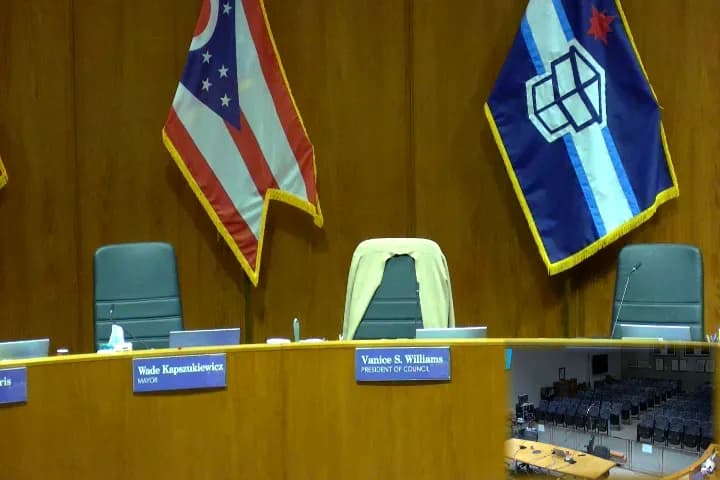
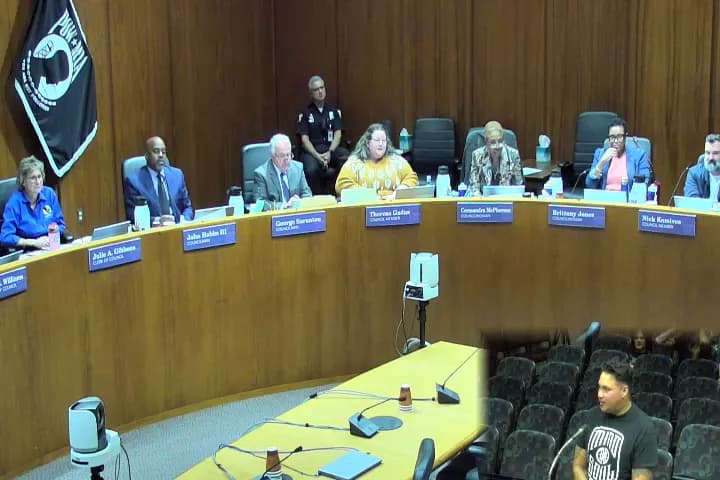
The Toledo City Council met on Tuesday, October 6, 2026, at 4:00 PM in the Council Chambers. Eleven council members were present (Driscoll, Gadus, Hobbs III, Jones, Komives, Kramer, McPherson, Melden, Morris, Sarantou, Williams); one member (Martinez) was absent. The meeting covered recognitions, second‑reading ordinances, new items from council and the administration, and zoning and planning matters. All items received a first reading, suspension, emergency, and passage as needed, with the majority passing unanimously. Notable dissenting or abstaining votes occurred on three items. Recognitions - R‑409‑26 – Recognizing Christopher “Chilly” Rodriguez (sponsored by Morris and Gadus). Passed unanimously (11‑0). - R‑410‑26 – Recognizing October as Domestic Violence Awareness Month (sponsored by Hobbs III). Passed unanimously (11‑0). Second Reading Items - O‑399‑26 – Enacting a new Toledo Municipal Code Chapter 1766, “Retaliation Prohibited.” An amendment was adopted, and the ordinance passed unanimously (11‑0). - O‑402‑26 – Authorizing $1,400,000 in the Municipal Garage Fund for city‑wide fuel purchases and $1,400,000 in internal service fuel chargebacks. An amendment was adopted, and the ordinance passed unanimously (11‑0). - O‑403‑26 – Authorizing expenditure of up to $250,000 annually from the Special Assessment Services Fund for a Smart Tree Inventory (two‑year contract). Passed unanimously (11‑0). - O‑404‑26 – Amending Toledo Municipal Code Chapter 917 (Trees) by repealing and reenacting eight sections. Passed unanimously (11‑0). New Items from Council (Street Dedications) - R‑411‑26 – Dedicating the corner of Escott Avenue at May Avenue as “Gregory Wojciechowski ‘Wojo’ Way.” Passed unanimously (11‑0). - R‑412‑26 – Dedicating the corner of Ewing Street at Nebraska Avenue as “Clifford L. Russell Way.” Passed unanimously (11‑0). New Items from the Administration - O‑413‑26 (Department of Finance) – Reallocating American Rescue Plan Act funds among eligible projects. Placed on first reading only (unanimous 11‑0). - O‑414‑26 (Office of the Mayor) – Supporting applications to the Ohio Department of Development’s Building Demolition and Site Revitalization grant program and authorizing a subrecipient agreement with the Lucas County Land Reutilization Corporation. Passed unanimously (11‑0). - O‑416‑26 (Department of Transportation) – Accepting a $831,976 grant from the Ohio Emergency Management Agency for the Miami Street Embankment project. Passed unanimously (11‑0). - O‑417‑26 (Department of Transportation) – Authorizing $62,304 from the Franklin Park/Westfield TIF fund for a five‑year SaaS license for traffic signal software (Path Master, Inc.). Passed 10‑1, with Councilman Driscoll voting nay. - O‑418‑26 (Department of Transportation) – Dedicating city‑owned parcels as public right‑of‑way for the TARTA Mobility Hub and multi‑use path improvements (RAISE Grant Project). Passed 10‑0, with Councilman Melden abstaining. - R‑415‑26 (Department of Transportation) – Declaring intent to reimburse the Capital Improvements Fund with tax‑exempt debt proceeds. Passed unanimously (11‑0). - O‑419‑26 (Police Operations) – School resource officer agreement with Toledo Public Schools ($139,458.32). Passed unanimously (11‑0). - O‑420‑26 (Police Operations) – School resource officer agreement with Washington Local Schools ($93,657.16). Passed unanimously (11‑0). - O‑421‑26 (Public Utilities) – Purchasing two pumps for Collins Park Water Treatment Plant ($45,205). Passed unanimously (11‑0). - O‑422‑26 (Public Utilities) – Accepting loan proceeds (up to $1,020,000) from Ohio EPA and Ohio Water Development Authority for Small Pump Station Improvements Package 1. Passed unanimously (11‑0). - O‑423‑26 (Public Utilities) – Repealing and replacing Section 933.10(d) of the Municipal Code to update the temporary debt relief program language. Passed unanimously (11‑0). - O‑424‑26 (Public Utilities) – Authorizing acquisition of a utility easement at 8780‑8820 Cedar Point Road, Oregon, OH for the Raw Water Main Project. Passed unanimously (11‑0). - O‑425‑26 (Development) – Agreement with the Toledo‑Lucas County Regional Board of Health for the Healthy Food Small Market Program ($355,297). Placed on first reading only (unanimous 11‑0). Zoning & Planning Items (Reported by Councilwoman Morris) - O‑426‑26 – Zoning change for 1302 Kelsey Avenue. Passed unanimously (11‑0). - O‑427‑26 – Zoning change for 3910 Haverhill Drive. Passed unanimously (11‑0). - O‑428‑26 – Special Use Permit for Storage of Towaway Vehicles at 5825 Angola Road (with conditions and two waivers). Passed unanimously (11‑0). - O‑429‑26 – Special Use Permit for a Scrap and Salvage Facility at 4103 Lagrange Street (with conditions and four waivers). Passed unanimously (11‑0). - O‑430‑26 – Special Use Permit for a Gas Station at 2485 N. Detroit Avenue (with conditions). Official minutes record a “Passage Nay” vote (11‑0), though this appears to be a recording error; the preceding procedural votes were unanimous. The ordinance was approved. - O‑431‑26 – Local landmark designation for the building at 4500 N. Detroit Avenue, accepting the City Plan Commission’s recommendation. Passed unanimously (11‑0). Key Outcomes - All ordinances and resolutions that received a final vote were adopted, most with unanimous support. - Two items (O‑413‑26 and O‑425‑26) were placed on first reading only and will require a future vote. - Councilman Driscoll voted against O‑417‑26 (traffic signal software license). - Councilman Melden abstained on O‑418‑26 (right‑of‑way dedication for TARTA mobility hub). - The minutes of O‑430‑26 contain an apparent inconsistency (the final passage is recorded as “Nay” despite the preceding unanimous votes); the ordinance was nonetheless enacted. Note: The meeting’s raw audio transcription provided only the national anthem and was not usable for extracting discussions or public comments. The summary is derived solely from the agenda and official minutes.
PROCEDURAL 100%
12
OCT 6, 2026 · TOLEDO, OHIO · CITY COUNCIL
Toledo City Council Formal Meeting – October 6, 2026

The Toledo City Council held its formal meeting on Tuesday, October 6, 2026, at 4:00 PM in Council Chambers. Eleven members were present (Councilman Martinez absent). The meeting included two recognitions, passage of several ordinances on second reading, introduction of new items, and zoning approvals. Key votes included unanimous support for most items, with one dissenting vote on a software license, one abstention on a right-of-way dedication, and unanimous rejection of a special use permit for a gas station. Recognitions and Proclamations - R-409-26: Resolution recognizing Christopher “Chilly” Rodriguez for his artistic contributions and perseverance. Adopted unanimously (11-0). Council members praised his murals and community impact. - R-410-26: Resolution recognizing October as Domestic Violence Awareness Month. Speakers highlighted statistics: domestic violence affects more than 1 in 3 women and 1 in 6 men nationally; in Toledo it accounts for 18% of criminal case filings. Felony convictions of repeat offenders rose from 252 in 2022 to 336 in 2024. Adopted unanimously. Second Reading Items (Final Passage) - O-399-26 (Retaliation Prohibited): Enacted new Toledo Municipal Code Chapter 1766. Councilwoman Gaddis stated the ordinance complements state law and was developed after seven town halls and a citywide survey. An amendment was adopted before final passage. Passed 11-0. - O-402-26 (Fuel Appropriation): Appropriated $1,400,000 from unappropriated fund balances for city-wide fuel purchases and internal chargebacks. An amendment clarified the source of funds. Passed 11-0, emergency. - O-403-26 (Smart Tree Inventory): Authorized a two-year contract not to exceed $250,000 annually for a smart tree inventory. Passed 11-0, emergency. - O-404-26 (Tree Code Amendments): Repealed and reenacted eight sections of Chapter 917 (Trees). Passed 11-0, emergency. New Items from Council - R-411-26: Dedicating the corner of Escott Avenue at May Avenue as “Gregory Wojciechowski ‘Wojo’ Way”. Adopted unanimously after suspension and emergency. - R-412-26: Dedicating the corner of Ewing Street at Nebraska Avenue as “Clifford L. Russell Way”. Adopted unanimously. New Items from the Administration - O-413-26 (ARPA Reallocation): Authorizing reallocation of American Rescue Plan Act funds among eligible projects. Placed on first reading. - O-414-26 (Demolition Grant Support): Authorizing support for applications to the Ohio Building Demolition and Site Revitalization grant program and entering into agreements with Lucas County Land Reutilization Corporation. Passed 11-0 after suspension and emergency. Department of Transportation - R-415-26: Resolution declaring official intent to reimburse the Capital Improvements Fund with proceeds of tax-exempt debt. Adopted 11-0. - O-416-26 (Miami Street Embankment): Authorizing a grant agreement with Ohio Emergency Management Agency for $831,976 for construction of the Miami Street Embankment project. Passed 11-0. - O-417-26 (Traffic Signal Software): Authorizing a five-year SaaS license with Path Master Inc. for traffic signal performance software, not to exceed $62,304 from the Franklin Park/Westfield TIF. Passed 10-1 (Councilman Driscoll dissenting). - O-418-26 (TARTA Mobility Hub Right-of-Way): Dedicating city-owned parcels as public right-of-way for a TARTA mobility hub at 1602 Monroe Street and multi-use path improvements on Dorr Street (RAISE Grant). Passed 10-0 (Councilman Melden abstained on all votes). Department of Police Operations - O-419-26 (Toledo Public Schools SRO): Authorizing a one-year school resource officer agreement with Toledo Public Schools, accepting $139,458.32. Passed 11-0. - O-420-26 (Washington Local Schools SRO): Authorizing a one-year SRO agreement with Washington Local Schools, accepting $93,657.16. Passed 11-0. Department of Public Utilities - O-421-26 (Pump Purchase): Authorizing $45,205 from the Water Operating Fund for two Watson Marlow Bredel pumps at Collins Park Water Treatment Plant. Passed 11-0. - O-422-26 (Pump Station Loan): Authorizing acceptance of a loan from Ohio EPA/WPCLF and OWDA up to $1,020,000 for small pump station improvements. Passed 11-0. - O-423-26 (Debt Relief Program): Updating municipal code language for DPU’s temporary debt relief program. Passed 11-0. - O-424-26 (Utility Easement): Authorizing acquisition of a utility easement on Cedar Point Road, Oregon, OH, for the Raw Water Main Project. Passed 11-0. Department of Development - O-425-26 (Healthy Food Small Market): Authorizing an agreement with Toledo-Lucas County Board of Health to support the Healthy Food Small Market Program, appropriating $355,297 from the General Fund. Placed on first reading. Zoning and Planning Items - O-426-26: Zoning map change for 1302 Kelsey Avenue. Passed 11-0. - O-427-26: Zoning map change for 3910 Haverhill Drive. Passed 11-0. - O-428-26: Special Use Permit for Towaway Vehicle Storage at 5825 Angola Road (with conditions and two waivers). Passed 11-0. - O-429-26: Special Use Permit for Scrap and Salvage Facility at 4103 Lagrange Street (with conditions and four waivers). Passed 11-0. - O-430-26: Special Use Permit for Gas Station at 2485 N. Detroit Avenue. Failed 0-11 after Councilwoman Morris stated opposition based on decision-making criteria in TMC 1111.0706. - O-431-26: Local landmark designation for the building at 4500 N. Detroit Avenue, accepting the City Plan Commission recommendation. Passed 11-0. Council Member Comments and Announcements - Councilwoman Gaddis thanked colleagues for passing the retaliation ordinance and noted it is the start of further rental legislation. She requested an update on biometric identifier guidelines (passed in April) and raised concerns about trash pickup in District 3, reporting 309 complaints to Engage and calling for a task force with Republic Services. - Councilwoman Dr. Jones emphasized that the retaliation ordinance is a living document and work in progress. She announced early voting began, a community meeting on Brent Industries test results on October 15, and her attendance at a conference on vacant land reclamation. - Councilmember Komives noted the $1.4 million fuel appropriation as a consequence of increased gas prices due to the war, and announced an Ohio historical marker for Lewis Escobar to be unveiled on October 22. - Councilwoman Kramer encouraged early voting and noted that handicap-accessible voting is available curbside. - Councilwoman McPherson welcomed an Italian opera singer and offered condolences for the recent passing of Jim Harton. - Council President Williams thanked colleagues for voting down the gas station and noted a pending senior housing project at the Fortin School site with Woodle Cooper. Key Outcomes - All items on the agenda passed except: - O-417-26 passed with one dissenting vote (Driscoll). - O-418-26 passed with one abstention (Melden). - O-430-26 failed unanimously (11-0). - O-413-26 and O-425-26 received first readings and will return for second reading. - Councilwoman Gaddis announced a future request for a task force on trash collection issues.

PROCEDURAL 32% · ARTS AND CULTURE 15% · PUBLIC SAFETY 12% · PUBLIC ENGAGEMENT 11%
13
OCT 5, 2026 · TOLEDO, OHIO · CITY COUNCIL
Housing Committee Discusses Swain Field RFP and Pop-Up Market on October 5, 2026

The Housing, Community Development & Public Health Committee met on October 5, 2026, at 5:00 PM in City Council Chambers. The primary agenda item was the Swain Field Food Hub Pilot Program, including the RFP process that resulted in only one bidder, Al Peak. Administration officials presented context and plans, while council members and community speakers raised concerns about insufficient outreach, lack of transparency, and exclusion of local black farmers. The committee discussed process improvements and next steps, but took no formal votes. Public Comments & Testimony - Tina Hall (Inglewood resident): Expressed support for the market, encouraged a fair and equitable vendor selection process moving forward, and urged the city to require vendors to accept Ohio Department of Aging Senior Farmers Market Nutrition Program benefits. - Sylvester Gould (real estate developer, Inglewood native): Supported the pop-up market as a start, cautioned that bringing a full grocery store requires about $10 million, and emphasized the need to include minority businesses. - Carla Thomas: Questioned whether the lack of transparency was truly a mistake, stating that the committee met regularly and was not informed. She asked Chief Clemens how the market was intended to economically benefit the black community; Chief Clemens replied the goal was to provide fresh produce access, not to direct profit to the black community. - Sonia (urban farmer): Expressed deep frustration, stating that the city excluded local farmers who have been doing the work for ten years. She said she was told she was “unqualified” before being contacted, and noted that $15,000 per week to an outside company does not reinvest in the community. She called the process “morally wrong.” - Alexia Sims: Contrasted the administration’s extra outreach for events like Party in the Park with the lack of effort for this RFP. She questioned whether the eight required employees would come from the community and noted that Swain Field owners were not contributing. - Alicia McNair: Requested additional clarification on the $150,000 payment to Al Peak, specifically what services it covered and how the city determined the expenditure was necessary given Al Peak also generates revenue from sales. The city offered to respond via email and make the answers public. - Montries: Urged the city to use the disparity study from 2022 to guide engagement, and called for more intentional outreach using multiple methods (not just Planet Bids). - Blair Johnson: Recommended the city hold public training sessions on how to use Planet Bids, and post bid opportunities on social media to widen participation. Discussion Items - Presentation by Chief Clemens (Administration): Provided context for the Swain Field Initiative, part of a HUD-designated Neighborhood Revitalization Strategy Area (NERSA). The city invested $3.3 million in renovation, funded by CDBG, HUD Section 108, Ohio EPA Green Infrastructure, and owner equity. The pop-up market was designed to test demand for a full grocery store. The RFP required market planning, weekly setup, point-of-sale systems, SNAP/EBT acceptance, and more. - Procurement Director Natalie Brower: Reported that only one proposal (from Al Peak) was submitted out of eight views, and that the city will now add NIGP codes and consider non-traditional advertising. She acknowledged the need to flag unusual bids before posting. - President Williams (District 4): Expressed anger that she was not consulted as the district councilperson and resident of Inglewood. She questioned why Marcoms (communications) was not involved and why the bid was not marketed through social media or community newspapers. She demanded Swain Field owners contribute “sweat equity.” - Councilmember Gaddis: Asked about existing education for vendors and whether there is a standardized communication process. Deputy Mayor Abby Arnold responded that bringing communications in early is encouraged but no formal standard exists. Gaddis also asked about using lessons from the 2022 disparity study; the administration indicated they are focusing on small business programs to avoid federal concerns. She expressed worry that the data from the market may be skewed due to community backlash. - Councilmember Saranto: Recommended issuing at least a news release and working with district council members for future bids. - Councilmember McPherson: Called the situation a “mess” and stressed that the administration must be transparent from the start, not as an afterthought. She pushed for holding the administration accountable and urged community members to come to the table rather than air grievances on social media. - Chair Jones: Emphasized the need to clearly define terms like “farmers market” vs. “pop-up market” and to view urban farming as entrepreneurship, not a hobby. She called for a food system approach that includes business support for local farmers. Key Outcomes - Commitment to Convene Urban Farmers: Chief Clemens agreed to hold a meeting with local urban farmers to identify capacity barriers, needs (e.g., EBT/SNAP acceptance, refrigeration), and design future rounds collaboratively. - Planet Bids Training: President Williams announced that she and administration staff will schedule training sessions for the community on how to register and bid on Planet Bids. These will be widely publicized. - Improved RFP Process: The city will add pre-bid outreach sessions, teach small businesses to register, and evaluate whether at least three registered vendors exist under selected NIGP codes before posting. Social media and community newspapers may be used for unique opportunities. - Forecasting Future Needs: The administration committed to annual forecasting of procurement opportunities so small businesses can prepare. - Continuing the Pop-Up Market: The market will operate each Saturday through October 24, 2026. Data on sales, attendance, and goods will be collected and shared. - No Formal Votes: The committee took no action or votes; the meeting was informational and discussion-only. Follow-up written answers on the $150,000 payment will be provided and made public.

COMMUNITY ENGAGEMENT 44% · FOOD SECURITY 20% · HOUSING AND COMMUNITY DEVELOPMENT 15% · ECONOMIC DEVELOPMENT 6%
14
OCT 1, 2026 · TOLEDO, OHIO · CITY COUNCIL
Toledo City Council Public Safety and Criminal Justice Reform Committee Meeting - October 1, 2026

The Public Safety and Criminal Justice Reform Committee met on October 1, 2026, to discuss Issue 16, a proposed quarter-percent income tax increase for neighborhood safety that will appear on the November ballot. Mayor Wade Kapszukiewicz presented the administration’s case for the levy, detailing the city’s $50 million structural budget deficit and specific public safety investments the levy would fund. Council members asked questions about staffing, budget cuts, and program impacts. The meeting also included quarterly reports from the Toledo Police Department (TPD) and Toledo Fire and Rescue Department (TFRD), and supporting testimony from the firefighters’ union president. Mayor’s Presentation on Issue 16 - Mayor Kapszukiewicz stated that the structural deficit is driven by population loss (peaked in 1963) and $288 million in state revenue cuts over 18 years (averaging $16 million per year — equivalent to the annual revenue from the Jeep plant). He argued the city cannot cut its way out of the deficit without eliminating entire departments or laying off police and fire, noting that Toledo already spends less per capita than other major Ohio cities and has the highest bond rating since 1980. - The quarter-percent income tax increase would raise the city’s rate to 2.75% (matching the state rate), generating $25 million annually for the general fund. Even with passage, a $25 million deficit would remain. The tax is on earned income, exempting Social Security and pensions, so many seniors would benefit without paying more. He also noted that non-residents who work in Toledo would also pay the tax. - Specific commitments if the levy passes: double annual police and fire recruit classes from 20 to 40; grow the gang task force by two-thirds; triple demolition of vacant/abandoned properties; create a residential speed enforcement program; commit fire resources to West Toledo, including a new station; and rebuild the fire investigation (arson) unit over four years. The levy must be spent on neighborhood safety per ballot language. The mayor mentioned that the Toledo Police Patrolman’s Association and Firefighters Local 92 support the measure. Councilmember Questions and Discussion - Council President Williams (District 4) expressed support despite her small business concerns, emphasizing quality-of-life issues like grass cutting and the need for resources. She asked Police Chief Trentley for retirement numbers: Chief Trentley reported 40 retirements/resignations in 2026, with sworn strength projected at about 600 by year-end (including a December class of 21). Doubling the class would help but there is a lag before officers are operational. On fire budget cuts, Fire Chief Cheers (or designee) said the department is running very trim and willing to do more. - Councilman Sarantu pressed for specific layoff numbers if Issue 16 fails, arguing that early voters need that information before the October 28 budget hearing. The mayor said that hearing would present two budgets: one with the levy and one without. - Councilwoman McPherson asked about the arson unit commitment and the existing levies. The mayor confirmed that the arson unit rebuild was added after discussions with Local 92. He clarified that the general services levy (renewed in 2024) designates a portion to police and fire, while the new levy would be fully dedicated to neighborhood safety. Even with the levy, the city will still face a $25 million deficit requiring ongoing management. - Councilwoman Kramer asked about the Monsey program. The mayor replied that Monsey would likely be continued if the levy passes, but would be in grave danger of elimination if it fails. - Councilwoman Morse requested actual dollar amounts for the proposed initiatives and pressed for specificity. She asked about officer training: Chief Trentley noted that CIT training has been expanded and a full-day professionalism/cultural competency training is being developed for next year. She also highlighted the economic strain on residents. Public Testimony - Joe Sierra, President of Toledo Firefighters Local 92, spoke in support of Issue 16. He stated that the department needs additional firefighters to keep up with call volume, particularly in West Toledo (Engine 23 has seen an 80–90% increase in runs over 20 years). He warned that aging apparatus and stations are at risk: as of October 1, 2026, there is no spare engine — if the front-line engine breaks down, the station is without a backup. He said the levy would help address attrition and support recruitment. Quarterly Reports - Toledo Police Department (Chief Trentley and Assistant Chief Braun): Current sworn staffing at 609, projected to drop to around 600 by year-end, with further retirements in January 2027. Without additional classes, layoffs may become necessary, and operations would be reduced to core calls for service, eliminating community programs. Year-to-date training includes 40 hours of in-service (legal updates, ICAT de-escalation, use of force, wellness, firearms). Internal affairs data show 150 internal complaints versus 6 citizen complaints, indicating active internal oversight. Citywide crime: overall reductions especially in violent crime, but burglary is slightly up. - Toledo Fire & Rescue Department (Deputy Chief Franklin): Current staffing at 591. Year-to-date retirements: 17 (15 + 2 confirmed). A recruit class of 20 started July 31, 2026, graduating February 19, 2027. Through August, total incidents: 43,944 (1.5% increase), EMS incidents: 36,407 (4.1% increase in total responses). Engine 23 is the busiest apparatus (3,266 runs through August). Fire prevention: 2,631 inspections, 659 plan reviews, 17 code red properties mitigated. Infrastructure issues: roof leaks at headquarters, floor repair at Station 21, ongoing HVAC repairs. Deputy Chief Franklin noted the successful replacement of the headquarters roof and the shop roof, and concrete work at various stations. Key Outcomes - No formal votes were taken during the committee meeting. - The committee received the mayor’s presentation and the quarterly reports from TPD and TFRD. - Councilman Sarantu directed the administration to provide specific potential layoff figures before the October 28 budget hearing. - Councilwoman Morse requested detailed dollar amounts for each levy-funded initiative. - The committee scheduled a second budget hearing for October 28 to present two budget scenarios (with and without Issue 16).

PUBLIC SAFETY 60% · FISCAL SUSTAINABILITY 16% · BUDGET EQUITY ANALYSIS 10% · RACIAL EQUITY 4%
15
SEP 30, 2026 · TOLEDO, OHIO · CITY COUNCIL
Finance, Debt & Budget Oversight Committee Meeting - September 30, 2026

The Finance, Debt & Budget Oversight Committee met on September 30, 2026, at 4:00 PM in the City Council Chambers. The meeting covered the Department of Public Utilities' collection efforts, a proposed reallocation of ARPA funds, the monthly financial report, and the city auditor's update. Committee members raised concerns about the structural budget deficit, fire overtime costs, and transparency in ARPA fund usage. Public Comments & Testimony - Richard Arnold (3305 Middlesex) urged the committee to hold a hearing on city communications, citing unreceived responses from residents regarding property damage, industrial incidents, and sidewalk concerns. He noted budget cuts to the communications department and requested a simple handout on call volumes and prioritization. He also shared a historical anecdote about a 1946 city council meeting where a meat substitute was thrown. - Councilwoman McPherson responded that the law department is addressing the property damage issue mentioned by a previous speaker. Discussion Items - Department of Public Utilities Report: Director Patika reported that the installment payment plan program collected approximately $7 million year-to-date through August 2026. The total active delinquent balance is $37.8 million, with residential accounts at $33.2 million, commercial at $4.1 million, and industrial at $556,000. The Fresh Start program ended on September 30, 2026. Disconnections for August were 364 residential and 5 commercial, with reconnections at 108 and 1, respectively. Commissioner Geronimo noted that many delinquent customers have not received new meters or have plumbing leaks, and efforts are underway to address those issues. Councilmembers requested breakouts by zip code/council district, and data on vacant houses versus occupied residences. Councilwoman Gaddis asked about linking fire resource usage to delinquent commercial accounts. - ARPA Fund Reallocation: Director Campbell proposed reallocating $713,000 from three underperforming ARPA projects (Healthy Food Systems Hub, Grocery Store Construction Incentive, and ARPA Administration) into the Municipal Recovery Revenue Replacement fund, which supports police and fire salaries. The funds must be fully expended by December 31, 2026. Chief Clemens explained that the healthy food projects are being shifted to general fund financing. Vice Chair Driscoll questioned the timing and transparency, noting council could potentially redirect general fund dollars elsewhere. Councilwoman McPherson expressed disappointment that the reallocation was not clearly communicated to council. Councilman Hobbs vehemently opposed using funds for Red and White market and Swain Field, citing lack of community investment. Councilwoman McPherson raised concerns about the Swain Field pop-up market pilot project. Councilwoman Jones noted a housing committee meeting on October 5th to discuss urban farming equity. Councilman Driscoll suggested delaying the ordinance to allow further deliberation. - Financial Report: Commissioner Zavisha reported income tax collections are down 5.2% year-to-date, driven largely by six companies' net profit declines. Withholding was up 6.1% for August, but business net profits dropped by $7.6 million for the year. The structural budget deficit is approximately $48 million, with plans to cover $24 million from the Capital Improvement Fund and $24 million from reserves. Fire overtime spending is at 92% of the annual budget, causing concern. Councilwoman Gaddis asked about billing companies for overtime related to disasters. Income tax revenues are expected to improve in September due to quarterly filings. Investment earnings are at 36% of budget, but expected to pick up. - City Auditor's Report: Auditor John Ravalsky reported ongoing audits of the Flock System, utilities receivable, and grass cutting/monitoring. Councilwoman Gaddis offered support if additional resources are needed. Key Outcomes - Multiple referrals were made by councilmembers for additional data: breakdowns of disconnections by zip code/district, information on commercial accounts by meter size, status of water meter repair funds, contract details for the Undue medical debt program (with a November 1, 2026 deadline for responses, after which leftover funds may be reallocated), and reports on open contracts and program mandates per department. - No formal votes were taken on the ARPA reallocation ordinance; discussion will continue at a future meeting. - The next regular meeting is scheduled for Wednesday, October 28, 2026.

FISCAL SUSTAINABILITY 36% · ECONOMIC DEVELOPMENT 21% · PUBLIC UTILITIES MANAGEMENT 17% · MISCELLANEOUS 9%
16
SEP 29, 2026 · TOLEDO, OHIO · CITY COUNCIL
Toledo City Council Agenda Review for October 6, 2026 - September 29, 2026

The Toledo City Council held an agenda review meeting on September 29, 2026, to discuss and recommend action on items scheduled for the October 6, 2026 full council meeting. Discussions covered ARPA fund reallocations, healthy food programs, demolition grants, transportation projects, school resource officer agreements, public utilities infrastructure, zoning changes, and second-reading ordinances. Several items were recommended for passage (SEP), while others were moved to first reading due to outstanding questions. ARPA Reallocation and Healthy Food Program - Item 1 (Finance): An ordinance to reallocate $713,000 in unspent ARPA funds among existing projects (ARPA administration, healthy food systems hub, grocery store incentive) to meet the December 31, 2026 federal deadline. Approximately 97% of total ARPA funds have been expended. The reallocation would free general fund resources for continued healthy food programs. Councilmembers Martinez, McPherson, and Saranto raised concerns about transparency and specificity of future spending. President Williams requested a first reading to allow further finance committee review. Moved to first reading. - Item 13 (Development): An agreement with the Toledo-Lucas County Health Department to use $355,000 for the Healthy Food Small Market Program, expanding from 6 to 12 stores. The pilot program showed measurable success: produce variety increased from bananas to 36 varieties at two stores; healthy food sales rose from $50/month to $530/month at two stores; Phoenix Earth Food Co-op saw a 159% increase in SNAP produce sales. Councilmembers expressed support but requested a map of stores by district and further details. Moved to first reading. Demolition and Transportation Projects - Item 2 (Mayor’s Office): Resolution supporting five grant applications to the Ohio Department of Development’s Building Demolition and Site Revitalization program for demolishing blighted properties, including the former D. Michael Collins substation and four other sites. Councilmember Martinez noted the need for better coordination with Toledo Public Schools on surplus property. Recommended SEP. - Items 3-6 (Transportation): - Item 3: Resolution of intent to reimburse capital improvement funds for the Glendale Avenue project ($248,457) via Ohio Public Works Commission debt. Recommended SEP. - Item 4: Authorization to accept $831,976 FEMA grant for Miami Street embankment stabilization (80-year design life), with a $277,325 city match. Construction expected in 2027. Recommended SEP. - Item 5: Renewal of Centracs traffic signal performance software for five years at $62,304 from the Franklin Park/Westfield TIF. Councilmembers Driscoll and Meldon questioned the use of TIF funds for software and requested a long-term plan for TIF expenditures. Recommended SEP. - Item 6: Dedication of city-owned parcels for the TARTA mobility hub and multi-use path as part of the RAISE Grant project. Recommended SEP. School Resource Officer Agreements - Items 7-8 (Police Operations): - Item 7: One-year agreement with Toledo Public Schools for three TPD officers (reduced from six due to TPS’s own sworn officers) at $139,458.32. Recommended SEP. - Item 8: One-year agreement with Washington Local Schools for two officers (increased from one) at $93,657.16. Recommended SEP. Deputy Chief Heffernan noted the police department is down to about 600 sworn officers and future staffing depends on the upcoming levy. Councilmember Kramer confirmed the reduction still provides adequate coverage. Public Utilities and Infrastructure - Items 9-12 (Public Utilities): - Item 9: Purchase of two Watson-Marlow Bredel pumps for Collins Park Water Treatment Plant at $45,205. Recommended SEP. - Item 10: Authorization for a $1,020,000 loan for design of Small Pump Station Improvements Package 1 (10 stations). Recommended SEP. - Item 11: Amendment to Toledo Municipal Code Section 933.10(d) to allow the DPU director to establish a temporary debt relief program for residential water/sewer customers. Recommended SEP. - Item 12: Resolution to acquire utility easements for the Raw Water Main project on Cedar Point Road in Oregon, Ohio, to serve 500,000 customers. Recommended SEP. Zoning and Planning Items - Six items were presented from the Zoning & Planning Committee, including zone changes at 1302 Kelsey Ave. and 3910 Haverhill Dr., special use permits for towaway vehicle storage, a scrap and salvage facility, and a gas station, plus a local landmark designation for the Dura building. President Williams urged voting down the gas station permit due to the owner’s history of tax delinquency and property disrepair. All items were recommended for SEP except the gas station, which was expected to be opposed. Second Reading Ordinances - O-399-26 (Retaliation Prohibited): Enacts new TMC Chapter 1766 prohibiting landlord retaliation. Councilmember Jones and George Thomas (Fair Housing Center) noted support but agreed to engage Housing Court Judge Howe for input. Held for further discussion; not moved to passage. - O-402-26 (Fuel Budget): Appropriates $1.4 million for city-wide fuel purchases. Recommended SEP. - O-403-26 (Smart Tree Inventory): Authorizes $250,000 annually for a two-year professional services contract. Councilmember Driscoll requested a referral to check for duplication with existing data from Lake Erie West Regional Council. Held for referral. - O-404-26 (Tree Code Amendments): Amends TMC Chapter 917 regarding tree removal permits. Councilmember Martinez questioned the transparency of existing fees. Held for referral. Resolutions - TMP-12923: Recognize Chilli Rodriguez (sponsors Morris, Gadus). - TMP-12924: Domestic Violence Awareness Month (sponsor Hobbs). Councilmember Hobbs invited co-sponsors and noted a Breaking the Violence Summit on October 2. - TMP-12919: Dedicate Escott Ave. at May St. as “Gregory Wojciechowski ‘Wojo’ Way.” - TMP-12922: Dedicate Ewing St. at Nebraska Ave. in honor of Clifford Russell. Key Outcomes - First readings ordered for ARPA reallocation (Item 1) and Healthy Food Small Market Program (Item 13). - SEP (second reading passage) recommended for Items 2-12 and most zoning items, pending final council vote on October 6. - Referrals issued for: interest earned on ARPA funds; map of healthy food stores by district; long-term plan for TIF fund spending (Franklin Park); tree canopy data duplication; and specific fees under tree code amendments. - Retaliation ordinance held for additional consultation with Housing Court. - Gas station special use permit expected to be rejected based on councilmember statements.

FOOD SECURITY 24% · FISCAL SUSTAINABILITY 15% · PUBLIC SAFETY 15% · WATER AND WASTEWATER MANAGEMENT 7%
17
SEP 24, 2026 · TOLEDO, OHIO · CITY COUNCIL
Toledo Housing, Community Development & Public Health Committee Reviews Renter Survey, Retaliation Ordinance, and Code Blue (September 24, 2026)

On September 24, 2026, the Toledo City Council Housing, Community Development & Public Health Policy Committee met at 20:30:00 UTC (listed on the agenda as 3:30 PM) in City Council Chambers. The committee heard presentations on the 'Our Home, Our Rights' renter survey and proposed legislation enacting Toledo Municipal Code Chapter 1766 to prohibit landlord retaliation, then received a Code Blue winter response update and public testimony. The agenda also listed a Capacity Building Institute Cohort Report Out, but that item was not covered in the recorded discussion. Discussion Items - Renter survey and housing conditions: Fair Housing Center staff attorneys reported that the city's tenant listening sessions drew well over 150 attendees and close to 500 survey responses. The most frequently reported tenant issues were rising rents, pest infestations, neighbor conflicts, and unhealthy living conditions. A separate Fair Housing Center survey of nearly 150 tenants who had contacted the center found that more than half indicated the highest level of concern about retaliation, stating, 'I am very concerned about retaliation.' - Anti-retaliation ordinance: The proposed ordinance, modeled closely on Cincinnati's law, would create a presumption of retaliation when a tenant engages in a protected activity, such as requesting repairs or contacting government authorities, and the landlord then takes an adverse action such as terminating a lease or raising rent. It would shift the burden to landlords to prove legitimate good cause. Presenters said current state law is vague and requires tenants to prove retaliatory intent, and that the ordinance would not hurt responsive landlords. - Housing Court consultation: Councilwoman McPherson asked whether Judge Howe had been consulted. The Fair Housing Center said he had not yet been contacted, and that they planned to prepare a memo for him before the committee votes. - Code Blue update: Sandra Destano, director of United Way 211, reported that Code Blue was open for 63 days and nights during the 2025-26 winter when the real-feel temperature fell below 15 degrees. The traditional winter crisis program at St. Paul's Community Center, operated for 10 years and serving approximately 45 additional people, will not operate this year because of funding constraints, though St. Paul's will participate in Code Blue nights. Destano asked for more locations, volunteers, and funding, noting the $120,000 ask in the 2027 budget may not be allocated until March 2027. Councilwoman Kramer added that there were 65 nights last year under 15 degrees and that it costs about $300 to feed 70 people. Public Comments & Testimony - Sean Kellebauer, president of the board of One Matters, urged the committee to treat unsheltered homelessness as an emergency, asked what emergency funds can be used now for winter response, and proposed a fee on downtown events to fund it. He stated that six people died from cold last year, including Richard Qualpak. - Taylor Burns, supervising attorney with Legal Aid of Western Ohio, supported the retaliation ordinance, saying it would create a rebuttable presumption if an adverse action occurs within one year of a protected activity and establish clear good-cause standards. She urged council to prioritize eviction-defense and right-to-counsel funding alongside the ordinance. - A renter, Marsona SARS, described nine years of poor rental conditions, including broken floors, pests, and landlord manipulation, and asked for change. - Annie Cheslakowski, intake specialist at the Fair Housing Center, supported the ordinance and described clients facing retaliation over repairs, disability accommodations, and rent increases, including a client who lost housing after requesting an emotional support animal. She noted that more than 50 percent of Toledo residents may be renters. - Venus Chapman ('Miss V') spoke on behalf of a disabled single mother whose rent increased by $100 after each repair request once she became month-to-month; she said Toledo evictions increased 10 percent over the last year and criticized committee attendance on housing issues. - Sonia Brown, a Toledo resident, spoke in support of Ordinance O 399-26, asking council to preserve protections for disability accommodations, fair housing activity, tenant organizing, and Housing Choice Voucher compliance, and to create a clear reporting process. - Logan Sultas, a tenant organizer, supported the ordinance and described retaliation such as threats, evictions, unnecessary charges, legal harassment, neglected repairs, non-renewals, physical violence, and sexual violence; he urged the council to enforce the ordinance. - Paul Radrup, of Advocates for Basic Legal Equality, supported the ordinance, saying prevention is cheaper than back-end crisis response and that the legal deck is stacked against tenants. He noted that, theoretically, a landlord could evict a tenant in about two weeks in Ohio. - Gloria Allen, a subsidized senior housing resident, described a dispute with her property manager over a transfer request and recertification, saying she felt the manager was trying to put her out. - Maddie Watkins, a 10-year Saxon House resident and Green Ribbon Initiative representative, described conditions after out-of-state owners bought the building in 2023, including lack of air conditioning, mold, water issues, and a tenant union. She said passing responsibility to nonprofits and churches is not the answer and urged a radical approach. - Sandra Destano returned to public comment to note that housing calls make up 40 percent of 211 call volume and that keeping housing is the most critical issue. - Blair Johnson, a contractor and landlord, supported tenant protections, urged the city to repurpose vacant properties for temporary shelters, modernize building codes to allow modular and container homes, and reach out to the private sector. He said there were less than 10 modular homes in Toledo. - Kiana Walker, a Section 8 voucher holder, described receiving a $1,200 water bill and a vacate notice less than 30 days after moving in, saying her out-of-state landlord in Florida caused her family's housing instability. - Tommy Rich said he wanted to help by baking and cooking for the community and asked for support. - Reggie Williams, executive director of Marketplace for All People at St. Paul's United Methodist Church, supported Councilwoman McPherson's call for churches, businesses, and volunteers to help with Code Blue and asked for all hands on deck. Key Outcomes - No formal vote was taken; the committee received presentations and public testimony. - Councilwoman McPherson said she will introduce a funding request for Code Blue and publicly called on churches and community centers to open as warming stations. - The Fair Housing Center committed to create a memo for Housing Court Judge Howe and to consult him before the council votes on the retaliation ordinance. - The retaliation ordinance, identified by a public speaker as Ordinance O 399-26 and described as enacting TMC Chapter 1766, remains before council; speakers urged passage and enforcement with dedicated eviction-defense funding.

FAIR HOUSING 42% · HOMELESSNESS 26% · PUBLIC SAFETY 8% · AFFORDABLE HOUSING 8%
18
SEP 23, 2026 · TOLEDO, OHIO · CITY COUNCIL
Toledo Community & Administrative Services Committee Meeting — September 23, 2026

The City of Toledo Community & Administrative Services Committee met on Wednesday, September 23, 2026, per the provided timestamp 2026-09-23 17:00:00+00:00. The formal agenda scheduled the meeting for 4:00 PM in City Council Chambers, noting a time discrepancy with the timestamp (1:00 PM EDT). The sole agenda item was Office of Community Services Updates, including MONSE and other key initiatives, and any other matter properly before the Committee. However, the available raw transcript contains only a sound check ("One two might check one") and no substantive discussion; no minutes were available. Thus, this summary is limited to the agenda and the absence of a record of discussion or action. Discussion Items - Office of Community Services Updates (MONSE, Other Key Initiatives) — The agenda identifies this as the meeting's purpose. No remarks, presentations, or deliberations were captured in the transcript, so no speaker positions or project details can be summarized. Key Outcomes - None recorded: The available transcript does not indicate any votes, decisions, directives, referrals, or next steps. Record Status - Minutes: Not available. - Transcript: Contains only a brief audio check line, lacking substantive content. - Scheduling discrepancy: Agenda lists 4:00 PM; timestamp indicates 17:00 UTC (1:00 PM EDT).

PROCEDURAL 100%
19
SEP 23, 2026 · TOLEDO, OHIO · CITY COUNCIL
Lucas County Plan Commission Meeting Summary – September 23, 2026

The Lucas County Plan Commission met on September 23, 2026, with a quorum present. Commissioner Grossweiler was noted as present. No written agenda or minutes document was included in the source materials; this summary is based on the raw transcript. The commission acted on one final plat, approval of prior meeting minutes, and five zoning cases. All votes were approved by voice vote with no audible opposition. Consent Calendar / Routine Approvals - Final Plat S-726 (also transcribed as S 326), Creek Plat 7, located west of Hair Road and south of Pennsylvania Avenue, Sylvania Township: all final clearances were received, and staff recommended approval. Motion to approve passed by voice vote. - Minutes from the July 22 and August 26 meetings (year not specified in the transcript) were approved together by voice vote. Public Comments & Testimony - No members of the public offered testimony. For each case, the chair invited attendees to speak, and no one commented. - On Case Z17 C 392, the township zoning inspector stated he had no comment. Discussion Items - Case Z33 C 159 – Zone change from A to C4 at 12961 Airport Highway. Applicant Sean J. Albert (1275 County Road EF, Swanton, Ohio) had no questions or comments. Staff recommended approval because the zone change supports the township's economic base through land use, development, and capital investment while preserving natural features and residential areas. Approved. - Case Z33 C 160 – Zone change from C4 to M1 for 13 lots along Airport Highway. Applicant Jason Rowley (260 East Brown Street, Birmingham, Michigan) had no comments or questions. Staff recommended approval for two reasons: support of the township's economic base, and assistance with the next phase of industrial park development. Approved unanimously. - Case Z17 C 392 – Zone change from C2 and AR to M1 at 10311 Airport Highway. Applicant George Lathrop (320 West Dossel, Maumee, Ohio) had no questions. Staff recommended approval because the request is compatible with surrounding zoning and uses, compatible with the 2022 Monclova Township comprehensive land use plan, and will have minimal adverse impacts on surrounding properties. Approved. - Case Z17 C 391 – Text amendment to modify Section 15, Monclova Township. The transcript labels it a tax amendment, but the person presenting the request explained it updates the township's zoning resolution to conform to current Ohio Revised Code law. Staff recommended approval. Approved. - Case Z19 C 709 – Text amendment to modify Section 19, supplemental regulations, Springfield Township. Josh Hollinger (7617 Angola Road) stated township staff recommends approval and agrees with the Lucas County Planning Commission. He explained the amendment is intended to address dogs on vacant properties; because the township lacks the right to enter those properties, it would work with the Sheriff Department, LC4, and the Humane Society to send violations and address issues quickly. In response to a commissioner's question, he said the township, not the county, has jurisdiction. Approved. Key Outcomes - Final Plat S-726 approved. - Minutes of July 22 and August 26 approved. - Cases Z33 C 159, Z33 C 160, Z17 C 392, Z17 C 391, and Z19 C 709 were all approved as staff recommended. Each motion passed by voice vote; no opposing votes were noted, and Case Z33 C 160 was specifically described as unanimous. - The meeting adjourned after the final vote.

ZONING AND PLANNING 82% · PROCEDURAL 10% · ANIMAL WELFARE 8%
20
SEP 23, 2026 · TOLEDO, OHIO · CITY COUNCIL
Toledo City Council Community & Administrative Services Committee Meeting - September 23, 2026

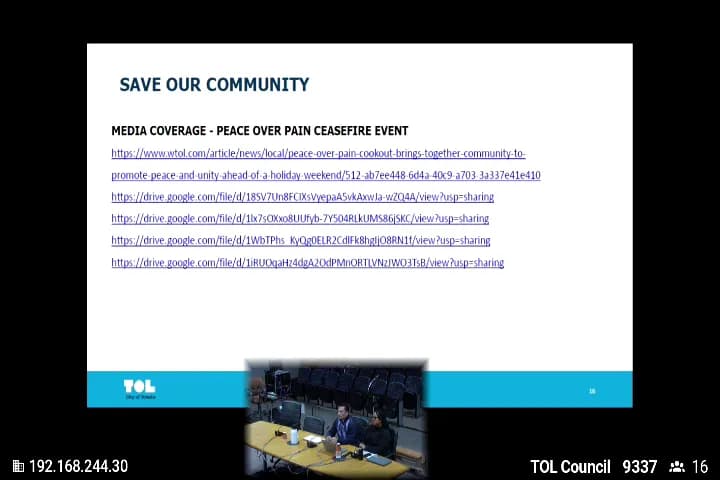
The Toledo City Council Community and Administrative Services Committee met on Wednesday, September 23, 2026, at 4:00 PM in City Council Chambers. The meeting focused on updates from the Office of Community Services, including youth workforce initiatives, Save Our Community (SOC) violence intervention programs, and a capacity analysis of the city's Community Violence Intervention (CVI) ecosystem. Presentations were delivered by Dr. Tiffany Whitman (Chief Impact Officer), Dr. Stephanie Covington (Commissioner of Educational Engagement and Workforce Development), Raymond Campos (Commissioner for Save Our Community), and researchers from Bowling Green State University. Staff from the MONSE (Mayor's Office of Neighborhood Safety and Engagement) program were introduced. No votes were taken, but several referrals and budget planning items were discussed. Public Comments & Testimony - Staff Introductions: MONSE staff members introduced themselves, including Josh Davis (Commissioner of Recent Motion in MONSE), Summer (violence interrupter at Waite High School), Roshni Ashik (C VIP Academy Coordinator), Sierra Webb (C VIP Academy Outreach Specialist), Diana Vasquez (Outreach Specialist), and Christopher Matthews (Violence Interrupter, LeGrange Corridor). - Sierra Webb (Outreach Specialist): Expressed gratitude for council's attention and urged continued engagement and collaboration beyond presentations, emphasizing the need to hear community ideas for the CVI Academy. - Unnamed community leader: Thanked for attending and acknowledged. Discussion Items Youth Workforce Initiatives (Dr. Stephanie Covington) - Comprehensive Case Management Employment Program (CCMEP): Funded through WIOA dollars, the city served as a worksite for youth ages 14–24 in departments such as parks and recreation, urban beautification, and finance. - Junior Achievement 5th Year Program: A gap-year initiative for high school graduates; the city hosted four interns this year (two in the Office of Community Services, two in Code Compliance). Visits by the 5th Year students to city hall are scheduled for November 17 and December 15, 2026. - Youth Employment Initiative (Pilot): An 8-month program for youth ages 16–24, starting with a workforce readiness institute (30 hours of classroom training from mid-October to December), followed by up to 300 hours of paid work experience (January–May). 300 applications were received for 20 slots, with emphasis on youth in NERSA areas. Selection has been completed; participants will be notified this week. - Hustle to Success Workshop (Pilot): A youth-centered lunchtime engagement initiative in partnership with SOC, targeting 45 students per week over six weeks (2nd and 4th Tuesdays and Thursdays). Launch planned for late October/November, school partner yet to be finalized. - Councilman Serantu suggested reviving a former program for youth to mow vacant lots, potentially in partnership with Local 7. Dr. Whitman noted the existing mobility program as a related pilot. Save Our Community (SOC) Update (Commissioner Raymond Campos) - SOC is a community violence intervention and prevention program focusing on youth and young adults (14+) at high risk of gun violence, using credible messengers from focus areas. - Key Statistics (as of September 16, 2026): 188 incidents of violence identified; coordinated responses completed for 105 incidents; 57 interventions (mediations, restorative justice circles, ceasefires, non-aggression agreements). - Healing and Compassion Fund: Administered by United Way, providing financial assistance to victims and families (memorial support, grief support, household needs, temporary relocation). - Youth Engagement: Includes "Intercepting Violence, Passing for Peace" flag football event (planned again for this year), summer outreach at all city pools (no incidents reported), MOUs with Lucas County Juvenile Court for referrals, weekly presence at Glass City Academy (downtown and East Toledo campuses), and attendance at TPS athletic events. - Mobility Aid Program: A paid youth workforce initiative for neighborhood beautification, run with Goodwill Industries and local businesses. Two cohorts in 2025 (18 total participants, 9 per cohort) provided free lawn care for older adults and residents with disabilities, focusing on LMHA properties. - Neighborhood Outreach: "Peace Over Pain" ceasefire event on July 4, 2026—no fatal gun violence incidents reported that day. Ongoing canvassing and public space engagement. - Councilwoman McPherson asked about response to a recent gun violence incident in the Old West End; Campos confirmed SOC attended public meetings, offered the Healing and Compassion Fund, and attempted to connect with all impacted individuals. - Councilman Serantu inquired about non-aggression agreements (not necessarily gang-related, but also school conflicts) and confirmed SOC was involved in mediating an incident at Myron Duhart Park (Frederick Douglass Center) involving a young girl attacked by other youth, successfully conducting a restorative justice circle. - Councilwoman Kramer praised the team's visibility and confirmed the flag football event will be planned again; she noted 25 residents attended her first community meeting and invited SOC to future meetings. CVI Capacity Analysis (BGSU Researchers Dr. Justin Rex and Dr. Nicole Pfeiffer, with Dr. Roshni Ashik) - Background: Part of a Department of Justice grant, this landscape assessment was recommended by the Peace in Motion plan to benchmark Toledo against best practices in community violence intervention. - Data Trends: Since 2020, fatal and non-fatal shootings have been cut nearly in half. Gun violence deaths among Black men have declined by more than half. In SOC target neighborhoods (Junction and Englewood), homicides dropped from 78 in 2020 to 26 in 2025. - Ecosystem Mapping: Categorized organizations into Core CVI (primary mission, e.g., MONSE/SOC—less than 1% of the ecosystem), Growing CVI (emerging organizations), Support Services (wraparound services—largest share), and Infrastructure Partners (data, funding, policy). The core CVI workforce is very small (less than a dozen people), carrying a heavy load. - Strengths: Dedicated organization (MONSE), strong community trust and engagement, large support services network. - Challenges: Workforce capacity (funding, burnout, turnover), uneven coordination and referral pathways, varied understanding of CVI, and community conditions (trauma, economic disruptions). - Opportunities: Build and professionalize the workforce via a CVI Academy (curriculum drafting underway, first cohort expected within six months), establish shared standards and language, improve coordination and referral infrastructure, secure sustainable multi-year funding, and enhance data sharing. - Geographic Gaps: No dedicated CVI presence on the east side (though Waite High School has a violence interrupter). Need for expansion into Greenbelt Parkway and Weiler Homes areas. - Dr. Whitman emphasized that sustainability requires multi-sector partnerships beyond city funding; budget discussions for 2027 will include potential large-scale changes. Key Outcomes - Referral: Councilwoman McPherson requested updated information on the Healing and Compassion Fund to be provided to council. - Budget Planning: Dr. Whitman noted that expansion of SOC to the east side and other areas will be part of the 2027 budget discussions, pending council action. - Next Steps for CVI Academy: Microgranting program and learning community to be launched in tandem with the academy; RFPs for technical assistance are being developed. - Community Engagement: Councilwoman Kramer will share her community meeting schedule with SOC; further outreach to faith-based communities was suggested and will be explored. - No formal votes were taken during the meeting.

YOUTH PROGRAMS 35% · PUBLIC SAFETY 33% · COMMUNITY ENGAGEMENT 28% · PROCEDURAL 2%
OPENPUBLICA · PUBLIC MEETING INDEXUPDATED DAILY · openpublica.com