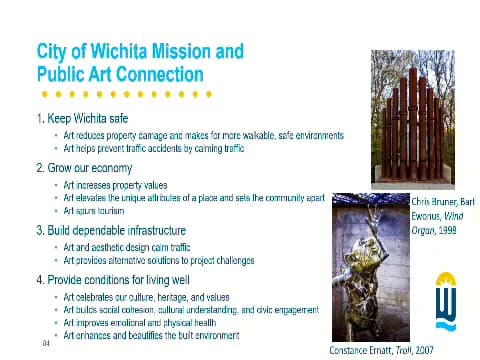
On October 22, 2024, the Wichita City Council held a workshop at 455 N. Main Street, Wichita, KS, starting at 9:00 a.m. The agenda included three presentations: the future of the current water treatment plant, proposed 2025 water and sewer rate adjustments, and a 10-year overview of the public art program. No formal votes were taken; council members offered feedback and direction for future action. Future of Current Water Treatment Plant - Laura Quick (Utilities Optimization Manager) and Gary Janssen (Public Works and Utilities) presented options from Burns & McDonald. - The new Wichita Waterworks plant is expected online in April 2025; both plants would operate 8–12 months, with the existing Main Water Treatment Plant (MWTP) likely offline around 2026. - Demand projections: using 2023 data, the projected highest single-day demand in 2045 is 86 million gallons per day (MGD), below the new plant's 120 MGD capacity; no capacity expansion is warranted. - The plant dates to 1939; condition assessment found corrosion, deferred maintenance, and chemical storage that does not meet current safety codes. - Eight options were considered; a capacity-expansion option was dropped early. Key options included: full demolition ($50–75M); mothballing ($8–9M over 20 years); raw-water emergency use (rejected by KDHE); groundwater emergency disinfection with a new building (45 MGD, 1–2 day startup, $24–29M capital, $28–33M 20-year lifecycle); groundwater emergency disinfection with temporary chemicals (45 MGD, 1–2 day startup, $11–16M capital plus $3–4M O&M over 20 years); surface/groundwater blend with disinfection building (45 MGD, 1 week startup, $14–19M capital, $22–28M lifecycle); blend with temporary disinfection (45 MGD, 1 week startup, $8–9M lifecycle). - Staff and the steering committee recommended Option 5 as first choice and Option 4 as alternate, both emergency-only, groundwater-only, with 1–2 day startup. - Council discussion covered risk tolerance, the 1993 Des Moines flood (11 days without water, another 8 days until safe), economic impacts of prolonged outages, the new plant's redundancy vs. a single point of failure, hard vs. soft water quality, and Option 7's slower one-week startup. - Existing $27M in CIP and $300,000/year in pro forma are budgeted for the MWTP; staff said the recommended emergency-use options would not require a rate increase. - Council requested additional information on demolition costs, the cost/benefit of emergency use, El Dorado Lake pipeline feasibility, and cyber/terrorism separation between plants. Water and Sewer Rate Adjustments for 2025 - Gary Janssen presented the 2025 rate outlook, saying the 2019 rate plan is no longer sustainable due to record inflation and known operating costs. - Actual average O&M increases over the past three years were 10% for water and 7% for sewer, versus a 3% assumption in the 2019 model. - Notable cost increases cited: chemicals up $2M in three years; bank fees +156%; energy +12%; technology +20%; facility insurance +47%. - New water plant O&M estimates changed substantially: chemicals from $269,000 to $721,000 in 2025; energy from $600,000 to $900,000; staffing/contract services from $600,000–$1.2M to $1.5M in 2024 and over $2M in 2025, ongoing. - BNR project additions: staffing/benefits $500,000 (2026) and $1M (2027); chemicals $864,000 (2025) and $1.7M (2026); energy $150,000 (2026) and $300,000 (2027). - The 2025–2034 CIP includes almost $800M in water/sewer improvements; debt service within the current rate structure is almost $2B. - Recommended combined 2025 rate increase: 6.14%, compared to 5.03% in the 2019 plan. It includes the adopted CIP (with staff deferrals), existing debt, BNR loans, new plant transition costs, and $300,000/year MWTP maintenance. It excludes lead/copper/PFAS costs, revenue losses from Derby/Valley Center building their own plants, and drought-related revenue losses. - The revised plan meets the minimum 120% debt coverage but leaves little contingency. - Customer bill impacts: low-volume user +$3.21/month; mid-volume user +$4.79/month. Low users would pay about $0.70/month more than under the 2019 projection; most residential users fall in the low category, with an estimated monthly bill of $73.54; mid-user bill would be $109.29. - Peer city comparison: Wichita's $92 total bill is 17% less than the next closest (Fort Worth). EPA affordability: 1.7% of median household income, well below the 4.5% threshold. - Assistance: 0.1% of water/sewer revenues earmarked for customer assistance — about $190,000 in 2024 and $202,000 in 2025; customer donations doubled to about $9,000; 2024 assistance projected at $55,000. - User fees are reviewed every two years; examples include new accounts (+$20), non-payment shutoff (+$12), grease maintenance (+$20/year), and backflow testing (+$4/year). - Staff recommended raising the late payment fee from 1.5% to 5% of the unpaid balance. Council discussed waivers, hardships, and the fact that 87% of 10,000+ annual payment arrangements were broken; more data on waiver cases was requested. - Conservation tier restructuring was revisited: NewGen estimated tier 2/3 increases could save 1.4 billion gallons annually while remaining revenue-neutral, but could add about $3M/year to large commercial users like Spirit AeroSystems for non-discretionary process water. Council directed further study, including options for commercial irrigation meters and tier designs; this would not be part of the December action. - Next steps: staff will refine 2025 rate/fee recommendations based on feedback and return to Council in December for formal action. Public Art Overview - Lindsay Banaka, Director of Arts and Cultural Services, presented a 10-year review of the public art program since the 2019 percent-for-art ordinance. - The city's collection spans 132 years, dating to 1892, with more than 300 accessioned works; about 205 are listed on publicartarchive.org. - The Design Council is an 11-member appointed board with a current vacancy for a landscape architect. - The percent-for-art ordinance sets aside at least 2% of eligible CIP budgets for art; an iconic-project provision allowing up to 2% additional has never been used. - Estimated public art spending by district over the past 10 years: District 1 $1.8M; District 2 $225,000; District 3 $225,000; District 4 $1.8M; District 5 $280,000; District 6 $3M; pools (across districts) $1.2M. - Commissioning now uses open calls via callforentry.org, with design council review at 30% and 90% design. - Maintenance: $160,000/year in the CIP beginning in 2024; artists now provide maintenance plans; 2024 is the first year of implementation. - Council discussion: desire for more art in South Wichita, especially District 3; donation/gift processes; displaying museum collection pieces in public buildings; and the $1.2M Wichita Waterworks art budget, with one piece not visible yet and a final sculpture delayed to January 2025. Staff noted art can be re-sited and that public art is primarily tied to CIP projects. Key Outcomes - No formal votes were taken during the workshop. - Water plant: Council feedback generally supported an emergency-use approach; staff will refine Option 5/Option 4 details, answer follow-up questions, and return with a formal concept and delivery method after the MWTP is offline (around 2026). - Rates: Staff will prepare final 2025 rate, fee, and late-fee recommendations for Council action in December; council directed further study of conservation tier changes and commercial irrigation metering. - Public art: Council received the overview and encouraged continued investment, with particular interest in more South Wichita art and robust maintenance funding; staff will provide additional information (e.g., storage list, re-siting options) without committing to a new ordinance change.