The Alameda City Council held a special budget workshop on Tuesday, May 13, 2025, continuing from a May 5 session, to provide direction on the biennial operating and capital budgets for fiscal years 2025-26 and 2026-27. The meeting ran from 6:00 PM to 8:56 PM and focused on social services restructuring, police staffing adjustments, capital improvement investments, and community input on pickleball facilities. No formal votes were taken; direction will be incorporated into adoption materials in June. Public Comments & Testimony - Gabriel Duncan (Alameda resident) expressed full support for adding social worker positions, urging the council to fund both positions in year one if possible. - Lee Volin (remote speaker) strongly supported adding a full-time, skilled social worker at the main library, stating library staff need dedicated professionals to handle complex social service and behavioral challenges. - Terry Rose (40-year resident) advocated for resurfacing the Lincoln Park pickleball courts, noting the courts are cracked from prior demolition work and serve a broad age range. - Charles Liwson echoed the pickleball court resurfacing request, emphasizing the sport's accessibility and noting that Alameda's courts rank only "fair" compared to neighboring cities. Discussion Items - Social Services and Library Social Worker – Assistant City Manager Amy Woolridge presented a revised proposal to bring homeless outreach in-house by eliminating the Village of Love contract (cost savings of $76,700) and adding two full-time social workers: one for street outreach in year one and one for the library in year two. Councilmembers questioned the limited 12 hours/week of current library casework and sought faster library coverage. The council directed staff to use the $76,700 savings to enhance library social services in year one via contract or part-time positions (e.g., with Alameda Family Services), to explore MSW intern pathways, and to return at mid-cycle with an update instead of the year-two permanent position. - Library Security Guard – Councilmember Jensen opposed adding a security guard, citing potential to make vulnerable patrons uncomfortable. Mayor Ashcraft supported it as a safety net. Staff noted it is a contract easily cancellable if later deemed unnecessary. The council provided no formal direction; the item remains in the proposed budget for evaluation. - Police Staffing – Finance Director Ross McCarthy recommended increasing sworn officers from 70 to 72 (two-year cost $1.1M) and adding a victim services advocate ($400k). Police Chief Nishant Joshi reported current sworn strength of 46, projected to drop to 44 in June, then rise to 47 with new hires. Councilmember Daysog argued that reducing authorized street officer positions from 65 (the historic baseline) to about 49-52 represented a 22% cut and required broader public discussion. Mayor Ashcraft countered that the city faces fiscal uncertainty from state and federal deficits and must be prudent, leaving room for future enhancements at mid-cycle. - Capital Improvement Program – Public Works Director Aaron Smith presented a $86.2 million two-year capital budget, with 48% for transportation, 20% for sewers, 22% for buildings/facilities, and 2% for parks. Key projects include: Lincoln-Marshall-Pacific corridor improvements (leveraging $16M federal grant), neighborhood greenways, emergency water supply system ($400k, two trailer turntable reels), Bay Farm Island sea level rise adaptation, and library interior reimagining. Staff confirmed that the Lincoln Park pickleball court resurfacing ($100k–$150k) is already planned for year two, and Estuary Park Phase Two will add 4–6 pickleball courts. - Sidewalk Repair Program – Director Smith shared success: 94 properties participated (70% participation rate) in a new city-led repair program, up from 20% compliance under the old model. Key Outcomes - Social Services Direction: The council directed staff to use the $76,700 cost savings from eliminating the Village of Love contract to enhance library social services in fiscal year 2025-26 via contract or part-time coverage, to explore MSW intern pathways (bachelor's or master's level), and to report progress at the mid-cycle budget update; the second year full-time library social worker request was removed for now. - Police Staffing Direction: The council provided general support for the recommended 72 sworn officers and victim advocate, with the understanding that baseline police staffing is being reset from 65 to 49–52 deployed officers due to budget constraints; further increases may be revisited at mid-cycle if revenues improve. - Capital Program Direction: Staff will proceed with the proposed $86.2M capital plan, including resurfacing Lincoln Park pickleball courts and building pickleball courts at Estuary Park, with an emphasis on safety, ADA compliance, and grant leverage. - General Fund Allocations: The recommended $8M in general fund capital investments (e.g., street safety, building repairs, adaptation planning) are already incorporated into the projected $9.1M ending fund balance for FY 2026-27, which exceeds the required 25% reserve. - Next Steps: Staff will finalize budget adoption materials incorporating council direction; a formal vote is scheduled for June 3 or June 17, 2025.
Public Meetings - Alameda, California
Public Meetings - Alameda, CaliforniaThe Alameda Planning Board held a workshop to review a proposed Research & Development facility by Pacific Fusion at Alameda Point. The project includes a 225,500-square-foot building with office, lab, and demonstration space, aiming to advance fusion energy technology. No final approvals were made; the board focused on gathering input and directing next steps. Consent Calendar - Approved draft meeting minutes for April 14, 2025, and April 28, 2025. Board member Sue abstained from voting on the April 14 minutes. Public Comments & Testimony - Supporters: Jonathan DeLong (Reap Climate Center) expressed support for the project's jobs and climate benefits. David Mick (Power Engineering Construction) supported the proposal citing infrastructure investment and economic revitalization. Toby Thiely (student) noted that tritium use is comparable to hospital levels and supported the project. Josh Roden (Brookfield) supported it as complementary to nearby residential development. Brock Grunt (resident) supported, citing alignment with the city's economic plan. - Opponents: James Evans (retired engineering professor) argued the facility is a nuclear reactor and should be at Livermore or Sandia labs, citing tritium leak risks. Kurt Peterson (resident) raised concerns about waste byproducts and groundwater contamination near the bay. Francisco Nafriya (resident) opposed due to radiological risks, proximity to homes and schools, and inadequate emergency response infrastructure. Sylvia Johnson (resident) worried about startup failure, lack of decommissioning plan, and absence of a business transition plan. - City Staff: Abby Thorne Lyman (Base Reuse Director) clarified the city's dual role as landlord and regulator, and that the project includes off-site infrastructure improvements. She noted the Master Infrastructure Plan costs have risen above $700 million. Discussion Items - Project Presentation: Staff (Brian McGuire) introduced the workshop goals, noting Alameda is competing with Livermore for the project. The proposal is consistent with the 2014 EIR and zoning for the Enterprise District. Environmental review is underway but not yet complete. - Applicant Presentation: Courtney Richardson (Pacific Fusion) explained the company's mission, plans for 250 jobs, over $1 billion in investment, and compliance with California Department of Public Health regulations. Teresa Goodwin (HPA Architects) presented the building design, which includes a 100-foot-tall pulsar section, office, lab, and utility areas. The design uses blue branding colors and vertical elements inspired by Alameda industrial buildings. - Board Questions and Comments: - Vice President Arisa asked about Skyhawk Street connection and circulation. Staff confirmed Skyhawk is not a dedicated right-of-way and may be removed in future phases; new streets (Orion, Pacific, Ticonderoga) will be built. - Board member Sue asked about federal regulations, waste disposal, and water use. Applicant stated no federal oversight; state and local regulations apply. Waste is minimal, modeled after hospital protocols. - Board member Sahiba asked about tank materials, bike parking, and site lighting. Architect noted tanks will be painted to blend with building; lighting will use building-mounted and pole fixtures. - Board member Wang asked about circulation and street vacation. Staff confirmed Skyhawk and Oriskany may disappear; future Ticonderoga extension to Central Avenue is planned. - Board Feedback: Members raised concerns about safety (especially regarding radioactive materials), building massing, and community outreach. There was discussion about the need for a decommissioning plan, interpretive programs highlighting clean tech, and ensuring the design fits the industrial character of Alameda Point. - Subcommittee Appointment: The board appointed Vice President Arisa and will confirm one absent member via email to form a subcommittee for design refinements. Key Outcomes - No action on the development plan or design review was taken; the meeting was a workshop. - The board directed staff and the applicant to address specific concerns: safety protocols, decommissioning plan, building massing, street frontage design, lighting, and pedestrian connections. - A two-member subcommittee (Vice President Arisa and one absent member) was formed to work with staff on design iterations over the summer. - Staff expects to return to the board for decisions on the development plan and design review just before or after the August recess. City Council will consider the land conveyance (purchase option) in June. - The applicant will continue community engagement, including Family Fusion Day on May 31, 2025.
The Recreation and Park Commission of Alameda met on Thursday, May 8, 2025, at 7:00 p.m. in City Hall Council Chambers. The meeting covered non-agenda public comments, staff communications, commissioner updates, approval of minutes, and a detailed update on aquatic programs. The Commission unanimously approved the March 13, 2025 meeting minutes and adjourned. Consent Calendar - Approval of Minutes (Item 5-A): The Commission unanimously approved the minutes from the March 13, 2025 regular meeting. (Motion by Commissioner Schwartz, second by Commissioner Robbins; roll call: all yes) Public Comments & Testimony - Savannah (in-person): Representing Mario Gonzalez's family support group, she requested the Commission initiate the process to designate a small plot of city land (where Mario Gonzalez was killed by police in 2021) as a park, so a memorial bench or larger memorial can be placed through the city's program. She detailed the family's difficult interactions with the city and expressed that a memorial bench is a small gesture for a great loss. - Jay Garfinkel (via Zoom): Raised safety concerns at Lincoln Park baseball field, stating that the fence is not high enough to protect spectators in the bleachers and that there is inadequate protection from foul balls toward the parking lot. He asked the Commission to initiate a review and recommend improvements to the City Council. Staff Communications Director Long provided an update on upcoming events and programs: - Community events: Alameda Walks (May 17, 24), 11th annual Play for the Parks Golf Tournament (May 19), Rhythmix Rising Seas event (May 31), Starlight Movies in the Park (May 16), National Kids to Parks Day (May 17), Sand Castle & Sculpture Contest (June 21), 48th annual Fourth of July Parade. - Summer programs: Over 1,400 programs offered; over 12,000 individuals already registered; 300+ summer job applicants; 70+ youth volunteers. Free drop-in parks program at Lincoln, Sweeney, Tillman, and Washington Parks (June 16–August 8, 12–5 p.m.). Teen summer day trips, LGBTQ teen center, adult sports leagues. - Parks updates: Scoreboards installed at Estuary Park (thanks to Friends of Alameda Parks). High-risk tree removals at Lincoln Park Playground and Chochenyo Park. 50 new trees planted at Main Street Linear Park (with 100 volunteers and PG&E grant). Surf pool public meeting scheduled May 17 at Enterprise Park. LED lights installed at Leydecker softball fields. Renovation at Leydecker Recreation Center and Library. - Budget update: Department received support for one new park technician position. Capital budget workshop on May 13. Commissioner Communications - Commissioner Alexander: Thanked teachers for Teacher Appreciation Week. Noted new scoreboards at Estuary Park, updated Whale Park sign, visited skate park, praised Spring Shindig event, and commended staff creativity in the summer guide. - Commissioner Bernie: Had no comments. - Commissioner Robbins: Encouraged student input for the surf pool survey. Visited Alameda Museum, played tennis at Washington Park (complimented signage), and noted different vibes at pickleball courts at Lincoln Park and Leydecker. Encouraged teens to apply for summer jobs with ARPD. - Commissioner Schwartz: Seconded Robbins' comments; shared personal experience as a teenage lifeguard. Enjoyed Spring Shindig but suggested better signage for swim lesson sign-ups. Noted confusing dates on park signage for tree removal. Excited for summer swimming programs. - Chair ADD: Acknowledged extraordinary times with federal actions impacting local conservation and climate efforts. Mentioned attending Bay Nature and Together Bay Area events. Shared that his son is a junior counselor-in-training. Encouraged commissioners to participate in upcoming budget workshops. Discussion Items 6-A Update on Aquatic Programs Stacey Thomas, Aquatic Supervisor, presented a detailed update: - Mission: "Aquatics for All" – ensuring everyone has the right to learn to swim. - Current facilities: Only Encinal Swim Center (9-lane pool + small baby pool) in operation. Emma Hood Aquatic Center under construction (expected open early 2026). City Aquatic Center in design (construction documents 19 weeks; construction early 2026, opening 2027). - Staffing: Thomas is the only full-time employee; 175 part-time staff in summer. Switched lifeguard training to Star Guard (from Red Cross), providing more hands-on training and support. - Programs: Family swim restored (Fri 1–6 p.m., Sat & Sun 4–6:30 p.m.). Swim lessons: 10,000–11,000 individual participants per year; adapted swim lessons for special needs started January 2025. New curriculum (Starfish Alliance) emphasizing water safety. - Aquatic camps: Mermaid vs. Pirate camps, Percy Jackson, Aqua Eco, intro to triathlon (with kayaking/paddleboarding). Partnership with Joe Stack and with nonprofit Aka Non Verba. - Events: Dive-in movie (Sky High), Water Safety Month event (500+ sign-ups for free lessons, CPR, first aid), Pumpkin Patch Pool Party (480 attendees), Thanksgiving Swim, first North Pole Swim (Santa in pool). Upcoming: Snowman Family Pool Party (returning) and Fourth of July Swim. - Pool rentals: Used by US Masters swim teams, water polo, high schools, Laney College, Dora Marine (scuba). - Lifeguard competition: ARPD team has medaled in recent years. - Scholarships: Fee assistance available but underutilized (only two requests so far this year). Commissioners discussed better outreach through schools. - Questions: Commissioners asked about completion schedules (answered), differences between Star Guard and Red Cross (more personalized), open water swim lessons (not offered, but intro triathlon provides foundation). Key Outcomes - Minutes approved unanimously. - Aquatic update received; no action required. - Next meeting scheduled for June 12, 2025. Possible agenda items: invitation to Friends of the Parks, youth sports update, budget results. The meeting adjourned unanimously.
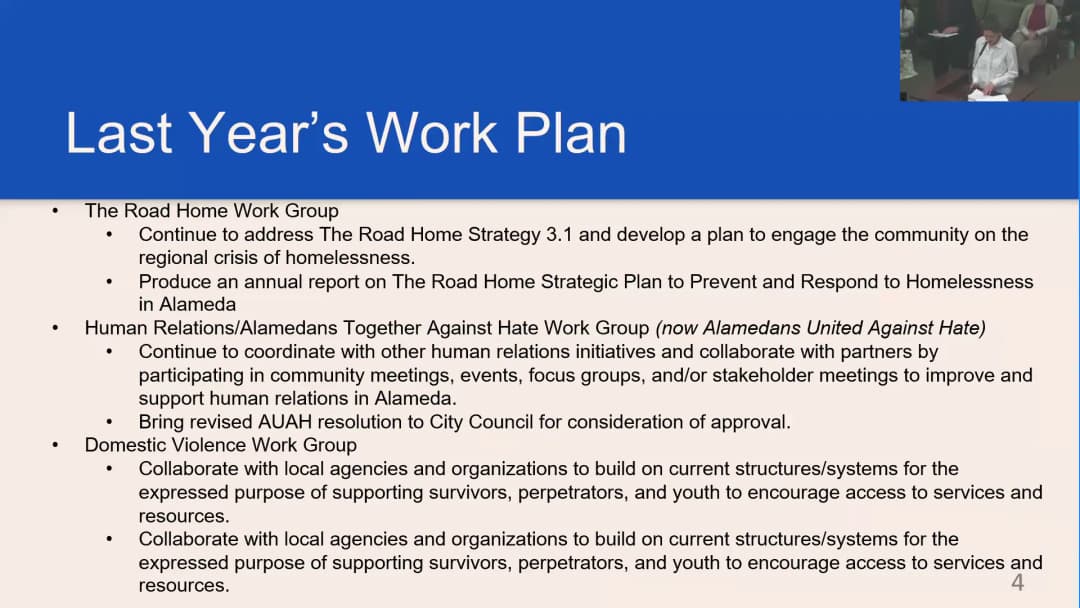
The City Council of Alameda held a special joint meeting with the Successor Agency to the Community Improvement Commission (SACIC) at 6:59 PM, followed by a regular City Council meeting at 7:00 PM on May 6, 2025. The closed session was canceled. The combined meetings covered routine approvals, public hearings, policy discussions, and a council referral on LGBTQ sanctuary city status. All votes were unanimous. Consent Calendar (SACIC) - 2-A (2025-4975): Minutes of the Special Joint City Council and SACIC Meeting held on February 18, 2025, were approved unanimously. Agenda Item (SACIC) - 3-A (2025-4970): The City Council accepted the Fiscal Year 2023-24 Audited Financial Statements and Compliance Reports. Acting Finance Director Ross McCarthy presented a 10-year comparison of CalPERS pension liability, highlighting a $20 million investment loss in FY 2021-22 due to a bear market. Elected City Auditor Kevin Kennedy praised the finance department for producing the financial statements in-house for the first time, resulting in a clean audit opinion. The motion passed unanimously. Proclamations, Special Orders of the Day and Announcements - 3-A (2025-4739): Proclamation declaring May 2025 as Asian American, Native Hawaiian, and Pacific Islander Heritage Month. Mayor Ashcraft read the proclamation, noting the theme "A Legacy of Leadership and Resilience" and listing local AANHPI leaders. Library events were highlighted. - 3-B (2025-4740): Proclamation declaring May 2025 as Jewish American Heritage Month. Mayor Ashcraft acknowledged rising antisemitism since October 7, 2023, and listed library programs celebrating Jewish culture. Councilmember Daysog added comments about upcoming cultural festivals. Oral Communications, Non-Agenda (Public Comment) - Brian Kennedy: Expressed opposition to the city's "Know Your Rights" webpage for immigrants, arguing it interferes with ICE's efforts to combat child sex trafficking and cartel activity. He urged the city to remove the page. - Gabrielle Duncan (Founder, Alameda Native History Project): Announced the first annual acorn harvest and culinary series, producing acorn flour for the first time in over 300 years. Noted a $5,000 grant recommendation from the Public Art Commission and thanked the city for support. Consent Calendar (Regular City Council) - Items 5-A through 5-Q: Approved by one motion. Councilmember Daysog recused himself from items 5-J (Island City Landscaping and Lighting District Zones 1,4,5,6,8) and 5-Q (Webster Street BIA) due to property boundary conflicts. - 5-E (2025-4920): MOU with Alameda Unified School District for exterior property management at Alameda Point (Building 17) for 10 years. Councilmember Jensen raised concerns about $600,000 in unpaid services over the prior decade. City Manager indicated staff would encourage the school district to sell or dispose of the property. The item was approved. - 5-O (2025-4961): Public hearing on the CDBG/HOME Five-Year Strategic Plan and FY 2025-26 Action Plan. Speakers included: - Carol Mahar (Spectrum Community Services): Thanked the city for funding senior meals (nearly 15,000 meals served last year). - Liz Varella (Building Futures): Reported a $35,000 cut to the Midway Shelter and noted looming federal cuts; requested continued support. - Laura McInnes (Family Violence Law Center): Urged adoption of the grant, citing critical legal services for domestic violence survivors. - Kyle Sinkhoff (Alameda Family Services): Spoke in support of continued CDBG funding for a part-time therapist at high schools, citing low social connectedness among AUSD youth. - Bridget Schultz (Eden I&R 211 Alameda County): Reported 2,110 calls and 5,159 referrals from Alameda residents last fiscal year, with housing as the top need. - 5-P (2025-4964): Public hearing on Park Street Business Improvement Area (BIA) assessment with a 2.4% CPI adjustment. No public comment. - 5-Q (2025-4965): Public hearing on Webster Street BIA assessment with a 2.4% CPI adjustment. No public comment. The consent calendar passed unanimously. Discussion Items - 7-A (2025-4968): Social Service Human Relations Board (SSHRB) Work Plan for FY 2025-26. Vice President Samantha Green and President Scott Beams presented. Key areas: continuing work on housing/homelessness, Alamedans United Against Hate, domestic violence, and CDBG oversight. New initiatives include age-friendly city designation and a community needs assessment. Councilmember Daysog encouraged SSHRB to focus on LGBTQ+ inclusion, especially transgender individuals. The work plan was accepted unanimously. - 7-B (2025-4977): CARE Team update and new service agreement with Alameda Family Services (AFS) for $1,681,886 over three years (July 2025-June 2028). Deputy Chief Cody Moxley reported that in 2024, the CARE Team responded to 1,332 calls (1,149 mental health crises). Outcomes: 46% resolved on-site, 28% transported, 8% psychiatric holds, 26% good intent/unable to locate. AFS Director Karen Zeltzer explained that most consultations are by phone, with in-person response within 20 minutes. She also noted a bridge therapy program using interns to address therapy waitlists. Discussion included concerns about library safety (9 CARE responses to main library in 2024). Fire Chief Nick Luby spoke about ongoing collaboration with library staff. The agreement was approved unanimously. - 7-C (2025-4982): Introduction of ordinance re-adopting limits on third-party food delivery service fees (15% cap on delivery fees, CPI-adjusted fee increases). Economic Development Manager Jackie Kali presented. Councilmember Jensen moved to remove the sunset clause and direct staff to return in one year with data on effectiveness, including potential cap reduction and investigation of pricing discrepancies. The motion passed unanimously. Council Referral - 10-A (2025-4942): Consider directing staff to declare Alameda an LGBTQ Sanctuary City. Councilmember Daysog introduced the item, noting the day's court ruling allowing the Trump administration to ban transgender individuals from the military. He emphasized concrete actions such as leveraging city assets (parks, pools) to show support. Public comment: Gabriel Duncan spoke in favor, highlighting the importance of safety for two-spirit and LGBTQ+ individuals. Council discussion: Mayor Ashcraft cautioned against adopting a formal label due to potential federal funding risks, but supported taking affirmative steps. Councilmember Bowler suggested referring the matter to the city manager and city attorney to develop recommendations. The council voted unanimously to direct staff to take steps to make Alameda more welcoming, with possible expedited actions for Pride Month in June. City Manager Communications - First budget workshop held May 5; second workshop scheduled for May 13. - Central Avenue Safety Project construction ongoing from Lincoln Avenue to 9th Street. - Oakland-Alameda Access Project virtual presentation on May 14. - Bike to Wherever Day on May 15. Key Outcomes - SACIC Minutes: Approved unanimously. - FY 2023-24 Audited Financial Statements: Accepted unanimously. - Consent Calendar (Regular): Approved unanimously, with recusals noted. - SSHRB Work Plan: Accepted unanimously. - CARE Team Agreement: Authorized unanimously. - Third-Party Food Delivery Ordinance: Introduced and approved with removal of sunset clause; staff to report back in one year. - LGBTQ Sanctuary City Referral: Referred to city manager and city attorney for affirmative steps; direction to consider expedited actions for Pride Month. Passed unanimously. - Council Communications: Members reported attending various community events. Meeting adjourned at 10:20 PM.
The City of Alameda held a special city council meeting on Monday, May 5, 2025, beginning at 6:00 PM, to workshop the biennial budget for fiscal years 2025-26 and 2026-27. Staff presented a proposed budget that uses $6.5 million in residual fund balance in FY26 and $2.9 million in FY27 to close gaps, maintaining a $9.5 million residual balance above the 25% emergency reserve. Council discussed revenue and expenditure trends, department requests, and gave preliminary direction on key priorities including police staffing, a victim advocate, and library safety. Consent Calendar - No consent calendar items were on the agenda. Public Comments & Testimony - Ruth Abbey (Community Action for Sustainable Alameda) expressed support for investing in a junior staff position to replace the Civic Spark fellow, noting the fellowship was defunded by the federal administration. She urged council to support climate resilience staffing as a strategic priority. - Karen Butter (President, Friends of the Alameda Free Library) spoke in support of the library’s budget request, highlighting safety concerns and the need for additional staff to maintain services. She also invited the public to the upcoming used book sale (May 14–17). - Charles Linson (Alameda Pickleball) noted over 1,000 people on the mailing list and requested continued investment in pickleball courts, noting only one lighted public court currently exists. Discussion Items - Budget Overview & Approach: City Manager Jennifer Ott and Acting Finance Director Ross McCarthy presented a stretched budget due to lower revenue projections, loss of a major sales tax generator, and absorption of programs previously funded by one-time grants. Operating revenues are projected to cover 97% of operating expenditures. Staff recommended using $6.5M (FY26) and $2.9M (FY27) of residual fund balance, ending with $9.5M residual. The 25% reserve ($37.5M) is protected. - Revenue & Expenditure Trends: Property tax growth is slowing (3-4% projected), sales tax is recovering, and transfer tax remains volatile. Federal grants total $30M, with $6.3M identified as high risk. Staff found balancing options including recouping property taxes, using excess pension fund balances, prepaying pension liabilities, and slowing police hiring. - Police Staffing: The current budget proposes a goal of 47 police officers (out of an authorized 70 sworn total) by September 1, 2025. Chief Joshi explained that attrition rates make it difficult to maintain even that number, and that field training takes 19 weeks. Council discussed increasing the goal to 49 (72 total) or 51 (74 total) at additional cost ($615K in FY26, $472K in FY27 per two officers). The city manager noted adding two officers would reduce residual fund balance to about $8.4M; adding four would reduce it to $7.3M. - Library Budget: Director Mike Eitner proposed realigning hours (net +1 hour systemwide), hiring security guards (year one), adding a social worker (year two), converting part-time to full-time staff, and other safety measures. Council members expressed varying views: Mayor supported a pilot contract social worker rather than a permanent hire; Vice Mayor favored social worker over security guard; Councilmember Jensen suggested potentially merging the HHS case manager role with library services. The security guard proposal faced opposition. - Victim Advocate: Julia Gonzalez (Prosecution Unit) requested funding for a victim advocate position (not recommended in staff budget). Councilmembers Jensen, Vice Mayor Pryor, and Mayor expressed strong support, citing needs for domestic violence and immigrant community support. Initial cost is roughly $150K for two part-time positions; adding two officers plus victim advocate would lower residual balance to about $8M. - Department Presentations: Other departments (Fire, Public Works, Recreation & Parks, Planning/Building/Transportation, City Attorney/Rent Program, Finance, Base Reuse, City Manager’s Office, Human Resources, IT, City Clerk) presented their budget proposals and workforce requests. Most general fund new FTE requests were not recommended except where offset by savings or revenue. Key Outcomes - Continuance: Council voted unanimously (5-0) to continue the budget workshop to the May 13, 2025 meeting (6:00 PM) for further discussion and to allow staff to refine proposals based on direction. - Direction to Staff: - Explore funding for 72–74 police officers (2–4 additional hires) and analyze potential offsetting revenue from Community Facilities Districts (CFDs) at Alameda Point and Alameda Landing. - Develop a plan to fund a victim advocate position, potentially as two part-time roles to save benefits, and evaluate grant opportunities. - Revisit the library social worker proposal as a contract (pilot) rather than permanent FTE, and consider consolidating with HHS case management. - The security guard for the library was not supported; instead, the social worker was preferred. - Defer the new HHS program specialist position to year two pending a more detailed implementation plan. - Staff will bring back financial scenarios for these options at the May 13 meeting. - Guiding Principle: Council emphasized using residual fund balance prudently, with several members expressing caution about reducing it below $8 million given economic uncertainty. The budget aims to maintain current service levels without across-the-board cuts.
Note: The meeting minutes and transcript indicate the actual meeting date was January 22, 2025, conflicting with the user-provided date of May 1, 2025. The summary below uses the provided date per instruction. The Commission on Persons with Disabilities held its regular meeting on May 1, 2025, chaired by Chair Mullings. All commissioners were present. The meeting covered sea-level rise adaptation projects, an age-friendly community initiative, and traffic calming designs for Fernside Boulevard, along with public comments and staff updates. Public Comments & Testimony - Non-Agenda Public Comment: The city's new ADA Coordinator, Lilian Jewell, and Public Works Director Erin Smith were introduced to the commission. Lillian Jewell expressed excitement about engaging with the community and building on existing accessibility efforts. - Public Comment on Fernside Traffic Calming & Bikeways Project: - Jim Strelow argued the design is 100% bike- and pedestrian-oriented, 0% resident-oriented, and will not reduce speed; he noted no stop signs, dips, or bumps are included and expressed confusion about bus stop placement. - Andy Wang asked that the Gibbons-Fernside-High intersection be studied for implementation as part of the 2026 resurfacing instead of being delayed several years; he cited safety concerns, narrow medians, and unclear crosswalks. - Ken Fagel addressed the lack of public parking along Fernside. - Kevis Brownson expressed concern over current crossings but appreciated the long-term plan as proposed. - Secretary Sarah Henry questioned the reasoning behind pedestrian median islands, bikeway direction changes, and the impact on Bayo Vista and High neighbors losing left-turn access. - Public Comment on Age-Friendly Initiative: Andy Wang wanted to ensure public comment was solicited. Jim Strelow shared that the Pacific Pinball Museum welcomes elderly visitors and volunteers and could partner with local adult day programs. Discussion Items 4-A: Concept Designs for Estuary Adaptation Project and Bay Farm Island Adaptation Project - Gail Payne, Senior Management Analyst, presented the early design phases for two sea-level rise projects, including shoreline treatments, water retention, erosion solutions, pump stations, nature-based solutions, and pedestrian elements. The projects are in the 10% design phase and exempt from CEQA (Section 15262) for this stage only. - Commissioner Questions and Positions: - Commissioner Roloff asked what insight from the commission would be most helpful; Gail Payne stated equity and community engagement are top of mind. - Commissioner Hall asked why the project is exempt from the Environmental Quality Act; Payne clarified only the design stage is exempt, with full CEQA/NEPA analysis to follow. - Commissioner Schmitz expressed concern that the wooden pedestrian bridge is not included; Payne noted Mayor Ashcraft shared the same concern, but grant funding limits prevent its inclusion, and it will require coordination with Transportation and East Bay Regional Parks. - Commissioner Schmitz affirmed that lookouts along trails would be valuable for a variety of mobility aid users. - Chair Mullings encouraged investment in a multimedia approach to accessibility for signs and trails. - Commissioner Bonsmith asked about the 10-year flood level baseline; Payne and Erin Smith clarified predictive modeling is used to design for future flood levels. - Commissioner Roloff asked about dependence on grant funding; Payne stated the current grant is nearly exhausted and future funding is still needed, though a FEMA grant ($50 million recommended for further review) and a Water Resources Development Act allocation ($30 million, pending appropriation) are potential sources. - Commissioner Comments: Commissioner Beehler agreed with the need for accessible lookouts, braille, sound, and tactile features. Commissioner Roloff suggested multiple access points with compliant slopes for levee access. 4-B: Presentation by the Social Service Human Relations Board – Age-Friendly Alameda - Jim Means presented the Age-Friendly Alameda initiative (based on the AARP/WHO model), which assesses built and social environments across eight domains. Next steps include community outreach and creation of SMART goals. - Commissioner Positions and Suggestions: - Commissioner Roloff noted collaboration could help provide adults with developmental disabilities more activity opportunities, especially with reduced job availability. - Chair Mullings encouraged sensitive and inclusive messaging to attract a wide range of residents. - Commissioner Bonsmith urged inclusion of mental health resources. - Means requested commissioner involvement by subscribing to the info list and participating in conversations. 4-C: Draft Final Design Concepts for Fernside Traffic Calming & Bikeways Project - Lisa Foster (Transportation Planning Manager) and Jimmy Jessup (Consultant) presented two phases: a long-term concept (two-way protected bikeway, pedestrian median islands, accessible bus boarding islands, estimated $20.5 million) and a near-term concept (2026 resurfacing, buffered bike lanes, estimated $1.5 million). The corridor runs 1.3 miles from Tilden Way to San Jose Avenue, with a near-term option from Tilden to High Street. - Commissioner Questions: - Commissioner Roloff asked about rapid-flashing beacons as alternatives; Jessup noted stop signs are ineffective for traffic calming but beacons may be considered. - Commissioner Hall asked about lengthening the red light at the High Street bridge; Jessup said long-term project includes intersection operations study. - Chair Mullings asked for clarification on bus transfer zones; Jessup explained in-lane boarding islands would allow buses to stop without merging. - Commissioner Schmitz asked about accessibility for wheelchair vans with ramps; Jessup described deployment over planting strips or across the bikeway, and Scott Wikstrom (City Engineer) referenced PROWAG guidelines for on-street accessible parking. - Commissioner Bonsmith asked about raised bikeways versus roadway grade; Jessup stated raised bikeways are 40% more expensive but preferred, and funding is grant-based. - Commissioner Beehler asked about the timeline to include Gibbons in 2026; staff explained the Gibbons intersection design requires further public input and will be studied separately. - Commissioner Comments: Commissioner Beehler thanked the transportation team for incorporating previous commission feedback. Commissioner Hall shared PROWAG guidelines with the commission. Key Outcomes - No formal votes were recorded for any agenda item. The commission discussed each item and provided feedback to staff. - For Item 4-A, the concept designs had already been approved by City Council the previous night (January 21, 2025). The commission's feedback will be forwarded to consultants. - For Item 4-B, the commission expressed interest in partnering with the Social Service Human Relations Board on the Age-Friendly initiative; commissioners may join the mailing list. - For Item 4-C, the commission reviewed the draft final design concepts; staff will incorporate feedback into the staff report for City Council. Further public outreach on the Gibbons intersection is planned. - Staff Communications: The Oakland-Alameda Access Project (OAAP) construction will begin summer 2025, requiring periodic single-lane closures of the Posey Tube for up to 18 months. The bike/pedestrian lane will remain open during single-lane closures. The commission was encouraged to attend other board meetings and recruit new members, especially persons with disabilities. - Commission Communications: The warming shelter at Christ Church is well-supported with meals and volunteers. Meeting dates for 2025 were set for the second Wednesday of each month (subject to cancellation or rescheduling).
The Transportation Commission held a special meeting on April 30, 2025, at 6:30 PM. Key agenda items included staff communications on the Oakland Alameda Access Project (OAAP), discussion of the Fiscal Years 2025-2027 Capital Budget for transportation projects, and review of the Transportation Program Plan for Older Adults and People with Disabilities. The Commission approved the consent calendar and unanimously endorsed the continuation of pilot programs for the free bus pass and Alameda Independent Mobility (AIM) programs. Consent Calendar - The Commission unanimously approved the draft minutes of the February 26, 2025, Transportation Commission meeting. Public Comments & Testimony - Jim Strelo (resident) spoke about the OAAP, requesting a published schedule for bridge openings/closures to help residents plan around construction impacts. He also raised a safety concern about a jogger in a bike lane and urged more public education on traffic rules. - Vicki Teng (East End homeowner) requested community engagement and input before the Gibbons High Fernside intersection study, noting that 80 people signed a letter seeking more input. - Cindy Johnson (speaking on behalf of Bikewalk Alameda) encouraged full funding for active transportation projects listed in the 2030 Infrastructure Plan, including Grand Street north of Otis, commercial districts, and neighborhood greenways beyond current slow street conversions. Staff Communications - Lisa Foster (Transportation Planning Manager) reported on recent City Council actions including approval of Fernside Boulevard traffic calming, adoption of the 2025 Climate Action and Resiliency Plan, and approval of the Stargell Complete Streets Corridor Design. She noted the water shuttle has carried 73,000 passengers since July 2024, and paid parking at ferry terminals is planned (Harbor Bay in late spring, Seaplane Lagoon in late summer) at $3/day. - Sarah Henry (Communications Director) provided an update on OAAP open houses, noting that construction is expected to go out to bid by summer, with a contractor identified by summer and construction starting in fall. The Webster tube will be reduced to a single lane for six months, followed by the Posey tube for 12 months; both tubes will not be closed simultaneously. She also mentioned that Caltrans will lead communications once construction begins. Discussion Items - 6A: Capital Budget FY25-27 (Discussion) – Scott Wickstrom (City Engineer) presented a proposed $87 million capital budget for the two-year cycle, with $41 million for transportation enhancements and pavement. He highlighted a $4.6 million general fund request to support transportation projects, including $1.2 million for neighborhood greenways, $1.2 million for the Stargell roundabout, and $1.2 million for the Lincoln Marshall Pacific corridor. The budget also includes $10.8 million for pavement, $2.5 million for sidewalks, $1.7 million for signals, and $16.5 million in grant-funded projects. Commissioners discussed staffing resources, the impact of 40% construction cost increases since 2020, and the need for additional funding to meet 2030 active transportation network goals. Staff noted that the Fernside intersection study is not explicitly funded in this two-year cycle pending council direction. - 6B: Transportation Program Plan for Older Adults and People with Disabilities (Action) – Lisa Foster presented the plan, which includes a free AC Transit bus pass program (970 members, 18,000 rides in December 2024, 73% Asian participants, half Cantonese-speaking) and the AIM program (170 participants, 6 rides/month via Uber/Lyft). The free bus pass program faces a funding gap due to a fare increase, requiring a general fund request to clear a waitlist. The AIM program has challenges with wheelchair accessibility and service animal accommodations. The Commission discussed equity concerns regarding the bus pass demographics and limitations of the AIM program. A motion to endorse a continuation of both pilot programs (rather than a one-year extension) passed unanimously. Key Outcomes - Approved the February 26, 2025, meeting minutes unanimously. - Endorsed continuation of the free bus pass and AIM pilot programs (motion carried unanimously). - No vote was taken on the capital budget; the Commission provided feedback to staff for consideration by City Council on May 13, 2025. - Staff noted that the City Council budget workshops are scheduled for May 5 and May 13, 2025.
The Alameda AC Transit Interagency Liaison Committee (ILC) met on April 29, 2025, in a hybrid format. The meeting covered updates on transportation projects, a free bus pass pilot program, proposed ILC consolidation, the Realign service redesign, and ridership performance. No formal votes were taken, but discussions informed next steps. Public Comments & Testimony - Christy Cannon, a volunteer with CASA (Community Action for Sustainable Alameda), commented on early bus arrivals, stating that early arrivals are worse than late arrivals because real-time apps are not helpful when the bus has not yet departed the terminal. She asked about driver training on holding at time points. Staff responded that operators are trained to wait at scheduled time points and acknowledged the issue, committing to follow-up. Discussion Items - Annual Transportation Report: City staff presented highlights: 1.4 miles of all-ages bikeways added, 395 sidewalk trip hazards repaired, over 51,000 riders on the Oakland-Alameda Water Shuttle (mid-July to Dec 2024), over 200,000 rides on the free bus pass program, bus ridership up 8% since 2023 (36% since 2021), and ferry ridership up 60% with over 500,000 boardings in 2024. Vice Mayor Pryor asked about bus service to Bay Farm ferry terminal; staff confirmed Line 21 serves it and will continue with Realign. The Cross Alameda Trail is nearly complete; Clement Tilden and Pennzoil projects are moving forward. - Free Bus Pass Pilot Program for Seniors & People with Disabilities: Staff reported 970 participants, with over 18,000 rides taken in December 2024 by 641 unique users. Active participants average 29 rides per month, and nearly half speak Cantonese. The program is funded by Measure BB but faces cost increases due to AC Transit fare hikes. Options include limiting program size, seeking general fund support, or converting to EasyPass. AC Transit staff (Deborah Garcia) explained that EasyPass is not suitable for this membership-style program. Annual renewal with stricter low-income verification will be implemented, potentially clearing the waitlist but increasing administrative burden. A moderate general fund request is being prepared for the city's biennial budget. - ILC Proposed Consolidation: AC Transit staff (Howard Durr) presented a proposal to merge several ILCs to reduce staff workload. The specific plan for Alameda is still in development. Director Peoples strongly opposed combining Alameda with Oakland, arguing Oakland's size and complexity would overshadow smaller cities and that Alameda's ILC is one of the most successful. The conversation referenced previous robust discussion and upcoming AC Transit board elections in 2026. - Realign Update: Howard Durr reported that the final network redesign plan was approved in October 2024, with implementation in August 2025. Service standards are being revised. Internal preparations, including bus stop changes and coordination with the city, are ongoing. A public information campaign will launch in June/July. Director Peoples noted that Realign currently represents a cut to 85% of 2019 service and urged that additional phases (100% and ideal service) be developed to advocate for more funding. - Alameda TMA Update: Staff reported on behalf of Lucy Lee: The Clipper Tree Pass pilot has nearly 1,200 participants (76 at Alameda Point) and recorded 44,000 trips in Q1 2025. EasyPass ridership also increased. The Alameda Landing Express shuttle will end in June due to low ridership, transitioning users to AC Transit. A new free AC Pass program launches in May for Alameda Landing residents and employees of Safeway and Michaels working 35+ hours/week. - Oakland Alameda Access Project: Crystal Wayne (AC Transit) reported that construction is expected to start fall 2025 (no sooner than October) and last 3.5 years. AC Transit's main concern is minimizing bus delay during tunnel closures. The City of Oakland is preliminarily open to a bus-only lane on 7th Street and a dedicated bus-only left turn from Broadway to 7th Street. A multi-agency workshop is planned. Public workshops are being held by ACTC. - AC Transit Ridership & Complaints: Staff presented performance data for Alameda lines (Nov 2024–Feb 2025). Ridership remained consistent, with a jump on the 51A. On-time performance: Transbay lines and Line 96 are below the 72% standard; Line 96 is on detour due to the city's Reshape project. School routes also low due to holding for students. Customer complaints about no-shows and pass-ups decreased significantly: pass-ups from over 130 to 46, no-shows from 96 to 40. Staff attribute improvement to better staffing. A new pilot program offering $2/hour incentive pay for operators on trunk lines (including the 51) aims to further boost reliability. Key Outcomes - No formal votes were taken. - Staff will follow up on early bus performance and operator training (Item 10). - The ILC consolidation proposal will continue to gather feedback and be presented to the AC Transit board; no decision made. - The free bus pass program will undergo annual renewal with stricter income verification; a general fund request will be prepared for the city budget. - Realign implementation remains on track for August 2025; a public information campaign will run June/July. - The Oakland Alameda Access Project timeline and transit mitigation measures will be addressed in upcoming workshops. - Next ILC meeting: July 17, 2025, and October 16, 2025.
Note: The transcript indicates the meeting occurred on April 24, 2025, but the provided date for this summary is April 29, 2025. This discrepancy is noted rather than silently resolved. The Social Service Human Relations Board (SSHRB) met in regular session at 7:03 p.m. on the recorded date. The board discussed and voted on amendments to its Fiscal Year 2025-26 work plan, provided feedback on a student-designed logo, and received updates from work groups and staff. Several routine items were approved unanimously. Consent Calendar - Minutes Approval (March 27, 2025): Motion to approve, seconded, passed unanimously (7-0). Public Comments & Testimony - Jennifer Rkowski spoke during agenda item 4A (work plan). She urged the board to update the city's domestic violence resources webpage, noting the current guide dated from 2011 contains disconnected crisis numbers and outdated locations. She emphasized the real consequences for the community and called for a more accurate and caring resource. Discussion Items - Fiscal Year 2025-26 Work Plan Amendment (Item 4A): Staff explained that the community needs assessment (CNA) is conducted every five years and the next cycle is 2026-27. Therefore, the board discussed amending the work plan to shift from completing the full CNA in FY25/26 to only performing data collection in that year, allowing ramp-up time. The amendment was moved, seconded, and after public comment, passed unanimously (7-0). - Age-Friendly Cities Update (Item 4B): Board member Scott Means reported on stakeholder engagement and lessons learned from Oakland's age-friendly initiative. He highlighted a volunteer list being developed, which will be hosted on the SSHRB website and updated quarterly. No vote was required. - Student Logo Design for SSHRB (Item 4C): The board reviewed a logo created by Alameda High School students. After discussion, the board voted (7-0) to provide feedback to the design team: include the full name “Social Service Human Relations Board,” use the official Alameda font, and incorporate imagery of people working together to reflect the board's mission. - Work Group Reports (Item 4D): - Domestic Violence Work Group: Reported progress on a central web page for domestic violence organizations, thanks to community input. - United Against Hate Resolution Work Group: Outlined a timeline to bring a resolution to the board in July, finalize in August, and present to City Council in October. Weekly meetings are being held with community leaders. - Road Home/Experiencing Homelessness Work Group: Announced a virtual presentation with a resident of Dignity Village, partnership with the school district’s McKinney-Vento liaison, and potential outreach at the Fourth of July race. Staff Communications - Gracia Manayan (Housing & Human Services Program Manager) reported: - Three items going to May 6 City Council meeting: CDBG consolidated plan, CDBG sub-recipient awards, and the SSHRB FY25-26 work plan. - Welcome to new staff member Camille Rodriguez, who will lead homelessness efforts. - Season for Nonviolence event on April 26. - Residential rehabilitation program now accepting applications for low-/moderate-income homeowners (grants up to $5,000, loans up to $15,000) for safety and accessibility modifications. - Budget update: slowing development has led to cautious budgeting; approximately 3% of general fund operating costs from reserves. - Day center relocation: 99% construction drawings, on track for mid-2026 opening. Board Communications - Upcoming Events: Speech contest, API Heritage Month (Bohol Circle festival), Buena Vista United Methodist Church Spring Festival, Older Americans Month, and discussion about a possible parade float for the Fourth of July. Key Outcomes - Work Plan Amendment (Item 4A): Approved unanimously (7-0) – the board will conduct data collection in FY25/26 rather than a full community needs assessment. - Logo Feedback (Item 4C): Approved unanimously (7-0) – the design team will be asked to include the board's full name, Alameda font, and imagery of people working together. - Minutes Approved (Consent): Unanimous. - No other formal votes taken.
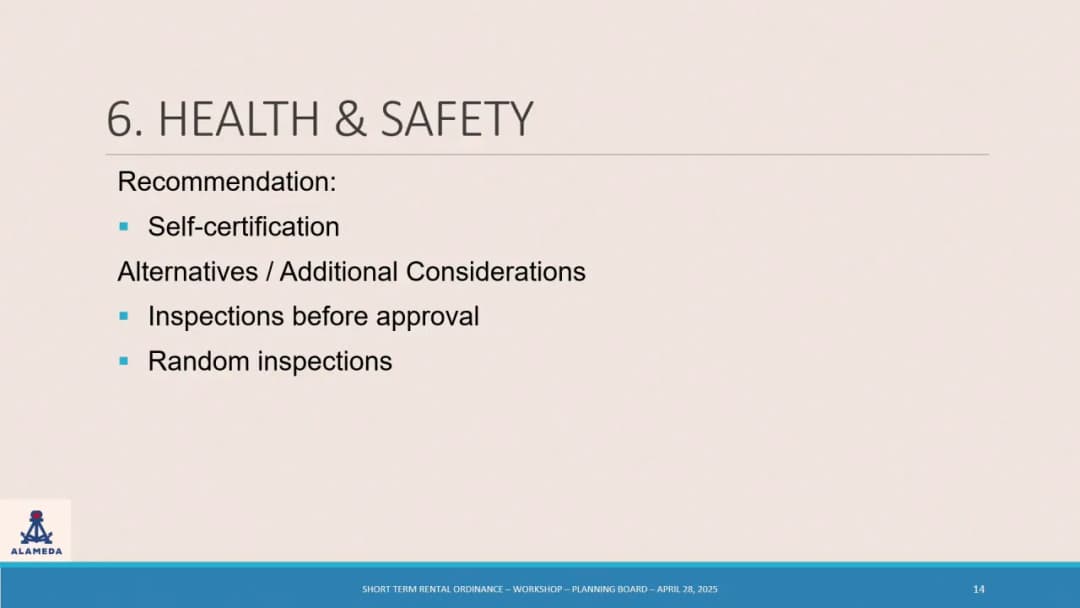
The Alameda Planning Board held a workshop on April 28, 2025, at 7:00 PM to continue discussions on regulating short-term rentals (STRs) in the city. The workshop was the second in a series, following one in February 2025. Staff presented initial recommendations, options, and answered board questions. Public testimony was heard, and board members provided feedback on key policy issues. No votes were taken; staff will return with a draft ordinance at a future meeting. Public Comments & Testimony - Joe Kaiser (resident on Otis Drive) described a two-year nightmare living next to an unhosted STR, with large gatherings (often 12–50 people) and unresponsive owners. He urged the board to implement a bare-minimum requirement that hosts be on-site and limit days per year. - Louai Al Kanji (resident on San Antonio Avenue) expressed concern about the studies cited by staff, noting one was funded by the hotel lobby. He stated that STRs generate approximately $12 million per year and support over 125 local jobs. His family relies on income from a backyard cottage (a semi-hosted STR) to afford their $8,000/month mortgage; he requested enough flexibility to allow them to stay in Alameda. - Steve Bus (owner of a Victorian home with a 90-year-old cottage) rents the cottage on Airbnb for about 200 days per year. He noted a 90-day limit would have significant economic impact. He also mentioned difficulty obtaining the correct business license and supported allowing semi-hosted STRs. - Sheila Keho (owner of a duplex, lives upstairs, rents downstairs) uses the rental mostly for parents visiting kids. She is retired and depends on the income from STRs, and she urged the board to consider people like her. Discussion Items - Staff Presentation: Planning staff (joined by consultant Heather Coleman) presented a follow-up to the February workshop. They recommended limiting STRs to owner-occupied properties, possibly allowing a second unit on the same property (but not ADUs built after 2017 per state law). Staff suggested self-certification for health and safety, a 90-day limit for unhosted/semi-hosted scenarios, and a zoning clearance/permit. They also noted that about 1% of Alameda’s housing stock is currently used as STRs, and a third-party tracking service could cost $15,000–$20,000 per year. - Board Member Wang: Questioned the policy rationale for a days-per-year limit, especially for semi-hosted situations where the owner is on-site. He favored a simple primary-residence requirement and opposed days-per-year limits and excluding ADUs from STRs. - Board Member Hom: Emphasized affordability, supported primary-residence requirement, preferred requiring the host to be on-site during rental, liked self-certification, suggested limiting simultaneous rentals, no party allowances, and opposed a 90-day limit if host is present. He raised questions about permit vs. zoning clearance for enforcement. - Board Member Ruiz: Agreed with Wang on preserving housing stock, noted Alameda is not a hot tourist destination, and saw appeal in full-dwelling-unit rentals for families. Supported semi-hosted STRs. - Board Member Saheba: Wanted data on unhosted STRs (78% rent entire house/apartment) and a policy that can adapt over time. She questioned how to enforce days limits and suggested flexibility for professions like teachers. - Board Member Sue: Echoed Wang’s concern that 90-day limits would preclude long-term rentals. She supported unlimited hosted and semi-hosted (with owner present) but was not convinced on semi-hosted where owner is away; she wanted more justification and suggested a 30-day limit to mirror state ADU law. - Board Member Adisa: Supported primary residence requirement and hosted (unlimited), but felt unhosted and semi-hosted (away) need days limits for enforceability. She also wanted to explore incentives for long-term rentals, such as partnerships with landlord associations. - Board Member Dewees: Provided detailed answers to staff’s policy questions: supported primary residence on same property, unlimited hosted and semi-hosted (host on-site), semi-hosted away should be limited. He opposed excluding ADUs built before 2017. He urged simplifying the health and safety checklist, not overreaching on guest limits or curfews, and streamlining the business license process. Key Outcomes - No formal votes or decisions were made; the workshop was for board feedback. - Staff will incorporate board comments and return with a draft short-term rental ordinance for further discussion at a future meeting (not the next two meetings due to absences). - The board generally converged on requiring primary residence occupancy, allowing hosted rentals (unlimited), and supporting self-certification for health and safety. - Divergent views were expressed on semi-hosted STRs, days-per-year limits, and whether to allow unhosted rentals (with or without limits). - Board members requested more information on enforcement costs, grandfathering options, and how to incentivize long-term rentals.