The Alameda County Board of Supervisors met on Tuesday, May 12, 2026, for a full-day regular meeting that included multiple proclamations, public testimony, a presentation on county efficiency consulting, and a vote to extend a data analytics contract with Peregrine Technologies. Supervisor Miley was excused for morning and reconvened later but was absent for parts of the afternoon. The meeting also featured reportable actions from closed session. Proclamations and Recognitions - CalFresh Awareness Month (May 2026): Recognized that over 171,000 Alameda County residents (about 1 in 10) rely on CalFresh. Speakers included Roland Chao (program specialist), Arlen Murillo (Alameda County Community Food Bank), and community member Sylvia Garcia. Theme: “CalFresh Works.” - Agriculture Week (May 10–16, 2026): Proclamation highlighted Alameda County’s $54 million in gross agricultural receipts and 208,000 acres under cultivation. Presentations from Dan Marcial (Farm Bureau), Livermore FFA students, Kathleen Mincer (Livermore Rodeo Foundation), Troy Horton (Dig Deep Farms, 100 acres of urban farms), Johnny Bootles (Alameda Point Collaborative Farm to Market), and Aisha Gannon (Gilltrack Farm Coalition). - Affordable Housing Month (May 2026): Recognized a county need for over 37,000 low-income and extremely low-income units. Measure A1 has created/preserved 4,117 units; Measure W awarded $53 million for nearly 950 units. Speaker: Joey Fliegel Mishlove (East Bay Housing Organizations). - Older Americans Month (May 2026): Theme “Champion Your Health.” County population age 60+ is approximately 390,000. Speaker: Sonia Frost (Department of Adult and Aging Services). Noted 27% of adults 65–74 and 7% aged 75+ remain in the workforce. - Emergency Medical Services Week (May 17–23, 2026): Recognized EMS clinicians. Speaker: Nyla Francis (interim deputy director, Alameda County EMS Agency). - Mental Health Awareness Month (May 2026): Recognized Our Cause organization, which hosts mental health awareness programs for South Asian communities. Reported that 75% of participants are more likely to seek help before crisis. Speakers: Rapali Rajvanchi and Sruti Ramnath. - Asian American, Native Hawaiian, and Pacific Islander Heritage Month (May 2026): Honored seven organizations: Asian Immigrant Women’s Advocates, API Legal Outreach, Banteay Srei, East Bay Asian Youth Center, Community Health for Asian Americans, Regional Pacific Islander Task Force, and Lan Shaw (Oakland Ballet). Eight individuals received commendations, including Siccone (from Family Bridges) and Pastor Barry Timani (Melino Foundation). - Public Service Recognition Week & 30-Year Service Awards: Recognized all county employees and honored 46 employees with 30 years of service (17 present). Supervisor Tam and President Halbert presented commendations. Public Comments & Testimony - Item 78 (Peregrine contract): Approximately 15 speakers opposed the contract amendment, citing privacy risks, potential data sharing with ICE/DHS, ties to Palantir, predictive policing concerns, and lack of community oversight. Several called the system “mass surveillance.” One speaker supported the contract, arguing it improves investigative efficiency. Multiple speakers also urged postponement pending stronger data governance measures. - Fireworks ordinance (Item 76): Two speakers supported the ban, noting 640 firework-related calls in the 30 days before July 4th last year, with 17 resulting in fires. - Other items: One speaker supported the housing provider resource center (Item 42). Two speakers raised non-agenda topics, including mental health and personal legal grievances. Discussion Items - Public Works LLC Efficiency Review (Item 33): Eric Schneer (president) presented the firm’s methodology for finding at least 5% operational savings in government. The board discussed sole-source vs. RFP, involvement of the auditor controller, and inclusion of Alameda Health Systems. Direction was given to staff to explore a contract with GSA, county counsel, and the auditor controller, with a goal of bringing a contract back quickly. - Peregrine Technologies Contract Amendment (Item 78): Sheriff Sanchez and Peregrine representatives presented the platform as a data analysis tool (not surveillance or predictive policing). They stated no federal contracts, no ALPR integration in this amendment, and strict data-sharing agreements under California law. Supervisor Fortunato Bass raised concerns about insufficient contract details and unanswered questions submitted in advance. Supervisor Marquez requested a future review of standard service agreements for technology. After debate, the board voted. Key Outcomes - Public Works LLC direction: Approved 3–0–2 (Supervisors Miley, Fortunato Bass, Halbert in favor; Supervisors Marquez and Tam abstained). Staff directed to conduct due diligence and return a contract proposal. - Peregrine contract amendment: Approved 4–0–1 (Supervisors Marquez, Tam, Miley, Halbert in favor; Supervisor Fortunato Bass abstained). The amendment increases the contract value from $686,500 to $1.4 million (a $723,000 increase) and extends the term two years through March 14, 2028. - Settlements approved in closed session: - Lee v. County of Alameda: $800,000 settlement (unanimous vote, March 10, 2026). - Tran et al. v. Alameda County Sheriff’s Office: $36 million settlement (4–0–1, March 24, 2026, with one excused). - Other actions: Approved minutes, consent calendar (including mass motion with recusals on items 34, 36, 42), salary ordinance amendments, fireworks prohibition ordinance (Chapter 9.46, first reading), and traffic regulations ordinance. - Meeting adjourned in memory of Deputy Probation Officer Simon Flores (18 years of service), Steve Zaley (former county administrator and CSAC executive director), and former Oakland Councilmember Wilson Riles Jr.
Public Meetings - Alameda County, California
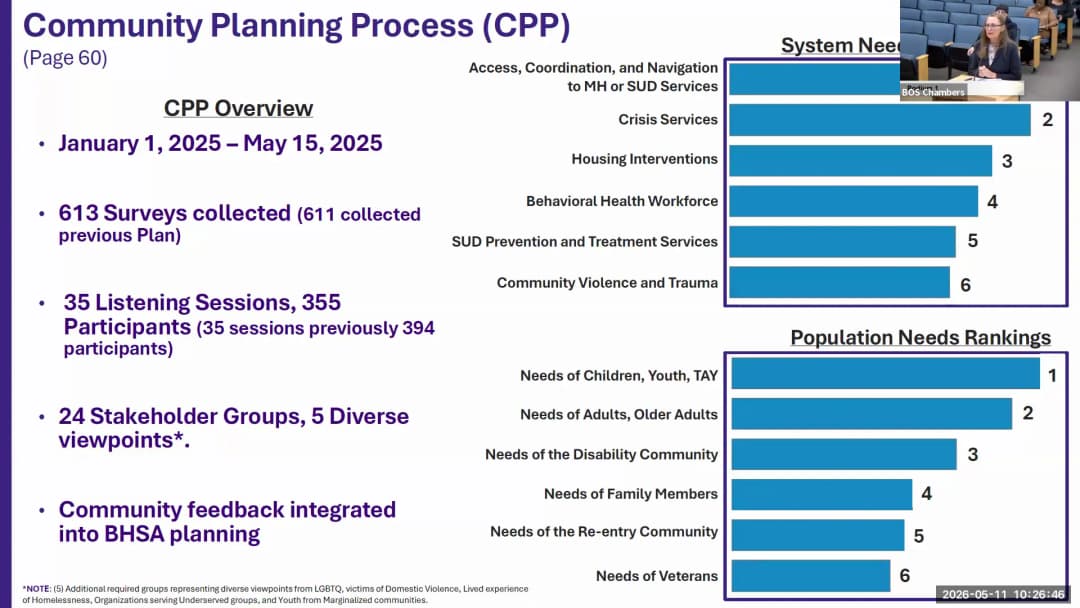
Public Meetings - Alameda County, CaliforniaThe Alameda County Board of Supervisors Health Committee convened on May 11, 2026, to discuss two major action items: the Behavioral Health Services Act (BHSA) three-year integrated plan (Item 1A) and a one-year bridge funding plan to support the transition from the Mental Health Services Act (MHSA) to BHSA (Item 1B). The committee heard presentations from AC Behavioral Health leadership, extensive public testimony, and deliberated on funding gaps, provider impacts, and compliance with state requirements. The committee voted to advance the BHSA integrated plan to the full Board and to pursue full restoration of cut programs through bridge funding, with a special Board meeting scheduled for May 19, 2026. Public Comments & Testimony - Prevention Providers (UELP, CMHC, etc.): Numerous speakers from Filipino Advocates for Justice, Cultura y Bienestar, First Five Alameda County, Crisis Support Services, Mental Health Association for Chinese Communities, Alameda Family Services, Peers, and others urged full restoration of prevention and early intervention programs. They stressed that culturally responsive, linguistically accessible prevention services are critical for immigrant, refugee, and Indigenous communities and that cuts would lead to increased crises, hospitalizations, and suicides. - Behavioral Health Collaborative: Valerie Gallo requested sufficient bridge funding to allow responsible program transitions and avoid abrupt closures that harm continuity of care. - Additional Testimony: Speakers highlighted the need for SSI/Medi-Cal advocacy, suicide prevention training, grief support, and trauma-informed care for underserved populations. Noha Abualada (Roots Community Health) noted that cutting base funding forfeits federal Medi-Cal matching dollars (up to 90% federal match). Discussion Items Item 1A – BHSA Three-Year Integrated Plan - Dr. Karen Tribble, Vanessa Baker, and Tracy Hazleton presented the draft plan, noting a state template error that doubled the carryover amount (actual carryover likely $20–$25 million less than shown). Revenues are projected at $164 million (27% below previous MHSA budget). - The plan shifts focus to severe mental illness and substance use, with 30% for housing, 35% for full service partnerships, and 35% for other services (including early intervention). Approximately $52.7 million in program reductions were identified; $32 million in solutions were found within ACBH. - Supervisor Tam questioned the use of carryover across years and explored moving $9 million from year three to year one to reduce the gap. Staff explained that MHSA carryover can only be used for one year, and shifting it would require rebalancing the plan, potentially causing cuts in years two and three and risking state compliance. - Community planning included 613 surveys and 35 listening sessions; top community needs: access/coordination/navigation, crisis services, housing. Item 1B – One-Year Bridge Funding Plan - Anika Chowdhury presented the bridge proposal: one-time funding for FY 2026-27 to help providers transition. The total transition gap is $77 million; $32 million in solutions were identified; $52.7 million in reductions; up to $35 million in potential restoration (from AC Health, Measure W, etc.), leaving a remaining gap of $10.7 million. - Chair Miley proposed using up to $17 million from the Measure W prudent reserve for full restoration, in addition to the $35 million already identified. Supervisor Tam supported options for maximum flexibility, including possible use of carryover and Measure W funds. - Staff noted that if the $9 million carryover is moved, it would require cuts in later years and potential state disapproval, but agreed to work with the Board on a plan. Key Outcomes - Motion (Approved 2-0): The committee voted to advance the BHSA three-year integrated plan to the full Board as presented, and to seek full restoration of MHSA prevention programs (up to $17 million from Measure W prudent reserve) through a one-year bridge funding plan. - Next Steps: A special Board of Supervisors meeting will be held on May 19, 2026, to act on the bridge funding proposal. Staff will provide a detailed restoration package, identify funding sources, and outline contract authorization to ensure providers receive funds by July 1, 2026. The integrated plan will be submitted to the state by June 14, with final Board approval expected by June 30.
The Fairview Municipal Advisory Council (MAC) met on May 6, 2026 (the transcript references May 5, but the official date is May 6). The meeting included updates from the California Highway Patrol, the Hayward Area Recreation and Park District (HARD), and the Alameda County Administrator's Office on the upcoming budget. The council also approved minutes, adjusted the June meeting date, and heard public comments on transit service reductions and county governance. Consent Calendar - Approval of Minutes (April 7, 2026): Approved with 3 ayes (Higgins, Rhodes, Anglin) and 1 abstention (Farmer). Public Comments & Testimony - Diane Castleberry (AC Transit): Announced a June 10, 2026 AC Transit board meeting to present a draft contingency service plan. The plan may include service reductions of over 16% (equivalent to removing 100 buses) and up to 300 layoffs, with earliest implementation in June 2027. She urged public awareness and feedback. - Kelly (caller): Criticized BART for not sending politicians to discuss potential closure of the Castro Valley BART station. Also criticized the county administrator's office for mandating action minutes instead of detailed minutes, noting that microphones often cut out, making video recordings unreliable. Reported that the Planning Commission chair rejected the order for action minutes, calling it a "myth" that staff reports to the county administrator. Also noted that the proposed Office of Unincorporated Services has been scaled back to a few strategic initiatives with a handful of staff. - Bruce King (Friends of San Lorenzo Creek): Commended HARD for their work and advocated for creek habitat restoration, particularly at Carroll Pereira Park and along the San Lorenzo Creekway Trail. - Caller (on Lake Ridge Park): Raised concern that vehicles are blocking the evacuation route at Pickford Street, a dead-end street leading into Lake Ridge Park, and asked how residents would exit in an emergency. Discussion Items - California Highway Patrol Update (Officer Jen Pabst): Presented first-quarter 2026 statistics for Fairview: traffic citations down compared to first quarter 2025 (due to officer Barcini training new officers), injury crashes up by 2, non-injury crashes down, 3 misdemeanor arrests. Highlighted the CARES program for unhoused individuals (one success story, database of over 300 individuals in patrol jurisdiction). Discussed traffic issues at Fairview Elementary and ongoing side show enforcement task force. New office on Jackson Street expected to open by end of July. - Hayward Area Recreation and Park District (HARD) Update (General Manager Jim Wheeler): Provided a comprehensive overview of the district's operations, finances, and projects. Key points: Measure X F1 bond ($250M) passed with 78% approval; district has 120 parks, 155 full-time employees; 5.9 million park visitors in the past year; $46.6 million general fund revenue; $23 million shifted to state via ERAF; $91.4 million county funding gap. Lake Ridge Park improvements planned with $72,000 in uncollected impact fees for Fairview, pending community process. Council expressed support and requested continued engagement. Public comment from Bruce King (Friends of San Lorenzo Creek) commended HARD and advocated for creek restoration. A caller raised concerns about blocked evacuation route at Lake Ridge Park. - Alameda County Unincorporated Area Budget Update (Melanie Atendito): Presented economic context, state/federal updates, and the county's $91.4 million funding gap for FY 2026-27. Highlighted that the county shifts more property tax to the state ($760M) than it keeps ($673M). Measure W allocations: 80% for housing and homelessness, 20% for essential county services, with 30% of that recommended for unincorporated areas. Department heads from Community Development Agency, Public Works, Fire, and Library provided brief updates on services and accomplishments. Council expressed interest in deeper Fairview-specific budget details. Key Outcomes - Minutes Approved: April 7, 2026 minutes approved (3-0-1). - Meeting Schedule Adjusted: The June 2, 2026 meeting was moved to June 4, 2026 to accommodate election use of the room. Approved unanimously. - CHP Update Received: Officer Pabst presented statistics and discussed enforcement, unhoused outreach, and traffic issues. Council requested continued collaboration on Fairview Elementary traffic. - HARD Update Received: General Manager Wheeler provided a comprehensive overview. Council expressed support for Lake Ridge Park improvements and community engagement. HARD will return to request $72,000 in uncollected impact fees for Fairview. - Budget Update Received: Melanie Atendito presented the county's $91.4 million funding gap for FY 2026-27, with strategies to close it. Council expressed interest in deeper Fairview-specific budget details. - Fireworks Ordinance Update: Chair reported that the ordinance is moving forward with small changes, aiming for Board of Supervisors approval on May 12 and June 2, with a 30-day review period, tight before July 4. - Affordable Homes Subcommittee Report: Councilmember Farmer reported on the ad hoc meeting regarding in-lieu fees and ministerial approval, expressing concerns about parking, fire safety, and infrastructure. Chair's Report & Council Announcements - Chair provided a brief update on the fireworks ordinance. - Councilmember Rhodes announced a new stop sign on Fairview Avenue and progress on painting bumps on Upper D. - Councilmember Higgins announced a Veterans Day ceremony at Lone Tree Cemetery (date to be confirmed). - Councilmember Farmer reported on the affordable homes subcommittee ad hoc meeting, noting concerns about in-lieu fees and ministerial approval. - Councilmember Rhodes noted she will be absent next month due to vacation. Key Outcomes - Minutes Approved: April 7, 2026 minutes approved (3-0-1). - Meeting Schedule Adjusted: June 2 meeting moved to June 4, 2026, approved unanimously. - CHP Update Received: Officer Pabst presented statistics and discussed enforcement, unhoused outreach, and traffic issues. Council requested continued collaboration on Fairview Elementary traffic. - HARD Update Received: General Manager Wheeler provided a comprehensive overview. Council expressed support for Lake Ridge Park improvements and community engagement process. HARD will return to request $72,000 in uncollected impact fees for Fairview. - Budget Update Received: Melanie Atendito presented the county's $91.4 million funding gap for FY 2026-27, with strategies to close it. Council expressed interest in deeper Fairview-specific budget details. - Fireworks Ordinance Update: Chair reported that the ordinance is moving forward with small changes, aiming for Board of Supervisors approval on May 12 and June 2, with a 30-day review period, tight before July 4. - Affordable Homes Subcommittee Report: Councilmember Farmer reported on the ad hoc meeting regarding in-lieu fees and ministerial approval, expressing concerns about parking, fire safety, and infrastructure. Chair's Report & Council Announcements - Chair provided a brief update on the fireworks ordinance. - Councilmember Rhodes announced a new stop sign on Fairview Avenue and progress on painting bumps on Upper D. She also noted she will be absent next month. - Councilmember Higgins announced a Veterans Day ceremony at Lone Tree Cemetery (date to be confirmed). - Councilmember Farmer reported on the affordable homes subcommittee ad hoc meeting. Key Outcomes - Minutes Approved: April 7, 2026 minutes approved (3-0-1). - Meeting Schedule Adjusted: June 2 meeting moved to June 4, 2026, approved unanimously. - CHP Update Received: Officer Pabst presented statistics and discussed enforcement, unhoused outreach, and traffic issues. Council requested continued collaboration on Fairview Elementary traffic. - HARD Update Received: General Manager Wheeler provided a comprehensive overview. Council expressed support for Lake Ridge Park improvements and community engagement process. HARD will return to request $72,000 in uncollected impact fees for Fairview. - Budget Update Received: Melanie Atendito presented the county's $91.4 million funding gap for FY 2026-27, with strategies to close it. Council expressed interest in deeper Fairview-specific budget details. - Fireworks Ordinance Update: Chair reported that the ordinance is moving forward with small changes, aiming for Board of Supervisors approval on May 12 and June 2, with a 30-day review period, tight before July 4. - Affordable Homes Subcommittee Report: Councilmember Farmer reported on the ad hoc meeting regarding in-lieu fees and ministerial approval, expressing concerns about parking, fire safety, and infrastructure. Chair's Report & Council Announcements - Chair provided a brief update on the fireworks ordinance. - Councilmember Rhodes announced a new stop sign on Fairview Avenue and progress on painting bumps on Upper D. She also noted she will be absent next month. - Councilmember Higgins announced a Veterans Day ceremony at Lone Tree Cemetery (date to be confirmed). - Councilmember Farmer reported on the affordable homes subcommittee ad hoc meeting. Key Outcomes - Minutes Approved: April 7, 2026 minutes approved (3-0-1). - Meeting Schedule Adjusted: June 2 meeting moved to June 4, 2026, approved unanimously. - CHP Update Received: Officer Pabst presented statistics and discussed enforcement, unhoused outreach, and traffic issues. Council requested continued collaboration on Fairview Elementary traffic. - HARD Update Received: General Manager Wheeler provided a comprehensive overview. Council expressed support for Lake Ridge Park improvements and community engagement process. HARD will return to request $72,000 in uncollected impact fees for Fairview. - Budget Update Received: Melanie Atendito presented the county's $91.4 million funding gap for FY 2026-27, with strategies to close it. Council expressed interest in deeper Fairview-specific budget details. - Fireworks Ordinance Update: Chair reported that the ordinance is moving forward with small changes, aiming for Board of Supervisors approval on May 12 and June 2, with a 30-day review period, tight before July 4. - Affordable Homes Subcommittee Report: Councilmember Farmer reported on the ad hoc meeting regarding in-lieu fees and ministerial approval, expressing concerns about parking, fire safety, and infrastructure.
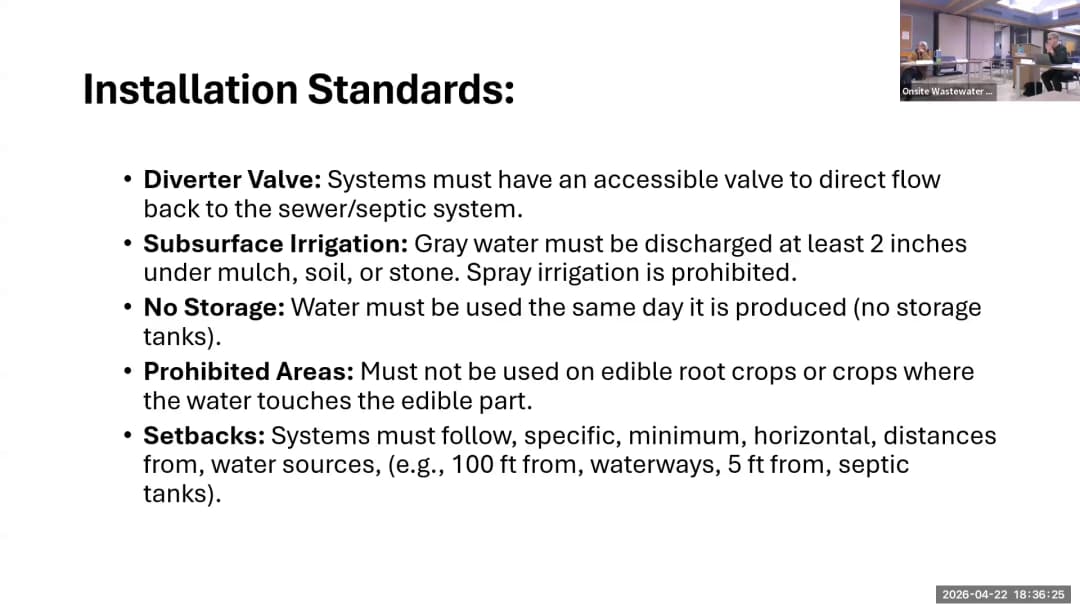
Commissioners discussed initiating a process to establish Alameda County gray water standards and recommendations, and addressed the vacant District 1 commissioner seat. No public comments were received. The commission agreed on several action items to move forward, including educational outreach and coordination with other county departments. Discussion Items - Gray Water Standards Initiation: Chair (identified as the speaker) introduced the topic, emphasizing the need for gray water systems to conserve water amid drought and growing population. The current California plumbing code (2025, effective Jan 1, 2026) governs gray water, but Alameda County lacks its own guidance. The state requires a Drought Resiliency Plan, which the county has not yet developed, causing missed funding opportunities. Commissioner Gill noted that gray water (from showers, tubs, laundry) is less hazardous than black water, but still requires proper management. The commission discussed permit exceptions, setback requirements (e.g., 100 ft from wells, 5 ft from septic tanks), and the need for education to prevent health hazards and cross-connections. They referenced other counties like Santa Clara that have robust gray water programs. The chair suggested starting with fact sheets for on-site wastewater system properties, then working with Public Works and county counsel to expand jurisdiction. - District 1 Vacancy: Commissioner (likely from District 2) noted that the District 1 seat is vacant because the previous commissioner has not attended meetings. The commission discussed moving the District 2 commissioner (who lives in District 1) to fill that vacancy, and then asking Supervisor Marquez to appoint a new District 2 commissioner. The chair agreed to send an email to the supervisors recommending this change. - Future Topics: Commissioners expressed interest in tackling other issues, such as small-diameter sewer connections (like Oakland's policy) and problem areas with failing septic systems (e.g., Happy Valley, unincorporated pockets near sewers). The chair also mentioned upcoming improvements to the online permit portal for transparent tracking of septic system applications. Key Outcomes - Action Items: - Staff will work with county counsel to determine environmental health's jurisdiction over gray water. - Staff will compile fact sheets on gray water best practices for septic system properties. - Reach out to gray water expert Laura Allen to gauge interest and cost for community workshops. - Continue pushing for the county to develop a Drought Resiliency Plan. - Chair will send an email to supervisors recommending the District 2 commissioner be moved to fill the District 1 vacancy, and that Supervisor Marquez appoint a new District 2 commissioner. - Next Meeting: The commission will revisit gray water progress and discuss the permit portal at a future meeting (likely within six months).
The Personnel Administration and Legislation (PAL) Committee met on Monday, May 4, 2026, at 9:30 AM with Supervisors Fortunato-Bass and Tam present. The committee received updates on federal and state legislative developments, focusing on federal budget reconciliation, immigration enforcement funding, and California state budget and policy bills. No public comments were offered. Discussion Items - Federal Legislative Update (presented by Emily Bacet Silva and John Assini of CJ Lake): - The House and Senate were in recess during the meeting week. A 75-day shutdown of DHS funding ended when the House passed a bipartisan bill funding DHS except for ICE and CBP, which will be funded through a separate reconciliation bill. The House also passed a budget resolution to begin the reconciliation 2.0 process, which will include three-year funding for ICE and CBP, effectively taking those agencies off the regular appropriations table for the remainder of the Trump administration. The farm bill passed the House without reversing SNAP cuts from HR1, but its path in the Senate is uncertain. FISA Section 702 was reauthorized for only 45 days. - In response to Supervisor Fortunato-Bass's question, the presenters confirmed that no ICE or CBP reforms are moving through Congress, as Republicans used reconciliation to avoid Democratic reform demands. The Supreme Court ruling on the Voting Rights Act (Allen v. Milligan) may lead to redrawing maps in Southern states, potentially reducing minority-representation seats in Louisiana, Alabama, and Tennessee, with possible rebuttal redistricting in blue states before 2028. - State Legislative Update (presented by Amy Costa of Fullman Strategies): - The policy committee deadline for non-fiscal bills passed on May 1. Upcoming milestones include May 14: the Appropriations suspense file release and the Governor's May Revise budget proposal. SB 1400 (county-sponsored) and SB 1193 (opposed by the board) are moving to the Senate floor; SB 1193 was amended to change the definition of discretionary funding. The chair of the Senate committee indicated the bill could be replicated statewide. - The Legislative Analyst's Office released a report showing state spending increased by $100 billion since 2019, with structural deficits of $20–30 billion annually. Revenues, partly from tech, are above projections in the current year but not guaranteed long-term. The budget may provide some reprieve in the current year, but HR1 impacts are more pronounced in the out-years. Several revenue measures qualified for the November ballot, including the billionaire tax and an extension of Prop 3055. Key Outcomes - The committee received the updates without taking formal votes or directing further action. Supervisor Fortunato-Bass noted the letter from Alameda Health Consortium regarding HR1 protections for federally qualified health clinics and inquired about potential backfill in the May Revise. The update noted that an Urban County Caucus lobby day with Alameda County Health Director Anika Shadry is scheduled for May 6.
The Alameda County Together for All Ad Hoc Committee held a special meeting on April 30, 2026, to receive the Office of Immigrant and Refugee Affairs (OIRA) Implementation Study presentation. The meeting focused on recommendations for establishing a permanent office to coordinate immigrant and refugee services. Supervisors Marquez and Fortunato Bass co-chaired. The committee heard from consultants, community members, and discussed next steps. No formal action was taken as this was an informational item. Public Comments & Testimony - Esmeralda Iglesias (Trabajadores Unidos Workers United) expressed strong support for OIRA, stating that navigating legal resources is difficult and overwhelming, and that centralizing and institutionalizing programs is needed to meet community needs efficiently. - Adriana (Trabajadores Unidos Workers United) supported the office, emphasizing its importance for immigrant and refugee communities to access services. - Paola (Trabajadores Unidos Workers United) voiced support, noting the office will help fulfill the county’s commitment to immigrant and refugee rights. - Alana (Trabajadores Unidos Workers United) urged support for OIRA, highlighting the need for systemic infrastructure for legal services, deportation defense, and know-your-rights outreach. She stated Alameda County is home to 23% of the region’s immigrant population. - Yanaton Greenberg (Trabajadores Unidos Workers United) argued that the Bay Area economy depends on immigrant workers and that supporting them is both a moral and economic necessity. - Lucas (Trabajadores Unidos Workers United, deep East Oakland resident) emphasized the terror of ICE threats and urged county investments for thriving, not just surviving. He cited collaboration with San Francisco’s Office of Civic Engagement and Immigrant Affairs. - Andrés Pomar (Trabajadores Unidos Workers United) reaffirmed support, stating the office is needed long-term to maintain commitment to immigrant and refugee communities. - Diego Villegas Aguilar (Trabajadores Unidos Workers United) noted that similar offices exist in other counties and that the office should remain accountable to community organizations. - Leticia (United Women Activist) highlighted the need for linguistic access and services, saying the community is terrorized and criminalized by the current administration. She supported the office for workshops and resource fairs. - Carmen (United Women Activist) said the office is important for providing resources and opportunities, especially for those who are lost and disoriented upon arrival. - Alma (United Women Activist) expressed continued support, stating the community needs to feel respected, supported, and defended, and to receive information in their own language. - Liliana (United Women Activist) asked the county to support the immigrant community, citing discrimination and barriers faced upon arrival. - Alejo (Executive Director, Trabajadores Unidos Workers United, part of Acudir) reaffirmed the need for the office, praised the collaborative process, and looked forward to continued work. - Miriam Edelin Myers (Lead Organizer, Trabajadores Unidos Workers United, Fruitvale resident) shared experience from San Francisco’s Office of Civic Engagement and Immigrant Affairs, noting that one in three Alameda County residents is an immigrant and that the office is crucial for equal protections. - Samuel (Organizing Director, Trabajadores Unidos Workers United, member of Acudir) highlighted the office’s potential to support families during raids and provide crucial support for those defending their loved ones. - Dave Thompson (Co-executive Director, My Eden Voice; co-chair of Acudir) urged placement of the office in the County Administrator’s Office (CAO) based on experience with the Office of Unincorporated Communities, stating agencies do not coordinate well without central authority. - Rich Whipple (Community Advisory Board member, District 3 resident) praised the consultants’ work and shared experience building San Francisco’s immigrant affairs office, expressing excitement for Alameda County to follow suit. - Lisa Knox (California Collaborative for Immigrant Justice, lead for Accord Collaborative; CAB member) fully supported all recommendations, especially sustaining funding for existing collaboratives, which have built strong networks serving diverse immigrant communities. - Cynthia Salazar (Trabajadores Unidos Workers United) said such programs would have helped her parents from Guatemala avoid living in fear, and expressed full support. - Maria Alejandra Leon (Mujeres Unidas Activas) stressed the importance of a space to learn about rights and how to defend them, especially amid ICE raids. - John Marks (Founder, Homeless Incorporated) supported the new office but urged the committee to expand its scope to protect unhoused residents from federal policy, proposing safe haven zones and expanded hotlines. - Marta Sanchez (United Women Activist, indigenous Mam speaker from Guatemala) emphasized the need for inclusion, accessibility, and continued language services for indigenous and immigrant communities. - Christopher Martinez (Spanish Speaking Citizens Foundation, part of FIELP rapid response network) applauded the county, stating the office is a true statement of values. He urged ongoing community input in multiple languages and long-term holistic investment. - One speaker played a video of past presidents making statements against illegal immigration, but did not state a personal position; the speaker identified as a lifelong Democrat and recalled earlier policies. Discussion Items - Presentation by Sangeeta Kumar (Be the Change Consulting) and Alex Deshinthal (Likewater Consulting Group): The consultants presented findings from a study conducted from December 2025 to April 2026. The methodology included a peer jurisdiction scan (13 jurisdictions), 22 county stakeholder interviews, community focus groups, steering committee guidance, and a nine-member community advisory board (CAB) with representatives from each supervisorial district and four rapid response coalitions (ASALEP, ACCORD, ACUDIR, APILO). Key strengths: genuine political will, existing investments, protective policies, strong legal infrastructure, rapid response networks, and a capable CBO ecosystem. Challenges: fragmentation of services, lack of shared data, inconsistent county coordination, need for predictable funding, and varying law enforcement partnership levels. - Mission: Build and sustain infrastructure supporting immigrant communities through convening, coordination, data analysis, and policy advancement. Vision: An Alameda County where immigrants are supported, protected, and able to fully participate. - Eight Core Functions: (1) Community partnership and engagement, (2) Population needs assessment, planning and evaluation, (3) Clearinghouse and navigation hub for referrals, (4) Public-private partnership coordination, (5) County coordination, compliance, and capacity building, (6) Policy development and advocacy, (7) Communications and intergovernmental affairs, (8) Learning and innovation. - Office Placement: The CAB recommended an eventual standalone office but suggested a two-year incubation period within a host department. Preferred placement is in the County Administrator’s Office (CAO) for central authority; if not feasible, another department with a champion, cross-department track record, and strong community connections. Criteria include agency head champion, cross-department collaboration experience, and support for accountability mechanisms. - Staffing Model: Seven-person office: Director of Immigrant and Refugee Affairs, Deputy Director of Community Engagement and Partnerships, Deputy Director of Policy and Planning, Senior Policy Analyst, Community Program and Training Specialist, Data and Research Analyst, and Administrative Coordinator. Total estimated cost: $1.92 million (assumes average $275k per position including benefits). - Community Accountability Structures: Continue the CAB during pilot phase, invest in existing community collaboratives, map existing coalitions, hold regular convenings for contractors, revise contracts to include collaboration, and invest in community pilot programs. - Budget Recommendation: $10 million total, including: $4.6 million for contract renewals and expanded services, $1.92 million for staffing, $450,000 for operating budget (needs assessment, clearinghouse, etc.), and $3 million as a floor for public-private partnership contributions. - Six Immediate Actions: (1) Sustain and augment current funding for services (avoid lapse). (2) Establish office placement with real authority (two-year incubation then standalone). (3) Launch director search immediately. (4) Fund full seven-person staff team. (5) Grant OIRA explicit cross-departmental authority for language access, ICE-free zones, and immigration response plan. (6) Allocate at least $450,000 programmatic operating budget. - Five Priorities for Two-Year Pilot: Build foundation for long-term county integration; assess needs and stabilize ecosystem; build countywide resource navigation hub; coordinate implementation of existing policies; build community accountability and transparency. - Supervisor Marquez: Acknowledged the rapid timeline, thanked consultants, CAB, CBOs, faith community, philanthropy (Zellerbach Family Foundation, San Francisco Foundation, East Bay Community Foundation, Akenati Foundation), staff (Alex Boskowitz, Hannah, Charles, Lori Cox, Shelly), and honored the legacy of Supervisors Richard Valle and Wilma Chan. Stated this was an informational item; she is not prepared to take a position but is committed to advancing the work. Noted a $95 million deficit but will explore all options, including reserves. - Supervisor Fortunato Bass: Expressed strong support, noted the urgency and the need to move quickly. Praised the comprehensiveness and thoughtful criteria. Acknowledged the contributions of staff Cynthia Munoz Ramos and the CAB. Stated the next tentative meeting is June 4, 2026, at 3:00 PM. Key Outcomes - No formal action was taken (informational item only). - Supervisors Marquez and Fortunato Bass will co-author a joint letter to advance next steps, with the number one priority being to sustain existing contracts. - The consultants will incorporate public and CAB feedback and finalize the full report (90+ pages) for presentation to the full Board of Supervisors. - Supervisor Marquez announced a second budget webinar on June 11, 2026, and noted the next budget work session is May 19, 2026, with the proposed budget presented May 28, 2026. - Supervisor Fortunato Bass proposed a future agenda item on data privacy and mass surveillance, referencing concerns about the Flock Safety system.
This special work session of the Alameda County Board of Supervisors focused on the fiscal year 2026-27 budget outlook, the status of COVID-19 ARPA funds, and implementation plans for Measure W, the half-cent sales tax for essential county services and homelessness. The meeting provided an opportunity for the board to hear staff presentations, receive public testimony, and offer preliminary direction for the upcoming budget and spending plans. No formal votes were taken, but staff were directed to refine the Essential Services Fund proposal and return for possible action in May. Public Comments & Testimony - Blair Beekman (multiple times) expressed support for the county's collaborative approach with AA SEG on closed session items, urged caution against austerity measures, and praised Oakland's deliberate approach to addressing deficits while maintaining social services. - Senior Services Coalition representatives (including Maria Alderete, Krista, Cynthia Arrington, Lavon Gibson, Wendy Peterson, and others) urged the board to invest $17.8 million over two years to meet the needs of older adults, citing increased poverty, food insecurity, and the impact of HR1 cuts. They highlighted that current Measure W funding for food and senior services is insufficient. - Health care providers (Yui Nishike, Dong Sa, Tony Panetta, Ella Schwartz, others) warned of revenue losses from Medicaid changes (HR1, Prop 1, elimination of PPS for undocumented immigrants). They asked the board to prevent cuts to HealthPAC and increase county indigent care funding, noting that clinics serve vulnerable populations and cannot absorb losses. - Prevention advocates (including PSA Finneth, Testata Kazadik, Sangita, Preet, and others) from the Prevention Matters Collaborative urged the board to protect UELP mental health prevention programs, which are at risk due to Prop 1 cuts. They argued that prevention saves costs and prevents crises. - Food security advocates (Jessica Montes, Kayla, Casey Bartholomew, Linda Liu, Caronica) requested increased funding for food assistance, noting that the proposed $5.5 million per year is a significant cut from the current $15 million allocation. They emphasized the need for multiple food distribution channels, including prepared meals for unsheltered individuals. - Unincorporated area representatives (Kay, Diana Montano, Alina Farooq) thanked the board for including unincorporated communities in the Essential Services Fund but urged fair allocation and continued representation. - Other speakers (Caleb Smith, City of Oakland) requested greater transparency and collaboration on Home Together fund allocations; others supported boarding care homes, rapid rehab programs, and the use of tax-defaulted properties. Discussion Items Federal, State, and County Budget Financial Updates County Administrator Susan Ren and Budget Director Melanie presented an economic overview and the FY 2026-27 maintenance-of-effort budget. Key points: - The county faces a $91.4 million funding gap for the coming fiscal year, driven by rising costs (including $41 million net salary/benefit adjustments, $33 million in internal service fund increases, and $50 million in capital/maintenance) and flat program revenue. - The gap is partly offset by $93.4 million in retirement savings from past pension liability reductions, which helped maintain the county's triple-A credit rating. - Program revenue is not keeping pace with net costs; the county is heavily reliant on state and federal aid (nearly two-thirds of general fund revenue). - Staff recommended closing the structural gap through ongoing adjustments, including reviewing program revenue, identifying cost reductions, and reviewing vacant positions. - Pending factors include unfunded capital needs, the impact of state policies (Prop 1, Measure W implementation), and potential federal cuts (HR1). - The proposed budget timeline: Governor's May revision by May 14, proposed budget to board on May 28, hearings and adoption in late June. ARPA Funding Status Update Pat O’Connell provided a status report on the county’s $324.6 million in ARPA funds (plus $330 million in CARES Act funds). Key points: - All funds must be obligated by December 31, 2024, and spent by December 31, 2026. - As of March 31, 2026, most funds are either spent or encumbered. Health Care has $21.4 million encumbered; GSA has $31.5 million encumbered for capital projects. Social Services and CDA funds are fully spent. - Staff are working closely with departments to ensure all funds are spent by the deadline. The federal government is being more strict about reporting and disallowing changes. - Supervisors expressed concern about some encumbrances (e.g., $3.3 million for vaccinations, $6.8 million for hotel sheltering) and asked for detailed plans to avoid clawbacks. Staff assured the board that they are on track to spend all funds. Measure W – Home Together and Essential Services Fund Updates County Administrator Susan Ren, AC Health Director Anika Chardry, Housing Director Jonathan Russell, and Amy Schrager presented the implementation plans for Measure W. Home Together Fund (80% of ongoing revenue): - The fund is expected to generate approximately $1.4 billion over 10 years, with $1.2 billion allocated to the Home Together Fund. - The Home Together 2030 plan is being refreshed with a racial equity analysis and system modeling. Key program areas: housing (43%), shelter (17%), prevention (12%), access (8%), coordination (4%), and capital (11%). - For FY 2026-27, the proposed Home Together budget is $288 million, including $93 million in one-time capital investments. For FY 2027-28, the budget is approximately $158 million (steady state). - Staff emphasized that the fund will be used to sustain, enhance, and expand homelessness services, with a focus on preventing homelessness and expanding housing vouchers. - Pending factors: potential federal cuts (HUD Continuum of Care, HR1), state reductions (HAP funding), and Prop 1 impacts on mental health services. Essential Services Fund (20% of ongoing revenue): - The board designated $34 million per year for essential services. The proposed two-year (FY26-27 and FY27-28) expenditure plan totals $82 million, including $68 million in ongoing programs and $14 million in one-time capital. - Categories: Stabilize the Safety Net ($20M/year) – covers Prop 1 bridge funding, HealthPAC, Medi-Cal retention, and supports for vulnerable communities. Meet Basic Needs ($7M/year) – food assistance, senior services, and unincorporated area food security. Housing Stability and Tenant Protections ($7M/year) – rental registry, landlord-tenant relations, rehab, legal assistance. Capacity Building ($7M/year) – CBO support, economic development, commercial corridor inspection, and potential unincorporated area manager. One-Time Capital/Major Maintenance ($14M) – includes Castro Valley Library, food hub, Livermore sewer, Lorenzo Theater, and other projects. - Staff requested board direction to incorporate these recommendations into the proposed budget. Board Deliberation and Direction Supervisors provided extensive feedback and asked staff to refine the Essential Services Fund plan. Key points from supervisors: - Supervisor Miley emphasized the need for transparency, collaboration with cities, and results. He suggested using the $170 million prudent reserve if additional funds are needed for food security and stabilization. He also requested a dashboard for regular Measure W status updates. - Supervisor Fortunato Bas stressed the importance of addressing HR1 and Prop 1 impacts, especially on food security and mental health. She supported using the prudent reserve and noted that overage from Measure W could be used to backfill the reserve. - Supervisor Tam highlighted the uncertainties from Prop 1 and HR1, and noted that the $20M stabilization fund covers many of the requested programs. She cautioned against over-reliance on the prudent reserve given sales tax volatility. - Supervisor Marquez flagged the need for a comprehensive overview of all pending requests (Office of Immigrant Refugee Affairs, reparations, Care First Jails Last) and asked for more detailed analysis before committing funds. She supported the use of other reserve accounts if needed. - Supervisor Miley reiterated that the board must see demonstrable results, especially in getting people housed and off the streets. He called for a standing agenda item on Measure W at joint committee meetings to track progress. - The board generally agreed that the staff proposal is a good starting point, but more work is needed to align with community input and city collaboration. Staff will bring back a refined plan for the May 19 work session or a subsequent action item. Key Outcomes - No formal actions taken. The meeting was a work session; the board provided individual direction to staff. - Staff will refine the Essential Services Fund two-year expenditure plan based on board feedback, including potential adjustments to food security funding, senior services, and consideration of the prudent reserve. The refined plan will be presented at the May 19 work session for further discussion, with a possible action item at a later meeting. - Staff will develop a dashboard for regular Measure W spending and outcome reporting, to be presented at joint health and social services committee meetings. - The county will continue to work with cities and community-based organizations to align spending plans and ensure equitable distribution of resources. - The county administrator confirmed that a balanced budget will be presented by June 30, 2026, incorporating the board's direction on Measure W.
The Alameda County Board of Supervisors convened on April 28, 2026, for a regularly scheduled meeting. The meeting included board member remarks, a closed session item on Coliseum property negotiations, a Law Day proclamation with student speeches, reports from closed session on lawsuit settlements, and three proclamations for Sexual Assault Awareness Month, Arab American and Muslim American Heritage Month, and National Healthy Homes Month. The board also approved a consent calendar and a mass motion of agenda items. Consent Calendar - The board approved the minutes of the special meeting of April 14, 2026. - The consent calendar was approved unanimously after public comment. Public Comments & Testimony - On closed session items: Blair Beekman praised the board’s approach of following closed session with public discussion on the Coliseum/Arena property negotiations, calling it a form of transparency he appreciated. Samuel Ramey spoke about jobs being sent overseas, unemployment, and the need for change. - On Item 18 (Coliseum negotiations): Blair Beekman again spoke, expressing trust in the AASEG (African American Sports and Entertainment Group) as a potential mediator between the county and the City of Oakland. - On non-agendized items (after close of business): Blair Beekman commended the board’s recent discussion on Flock cameras, noting the decision to slowly separate from Flock and urging a community process for selecting a new ALPR vendor. - General public comment before consent calendar: Samuel Ramey addressed the board, criticizing federal policies and calling for reinvestment in social services. Discussion Items Item 18 – Authorization to Negotiate for Oakland Coliseum and Arena Properties President Halbert introduced the item, which authorizes Patrick O’Connell and Kimberly Gassaway to negotiate with the City of Oakland. The item was continued from previous meetings. Supervisor Fortunato Bas requested that supervisors Miley and herself be allowed to observe negotiations, but the county counsel clarified that the open session action is solely to identify negotiators per Government Code; substantive discussion occurs in closed session. The board voted unanimously to approve the authorization (roll call: 5-0). Law Day Proclamation – May 1, 2026 President Halbert read the proclamation emphasizing the rule of law. Presiding Judge Michael Markman spoke about challenges to the courts, including AI and security threats, and highlighted the mock trial students. Attorney Gordon Greenwood (Kazan McClain) spoke about the need for young minds in law. Three students spoke: Katie Punitharaja (Moreau Catholic) described the supportive team environment; Victor Mahajan (Mission San Jose High) emphasized skills and friendships gained. Supervisor Miley and Fortunato Bas added remarks about the importance of the rule of law. The board adopted the proclamation. Closed Session Report County counsel reported three settlements: - Tishera v. County of Alameda (case 22CV023944): Approved in closed session on March 24, 2026, by a 4-1 vote (Supervisor Miley excused) for a final settlement of $206,000. - Smith v. County of Alameda (case 25CV12263): Approved unanimously on March 3, 2026, for $100,000. - Castro Valley Investment Group v. Castro Valley Marketplace (case 24CV075116): Unanimously authorized on April 21, 2026, with no monetary payment. Proclamation – Sexual Assault Awareness Month (April 2026) and Denim Day (April 29, 2026) President Halbert read the proclamation. District Attorney Ursula Jones Dixon accepted, emphasizing survivor agency and introducing victim witness advocates. She noted the 25th anniversary of the awareness month and the meaning of Denim Day. The board adopted the proclamation. Proclamation – Arab American and Muslim American Heritage Month (April 2026) Supervisor Marquez read the proclamation detailing contributions and noting that CAIR recorded a 419% increase in hate incidents in 2023 (8,061 complaints) and 8,683 complaints in 2025. Musa Tariq (CAIR) accepted, thanking the board and calling for further action, including implementation of an ethical investment policy. Additional speakers: Moina Shaik, Jitu Chabi (president of a Newark mosque), and Dr. Ranak Chan Chowdhury, who emphasized education. The board adopted the proclamation. Proclamation – National Healthy Homes Month (April 2026) Supervisor Miley presented the proclamation, highlighting the Healthy Homes Department’s 31 years of work. Director Abraham Williamson described the integrated health-housing-environment model and noted outcomes: over 10,000 homes assessed with young children, over 2,500 homes reduced asthma/lead hazards, over 1,000 older adults and disabled homeowners received safety repairs, and over 2,200 individuals trained. The board adopted the proclamation. Mass Motion – Items 2–30 (excluding Item 11) Supervisor Tam moved a mass motion covering items 2–10, 12–17, 19–30. Supervisor Marquez asked about Item 14 (EV charging stations at Hayward), clarifying if they would be in every supervisorial district and why called "Hayward Station." Kimberly Gassaway explained it is part of the Hayward Energy Services Project. Supervisor Fortunato Bas asked about Item 20 (food services for juvenile facilities) regarding food waste collaboration with StopWaste; Chief Ford did not know but promised to follow up. The mass motion passed unanimously. Key Outcomes - Authorized negotiators for Oakland Coliseum/Arena property discussions (unanimous). - Approved three lawsuit settlements ($206,000, $100,000, and non-monetary) as reported from closed session. - Adopted four proclamations: Law Day, Sexual Assault Awareness Month, Arab American and Muslim American Heritage Month, and National Healthy Homes Month. - Approved minutes of April 14 special meeting. - Approved consent calendar (unanimous). - Approved mass motion for items 2–30 with questions answered. - Adopted second reading of ordinance (Item 11) consolidating Veterans Memorial Buildings commissions and authorizing $400 monthly stipend for commissioners (unanimous). - The board adjourned to a subsequent special meeting. Note: The meeting recessed twice for closed session; no decisions from those sessions were reported except the settlements listed.
The Alameda County Health Committee, chaired by Supervisor Miley and including Supervisor Lena Tan, met on April 27, 2026, to receive three informational presentations: a Housing First overview, an update on maternal, paternal, child, and adolescent health, and a report on the county's wastewater surveillance pilot. The committee also heard public comments on these items and on behavioral health budget cuts. Housing First Overview - Jonathan Russell, Director of Alameda County Health Housing and Homelessness Services, presented an evidence-based overview of Housing First, emphasizing that it is not "housing only" but includes voluntary services. He noted that Housing First was adopted as federal policy under George W. Bush and has led to a 50% reduction in veteran homelessness nationally through the HUD-VASH program. - Key local data: 73–88% of housing participants remain housed at follow-up; a Santa Clara County study found 93% housed after three years for highest-needs individuals. In Alameda County, over 4,700 people were housed in the last fiscal year, the return-to-homelessness rate dropped from 18% in 2020 to 13% in 2025, and the flex pool subsidy program has a 93% housing retention rate after two years. - Russell explained the difference between the "staircase model" and Housing First, and outlined state requirements under SB 1380, AB 1220, and SB 184 (2021). He described county practices including coordinated entry, tenancy sustaining services (supporting 2,100+ people/year), the housing flexible subsidy pool (adding 150–250 subsidies annually), and updated shelter standards. - Supervisor Miley questioned why homelessness remains a crisis despite decades of Housing First, citing $1.4 billion in Home Together funds. Russell argued the issue is scale and underinvestment, akin to renewable energy not solving climate change alone. Miley advocated for a "treatment first" approach, especially for those with mental health and substance use disorders. Russell clarified that Housing First is compatible with treatment and that housing improves treatment outcomes. - Supervisor Tan asked about the division of roles between cities and the county, using Mandela Homes as an example. Russell noted that cities often fund shelters and siting, while the county provides navigation and permanent housing subsidies through coordinated entry. Tan also raised the possibility of cities handling capital projects and the county focusing on navigation services. - Russell warned against over-investing in shelter at the expense of permanent housing, citing San Jose's budget challenges after diverting funds to shelters. He emphasized a balanced approach across prevention, shelter, and permanent housing. - Public comments: Alison Monroe spoke about the need for higher service levels for severely mentally ill individuals, citing boarding cares as a missing link. Tessa McCarrow (Supportive Housing Community Land Alliance) advocated for licensed boarding cares as part of the housing continuum, noting a 20-bed facility in West Oakland ready to house 20 individuals. Maternal, Paternal, Child, and Adolescent Health Presentation - Anna Groover, Julia Rafman, and Dana Cruz Santana presented data and programs. Key statistics: - Birth rate in Alameda County declined 26% since 2010 (from 19.3 to 16.0 per 1,000). - More than 40% of births to Hispanic/Latina and African American/Black women are covered by Medi-Cal. - Teen birth rate is 30 times higher for Hispanic/Latina teens than for Asian teens. - African American/Black infant mortality is 3.1 times higher than Asian; fetal death rate is 3+ times higher for Black, Pacific Islander, and American Indian/Alaska Native populations. - 7% of births are low birth weight; 8% are preterm. African American/Black women are 2.3 times more likely to have low birth weight infants. - 78% of infants initiate breastfeeding in hospitals; rates lower for Pacific Islander and African American/Black populations. - Congenital syphilis is rising, linked to homelessness and barriers to prenatal care. - The "Starting Out Strong" program served over 3,000 families in 2024; 48% Latina, 41% African American/Black. 90% client satisfaction. - The "Beloved Birth Black Centering" program has eliminated racial disparities in preterm birth outcomes. - Abundant Birth Project provided guaranteed income ($981/month for one year) to 235 pregnant women—program concluding in about nine months. - 22% of families in the program experience housing insecurity; 30 families identified as actively homeless. The county is collaborating with Housing and Homelessness Services on prevention. - Supervisor Miley noted the importance of housing as a social determinant and asked about using Measure W essential services funds to fill gaps. Groover and Watkins-Tart emphasized community-based outreach and grassroots organizations to reach fearful immigrant families. Miley also questioned the sustainability of the guaranteed income pilot and the defunding of Fetal Infant Mortality Review (FIMR); the county funds it with public health dollars (approx. $150,000/year for one staff position). - Supervisor Tan asked about disaggregating birth rate data and the impact of HR1 on Medi-Cal enrollment. The committee discussed the need to protect continuity of care and engage trusted messengers. Wastewater Surveillance Monitoring Pilot Program - Dr. Eileen Dunn presented on the wastewater monitoring pilot, funded by $750,000 from ARPA for a two-year contract starting January 2025. The contract is with Virally and covers six community sewer sheds (Castro Valley, San Leandro, Hayward, Livermore, and EB MUD sub-sewer sheds in East and West Oakland) and Santa Rita Jail. Sampling occurs twice weekly, testing for SARS-CoV-2, MPOX, influenza A/B, RSV, measles, influenza H5, and Candida auris. - Examples of public health actions: wastewater data helped confirm no measles cases in Alameda County during a Contra Costa outbreak, and no MPOX detection helped rule out a larger outbreak. In San Mateo, wastewater detection led to identification of a measles case. - Dunn noted that the state funds EB MUD's separate wastewater monitoring through 2027. The county is considering continuation after the pilot ends. - Supervisor Miley asked about bringing testing in-house; Watkins-Tart stated it is more cost-effective to subcontract but they will explore costs. Miley also suggested having sanitary districts contribute funding to sustain the program, and inquired about testing for PFAS. Dunn will follow up with Dr. Moss on PFAS detection capabilities. Public Comments on Non-Agendized Items - Alison Monroe spoke about behavioral health budget cuts, identifying three programs being cut: Family Education and Resource Center (FERC), a patient advocate at John George (Bev Bergman), and the Supportive Community Housing Land Alliance. She urged the committee to ask Behavioral Health why these programs were cut and how much is still going to prevention programs. She noted the budget process was confusing and that the cuts amount to $53 million. Key Outcomes - No formal votes were taken; all items were informational. - Supervisor Miley directed that an update be provided on the Radisson hotel (Oakland) for potential use as shelter/housing. - The committee discussed the possibility of hosting a symposium on homelessness strategies involving other Bay Area cities. - Supervisor Miley requested a follow-up report on the Abundant Birth Project guaranteed income pilot and on the PFAS detection capability in wastewater. - The committee will continue to monitor behavioral health budget impacts and the sustainability of wastewater surveillance.
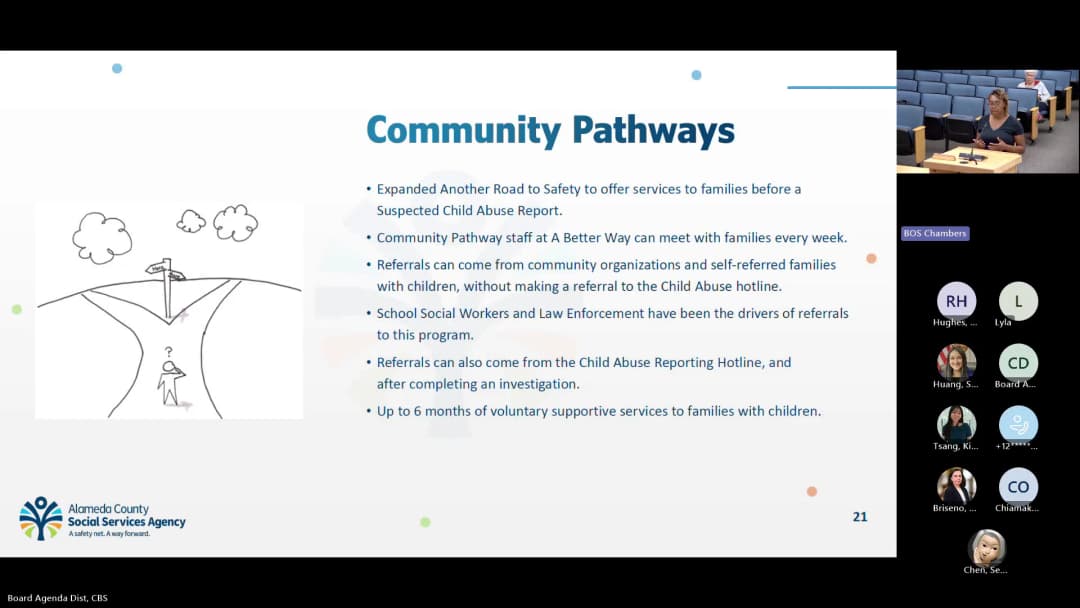
The Social Services Committee of the Alameda County Board of Supervisors met on April 27, 2026, to receive informational updates on the CalFresh program, Child Abuse Prevention Month activities, foster care services, and the eighth audit update on child welfare services. Key discussions centered on the impact of federal HR1 legislation on CalFresh eligibility, declining enrollment, foster care placement challenges, and progress on audit recommendations. Public Comments & Testimony - Dion Earner (private citizen) commented on the child abuse prevention presentation, noting that the concept of prevention services dates back to the late 1980s family preservation model. He suggested evaluating the balance between $1.1 million spent on prevention versus costs at the other end of the child welfare system, and questioned whether more funding should be directed upstream. Discussion Items CalFresh Program Update - Jaime N Domosco and Roland Shaw (Social Services Agency) presented. CalFresh Awareness Month in May 2026 will use the theme "CalFresh Works" to counter misconceptions that the program only serves non-working individuals. The county is partnering with Alameda County Community Food Bank for outreach. - SunBucks: In Alameda County, 111,926 cards were issued ($13.4 million in benefits) as of April 5, 2026, with 67.2% pinned. Statewide, 80% of cards were pinned, but 80% of the total value loaded on mailed cards was expunged due to non-use. - CalFresh Fruit & Vegetable EBT Pilot: A dollar-for-dollar match up to $60/month is available at one participating store in Newark. No immediate plans for expansion. - EBT Theft: Theft declined by approximately 92% since February 2024 due to chip cards and other measures. - HR1 Changes: As of April 1, 2026, non-citizens (e.g., refugees, asylees, parolees) are no longer eligible for federal CalFresh unless they later obtain Legal Permanent Resident status. Alameda County estimates 5,400 individuals will lose benefits. The county is partnering with the East Bay Refugee Immigration Forum and developing a food distribution plan. Refugee support service funding may provide short-term assistance; a plan is expected within two months. - Able-Bodied Adults Without Dependents (ABAWD): As of March 31, 2026, approximately 26,000 non-exempt ABAWDs were identified (down from 27,000 in January). Work requirements or exemptions apply; time limits begin June 1, 2026. - Overall CalFresh Data: Total recipients dropped from 179,000 in March 2025 to 167,900 in March 2026 (a 6.3% decline). Applications fell from a monthly average of 6,000 to 4,200. Staff cited fear in immigrant communities and the end of pandemic-era policies as likely causes. The county processes 98-99% of applications within 30 days. - Supervisors asked about zip-code-level data (top five: 94601, 94621, 94603, 94544, 94605) and the plan for impacted non-citizens. Child Abuse Prevention Month - Colette Katwala and Carlin Stewart presented. The Child Abuse Prevention Council oversees 12 organizations funded through CAPIT contracts (each $84,000/year) and a CBCAP contract ($94,000/year). Total prevention services budget is approximately $1.1 million. The Strong Families Alliance coordinates referrals among providers. - An ARPA one-time grant of $811,000 served 2,148 families in 2025, focusing on basic needs and concrete supports. - The state is shifting from mandated reporting to community supporting; Assembly Bill 2085 (2022) clarifies that poverty alone is not neglect. - The Community Pathways program allows families to access voluntary services without a child welfare hotline call. The contract with A Better Way for this program is funded under the "Another Road to Safety" initiative; total prevention services budget is $1.1 million. - Supervisors noted the importance of prevention and the need for metrics to evaluate effectiveness. Foster Care Presentation - Jess Samp (Program Manager) reported approximately 700 children (ages 0-17) in out-of-home foster care in Alameda County, plus about 230 children at home under supervision. About half of foster children are placed with relatives. There are 200 non-minor dependents (18-21), with 80% in specialized transitional placements. - The Resource Family Approval (RFA) process includes background checks, home inspections, training, and psycho-social assessments. The county has about 1,200 approved resource families; 150-200 new homes are approved annually, but the total remains stable due to exits. - The Transitional Shelter Care Facility (formerly the assessment center) reopened in late March 2026 after a hiatus. As of the meeting, no youth had been placed yet; the facility is intended for children in placement transition. - High-needs youth: About 42 children with complex needs (defined as five or more placement moves in a year) are a focus. Short-term residential treatment programs (STRTPs) are often full, causing placement delays. The county is unable to place children out of state. - The caregiver appreciation dinner is scheduled for May 15, 2026. - Supervisors discussed vetting of resource parents, the Santa Clara County tragedy, and the need for more foster homes. 8th Audit Update - Director Love and staff presented. The 12-month progress report on the state audit is due September 23, 2026. CDSS conducted an on-site visit March 26, 2026, with focus groups (16 workers, 10 supervisors), 15 individual interviews, and a case review of 77 cases on April 21, 2026. Findings and recommendations are expected in about 12 weeks. - Open referrals backlog: data as of April 7, 2026, shows three referrals from 2021 still open, with more recent years having higher numbers. Investigations in progress and pending closure figures were provided. - Staff safety culture survey: Eight presentations and focus groups have been held; additional focus groups on psychological safety are scheduled for May 2026. An action plan is due by June 2026. - Hiring: Continuous hiring for bachelor's and master's level child welfare workers; 11 bachelor's and 13 master's hired in 2025. Attrition in 2026 so far is 9 (including retirements and probationary releases). Upcoming exam dates: May 15, July 15, September 15, November 16, 2026. - Youth Transitions Partnership program (ages 14-21, expanded to 24) uses coaching and dialectical behavioral therapy; positive feedback from youth focus groups. - Audit dashboard is publicly available online. - Implementation status: 4 of 15 recommendations fully implemented (6, 7, 9, 13); 9 pending (1-5, 8, 10, 14, 15). Some depend on the transitional shelter care facility and on meet-and-confer outcomes with SEIU. - Supervisors discussed the need for better data on quality of care and staffing challenges. Staff noted they are working with Cal State East Bay and other partners on recruitment. Key Outcomes - No formal votes were taken; all items were informational. - The CalFresh team will share zip-code-level data on impacted non-citizens with all supervisors. - The county will continue outreach for CalFresh Awareness Month and develop a plan for food distribution to those losing benefits due to HR1, with details expected within two months. - Child abuse prevention efforts will continue; the county is working with contractors to possibly amend contracts for refugee support services before the fiscal year end. - The foster care team will monitor utilization of the reopened Transitional Shelter Care Facility and continue recruitment efforts. - The audit implementation will proceed; CDSS findings expected in about 12 weeks. The staff safety action plan is due June 2026. Meet-and-confer with SEIU regarding supervisors and emergency response is ongoing. - The committee received public comment and adjourned.