Browse by city
Date range
Search help

Search titles, summaries, topics and stored transcripts together. Keywords may match separately; put the whole query in double quotes for a phrase. Matching follows word analysis, so punctuation is not exact. Both dates are included. Documents are not searched.

SHOWING 101–110 ENTRIES
101
APR 27, 2026 · ALAMEDA COUNTY, CALIFORNIA · BOARD OF SUPERVISORS
Alameda County PAL Committee Meeting: Federal & State Updates, Legislative Positions - April 27, 2026

The committee convened on April 27, 2026, to receive federal and state legislative updates, discuss the impacts of HR1, and vote on late legislative position requests. The meeting began with a federal update from CJ Lake and a state update from Full Moon Strategies, followed by committee discussion and actions. Federal Legislative Update (CJ Lake) - Both chambers in session; House facing a busy week with three major items: DHS funding (budget resolution), FISA Section 702 reauthorization, and the farm bill. - The Senate passed a budget resolution (50-48) allowing reconciliation for DHS funding for 3.5 years; House aims to act before DHS runs out of money by April 30. - House leadership tries to contain conservative dissent; a third reconciliation package may be introduced. - FISA reauthorization faces hurdles over warrant requirements; Speaker Johnson may need Democratic votes. - Farm bill reauthorization (5-year) includes commodity, conservation, SNAP, etc., but no SNAP changes; may be delayed. - Update on Iran conflict: Congress delaying action on war powers; Pentagon turmoil with Navy Secretary fired over Trump-class battleship delays. - Supervisor Fortunato Bass asked about DHS funding reforms (none included) and the impact of the Congressional District 14 vacancy on margins. Emily noted current House breakdown: 217-212-1, five vacancies. State Legislative Update (Full Moon Strategies - Amy Costa) - April 24 policy deadline: 850 measures considered in 50 hearings. - County-sponsored SB 1400 passed Senate Local Government (5-1) and Senate Housing (unanimous); now on Senate floor. - Board opposed SB 1193 (non-fiscal), scheduled for hearing April 29; committee analysis suggests amendments (exemptions, disclosure limits, etc.). - State budget: Department of Finance reports year-to-date revenues $8.6 billion above forecast; Senate Democrats released "Foundations for the Future" framework assuming $20 billion higher revenues, with $5 billion in ongoing cuts. - Senate proposes new "fair share contribution" on corporations, backfills health/human service cuts, invests $1 billion in homelessness (HAHAP), and $100 million for Prop 36. - Supervisor Tam noted the revenue gap and asked about sustainability of revenues (AI-driven). Also asked about SB 1400 follow-up with Assemblymember Bonta's office and scope of SB 1193 amendments regarding election-year discretionary funds. Discussion of Late Legislative Position Requests - Five requests were presented: (1) support for state budget request to mitigate HR1 impacts, (2) AB 2214 (support for small businesses/homebuyers), (3) SB 1313 (drinking water PFOS mitigation), (4) Alameda County Health request for children's services staffing, (5) AB 1659 (juvenile school transition planning). - Supervisor Tam noted that AB 2214 missed the fiscal deadline and was removed from consideration. - Supervisor Fortunato Bass moved to approve items 1, 3, 4, and 5 to the full board; Supervisor Tam seconded. Public Comments - No public comments were received on the federal or state updates, nor on non-agendized items. Key Outcomes - Motion to forward late legislative position requests (items 1, 3, 4, 5) to the full Board of Supervisors passed unanimously (2-0). - AB 2214 (item 2) was withdrawn due to missed deadline.

GOVERNMENT REPRESENTATION 63% · BUDGET PROCESS 22% · PROCEDURAL 7% · STATE LEGISLATION 5%
102
APR 23, 2026 · ALAMEDA COUNTY, CALIFORNIA · BOARD OF SUPERVISORS
Alameda County Budget Work Group Special Meeting - April 23, 2026

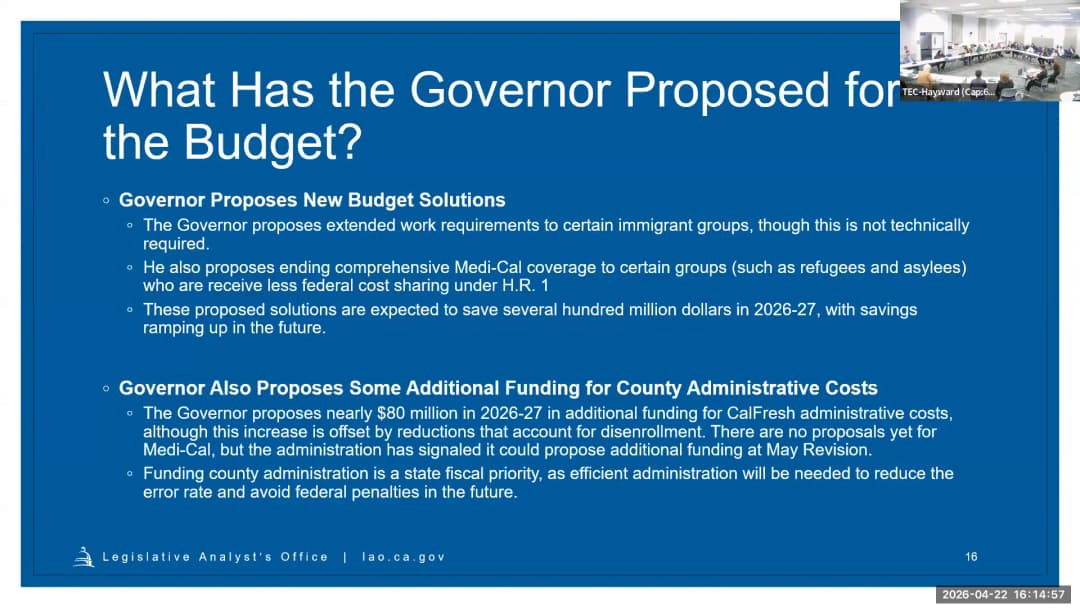
The Alameda County Board of Supervisors Budget Work Group held a special meeting on April 23, 2026, to discuss the economic outlook, federal and state budget updates, and the county's preliminary fiscal year 2026-27 maintenance of effort (MOE) budget. The meeting featured presentations from the County Administrator's Office and special guests from the California Legislative Analyst's Office (LAO) on the impacts of federal HR1 legislation on Medi-Cal and CalFresh. Supervisors David Halbert (District 1) and Lena Tam (District 3) presided. Economic and State Budget Outlook - Amy Shraga presented economic data: Alameda County's unemployment rate was 4.5% in February 2026, down from a pandemic peak of 14%. The median home price reached $1.3 million, with sales up 34% month-over-month but down 2% year-over-year. Foreclosure filings rose 32% year-over-year in January 2026, though levels remain well below historic peaks. - Federal update: The President's FY27 budget proposed a 10% cut to non-defense spending and a 44% increase in defense spending. It is unlikely to be enacted as proposed. - State update: The Governor's May Revise, due by May 14, 2026, will include additional spending cuts. The Senate Democrats released a budget framework emphasizing responsible budgeting and maintenance of essential programs, including increased costs from HR1. Presentation by LAO Analysts on HR1 Impacts - Jason Constanturus and Ryan Woolsey, principal fiscal and policy analysts from the LAO, presented on HR1's effects on Medi-Cal and CalFresh. - Key changes include new work and community engagement requirements, more frequent eligibility renewals, restrictions on non-citizen eligibility, reduced federal funding for emergency care and administration, and tighter rules on provider taxes. - Medi-Cal disenrollments could reach up to 2 million people statewide; CalFresh disenrollments estimated at 650,000. Alameda County's data shows 159,000 residents may be subject to work requirements in Medi-Cal starting 2027, with 14,600 expected to lose coverage in FY26-27, rising to over 50,000 by 2030. For CalFresh, 40,000 recipients will face strict three-month time limits, with 19,000 at highest risk of losing assistance. - CalFresh administrative costs for Alameda County would increase from $16.1 million to $26.3 million starting October 2026 due to reduced federal match. - The LAO analysts noted three key issues for the legislature: immediate implementation of HR1, long-term program structure and financing, and support for those disenrolled, who may become uninsured or rely on strained county indigent care programs. County Budget Update - Susan Moraneshi, County Administrator, and Rasley presented the FY26-27 Maintenance of Effort (MOE) budget. The current FY25-26 budget is balanced at $6.1 billion with $4.3 billion in general fund appropriations supporting 10,500 FTE positions. - For FY26-27, program appropriations increase $78 million (2%) while revenues are flat, resulting in a net county cost increase of $76 million (8%). The total net county cost for all programs is $1,045 million. - Key cost drivers include salary and benefit increases ($41 million net after $93 million pension savings), internal service fund increases (building maintenance up $19 million, motor vehicle up $4 million, risk management up $7 million), and program changes such as a $33 million decline in public safety sales tax revenue and a $20 million loss in CalFresh revenue due to HR1. - The preliminary funding gap is $91.4 million, but without the benefit of prior pension prepayments the gap would have been $185 million. The county has closed $2.7 billion in funding shortfalls since EREF began in 1992-93. - Unfunded capital and major maintenance needs exceed $1 billion. Key Outcomes - No formal votes were taken; the meeting was a workshop. - Supervisors and staff discussed the significant challenges posed by HR1, particularly the impact on county indigent care programs and administrative burdens. Director of Social Services Andrea Ford requested LAO support for continuation of the CalFresh match waiver, additional workforce funding for Medi-Cal and CalFresh eligibility, and specific funding levels for urban counties. - The CAO outlined a budget balancing approach: close the $91.4 million gap through revenue adjustments, cost reductions, use of vacant positions and departmental funds, and reduced reliance on one-time strategies. Next steps include incorporating the Governor's May Revise, updating revenue projections, and presenting a proposed balanced budget to the Board on May 28, 2026. - The LAO analysts emphasized that the state's structural deficit and limited flexibility require difficult decisions, and that county administration is both a programmatic and fiscal priority for the legislature.

BUDGET PROCESS 33% · PUBLIC HEALTH SERVICES 25% · FISCAL SUSTAINABILITY 13% · STATE LEGISLATION 8%
103
APR 23, 2026 · ALAMEDA COUNTY, CALIFORNIA · BOARD OF SUPERVISORS
Unincorporated Services Committee Meeting – April 23, 2026

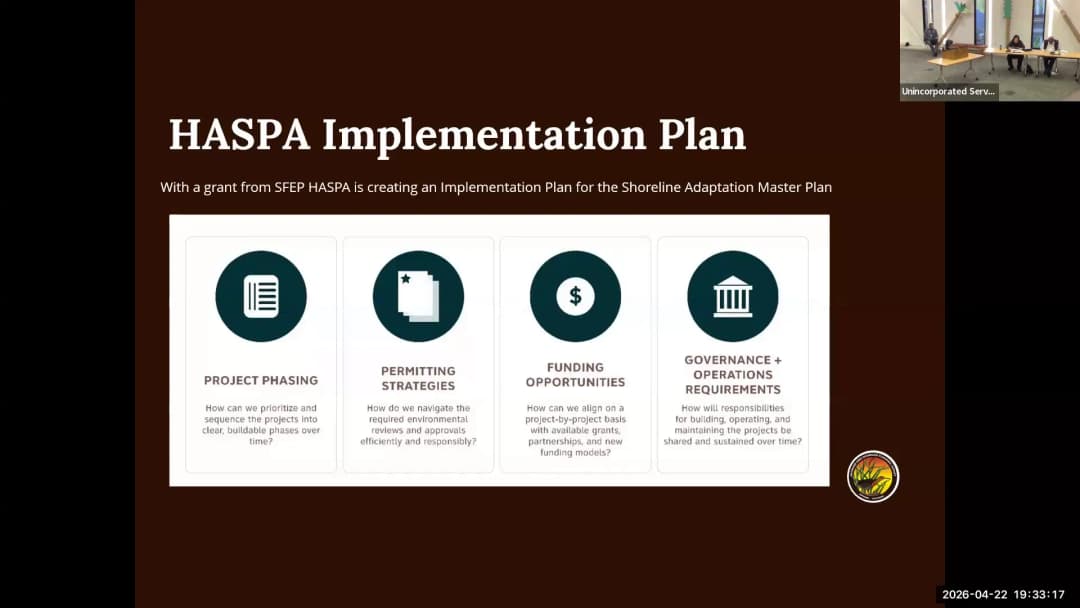
The Alameda County Board of Supervisors’ Unincorporated Services Committee met on April 23, 2026, to discuss a proposed fireworks ordinance update, the disposition of the former Cherryland Fire Station, and sea level rise planning through potential membership in the Hayward Area Shoreline Planning Agency (HASPA). The committee heard public testimony on all items and provided direction for next steps. Public Comments & Testimony - Fireworks ordinance: Commenters from San Lorenzo, Fairview, and a former MAC member expressed strong support for the ordinance, urging its adoption before July 4, 2026, and raising questions about enforcement regarding individuals vs. venues. - Cherryland Fire Station: Multiple speakers (Cindy Torres, Dr. Ann Maris, Michael Fried, Diane Weiler) opposed demolition, citing the building’s historical significance, community efforts to preserve it, and frustration with the lack of maintenance and communication over six years. Roy questioned the county’s proactive approach and lack of plans for historic buildings. - Sea level rise/HASPA: Bruce King (Friends of San Lorenzo Creek) and Mimi Dean (speaking personally, from Oraloma Sanitary District) supported regional collaboration, noting that flood control and integrated solutions are essential. Roy also raised concerns about Castro Valley MAC members’ criticism of supervisors regarding the Mosaic Project. Discussion Items - Proposed Fireworks Ordinance Update (Item 3): Sgt. Curtis Imperial reported modifications: the appeals body changed from the Board of Zoning Adjustments (BZA) to a neutral hearing officer due to jurisdictional limits; the maximum fine for third/subsequent violations reduced from $2,500 to $2,000; a 24-hour grace period between citations added. Timeline: first reading May 12, 2026, second reading June 2, 2026, effective July 2, 2026. Supervisors Miley and Tam discussed appeal costs and enforcement. Committee support for advancing to the full board. - Former Cherryland Fire Station Disposition (Item 1): Deputy Chief Eric Moore presented the building’s rapid deterioration, vandalism, and safety hazards since being declared surplus in 2017. A historical assessment was ordered in 2023 but never completed due to lack of funding. Moore requested committee support to authorize disposition. Supervisor Miley expressed embarrassment and directed staff to investigate the stalled historical assessment, consult with the Parks Recreation and Historical Commission, and the Cherryland MAC before proceeding. Item held. - Sea Level Rise Planning and HASPA Membership (Item 2): Planning staff (Allie Abbers) and HASPA representatives (Lou Andrade, Adrian Harris, Brian Lasco) presented options for complying with SB 272. Recommending the county join HASPA to share costs, data, and grant competitiveness. HASPA’s existing 2021 Shoreline Adaptation Master Plan and ongoing implementation work overlap with unincorporated San Lorenzo. Supervisor Tam (county’s BCDC representative) strongly supported membership; Supervisor Miley agreed, noting budgetary considerations for annual dues ($12,000–$31,800). Committee directed staff to bring a formal action item for board approval. Key Outcomes - Fireworks ordinance: Committee unanimously supports advancing the draft ordinance to the full Board of Supervisors for first reading on May 12, 2026, and second reading on June 2, 2026, with a target effective date of July 2, 2026. - Cherryland Fire Station: Item held; staff directed to research: (1) what the Parks Recreation and Historical Commission did, (2) the MAC’s prior recommendation, (3) historical assessment funding status, and (4) community preservation ideas. Staff to report back to committee. - HASPA membership: Committee gave conceptual approval for the county to pursue membership in HASPA as a path to SB 272 compliance; staff (CDA) to work with County Counsel and prepare an action item for a future committee meeting and board consideration.

ENVIRONMENTAL PROTECTION 32% · HISTORIC PRESERVATION 20% · FIREWORKS REGULATION 19% · COMMUNITY ENGAGEMENT 7%
104
APR 23, 2026 · ALAMEDA COUNTY, CALIFORNIA · BOARD OF SUPERVISORS
Alameda County Joint Health & Public Protection Committee Meeting – April 23, 2026

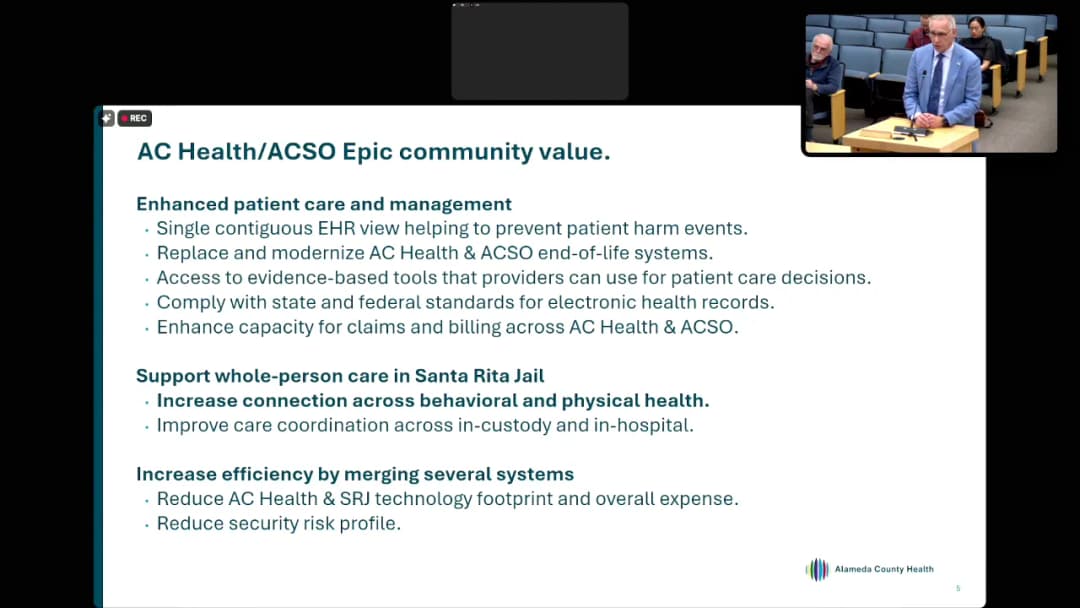
The Alameda County Board of Supervisors held a special joint meeting of the Health and Public Protection Committee on Thursday, April 23, 2026, to receive updates on three key initiatives at Santa Rita Jail: the procurement of a new comprehensive medical services contract, a quality assurance baseline report from Actura Health, and the implementation of the Epic electronic health records system. The meeting was chaired by Supervisor Marquez, with Supervisors Miley and Town present. The discussion emphasized cross-agency coordination, accountability, and the county's commitment to improving health care for individuals in custody. Public Comments & Testimony - Mickey Ducksbury urged the county to consider running jail health care in-house, citing the current provider's bankruptcy and contract violations, and argued that better medical care saves money in the long run. - Richard Spiegelman (Interfaith Coalition for Justice in our Jails) noted that the procurement timeline omits transition time for a new provider and asked for clarification on the value of NCCHC accreditation. - John Lindsey Poland (American Friends Service Committee) requested details on the evaluation panel's composition and whether the RFP includes provisions to exclude bidders with a history of litigation or poor performance. - Alydrian (NUHW representative) thanked supervisors for meeting with union members and urged continued engagement and inclusion of frontline workers in the process. - Lonnie Hancock asked about outreach to academic medical centers (e.g., UCSF, UC Davis) and suggested the selection panel include outside experts. - Bob Britton asked whether the RFP can set performance standards to exclude bidders based on past performance, and questioned the timeline details (negotiation, appeals). - Dr. Amy Lang (Medical Director, Santa Rita Jail) expressed gratitude for the partnership and noted that one NCCHC standard was already met 100% after one month. Discussion Items 1. Procurement of Santa Rita Jail Comprehensive Medical Services Contract - Director Kimberly Gasway (General Services Agency) presented the procurement timeline: the RFP is approximately 85% complete, with a target release at the end of June 2026. The pre-procurement phase (spec development with the Sheriff's Department) is ongoing; concurrent county council review is taking place. The overall 12-month process includes a mandatory bidders conference, security clearance, bid submission (30 days), evaluation, and potential appeal. A protest could extend the timeline if an appeal goes to the Auditor's Office. - Supervisor Miley raised the possibility of the board reviewing the RFP before release, but Chair Marquez preferred to maintain the current process, noting the board has already received community input. County counsel Kathy Lee confirmed that board review is permissible but unusual, and could raise concerns about directing the award. - Lt. Dan Murphy (Sheriff's Office) stated that the county is using a consultant and has gathered best practices from other counties. He expects three or four interested vendors. He also noted that CalAIM and Epic will improve care coordination. - Supervisor Miley inquired about the possibility of using county employees (e.g., Alameda County Health) instead of contracting; county counsel confirmed that would not require a procurement process but would require county capacity. 2. Santa Rita Jail Medical Quality Assurance Update - Lt. Dan Murphy introduced the new quality assurance provider, Actura Health, which began in December 2025. The first quarterly report (Q1 2026) establishes a baseline using the 2026 NCCHC standards. Mark Fisher (CEO, Actura) described a shift from reactive to proactive oversight, with a focus on sustainable improvement and accreditation readiness. Dr. Eric Lee presented the Q1 dashboard for Section E (Patient Care and Treatment): only 1 of 10 standards was fully met; several were partially met or not met. Key gaps included receiving screening, continuity of care, and nurse-initiated protocols (scope-of-practice violations). The team emphasized that sustained improvement, not one-time fixes, is required for accreditation. Actura is also advising on the RFP and Epic implementation. - Supervisor Miley praised the thoroughness and asked about the contract duration (3 years, $1.2 million). He highlighted the complexity of Santa Rita Jail and noted that frontline workers will be included in the improvement process. - Supervisor Town compared the process to hospital accreditation and asked about the root causes of low scores; Lt. Murphy cited incomplete documentation and process gaps that Epic will help address. 3. Epic Electronic Health Records Project Update - Dr. Nick Moss (Health Officer) introduced the presentation. Asad Iqbal (Interim Director, Health & Business Data Analytics) and Tom McMillan (Interim Director, Information Systems) described the current fragmented system and the future state: a single Epic platform integrating health, behavioral health, and correctional health. The project will go live in Fall 2027, with a budget over $40 million. Key benefits include real-time data access, improved care coordination, revenue generation via CalAIM, and enhanced patient empowerment (MyChart). The governance structure includes a steering committee and advisory groups. - Supervisor Miley expressed strong support but raised concerns about interoperability with Alameda Health System (AHS) and other providers. He noted that AHS is not on the steering committee, but Tom McMillan confirmed ongoing discussions with AHS's CIO. Supervisor Miley stressed the need for countywide coordination. - Supervisor Town asked about the digital divide and post-release follow-up; Lt. Murphy explained that individuals released with a 30-day medication supply and a community appointment through CalAIM partners (Alliance, Kaiser). Key Outcomes - No votes were taken; all items were informational. - Chair Marquez committed to following up on public comments regarding the evaluation panel, workforce transition, and timeline adjustments. She directed her office to work with the Sheriff's Department and General Services to address feasible suggestions. - The next quarterly quality assurance report from Actura is expected in July 2026. - The next joint public protection and health committee meeting is scheduled for July 2026 (date to be announced). The next public protection committee meeting is May 21, 2026, at 10:30 AM. - The Epic project is on track; additional board letters for staffing and third-party vendors are anticipated. - Supervisors Miley and Town praised the presentations and the collaborative effort, noting significant progress in jail health care over the past several years.

PROCUREMENT AND CONTRACTING 24% · PUBLIC SAFETY 22% · TECHNOLOGY AND INNOVATION 19% · PUBLIC HEALTH SERVICES 15%
105
APR 21, 2026 · ALAMEDA COUNTY, CALIFORNIA · BOARD OF SUPERVISORS
Alameda County Board of Supervisors Regular Meeting - April 21, 2026

The Alameda County Board of Supervisors held a regular meeting on Tuesday, April 21, 2026, convening at 9:15 AM. The meeting included supervisor remarks, public comment, closed session, proclamations, and a lengthy discussion and vote on the Flock Safety license plate reader contract. The board also addressed Senate Bill 1193, which would restrict county discretionary funding to nonprofits, and approved numerous consent calendar items. Consent Calendar - The consent calendar was approved with discussion on Item 59. All supervisors expressed strong opposition to SB 1193, citing its targeting of Alameda County, lack of rational basis, potential harm to small nonprofits, and the county's existing transparency processes. Supervisor Miley called for the bill to apply to all 58 counties if it is good policy. The consent calendar passed unanimously after the discussion. Public Comments & Testimony - On SB 1193 (Item 59): Numerous speakers opposed the bill, calling it retaliatory, unnecessary, and harmful to essential nonprofit services such as women's shelters, food security, and mental health care. Speakers urged the board to reject the legislation and noted that discretionary funding already has oversight. - On Peregrine Technologies (Item 36): Speakers opposed extending the contract, describing Peregrine as a mass surveillance platform integrated with predictive policing and potential facial recognition. Concerns included data privacy, civil rights violations, and vulnerability to federal access. Some speakers also drew connections to immigration enforcement. - On Flock Safety (Item 55): Public comment was extensive, with over 80 in-person speakers and 30 online. Many in opposition cited risks of data sharing with federal agencies (especially ICE), hacking vulnerabilities, chilling effects on civil liberties, and disproportionate impact on communities of color and immigrants. Supporters argued the technology reduces crime, helps solve cases, and is a necessary tool for public safety, especially in unincorporated areas with limited law enforcement resources. - On other agenda items: Speakers also commented on closed session litigation and general county matters. Discussion Items - Senate Bill 1193 (Item 59): Supervisor Miley led discussion, noting the bill would apply to discretionary funds for community organizations. He and other supervisors called the bill unfair, retaliatory, and redundant given existing county transparency. Supervisor Fortunato Bass supported transparency but opposed the bill's current form, urging it to apply statewide and include carve-outs for small grants. All five supervisors registered opposition. - Peregrine Technologies Contract (Item 36): Supervisor Fortunato Bass continued the item to May 12, 2026, citing insufficient time to review public concerns and technical details. The sheriff clarified that Peregrine is a data analytics platform, not facial recognition or ALPR integrated, but the continuation was approved to allow further scrutiny. - Flock Safety Contract (Item 55): The sheriff's office presented on the value of automated license plate readers, citing crime reduction, stolen vehicle recoveries, and integration with other technologies. Community outreach efforts were highlighted. During deliberations, Supervisor Marquez and Supervisor Fortunato Bass opposed the contract due to lack of trust in the vendor and concerns about data security under the federal administration. Supervisor Tam and Supervisor Miley supported paying the retroactive bill and continuing service while pursuing an RFP. President Haubert also supported. The motion to approve the second amendment passed 3-2. Key Outcomes - Closed Session Settlements: The board approved a $110,000 settlement in the case Castro vs Stubblefield (March 17, 2026) and a $58,000 settlement on the Hampton tort claim (March 24, 2026), both reported unanimously. - Proclamations: April was proclaimed National County Government Month and Foster Care Month. The board also proclaimed National Donate Life Month, National Crime Victims' Rights Week (with District Attorney Ursula Jones Dixon), Children's Memorial Day/Flag Day, and Sexually Exploited Minors Awareness Week. - Item 14 Approved: $200,000 from District 4 discretionary funds to the Oakland Fund for Public Innovation for a feasibility study to establish a historically black college and university (HBCU) satellite campus in Oakland. - Ordinances Passed: First reading to consolidate veterans memorial building commissions (Item 22), second reading of salary ordinance amendments (Item 26), and second reading of floodplain management code amendment (Item 43). - Mass Motion Approved: All remaining consent calendar and regular agenda items (excluding those pulled) were approved en bloc, including contracts for disaster preparedness (Item 25) and Aramark food services at Santa Rita Jail (Item 39). - Flock Contract Approved: The second amendment to the Flock Safety contract was approved on a 3-2 vote, extending the retroactive period to June 30, 2026, and increasing the contract amount by $303,600, bringing the total to $854,200. The sheriff committed to pursuing a formal RFP for future services. Additional Notes - Public comment on the mass motion was allowed; several speakers opposed Peregrine and Flock. The meeting ran late, with public comment on Item 55 limited to one hour plus 15 minutes. - Supervisor Fortunato Bass joined after absent for closed session. All five supervisors were present for the vote on Item 55.

PUBLIC SAFETY 46% · TECHNOLOGY AND INNOVATION 14% · PROCEDURAL 13% · PUBLIC COMMENT 8%
106
APR 21, 2026 · ALAMEDA COUNTY, CALIFORNIA · BOARD OF SUPERVISORS
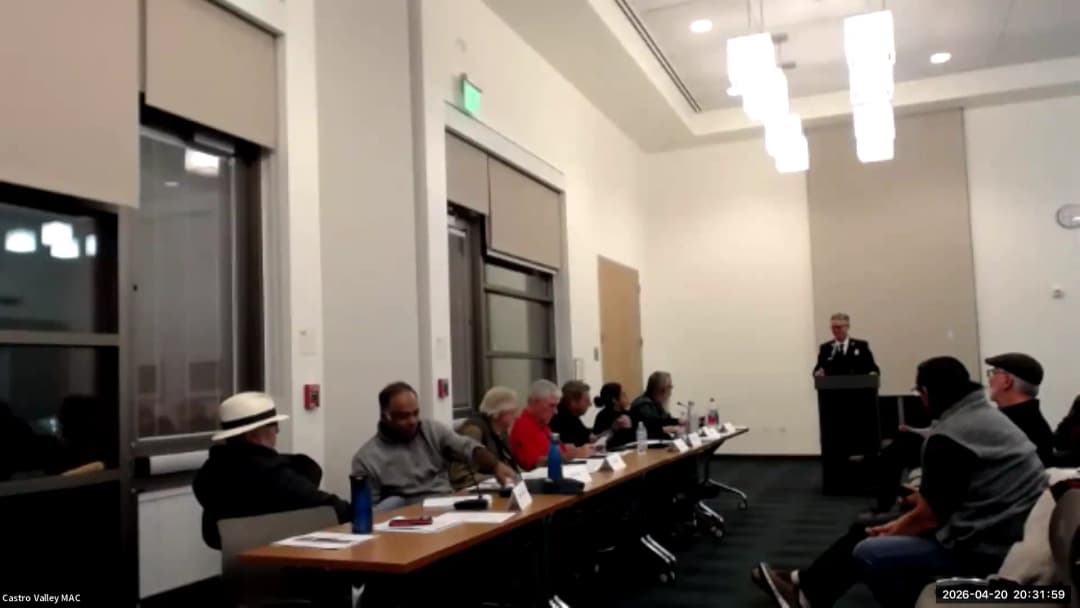
Castro Valley MAC Meeting – April 21, 2026: Mosaic Project, Fire Station Updates, Flock Safety Debate

The Castro Valley Municipal Advisory Council (MAC) held a meeting on April 21, 2026, at 2:00 PM. The meeting featured extensive public comment regarding the controversial Mosaic outdoor school/camp project approved by the Board of Supervisors, an update on new fire station construction, and a detailed presentation on the Sheriff's Office license plate reader (Flock Safety) program with a call to action for the Board of Supervisors vote the following day. Consent Calendar - Approved the minutes of the March 16, 2026 MAC meeting (motion by Councilmember Davini, seconded, passed unanimously). Public Comments & Testimony - Robert Brahm (arborist, 51 years): Expressed strong opposition to the Mosaic project, stating that 50% of trees on the western side of the creek are California Bay, the most flammable leaf in California. He argued a fire would be impossible to suppress and the canyon is a "fire trap." - Leslie Hardy (Cole Canyon resident, 41 years): Opposed the project, citing fire danger, water supply concerns (septic system inadequacy, reliance on trucked water), traffic impacts, and the inability to build on her own land due to restrictions. Noted that the project would take 10+ years and create a safety hazard. - Rex Warren (third-generation Cole Canyon resident): Opposed, highlighting water issues – wells drilled five times yielding only 1.5 and 4 gallons per minute – and criticizing the planning department for not hearing back from the ABC (Alcohol Beverage Control) for 10 years. Also noted Williamson Act and Measure D violations. - Dick Schneider: Detailed Williamson Act violations (no compatible use determination, no existing commercial agricultural use, no conditions to protect adjacent winery) and Measure D violations (project is a school, not a recreational camp, as shown by tax returns and business codes). - Matt Turner (demographer): Announced Oraloma Sanitary District's move to by-district elections and invited public map drawing. Also argued the project approval shows need for incorporation. - Katie Burdett (president, Castro Valley Parent Nursery School): Expressed safety concerns about children nearly being hit by cars near her school on Christensen Lane, requesting county help to address traffic issues. - Martha McFarland (resident): Opposed the project, discussing fire danger, inadequate water supply (her 2,500-gallon tank provides only four minutes of fire flow), steep terrain, and fear that the school would bring noise and wildlife displacement. - Carolyn Millen: Strongly opposed, alleging the EIR process was biased – letters were withheld, the Ag Advisory Committee not consulted, and the Board of Supervisors ignored MAC and BZA unanimous votes. Noted firefighters fear speaking publicly. - Robert Batinic (coalition of unincorporated area representatives): Spoke in support of community cameras (Flock Safety) for public safety, urging their retention. (Later clarified under item 7.) - Edward Escobar: Opposed Senate Bill 1135 (removing supervisor discretionary funds) and criticized political games. Supported public safety cameras. - James Millen (unclear if Jim or John?): Jim Millen – Opposed project, disappointed that the MAC's unanimous vote (5-0) was ignored. Criticized three supervisors for disregarding Measure D, Williamson Act, and safety concerns. Praised Supervisor Miley. - Linda Fusinati (30-year resident): Opposed, emphasizing fire risk from children, flawed evacuation plan (buses too large for road), and that the school doubles the population of the box canyon with one way in/out. - Bob Fusinati: Argued the project is clearly a school (calling sleeping quarters temporary is misleading), that square footage exceeds 12,000 ft² limit, and that the planning department was incompetent. - Pat Sullivan (developer): Complained about Alameda County building department delays – his 11-unit Anita Ave project took 5 years to get a permit, despite initial support. - Alana Koskey (Cole Canyon resident): Opposed, criticized lack of MAC representation at BOS meeting, noting that Supervisor Tam misquoted square footage limits and that Albert Lopez (planning director) ignored issues. Questioned bridge access for fire engines. - John Coskey (end of Cole Canyon): Opposed, stated BOS decision was hasty and ignored Canyon residents. Worried about oversight of the property and potential creep of activities. - Bruce King (Friends of San Lorenzo Creek): Provided update on multi-use trail development (San Lorenzo Creekway and Foothill Trail), invited community to Trails Day event. - Keith Seaburn (neighbor and winery owner): Expressed gratitude for MAC's work, but criticized planning department for never reaching out to neighbors. Noted that their winery must provide portable toilets for 35 guests, yet the school's septic system is deemed sufficient. - Lindsay Wizamerski (canyon resident): Opposed, referenced the Paradise fire and the lack of a secondary drain field in the project plans. Also mentioned Williamson Act tax credit issues. - Stephen Wisomerski: Opposed, argued the project violates Williamson Act (parcel under 40 acres) and that the ABC issue was ignored. Criticized supervisors for not considering MAC input. - Christy Picotto (realtor): Opposed, stated she warned Mosaic about agricultural zoning restrictions before they bought the property. Disappointed in planning department and supervisors who didn't understand agricultural law. - John Coskey (second speaker?): Called ABC himself and got a callback the next morning, suggesting Albert Lopez didn't try hard enough. Urged impeachment of Lopez. - Ruth Blay (50-year resident, geologist): Opposed, argued fractured geology is not a valid reason to assume separate aquifers – wells could deplete neighbors' water. The project would start "water wars." The land cannot support the proposed use. - Brian Morrison (former resident, cattle partner): Opposed, discussed his experience digging wells on the site (shallow, drought issues). Accused planning staff of bias (saying "we" when referencing the project). Urged appeal and lawsuit. - Peter Rosen: Opposed, said process was flawed – staff recommendation was followed despite unanimous opposition from MAC and BZA. Encouraged residents to keep fighting. - Tron (speaker online?): Supported Nate Miley and public safety, criticized Aisha Wahab's politics. - Linda Tangren (online): Opposed project, called EIR biased, criticized Albert Lopez. Warned of fire spreading to other schools (Van Oi, Canyon Middle). Urged continued fight. - Ruth (later, after fire presentation): Asked about fire insurance availability. (Additional public comments on Flock Safety item are noted below under that discussion.) Discussion Items - Fire Station Construction Update (Deputy Chief Eric): Reported that three fire stations are under construction (Station 7 in Palomares Hills, Station 25 in Castro Valley, Station 22 in San Lorenzo). Station 7 slab poured, framing to start June; Station 25 interim station active, demolition complete, permit process finishing; Station 7 on track for January 2027 completion, Station 25 14 months out. Remainder of Measure X bond ($25M) will fund two more stations (Lake Chabot and Ashland). Council expressed appreciation for on-schedule progress. - Sheriff's Real-Time Information Center and Flock Safety Presentation (Sergeant Fenton Carly): Presented overview of the license plate reader (LPR) program, real-time information center, community cameras, and drone program. Emphasized crime reduction (auto theft cut in half), solved homicides, human trafficking, missing persons cases. Stated data is not shared with ICE or federal authorities. Guardrails in place. Noted that the Board of Supervisors is voting tomorrow on a retroactive contract to continue Flock. If vote no, unincorporated areas would lose coverage. Council members expressed strong support, with some technical questions deferred. Multiple public speakers in favor of retaining Flock; one speaker opposed citing privacy concerns. - Mosaic Project (general discussion): While not an agenda item for new action, the entire first half of the meeting was dedicated to public comments and council comments on the Board of Supervisors' approval of the Mosaic outdoor school/camp on Cole Canyon Road. Council members expressed frustration that their unanimous 7-0 vote against the project was ignored, as was the West County BZA's 3-0 vote. They criticized staff and the three supervisors who voted for approval (Bass, Marquez, Tam) and praised Supervisor Miley. Chair Moore noted the lack of representation for unincorporated areas and suggested either incorporation or supporting pro-agriculture supervisors in elections. Key Outcomes - The MAC took no action on the Mosaic project, as it has already been approved by the Board of Supervisors. However, council members and the chair encouraged residents to seek reconsideration by contacting the three supervisors who voted for approval. - The fire station updates were informational; no action required. - On the Flock Safety item, the MAC did not take a formal vote but council members unanimously expressed support for retaining the technology. They urged residents to attend the Board of Supervisors meeting on April 22, 2026 at 3:00 PM to speak in favor of the contract renewal. - The meeting adjourned at approximately 9:15 PM.

LAND USE PLANNING 27% · PUBLIC SAFETY 24% · AGRICULTURAL LAND USE 10% · PUBLIC COMMENT 9%
107
APR 21, 2026 · ALAMEDA COUNTY, CALIFORNIA · BOARD OF SUPERVISORS
Alameda County Elections Commission Meeting - April 21, 2026

The Alameda County Elections Commission met on April 21, 2026, to discuss upcoming elections (June 2 primary and June 16 special election for CD 14), receive committee updates, review vendor contracts over $100,000, and review new election laws for 2026. The commission unanimously approved minutes, disbanded a post-election assessment committee, formed a rules revision committee, and selected a new commissioner liaison. Consent Calendar - Approval of February 2026 Meeting Minutes: Moved by Commissioner Barley, seconded by Commissioner Butter. Passed unanimously (all present in favor). - Approval of March 2026 Meeting Minutes: Moved by Commissioner Lindsay, seconded by Commissioner Butter. Passed unanimously. Public Comments & Testimony - Steve Chesson (Californians for Electoral Reform): Expressed concern about potential voter confusion due to two ballots (June 2 primary and June 16 special election) being mailed to residents of CD 14. Recommended distinctive markings on outer and return envelopes to avoid mix-ups. Later thanked the Registrar for addressing this concern. - Dominici Morris (Oakland Kids First / Oakland Youth Vote Coalition): Presented an evaluation report on youth voting implementation in 2024, highlighting recommendations for school districts to formalize civic curriculum and accountability. Called for greater collaboration between the commission’s youth participation committee and their coalition. Offered to share the report. Discussion Items - Monthly Update from Registrar of Voters (ROV) – Tim Cornejo: - Provided key dates for the June 2, 2026 Direct Primary Election: first day of mailing voter information guides (April 23), vote-by-mail ballots (May 4), early voting (May 4), 24-hour drop box opening (May 4), and close of registration (May 18). There are eight ballot measures. - Reported on the special primary election for the 14th Congressional District on June 16 (with a potential general election on August 18). Signature-in-lieu period ends April 16; 143 signatures needed to offset the $1,740 filing fee. - Described plans to prevent voter confusion between the two elections: distinct messaging and color coding on outer and return envelopes, special inserts, and social media campaigns. ROV had already contacted printers. - Confirmed that voting will be in-person and by mail for both elections. All 100 vote centers are secured. The remote accessible vote-by-mail (RAVBM) tool is ready for voters with disabilities. - In Q&A, addressed questions about past confusion (e.g., three overlapping elections in 2010), the capital fund for equipment (85¢ per registered voter charged to jurisdictions), and the use of online voter notification tools (text/email). - Ad Hoc Committee Reports: - November 2025 Post-Election Assessment: President Dieter reported that the draft assessment was sent to the Board of Supervisors; two supervisors (Marquez and Bass) responded positively. Motion to disband the subcommittee passed unanimously. - Voting Participation Committee (Commissioner Seabrook): Committee met twice, now has access to a database (PDI) for analysis. Next in-person meeting in May to fine-tune data analysis. - Youth Participation Committee: Met with ROV staff on March 25. Received a presentation on youth voter engagement efforts. Discussed partnerships with NAACP and League of Women Voters. Working to identify student leaders in high schools to become deputized voter registrars. Request for the ROV to present at the next commission meeting. Commissioners Butter and Whitehurst noted successful high school events (McClymonds and Henderson). - Budgeting for Elections Committee (Commissioner Wagner): Just getting started. Focused on understanding cost allocation model between county and jurisdictions. Learned that costs are proportional to registered voters, with extra charges for jurisdictions with ≥5 measures (double share) and separate handling for RCV and youth voting costs. Short-term goal: improve predictability for cities. ROV is working on better communication with city clerks. - Contracts Over $100,000: Agenda item returning from October request for transparency. Three contracts listed: Runbeck (election management system VIMS – $4.1M over 2 years), Liberty Vote formerly Dominion (voting system – $23.7M over 10 years with additional annual licensing $1.2M), and Netfile (online campaign finance filing – cost not specified). ROV explained that capital fund (85¢/registered voter) covers annual licensing and equipment purchases. Poll pads were purchased from a different vendor under $100k and thus not listed. - Special Report: New Laws Affecting the ROV in 2026: ROV Tim Cornejo summarized several new laws: - AB 1392: Extends confidential voter status to elected officials and candidates automatically (can opt out). ROV sent notification letters and reminders. - SB 398: Makes it a crime (fine up to $10,000, imprisonment up to 3 years) to offer payment to induce voting or registration, with exceptions for transportation and certain activities. ROV will direct questions to Secretary of State. - AB 287: Requires public buildings (including schools, libraries, veterans halls) used as polling places or vote centers to provide accessible parking and storage space. - AB 1072: Requires uniform standards for ballot correction instructions (already implemented). - AB 5: Mandates that all ballots be counted by E+13 days (13 days after election), with exceptions for duplicated, forwarded, provisional, curing, same-day registration, and postmarked ballots received after E+4. Results must be released with an unprocessed ballot report. - AB 827: Reduces deadlines for signature curing notification (first notice within 14 days) and voter response (by 5 p.m. on day 22). ROV already does more than required. Commissioners asked clarifying questions about impacts on community programs and public confusion over partial results. Key Outcomes - Minutes Approved: Unanimous approval of February and March 2026 meeting minutes. - Post-Election Assessment Committee Disbanded: Motion passed unanimously. - Rules and Procedures Ad Hoc Committee Formed: Motion to create a committee composed of President Dieter and Commissioner Henderson to update the rules passed unanimously (Commissioner Wagner abstained due to missing the description). - Liaison for New Commissioner Onboarding Selected: Commissioner Lindsay was chosen via unanimous vote. - Action Items: Request for ROV to provide a presentation on youth voting at the next meeting. Committee chairs to continue work and report back.

ELECTIONS ADMINISTRATION 63% · PROCEDURAL 16% · BUDGET PROCESS 6% · YOUTH PROGRAMS 5%
108
APR 20, 2026 · ALAMEDA COUNTY, CALIFORNIA · BOARD OF SUPERVISORS
Board of Supervisors Special Meeting – April 20, 2026

The Alameda County Board of Supervisors held a special meeting on Monday, April 20, 2026, at 9:00 AM. The meeting was called to order by the presiding officer, with roll call establishing quorum. The agenda included only closed session items. Public comment on closed session items was invited but none was offered. The board then recessed into closed session. Closed Session - The board entered closed session to discuss confidential matters as listed on the agenda. No additional details are available from the transcript.

PROCEDURAL 100%
109
APR 16, 2026 · ALAMEDA COUNTY, CALIFORNIA · BOARD OF SUPERVISORS
Alameda County Board of Supervisors Approves Mosaic Project CUP on April 16, 2026

The Alameda County Board of Supervisors met on April 16, 2026, to consider a de novo hearing on an appeal of the West County Board of Zoning Adjustments' decision to deny a conditional use permit (CUP) for the Mosaic Project. The project proposes an overnight social-emotional camp for fourth- and fifth-graders on a 37-acre parcel at 17015 Cole Canyon Road in the unincorporated community of Castro Valley. After extensive testimony, the board voted 3-1-1 to approve the CUP and certify the project’s Environmental Impact Report (EIR), adopting the staff-recommended reduced building footprint alternative. Consent Calendar - The board unanimously approved the minutes from March 5, 2026, and the consent calendar without public comment. Public Comments & Testimony - Supporters (students, alumni, educators, parents, and experts): Over 40 speakers testified in favor, citing the program’s 25-year safety record, its impact on 76,000 students, and the importance of a permanent local site. They argued that the project meets all legal standards and that opponents rely on speculation, not evidence. - Opponents (residents, ranchers, and technical experts): Approximately 40 speakers voiced concerns, arguing the project violates Measure D and the Williamson Act, endangers the adjacent winery, and poses unacceptable risks from wildfire, water scarcity, and evacuation challenges in a one-way-in, one-way-out canyon. Discussion Items - Staff Report: Albert Lopez, Planning Director, presented the project, noting it would develop roughly two acres of a 37-acre site, leaving 95% in its natural state. The camp would host up to 95 children per session across 18 five-day, four-night sessions per year. An EIR was prepared and circulated twice; the staff recommended adopting the “reduced building footprint alternative” as the environmentally superior option. - Applicant Presentation: Sabrina Moyle (Board President), retired Fire Chief Dave Winnaker, and land-use attorneys argued that all technical concerns—water supply, wastewater treatment, fire safety, and evacuation—have been addressed by certified experts and state agency reviews. They emphasized that the project’s voluntary mitigations, such as shutting down on red-flag days and using a reverse-osmosis water system, exceed requirements. - Opposition Presentation: Suzanne Bradford of Friends of Castro Valley Canyonlands presented expert testimony challenging the hydrology analysis, asserting that well testing was insufficient to prove no connectivity to the larger aquifer and that the water supply is unsustainable. Fire-risk and evacuation concerns were also raised, citing the lack of a comprehensive, code-compliant evacuation plan. - Board Questions and Staff Responses: - Supervisor Miley focused on fire safety, evacuation, and water supply. He expressed concern that the fire department does not formally approve evacuation plans and that the single road creates a choke point. He also questioned the adequacy of the water supply and the road’s weight limit (14,000 lbs) for school buses. - Supervisor Tam requested substantial evidence on hydrology, wastewater, and aquifer reliability. The applicant’s experts cited state agency reviews showing adequate supply, while opponents pointed to gaps in baseline data and connectivity testing. - Supervisor Fortunato Bass noted the importance of diligent monitoring and suggested a three-year, rather than five-year, mandatory review. - President Haubert focused on Measure D compliance, questioning whether the project’s use is consistent with the intent of agricultural zoning. Key Outcomes - Motion: Supervisor Marquez moved to adopt the staff recommendation (approve the appeal, certify the EIR with the reduced building footprint alternative, and approve the CUP). Supervisor Fortunato Bass seconded. - Vote: 3-1-1 (Supervisors Marquez, Tam, and Fortunato Bass voted aye; Supervisor Miley voted no; President Haubert abstained). - Conditions and Next Steps: The project must obtain multiple permits (e.g., state drinking water permit, environmental health septic permit, building permits subject to Cal Fire and county fire codes). A mandatory review will occur in three years (instead of the standard five) to assess compliance with all 57 conditions of approval. The county planning department will serve as the central monitoring hub.

LAND USE PLANNING 42% · PUBLIC SAFETY 19% · PROCEDURAL 11% · ENVIRONMENTAL PROTECTION 4%
110
APR 16, 2026 · ALAMEDA COUNTY, CALIFORNIA · BOARD OF SUPERVISORS
Sunol Citizens Advisory Council Meeting – April 16, 2026

The Sunol Citizens Advisory Council (CAC) met on April 16, 2026, at 6:30 PM. The meeting covered a wide range of topics including public safety, downtown revitalization, a proposed office for unincorporated communities, land-use permits, cell tower compliance, and wayfinding signage. Several votes were taken, and follow-up actions were assigned. Public Comments & Testimony - Andrea Turnbull, a 27-year Sunol resident, shared a story about the company Teradyne’s CEO who championed asking “What’s the benefit?” to drive quality. She encouraged the council to use that question throughout the evening. Discussion Items Law Enforcement Monthly Report (Item 1A) - Deputy Edwards presented the monthly report. Statistics included: 33 traffic citations, 16 calls for service, 78 business/patrol checks. An uptick in stolen vehicles dumped on Palmers Road was noted. Vehicle break-ins at Sheridan Road (4–5 incidents) are under investigation. Edwards also addressed continued calls about a shooting range in the Niles Canyon agricultural area; the range is legal as it is on private property and operated safely. Council and Staff Comments (Item 3) - Councilmember noted that PG&E will hold an open house on May 13 to discuss undergrounding and hardening electrical lines on Kilkare Road. - County memos (3A, 3B) regarding meeting deadlines and advisory council operations were discussed. A public commenter questioned their benefit; staff clarified they were sent countywide due to misunderstandings at other councils, not because Sunol has an issue. - Staff reported a successful bulky waste pickup day on April 11, though turnout was lower than usual, likely due to rain. On-Site Wastewater Treatment System Downtown Project (Item 4A) - Councilmember Connie DeGrange and consultant Lilia Walsh presented the fifth and final memo of the feasibility study for a community wastewater system, focused on downtown. Alternatives 3 and 4 were highlighted. Alternative 3 provides restrooms only at the train station and Depot Gardens; Alternative 4 adds parking capacity by rebuilding the leach field (estimated total facilities cost: $1.659 million, annual O&M: $44,000). Pacific Locomotive Association (train operators) expressed interest in contributing financially and in-kind labor, and desire restrooms built in a Mediterranean style. The council discussed maintenance, insurance, liability, and the importance of parking for downtown businesses. No vote was taken; the council agreed to gather more information from the train station and explore grants (e.g., state revolving fund, USDA). Members expressed general support for Alternative 4 if funding can be secured. Office of Unincorporated Communities (Item 4B) - Brianne Gala presented her research and recommendations for establishing a three-year pilot Office of Unincorporated Communities within the County Administrator’s Office. The office would address coordination gaps, improve communication, and support the advisory councils. After discussion, councilmembers voiced strong concerns that rural Sunol (0.7% of unincorporated population) would be overshadowed by the urban communities. A motion was made to recommend approval with an amendment excluding rural areas from the office’s scope. The motion passed 5-0 (Councilmember Connett abstained? Actually all approved: Connett, Harrison, McLean, Start, DeGrange all voted approved with amendment). The council clarified they support the office for urban unincorporated areas but not for rural Sunol. Conditional Use Permit – Multi-Use Rental Space (Item 4C) - William from the Planning Department presented a CUP (PLN 2026-00010) that consolidates several uses (personal services, food/beverage, micro-event venue, office) under one permit for the building at 11583 Main Street. This streamlines future business changes. The CAC voted 5-0 to recommend approval to the Board of Supervisors. Councilmember Connett abstained from voting. The permit includes conditions from Environmental Health regarding septic capacity. Wayfinding Signs Update (Item 4D) - The prototype sign installed at Main Street and Kilkare drew community comments: many said it was too small, but staff explained it is designed for pedestrians, not drivers. The bigger concern was the cluttered background behind the sign. The council agreed to work with code enforcement to remove non-conforming signs, banners, and abandoned business signs to let the wayfinding sign stand out. The item was continued to the May meeting for further community feedback. Cell Tower Camouflage Follow-Up (Item 4E) - Michael Fleming and Rodrigo from the Planning Department presented a status update on nine cell tower sites. Of these, four were found out of compliance with camouflage conditions. Those four will be referred to code enforcement for citations. The site at 11640 Pleasanton-Sunol Road (PLN 2022-00125) was noted as problematic because three carriers share the tower; a request for an oak tree camouflage was not included in the approval. The council pushed for enforcement and requested regular updates. They also asked for a list of tower owners who have failed to meet conditions. Telecommunications Facility Renewal (Item 4F) - Michael Fleming presented a renewal request (PLN 2025-00153) for T-Mobile at 5764 Mission Road. The current permit expires September 2026. The applicant offered two camouflage options: faux foliage sleeves (Exhibit B) and green slats. The CAC voted 5-0 to recommend approval, with a condition that camouflage per Exhibit B be implemented. The applicant stated they can complete the work within 120 days after permit approval. Key Outcomes - Vote (4B): Recommend establishing the Office of Unincorporated Communities as a pilot, with an amendment excluding rural areas from its scope – passed unanimously (5-0). - Vote (4C): Recommend approval of CUP PLN 2026-00010 for multi-use rental space at 11583 Main Street – passed unanimously (5-0; Connett abstained). - Vote (4F): Recommend approval of renewal for T-Mobile site at 5764 Mission Road, with condition to add faux foliage camouflage – passed unanimously (5-0). - Referral (4E): Code enforcement will cite four cell tower sites for non-compliance with camouflage conditions; staff will follow up on the Oak tree request at 11640 Pleasanton-Sunol Road. - Continued Item (4D): Wayfinding sign discussion continued to May 2026 meeting; code enforcement to address sign clutter downtown. - Next Steps (4A): Staff to meet with train station to clarify financial participation and explore grant opportunities; public input will continue. Note: The transcript indicates the meeting started at 6:30 PM on April 15, 2026, but this summary uses the provided official date of April 16, 2026, per the instruction.

UNINCORPORATED AREA SERVICES 22% · LAND USE PLANNING 18% · WATER AND WASTEWATER MANAGEMENT 16% · CODE ENFORCEMENT 13%
OPENPUBLICA · PUBLIC MEETING INDEXUPDATED DAILY · openpublica.com