The Alameda County Board of Supervisors met on Tuesday, March 17, 2026 (St. Patrick's Day) in a regularly scheduled meeting. The meeting included supervisors' remarks, public comments, approval of minutes and consent calendar, a mass motion covering multiple agenda items, and a detailed oral presentation on the fiscal challenges facing Alameda Health System (AHS). The board also addressed a continuance request and received public input on non-agenda items. Consent Calendar - Items 50 through 57 were approved unanimously on a roll call vote with all present supervisors voting aye. Public Comments & Testimony - Samuel Raimi spoke on items 9 and 11, expressing frustration about the lack of affordable housing and the plight of social workers and students sleeping in cars. He urged the board to take action for the poor. - Anthony Fuentes, ACNE director, thanked the board for their recent leadership and intent listening, expressing hope for consensus moving forward. - Alison Monroe (FASME) requested that the report from the ad hoc committee on AHS (item 38) be posted promptly. - Harold Bryant, a 27-year homeowner, complained about illegal dumping in Oakland, asking the board to require hauling businesses to have licenses and to provide resources for environmental services. - Laura (speaker name not given) urged the county to streamline hiring to fill high vacancy rates, noting the impact on services. - Jane Kramer raised concerns about graffiti as a countywide problem. - One speaker expressed support for former President Trump and criticized comments against him. Discussion Items - Supervisors' Remarks: Supervisor Marquez asked HR Director Margarita Zamora for an update on Sheriff Oversight AB 1185, noting ongoing meet-and-confer with employee organizations. Supervisor Tam reported on a budget work session, warning of grim financial outlook due to HR1, with 60% of the budget from state/federal sources and citing Santa Clara County's challenges. - Item 3 – MOU on Immigrant and Refugee Affairs: Supervisor Marquez highlighted a public-private partnership with the San Francisco Foundation and Zellerbach Family Foundation to design an Office of Immigrant and Refugee Affairs, with over $120,000 raised and an update scheduled for April 30. - Item 10 – St. Rose Hospital Funding: Supervisor Marquez provided a detailed timeline of county efforts to support St. Rose Hospital, culminating in its acquisition by Alameda Health System. She emphasized the importance of preserving the healthcare ecosystem. Supervisor Miley commended her leadership. - Item 37 Continuance: Originally continued one week by Supervisor Miley, President Halbert exercised his right to continue the item for two meetings until April 7, 2026, overriding the earlier request. - Item 31 – Salary Ordinance Amendment: Adopted a side letter with ACNE and introduced a salary ordinance amendment (unanimous vote). - Item 46 – Traffic Code Amendment: Introduced an ordinance amending traffic regulations in unincorporated areas (unanimous vote). - Item 38 – Oral Presentation on AHS Fiscal Status: County Administrator Susan Marnichi reviewed the background leading to the board's March 3 directive to defer layoffs. AHS CEO James Jackson reported that the Board of Trustees delayed all reductions in force until June 30, 2026, at an estimated fiscal impact of $14.1 million (based on average compensation of $171,000 per FTE, benefits, and administrative costs for reintegration). County staff proposed two strategies to cover the cost: (1) reducing the specialty mental health contract withhold from 20% to 10% to improve cash flow, and (2) adjusting AHS's line of credit with the county treasury by keeping the net negative balance at $100 million through June 2027 (instead of reducing it by $5 million per year) and increasing intra-year flexibility from $50 million to $100 million. The Intensive Outpatient Program (IOP) was discussed but not taken on by the county. Supervisors Miley, Fortunato Bass, and Marquez asked clarifying questions and expressed support for the approach, with formal board action scheduled for March 24. Key Outcomes - Minutes from March 3, 2026 approved unanimously. - Consent calendar (items 50-57) approved unanimously. - Mass motion (items 2-6, 8-36, 38-44, 46-49) approved unanimously, with item 37 continued to April 7, 2026 and item 45 pulled. - Item 31 (side letter and salary ordinance) and Item 46 (traffic code) both adopted on first reading unanimously. - Item 38 – AHS Oral Update: The board will consider formal action at the March 24, 2026 meeting to (a) reduce the behavioral health payment withhold from 20% to 10% and (b) amend the permanent line of credit agreement to maintain a $100 million net negative balance through June 2027 and increase intra-year flexibility to $100 million. An ad hoc committee (Supervisors Miley and Fortunato Bass) will continue working with AHS and labor to address the fiscal year 2026-27 budget. - Item 37 continued to the April 7, 2026 meeting per President Halbert's exercise of his continuance right (two meetings).
Public Meetings - Alameda County, California
Public Meetings - Alameda County, CaliforniaThe Castro Valley Municipal Advisory Council met on March 17, 2026, at 2:00 PM to discuss a range of community issues. Key topics included updates on fire station relocations, California Highway Patrol statistics, crime trends, code enforcement activities, sidewalk vending enforcement, and a proposed fireworks and social host ordinance. The meeting featured public comments, council discussions, and a vote on the fireworks ordinance. Public Comments & Testimony - Deputy Chief Moore (Fire Department) gave an update on fire station progress: Station 25 is relocating to a CV sanitary location effective March 18, with demolition and abatement starting in April. Station 7 on Palomaris Hills has underground work completed and foundation work beginning. No questions were taken, but the chair asked him to present a formal update at a future land use meeting. - Ann Ponagati (Beacon Hill Drive resident) expressed concern about a short-term rental property on her street operating as an event space, creating noise, traffic, safety, and fire hazards. She asked the MAC to help influence the Board of Supervisors to adopt regulations similar to neighboring cities (e.g., 30-day minimum stays, non-hosted rental prohibitions). She also raised fire safety enforcement issues. - Roy (public comment on CHP item) thanked Officer Paps and reported a severe cyclist-vehicle accident on Center Street/Edwards. He criticized the MAC for historically obstructing bike lane infrastructure, stating that the council shares blame for such incidents. - Brenda (Fairview resident, on fireworks item) urged the MAC to pass the fireworks ordinance, noting it had already been presented to other MACs and that delays could miss another Fourth of July enforcement opportunity. California Highway Patrol Update Officer Paps presented statistics comparing February 2025 to February 2026. Traffic citations decreased due to personnel changes, but DUI arrests increased. Injury crashes decreased, while non-injury crashes increased slightly. Stolen vehicle recoveries remained the same. Ongoing enforcement includes side show prevention, trespassing enforcement on state properties (using CARES program partnerships), and pedestrian safety operations. Upcoming events: Distracted Driving Awareness Month in April, a maximum enforcement period for speeding on April 28-29, and the Every 15 Minutes program at Castro Valley High School. Officer Paps also discussed traffic complaints (e.g., Proctor Elementary food distribution) and future Start Smart classes. Council members asked about e-bike regulations, jaywalking fault, DUI education, intersection safety (Alman/Christensen, Crow Canyon, James/Redwood), and coordination with CHP on speeding hot spots. Officer Paps noted that no presumptive limit for marijuana exists. Castro Valley Crime Statistics Update Deputies Lazouk and Finley presented crime statistics comparing 2024 to 2025. Key trends: - Crimes against person increased 4% overall (fondling doubled, but aggravated assault/simple assault offset). - Property crimes increased 3% overall (robbery down 34%, burglary down 30%, larceny/theft up 31%, motor vehicle theft down 25%). - Crimes against society increased 32% (fraud up 113%, disorderly conduct up 111%, DUI and drug violations up). Captain McMillan provided context: calls for service are down, homicides decreased (2 in 2025), and proactive enforcement is increasing. He noted that the department is 20% short-staffed but actively hiring. Council members discussed flock cameras, catalytic converter thefts (down due to lower copper prices), deputy consistency, and comparisons to surrounding areas. Vice Chair Mulgrew requested patrol hours data for the upcoming annual report. Code Enforcement Update Ed La Bayo and John Cransky presented code enforcement data for 2025 and early 2026. In 2025, there were 1,924 reports countywide, 531 in Castro Valley. Top complaint types: weeds/vegetation (81), trash/debris (73), and other nuisances. Proactive programs include tobacco retail licensing (down from 85 to 65 retailers), cannabis inspections (3 permitted retailers, 4 illegal grow ops in 2025), rental inspections (125 cases countywide), and sidewalk vending enforcement. John Cransky detailed sidewalk vending enforcement: in 2025, 13 locations were addressed; in 2026 (Jan-Feb), 22 vendors were contacted, with 41 warnings/citations issued. Environmental Health (Antonio) reported confiscation of food and equipment, though larger items like steam cookers cannot be taken due to lack of lift gates/storage. Council members discussed Beacon Hill short-term rental case (open), need for weekend code enforcement coverage, and barriers to enforcement (coordination, equipment). Chair Moore emphasized the need for a lead agency and discussed cleanup responsibilities and potential tow company partnerships. Fireworks and Social Host Ordinance Sergeant Kurt Imperial of ACSO presented a proposed ordinance banning all fireworks (including safe/sane) in unincorporated Alameda County, with a social host provision holding property owners/renters liable. Fines: $750 first violation, $1,500 second, $2,500 subsequent. Appeals to BZA and Board of Supervisors. The ACSO requested the MAC's recommendation to the Board of Supervisors. Council members raised concerns about holding property owners liable for tenants' actions and the overreach of banning possession of safe/sane fireworks. Councilmember Davini moved to recommend approval with an amendment that fines be assessed only against the legal occupant, not the owner. The motion failed on a roll call vote (DeVini aye, Phoebe no, Thomas no, Davis aye, Moore no). The MAC did not recommend the ordinance. Key Outcomes - Minutes Approved: The minutes from the January 20, 2026 meeting were approved unanimously (6-0, Chair Moore abstained as absent). - Fireworks Ordinance: The MAC voted 2-3 against recommending the proposed fireworks and social host ordinance to the Board of Supervisors. The motion to recommend with an amendment (fines only against occupant) failed. - Sidewalk Vending Enforcement: The council acknowledged progress but requested continued updates, especially regarding weekend enforcement and equipment storage. - Future Presentations: Officer Paps will return next month for an annual overview; Sergeant Coley will present the Real-Time Information Center at the next general purpose meeting; Deputy Chief Moore will provide a formal fire station update at a future land use meeting.
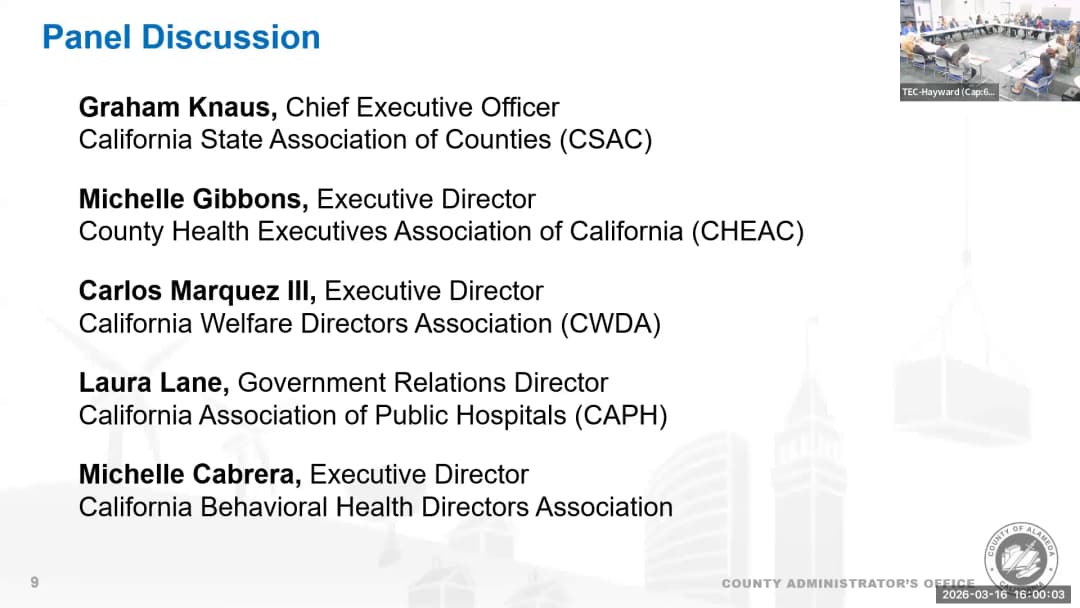
The Board of Supervisors Budget Work Group (Supervisors Halbert and Tam) convened a special meeting on March 17, 2026, to receive an economic outlook, a state budget forecast, and a panel of state‑level experts on the impacts of federal and state policy changes on county services. The meeting also included an update on Alameda County’s current budget and a timeline for the FY 2026‑27 budget adoption. Economic & State Budget Outlook Rasley Tadeo (County Administrator’s Office) presented key economic indicators for Alameda County: - January 2026 median home price: $1.12 million (down 5% from December, down 2.6% year‑over‑year). - January home sales down nearly 40% from December, up 2% year‑over‑year. - Unsold inventory up 115% from December, down 13% year‑over‑year. - Median days on market: 17 (down 10.5% from December, flat year‑over‑year). - Foreclosure filings up 32% year‑over‑year (11th straight month of increase, but below historic peaks). - February 2026 jobs report: loss of 92,000 jobs (vs. 126,000 gained in January; economists had expected +60,000). Unemployment rate 4.4%. - Tech layoffs: Amazon cut 16,000 jobs globally (750+ local); UPS 30,000; Workday cut 150 East Bay jobs; Block cut 40% of workforce (4,000 employees). The presentation stressed that nearly two‑thirds of the county budget comes from state and federal sources, and that the county faces rising costs, increased service demands, unfunded mandates, and limited ability to raise revenue. Panel Discussion: Federal & State Policy Impacts on Counties A panel of experts from state associations provided an overview of current challenges and anticipated impacts. Key points from each panelist: - Carlos Marquez III (California Welfare Directors Association): - HR1 will require county eligibility workers to manually process exemptions and compliance for 2.8 million ACA expansion Medi‑Cal enrollees and 950,000 CalFresh recipients. - The state’s harm‑reduction guidance (December 2025) is unfunded. - Counties are exploring reclassification of work functions, data‑sharing agreements, and CalFresh employment programs, but nothing is funded. - The remaining complex cases (often homeless, lacking data footprint) are at highest risk of losing coverage. - Laura Lane (California Association of Public Hospitals): - HR1 makes the most consequential federal Medicaid cuts in a generation, shifting costs to California and public hospitals. - Public hospital systems face a structural deficit of $1.5 billion annually from low Medi‑Cal rates. - Additional hits: $150 million from changes to UIS coverage; $827 million if the 1115 waiver is not renewed in 2027; $500 million from new eligibility burdens. - By 2032, annual losses could reach $5 billion across California. - Patients losing coverage will still show up, sicker and more expensive, increasing uncompensated care costs. - Michelle Gibbons (County Health Executives Association of California): - HR1 is “taking the air out of every room.” - Indigent care programs (dismantled after ACA) will need to be rebuilt. State cost estimates: $2 billion to $5.5 billion for counties if 1.4 million people fall off Medi‑Cal (using a one‑third attrition assumption). - State redirections of 1991 health realignment funds have slowed revenue growth (from 52–53% to 17% annually), compounding the gap. - Public health funding is in a “neglect, panic, repeat” cycle; COVID‑era funding is expiring, and federal grants are being terminated early, threatening communicable disease capacity and IT systems. - Michelle Cabrera (County Behavioral Health Directors Association of California): - County behavioral health is a safety net with health plan responsibilities, funded by state sales tax, vehicle license fees, and the millionaires’ tax (MHSA). - Proposition 1 will require Alameda County to cut $53 million in existing mental health services (prevention, wellness, peer programs) to fund housing rental subsidies. - New initiatives (e.g., mobile crisis) are at risk: the state proposed shifting the $168.8 million mobile crisis benefit to counties – a “pennywise, pound foolish” move that could increase deaths by suicide. - HR1 will cost county behavioral health $224 million in FY 2026‑27 (27,000 individuals losing coverage) and $828 million in FY 2027‑28 (89,000 individuals). - Counties are being asked to “do more with less” while facing new reporting requirements and data demands. - Graham Knaus (California State Association of Counties): - The current “unparalleled” attempt by federal and state governments to shift costs and responsibilities to counties is worse than any period since 1999. - HR1 alone represents a $6–9.5 billion annual cost shift to counties – not mentioned in the January state budget proposal. - No county can mitigate HR1’s scale; even Santa Clara County’s sales tax measure covers only a third of its deficit. - Loss of revenue harms not just the poor but also the insured, because hospitals lose the revenue that keeps doors open. - The state must step up, and counties need flexibility to achieve outcomes without prescribed methods. Alameda County Budget Update Rasley Tadeo presented the current FY 2025‑26 approved budget: - Total: $6.1 billion (balanced). - General Fund appropriations: $4.3 billion (increase of $300 million from FY 2024‑25). - Workforce: nearly 10,500 FTEs (increase of 10 FTEs). - Largest expenses: salaries & benefits ($1.7 billion, 40% of General Fund). - Largest program areas: health, public protection, public assistance (each over $1 billion). - State and federal revenue: nearly two‑thirds of the General Fund. - Discretionary revenue: only 30% of General Fund; 75% of that is property‑tax based. - The county receives only 15¢ of every property‑tax dollar; since FY 1992‑93, ERAF shifts have diverted $11.5 billion in property tax revenue from the county. - Current year funding gap: $105.7 million; total gaps closed since ERAF: $2.6 billion. - Long‑term obligations: over $800 million in unfunded capital and major maintenance needs; risks from ballot initiatives, labor negotiations, rising insurance costs, litigation, and economic downturn. Public Comments & Testimony - John Lindsay Poland (American Friends Service Committee): - Urged the county to revisit the maintenance‑of‑effort budget assumption and the Pabu consent decree (which requires 240+ sheriff’s jail staff, never fulfilled). - Noted that jail costs are much higher than community care. - Requested that the county’s CIO and behavioral health agency plot out how to fund services for 30 years in new BCHIP facilities being constructed. - Asked for presentation materials to be posted online before meetings. - Online speaker (unincorporated area resident): - Stressed that the unincorporated area is chronically underfunded and lacks municipal representation. - Urged the county to treat the unincorporated area like a city when allocating funds. - Called for a community budget input process to prioritize services amid cuts. Key Outcomes - The board and staff heard the panel’s analyses and public comments. - Supervisor Tam noted that the unincorporated services committee will work with the CAO’s office to present budget information to municipal advisory councils and gather input. - Supervisor Halbert requested that future budget presentations include year‑over‑year changes in revenue sources (growth/decline). - The CAO’s office outlined the budget adoption timeline: - April 14: Early budget work session with the Board of Supervisors. - Week of April 20: Next Budget Work Group meeting to review projected funding gap. - May 28: Proposed budget presented to the board (accelerated from previous years). - Mid‑June: Budget hearings. - End of June: Final adoption. - The board directed staff to continue community engagement, especially for unincorporated areas, and to refine the presentation materials for transparency.
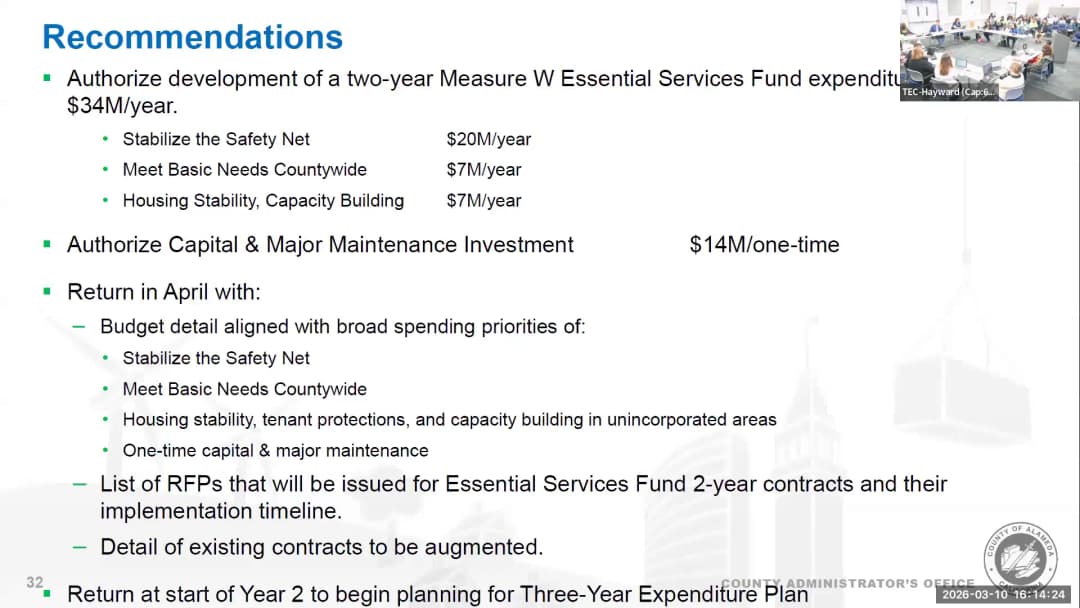
This special meeting of the Alameda County Board of Supervisors convened on March 12, 2026, to address the county's fiscal outlook, Measure W essential services spending, and the status of child welfare services following a state audit. Note: The meeting transcript references Tuesday, March 10, 2026; the date used here is as provided. Closed Session - The board recessed into closed session after receiving public comment concerning a public trail closure and a proposed transfer of a BART parking lot. No reportable actions were taken during the session, but the board later authorized the county counsel to sign onto amicus briefs in coordination with the Public Rights Project in the matter of MIOT v. Trump (Case No. 26-5050) pending in the D.C. Circuit Court. The vote was 5-0. Public Comments & Testimony - Closed session comment: One speaker criticized the county for sponsoring the closure of a 150-year-old hiking and biking trail and for planning to give away a publicly owned parking lot at Dublin BART station to a private party, calling the latter a “white elephant.” - Item 1 – Budget update: Two in-person speakers addressed the board. Samuel Ramy expressed frustration that tax revenues are not used to house or feed homeless residents, alleging mismanagement of funds. A second speaker (Buffalo Soldier) called for completion of the Oak Knoll Naval Air Station senior housing project and questioned the allocation of housing resources to immigrants over local homeless residents. - Item 2a – Measure W: 34 speakers (15 in person, 19 online) advocated for ongoing funding priorities, including: - Allocating at least 35% of the Essential Services Fund to unincorporated areas (multiple speakers from Eden Power Collective and community organizations). - Sustaining mental health prevention and early intervention programs threatened by Proposition 1 cuts (speakers from Prevention Matters Collaborative, Mental Health Association for Chinese Communities, Center for Empowering Refugees and Immigrants, Crisis Support Services, etc.). - Maintaining senior meal programs and food security services (Senior Services Coalition, SOS Meals on Wheels, Mercy Brownbag, Legal Assistance for Seniors). - Supporting immigrant and refugee legal services and community health providers (La Clinica de la Raza, Tiburcio Vasquez Health Center). - One speaker (Laura Calvert) criticized the late posting of the agenda and materials, stating the process impeded meaningful public input. - Item 2b – DCFS: No public comments were offered. Discussion Items 1. Federal, State, and County Budget & Finance Update - Staff (Rasley Tadeo and Amy Schregel) presented a comprehensive overview of economic conditions and budget risks. Key points: - Alameda County’s median home price in January 2026 was $1.12 million, down 5% from December and 2.6% year-over-year. Home sales fell 40% compared to December. Foreclosure filings rose 32% year-over-year. - The February 2026 jobs report showed a loss of 92,000 jobs nationally; the unemployment rate held at 4.4%. - Federal uncertainty: HR1 legislation threatens significant Medi-Cal and SNAP cuts. The state’s LAO has advised waiting for May revise before making budget decisions. - The county’s general fund appropriations total $4.3 billion for FY 25-26, supporting nearly 10,500 FTEs. A structural deficit persists; the current year gap ($105.7 million) was closed with one-time ($60.6M) and ongoing ($45.1M) strategies. - The county maintains its AAA credit rating (shared by only two other California counties). Unfunded capital needs exceed $800 million. - Sales tax measures: Three countywide measures (AA, C, W) raise approximately $170 million annually for health, child care, and essential services. Cities are also adding sales taxes, pushing rates toward 11.25% in some areas. - Historical realignments (1991, 2011) shifted program costs to counties while providing dedicated but insufficient revenue. Since 1993-94, Alameda County has lost $11.5 billion in property tax revenue to the Educational Revenue Augmentation Fund (ERAF). - Board discussion: - Supervisor Miley voiced frustration with state unfunded mandates and realignment, calling the system “broken.” He urged reform of property tax allocation. - Supervisor Tam asked about limits on sales tax increases; staff noted that while legal waivers are possible, voter appetite and competition from city taxes are constraints. - Supervisor Fortunato Bass advocated for exploring new revenue sources, including a billionaire’s tax and split-roll property tax reform. She asked staff to include CIP budget in future presentations. - President Halbert requested that each department list its unfunded mandates during budget hearings and asked about the county’s ability to poll the community on tax measures. Staff indicated that county funds can be used for polling on the county’s own measures but not on others’ campaigns. 2. Measure W Essential Services Update - Staff presented a proposed two-year spending plan for the Essential Services Fund, which has $170 million in ongoing revenue and $14.78 million in one-time carryover. Key recommendations: - Stabilize the safety net: $20 million/year for health pack, Prop 1 mitigation, medical retention, and support for LGBTQ+ and immigrant communities. - Meet basic needs countywide: $7 million/year for food security, senior staffing, and older adult services. - Housing stability, tenant protections, and capacity building: $7 million/year (planned for unincorporated areas). - One-time capital and major maintenance: $14.78 million deferred. - Board discussion and direction: - Supervisor Miley questioned the 35% allocation request for unincorporated areas, noting the region accounts for about 10% of population. Staff clarified that capital projects (e.g., Castro Valley Library, Livermore sewer, San Lorenzo Theatre) plus housing services bring the unincorporated share to approximately 20–34% over the fund’s life. - Supervisors generally supported moving the housing stability and tenant protection bucket to the Home Together fund, freeing up $7 million for health care and safety net priorities. - Supervisor Tam emphasized the need for bridge funding for Prop 1 and Alameda Health System. Supervisor Fortunato Bass pushed for additional mental health prevention, reproductive health, and fair chance housing. President Halbert called for outcomes-based contracting and accountability dashboards. - Staff will refine the plan and return in April with detailed allocations, contract augmentation lists, and implementation timelines. The board did not finalize the dollar amounts but provided consensus on the broad framework. 3. Department of Children and Family Services – State Audit Follow-Up - Social Services Agency and Behavioral Health staff updated the board on progress addressing a 2024 state audit. Highlights: - Open referrals backlog reduced by 57% (from 3,997 to 1,497). The oldest open referral dates to 2021. - Daily emergency response staffing averages 10–14 workers on day shift, dropping to 11.3 in February 2026. - Behavioral Health partnership: 96% of foster youth (approximately 960) are connected to services. 32% of shared clients are placed out of county. - 14 audit recommendations are addressed or in progress: completed items include mandatory shadowing for new hires, documentation templates for court reports, and policies to track shelter overstays. - Ongoing work includes meet-and-confer with supervisors’ union on case oversight, a staff survey on retention, and data-sharing improvements. - A public dashboard is now available with metrics on referral timeliness, staffing, and foster child well-being (sibling placement, medical exams). - Board comments: - Supervisor Tam requested qualitative data to complement the dashboard, such as stories of successful sibling reunifications and high-needs youth placements. Staff agreed to include such information in future updates. - Supervisor Fortunato Bass stressed the importance of system collaboration and transparency through the interagency coordinating council. - The next report to the Social Services Committee is scheduled for April 23, 2026. Key Outcomes - Closed session: Authorized 5-0 to join amicus briefs in MIOT v. Trump. - Budget update: No formal action; board directed staff to return with additional information on CIP budget, unfunded mandates by department, and options for polling on tax measures. - Measure W spending plan: Board gave informal direction to staff to develop a two-year expenditure plan focusing on safety net stabilization and basic needs, with housing-related allocations moved to the Home Together fund. Staff will present a detailed proposal in April 2026. - DCFS audit update: No formal action; staff will continue implementing recommendations and report to the Social Services Committee on April 23, 2026. The board encouraged inclusion of qualitative success stories in future reports. - The next special meeting agenda will be communicated in advance to allow for longer public notice.
The Alameda County Board of Supervisors held a special meeting on March 12, 2026, to reaffirm and clarify a motion passed on March 3, 2026, requesting that the Alameda Health System (AHS) Board of Trustees defer all layoffs and program closures through June 30, 2026. Supervisors Miley and Fortunato Bass introduced a board letter to solidify the board's intent after AHS only deferred layoffs for patient-facing positions for two weeks. The board unanimously approved the letter. Public Comments & Testimony - Tony Fuentes (Director, Alameda Health System ACNE): Expressed concern about program closures and reductions in force (RIFs) impacting the safety net system, which cares for over 150,000 patients annually. Urged the board to ensure its direction is carried out and to require transparency about patient care impacts. - Nathan Hansford (Area Supervisor, SCIU, Bargaining Chair): Asked for layoffs to be fully postponed and laid-off employees to be brought back to restore services. - Christian Puss (AHS Cafeteria Worker): Requested that employees on leave be brought back and called for better collaboration with AHS. - Drew Scott (Therapist, Fairmont Intensive Outpatient Program): Described the emotional stress on clients caused by AHS not adhering to the board's initial request. Urged the board to vote yes on the reaffirming letter to protect patient care. - David Padilla (SCAU 1021): Thanked the board for its swift action, expressed frustration that the AHS Board of Trustees defied the county's direction, and reiterated the union's partnership in finding solutions. - Susan Sandoval (SEIU Member, San Leandro Hospital): Voiced full support for deferring layoffs, restoring health care services, protecting the Level 1 trauma center at Highland Hospital, and forming the ad hoc committee. - Ashley Maher: Presented data showing a 200% increase in contaminated blood culture rates (from 1.1% in 2025 to 3% in January 2026), arguing it increases workload and burnout. Urged collaboration and using informed staff ideas instead of eliminating positions. - Iman Khalil (Online): Supported the reaffirmation vote and encouraged all parties to collaborate. Discussion Items - Supervisors Miley and Fortunato Bass introduced the board letter, clarifying that the intent of the March 3rd motion was to defer all layoffs (both patient-facing and non-patient facing) and program closures through June 30, 2026. This clarification was prompted by AHS only delaying patient-facing layoffs by two weeks. - President Halbert confirmed that the board lacks the authority to direct AHS but was issuing a formal request. He noted the risk that delaying cuts now could lead to deeper cuts in the future but expressed trust in the ad hoc committee. - Supervisor Miley emphasized the board's willingness to allocate county resources if necessary. He outlined the ad hoc committee's schedule (first Wednesday of April, May, and June) and directed county administration to report back on March 17, 2026, exploring other funding options. - Supervisor Fortunato Bass highlighted the collaborative approach of the ad hoc committee, which will work to raise revenue, find savings, and minimize service and staff impacts. Key Outcomes - The Board voted unanimously (5-0) to approve the board letter reaffirming the request that AHS defer all layoffs and program closures through June 30, 2026. - The Board formally established an ad hoc committee (Supervisors Miley and Fortunato Bass) with scheduled meetings in April, May, and June to develop financial solutions to the funding crisis. - The County Administrator was directed to continue working on alternative funding options and report back to the full board on March 17, 2026, identifying potential county resources to support the deferment.
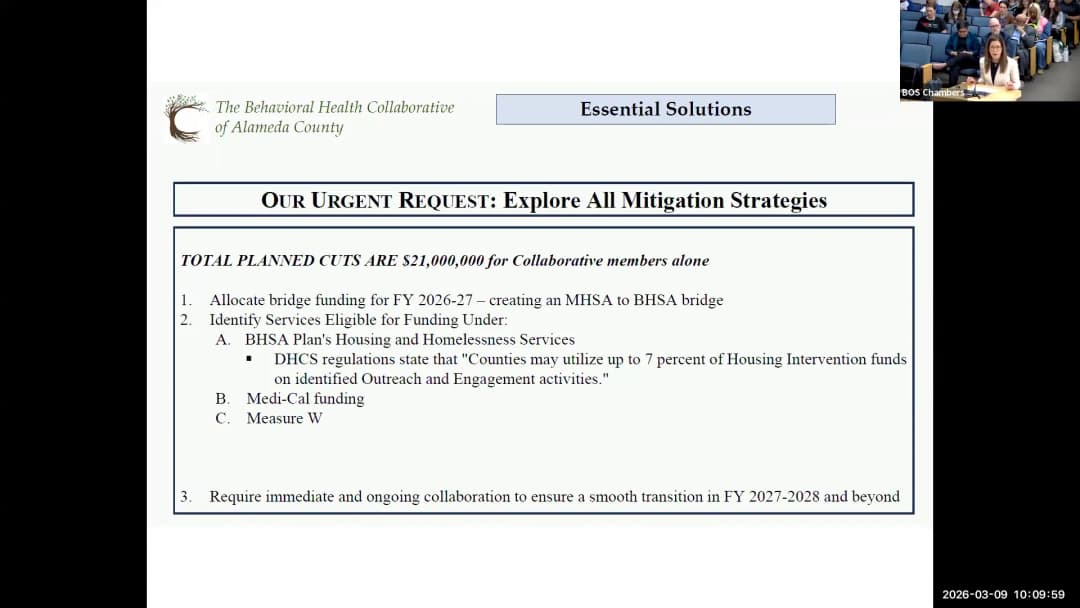
Date: March 10, 2026 Location: Alameda County Board Chambers Chaired by: Supervisor Miley (arrived late) and Supervisor Tam The meeting covered an update on the Tax Defaulted Properties Program, a deep-dive information item on the impacts of Proposition 1 (Behavioral Health Services Act) on behavioral health funding and services, and an action item to approve a contract for the Scalable Housing Infill Funding Toolkit (SHIFT). Public testimony on Item 3 lasted over two hours, with 62 speakers (52 in-person, 10 online) sharing concerns about the scale of cuts. Consent Calendar - No consent calendar items were listed on the agenda. Tax Defaulted Properties Program Update (Item 2 – Informational) - Staff Report: Presented by Alameda County Housing and Community Development. The program invested $3 million from Measure A1’s Innovation and Opportunity Fund to acquire tax-defaulted properties for affordable housing. Of 13 proposals from 11 applicants, only one project met minimum requirements: Kingdom Builders Christian Fellowship Ministries with Community Housing Development Corporation. The project is located at 7963 MacArthur Boulevard. - Challenges Identified: Infeasible budgets, unrealistic service plans, limited developer capacity, and the risk of county investments stalling. Properties become defaulted after five years of delinquency, with a year-long curing period after sale, requiring emerging developers to take on significant liability. - Program Revisions: Staff proposed simplifying requirements, pre-selecting optimal sites, requiring partnerships with pre-qualified developers, providing flexible affordability requirements, and offering full technical assistance via Hello Housing. Evaluation criteria will shift from tax-credit project standards to feasibility and value to the county. - Public Comment: Casey Farmer (Policy Advisor to Treasurer Tax Collector Hank Levy) expressed strong support for the revised plan, calling it “streamlined” and noting the Treasurer’s emphasis on transferring properties to affordable housing nonprofits under Chapter 8 of the California Revenue and Taxation Code. - Board Direction: Supervisor Tam accepted the staff report and commended efforts to streamline the program, noting it could serve as a model for future projects. Behavioral Health Services Funding Impacts – Proposition 1 (Item 3 – Informational) - Presentation by Alameda County Behavioral Health Collaborative: David Channer (President), Nar just Dillon (Past President), and Stacey Katz (Vice President) described the risks to the county’s behavioral health ecosystem. They estimated 15,000 consumers could lose services, with an additional 20,000 losing outreach/education. More than 350 jobs are at risk. - Key Impacts Cited: - Cuts to suicide prevention, wellness centers, LGBTQ+ programs, and immigrant-focused services. - Loss of peer-led services (reducing psychiatric hospitalizations by 72%) and family support (associated with 60% lower relapse rates). - Elimination of school-based programs (e.g., Hume Center, Crisis Support Services) and re-entry programs like BACS’s Oakland Project Connect and Roots Community Health’s Safe Landing project. - The crisis line (CSS) saw a 41% increase in calls and a 73% increase in suicide-related calls in the first six months of FY2026. - Proposed Solutions: - Bridge funding for FY 2026–27 to preserve services while crosswalking to BHSA. - Identify eligible services under BHSA housing intervention funds (up to 7% for outreach/engagement). - Leverage Medi-Cal billing (e.g., CalAIM) and Measure W funding. - Establish regular interagency working groups (CPAG) for collaborative planning. - Staff Response: Director Anika Chadry and Dr. Tribble acknowledged the catastrophic impact ($53 million delta, with $21 million from collaborative members and $11.5 million from county programs). They noted efforts to use Measure W, Measure C, and the Essential Services Fund but emphasized the complexity of shifting contracts and reporting requirements. - Public Testimony: 62 speakers (52 in person, 10 online) testified over 1.5 minutes each. Speakers included Jamie Almanza (BACS – 4,000 clients affected), Jennifer Johal (Crisis Support Services – suicide prevention training at risk), Bernitz (Inside Housing – board and care operations), and many others representing grassroots organizations, legal aid, and peer support agencies. Recurring themes: prevention saves lives and dollars; cuts will shift costs to emergency rooms and jails; the county must invest reserves rather than deplete community resources. - Board Action: Supervisor Miley expressed frustration with the state’s “either/or” framing and committed to direct intervention. He directed staff to examine all internal funding sources, including Measure W ($250 million essential services fund) and the prudent reserve ($170 million), and to bring a comprehensive plan to the March 19 CPAG meeting. He emphasized the need for bridge funding by June 30 to avoid service disruptions. - Next Steps: An ad hoc CPAG work group will meet Thursday, March 19, at 3 p.m. to develop a mitigation strategy, with a report back to the full Board of Supervisors. Scalable Housing Infill Funding Toolkit (SHIFT) – Consultant Contract (Item 1 – Action) - Staff Report: Presented by HCD. SHIFT aims to deliver lower-cost affordable housing on small, underutilized sites. The initiative includes a development toolkit (pre-approved designs, planning streamlining) and a development program funded by $7.4 million from Measure A1 program income. - Contractor Selection: Inspired ADUs (Oakland-based) was selected from six proposals for a program design and architecture contract. Cities of Oakland, Livermore, and Newark participated in the review panel. - Timeline: Contract goes to full Board of Supervisors in March 2026; RFQ for developer pool in summer 2026; NOFA for pilot projects fall 2026; applications for specific sites expected by end of calendar year. - Public Comment: None. - Vote: Motion by Supervisor Tam, seconded by Supervisor Miley – Passed unanimously. Key Outcomes - Tax Defaulted Properties Program: Staff report accepted; board directed staff to proceed with revised program (pre-selected sites, pre-qualified developers, simplified requirements). - Behavioral Health Funding (Prop 1): Board committed to bridge funding; staff directed to identify all internal sources (Measure W, Measure C, prudent reserve) and report to CPAG on March 19. Supervisor Miley will personally oversee efforts. - SHIFT Program: Contract with Inspired ADUs approved; framework and 7.4 million in Measure A1 funds referred to full Board of Supervisors for final approval. - Other: Adjourned at approximately 12:30 p.m. (meeting started at 5:45 p.m.; note: time discrepancy in transcription indicates possible recording error).
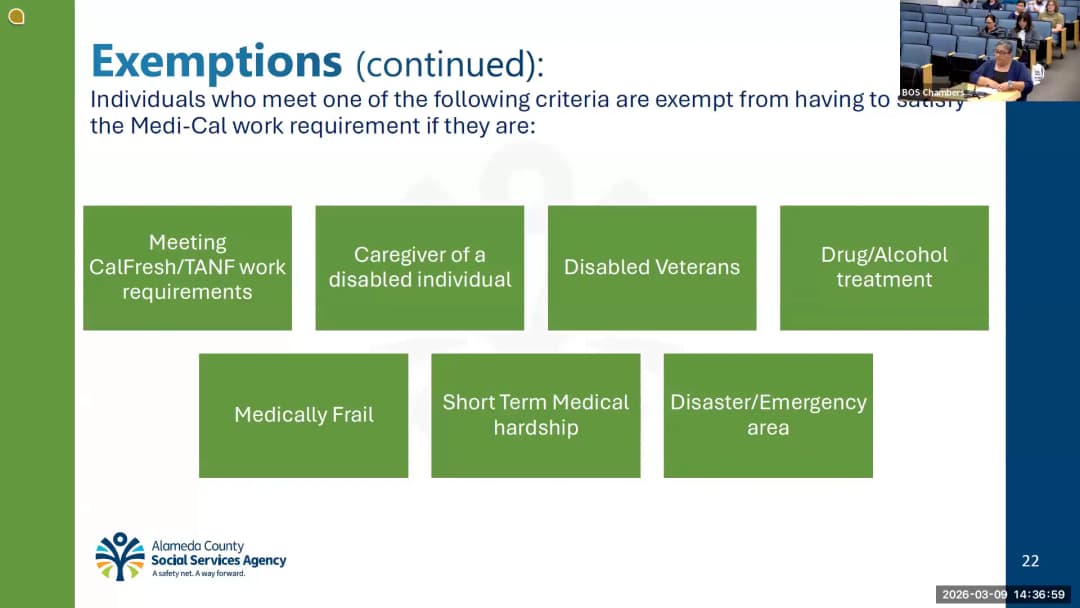
The Alameda County Board of Supervisors held a Joint Social Service and Health Committee special meeting on March 10, 2026, to receive two informational presentations. The first presentation covered state and federal policy changes to Medi-Cal, including an enrollment freeze, dental benefit reductions, work and community engagement requirements, and impacts on non-citizen residents. The second presentation provided an annual update from the Alameda County Council for Age Friendly Communities, highlighting housing, health, digital inclusion, transportation, and advocacy efforts for older adults. Public comments raised concerns about a proposed single-provider contract for the Area Agency on Aging's Information and Assistance services and insufficient transparency in the RFP process. Consent Calendar - [None mentioned] Public Comments & Testimony - Wendy Peterson (Senior Services Coalition) spoke on the age-friendly annual report, raising alarm about the Social Services Agency's Notice of Intent to award the AAA Information and Assistance contract to a single provider. She called it an unprecedented departure from past practice that would re-configure the service landscape and be catastrophic for locally embedded providers without countywide reach. - Anna Baptist (City of Oakland) stated that the City of Oakland and other providers have delivered information and assistance for decades (Oakland for over 20 years). She argued that centralization would not create efficiency because community-based organizations know their communities better. She further asserted that the RFP did not clearly state it would be single-source; on page 1713 the RFP said multiple awards may be made, and at the bidders' conference staff said they did not have a set number of organizations and that there could be multiple awards. She criticized the RFP process as lacking transparency. Discussion Items 1. State Budget & HR1 Impacts on Medi-Cal - Juan Ventania, Emilia Sanders, and Tammy Lu (SSA) presented updates on Medi-Cal policy changes affecting non-citizens and work/community engagement requirements. - Enrollment freeze for individuals with unsatisfactory immigration status (UIS): Effective January 1, 2026. As of late February 2026, 49,910 individuals were enrolled in full-scope Medi-Cal as a result of past expansions, a decrease of 1,290 from December 2025. The largest reason for the drop (70% of sampled discontinuations) was failure to complete annual renewal. Exemptions include pregnant individuals through postpartum and those permanently residing under color of law (PRUCOL), among others. - Reduction of dental benefits for UIS individuals: Effective July 1, 2026, full-scope dental will end for UIS adults 19+ (except pregnant/postpartum). 71,790 individuals are potentially impacted, down 2,210 from December. Emergency dental coverage will remain. - Redefinition of qualified non-citizens (QNC): Effective October 2026, QNC status will be limited to lawful permanent residents, Cuban/Haitian entrants, and COFA migrants. Refugees, asylees, battered non-citizens, and others will lose QNC status, potentially moving to restricted-scope Medi-Cal unless state funding is provided. An estimated 8,960 individuals will be affected, down 1,640 from December. - Health Navigators Project (CBO partnerships): From July–December 2025, CBO partners assisted with 1,453 new enrollments (on 1,149 cases) and 2,957 Medi-Cal renewals (on 1,275 cases). Two success stories were highlighted about helping newly arrived families and individuals navigate constant policy changes. - CMS data sharing with DHS/ICE: A federal court ruled (Dec. 2025) that CMS may share limited data with ICE only for individuals not lawfully residing in the U.S., but if the data cannot be separated out (e.g., includes lawful permanent residents or U.S. citizens), it cannot be shared for immigration enforcement. The lawsuit is ongoing. - Work and community engagement requirements (HR1): Effective January 1, 2027, for individuals aged 19–64 in the MAGI New Adult Group (incomes over 109% FPL). Exemptions include parents/caretakers of a child under 13, pregnant/postpartum (12 months), individuals receiving Medicare A/B, American Indians/Alaska Natives, and medically frail individuals. Qualifying activities include earning ≥$580/month (80 hours at $7.25/hr federal minimum wage), employment ≥80 hrs/month, school attendance, or community service. The process involves a 30-day look-back at application and a 6-month renewal window. - Preliminary data (Tammy Lu): 158,900 residents are subject to the work requirements (down 2,100 from early February). The majority of the decrease was due to renewal failure. Age group 26–49 is most affected; more males than females are subject to work requirements. Top countries of origin among affected: Mexico, China, Guatemala, Vietnam. About 15,100 individuals may meet an exemption (largest group: caring for a child under 14, 9,500). About 55,900 may meet work requirements through income, employment, or school. About 87,900 individuals currently do not meet an exemption or a qualifying activity (58% of the subject population). District 3 has the highest numbers. Full implementation by 2030 is projected to reduce statewide Medi-Cal caseload by 12.24% (50,300 in Alameda County). - Future enhancements: State is developing an exemption/work reporting form, exploring data sources (EDD, IRS, Equifax, CalFresh/CalWorks, veteran service history, etc.) and gig economy data via TRUVE, and looking at managed care data. County is optimizing data queries and convening a workgroup for staffing, training, and outreach. State text messaging campaign began February 2026 (targeting those with Jan/Feb 2027 renewals). - Supervisor concerns and questions: - Supervisor Fortunato Bass asked clarifying questions about the $580/month income threshold (confirmed it is an alternative to 80 hours of employment). She emphasized that the workgroup needs to be “all hands on deck” and asked for regular updates to the board. - Supervisor Miley asked about the possibility of enrollment after the 3-month grace period (only restricted-scope would be available). He suggested creating a county program to help individuals meet the work/community engagement requirement (e.g., volunteering for litter pickup). He also asked about eligibility worker caseload (2,000 per worker) and vacancies (140 FTE). He expressed concern that 87,900 people could lose coverage and urged proactive help. - Supervisor Tam asked about the timeline for when displaced refugees could regain full-scope (when they change to another qualified status) and whether the numbers from SSA align with broader Alliance projections (confirmed by Andrea Ford: the numbers are on par with earlier worst-case scenario projections, but the 12.24% reduction is a phased figure, not absolute). He noted that “any number is bad” but appreciated the phased approach. 2. Alameda County Council for Age Friendly Communities – 2025 Annual Update - Faith Battles (Assistant Agency Director, Department of Adult and Aging Services) and Kimmy Watkins Tart (Director, Alameda County Public Health) presented the update, covering age-friendly domains aligned with the state’s Master Plan on Aging, Vision 10X, and AARP domains. - Housing: Over 8,000 older adults served via HMIS in FY23-24; 1,200 obtained housing. Among new homeless entries, 1,200 were 50+. Over 4,000 served were Black/African American (disproportionate). 22% of older adults returned to homelessness within two years (7 ppt higher than county average). The Home Safe program has dispersed over $8 million countywide, enrolling nearly 500 clients. FY25-26 allocation is $2.75 million. Examples included funding a $22,000 home cleanout after a red tag, water heater replacement, and bathroom renovation. UCSF Vinioff study found 93% of those housed at entry remained housed at exit; 58% unhoused at entry were housed at exit. Alameda County served twice as many clients as LA County. - Health and community supports: Healthy Brain Initiative (700k grant, July 2023–June 2025) conducted 110+ training/listening sessions with nearly 1,700 care providers (550 family caregivers, 300 first responders). Triple A delivered 623,000 home-delivered meals to 3,600+ older adults; 200,000 congregate meals to 2,700+ seniors. Legal assistance provided to 3,100 older adults. HICAP served 2,200 Medicare beneficiaries. Advocacy included pushing for increased Medi-Cal reimbursement rates for adult day services and funding for Alzheimer’s disease centers. Partnership with Sutter Health to promote age-friendly health systems. - Digital inclusion: Two grant applications (federal $4M NTIA Digital Equity Grant; state $1.2M digital equity plan) were terminated due to federal funding shifts. Council remains active via Oakland Undivided’s transition to East Bay Broadband Consortium and CPUC’s California Advanced Services Fund (public housing account). Exploring device refurbishing with Alameda County ITD. Published an older adult data resource directory. - Civic participation & economic security: Legislation and Advocacy Committee reviewed state budget proposals and took positions on key bills. Four bills passed: AB 561 (elder abuse protective orders), AB 1069 (emergency shelter access for older adults), SB 470 (extending remote meeting attendance through 2030), AB 960 (allowing bedside visitors for patients with dementia). Finalized issue briefs on Alzheimer’s and older adult employment. Identified a critical gap: eviction data does not report age at time of eviction. Launched a client story submission campaign for advocacy. - Transportation: Participated in ACTC listening sessions to reflect older adult needs in regional plans. Attended AC Transit community meeting to oppose paratransit reductions; elected board preserved all services for the year. - Demographics: Nearly 385,000 residents are 60+; projected to reach 600,000 by 2040 (70–80% growth). Half of single older adults report not affording basic living costs. Over 69,000 residents 65+ projected to have Alzheimer’s/dementia by 2060. 2,406 older adults served by behavioral health in FY22-23; need is expected to grow. - Supervisor Miley’s feedback and questions: He expressed difficulty gauging overall progress on age-friendliness without a dashboard with baseline data from 2017. He noted that the report felt anecdotal and requested a more quantitative dashboard. He asked about partnerships with Spectrum (LIHEAP) and the food bank—confirmed they have participated at times. He noted the absence of these prominent food programs from the report and felt the council should highlight such priorities. He asked about the Master Plan on Aging: it is a state plan with no mandates and no funding. He urged the council to advocate for state funding tied to the plan’s priorities. He asked about the council’s role vis-à-vis homelessness: HH (Housing & Homelessness) is an active council participant; data shows disproportionate homelessness among older adults, but also that older adults are heavily represented among those placed into permanent housing. He asked about behavioral health involvement—confirmed BH is an active council member and will continue to be a focus. He suggested the board may need to reaffirm its commitment to age-friendliness and cross-departmental collaboration. He asked about Measure W funding for older adults: the council provided recommendations but did not request specific funding. He noted that roughly 2 million of the 25 million Measure W allocation went to senior meals (SNAP program). He asked for a percentage or total—staff could not give a figure but said some older adult investments were made via the Essential Services Fund and the refreshed Home Together plan. He expressed concern that older adults might not support future Measure W measures if their needs are not addressed. - Supervisor Fortunato Bass thanked staff, praised the website and data resource directory, and asked about longevity trends. Battles responded that people are living longer but not healthier, citing IHSS/APS clients in their 70s–90s, increasing isolation, and high costs of aging (especially for vision, dental, hearing, foot care not covered by Medicare). Kimmy Watkins Tart added that life expectancy is unequal by race/ethnicity, leading to shorter, sicker lives, and that systems are not equipped to handle a large, older, sick population with few family supports. - Supervisor Tam thanked staff and specifically praised the advocacy that preserved paratransit services. He asked about the link between affordability and Medi-Cal/Medicare coverage: Battles confirmed that 50% of seniors reporting inability to afford basics likely rely on Medi-Cal in addition to Medicare, but noted subsidized housing is often unavailable and that many seniors pay 30% of income on rent, leading to a snowball effect of missed care and food. She explained that the Home Safe study found that even with flexible funds, the high cost of living limits impact. Tam asked about how HICAP counseling offsets uncovered costs (e.g., hearing aids, dental, podiatry)—Battles said that legal assistance and HICAP help but there is no long-term plan for persistent issues, and there are programs but they are insufficient for all who need them. Kimmy Watkins Tart added that without these supports, health becomes more compromised, especially for those who fall into a “hole” between being on Medicaid and having some money (e.g., home owners who cannot maintain their homes). Key Outcomes - No formal votes taken (informational items). - Directives and next steps: - The presentations will inform ongoing board oversight of Medi-Cal eligibility changes and age-friendly initiatives. - Supervisor Miley asked staff to consider creating a county program to help the 88,000 individuals meet work/community engagement requirements, such as volunteer opportunities for litter cleanup. Staff noted they are awaiting state guidance and federal approval for county opt-in supports. - Supervisor Miley requested that the board be provided with a formal dashboard for age-friendly progress, using baseline data from 2017. - Supervisor Miley suggested the board may take formal action to reaffirm the importance of age-friendliness and cross-departmental collaboration. - Supervisor Tam and Fortunato Bass asked that the committee be kept updated on the Medi-Cal workgroup’s plans and any resource needs. - The Social Services Agency’s decision to award the AAA Information and Assistance contract to a single provider will be brought to the full Board of Supervisors at a future date, currently undetermined. Multiple supervisors expressed strong concern and indicated they may reject the award without sufficient justification.
Almy County Board of Supervisors Personnel Administration and Legislation Committee Meeting - March 9, 2026\n\nThe Personnel Administration and Legislation (PAL) Committee met on Monday, March 9, 2026, to receive updates on federal and state legislative developments. The meeting included a federal update from CJ Lake and a state update from Full Moon Strategies, followed by questions from supervisors. No public comments were made on agendized items. The committee voted to recommend a request from AC Health to the full Board of Supervisors.\n\n Federal Legislative Update\n- John Asini of CJ Lake reported on the current congressional landscape. The Senate is in session; the House is out for a Republican policy retreat at Trump National Doral in Miami, focused on midterm election strategy amid the ongoing U.S. war with Iran. The Department of Homeland Security (DHS) remains unfunded in its third government shutdown, and former DHS Secretary Christy Noem was ousted.\n- House leadership projects confidence in retaining its slim 218-to-214 majority but faces challenges passing partisan legislation, including a potential second reconciliation bill on housing and health care. No clear direction from the White House on reconciliation exists.\n- The White House is expected to request tens of billions in supplemental Pentagon funding for the Iran conflict, which may dominate the retreat agenda. Some Republicans want to add farm aid and disaster relief, risking tension with fiscal conservatives.\n- On the Senate side, President Trump is pressuring passage of the Save America Act (requiring photo ID and proof of citizenship to vote), but Senate Republicans are unwilling to change filibuster rules to pass it. No support exists within the Senate Republican conference for such a rule change.\n- Senator Mark Wayne Mullin is expected to be confirmed as DHS Secretary soon; confirmation hearings have not yet been scheduled.\n- The Senate continues work on the Road to Housing Act, a bipartisan housing package. Senators Tim Scott and Elizabeth Warren released a substitute amendment (21st Century Road to Housing Act) on March 2. The Senate voted 84-6 to limit debate on the motion to proceed, then 90-8 to advance the measure. House Financial Services Chair French Hill warned the House is not ready to back the Senate version, raising the prospect of a conference committee.\n- The House Agriculture Committee passed the 2026 Farm Bill by a 37-17 bipartisan vote after a 20-hour markup with over 100 amendments. Several adopted amendments affect SNAP and county governments. However, the bill faces a difficult path due to narrow margins, disputes over reconciliation, and election-year politics. No action is anticipated from the Senate.\n- Q&A: Supervisor Portunova Bath asked about DHS funding scenarios. Asini noted no clear path forward; TSA sickouts are increasing wait times as unpaid status enters week three. The firing of Noem and nomination of Mullin may provide an off-ramp, but no breakthroughs yet. Supervisor Bath also asked about war powers resolutions and the Iran supplemental. Both war powers resolutions failed; an AUMF vote is not scheduled. The White House is requesting $50 billion in additional defense aid for Iran, which will be a major point of contention. Asini agreed to provide a list of farm bill SNAP amendments.\n\n State Legislative Update\n- Amy Costa of Full Moon Strategies provided the state update. Policy committee hearings have begun for bills meeting the 30-day in-print requirement. Departments should review the weekly bill report for county impacts.\n- Attorney General Rob Bonta joined a 22-state coalition filing an amicus brief supporting Pennsylvania and New Jersey lawsuits against Trump administration regulations that expanded religious and moral exemptions to no-cost contraceptive coverage under the Affordable Care Act. The coalition argues the regulations harm access to birth control, especially for women of color and low-income individuals.\n- The Legislative Analyst’s Office (LAO) released a report on county administration impacts of HR1, focusing on Medi-Cal and CalFresh. The report highlights that new work requirements (community engagement) are expected to lower enrollment. Counties are responsible for eligibility determination and redetermination, and the LAO recommends directing counties to report on error rate drivers and strategies. The LAO also suggests automating some processes to reduce disenrollment and proposes temporary additional funding for administrative burdens until the full impact of HR1 is known. The LAO calls for a revision to the Medi-Cal budgeting process to link funding more directly to county workload.\n- The LAO also released a Medi-Cal analysis noting the program serves roughly 14.5 million Californians. Growth in managed care, pharmacy costs, and Medicare-related payments, along with shifts toward seniors and people with disabilities, are the main cost drivers.\n- Political update: State Senator Calderon declined to run for Insurance Commissioner, citing timing, finances, and family. His announcement followed California Democratic Party Chair Rusty Hicks urging consolidation. Election data expert Paul Mitchell estimates a 25% chance that two Republican candidates could advance to the general election.\n- Full Moon Strategies released a 2026 ballot initiative tracker. Signatures for initiatives must be submitted by June 25, 2026, to qualify for the November ballot. Amy Costa will report back on the certification deadline.\n- Q&A: Supervisor Bath asked about state relief for public hospitals. Costa noted that CSAC and county affiliates will put forward a proposal on HR1 impacts within two weeks. Two revenue measures gaining traction: a tax on employers with many employees in safety net services (the "Walmart tax," possibly carried by Assemblymember Mia Bonta) and a "Water’s Edge" corporate tax. A coalition led by SEIU and labor partners will launch on Wednesday March 11. Costa will provide more details. Supervisor Bath also asked for clarification on LAO recommendations for administrative funding. Costa explained the LAO identified counties’ key role but noted the governor's budget does not include additional funding for the HR1 administrative burden, and the current Medi-Cal administrative cost determination method may be insufficient.\n\n Key Outcomes\n- No public comments were received on either the federal or state legislative updates.\n- Supervisor Portunova Bath moved to recommend "this request from AC Health to the full board of supervisors." The committee approved and adjourned. No further details on the AC Health request were provided in the transcript.
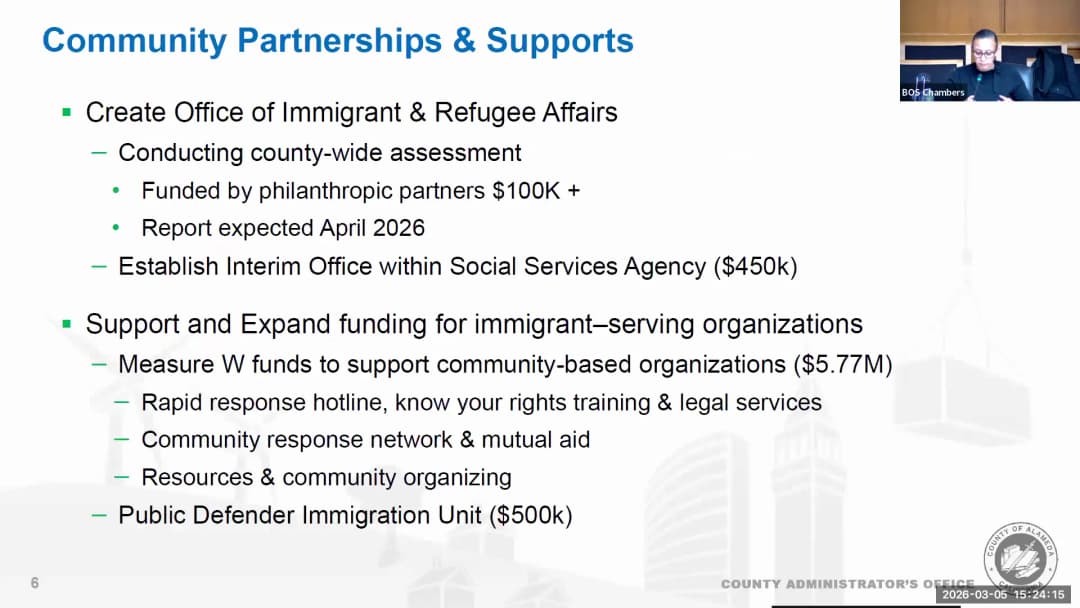
The Alameda County Together for All (Act for All) Ad Hoc Committee, chaired by Supervisor Nikki Fortunato Bas and Vice Chair Supervisor Lena Marquez, convened on March 6, 2026, to receive updates on the implementation of the county's Immigration Enforcement Response Plan and the ICE-Free Zones policy adopted on January 27th. The meeting featured a presentation from Chief Deputy County Administrator Lori Cox, public testimony, and discussion on future steps for immigrant and refugee protections. Public Comments & Testimony - Mindy Petchener (Oakland mayoral candidate): Criticized Chair Fortunato Bas's opening remarks concerning federal foreign policy, defending the administration's actions and urging the board to focus on "illegals that are criminal." - Christopher Martinez (Spanish Speaking Citizens Foundation / A CLIP partner): Expressed strong support for the ICE-Free Zones policy and response plan. Urged the board to continue planning, establish the Office of Immigrant and Refugee Services with sustained funding, and prepare for declaring a local state of emergency if enforcement escalates. - Kathy: Raised concern over an Oakland truck driver recently arrested by unidentified federal agents, asking the board for updates and efforts to reunite him with his family. - John: Concurred with Mindy Petchener on foreign policy and noted that Minneapolis is now cooperating with ICE, contrasting it with Alameda County's approach. - Bob Britton (Interfaith Coalition for Justice Center Jails): Urged the board to end participation in the SCAAP program, as Marin County did, citing the Sheriff's willingness to stop the program if the funding is replaced. - John (second comment): Asked the committee to "tone down" rhetoric, citing vandalism attacks on the Alameda County Republican Party headquarters. - Zila Resh (Deputy Chief of Strategy and Partnerships, Alameda County Office of Education): Shared that ACOE's resources are being nationally modeled, launched the "Supplies for Safe Pathways to School" initiative with over 70 schools participating, and noted that the ACOE Board of Education passed an ICE-Free policy on February 10th. Discussion Items - Opening Remarks: Chair Fortunato Bas provided a national and global context, highlighting impacts of federal policies, DHS actions, and immigration enforcement in neighboring Santa Clara County. Vice Chair Marquez thanked staff for their work and emphasized the unanimous January vote as a demonstration of the county's commitment to protecting residents. - Presentation by Lori Cox (Chief Deputy County Administrator): Provided a status update on the Response Plan and ICE-Free Zones policy implementation. - Signage: Standardized signs (with braille) cost $500 per sign, including posts if needed. Installation will be phased by General Services (GSA). - Communication Protocols: Drafted across departments, pending review by labor and county council. The goal is consistent messaging followed by department-specific training. - Community Coordination: The county is meeting with Social Services Agency (SSA) and community partners on the rapid response network. "Know Your Rights" red cards are being distributed. - Office of Immigrant and Refugee Affairs: A countywide assessment, funded by foundation partners (over $100,000), is underway. A report is expected by the end of April. An interim office within SSA is in the final stages of hiring. - Funding: The county allocated $5.7 million in Measure W funds for rapid response, legal services, and organizing. Renewal of contracts will be brought to the board before expiry. - Board Discussion: - Supervisor Marquez requested a hiring update for the interim Office of Immigrant and Refugee Affairs and emphasized the urgency of sustained funding for community organizations over the next two and a half years. - Chair Fortunato Bas highlighted SSA's website resources (including family preparedness plans) and noted a new Alameda County Superior Court policy prohibiting armed ICE agents from entering courthouses without official business. Key Outcomes - Report Received: The committee formally received the informational report on the implementation status of the immigration enforcement response plan and ICE-free zones policy. - Next Meeting: Scheduled for Friday, April 30, 2026, to receive an update on the framework for the Office of Immigrant and Refugee Affairs. - Upcoming Board Actions: An MOU for SSA services will go before the full Board of Supervisors on March 17, 2026. Chair Fortunato Bas noted the Sheriff is ending the contract with the third-party contractor for the SCAAP program and working to not renew the funding. A resolution objecting to FCI Dublin is also in development, led by President Howard.
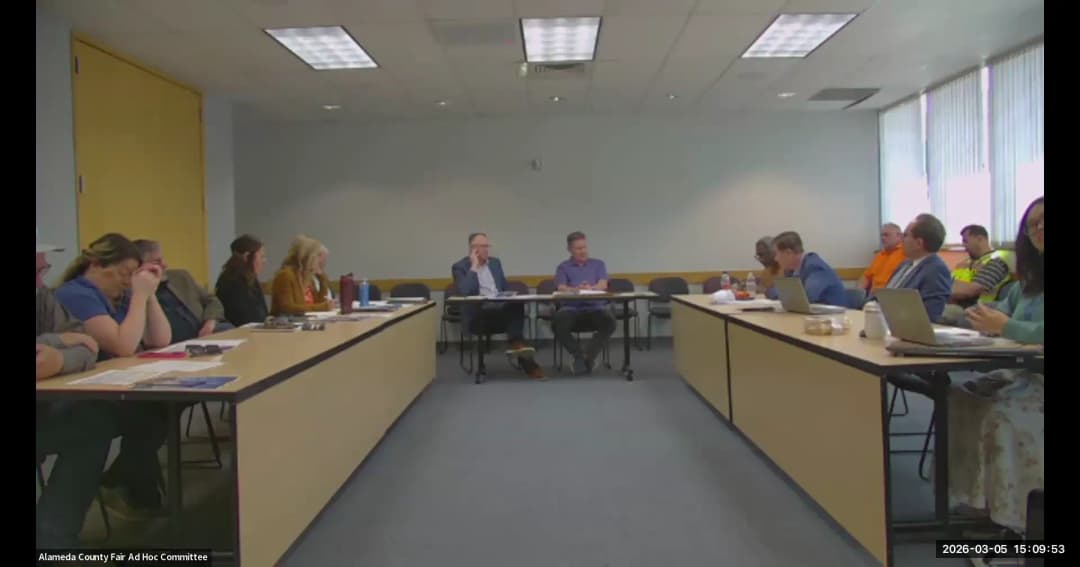
The meeting, held on March 6, 2026, covered updates on capital improvements, marketing plans, horse racing, stormwater compliance, and economic impact. Key discussions centered on the absence of horse racing for the 2026 fair, with public commenters expressing disappointment and a supervisor questioning the board's decision not to apply for race dates. The committee also reviewed a $312 million economic impact report and received over 60 industry awards. Public Comments & Testimony - Anthony Cordova: Expressed that the BPR partnership was derailed by minor issues and that the board should have pursued race dates despite disagreements. - George Smith (BPR): Argued that the executive committee meeting was closed session, that the board had already decided against horse racing (as evidenced by brochures and website), and that the requirements for 2027 are unattainable. He also stated that a joint powers authority could handle purse accounts and that the three-million-dollar line of credit was a cash flow issue. - Gloria Haley: Supported horse racing, citing its historical and economic importance to the community, and noted that the fair's success without racing was not evident from empty parking lots. - Donald Smith: Questioned the denial of horse racing after the racing committee recommended it, alleging a monopoly by Southern California interests. - Chelsea Langan: Criticized the board's lack of transparency and community engagement, noting that attendance appeared low during the fair and that local businesses suffered without horse racing. - Maureen Morley (Pleasanton resident): Requested proactive engagement with residents regarding changes in fairgrounds use, particularly the replacement of horse racing with action sports (monster trucks, demolition derbies, tractor pulls) which caused unacceptable noise. Discussion Items 1. Land Surplus Act Informational - Staff reported ongoing evaluation of options and initial conversations with GSA and county counsel. Timeline expected within six months. No public comment. 2. 2026 Capital Improvement and Marketing Plan Update - Capital Projects: Highlighted active projects: RV Adobe Building Clubhouse (remodel, 105% budget spent, 40% complete), RV campground restroom/laundry (A&E), grandstand staircase (repair), sheriff's lot asphalt (A&E), audio phase 7 (install before fair), Amador Pavilion wash racks (under construction), grandstand plaza (A&E), wine courtyard plaza (A&E), roadway 12 (A&E). Grandstand shade structure is a separate $400k project. - Marketing Plan: Celebrating 250th anniversary of the U.S. with special decor, contests, and a time capsule to be opened at the 300th anniversary in 2076. Fourth of July fireworks returning. Sensory morning on July 8 (quiet hour). 9/11 memorial: a steel beam from the Twin Towers on loan from May 21 through the fair, escorted by law enforcement. Concert lineup includes Flow Rida, Tower of Power, K-pop group, Banda MS, Gene Simmons band, and more. Grandstand programming: demolition derby (Hayward Fire Dept.), monster trucks, arena cross, tractor pulls (two shows), silent disco. - Budget Concerns: Supervisor Miley questioned cost overruns on projects (e.g., RV Adobe at 105% budget but only 40% complete). Staff said overruns are handled at the building and grounds committee and reported to the board. 3. Horse Racing Update - Timeline: December 12, 2025: letter from county counsel. December 24: MOU sent to BPR. January 6: unscheduled meeting. January 12: letter from association counsel to county counsel; no response. January 14: CHRB denied BPR's request for dates, requiring the fair to apply directly. January 28: Racing committee voted 5-2 to recommend full board direct CEO to propose 2026 race dates. February 4: BPR submitted business plan. February 5: email from George Schmidt citing errors. February 10: Executive committee approved 6-2 to recommend pursuing 2027 dates with conditions (full financial guarantee, legal authority, etc.). February 17: Full board meeting – executive committee motion passed 11-4-1; racing committee motion failed 13-3. February 26: CHRB denied Tahoe and Humboldt dates; fair did not apply for 2026. - Dispute: Supervisor Miley expressed disappointment that the board did not apply for 2026 dates, calling it a breach of contract. The association maintained they had fulfilled obligations and that the board's decision was based on financial risk. The county's contract includes a dispute resolution process (letter, 30-day response, ad hoc committee, mediation). 4. Stormwater Compliance - Staff reported waiting for lab results from recent rain. Amador Pavilion wash rack under construction. $500,000 budgeted for filtration systems and potential construction. George Smith noted an unrecorded drain diverting water to a city retention pond, which could simplify compliance. 5. Building B Replacement - Building B (1940s, not ADA compliant, not seismically safe) is proposed for replacement with a duplicate of Building A (cost estimate $18-19 million). The building is needed for essential services (law enforcement, fire, hospital) during emergencies. Staff are seeking grant funding and county partnership. 6. Economic Impact Report - Annual economic impact of the fairgrounds: $312 million total local impact, $14.3 million in sales tax, $186,000 in hotel tax, $14.5 million fiscal impact, 1,979 ongoing jobs, $104.7 million in wages, 16,917 hotel room nights, 1.4 million visits per year. The fair received 60+ awards from IAEE and Western Fairs Association, including top awards for the Safeway Barn, agricultural displays, and emergency response training. Key Outcomes - No formal votes were taken during the ad hoc committee meeting (it is an informational and discussion body). - Horse Racing: The board did not apply for 2026 dates; the dispute remains unresolved. Supervisor Miley suggested clarifying the contract language regarding the association's obligation to apply for race dates. The May meeting will include discussion of the contract extension and operating agreement. - Building B Replacement: Staff will continue to seek funding; the item remains on the vision plan. - Annual Meeting Schedule: The committee will set a schedule at the May meeting; the next meeting is planned for May 2026. - Public Comment: The committee acknowledged resident concerns about noise from action sports and committed to proactive engagement at the May meeting.