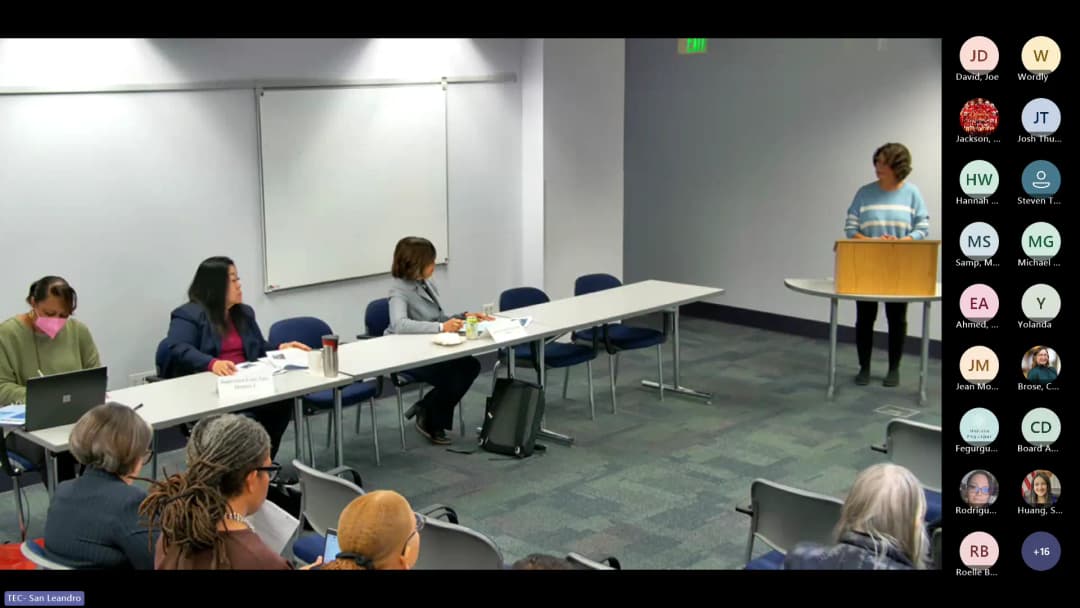
The Board of Supervisors met on March 5, 2026, at 10 a.m. for a planning meeting. The meeting included approval of minutes, a closed session, continuation of a conditional use permit, adoption of the 2025 General Plan and Housing Element Annual Reports, and a reconsideration hearing on code enforcement violations at 2550 Uvis Court. The board voted on several items, with one item continued to April 16, 2026. Consent Calendar - Approval of Minutes: Minutes from the February 10, 2026, planning meeting were approved unanimously (3-0, with Supervisors Marquez and Tam excused). - Item 3 – Cost Abatement Liens: Approved record of cost abatement and authorization for assessment liens on properties in violation of abatement orders under the Neighborhood Preservation Ordinance. Passed 3-0 (Tam excused). Public Comments & Testimony - On Item 4 (General Plan/Housing Element): One public commenter criticized the county's progress toward RHNA goals, noting that only 15% of the required units had been permitted with about 30% of the planning cycle elapsed, and expressed concern about vague reporting. - On Items 5 & 6 (2550 Uvis Court Violations): Multiple speakers testified. Supporters of the county's enforcement action included Chuck Meadows, his wife Lucy Liu, and neighbors who claimed to have witnessed illegal dumping of soil and debris. Opponents, including neighbors and the appellant's attorney, argued that the allegations were part of a neighbor dispute, that the county's evidence was flawed, and that the property owner had been harassed by Mr. Meadows. Several speakers described Mr. Meadows as a bully who uses the county to target neighbors. Two geotechnical engineers testified: one (Dan Dykman, for the appellant) said the slope was stable; another (Craig Hall, for the county) said it was unstable and needed mitigation. Discussion Items - Item 7 – Mosaic Project Conditional Use Permit: Supervisor Marquez requested to continue the item to the next planning meeting on April 16, 2026, citing receipt of extensive materials the day before and the absence of Supervisor Tam. The board granted the continuance. - Item 4 – 2025 General Plan and Housing Element Annual Reports: Staff presented the annual reports, noting that 107 housing units were permitted in 2025 (94 ADUs, 11 single-family homes, 1 duplex). The county has permitted 718 units during the current housing element cycle, meeting 15% of the RHNA target. The board discussed ADU production, mobile home park protections, and the status of tenant protection ordinances. Supervisor Miley criticized RHNA as a "joke" but acknowledged the report's necessity. The resolution approving the reports was adopted unanimously. - Items 5 & 6 – Reconsideration of Appeal for 2550 Uvis Court: The board considered a reconsideration of its November 13, 2025, decision on violations of the Soil Importing Ordinance and Neighborhood Preservation Ordinance. Staff presented evidence of soil importation and debris on the property. The appellant (Uvis Court LLC) argued that the soil came from an adjacent lot and that the county's investigation was inadequate. The complainant (Chuck Meadows) and the county's engineer testified that the slope was unstable and contained debris. After hearing public testimony and deliberation, the board voted to uphold the West County Board of Zoning Adjustments' decision, finding violations of both ordinances and requiring abatement. Key Outcomes - Item 7 Continued: The Mosaic Project conditional use permit was continued to the April 16, 2026, planning meeting at 10 a.m. - Item 4 Approved: Resolution approving the 2025 General Plan Annual Report and Housing Element Annual Report passed unanimously (3-0, Tam excused). - Items 5 & 6 – Motion Passed: Supervisor Miley moved to uphold the West County BZA decision, deny the appeal, and require the property owner to conduct investigation, testing, and abatement. The motion passed 3-0 (Supervisors Marquez, Miley, Fortunato Bas, and President Haubert voting aye; Tam excused). - No Reportable Closed Session Action: The board noted that no reportable action was taken in closed session.
Public Meetings - Alameda County, California
Public Meetings - Alameda County, CaliforniaThe Fairview Municipal Advisory Council (MAC) met on March 4, 2026, at 2:00 PM to discuss a presentation from the East Bay Regional Park District, consider a proposed fireworks and social host ordinance, and address routine business. The meeting included public comments on various local issues and a unanimous vote to recommend the fireworks ordinance to the Board of Supervisors. Consent Calendar - Approval of Minutes (February 3, 2026): Councilmember Higgins noted that his comments regarding the six-cycle housing element were not included in the draft minutes. Staff explained that future minutes will be action-only, with the video serving as the transcript. The minutes were approved unanimously (5-0). Public Comments & Testimony - Rolando Gonzalez (East Bay MUD Community Affairs Representative): Announced that residents may receive letters from SLWA Insurance Services offering optional exterior water service line coverage. He clarified that the program is optional, no customer data was shared, and East Bay MUD receives a brand fee to support its Customer Assistance Program (CAP). - Jennifer Pabst (CHP Officer): Reported on February enforcement: 10 traffic citations, 4 non-injury crashes, no stolen vehicles. Noted ongoing issues at Fairview/Oaks (stop sign running) and Fairview Elementary School (drop-off/pickup traffic). Mentioned that speed bumps on D Street have helped. Upcoming enforcement period on April 28-29 focusing on speed. Six new officers reported to Hayward in February, with 12 more in April. - Bruce King (Friends of San Lorenzo Creek): Raised concerns about Don Castro Reservoir: heavy siltation, lack of fish stocking, illegal fishing downstream, and the failed June 2025 flood control measure. Urged East Bay Regional Park District to use its influence on flood control issues and support the planned San Lorenzo Creekway connector. - Dale Silva (Fairview Resident): Complimented Director Waspey for representing the area and urged progress on the Llama Lane trail, which was planned to open in 2024 but remains delayed. He encouraged the MAC to advocate for trail completion. - Mimi Dean (Save Sky West): Promoted the preservation of Sky West, a 126-acre former golf course in Hayward, citing its importance as habitat for Western Pond Turtles and monarch butterflies (ranked 4 in California). She emphasized its flat terrain and accessibility for people of all abilities and its role in climate resiliency. - Dale Silva (on Fireworks Ordinance): Expressed strong support for the proposed ordinance, thanking Sgt. Imperial, Supervisor Miley's office, and community advocates. He highlighted the value of the evidence provision that allows residents to submit photographic/video evidence and statements. - Vanya Taylor (Phone): Asked about anonymous reporting methods and whether people who drive into Fairview to set off fireworks can be cited. Sgt. Imperial responded that calling dispatch is the best way to report in real time, and that license plates can lead to investigations. - Brenda (Phone): Noted that safe-and-sane fireworks have been illegal in Fairview for 40 years but lacked enforcement. She stated that surrounding jurisdictions already have similar ordinances and urged adoption. - Fran Krug (Phone): Thanked the Sheriff's Department and Sgt. Imperial for their work, emphasizing that the ordinance is needed to address ongoing fireworks issues. Discussion Items - East Bay Regional Park District Update - Director Dennis Waspey (Ward 3) presented the district's plans, covering 73 parks, 126,000 acres, 55 miles of shoreline, and over 30 million annual visits. He discussed the new District Plan (master plan update), balancing recreation and preservation, climate resiliency, wildfire protection, and efforts to increase community access and equity. - Questions from the MAC focused on: Don Castro Reservoir fishing and siltation (Waspey explained that dredging is prohibitively expensive and complicated by environmental regulations), the Llama Lane trail (design wrapping up, construction expected in late 2026 with public opening in spring/summer 2027), eucalyptus abatement and wildfire risk (mentioned a $5 million goat grazing contract and carbonizer technology for biochar), and visitation tracking (no per-park breakdown, but overall visits estimated at 30 million). - Fireworks and Social Host Ordinance (Action Item) - Sgt. Kurt Imperial presented the proposed ordinance, which would ban all fireworks in unincorporated Alameda County and establish a civil penalty structure. Fines: $750 for first violation, $1,500 for second, $2,500 for third or subsequent. Enforcement would rely on observe-and-report techniques, video evidence, and property owner liability (social host). The appeals process goes through the Board of Zoning Adjustment and then the Board of Supervisors. - Timeline: Presentations to other MACs through March, Unincorporated Services Committee on March 25, Board of Supervisors consideration in April-May, potential enactment by June before July 4th. - The MAC discussed public education (PSAs, media), anonymous reporting (dispatch), and enforcement plans (patrol training, use of body cameras and county-issued phones). - Motion to recommend adoption to the Board of Supervisors passed unanimously (5-0). Key Outcomes - Minutes Approved: February 3, 2026, minutes approved with understanding that future minutes will be action-only. - Fireworks Ordinance Recommendation: The MAC voted 5-0 to recommend that the Board of Supervisors adopt the proposed draft ordinance. Next steps include presentations at the remaining MAC meeting (Castro Valley on March 16) and the Unincorporated Services Committee on March 25, followed by full Board consideration in April-May. - Community Concerns Referred: Issues raised but not on the agenda (D Street speed bumps lacking striping, trash accumulation on Windfelt, traffic enforcement at Fairview Elementary School, and 2nd Street speeding) will be referred to public works and the Sheriff's Office for follow-up. - Upcoming Events: CHP Start Smart class for young drivers on March 31; maximum enforcement period April 28-29; Veterans Day celebration on November 8 at Lone Tree Cemetery.
The Alameda County Board of Supervisors held its regularly scheduled meeting on Tuesday, March 3, 2026, beginning at 9:30 AM and concluding after 5:00 PM. The meeting included opening remarks from supervisors, approval of a consent calendar, extensive public comment, a continued public hearing on the Alameda Health System (AHS) budget reductions (the Belinson hearing), and several appointments and reports. Key actions included approval of $53 million in Measure W funding for affordable housing, deferral of AHS layoffs, and creation of an ad hoc committee to address AHS's structural deficit. Remarks & Reports from Supervisors - Supervisor Tam reported on February events: the third annual African American Recognition Awards, a Lunar New Year celebration at Lincoln Square Recreation Center, a sold-out screening of "The Apology" about the dismantling of Russell City, and the fourth annual Oakland Chinatown Lunar New Year parade. The Russell City Redress Fund has reached $1.3 million. - Supervisor Marquez highlighted participation in Lunar New Year events, a Black History Month listening session with the Reparations Commission, a visit from Governor Gavin Newsom to the Fremont Library to launch a connectivity initiative, and a Care Court event in Hayward praising Alameda County's progress. - Supervisor Fortunato Bass noted support for the Fair Chance Housing ordinance, reminded of the March 5th Alameda County Together for All meeting, and congratulated retirees from Firefighters Local 55. She also announced a proclamation for figure skater Alyssa Liu and the 100th anniversary of the Grand Lake Theater. - Supervisor Miley requested a work session in April on the pediatric portion of Measure C, citing controversy over funding for Children's Hospital Oakland. He also disclosed his attendance at the National Association of Counties meeting in Washington, D.C. Consent Calendar - The board approved a mass motion covering items 1–47, with items 28 and 29 pulled for separate votes. Item 38 was withdrawn at the department's request. The motion passed 5-0. Public Comments & Testimony - Parent Voices Oakland (four speakers, including Keila Moore) urged that any Measure C funds for pediatric care be spent exclusively in Oakland, not San Francisco. They called for audits, construction upgrades, and staff input. Supervisor Miley noted that a work session on Measure C is planned for April. - City of Oakland (Faye Darmawi, Deputy Director of Housing and Community Development) thanked the county for Measure W funding and requested future allocations reflect Oakland's 60% share of the county's homeless population. She noted 800 affordable units under construction and 600 more planned. - Eden Housing (Vasco Yorgov, Diego Castro) and Sahar (Nan Mai) expressed gratitude for Measure W awards, highlighting projects like Downtown Livermore Apartments (130 units, 33 PSH) and Brighter Bancroft (91 senior units, 25 PSH). Eden Housing noted the Livermore project faced litigation starting in 2021. - EBRA (Emma) proposed a vacancy activation program to repair existing units quickly, complementing new development. - Public comment on items not on the agenda (later in meeting): - Glenn Kirby and Mark Egonoff opposed an informal RFP to amend Measure D (Agriculture and Open Space Initiative), arguing it would overturn voter intent. They requested the process be made public and the RFP withdrawn. - Jane Kramer suggested the health department create a public education program on nutrition and food choices, and questioned police-community trust. - Venus Gist updated on probate court reform, announcing monthly town halls and cases of concern (Kia Jandeyi, Gums family). Discussion Items - Measure W Funding (Item 19): The board discussed awarding $53 million to 10 projects creating 950 affordable units, including 310 for people experiencing homelessness. Staff noted 85–90 projects in the pipeline and that future RFPs would focus on acquisition/rehab. Supervisors emphasized transparency, accurate public communication, and integrating Fair Chance Housing policies. Staff confirmed that once a countywide Fair Chance ordinance is adopted, it can be included in loan documents. - Illegal Dumping (Item 15): Supervisor Miley spoke about the fifth annual statewide illegal dumping conference (April 30–May 1 in Oakland), which he initiated. The conference uses the three E's: education, eradication, enforcement. A model ordinance is being developed, and state legislation is being pursued. - Appointments (Items 28 & 29): The board unanimously approved: - Cynthia Cornejo as acting Registrar of Voters, effective March 29, 2026, at $8,867.20 bi-weekly. - Andrea Weddle as interim County Counsel, effective March 29, 2026, at $15,985.60 bi-weekly. Both fill vacancies created by retirements (Tim Dupuis and Donna Ziegler). - Belinson Hearing (Continued): The board continued deliberation on AHS's proposed reductions. The county administrator reported that AHS is exploring deferring the March 9 layoff date and identifying non-patient-facing positions for cuts. The board heard from AHS CEO James Jackson, who acknowledged the need for better collaboration and committed to a special board meeting the next day to discuss deferral. Key Outcomes - Mass Motion Passed 5-0 approving the consent calendar (minus items 28, 29, 38). - Item 28 Approved 5-0: Appointment of Cynthia Cornejo as acting Registrar of Voters. - Item 29 Approved 5-0: Appointment of Andrea Weddle as interim County Counsel. - Belinson Hearing Actions: - The board voted 5-0 to close the public hearing. - Approved a motion by Supervisor Miley (seconded by Fortunato Bass) that: 1. Concurs with AHS's direction to defer March 9, 2026 layoffs and identify alternative non-patient-facing reductions. 2. Directs the county administrator, auditor, and AHS interim director to continue working on options (behavioral health contract payments, line of credit, IOP program models). 3. Schedules a report back on March 17, 2026. 4. Designates an ad hoc committee (Supervisors Miley and Bass) to interface with stakeholders, including AHS leadership and labor, to address AHS's fiscal imbalance. - Approved item 48B 5-0, designating AHS to provide a 24-hour information service and receive complaints under Health and Safety Code sections 1440–1498. - Closed Session Report: The board authorized (5-0) the county to sign amicus briefs supporting Governor Newsom in Newsom v. Trump (Ninth Circuit). Also, a settlement of $120,000 plus waiver of $4,800 in sanctions was approved in Jose Mejia Valle v. County of Alameda (consolidated with Norma Marino Lopez v. County of Alameda). - Adjournment: The meeting was adjourned in memory of Betty Reed Soskin (age 104, historian and activist) and Dorothy "Puffy" Moring (San Lorenzo community volunteer).
Note: The meeting transcript identifies the date as February 26, 2026, but the provided metadata specifies March 3, 2026. This summary follows the metadata date. The Unincorporated Services Committee, chaired by Supervisor Miley and including Supervisor Tam, met to review the unincorporated area budget, behavioral health services, tenant protections, and a proposed inclusionary zoning and ministerial review policy. The meeting featured extensive public testimony, with calls for greater transparency, community input, and preservation of prevention programs. Public Comments & Testimony - Non‑agendized items: Two speakers addressed unrelated issues. One called for county enforcement against an illegal food vendor on Hesperian Boulevard, alleging repeated violations with no penalty. Another requested county assistance for a family displaced by a gas explosion on Meekland Avenue; Supervisor Miley’s office promised follow‑up. - Budget Overview: Multiple speakers (Warren Cushman, Dave Thompson, Juliana Weiser Leon, Anna Raschizon, Charles Pisano, Sandra, Oscar Gonzalez, Delilah, Aidan, Carlos Sandoval, Ashley Acosta, Matias, Tun Wynn, Raimundo, Santos, David, Taylor, Jesus Romero, and others) expressed appreciation for the increased detail in the budget book but urged a formal, ongoing community input process. Many emphasized that unincorporated residents deserve a meaningful voice in budget decisions, especially given reduced funds and a compressed timeline. Several youth leaders from SLAM requested that prevention funding be protected and that grants be released through open RFPs. - Behavioral Health: Public comment focused on the impact of Proposition 1 cuts. Youth leaders from SLAM (Oscar, Jesus, Delilah, Matias, Santos, Ashley, Carlos, Aidan, Isabel, and others) asked the county to preserve prevention programs, partner with SLAM, and ensure funding opportunities are transparent. Juliana (Eden Church) and Maria Miranda (My Eden Voice) described the value of peer‑to‑peer services and family cafes in the unincorporated area. Warren Cushman urged collaboration given the difficult budget landscape. - Tenant Protections: Warren Cushman called for inclusive stakeholder engagement. Jennifer Rizzo (California Apartment Association) noted that 93% of eviction notices were for non‑payment of rent and that mediation had a 94% resolution rate. David Stark (Bay East Association of Realtors) questioned the need for new ordinances given economic headwinds. Kristen Hackett (My Eden Voice) reported challenges with the mediation program and requested a housing counselor. Dirk Barnes (East Bay Rental Housing Association) praised the Housing Provider Resource Center and suggested an eviction diversion program. Rove Antonio (CAA) cautioned against using theoretical models for eviction trends. Lindsay (member of the public) asked for stronger just‑cause protections, rental registry, and expanded relocation assistance. David Garges (property owner) warned that overregulation could drive small landlords out of the market. - Inclusionary Zoning: Warren Cushman expressed support for the planned process and emphasized early stakeholder dialogue. Discussion Items - Unincorporated Area Budget Overview (Melanie, CAO’s office): - Presented an accelerated budget timeline for FY 26‑27, with the proposed balanced budget to be presented to the Board in late May (instead of early June). - Highlighted economic challenges: median home price in Alameda County at $1.12 million, home sales down 40% from December, foreclosure filings up 32% nationally. - State and federal uncertainties: California projects a $2.9 billion shortfall for FY 25‑26 and a $22 billion deficit for FY 27‑28. Federal policy changes may impact Medi‑Cal and safety‑net programs. - The FY 25‑26 unincorporated services budget totals $385 million for direct municipal services (Public Works, Fire, Sheriff, CDA, Library). - Ongoing research: a landscape analysis of management models in comparable urban counties is being conducted with a UC Berkeley graduate student. - Supervisor Miley noted that the county faces a $3.2 billion deficit in the next few years and urged caution on discretionary spending. He and Supervisor Tam supported a “road show” of budget presentations to the Municipal Advisory Councils (MACs) to gather community input. - Public speakers overwhelmingly supported the transparency improvements but called for deeper community engagement and a formal input process. - Behavioral Health Update (Dr. Karen Tribble, Director; Stephanie Montgomery, Kathy Powell): - The department oversees an $832 million budget, with $540 million contracted to community providers. - Proposition 1 (Behavioral Health Services Act) shifts funding from prevention to severe mental illness and substance use, reducing the county’s MHSA allocation from $206 million to $127.5 million. This will require $52.8 million in program cuts, with a remaining $22 million gap (plus an additional $6 million shortfall). - The My Eden Voice Community Wellness Committee proposal for $60,000 in prevention funding cannot be funded under the new rules, but the department offered alternative collaboration: use existing language access services, co‑location spaces, and opioid settlement funds ($80 million total, $31.7 million received to date) for prevention‑aligned activities. - The department committed to exploring third‑space supports and a potential Eden Mental Health Task Force. - Public speakers, especially SLAM youth, urged the county to preserve prevention efforts and partner with coalitions like SLAM. They noted that SLAM is federally funded and conducts youth substance use needs assessments and monthly art socials. - Tenant Protection Update (Michelle, Jennifer – CDA): - Since March 2025, 153 eviction notices were received; 93% were for non‑payment of rent. Only 62 unlawful detainer actions were filed in court, but informal evictions are estimated to be 5.5 times higher than court evictions, suggesting possible non‑compliance. - The mediation program (launched November 2024) handled 21 cases, with 8 fully resolved and 2 partially resolved. A separate courthouse‑based mediation program had a 99% success rate but is currently unfunded. - Upcoming ordinances: Fair Chance Housing (target summer 2026), Rental Registry (spring 2026), Proactive Rental Inspection Pilot (spring/summer 2026), and Landlord‑Tenant Relations Ordinance (fall 2026). - Measure W funds ($1.2 million for unincorporated tenant‑landlord programs) will support continuation of the Housing Provider Resource Center ($150,000), My Eden Voice outreach ($150,000), and a minor home repair program ($200,000). - Supervisor Miley expressed support for emergency rental assistance and stressed the need for collaboration between landlords and tenants. He remained opposed to extending just‑cause to single‑family homes unless a rental registry shows abuse. - Inclusionary Zoning & Ministerial Review (Angelica Gonzalez, Olivia Ortiz – CDA Planning): - This is an initial informational presentation on the Affordable Housing Production (AHP) policies, part of the transit‑oriented communities (TOC) compliance. - 75% of Bay Area jurisdictions (82 of 109) have inclusionary zoning policies. Unincorporated Alameda County currently does not. - The policy would require a percentage of affordable units in new market‑rate developments, with alternative compliance (e.g., in‑lieu fees). Ministerial review (streamlined approval) would be offered to projects exceeding the affordability requirements. - Timeline: public meetings now through April 2026; feasibility study and ordinance drafts in late 2026‑early 2027; adoption target by July 1, 2027. - Public feedback from MACs and Planning Commission showed general support but concerns about reducing development and limited public involvement in ministerial review. An ad‑hoc MAC subcommittee of seven members will guide the process. - Supervisor Tam noted the challenging market conditions and asked how the policy would avoid impeding development. Staff responded that the feasibility study will consider phasing and future amendments. Supervisor Miley expressed hope for moving the timeline forward and asked for data on other jurisdictions’ ministerial review experiences. Key Outcomes - The committee received the budget overview and behavioral health update without formal votes. - The CAO’s office will conduct a MAC road show in April/May 2026 to present the proposed budget and gather community input. - Behavioral Health will continue to collaborate with My Eden Voice and explore alternative funding sources (e.g., opioid settlement) for prevention‑style programs. - CDA will proceed with stakeholder engagement for the upcoming tenant protection ordinances, including a rental registry and proactive rental inspection pilot. - The inclusionary zoning and ministerial review process will move forward with the ad‑hoc MAC subcommittee, a community meeting on April 29, 2026, and ongoing consultant work. The committee did not take a vote but endorsed continued development of the policy.
The committee heard updates on federal and state legislation, considered several legislative position requests, and received public comments. The meeting included reports on the Iran war powers resolution, Department of Homeland Security funding, housing bills, the farm bill, state-level advocacy, and a gubernatorial race poll. All five proposed legislative positions were approved unanimously. Discussion Items - Federal Updates: Staff provided updates on the bipartisan war powers resolution to limit U.S. military operations in Iran without congressional approval, noting that the Senate could vote as early as March 3 and the House on March 5. The Department of Homeland Security remains in a partial shutdown due to lack of FY26 appropriations; TSA and other personnel may miss paychecks that week. Housing negotiations continued between the House and Senate, with a possible procedural vote that evening. The House farm bill markup was postponed to March 4-5, with uncertain floor prospects due to opposition from fiscal conservatives and Democrats over SNAP cuts. - State Legislation Update (Full Money Strategies): Attorney General Bonta secured a second court order blocking the Trump administration's SNAP data demands. The state also filed a lawsuit against federal vaccine policy changes. Governor Newsom announced $131.8 million in Proposition 1 funds for home key-plus sites and $159 million for homeless housing assistance, naming Alameda County a “care champion.” The PPIC poll showed a competitive gubernatorial race with five leading candidates (Hilton, Porter, Bianco, Swalwell, Stire) and 10% undecided. - Legislative Position Requests: Five requests were presented and discussed: 1. Support for HR 7267/SB 3706 to authorize produce prescriptions for veterans (food as medicine). 2. Support for congressionally directed spending for mobile medical units for homeless services. 3. Support for SB 1218 (DMV registration refusal for illegal dumping violations). 4. Support for $26 million in one-time general funding for gender-affirming care due to federal destabilization. 5. Support for SB 936 (nitrous oxide container handling) and AB 1617 (household hazardous waste reporting), plus a proposal for $5.1 million to modernize landfills. Public Comments & Testimony - Kelly (on landfill items): Expressed concern about underground fires at landfills, toxic gases, and leachate affecting workers and communities. Questioned why Supervisor Haubert was not addressing the issue and why Supervisor Miley sponsored the landfill modernization item when it is not in his district. Also urged the board to protect Measure D, which limits development in the Tri-Valley, and warned against any attempt to undermine it. Key Outcomes - Votes: All five legislative position requests were approved unanimously (Supervisor Fortunata and Supervisor Tam voting aye on each motion). The motions were made by Supervisor Fortunata and seconded by Supervisor Tam, then passed by roll call with no opposition. - Next Steps: The approved positions will be forwarded to the full Board of Supervisors for consideration. Notes - The meeting date is recorded as March 3, 2026, per the official time stamp, though the transcript indicates March 2, 2026. This discrepancy is noted but not resolved.
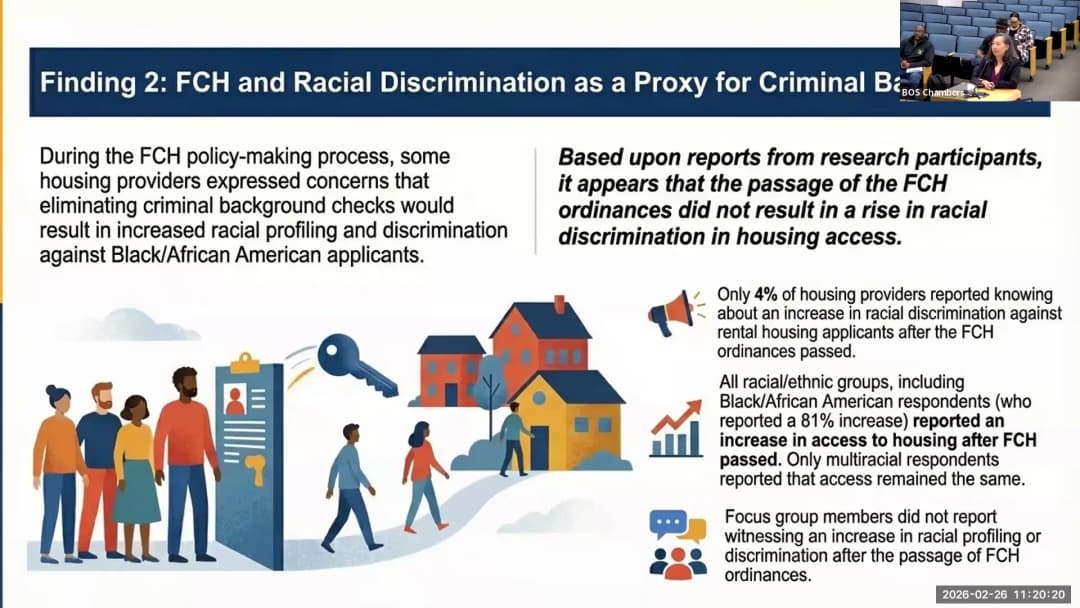
The Alameda County Board of Supervisors Public Protection Committee met on February 27, 2026, to discuss two informational items related to fair chance housing policy. The meeting focused on an update to the unincorporated fair chance ordinance and research findings from the Berkeley and Oakland Fair Chance Housing Impact Evaluation Study. Public testimony strongly supported the ordinance, with speakers sharing personal experiences and urging the county to extend provisions to housing developers receiving county funds. Committee members expressed support and discussed legal timelines, implementation, and future amendments. Public Comments & Testimony - Alex Pinegas (Just Cities) thanked the board for considering the policy but asked why the proposed ordinance would not require housing providers receiving county funds to abide by fair chance provisions, urging the county to use its contracting powers to extend coverage to incorporated areas. - John Jones III (Urban Strategies Council, Justice Reinvestment Coalition) thanked staff and echoed the call to apply the ordinance to county-funded housing, emphasizing the impact on families and children. He shared personal experiences of housing discrimination after incarceration. - Marco Duncan (Legal Services for Prisoners with Children) supported the policy and noted that developers receiving state money should not exclude formerly incarcerated people. - Takwa Bonner (All of Us or None) shared his personal story of homelessness after 30 years in prison and how Oakland's Fair Chance Housing law allowed him to reunite with family and become a productive citizen. He asked that any developer receiving county dollars not exclude formerly incarcerated individuals. - Patricia Tuscano (Just Cities, mother) spoke about the importance of stable housing for formerly incarcerated mothers, enabling family reunification and employment. She urged the committee to extend the ordinance to all developers. - Dean Moses (Oakland resident) urged support for fair chance housing and extending it to developers accepting county funds. - Anaya (Oakland homeowner) expressed full support for fair chance housing, agreeing with prior speakers. - Tanisha Cannon (Legal Services for Prisoners with Children) attempted to comment on fair chance housing after public comment had closed; she was directed to submit written comments. Discussion Items - Item 1: Update on Unincorporated Fair Chance Ordinance – Jennifer Pierce (Assistant Director, Housing and Community Development) presented an overview of the fair chance housing policy, including the community process from 2020-2022 (19 stakeholder meetings, 9 public hearings), the impact of the Yim v. Seattle lawsuit on the ordinance's drafting, and the current status: staff is revising the ordinance with County Counsel to ensure compliance with court rulings. The committee discussed the timeline: the ordinance will first go to the Unincorporated Services Committee (which meets monthly), then to the full Board. Supervisor Miley inquired about the legislative process (first reading, second reading, effective date) and whether the ordinance could apply to county-funded housing projects outside unincorporated areas. He recommended not delaying the core ordinance to explore legal options for expanding scope, and suggested considering incentive mechanisms if regulatory expansion is not feasible. Supervisor Marquez concurred. - Item 2: Research Findings from Berkeley and Oakland Fair Chance Housing Impact Evaluation Study – Margareta Lynn (Principal Investigator, UC Berkeley Institute of Urban and Regional Development) presented the study, which used surveys of 207 formerly incarcerated people and housing providers in Berkeley and Oakland, plus focus groups. Key findings: housing access increased across racial groups (81% increase for Black/African American respondents), income levels, and gender (male access reached parity with female). Compliance was higher in Berkeley (95%) than Oakland (77%); the lowest compliance (59%) was among providers of larger buildings. No evidence of increased public safety issues or racial discrimination; 36% of providers increased tenant screening requirements but attributed it to COVID eviction moratoriums, not fair chance laws. The study concluded that fair chance housing reduces housing barriers but does not solve all reentry challenges; additional resources (e.g., from AB 109) are needed. Supervisor Miley noted the ordinance would not allow landlords to ask about criminal history on applications (per First Amendment ruling) but they cannot use it to deny housing. He requested data tracking for unincorporated areas. Supervisor Marquez committed to close tracking and expanding provisions where possible. Key Outcomes - The committee received the informational presentations without formal votes. - Staff will continue revising the unincorporated fair chance ordinance, aiming for presentation to the Unincorporated Services Committee in the spring/summer, followed by Board adoption (two readings). - Supervisor Miley directed staff to examine legal options for applying the ordinance to housing projects funded by county dollars, including potential incentive mechanisms, and to provide legal analysis on scope. - The committee expressed intent to track implementation data in unincorporated areas and to consider future amendments to expand the ordinance countywide. - Public testimony strongly supported the ordinance, and the committee acknowledged the need for additional reentry housing resources beyond fair chance policies.
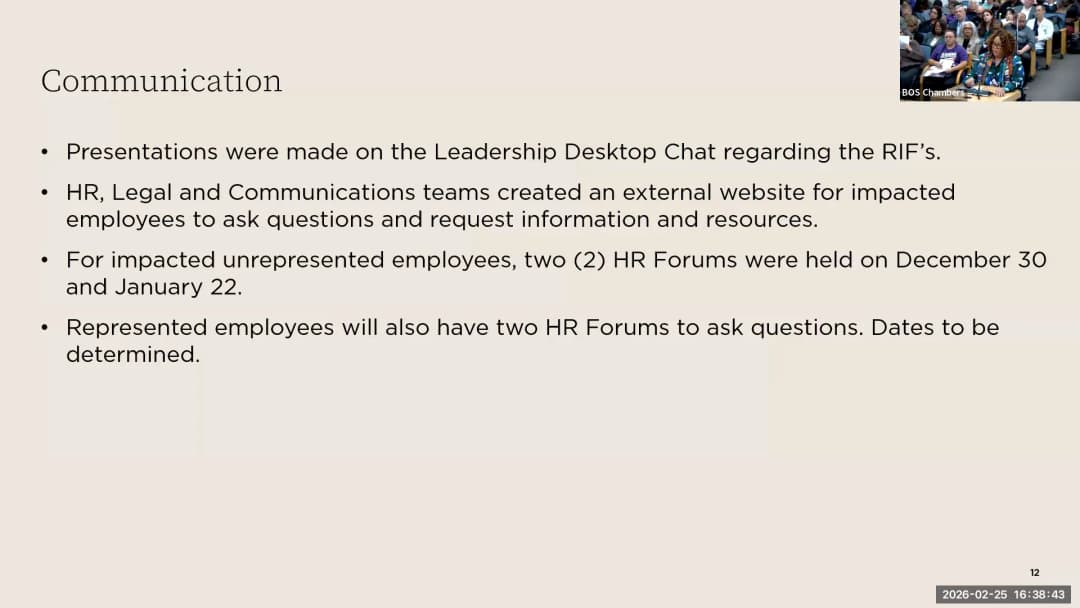
On February 25, 2026, the Alameda County Board of Supervisors convened a public hearing under the Beilinson Act (Health and Safety Code 1442.5) to consider the Alameda Health System's (AHS) proposed reductions in workforce and medical services. The hearing featured presentations from AHS leadership, a response from SEIU 1021, extensive public testimony from over 115 speakers, and board member questions. The board ultimately voted to close public comment and continue deliberations to March 3, 2026, with Supervisor Miley telegraphing a potential $10 million county contribution and the formation of a working group to explore alternatives. Public Comments & Testimony - SEIU 1021 Presentation (Peter Maziac & Maria Bettencourt): The union argued that AHS has not sufficiently engaged with frontline workers or physicians, that the rationale for layoffs has shifted (initially citing HR1 cuts but later claiming overstaffing), and that AHS has not pursued $29 million in union-identified cost-saving ideas. They criticized the timing of executive bonuses and stated that proposed closures, especially of outpatient behavioral health programs, will shift costs to emergency services, jails, and other county agencies, ultimately costing more. They also highlighted that no actual HR1 cuts have taken effect this fiscal year and that federal delays in DSH and MCO tax cuts have created additional financial breathing room that AHS has not acknowledged. - Physician Representatives (Dr. Benny Liu, Dr. Caitlin Bailey, Dr. Allen, and others): Multiple physicians read a letter signed by 332 clinicians expressing profound opposition to the cuts, citing lack of clinical input, systemic mismanagement, and risks to trauma center certification, cardiac care, birthing services, and other critical services. They stated that AHS systematically under-codes and under-bills, and that cuts will not save money but will increase costs elsewhere. Specific concerns included anesthesia shortages, vascular surgery coverage gaps, and the impact of phlebotomy and lab assistant cuts on blood culture contamination rates and emergency care. - Public Speakers (116 registered, many patients and staff): Over three hours of public comment, alternating between in-person and remote speakers, with most speakers opposing the cuts. Clients of the Fairmont and Highland outpatient behavioral health programs described the programs as life-saving and essential for maintaining stability, preventing hospitalization, homelessness, and incarceration. Staff from multiple departments (lab, dietary, environmental services, nursing, therapy) warned that cuts to already understaffed units will degrade patient safety, increase errors, and lead to burnout. Several speakers noted that AHS management gave inconsistent numbers and that the proposed alternatives (e.g., 211, Fremont Hospital, Herrick) are inadequate for the chronic, severely mentally ill patients served by AHS. A few community members and advocates urged the board to consider systemic solutions such as the Billionaire Tax Act and to hold AHS executive leadership accountable. Discussion Items - County Administrator Introduction: Presented the two recommendations: 1) conduct the public hearing, and 2) designate AHS to provide 24-hour information service. Noted that the county allocates approximately $134 million to AHS ($83M for behavioral care, $44M for indigent care, $7M for other services). - AHS Financial Update (CFO Kim Miranda): Reported year-to-date financials: breakeven of $700K vs. budgeted $9.5M deficit, but January showed an $11.5M loss. Revenue is ahead of budget, but expenses are $13.2M unfavorable due to higher labor costs and FTE counts (5,207 paid FTEs, 74 over budget). The line of credit is at $80M, projected to max at $95M by June 30, and to exceed the limit by $60M in September 2026. The CFO attributed pressures to the $42M AB 85 realignment payback, reduced John George funding, and high inflation without matching government fee increases. - Reduction in Force Overview (CHRO Jet Chapman): The initial 372 positions targeted were reduced to 211 after voluntary resignation (31) and retirement (43) programs. Impact bargaining with unions continues. Notified unrepresented employees on Dec 19, represented on Jan 6. Effective separation date is March 9, 2026. - Service Closures/Reductions (COO Mark Fratsky & Department Heads): - Fairmont Cafeteria Closure (Rosie Rojas): Saves $176,000/year; low customer volume; 2.7 FTEs impacted. - Telesitter Program Suspension (Dana Littlepage): Saves $395,000/year; did not reduce physical sitter costs ($3.17M annually); 42% utilization. - Health Advocates Program Closure (Lily McRae): Saves $890,000/year; 6.5 FTEs; services include connecting patients to social resources (housing, food, legal). Alternatives said to be 211 and internal resources. - Complex Care Management Reduction (Lily McRae): Saves $1.2M/year; 6.6 FTEs; reduces capacity for high-need patients with SMI, homelessness, etc. - Plastic Surgery Reduction (Dr. Lisa Laurent): Reduces from 1.4 to 0.6 FTE, saving $350,000; maintains trauma coverage; actual annual case volume disputed by Dr. Alan (210 cases vs. AHS's 36-40). - Behavioral Health Outpatient Services at Fairmont & Highland (Patty Esposeff): Programs lose $3.6M in operating revenue vs. $7.2M costs (excluding overhead); 175 clients served; patients with chronic SMI referred to other programs but alternatives lack capacity, transportation, interpreters, and long-term support. - Board Questions: - Supervisor Tam: Asked about patient mix (60% Medi-Cal, 92% government payers, 1.7% uninsured), transition plans for programs, and the impact of cuts on trauma center certification. Heard testimony that pre-existing understaffing will be worsened. - Supervisor Fortunato Bass: Queried timing of financial pressures relative to HR1, bonuses ($7M based on prior year performance), and response to union cost-saving ideas. AHS replied that bonuses were tied to FY 24-25 performance and that they are open to exploring ideas but have not yet implemented. - Supervisor Marquez: Asked about the rationale for adding 114 FTEs last year, vacancy rates, layoff notice process, and behavioral health patient tenure (some patients in wellness program for over 10 years). Noted additional upcoming cuts due to Prop 1 and the need for coordination with county behavioral health. - Supervisor Miley: Stressed the need for collaboration and expressed concern about the disconnect between executive decisions and frontline knowledge. He indicated he would propose $10M in county funding and a working group at the next meeting. - President Halbert: Arrived late but emphasized health care as a human right, the need to maximize revenue and streamline operations before cuts, and the importance of listening to experts and the public. Key Outcomes - Motion to Close Public Comment and Continue Deliberations: Supervisor Miley moved to close public comment and continue the matter to the Board's next regular meeting on Tuesday, March 3, 2026, at 2:00 p.m. as a set item. The motion was seconded by Supervisor Fortunato Bass and passed unanimously (4-0, with President Halbert excused and later present). - Telegraphed Proposal for March 3: Supervisor Miley indicated he will propose: 1. County contribute $10 million to AHS to curtail layoffs. 2. Formation of a working group with two supervisors, AHS representatives, and labor to collaboratively address the budget over the next two fiscal years. - Supervisor Fortunato Bass added interest in lobbying for state relief, renegotiating the net negative balance and behavioral health payment withholdings, and seeking input from Alameda County Health. - Closed Session Report: Earlier in the meeting, the board reported no action from closed session, but later corrected to state that the board authorized joining an amicus brief in Trump v. Barbara supporting birthright citizenship (4-0 vote, Halbert excused). - Continuation: The public hearing remains open for board deliberation at the next meeting; public comment is closed. The board will consider the proposals and may take action on March 3.
The Alameda County Election Commission met on February 24, 2026, at 12:00 PM. The meeting included the swearing-in of a new commissioner, elections for president and vice president, approval of minutes, public comments, updates from the Registrar of Voters (ROV), reports from ad hoc committees, and discussions on election budgeting and observation processes. Key decisions included the election of Irene Dieter as President and Commissioner Ramone as Vice President, a motion to request a written fee schedule from the ROV for the 2026 elections, and a standing recommendation for incremental improvements to alert subscribers when election processes start. Consent Calendar - Approval of Minutes: The minutes from the November 2025 meeting (pages 4–7) were approved unanimously. The minutes from the January 2026 meeting (pages 8–9) were also approved unanimously after a brief discussion about Commissioner Whitehurst's remote attendance; it was clarified that she could not count toward quorum under the Brown Act, but the minutes were approved as written. Public Comments & Testimony - Preston Jordan (Albany City Council): Commented on item 8E1 (budgeting for elections). He requested that the commission secure a binding schedule of charges from the ROV, citing a significant escalation in costs for youth voting in 2024 (from $21 per registered voter to over $150). He also noted that the surcharge for ranked-choice voting (RCV) has not been provided in advance and that printing charges for RCV ballots appeared excessive (nearly $4.50 per ballot in 2024, ten times the cost of the rest of the ballot). He urged the commission to consider the basis and justification for charges. - John Guerrero (public comment on observation): Commented on the discussion about improving customer service for election observers. He suggested that the ROV leave video cameras on 24/7, as done in San Francisco and other jurisdictions, so the public can see when processes start, stop, or are ongoing. He noted that color-coded bins help observers track the process. Announcements & Communications - Staff Announcement (Cynthia Cornejo, Acting ROV): The meeting location will change starting in March 2026 due to a conflict at the library. Future meetings will be held at the Registrar of Voters' Office, 1225 Fallon Street, Oakland (basement of the superior court building). Attendees should be aware of security screening. - Commissioner Announcements: Commissioner Henderson noted a New York Times opinion piece about California's slow election results due to the seven-day mail ballot rule. Discussion Items - Swearing-In of New Commissioner: Alexandra Jalith Metianes (Sasha) was sworn in as a commissioner. She will participate fully but does not count toward quorum as an ex-officio member. - Election of President and Vice President: President Lindsay's term expired. Commissioner Irene Dieter was nominated and elected President (unanimous). Commissioner Ramone was nominated and elected Vice President (unanimous). The new President took over the meeting. - Agenda Change: A motion to move item 8A4 (post-election assessment) to after item 8B2 (observation notifications) was approved (unanimous). - Monthly Update from ROV (Cynthia Cornejo): The ROV is preparing for the June 2, 2026 primary election. The candidate nomination period runs February 9 to March 6. About 100 filings have been received so far. The signatures-in-lieu period has concluded; signatures are worth $0.33 each toward filing fees. Filing fees for county offices are approximately 1% of annual salary (around $2,000), requiring 6,000–7,000 valid signatures to offset. Candidate statements require translation into five languages, which adds cost. The ROV also noted that city candidates file with their respective cities. - Ad Hoc Committee Reports: - Voting Participation Committee (Commissioner Seabrook): The committee has created a mission statement and is working on measurable goals. Commissioner Ritzy Hernandez was added to the committee (motion passed unanimously). - Nominations Committee (President Dieter): The committee successfully nominated and included Commissioner Ritzy Hernandez. A motion to disband the committee passed unanimously. - Youth Participation Ad Hoc Committee (Commissioner Varlick): The committee has not met recently but has done preliminary research. They requested data from the ROV on youth voter demographics and trends. The committee is considering pushing for in-person youth voting to reduce costs. They also learned about a program in Illinois called "Defenders of Democracy" that trains students to monitor elections. The ROV reported on its own youth outreach: a program to deputize high school students to register peers, a new data page on the ROV website with a filter for pre-registration, and the student election worker program (students receive a stipend and school credit). The ROV noted that youth voting costs are higher due to small numbers, but one-time costs (software, supplies) have been incurred. - Update on Recruitment for ROV Position (Commissioner Lindsay): A letter was sent to the Board of Supervisors encouraging them to spread the word and offering assistance. The Board responded appreciatively and provided information on the process (pages 14–22 of the agenda). The recruitment is in progress. - Budgeting for Elections and Candidate Statements (Item 8B1): Discussion centered on the need for clear, binding fee schedules for cities and jurisdictions, especially for RCV, youth voting, and reallocations for five or more ballot measures. A motion was made and seconded: to request the ROV produce a written fee schedule for the 2026 elections (including RCV, youth voting, and reallocations for five or more ballot measures) and to form an ad hoc committee to oversee implementation. The motion passed unanimously. The ad hoc committee will include Commissioners David Wagner, Jim Lindsay, and Commissioner Phan (city clerk). - Start Times and Processes for Observation (Item 8B2): Discussion focused on improving notification to observers about when specific processes begin. Commissioner Lindsay moved to designate one staff member as a point person to give the fastest updates via the ROV alert list. After debate about feasibility and burden, President Dieter offered a substitute motion: that the commission make a standing recommendation for incremental improvements to alert subscribers when a certain process is about to start, and that the ROV update the commission on any changes. The substitute motion passed (one no vote). Key Outcomes - Elected President: Irene Dieter (unanimous). - Elected Vice President: Commissioner Ramone (unanimous). - Approved Minutes: November 2025 and January 2026 minutes approved unanimously. - Added Commissioner to Voting Participation Committee: Sasha Ritzy Hernandez added (unanimous). - Disbanded Nominations Committee: Unanimous. - Motion on Fee Schedule (8B1): Passed unanimously. The ROV is to produce a written fee schedule for the 2026 elections, including RCV, youth voting, and reallocations for five or more ballot measures. An ad hoc committee (Wagner, Lindsay, Phan) will oversee implementation. - Substitute Motion on Observation (8B2): Passed (one no vote). The commission recommends incremental improvements to alert subscribers when processes start; the ROV is to update the commission on any changes. - Postponed Items: The special report on new laws and the post-election assessment were postponed to the next meeting (March 2026) due to time constraints. The next meeting will be at the ROV office in Oakland.
The meeting convened but no substantive discussion or agenda items were recorded. The available transcript contains only opening remarks with no further content. Therefore, no decisions, public comments, or discussion items are available to summarize.
The Alameda County Board of Supervisors' committee (chaired by Supervisor Tam, with Supervisor Fortunado Bass) met on February 24, 2026, at 10:30 AM to receive informational updates from four county departments and hear public testimony. No votes were taken; the committee received reports and discussed next steps. Public Comments & Testimony - Jean Moses (public comment on Item 3 – Refugee Services): Asked whether the decline in refugee clients is due to fear of being identified by federal agents. The presenter acknowledged uncertainty but stated that the Social Services Agency does not share client information. - Former Assemblymember Dion Aroner (public comment on Item 4 – Child Welfare): Expressed concern that the audit and updates focus on timeliness and accountability but do not address the well-being of children or the lack of community engagement. Noted that many mental health and child welfare agencies in Alameda County do not contract with the county and called for renewed coordination. - Cynthia Oliandry (public comment on Item 4 – Child Welfare): As a social worker and union vice president, asked what type of case management experience is required for Child Welfare Worker I positions, suggesting that broader definitions could increase the applicant pool. Director Love responded that the job description is set by Human Resources and each case is evaluated individually. - Ms. Robinson (online public comment on Item 4 – Child Welfare): Questioned whether the minimum requirements for Social Worker II positions (post-bachelor's experience) may be hindering applications from otherwise qualified candidates with relevant human services experience. Director Love noted that case management experience is required for bachelor's-level hires to improve retention. Discussion Items Advisory Commission on Aging Update - Presenter: Laura Michael, Chair of the Advisory Commission on Aging. - The commission has 11 of 21 authorized members; they are seeking more appointments from the Mayor's Conference. - Accomplishments: quarterly senior update newsletter, a webinar on grandparents raising grandchildren, holiday baskets, and participation in RFP review panels. - Committees: legislative, public relations/outreach, and services delivery. - Supervisor Tam asked about food security trends. Michael noted that changes in Medi-Cal and CalFresh requirements are coming but not yet fully felt; seniors make up 40% of the homeless population. - Supervisor Fortunado Bass asked about quorum (over half of current members) and whether need for meals is increasing. Michael reported that food availability from Mercy Brownbag has decreased, while need may be rising. - No public comments. Disaster Preparedness and Emergency Management (DPEM) Update - Presenters: Pamela Powell (Executive Program Coordinator) and Lorena Briceño (Senior Management Analyst), Social Services Agency. - DPEM aligned under the Office of Public Affairs in January 2025 to integrate crisis communication with operational response. - Key statistics: 96% of agency staff completed shelter fundamentals training; during the 2025 federal shutdown, 119,000 pounds of food were distributed to over 4,000 households (13,700 individuals); supported 80 residents after the January 2026 Broadway apartment fires in Oakland. - The Mass Care and Shelter Plan was adopted by the Disaster Council in January 2025. The agency's continuity of operations plan is under executive review. - Goals for 2026: expand disaster service worker readiness, enhance crisis communication, and deepen coordination with cities. - Supervisor Fortunado Bass asked about coordination with the Sheriff's Office (Office of Emergency Services) and resilience hubs. Briceño explained regular coordination calls and identified shelter locations in unincorporated areas (e.g., REACH center, community colleges). She noted that Ava Community Energy and California Forward have programs for resilience hubs. - No public comments. Refugee Resettlement Agencies and Support Services Update - Presenter: Raman Zamani (Social Services Agency). - Background: A January 20, 2025 executive order paused foreign aid, suspending refugee resettlement grants. Alameda County approved a three-month emergency contract (February 1 – April 30, 2025) for $876,050 with three agencies: IRC Oakland, Jewish Family & Community Services East Bay, and Jewish Family Services Silicon Valley. Only 38% of funds were used because some agencies received federal funding and saved county general funds. - Refugee Housing Support Program (RHSP): $787,999 allocated; from October 2025 to January 2026, 61 clients were served across five districts, using $119,706. - Refugee Support Services contracts: $14.015 million for core services (employment, ESL, social adjustment) through September 2026; $1.322 million for social integration through August 2026; $1.216 million for trafficking victims through September 2028. - New arrivals to California declined sharply: 665 in March 2025, 267 in April 2025, and 105 in January 2026. - Supervisor Tam asked about outcomes; Zamani said providers are meeting or exceeding goals but client numbers are declining. Cash assistance was reduced from 12 to 4 months, increasing pressure on self-sufficiency. - Supervisor Fortunado Bass asked why only 38% of emergency funds were used; Zamani explained that some agencies received federal funding and saved county funds, and one agency (Jewish Family Services Silicon Valley) used 100% of its allocation. - Public comment from Jean Moses (see above). Department of Children and Family Services (DCFS) Status Update - Presenter: Machelle Love, Assistant Agency Director for Children and Family Services. - Update on the 2024 state audit: 15 recommendations; six (6, 7, 9, 11) have been successfully implemented; the rest are in progress. The six-month progress report is due March 23, 2026. - Key metrics (as of February 2026): - 10-day response referrals: 35% timely (state average 58%); attempts at 43.8%. - Immediate response referrals: 82.5% (goal 90%). - Vacant child welfare worker positions: 70. - New exam (March 16, 2026) received 140 applications. - Caseloads (all below state guidelines): - Emergency response: 296 cases, 31 workers. - Dependency investigations: 154 cases, 17 workers. - Family reunification: 245 cases, 19 workers. - Family maintenance: 126 cases, 10 workers. - Permanent youth connections: 421 cases, 25 workers. - Adoptions: 118 cases, 5 workers. - Diverse Ideas Work Group meets monthly; recently improved referral assignment timeliness by having supervisors assign cases jointly with clerical staff. - Supervisor Fortunado Bass asked about quality outcomes beyond timeliness. Love explained that court report templates have been updated to document services (therapy, medical/dental) and are reviewed by attorneys and judges, providing external accountability. - Supervisor Tam asked about obstacles to closing old cases. Love noted that cases were found dumped in unexpected places after worker resignations; a meet-and-confer with the supervisors union is underway to set firm closure timelines. - Love expressed concern about hiring bachelor's-level workers for emergency response, as a pilot had limited success; she plans to discuss with auditors. - Public comments from Dion Aroner, Cynthia Oliandry, and Ms. Robinson (see above). - Love agreed to present federal child well-being metrics (e.g., re-entry rates, permanency) at a future meeting, possibly in summer 2026. Key Outcomes - No formal votes were taken; all items were informational. - The committee directed DCFS to present a progress report to the full Board of Supervisors in March 2026 and to include child well-being metrics in a future presentation. - The committee acknowledged the work of the Advisory Commission on Aging and encouraged continued communication. - DPEM and refugee services will continue monitoring federal policy changes and report back as needed. - The committee will receive the DCFS six-month audit response by March 23, 2026, and a full board update in March.