Note: The agenda and transcript indicate the meeting was originally scheduled for Monday, July 6, 2026, but the provided date for this summary is August 7, 2026. The committee convened with Supervisors Lena Tam (Chair) and Nikki Fortunato Bas present, constituting a quorum. Federal Legislative Update - The Picard Group (Emily Baket DeSilva and Curtis Erdman) reported on federal matters. Key points: - Both chambers are in recess; the House adjourned early due to conservative members blocking floor action over the SAVE Act. - The SAVE Act (requiring documentary proof of citizenship for voter registration) passed the House but lacks Senate support. Speaker Johnson plans to fold it into a third reconciliation package alongside $67 billion for defense, including a $4 billion incentive pool for states adopting voter ID requirements; viability is uncertain. - The 21st Century Road to Housing Act (bipartisan housing bill) is expected to become law without the President’s signature by July 10, as it is veto-proof. - FY27 appropriations bills are stalled; a continuing resolution is likely for October 1. - A federal judge struck down HUD’s changes to the Continuum of Care (CoC) program for FY25, ruling the shift away from Housing First violated the Administrative Procedures Act. - OMB proposed rewriting 2 CFR Part 200 (uniform grant guidance), with comments due July 13; NACO urges county comment. - The Farm Bill remains stalled; the House passed its version 224-200, but Senate markup is uncertain. Public Comments on Federal Update - One public commenter expressed concerns about legislative procedures and referenced multiple legal cases (e.g., Oakland v. Simon Properties, Michigan v. EPA) and requested further exploration of state authority issues. Federal Legislative Position Request: HUD Equal Access Rule (Docket FR-6518-P-01) - Alameda County Health requested opposition to the HUD rule revising equal access to housing programs, citing preemption of local laws and risks to the County’s Continuum of Care, especially for transgender and gender non-conforming residents. - Supervisors Tam and Bas concurred; motion to advance the opposition passed unanimously (2-0). State Legislative Update - Full Moon Strategies (Amy Costa) reported: - California Legislature is on summer recess until August 3; fiscal deadline August 14; final deadline August 31. - Governor Newsom signed budget bills on June 29, but climate bond and cap-and-trade allocations remain outstanding. - SB 1400 (Alameda Health System) is on the Assembly floor. - SB 811 (metal shredding facilities, opposed by county) passed Assembly committee 4-1, now in fiscal committee. - SB 1193 (opposed by county) passed Assembly Local Government 9-0; on Assembly floor. - An $11.25 billion affordable housing bond will appear on the November 2026 ballot, including $10 billion for housing production/preservation and $1.25 billion for the veterans farm and home fund. - AG Bonta issued guidance on SB 580 regarding federal immigration enforcement interactions; community briefing scheduled July 16. - Supervisors asked about funding for transitional age youth in the bond (no specific answer yet), hospital allocation methodology (DHS to determine), and whether the bond offsets HAHAP budget cuts (uncertain, dependent on revenues). State Legislative Position Request: SB 1114 (Data Collection: Sexual Orientation, Gender Identity, Intersex Disclosure) - Alameda County Health requested support for SB 1114, which would keep such data confidential, exempt from public records, and limit disclosures outside California. - Supervisors concurred and moved to advance; motion passed unanimously (2-0). Public Comments on Non-Agendized Items - One public commenter addressed the committee with statements referencing various military and legal topics (e.g., VX weapon, RS-28 Sarmat, ICJ request), but no immediate action was taken. Key Outcomes - Federal opposition to HUD Equal Access Rule advanced to the full Board (vote 2-0). - State support for SB 1114 advanced to the full Board (vote 2-0). - Both legislative updates were received as informational items. - Meeting adjourned without further business.
Public Meetings - Alameda County, California
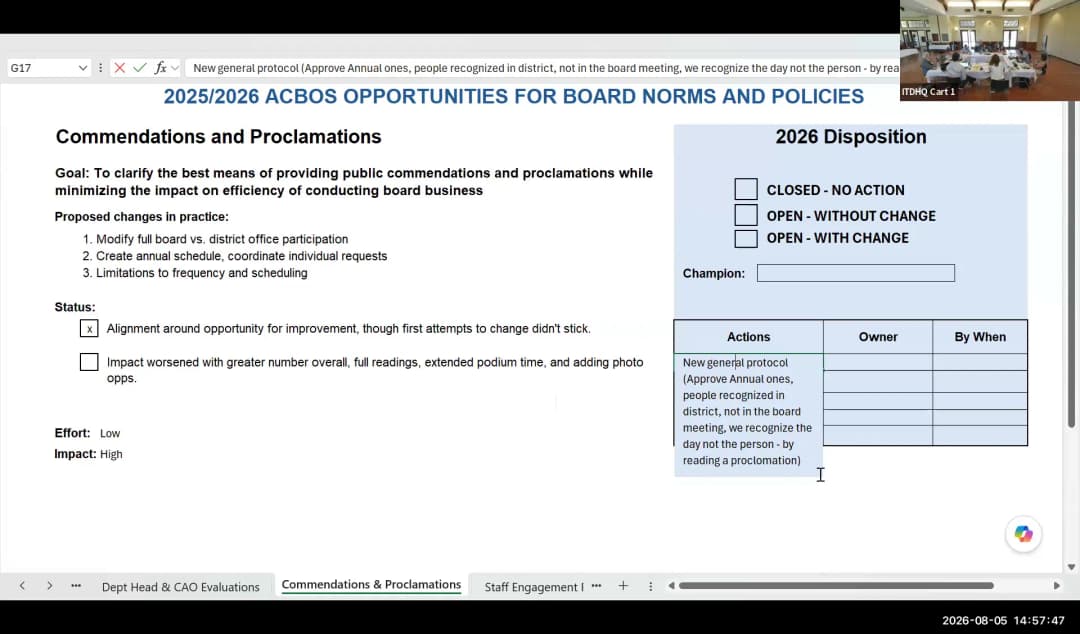
Public Meetings - Alameda County, CaliforniaThe Alameda County Board of Supervisors held the first day of a two-day retreat on August 6, 2026, at the Martinelli Event Center. The retreat focused on team building, group dynamics, and reviewing norms and protocols to improve board functioning. Facilitators Jen and Dan led exercises on trust, conflict, and feedback. The board then worked through a series of operational items, reaching several agreements on public comment, closed session scheduling, proclamations, support materials, and other procedural improvements. No formal votes were taken, but consensus was reached on multiple action items. Public Comments & Testimony - Kelly Abrew (in person) expressed views on team dynamics, calling the board a "team of sharks," and criticized the use of closed sessions as a buffer that makes it difficult for the public to know when to speak. He also commented on discretionary grants and geographic equity. - Andrew Turnbull (in person) complimented the facilitators and urged the board to create a flow chart for how issues proceed through committees and the Synol Municipal Advisory Council. He also stressed the importance of predictable public comment times for citizens. Discussion Items - Team Building and Group Dynamics: The board participated in a photo card exercise to share how they showed up and how they wanted to feel by the end of the retreat. A discussion on whether the board is a team followed, with supervisors generally agreeing they are a team but with room for improvement. They later engaged in a “blind spotting” feedback exercise where each supervisor and the county administrator and interim county counsel received constructive feedback from colleagues on strengths and areas for growth. - Norms and Protocols Review: The board reviewed and debated several items raised in the prior year’s retreat and in one-on-one interviews: - Public Comment: Agreed to standardize to two minutes per speaker; set a reasonable time (3–5 minutes) for speakers to sign up or raise hands; limit total public comment to up to one hour; and establish a set time for public comment on open session items (likely 1:30 PM after closed session). The board policy will be updated from three minutes to two minutes. - Closed Session: Decided to time‑block closed session on Tuesdays: public comment on closed session at 9:30 AM, closed session begins immediately after, with the goal of reconvening open session at 1:30 PM. If closed session runs beyond 1:30 PM, remaining items are postponed to the end of the day. Also agreed to add a separate closed session on Thursday afternoons following the planning meeting for non‑time‑sensitive items (e.g., labor, litigation, performance evaluations), starting with one Thursday per month. - Commendations and Proclamations: After extensive discussion, the board agreed to eliminate nearly all proclamations from board meetings effective immediately. Annual acknowledgments (e.g., Law Day, employee service awards) will be handled at the district level or via newsletters/social media. The board president may briefly recognize a month or day (e.g., Hispanic Heritage Month) without bringing in speakers or taking photos. Exceptions will be rare and require the board president’s approval. - Support Materials: The board requested that materials for work sessions be posted 24 hours in advance and that for regular meetings, materials be available 72 hours before (by Friday for Tuesday meetings). If materials are not ready, the item should be postponed. Departments are also asked to include live hyperlinks to prior actions. County Administration will confirm technical feasibility and notify departments. - Speaking Order: The board agreed to capture its typical speaking order (sponsor first, then district‑related, then others) as an intention in the board operating procedures, but no formal change to practice. - Parliamentary Procedures: The board decided to defer selecting a formal parliamentary authority (e.g., Robert’s Rules or Rosenberg’s) to a work session later in the year, with a recommendation to be presented by end of 2026. - Budget Integration and Oversight: Acknowledged improvements made this year (e.g., earlier budget work sessions, involving unincorporated representatives). No further changes were requested. - Department Head Evaluations: County Administrator Susan Muranishi will develop a evaluation schedule by October 31, 2026. Most department heads will be on a two‑year cycle, with annual check‑ins for key departments (Social Services, Health, Community Development, Public Works). Prioritize completing the outstanding evaluation for the County Administrator from the previous cycle. - Board Committees and Ad Hoc Committees: The board agreed to defer reorganization of standing and ad hoc committees to January/February 2027, after receiving a comprehensive list of committees and commissions. A separate work session may be scheduled. - Staff Engagement: The idea of holding a meeting with department heads was left as a good idea but not committed; it will be considered by the incoming board president. Key Outcomes - Public Comment: Policy to be updated to two‑minute standard; implementation expected by September 15, 2026. - Closed Session: New Tuesday and Thursday time‑block schedule to take effect at the next meeting. - Commendations: New policy to go into effect immediately; Susan’s office to draft communication for department heads and supervisors by September 2026. - Support Materials: 24‑hour advance posting for work sessions and 72‑hour for regular meetings; technology check and department notification to be completed by September 2026. - Department Head Evaluations: Schedule to be produced by October 31, 2026. - Parliamentary Procedures: Work session and recommendation due by end of 2026. - Committee Structure: Deferred to first quarter 2027. - Staff Engagement: No timeline; remains a good idea. All decisions are subject to formal action at a future board meeting as needed.
The Alameda County Board of Supervisors convened on Tuesday, August 4, 2026, at 9:30 a.m. at the County Administration Building in Oakland. The meeting included proclamations, a historic action on the Russell City Redress Fund, extensive public testimony on a proposed $30 minimum wage initiative, approval of a substantial consent calendar and mass motion, and a closed session report on the settlement and release of the independent investigation into the death of Sophia Mason. The board voted 5-0 to approve the Russell City Redress Fund MOU and 3-2 to refer the minimum wage initiative for an economic impact study before placing it on a future ballot. Proclamations & Commendations - August 2026 as Child Support Awareness Month – Recognized the Alameda County Child Support Services, which collected over $78 million last year with 94% going directly to children. - 2026 as International Year of Rangelands and Pastoralists – Highlighted that rangelands cover approximately 188,000 acres (40%) of Alameda County and that livestock is the second largest agricultural commodity in the county. Russell City Redress Fund (Item 129) - The board unanimously approved a Memorandum of Understanding between Alameda County and the City of Hayward establishing the governance of the Russell City Redress Fund and authorized the Auditor-Controller to issue phase one redress payments to eligible former residents. - The fund totals $1.3 million, contributed by Supervisor Marquez ($400,000), Supervisor Miley ($250,000), City of Hayward ($250,000), President Halbert ($100,000), Supervisor Fortunato Bas ($100,000), Supervisor Tam ($100,000), and the Alameda County Office of Education. - Supervisor Miley pledged an additional $250,000 (to be brought as a separate action in the fall), which would bring the fund to $1.8 million. - Community speakers expressed strong support, including descendants and former residents who described the trauma of displacement in the 1950s-60s when approximately 700 parcels were acquired via eminent domain, displacing about 1,400 residents. Several speakers urged the board to continue expanding the fund and to consider creating an office of reparations. Minimum Wage Ballot Initiative (Item 130) – Public Hearing & Vote - Background: The Registrar of Voters certified 117,000 signatures for a proposed ordinance raising the minimum wage to $30 per hour by 2030 for unincorporated areas, county-owned properties, and certain employers. The board had three options: A) adopt immediately, B) place on the November 2026 ballot, or C) refer for a 30-day study. - Public Comments (over 50 speakers, one minute each): - Proponents (workers, community organizations, youth): Argued that $30/hour is the minimum needed for a living wage in Alameda County, cited 117,000 signatures as the will of the people, and noted the gradual phase-in (large employers by 2030, small by 2037). Speakers shared personal stories of working multiple jobs and struggling with rent and food costs. - Opponents (business owners, chambers of commerce, some nonprofits): Requested an economic impact study, citing concerns about job losses, price increases, harm to small businesses and nonprofits, and potential conflicts with Measure C and state laws. - Board Deliberation: - Supervisors Tam, Miley, and Halbert supported option C (study), citing the need to understand fiscal impacts, effects on small businesses, nonprofits, the interplay with Measure C, legal challenges, and county contracts. They noted voters would still have a chance to vote in March 2028. - Supervisors Marquez and Fortunato Bas supported option B (ballot), arguing the democratic process should be honored and that the study would delay justice. - Vote: Motion to adopt option C (study) passed 3-2 (Marquez and Fortunato Bas opposed). Scope of study to include economic impact on businesses of all sizes, fiscal impact on the county, effects on employment, inflation, the wealth gap, interactions with state minimum wage laws, and implications for county contracts and Measure C. Report due within 30 days (by September 15, 2026). Consent Calendar (Items 131-153) and Mass Motion (Items 2-126) - Consent Calendar: Approved unanimously. Included routine health, social services, personnel, and board/commission appointments. - Mass Motion: Approved with specific discussions on several items: - Item 3 – Capital Improvement Plan: Supervisor Fortunato Bas inquired about a projected $182 million for Santa Rita Jail electrical and core renovations. GSA Director explained it is a future planning estimate not yet approved. - Item 8 – Training contract with Chabot Las Positas Community College ($13 million increase): Clarified that funds are for training staff and caregivers serving foster youth, not a direct pipeline for child welfare workers. - Item 15 – Emergency food distribution contracts: Supervisor Fortunato Bas asked Social Services to issue an RFP before contracts expire in two years to ensure broader and more innovative services. - Item 24 – Supportive Housing Community Land Trust ($900,000 bridge funding): Agency reported the organization has drawn $3.3 million of prior $5.8 million and is working toward operational stability. - Item 29 – Oakland LGBTQ Community Center ($1.5 million for identity-affirming wellness care): Approved. Supervisor Fortunato Bas noted this is a milestone for LGBTQIA+ services. - Item 97 – Probation contract extension: Several youth speakers from Urban Peace Movement urged a ban on pepper spray in juvenile hall. Chief Probation Officer reported that after a five-year meet-and-confer process, use of force policies were narrowed to three extreme situations, and a less harmful agent (Repulse) is being adopted. Usage dropped from 8-9 times per month in 2024 to 1-2 times per month in 2025. - Item 113 – License agreement with Federal Bureau of Prisons for Fire Department Fuels Crew housing: Approved. Chief McDonald noted the crew is currently deployed to Washington wildfires. - Recusals: Supervisor Miley recused from items 20 and 47 due to campaign contributions. Those items passed on separate votes. Ordenances (Second Readings) - Item 48: Firearm safe storage ordinance for unincorporated areas – Adopted unanimously. - Item 79: Memorandum of Understanding with ACMEA Sworn (Sheriff's units) and salary ordinance amendments – Adopted unanimously. - Item 116: First reading of traffic code amendments for unincorporated county roadways – Introduced unanimously. Closed Session Report - County Counsel reported two settlements: 1. Blackman case: $130,000 settlement approved May 12, 2026 (unanimous). 2. Johnson v. County (Sophia Mason case): $12 million settlement approved October 7, 2025 (unanimous). The independent investigation report into Sophia Mason's death was released publicly with limited redactions. The board issued a statement noting that 7 of 15 state recommendations have been fully implemented, staff vacancies reduced from 32.8% to 21.2%, and case backlog reduced by 57% from 3,900 to 1,500. A moment of silence was observed. Key Outcomes - Russell City Redress Fund MOU approved (5-0); first phase payments authorized. - Minimum wage initiative referred for a 30-day economic impact study (3-2); final board action expected September 15, 2026. - Consent calendar and mass motion (most items) approved, with several items discussed in detail. - Firearm storage and salary ordinances adopted. - Closed session settlements announced; independent investigation report released. - Next regular meeting: September 15, 2026 (board on recess in August).
The Transportation/Planning Committee convened on August 3, 2026, at 9:30 a.m. The meeting featured two informational items: a proposal for a multi-use event center land transfer in the Tri-Valley region and an update on regional housing policies (Transit Oriented Communities and One Bay Area Grant). Public comments were received on both items and on general county matters. Public Comments & Testimony - Bill Wheeler (founder/CEO of Black Tie Transportation, board member of Visit Tri-Valley): Expressed full support for the event center, noting that since 2018 the Tri-Valley has attracted over 133,000 sports and entertainment attendees and 41,000 hotel room nights without a centralized facility, while losing an estimated 40% of high-impact events. He highlighted the projected $120 million annual economic impact and 500 jobs. - Joe Calabrigo (interim city manager, City of Pleasanton): Opposed the current financing plan, stating the city faces a structural budget deficit and the proposed JPA would capture approximately $1.6 million per year from Pleasanton. He noted the city council has not discussed or endorsed the project, and Pleasanton’s priority is a November TOT increase to address its deficit. - Kelly (Alameda County resident, non-Tri-Valley): Expressed concerns about county general fund contributions, noting the combined $3 million annual contribution from Dublin and Pleasanton, a $360 million capital cost described as “luxurious,” the county giving up $20 million in land value via a 99-year lease, and a potential $10 million annual diversion from the county general fund through tax increment financing. Also worried that Danville would pay taxes without full representation on the JPA. - Caller “Yay”: Made an unintelligible positive statement. - Jim McDonnell (restaurant owner, former board chair of Visit Tri-Valley): Supported the project, stating it would bring economic benefits to small businesses like his. - Kelly (public comment on non-agenda item): Criticized state housing mandates (RHNA), noting Bay Area jurisdictions are producing only about 13-14% of required housing in the current cycle and are on track for only 37% of the goal, with no penalties. Questioned whether the committee represents a subregion or the whole county. - Kelly (on OBAG/TOC item): Urged support for the Niles Canyon Trail project ($300,000), citing the legacy of former Supervisors Scott Haggerty and Richard Valle. Discussion Items Tri-Valley Multiuse Event Center Land Transfer - Presentation: Tracy Farhad (CEO, Visit Tri-Valley) and Dan Fenton (Managing Director, JLL Hospitality Advisors) presented a proposal to develop a multi-use venue on a 12-acre county-owned surplus site at Martin Ellie Way/Arnold Roll in Dublin. The venue would host indoor sports tournaments (3,000–5,000 seats), entertainment/performing arts, and corporate events. Key requests included: - Support for a 99-year ground lease (with an estimated $20+ million county land value investment). - $350,000 in reimbursable seed capital for due diligence (civil site work, design cost refinement). - Authorization to pursue a tax increment financing (TIF) district that would capture increased property value from the venue, with a portion shared with the county. - County interest in being a member of a future Joint Powers Authority (JPA) to manage the venue. - Support for an expanded tourism improvement district (beyond hotels) to include retail and related industries. - Economic impact: Projected 60,000 incremental hotel room nights annually, 318,500 annual attendees, permanent jobs, and $120 million annual direct spending. - Committee discussion: - Supervisor Haubert supported referring the matter to staff and the surplus property ad hoc committee. He cautioned that the county must avoid repeating past mistakes with professional sports facilities and wants a full analysis of the county’s historical partnership with Dublin (including the Emerald Fund). He described the project as “cautiously optimistic.” - Supervisor Miley agreed with the referral and suggested declaring the property surplus (rather than surplus exempt) to minimize legal risk. - Staff (Sandy Rivera, CDA Director) recommended staff work with the presenters to validate the proposal, then bring findings to the surplus property ad hoc committee (which is confidential), and eventually to the full Board of Supervisors sitting as the Surplus Property Authority. - Ellen Dalton (staff) noted that the remaining 7 acres of the parcel (D2) are not yet cleared under the Surplus Land Act; she recommended declaring them surplus to open all options. Regional Housing Policy Update: TOC and OBAG - Presentation: Aaron Tiedemann (Housing & Community Development Specialist) provided an update on the Metropolitan Transportation Commission’s Transit Oriented Communities (TOC) policy and its connection to One Bay Area Grant (OBAG) funding. - Key changes: TOC compliance is no longer required for most OBAG 4 funds; instead, jurisdictions scoring 85+ out of 100 points will access a $45 million regional set-aside. The compliance deadline was moved to July 2027. - Unincorporated Alameda County has two TOC areas (Bay Fair and Castro Valley BART stations). - OBAG 1-3 provided $32 million for unincorporated projects and $215 million countywide; OBAG 4 is expected to deliver $70 million to the county. - County housing policies under the TOC framework: production (inclusionary housing, ministerial approval – planned), preservation (Eden Land Trust existing, mobile home park closure ordinance planned), protections (just cause eviction existing, anti-harassment ordinance planned). $2.1 million in MTC planning grants support this policy development. - A request for Measure W funds to meet TOC funding requirements is pending. - Committee discussion: - Supervisor Miley (also MTC board member) noted the extensive regional debate leading to the TOC policy changes and expressed satisfaction that compliance is no longer a barrier for OBAG funds. He encouraged staff to continue efforts to achieve the 85-point threshold. - Supervisor Haubert asked about the timeline for inclusionary housing and ministerial approval ordinances. Olivia Ortiz (Planner) indicated an update is expected at the October Board of Supervisors planning meeting, with a community roadshow starting soon. - Conversation about mobile home park ordinance: staff considered it a preservation policy, though Supervisor Haubert noted it could also relate to production if conversions occur. Key Outcomes - Tri-Valley Event Center: The committee directed staff to work with Visit Tri-Valley and JLL to further investigate the proposal (land value, site conditions, financing feasibility) and then report to the surplus property ad hoc committee. The ad hoc committee will review and, if appropriate, recommend to the full Board of Supervisors (as the Surplus Property Authority) for further action. No formal vote was taken; the referral was unanimous among members present. - TOC/OBAG Update: The item was informational only. Staff will continue developing the required housing policies and will return to the board with specific ordinances (inclusionary housing, ministerial approval, anti-harassment) in the coming months. No votes were taken. - Public comment on non-agenda items: No committee action was taken. The meeting was adjourned at approximately 11:00 a.m.
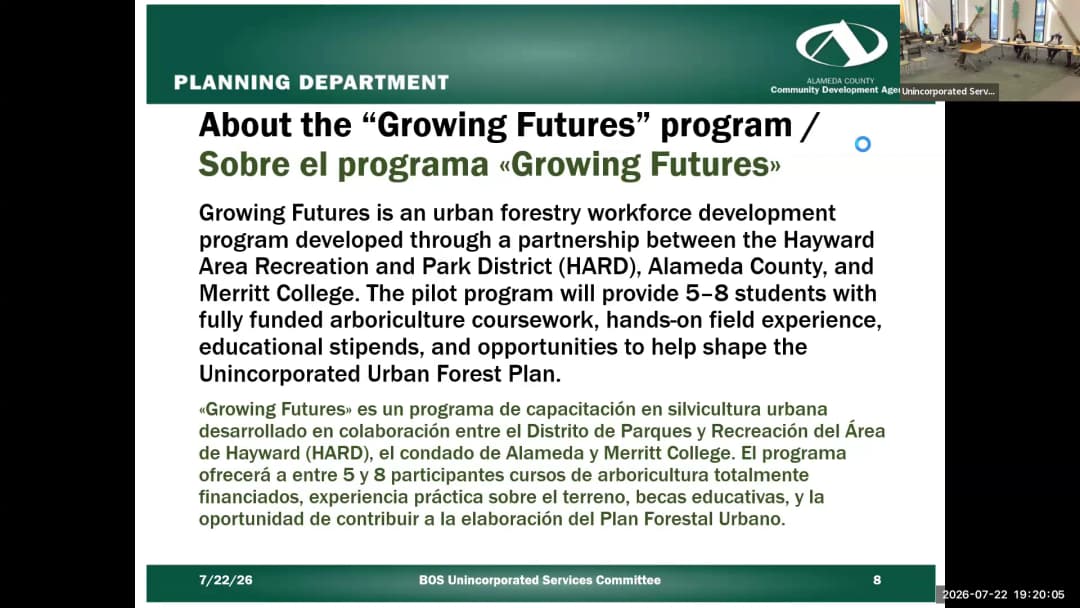
The Unincorporated Services Committee (USC) met on July 31, 2026, at the San Lorenzo Library to receive informational briefings on two topics: a background and policy briefing on "junk fees" in the unincorporated rental market, and an update on the Unincorporated Urban Forest Planning project. Both items were informational; no votes were taken. The committee heard public testimony on both items and provided direction to staff on next steps. Public Comments & Testimony - Kristen Hackett (Eden Renters United) presented bills showing a family paying $738/month in extra fees (including a $250 month-to-month lease fee) and argued fees are divorced from actual costs (the landlord pays $153/month for trash but charges $200 per tenant). - Lindsay Wright (reading testimony for Nika B) asked for investigation and documentation requirements due to unpredictable utility billing. - Sandra Hernandez (My Eden Voice) reported fees ranging from $80 to $700/month were found in five of eight surveyed buildings, emerged after 2019 state rent control, and are used to circumvent rent caps; she argued housing is a human right. - A representative from the California Apartment Association (CAA) supported education and transparency over new local ordinances, stating renters should understand charges. - Tahira Dean (Public Advocates) stated state bill AB 1248 to ban junk fees failed, and the county should pass a local ordinance; she noted landlords often hide fees or add them via coerced leases. - Derek Barnes (Fair Rental Housing Association) supported protecting residents from surprise charges but urged the county to avoid the loaded term "junk fees" and to study actual practices before regulating; he distinguished legitimate utility costs. - Diane Weither (San Lorenzo resident) commented on the urban forest item, raising concerns about PG&E tree removals without coordination, need for tree maintenance education, and grants for proper trimming. - Miguel (in Spanish, interpreted) commented on tree maintenance responsibility and broken sidewalks, suggesting a dedicated maintenance agency. - Mila (intern for Supervisor Miley) announced the Healthy Living Festival on September 24, 2026, at the Oakland Zoo for Alameda County seniors. Discussion Items 1. Informational Item: Background and Policy Briefing on Junk Fees Aaron Tiedman (Housing & Community Development) presented an overview of junk fees – hidden, excessive, or deceptive charges outside base rent. A survey by Eden Renters United of five large rental buildings in Ashland, Cherryland, and Castro Valley found fees for garbage, water, and sewer ranging from $85 to $700/month, often without notice, not tied to service, and used to pressure tenants. State law (AB 1482/SB 567) does not cover these fees; AB 1248 failed at the state level. The California Apartment Association (CAA) argued fees are standard and can help tenants manage costs, but supported transparency in listings. The National Consumer Law Center recommended limiting fees, requiring opt-in consent, and mandating transparent advertising. Local examples from Salinas and Mountain View define rent narrowly to ban junk fees. Possible county options include defining rent in a stabilization ordinance, banning specific fees, seeking state clarification, or funding enforcement. Supervisor Lena Tam asked clarifying questions about which fees are at issue; the problematic fees are primarily for garbage, water, and sewer that are not separately metered. She also asked whether junk fees have appeared in unlawful detainer proceedings; staff did not have that data. Supervisor Nate Miley emphasized the need to distinguish between legitimate and abusive practices, and proposed exploring: - Requiring all rental listings and agreements to include all costs and fees (subject to county counsel review) - Determining if imposing junk fees could be treated as harassment under an anti‑harassment ordinance - Conducting a broader study of the problem The supervisors agreed that more information is needed. Staff and county counsel were asked to return in 3–4 months with a comprehensive informational report on legal options and potential studies. 2. Informational Item: Unincorporated Urban Forest Planning Project Update Ali Abbors (Planning Department) updated the committee on the Urban Forest Plan project, funded by a $685,000 Calfire grant (IRA funding). The project has two main deliverables: (1) an Unincorporated Urban Forest Plan, including a complete street‑tree inventory (expected 16,000 trees), analysis of canopy equity, urban heat, and fire risk, and recommendations to achieve the Board's goal of 20% canopy cover by 2050; (2) a Growing Futures workforce development pilot program in partnership with Merritt College and the Hayward Area Recreation and Park District (HARD), providing 5–8 students with free coursework and stipends in arboriculture. The project timeline runs through March 2028. A tree advisory group of 15 members (non‑Brown Act body) has been formed. The tree inventory is underway (about 4,000 trees inventoried as of the meeting). The project covers the urban unincorporated areas: San Lorenzo, Hayward Acres, Ashland, Cherryland, Fairview, and urban Castro Valley. Supervisor Tam noted that San Lorenzo values tree canopy and asked about the existing tree advisory board (TAB) under Public Works, which has not met since 2023; its members may be invited to the new advisory group. She also asked about the selection and composition of the new advisory group. Supervisor Miley stressed that he would need strong convincing before supporting any regulation of trees on private property, noting past controversies. Staff confirmed that the canopy equity analysis will include private property data from satellite imagery but the inventory is limited to public trees. Recommendations from the plan could include updates to the county's recommended tree list and possibly a future urban forest management plan. The committee will receive another update after the inventory and existing conditions study are completed. Key Outcomes - No votes were taken; both items were informational. - Junk fees: Supervisors directed staff (Community Development Agency and County Counsel) to prepare a comprehensive report within 3–4 months exploring legal options for requiring transparency in rental listings and agreements, possibly treating junk fees as harassment, and conducting a study of the scope of the problem. - Urban Forest Plan: The committee will receive a future update after completion of the tree inventory and existing conditions study (anticipated within the next few seasons). The project timeline continues with public workshops and advisory group meetings. - The tree advisory group (15 members) for the Urban Forest Plan has been seated; the committee asked that its membership be disclosed at the next report. - The Growing Futures workforce program is recruiting 5–8 participants; information will be shared via newsletters and social media.
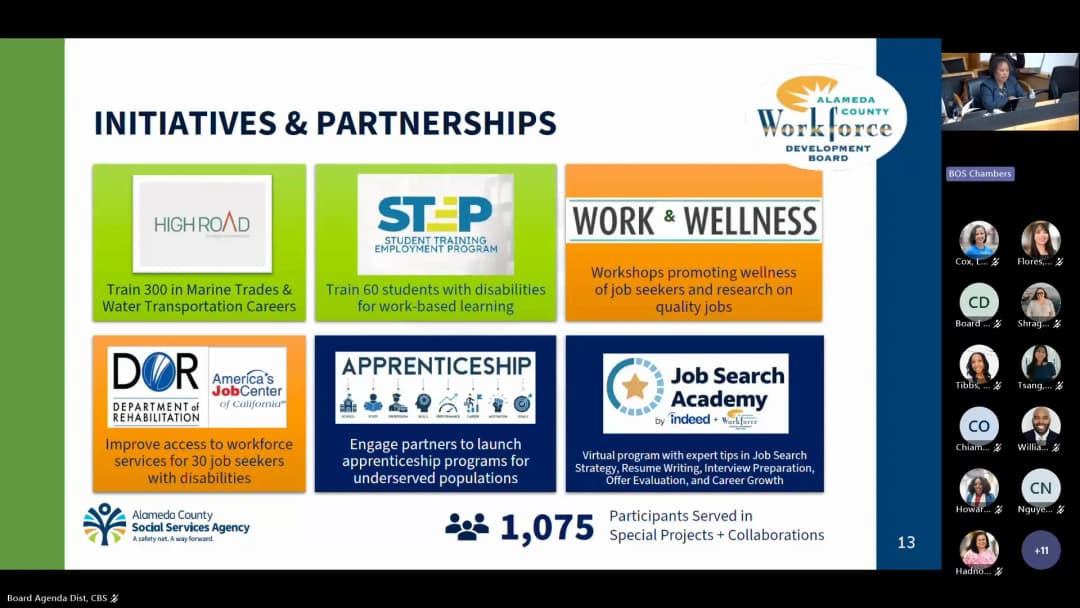
The Alameda County Board of Supervisors Social Services Committee met on July 30, 2026, to receive three informational updates. The committee discussed the Department of Children and Family Services' 10th status update on the state auditor's findings, the Volunteer Income Tax Assistance (VITA) program for the 2025-2026 tax season, and the Workforce Development Board's program update. Supervisors Lena Tam (Chair) and Nikki Fortunato Bas participated. No public comments were made. Discussion Items - Department of Children and Family Services Status Update: Director Michelle Love presented data on sibling placements, reunification rates, timely investigations, and workforce vacancies. As of July 2026, Alameda County had 607 children (ages 0-17) and 196 non-minor dependents (ages 18-21) in foster care. 51.9% of children were placed with relatives. For children entering foster care with siblings in 2024, 88.2% were reunified with some or all siblings. Timely investigations declined from 77.1% in March 2026 to 50.8% in June 2026. The department’s overall vacancy rate was 21%, but continuous hiring (165 new child welfare workers since 2019) and a new recruiter were underway. Supervisor Fortunato Bas expressed concern about declining investigation timelines and closures, and asked about the ombudsperson position and Victor Community Support Services contract. Chair Tam asked about placement safety and mental health services. The department will provide an update on Victor Community Support Services at the August committee meeting and continue working on the ombudsperson position. - Volunteer Income Tax Assistance (VITA) Program Update: Pamela Powell and Marissa Hollenback reported that the program filed 2,050 tax returns across three sites, securing $3.4 million in total refunds, including over $980,000 in Earned Income Tax Credits and over $1 million in Child Tax Credits. The average adjusted gross income for filers ranged from $41,000 to $44,000. The program introduced a weekly communication series and an apprenticeship. Apprentice Brittany Lampkin recommended separating program operations from community engagement roles. Supervisors thanked volunteers and asked about outreach methods. Looking ahead, the program will expand the apprenticeship, explore becoming a Certifying Acceptance Agency for Individual Taxpayer Identification Numbers (ITINs), and enhance outreach. - Workforce Development Board Update: Rhonda Boykin and Carl Pasqual presented on program performance, labor market trends, and legislative impacts. The board was designated a high-performing board. In program year 2025-2026, over 400 participants were enrolled, with 50% entering employment—80% in priority sectors. The unemployment rate in Alameda County was 3.8% (May 2026). AI was the fastest-growing in-demand skill (92.5% increase in job postings from May to July 2026), while healthcare jobs were least exposed to AI. The board spent over $1 million on training for 249 participants, with top programs including AI-driven administrative assistant and healthcare certifications. Over 3,000 employees were impacted by layoffs, with rapid response provided to 700 individuals. Legislative concerns included unfunded mandates for HR1 work requirements for CalFresh/Medi-Cal recipients and proposed OMB changes to federal grant guidance. Chair Tam asked about reconciling layoff news with low unemployment and about implementation of work requirements. The board will continue coordinating with Social Services and provide a joint update with the Health Committee. Key Outcomes - All three informational items were received and filed by the committee. - The Department of Children and Family Services will report back on the Victor Community Support Services contract and the ombudsperson position at a future meeting. - The VITA program will expand its apprenticeship and explore ITIN certification. - The Workforce Development Board will collaborate with Social Services on CalFresh work requirements and provide a joint update with the Health Committee. - No formal votes or resolutions were adopted. Public Comments & Testimony - No public comments were made on any agenda item or on non-agenda matters.
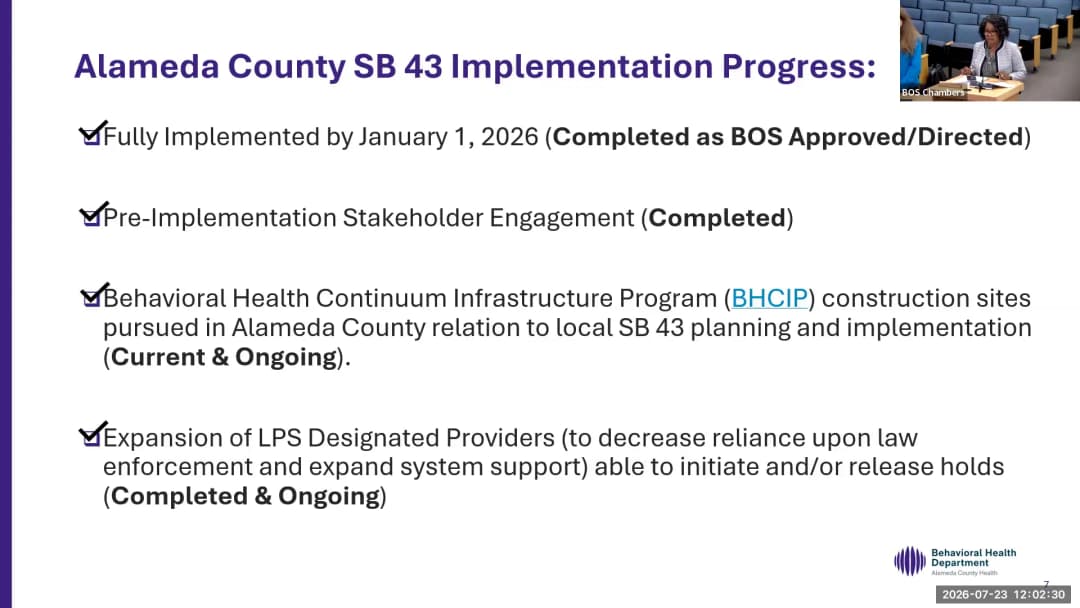
The Alameda County Board of Supervisors convened a special joint meeting of the Health and Public Protection Committee on July 29, 2026, from 10:00 a.m. to approximately 1:00 p.m. The meeting featured three informational items: a progress report from the Behavioral Health Advisory Board (BHAB) on Care First Jails Last (CFJL) implementation, an update on the state’s CARE Act (Care Court) in Alameda County, and an update on Senate Bill 43 (SB 43) implementation. Supervisors Elisa Márquez (Chair), Nate Miley, and Lena Tam were present. Public comment was taken after each presentation. Consent Calendar - No consent calendar items were on the agenda. Public Comments & Testimony Item I – Care First Jails Last: - Merle Lustig (resident/taxpayer) expressed full support for the BHAB's recommendations, particularly continued funding for pretrial release services, calling it a major success. - John Lindsay Poland (American Friends Service Committee) urged braided funding to increase licensed boarding care beds, noting a net loss of 198 beds since 2021. - Richard Spiegelman (Interfaith Coalition for Justice in Our Jails) emphasized the need to renew Wendy Ware’s contract for jail data analysis and to appoint a CFJL implementation director. - A speaker (unidentified) urged the Board to require a serious study on reducing jail operating costs to capture savings from the declining jail population. - Sherry Novick praised the CFJL report’s recognition of changing needs over time and called for county investment in licensed board and care homes. - Elay Dream Hillman (NUHW) supported renewing Wendy Ware’s contract and stressed that mental health care is health care, urging full provision of Kaiser mental health benefits. - Margot Dashiel highlighted the need for county support of licensed board and care homes as a housing strategy. - Moni (no affiliation given) praised the report’s four concrete recommendations: fund mental health diversion court, pretrial services, board and care development, and data analysis via Wendy Ware. - Tony Velgia and Alison Monroe (FASME) urged the county to look at best practices in board and cares, noting that some people cannot be supported by family forever. - Ann Foley shared a personal story contrasting a positive 2007 Berkeley crisis response with a 2026 incident where police ignored her AB form, leading to her partner’s jail booking. - Kathleen Secora requested a comprehensive independent assessment of unmet needs for licensed board and cares, warning that closures lead to homelessness. - A speaker (SHCLA) supported a CFJL implementation director in the County Administrator’s Office, noting that SHCLA’s budget had been slashed despite being cited in CFJL recommendations. Item II – Care Court Update: - Alison Monroe (FASME) acknowledged Care Court’s benefits but argued that some people are too ill to engage voluntarily, supporting SB 1016 to clarify that WIC 5200 can exit Care Court to conservatorship; she disagreed with BH’s assessment that 5150s are sufficient. - Monty Hancock asked about structural lessons from case-by-case approaches, permanent supportive housing for graduates, and whether the sheriff’s internal capacity building means Wendy Ware will not be used. Item III – SB 43 Implementation: - Alison Monroe (FASME) expressed disappointment that SB 43 has helped very few people and suggested police abdication of 5150s as a factor; she stated that behavioral health directors resist expanding the system for the seriously mentally ill. - Brian Bloom (citizen) responded to Supervisor Miley’s question about capacity for treatment over objections. He inferred from John George’s 72% discharge rate (only 28% admitted) that the county lacks capacity; he called for an honest assessment. General Public Comment: - John Lindsay Poland urged the Board to require the CAO to publish financial information on savings from the declining jail population, noting the sheriff’s office underspent its budget last year despite $52 million in overtime. Discussion Items Item I – Care First Jails Last: BHAB 2026 Update - Brian Bloom (BHAB Chair) presented a detailed report, calling it a “call to action.” Key points: - Jail population continues to decline (1,214 as of the night before, a 50% reduction from 10 years ago). - However, the number of people with serious mental illness (SMI) in jail increased from 76 in 2023 to 113 in June 2024, and was 124 as of the night before. - Racial disparities persist: 33% of the forensic behavioral health population is African American, vs. 9-10% of the county population. - Low-hanging fruit: fully fund 1,400 FSP slots (needed per county assessment; current funding covers only 1,155); staff the mental health diversion court (only treatment court without clinicians); provide $200,000 for collaborative courts; develop a permanent IST diversion program; and continue funding the pretrial release program (rearrest rate dropped from 44% to 18% with services). - Renew Wendy Ware’s contract to add behavioral health needs assessment to jail data. - Recommended creating a CFJL implementation director (or “czar”) with authority across agencies. - Supervisor Tam noted that savings from jail population reduction are constrained by staffing and legal issues; she asked about FSP assessment timing (completed spring/summer 2025) and bed counts at John George (69 licensed, 89 certified) and Villa Fairmont (90 beds). - Supervisor Miley suggested discussing CFJL implementation at the Board’s August retreat. - Sheriff’s Captain Charles Joe stated the sheriff’s office is building internal capacity for jail data analysis, including behavioral health tracking. Item II – Care Court Update - Dr. Karyn Tribble (ACBH Director) and Ardavan Davaran (Indigo Project) provided the update. Key data: - 339 petitions filed since December 2024; 317 met prima facie; 317 ordered for investigation; approximately 120 have agreed to CARE Act services, most enrolled in the BACS FSP. - Demographics: 68% male, 32% female; 42% African American, 27% white. - Average time from petition to FSP enrollment decreased from 99 days (first 13 months) to 52 days (last 6 months). - Outreach and engagement improved due to push notifications from jail and John George. - 130 CARE respondents have been housed through bridge housing (300+ interim beds, 210 hotel/motel nights per month, 40 licensed facility beds, 55 rental vouchers). - Juan Tizon (Director of Forensic Services) reported that 34% of incarcerated individuals are in therapeutic housing; 121 individuals identified as SMI are supported by re-entry team, including CARE Court referrals. - Regarding WIC 5200, ACBH stated it is not used in conjunction with CARE Court; no other California county is actively using it; they believe 5150 and existing treatment courts are more effective. - Supervisor Tam asked about the decline in 5150s; Dr. Tribble attributed it to increased use of prevention and less restrictive alternatives, such as CARE Court, AOT, and community conservatorship. Item III – SB 43 Implementation Update - Dr. Tribble and Deputy Director Vanessa Baker presented. Key points: - SB 43 broadened grave disability to include severe substance use disorder and inability to provide for medical care/personal safety. - County preparation included stakeholder engagement, training, and designation of providers. As of the meeting, 174 individuals and 21 facilities were designated to initiate SB 43 holds (level 1 and level 2). - County-operated clinics initiated zero SB 43-based 5150s; a “handful” (fewer than 5) were initiated at medical facilities in two districts. - The number of 5150s in Alameda County dropped from 8,100 in 2023 to 3,934 in 2024 (a 45% decline). Dr. Tribble explained this is likely due to expanded voluntary services, CARE Court, and preventive programs. - The county is developing a data report to analyze SB 43 holds further and is monitoring the impact of extended holds (up to 60 days with board-approved 5270 and 5121 authorities). - A 40-bed geriatric med-psych unit (ages 55+) is expected to open in 2028 under Alameda Health System, pending state approval for revised scope. - Supervisor Tam stressed the need for early communication with Hayward regarding the concentration of new BCHIP-funded facilities there, and suggested a public education campaign. Key Outcomes - No formal votes were taken, as all items were informational. However, the following commitments and directives emerged: - Supervisor Miley proposed discussing CFJL implementation at the Board’s August retreat. - Supervisor Marquez affirmed her commitment to working on pretrial release funding, noting the contract expires in December and she co-authored the initial letter; she called for a one-year evaluation and a bridge plan. - The Sheriff’s Office indicated it is building internal data capacity and will incorporate behavioral health metrics, though no commitment was made to renew Wendy Ware’s contract. - BHAB’s requests for a CFJL implementation director, full FSP funding (1,400 slots), and licensure of more boarding care beds were placed on the record for future consideration. - The Behavioral Health Department committed to ongoing data analysis on SB 43 impacts and to seek board approval for future level one facilities (receiving centers) as BCHIP projects come online. - Supervisor Tam flagged the need for a collaborative outreach plan with Hayward regarding new behavioral health facilities.
Note: The agenda and transcript indicate the meeting was held on Tuesday, July 28, 2026, but the system instruction specifies July 29, 2026. This summary uses the instruction-provided date. The Board of Supervisors convened a special meeting at 10:00 a.m. (starting about 15 minutes late) that ran over nine hours, including closed session, multiple open session items, and a set matter at 3:00 p.m. The meeting covered budget and capital planning, the Russell City Redress Fund, state audits of child welfare services, and the proposed Office of Immigration and Refugee Affairs. Public comment was received on several items, and the board gave direction on future actions. Public Comments & Testimony - Closed Session: Kelly A. alleged Brown Act violations, including a 23-hour notice for a 1:00 p.m. meeting (below the required 24 hours), the use of decoy agenda items, and consistently late start times. - Immigration Office (Item 4): - Alma Sidego (Global Communication, Education and Art / African Resource Center) requested that African immigrant populations be included in funding and services, noting that her organization serves over 500 people and handles deportation defense and know-your-rights education. - Desmond Jeffries (GCA) asked for a three-year, $450,000 annual African immigrant community stabilization initiative, pointing out that no African languages appear on the county’s website and that GCA served 1,700 individuals last year. - Jane Pack (Refugee and Immigrant Transitions) supported the office but urged the board to think beyond emergency mode and invest in long-term livability for refugee communities. Discussion Items 1. Budget/Financial Updates (Item 1A) County staff presented the final FY 2026-27 budget ($6.8 billion total, $4.3 billion General Fund), closing a $185 million gap with $93 million in retirement savings and $60 million in program reductions/efficiencies, though heavily reliant on one-time strategies. State and federal uncertainties were highlighted, including five November 2026 ballot initiatives affecting county revenue. Supervisors discussed the need for fee increases, reserve transparency, liability reduction, and better public communication. 2. 5-Year Capital Improvement Plan (Item 1B) The General Services Agency presented a $2.5 billion five-year plan (FY 2027-2031), with a $504 million funding gap after applying $410 million from the special capital construction fund. A detailed review of Santa Rita Jail projects (ADA, network infrastructure, health spaces, kitchen renovation, critical operations) was provided. Supervisors discussed issuing bonds, updating the facility conditions assessment (last done in 2018), and restarting the real estate master plan for the government center. Supervisor Miley and President Halbert called for a comprehensive needs assessment to support a potential bond measure. 3. Russell City Redress Fund Implementation (Item 2A) Supervisor Marquez reported that Philanthropic Ventures Foundation will no longer serve as fiscal partner; instead, the County Auditor-Controller will hold and distribute funds, saving 2% in administrative fees. An MOU establishing the governance structure will be presented for approval on August 4, 2026. Two former Russell City elders (Jose Cota, age 104, and Jesse Mae Johnson) have passed away, underscoring urgency. 4. Social Services Agency Children and Family Services State Audits (Item 3A) Assistant Agency Director Michelle Love updated on the state audit and CDSS on-site review. Seven of 15 audit recommendations are complete; the vacancy rate dropped from 32.8% (September 2025) to 21.2%. The corrective action plan is due to CDSS by October 1, 2026, and will run for 18 months. Recruitment remains challenging: in the latest hiring class, only 34 of 249 applicants for bachelor’s-level child welfare workers met minimum qualifications. Supervisors emphasized the need to support frontline staff, address redundancies in state mandates, and ensure child safety. Agency Director Andrea Ford expressed frustration with the state senator’s task force, which she said has made her a target. 5. Office of Immigration and Refugee Affairs Implementation Study (Item 4) Consultants Sangita Kumar and Alex Deshintel presented the CAB’s recommendations for a pilot office: a $10 million budget for two years, seven staff, and placement within the Social Services Agency (though the CAB advocated for an independent entity). Core functions include community partnerships, data analysis, policy coordination, and resource navigation. The board expressed support for the concept but raised questions about funding, coordination with existing services, and the need to address gaps for African immigrant communities. Supervisor Marquez noted that three positions are already funded. Key Outcomes - Closed Session: The board unanimously approved a $250,000 settlement in Chew v. County of Alameda (Case No. 24cv097781). No other reportable action. - Capital Plan: Staff will dust off the real estate master plan and bring back a facilities conditions assessment to support a potential bond measure in the next one to two years. - Russell City Redress Fund: The MOU will be voted on at the August 4, 2026 board meeting. - Children and Family Services: The agency will formally accept CDSS recommendations by August 1, 2026, and continue monthly corrective action meetings. The board will discuss the topic at the upcoming board retreat. - Immigration Office: The implementation study will be finalized with an appendix from SSA; the board retreat will include further discussion on funding and structure.
This meeting of the Social Services Committee featured a presentation on workforce development updates, including concerns about proposed federal changes to workforce board operations and an update on the implementation of new CalFresh work requirements. Committee members discussed unemployment trends, layoffs in key sectors, and the county's role in connecting residents to qualifying activities. No public comments were heard. Discussion Items - Workforce Development Presentation: A presenter (likely from the local workforce board) reported on proposed federal changes that would limit local flexibility, require prior approval for conference attendance, affect association membership, and limit funding for LICAST (an entity providing labor market information). The presenter expressed strong concern about the potential for termination of awards without an appeal, noting that formula funds have never been subject to such requirements. The comment period on the changes has closed, with thousands of comments submitted. The committee will monitor the proposed changes. - CalFresh Work Requirements Update: The committee discussed the implementation of ABOD requirements for Medi-Cal and CalFresh eligibility, effective June 2026. The first group of recipients who applied on June 1 may drop off in September or October. Staff (Rhonda and Carl) outlined coordination with social services, adult schools, community colleges, and community-based organizations to provide qualifying activities. The county is one of seven pilot counties working with a consulting organization (Aurora) to develop tools, including an online training platform and a tool to help individuals calculate required hours. Last year, the county served about 400 individuals, with 26% self-reporting CalFresh enrollment; new efforts will require disclosure to ensure proper guidance. The committee will receive further updates at a joint health and social services committee meeting. - Unemployment and Layoff Trends: A committee member asked how to reconcile low unemployment figures (shown on page seven of the presentation) with reported tech layoffs. Staff explained that layoffs often result from competition and turnover within growing sectors, and the report only reflects layoffs at tech companies located within Alameda County, not larger firms based elsewhere. On page nine, "scalability" was defined as the ability to take a process or product from small scale to large scale (e.g., in startups). On page sixteen, the manufacturing and transportation/warehousing sectors saw the most rapid response layoffs in the past 12 months; reasons include business closures, relocations, and automation. The committee member noted Tesla's Fremont plant shifting to robotics, which may require fewer workers. Staff observed that Alameda County's proximity to Silicon Valley makes it a test case for automation and AI-driven changes. Key Outcomes - The committee will continue to monitor proposed federal changes to workforce board operations and will keep informed about CalFresh implementation developments. - Staff will provide further updates on CalFresh work requirement implementation and the Aurora pilot at a joint health and social services committee meeting. - No formal votes or decisions were taken during this meeting.
The committee convened at 9:30 AM with Supervisor TAM present and Supervisor Fortunata Bass arriving later. The meeting featured federal and state legislative updates and three legislative action items from county departments. No public comments were made. Federal Legislative Update - Emily DeSulva and John Sini from CJ Lake provided the update. They reported that Congress faces a two-month sprint before the August recess, with key items including two reconciliation bills, FY27 appropriations, surface transportation reauthorization, FISA reauthorization, and the NDAA. - The Senate reconciliation bill for ICE and CBP funding ($70 billion) stalled due to Republican opposition to a $1.776 billion anti-weaponization fund and a $1 billion White House ballroom provision. Both provisions appear likely to be dropped, potentially allowing passage by the end of the week. - FY27 appropriations: The House has advanced 10 of 12 bills on a partisan basis; the Senate appropriations committee begins this week without a bipartisan top-line agreement. A continuing resolution is expected by September 30. - FISA Section 702 expires June 12. A bipartisan three-year reauthorization deal is emerging in the Senate, but the House has historically struggled with the issue. - Surface Transportation Reauthorization: The House T&I committee approved a $580 billion, five-year bill including a $130 annual EV registration fee and rollbacks of climate programs (carbon reduction, Healthy Streets, low-no emissions vehicle set-asides). The Senate has not yet started its version. An extension beyond September 30 is likely. - NDAA: House Armed Services Committee markup scheduled for June 4; Senate markup the week of June 12. - Supervisor TAM asked about the parliamentarian's role in the reconciliation provisions and whether Congressional District 14 representation would be needed for critical votes. The presenters noted that while the parliamentarian had stripped provisions, they could be redrafted, but lacked majority support. Floor votes and amendments would involve all members. State Legislative Update - Giel Dantes from Full Moon Strategies reported that the first house policy deadline has passed, with the Assembly advancing 400 bills and the Senate 130. The state budget dominates discussions. - The Senate proposed a "fair share contribution" requiring the largest corporations (1-2% of those with workers using safety net programs) to contribute to Medi-Cal costs, generating $5-8 billion annually. This is a budget play, not policy legislation. - Assembly priorities released today include: $250 million general fund over two years for county indigent care emergency services; $139 million additional general fund for county eligibility workload tied to HR1 impacts; rejection of the governor's proposal to automatically terminate IHSS eligibility when Medi-Cal is lost; $220 million one-time general fund for CalFresh workload and retention; and $300 million for homelessness response. - Upcoming elections: California primaries on June 2, 2026, and a special election for Congressional District 14 on June 16 (with a possible August runoff). The governor's race is very competitive, with over $79 million in outside spending and Tom Steyer contributing over $200 million personally. - Supervisor Fortunata asked about implementation of the Senate's fair share contribution (if adopted) and the likelihood of survival through budget negotiations. Dantes replied that it is a budget item under negotiation; the Assembly has not endorsed it. The county's advocacy via letters and associations (Urban Counties, CSAC) is ongoing. The May Revise contained $33 million for county eligibility workload, but the Assembly requests $139 million. Both houses have prioritized this, making it likely to survive negotiations. Supervisor Fortunata also asked about the timeline: a budget agreement is expected by or before June 15. Legislative Action Items Three requests from the Social Services Agency and Health Care Agency were presented: 1. Oppose the $70 million cut in Adult Protective Services in the May Revise. 2. Secure sufficient funding to stabilize child welfare investments, including $20 million general fund for emergency response. 3. Fund a two-year pilot project to mitigate HR1 impacts, with adequate funding. - Supervisor TAM made a motion to bring these three action items to the full Board of Supervisors. Supervisor Fortunata seconded. The motion passed unanimously (Supervisors TAM and Fortunata voting aye). Key Outcomes - The committee voted unanimously to forward three legislative action items to the full Board: opposing the $70 million APS cut, seeking $20 million for child welfare emergency response, and supporting an adequately funded two-year HR1 mitigation pilot. - No public comments were received on any agenda or non-agenda items. - Meeting adjourned.