Browse by city
Date range
Search help

Search titles, summaries, topics and stored transcripts together. Keywords may match separately; put the whole query in double quotes for a phrase. Matching follows word analysis, so punctuation is not exact. Both dates are included. Documents are not searched.

SHOWING 41–50 ENTRIES
41
JUL 29, 2026 · ALAMEDA COUNTY, CALIFORNIA · BOARD OF SUPERVISORS
Alameda County PAL Committee Meeting - July 29, 2026

The committee convened at 9:30 AM with Supervisor TAM present and Supervisor Fortunata Bass arriving later. The meeting featured federal and state legislative updates and three legislative action items from county departments. No public comments were made. Federal Legislative Update - Emily DeSulva and John Sini from CJ Lake provided the update. They reported that Congress faces a two-month sprint before the August recess, with key items including two reconciliation bills, FY27 appropriations, surface transportation reauthorization, FISA reauthorization, and the NDAA. - The Senate reconciliation bill for ICE and CBP funding ($70 billion) stalled due to Republican opposition to a $1.776 billion anti-weaponization fund and a $1 billion White House ballroom provision. Both provisions appear likely to be dropped, potentially allowing passage by the end of the week. - FY27 appropriations: The House has advanced 10 of 12 bills on a partisan basis; the Senate appropriations committee begins this week without a bipartisan top-line agreement. A continuing resolution is expected by September 30. - FISA Section 702 expires June 12. A bipartisan three-year reauthorization deal is emerging in the Senate, but the House has historically struggled with the issue. - Surface Transportation Reauthorization: The House T&I committee approved a $580 billion, five-year bill including a $130 annual EV registration fee and rollbacks of climate programs (carbon reduction, Healthy Streets, low-no emissions vehicle set-asides). The Senate has not yet started its version. An extension beyond September 30 is likely. - NDAA: House Armed Services Committee markup scheduled for June 4; Senate markup the week of June 12. - Supervisor TAM asked about the parliamentarian's role in the reconciliation provisions and whether Congressional District 14 representation would be needed for critical votes. The presenters noted that while the parliamentarian had stripped provisions, they could be redrafted, but lacked majority support. Floor votes and amendments would involve all members. State Legislative Update - Giel Dantes from Full Moon Strategies reported that the first house policy deadline has passed, with the Assembly advancing 400 bills and the Senate 130. The state budget dominates discussions. - The Senate proposed a "fair share contribution" requiring the largest corporations (1-2% of those with workers using safety net programs) to contribute to Medi-Cal costs, generating $5-8 billion annually. This is a budget play, not policy legislation. - Assembly priorities released today include: $250 million general fund over two years for county indigent care emergency services; $139 million additional general fund for county eligibility workload tied to HR1 impacts; rejection of the governor's proposal to automatically terminate IHSS eligibility when Medi-Cal is lost; $220 million one-time general fund for CalFresh workload and retention; and $300 million for homelessness response. - Upcoming elections: California primaries on June 2, 2026, and a special election for Congressional District 14 on June 16 (with a possible August runoff). The governor's race is very competitive, with over $79 million in outside spending and Tom Steyer contributing over $200 million personally. - Supervisor Fortunata asked about implementation of the Senate's fair share contribution (if adopted) and the likelihood of survival through budget negotiations. Dantes replied that it is a budget item under negotiation; the Assembly has not endorsed it. The county's advocacy via letters and associations (Urban Counties, CSAC) is ongoing. The May Revise contained $33 million for county eligibility workload, but the Assembly requests $139 million. Both houses have prioritized this, making it likely to survive negotiations. Supervisor Fortunata also asked about the timeline: a budget agreement is expected by or before June 15. Legislative Action Items Three requests from the Social Services Agency and Health Care Agency were presented: 1. Oppose the $70 million cut in Adult Protective Services in the May Revise. 2. Secure sufficient funding to stabilize child welfare investments, including $20 million general fund for emergency response. 3. Fund a two-year pilot project to mitigate HR1 impacts, with adequate funding. - Supervisor TAM made a motion to bring these three action items to the full Board of Supervisors. Supervisor Fortunata seconded. The motion passed unanimously (Supervisors TAM and Fortunata voting aye). Key Outcomes - The committee voted unanimously to forward three legislative action items to the full Board: opposing the $70 million APS cut, seeking $20 million for child welfare emergency response, and supporting an adequately funded two-year HR1 mitigation pilot. - No public comments were received on any agenda or non-agenda items. - Meeting adjourned.
FEDERAL LEGISLATION 45% · STATE LEGISLATION 31% · PROCEDURAL 8% · PUBLIC COMMENT 5%
42
JUL 29, 2026 · ALAMEDA COUNTY, CALIFORNIA · BOARD OF SUPERVISORS
Alameda County Board of Supervisors Special Meeting: Polling Results on Healthy Homes Funding and Measure D Amendments - July 29, 2026

This special meeting of the Alameda County Board of Supervisors on July 29, 2026, focused on initial polling results for two potential ballot measures: a parcel tax to fund the Healthy Homes Department and amendments to Measure D (Save Open Space Lands Initiative). Presentations were given by Team Civics, EMC Research, and NBS. The board heard public testimony, discussed the findings, and set directions for future engagement. Public Comments & Testimony - Healthy Homes: No public comments were made during this portion of the meeting. - Measure D: Multiple speakers expressed opposition to placing amendments on the ballot, citing the importance of voter control and the 25-year success of Measure D. Speakers urged the board to collaborate with stakeholders, particularly farmers, and to respect the original voter intent. Some speakers questioned the use of public funds for polling and called for transparency with poll data. Several noted that the 2022 ballot measure (which passed with nearly 70% support) was achieved through broad collaboration, and that any future amendments should follow the same path. Discussion Items - Healthy Homes Department Polling: Jeremy Hauser (Team Civics), Jessica Polski (EMC Research), and Danielle Wood (NBS) presented polling results for a potential parcel tax to fund the Healthy Homes Department. The poll tested two rates: $78/parcel (raising $15 million annually) and $26/parcel (raising $5 million). Initial support was 55% and 56% respectively, but after opposition messaging, support dropped to 45% and 47%. Only 30% of voters in the current service area (four cities and unincorporated areas) were aware of the department. The consultants concluded that a measure is not viable in the current economic climate but recommended public education to build future support. Supervisor Miley noted the long history of the program and expressed disappointment, while Supervisor Fortunato Bass asked about the gap between current funding ($2 million/year) and need. Supervisor Tam suggested exploring alternative funding sources like Measure W or the Oakland lead settlement. Staff indicated they would pursue public education and stakeholder engagement. - Measure D Polling: The same consultants presented polling on a potential November 2026 ballot measure to allow the Board of Supervisors, by a 4/5 supermajority, to make technical and administrative amendments to the East County Area Plan (Measure D). The poll of 800 likely countywide voters showed initial support at 48% (evenly split), but after providing context, support dropped to 41% and opposition rose to 57%. After positive information, support rose to 57%, but after opposition messaging, it fell back to 57% opposition. The consultants noted that voters prioritized protecting open space and supporting family farms, but were wary of changes that could weaken voter control. The proposed measure was deemed not viable for November 2026. Supervisors Halbert, Miley, and Tam emphasized the need for collaboration and stakeholder engagement, referencing the 10-year process that led to the 2022 ballot measure. Supervisor Fortunato Bass requested cross-tabulation data be made public. The board agreed the polling provides a roadmap for future efforts. Key Outcomes - No formal votes were taken on either potential ballot measure. - For the Healthy Homes Department, staff will continue public education efforts and explore alternative funding sources, including potential use of Measure W funds and the Oakland lead settlement (approximately $10 million, restricted to residential lead paint). The board directed staff to provide media toolkits to supervisors' offices. - For Measure D, the board acknowledged the polling results and directed staff to engage with stakeholders, including the Agricultural Advisory Committee, to build consensus on any future amendments. The board emphasized that any changes must go to voters and that collaboration with farmers, environmental groups, and the broader community is essential. - Staff committed to making the polling presentations and detailed data available to the public.

PUBLIC ENGAGEMENT 39% · PUBLIC COMMENT 19% · AGRICULTURAL LAND USE 13% · BUDGET PROCESS 11%
43
JUL 28, 2026 · ALAMEDA COUNTY, CALIFORNIA · BOARD OF SUPERVISORS
Alameda County Health Committee Meeting – July 28, 2026

The Health Committee met on July 28, 2026 (the agenda listed July 27, 2026, but the user-provided date is used here) to discuss three items: an update on the Healthy Schools and Communities program, a proposed ordinance banning the sale of nitrous oxide for recreational use, and a proposed ordinance banning the sale of kratom and 7-hydroxymitagynine (7-OH) products. The meeting was held at 9:30 a.m. in the Board of Supervisors Chambers and via Zoom. Supervisors Nate Miley (Chair) and Lena Tam were present. The committee advanced the nitrous oxide ordinance to the full Board with a recommendation, and agreed to send the kratom/7-OH ordinance to a Board Planning Committee meeting for further discussion without a recommendation. Healthy Schools and Communities Update (Informational Item) - Lisa Erickson, Director of Children and Youth Initiatives, presented a detailed update on the program's work, including the REACH Ashland Youth Center, 28 school health centers, the Youth and Family Opportunity Initiative, the Caminos program for newcomer students, school-based behavioral health, and family engagement efforts. - Key statistics: school health centers served approximately 15,000 clients with nearly 60,000 visits; 60% client retention; 206 youth in leadership programs; 98% of students agreed the center helped them have somewhere to go for support. The Caminos program served nearly 3,000 newcomer students and trained nearly 100 providers in family emergency preparedness. - Supervisor Miley noted challenges with sustainability and funding, particularly for the Alameda High School health center and the REACH clinic. The committee discussed the need for better metrics to measure progress toward the program's “North Star” goal of youth self-determination and graduation readiness. Supervisor Miley requested an annual update and additional data on demographics and Medi-Cal enrollment rates. Public Comments & Testimony - Item 2 (Nitrous Oxide): Liz Williams, Vice Chair of the Alameda County Tobacco Control Coalition, expressed support for the ordinance, citing deceptive packaging and youth appeal. Elvis Perez, a student at College of Alameda, also spoke in support, noting the risks of easy access to nitrous oxide. - Item 3 (Kratom/7-OH): A large number of public speakers addressed the committee. The majority urged the committee to distinguish between natural leaf kratom and synthetic 7-OH products. Speakers included Jeffrey Laredo (retired NIH policy official, consultant to American Kratom Association), Brandy Clark, Charles Bowden, Camber Garrison (OB nurse), Melody Wolf (daily kratom consumer who spoke at an FDA press conference), Connie Sanford, Stephen Macintosh (chronic pain patient), Ethan (retailer), and others. They argued that natural leaf kratom helps with chronic pain, opioid withdrawal, and anxiety, and that the DEA is about to schedule 7-OH as a Schedule I controlled substance. Several speakers noted that Orange County’s ordinance uses a potency threshold rather than a blanket ban. Liz Williams (Tobacco Control Coalition) and Cyrus Nicaragua (student) spoke in favor of the full ordinance, including the ban on natural leaf kratom, citing the lack of regulation and risk to youth. Discussion Items - Item 2: Nitrous Oxide Ordinance – Paul Cummings and Rachel Gratz-Lazarus from the Tobacco Control Program presented the public health concerns: rising emergency room visits and deaths (23 deaths in 2010, 156 in 2023 per CDC), easy availability in smoke shops, and marketing to youth. The proposed ordinance would ban the sale of nitrous oxide and devices for recreational use in unincorporated areas, with exceptions for legal uses (medical, culinary, automotive). Penalties: $250 first violation, $500 second, $1,000 third and subsequent. Enforcement by Community Development Agency (CDA) code enforcement. Supervisors Miley and Tam expressed support but questioned enforcement capacity and requested a future report on impacts. The committee voted to move the ordinance to the full Board. - Item 3: Kratom/7-OH Ordinance – Same presenters explained that kratom and 7-OH are unregulated opioid-like products, with the FDA warning against use. They noted that California state law considers these adulterated food products, but local enforcement is needed. The proposed ordinance would ban all sales in unincorporated areas, with the same penalty structure. Public comments raised significant opposition to banning natural leaf kratom, citing its benefits and the pending DEA scheduling of 7-OH. County Counsel and Health Officer Dr. Nicholas Moss discussed the legal framework: state law does not distinguish between natural and synthetic forms, and CDPH enforcement would continue regardless of a local ordinance. Supervisor Tam expressed concern about the practicality of enforcement and the lack of clear distinction between product types. Supervisor Miley noted the parallels to medical cannabis and the need for more information. The committee decided to advance the item to a Board Planning Committee meeting (likely in September or October) without a recommendation, allowing time for further input from state officials and the public. Key Outcomes - Item 2: The committee voted to recommend the nitrous oxide ordinance to the full Board of Supervisors. It will be scheduled after the August recess, likely on September 15, 2026, and will require two readings. - Item 3: The committee agreed to send the kratom/7-OH ordinance to a Board Planning Committee meeting (tentatively September 17 or October) without a recommendation. Staff will consider options, including possible amendments to mirror Orange County’s potency threshold approach, and will coordinate with state officials for testimony. - General: Supervisor Miley requested an annual update on the Healthy Schools and Communities program, including metrics on the North Star outcome. He also asked for a presentation on lead testing in schools, partnering with the Joint Powers Authority for Lead Abatement and the Alameda County Office of Education.

PUBLIC HEALTH SERVICES 37% · HEALTHCARE SERVICES 17% · SUBSTANCE ABUSE TREATMENT 10% · PUBLIC SAFETY 10%
44
JUL 28, 2026 · ALAMEDA COUNTY, CALIFORNIA · BOARD OF SUPERVISORS
Eden Area Municipal Advisory Council Meeting - July 28, 2026

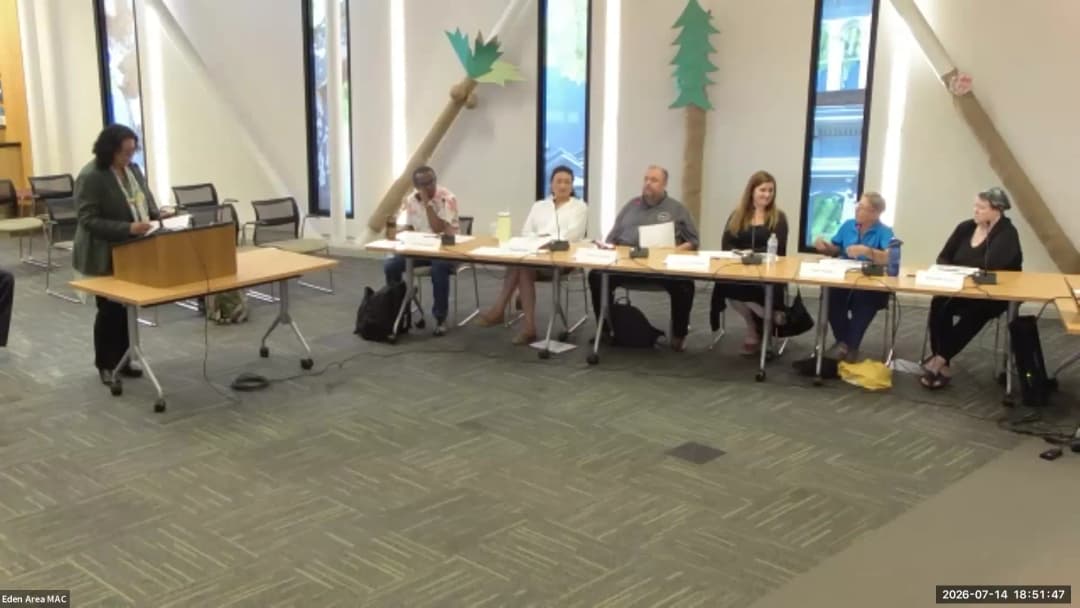
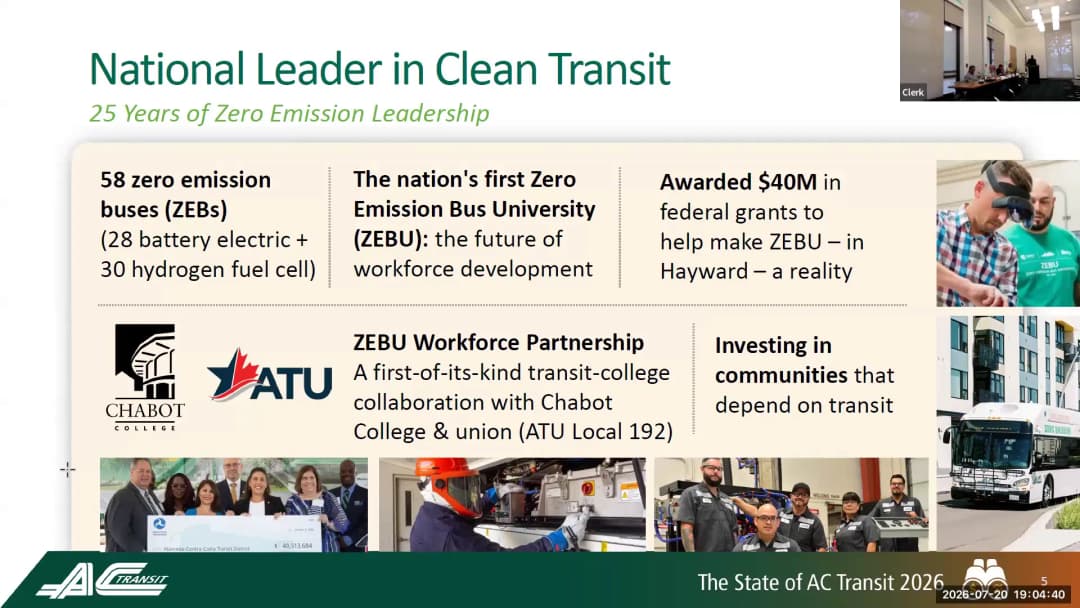
The Eden Area Municipal Advisory Council (MAC) held a regular meeting on July 28, 2026, at the San Lorenzo Library. The meeting included an informational update from AC Transit on its budget and service outlook, and an action item on a proposed Taco Bell drive-in restaurant. The council also approved the June 9, 2026 minutes and heard public comments. Consent Calendar - Approval of June 9, 2026 Minutes: The minutes were approved with 4 ayes, 1 abstention (Councilmember Marumahoka was absent), and 1 excused (Vice Chair Aston-Nielsen). No public comments were made on the minutes. Public Comments & Testimony - Fire Department Update (Non-Agenda Public Comment): Aaron Penfelio, Alameda County Fire liaison, reported May 2026 call statistics: 743 total calls (54 fire, 455 EMS, 10 non-fire, 18 service, 97 good intent, 38 false alarms, 71 other). No questions were asked. - Taco Bell Item (Public Comment): A community member, Randy, spoke in support of the Taco Bell, citing convenience, economic development, and the loss of previous nearby Taco Bells. No other public comments were made on this item. Discussion Items - AC Transit Budget & Service Update (Informational): Murphy McCalley (AC Transit Board Vice President), Diann Castleberry, and Owen Christofferson presented on AC Transit's financial challenges. Key points: - AC Transit operates a $606 million operating budget (capital separate), serves 141,000 weekday riders, and provides 30,000 student trips daily. - A projected $200 million deficit over four years (annual gap of $50 million starting in 2027) could force up to 16% service reductions and 300 layoffs. - A state bridge loan of $55 million closes the current gap but must be repaid. - The Connect Bay Area Act (November 2026 ballot) would impose a half-cent sales tax in five counties, giving AC Transit $52 million annually to avert cuts. - A contingency service plan proposes frequency and span reductions on lines 9, 97, and neighborhood routes, but would only take effect if the measure fails. - Council members asked about fare increases (25 cents on July 1, 2026, approved three years ago), student trip subsidies, Easy Pass programs, and coordination with development. Chair Cushman noted paratransit dependency and encouraged public awareness. - PLN2025-00203, Taco Bell Drive-In Restaurant (Action Item): Christine Greene (Planning Department) presented a proposal for a 1,600 sq ft drive-in Taco Bell at 20200 Hesperian Blvd. The project is CEQA-exempt (Class 3). Key aspects: - Hours: 8 a.m. to 1 a.m. daily; a condition requires limiting delivery hours to 8-11 a.m. and 2-5 p.m. to reduce noise. - Noise mitigation: sound wall on rear property line, speaker facing away from residences, signage encouraging quiet. - Parking: 9 spaces (exceeds required 5). - The site is within the Hesperian Boulevard Drive-In Policy (amended 2025) allowing up to 5 drive-ins; this is the first application. - One letter of opposition from a neighboring business (traffic/noise concerns). - Council discussion centered on residential impact, privacy, and traffic. Councilmember Taylor proposed a motion to approve with conditions: a 12-foot fence (instead of proposed 6-foot) and restricted delivery hours. The motion passed unanimously for both the Conditional Use Permit (CUP) and the Site Development Review (BZA) components. Key Outcomes - Minutes Approved: June 9, 2026 minutes approved (4-0-1-1). - AC Transit Update Received: Informational; council encouraged community input on the contingency plan and the November ballot measure. - Taco Bell Approved: Both the Conditional Use Permit and Site Development Review were approved unanimously (5-0, with Vice Chair excused). Conditions include a 12-foot fence and delivery hours limited to 8-11 a.m. and 2-5 p.m. - Next Meeting: Scheduled for August 11, 2026.

TRANSPORTATION SAFETY 31% · LAND USE PLANNING 24% · PROCEDURAL 11% · ECONOMIC DEVELOPMENT 8%
45
JUL 23, 2026 · ALAMEDA COUNTY, CALIFORNIA · BOARD OF SUPERVISORS
Sunol Community Advisory Council Meeting – July 23, 2026

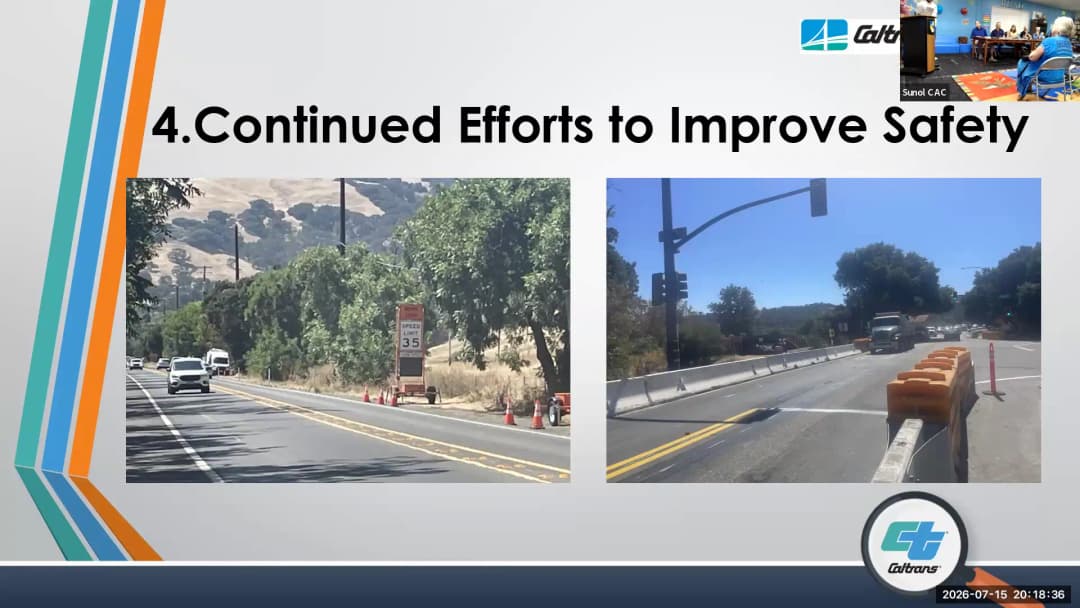
The Sunol Community Advisory Council (SCAC) met on July 23, 2026 at 10:00 AM. The meeting covered updates from the Sheriff and Fire departments, a presentation on expanded waste collection services (SB 1383), a request for funding for wayfinding signs, a proposal for community event support from the Sunol Business Guild, and a detailed discussion with Caltrans regarding the bridge construction project and the removal of a tree near the historic water temple gates. The council also approved a formal letter to Caltrans concerning environmental and historical preservation commitments. Public Comments & Testimony - A speaker thanked Rob Tillmans and praised Connie's (presumably a council member or resident) letter to Caltrans, noting the extensive background work and research behind it. - Another speaker expressed support for using Rosenberg's Rules of Order in meetings and encouraged the council to adopt them. Discussion Items Waste Collection Update (Item 4A) Andy Schneider, Waste Program Manager for the County Planning Department, presented the county's plan to comply with Senate Bill 1383 (Short-Lived Climate Pollutants Reduction Act). Key points: - The new County Collection Service Zone Two will include Sunol, Castlewood, Happy Valley, Little Valley, Sheridan Road, and Andrade Road. - Mandatory three-container service (garbage, recycling, organics) will be implemented, with a self-haul certification option for residents who do not want curbside collection. - Current PGS customers will automatically receive expanded services: recycling and organics carts, three free bulky item collections annually, curbside used motor oil collection, holiday tree collection, and free drop‑off of up to seven cubic yards of yard trimmings at the transfer station. - Rates: 35‑gallon garbage cart increases 12.3% to $49/month; 96‑gallon cart sees a 3.4% reduction. Castlewood will see different adjustments. - The Board of Supervisors will consider the recommendation on August 4, 2026. Notices to residents will be mailed shortly, with additional container delivery in October. - Council members asked about self‑haul certification, disposal of animal mortalities, and the potential for container screening to address road safety and aesthetics. Wayfinding Signs (Item 4C) A representative presented a request for $29,382.15 from community improvement funds to fabricate and install three remaining wayfinding signs, completing a system of four signs that highlight Sunol's historic features and improve pedestrian navigation. The prototype sign has been installed and received positive feedback. The signs are designed to last 20+ years with low maintenance; ongoing maintenance will be funded through sales of coordinating house number signs. The motion to approve the funding passed unanimously (4–0). Sunol Business Guild Fundraising Event (Item 4D) Vina and Michael Miller from the Sunol Business Guild requested $1,000 from the community improvement fund to support a free community event, "Stroll in Sunol: Picnics and Paws," scheduled for August 22, 2026. The event aims to raise funds for community programs (scholarships, school support, etc.) and has already secured $2,500 from Supervisor David Haubert's office and donations from local businesses. Some council members questioned whether the fund should be used for fundraising events rather than tangible improvements. The discussion was tabled because the council does not meet again until September, after the event. No vote was taken; the guild was advised to seek clarification on allowable uses of the fund. Caltrans Bridge Project & Letter to Caltrans (Item 4E and subsequent presentation) The council discussed a letter drafted by Councilmember Connie (assumed) regarding the removal of a tree and changes to the project design near the historic water temple gates without prior consultation with the State Historic Preservation Office (SHPO). Multiple speakers expressed strong opposition to the tree removal, citing environmental and aesthetic harm. The council voted to send the letter to Caltrans, requesting a halt to work in the area, consultation with SHPO, and a detailed explanation of project changes. The motion passed (4–0). Caltrans representatives then gave a presentation on the bridge project. Key points: - The bridge replacement will provide a wider, safer structure with ADA sidewalks and a bike lane. - Construction is constrained by a work window from June 1 to October 15 due to environmental restrictions in the creek. - The shuttle service for pedestrians during construction was halted due to minimal usage (1–2 riders) but remains available upon request. - Regarding the tree removed near the water temple gates: Caltrans stated the tree conflicted with the planned relocation of a signal pole, which was part of the approved design. They claimed SHPO had cleared the work. Council members expressed frustration that the change from the environmental phase to the design phase was not communicated to the community. Caltrans agreed to provide a formal written response to the council's letter and offered to hold monthly community updates. - Caltrans also noted that the area near the gate will not be further disturbed; only the signal pole will be installed. No additional tree removal is planned. - Council requested that a potential 55‑hour closure (currently under consideration for September) avoid the weekend of October 27, and Caltrans agreed to work around that date. Key Outcomes - Wayfinding signs: Approved (4–0) for $29,382.15 from community improvement funds. - Letter to Caltrans: Approved (4–0) to demand consultation, project transparency, and preservation of historic resources. - Minutes of June 17, 2026: Approved (4–0). - Business guild funding request: No action taken; will be revisited after clarification of fund guidelines. - Caltrans bridge project: Caltrans will respond to the letter, provide monthly construction updates, and consider community requests regarding closures and tree preservation.

ENGINEERING AND INFRASTRUCTURE 21% · PUBLIC ENGAGEMENT 17% · WASTE MANAGEMENT 12% · PUBLIC SAFETY 9%
46
JUL 23, 2026 · ALAMEDA COUNTY, CALIFORNIA · BOARD OF SUPERVISORS
Alameda County PAL Committee Meeting - July 20, 2026

The Personnel/Administration/Legislation (PAL) Committee of the Alameda County Board of Supervisors met on Monday, July 20, 2026, at 1:30 p.m. Supervisors Lena Tam (Chair) and Nikki Fortunato Bas were present (quorum). The committee received federal and state legislative updates, discussed the new federal public charge rule, and voted unanimously to oppose an interim final rule on Medicaid community engagement requirements. Federal Legislative Update - Emily DeSilva and Curtis Erdman (The Picard Group) provided an update. Key points: - House plans to leave for August recess at end of week; Senate in session through August 7. - House Rules Committee to write a rule covering four bills: National Defense Authorization Act (NDAA), a clean continuing resolution (CR) to December 4, a budget resolution ("3.0") unlocking reconciliation, and a stock trading ban. - The budget resolution authorizes $95 billion with no offsets, facing opposition from fiscal hawks. President Trump urged support. - NDAA expected to pass on party lines; the clean CR has support from Freedom Caucus chair. - The budget resolution includes $73 billion for military/intelligence (mainly for Iran war), $12 billion for farmer aid, and $10 billion for election security grants tied to the Save America Act. - Senate Majority Leader Thune indicated the budget resolution likely lacks Senate votes. - Senate plans to consider nomination of Jay Clayton for Director of National Intelligence; confirmation uncertain this week. - Senate Republicans are working on their own CR, signaling likely rejection of House clean CR, leaving FY27 funding unresolved. - Final public charge rule published in Federal Register July 20, effective September 18. County submitted comments in November. Rule expected to face lawsuits; chilling effect on benefit applications is a major concern. - Supervisor Bas expressed frustration that large sums go to war instead of basic needs, and noted elections matter. She asked about litigation as the main recourse; DeSilva confirmed litigation is expected and agencies may issue further guidance. - Supervisor Bas also asked about election security funding in the context of the Save America Act; DeSilva explained the reconciliation approach is unlikely to pass the Senate. State Legislative Update - Vanessa Flores (Full Moon Strategies) provided the state update: - Governor Newsom signed most remaining budget trailer bills. Notable bills: - SB 172: Permanent funding for California's Farm to School program. Since 2021, $86 million invested in 327 projects, benefiting 49% of public school students, 80% of grant recipients are Title I schools. - SB 168: New light-duty zero-emission vehicle incentive program. First-time EV buyers get instant rebate of $3,500 for new vehicle (MSRP up to $50,000) or $1,750 for used (up to $25,000). State dedicates $135.5 million, requires automaker dollar-for-dollar match. - SB 180: Extends California Competes program through taxable years before Jan 1, 2035 (capped at $100 million annually) to encourage business expansion. - AB 179: Housing development finance committee bond and tax credit reservation; implements parts of governor's reorganization plan, eliminates Business Consumer Services and Housing Agency (effective July 1, 2026), creates new Housing and Homeless Agency, makes targeted changes to housing programs. - California Health and Human Services Agency released a joint statement on the federal public charge rule, expressing concern about confusion and chilling effect; they will post more information and provide a list of nonprofit organizations on the California Department of Social Services website. - Supervisor Bas asked about progress on the public hospital allocation of $250 million and draft guidance on distribution. Flores offered to follow up. Legislative Position Request (Action Item) - The committee considered a request from Alameda County Social Services Agency and Alameda County Health to oppose CMS-2454-IFC, an interim final rule on Medicaid community engagement requirements. Supervisor Bas noted the rule would increase coverage loss and tighten criteria for medically frail individuals. - Supervisor Bas moved to advance the opposition to the full Board of Supervisors; Supervisor Tam seconded. No public comment. - Roll call: both supervisors voted aye. Motion passes. Public Comments - No public comments were received on the federal update, state update, or items not on the agenda. Key Outcomes - The committee unanimously voted to recommend that the full Board of Supervisors oppose the interim final rule CMS-2454-IFC (Medicaid community engagement requirement). - The committee received informational updates on federal and state legislative developments. - The meeting adjourned without further action.

FEDERAL LEGISLATION 54% · STATE LEGISLATION 18% · IMMIGRATION POLICY 12% · PROCEDURAL 7%
47
JUL 22, 2026 · ALAMEDA COUNTY, CALIFORNIA · BOARD OF SUPERVISORS
Alameda County Procurement & Contracting Committee Quarterly Update - July 22, 2026

The Procurement and Contracting Committee met on July 22, 2026, at 5:45 PM, with Supervisors Marquez and Miley present, forming a quorum. The meeting initially paused briefly to fix a non-working Zoom link. Key updates included GSA's quarterly procurement report, a 12-month contract outlook, and the Measure A1 labor and contract compliance pilot program report. Discussion Items - GSA Informational Update (Item 1A): Director Kimberly Gasway presented GSA's procurement and contracting report for Q1 2026 (January 1 to March 31, 2026). Highlights: 11 formal procurements totaling $7.9 million; 62% awarded to local/SLEB vendors; 59% to certified SLBs. Sole source approvals: 151 ($14.5 million), including 69 exceptions ($6.7M) and 82 exemptions ($7.8M). 29 piggyback approvals ($7.6M). SLB waivers: 245 ($32.1M total; 35% to local firms). The Project Stabilization and Community Benefits Agreement labor report showed cumulative countywide local hire at 50.55% (exceeding 40% goal), apprentice hours at 16% (below 20% state requirement), and disadvantaged resident apprentices at 40% (meeting goal). Supervisor Miley asked about consistently low apprentice hours on public works projects; Director Gasway noted vendors meet with the Joint Advisory Committee (monthly) and receive corrective action letters. Deputy County Counsel Kathy Lee clarified that state law makes the prime contractor responsible for apprenticeship compliance. Supervisor Marquez asked about unbundling; Procurement Administrator Dietra Dillon said GSA advises client departments but decisions rest with them. Supervisor Miley requested the next quarterly report include unbundling examples. - 12-Month Outlook Report (Item 1B): Dietra Dillon presented GSA's forecast: 207 single/multi-vendor contracts expected; 90 await department instructions (potential unbundling opportunities), 47 in rebid, 17 no longer needed, 24 extending for time, 8 increasing funds only, 6 departments self-conducting rebids. Supervisor Miley asked about countywide visibility beyond GSA; agreed to coordinate with Health and Social Services departments to include their projections in future reports. Specific contracts noted: shuttle bus service (ending 3/31/2027); concern flagged about Santa Rita Jail shuttle ending 12/31/2026. Supervisor Marquez requested next meeting update on unbundling data. - Measure A1 Labor and Contract Compliance Pilot Program (Item 2): Anna Olivia (Compliance Program Lead) presented the ninth report. Since Measure A1's 2016 approval, 54 rental housing projects (4,206 homes) received funding; 35 completed, 12 under construction, 7 in pre-development. $3.3 billion total construction activity catalyzed (1:7.4 leverage). All local contracting goals met/exceeded: local businesses awarded $1.19B (over 392% of A1 investment); small local businesses awarded $135M (nearly 47%). Minority-owned businesses: $36.5M (29% local); women-owned: $16.3M (21.5% local). Supervisor Marquez requested future reports include geographic mapping and clear distinction between A1 and Measure W funding on mixed-funded projects. Staff noted a new interactive website is launching within a month. Supervisor Miley asked for resident demographic data (seniors, veterans, formerly incarcerated); Asset Management team can provide data after a database transition (estimated 6 months). The next report will cover workforce demographics and job creation. Public Comments & Testimony - No public comments were made on any agenda item. Key Outcomes - GSA will provide unbundling examples and improved data at the next quarterly update. - The 12-month outlook report will be expanded to include projections from Health and Social Services departments. - The Measure A1 team will present a future report with resident demographic data and a geographic map of projects. - A discussion was initiated about improving public communications and addressing inaccurate media coverage. - The meeting adjourned without other business.

PROCUREMENT AND CONTRACTING 41% · AFFORDABLE HOUSING 20% · PUBLIC ENGAGEMENT 10% · LABOR NEGOTIATIONS 9%
48
JUL 22, 2026 · ALAMEDA COUNTY, CALIFORNIA · BOARD OF SUPERVISORS
Castro Valley Municipal Advisory Council Meeting – July 22, 2026

The Castro Valley Municipal Advisory Council (MAC) held its regular meeting on July 22, 2026, at 2:15 PM (Pacific). The meeting included routine approvals, public comments on non-agenda items, staff reports from law enforcement and fire services, council member introductions, a presentation on the upcoming Castro Valley Car Show, and a detailed update from AC Transit on its budget crisis and contingency service plan. The council also addressed concerns about the previous meeting’s minutes. Consent Calendar - No consent calendar items were listed or acted upon. Public Comments & Testimony - Jim Silva (general contractor) expressed strong opposition to Alameda County’s business licensing process, calling it the most difficult he has encountered. He specifically objected to the requirement to submit tax returns, citing data security risks and noting that no other city he works in demands tax returns. He urged the MAC to use its influence to streamline the process and eliminate the tax return requirement. - Ken Carboni raised two issues: (1) the long‑delayed replacement of public trash enclosures on Castro Boulevard, and (2) repeated frustration with the business license process, calling it an “embarrassment” for the community and stating that the county’s approach undermines efforts to attract businesses. He noted that the tax return requirement is unsecure and that the county has been unresponsive despite multiple prior discussions. - Officer Jennifer Pabst (CHP) reported traffic enforcement statistics for June 2026 in the Castro Valley area: 285 traffic citations, 5 DUI arrests, 3 misdemeanor arrests, 9 injury crashes, 35 non‑injury crashes, and 26 vehicles towed. She noted that numbers are down from previous months and that no fatal crashes occurred during the 4th of July enforcement period. She also mentioned ongoing enforcement on Parsons Avenue and stop‑sign enforcement on Seven Hills, and reminded the public about National Night Out and other upcoming events. - Aaron Penfilio (Alameda County Fire) reported May 2026 call totals for Castro Valley: 606 total calls of service, including 28 fire‑related, 356 EMS/medical, 4 non‑fire (gas leak), 15 service calls, 108 good‑intent calls, 16 false alarms, and 79 other calls. He also provided an update on a fire that occurred that day, contained at 6.2 acres at the intersection of Norris and Crow Canyon. Councilmember Mulgrew praised the multi‑agency response as “phenomenal.” Discussion Items - Approval of Minutes (May 18, 2026): Councilmember DeVinny expressed concern that the minutes did not fully capture the discussion, particularly regarding the Office of Unincorporated Communities. Councilmember Davis agreed, requesting that names of public speakers and a more detailed summary be included. A motion to continue the minutes to a future meeting was made, seconded, and passed unanimously (Councilmember Davis and Mota excused). - Council Member Introductions: Each member gave a brief personal background to help the community become familiar with them. Introductions were made by: Dan DeVinny (longest resident, CPA, coach), Tim Feebig (real estate broker, community volunteer), Tojo Thomas (24‑year deputy probation officer, safety background), Chuck Moore (grocery industry executive, equestrian center owner, 50‑year resident), Ray Davis (traffic engineer, presented by Chair Mulgrew), and Bill Mulgrew (marketing, stockbroker, chamber of commerce, rental housing executive). - Castro Valley Car Show Update: Craig Semmelmeyer (Castro Valley Rotary Club) reported that the 19th annual car show will be held on the Saturday before Father’s Day. The event uses 120 volunteers, has a $45,000 budget, and generates a net profit of about $20,000 annually for the Castro Valley Endowment Fund, which supports scholarships. Approximately 20,000 people attended this year, and there was a waiting list of 400 cars. Semmelmeyer noted challenges with unlicensed street vendors and asked for stronger enforcement from Code Enforcement and the Sheriff’s Office. Councilmember DeVinny suggested coordinating with those agencies prior to the event, as was done successfully for the Row Ranch Rodeo Parade. Councilmember Thomas asked about vendor permits. Vice Chair Moore inquired about economic impact on local businesses; Semmelmeyer said some businesses report their best day of the year while others see disruption, and the club is working to drive foot traffic into stores. - AC Transit Budget and Services Update: Director Murphy McCauley (Ward 4 representative), Diane Castleberry (finance), and Owen Christofferson (transportation planner) presented. AC Transit is the largest public bus‑only system in California, with a $606 million annual operating budget, 2,200 employees, and about 3 million monthly riders. Ridership is at 85% of pre‑COVID levels (141,000 weekday passengers). The agency faces a projected $200 million deficit over four years, with a $50 million annual funding gap starting July 2027. A state bridge loan of $55 million will close this year’s gap but must be repaid. A regional transit measure (Senate Bill 830) on the November 2026 ballot would impose a half‑cent sales tax (one cent in San Francisco) to generate $980 million annually; AC Transit would receive about $52 million per year. If the measure fails, a contingency plan would cut service by up to 16%, reducing frequencies on Castro Valley routes (28, 35, 93) from 40 to 60 minutes and trimming hours of operation (e.g., Route 35 and 93 would run 7 AM–7 PM instead of 6 AM–11 PM). McCauley emphasized that student transportation would not be cut. Councilmembers questioned cost per ride ($15, with fares covering only 7%), labor costs (70% of operating budget), potential alternatives such as microtransit or consolidation, and the need for innovative solutions. The MAC expressed concern about the financial cliff but appreciated the detailed presentation. No action was taken. Key Outcomes - Minutes: The May 18, 2026 minutes were continued to a future meeting pending revisions to better reflect the discussion and include speaker names. - Car Show: The MAC received the car show update and offered support for stronger enforcement against unlicensed vendors. No formal vote was taken. - AC Transit: The presentation was received and discussed. The MAC encouraged AC Transit to explore outside‑the‑box solutions and to communicate a positive vision for the future. The council urged community members to support the regional transit measure on the November 2026 ballot. - Public Comments: The MAC will follow up on the business license process and trash container replacement issues with Alameda County staff. - Adjournment: The meeting was adjourned at 8:31 PM.

TRANSPORTATION SAFETY 40% · COMMUNITY ENGAGEMENT 20% · PUBLIC SAFETY 11% · PROCEDURAL 7%
49
JUL 21, 2026 · ALAMEDA COUNTY, CALIFORNIA · BOARD OF SUPERVISORS
Alameda County Elections Commission Meeting – July 21, 2026

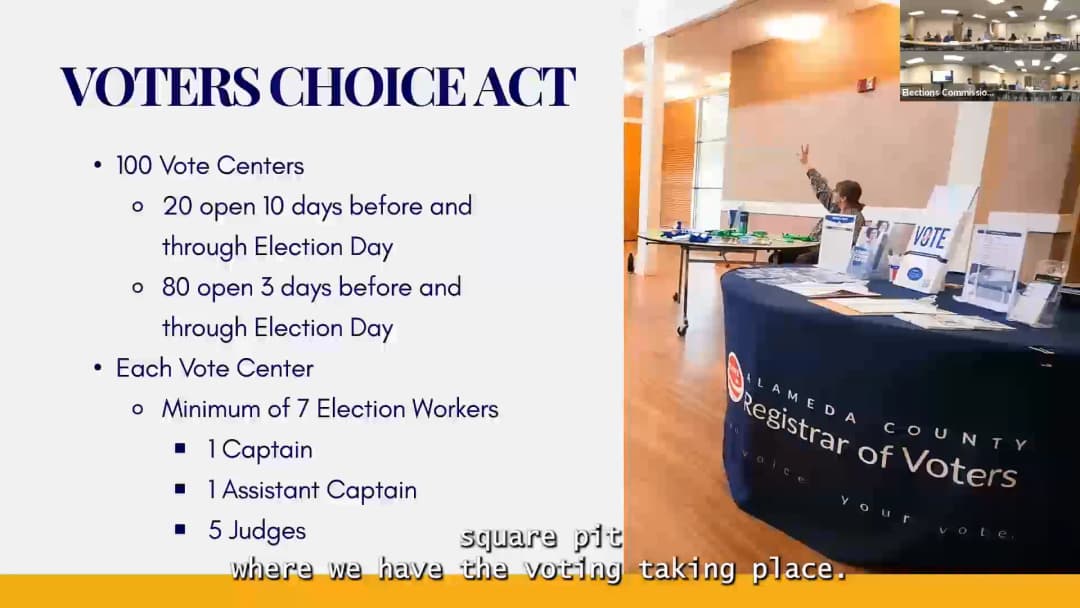
Note: The meeting transcript indicates the meeting took place on July 16, 2026, but the provided meeting date is July 21, 2026. This summary uses the provided date, but the discrepancy is noted. The Alameda County Elections Commission convened at 12:00 PM (PDT) with a quorum present. The meeting covered routine approvals, updates from the Registrar of Voters (ROV), reports from ad hoc committees, and several operational items regarding election administration and voter protection. Consent Calendar - Approval of meeting minutes: The minutes were approved by a vote of 7 yes, with one abstention (Commissioner Henderson abstained). Public Comments & Testimony - No public comments were made on non-agenda items or on the specific agenda items discussed (rules and procedures, post‑election assessment, email protocols, public records, voter protection, and election workers). Discussion Items - Announcements & Communications: Staff announced the special general election for the 14th Congressional District (scheduled for August 18) and the start of the November 3 statewide general election candidate nomination period. Commissioner Lindsay noted openings on voting rights organizations and suggested forming a nominations committee; she also raised the possibility of a future agenda item to allow the body to schedule items by motion. - Monthly Update – Voting by Mail at Vote Centers: The ROV described a new process allowing voters to bring their vote‑by‑mail ballot to a vote center, check in, and deposit it without an identification envelope. Voters may also receive a replacement ballot if needed. The procedure was piloted in the June election and will continue. Commissioners expressed support. - Ad Hoc Committee Reports: - Voting Participation Committee (Commissioner Seabrook): Continued collaboration with the Alameda County Labor Council; a data analysis request has been submitted to Columbia Legal Counsel, broken down by jurisdiction, ethnicity, and elections (last two to six). Age was not included to keep the request manageable. - Youth Participation Committee (Commissioner Butter): Did not meet; no report. - Budgeting for Elections Committee (Commissioner Wagner): The committee met and decided to learn more about the ROV budgeting process. Language about ballot‑issue cost thresholds (four or more issues) has been posted on the website and shared with city clerks. - Rules and Procedures Committee (President Dieter): Presented revisions aiming to make the rules more durable and less prescriptive. Extensive discussion ensued regarding Brown Act compliance, remote participation, quorum, and agenda materials. The commission decided to bring the draft back next month for further review rather than approve it immediately. - June Post‑Election Assessment: The assessment, previously discussed, was approved unanimously. Commissioner Lindsay proposed an amendment regarding proactive notification to election observers, but after discussion (including ROV explanation of operational challenges), the original language (incremental improvements) was retained. - Response Protocols to Email Inquiries: The ROV described a new “Contact Us” web form with drop‑down categories and dedicated mailboxes for vote‑by‑mail, registration, media, city clerks, etc. The system includes CAPTCHA to reduce spam. Commissioners praised the improvement and requested a follow‑up in six months. - Public Record Act Requests Portal: The ROV reported that a tracking portal is in place, with weekly team meetings. Requests are logged and color‑coded to monitor deadlines. Median response time was not provided, but the system ensures compliance with legal timelines. - Voter Protection: The ROV updated on coordination with the Secretary of State’s office, local law enforcement, and planning for potential voter intimidation or weapons at vote centers. An active drop‑box issue in Alameda (near demonstrations) was addressed by stationing outreach staff at a nearby library. Commissioners raised questions about protection for election workers and historical incidents of electioneering. - Special Report – Temporary Election Workers at Vote Centers (David Pink, Election Division Manager): Alameda County operates under the Voters Choice Act with 100 vote centers (20 open 10 days, 80 open 3 days). Each center has 7 workers (captain, assistant captain, 5 judges). For the June statewide direct primary, 906 workers served. Training includes online and in‑person components on equipment, voter processing, and accessibility. Student election worker program requirements: age 16+, U.S. citizen or permanent resident, GPA 2.5. Bilingual support is provided for five main languages plus additional languages via interpretation phone line. Key Outcomes - Approved: Meeting minutes (7‑0‑1). - Approved: June post‑election assessment (unanimous). - Deferred: Rules and procedures revision (to be brought back next month). - No action taken: On email protocols, public records portal, voter protection, and election worker report (informational only). - Next steps: The rules committee will incorporate feedback on Brown Act language and return; the ROV will provide a future update on email inquiry system performance; the voter participation committee awaits data from Columbia Legal Counsel; the budgeting committee will schedule a meeting with the ROV. The meeting was adjourned at 6:10 PM.

ELECTIONS ADMINISTRATION 57% · PUBLIC ENGAGEMENT 14% · PROCEDURAL 11% · PUBLIC SAFETY 6%
50
JUL 17, 2026 · ALAMEDA COUNTY, CALIFORNIA · BOARD OF SUPERVISORS
Alameda County Together for All Ad Hoc Committee Meeting - July 17, 2026

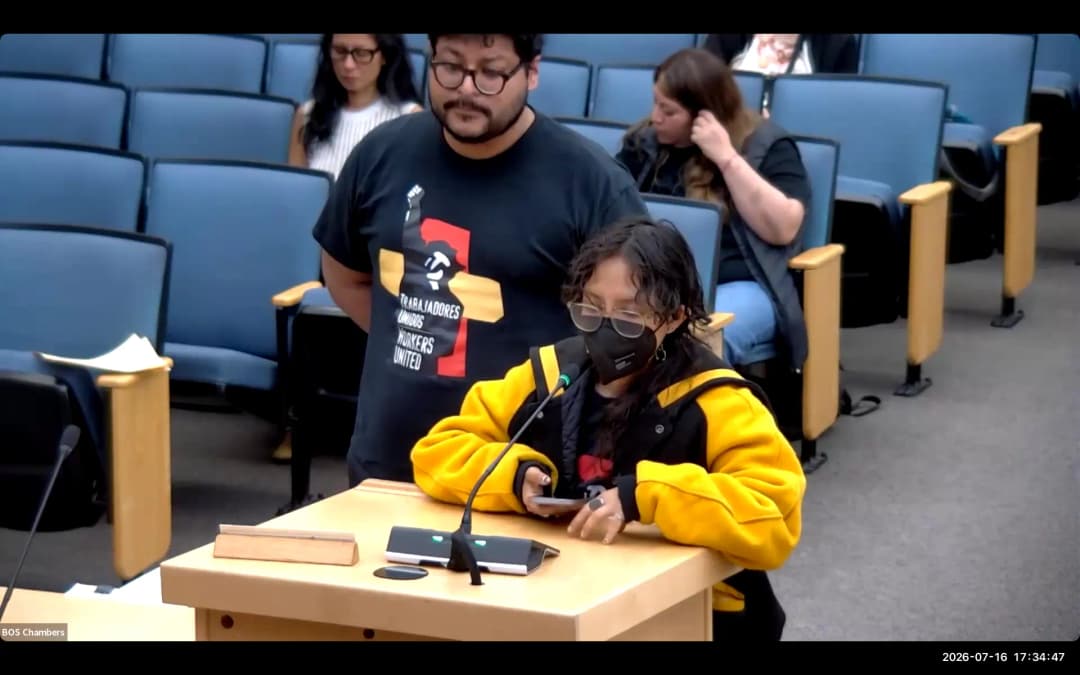
The Alameda County Together for All (Act for All) Ad Hoc Committee convened on July 17, 2026, at 11:15 AM to monitor the impacts of federal immigration enforcement on county residents and to coordinate proactive responses. The meeting opened with a moment of silence for five individuals who died in ICE-related incidents in the preceding week, bringing the total to 22 deaths in immigration detention this calendar year. Supervisors Nikki Fortunato Bas and Lena Marquez led the session, which included updates on state guidance, a legal landscape presentation, county ICE-free zone implementation, and reports from three community coalitions. The board announced a planned extension of coalition contracts through June 2027 and outlined a forthcoming request for proposals (RFP) for sustained immigrant and refugee services. Public Comments & Testimony - Thirteen speakers provided public comment, largely representing community organizations and impacted families. - Multiple speakers from Trabajadores Unidos Workers United and ACUDIER urged the board to continue funding the three coalitions (A-CLIP, Accord, ACUDIER) and to create an Office of Immigrant and Refugee Affairs. - Speakers highlighted the need for additional funding for Southeast Asian and African immigrant communities, citing language access gaps and a 900% increase in ICE detentions of Southeast Asians since 2025. - A family member testified that her husband, Fernando Cruz Sanchez, was kidnapped by ICE on July 11 without a warrant, leaving her and their children in distress. - The Alameda County Office of Education reported that ICE has detained over 650 California children between October 2025 and March 2026, and that they have distributed more than 100,000 red cards in seven languages at 70 schools. - Several commenters requested that the RFP process include input from frontline organizations and that multi-year funding be provided to avoid disruption. Discussion Items 1. Guidance on SB 580 (Safe and Secure Government Access) - A representative from the California Attorney General’s office was unexpectedly unable to attend. Supervisor Fortunato Bas summarized the five core principles of SB 580: (1) state and local resources should not assist immigration enforcement except as required by law; (2) limit collection and disclosure of information that could identify undocumented individuals; (3) require judicial warrants before complying with requests; (4) direct all inquiries to designated legal staff; and (5) document all interactions with immigration authorities. The webinar recording is available at OAG.ca.gov/care/community-briefings. 2. Immigrant and Refugee Rights Landscape Update (Immigrant Legal Resource Center) - Managing Attorney Jayhan Lehner presented four key threats: - Loss of legal status: termination of legal pathways, travel bans, and adjudication pauses; the Supreme Court recently ended TPS for certain groups. - Aggressive enforcement: targeted arrests at courts, check-ins, and workplaces; random arrests via traffic stops and racial profiling. In the Bay Area, targeted arrests have increased, but random arrests remain lower due to the absence of a local detention center. - Expanded detention infrastructure: California City now has the largest ICE detention center in the state (2,500 beds). Threats include the proposed repurposing of FCI Dublin (900 beds) and a new processing center in Gilroy. The county board passed a resolution opposing FCI Dublin’s use for immigration detention. - Fast-tracked deportations: the Board of Immigration Appeals has issued biased rulings limiting relief, and immigration courts are rejecting applications on pretextual grounds. - Lehner emphasized the need for continued data privacy protections, especially regarding automated license plate readers (FLOCK cameras), and for maintaining rapid response networks. 3. County ICE-Free Zones and Readiness Plans Update - Marita Semora, Director of Human Resource Services, reported that meet-and-confer with all employee organizations concluded on July 3, and countywide employee guidelines for responding to immigration enforcement were issued on July 8. An online training program was launched; as of the meeting, over 100 employees had accessed it. The training is not mandatory but will be strongly encouraged via a second email blast. - Kimberly Gasway, Director of General Services Agency, stated that 96 signs have been installed at county-owned or leased properties, fire district properties, and surplus property authority sites. The signs read: "This property is owned or controlled by the County of Alameda. It may not be used for any civil immigration enforcement activity, including staging area, processing location, or operations base." - Supervisor Marquez noted that the employee guidelines prioritize safety, immediate notification of supervisors, knowledge of rights, and documentation. A communication protocol for executive-level notification in the event of ICE enforcement was also outlined, including notifying the mayor, city manager, and the Social Services Agency to coordinate community resources. 4. Coalition Overviews (A-CLIP, Accord, ACUDIER) - A-CLIP (Alameda County Legal and Immigrant Protection): Co-led by Centro Legal de la Raza and partners. Provided 8,500 know-your-rights trainings, distributed 25,000 red cards, verified 120 reported sightings, facilitated 85 accompaniments, filed 75 substantive legal filings (including habeas petitions with 100% success rate), and secured the release of over 50 clients from custody. The hotline now operates seven days a week, 6 AM to 6 PM, following expansion in October 2025. A new community care component supports families post-arrest. The coalition recently added a partnership with Jewish Family and Community Services. - Accord (Alameda County Coalition for Removal Defense): Lisa Knopps, director of the California Collaborative for Immigrant Justice, reported that the coalition expanded from 4 to 8 organizations. In the first year, they served nearly 1,000 community members, far exceeding targets. In the most recent quarter, they provided 2,000% of their target for community education events. Roughly one-third of clients were in ICE detention. The coalition has focused on serving detained residents, with 23 emergency legal consultations for Southeast Asians facing deportation. A PILO filed habeas petitions that stopped the deportation of two brothers. Accord emphasized the need for continued funding and an Office of Immigrant and Refugee Affairs to improve data sharing and referral systems. - ACUDIER (Alameda County United in Defense for Immigrant Rights): Represented by Trabajadores Unidos Workers United. Reported 56 community members developed as leaders, 12,500 materials distributed, and 37 impacted individuals and families connected to resources. The coalition has grown to include five new organizations serving AAPI and youth communities (e.g., Asian Health Services, Asian Prisoner Support Committee, Center for Empowering Refugees and Immigrants). Trends observed include pressure to sign self-deportation, poor detention conditions, wage theft, and food insecurity. In the last two months, three community members were kidnapped in Eden area; four more were kidnapped in the past week in Berkeley, Hayward, Castro Valley, and Livermore. ACUDIER called for emergency relief for impacted families and long-term funding. Key Outcomes - Contract Extensions: Supervisor Marquez announced that the three coalition contracts (A-CLIP, Accord, ACUDIER) will be extended through June 2027. The Social Services Agency and Interim Office of Immigrant and Refugee Affairs will develop an RFP for a competitive procurement process, expected to be released in no less than four months. The goal is to sustain and expand services while addressing gaps, particularly for Southeast Asian and African immigrant communities. - Board Direction: The board will receive a full presentation on the Immigrant and Refugee Affairs Office implementation study at a work session on July 28, 2026, at 3:00 PM. The board approved $3.3 million for this fiscal year from Measure W Essential Services Fund for immigrant and refugee support. - Data and Inclusivity: Supervisors called for improved data collection on demographic trends, including loss of work authorization, and for protocols to ensure that families of individuals taken by ICE are quickly connected to support, even if not reported to the hotline. Additional outreach to AAPI and African immigrant communities was urged. - Regional Opposition: The board expressed continued opposition to the proposed FCI Dublin detention facility and the Gilroy processing center, and will consider joining amicus briefs. - Volunteer and Resource Coordination: ACUDIER’s monthly coalition meetings (Wednesdays at noon) and anti-deportation organizing committee were highlighted as entry points for volunteers. The Stand Together Bay Area Fund (San Francisco Foundation) remains a resource for direct financial assistance. - Adjournment: The meeting was adjourned in memory of Lorenzo Salgado Araujo, Johan Sebastian Guerrero, and Jesus Manuel Arenas Silva, who died in ICE-related incidents the week of July 10–17, 2026.

IMMIGRATION POLICY 74% · PUBLIC SAFETY 6% · PROCEDURAL 4% · PUBLIC ENGAGEMENT 3%
OPENPUBLICA · PUBLIC MEETING INDEXUPDATED DAILY · openpublica.com