Browse by city
Date range
Search help

Search titles, summaries, topics and stored transcripts together. Keywords may match separately; put the whole query in double quotes for a phrase. Matching follows word analysis, so punctuation is not exact. Both dates are included. Documents are not searched.

SHOWING 21–30 ENTRIES
21
SEP 16, 2026 · ALAMEDA COUNTY, CALIFORNIA · BOARD OF SUPERVISORS
Alameda County Board of Supervisors Meeting – September 16, 2026

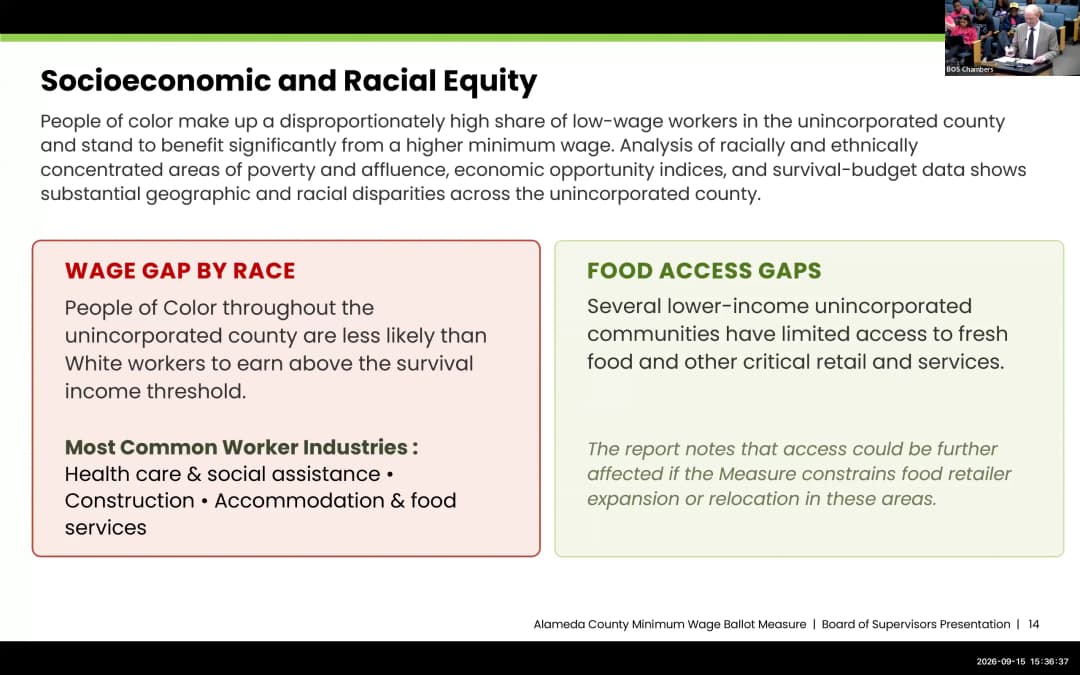
This summary covers the Alameda County Board of Supervisors meeting that began on Tuesday, September 15, 2026, according to the agenda and transcript, but the provided timestamp indicates the meeting took place on September 16, 2026. The meeting included a closed session, approval of a large consent calendar, and a set matter at 3:00 PM regarding a voter-initiated minimum wage ballot measure for unincorporated areas. Key decisions included placing the measure on the March 2028 ballot and referring a potential competing measure to the Unincorporated Services Committee. Consent Calendar - Approved items 101–115 except item 101D (minutes from August 4, 2026), which was withdrawn by Supervisor Marquez for correction regarding an AB 1185 update response. - The consent calendar was approved as amended by a 4-0 vote (Supervisor Fortunato Bass excused). Public Comments & Testimony - Closed Session Comment: Several SEIU 1021 members and Teamsters 856 representatives spoke about ongoing contract negotiations, urging the Board to help finalize agreements. They highlighted concerns over proposed healthcare cost shifts and the need for a tiered county allowance to protect working families. - Minimum Wage Ballot Measure (Item 100): Nineteen speakers (13 in-person, 6 online) addressed the Board. - Supporters (including One Fair Wage, Black Organizing Project, UAW, and individual workers) urged the Board to adopt the measure or place it on the next ballot, arguing it would lift wages for thousands, reduce poverty, and address the affordability crisis. They cited broad voter support (70% polling) and warned that delays would harm small businesses by compressing the phase-in schedule. - Opponents (including California Retailers Association, Dublin Chamber of Commerce, San Leandro Chamber of Commerce, and a resident of unincorporated areas) asked the Board to place the measure on the March 2028 ballot to allow more time to study impacts. They warned of business closures, job losses, increased costs for consumers, and disproportionate harm to unincorporated communities, which would become a "testing zone." Discussion Items - Minimum Wage Ballot Measure (Item 100): The Board received a presentation from BAE Urban Economics on a fiscal and economic impact study. Key findings: estimated annual county costs of $32.9–$34.3 million by 2030 (primarily personnel and leased properties), potential cross-border business effects, and equity considerations. County Counsel noted legal concerns, particularly regarding interaction with Measure C (child care funding) and other unaddressed issues. Supervisor Miley expressed concerns that the measure applies only to unincorporated areas and could have unintended consequences. He proposed two actions: (1) place the measure on the next statewide election (currently March 7, 2028) as required by law, and (2) refer the exploration of a competing ballot measure to the Unincorporated Services Committee to develop a more tailored approach with stakeholder input. Supervisor Marquez and Supervisor Tam supported the referral, emphasizing the need for further analysis and community engagement. - Other Items: - Supervisor Miley highlighted item 49 (Measure A1 annual report, showing 4,300 affordable housing units created), item 52 (extension of homeless services contract with First Presbyterian Church of Hayward), item 54 (renovation of historic Whitecotton Cottage into a community space and district office), item 86 (AC Alert mass notification system extension), and item 96 (East Bay Greenway multimodal project grant application). - Supervisor Marquez asked about items 8 and 9 (interagency MOUs for child welfare and commercially sexually exploited youth), seeking data and update frequency. - Supervisor Tam questioned item 14 (state hospital penalty for exceeding incompetency-to-stand-trial cap). - Item 74 (investment consulting contract) was continued to the next meeting due to the absence of the Treasurer-Tax Collector. - Item 34 (District 1 funding) was approved with Supervisor Miley recused due to his role with United Seniors of Oakland & Alameda County. - Item 45 was pulled by the department. Key Outcomes - Vote on Minimum Wage Ballot Measure (Item 100): The Board voted 4-0 (Supervisor Fortunato Bass excused) to submit the proposed minimum wage ordinance without change to the voters at the next statewide election, currently scheduled for March 7, 2028. The motion included a provision that if a statewide special election is called before that date, the measure would appear on that ballot. (Motion by Miley, seconded by Marquez.) - Referral to Unincorporated Services Committee: The Board voted 4-0 to refer the exploration of a potential competing minimum wage ballot measure to the Unincorporated Services Committee (composed of Supervisors Miley and Tam). The committee is to work with staff and community stakeholders and report back with a timeline and deliverables. (Motion by Miley, seconded by Tam.) - Consent Calendar Approved: Approved as amended (excluding 101D). - Closed Session Reports: County Counsel reported: - Settlement in Hernandez Ahumada v. County of Alameda: $320,000 (unanimous vote July 14). - Settlement in K.P. v. County of Alameda: $3 million (unanimous vote May 12). - Settlement in flood control district claim against East Bay MUD and PG&E: $3,917,233 (approved September 15). - Authorization to retain outside counsel in Erhardt v. Alameda County Fire Department. - Other Actions: Numerous contracts, grants, appointments, and administrative items were approved via the consent calendar and mass motion.
MINIMUM WAGE 35% · PROCEDURAL 14% · PUBLIC COMMENT 8% · ECONOMIC DEVELOPMENT 7%
22
SEP 14, 2026 · ALAMEDA COUNTY, CALIFORNIA · BOARD OF SUPERVISORS
Alameda County Board of Supervisors Health Committee Meeting – September 14, 2026

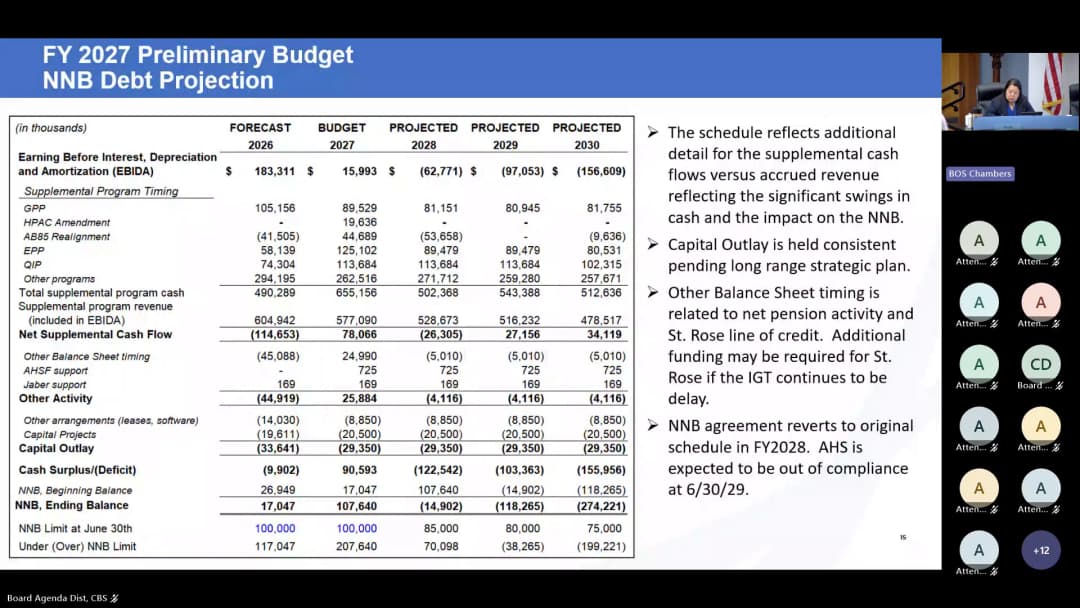
The Health Committee (Supervisor Miley, Chair, and Supervisor Tam) met at 9:30 a.m. to receive an informational presentation from Alameda Health System (AHS) on its Fiscal Year 2026-27 Operating Budget. The presentation reviewed the budget's financial position, supplemental revenue changes, FTE levels, and long-term projections. No public comments were made. Discussion Items - FY27 Budget Overview: Ann Metzger, Vice President of Finance for AHS, presented the budget. The June budget showed a $30.1 million loss; after additional work, the revised budget reduced the loss to $19.4 million, which the AHS Board of Trustees approved. The $10.7 million improvement came largely from supplemental revenue increases. Key changes included: increasing the EPP program by $9.6 million, adjusting the AB 85 redirection reserve by $10 million (based on repayment for FY26-27), new MCO tax benefit of $10 million, IFHCOF increase of $2.4 million, and a GME true-up of $0.8 million. Offsetting items included $9.3 million for a St. Rose IGT delay, contract cost increases, and software amortization true-ups. - FY26 Actuals: The original FY26 projection of a $10.2 million loss turned into a significant profit due to unanticipated revenues: a $40 million FQHC settlement covering fiscal years 2012 through 2021, $44.7 million from AB 85 realignment for FY24, and the $10 million MCO tax. The FY26 EBITDA is expected to be $183.3 million positive, compared to the projected $22.6 million positive. The additional cash will be received primarily in FY27. - FTEs and County Funding: AHS originally planned a reduction in force of 92 FTEs; the county provided $19.3 million in funding to maintain those positions. The budgeted FTEs are approximately 5,131, and AHS aims to hold paid FTEs flat. Performance initiatives are expected to generate $50 million in savings, offset by $78.2 million in increased labor costs. The largest expense improvement is $18.26 million from attrition (95 FTEs). - Long-Term Projections: The five-year forecast (FY27-30) shows a positive EBITDA of $16 million in FY27, but losses in subsequent years due to reduced supplemental funding and HR1 impacts. The NNB (net negative balance) line of credit was increased to $100 million for FY26-27; without extension, it would revert to $85 million. Projected NNB balances: positive $107.6 million in FY27, negative $14.9 million in FY28, negative $118.3 million in FY29, and negative $274.2 million in FY30. The FY29 and FY30 projections assume no major revenue increases and include HR1 impacts. - St. Rose Hospital: AHS has advanced $15 million (plus about $4 million in support) to St. Rose under a $25 million line of credit. St. Rose's financial performance is better than anticipated due to a Stanford relationship (20 beds in skilled nursing, and a planned hospital-within-a-hospital starting July 2027). The delay in the IGT supplemental program (approximately $30 million) threatens St. Rose's ability to repay the line of credit. County lobbyists are working with federal CMS to resolve the IGT delay. - Discussion on Revenues and Transparency: Supervisor Tam questioned why a large deficit was projected when FY26 actuals show a surplus. AHS explained that the unanticipated revenues (FQHC settlement, AB 85, MCO tax) were not known when deficit reduction efforts began. Supervisor Miley acknowledged the need for transparency and suggested the $19.3 million county funding could be held in reserve for future years rather than used immediately. He also expressed support for extending the NNB limit to $100 million to provide stability through 2030. - Out-Year Challenges: The committee focused on FY28-30 challenges driven by HR1 impacts. Measure W (a key funding source) sunsets in 2030. A joint meeting between the AHS Board of Trustees and the Board of Supervisors was anticipated for October or November to discuss long-term financial sustainability. Key Outcomes - The presentation was informational; no formal votes were taken. - Supervisor Miley indicated support for maintaining the NNB limit at $100 million. - A joint meeting between the AHS Board of Trustees and the Board of Supervisors will be scheduled for October or November. - The county and AHS will continue conversations regarding the use of the $19.3 million county funding (possible deferral or reserve) and the St. Rose IGT delay.

FISCAL SUSTAINABILITY 40% · BUDGET PROCESS 31% · HEALTHCARE SERVICES 19% · PUBLIC HEALTH SERVICES 5%
23
SEP 10, 2026 · ALAMEDA COUNTY, CALIFORNIA · BOARD OF SUPERVISORS
Eden Area Municipal Advisory Council Meeting - September 10, 2026

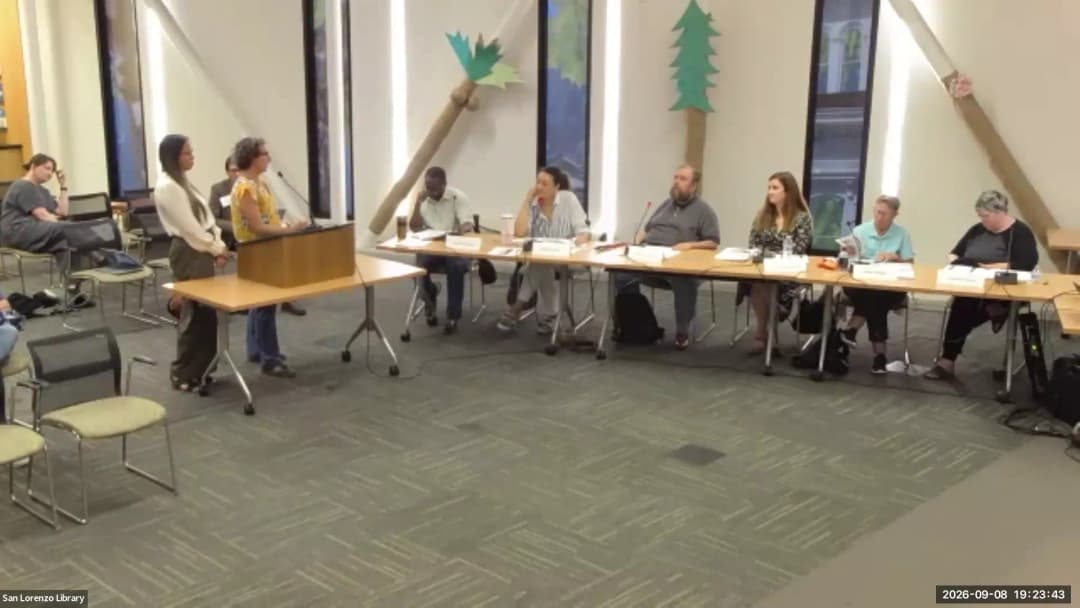
Note: The agenda and transcript indicate the meeting was held on September 8, 2026; however, per user instruction the date is given as September 10, 2026. The Eden Area Municipal Advisory Council (MAC) met on the evening of September 10, 2026 (as specified) at the San Lorenzo Library Green House Community Room. The meeting included informational updates on fire station construction and transit-oriented development planning, plus two action items: a subdivision application and a conditional use permit for an EV charging station. The council also heard extensive public comment on Hunger Action Month and on preserving the Sky West Golf Course open space. All action items were recommended for approval to the Board of Supervisors. Public Comments & Testimony - Hunger Action Month (non-agenda item): Several youth speakers from SLAM and local students urged the council to proclaim September 2026 as Hunger Action Month, citing food insecurity, rising costs, and the need for basic food access. An adult speaker noted this is a multi-city initiative and asked the council to relay the request to the Board of Supervisors. - Save Sky West Golf Course (non-agenda item): Two speakers requested the council's support to preserve 126 acres of open space at the Sky West Golf Course, emphasizing its habitat for the largest monarch butterfly population in the Bay Area and native turtles. They expressed concern over the Hayward Executive Airport's maintenance failures and expansion plans. - Fire Station Update (Item 1): One public speaker asked about soil mitigation at Station 22, specifically the plastic sheeting and vapor barrier; Deputy Chief Moore clarified that both mercury and PCE contamination issues are being addressed. - Subdivision (Item 3) and Conditional Use Permit (Item 4): No public comments were received on these items during their respective portions. Discussion Items - Approval of Minutes (August 11, 2026): Councilmember Wydler noted that the minutes incorrectly listed Stanley as absent; a correction was mentioned. Councilmember Marumahoko abstained because he had been absent. The minutes were approved with one abstention (Marumahoko) and five in favor. - 1. Update on Fire Station Rebuilding Projects (Measure X Bond): Deputy Chief Eric Moore presented progress on three fire stations. Station 7 (Palomares Hills) is nearly complete with roofing and utilities; occupancy expected mid-January 2027. Station 25 (Castro Valley) slab pour is imminent; vertical construction begins October 2026. Station 22 (San Lorenzo) interior signage and permits are underway; utility trenching begins October 2026; soil remediation for former gas station/dry cleaner site will include vapor mitigation. Construction completion targeted for June 2028. Council members expressed excitement and asked about lessons learned, community tours, public art (artist David Burke selected), and the longer timeline due to environmental work. The update was informational. - 2. Bay Fair Priority Sites Technical Assistance (PSTA): Angelica González (Planning) and Kirsten Dishinger (consultant) presented pre-development work for transit-oriented development (TOD) on the 7.2-acre county portion of the Bay Fair BART property in Ashland. Carly Payne (BART TOD program manager) explained BART's process: ground lease, developer selection, and community engagement. Key constraints include ADA access to the BART station (currently stairs only), undergrounding power lines, and coordination with the City of San Leandro (which controls the other half, approx. 7+ acres). Community input (135 survey responses) favored housing, affordability, improved bike/pedestrian safety, and neighborhood-serving commercial uses. BART's aspirational goal is 35% affordable housing across its portfolio; minimum 20% per site. The site will likely be phased; developer solicitation is 15-18 months out. Council members asked about funding gaps, interjurisdictional complexity, and timelines. The item was informational. - 3. PLN2026-00020, Subdivision (Mario Clamar): William Chin presented a tentative parcel map to divide an 18,720 sq ft lot into three parcels with two new single-family dwellings at 18449 Standish Ave., Cherryland. The existing home will be partially demolished to provide a 20-ft fire lane. The project is CEQA-exempt (Class 15). Council members asked about landscaping (to be addressed at building permit stage) and demolition. No public comment. The council voted unanimously (6-0) to recommend approval to the Board of Supervisors. - 4. PLN2026-00065, Conditional Use Permit (Ionna EV Charging Station): William Chin presented a proposal by Dewberry Engineers for a 24-hour EV charging facility with 10 stalls, five canopies, a picnic area, restrooms, and vending machines at 19895 Mission Blvd., Ashland. The amenity building makes the project require a CUP; without amenities, it would be a by-right use. The existing car lot structures and a 36-ft sign will be demolished. The applicant (Jack from Ionna) confirmed the restrooms and amenities are open to the public, with 24/7 security monitoring and daily cleaning. Council member Wydler expressed disappointment that no solar panels or additional landscaping were included, given climate goals. The council supported the project as an improvement. One public comment welcomed the neighbor. The council voted unanimously (6-0) to recommend approval to the West County Board of Zoning Adjustments. Key Outcomes - Minutes (August 11, 2026): Approved (5-0-1, Marumahoko abstaining). - Subdivision (PLN2026-00020): Council recommended approval (6-0) to the Board of Supervisors. - Conditional Use Permit (PLN2026-00065): Council recommended approval (6-0) to the West County Board of Zoning Adjustments. - Next Meeting: Scheduled for Tuesday, October 13, 2026.

PUBLIC TRANSPORTATION 22% · LAND USE PLANNING 19% · FIRE SAFETY 11% · FOOD SECURITY 10%
24
SEP 8, 2026 · ALAMEDA COUNTY, CALIFORNIA · BOARD OF SUPERVISORS
Alameda County Fair Ad Hoc Committee Meeting - September 8, 2026

The Alameda County Fair Ad Hoc Committee met on September 8, 2026, at 10:00 a.m. in the Fair Board Room and via Zoom. The meeting covered a recap of the 2026 fair, vision plan updates, hotel development, horse racing, and proposed contract amendments. Key decisions included forming a subcommittee to negotiate contract changes. Public Comments & Testimony - Amy, representing Alameda County 4-H, expressed concerns about restrictions on feeding children during the fair, citing a letter from the fire chief. She requested an investigation into staff conduct and asked for continued support for youth exhibitors. - Katie (remote) raised concerns about livestock safety, injuries at wash racks, and the lack of youth facilities in planning, urging preservation of agricultural heritage. - George (horse owner and industry participant) argued that the fair board did not support horse racing date applications and criticized the lack of racing in Northern California, stating he was willing to fund racing during the fair but not in May. Discussion Items - Change in Committee Members: Bill Harrison replaced Frank M. Hoff. Harrison participated remotely citing a medical condition (hospitalization and IV antibiotics), which qualified as just cause under the Brown Act. The committee accepted his remote participation. - 2026 Fair Recap: Presented by staff and CFO Vivian. Highlights: 399,000 attendance (down 3% from 2025), net income of $4.7 million (down from $5.03 million in 2025 but up from $2.2 million in 2024). Per capita spending was $55. Free ticket programs expanded: school tickets (34,000 claimed), senior tickets (7,200 distributed, 3,800 redeemed). The food drive collected 59,221 pounds (up 26%). A new sensory morning attracted 717 guests. Marketing campaigns (geofencing, voice recognition) exceeded industry averages. Guest satisfaction scored 8.6 out of 9. Economic impact: $14.3 million in sales tax, $186 million in hotel tax, nearly 2,000 ongoing jobs, and 17,000 hotel room nights generated annually. - Vision Plan Progress: Projects include OTB facility remodel ($1.2 million), Grandstand plaza and wine garden ($1.8 million, phase 1 in 2026), pickleball complex discussion (34 courts), and farm project (phase 1 complete). Solar capacity exceeds 2 megawatts. A C3 stormwater compliance project is planned for 2027. The committee noted that 11 trees will be removed in the grandstand area with 6 replacements. - Hotel Development Project Update: No developer identified. The committee discussed the need to go through the surplus land act process. County staff advised working through GSA on parcelization and a formal request. The item remains informational. - 2027 Horse Racing Update: Discussion focused on May dates. Alan Aldridge (racing chair) explained the horse flow from Phoenix to Seattle and the financial benefits of off-track betting. The fair board reaffirmed interest in racing but requires a financial partner. A public commenter (George) stated he was willing to fund racing during the fair but not in May. The committee noted that the fair board previously voted to support racing under conditions that have not been met. - Fair/County Proposed Contract Amendments: County staff proposed changes to the 2017 contract focusing on governance, transparency, code compliance, and board composition. Fair board CEO Jerome Hoban listed key disputed items: reducing board size from 21 to 15 with majority county-appointed, making the committee a county-only committee, imposing Brown Act obligations, and administrative protocols. County representative Lori Cox noted the parties are far apart due to limited discussions. County attorney Andrew Manson explained the September 30 non-renewal notice deadline. After debate, the committee agreed to form a subcommittee consisting of John Smith, Chuck Moore, Jerome Hoban, and David Haubert to negotiate before the next Board of Supervisors meeting on September 15. The subcommittee will meet on Friday, September 11, 2026. Key Outcomes - The committee acknowledged the change in committee membership and accepted Bill Harrison's remote participation. - Fair recap and vision plan updates were received as informational. - No action on hotel development; staff to continue working with GSA. - No action on horse racing; the fair board reaffirmed interest in May dates but requires a financial partner. - The committee formed a subcommittee to negotiate contract amendments: John Smith, Chuck Moore, Jerome Hoban, and David Haubert. They will meet on Friday, September 11, 2026, to discuss the proposed changes before the Board of Supervisors meeting on September 15. - The approval of the annual meeting schedule was postponed pending the subcommittee's outcome.

PROCEDURAL 13% · PUBLIC ENGAGEMENT 12% · FAIRGROUNDS MANAGEMENT 12% · FAIR OPERATIONS 10%
25
SEP 2, 2026 · ALAMEDA COUNTY, CALIFORNIA · BOARD OF SUPERVISORS
Fairview Municipal Advisory Council Meeting - September 2, 2026

Note: The meeting agenda and transcript indicate the meeting was called on Tuesday, September 1, 2026, at 6:00 p.m. However, this summary uses the date provided in the instruction (2026-09-02). This regular meeting of the Fairview Municipal Advisory Council (MAC) covered three main agenda items: an informational update on affordable housing production policies, and two site development review action items for new housing in the Fairview area. The council also received public comments from community members, a CHP officer, and county staff, and approved the July 2026 minutes with a correction. Public Comments & Testimony - Jimmy Dang, General Manager of Oro Loma Sanitary District, introduced himself and provided information about sewer and garbage services, ongoing capital projects, and a transition to district-based elections. - Rita Duncan, a candidate for the Oro Loma Sanitary District Board (representing District Five, which includes Fairview), introduced herself and requested support for her re-election. - Brenda (remote) commented on the Brown Act, urging the council to always take public comment before and during board deliberation, not after. - CHP Officer Jen Pabst reported August enforcement statistics in Fairview: 20 traffic citations, 10 non-injury crashes, 1 DUI arrest, no injury crashes, no stolen vehicles. She also announced a car seat checkup event on September 5, Labor Day holiday enforcement (Sept 4-8), a Start Smart class for youth on September 17, and that September is California Pedestrian Safety Month. - Ally Abbers, Alameda County Planning Department, invited the community to an urban forest planning workshop on September 29, 5:30-7:00 p.m. at the San Lorenzo Library. The workshop is the first of four on developing an unincorporated urban forest plan with CalFire funding. - Rita Duncan (in-person during Item 1) asked about TOC (Transit-Oriented Communities) and questioned whether building new housing addresses the income gap for unhoused people. She also raised safety concerns about limited egress in Fairview and asked if developers could be required to disclose profit margins. - Kathy Langley (in-person during Item 1) expressed strong opposition to the affordable housing policies, stating that people who cannot afford to live in California should move elsewhere. She called the housing element a state takeover of local zoning and advocated converting non-residential buildings (e.g., malls) into homes for the unhoused. - Kathy Langley (during Item 3) raised concerns that 3247 D Street might be an historic property, questioned the owner's intentions, and argued that parking would be insufficient, potentially obstructing ambulances accessing the nearby acute care facility. - Brenda (during Item 3) reiterated her point about public comment timing, asking the council to circle back to the applicant on questions raised by the public. - Helen Yang Fung (applicant, remote during Item 3) clarified that she is not the owner, the property is not historically significant, and the owner (Crescendo Sandoval Trust) does not own adjacent land. She noted that the ADU will provide affordable housing and the family has outgrown their home. Discussion Items 1. Affordable Housing Production Policies Update, Inclusionary Zoning (Informational) Presenters: Angelica Gonzalez (Assistant Planning Director), Olivia Ortiz (Planner III), Rick Jacobis (Street Level Advisors) Staff presented an update on two proposed policies: inclusionary zoning (requiring affordable units in market-rate developments of 11+ units) and expanded ministerial approval (streamlined staff-level approval for projects meeting objective standards). A financial feasibility analysis showed that rental housing is currently unfeasible in unincorporated Alameda County, even without affordable requirements, while for-sale housing has some capacity for modest affordable requirements. The presenters suggested a phased implementation, prioritizing 50-60% AMI for rental and 80-100% AMI for ownership, with the option to pay in-lieu fees. Ministerial approval would be offered as a bonus for projects providing deeper affordability. Council Discussion: Members expressed significant concerns about ministerial review, citing past experiences of developer errors (e.g., traffic studies, soil reports) that were caught by the community. They emphasized that removing local review processes undermines community trust and the purpose of the MAC. Vice Chair Rhodes noted the council did not support the previous housing element (6th cycle) partly due to ministerial review. Chair Filbin questioned the accountability of in-lieu fees, referencing past issues with park fees. Members asked for data on how in-lieu fees have been spent in the county and sought evidence of mobile home parks as an affordable housing option. Councilmember Higgins questioned why Fairview is grouped with the Eden General Plan, which has more urban standards. 2. PLN2026-00045 – Site Development Review for 0 Quercus Ct (Action Item) Presenter: Aubrey Rose, Alameda County Planning Department Proposal: Construction of a new 1,698 sq ft one-story, one-bedroom, one-bath home with a 516 sq ft attached two-car garage on a 1.77-acre downslope lot. The lot is conforming (grandfathered from pre-1975 zoning that required 5 acres). The project meets all development standards and requires fire sprinklers. No variances are needed. The staff recommended approval. Public Comments: Jill Angel and Richmond Von Wave, both neighbors on Arbutus and Quercus Ct, expressed concerns about construction traffic damaging the narrow private roads (already in disrepair), staging of equipment, and future parking overflow. The applicant assured that six off-street parking spaces would be available (two in garage, four on-site) and that any road damage would be repaired by the contractor. Council Discussion: Councilmember Higgins asked about the conforming lot status and visited the site. Council asked clarifying questions about road access and parking. No other concerns were raised. Vote: Motion to approve as presented by Councilmember Farmer, seconded by Councilmember Higgins. Roll call: Farmer – yes, Higgins – aye, Rhodes – aye, Philbin – aye. Unanimous approval. 3. PLN2026-00041 – Site Development Review for 3247 D Street (Action Item) Presenter: Michael Fleming, Alameda County Planning Department Proposal: Convert the existing first floor into an 813 sq ft ADU (with separate exterior entrance and kitchen), add 1,386 sq ft to the second floor (master suite, two additional bedrooms, office, kitchen/dining/living), 292 sq ft to the first floor (storage/utility), and an 860 sq ft three-car garage. Total building area is 3,265 sq ft plus garage, well under the maximum FAR. The project meets all development standards. Staff recommended approval. Public Comments: Kathy Langley questioned the property's historical significance (claimed it was owned by the Bruchard family) and expressed suspicion about future development of the adjacent empty lot. She argued parking would be inadequate for a four-bedroom home. Helen Yang Fung (applicant) corrected that the property is not historic, the owner does not own adjacent land, and the family needs more space for their young son. Council Discussion: Concerns centered on parking in the neighborhood, which is already congested due to nearby assisted living facility and school. Councilmember Higgins noted the large lot allows for ample off-street parking (e.g., 25-foot side setback, rear lot). Council clarified that the ADU is created by keeping the existing kitchen and adding a separate entrance, which is an innovative way to provide additional housing. Fire sprinklers are required; water pressure concerns from a previous development are not relevant here as it's a single home on an existing water line. Vote: Motion to approve as submitted by Councilmember Farmer, seconded by Vice Chair Rhodes. Roll call: Farmer – yes, Higgins – aye, Rhodes – aye, Philbin – aye. Unanimous approval. Consent Calendar - None. The consent calendar was not part of the agenda. Key Outcomes - Item 1 (Affordable Housing Policies): No action taken; this was informational. Staff will incorporate feedback and present a draft ordinance later in 2026 or early 2027. Council members voiced strong opposition to ministerial review and requested more accountability for in-lieu fees. - Item 2 (0 Quercus Ct): Unanimous recommendation for approval to the Alameda County Planning Director. - Item 3 (3247 D Street): Unanimous recommendation for approval to the Alameda County Planning Director. - Minutes: The July 7, 2026 minutes were approved as corrected (changing "motioned" to "moved"). The June 4, 2026 minutes were continued to the October 6, 2026 meeting. - Next Meeting: Tuesday, October 6, 2026, at 6:00 p.m.

AFFORDABLE HOUSING 24% · PROCEDURAL 14% · HOUSING 12% · PUBLIC COMMENT 11%
26
AUG 31, 2026 · ALAMEDA COUNTY, CALIFORNIA · BOARD OF SUPERVISORS
Alameda County Elections Commission Meeting - August 27, 2026

The Alameda County Elections Commission met on August 27, 2026, at 4:00 p.m. to discuss ongoing election operations, ad hoc committee reports, potential memorandums of understanding with city clerks, commissioner restrictions, and a special report on temporary election workers. The commission approved the July meeting minutes and adopted revised rules and procedures after amendments. Consent Calendar - Approved the July 16, 2026 meeting minutes by a vote of 6-0 (Commissioner Henderson abstaining). - The June 2026 post-election assessment was previously emailed to the Board of Supervisors; no changes were made. Public Comments & Testimony - No public comments were made on non-agenda items at the start of the meeting. - Public comment periods were opened for each agenda item but no speakers came forward. Discussion Items - Ad Hoc Committee Reports - Voting Participation Committee (Seabrook, Moore, Whitehurst, Lindsay, Hernandez): Received data from a local nonprofit covering voter eligibility and turnout across cities. The committee noted that Oakland District 3 had only 40% of eligible voters turning out, making it a potential pilot focus. Requested further data for other jurisdictions; expects to share findings with full commission. - Youth Participation Committee (Varlack, Whitehurst, Butter, Hernandez): Reported no formal meeting but monitored youth voting implementation in Oakland and Berkeley. Expressed interest in a standardized framework for youth voting across jurisdictions and protecting youth voter data privacy. The ROV confirmed that youth pre-registration records are confidential under state law and that youth voters can vote by mail or in person. - Budgeting for Elections Committee (Wagner, Pham, Lindsay): Scheduled a follow-up meeting with the ROV on September 9, 2026 to further understand cost allocation. The ROV posted explanatory language on five-or-more measure pricing on its website. - Rules and Procedures Committee (Dieter): The commission approved revised rules and procedures after incorporating feedback from county counsel and amending the document. Amendments included moving Section B12 (Member Responsibilities) to B1, adding language that the Board of Supervisors' handbook supersedes the commission's rules, and emphasizing in-person and on-time attendance. Motion passed unanimously. - Election Services Discussion and Potential MOUs: The ROV reported improved communication with city clerks, including a pre-election workshop, a planned post-election debrief, and regular updates on ballot measure letter designations. County counsel noted legal cautions about MOUs potentially altering election code obligations. The commission agreed to revisit the topic at its October meeting but acknowledged that an update may be deferred due to election workload. - Workshop on Election Commission Interests: Commissioners and staff brainstormed potential future agenda items, including: public communication improvements, Brown Act yearly updates, election website and ordinance clarifications, impact of mail ballot restrictions, election cost allocation recommendations, voter turnout analysis, transparency in election data, certification speed, youth voting data presentation, and ADA/WCAG 2.1AA compliance by April 2027. A new public spreadsheet will track requests. - Commission Member Restrictions: The commission reviewed Administrative Code Section 2.134.060 prohibiting holding other county office, being a campaign consultant/lobbyist, or participating in campaigns for candidates or ballot measures appearing on the county or municipal ballot. Discussion focused on ambiguity regarding federal/state races and appearances of bias. Counsel emphasized maintaining objectivity. No action taken. - Special Report – Temporary Election Workers (TAP Program): The ROV explained the Temporary Assignment Pool (TAP) for internal election workers (about 300 per election). Hiring involves county HR screening, background checks, interviews, and orientation. The ROV relies on rehires but still requires full onboarding. Commission members were reminded that they cannot work for the ROV due to employment restrictions. Key Outcomes - Motion to approve revised Rules and Procedures (Item 7-A(4)) passed unanimously with amendments to reorder sections, add a superseding clause for the Board of Supervisors' handbook, and clarify attendance expectations. - Approved July 2026 meeting minutes (6-0, 1 abstention). - The commission gathered a list of suggested agenda items from members and staff for future meetings; scheduling will be handled by the President and Vice-President. - The election services update will remain on the October agenda, though the ROV may report no update due to election season. - No formal votes were taken on other discussion items.

ELECTIONS ADMINISTRATION 46% · PROCEDURAL 15% · PUBLIC ENGAGEMENT 9% · YOUTH PROGRAMS 8%
27
AUG 17, 2026 · ALAMEDA COUNTY, CALIFORNIA · BOARD OF SUPERVISORS
Alameda County Board of Supervisors Special Meeting - August 17, 2026

Note: The agenda and transcript indicate the meeting was scheduled for August 13, 2026, but the meeting date is reported as August 17, 2026 per the provided information. The Alameda County Board of Supervisors held a special meeting on August 17, 2026, to consider the First Amendment to the Non-Binding Term Sheet for the sale of the county's half undivided interest in the Oakland-Alameda County Coliseum Complex. The amendment included a carve-out from the environmental release and indemnity provisions for the arena buyer's purchase of the arena parcel from Oakland Acquisition Company (OAC). The meeting began with a closed session (no reportable action) and proceeded to public comment and deliberation. The board voted 3-0 to adopt the amendment, with two supervisors excused. Public Comments & Testimony - Andreas Kluver, Executive Officer of the Alameda County Building Trades Council, expressed strong support for the amendment. He noted that the developer has hung in through challenges, partnered with labor and community, and that this step is critical to moving the project forward. He urged approval, saying otherwise the site could remain undeveloped for another 20 years. - Barbara Leslie, CEO of the Oakland Chamber of Commerce, supported the amendment, emphasizing that major economic development requires certainty, and that the Coliseum site has tremendous potential for housing, employment, and commercial development. She encouraged the board to adopt the amendment without delay. - Ray Bobbett and Susan Cronin, representing OAC, urged adoption. They explained that the arena buyer is making a significant compromise by not receiving indemnity and instead taking an as-is position, and that this amendment is the last remaining point in the purchase agreement. They asked for the board's approval to move the deal forward. - A representative from the Urban League of the Greater San Francisco Bay Area expressed support, hoping that the project would create opportunities for the next generation and that the arena would host concerts and jobs in Oakland. Discussion Items - Supervisor Miley made a motion to adopt the amendment, describing it as a critical step to advance the transaction. He acknowledged the complexity and risk but expressed confidence in moving forward. He noted the failed opportunities over his 26 years on the board and expressed hope that this step would lead to a bright future for the area. - Supervisor Fortunato Bas seconded the motion and echoed support, stating the amendment is essential to prevent the transaction from failing and to bring transformational economic development to East Oakland. She thanked staff and the city for their partnership. - President Haubert questioned OAC about the timeline and next steps. OAC stated they aim to close by the end of September 2026 and are committed to working with county staff 24/7 to complete due diligence and transition planning. President Haubert noted that county staff have other responsibilities but committed to observing the negotiations. - Kimberly Gasaway, Director of the General Services Agency, confirmed staff's commitment to moving the project forward. Key Outcomes - Motion: Supervisor Miley moved to adopt the First Amendment to the Non-Binding Term Sheet among the county, Coliseum Way Partners, LLC, and Oakland Acquisition Company, LLC for the sale of the county's half undivided interest in the Oakland-Alameda County Coliseum Complex, including a carve-out from the environmental release and indemnity provisions for the arena buyer's purchase of the arena parcel from OAC. - Second: Supervisor Fortunato Bas seconded the motion. - Vote: Roll call vote resulted in 3 ayes (Supervisors Miley, Fortunato Bas, and President Haubert) and 2 excused (Supervisors Marquez and Tam). The item passed. - Next Steps: The board directed staff to continue negotiations and work towards closing the transaction. OAC committed to providing long-form documents and working with staff to achieve a target closing date by the end of September 2026.

ECONOMIC DEVELOPMENT 70% · PROCEDURAL 14% · REAL PROPERTY NEGOTIATIONS 10% · PUBLIC ENGAGEMENT 6%
28
AUG 13, 2026 · ALAMEDA COUNTY, CALIFORNIA · BOARD OF SUPERVISORS
Alameda County Reparations Commission Meeting – August 13, 2026

The Reparations Commission met from 6:00 p.m. to approximately 8:04 p.m. on the date listed above (the agenda and transcript reference April 8, 2026, but the timestamp supplied for this summary is August 13, 2026). Roll call was completed; approval of the March 18 and March 23, 2026 minutes was postponed because those minutes were not ready. Ad Hoc Committee Meeting Discussion - Chair Gore reported that the ad hoc committee presented a full slide deck to the Board of Supervisors and answered questions. Supervisors said the proposed 12 recommendations with short-, medium-, and long-term timelines were not realistic to adopt on June 30, and they strongly recommended prioritizing one or two achievable items. - Supervisors advised preparing FAQs to counter opposition, and asked the commission to consider what happens after the report is delivered. They confirmed June 30 is a set matter, but the Board needs materials at least three weeks in advance. - Commissioner McClendon recommended getting a draft to all supervisors at least three weeks before June 30 and also holding one-hour individual meetings with each supervisor. Under normal county process, that would require submission by Tuesday, June 9, at noon. - Commissioner Sass questioned the value of a June 30 'receiving' rather than adoption, stating that after 175 years of inequity it is unacceptable to wait years. He and others supported identifying one or two 'stakes in the ground,' such as an Office of Reparations or a funded person/team. - Several commissioners discussed continuing the work through a smaller implementation-focused body rather than the full 15-member commission. Some suggested using leftover funds for three or four people to shepherd implementation. - Commissioner Bazile cautioned against hiring someone to simply revisit the three-year report, citing Berkeley's shelved report; he urged focusing on actionable items and existing county initiatives. - No formal vote was taken. In-Person Feedback Session Observations - The in-person session was reported to have gone well, with breakout rooms, a gallery walk, whiteboards, and post-it notes. Feedback forms and photos were captured; poster photos still need to be uploaded. - Community participants expressed strong urgency, with many saying there is no short-term, midterm, or long term—everything needs to happen now. There was widespread appreciation for the commission's work. - Commissioner Dones said his re-entry breakout table raised issues already addressed by the commission, validating the thoroughness of the work. - Commissioner McClendon noted that 'red dots' (priority votes) showed strong interest in creating a reparations commission/body as an immediate step. Data, Research & Report Writing Update - Informing Change (Michael) reported that data collection is nearly complete, with some qualitative pieces remaining. The report is currently 30+ pages and likely to reach 60+ pages. - He initially proposed a 10–12 page executive summary by June 8 and a full draft report by June 23/30. - Chair Gore and other commissioners objected to sending a skimmed-down summary as the main document; they directed Informing Change to produce the full, substantive report without page constraints. Any shorter companion piece would be developed by the commission afterward. - Informing Change agreed to reverse the order: full report first, shorter piece later. Work Plans & Subcommittee Reports - ECC (Exceptional Community Connections) reported March work: completing vendor invoice processing, creating budget priorities, delivering recommendations to Informing Change, and conducting one community feedback session. April focus includes launching the virtual feedback session, expanding outreach, and preparing for June 30. - Community Listening Sessions: one in-person session was held; a virtual session is scheduled for the coming Saturday; outreach will continue. - DAR (Data, Research & Report): recommendations were delivered to Informing Change; data were organized and aligned with listening-session categories. Budget Report (Admin/Budget Subcommittee) - Commissioner McClendon presented the budget: approved budget is $500,000; spending to date is $307,752; remaining balance is $192,247.48, representing 61% of the approved budget utilized. - The combined ECC/Informing Change total should have been listed as $270,000 rather than $260,000. Overages include $4,470 in documentation/media and $600 in note-taking; these would be offset by moving funds from underutilized line items. - He proposed increasing funding for ECC and Informing Change to complete the report and project management. - The commission discussed using leftover funds for June 30 outreach, food (up to $3,000 per vendor), photography/videography, and possibly a small next-phase team. - Commissioners praised McClendon's stewardship and noted that community relationships produced discounts and gratis services, including from the Trusted African American Cultural Historical Society. Key Outcomes - Minutes from March 18 and March 23, 2026 were deferred to the next regular meeting. - June 30 is confirmed as the set-matter date; the commission will deliver a draft to the Board at least three weeks in advance (around June 9 at noon). - The commission will develop talking points and identify one or two priority recommendations/action items to present as immediate next steps. - Informing Change will write the full report without length restrictions; the commission will create a shorter companion piece from it. - The commission will pursue individual meetings with Board of Supervisors members and expand community outreach and mobilization for June 30. - Admin/Budget will research the official process for commission transition, wind-down, or continuation, and will plan public recognition for commissioners. - Further discussion on the post-June 30 structure will continue at the May meeting.

BUDGET PROCESS 21% · COMMUNITY ENGAGEMENT 19% · PROCEDURAL 13% · IMMIGRATION POLICY 13%
29
AUG 12, 2026 · ALAMEDA COUNTY, CALIFORNIA · BOARD OF SUPERVISORS
Eden Area Municipal Advisory Council Meeting – August 12, 2026

The Eden Area Municipal Advisory Council (MAC) held a regular meeting on August 12, 2026, at the San Lorenzo Library. The meeting included a detailed presentation from AC Transit on its financial crisis and proposed contingency service cuts, a public hearing and vote on a new Taco Bell drive‑through restaurant, and routine administrative items. Councilmembers asked clarifying questions, debated trade‑offs, and voted unanimously on both action items. Consent Calendar - None on the agenda. Public Comments & Testimony - Fire Department Liaison Report (non‑agenda public comment): Aaron Panfilio, Alameda County Fire, reported 743 total calls for service in May 2026, including 54 fire‑related, 455 EMS, 10 non‑fire (gas leaks), 18 service calls, 97 good‑intent calls, 38 false alarms, and 71 other calls. He offered to provide monthly updates. - Public Comment on the Taco Bell project: Randy (community member) spoke in strong support, citing the convenience of a late‑night food option and economic development benefits. - No other public comments were received on agenda items. Discussion Items 1. AC Transit Informational Presentation: Financial Outlook & Contingency Service Plan AC Transit Board Vice President Murphy McCaulay, along with staff Diane Castleberry and Owen Christofferson, presented an overview of the agency’s operations and a looming fiscal crisis. Key points: - AC Transit serves 3 million riders/month (65% low‑income, 75% people of color) with a $606 million annual operating budget. - Post‑pandemic recovery: Weekday ridership is 141,000; weekend ridership now exceeds weekday numbers. Student trips total 30,000/day. - Fiscal cliff: A projected $200 million deficit over four years (annual gap of $50 million starting 2027). Causes: exhausted federal pandemic aid, flat sales tax revenue, rising costs (fuel +28%, parts +14%, buses +35%). - Contingency plan (16% service cuts) would reduce frequencies and hours on many routes, including Line 9 (30‑minute before 7am/after 7pm, 6am‑10pm) and Line 97 (30‑minute all day, truncated to Union Landing Transit Center). Neighborhood routes would also see cuts. The plan would only take effect if a new funding measure fails. - Connect Bay Area Act – a proposed half‑cent sales tax on the November 2026 ballot (five Bay Area counties) would generate $980 million/year for transit; AC Transit would receive $52 million/year to avoid cuts. - State bridge loan: AC Transit received a $55 million loan (must be repaid with interest). - Outreach & next steps: Public hearings scheduled for October 14, 2026; board decisions in November/December; cuts would take effect June 13, 2027 if no new funding is approved. - Councilmembers raised questions about capital budget, student route funding, fare increases, the trade‑off between frequency and coverage, and the intersection with development requiring no parking. Chair Cushman (a transit‑dependent rider) emphasized the community’s reliance on bus service. Councilmembers expressed general support for the sales tax measure and asked AC Transit to provide information on emergency evacuation coordination. 2. PLN2025-00099 – Taco Bell Drive‑Through Restaurant at 2020 Hesperian Boulevard (Action Item) Staff Planner Christine Green presented a Site Development Review and Conditional Use Permit for a new 1,600‑sq‑ft single‑lane Taco Bell with a drive‑through (hours 8am – 1am daily). The site is vacant, zoned C‑1, adjacent to residential units. Key conditions recommended by staff: - 9 parking spaces (5 required). - Sound wall on rear property line; order speaker facing away from homes. - Landscaping plan with trees and shrubs. - The project is categorically exempt from CEQA (Class 3, Section 15303). - The drive‑through policy was recently amended to allow five new drive‑ins along Hesperian; this is the first application. One letter of opposition was received from a nearby business owner; Alameda County Economic and Civil Development supported the project subject to noise/traffic investigation. - Councilmembers Taylor Aston‑Nielsen and Megan Roehl proposed additional conditions: a 12‑foot‑high fence (max allowed) and delivery hours limited to 8‑11am and 2‑5pm to minimize neighborhood disruption. - Motion to approve the Conditional Use Permit and Site Development Review (forwarded to West County Board of Zoning Adjustments and Planning Director, respectively) passed unanimously (4‑0‑1, Vice Chair Aston‑Nielsen absent) on both votes, with the additional conditions included. Key Outcomes - Minutes of June 9, 2026: Approved (4‑0‑1, Councilmember Marumahoko abstained as not present; Vice Chair excused). - AC Transit Presentation: Received as informational; council encouraged public support for the Connect Bay Area Act. No formal action taken. - Taco Bell Project (PLN2025-00099): Approved with conditions (12‑foot fence, restricted delivery hours). Two separate motions passed unanimously: (1) Conditional Use Permit forwarded to West County Board of Zoning Adjustments, and (2) Site Development Review forwarded to the Planning Director. - Chair’s Report: Chair Warren Cushman introduced himself and his disability advocacy background; council congratulated him and Vice Chair Taylor Aston‑Nielsen. - Announcements: Healthy Living Festival on September 24 at Oakland Zoo (ages 55+); District Director coffee with Supervisor Lena Tam on July 29 (9–10am). - Adjournment: Meeting adjourned at 7:35 p.m. The next regular meeting is scheduled for September 8, 2026. Note: The agenda listed the meeting date as August 11, 2026, but the transcript indicates the meeting occurred on August 12, 2026 (as specified in the user instruction). This discrepancy may be due to a time‑zone offset or transcription error.

PUBLIC TRANSPORTATION 40% · LAND USE PLANNING 21% · PROCEDURAL 13% · PUBLIC SAFETY 9%
30
AUG 7, 2026 · ALAMEDA COUNTY, CALIFORNIA · BOARD OF SUPERVISORS
Alameda County Board of Supervisors Special Meeting Retreat - August 7, 2026

The Board of Supervisors held a special meeting and retreat on August 7, 2026, continuing from the previous day. The meeting focused on team building, priority setting, operating procedures, and review of boards, commissions, and committee structures. Key decisions included eliminating joint committee meetings, sunsetting several ad hoc committees, creating a standing reparations committee, and identifying top board priorities for the next 12-18 months. Public Comments & Testimony - No members of the public submitted comments on closed session items or on any agenda items during the open session work retreat. Discussion Items - Boards and Commissions Review: The board reviewed a list of 116 boards, commissions, and committees (27 joint powers authorities, 27 outside boards, 8 board policy committees, and 54 other advisory boards). Supervisor Miley expressed frustration that the review has lingered for years. Facilitators led a discussion on the importance of reducing the number of inactive boards to free up staff time and resources. The board rated the importance of this reform at 4.5-5 on a 1-5 scale. It was agreed that Supervisors Halbert and Márquez will work with the County Administrator to identify low-hanging fruit (committees that have not met in two years) and bring a recommendation to the board by December 15, 2026. - Board Policy Committees and Ad Hoc Committees: The eight standing policy committees were reaffirmed as valuable. The board discussed the frequency and overlap of joint committee meetings (e.g., Health and Social Services). A consensus was reached to eliminate all joint committee meetings and instead bring cross-cutting issues to the full board as informational items or work sessions. Several ad hoc committees were reviewed: the Public Safety Community Relations Ad Hoc Committee was sunset (it had not met in years); the Surplus Property Authority Ad Hoc was deemed necessary but meets infrequently; the Agricultural Fair Association Board was recognized as a standing committee with external members; the Reparations Ad Hoc Committee was sunset and replaced with a new standing committee on reparations (board president to appoint members by September 15, 2026); the Alameda County Together for All committee was continued with a plan to revisit its necessity after 2028; the Alameda Health System Ad Hoc Committee was extended through January 2027. - Board Priorities and Initiatives: County Administrator Susan Muranishi presented a visual of ongoing board initiatives (over 20 items). Each supervisor identified their top 3-5 priorities. After a dot-voting exercise, the ranked top six board priorities were (in order): 1) Homelessness (including Measure W implementation and results-based contracts), 2) Office of Immigrant and Refugee Affairs, 3) EMS Redesign, 4) Improved Child Welfare (corrective action plan), 5) Office of Reparative Justice / Reparations, and 6) Alameda Health System (financial sustainability, governance, and reinstating labor and delivery at St. Rose Hospital). The board also discussed several lower-priority initiatives and assigned champions and next steps for each. - Work Session and Communications Improvements: The board discussed the ineffectiveness of current work sessions and wished to have more discussion-oriented sessions with specific questions for board direction rather than lengthy presentations. There was also a consensus for a county-level public information officer (staff rather than consultant) to coordinate communications, and for enhanced metrics and dashboards for homelessness and ballot measure outcomes. Key Outcomes - Ad Hoc Committee Changes: - Eliminated joint committee meetings; cross-cutting issues will now come to the full board as informational/set matters. - Sunset Public Safety Community Relations Ad Hoc Committee. - Sunset Reparations Ad Hoc Committee; created a new standing committee on reparations (board president to appoint members by September 15, 2026). - Extended Alameda Health System Ad Hoc Committee through January 2027. - Continued Alameda County Together for All committee, with intention to reevaluate after 2028. - Boards and Commissions: Supervisors Halbert and Márquez will lead a review to eliminate inactive or non-mandated bodies, with a progress recommendation by December 15, 2026. - Top Board Priorities Endorsed: The board agreed to focus staff resources on the six top-priority initiatives: homelessness, immigrant affairs, EMS redesign, child welfare, reparations, and AHS (including St. Rose birthing center). Lower-priority initiatives (food security, East County development, ballot communications, Coliseum negotiations, efficiency audit of environmental health, wildfire prevention, etc.) were assigned champions and next steps but are secondary. - Proclamations/Commendations: The board confirmed its earlier decision to eliminate routine commendations (based on 2025 data showing 70 were issued) to save staff time. - Future Retreat: The board agreed to hold a full-day retreat in January/February 2027 (date to be set by incoming board president).

PUBLIC ENGAGEMENT 18% · PROCEDURAL 16% · GOVERNMENT REPRESENTATION 16% · HOMELESSNESS 13%
OPENPUBLICA · PUBLIC MEETING INDEXUPDATED DAILY · openpublica.com