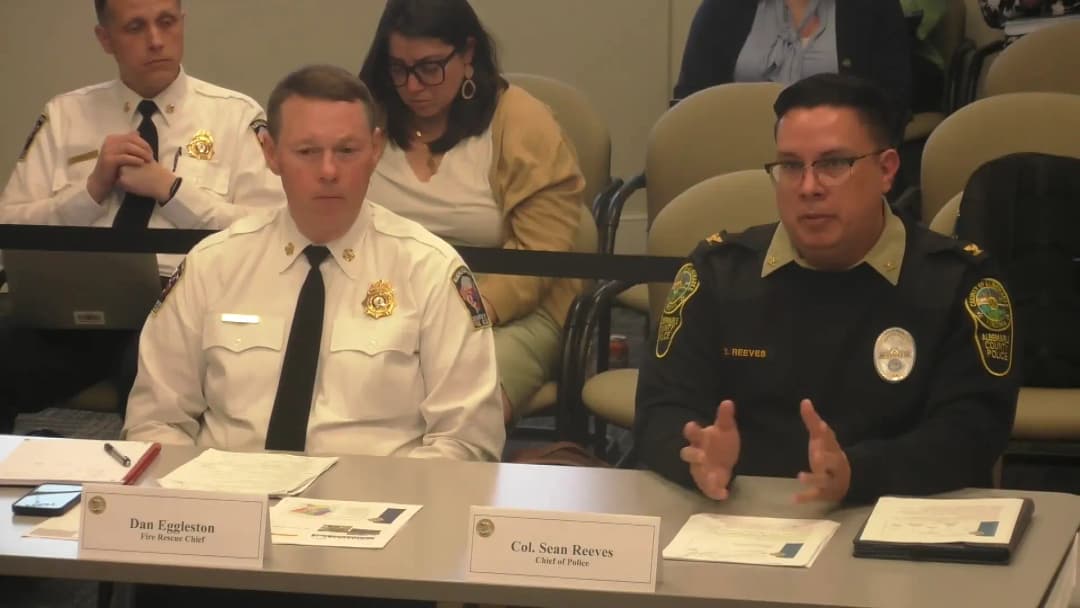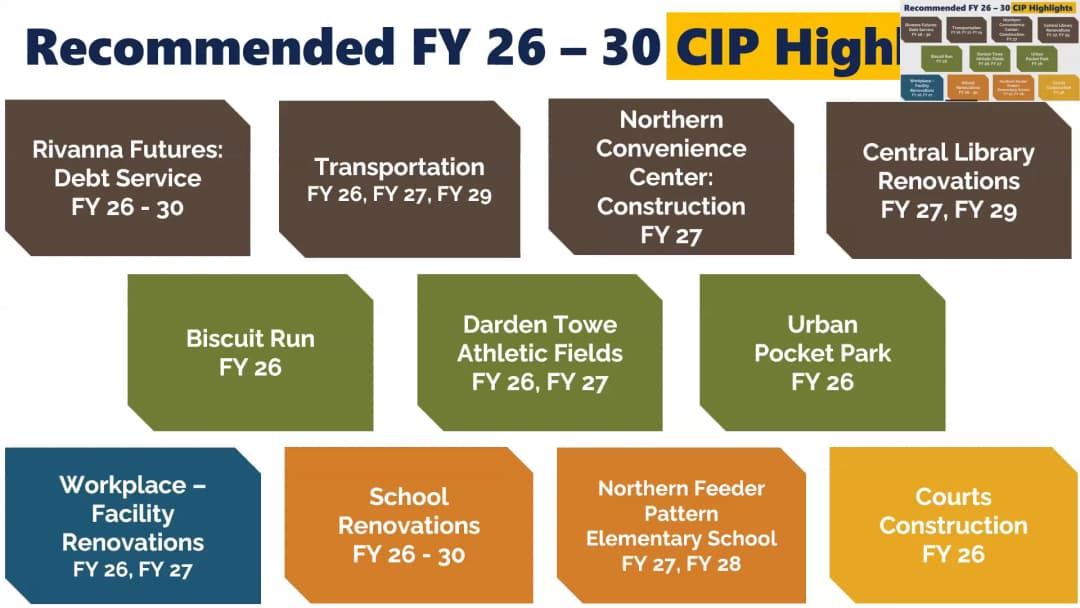
The Board of Supervisors held its fifth budget work session on Monday, April 7, 2025, at 3:00 PM in Room 241. The session focused on affordable housing funding within the Capital Improvement Program (CIP), the human services funding process, and identification of remaining board adjustments to the FY 2026 proposed budget. Key decisions included reallocating $1.2 million from the Board Strategic Priorities Reserve to the housing investment fund and emergency rental assistance. Discussion Items Affordable Housing and the Capital Improvement Program (CIP) - Staff presented three scenarios for leveraging the proposed 0.4 cent real estate tax dedication ($1.2 million ongoing) through borrowing for affordable housing projects. Scenario A (no borrowing), Scenario B (half leveraged, $7.3 million one-time project funds), and Scenario C (full leveraged, $14.6 million one-time project funds). - Bond counsel advised that eligible expenses for borrowing include grants for construction, infrastructure/public facilities, and land acquisition. Ineligible expenses include setting up a revolving loan fund from bond proceeds. - Board members expressed concerns about the long-term cost and reduced flexibility. Supervisor Pruitt argued that borrowing would provide a one-time boost but hinder reaching the $10 million annual funding goal. Supervisor Mallek supported exploring leveraging to attract outside funding, while Supervisor Gallaway emphasized the need to consider CIP as a tool for larger projects like acquiring expiring complexes. - Staff noted that any borrowing for affordable housing would need to be bundled with other CIP debt issuances, planned for spring 2026. Human Services Funding Process - Staff reviewed the revised human services funding process (formerly Agency Budget Review Team), which allocates $1.6 million among 25 programs. A new tiered prioritization system directs resources to direct services for vulnerable populations (Tier 1) and critical services (Tier 2), with Tiers 3 and 4 receiving no funding. - Board members discussed the evaluation process, including the use of audits and outcome metrics. Supervisor Mallek requested deeper organizational health reviews, which staff indicated will be expanded for a third of applicants in future years. - No votes were taken on human services allocations. Board Adjustments and Straw Votes - The board considered several motions to reallocate funds from the Board Strategic Priorities Reserve ($1.9 million available). - Motion (Supervisor Gallaway, seconded by Mallek): Reallocate $1.2 million to the Albemarle Housing Investment Fund (AHIF). Passed 6-0. - Motion (Supervisor Pruitt, seconded by Mallek): Amend to allocate $1 million to AHIF and $200,000 to the Albemarle County Emergency Relief Program (ACERP). Passed 6-0. - Motion (Supervisor LaPisto-Kirtley, seconded by Pruitt): Further amend to $800,000 to AHIF and $400,000 to ACERP. Failed 3-3. - Motion (Supervisor Mallek): Move 0.4 cents from schools to housing. Failed for lack of second. - Motion (Supervisor Pruitt): Reallocate $1 million from Economic Development Fund to AHIF. Failed for lack of second. Key Outcomes - The board adopted a motion to reallocate $1.2 million from the Board Strategic Priorities Reserve: $1 million to the Albemarle Housing Investment Fund (one-time) and $200,000 to the Albemarle County Emergency Relief Program (one-time). This brings the total proposed one-time housing funding to $4.2 million (including the previously proposed $3 million). - The board did not amend the proposed CIP to include affordable housing borrowing, but staff advised the option remains available for future consideration. - Final budget adoption is scheduled for May 7, 2025, following public hearings on April 23 and April 30, and town halls on April 9 and April 10.
Public Meetings - Albemarle County, Virginia
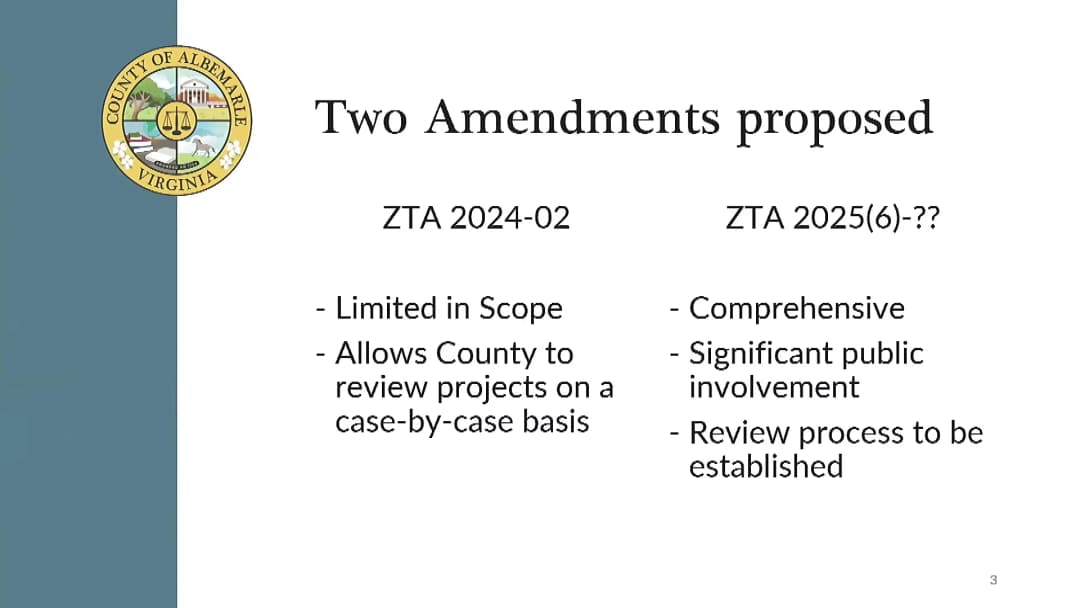
Public Meetings - Albemarle County, VirginiaThe Albemarle County Board of Supervisors held a regular meeting on April 2, 2025, starting at 1:00 PM in Lane Auditorium. The meeting included proclamations, work sessions on the comprehensive plan and secondary six-year plan, a VDOT quarterly report, a closed meeting, public hearings on agricultural and forestal districts and data center regulations, and multiple votes. The board approved several items, including an emergency ordinance changing a polling place, renewals of agricultural and forestal districts, and a first-phase zoning amendment for data centers. Proclamations & Recognitions - Dark Sky Week (April 21–28, 2025): Unanimously adopted. Christine Putnam, Chair of the Natural Heritage Committee, accepted and advocated for an outdoor lighting ordinance. Multiple supervisors spoke in support of dark skies. - Financial Literacy Awareness Month (April 2025): Unanimously adopted. Janasha Bradford, founder of Mahogany and Friends, accepted and described her organization's work teaching financial literacy to youth. Public Comments & Testimony - Afternoon Session: - Gary Grant (Rio District): Criticized the board for holding work sessions in Room 241 (poor sound) and for the process of paving rural roads, citing the Bleak House Road experience. - Neil Williamson (Free Enterprise Forum): Argued for expanding the development area from 5% to 7% and increasing height allowances to promote densification. - Evening Session: - Kathy Coleman (Rivanna District): Urged the board to reinstate horse trails at Biscuit Run Park, as originally planned, stating that a 2018 survey showing no interest was flawed. - Public Hearing on Agricultural and Forestal Districts: - Madeline Rafferty: Supported preserving AFDs and opposed parcel removals without parcel-by-parcel analysis. - Melanie Van Moijten (Chair, AFD Advisory Committee): Opposed removing parcels without development rights, noting that 2/3 of such parcels are not in land use and pay full taxes. - Public Hearing on Data Center Zoning: - Rob McGuinness (Piedmont Environmental Council): Supported the phase one amendment but recommended excluding or limiting data centers in the Downtown Crozet District. - Christina Libre (Southern Environmental Law Center): Supported the amendment but urged a 40,000 sq ft cap on accessory data centers and removal of data centers from the Downtown Crozet District. Discussion Items - AC44 Development Areas Land Use Chapter & Community Design Guidelines (Work Session): - Staff presented revisions to the development areas land use chapter and community design guidelines. Key discussion points included: - Supervisor Malik questioned the inclusion of a Rutgers study on parking and rents, preferred local photos over the Navy Yard, and raised concerns about tree preservation and trail design. - Supervisor LaPisto-Kirtley advocated for taller buildings (up to 8–10 stories) in appropriate areas to increase density. - Supervisor Galloway expressed comfort with the draft but raised concerns about monitoring rural area development proportions (Action 1.9) and the need for inter-agency coordination. - Supervisor Pruitt opposed the reliance on CACs for future land use map updates, arguing for a more centralized legislative process. He also emphasized clear standards over studies for lighting and tree preservation. - Supervisor McKeel highlighted the need for affordable housing and better use of parking lots. - Supervisor Andrews suggested a six-year do-not-pave list for roads where residents have rejected paving. - No formal decision was made; staff will incorporate feedback. - VDOT/Albemarle County FY26-31 Secondary Six-Year Plan (Work Session): - Planner Albert Karina-Plun presented the draft plan and rural rustic paving program. Nine roads requested paving; five had enough signatures. Staff recommended adding Burton Road and Burton Lane despite being one vote short due to safety concerns. - Board discussion focused on the process: Supervisor Galloway and others argued that residents should gather signatures first, and a do-not-pave list should be created. Supervisor Malik and Supervisor Pruitt supported a time-limited list (e.g., 5–6 years). - The county executive indicated staff will develop a formal petition process and return with a framework. - VDOT Quarterly Report (Presentation): - Residency Administrator Carrie Shepheard provided updates on projects: Route 29 shared-use path (spring 2025 ad), Route 250/20 intersection improvements, bridge replacements, and design-build bundles. Discussion included traffic signal coordination, speed limit changes, and maintenance issues. - Closed Meeting: - The board met in closed session under Virginia Code § 2.2-3711(A) to discuss appointments to boards/commissions and legal matters (payments in lieu of taxation and covered practices). The closed meeting was certified. Key Outcomes - Consent Agenda Approved: Unanimously (6-0). Items included approval of minutes, appropriations, polling place relocation, and other routine matters. - Emergency Ordinance (Branchlands Polling Place): Unanimously adopted (6-0) to change the polling place for the Branchlands Precinct from Hillsdale Conference Center to Harvest Church of God (1025 Rio Road East). The ordinance will undergo a 60-day Attorney General review, with a permanent ordinance scheduled for May 7. - Boards and Commissions Appointments: Unanimously approved (6-0) the following appointments: - Citizens Transportation Advisory Committee: Peter Thompson - Crozet Community Advisory Committee: Grace Balding - Economic Development Authority: William Mitchell - Rivanna Solid Waste Authority: Jeff Richardson - Rivanna Water and Sewer Authority: Jeff Richardson and Quinn Lunsford - Agricultural and Forestal Districts Renewal: After public hearing, the board adopted the ordinance (as revised April 2, 2025) by a vote of 6-0. The ordinance renews seven districts (Buck Mountain, Buck's Elbow, Fox Mountain, Keswick, Kinloch, Moorman's River, and Sugar Hollow) with parcel removals as recommended by staff and planning commission, including a five-year phase for parcels in open space land use. - Data Center Zoning Amendment (ZTA202400002 Phase 1): The board adopted the ordinance as presented (Attachment D) by a vote of 6-0. Two amendments failed (3-3): - Amendment to cap accessory data centers at 25% or 40,000 sq ft (failed). - Amendment to prohibit standalone data centers in the Downtown Crozet District (failed). The adopted ordinance requires special use permits for data centers over 40,000 sq ft in industrial districts and for all sizes in commercial districts, with performance standards including setbacks and closed-loop cooling. Next Steps - Staff will develop a formal petition process for rural road paving and return with a do-not-pave list framework. - Phase 2 of the data center zoning text amendment will commence, with a scope and schedule to be presented to the board. - The board will meet for a budget work session on April 7, 2025, at 3:00 PM in Room 241.
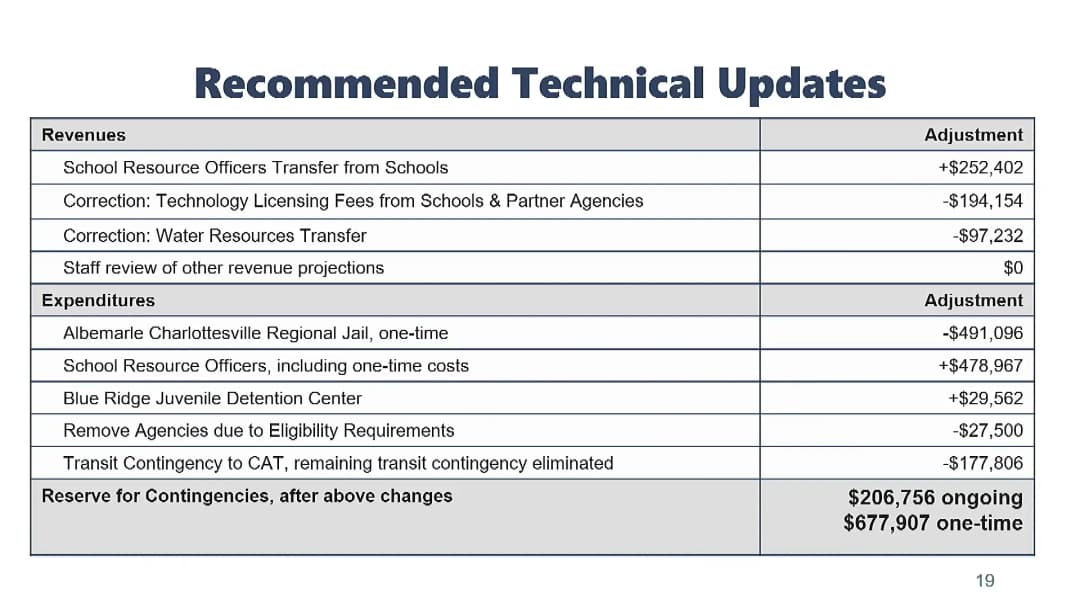
The Board of Supervisors held a budget work session on March 20, 2025, beginning at approximately 1:00 PM in Lane Auditorium. The session focused on finalizing the proposed FY26 budget, setting advertised tax rates, and hearing public comment on affordable housing, transit funding, and other priorities. After extensive discussion, the board voted to advertise a real property tax rate of $0.894 per $100 assessed value (a 4-cent increase) and maintain the personal property rate at $4.28 per $100. The board also authorized staff to advertise the county executive’s recommended budget with technical adjustments. Consent Calendar - The consent agenda was approved unanimously. Items included routine approvals and staff recommendations; specific items were not detailed in the transcript. Public Comments & Testimony - Vicky Bravo (Impact) urged support for a $10 million affordable housing trust fund, stating that $8 in outside funding can be leveraged for every $1 invested, enabling 300 homes per year. She emphasized that stable housing improves children’s health, nutrition, and cognitive development. - Pastor Colleen Swingle Titus (Park Street Christian Church) described the eight-year struggle to build 50 affordable units in partnership with Piedmont Housing Alliance. She noted that 50% of her congregation faces housing challenges, including seniors on fixed incomes and workers commuting from neighboring communities. - Tom Ekman (Rivanna district) noted that in Albemarle County the average home price is $800,000, and over 10,000 families are one paycheck away from losing their homes. He advocated for a $10 million housing trust fund, citing 800 other U.S. communities with successful funds. - Major Mark Van Meter (Salvation Army) described plans to replace the current 55-bed shelter with a 114-bed high‑barrier shelter and a new 50‑bed low‑barrier shelter (total capital cost $31 million). He requested $3.5 million from the county’s affordable housing fund. - Neil Williamson (Free Enterprise Forum) criticized the slow progress on converting underperforming commercial offices to residential use. Despite a unanimous 2024 Board resolution of intent, staff has not implemented the five‑word zoning change; he urged prioritizing this low‑cost, high‑impact housing solution. - Francis Lee Van Dell (Impact) reiterated the need for an affordable housing trust fund and called for better attention to those slipping through the cracks. - Savid O’Flynn (Community Climate Collaborative C3) supported the housing fund and noted that housing investments are also climate investments. He pointed out that the FY26 budget contains only a $200,000 reappropriation (not new money) for climate action, and urged the board to direct staff to plan for a $1 million climate action fund matching the city’s program. Discussion Items - Transit Funding (CAT & MicroCAT) – Staff recommended an $822,000 increase for Charlottesville Area Transit (CAT) to cover the phase‑out of federal pandemic relief, full‑year costs of a collective bargaining contract, and other cost drivers; service levels remain unchanged. The MicroCAT program will see a $440,000 reduction to $1.3 million due to savings from an extended grant. The existing fare‑free policy continues through FY26; a decision on reinstating fares will be needed in FY27. Board members expressed support for consolidated regional transit and for leveraging transit to serve school transportation needs. - Parks, Recreation & Culture – The parks operating budget includes full‑year costs for Biscuit Run and Rivanna Village Park, a $32,000 increase for adaptive recreation, and $33,000 to expand invasive species management (plus $100,000 in a one‑time state grant). The regional library system (JMRL) and the Convention & Visitors Bureau (CACVB) are funded at levels determined by formulas; the CACVB increase reflects strong prior‑year lodging tax revenues. A new process allocated $85,000 to 17 cultural arts and festival agencies. - Administration & Efficiency – Staff highlighted ongoing efficiency efforts, including the elimination of 11.7 vacant FTEs (net reduction of 5.7 after adding 6 police officers), and $1 million in annual cost savings achieved through process improvements, technology modernization, and space management. Administrative overhead remains low (under 6% of the general fund). - Technical Adjustments & School Gap – Staff recommended technical updates: adding a $252,000 revenue offset for two new school resource officers (SROs), correcting technology fee allocations, and adjusting the regional jail debt timing (one‑time savings). The school division’s FY26 funding gap is now $558,000 after the correction, and the recurring gap is about $15 million. Board members discussed options for dedicating a portion of the tax increase to schools, public safety, or housing. - Tax Rate Deliberation – Supervisor Galloway announced he would support advertising the recommended 89.4¢ rate, noting that older, more affordable neighborhoods experienced double‑digit assessment increases. Supervisor Malik suggested that the 0.8¢ above the 3.2¢ public safety dedication should go entirely to housing to build a lasting fund. Supervisor Pruitt proposed a 30‑cent increase in the personal property tax to fund a $10 million housing trust fund, but the idea did not gain board support. Supervisor Lapisto Kirtley favored keeping the 0.4¢ for schools as a more immediate need. Supervisor McKeel supported the 89.4¢ rate and expressed interest in using the CIP for housing. After discussion, the board voted to advertise the recommended tax rates. - Housing Trust Fund & CIP – Supervisor Galloway proposed exploring the use of capital improvement plan (CIP) debt to leverage affordable housing, modeled on the transportation leveraging program. The board agreed to discuss this further at an April 7 work session, along with the housing trust fund concept and the adequacy of the emergency assistance fund. Key Outcomes - Tax Rates for Advertisement (approved 6‑0): Real property – $0.894 per $100 assessed value; Personal property – $4.28 per $100; Machinery & tools – $4.28 per $100. The board will hold public hearings on April 23 and 30. - Budget for Advertisement (approved 6‑0): The FY26 proposed budget is the county executive’s recommended budget with staff technical adjustments. Further board amendments may be considered before final adoption. - Cancellation of March 26 Work Session (approved 6‑0): The board will instead meet for a special work session on April 7 to discuss the housing trust fund, CIP leveraging, and potential adjustments to the emergency assistance program. - Blighted Property Declaration (approved 6‑0): 5624 Brownsville Road was declared blighted; the county may proceed with abatement and seek cost recovery. - Special Use Permit – Charlottesville Community Church (approved 6‑0): A 500‑seat church on Pebble Drive (Scottsville district) was approved with conditions including a shared‑use path, right‑turn lane, and landscaping buffers.
The Board of Supervisors held a full-day work session and regular meeting on March 19, 2025, focusing primarily on the Fiscal Year 2026 budget and tax rate advertisement. The board heard extensive public comment on affordable housing and climate action, approved technical budget adjustments, and set advertised tax rates. Additionally, the board conducted public hearings on a blighted property declaration and a special use permit for a church, and received a county executive's report. Consent Calendar - The board unanimously approved the final agenda and the consent agenda (routine approvals) without objection. Public Comments & Testimony - Vicky Bravo (Impact) – Stated full support for a $10 million annual affordable housing trust fund, noting it would help build 300 homes per year and improve health outcomes for families. - Pastor Colleen Swingle Titus (Park Street Christian Church) – Expressed strong support for affordable housing, citing her congregation's struggles and the need for integrity in addressing the crisis. - Tom Ekman (Rivanna District) – Reported that over 10,000 families in Albemarle County are one paycheck from losing their home, and urged creation of a housing trust fund. - Major Mark Van Meter (Salvation Army) – Requested $3.5 million from the county's affordable housing fund to support a $28 million shelter expansion project, including a new 114-bed high-barrier shelter and a 50-bed low-barrier shelter. - Neil Williamson (Free Enterprise Forum) – Criticized the board for not prioritizing staff time to implement a five-word zoning change allowing office-to-residential conversions, calling the delay a missed opportunity for affordable housing. - Francis Lee Vendell – Expressed support for a housing trust fund, stating residents have waited many years for action. - Sai Vauflin (Community Climate Collaborative C3) – Supported the housing trust fund as a climate investment and urged the board to allocate $1 million for a climate action implementation fund, noting that proposed climate funding in the budget is only $200,000 (reappropriated) and insufficient. Discussion Items - Budget Work Session (Part 4) – Chief Financial Officer Andy Bowman and Deputy Budget Chief Ryan Davidson reviewed remaining budget chapters: Community Development (including transit contributions), Parks, Recreation & Culture, Administration, and Performance & Strategic Management. Technical adjustments were presented, including an $822,000 increase for Charlottesville Area Transit (to cover ongoing costs and collective bargaining), a $440,000 reduction in microCAT funding, and updates to school resource officer funding and regional jail costs. Staff recommended incorporating all technical adjustments into the proposed budget. - Tax Rate Discussion – Supervisors discussed the recommended 89.4 cent real property tax rate (a 4-cent increase) and the personal property rate of $4.28 per $100. Supervisor Galloway supported advertising the 89.4 cent rate, dedicating 3.2 cents to public safety, 0.4 to housing, and 0.4 to schools. Supervisor Malik proposed directing the full 0.8 cents (beyond public safety) to housing. Supervisor Kirtley favored dedicating 0.8 cents to schools. Supervisor Pruitt suggested a 30-cent increase in the personal property tax rate to fund housing, but found no support. Supervisor McKeel supported the 89.4 cent rate. No consensus emerged to change the distribution, so the board moved forward with the recommended advertisement. - Capital Improvement Plan (CIP) and Affordable Housing – Supervisor Galloway proposed exploring the use of CIP debt to fund affordable housing, similar to the transportation leveraging program. Other supervisors expressed interest in receiving more information on this concept. Key Outcomes - Tax Rate Advertisement – The board voted 6-0 to advertise the following rates for public hearing: real property at $0.894 per $100 assessed value; personal property, machinery and tools, and other tangibles at $4.28 per $100. (Motion by Supervisor Lapista Kirtley, second by Supervisor McKeel) - Proposed Budget Advertisement – The board voted 6-0 to authorize advertising the Fiscal Year 2026 proposed budget as recommended by the county executive, including all staff technical adjustments and any board amendments. (Motion by Supervisor Malik, second by Supervisor McKeel) - Public Hearing: Blighted Property Declaration – The board unanimously approved an ordinance declaring 5624 Brownsville Road as blighted, allowing the county to abate the structure and recover costs. (Motion by Chair Andrews, second by Supervisor Malik) - Public Hearing: Special Use Permit (SP 2024-18) – The board voted 6-0 to approve a special use permit for Charlottesville Community Church to operate a 500-seat religious assembly on Pebble Drive, with conditions including landscape screening and a future shared-use path. (Motion by Supervisor Pruitt, second by Supervisor Lapista Kirtley) - Closed Session – The board unanimously approved entering closed session to discuss performance agreements and legal matters, and later certified that only exempt matters were discussed. - Schedule – The board canceled the March 26 work session and will hold the next budget work session on April 7, 2025.
On March 17, 2025, the Albemarle County Board of Supervisors held a budget work session in Room 241, focusing on the FY2026 Operating and Capital Budget. The session included a detailed presentation from the Albemarle County Public Schools (ACPS) board and staff, followed by a review of the Capital Improvement Program (CIP) and debt management. No formal votes were taken; the session was preparatory for the March 19, 2025 work session where the proposed budget and tax rates are scheduled for advertisement. Discussion Items Albemarle County Public Schools Budget Presentation ACPS Chair Kate Acuff and Vice Chair Dr. Rebecca Bolyn presented the school division's needs-based funding request. Key highlights: - Student Demographics: ACPS serves 14,173 students (K-12), with 28% economically disadvantaged, 13% English learners, and over 400 homeless students. The division operates 24 schools and employs 2,800 staff, with an 86.8% teacher retention rate. - Total Budget Request: $308 million (all funds), with a $284 million operating budget (school fund). Local sources provide 71% ($219.3M), state 25% ($75M), federal 4% ($13.5M). - Funding Gap: After $6.4 million in service reductions (including 40 FTEs), the remaining gap is $750,000 for FY2026. However, true recurring gap is $1.7 million when including $934,000 deferred costs (classification review, technology, furniture). - Key Investments: $8.3 million for five strategic proposals: 3% employee compensation increase ($6.5M), instructional resources ($500K), Scholar Studios staffing ($406K), special education expansion ($649K), and adding school resource officers ($252K) at Monticello and Western Albemarle high schools. - Service Reductions: $5.5 million in structural cuts (reducing instructional coaches by 40%, eliminating foreign language in elementary, freezing positions) and $935K in deferred costs. - State Funding Challenge: The Local Composite Index (LCI) change reduced state funding by $10 million annually, forcing heavier reliance on local revenue. Board Questions and Discussion Supervisors questioned the school board on the gap, tax rate implications, and specific programs: - Tax Rate Impact: Assistant CFO Andy Bowman noted each tenth of a penny (0.1 cent) yields $310,000. To close the $750K gap would require 0.3 cents dedicated; to cover the $1.7M true gap would require 0.6 cents. A full penny (undedicated) would be worth $1.7M to schools. - School Resource Officers: Supervisor McKeel expressed support. School board explained that SROs complement existing school safety coaches; the pilot at Albemarle High School has been successful. The proposed addition would place an SRO at each comprehensive high school under a formal MOU with the police department. - Special Education Expansion: The Intensive Support Center (ISC) at Ivy Creek will be converted to a fully ACPS-run program, reducing costly external placements (some $150,000 per student per year). The move will also free space for the Center for Learning and Growth. - Homeless Student Support: Supervisor McKeel noted the high number (353 K-12 homeless students) and asked about transportation stability. ACPS provides transport to base schools to maintain educational continuity. - Capital Needs: School board requested $189.6 million in CIP funding over five years, but only 33.9% of their request is currently funded. Additional funding is needed for the Northern Feeder Pattern elementary school (capacity increase of 100 students) and school renovations. Capital Improvement Program & Debt Management Andy Bowman and Ryan Davidson presented the county government CIP: - Total CIP: $128.5 million over five years, primarily funded by borrowed proceeds (72%) and cash equity (22%). - Key Projects: Courts facility addition, transportation leveraging program ($28M), Northern Convenience Center (design in FY26, construction in FY27), Central Library renovation (joint with city), Biscuit Run park phase 1, urban park planning ($1.5M), workplace renovations, and community nonprofit capital (only Loaves & Fishes at $40,000). - Debt Capacity: The county maintains a AAA bond rating with headroom under policy limits. Going to 9% debt service ratio would provide $72 million in additional capacity, which would require $3.6 million in cash (5% pay-as-you-go) and annual debt service of $6 million for 20 years. - Advancing Strategic Priorities Reserve: $1.9 million in unallocated cash is available for one-time uses (e.g., affordable housing, capital needs). - Transportation Funding: Supervisor Gallaway noted that only one of seven Smart Scale projects (Pantops) was approved in the current cycle; other projects (Fifth Street, Greenbrier) were not funded. The next cycle is two years away. Key Outcomes - No formal action was taken; the session was informational. - The Board will consider the proposed budget and tax rates for advertisement at the March 19, 2025 work session (1:00 PM, Lane Auditorium). - Staff will prepare options for the board, including potential adjustments to the affordable housing investment fund and technical adjustments (e.g., SRO funding). - The school board's funding gap of $750,000 (or $1.7 million true gap) will be part of the tax rate discussion. - The next meeting will also cover remaining items from prior work sessions: community development, transit, and position changes. - The county's $1.9 million strategic reserve could be used for one-time needs, such as affordable housing or capital items. - The board noted the need for future discussions on manufactured home ordinances and the housing trust fund's purpose.
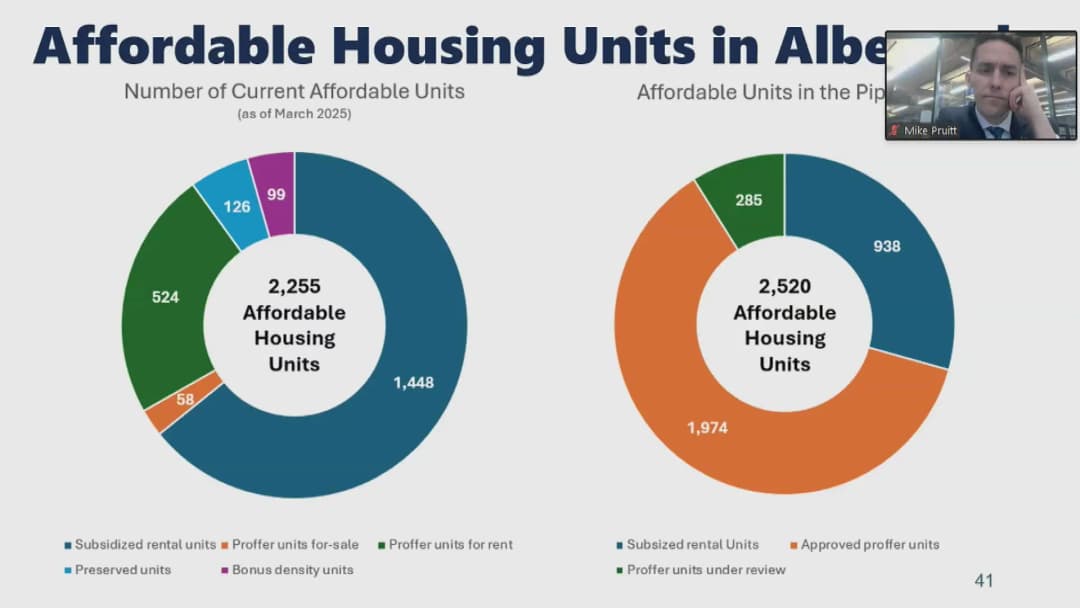
The Board of Supervisors held the second work session on the Fiscal Year 2026 recommended budget on March 12, 2025. The meeting focused on the allocation of shared revenues, health fund challenges, climate action, affordable housing investments, and the economic development fund. No formal votes were taken; board direction is expected on March 19, 2025, when a proposed budget and tax rate will be advertised. Discussion Items - Allocation of Shared Revenues (3.2 cents for Public Safety): Staff presented two options for future allocation of the 3.2 cents dedicated to public safety in FY26. Option A would split the growth of that revenue using the standard 54% schools, 36% county government, 10% capital/debt split. Option B would dedicate 100% of the growth to public safety. Under an illustrative 4.9% revenue growth, Option B would provide approximately $300,000 more annually for public safety compared to Option A. Board members expressed differing views: Supervisors McKeel and LaPisto voiced support for Option B; Supervisor Andrews supported Option A for consistency; Supervisor Galloway requested more strategic analysis before deciding; Supervisor Pruitt also leaned toward Option A. No consensus was reached; staff will prepare additional analysis for the March 17 work session. - Compensation & Health Fund: Chief Operating Officer Christie Schuffler outlined compensation changes: a 3% cost-of-living adjustment for all staff, a 2% step increase for public safety, and expansion of police/fire rescue pay scales from 26 to 30 steps. The health fund faces a 24% increase in costs and a $9 million one-time transfer to replenish reserves, which have fallen to less than 5% of expenditures. Staff explained that expenditures have grown 16% annually on average, driven by high-cost claimants. The new employee health clinic has had 152 visits in its first month and is expected to moderate future cost increases. The second clinic is on track for mid-April. - Climate Action & Environmental Sustainability: Staff reported that an EPA climate resilience cohort grant of $460,000 has been rescinded by the federal government, though funds spent to date are recoverable. The FY26 budget includes ongoing funding for environmental services ($100,000 for climate initiatives), a $200,000 unallocated climate reserve, and continuation of the septic-to-sewer program. The water resources reserve (funded by 0.7 cents of the tax rate) supports stormwater maintenance and capital projects. - Affordable Housing: The recommended budget dedicates 0.4 cents of the tax rate ($1.2 million ongoing) and a one-time $3 million transfer to the Affordable Housing Investment Fund (AHIF). The AHIF currently has $200,000 unallocated; with the new funding, the balance would reach $4.4 million. From 2019 to 2025, the county has invested $68 million in the housing continuum, including federal pass-through funds. The pipeline includes over 2,500 affordable units, but only those actually built count toward the goal of 10,000 units by 2040. Multiple board members expressed interest in increasing funding and discussing a formal housing trust fund later this spring. - Economic Development Fund: The fund has $3.3 million unallocated; the budget recommends adding $1 million to bring the total to $4.3 million. Past uses include grants for the Afton Scientific project, site readiness (Rivanna Futures), and workforce development. Board members noted the fund’s importance for leveraging state and federal grants and reacting quickly to economic opportunities. Supervisor Pruitt expressed that the current balance may be sufficient without an additional transfer this year. - Tipping Fees: Bill Moyer of the Rivanna Solid Waste Authority proposed a $2 per ton increase (from $58 to $60) to keep pace with market averages and inflation. The board generally supported the increase. Key Outcomes - No votes were taken; the board will continue work sessions on March 17 (with school board and CIP discussion) and March 19 (proposed budget and tax rate advertisement). - Staff will provide additional analysis on the shared revenue allocation options (Option A vs. B) and a comparison of housing trust fund structures. - The board acknowledged the need for a formal housing trust fund discussion after the budget cycle. - A federal climate grant rescission was noted; staff will update the board on any further impacts.
This was the first work session for the Fiscal Year 2026 budget, focusing on general fund revenues, non-departmental transfers, and public safety. No formal action was taken; the session was intended to inform the board ahead of upcoming decision points. Staff presented detailed data on tax rates, revenue growth, and the financial impact of expiring federal grants on public safety. Discussion Items - Total Budget Overview: The total budget is nearly flat (increase of $190,000 or less than 0.1%), but the general fund shows a recommended tax increase due to rising costs. The county executive's proposal includes a 4-cent real estate tax increase (from 85.4 to 89.4 cents per $100 of assessed value) and a personal property tax increase from $3.96 to $4.28 per $100 of assessed value. - General Fund Revenues: Real estate tax revenue is projected to increase $29 million (12%), driven by reassessment growth (5.1%) and the proposed tax rate increase ($12.4 million). The effective tax rate to offset reassessments only would be 81.3 cents. Personal property tax relief is provided by the state on a sliding scale; the county receives a fixed $15 million annually. Other local taxes (sales, meals, transient occupancy) are near their state-imposed maximums. Staff noted limited options for revenue diversification due to the Dillon rule. - Non-Departmental Transfers: The revenue sharing payment to Charlottesville will exceed $20 million, up $2.4 million (14%). The recommended ongoing transfer to public schools is $14.3 million (7.3% increase), plus $6.2 million one-time from fund balance for the health fund. Capital transfer increases $2.4 million. Staff presented the historical allocation of shared revenues (54% schools, 36% county, 10% capital) and noted that tax rate increases are often dedicated to specific purposes rather than flowing through the formula. For FY26, the 4-cent increase is proposed as: 3.2 cents for public safety, 0.4 cents for schools, and 0.4 cents for affordable housing (to be dedicated and not split). Board members questioned whether the public safety portion should also be dedicated ongoing. - Public Safety – Police: Chief Sean Reeves requested six additional patrol officers. He presented data showing 158 sworn officers (out of 165 positions), with officers spending 90% of time on reactive calls, leaving only 10% for proactive work. Calls for service increased 17% from 2021 to 2024, with priority one calls up 88% in urban areas. Response time goals (5 min urban, 10 min rural) are not being met (urban 73%, rural below 50%). The six officers would be placed in high-demand sectors to improve coverage and backup. A staffing study is underway, expected fall 2025. - Public Safety – Fire Rescue: Chief Dan Egliston highlighted a 21% increase in calls since 2019, including more complex incidents and weather-related events. The system relies on career and volunteer staff; volunteer numbers are declining. The FY26 budget includes absorbing 57 positions previously funded through federal SAFER grants, which are expiring. This is a major driver of the tax increase. The department is also adding a new ambulance at Berkmar and a ladder truck at Monticello. A study on standards of cover is being updated. Key Outcomes - No formal action was taken; the work session was informational. - Staff will bring back scenarios for the board's consideration at subsequent work sessions (March 12, 17, and 19). On March 19, the board is expected to propose a budget and set a maximum tax rate for advertisement. - Board members expressed interest in making the 3.2 cents public safety funding a dedicated ongoing allocation, rather than letting it fall into the general split formula after the first year. Staff agreed to prepare illustrative options. - The board will consider using $11.1 million in one-time FY25 revenue from the tax rate change and stronger assessments, with staff recommending the traditional 54/36/10 split for that money (directing it to schools, capital, affordable housing, and economic development). - The public safety staffing study is ongoing; results will inform future resource requests. - The next work session is scheduled for March 12, 2025, at 3:00 PM in Room 241.
The Board of Supervisors met on Wednesday, March 5, 2025, at 1:00 PM in Lane Auditorium, with a second session starting at 6:00 PM. The meeting included proclamations, a consent agenda, an action item, a work session on the AC44 Parks chapter, public comments, and public hearings on the FY2026 budget and the Chestnut Grove Manufactured Home Park rezoning. Key votes included approval of a special exception for a country store expansion, denial of the Chestnut Grove rezoning (3-3 tie), and receipt of the FY2026 budget proposal. Consent Calendar - Approved Fiscal Year 2025 Appropriations (25-176). - Approved Memorandum of Agreement between the County and the Albemarle Fire Rescue Foundation (25-181). - Approved Resolution to Accept Roads in Brookhill Subdivision Phase 1 into the State Secondary System of Highways (25-186). - Approved Special Exceptions for Woodbrook Apartments perimeter landscape buffer (25-160) and use buffer (25-161). - Received for information: Cost of Community Services Study (25-117) and Albemarle Broadband Authority Quarterly Report (25-167). Public Comments & Testimony First Session (1:00 PM) – Matters Previously Considered or Pending - Lynn Gebhard (Scottsville District), equine business owner, requested the addition of equestrian trails to Biscuit Run Park, citing economic benefits from tourism and suggesting a meeting with Parks and Recreation Director Mr. Krikenberger. - Mark Gebhard (Scottsville District), equine business owner, expressed concern about whether the county operates as a democracy or bureaucracy, and criticized the AC44 parks plan as a "plan to create a plan," urging quantified objectives. Second Session (6:00 PM) – Matters Previously Considered or Pending - Victoria Veliki (Scottsville District) urged reinstatement of equine business wording in AC44 and inclusion of equestrian trails at Biscuit Run, requesting certified mail notification if these are not included. - Ann Wicks (Samuel Miller District) supported new horse trails per Action 6.1, asked the board to revisit Biscuit Run equine access, and requested AC44 language recognizing the equine industry. - Shawnee Baker (White Hall District) spoke on behalf of the equine industry, emphasizing its economic impact and urging development of horse trails at Biscuit Run as originally planned. - Liz King (White Hall District), owner of Millington Stables, noted her farm's 55 years of operation and 80+ weekly lessons, and encouraged the board to include equestrian trails at Biscuit Run. Discussion Items Proclamations & Recognitions - Proclamation celebrating CAAR’s 100th anniversary (25-183) adopted unanimously. Josh White, CAAR President, accepted and highlighted the association's century of service. - Proclamation celebrating Women’s History Month (25-185) adopted unanimously. Kathleen Baines and other members of the Women in Government Affinity Group accepted, emphasizing the power of vulnerability and mentorship. Action Item – 25-178 Rockfish Gap Turnpike Country Store - Senior Planner Lea Brumfield presented a request for a special exception to expand the Greenwood Grocery country store from 4,000 to 5,600 square feet. The store has historical nonconforming status. Staff recommended approval with a condition to combine two parcels into one. The board approved unanimously. Work Session – AC44: Parks, Recreation and Open Space - Ben Holt and Tim Padalino presented the draft chapter, highlighting themes: expanding parks and greenways in development areas, improving walkable access (15-minute walk to park or greenway trail), sustainable management, and multimodal connections to the Rivanna Greenway and Blueway. The Rivanna River vision includes 17 river miles from Brookhill River Park to Buck Island River Park, with priority projects: Brookhill upgrades, Old Mills Trail extension (must begin construction by August 2027), and Milton Landing River Park. Staff noted a 40%+ increase in park visits since 2019 (over 600,000 more visitors in 2023 vs 2019). - Board discussion focused on objectives 3, 5, and 6: - Objective 3 (Accelerate urban parks/pocket parks): Supervisor Malik supported simple pocket parks with shade and benches. Supervisor Pruitt emphasized the need for a "forcing function" to commit public money, and noted that equestrian trails may be a regressive use of funds. Supervisor McKeel highlighted the 5% of development area parkland and connectivity needs at Ivy Creek Natural Area and Charlotte Humphreys Park. Supervisor Galloway called for amenities for teenagers (e.g., basketball courts, futsal) and for the plan to incorporate commitments from the Rio 29 Small Area Plan. Chair Andrews agreed on the importance of connectivity and urged examining park usage data. - Objective 5 (Environmental sustainability): Supervisor Malik requested strengthening the safer chemical policy. Supervisor Pruitt noted that action 5.6 (volunteer coordination) is already being done and should include metrics. Supervisor McKeel raised concerns about harmful algae blooms and the need to address upstream land uses. Supervisor Galloway linked algae blooms to lack of enforcement of stormwater ordinances. - Objective 6 (Expanded greenways network): Supervisor Malik valued gravel roads for recreation. Supervisor Pruitt described the Rivanna Greenway as a potential economic engine. Supervisor LaPisto-Kirtley emphasized tourism benefits. Supervisor McKeel supported maintaining existing parks over new purchases, and called for safety improvements. Supervisor Galloway asked about alternative funding for the bike-ped bridge over the Rivanna and noted the three-notch trail study. - General comments: Supervisor McKeel suggested combining objectives 2 and 3. Supervisor LaPisto-Kirtley proposed rewording action 2.3 to include the County Parks Foundation and public-private partnerships. Supervisor Galloway noted the lack of a county community center in the urban ring. Supervisor Pruitt raised the need for a land acquisition policy and for aligning economic development with equity. Key Outcomes - Proclamations adopted unanimously for CAAR 100th anniversary and Women’s History Month. - Consent agenda approved (recorded vote). - Rockfish Gap Country Store special exception approved (6-0). - AC44 Parks chapter to be refined based on board feedback; subsequent work sessions on other chapters scheduled for March 11, April 2, and April 16. - Closed meeting held pursuant to state code sections 2.2-3711(A)(1), (3), (8), and (29); certifications of closed meeting and appointments approved. - FY 2026 Recommended Budget public hearing held; budget proposes a 4-cent real property tax increase (3.2¢ for public safety, 0.4¢ for schools, 0.4¢ for affordable housing) and personal property tax restoration to $4.28/$100. Additional one-time $3M for affordable housing. County Executive Jeff Richardson presented. Public speakers advocated for a $10M housing trust fund, increased school capital funding, climate action implementation fund, and funding for organizations like Loaves & Fishes and Lighthouse Studio. - Chestnut Grove Manufactured Home Park rezoning (ZMA202300017) denied on a 3-3 vote (Andrews, Mallek, LaPisto-Kirtley voted to deny; Pruitt, McKeel, Galloway voted to approve). The corresponding special use permit (SP202300020) and special exceptions (SE202300041) were also denied subsequently. The applicant, Justin Shimp, argued the project could not be built in the development area due to land costs.
County Executive Jeffrey Richardson presented the recommended fiscal year 2026 budget to the Board of Supervisors, outlining a 4-cent real property tax rate increase (from 85.4 to 89.4 cents per $100 valuation) to address public safety obligations, school funding, and affordable housing. The $480.5 million general fund budget represents a 9.7% increase ($42.5 million) over the current year. The presentation emphasized strategic budgeting through three lenses—economic vibrancy, service delivery, and quality of life—and highlighted multi-year financial planning to manage out-year obligations. Discussion Items - Tax Rate Increase: The recommended 4-cent increase dedicates 3.2 cents ($10 million) to public safety, 0.4 cents ($1.2 million) to schools (over and above the 54% revenue split), and 0.4 cents ($1.2 million) to create an ongoing affordable housing funding stream. The personal property tax rate is recommended to return to the pre-pandemic rate of 4.28 cents per $100 valuation, completing a two-step restoration. Food and beverage tax remains at 6%, transit occupancy at 9%. - Public Safety: The budget includes transitioning 57 firefighter positions from FEMA SAFER grants (totaling $12.7 million) to local funding, and adding six new police officers—the largest increase since FY16. A consultant study on police and fire service delivery models is underway. Board members inquired about performance metrics for police additions and the rationale behind the staffing increase. - Education Funding: Schools receive $14.3 million in additional ongoing operational funding (7.3% increase) plus $6.2 million one-time to support the joint employee health fund. Supervisor McKee requested clarity on the tax revenue split (54% schools, 36% county, 10% capital/debt) and noted concern about federal funding risks to schools. - Affordable Housing: Total affordable housing investment in the budget is $4.2 million: $3 million one-time and $1.2 million ongoing from the tax increase. Supervisor Protect expressed commitment to a $10 million annual housing trust fund and questioned the low current balance (under $100,000). Supervisor Andrews requested a comprehensive view of all housing-related budget items. - Economic Development: The budget proposes $1 million for the economic development opportunity fund, continued investment in Rivanna Futures (462-acre campus for federal/private sector growth), and partnerships with Home Depot (Fashion Square Mall redevelopment) and Afton Scientific ($200 million expansion). Supervisor Mallet highlighted workforce training partnerships with PVCC and UVA. - Workforce and Health: A 3% market adjustment for non-sworn staff and a 2% step adjustment for public safety are included. The county opened its first health clinic in Pantops (99 visits in first two weeks) and will open a second location. Health care rates increased 24%, and the county invested an additional $9 million into the health fund. - Federal Funding Risks: County Executive noted federal funding is 2% of the budget ($9 million), and the county is developing contingency plans using its $10–11 million budget stabilization fund. Supervisor McKee asked for scenario planning for potential federal cuts affecting schools. - Capital Improvements (CIP): FY26–30 CIP includes school renovations, new schools (two opening in FY27), court facilities (opening later FY26), urban pocket park, northern convenience center, and regional transit authority development. Supervisor Protect noted the courts debt service will ramp up, and jail debt service starts at $650,000 in FY26. - Board Questions and Directions: Supervisors raised topics for future work sessions: climate action plan budget alignment, cost-of-service study (presented March 5), police-to-population ratios, emergency relief program funding ($260,000), transit impact on collective bargaining, and state limitations on tax diversification. Supervisor Cowley requested a document of unfunded departmental requests (similar to last year). Supervisor Pruitt asked for performance metrics for police resource additions. Key Outcomes - Next Steps: The budget process includes 16 public meetings and multiple board work sessions. The tax rate will be advertised by March 19, and final adoption is targeted for May 7, 2025. The board will review detailed Q&A published online and receive budget chapters before each work session. - No Votes Taken: The meeting was a presentation; no formal votes were cast. Board members directed staff to prepare additional information on housing, climate, performance metrics, and contingency plans for federal funding changes.
On February 26, 2025, the Albemarle County Board of Supervisors met at 12:00 PM in Room 241 of the Albemarle County Office Building to receive the County Executive's recommended Fiscal Year 2026 budget. The meeting featured a detailed presentation by County Executive Jeff Richardson, followed by questions and comments from the Board. Key proposals include a four-cent real property tax increase (from 85.4 cents to 89.4 cents per $100 valuation), dedicated primarily to public safety, with portions for schools and affordable housing. Discussion Items - Strategic Budgeting Overview: County Executive Jeff Richardson presented the budget through three lenses: economic vibrancy, service delivery, and quality of life. He emphasized that the budget is aligned with the county's five-year strategic plan and that local government cannot meet all needs alone, requiring strong partnerships. - Economic Trends and Revenue: The recommended general fund budget is $480.5 million, a 9.7% increase ($42.5 million) over the current year. Real property assessments rose 5.1% (residential 7.1%, commercial/commercial lower). The county faces a $13 million budget gap (3.1%) due to out-year obligations, including FEMA SAFER grants (four grants totaling $12.7 million) that now require local funding. - Recommended Tax Rate Increase: A dedicated four-cent increase to 89.4 cents per $100 valuation is proposed. Of this, 3.2 cents (80%) is dedicated to public safety (firefighter positions, new police officers, public safety pay plan, capital), 0.4 cents to public schools (additional $1.2 million ongoing), and 0.4 cents to affordable housing (first-ever dedicated stream of $1.2 million). The personal property tax rate is recommended to be restored to pre-pandemic 4.28 cents per $100 valuation (a two-step process completed). - Key Investments: - Public Safety: 57 firefighter positions hired through federal grants will be transitioned to local funding; 6 new police officers (the most added in a single year since FY16). A consultant study on staffing models is underway. - Human Services: $1.6 million for 26 programs (a 31% increase of $385,000), including Loaves and Fishes, Hoteach (shelter), and Ready Kids (mental health). - Community Services: $12.5 million for regional jail renovation, juvenile detention, SPCA, emergency communications, and crime control. - Public Works & Transit: $2.9 million for solid waste; $7.7 million for transit partnerships (CAT, MicroCAT, Jaunt, regional transit authority). - Schools: $14.3 million ongoing operational increase (7.3%) plus $6.2 million one-time for employee health fund. Commitment to three new schools. - Affordable Housing: Total $4.2 million: $3 million one-time plus $1.2 million ongoing from the tax increase. The county has invested $17.7 million in affordable housing from FY21-24. - Economic Development: $1 million in the economic development opportunity fund; continued support for Rivanna Futures (462 acres, $58 million acquisition, potential $1.1 billion annual economic activity) and Project Enable 2.0. - Workforce Support: $3.5 million for 3% market adjustment for non-sworn employees and 2% step adjustment for public safety; $9 million additional into healthcare fund (including $6.2 million for schools' health costs); opened first employee health clinic (99 visits in first two weeks, all Saturday slots filled). - Cost Savings: 11.7 county government positions eliminated through reengineering; departments identified $500,000 annual savings (total $1 million over FY25-26). - Capital Improvements (FY26-30): $128.5 million for local government (Rivanna Futures, transportation, Northern Convenience Center, central library renovations, athletic fields, urban pocket park, school renovations and new schools). Schools' CIP: $189.6 million. - Board Questions and Comments: - Supervisor Rudolph asked clarifying questions about the $9 million healthcare figure (includes $6.2M for schools), revenue growth assumptions, and the rationale for adding six police officers now. He suggested linking new investments to strategic plan performance (SPER) metrics. - Supervisor McDowell highlighted the need to control expenditures to benefit residential taxpayers, praised capital investments, and requested inclusion of federal workforce programs in discussions. - Supervisor Pruitt emphasized the March 19 tax rate advertisement deadline as a key decision point, noted that real property assessment growth is driven by single-family homes (multifamily declining), and reiterated commitment to $10 million annual housing trust fund. He explored tax diversification options (TOT increase, machinery and tools tax) and inquired about housing trust fund status (nearly depleted after $2.6 million last year). He also noted federal funding threats to schools (2-3% of their budget) and requested a briefing on progressive elements of personal property tax. - Supervisor Galloway expressed support for the budget, questioned how many affordable homes have been built and are in the pipeline, supported tax diversification (TOT, meals tax, plastic bag tax), expressed concern about federal/state revenue stability, and called for increased school renovation funding. - Supervisor McKee thanked staff, addressed the need for firefighters due to volunteer declines and rising call volumes, noted climate and environment were not mentioned (County Executive Richardson said those goals will be detailed in work sessions), requested clarity on the 54% schools/36% county/10% capital split, and asked about the impact of transit (Coldwood Collective Marketing) on the budget. She also raised concerns about federal funding impacts and the budget stabilization fund ($10-11 million). She suggested discussing the impact of daytime commuters on services and endorsed a potential one-cent sales tax referendum for school capital (would generate $25 million annually). - Supervisor Andrews noted a cost of service study coming March 5, requested a comprehensive look at all housing-related budget items and climate action plan funding, and advocated for keeping the ARPA (366) fund for emergencies. - Supervisor Puritt (additional) requested a list of unfunded departmental requests (similar to last year's cutting room floor document) and a clear metric for evaluating police officer additions (response times). - Next Steps: The budget process includes eight work sessions and 16 public meetings (town halls), with a final adoption target of May 7, 2025. Questions from the board will be answered in small batches and published on the county website. Key Outcomes - The County Executive recommended a four-cent real property tax increase (from 85.4 to 89.4 cents) dedicated 3.2 cents to public safety, 0.4 cents to schools, and 0.4 cents to affordable housing. Personal property tax rate to be restored to 4.28 cents. - The recommended general fund budget is $480.5 million, a 9.7% increase year-over-year. - The Board did not take any votes; the presentation was for discussion and to set the stage for upcoming work sessions. - The next meeting is scheduled for March 5, 2025, at 1:00 PM in Lane Auditorium.