The Middletown Commission on the Arts (MCA) met on October 26, 2026, at 5:03 PM. No members of the public attended. The commission approved the minutes from April and the meeting agenda. The chair indicated willingness to remain in the position, with the officer slate to be voted on at the next meeting. Staff member Keisha reported on low membership, the need for a quorum of six members, and an effort to relocate a valuable Risley wire sculpture to Wesleyan University. Discussion was held on restructuring committees to be formed only as needed. The commission reviewed and approved four grants, including $1,500 for Christine Lucian's project and general operating support of $9,875 for Odd Fellows. A condition was attached to Sandra Lira's grant to ensure prioritization of Middletown residents. The meeting adjourned with a birthday announcement. Consent Calendar - Approval of Minutes: The minutes from the April meeting were approved unanimously. - Approval of Agenda: The meeting agenda was approved without objection. Public Comments & Testimony - No members of the public were present to comment. Discussion Items Staff Report - Membership and Quorum: Keisha reported that membership attendance has been low and that six consistent members are required for a quorum. Members committed to improving attendance. - Risley Sculpture: Keisha and David met with a curator from Wesleyan's Zilka Gallery regarding a valuable wire sculpture by former Wesleyan professor Mr. Risley. The curator was interested but did not make a commitment; the sculpture currently resides in the basement. - Grant Administration: Keisha noted that spreading grants throughout the year has eased the workload and improved efficiency. Committee Restructuring - The chair proposed eliminating standing committees and creating ad hoc committees only when specific projects arise. The goal is to use time more efficiently and avoid incomplete projects. Members expressed agreement, and the proposal will be formalized at the next meeting in November. MCA Grants Cycle Discussion - Year 28 Proposal: The chair advocated for continuing the grant structure used during the semi-quincentennial, which distributes smaller, more equitable grants. This approach encourages new applicants and better use of taxpayer dollars. - Intent-to-Apply Step: Keisha introduced a new "intent to apply" inquiry form that helps clarify applicants' planned use of funds before they submit full applications. This has already improved the process. - Fundraising and Directed Projects: Pam mentioned the possibility of using leftover funds to directly commission specific organizations or individuals for larger projects. This idea will be explored further. Grant Attachments Review and Approvals - The commission reviewed four grant applications attached to the agenda: - Christine Lucian ($1,500): A motion to approve her unique artistic project was made and seconded. The motion passed unanimously. - Acclesia: The applicant had previously applied and was denied. The application was similar to the earlier one. A motion to approve was made, seconded, and passed. - Sandra Lira (Legal Toolbox): Lira proposed a workshop on legal issues for artists. David questioned how Middletown taxpayers would benefit, noting that Wesleyan students are not taxpayers. After discussion, a motion to approve was passed with the understanding that the grantee will be asked to prioritize Middletown residents. - Fellow (Odd Fellows): Requesting $9,875 in general operating support. The motion to approve was made, seconded, and passed. Note: The commission acknowledged the grant history spreadsheet showing a total of $1,296,181 in grants distributed by the MCA since the 1980s. Key Outcomes - Grants Approved: Four grants were approved (Christine Lucian, Acclesia, Sandra Lira, Odd Fellows), with Lira's grant conditioned on prioritizing Middletown residents. - Committee Restructuring: The proposal to replace standing committees with ad hoc committees will be discussed further at the November meeting. - Officer Slate: The chair will continue in the role; the officer election will occur at the next meeting. - Grant Cycle: The commission will continue the current format for Year 28 grants, with additional discussion scheduled for next month.
The Public Meeting Index
The Public Meeting IndexThe Spokane Valley Homeless Housing Task Force met to receive updates on two forthcoming RFPs and the regional Point-in-Time Count, welcome two new members, and approve the July 2026 meeting minutes. The agenda lists the meeting date as October 22, 2026, while the source metadata indicates October 26, 2026; this summary uses the metadata date. Consent Calendar - The July 2026 meeting minutes were approved unanimously by voice vote after the task force reached a quorum. Public Comments & Testimony - No public comments were offered during the general public comment opportunity. New Member Introductions - Bryn/Brent Eichenberger, a registered nurse and Director of Utilization and Care Management at CHAS Health, introduced themselves and expressed excitement about aligning their work with the task force. They noted that CHAS has a clinic in Spokane Valley and mobile outreach teams that work alongside the city’s team. - Jessica Lowry, the new CEO of the Spokane Valley Chamber of Commerce, was welcomed. She shared her six months with the Chamber and prior nonprofit experience with Hutton Settlement Children’s Home and Joya Child and Family Development. Housing and Homeless Program RFPs Update - Staff reported that the City Council approved the task force’s recommendation to move forward with the Affordable Housing and Supportive Sales Tax RFP. Funding may be used for rental assistance, new affordable housing units, operational assistance for affordable housing, and some administrative costs. - The RFP is expected to offer up to $1 million. The task force was told the fund balance is approximately $1.4 million, with another $200,000 expected in early 2027, and annual revenues are roughly $200,000. - Staff noted contracts could be multi-year, possibly up to two years, depending on the project type, with construction projects requiring more time. - The Homeless Outreach Services RFP was also discussed. The current contract with Frontier Behavioral Health expires June 30, 2027, and competitive bidding is required. The RFP is expected to be released before the end of the year, possibly in November, with a special task force meeting likely in the spring to meet the timeline. - Eric and Gretchen described the co-deployment model where case managers and social workers work alongside two dedicated homeless outreach deputies. For 2026, the team has helped 60 households into permanent housing, including 20 households in the last quarter, and was described as very strong compared with county-funded outreach performance metrics. - Several members expressed support for potentially expanding the number of dedicated homeless outreach deputies, but noted budget limitations. Public safety already makes up about 65% of the budget, and the expected public safety contract increase is approximately 20%, prompting one member to say “math gets in the way of communication." - A member asked Frontier about TrueBlood-eligible clients in the valley. Frontier representatives said there are only a handful in the valley, though more are on downtown caseloads, and that TrueBlood resources are not reported to HMIS. Discussion included interest in better communicating TrueBlood eligibility to shelters and outreach teams. Point in Time Count Update - Staff explained that the Point-in-Time Count, which counts sheltered and unsheltered people on a single night in January, will now be conducted every other year because federal and state guidelines aligned and the local CoC voted for that change. The next PIT Count will be in January 2028. - The single-night PIT Count was compared with other data sources: the PIT Count is closer to 2,000, the HMIS-based LSA report showed about 7,000 people over the year, and a state Department of Commerce report estimated about 17,000 people in the county are homeless or unstably housed. - Ariel Anderson added that improved HMIS data entry by street outreach teams provides a more accurate and useful picture than the one-night count. A member expressed relief and agreed the data point was not worth the annual effort. Key Outcomes - The task force approved the July 2026 meeting minutes unanimously. - No other action items were taken. - Next steps include releasing the two RFPs, likely before the end of the year, and continuing to review proposals through the task force before recommendations go to City Council.
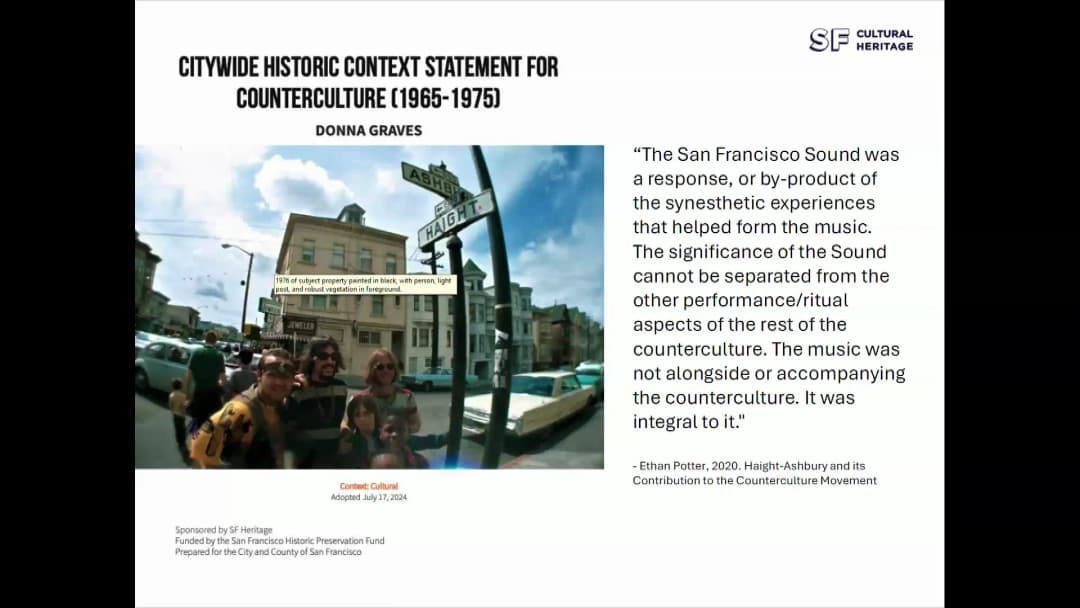
The San Francisco Board of Supervisors Land Use and Transportation Committee, chaired by Supervisor Mirna Melgar and joined by Vice Chair Cheyenne Chen and Supervisor Matt Dorsey, met on Monday, October 26, 2026, at 9:45 a.m. The committee heard and unanimously forwarded five items to the full Board of Supervisors, covering an encroachment permit, a commemorative street naming, a music history landmark designation, a rooftop restroom zoning fix, and a tenant rights disclosure requirement. The meeting concluded without reaching items listed under the 30-day rule. Discussion Items Item 1: 150 Bronte Street Encroachment Permit Gregory Slocum from Public Works presented a request for a revocable encroachment permit to install and privately maintain retaining walls, a sewer lateral, a curb, and bollards at 150 Bronte Street. A public hearing was held on March 26, 2025, with no objections raised, and the hearing officer and Director of Public Works recommended approval. There was no public comment. The committee voted unanimously to forward the resolution to the Board of Supervisors. Item 2: Sunset Healthcare Corridor Supervisor Alan Wong (District 4) presented a resolution to commemorate the stretch of Noriega Street between 19th Avenue and 33rd Avenue as the "Sunset Healthcare Corridor," noting over 30 healthcare providers concentrated in that area and the personal importance of local, culturally competent care for his family. He formally introduced amendments clarifying the geographic scope and signage provisions. Public comment was strongly supportive and included Dr. Joseph Wu (President, All American Medical Group), Dr. Han Zhu (practicing in the Sunset since 1993), and representatives from Northeast Medical Services, Chinese Hospital, and the Chinese Community Health Plan, who highlighted the legacy of independent doctors and the importance of accessible local healthcare. Supervisor Cheyenne Chen added herself as a co-sponsor. The committee unanimously recommended approval of the amended resolution. Item 3: Landmark Designation – Jefferson Airplane House Angelina Wong, from Supervisor Connie Chan's office, and Alex Westoff from the Planning Department presented an ordinance to designate 2400 Fulton Street as an Article 10 landmark. Westoff explained the property's significance as the band house for Jefferson Airplane, a central figure in the 1960s San Francisco counterculture, and noted that the Historic Preservation Commission recommended designation on September 2, 2026. Paul Curtin, the owner since 1993, spoke in support, sharing the property's history with the band and its intact architecture. Supervisor Matt Dorsey added himself as a co-sponsor. No additional members of the public spoke. The committee unanimously forwarded the ordinance to the full board. Item 4: Height Limit Exemption for Required Rooftop Restrooms Rain L. Cooper, from Supervisor Mahmood's office, presented an ordinance exempting the height of restrooms serving rooftop common use areas from a building's total height calculation. The ordinance was prompted by the Freedom West 2.0 affordable senior housing project, which faced a conflict between plumbing code requirements for adjacent restrooms and existing height limits. Tate Hannah from the Planning Department confirmed that the Planning Commission adopted a recommendation of approval on October 1, 2026, without modifications. There was no public comment. The committee unanimously forwarded the ordinance. Item 5: Disclosure of Tenant Protections Supervisor Matt Dorsey presented an ordinance requiring landlords to annually provide tenants with notices explaining rent increase limitations and just cause eviction protections under the local Rent Ordinance and the state Tenant Protection Act of 2019 (AB 1482). The ordinance directs the Rent Board to create a standard notice and provide counseling. Public comment was strongly supportive, with speakers from HomeRise, SomCAN, and the Affordable Housing Alliance emphasizing the need for multilingual, accessible notices. Christina Varner from the Rent Board confirmed the Board's commitment to translation and accessibility. Supervisor Cheyenne Chen spoke in support of the disclosure requirements. The committee unanimously forwarded the ordinance to the full board. Key Outcomes - All five items received unanimous votes (3-0) and were forwarded to the full Board of Supervisors, expected to appear on the agenda of November 3, 2026, unless otherwise stated. - Item 2 (Sunset Healthcare Corridor): Resolution was amended (clarifying geographic scope and sign placement flexibility) and forwarded with a positive recommendation. Supervisor Chen added as co-sponsor. - Item 3 (Jefferson Airplane House): Landmark designation forwarded to the full board. Supervisor Dorsey added as co-sponsor. - Item 4 (Rooftop Restrooms): Ordinance forwarded. The Planning Commission had previously recommended approval on October 1, 2026. - Item 5 (Tenant Protections): Ordinance forwarded with strong support from tenant advocacy groups and the Rent Board, which confirmed commitments to multilingual compliance.
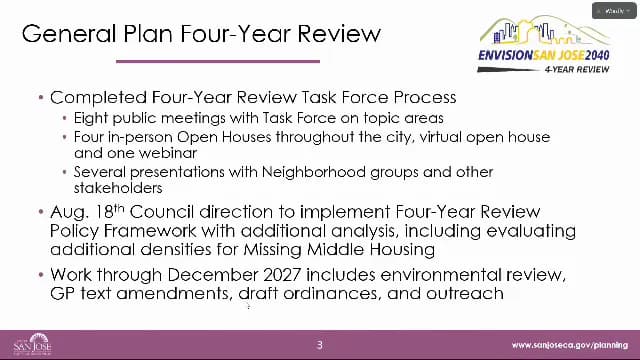
The Community & Economic Development Committee (CED) met on Monday, October 26, 2026, at 1:30 PM in a hybrid format (Council Chambers and virtually via Zoom). Chair Pam Foley presided alongside Vice Chair Rosemary Kamei and Councilmembers Peter Ortiz, Michael Mulcahy, and George Casey; a quorum was established. The committee approved a two-item consent calendar, received three staff reports (Team San José semi-annual status, City Council Policy 6-30 public outreach update, and citywide planning activities), and heard one public comment. Chair Foley opened the meeting by challenging colleagues to set a record for the fastest CED meeting and closed by declaring the 2:18 adjournment a record. Consent Calendar - CC 26-104 – Arts Commission Annual Report and Work Plan: Accepted the Arts Commission Annual Report for Fiscal Year 2025-2026 and Work Plan for Fiscal Year 2026-2027, in compliance with City Municipal Code requirements for boards and commissions. - CC 26-103 – Housing and Community Development Commission Annual Accomplishments Report and Work Plan: Accepted the Commission's FY 2025-2026 accomplishments report and FY 2026-2027 work plan. - No member of the public spoke on the consent calendar; the motion to approve carried unanimously. Public Comments & Testimony - Jordan Moldow (District 3 resident) – on Policy 6-30: Supported expanding mailing radii, noting frequent resident complaints about not receiving notifications; recommended digitally retrievable notifications using push and pull models, including email sign-ups within a custom radius of a user's chosen point, and a map/calendar of all upcoming planning hearings. He also urged broadening the outreach model to other departments (e.g., DOT, Environmental Services) to save money and effort across the organization. - No public comment was offered on the consent calendar, the Team San José report, the citywide planning report, or during open forum. Discussion Items 1. Team San José Semi-Annual Status Report (CC 26-105) - Rosalynn Hughey (City Manager's Office) noted that the June budget message directed additional information on benchmarking with peer cities, competitiveness, and market potential, which is included in the posted memorandum. A council-directed RFI/RFP process will begin after the start of 2027. - Team San José leadership (John, Matthew, and Laura Shameluski) gave a forward-looking presentation focused on 2027 strategies and opportunities. - Capital projects: All four theaters are up 8% in performances and 9% in attendance versus pre-pandemic; the Civic is up 40-41% in performances and 47% in attendance. The completed South Hall floor-leveling project (requested by NVIDIA and OCP, the city's two biggest groups) has opened the hall to sporting events, including a four-year volleyball deal for the first week of January, with futsal and karate discussions underway. Other projects: CPA sound system upgrade, two large video screens at the Civic, CPA boiler/chiller replacement (ETA August 2027), convention center restroom upgrades (ETA September 2027), HVAC upgrades (ETA November 2028), and fire alarm panel replacements (ETA 2029). John thanked Jim Shannon and Jennifer Tell for securing funding. - Sales and marketing: Last fiscal year, 27 of 53 contracted groups and 55,000 of 105,000 contracted room nights were first-time events for San Jose. Show dates totaled 63 in 2023, 74 in 2024, and 91 in 2025; 2026 would have exceeded 100 but for a couple of cancellations. For 2027, 70 shows were contracted by the end of June, versus 42 at the same time last year. - OCP departure and replacement: Matthew explained that OCP (Open Compute Project), the year's second-largest group, "outgrew" San Jose's finite convention center and hotel capacity, with 3,000 people on its waiting list, and will move to San Francisco beginning in 2027. A smaller company, secured through an intermediary relationship, will replace the program at a nearly equal size while using space more efficiently, freeing October dates to sell. NVIDIA has roughly 400 exhibitors waiting for space. - Convention center expansion: At Councilmember Mulcahy's request, John discussed a Wednesday meeting with the mayor and staff about the CSL report on expansion; an alternative would remove a wall between the executive ballroom and exhibit halls 1-3 to create about 30,000 square feet of additional contiguous space. - Marketing and communications: Laura Shameluski reported that paid media generated $35.8 million, including 64,000 hotel room nights and 30,000 flight bookings into SJC — a $76 return for every $1 invested. She described adapting to AI "no-click search" (ChatGPT, Claude) through AI audits of digital assets, a November 12 event with the AI lead from their agency (the largest buyer of travel media on the planet, with 200 global offices), first-time paid influencer partnerships, a New York media mission with four chefs cooking at the James Beard House for about 150 media, a new Fodor's guide for San Jose (the first in California outside Los Angeles and San Francisco), and planned integration into Reddit and TripAdvisor reviews — potentially a first among California destinations. She cited San Jose's diversity (92 languages spoken; 42% of residents born in a foreign country) as a culinary storytelling strength and noted upcoming events including the California Theatre centennial (with San Jose Jazz, Cinequest, the Longest Table, and Peter's Bakery attempting the world's largest burnt almond birthday cake) ahead of San Jose's 250th anniversary. - Councilmember Kamei expressed support for exploring expansion, stating that remaining with the same footprint limits future growth. Chair Foley stressed that communicating "San Jose is open for business" is critical. The committee voted to accept the report. 2. Update to City Council Policy 6-30 – Public Outreach Policy for Pending Land Use and Development Proposals (CC 26-106) - Principal Planner Jared Ferguson presented the status update. Policy 6-30, first adopted in 1999 and last revised in 2004, sets expectations for how the city informs and engages the public on land use and development proposals. Ferguson noted that traditional media has lost reach, online and social media have grown, and residents face barriers related to language, accessibility, scheduling, and technology access. - Drivers include the 2019 City Auditor's report, the Racial and Social Equity Action Plan, the upcoming Environmental Justice Element, and the Six-Cycle Housing Element (Strategy I-7). Recommended improvements include language access and translation, accessible plain-language information, online access to project and hearing information, proactive outreach to community organizations, and review of notice timing and mailing distances. - The work plan has four components: focus groups prioritizing underrepresented residents (persons with disabilities, monolingual Spanish and Vietnamese speakers, youth, renters) plus developers and neighborhood associations; meetings with internal staff who implement the policy; a virtual community meeting; and a project web page with potential online survey methods. - Ferguson cautioned that the timeline predates the prior week's City Council decisions on missing middle housing; the added workload will likely push out the schedule, and revised dates will be communicated. - Chair Foley directed staff to add seniors to the focus groups and to send the survey and web page to council offices for inclusion in newsletters. Councilmember Kamei thanked Foley for including seniors, emphasized the importance of youth participation ("it is their future"), supported creating a shared outreach template for other departments, and expressed concern that roughly 90% of planning work is driven by regulated/unfunded mandates, leaving little time for community outreach. Before the vote, Chair Foley added that members of the disability community should also be included. The committee voted to accept the status report. 3. Citywide Planning Activities Semi-Annual Status Report (CC 26-107) - Ruth Gueto (with Jared Ferguson, Martina Davis, and Maneira Sand) presented the semi-annual update. The division spans general plan analytics, housing and housing element, ordinances and policies, urban villages, and special projects including transit-oriented communities (TOC) compliance. It has 19 authorized positions and one vacancy. - The four-year General Plan review task force process was completed with eight public task force meetings, in-person open houses, a virtual open house, and presentations to neighborhood groups and other stakeholders. On August 18, council directed implementation of the policy framework with additional analysis, including missing middle housing densities; further direction came the prior week. Work continues through December 2027, including environmental review and outreach, with timelines being re-evaluated. - The general plan and analytics team delivered the 2025 General Plan annual progress report and an early consideration hearing for privately initiated general plan amendments. Upcoming work includes state-mandated updates to the safety, open space, and environmental justice elements. - The housing policy team completed the reasonable accommodation zoning update and will begin the annual housing element progress report cycle in December; the development fee framework continues, and the downtown ministerial approval ordinance will proceed next year. - Urban villages: Five Wounds draft posted in August with comments accepted through October; amendments are being prepared for December 2026 council hearings. Alum Rock East will have another outreach round in early 2027 with council consideration in February-March. Saratoga is tracking with the four-year review CEQA, with a November community touchpoint on parks and open space. A new "neighborhood villages strategy" will streamline planning for smaller shopping-center villages with a unified approach and combined outreach. - Transit-oriented communities: In response to Metropolitan Transportation Commission policy, the city is adopting minimum densities and allowing maximum densities for residential development within a half mile of 54 transit stations, plus minimum and maximum floor area ratios for commercial office development. Approximately $1.4 million in grant funding is focused on 26 stations. A transit area commercial overlay concept from the four-year review will be coordinated with this work. - Ordinances and policies: Standard permit findings were made objective (a state law and housing element action); a state law compliance maintenance update was completed in June. A November zoning update will address demolition definitions for historic resources, extend the legal nonconforming timeframe to three years, and streamline tree removal permits needed for defensible space in high fire hazard severity areas. Additional state law work will address downtown minimum densities, vape shops, and detention centers. Two sign code items were noted orally: digital wayfinding (early next year) and arena freeway marquees. - Long-term priorities include adopting the seven-cycle housing element, four-year review implementation, the safety/open space/environmental justice elements update, and a comprehensive General Plan update directed through the June budget process. - No public comment was offered. The motion to accept the report passed 4-0. Key Outcomes - Consent calendar approved unanimously: Arts Commission FY 2025-2026 annual report / FY 2026-2027 work plan, and Housing and Community Development Commission FY 2025-2026 accomplishments report / FY 2026-2027 work plan. - Team San José semi-annual status report accepted; RFI/RFP process confirmed to begin after the start of 2027; CSL convention center expansion report to be discussed Wednesday; approximately 30,000 sq ft reconfiguration concept presented. - Policy 6-30 status report accepted; outreach revision work plan endorsed, with direction to include seniors and disability community members as focus groups and to route survey/web materials through council offices; timeline to be revised due to missing middle housing workload. - Citywide planning semi-annual status report accepted 4-0. - No open forum comments; the meeting adjourned at 2:18 PM, which Chair Foley declared a record for the fastest CED meeting.
The Rochester City Council held a study session on October 26, 2026, from approximately 3:30 p.m. to 6:30 p.m., before adjourning to a closed executive session for the city attorney's performance review. The session covered strategic management of Tax Increment Financing (TIF), a prevailing wage policy overview, a downtown employee parking program, and a review of the parkland dedication ordinance. Council provided direction on staff proposals without formal votes, as is typical for a study session. Tax Increment Financing (TIF) – Strategic Management and Policy Considerations (3:30 - 4:30 p.m.) - Staff outlined a plan to shift from managing TIF districts individually to strategically managing them as a citywide portfolio. Senior Economic Development Specialist Josh Johnson highlighted that Rochester has invested over $120 million across 43-44 open districts, creating over 4,000 residential units (46% affordable at 60% AMI or less). - Key recommendations included tracking and allocating staff time to TIF districts to recoup costs from administrative fees (currently a standard 5%), establishing broader project areas for coding efficiency, and passing legal fees for negotiations directly to developers. - Staff presented a major opportunity under the DMC legislation to pool 100% of increment for the full 25-year term. Decertifying districts immediately upon obligation completion would generate an estimated $14.5 million, while preserving eligibility for pooling could yield up to $66 million. Councilmembers expressed broad support for the strategic portfolio approach and the potential for pooling funds for infrastructure and affordable housing. Prevailing Wage Background and Overview (4:30 - 5:00 p.m.) - Staff provided an overview of prevailing wage requirements for federally funded, state-funded, DMC, and city-funded projects. The city's current policy requires prevailing wage for all city-funded projects over $175,000. - A debate emerged over the policy's impact on project costs and competition. Councilmember Palmer argued it reduces competition and increases costs, particularly for wood-frame housing, questioning the efficacy of the city's own requirement. Councilmember Fredericks echoed concerns about cost. - Mayor Norton clarified that prevailing wage is the average wage for a trade in the region, not necessarily the highest. Staff noted that state and federal requirements apply to most projects anyway; of 44 past TIF projects, only 11 (wood-frame, non-subsidized) over 15 years would have been affected by a change in city-only prevailing wage rules. The Minnesota Housing Finance Agency (MFA) recently adopted a lower residential carpentry rate for projects under six stories, representing a potential 23% savings on carpentry labor. Councilmember Miller and Doring expressed openness to adopting a similar reduced rate for affordable housing projects, while Councilmember Keene requested more data from industry stakeholders before making broader changes. Downtown Employee Parking Program (5:00 - 5:45 p.m.) - Transit and Parking Director Rachel Fauch presented options to address the cost of parking for non-Mayo downtown employees. Current ramp occupancy ranges from 62% to 73%, with 53% of spaces under contract. Options included a flat discounted parking rate, a reduced transit pass subsidy, or no program. - Councilmember Doring challenged the fairness of subsidizing downtown employee parking with city funds. Councilmember Fredericks countered that utilizing empty ramp space is not a true subsidy and is vital for struggling downtown businesses. Councilmember Wall and Keene expressed concern about potential impacts on the parking enterprise fund. - Councilmembers Miller and Palmer advocated strongly for partnering with the Rochester Downtown Alliance (RDA) to design and administer a pilot program, focusing on data collection and strict caps to avoid unintended consequences. The Mayor noted that getting employees off metered street spaces is a key goal. Parkland Dedication (5:45 - 6:30 p.m.) - Parks and Recreation staff Paul Widman and Irene Woodward presented options to update the 1989 ordinance, including establishing a predictable per-unit fee instead of the current population-based formula. Current costs vary widely based on fair market value (e.g., a $300 fee versus a $1,000 fee for a single lot split). - Proposed per-unit fees ranged from $1,127 to $1,607 depending on density and whether the fee included full (Option B) or partial (Option C) park improvement costs. Staff recommended a hybrid geographic allocation (75% to the quadrant where development occurs, 25% citywide) and adding trails as eligible uses. - Councilmember Wall favored Option B but worried about housing affordability. Councilmember Miller supported adding trails and favored flexibility for affordable housing projects. Councilmember Palmer strongly supported a legislative change to allow fees on redevelopment sites (like the former YMCA). Councilmember Keene cautioned that legislative changes are difficult without regional allies. Councilmember Fredericks urged smart design to control maintenance costs. Key Outcomes - TIF Policy: Council directed staff to implement a portfolio management approach, track staff hours for reimbursement, develop a legal fee pass-through policy, and return annually in Q2 for decertification and pooling guidance. - Prevailing Wage: No direction was given to change the city's policy. Staff were asked to gather specific regional wage data and engage with the local building industry to better understand the cost impacts, particularly regarding the potential use of MFA's lower carpentry wage rate for affordable wood-frame projects. - Downtown Employee Parking: Council directed staff to develop a formal proposal for a downtown employee parking and transit program in partnership with the Rochester Downtown Alliance (RDA). The proposal should include strict parameters and a plan to evaluate utilization and financial impact, to be brought back for council approval in the second quarter of 2027, aligned with the Link BRT launch. - Parkland Dedication: Council endorsed moving forward with a per-unit fee structure. Staff will engage the Rochester Area Builders and the Park Board before drafting specific ordinance language. The preferred model is a hybrid approach that includes improvement costs and a citywide funding component. Council supports pursuing a state legislative change to allow parkland dedication requirements for redevelopment projects.
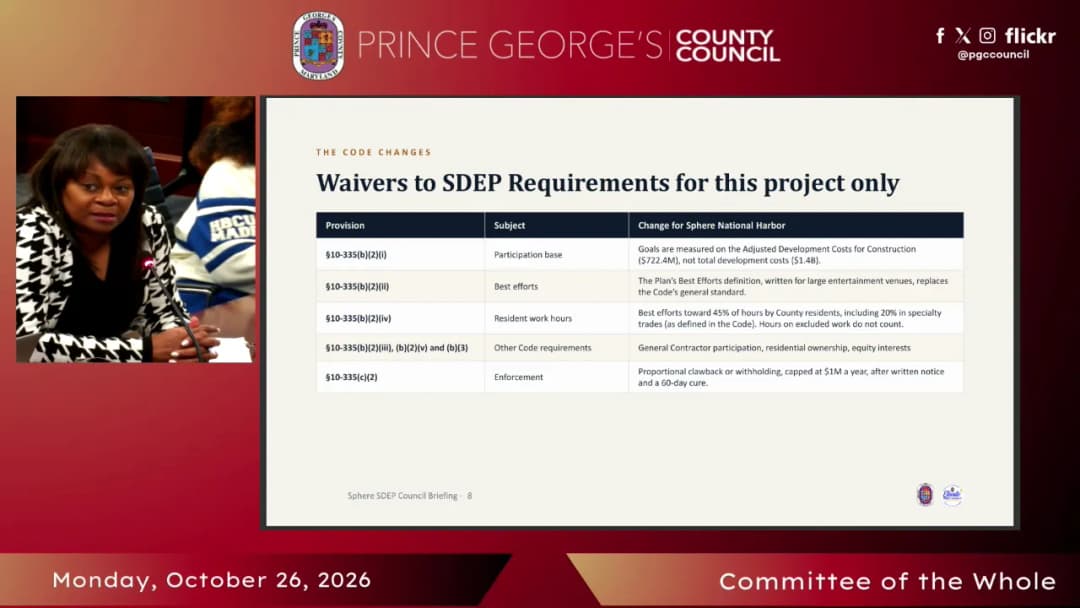
The Prince George's County Council met as the Committee of the Whole on Monday, October 26, 2026, at 2:00 PM in the Council Hearing Room in Largo, Maryland. Seven members were present for roll call: Chair Oriada, Vice Chair Olson, and Councilmembers Adams, Blay, Burroughs, Fisher, and Hunter. The committee reviewed the Supplier Diversity and Equity Plan for Sphere National Harbor, considered CR-121-2026 approving a tax increment financing proposal, endorsed the FY 2028 joint school construction priorities letter, and advanced CR-115-2026 on a county-owned grocery store pilot. The printed agenda listed only the first two items; the school construction letter and CR-115 were also taken up during the meeting. No minutes were available. Sphere National Harbor Supplier Diversity and Equity Plan Staff from the County Executive's Office and the Office of Procurement presented the Supplier Diversity and Equity Plan for the proposed Sphere at National Harbor. The plan, executed on October 19, 2026, applies to a $1.4 billion construction program. The venue would seat about 6,000 people, stand roughly 302 feet tall, sit next to MGM National Harbor, and is targeted to open in 2030, with site work beginning this winter. The county subsidy plan would attach $130 million in net tax increment financing proceeds under CR-121-2026. The plan measures requirements against a $722.4 million adjusted construction base rather than the full $1.4 billion. About $683.8 million in specialized costs are excluded, including proprietary Sphere show systems, the exterior LED display, ELV systems, immersive interior surfaces, bowl audio and show software, 4D systems, rigging, seating, and $88.3 million in design fees already issued. Staff stated that further exclusions are not automatic and require documented approval. Key commitments include: - At least 50% of the adjusted base, about $361.2 million, paid to county-based small businesses and locally owned and operated businesses. Staff described this as a requirement, not a goal. - Best efforts to reach 40% county-based minority business enterprise participation, about $289 million. - A combined local and minority spend minimum equal to the lesser of $280 million or 50% of the adjusted base, with a $130 million floor. - A best-efforts goal that 45% of construction hours go to county residents, including 20% in specialty trades. - County firms must perform a commercially useful function; pass-through arrangements do not count. Monitoring and enforcement were also outlined. The developer must file a preliminary report within 45 days, advertise solicitations at least 14 days before bids are due, report monthly and quarterly, pay county firms within 45 days, and face potential clawbacks or withholding of up to $1 million per year after written notice and a 60-day cure period. Waivers of participation goals require documentation and council approval. Councilmembers raised several concerns. One councilmember asked about penalties and was told the community benefits agreement has not been finalized, while SDEP penalties are up to $1 million. Councilmember Adams stressed the need for experienced staff on the ground to help county businesses build capacity, not just monitor reports, and urged that exclusions not become off-the-shelf opportunities. Chair Oriada expressed concern about having no hard local-hiring minimum and called the $1 million clawback cap low for a $1 billion project. Staff clarified that CR-21-2019 had a 40% resident minimum, while the plan negotiated 45% as a best-efforts target with documented outreach required. CR-121-2026 – Tax Increment Financing for National Harbor Staff explained that CR-121-2026 is required under CR-21-2019 before tax increment financing bonds can be issued for the National Harbor Development District and National Harbor Extraordinary Development District. The resolution approves the TIF proposal and certifications from the developer, the County Executive, and bond counsel. The developer requested waivers of CR-21-2019 requirements related to the trigger mechanism/lookback, equity participation and ownership, and delivery of a minority business enterprise plan. All remaining CR-21-2019 requirements would apply to bonds authorized under CB-111-2026. The County Executive certification and Bond Counsel certification were dated October 20, 2026. During discussion, a councilmember questioned the local and minority spend floor in the plan. Staff responded that the $280 million combined minimum represented a 100% success scenario, the $130 million floor was added so the developer could not reduce obligations if exclusions shrink the base, and any lower threshold would require extensive documentation and compliance-manager approval. The committee voted 7-0 to move CR-121-2026 favorably. Chair Oriada voted with the majority but said she felt uncomfortable with the absence of hard confirmed penalties for MBE participation and with the $1 million clawback cap, and asked to continue working on those concerns offline before the next day's session. A separate motion to accept the additions package also carried 7-0, though its specific contents were not identified in the transcript. FY 2028 Joint Capital Improvement Priorities Letter PGCPS and county officials presented the joint capital improvement priorities letter to the Maryland Interagency Commission on School Construction. The Board of Education's FY 2028 request is $51.9 million. It includes continuation of multi-year modernizations, including the Cool Spring regional special education therapy pool annex, High Point High School, and New Northern planning; planning approvals for Crossland High School and southern-area elementary and middle school analysis; and envelope replacement projects, including nine roof replacements and four window and door replacements previously excluded from state funding requests. The letter is intended to demonstrate alignment among PGCPS, the County Executive, and the County Council and to maximize potential state CIP funding. A councilmember asked about New Northern and the absence of a county match. Staff explained that High Point is further along in design and is receiving initial construction funding, while New Northern is still in the planning phase and does not yet require the county match. Another councilmember raised long-term possibilities for Lewisdale Elementary and its surrounding land; staff responded that district-wide facility and enrollment data is being updated to guide future priorities. Staff also confirmed that parking-lot projects would be funded through countywide categories in the spring budget rather than through this state request. The committee voted 6-0 to recommend chair signature on the joint letter. The item was expected to return for authorization the following day. CR-115-2026 – County-Owned Grocery Store Implementation Plan The committee reviewed CR-115-2026, sponsored by Chair Oriada. The resolution directs the Council Administrator to designate legislative branch staff to coordinate with executive agencies and outside entities on a pilot proposal for a county-owned grocery store. The intent is to expand access to affordable, healthy food in underserved neighborhoods. The proposal must address sites, community needs, ownership models, fiscal scenarios, operator selection, and success measures, and is due within 180 days of adoption. Chair Oriada moved favorable, Councilmember Hunter seconded, and the motion carried 6-0. Key Outcomes - CR-121-2026 was reported favorably by a 7-0 vote, with Chair Oriada requesting follow-up on MBE penalties and the clawback cap. - A motion to accept the additions package passed 7-0. - The FY 2028 joint school construction priorities letter was recommended for chair signature by a 6-0 vote and will return for authorization. - CR-115-2026 was reported favorably by a 6-0 vote. - The meeting adjourned following the CR-115 vote.
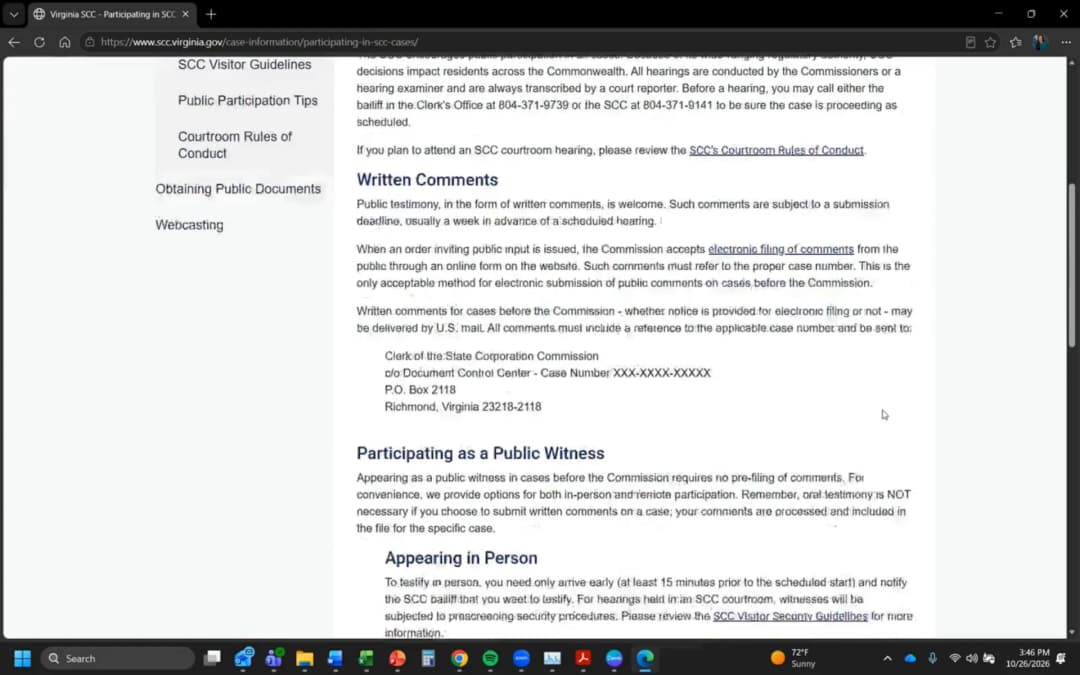
The meeting on October 26, 2026, consisted solely of procedural instructions for the public on how to submit comments or testify in the Dominion Next Era case before the State Corporation Commission. No substantive discussion, votes, or decisions occurred. Public Comments & Testimony - The meeting provided guidance on two ways to participate: telephone public hearings or written comments. Instructions were given for registering to give oral comment, submitting written comments, and finding case materials on the SCC website. Key Outcomes - No decisions or votes were taken. The meeting was informational only.
The Forest Grove City Council met at 7:05 p.m. on October 26, 2026. No written agenda or minutes were available, so this summary is based solely on the transcript. All council members were present except Councilor Gustavson. The meeting opened with a land acknowledgment, the Pledge of Allegiance, a Civics Academy graduation procession, and public comment before moving through the consent calendar, presentations, and council communications. Consent Calendar - The consent agenda was approved 6-0 by voice vote on a motion by Councilor Martinez, seconded by Council President Valenzuela. No items were removed. Public Comments & Testimony - Dale Feek asked for and received three minutes. He raised two topics: (1) concerns about the data center resolution/action and the air quality permit process, saying he had not received conclusive answers from Oregon DEQ or city staff, and (2) an election-season appeal focused on protecting education, immigration, and democratic norms, saying "everything we love is on the line" for the November 3rd election. - McCain LeVarant, a Forest Grove High School senior and Girl Scout Ambassador, presented "Project Shining Star" to reduce senior isolation. She asked the city to designate a week or month in November or December as a citywide "Visit a Senior" initiative and to consider a banner on Pacific Avenue. Her motto was "presence is the real present." - Dr. Ronald Wiseman/Wismer spoke on behalf of David Hill Road landowners in the West Side planning area. He said properties were annexed in 2007, the city adopted the West Side Refinement Plan in 2017 identifying room for approximately 1,256 additional homes across roughly 592 acres, and nearly 20 years later there is still no workable path for sewer service, David Hill Road improvements, or infrastructure funding. He cited David Weekly Homes' effort on more than 90 acres for about 235 homes and asked the city to identify staff, schedule, and funding commitments, respond in writing, and provide monthly progress updates. He emphasized landowners want to work locally rather than go to the state level. - Carol Allery thanked city staff for quickly clearing squatters near Karen's Corners, saying the area is much safer. She also shared a Bible passage from Proverbs 6:19 about a person who stirs up conflict in the community and prayed for peace in the city. - No other public comments were offered in person or on Zoom. Presentations & Reports Washington County Cooperative Library Services (WCCLS) Update - Marnie Kyle, an assistant county administrator, presented on WCCLS. She reported that nearly 351,000 residents hold library cards, users had about three-quarters of a million Wi-Fi sessions, more than 3.7 million digital checkouts through Libby, and more than 2.4 million in-person visits. WCCLS includes nine cities and three nonprofit partners operating 16 library locations serving about 600,000 residents. - The most recent library levy passed with 59% voter support in November 2025. The levy rate is 37 cents per thousand dollars of assessed value, an increase of 15 cents from the previous rate of 22 cents. Forest Grove received $1,231,813 from WCCLS in fiscal year 2026-27, a 24% increase over the prior year. - WCCLS is developing a shared collection management model. City Manager Jesse Vander Zanden serves on the WCCLS executive board, and Library Director Colleen Winters serves on the library leadership group. - Council President Valenzuela asked whether levy funds are used exclusively for libraries and expressed concern that centralized collections could reduce local control. The county representative confirmed 100% of levy funds go to libraries and that WCCLS funds can still be used for locally purchased materials. - Mayor Winsel said she had lost trust in the process and finances, particularly because the new agreement has no floor or guarantee of county general fund support. She said voters who passed the levy expected it to add to services, not replace existing support, and she asked how WCCLS would rebuild trust. She also raised concerns about unincorporated Washington County residents using city libraries and the strain on city budgets. - Councilor Marty (as transcribed) asked about levy surplus, county general fund commitments, and the perception that county commissioners could redistribute funds. He said the uncertainty makes it harder for the city to ask voters for its own levies and cited other county departments, such as health and human services and housing, as examples of collaboration that incorporates feedback. The county representative responded that levy funds do not go into the general fund, there is a 3% fund balance policy, and all partner libraries received funding increases. Watershed Annual Report - Barry Sims of Trout Mountain Forestry and Public Works Director Greg Robertson presented the annual watershed report. The watershed is about 4,200 acres, roughly five miles northwest of the city, and supplies about half of Forest Grove's water. About one-third of the watershed is reserved from timber management to protect water quality and steep slopes. - In 2026, thinning and small patch cuts produced 1.86 million board feet of harvest volume and a net return to the city of about $900,000. Staff recommend a smaller harvest of about 1.5 million board feet next year. A new timber inventory is planned, and the city will undergo its next Forest Stewardship Council audit next year. - Councilor Falkner asked about long-term risks such as wildfire, disease, pests, and species diversity. Mr. Sims said the city is planting western red cedar, relying on drought-tolerant Douglas fir, avoiding steep erodible slopes, and responding quickly to issues such as lightning strikes and bark beetles. He said the only power line in the watershed is a PGE distribution line along Soda Springs Road, and undergrounding has not been discussed. - Councilor Schimmel asked about state forestry policy; Mr. Sims said the city's stream buffers already exceed the recent Private Forest Accord requirements and he was not aware of pending state changes that would harm city watershed management. MECOP Internship Presentation - Ava Greck, a MECOP engineering intern, presented the projects she worked on over about five months with the city. She worked with engineering inspector Leo Cortez, Public Works staff, and contractors including Goodfellow Bros., Fortis Construction, and Clean Water Services. - Her work included weekly erosion control inspections, ADA curb ramp inspections, subdivision projects Davis Estates and Bailey Meadows (each with over 200 new lots), Mills Lane with Habitat for Humanity (12 lots), and the Heather Street Extension. The Heather Street project created a new collector street from Mountain View Lane to Highway 47, with the Crane Data Center and Clean Water Services funding road frontage improvements. Sidewalks and two crosswalks were included at the new intersection. - She earned an ADA curb ramp inspector certification and learned AutoCAD, Blue Beam, Procore, and other software. - Councilor Falkner asked about pedestrian facilities on Heather Street, and Ms. Greck confirmed sidewalks and crosswalks are part of the project. A council member suggested checking an ADA ramp at the northeast slip lane at Quince and Tualatin Valley Highway for water pooling. Public Works Annual Report - Greg Robertson described projects by other agencies and city projects. ODOT's U Street signalization project is fully funded, with construction planned for 2028. The Rose Grove Crossing project is nearly complete. The Highway 47/Maple/Fern Hill intersection project is in Washington County's hands and is now planned for construction in 2028 after railroad agreements are finalized. The Council Creek Regional Trail is at about 90% design and is scheduled for completion around 2029. - City accomplishments included about 1.2 miles of overlay work, 47 curb ramps (about 600 total since the program began), completion of the Public Works administration building remodel on time and under budget, finishing an emergency intertie project, and replacing a 75-year-old raw water booster pump at the water treatment plant. - Upcoming priorities include a two-way traffic planning study for the Pacific Avenue/19th Avenue couplet between B Street and Hawthorne, completion of the Mountain View Safe Routes to School project in 2027, resumption of stormwater and sewer master plan updates, and continued support for county trail and Highway 47 projects. - Councilor Falkner asked about speed and safety at the Highway 47/Maple/Fern Hill intersection. Mr. Robertson said ODOT is proposing a lower speed limit beginning near Elm Street through Quince, and he would follow up on a possible roundabout at B Street and safety improvements at the B Street yield intersection. He also said the city has a GIS inventory of non-compliant curb ramps and expects the full sidewalk-gap inventory to be completed in about two years. - The mayor expressed frustration about repeated delays on the Fern Hill/Maple/47 project. Mr. Robertson explained that a roundabout was explored but not allowed by the railroad, so the project became a conventional signal. The mayor also asked about high-impact, low-cost speed reductions before construction. Federal Affairs Update: ICE Incident - Police Chief Marzelli provided an update on the October 7th incident in which an ICE agent entered the police station. He said a public records request for video footage is being processed; the city plans to release the video to the requester and post it on the city's YouTube channel. He estimated the video could be ready by the end of the week. - The chief met with community organizations on October 22 to discuss rebuilding trust. Groups included Adelante, community action agencies, the Ecumenical Ministries of Oregon, Portland Community College, Centro Cultural, and others. An external third-party review is being coordinated, and training materials will be updated after the review. - Forest Grove participates in the governor's office coordination call on ICE activity. City staff also reminded department directors of policies for interactions with federal immigration officers. - Councilor Martinez said she has trust in Chief Marzelli and Assistant City Manager Zelle and thanked officers for their work. Councilor Schimmel asked about state coordination regarding Oregon State Police parking lots and broader scenarios if ICE agents were turned away from one public location and went to another. The chief said those questions are part of ongoing discussion. - Chief Marzelli affirmed that officers are committed to serving and protecting everyone in Forest Grove regardless of immigration status. Data Center Moratorium: Next Steps - Dan Reardon, senior planner, presented the schedule for development code amendments during the data center moratorium. The council adopted the moratorium resolution on October 12, 2026, which started a 120-day period ending February 9, 2027. - Proposed schedule: a joint council-planning commission work session on November 9; a council work session on November 23 to review draft amendments; public notice around November 30; a planning commission hearing on January 4, 2027; council first reading on January 25; second reading on February 8; and code amendments effective about March 10 unless an emergency clause is used. - Amendment topics may include application review process, location restrictions and setbacks, building design and screening standards, electrical availability requirements, water-cooling standards, noise standards for continuous low hum, heat island mitigation/heat recapture, and natural resource protections. - The mayor asked about the gap between moratorium expiration and the effective date. Mr. Reardon said the council could extend the moratorium or adopt an ordinance with an emergency clause. - Councilor Falkner suggested learning from Eugene, where data centers are not allowed in industrial zones, and noted that many of the proposed standards could benefit all industrial zones, not just data centers. Council Communications & City Manager Report - Council President Valenzuela reported on the October 14 library commission meeting, the Civics Academy library tour, and the band book event attended by about 10 people. She said Forest Grove is in the last cohort for centralized library collections, beginning in March 2028. She also reported on the Public Arts Commission's plans to present a Main Street art project, decorated trash bins (city purchased 25, starting with five), and an artist mixer on November 13. - Councilor Schimmel reported on the TV Highway bus rapid transit project, noting value engineering reduced the state funding ask from about $50 million to $40 million. He also mentioned the veterans memorial grant, Barney Reservoir Joint Water Commission recruitment after Rod's retirement, the Chamber's Latina Power Luncheon on November 4, and the tree lighting on November 27. - Mayor Winsel mentioned the sister city student delegation arriving Wednesday evening and discussed a future idea to combine the holiday parade with the tree lighting. - City Manager Jesse Vander Zanden reported that the community open house is October 27 from 6 to 8 p.m. He said the September FIRE report showed the fire department could staff and equip two emergency response units 90% of the time (27 of 30 days); without levy-funded firefighters, that would be 47% of the time (14 of 30 days). He also noted the library foundation funded five new crepe myrtle trees, Light and Power completed holiday tree decoration at Pacific University and replaced ten 1954 transmission poles, and the city is hiring cashier positions at the pool. Key Outcomes - Consent agenda approved 6-0. - The council voted to extend the meeting past 9:30 p.m. to finish council communications. - No formal votes were taken on the presentations, but the council received the WCCLS update, watershed report, MECOP internship report, public works annual report, ICE update, and data center moratorium plan. - Council reached consensus for staff to evaluate whether the state Veterans and War Memorial Grant program, ranging from $10,000 to $80,000, is viable for the city and to return with a recommendation. - Next steps for the data center moratorium include a November 9 joint work session, November 23 council work session, January 2027 hearings, and February 2027 ordinance readings.
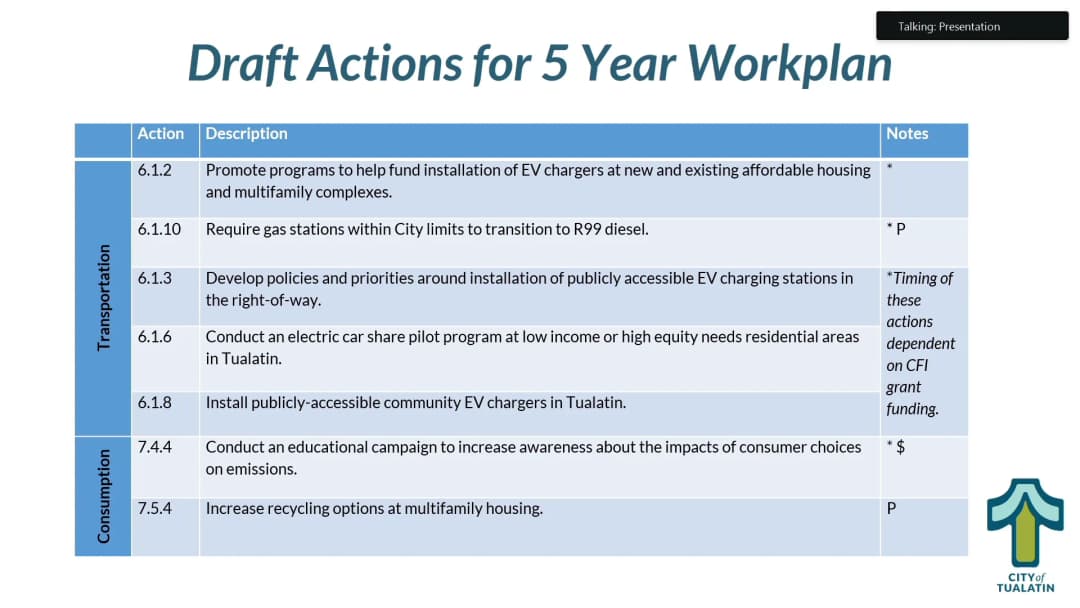
The Tualatin City Council held a work session on October 26, 2026. Staff presented the draft five-year Climate Action Plan work plan, outlined a proposed eviction prevention grant program, reviewed the upcoming council agenda, and heard council roundtable updates. No agenda or minutes were included with the transcript; the regular council meeting was scheduled to follow the work session. Climate Action Plan Five-Year Work Plan - Amanda Watson, climate action program manager, said the Climate Action Plan includes more than 100 actions to prepare for climate impacts and reach net zero carbon emissions by 2050. The draft work plan covers 2026-2031 and was developed with a cross-departmental staff group, advisory committees, and earlier council feedback. - Actions were scored in two rounds. Round 1 considered climate impact, co-benefits, alignment with council goals and adopted plans, and opportuneness. Round 2 considered feasibility, staff capacity, community support, funding, rough implementation cost, and long-term cost savings. - The draft list balances adaptation and mitigation, all major hazards (heat, flooding, wildfire smoke) and emission sources, ongoing versus new work, and short-term versus longer-term efforts, while leaving room for emerging opportunities. - Highlighted draft actions include: heat-focused communications and tree canopy efforts, Emerald Ash Borer response under the Tualatin River watershed action, wildfire preparedness and air filtration outreach, flood reduction and stormwater work tied to downtown and Nyberg Creek, building energy efficiency incentives, home energy scores, EV charging and R99 renewable diesel policies, consumer choice and multifamily recycling initiatives, and a facilities master plan that integrates climate goals. - Councilors offered suggestions: Councilor Brooks asked about measuring emissions and suggested public-friendly projections; Councilor Gonzalez asked to emphasize reduce/reuse before recycling, explore cool/white roofs, and support dry-season walkability; Councilor Sacco asked about partnerships with the IDEA Committee and the Grand Ronde Tribe and multilingual emergency preparedness resources; Council President Pratt asked for housing variety/ADU connections, confirmed extreme weather shelters are in place, and asked about CERT evacuation workshops and heat-resource maps. - Watson said the next GHG inventory update will measure community-wide progress, some individual actions can be quantified while education actions are indirect, and staff could investigate cool roofs, reuse partnerships, and community walking/carpooling events. Eviction Prevention Grant Program - Robin Doty, interim deputy city manager, introduced the item and Megan Cohen, homelessness liaison, presented the proposal. The program would use supportive housing services funds to prevent homelessness before eviction, focusing on Tualatin renters with one-time arrears caused by short-term job loss, medical emergencies, or similar situations. - The proposed partner is Family Promise of Tualatin Valley, which operates a 70-bed family shelter and already has dedicated eviction prevention staff. They would handle household income verification, light-touch case management, direct payments to landlords, and coordination with other agencies. The program would target renters, not homeowners. - Funding would be $35,000 per year beginning in FY 2026-27, using roughly $105,000 in homeless liaison intergovernmental agreement funds to cover three years: $30,000 for direct assistance and $5,000 for administration. Family Promise would report twice a year and present outcomes to the council. - Complementary programming includes Community Action utility assistance for Tualatin water bills at multifamily properties, a Community Action staff liaison at the Tualatin library one day a week and at the Tigard library one day a week, possible on-the-spot utility assistance and navigation, and advocacy during the 2027 legislative session. - Megan Cohen noted Washington County Supportive Housing Services ended the fiscal year with roughly $14 million in unspent funds; the county commission was expected to vote in mid-November on allocating those funds, with additional eviction prevention recommended and largely managed by Community Action. - Councilor Brooks asked about supports for people on disability and benefits renewals. Megan cited SSI/SSDI navigation gaps, mentioned the Assist organization, and said the library liaison could generally refer people but not provide full casework. Council President Pratt asked Megan to repeat the organization name. Another councilor said it was reassuring that eviction help would be available in Tualatin after hearing many Tualatin residents seek help in other cities. The mayor called it good news but acknowledged it was not enough, while noting it would help several families over three years. Agenda Review and Council Roundtable - Council reviewed the regular meeting agenda, including the pledge, a Native American Heritage Month proclamation with IDEA Committee members, and a consent calendar item adopting the City of Tualatin Investment Policy. Councilor Brooks raised a transparency question, but staff clarified the policy must be approved annually by state law and no changes were recommended this year, so the item remained on consent. - City Manager Lombos reported a national website award, a record-breaking city booth at the Pumpkin Regatta with at least 1,000 items given out, an initial Pumpkin Regatta attendance estimate of about 27,000, a winning pumpkin at Pints and Pumpkins weighing 1,563 pounds, winter program registration opening November 9, the lowest lead and copper sampling results since testing began, two new grant-funded electric city vehicles, and an asset management day with 40-50 participants. - Council roundtable updates included attendance at League of Oregon Cities and ICMA conferences, Councilor Sacco's re-election to the women's caucus board, an LOC exceptional service award for Sherilyn, a Willamette River Water Coalition update that 82% of Oregon is in drought and the Willamette basin snow water equivalent was at 4%, IDEA Committee and community events, and Council President Pratt noting the housing forum highlighted that only 1% of people who reach out for help actually receive it. Key Outcomes - No formal votes were taken during the work session. - Climate Action Plan staff will incorporate council feedback, finalize the draft action list, create rough fiscal-year timelines, develop performance measures, and report annually; staff said a final plan would likely return before the end of the year. - The eviction prevention grant program received broadly supportive feedback. Staff will continue developing the Family Promise partnership, utility assistance, library liaison, and related wraparound services, with more details to come.
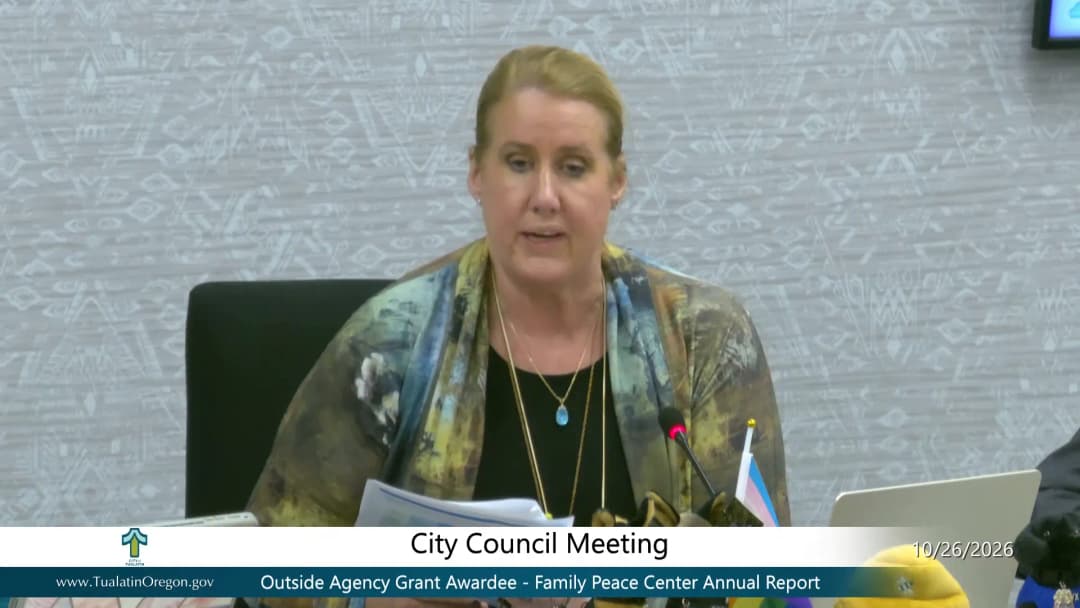
The Tualatin City Council met on October 26, 2026, for a regular meeting. The meeting opened with the Pledge of Allegiance led by veterans and included a Native American Heritage Month proclamation, public comments, a unanimous consent agenda, reports from Washington County Commissioner Jason Snyder and the Family Peace Center, a downtown revitalization project update, advisory appointments, and council communications. No agenda or minutes were available; this summary is based solely on the transcript. Consent Calendar - Council unanimously approved the consent agenda as read, including: (1) minutes of the October 12, 2026 work session and regular meeting; (2) Resolution 6003-26 adopting the City of Tualatin investment policy; and (3) Resolution 6004-26 awarding FY 2026-27 outside agency grant funds for services to the Tualatin community. Public Comments & Testimony - Dale Potts, joined by veterans Lynn Schauberg and Rocky Bixby, promoted the Veterans Recognition Breakfast scheduled for November 10 from 9:00 to 10:30 a.m. at the Poll Center. Veterans attend free, guests are $12, and about 100-125 people typically attend. They encouraged registration by calling the Poll Center and asked attendees to park away from accessible spaces for disabled veterans. - A Zoom commenter asked the council to consider installing more protective bus stop shelters with walls that block wind, similar to Washington Square Mall, and adding outdoor water stations with maps and purifiers, noting the region has more rain than sunshine. Proclamations & Special Recognitions - Councilor Sacco read a proclamation declaring November 2026 as Native American Heritage Month in Tualatin. The proclamation recognized the Atfalati/Kalapuya (Tualatin) people, Oregon's nine federally recognized tribal nations, and the city's commitment to tribal engagement and equity. - Councilor Sacco also noted the 43rd anniversary of the Grand Ronde Restoration Act on November 22, commemorating the 1983 restoration of federal recognition, and mentioned 1988 legislation restoring over 9,000 acres to the Grand Ronde. - Mayor Bubenick read a mayoral proclamation marking the 100th anniversary of the removal of the Black Exclusion Clause from the Oregon Constitution on November 2, 1926, noting the 62.52% vote in favor of repeal and the case of Jacob Vanderpool. Special Report: Washington County Commissioner Jason Snyder - Commissioner Snyder provided updates: he is now the primary commissioner on the Metro Supportive Housing Services Regional Policy and Oversight Committee; the county passed a vehicle registration fee with a slower ramp-up; budget priority discussions are beginning; and jail and community corrections facility planning and courthouse replacement work are underway. He stated the two facilities should be on the same campus or directly connected for operational efficiency. - Councilor Brooks raised concerns about potential loss of housing for about 4,000 people if state funding and disability benefit requirements change, urging prevention funding. Commissioner Snyder acknowledged federal and state funding challenges. - Councilor Reyes asked about filling the vacant commission chair seat; Snyder explained the chair election in November and that a short vacancy would not be filled. - Council President Pratt asked about creative county revenue solutions and the county budget deficit, noting a prior $20.5 million deficit. Snyder said the final forecast is coming soon and assessed values are lower than average in some areas. Pratt also asked about the county's nearly $6 million purchase of the Cameron Jewett property near North Plains; Snyder defended it as a good purchase for maintaining the transportation system. - Council members expressed concerns about WCCLS library oversight, including the executive committee being city managers rather than elected officials and uncertainty about centralized collections. Snyder said there has been willingness to discuss more elected engagement after the November election, and he personally supports elected representation. City Manager Lombos said he had no opinion on the structure but acknowledged elected-to-elected communication is important. Special Report: Family Peace Center Annual Report - Board President Judy Willie and Executive Director Rachel Schultz presented the annual report. Willie noted the center opened a new 60,000-square-foot, three-level building that is already full, with 22 agencies under one roof. She thanked Tualatin for 10 years of support and announced she will step off the board in January. - Schultz reported that the Family Peace Center opened January 20, 2026, and is seeing a 34% increase in physical access over the former Family Justice Center, with 28-32 people walking in daily. On a first visit, survivors meet an average of 7-10 organizations, with a record of 17. Services accessed increased 16%. Through August, the center served 3,479 survivors and provided 6,754 services, with 99% positive survivor outcome indicators. - Tualatin-specific numbers: 73 Tualatin survivors were served in 2026 versus 54 in 2025, about a 35% increase, while services accessed were 166 in 2026 versus 175 in 2025, about a 5% decrease. Overall, 76% of survivors come from urban Washington County cities. - Schultz described the service menu and navigator model, transportation partnerships including Ride Connection, Ride to Care, and a free Uber grant, and police departments' willingness to transport survivors. Walk-in hours are Monday through Friday, 8:30 to 4, and the phone line operates 24 hours. - Councilor Brooks praised the model and asked about duplicating it for housing insecurity; Schultz agreed the model is transferable. Councilor Gonzalo asked how people can help; Schultz mentioned donations, clothing and food contributions, fabric recycling bins, Denim and Diamonds, and the upcoming Run for Hope 5K. Discussion Items - Downtown Revitalization Project Update: Quinn Brunner introduced Ken Peary and Mike Zylas of Walker Macy, the consultant team leading phase three. They described the project team, community engagement at the Regatta reaching 350 people, and five CAC evaluation criteria. The study area includes a roughly 300-acre overall area and a 60-acre core downtown area. They noted only about 17% of downtown building frontages are currently active and identified wayfinding, connections to the lake and riverfront, and adaptive reuse as key challenges. The schedule includes an existing conditions presentation in December, draft urban design frameworks in March and June, draft standards in September, final standards in late October, and adoption in early 2028. - Councilor Brooks asked about the Regatta feedback dots and about entryways, river integration, and sustainable modernization; Ken Peary said the dots were fairly even, with the magnetic and fun identity value receiving fewer dots possibly due to wording, and that wayfinding and building adaptation would be priorities. Councilor Reyes expressed excitement about making the lake area visible and attracting foot traffic and businesses. - Council Committee on Advisory Appointments: Councilor Reyes reported the committee met October 6 and recommended five nominees. The council unanimously appointed Ralph Galantine to the Core Area Parking District Board; Ashley Payne and Emmy Lowanzon to the Library Advisory Committee; and Tay Washington and Lexi Washington to the IDEA Committee. Key Outcomes - Consent agenda approved unanimously. - Five advisory board and committee appointments approved unanimously. - Proclamations issued for Native American Heritage Month and the Black Exclusion Clause anniversary. - Downtown revitalization project update received; next council touchpoint scheduled for December with existing conditions findings. - No items were removed from the consent agenda for separate hearing. Council Communications - Council President Pratt reminded the public of a micro-mobility listening session on e-bikes and e-scooters at 6:00 p.m. tomorrow at Hazelbrook Middle School, with Spanish translation available. - Councilor Brooks invited the community to the third annual Trades and Manufacturing Forum on Thursday and the League of Minority Voters' State of Civil Rights and candidate forum that evening.