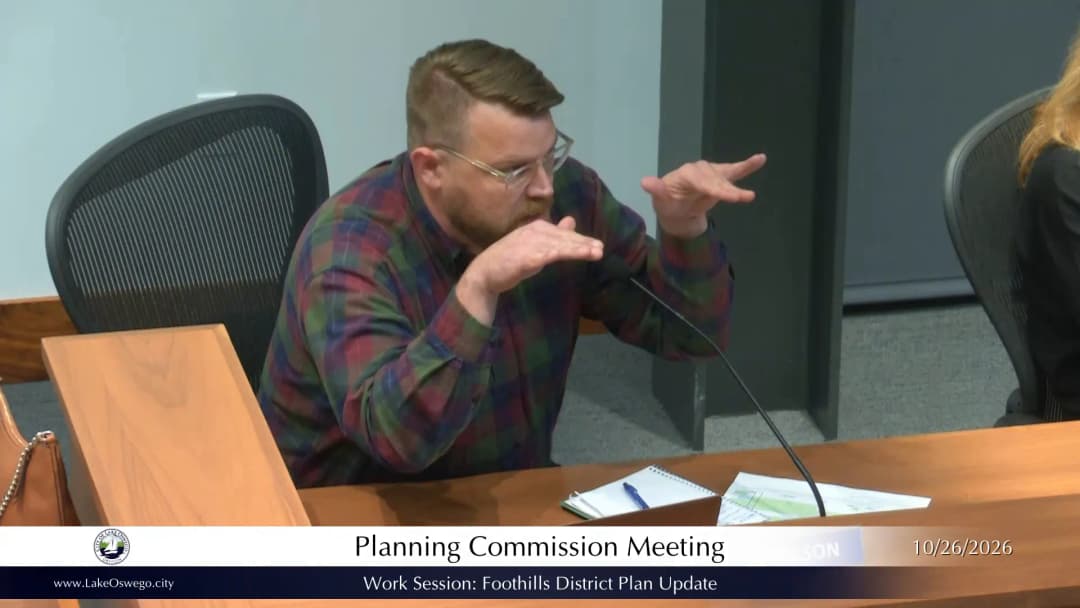
The Lake Oswego Planning Commission convened on Monday, October 26, 2026, for a work session primarily focused on the Foothills District Plan Update (PP 25-0005), Work Session 7. The meeting included updates on city council activities, project engagement, and a detailed presentation on the evolving schematic plan for the district's redevelopment. Consent Calendar - The Commission unanimously approved the meeting minutes from October 12, 2026, as written. Public Comments & Testimony - No members of the public provided oral comment during the open comment period or signed up to speak on the work session agenda item. Discussion Items City Council Update Councilor Burdick provided an update on recent council activities, including the start of new City Manager Denzel Maxwell, a tight but stable city budget, and a planned 28% one-time rate increase for the new wastewater treatment plant (Jacobs design-build-operate), which was chosen over smaller incremental increases as a better long-term financial decision. Council also received updates on the South Shore Fire Station, Republic Services (no rate increase), the communication strategy, economic development, and the rezoning housing project. Foothills District Plan Update (Work Session 7) Jason Graff (First 40 Feet) and Eric Olson (Long Range Planning Manager) led the presentation. Vision and Process: The project vision was condensed to: "the district will complete downtown's connection to the Willamette River, and it's going to create a vibrant waterfront district that extends the civic heart of Lake Oswego." The framework plan process is at the schematic stage, with technical analysis ongoing. Engagement and Technical Coordination: Olson reported extensive community engagement, including three Community Advisory Committee (CAC) meetings, an open house in the Foothills district (50 attendees), a farmers market booth, and ongoing technical meetings with ODOT (State Street Special Transportation Area), the Tryon Creek Watershed Council (fish passage/culvert project), the Willamette Shoreline Trolley Consortium, PGE (substation consolidation), and City Parks. Key Development Moves: Graff introduced eight key elements of the schematic plan: 1. State Street Gateway: Proposals for improved crossings at B Avenue (walk/bike bridge), A Avenue (potential elevator/landing), and the lower Millennium Plaza. Commissioner Sly noted the "fantasy" of the A Avenue landing, highlighting land acquisition and rising property values as significant hurdles. 2. The Grand Connection: A central multimodal street with a 74-foot right-of-way, featuring two travel lanes, parallel parking, separated bike facilities, and generous pedestrian zones. The potential for future pedestrianization was discussed. 3. Park Plaza & Active Waterfront: A new urban plaza additive to Foothills Park, designed to host festivals and events. Commissioner Avison questioned how this space would differentiate itself from Millennium Plaza. Staff noted it would be a more waterfront-oriented space. 4. Development Capacity & Character: The schematic currently envisions approximately 1,300 residential units and 30,000 square feet of retail. Building types include townhomes, podium buildings, and a small tower. Design priorities include the Foothills Mixed-Use Zone, building stepbacks, and usable "fifth facade" rooftops. 5. Housing Affordability: Eric Olson reviewed the Housing Action Plan, noting a city need for approximately 2,000 units over 20 years. Chair Najok clarified that affordable housing is defined by HUD percentages of Area Median Income (AMI), citing low-income (60% or below), workforce (80-120%), and market rate (above 120%). Tax Increment Financing (TIF) is a potential tool but staff stressed funds would be tight. The city-owned former wastewater treatment plant site was noted as a potential asset for future development. 6. Parking: The plan models roughly 1.14 structured parking spaces per unit, driven by the floodplain fill strategy. Commissioners Sly and Call raised major concerns about a lack of dedicated public parking for the waterfront and retail. Graff cited shared parking with The Foundry and on-street parking as potential partial solutions but acknowledged the challenge. 7. Trails & Lake-to-River Connection: A comprehensive trail network is planned linking Lakewood Bay to the Willamette River via the Grand Connection, Curly Q trail, and a future Tryon Creek crossing linked to the fish passage project. A State Street corridor study for bikes was identified as a future need. 8. Access & Infrastructure (North & South Portals): - The South Portal realigns roads to push traffic away from Oswego Point condominiums and adds parking. - The North Portal is deemed critical for development beyond a threshold of 700 to 900 units. Two options remain under study: a route through the public storage yard (requiring property acquisition) and a route connecting to Terwilliger Boulevard (more expensive but offering partnership potential around the Tryon Creek fish passage project). Commissioner Sly strongly urged selecting a preferred route, expressing concern about project feasibility. Staff indicated council direction is to keep both options open to leverage strategic partnerships and funding opportunities. Key Outcomes - The Commission generally supported the vision and design character of the schematic plan, seeing it as a natural extension of downtown. - Significant concerns were registered regarding the feasibility of land assembly for the road network and the lack of a comprehensive public parking plan for the waterfront district. - Staff was directed to document lessons from similar developments (e.g., Vancouver, WA waterfront) and to develop a detailed pros and cons analysis of the North Portal options. - The project schedule was confirmed: Draft Framework Plan for Planning Commission review on February 22, 2027, City Council adoption in April 2027, and implementation code amendments beginning in June 2027, concluding by the end of 2027. - The regular Planning Commission meeting scheduled for November 9, 2026 was canceled. The next meeting is November 23, 2026.
The Public Meeting Index
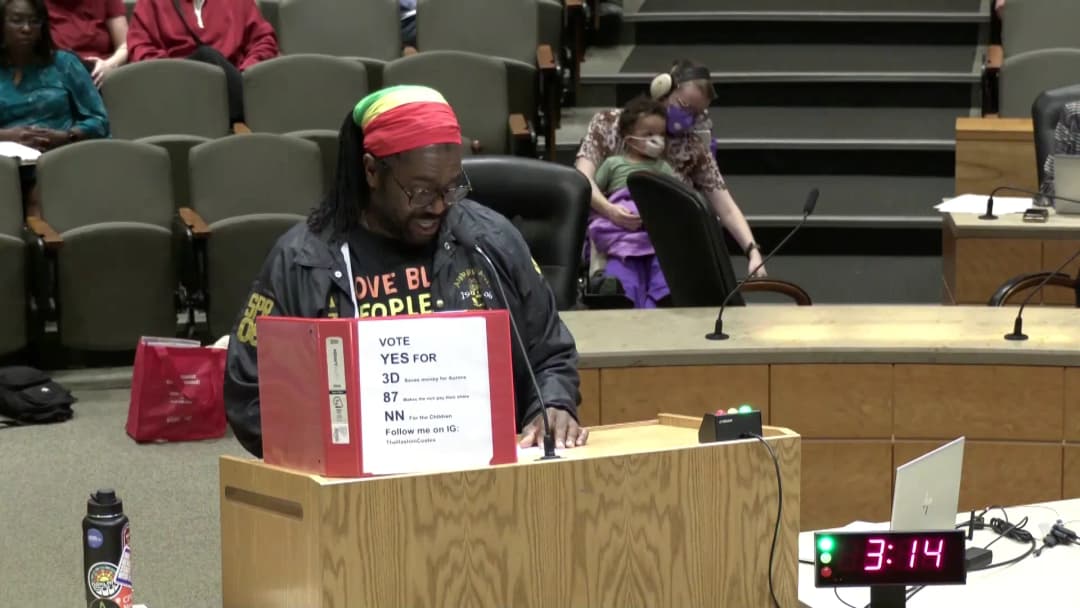
The Public Meeting IndexThe Aurora City Council met on October 26, 2026, in a session that ran past midnight. After an executive session on oil and gas lease agreements, the council took up routine approvals, heard extensive public testimony, and considered a failed procedural attempt to revive a data-center moratorium resolution (2026-97) that had failed in August. The council also passed a resolution tightening legislative process rules and introduced a self-insurance fund ordinance. The transcript opens by referring to the 'Orient City Council,' but all other references identify the City of Aurora; no agenda or minutes were provided. Councilmember Reports - Multiple members gave updates: Jackson reported on the housing committee's review of Aurora Saves and the Arapahoe County Justice Coordinating Committee; Horton discussed Fletcher Plaza and a youth barbershop talk; Wiles announced a Nov. 2 data center town hall; Medina announced a Nov. 10 town hall; Hancock attended the America's Defense Communities Conference. - Mayor Kaufman said he does not condone profanity in chambers, noted a $75,000 payment tied to a First Amendment lawsuit, and said he acts on the city attorney's advice. Consent Calendar - The council adopted the Oct. 12, 2026 minutes unanimously and adopted the meeting agenda unanimously. - Councilmember Bergen pulled item 11A1; the remaining consent motions 11A2–11C1 were adopted unanimously. The council then approved item 11A1, the Homeless Services Notice of Funding Opportunity recommendation for Three Birds Alliance using marijuana funds, unanimously after staff described performance metrics such as shelter occupancy, exits to permanent housing, and average length of stay. - The council pulled resolution/ordinance item 12A1 and adopted the remaining consent resolutions/ordinances 12A2–12B2 unanimously. Public Comments & Testimony - Police accountability: Numerous residents demanded that Police Chief Todd Chamberlain be fired and called for community control of policing. Speakers invoked the deaths of Corey Dillard and Kylin Lewis, criticized City Manager Jason Bachelor's selection of Chamberlain, questioned consent-decree monitoring work by IntegraSure, and objected to police raises. One speaker cited a consent decree report saying APD would not be fully compliant by February 2027 and had problems with 10 mandates. Another said use-of-force incidents against Black residents had remained around 30% while Black residents make up about 15% of Aurora's population. - Surveillance: Chad Johnson (Ward 5) urged council to let the Flock license plate reader contract expire in March, called the $848,000 annual cost a waste, and opposed ballot issue 3B, saying it would fund a $900 million police master plan and mass surveillance. Ryan Costanzo called Flock cameras 'surveillance cameras' and cited the U.S. Supreme Court decision in Chatry v. United States. - Data centers: Dozens of residents, including youth and neighboring municipal officials, opposed the proposed Vantage/Trident hyperscale data center and other projects. They cited water consumption, electricity demand, noise, low-frequency sound, air pollution, emergency generators, property values, lack of public notice, and developer incentives. Some speakers said a moratorium alone was insufficient and demanded a permanent ban. Speakers said five data centers were under consideration, including QTS, Trident, NTT, Microsoft, and Aerotropolis. One speaker said Trident would require about 11 times more power than DIA and cover more than 15 football fields. Another cited research estimating pollution tied to AI power demand could cause up to 3,100 premature deaths a year nationwide by 2030. - Oil and gas/fracking: Andrew Pinkowitz asked council not to lease city minerals for the proposed Sunlight Long fracking site near Aurora Reservoir, saying it threatened the drinking water source for over 400,000 people and used about 28 million gallons of water per well. Yvonne Yap, with Safety Aurora Reservoir, drew parallels between fracking approvals and data center approvals. - Other topics: Speakers raised ADU parking concerns, slumlord enforcement, EV charger permitting delays, library board appointments, and the arrest and asylum case of Roberto Roa. One speaker corrected Mayor Kaufman's earlier statement, saying a $75,000 payment went to attorneys, not to the speaker personally. Discussion Items - Three Birds Alliance funding (11A1): Homelessness Manager Stephanie Kuiper presented the marijuana-funds allocation for staffing, food, shelter supplies, and utilities. Public commenter Hashim Coates supported housing-first investments while urging disclosure of any conflicts of interest and measurable outcomes. The item was approved unanimously. - Resolution 2026-112 – Council rules amendment: The resolution would require council legislation to go through policy committee, study session, and regular meeting unless it meets specified exceptions. It was sponsored by Councilmembers Andrews and Hancock. Supporters said it restores proper process; opponents said it was rigid, allowed a minority to block items, and contained unclear emergency definitions. The city attorney explained exceptions for public safety/health emergencies, fiscal impacts, and legal deadlines. It passed 6-5, with Mayor Kaufman casting the deciding vote; Mayor Pro Tem Coombs and Councilmembers Horton, Jackson, Medina, and Wiles voted no. - Ordinance 2026-53 – Self-insurance fund: Staff said the city will move its United Healthcare plan from fully insured to self-funded on Jan. 1, 2027, and the ordinance creates an internal service fund. Councilmember Wiles recused herself. Hashim Coates raised concerns about financial exposure, employee benefits, and taxpayer risk. The item was adopted unanimously among participating councilmembers. - Data center reconsideration procedure: Mayor Kaufman moved to suspend the rules to allow an out-of-time motion to reconsider Resolution 2026-97, the failed August data center resolution. The motion required a two-thirds vote and failed 6-5, with Councilmembers Andrews, Bergen, Gardner, Hancock, and Lawson voting no. The council therefore did not reach the substantive data center moratorium question. Mayor Kaufman gave notice he would bring the same motion and resolution again at the next regular meeting. Key Outcomes - Adopted Oct. 12, 2026 minutes and the meeting agenda unanimously. - Extended the first public comment period to allow the remaining 23 speakers, by an 8-3 vote. - Approved Three Birds Alliance marijuana-funds homeless services spending unanimously. - Adopted consent calendars 11A2–11C1 and 12A2–12B2 unanimously, with items 11A1 and 12A1 pulled and considered separately. - Passed Resolution 2026-112 (council rules amendment) 6-5. - Introduced/adopted Ordinance 2026-53 creating the self-insurance fund; Councilmember Wiles recused. - Failed to suspend the rules to reconsider Resolution 2026-97, by 6-5; the data center moratorium was not heard. Mayor Kaufman announced he will bring it again at the next regular meeting. - Near the end of the meeting, Councilmember Horton said most remote councilmembers had logged off; Councilmember Bergen disputed that, saying he was listening on another computer. Note: No agenda or minutes were available for this summary; it is based solely on the raw transcript.
The Aurora City Council convened a study session on Monday, October 26, 2026, with Mayor Kaufman presiding. A quorum was present. The council moved consent calendar items forward, received a presentation on the South Metro Aurora Auto Aid Agreement, established an ad hoc committee on criminal sentencing reform, and debated a proposal to change data center siting distances. Consent Calendar - Items 2A through 2D were moved forward without objection. Discussion Items 3A: South Metro Aurora Auto Aid Agreement (First Amendment) - Assistant Fire Chief Hunter Hackbirth Barth presented the first amendment to the South Metro Aurora Auto Aid Agreement, last updated in 2019 when Cunningham Fire Protection District and South Metro Fire consolidated into a fire authority. - The amendment adds a small area between Chambers and Tower and Quincy and Bellview to the auto aid agreement so an additional South Metro engine can respond to structure fires, because South Metro operates a firehouse in a strip mall at Buckley and Smoky Hill. - The agreement is two-way: Aurora assists with unincorporated Arapahoe County areas from Hampden south to Parker and east of Parker Road. - Barth stated there are no significant changes and no added cost. Item 3A moved forward without questions. 3B: Ad Hoc Committee on Criminal Sentencing Reforms - Mayor Pro Tem Coombs explained that the goal is to gather data from internal departments, Judicial District 18, Arapahoe and Adams County sheriffs, JD 17 and 18 courts, and to a more limited extent Douglas County and District 23, before revising the city's criminal code and penalties in response to the Camp and Simons decision. - Councilmember Bergen questioned why a subcommittee was needed and whether the data already existed; staff member Pete said the intent is a deeper dive and to keep stakeholders informed, including if council considers eliminating criminal cases from municipal court. - Councilmember Lawson asked for examples of community stakeholders. Examples provided included Bridge House (re-entry programs), the Colorado Freedom Fund, the ACLU, and the NAACP. Lawson suggested also contacting victim-advocacy and crime-impacted groups. - Councilmember Gardner proposed creating an ad hoc committee rather than a public safety subcommittee and agreed to a five-member cap; the committee will receive input and testimony from non-members, but decisions remain with elected officials. - Councilmember Hancock raised concerns about timelines and scope, favoring membership limited to court professionals with other groups only submitting information for consideration. - Final structure approved without objection: a five-member ad hoc committee composed of the three public safety committee members plus Mayor Kaufman and Mayor Pro Tem Coombs; Coombs will chair. Work is expected to conclude by the end of January 2027, accounting for the holidays. 5A: Data Center Siting Standards - Councilmember Wiles proposed new standards: a prohibition on data centers within 750 feet of residential areas, conditional use between 750 feet and one-half mile, and by-right use beyond one-half mile. She cited a Magellan study finding that 90 percent of Coloradans oppose data centers in their city and estimated property value impacts of 6 to 7 percent. She argued thousands of acres remain available at greater distances. - Councilmember Andrews expressed support, stating current regulations are ill-equipped and citing the Trident site being across the street from a new home development. He noted Aurora has about 65 square miles of vacant land. - The city attorney stated new regulations would not apply to applications already in process (including Trident, Vantage, QTS, JP Morgan Chase, and data centers in the Fulenwider and ATEC master plan areas). If Vantage relocates, the city would treat it as an amended application, not a new application. - Councilmember Lawson asked whether enacting regulations now could jeopardize Vantage's move; the city attorney and city manager responded that completed applications would be unaffected. - Councilmember Bergen opposed arbitrary distances, urging engineering controls at the source (silencers, fan modulation, acoustic baffling) and scientifically based noise standards before setting distances. Councilmember Gardner agreed, arguing power infrastructure matters more than vacant land, some data center talking points are based on junk science, and other uses such as a Costco distribution center could be more harmful. Both formally objected. - Councilmember Wiles cited National Institutes of Health findings on low-frequency noise, noted the many generators at data centers, and said she verified noise from QTS in her backyard by driving there. She said her proposal is based on months of research and conversations with other cities. - The city attorney noted the proposed ordinance requires a third-party noise modeling study at the time of application. Councilmember Gardner stated generator testing occurs for 50 minutes at a time, less than 24 hours per year, disputing the numbers presented. - Six members voiced support, including Mayor Kaufman; Councilmembers Bergen and Gardner opposed. Item 5A moved forward. Key Outcomes - Consent calendar items 2A–2D moved forward. - Item 3A (South Metro Aurora Auto Aid first amendment) moved forward. - Item 3B approved: a five-member ad hoc committee on Chapter 94 criminal sentencing revisions was established, with completion targeted by the end of January 2027. - Item 5A approved to move forward: it will go to the planning commission in November and return for council action, likely at the first regular council meeting in December. - The council recessed until 5:05 PM, with an executive session scheduled to end by 5:20 PM.
The Fitchburg Community Equity Advisory Committee met on October 26, 2026. It approved prior minutes, heard public opposition to a proposed 2026 police budget amendment for real-time information center technology, received a detailed police presentation, and postponed its recommendation until a special meeting before the council's November 10 consideration. Consent Calendar - Approved the September 23, 2026 meeting minutes. - Approved a temporary transition of chair duties to Chase so the chair could leave early. Public Comments & Testimony - No public comment was offered for non-agenda items. - Two written comments from Ari Lowe and Kelly Jetzer opposed the RTIC budget amendment; the detailed emails were to be available for public viewing. - Chris Ungar expressed concern about privacy trade-offs and called for better guidelines governing the technology. - Ann Sawyer said the technology could help solve crime but warned about misuse, citing possible monitoring of gay bars, places of worship, reproductive care centers, political party headquarters, smoke shops, individuals, and ESL classes; she urged citizen oversight and regulation before large spending. Discussion Items - Capt. Drew McCarthy and Patrol Capt. Logan Brown presented the RTIC proposal. McCarthy said Fitchburg is about 12 officer positions short of the 1.8 officers per 1,000 residents benchmark, roughly 20% of the department, and likely 13-14 short by January 1; he said the city has 35 square miles, ranks last among 15 Wisconsin agencies serving 30,000-50,000 people, and faces 12-18 months to recruit and train an officer. - The RTIC package included cloud-based data analytics; drones as first responder (DFR); a camera-integration system with owner-controlled sharing; body and squad cameras with live translation; and Axon license plate readers (LPR). McCarthy said DFR aims to put eyes on scene within 60-120 seconds versus a 6-7 minute officer response and could clear some calls without an officer; up to three drones were proposed. - On LPR, McCarthy said the prior Flock system was removed earlier in the year over data-sharing concerns. He said Axon LPR would keep data agency-owned, require a case number and preselected reason for searches, restrict searches to detectives and above, retain data for 30 days, and use manual regional MOUs; immigration enforcement and most civil/traffic offenses would not be permitted uses. He cited the Pick 'n Save explosion and a September shooting as cases aided by camera/LPR technology. - Funding and timing: McCarthy said the $1.8 million figure includes already budgeted body cameras, squad cameras, and some tasers, with a lower additional ask; the Fitchburg Law Enforcement Foundation and private donors had committed several hundred thousand dollars, and grants would be pursued. A December 1 contract/pricing deadline was cited, with council action targeted for November 10, implementation not before April, and a one- to two-year proof-of-concept assessment. A committee member said the police chief redirected funding for a new officer position toward the technology, which could provide capacity equal to one to three officers as it rolls out. - Committee members raised concerns about the speed of the proposal, limited community engagement/listening sessions, trust and transparency, camera placement in marginalized areas, the lack of equity data or analysis, and whether Axon was the only vendor considered. One member asked that an equity analysis be included in the proof-of-concept assessment. A member noted the equity rubric did not fit a device procurement and that a failing score reflected information gaps rather than a definitive judgment on the program. - Alder Donald described the late referral to the committee, defended the budget context, and committed to meeting with police monthly or bi-monthly and reporting back to the committee. Police offered to provide references and data from other cities that have implemented similar technology. Key Outcomes - A motion to postpone the RTIC decision until the committee could meet again before November 10 passed by voice vote; the chair recorded ayes and no nays. - The committee planned to digest the presentation, identify gaps, and provide a statement or recommendation before the council's November 10 meeting. - Police agreed to consider or provide equity-related assessment data and references from other cities; implementation would not begin until April if approved. - Announcements included a District 3 listening session on October 29 from 6-8 p.m. at Fire Station 3, a housing pathway to homeownership event on November 15, and a note that the next regular meeting would not be November 25; a special session was to be scheduled. The meeting adjourned.
On October 26, 2026, the Fayetteville City Council held an informal meeting to review the proposed 2027 operating budget. City staff presented a $291.9 million all-funds budget, an increase of 6.6% (approximately $18 million) over the 2026 adopted budget, and introduced 15 proposed new full-time equivalent (FTE) positions. The budget will be formally considered at the November 10 agenda session and the November 17 City Council meeting. Budget Process & Timeline - The 2027 draft budget was delivered to council more than a week earlier than in prior years, per council request. - A new Budget in Brief document provides a condensed summary with simplified tables and charts. - All departments completed a planning exercise assuming a 15% budget reduction scenario; the city took very few of the suggested cuts, and the resulting citywide average reduction was approximately 2.5%. - The exercise was a direct follow-through on a council request from the prior year's budget discussions and will be repeated and refined in future years. - Carryover programs from prior fiscal years (capital projects, multi-year grants, CDBG, bond projects) can total up to $350 million and will be addressed in the first quarter of 2027 reappropriation budget. - Total all-funds budget: $291.9 million; general fund 28%, water and sewer fund 25%, sales tax bond fund 12%, recycling and trash fund 7%. - Personnel services account for 35% of total expenditures; primary increases are tied to the new council-approved pay plan, two mid-year 2026 hires, and the 15 proposed 2027 FTEs. - Fuel expenditures increased by $1.7 million citywide; regular unleaded is budgeted at $4.25 per gallon and diesel at $5.50 per gallon (up from $4 each in prior years). Proposed Personnel Additions (15 FTEs) - 1 engineering project manager, funded by the voter-approved $56 million 2026 transportation bonds. - 1 facilities custodian, offset by a reduction in temporary services expense. - 2 police school resource officers (SROs) per Resolution 190-22, bringing the total to 17 as the city works toward staffing all Fayetteville Public Schools. - 4 police officers to oversee parks and trails amid continued park and trail expansion. - 1 deputy utilities director (water and sewer fund). - 5 water and sewer positions (1 crew leader, 2 maintenance worker IIIs, 2 maintenance worker IVs) forming two new crews for capital improvement projects and water-loss reduction. - 1 stormwater staff engineer focused on stormwater capital projects, inspections, and maintenance. - The city's FTE count is currently 970.1 (968.1 adopted for 2026 plus 2 mid-year additions); the proposed additions would bring it to 985.1. General Fund - Proposed budget of $81.267 million, an increase of approximately $278,000 over 2026. - Approximately 85% of general fund expenditures are personnel expenses. - Revenue changes: county sales tax reduced by $500,000; city sales tax up $213,000; franchise fees up $1 million (following a review of agreements, some dating to the 1950s); charges for services down $345,000; property tax up 2.3%. - Sales tax growth is projected at 1.4% over estimated 2026 collections, down from the 3% typically projected. - Building permit fee projections reduced by approximately $1 million, based on development services signals that large-scale development levels may be slowing. - $740,000 transfer from the sales tax capital fund to the general fund (down $127,000 from 2026); the sales tax capital fund would still end 2027 with $1.9 million. - Expense reductions: motor pool expenditures reduced by $1.6 million (charges now calculated based on equipment assigned to each department and fund); citywide travel reduced by $291,000 (individual travel requests will be evaluated in 2027 rather than pre-budgeted); Fayetteville Public Library contribution reduced by approximately $272,000 (the mayor described the cut as a 2.8% reduction in operating support, moving from $1.8 million to $1.5 million; the transcript notes both figures). - Seven Hills funding is reduced in the general fund but fully offset by a contribution from the franchise fee fund, so total funding is unchanged. - Estimated general fund ending balance: $36 million; available balance after the required 60-day reserve: $22 million. Water & Sewer Fund - Proposed budget of $63.9 million, an increase of $4.7 million. - Increases are driven by the cost of water purchased from Beaver Water District; a new rate study adopted in 2026 is expected to hold for at least four more years. - Repayment of the $85 million state revolving loan for the 48-inch water line begins in 2027: $2.6 million in principal and $272,000 in interest; the line is projected to be in service in late 2026 or early 2027. - Capital expenditures of $9.7 million; CIP projections increased by $60 million over the 2026-2030 five-year span. - $146 million in 2026 bond projects address Nolan wastewater plant repairs, a major 36-inch water line, and water storage tanks. - Proposed staffing: 6 new positions; in-house work is significantly less costly than outside contracting, per repeated water and sewer committee discussions. - Projected ending unrestricted fund balance: $23.9 million. - West Side Treatment Plant study is planned for 2027, with results expected around 2028. Other Funds - Street fund: 69% state turnback and 21% county turnback funding; state turnback revenues reduced due to 2026 shortfalls; ORT and Razorback Transit contributions increased 25% over the adopted 2026 numbers, reaching nearly $1 million above the 2025 contribution; projected $338,000 loss; ending balance $8.7 million. - Parking fund: downtown district (32%) and entertainment district (52%) parking revenues; projected small gain of $46,000; ending reserve of $2.2 million. - Parks development fund: $6.1 million budget (+$120,000); funded by half of the 2% hotel-motel-restaurant tax; 62% to parks maintenance, 22% to parks development capital; ending balance $5.7 million. - Stormwater fund: $3.5 million budget ($851,000 operations, $1.1 million drainage maintenance, $1.5 million stormwater projects); $390,000 set aside in the CIP for bridge and drainage improvements; ending unrestricted net assets $1.2 million. The mayor asked about a prior $1.5 million city CIP contribution to stormwater; staff said the $390,000 is in the CIP and that they would double-check the $1.5 million figure. - Recycling and trash fund: revenues $21.2 million; expenses $19.6 million; $1.6 million in capital expenditures and shop transfers; projected ending unrestricted balance of $4.3 million; a 2025 rate study is expected to hold for several more years. - Airport fund: revenues of $5.3 million; fuel sales revenue down $327,000 and fuel costs down $288,000; $120,000 operating gain; ending fund balance $160,000; a business plan study is in its final phase, with results expected in late 2026 or early 2027; the city may need to use general fund dollars temporarily for grant matches. - City shop fund: shop charges are 93% of total revenues; budget increased $8.1 million over 2026; projected $6.6 million gain before capital expenditures; $12 million in vehicle/equipment replacements planned; projected $5.5 million budgetary loss; ending balance $20 million; fleet replacement reserve target lowered to 50% of total replacement cost (previous target was 100%, currently 60% funded; the industry benchmark is roughly 25%). Capital Improvement Plan (Sales Tax Capital Fund) - $14.6 million in planned 2027 expenditures. - Key changes: +$225,000 for airport terminal improvements; +$320,000 for citywide generator replacements; reduced 2027 fire apparatus purchases (now bond-funded); -$110,000 for library technology replacements; +$350,000 for the downtown master plan and UDC rewrite; +$500,000 for parking deck improvements; -$129,000 for parks and recreation improvements; reduced wireless traffic signal control contribution (partially bond-funded). - Sales tax revenues up $146,000, offset by lower investment earnings. - CIP increases over 2026: bridge and drainage +$150,000; facilities improvements +$117,000; fire improvements +$292,000; IT improvements +$130,000; other capital improvements +$689,000. - Projected ending fund balance: $1.9 million. - The CIP is updated every two years; council workshops will be scheduled around the second quarter of 2027 to discuss the next CIP update. Council Discussion & Follow-ups - Library funding: The reduction is a 2.8% cut to operating support, not the 15% scenario figure that was reported publicly; library capital funding is intact, including $500,000 for books. Library Executive Director David Johnson indicated the one-year reduction can be absorbed without cutting public services, programming, or staff. The library contribution now sits in the mayor's office budget so it has an accountable owner; an annual library report will be scheduled for the first quarter of 2027. - Community access television funding was put out for RFP; Your Media was the respondent, and the contract will return to council for approval. - Outside agency funding was reorganized from general administration into department budgets, with a named department champion for each entity (e.g., Central EMS under police; Boys and Girls Club under parks and recreation). - Fleet: Council questioned the new 50% replacement reserve target and the fuel price assumptions; staff explained rising vehicle costs and that fleet charges will be recalculated per assigned equipment, with a true citywide motor pool under development. - TIF debt: $6 million in accreted value plus $3 million in principal remains outstanding; payoff will continue for quite a few years; staff will provide an update at the next agenda session. - Planning: The downtown master plan and UDC rewrite will move forward in tandem, with outside consultants selected via an RFP/RFQ process; two open planning positions remain unfilled; planning leadership has cleared most of the development backlog. - Parking: Council asked whether new parking districts (e.g., Garland/Leverett area neighborhoods) should be considered for 2027; staff responded that a new district would carry its own budget and is not part of the 2027 budget process, with follow-up planned for the agenda session. - Delinquent county taxes: Council asked whether delinquency data could flag households in distress, such as affordable housing owners at risk of losing their homes; staff noted current data is aggregate-only; the mayor suggested exploring the assessor's public records and incorporating the data point into the tenant toolkit work. - Investment earnings: Budgeted under $1 million for 2027 (down from $1.5 million in 2025 and $1.2 million adopted for 2026) due to a weaker economic outlook; a fluctuating general fund revenue line item and the Area Agency on Aging/Senior Center funding breakdown were deferred to the November 10 agenda session. - One council member with development industry experience validated the reduced building permit projections, citing saturation of off-campus student housing and few large office projects expected; 2027 is the third year of the development services fee increases. Key Outcomes - No formal votes were taken; this was an informal budget review session. - The 2027 budget will be presented again at the November 10 agenda session and considered for adoption at the November 17 City Council meeting. - Staff will prepare follow-up materials: Senior Center/Area Agency on Aging funding breakdown, TIF debt update, detail on the fluctuating general fund revenue line, parking district feasibility discussion, and scheduling of the library's annual report. - The city committed to continuing the departmental 15%-reduction planning exercise with more standardized templates in future years. - Council will receive the presentation slides electronically following the meeting.
On Monday, October 26, 2026, the Bloomington City Council met in Council Chambers with an online audience. The agenda and minutes were not separately available, so this summary is based entirely on the meeting transcript. The council adopted the agenda 7-0, approved a Native American Heritage Month proclamation, welcomed new employees, heard a Hennepin County update, acted on consent business, discussed a sports and recreation zoning study item, and adjourned 7-0. Consent Calendar - The agenda was approved 7-0 on a motion by Councilmember Rivas, seconded by Councilmember Robertson. - Consent business items 3.1 through 3.10 were approved 7-0 on a motion by Councilmember Loman, seconded by Councilmember Dalessandro. - Councilmember Loman pulled item 3.11, a resolution amending the city of Bloomington employment rules, and said he would vote against it. Councilmember Dalessandro moved approval, Councilmember Carter seconded, and the resolution carried 6-1 with Councilmember Loman opposed. Proclamations, Presentations, and Introductions - Mayor Tim Bussi proclaimed November 2026 as Native American Heritage Month. Nat Kirk, Equity and Inclusion Project Manager, accepted the proclamation and spoke about her mixed Native ancestry, the history of survivance, and the meaning of the month. She invited the community to a screening of The People's Protectors on November 13 at 6:30 p.m. at Schneider Theater. - Community Development staff introduced two new employees: long-range planner Elena Franzen, who started September 21 and previously worked in Plymouth and Arden Hills, and environmental health specialist Alma Guerrero Sanchez, who rejoined on August 31 after a 2025 internship. - Hennepin County Commissioner Debbie Goettel gave an annual update. She described Hennepin County as Minnesota's second-largest government and largest local government unit, with a budget of nearly $3.2 billion. She reported that the county absorbed $10.8 million in federal cuts during the 2026 budget year and faces roughly $27 million to $28 million in cuts for 2027, including $59 million in combined HUD, SNAP, and Medicaid pressures, and $52 million the following year. She discussed an 8.15 percent property tax levy increase, the county board's assumption of the HCMC hospital board role to prevent closure, affordable housing investments of $19.4 million creating or preserving 1,339 affordable rental units and 69 affordable homeowner options, Elevate Hennepin assistance to more than 4,500 entrepreneurs, a youth crisis stabilization center with 13 beds, tree canopy programs, and the county board's September 15 affirmation of free and fair elections. She also answered council questions about Hennepin Health work requirements, HCMC funding options, possible service cuts, and the levy increase. Public Comments & Testimony - The mayor reported the evening's community listening session included six speakers, then named five: Matthew Hallett made four suggestions about climate resiliency; John Crampton, representing Third Act, urged the city to adopt SolarAPP+ to speed residential solar permitting; Deb Harper raised code enforcement concerns affecting her neighbors; John Hutmaker discussed budget forecasts, tariffs, and household costs; and Kathy Jones, a neighbor to the James Avenue townhomes approved at the previous meeting, shared reactions to that project. Council members indicated staff would follow up on several of these items. Discussion Items - Item 5.1 was a study item on a sports, health, and recreation use review, presented by planning staff Emily Hesbeck; no decision was required. Staff proposed combining the current health club and sports training facility uses into a new category called fitness and sports facility, with indoor recreation and entertainment remaining separate. The proposal would allow the new use in all commercial districts except B1 and, in industrial districts, would permit facilities under 10,000 square feet and larger facilities only when adjacent to an arterial or collector road. Staff noted current health club rules require adjacency to an arterial or collector and limit use to 50 percent of a building's floor area. - Existing examples cited included Vertical Endeavors, Northern Elite All Stars, and M1 Volleyball. Planning Commission feedback on October 1 included adding hockey facilities and ice rinks and requesting additional data on industrial vacancies and traffic. - Council discussion raised definitional questions about fitness businesses, food and beverage service, saunas and cold plunge facilities, and membership-only versus public access. Councilmembers expressed concerns about safety for children near heavy industrial uses, preserving industrial land and tax base, the usefulness of the 10,000-square-foot threshold, tournament parking demand, and the need for performance standards on lighting, pedestrian routes, building entrances, and parking. Some councilmembers suggested phasing the allowance into lighter industrial districts and letting the market guide which buildings are reused. Staff clarified the review was not tied to a specific development project and that the fire code restricts some hazardous uses from sharing buildings. - No formal action was taken. Staff said public hearings will likely be held in December or January. Council Policy & Issue Updates - Mayor Bussi summarized the listening session comments and reminded residents that Election Day is November 3, with early voting available at City Hall. - The City Manager thanked Fire Chief Yuli Seal for 50 years and five months of service, noting he is the city's first and only fire chief; remarks mentioned a November 6 retirement date before correcting to a November 9 celebration. Key Outcomes - Agenda and consent items approved; item 3.11 approved 6-1. - November 2026 proclaimed Native American Heritage Month; new employees introduced; county update received. - Sports-use study item discussed with no vote; staff will refine the proposed ordinance and return for public hearings in December or January. - Listening-session items, including SolarAPP+ and climate resiliency, were referred for staff follow-up. - The meeting adjourned 7-0.
The Great Barrington Select Board and Sewer Commissioners met on Monday, October 26, 2026, beginning at 5 p.m. The meeting was recorded by the Berkshire Edge, CTSB, and the town. Actions included a unanimous vote opposing Housatonic Waterworks rate increases, a sewer asset management grant closeout, a continued show cause hearing for All-Star Salvaging/Formells, routine license and donation approvals, and referrals to the Planning Board and Zoning Board of Appeals. Consent Calendar / Routine Approvals - Sewer Commissioners approved August 26, 2026 minutes (4 yes votes; one member not present) and September 17, 2026 minutes unanimously. - Select Board approved September 28, 2026 minutes unanimously. - Approved a temporary beer and wine license for Guthrie Center/Guthrie Family Apples, Saturday November 14 and Sunday November 15, 2026, 7 p.m. to 10 p.m., at 2 Van Deusenville Road. - Approved a sign request from Lynn Posner, League of Women Voters of Southern Berkshire, encouraging voting by November 3; staff were asked to verify the QR code/Vote411 reference. - Approved appointment of Eric Room to the Historical Commission for a two-year term expiring June 30, 2028. - Accepted donations: $248.80 to Great Barrington Libraries; $350 to Great Barrington Police Department K9; $344.75 in bottled water for distribution to Housatonic residents; and $1,000 to Great Barrington Fire Department. Public Comments & Testimony - On the Housatonic Waterworks rate increase item, Cecilia Turner, 208 Pleasant Street, said she cannot trust the water for her six-month-old baby’s formula, described frequent outages, brown-water conditions, and unreliable notices, and called on Governor Healey to declare a state of emergency for 850 Massachusetts households. She said residents deserve a public water utility or at least removal of the current operator. - A resident who arrived during the discussion opposed the rate increase and described a civil disobedience effort in which customers are withholding water bill payments until a safeguarded account is set up through the Department of Public Utilities or the Attorney General. - Another Housatonic customer said she could not bathe her child that day, had spent $10,000 on a reverse osmosis system, and said the water situation felt like an assault on her children. - Kate Ranald, 24 Heart Street, identified herself as a Housatonic ratepayer and town employee. She showed a photo of her child’s brown bathtub, asked what the plan is if Housatonic Waterworks fails, and requested that none of the $50,000 state appropriation go to the company, its debts, or the Mercers. She said she feels she is paying both sides of the legal fight through town taxes and water bills. - Michelle Bear, 70 Division Street, compared Tuesday’s testimony to a 2018 case before the Select Board involving a baby bath in dirty water, and said the town board cannot handle the crisis alone. - State Rep. Lee Davis said she is working with the Select Board, governor, DPU, DBR, and AGO, and that she secured $50,000 in the FY26 supplemental budget for the town to help Housatonic customers. She said she cannot imagine a rate increase happening and wants any transition of Housatonic Waterworks to move quickly and smoothly. - At the All-Star Salvaging show cause hearing, Donna Jacobs said the operation’s impacts fit heavy manufacturing, not light manufacturing. Attorney Mitch Greenwell, representing Michelle and Bruce Loubert, argued the 1985 special permit extension was not a valid special permit because it lacked notice, a public hearing, and recording. Another commenter said Massachusetts classifies auto salvage as heavy industrial. Board of Health member Ruby Chang submitted a Clean Harbors Environmental Services report dated October 15, 2026, showing benzene at 77.6 micrograms per liter in one groundwater sample versus the 5 microgram per liter standard, and urged private well testing nearby. - During citizen speak, Michelle Bear and James Garzone said the special permit process has not protected residents, that complaints bounce between boards, and that residents and taxpayers bear the costs of enforcement. Discussion Items Housatonic Waterworks Rate Increase - The Select Board discussed a possible future emergency or long-term rate increase filing by Housatonic Waterworks. A board member said the owner told a fire district meeting that he planned to file for an emergency rate increase. - The board voted unanimously to send a negative recommendation to the Department of Public Utilities for any emergency or long-term rate filing by Housatonic Waterworks. Sewer Asset Management Grant Closeout - DPC consultants Justin and Aaron Reed presented the closeout of the town’s sewer asset management grant. Great Barrington completed years one through three before applying for the $150,000 grant, which funded year four, with a second grant funding year five. The DEP program has since ended. - Work covers about 20 percent of pipes and manholes per year, reaching 100 percent of the system by the end of year five. Fieldwork included CCTV inspection of sewer mains and pole-camera inspection of manholes. - Deliverables include an Excel-based asset database and GIS mapping. Preliminary observations found normal maintenance needs, candidates for cured-in-place pipe lining or epoxy lining, and few open-cut replacements. - The project is separate from the recently approved water treatment plant project, and no sewer rate projections changed. - In response to a Board of Health question about wet wipes, staff said new pump station pumps pass wipes through more effectively and an upgraded bar rack at the treatment plant removes solids. - Final grant paperwork was expected to be submitted by the end of the week; year five work is expected to begin next. All-Star Salvaging / Formells Show Cause Hearing - The Select Board continued the September 28, 2026 show cause hearing on whether to modify, suspend, or revoke annual class 2/3 licenses held by All-Star Salvaging, doing business as Formells, at 21 Van Deusenville Road, for alleged violations of town bylaws and MGL Chapter 140 Section 59. - Building Commissioner Matt presented a written determination. He said he did not see a zoning bylaw violation, considered the current operation an expansion rather than a change of use, and found processing of vehicles consistent with the light manufacturing definition. He noted, however, that the original special permit contemplated most work inside while much of the work now occurs outside. - The licensee’s attorney said the claim of no special permit is false, pointing to a 1984 special permit renewed in 1985, and said the only determination in the record is zoning compliance. - The board voted to refer the factual record to Town Counsel and continue the hearing to November 23, 2026 at 5 p.m. W.E.B. Du Bois Freedom Center Legacy Trail - Marcus Smith, Deputy Director of the W.E.B. Du Bois Freedom Center, presented a proposed Legacy Trail for a Community Preservation Committee application. The concept would place signs or kiosks at historically significant locations connected to the Black community and Du Bois, with QR codes linking to existing history tours. - Staff have worked with the town planner and DPW to identify town-owned locations. The board expressed support; a preliminary CPC application is expected next week. Zoning Recommendations - The board made a positive recommendation to the Planning Board for a special permit application by 274 GP LLC to expand the non-conforming structure at 425 Park Street, Housatonic, in the Housatonic Mill Revitalization Overlay District. The applicant’s representative said the project would add a second-floor fire egress, replace the front deck and stairs so they sit on the property, and install a split-rail fence along the sidewalk/town property to control pedestrian movement. The magnolia tree will remain. - The board made a positive recommendation to the Zoning Board of Appeals for James Toby Zuko’s application to build a larger garage on the same non-conforming footprint as the previous structure. Municipal Cannabis Equity Compliance - The town received a September 23, 2026 notice from the Cannabis Control Commission stating that Great Barrington is out of compliance with social equity requirements. - Town Counsel has drafted a compliance policy. The board will discuss it on November 9, and staff will need to maintain website criteria and an evaluation system. Town Manager’s Report and Board Announcements - State Rep. Lee Davis announced House adoption of two amendments to the FY26 closeout supplemental budget: $50,000 for the town’s water emergency efforts, with availability extended to December 31, 2028, and $20,000 for the South County Connector, with availability extended through June 2027. Final approval and the governor’s signature are still pending. - DPW installed rectangular rapid flashing beacons at the South Main Street crosswalk on October 20. - Southern Berkshire Community Transportation restored its full weekday schedule effective October 26, with service Monday through Friday from 6 a.m. to 9 p.m. - Early voting runs October 26-30, 2026, at town hall from 8:30 a.m. to 4 p.m.; election day is November 3; vote-by-mail request deadline is October 27 at 5 p.m. - The report thanked participants in the October 19 special town meeting and noted a health department professional certification. - Board members commented on the Housatonic water crisis, urged CodeRED signups, called for Governor Healey to declare an emergency and start receivership, thanked DPW, and reminded the public about Halloween weekend traffic. Key Outcomes - Unanimous vote to oppose any emergency or long-term Housatonic Waterworks rate increase and send a negative recommendation to the DPU. - Sewer asset management grant closeout accepted; year five work will complete 100 percent system baseline, and grant paperwork is due by the end of the week. - All-Star Salvaging/Formells show cause hearing continued to November 23, 2026 and referred to Town Counsel. - Positive recommendations approved for 425 Park Street (Planning Board) and James Toby Zuko (ZBA). - Approved routine minutes, Guthrie Center license, League of Women Voters sign, Historical Commission appointment, and donations. - Cannabis equity compliance policy scheduled for board discussion on November 9, 2026. - Du Bois Freedom Center Legacy Trail preliminary CPC application expected next week.
The Lee Planning Board held a meeting on October 26, 2026, conducting a preliminary discussion on a commercial development proposal at 940 Pleasant Street and administrative business. Consent Calendar - The Board approved the minutes from the meeting of October 19, 2026. Public Comments & Testimony - Robert Raymond, a real estate broker representing the seller of 940 Pleasant Street (Great Barrington Sonoco, LLC), requested guidance on a setback extension. He stated a commercial buyer requires an additional 50 feet of depth for a planned building footprint between 6,000 and 9,000 square feet. - Board members questioned Mr. Raymond on the impact on the adjacent lot, the need for a special permit for parking, and lighting and stormwater management considerations. Mr. Raymond confirmed he would relay these concerns to the buyer. Discussion Items - Setback Extension and Lot Boundary: Board members discussed the consequences of moving the lot line 50 feet westward. They expressed concern that this would increase the non-conformity of the adjacent lot and prevent an ANR (Approval Not Required) endorsement. The Board recommended the potential merger of the two lots. - Legal Precedent on Automatic Merger: The Board debated whether the two lots had merged under Massachusetts common law due to common ownership. Members cited local precedent on High Field Drive and state statutes from 2013, 1957, and 1936. Key Outcomes - No Formal Vote: The item was introductory; no motion or vote was taken on the request. - Guidance Issued: The Board cautioned against the boundary adjustment without a full lot merger, citing the risk of creating an unbuildable lot. - Next Steps: The commercial buyer will likely submit a formal application for a special permit and site plan review. - Adjournment: The meeting was adjourned by unanimous vote.
The Edison Township Council held a combined work session and regular meeting on Monday, October 26, 2026, at 6 p.m. The agenda and minutes were not provided, so this summary is based solely on the raw meeting transcript. Councilmember Brescher was absent from the roll call and was referred to as having the 'bug.' The meeting included recognition resolutions, a bamboo ordinance introduction, a tabled data-center ordinance, a contested Glendale property resolution, and extensive public comment on Flock surveillance cameras, a proposed Care One expansion, data centers, and other local issues. Consent Calendar - The council adopted the consent agenda except for Resolution 558. Routine items and resolutions were approved, including recognition of Finn Power and Fire Chief Andrew L. Toth Jr., along with various grant, sidewalk, cooperative purchasing, vehicle, and auction items. - Finn Power recognition: The council recognized Finn Power, a youth-led financial empowerment organization founded in Edison in April 2025. The resolution noted that within its first 18 months it grew to more than 15 chapters and impacted over 10,000 individuals through programs in New Jersey, India, Nigeria, Ghana, and Pakistan. The council praised its advocacy for New Jersey legislation S3462/A3123, proposing a standalone high school financial literacy course. One public commenter asked whether volunteers working directly with schools would be fingerprinted like normal school personnel. The resolution passed by roll call. - Chief Andrew L. Toth Jr. recognition: The council honored Chief Toth for 28 years of service to Edison, including 23 years in the Edison Township Fire Department, service as Director of the Office of Emergency Management, and leadership during the COVID-19 pandemic. The resolution noted his 2026 induction into the JP Stevens High School Hall of Honor. Council members and members of the public praised his dedication, humility, and responsiveness. The resolution passed by roll call. Public Comments & Testimony - Flock cameras: Multiple residents opposed the council's prior 6-1 approval of 92 additional Flock license-plate reader cameras, bringing Edison's approved total to 114. John Shu said 250 people had signed a petition asking the council to rescind the Flock contract and cited concerns about Flock's terms of service allowing perpetual use of customer data. Hilary Herzeg argued the expansion violated Fourth Amendment principles and challenged council members to place cameras outside their own homes. Arman Muchala said his OPRA requests were not answered within seven business days and questioned Flock's false-positive rate, full capabilities, and the roughly $600,000 cost. Viviane Verismo, a New Brunswick resident with family in Edison, cited audit-log deletion and employee abuse cases and asked that the money be spent on schools. Ian Padua said he no longer felt safe living in Edison. Gabriel Franco asked for a pause and a public vote. Dan Levine asked the council to consider a subcommittee to study the issue. Joyce Ship Freeman raised privacy, water, and grid concerns. Anthony D'Ameron defended the police department, saying officers enforce policy rather than make it. One speaker, Carl Zerman, supported the cameras and asked for more in the Clara Barton section. - Data centers: Speakers were divided. Supporters, including John Banani, Scott Felasco, Ed Sofield, Richard Schein, and Carl Zerman, cited tax revenue, clean jobs, union labor, closed-loop cooling systems, and examples such as Piscataway, where they said 12 data centers provide 30% of tax revenue and $14 million to the Board of Education. Opponents, including a student speaker, Kulbinder Dhamija, Joyce Ship Freeman, Dan Levine, Gabriel Franco, and another resident, cited water consumption, electric grid strain, environmental hazards, residential placement concerns, and the need for clear definitions to prevent loopholes. The council president noted that the current ordinance already prohibits data centers, so no data-center vote was being taken that night. - Care One / Inman Avenue expansion: Many residents opposed the proposed 95,000-square-foot Care One memory-care facility on Inman Avenue. Patrick Carroll, Sanjay Amin, Ankit Majmudar, Neil Jarrett, Sue Dylan, and Carl Zerman described concerns including traffic, flooding, noise from a proposed generator, property value declines estimated at 10-20%, and the facility's current fines of $1,500 per day for insufficient staffing. Multiple speakers alleged that the Care One attorney offered donations during the zoning board process and threatened a lawsuit if the application was denied. They asked the council to do the right thing and not bow to pressure. Council members remained neutral because the matter could come back to them in litigation or an appeal. - Other public comments: Kulbinder Dhamija requested more detailed agenda explanations, annual council presentations, and greater public engagement. Anthony D'Ameron urged the council to consider banning unsolicited coupon newspapers in plastic bags and to lean on state representatives to restore school funding. Joyce Ship Freeman praised COVID-19 volunteer work, raised concerns about a planning board appointment, and called for a ward system. Dan Levine requested busing for religious holidays and more public discussion of surveillance. Discussion Items - Data-center ordinance: The unfinished business ordinance related to data centers was pulled from action. The township attorney explained that because the ordinance changes zoning, it must go to the planning board first, which has 35 days to review it. The council tabled the ordinance; the attorney noted the current ordinance already prohibits data centers. - Bamboo ordinance: Under new business, Ordinance 2290-2026 was introduced to repeal Chapter 25, Section 17 of the Edison code and to amend Chapter 15 to prohibit new running bamboo planting and relegate private property disputes and grandfathering determinations solely to the civil court system. The ordinance passed first reading with Council President Coyle voting no, and a public hearing was set for November 12, 2026. - Resolution 558 (41 Glendale): This resolution was pulled from the consent agenda. It concerns sending the Glendale property to the planning board for an area-in-need-of-redevelopment study. Public speaker Ron Lawler urged the council to preserve the property as open space, saying it was the last 10 acres in Edison and that county and Green Acres matching funds had been available. Councilmember Kentos moved to table it, seeking answers from the administration about the property's history and legal restrictions. The township attorney said no Green Acres grant had been accepted and the purchase was done through a bond ordinance; he agreed to look into whether any deed restriction applies. The council held a brief closed-session recess for legal consultation. After reconvening, the motion to table failed 2-4, and Resolution 558 was adopted 4-2. Key Outcomes - Finn Power recognition resolution adopted by roll call. - Chief Andrew L. Toth Jr. recognition resolution adopted by roll call. - Consent agenda adopted except Resolution 558. - Data-center ordinance was tabled without a vote on the merits. - Bamboo Ordinance 2290-2026 introduced on first reading, 5-1, with public hearing scheduled for November 12, 2026. - Resolution 558 was adopted 4-2 after a motion to table failed 2-4. - The meeting concluded with announcements about leaf bag distribution, Trunk Retreat on October 30, early voting through November 1, Election Day on November 3, the Diwali Festival of Lights on November 7, and Veterans Day on November 11.
Date: October 26, 2026 The Claremont Planning Board met on Monday, October 26, 2026, to conduct a public hearing on a minor subdivision application for 174 Broad Street, discuss adding a definition for data centers to the zoning ordinance, and deliberate on road impact fees. The hearing for the subdivision was continued to a later date due to outstanding legal and documentation issues. Consent Calendar - The Board unanimously approved the minutes from the September 14, 2026 meeting as presented. Discussion Items Public Hearing: 174 Broad Street Minor Subdivision (PL 2026 00012) Applicant Terry Predzmeski presented a proposal to subdivide a roughly 0.45-acre lot at the corner of Broad Street and Bailey Avenue into two parcels. Parcel A (17,370 square feet) would retain the existing multi-unit building. Parcel B (6,215 square feet) is intended for a potential single dwelling unit. Key Issues and Positions: - Applicant (Terry Predzmeski): Expressed the intent to subdivide the lot and potentially sell Parcel B. He stated his understanding, based on consultations with a former city planner (Austin), that the previously granted variance for a fifth unit on the larger lot would apply across the subdivided lots (four units in the main building, one on the new lot). He was not prepared to discuss the implications of a 79E tax agreement during the meeting without first consulting legal counsel, stating he was unaware of a compliance deadline. - Board Concerns (Kalaski, Matto, Bergeron): The Board raised significant concerns that the subdivision would invalidate the original variance, arguing that variances are tied to the specific conditions of the original lot. The Board also noted that the previous site plan approval would be negated by the new lot lines and that the current application lacked a required parking plan. - Deborah Matto: Proposed a path forward by approving the subdivision with explicit conditions that the prior site plan, variance, and 79E agreement are all negated, and by designating the main building as a three-unit property to avoid requiring a new site plan immediately. The applicant did not accept these conditions without first seeking legal advice on the 79E issue. - 79E Tax Agreement Conflict: During the hearing, the Board noted the applicant’s 79E agreement required the completion of five units by March 31, 2026, but only three units were built. The applicant stated he had no prior notice of this compliance issue and needed to seek legal representation. Outcome: The Board voted unanimously to continue the public hearing to the November 9, 2026 meeting to allow the applicant to gather information on the 79E covenant and for the Board to collect necessary documents (prior site plan, variance details, 79E covenant). Data Center Definition A Board member initiated a discussion on codifying a definition for “data center” in the zoning ordinance. The member argued that since the city’s zoning code prohibits uses not explicitly permitted, a precise definition provides legal protection against future ambiguous applications. The Board agreed to review reference materials and bring a recommended simple definition to the next meeting for further discussion and eventual recommendation to the City Council. RSA Road Impact Fees A Board member questioned whether the city has formally adopted the statutory language for charging road impact fees on large developments under the RSA. City Planner Matthew Bleacher stated he would research the city’s current authority regarding these fees and consult with the Department of Public Works to provide an accurate answer. Adjournment The meeting was adjourned following a unanimous vote.