Browse by city
Date range
Search help

Search titles, summaries, topics and stored transcripts together. Keywords may match separately; put the whole query in double quotes for a phrase. Matching follows word analysis, so punctuation is not exact. Both dates are included. Documents are not searched.

SHOWING 1281–1290 ENTRIES
1281
OCT 22, 2026 · LA CROSSE, WISCONSIN · COMMON COUNCIL & COMMITTEES
Redevelopment Authority October 22, 2026 Meeting Summary

The Redevelopment Authority of La Crosse, Wisconsin met on Thursday, October 22, 2026 at 4:01 PM in Council Chambers. The meeting covered project updates, financial reports, contract approvals, and a closed session for property acquisition strategy. All action items were approved unanimously by voice vote unless noted. Discussion Items - Monthly Project Management Update (River Point District) – Project manager Jason Gilman reported on undergrounding XL Energy Lines (estimated cost $1.35 million), website updates, and development progress at multiple sites: 360 Real Estate (demolition complete, revising site plan for two mixed-use buildings); Cowboy Jack's (planning April 2027 construction, 9-month build); Rike Key's 'the 11' (60 units with commercial space); War Eagle's condominiums (90% plans complete, awaiting Bridgeville Plaza agreement); Unwind 42 townhomes (first phase spring 2027); MSP senior housing (165–180 units, $80M, expecting update in November). Gilman also shared positive developer feedback from two completed projects (War Eagle and the LOFTS), noting quick lease-up and smooth city processes. - Monthly Financial Update – October 2026 – The financial statement was provided; no questions were raised. - Second Extension to Option to Purchase Agreement – Cowboy Jack's (Lot 2 of Lot 11) – Approved by voice vote (motion by Janssen, seconded by Przytarski). - Second Extension to Option to Purchase Agreement – Cowboy Jack's (Lot 12) – Approved by voice vote (motion by Janssen, seconded by Henline). - Property Maintenance Agreement for Snow Removal – Property Reliance LLC – Approved by voice vote (motion by Henline, seconded by Przytarski). Payments to come from planning option agreement payments. - Resolution Approving Quit Claim Deed – City to RDA for Cowboy Jack's parcel – Staff explained the deed transfers 300–2,500 sq ft (speaker discrepancy) of park-dedicated land needed for Cowboy Jack's concert deck; the land will be combined with the main parcel for sale. Approved by voice vote (motion by Janssen, seconded by Przytarski). - Memorandum of Understanding for Letter of Map Revision (Lot 10) – Professional services to remove lot from floodplain; cost not to exceed $15,000, split with War Eagle LLC. Funding source directed to planning option agreement payments (motion by Janssen, seconded by Henline). Approved by voice vote. - Contract with Project for Public Spaces for Public Market – Pre-phase 1 contract at $45,000 from $600,000 urban renewal funds. Scope includes site visits, stakeholder meetings, market demand analysis, and a final report. Members noted previous 2018 study was by a different company. Approved by voice vote (motion by Henline, seconded by Przytarski). - Resolution Approving Fund Transfer for Property Acquisition at River Point District – The Authority moved into closed session (Wis. Stat. 19.85(1)(e)) via roll call vote (motion by Przytarski, seconded by Janssen). In closed session, a status update was given and the item was advanced with no recommendation. The meeting adjourned in closed session at 4:42 PM. Key Outcomes - All open-session action items (seven total) were approved unanimously by voice vote. - Closed session held for negotiation strategies; no public action taken. - Next regular meeting expected in November 2026.

ECONOMIC DEVELOPMENT 47% · PROCEDURAL 35% · ENGINEERING AND INFRASTRUCTURE 11% · PUBLIC MARKET REDEVELOPMENT 7%
1282
OCT 22, 2026 · COOK COUNTY, ILLINOIS · BOARD OF COMMISSIONERS
Cook County Board Receives OIIG Quarterly Report and Other Items – October 22, 2026

The Cook County Board convened on October 22, 2026, to receive and file several items, including the OIIG quarterly report for the second quarter of 2026, a case disposition summary from the Civil Rights and Torts Section, and two additional items (26-2619 and 26-2620). The meeting began with a motion to return to open session from a closed session, followed by presentations and unanimous approvals. Discussion Items - OIIG Quarterly Report (Item 26-2031): Cook County Inspector General Terrell Paxton presented the OIIG quarterly report for the second quarter of 2026, issued on July 15, 2026. The report covered 30 completed investigations, of which 19 involved fraudulent PPP loans. Of those 19 PPP loan cases, 12 were attributed to Cook County Health and Hospital System employees, 3 to the Clerk's Office, 2 to the Public Defender's Office, and 2 to the Department of Transportation and Highway. All PPP loan allegations were sustained, with recommendations to place subjects on a do-not-hire list. The Public Defender's Office allowed resignations in lieu of termination and did not comment on inclusion in the do-not-hire list; the Clerk's Office had no such list. An assessor's office employee obtained a fraudulent loan while at Cook County Health, prompting a recommendation for a reciprocity agreement to be spearheaded by the President's Office. In total, the OIIG has closed 354 PPP loan fraud cases, reported 136 cases in quarterly reports involving over $3.1 million in fraudulent loans, and referred all sustained cases for prosecution. Non-PPP investigations identified systemic weaknesses in the Assessor's Office assessment and exemption programs, including inconsistent policy application, inadequate verification, missing documentation, improper reductions, and insufficient internal controls, leading to misclassification, unsupported tax relief, and improper tax savings. Three investigations involving county officials found issues ranging from inconsistent administrative practices to ethics and political activity violations, including a Border Review official who refused to cooperate and an elected official engaging in prohibited political activity on county property. Recommendations included clearer procedures, improved transparency, and required ethics training. - Case Disposition Summary (Item 26-2613): The board received and filed the case disposition summary from the Civil Rights and Torts Section. - Items 26-2619 and 26-2620: The board received and filed these two additional items without discussion. Key Outcomes - Item 26-2031 (OIIG Quarterly Report): Motion to receive and file made by Vice Chair Lowry, seconded by Commissioner Trevor. Approved unanimously by voice vote (ayes all present). - Item 26-2613 (Case Disposition Summary): Motion to receive and file made by Vice Chair Lowry, seconded by Commissioner Degnan. Approved unanimously. - Items 26-2619 and 26-2620: Motion to receive and file made by Vice Chair Lowry, seconded by Commissioner Degnan. Approved unanimously. - Adjournment: Motion to adjourn made by Vice Chair Lowry, seconded by Commissioner Trevor. Approved unanimously.

PROCEDURAL 78% · PUBLIC ADMINISTRATION 17% · PUBLIC SAFETY 5%
1284
OCT 22, 2026 · COOK COUNTY, ILLINOIS · BOARD OF COMMISSIONERS
Cook County Board Finance Committee Meeting - October 22, 2026

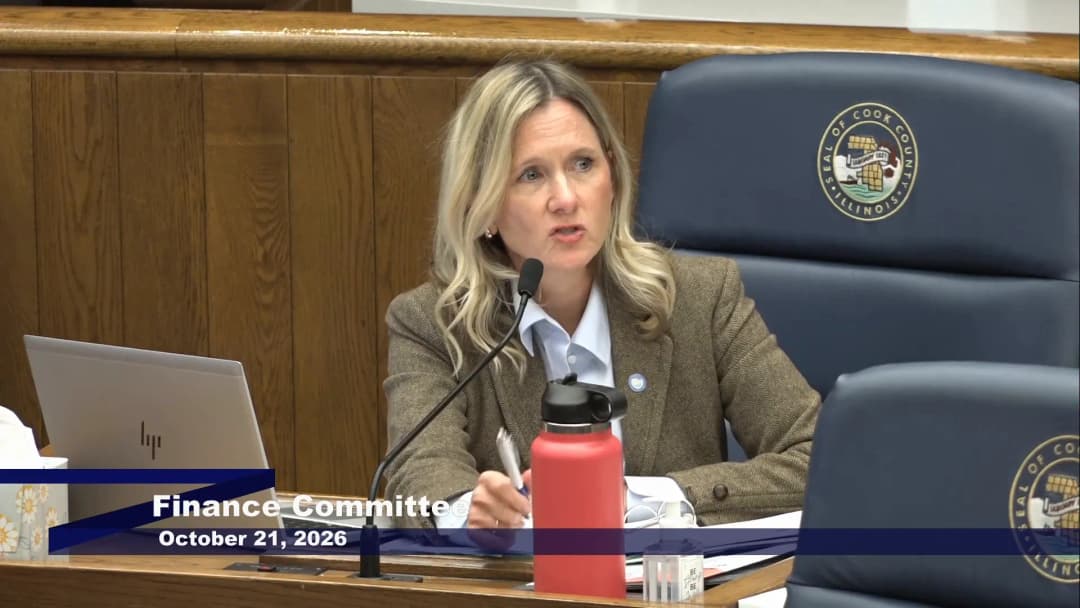
The Finance Committee of the Cook County Board convened on October 22, 2026, at 9:15 AM. Chairperson Daly presided. A quorum was present. The committee heard public testimony, received financial reports, and approved several contracts and grants totaling over $8 million. Public Comments & Testimony - Chela Garcia, a visually impaired community organizer from Little Village, spoke in strong support of the county's guaranteed income program. She highlighted personal struggles with poverty and stated that the $7.5 million allocated in the 2027 budget is a floor, not a ceiling. She cited statistics: 75% of pilot participants felt more financially secure, 70% reported better mental health, and 94% could handle an unexpected emergency. She urged expansion of funding. - Ian Tobin, Vice President of the Lincoln Square Ravenswood Chamber of Commerce (SSA 21), expressed concern over continued delays and shortfalls in property tax disbursements to Chicago's Special Service Areas. He noted a $133,000 shortfall from the 2024 levy and stated that the county's vendor Tyler Technologies could not provide a resolution date. He requested a clear accounting, a timeline, and equal attention to Chicago taxing bodies. - George Blakebourne was registered but did not appear. Financial Reports - Controller's Report (Item 26-2556): Cyril Thomas, Comptroller, reported for the nine months ended August 31, 2026: General fund had a favorable net budget variance of $320.2 million ($256 million favorable revenue variance, $64.2 million favorable expense variance). Health fund had an unfavorable net budget variance of $75.1 million ($26 million favorable revenue, $101.1 million unfavorable expense). State of Illinois owed the county $82.4 million, including $71.3 million to the general fund. The federal government canceled $1.2 million in one-time grants. - Cook County Health Report (Item 26-1608): Scott Spencer, interim CFO, reported that CCH is $75 million unfavorable to budget, driven by higher uncompensated care estimated at $400 million for the year. However, the health system anticipates a small surplus. Past due capitation from the state is $7.3 million. Dish payments are timely. Discussion Items - Juvenile Justice Collaborative Deferred Prosecution Program (Item 26-2251): Commissioner Lowry moved to approve an interagency grant agreement with the Office of the Chief Judge and the Cook County Justice Advisory Council, and a sub-recipient agreement with Lurie's Children's Hospital for continuation of the program (fiscal impact $1 million). Commissioner Degnan asked for confirmation of State's Attorney's Office support. Robert Klein, Deputy Bureau Chief in the Juvenile Justice Bureau, confirmed strong collaboration since 2020, anticipating up to 250 referrals per year. The program has a waiting list. Approved. - Contracts for Juvenile Probation and Housing Services: - Item 26-2245: Contract amendment with Northwestern School of Medicine for clinical assessment and forensic services for court-involved youth, increase of $2,307,736. - Item 26-2248: Contract with Henry's Sober Living, $2,701,000. - Item 26-2249: Contract with St. Leonard's Ministries for \"No Place to Stay\" housing services, $273,750. - Item 26-2250: Contract with JAMS YAMS Hope Community Center for \"No Place to Stay\" housing services, $2,737,500. Commissioner Lowry highlighted a total commitment of over $5 million for housing services. Commissioner Scott voted aye on all except present on item 26-2248. Consent Calendar - Approval of September 2026 Finance Committee meeting minutes (Items 26-2591 and 26-2624). - Receive and file quarterly report (Item 26-2475) and approve special court cases, proposed settlements, and various workers' compensation and claims reports (Items 26-2510, 26-2513, 26-2584, 26-2494, 26-2995). All approved unanimously. Key Outcomes - All items on the agenda were approved, with one commissioner recording a present vote on contract 26-2248. - The committee passed motions to receive and file financial reports and approve contracts and grants totaling over $8 million. - The meeting adjourned following a motion by Commissioner Lowry, seconded by Commissioner Britton.

PROCEDURAL 23% · GUARANTEED INCOME 20% · BUDGET EQUITY ANALYSIS 16% · JUVENILE JUSTICE 14%
1285
OCT 22, 2026 · SAN DIEGO, CALIFORNIA · ACTIVE TRANSPORTATION & INFRASTRUCTURE COMMITTEE
San Diego Active Transportation and Infrastructure Committee Meeting - October 22, 2026

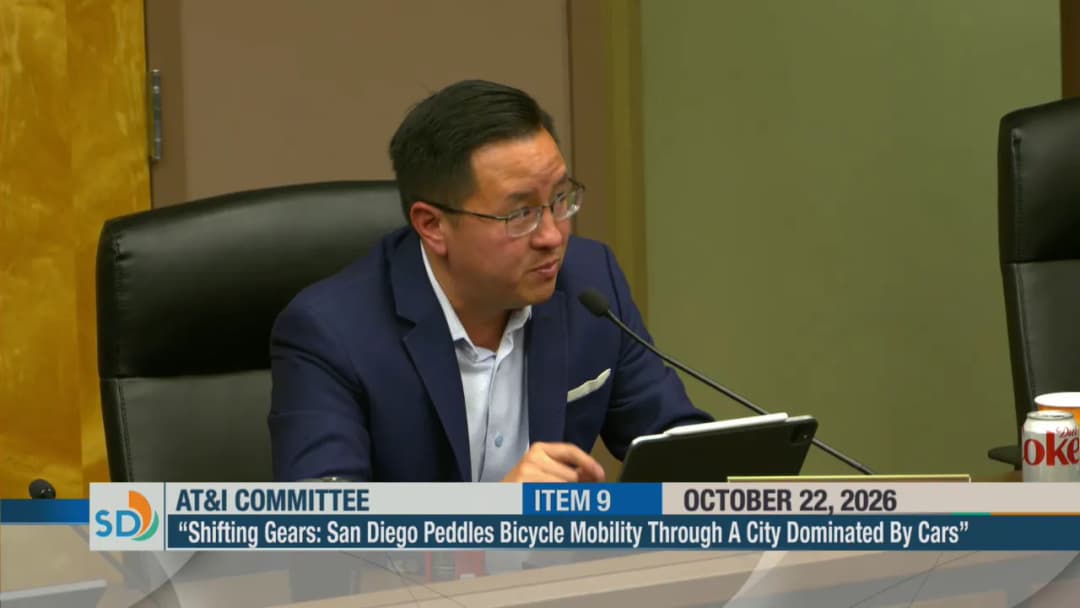
The Active Transportation and Infrastructure Committee of the San Diego City Council held a meeting on October 22, 2026, at 9:00 AM. Chair Whitburn presided, with Vice Chair Foster and Council President Pro Tem Lee present. Councilmember Von Wilbert was absent. The meeting covered non-agenda public comment, a consent calendar, a mill and pave project authorization, and the city's response to a Grand Jury report on bicycle mobility. Consent Calendar The consent agenda comprised Items 1 through 7, including approval of previous meeting minutes, contracts for concrete pumping and paving materials, change orders for emergency repairs, and airport planning agreements. No items were pulled by committee members. The consent calendar was approved unanimously (3-0) on a motion by Vice Chair Foster, seconded by Councilmember Lee. Public Comments & Testimony Non-Agenda Testimony: - Audra spoke against surveillance technology (ALPR and Flock cameras), raising concerns about data misuse and vendor backgrounds. - Jason (Downtown resident) urged better enforcement of safe detour rules when construction closes bike lanes, citing a dangerous experience on Pacific Highway. - Terry Ann Skelly (Parent/volunteer) discussed the dangers of e-bike use among teens combined with alcohol and marijuana. - Blair Beekman advocated for a broad, legally-framed conversation on city technology and surveillance. - Joy Sanyata requested balanced dialogue on surveillance and announced an intention to research city debt. - Michael Schmidt supported removing Flock cameras and requested double-lane paving. - Kathleen Lippitt highlighted a CalMatters investigation into DMV oversight of commercial truck drivers. - Madison emphasized the need for consistent safe driving campaigns to address driver behavior. - Sanjay Stone called for enhanced driver education and enforcement, particularly near schools. - Natalie Ratchke thanked the committee for reconsidering Flock, raised safety concerns about Waymo vehicles, and flagged privacy risks at family entertainment venues. Consent Calendar Testimony: - Audra criticized the city's reliance on emergency contracts and lack of progress on street maintenance, warning of future gridlock from airport plans. - A speaker (phone 870) reviewed items individually, supporting most contracts while questioning workforce data and inspection practices. - Hector suggested the city mine sand from the Tijuana River for concrete needs. - Blair Beekman thanked previous speakers for their testimony. - Michael Schmidt expressed agreement with the sand mining suggestion. Item 8 (Mill and Pave) Testimony: - Audra criticized shifting city forces from stormwater to paving, arguing for dedicated contract crews. - Hector advocated for private contractors to save on long-term pension costs. - Sanjay Stone supported the item and requested integration of bike and pedestrian improvements. - Joy Sanyata strongly supported using city forces for the $12 million paving project. - Blair Beekman asked how the paving considers sea level rise and requested sustainable materials. - Michael Schmidt supported the item. Item 9 (Grand Jury Response) Testimony: - Audra opposed prioritizing bike infrastructure over cars and defended parents driving children. - Ian Hembry (San Diego County Bicycle Coalition) strongly criticized the city's response to Recommendations 1 and 5, calling them disrespectful to cyclists, and submitted a list of proposed changes. - Jason (D3 resident) disagreed with the city's claim of a connected network, citing major gaps. - David Soles urged a grant application for the Mission Hills bikeway, calling University Avenue a dangerous gap. - Victoria Bruzos (Cyclist, Fricks Ranch) rejected the city's refusal to implement routine bike lane maintenance (Recommendation 5). - Hector dismissed the grand jury report and asked for funding to be directed elsewhere. - Harry Bobbins supported the grand jury, arguing the city's response of "implemented" for connectivity is insufficient. - Joy Sanyata supported improved communication on the bike network for underserved communities. - Sanjay Stone cited the 15-year planning of the Mission Hills bikeway as evidence that planning has not sufficed. - Anar Salayev (Bike San Diego) asked the city to change Recommendation 1 from "implemented" to "requires further implementation." - Nicole Burgess (D2 resident) supported changing Recommendation 1 and expressed dismay over the loss of experienced bike program staff. - Blair Beekman emphasized the need for a regional focus on bike projects. - Kathleen Lippitt noted that 34% of city streets are rated poor or worse and highlighted the nexus between pavement conditions and safety for all road users. Discussion Items Item 8: Authorize City Forces for FY27 Mill and Pave CIP Deputy Director Philip Lowry presented the request for committee approval to use up to $12 million in city forces spending for approximately 30 line miles of paving. The authorization is required under the municipal code when personnel expenditures for a CIP project exceed $500,000. Lowry highlighted the flexibility of city forces to pivot from storm response to paving. Vice Chair Foster and Councilmember Lee spoke in favor, emphasizing efficiency and responsiveness to resident complaints. The motion passed unanimously (3-0). Item 9: Proposed Response to Grand Jury Report on Bicycle Mobility IBA representatives Trisha Tackey and Jordan Moore presented the draft responses to the eight findings and eight recommendations from the Grand Jury report "Shifting Gears." The proposed responses generally disagreed with findings regarding network connectivity and pavement conditions, and stated that recommendations for routine maintenance (R5) and a 70% PCI goal would not be implemented as unreasonable. Councilmember Lee led a detailed discussion, arguing the responses were overly defensive and recommending that Findings 1, 4, and 8 be acknowledged as true while contextualizing the city's efforts. He proposed changing the response to Recommendation 5 from "will not be implemented because it is unreasonable" to "requires further analysis." Chair Whitburn supported this direction. Vice Chair Foster strongly dissented, arguing that committing to implementation or analysis without a viable budget path creates a disservice to the public and an administrative burden of reporting back to the Grand Jury every six months without making progress. Staff clarified that a change to "requires further analysis" would trigger a six-month follow-up requirement. Key Outcomes - Vote on Item 9 Motion: Councilmember Lee's motion to amend the staff recommendation (changing responses to Findings 1, 4, and 8, and changing the response to Recommendation 5 to "requires further analysis") passed with a vote of 2-1 (Lee and Whitburn in favor, Foster opposed). - Procedural Outcome: Because the motion did not receive unanimous support, the item will advance to the full City Council without a recommendation from the committee. Staff will work with the Mayor's office and the IBA to refine the proposed language before the council hearing. - Consent Calendar and Item 8: Both items were approved unanimously by the committee. - Next Meeting: The committee is scheduled to meet next on Thursday, November 19, 2026, at 1:00 PM.

BICYCLE INFRASTRUCTURE 45% · PAVING 10% · PUBLIC SAFETY 9% · PUBLIC COMMENT 7%
1287
OCT 22, 2026 · ST LOUIS, MISSOURI · BOARD OF ALDERMEN COMMITTEES
St. Louis Public Infrastructure and Utilities Committee Meeting – Department of Transportation Transition Update – 2026-10-22

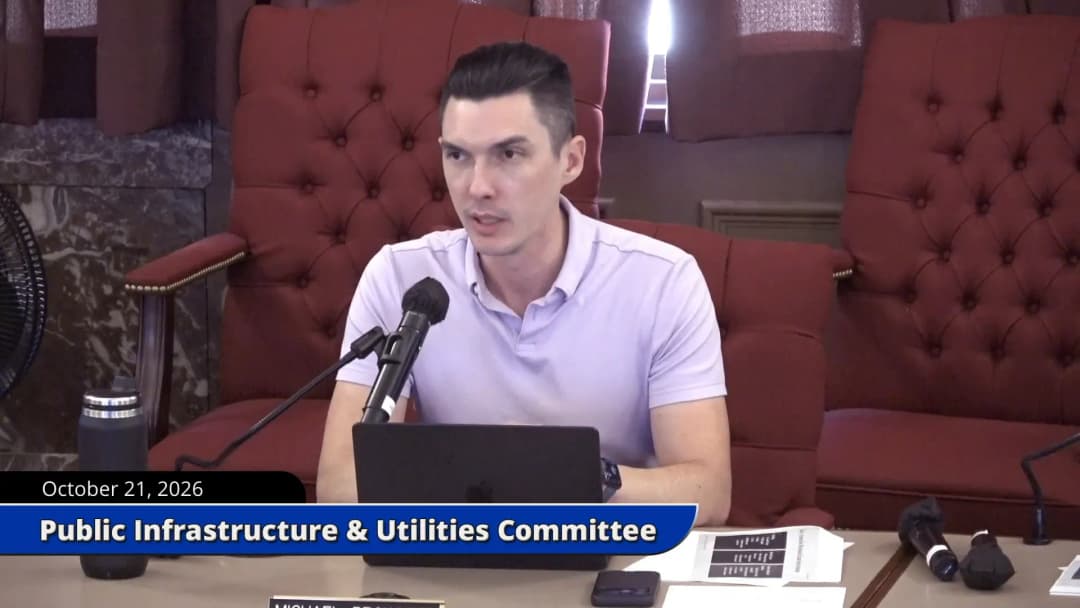
On 2026-10-22 (record timestamp 05:00:00 UTC), the St. Louis Public Infrastructure and Utilities Committee met to receive an update on the transition from the Streets Department to a Department of Transportation (DOT). The transcript indicates the meeting opened at 3:33 p.m. and a quorum was present. No board bills or resolutions were on the agenda. Chair Browning called the DOT transition a voter-approved priority (nearly 90% approval in November 2024) and emphasized safety and multimodal access as goals. Consent Calendar - The committee approved the minutes of the October 14, 2026 meeting by unanimous roll-call vote (5 ayes), on a motion by the alderman from the 5th ward and a second from the alderman from the 1st ward. - There were no board bills or resolutions for review. Public Comments & Testimony - James Stringfowl, an 11th Ward resident, testified. He expressed concern that the proposed DOT structure did not visibly include community residents or disability communities (wheelchair users and blind people) in decision-making, and he asked where experts would sit in the organizational chart. - Chair Browning and presenters responded by pointing to a preliminary public-engagement team concept and ongoing discussions about whether the ADA coordinator position should sit in the new department or remain in the Office on the Disabled. - No written testimony was submitted. Discussion Items - Caitlin Smith, Mayor’s Policy Advisor, and Streets Director James Jackson presented the transition plan. They said the goal is to move from a Streets Department focused on pothole filling, refuse, towing, traffic, and local maintenance to a DOT that plans and manages the city’s entire multimodal transportation network. - The draft DOT mission statement is: "To deliver a safe, reliable, and sustainable transportation network through strategic leadership, innovative planning, rigorous engineering, and year-round maintenance that connects our community, enhances quality of life." Smith and Jackson highlighted safety and community connection as core priorities. - Current Streets Department divisions would be retained, with a new planning, engineering, and project-delivery division added. Board of Public Service (BPS) President Rich Bradley said roughly five BPS transportation-focused positions—including the chief bridge engineer, grant manager, and compliance/DBE manager—would eventually move to the DOT. He assured the committee that BPS would not "dump" the work on the new department and would continue supporting grants and projects; he referenced July 1, 2029 as the transition timing. Bradley also said BPS staffing is at about 67% and cited the $131 million ARPA program as a recent test of the staff. - Proposed staffing/timeline: 2–4 initial DOT planner positions in Q2 FY2027; at least three bureau chiefs identified in Q2 FY2027; about three additional positions for FY2028. Jackson said Streets Department staff would not lose jobs; the transition is intended as an enhancement. - Street-condition data: St. Louis has over 4,100 lane miles. The Transportation and Mobility Plan, adopted November 2025, covers about 1,900 miles of arterials, primaries, and secondaries. LIDAR-based pilot assessments have been completed in two wards, totaling about 200 lane miles (one ward about 130, another about 73). The PCI (pavement condition index) scale runs 0 to 100, with below 40 indicating major maintenance need. Jackson said five more wards have been approached and the goal is to have their data by February 2027; each ward assessment currently costs $10,000, paid by the alderperson. Once citywide data is available, assessments would be done at least biennially. - Funding: Smith identified possible future revenue sources, including the introduced St. Louis Works bill, ward capital reallocation, parking funds, a future gas tax, and a rideshare tax that would require state law change. Alderman Devotee noted that this year each ward received $270,000 from St. Louis Works, total utility collections were just over $6 million, and a little over $3 million remained in the transportation fund after ward allocations and other portions. He also stated the Streets Department’s total FY budget is $46 million. Devotee pressed for a system that would survive changes in personnel; Jackson responded that the department would rely on objective condition data and professional recommendations, while elected officials would retain funding decisions. - Sidewalk program: Smith called the 50/50 sidewalk repair system "broken" and said the city is exploring a centralized block-by-block approach, possibly funded by property assessments estimated at $20–$40 per property at current funding levels. Alderwoman Schweitzer expressed frustration that First Ward sidewalk funds were not being spent and questioned the effectiveness of the program. Alderman Devotee argued the city has a non-delegable duty to repair sidewalks in the right-of-way and said work should be done immediately when residents contribute. Jackson said the department cleared more than 600 of roughly 4,000 backlogged sidewalk service requests in five to six weeks, many of which were duplicates or ineligible, and was bringing contractors on board to begin work in early 2027. - Transportation safety and priorities: Smith said a draft map of transportation priorities would go through the Complete Streets Committee and Capital Committee, with attention to the most dangerous streets and intersections. Chair Browning praised quick-build traffic calming; Jackson said a Gravois quick-build project would be installed within the next couple of weeks. Chair Browning also raised utility-coordination problems, citing utility cuts in newly paved Manchester and improper patches on ARPA-funded Kings Highway, plus about 40 utility holes in a single residential block in his ward. Jackson cited the Mayor’s one-dig policy and said three major utilities had submitted conflict information for 2027. - Alderwoman Coxantwee asked that outreach be tailored so residents understand the old system versus the new DOT structure, noting that many residents had not previously been involved in such government processes. - Chair Browning said he saw advantages in centralizing transportation funding and making street-condition data public, but agreed that the transition would require building aldermanic and public trust. Alderwoman Schweitzer said she was less likely to support ceding control before her ward had a condition assessment. Key Outcomes - Minutes of the October 14, 2026 meeting were approved unanimously (5–0). - No board bills or resolutions were considered. - The committee received the DOT transition update without taking a formal vote on the transition. - Next steps identified: continue LIDAR condition assessments in five additional wards, with data targeted by February 2027; develop initial DOT staffing/bureau chief requests for FY2027; finalize sidewalk contractor capacity so repairs can start in early 2027; install the Gravois quick-build traffic-calming project; and hold future discussions on sidewalk funding, utility coordination, and centralized DOT funding.

ENGINEERING AND INFRASTRUCTURE 50% · TRANSPORTATION SAFETY 19% · BUDGET 11% · PROCEDURAL 9%
1288
OCT 22, 2026 · LAKE COUNTY, ILLINOIS · COMMITTEE MEETINGS
Lake County Financial & Administration and Health & Community Services Joint Budget Hearing - October 22, 2026

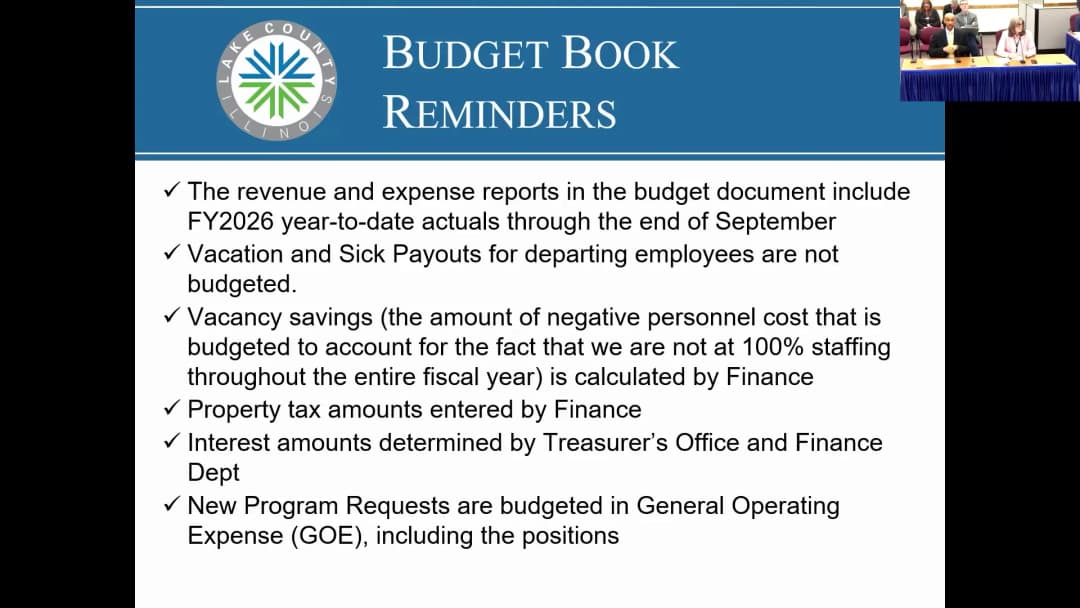
The Financial and Administration (FA) Committee and the Health and Community Services (HCS) Committee held a joint budget hearing on October 22, 2026, starting at 8:34 a.m., to review the recommended Fiscal Year 2027 budget for Lake County. County Administrator Patrice Sutton and Budget Manager Michael Wheeler presented an overview of the $732 million total budget, an 8% increase, highlighting revenue growth from economically sensitive taxes and a 2.7% CPI property tax increase. New program requests were consolidated in the General Operating Expense (GOE) budget. All departmental budgets presented were ultimately approved by both committees, with one significant discussion deferred. Discussion Items FY2027 Budget Overview - Administration presented the budget framework for property tax operating funds, noting increases in special revenue ($13M), internal service ($19M), and enterprise funds ($8M). A merit pool for non-union employees was introduced alongside a 2.7% cost-of-living adjustment. - A mistake in the Sheriff's department vacancy savings calculation was acknowledged and will be corrected using GOE contingency funds. - Chair Frank commended the consolidated approach to new program requests, allowing holistic decision-making. Veterans Assistance Commission (VAC) Budget - Superintendent reported a $34.6 million benefit return to Lake County, a 5.4:1 return on property tax investment. The VAC plans to break ground on a new facility in one year. - Motion to approve made by Member Litig and seconded; approved unanimously. Workforce Development Budget (8.H1) - Director Jennifer Sereno presented a budget funded primarily by federal WIOA grants, which decreased slightly due to low unemployment. The department placed 734 residents (66% of those served) into employment, bringing $31.5 million in wages to the county. Summer youth program placed 175 high school students. - Staffing remained at 41 despite a chart error. Two new positions for the Digital Growth Initiative are budgeted in GOE. - Approved unanimously. Community Development (CDBG) Budget (8.H2) - Dominic Strezzo presented a stable $5.1 million in HUD entitlement funds, with two-thirds directed to affordable housing. The department’s annual goal is to support 40 new rental units, a figure acknowledged as constrained by factors beyond funding alone. - Members confirmed that funding expectations are consistent with prior years despite federal uncertainty. - Approved unanimously. Video Gaming Fund Budget (8.H3) - $825,000 directed to community development, with set-asides for addiction services and gambling treatment. Funding is expected to remain flat. - Approved unanimously. Opioid Settlement Fund Budget (8.H4) - Coordinator Ashley Watson presented a budget allocating $1 million for community grants, with $4 million held in reserves. Only 45% of the expected settlement has been received; some payments extend to 2038. - Emergency appropriations may increase spending if worthy applications arise, as occurred in FY26. - Members requested better visibility into fund balances; administration agreed to explore providing that information. - Approved unanimously. Regional Office of Education (ROE) Budget (8.H5) - Dr. Carner presented a flat budget and proposed moving 10 staff positions from county payroll to a reimbursement model, similar to his existing setup for grant-funded employees. He argued this would streamline administration under the new Workday system. - Several members expressed hesitation: Member Altenburg called for a broader policy discussion, and Member Maine noted no documentation was provided. County Administrator Sutton suggested deferring the decision to allow full conversation, and Dr. Carner agreed. - The budget was approved without the staffing model change; the matter will return later as a separate item. - Members praised the ROE's performance metrics (page 125 of the budget book) and its expanded services. Health Department Budgets (8.H6–8.H10, Taken Together) - Executive Director Chris Hoff and Deputy Sam Johnson presented budgets for the Health Department, TB Special Service Area, Solid Waste, Loon Lakes, and the Health Department Capital Fund. - The health department budget reflects an overall increase despite a reduction of 15 funded positions (to 831), driven by benefit cost increases (22% rise) and federal Medicaid changes. The closure of the North Shore Health Center and prenatal program were noted. - Director Hoff reported that 29% of patients are now uninsured, up from 23%, due to anticipated Medicaid work requirements and redeterminations. - The Health Department Capital Fund ($1 million, new) will use Medicaid match funds for parking lot repairs, access control, and fire sprinklers. - Members questioned the need to integrate these capital projects into the countywide capital improvement plan for better visibility and prioritization. Administration indicated openness to greater alignment in the future. - All five items were approved unanimously. Key Outcomes - All budget items (VAC, Workforce Development, Community Development, Video Gaming, Opioid Settlement, ROE, Health Department and associated funds) were approved by both committees. - Decision on the Regional Office of Education staffing model transition was deferred for later discussion, recognizing the need for a broader county policy. - County administration will work to provide more detailed fund balance information for the Opioid Settlement account in future budget documents. - The health department’s capital projects will be considered for inclusion in the county’s capital improvement planning process.

BUDGET 33% · PUBLIC HEALTH 20% · PERSONNEL MATTERS 8% · PROCEDURAL 7%
1289
OCT 22, 2026 · ST LOUIS, MISSOURI · BOARD OF ALDERMEN COMMITTEES
St. Louis Health and Human Development Committee Approves Opioid Funding, Reviews Code Blue – Oct. 22, 2026

The Health and Human Development Committee of the St. Louis Board of Aldermen met at 9:04 a.m. on October 22, 2026, with Chair Boyd presiding. Four members were present, constituting a quorum. The committee approved the October 1 committee minutes, heard testimony and advanced Board Bill 94 on opioid settlement funding, and received a detailed presentation and public testimony on Board Bill 91 to codify the Code Blue emergency shelter program. No agenda or minutes document was supplied with the transcript; this summary is based on the verbatim transcript. Consent Calendar - Minutes of the October 1, 2026 committee hearing were approved by roll-call vote with four ayes. Public Comments & Testimony - James Truth (founder of an organization focused on correctional institutions) raised concerns about both bills. He asked whether any opioid settlement funds under Board Bill 94 would address the needs of people who are incarcerated or recently released from St. Louis detention facilities. For Board Bill 91, he asked whether the Code Blue program would establish a direct referral process for individuals released from the city justice center and whether they would have a realistic way to reach emergency shelter during dangerous weather. - Dr. LJ Punch (Eighth Ward resident and community health advocate) expressed strong support for Board Bill 91, praising sustained funding and the bill’s coverage of cold, heat, and disaster. She raised one concern: that Code Blue participation should not become a mechanism of surveillance or displacement for unhoused people, and urged protective language on that point. - Chelsea Murda Vossmeyer (former legislative assistant to Alderwoman Sonier) spoke in support of Board Bill 91. She said shelter providers need permanent, predictable funding, cited point-in-time counts of more than 500 unsheltered people in 2025 and more than 1,700 in 2026, and noted the May 2025 tornado left more than 5,000 families homeless or housing insecure. She also said the city’s after-action review identified the lack of durable funding as a huge risk, argued that codifying Code Blue with dedicated marijuana-sales-tax revenue would prevent people freezing to death while funding arrives too late, and said the bill would stop encampment sweeps during a Code Blue except for imminent dangers. Discussion Items - Board Bill 94 – Opioid Settlement Funding: Chair Boyd introduced the bill. Craig Schmidt (Government Services Analyst, Department of Health) said a 2025 federal report estimated illegal opioids cost the United States $2.7 trillion in 2023, and that St. Louis recorded 407 opioid-related overdose deaths in 2023 and 198 in 2025, a 50% decrease, with 114 preliminary deaths through September 30 of the current year. Bo Richman (Behavioral Health Bureau Chief) described about $3.8 million in city opioid settlement appropriations and the proposed allocation of $953,898.95. He highlighted community partners Williams and Associates and Haven Recovery, including individual success stories in treatment and housing, and other uses such as $55,000 for EMS/Fire airway ventilation equipment and medication lock boxes for St. Louis Children’s Hospital (500 already supplied and 500 more to reach 1,000). He also noted that 26 organizations applied in response to a Notice of Funding Availability; Commissioner Warrior clarified that the NOFA total was $1.2 million, not $2 million. - Board Bill 91 – Code Blue Codification: Alderwoman Sonier presented the bill. It would put Code Blue in city code, require activation at 32°F or colder using National Weather Service overnight forecasts from 6 p.m. to 6 a.m., and make the shelter response permanent. Code Blue would run November 1 through March 31, with required operation December 1 through March 31, plus daytime warming sites from 9 a.m. to 3 p.m. and overnight shelter beds from 5 p.m. to 7 a.m. The bill would establish four access-point quadrants, free transportation, at least one pet-friendly overnight shelter, and notification through official city channels. It would create a Code Blue fund paid from the city’s existing 3% recreational marijuana sales tax, capped at $5 million per year, beginning in fiscal year 2028, with a 7.5% administrative-cost cap and reimbursement requirements if disaster funds cover costs. Alderwoman Sonier noted that Code Blue is currently governed by Executive Order 93, last winter’s operation used $3.3 million in RAM settlement interest funds, and this year’s general budget includes $2 million for Code Blue. The fund could also be used for extreme heat, other severe weather, or declared disasters. - Marijuana fund discussion: Asked about the funding source, Alderwoman Sonier said the marijuana tax fund currently holds about $1.76 million for the calendar year, after collecting about $469,000 in its first partial year and $1.5 million last year. She said she would provide an updated figure at the committee’s next hearing. Key Outcomes - The chair announced that Board Bill 94 had passed the committee; Alderwoman Keys, Alderwoman Sonier, and Alderwoman Cox-Anthony added themselves as co-sponsors. - Board Bill 91 was discussed but not voted on; a further committee hearing was scheduled for the next Wednesday at 5:15 p.m. in the Kennedy Room to continue discussion and community input. - The committee adjourned after the presentations and testimony.

PUBLIC HEALTH 35% · HOMELESSNESS 34% · PROCEDURAL 14% · PUBLIC SAFETY 5%
1290
OCT 22, 2026 · LAKE COUNTY, ILLINOIS · COMMITTEE MEETINGS
Lake County PBZE Committee Approves FY2027 Budgets (October 22, 2026)

Note on Date Discrepancy: The meeting transcript opens with a call to order on "October 21st, 2025" and adjourns with a future meeting date of "October 28th, 2026", creating a conflict with the provided meeting date of 2026-10-22. This summary adheres to the assigned date for consistency. The Planning, Building, Zoning, and Environment (PBZE) Committee met to review and approve the Fiscal Year 2027 budgets for the Planning, Building, and Development (PBD) department and the Stormwater Management Commission (SMC). Both departments presented comprehensive overviews of their financial outlooks, staffing, strategic accomplishments, and upcoming initiatives. The discussions heavily featured revenue trends, capital needs for infrastructure, and the challenge of securing reliable funding streams. Discussion Items 8B1: Joint Committee Action Approving the Fiscal Year 2027 Budget for Planning, Building, and Development (PBD) - Director Eric Wagner presented the budget. He outlined the department's alignment with county strategic plans (superior operations, sustainable environment, healthy communities). - The budget maintains a flat headcount of 34 FTEs but requests the reclassification of a Senior Planner and Field Superintendent and a promotion for a Planner. Small increases are proposed for commodities (field team iPads, scanner) and contractuals (ZBA per diem, vehicle maintenance). - Wagner reported that 2026 revenue has been softer than anticipated. Commercial solar permitting lagged due to developer delays in engineering and ComEd interconnection agreements. General residential and non-residential activity has also slowed. A significant revenue rebound is expected in 2027 due to a pent-up pipeline of commercial solar and battery energy storage system (BESS) projects. - Code enforcement filing fees and fines are budgeted at $100,000, consistent with recent high volumes of property maintenance cases (tall grass, junk, debris). - Key FY26 accomplishments included maintaining a CRS Class 6 rating (providing up to a 20% flood insurance discount), passing regulations for wind/solar, BESS, and logistics facilities, enacting an 8-month temporary moratorium on data centers, and updating building codes. - Upcoming FY27 projects include facilitating board adoption of UDO amendments for attainable housing and sustainability, finalizing updated IGA contracts with an hourly rate escalator, and continuing the Housing Lake Initiative implementation program with CMAP. - Committee Questions: - Member Compost asked about the data center moratorium work not appearing in stated goals. Wagner confirmed it is absorbed into existing staff work plans. Member Compost emphasized sharing the resulting best practices guide regionally. - Member Campos inquired about the impact of lower permit revenues. Wagner explained that 2025 was an anomaly and the 2027 budget projects a strong recovery. - Member Maine asked about escalating IGA costs. Wagner confirmed an escalator clause is being finalized with Finance and has been communicated to partner communities. - Member Litzek discussed linking development with environmental conservation. Wagner presented a draft sustainable development incentives ordinance and enhanced conservation subdivision incentives coming to committee the following week. - Chair Altenberg and others commended Wagner for managing a substantial work program without requesting additional staff. 8B2, 8B3, 8B4: Joint Committee Action Approving the Fiscal Year 2027 Budget for Stormwater Management (SMC) - Executive Director Kurt Wolford presented alongside Mike Priscilla and Sharon Osterby. - Wolford highlighted SMC's role in flood mitigation, watershed planning, and water quality protection. He emphasized that stormwater management requires a county-wide, holistic approach. - A key finding from the Comp Plan update is that SMC's annual program costs ($5.88 per resident) are approximately 65% less than DuPage County ($16.73 per resident). While this demonstrates efficiency, it also reveals a significant gap in reliable, dedicated funding for capital improvements and stormwater infrastructure maintenance. - Mike Priscilla discussed the state DCEO appropriation of $122 million. Of this, $60 million has been granted, leading to the construction of 33 regional projects. An additional 32 projects requesting $62 million remain unfunded. A new Project Expense Match (PEM) fund (781) was created to manage local cost shares for administration and pre-construction work. - Wolford presented a five-year prioritized capital improvement plan totaling $11 million. The County Administrator recommended $500,000 for SMC in FY27. Wolford formally requested an increase to $1 million (10% of the county's capital improvement fund), arguing this is necessary to leverage state/federal grants and create shovel-ready projects. - Sharon Osterby summarized the challenges of the FEMA buyout program, including strict eligibility requirements (benefit-cost analysis, location in a Special Flood Hazard Area, maintaining NFIP insurance) and the lack of a local 25% cost share for unincorporated areas. - Committee Questions: - Member Compost supported the need for a reliable funding source. - Chair Hart sought details on cost-sharing with municipalities, confirming it is typically 50-50 for design work. - Member Litzek questioned the inclusion of the Route 53 Greenway project on the CIP list, wondering about the timeline and SMC's role alongside the Forest Preserves. Wolford stated it was a multi-objective, long-range planning item. - Member Hunter provided strong testimony on the plight of unincorporated areas, noting townships cannot provide matching funds for grants, making SMC support critical for these residents. He fully supported the funding request. - Member Parek clarified that the immediate ask is for an additional $500,000 in CIP funding, raising the total allocation to SMC to $1 million. - Chair Altenberg praised the team for its masterful management of the historic $122 million state grant, noting the completion of 33 projects. Key Outcomes - 8B1 (PBD Budget): Motion by Member Wasick, second by Member Campos. Approved unanimously by voice vote. - 8B2, 8B3, 8B4 (SMC Budgets): Motion by Member Campos, second by Member Wasick. Approved unanimously by voice vote. - Funding Discussion: The SMC's request for a $1 million allocation in the capital improvement fund ($500,000 above the administrator's recommendation) was strongly advocated for by committee members. The discussion highlighted the need for ongoing dialogue to secure reliable funding to address the county's stormwater infrastructure gaps and matching requirements.

STORMWATER MANAGEMENT 30% · BUDGET 18% · CAPITAL PLANNING 16% · CAPITAL IMPROVEMENT 15%
OPENPUBLICA · PUBLIC MEETING INDEXUPDATED DAILY · openpublica.com