Browse by city
Date range
Search help

Search titles, summaries, topics and stored transcripts together. Keywords may match separately; put the whole query in double quotes for a phrase. Matching follows word analysis, so punctuation is not exact. Both dates are included. Documents are not searched.

SHOWING 1851–1860 ENTRIES
1851
OCT 19, 2026 · INDIANAPOLIS, INDIANA · OTHER MEETINGS (A-H)
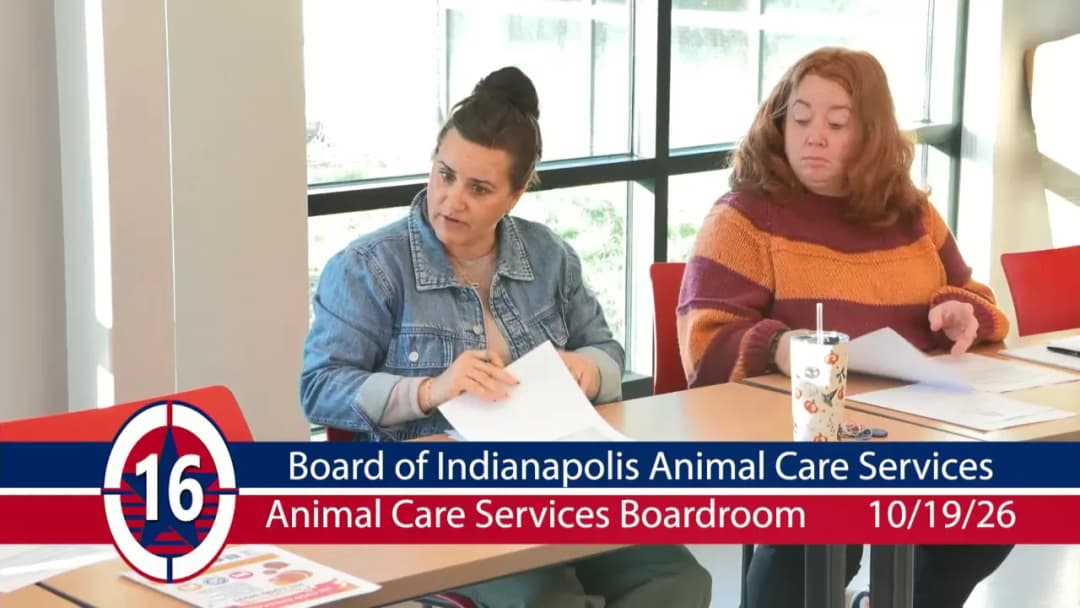
Indianapolis Animal Care Services Board Meeting - October 19, 2026

The Board of Indianapolis Animal Care Services convened on Monday, October 19, 2026, at 8:32 AM. Board members introduced themselves, approved several contracts, reviewed September 2026 shelter statistics, and reported on a successful community vaccine clinic. Consent Calendar - Adoption of minutes from the September 2026 board meeting: motion approved without objection. Discussion Items - Resolution 1026: Contract with NOAA's for emergency care and spay/neuter services, with a two-year cap of $200,000. Discussion clarified that IndyCare's vouchers are currently limited to West Michigan Street Veterinary and not part of this contract. The contract provides flexibility for after-hours and overnight care. Motion to approve passed unanimously. - Resolution 1126: Contract renewal with Pet Vaccination Clinic (PVC), a common vendor for surgeries and other veterinary services. The shelter's former shelter vet, who had moved to PVC, is returning, which may reduce usage. PVC could potentially support public rabies clinics if vaccines are provided at a discounted rate. Motion to approve passed unanimously. - Resolution 1226: Contract renewal with FAC (a large spay/neuter clinic). Discussion noted that transporting animals to FAC incurs overtime costs; on-site services at the new shelter are being considered but no concrete transition plan exists. Motion to approve passed unanimously. - Resolution 1326: Extension of contract for Dr. Birchfield, who provides veterinary services one to two times per week. Motion to approve passed unanimously. Reports & Statistics - September 2026 Shelter Statistics: Total intake was 820 (up from 760 in September 2025). Total outcomes (adoptions, owner returns, transfers) were 78. The live release rate for dogs and cats was 89.97% for September and 90.02% year-round average. The board noted the shelter has achieved no-kill status per industry standards, a significant milestone for a large municipal shelter. Wait times: 5 weeks for dogs, 7 weeks for cats, 14 weeks for owner-surrender dogs, and 8 weeks for owner-surrender cats. Animal control officers submitted 313 reports (including 69 bites), issued 168 summons or citations, and conducted 57 investigation inpounds. Total service calls: 2,228. Vacancy rate: 16%. Indicator specialist positions are fully staffed; kennel staff is nearly full; a veterinarian joins in November. - Volunteer Report: 138 volunteers in training, 43 active new volunteers, and 320 total active volunteers (up from 244 in September 2025). Total volunteer hours at shelter: 1,371; special events: 94; Doggy Day Out: 31 hours (year-to-date: 12,937). - Community Day Recap: On October 2026, the shelter held a free vaccine and microchip clinic, delivering about 700 rabies, FVRCP, and other vaccines along with microchips. The event drew a large, patient crowd that lined up early. Friends of Indianapolis Animal Care Services funded all vaccines. Staff and partners from SOR and Indy Urgent Care assisted. The event included a cookout and resource sharing; it will be repeated. Other Business - Budget Update: Final approval for the ICS (Indianapolis Animal Care Services) budget is scheduled for 5:30 PM that evening; no changes are anticipated. - Upcoming Event: The "Paul's Giving" food drive and giveaway will be held later in the year. Key Outcomes - All four resolutions (1026, 1126, 1226, 1326) were approved unanimously. - The shelter was recognized as having achieved no-kill status. - September 2026 statistics were accepted as presented. - The community vaccine clinic was deemed a success, with plans for future events. The meeting adjourned at 8:50 AM.

ANIMAL CARE 79% · PROCEDURAL 11% · PUBLIC ENGAGEMENT 10%
1852
OCT 19, 2026 · WASHINGTON, DISTRICT OF COLUMBIA · COUNCIL OF THE DISTRICT OF COLUMBIA
DC Council Chairman Press Conference Previews Oct. 20 Legislative Meeting — Oct. 19, 2026

On Oct. 19, 2026, Council Chairman Mendelson held a morning press conference ahead of the additional legislative meeting scheduled for Tuesday, Oct. 20, 2026, and answered reporters' questions on tax policy, traffic fines, stadium proposals, and other issues. He said the Committee of the Whole would meet at 11 a.m. before the legislative meeting and would markup about eight bills, with one item postponed. Legislative Preview - The Deferred Retirement Option Program (DROP) markup was pulled from the Oct. 20 agenda because the Chief Financial Officer's fiscal impact statement is still pending, with an actuary completing work; Chairman Mendelson expects it to be considered Nov. 10. DROP would let eligible firefighters and police officers retire and continue working, collecting salary and retirement benefits but no interest on the retirement account; he described it as improving benefits at no cost to the District and said the unions have supported it. - The Georgetown boathouse bill combines closing 35th Street, an unpaved dedicated right-of-way running toward the river from K Street, with accepting a transfer of jurisdiction. Companion surplus and disposition legislation would swap parcels with the National Park Service; the boathouse would be built by Georgetown University. - A mayoral transition emergency bill would clarify that funds appropriated for the transition are available before the Board of Elections certifies the Nov. 3 election results. Chairman Mendelson said he expects no controversy and that, unless the results are close, the apparent winner should be able to proceed as of Nov. 4. - Councilmember Tran White's parking and traffic ticket penalty reduction emergency will not be in order Oct. 20 because it has a significant fiscal impact. The Chairman said he supports addressing the issue and personally believes fines should be cut in half; he also cited photo enforcement notices arriving weeks later, leading to repeated violations and drivers owing thousands of dollars. Press Q&A and Discussion - On last Friday's revenue hearing, Chairman Mendelson said the two proposals that rose to the top were a wealth proceeds tax and a business activity tax. He said the business activity tax is intended to broaden the tax base, not add a burden on existing business taxpayers, and that a land value tax lacked research support. He noted testimony that the District has the most or second most progressive tax burden among states. - Asked about tax flight, he said it is a matter of degree: slight income tax increases would cause little flight, major increases would cause more; repeated annual increases create instability, so any changes should be followed by a couple of years without further tax increases. - He said he did not come out of the revenue hearing saying the city needs to raise taxes. When asked about a potential $600 million deficit, he said no specific revenue proposal was a must-do to close the gap. - On expenditures, he recalled that the 2019 tax expenditure commission never functioned because the mayor did not make appointments. He said identifying waste is difficult because programs opponents dislike are often called waste, and cutting programs objectively would not produce the $200 million to $300 million advocates seek. He also said the tax revision commission is not coming back. - The Oct. 29 hearing will examine agency overspending, OCFO practices, and budget implementation, including council initiatives not carried out by the executive. He said FY25 overspending was about $300 million compared with the initial adopted budget; he estimated FY26 overspending so far is about one-third of that, roughly $100 million. - Responding to a question about a standalone finance and revenue committee, he argued committee structure matters less than committee leadership, noting the recent revenue hearing was the first in memory and that reductions to the CFO budget occurred without a standalone committee. - He recalled that Councilmember White's earlier bill to allow community service instead of some automated traffic enforcement fines had a fiscal impact statement of $11 million over four years and was never funded. He said unfunded emergency legislation can be out of order and misleading. - On the Audi Field roof proposal, he said the upcoming Friday hearing is informational; he wants to understand costs, need, and cannibalization of other city investments such as Nationals Ballpark, Commanders events, and the downtown arena. He said the mayor is opposed, but the incoming mayor's position is not clear. He noted reported plans for capacity to increase from 22,000 to 30,000 seats. - On the Poplar Point land swap to build a spa, he said he has not announced a position and will see how the hearing goes. - On last night's shooting of a National Guardsman, he said he had not been briefed; he called the situation unfortunate and wants more details. - On the nightlife noise bill, he said he is concerned it uses subjective standards, unlike the earlier buskers legislation with objective standards, and noted the restaurant association has concerns; the bill will get a full airing Oct. 20. - On school elevators, he said broken elevators are also a window into mismanagement by the Department of General Services; a follow-up hearing is planned for the end of November. - He also discussed traditional revenue options, noting Mayor Bowser proposed sales tax increases in the last two budgets that the council adopted, increasing the rate from 6% to 7% in the financial plan. He said the increase was intended for a regional transit authority commitment not yet made; while sales tax is regressive, low-income residents pay little or no income tax, and the sales tax also captures spending by non-residents and tourists. Key Outcomes - No formal votes or decisions were made at the press conference. - DROP markup will move to Nov. 10. - The parking and ticket penalty reduction emergency is expected to be ruled out of order Oct. 20 because it lacks funding. - Follow-up hearings were announced: school elevators at the end of November, agency overspending and OCFO practices on Oct. 29, and Audi Field roof on the upcoming Friday. - The next legislative meeting after Oct. 20 is Nov. 10, with additional meetings planned later in the fall, including December.

FISCAL SUSTAINABILITY 31% · PROCEDURAL 23% · TRAFFIC SAFETY 18% · TAX POLICY 13%
1853
OCT 19, 2026 · KERRVILLE, TEXAS · CITY COUNCIL & ASSOCIATED BOARDS
Kerrville Economic and Industrial Development (EIC) Board Meeting - October 19, 2026

The EIC Board of Kerrville met on October 19, 2026, at 4:00 PM (actual start time not specified). The meeting opened with prayer and included approvals, reports on economic development activities, infrastructure projects, financial updates, a presentation from Shriner University's Center for Talent and Workforce Development, and discussion of a new cash-back incentive program to encourage local shopping. Consent Calendar - Minutes Approval: The board unanimously approved the minutes from the September 21 meeting without changes. Public Comments & Testimony - Lewis Amstoy (Business Owner): Spoke about his experience with the 'Love Where You Live' flood recovery program and noted that after the flood he offered free promotions to 78 local businesses, many of whom were unaware of available resources. He proposed that the EIC fund a voucher program for small business advertising through local media, emphasizing frequency and reach, and suggested it could be a cost-effective alternative to a cash-back program. Discussion Items 1. KEDC Monthly Report (Todd Beck): - Financial Status (Month Ending August 31): KEDC is fully funded at $475,000. Other revenue and interest held for flood recovery fiscal sponsorship. Year-to-date fiscal activity: $270,842; balance: $204,158. - Business Retention and Expansion: Hosted an employer roundtable with Shriner University and Workforce Solutions Alamo, focused on workforce development. Employers found the peer networking valuable. Additional retail roundtables scheduled for October 26 and 27. This programming will continue regularly. - Project Updates: Most active projects include Wolf Creek, K2, and Save (no major updates). Recruitment projects: RiverPaddle and Granite (site selection). Many business startups are coming through the EDC from various partners. - Kerr Together: EDC remains fiscal sponsor for flood recovery grants managed with the City of Kerrville Finance Department. Remaining grant funds approximately $1.23 million. Application for nonprofit status in process. 2. City Project Status Update (Michael): - Olympic Pool: Substantial completion punch walk set for November 9. The bulkhead for competition swimming will be installed a month later; it is mobile but requires a crane for repositioning. - Travis Street Pump Station: Designed; construction anticipated for summer 2027, opening capacity for east side developments. - Granger McDonald Park: Scheduled for council discussion to divest to UGRC. This will save approximately $1.8 million in bond proceeds, which can be used for other park-related projects (river trail top priority). Total savings from completed projects is approximately $2.8 million. - Quinlan Creek Sewer Expansion: Approximately 7,000 linear feet of sewer line will open development opportunities. Federal grant review expected in November; engineering is underway with a target completion of summer 2027. - James Avery Traffic Signal: Public hearing scheduled for November. The city is requesting the state legislature change the notice requirement from 30 days to 20 days to better align with meeting schedules. - Golf Course Management: Council approved a contract with Southern Golf Management (local group) who also manages the baseball complex—reported positive results. - FEMA Projects: High-priority projects include river trail, Town Creek road/sewer/water, and a major water transmission line. Each has multi-million-dollar price tags; FEMA has a team in the area assisting. - Kerrville-Schreiner Park: Only preliminary conversations with Texas Parks & Wildlife; nothing concrete. 3. Financial Report (Trina): - Revenue Bonds: September interest revenue $21,577. Main project expense was Olympic pool improvements ($548,000). Remaining bond proceeds $4,284,000; interest earnings minus arbitrage liability $1,521,000. Cash balance investments shown. - Operational Fund: September sales tax revenue $452,342 (down 3% year-over-year). Fiscal year-to-date sales tax $5,286,000 (better than budget by $156,000). Interest income $23,226 for month (better than budget by $68,000). - Expenditures: City contract transfer $23,000, debt service $213,000, project payments $54,000 (Travis Street) and Quinlan Creek interceptor. Total expenses $321,455. Net change in position for year negative $17,000, tracking to budget. - Cash Balance: $5,380,000. Remaining commitments on operational projects $4,975,000. - Sales Tax Analysis: 12-month rolling average held at 4%. Budget set at 3% over estimate, resulting in a slight surplus. Investment rates: current yield 3.90%, expected to rise. 4. Shriner University – Center for Talent and Workforce Development (Dr. Melissa Allen): - Enrollment Growth: First year 86, second year 131, current year first quarter 40 (several programs enroll only at specific times). On track to meet EIC goal of 171 enrollments this year. - Programs: Over 20 healthcare, 6 additional (Spanish, LVN), 5 IT, 8 business. New programs include sales certificate (by school year end), hospitality (introductory course with local video content), automotive (launching June 2027, with hands-on Saturdays with master mechanics), and 'Bona Fide Texan' (in partnership with the Texas Center, targeted at newcomers). - Career Fair: Regional Career Fair attracted over 40 employers, 10 nonprofits, 400 attendees. Held 8 on-site interviews and generated 22 follow-up interviews. - Alignment with Employer Needs: Participating in EDC roundtables; employers identified need for middle management training, which the Center is exploring. - Community Partnerships: Collaborating with Northwest Vista College to ensure complementary program offerings and student pathways. 5. Proposed Cash-Back Program (Staff Presentation): - Staff outlined a pilot program using the 'Open Rewards' platform (integrated with the Blue Dot CRM) that would provide cash back to shoppers at local businesses. - Examples: Leban (population approx. 7,000) started with $5,000 and saw 27x return; El Paso invested $200,000 generating $5.4 million in local spending; South Lake invested $75,000 and measured 20x ROI with 90% of spending from locals. - Mechanics: Residents earn points via receipts, redeemable at other local businesses. City can set caps (e.g., $100 per person per year) and exclude certain business types (e.g., national chains, news organizations). - Cost: Platform fee estimated $2,000–$5,000 depending on population; additional funding would be allocated for the actual rewards. - Legal Authority: Under state law, 4B corporations may spend up to 10% of revenues on promotional activities. Staff will coordinate with the city attorney to confirm eligibility. - Concerns Raised: Board members questioned the reliability of the shown ROI figures (not adjusted for existing sales), requested before/after comparisons from other cities, and asked for data distinguishing new vs. redirected spending. - Integration: Lewis Amstoy suggested complementing the cash-back program with an advertising voucher program for small businesses via local media, which could also fall within promotional spending authority. - Next Steps: Board directed staff to gather more detailed information, consult with the city attorney, survey local businesses (possibly via the Chamber of Commerce), and prepare a complete proposal for the November meeting with a target launch in January 2027. Key Outcomes - Minutes Approved: Unanimous approval of September 21 minutes. - Project Updates Received: No board action required on reports; board acknowledged the status of projects and expressed interest in future river trail and park projects. - Cash-Back Program Direction: The board did not take a vote but clearly directed staff to refine the Open Rewards proposal. They requested more robust ROI data, legal clarification, and a structured implementation plan. A consensus emerged to consider a small pilot investment (e.g., $10,000 initially) and to link any new program with existing efforts like 'Love Where You Live' if appropriate. - Small Business Voucher Concept: The board asked staff to also explore the possibility of an advertising voucher program for small businesses, with the city attorney's guidance on legal authority. - Next Meeting: Staff to return with a comprehensive recommendation at the next board meeting (date not specified but presumably November).

ECONOMIC DEVELOPMENT 52% · WORKFORCE DEVELOPMENT 19% · FISCAL SUSTAINABILITY 8% · ENGINEERING AND INFRASTRUCTURE 5%
1854
OCT 19, 2026 · WESTCHESTER COUNTY, NEW YORK · BOARD OF LEGISLATORS & COMMITTEES
Westchester County Budget & Appropriations Committee Capital Budget Presentation - October 19, 2026

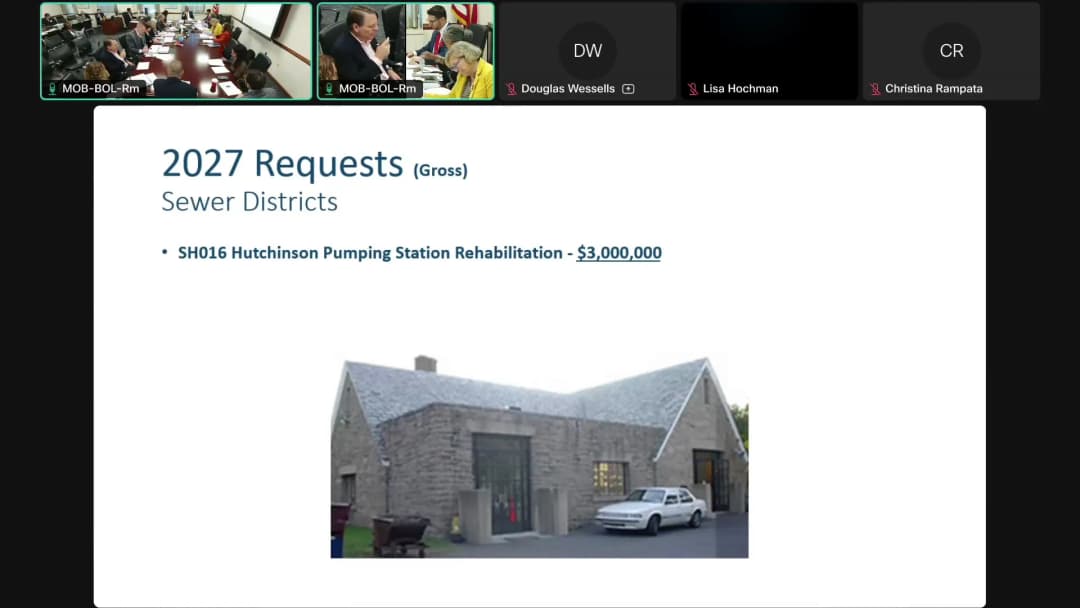
The Budget & Appropriations Committee of the Westchester County Board of Legislators met on October 19, 2026, to review Part 1 of the Capital Budget. Presentations were received from the Department of Planning and the Department of Environmental Facilities (DEF). Discussions focused on infrastructure resilience, cost escalations, ratepayer impacts, and improving transparency in capital project oversight. Department of Planning - Project Status - Legislator Johnson inquired about BPL 40, a project on county-owned land behind 10 County Center Road and the Greenburgh area. Staff indicated that discussions with the Town of Greenburgh are ongoing but complicated by town staff turnover. County staff committed to providing a specific status update on BPL 40. Department of Environmental Facilities - Capital Projects Commissioner Vincent Kopicki and his team presented dozens of capital projects for 2027, including vehicles, heavy equipment, sewer system rehabilitation, pumping station upgrades, and treatment facility improvements. - Power Reliability & Resilience: In response to Legislator Kunzler's questions about a 17-hour Con Edison power reduction on July 2-3, Commissioner Kopicki explained that the SYL28 plant upgrade ($240 million total) and new digester gas engines will allow the Yonkers plant to generate roughly 85% of its own power. Diesel storage capacity was noted as a priority but not yet budgeted. - Costs, Grants & Ratepayer Impact: Legislator Williams Johnson inquired about impacts on ratepayers. Staff detailed ongoing efforts to secure EFC and DEC grants and reported that average annual cost escalation for specialized equipment is roughly 8%, driving the need for regular budget modifications. - Port Chester Facilities: Legislator Pierce requested a detailed status. Staff cited recent construction awards for the electrical, HVAC, and emergency generator contract. Flood mitigation measures are being included in individual projects, while a plant-wide plan remains in design since 2018. - Yonkers WRF Study: Legislator Pierce noted a $1 million study for the Yonkers facility funded in 2025 is not yet complete, expected by early 2027. - Communication & Reporting: Legislator NamyR and Kunzler stressed the importance of communicating the scope of capital work to the public. Legislator NamyR requested a district-by-district breakdown of project timelines. Legislator Pierce highlighted a prior request for formal, regular capital project reporting that has not yet been implemented. Chair Tyrae Woodson-Samuels confirmed she would reiterate this request in an upcoming meeting with the Department of Public Works. Key Outcomes - Staff agreed to follow up on BPL 40 and to provide a district-by-district pipeline summary and a Port Chester project status update. - The committee reinforced the need for a regular, structured capital project reporting mechanism. - A legislator noted significant improvements in the capital budget documentation compared to previous years. - The meeting was adjourned at 11:13 AM.

WATER AND WASTEWATER MANAGEMENT 63% · FISCAL SUSTAINABILITY 13% · PUBLIC ENGAGEMENT 7% · FLOOD MITIGATION 7%
1855
OCT 19, 2026 · DANBURY, CONNECTICUT · MEETING PORTAL
Danbury Ad Hoc Committee Meeting on Proposed Vape Shop Establishment Ordinance - October 19, 2026

On October 19, 2026, the Danbury City Council Ad Hoc Committee met at 6:30 p.m. to review amended draft language for a new Ordinance Sec. 16-320 et seq. regulating vape shop establishments. Chair Frank Salvatore presided, joined by Councilwoman Diane Lepine and Councilman Mike Henry. Corporation Counsel presented the ordinance, and representatives from the mayor's office, Health Department, and Police Department answered questions. No public comment period was held; Corporation Counsel noted that earlier public comments had prompted the definition changes. The committee voted unanimously to send the amended ordinance to the City Council for public hearing. Discussion Items - Proposed ordinance overview: Corporation Counsel explained the ordinance would establish a local business license for vape shops under the city's police power, in addition to state licensing, to combat illegal sales of tobacco, unregulated cannabis/THC products, controlled substances, and sales to minors. The definition of vape shop establishment covers premises with more than 25% of gross floor area devoted to tobacco/vape retail sales or more than 50% of gross sales derived from such products, and it mirrors the city's zoning definition. - Revisions from earlier draft: Corporation Counsel reported changes based on prior public comments: cigar shops were removed from the exception list because tobacco is their primary, not ancillary, sale; the term retailer was changed to dealer to match Connecticut General Statutes language; and the definition of vaporized tobacco and smoking products was clarified to exclude medicinal/therapeutic products used by licensed health care providers. - License and enforcement framework: The license would be issued by the Department of Health and Human Services; existing shops must obtain one within 90 days; licenses are non-transferable and must be posted. Applications would require a $250 fee, ownership disclosure, criminal background checks, fingerprinting, proof of state licenses, store layout, compliance checks, a staff-training affidavit, and a $5,000 cash bond or letter of credit. Not covered: convenience stores, gas stations, cannabis establishments, grocery stores, and medical/prescribed products. Other provisions: no sales to under-21 patrons, ID checks for anyone appearing under 30, required signage and license posting, a hard prohibition on selling marijuana, cannabis, narcotics, or controlled substances with automatic license revocation for such sales, inspections by health or police at reasonable times, manager-on-site requirement, no unaccompanied minors under 18, and no blocked windows. - Penalties: First violation is a $250 fine; second violation within 12 months results in a six-month license suspension; third violation within 24 months results in revocation; each day of violation counts separately; no new license may be issued for two years after revocation. The ordinance provides notice, a 10-day request for hearing, a citation hearing officer, right to counsel, and court injunction authority, in addition to state action under CGS § 21a-420(e)(3). - Mayor's office comments: The mayor's office representative supported the ordinance as a needed regulatory tool. He said there are about 25 known vape shops with active, pending, or lapsed state licenses. A zoning commission moratorium defining smoke shops has made current shops non-conforming and grandfathered, so no new vape shops can currently open. He noted the $250 first-offense fine was designed to be consistent with other city fines and not punitive. - Health Department comments: Health Department staff stressed protection of public health and said the ordinance provides a clear, consistent, and enforceable framework. Citing 2023 state data, 11.5% of Connecticut high school students were currently vaping, and 69.1% of those reported using electronic vapor products to vape cannabis. The department has about 10 inspectors and currently enough staffing; it plans to shift work to a staff member who previously enforced a similar ordinance in New Haven and could use grant-funded staff. No state certification is required for enforcing this ordinance, unlike food inspections. - Police Department comments: The Police Chief and Detective Sergeant Castrovinci expressed strong support, saying the ordinance gives local enforcement an additional tool beyond state action. The detective sergeant reported that school resource officers have handled more than 200 incidents involving vape products in Danbury schools over the last two years, including 155 opened cases from August 2024 to the present and about 50-60 additional calls where no products were found. He emphasized that products are often packaged to appeal to children and that the ordinance creates accountability through staff-training affidavits and the $5,000 bond. - Committee questions and answers: Council members asked about relying on state enforcement; Corporation Counsel responded that local licensing gives faster, direct entry and civil enforcement. The health department licensing model was chosen over police-issued permits because the ordinance addresses broader public health and business compliance, not just illicit activity. Committee members asked about proactive versus complaint-based inspections; officials indicated a joint training and proactive inspection approach. Corporation Counsel said the draft does not currently impose landlord liability, but tax-compliance language could be added. - Housekeeping and amendments directed: Council President noted technical corrections: the Article One General Provisions header should not appear under Article 10, and the word width was missing from item 7. The committee directed Corporation Counsel to add language to Section 16-323(e)(4) and renewal sections requiring that personal property tax declarations and payments be current, as verified by the tax collector and assessor, and for any other delinquent city taxes, water, or sewer charges when applicable. A council member who could not attend, referred to as Councilman Sheanne, proposed this addition. Key Outcomes - Councilwoman Diane Lepine moved that the vape shop establishment ordinance, as amended and subsequently amended at the ad hoc on October 19, 2026, be sent to the city council to be moved to a public hearing. The motion was seconded and passed unanimously; no opposing votes were recorded. - Corporation Counsel was directed to incorporate the noted technical and tax-compliance amendments before the ordinance goes to the City Council for public hearing. - The meeting adjourned after the vote.

CANNABIS REGULATION 54% · MISCELLANEOUS 23% · PUBLIC SAFETY 14% · PROCEDURAL 7%
1856
OCT 19, 2026 · TWIN FALLS, IDAHO · CITY COUNCIL
Twin Falls City Council Special Meeting: Review of City Council Candidate Applications – October 19, 2026

The Twin Falls City Council held a special meeting on October 19, 2026, at 3:00 PM at 203 Main Ave E., Twin Falls, ID, to review applications for the City Council vacancy created by Councilman Stone's September resignation. Mayor Jason Brown, Vice Mayor Craig Hawkins, and Council Member Ruth Pierce participated; the two other council members declined to participate in the initial review. City Manager Travis Rothweiler outlined the legal requirements and application process. Process & Legal Requirements - City Manager Travis Rothweiler explained the Idaho Code process for filling a midterm city council vacancy: the mayor nominates one or more candidates, and the council votes yes or no on the nomination(s). - Eligibility requirements for applicants include being a qualified elector, a resident of Twin Falls as their primary residence, at least 18 years old, a U.S. citizen, and a resident for at least 30 days. - The application period remained open for almost three weeks and closed on October 16, 2026. Staff received 15 applications, with no applications received after the cutoff. - Each applicant affirmed that they met the qualified-elector definition, and the county elections office validated those affirmations. - The applications, including answers to five questions developed by Mayor Brown, are part of the public record; applicants acknowledged this when applying. - Rothweiler noted that the numbers on the applicant matrix reflected the order in which applications were timestamped, not staff rankings or preferences. Candidate Review & Deliberation - Council Member Ruth Pierce evaluated applicants based on involvement with city meetings and events, service on city commissions, community involvement, and their answers on significant issues facing the city. She named Neil Christiansen, Kelly Hergasell, Gerardo Munoz, Todd Ramber, and Lucy Wills as her five selections. - Vice Mayor Craig Hawkins described similar review criteria, including community connection, attendance at city council meetings and events, commission service, and applicants' backgrounds. - Mayor Brown said he valued community service, an understanding of the time commitment, diverse backgrounds, and willingness to run in the next election. - After comparing lists, the three participating council members found substantial overlap and agreed to advance a combined slate of six applicants, adding Donna Graybill to the group: Neil Christiansen, Kelly Hergasell, Gerardo Munoz, Todd Ramber, Lucy Wills, and Donna Graybill. Transcript spellings vary for some names, including Christiansen/Christianson and Munoz/Munez Munos. - All three expressed appreciation for the 15-person applicant pool and noted the difficulty of the selection. Key Outcomes - The council advanced six candidates for the vacant seat: Neil Christiansen, Kelly Hergasell, Gerardo Munoz, Todd Ramber, Lucy Wills, and Donna Graybill. No formal vote was taken; the decision was reached by consensus. - Staff will notify both advancing and non-advancing applicants. - The six advancing candidates will present before the council at a special meeting on November 2, 2026, at 5:00 PM. - For each candidate, the presentation format will be six minutes for remarks, up to three minutes for questions from the council with flexibility to go longer if needed, and one minute for closing remarks. Audio/visual materials such as PowerPoint will not be allowed, and questions will come only from council members. - The order of candidate presentations will be randomized, and because the meeting is public, candidates who present later may observe earlier presentations. - It is anticipated that Mayor Brown will name one or two candidates on November 9, 2026, depending in part on the outcome of the upcoming state election in which a current council member is a candidate. - Mayor Brown encouraged applicants who were not selected to become involved in city boards, commissions, and community events as a path to future service.

PROCEDURAL 56% · MISCELLANEOUS 44%
1857
OCT 19, 2026 · SHORELINE, WASHINGTON · CITY COUNCIL
Shoreline City Council Regular Meeting - October 19, 2026

The Shoreline City Council held a regular meeting on October 19, 2026, from 7:00 PM to approximately 8:43 PM. The primary focus was the presentation and discussion of the 2027-2026 Proposed Biennial Budget, including departmental budgets and a permit fee recovery study. The meeting began with a consent calendar and one public comment, followed by extensive departmental presentations and council discussion. Consent Calendar - Approval of Regular Meeting Minutes of September 28, 2026: Approved unanimously by voice vote. Public Comments & Testimony - Janelle Cammerling, a Shoreline resident, expressed support for the urban forester budget position recommended by staff and requested that the position be placed under the direction of the city manager to ensure it can work across all organizational boundaries. She urged council to discuss this option. Discussion Items - Budget Process Overview: Administrative Services Director Joe Branstetter outlined the budget schedule, noting that the council has opportunities to ask questions after each department presentation. He highlighted that expenditure increases across departments are largely due to a 4.53% cost-of-living adjustment for 2027 and an 11% increase in health and dental benefits. - City Council Budget: Deputy City Manager John Norris presented the council budget, which increases significantly due to the city council salary commission decision to raise council salaries effective January 1, 2027, and include annual cost-of-living adjustments. Mayor Robertson expressed astonishment at the increase, stating that to justify it, council must change how they do their job, such as appearing at more community events. He noted that council cannot easily revise the salary commission's decision without amending the municipal code. - City Manager's Office: Norris presented proposed supplemental requests, including $150,000 for a city website redesign (complete overhaul of content management system), funding for the Shoreline Farmers Market SNAP Benefit Market Match program, and an ongoing addition for the Shoreline Pride Festival. A term-limited senior management analyst position was proposed for two more years to support a potential levy lid lift ballot measure for 2028. Councilmember Snyder asked about the website cost; Eric Bratton (Communications Program Manager explained that $150,000 is at the top end for a complete CMS overhaul after 10 years. Councilmember Adamasu expressed support for the small business outreach and Shoreline Small Business Development Center advising for 84,000 and $119,000 in one-time supplements to improve dining and entertainment options, noting that only 27% of survey respondents were satisfied. - Deputy Mayor Povey questioned the reduction in the Shoreline Secure Storage Fund's operating expenses (down 23%) because it reflects varying costs like roof repairs, not reduced debt service payments. Councilmember Roberts asked about the $29,000 for the Farmers Market SNAP benefits; it matches the request from the dinner meeting; staff will provide usage data for future consideration. - Human Resources Department: Libby Smith-Eua (HR Director) requested a one-time supplemental of $20,000 for labor relations consulting and a limited-term Senior HR Analyst for organizational development work. Deputy Mayor Povey asked about the long-term plan for limited-term positions, noting that creating value but not funding ongoing is unsustainable. John Norris responded that limited-term positions reflect ongoing need without ongoing revenue; the city is being fiscally conservative. Councilmember Scully objected to limited-term budgeting, saying if there is a long-term need, it should be funded long-term. Councilmember Roberts asked if similar cities have HR teams of six to seven people. Mayor Robertson acknowledged limited-term positions could become permanent if revenue permits. Councilmember Mork noted that the unemployment operations budget cut in half due to actuals. - Parks, Recreation, and Community Services: Director Mary Reedy presented a $32.6 million biennial budget. The community support specialist (community support specialist) position was proposed for elimination; Councilmember Mork expressed concern, especially given the addition of $350,000 for HR, and requested the question matrix include cost and feasibility of adding it back. The mayor noted that Deputy Mayor Povey had already requested this. Councilmember Mork also asked about the increase in public art funding (28%) due to shifting a coordinator position from bond funding to general fund. Councilmember Scully expressed opposition to cutting the community support specialist position while adding funds to HR. The department also proposed an urban forester position, mostly revenue-backed through the King County Parks Levy. - Administrative Services and Citywide: Director Branstetter presented $21.56 million biennial budget, including a request for AI governance and training program for up to 10 staff per year, and a management analyst position to coordinate citywide grants. Councilmember Roberts asked about AI policy; the city adopted one in summer 2026 that prohibits using generative AI to create staff reports or generate images. AI training will be balanced. Councilmember Snyder emphasized the need for cybersecurity investment; the IT budget includes cybersecurity measures. Councilmember Scully requested a separate session to discuss AI policy. - Police Department: Chief Tommy Collins reported a projected six percent increase in the police contract for 2027 and 2028, with 53 FTEs authorized but 7 vacant. Response time for priority X calls decreased to 4.24 minutes. On-view activity increased due to a dedicated traffic unit and DUI officer. Councilmember Mork asked why the department aims to maintain or increase public complaints; Chief Collins explained that complaints signal community communication. Councilmember Snyder noted overall budget increase of 13-14% but no FTE increase. - Criminal Justice: Christina RCD reported a $6.8 million biennial budget with no FTEs. Costs are driven by jail, court, and public defense. Requests no one-time supplements; base budget increase of $1.4 million (26%) due to rising jail population and court filings, particularly from parking enforcement and traffic enforcement. Public defense costs increase due to state Supreme Court limits on case loads for defenders. - Planning and Community Development: Andrew Bauer presented $11.5 million biennial budget. Proposed permit fee fee recovery study recommends moving from 55% cost recovery to 75% over four years (option three) with fee adjustments. Option one is CPI adjustment; option two is 65% recovery; option three is 75% with phased increases. Councilmember Roberts supported option three; Councilmember Scully opposed any increase, preferring general fund subsidies to avoid burdening development. Councilmember Snyder supported 75% and suggested going closer to 100%. Councilmember Mork supported option three but also encouraged exploration of pre-approved plans to reduce fees. Key Outcomes - Consent Calendar: The minutes of September 28, 2026, were approved unanimously. - Permit Fee Recovery: Council expressed clear support for option three (75% cost recovery over four years) from several members; staff will bring a proposed fee schedule for adoption at a future meeting. No formal vote was taken at this meeting. - Budget Amendments: Council is asked to submit proposed amendments prior to November 2, 2026, for the budget adoption public hearings scheduled for November 2 and November 16. The budget adoption is planned for November 16. - Limited Term Positions: Several councilmembers expressed reservations about the long-term use of limited-term positions, with Mayor Robertson acknowledging these positions could become permanent if revenue allows. - Community Support Specialist Position: Councilmember Scully, Mork, and others expressed concern about eliminating the position; Mayor Robertson confirmed the project will be included in the budget analysis for further discussion. - Urban Forester Position: The single public comment urged placing the position under the city manager; no council direction was given on this request during the meeting.

BUDGET EQUITY ANALYSIS 27% · TECHNOLOGY AND INNOVATION 8% · HUMAN SERVICES FUNDING 8% · PARKS AND RECREATION 7%
1858
OCT 19, 2026 · LAFAYETTE, CALIFORNIA · PLANNING COMMISSION
Planning Commission Meeting - October 19, 2026: Downtown Land Use and Zoning Amendments

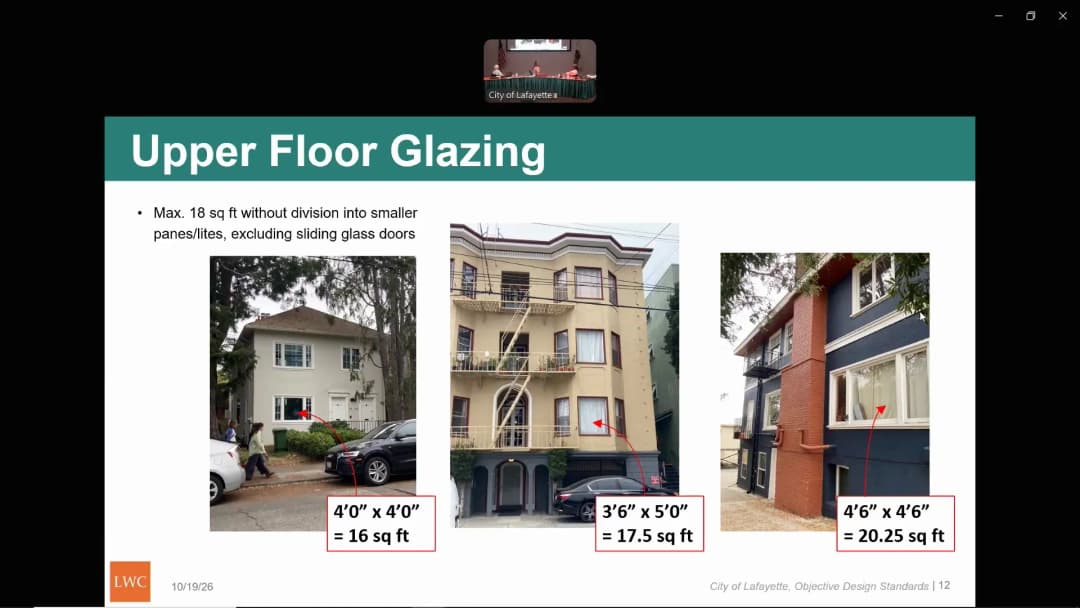
The Lafayette Planning Commission met on Monday, October 19, 2026, at 6:38 p.m. in the Don Tatzin Community Hall. The meeting focused on a public hearing for proposed General Plan and Zoning Code amendments (GP01-26 & ZT01-26) stemming from a Housing Element lawsuit settlement with the Housing Action Coalition (HAC). The commission also considered associated environmental review. No votes were taken during the portion of the meeting covered by the transcript. Public Comments & Testimony - No oral public comments were made on non-agenda items or on the hearing item at the time of the transcript. - Staff reported receiving two written comments prior to the meeting: one in opposition to additional height in the city, and one raising concerns about consolidation of the west and east ends. Staff clarified that consolidation is only proposed for the downtown core zoning districts, not the east/west ends. Discussion Items - GP01-26 & ZT01-26 – Downtown Land Use and Zoning Amendments: Assistant Planning Director Stefanie Cervantes presented the staff report. The amendments are required to implement the June 2026 settlement agreement with HAC, which ended litigation over the city's 6th Cycle Housing Element. Key terms of the settlement include increasing maximum density to 65 dwelling units per acre (du/ac) in areas north of Highway 24, and to 45 du/ac in areas between the 65 du/ac zone and Mount Diablo Boulevard and south of Mount Diablo Boulevard. Minimum densities for opportunity sites are set at 88% of the maximum (i.e., 57.2 du/ac for 65 du/ac zones, and 39.6 du/ac for 45 du/ac zones). The De Silva South site gains an additional two acres at 35 du/ac. Height limits are being raised to correspond with the density increases. The proposal also consolidates two existing zoning districts (Special Retail Business and Retail Business) into a single Downtown Retail district, and makes minor amendments to the Downtown Specific Plan to align use permissions and remove redundant density/height references. Staff recommended adoption of Resolution 2026-11 forwarding the amendments to the City Council. Commissioner Mason inquired about potential confusion from multiple height limits; staff responded that each district will have a single maximum height, eliminating dual limits. Key Outcomes - No decisions or votes were recorded in the available transcript. The public hearing remained open, and the commission did not take action on the staff recommendation. The meeting was ongoing at the conclusion of the provided transcript.

LAND USE PLANNING 35% · HOUSING 33% · PROCEDURAL 22% · PENDING LITIGATION 7%
1859
OCT 19, 2026 · MONTGOMERY COUNTY, MARYLAND · COUNTY COUNCIL & COMMITTEES
Public Safety Committee Work Session on Police Accountability Board Annual Report - October 19, 2026

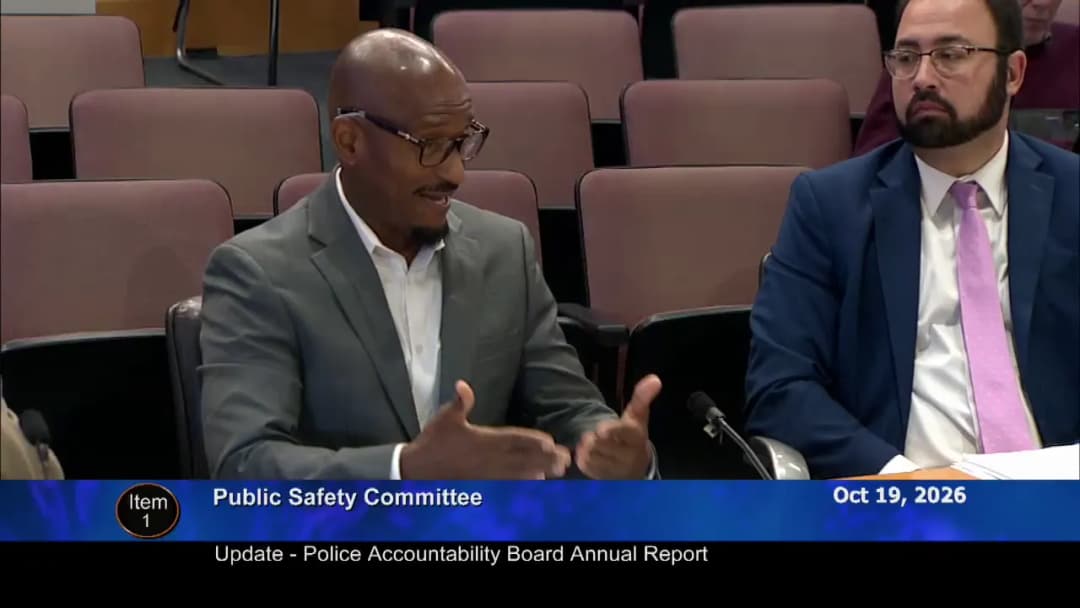
The Montgomery County Council Public Safety (PS) Committee, chaired by Sidney Katz, held a work session on Monday, October 19, 2026, to receive an update on the Police Accountability Board (PAB) Annual Report. The meeting included presentations from PAB Chair Paul Walker, Vice Chair George Juetis, ACC Chair James Hopkins, and PAB/ACC staff, facilitated by Council Staff Ms. Farag. The discussion centered on the PAB's focus memo which identified operational challenges and three central requests to improve data transparency and effectiveness. Discussion Items - PAB Annual Report Findings: PAB leadership presented data showing a significant increase in public engagement, with cases rising from 8 in 2022 to 85 in the latest reporting period. Of the 434 total allegations, 80% relate to bias or use of force. The board highlighted that residents identifying as Black are overrepresented in complaints at approximately 35%. A critical challenge is the lack of visibility into final trial board outcomes; for example, three Montgomery County Police Department (MCPD) termination trial boards resulted in zero officer terminations. The PAB stated it cannot fully meet its statutory mandate to make specific policy recommendations without stronger data from the ACC and law enforcement agencies. - Legislative Request for ACC Data: The PAB formally requested an amendment to county law to require the Administrative Charging Committee (ACC) to provide its written opinions to the PAB under existing confidentiality protections. Council Staff Ms. Farag noted a 2025 special counsel opinion states the ACC is not required, but may, share these opinions. ACC Chair James Hopkins raised concerns about protecting the identities of officers and complainants. PAB members countered that they receive this front-end data, are willing to sign additional non-disclosure agreements (NDAs), and require the full data for robust trend analysis. - Data Analyst Staffing Request: The PAB requested funding for a full-time research and data specialist (Grade 90 or higher), noting that jurisdictions like Prince George's County employ multiple analysts to support similar boards. - Trial Board Coordination: The committee discussed the disconnect between ACC charging decisions and trial board outcomes. Councilmember Mink argued that trial board counsel must have input into the charging process to fix the current system yielding incongruent results. Key Outcomes - Formal Support for PAB Requests: Committee Chair Sidney Katz formally supported all three PAB requests: amending the county code to mandate ACC data sharing, funding a dedicated data analyst position, and improving legal coordination for trial boards. He noted it is a "cruel joke" to assign duties without providing resources. - Mandate vs. Voluntary Approach: Councilmember Luedtke expressed strong frustration over the lack of progress since March and advocated mandating data sharing through legislation rather than relying on ongoing voluntary discussions, stating the PAB cannot fulfill its mandate under the status quo. - Path Forward: The committee committed to bringing forward the necessary legislative and budgetary items. The PAB's willingness to sign enhanced NDAs was highlighted as a viable solution to address confidentiality impasses, allowing data-driven oversight of police accountability processes.

PUBLIC SAFETY 83% · MISCELLANEOUS 17%
1860
OCT 19, 2026 · STAMFORD, CONNECTICUT · BOARD OF REPRESENTATIVES
Personnel Committee Meeting - October 19, 2026

The Personnel Committee of the Board of Representatives met on October 19, 2026, at 7:00 p.m. to consider a single agenda item, Approval P32.016, a three-year agreement with Concentra for occupational health and random drug testing services. Chair Carl Weinberg presided, and the meeting adjourned at 7:50 p.m. Discussion Items - Item P32.016: Agreement with Concentra – Director of Human Resources Paula Russell presented the proposed contract, which was previously approved unanimously by the Board of Finance on March 12, 2026. The contract includes a standard three-year term with options for two additional one-year extensions. - Procurement and Selection: The city conducted a competitive RFP process, receiving six proposals and interviewing three finalists: Concentra, Hartford Healthcare, and Yale New Haven Health. Concentra was selected for providing the best overall value, offering comprehensive services including pre-employment physicals, drug and alcohol testing, fitness for duty evaluations, return to work evaluations, and annual firefighter physicals. - Financing: Historical expenditures for the services in FY 2025-2026 were approximately $144,000. The current budget for the HR professional medicine account is $63,000, with a total budget request for the relevant line items of $186,900 and current allocated funding at $125,000. Director Russell stated there was no anticipated shortfall. - Firefighter Coverage: The city employs 170 firefighters and 59 fire captains and lieutenants. Annual physicals mandated by NFPA standards are a primary cost driver, conducted over a three-month period to manage operational impact. Concentra has 11 locations in Connecticut, including one in Stamford. Volunteer firefighters, while held to the same physical standards, are not covered under this contract and manage their own costs. - Police Department: Occupational health services for the police department, including steroid testing for recertification, are managed separately through Greenwich Occupational Health (Yale New Haven Health), a contract handled by the HR liaison for the police department. - Contract Term and Extensions: Representative de la Cruz raised concerns about the five-year potential duration (three years plus two one-year extensions) without requiring further BOR approval. Attorney Liz Turner clarified that extensions would only require a return to the Board of Representatives if they caused the contract value to exceed $100,000, as stipulated by the city charter. - Safeguards and Employee Options: Vice Chair Pavia asked about safeguards against false positive drug tests and the termination for convenience clause. Director Russell noted the fire contract includes a detailed City of Stamford Drug and Alcohol Policy appendix outlining procedures for various violation categories. Representative Pollack asked if employees could use a third-party vendor for drug tests at their own expense; Director Russell confirmed employees are required to use the city's vendor to ensure results are received and this alternative is not offered. Representative Hill confirmed drug testing occurs annually. - Contract Negotiations: Representative Hill inquired about exceptions requested by Concentra in the contract. Attorney Turner confirmed that while Concentra initially requested the removal of the city's standard indemnification language, the final contract contains the city's standard, broad indemnification clause favorable to the city. Key Outcomes - Vote: The committee voted unanimously to approve Item P32.016, the agreement with Concentra for occupational health and random drug testing. The motion passed by a voice vote of 7-0-0, with Chair Weinberg, Vice Chair Pavia, and Representatives de la Cruz, Gross, Hill, Pollack, and Salas voting in favor.

PERSONNEL MATTERS 39% · FIRE DEPARTMENT 26% · PURCHASING 12% · LEGAL 10%
OPENPUBLICA · PUBLIC MEETING INDEXUPDATED DAILY · openpublica.com