On October 29, 2026, the Committee on Health (Chairperson Christina Henderson) and the Committee on Human Services (Chairperson Matt Freeman) held a joint public oversight roundtable to examine the District's implementation of federal SNAP work requirements (effective June 1, 2026) and preparation for Medicaid work requirements (effective January 1, 2027). The roundtable included opening statements, testimony from the Department of Employment Services Director, four panels of public witnesses, and closing testimony from Deputy Mayor for Health and Human Services and the Director of the Department of Human Services. Councilmembers Anita Bonds and Zachary Parker also participated. Public Comments & Testimony First Panel – Consumer and Advocacy Perspective - Jacqueline Bowens (DC Hospital Association) expressed deep concern about coverage disruptions and described hospital outreach efforts, including a provider toolkit and a pilot to embed eligibility workers in hospitals. - Clara Flora Luna Kunt (affected resident) testified that she submitted all required documentation for SNAP recertification but her case was not processed in time, resulting in a 20-day loss of food benefits. She emphasized the lack of confirmation receipts and clear communication from DHS. - Hannah Eckner (Bread for the City) described problems with the five-page work requirement exemption screening form: it was not shared with advocates for input until after finalization, and its complexity leads to delays and errors. She cited cases where exemptions were not applied despite proper documentation. She also raised concerns about medical frailty determinations and the need to align definitions across states. - Jessica Berger (Legal Aid DC) testified that SNAP participation has dropped by tens of thousands since HR1, partly due to misinformation and fear. She gave examples where DHS failed to use its own data to apply exemptions (e.g., a client over 80 asked to prove disability, and a parent not exempted despite caregiving duties). She urged targeted communication and earlier engagement with legal service providers. Second Panel – Policy and Community Organizations - Ruth Pollard (DC Primary Care Association) highlighted health centers' preparation, development of 30/60/90-day renewal reports to identify at-risk patients, and recommendations including clear timelines, presumptive eligibility, and continued patient engagement. - Maria Mencelala (DC Fiscal Policy Institute) criticized DHS for lack of transparency and inconsistent data sharing with advocates. She noted that ESA meetings were canceled and data slides skipped, and recommended monthly meetings and a public dashboard with detailed metrics. - LaMonica Jones (DC Hunger Solutions) described extensive outreach and pre-screening for SNAP, and noted that clients with disabilities are still asked to document work hours despite qualifying for exemptions. She urged better data sharing and simpler forms. - Joseph Liu (Capital Area Food Bank) praised DHS for quickly establishing a SNAP volunteer program but noted only one referral so far. He pointed out that SNAP E&T providers are only reimbursed 40% of costs, which is insufficient to meet increased demand. He also stressed the need to align Medicaid and SNAP work requirements to reduce confusion. Third Panel – Hospital and Legal Services - Beverly Wheeler (DC Central Kitchen) testified as a SNAP E&T provider and volunteer host site. She reported only one referral for volunteer hours and noted that demand for their culinary program has not increased significantly. She expects rising need for emergency food as benefits are lost. - Robin Griffin (Legal Counsel for the Elderly) described a major DCAS glitch that double-counted Social Security income for thousands of beneficiaries, leading to erroneous termination of Medicaid/Q&B coverage. It took months to resolve, and some are still awaiting reimbursement. She stressed that these systemic issues will be compounded by work requirements. - Keith McCannon (AmeriHealth Caritas) outlined the MCO's aggressive outreach to potentially affected Medicaid enrollees, including reminder texts, calls, and provider notifications. He noted that approximately 43,000 of their 143,000 enrollees are in the expansion population subject to work requirements. They are launching a provider alert system and updating eligibility portals to flag affected patients. Discussion Items - SNAP Implementation and Data: DHS Director Pierre reported that as of October, 1,066 individuals lost SNAP benefits for noncompliance, and another 1,032 are at risk in November. Approximately 87% of SNAP customers are exempt or not subject to work requirements. The agency conducted over 900 robocalls, mailings, and 85 community sessions. - Medicaid Preparations: Deputy Mayor Turnage presented DHCF's analysis: of 250,000 Medicaid enrollees, 75,000 are childless adults subject to work requirements. Using income data and preliminary medical frailty proxies, 55% (40,803) are expected to be compliant or exempt, leaving 33,000 who must meet the requirement or qualify for an exemption. He announced that the District submitted a hardship waiver on October 16 seeking to exempt Wards 7 and 8 due to high unemployment. - Medical Frailty Definition: Turnage discussed the CMS interim final rule requiring states to prove that a condition "significantly impairs" the ability to work. He called it "wholly unreasonable" and noted that a federal court vacated that rule on the morning of the hearing. DHCF had planned to use a three-tier system; the court ruling may simplify the process. - Workforce Capacity: DOES Director Morris Hughes testified that the agency offers 1,200–1,300 training slots, but served about 1,000 SNAP participants in FY26, of which 241 found employment. Project Empowerment placed 210 of 508 completers into jobs. She stated that additional resources ($2.5 million) would be needed to add 300 more slots. Councilmembers expressed concern that capacity falls far short of the number of people losing benefits. - Data Sharing and Systems: An updated data sharing agreement between DOES and DHS/DHCF has been signed by DOES and is pending final signatures. It will allow automated verification of participation and wages. DHCF is working to integrate CRISP health data and using AI tools (OLI) to assist caseworkers. DCAS has implemented entity resolution and smart assist features to reduce errors. - Call Center and Frontline Issues: Multiple witnesses described long wait times, conflicting information, and lack of confirmation receipts. DHS noted that applicants can now receive receipts when dropping off paper forms and that callback options exist, but acknowledged wait times average 15–17 minutes. The 68-page combined application remains a barrier. - Coordination and Leadership: Councilmembers repeatedly asked for a "captain of the ship" across workforce programs. The Workforce Investment Council (WIC) was not permitted to participate. DOES Director Hughes argued that DOES has been leading workforce coordination behind the scenes. Councilmember Bonds emphasized the need for legislation to create a central coordinating body. Key Outcomes - Data Sharing Agreement: The interagency data sharing MOU has been signed by DOES and is under review by DHS and DHCF. It will allow automated verification of work requirement compliance. - Waiver Request: DHCF submitted a hardship waiver for Wards 7 and 8 on October 16, 2026, seeking to exempt residents from Medicaid work requirements due to high unemployment. A decision is expected before the end of the year. - Medical Frailty Court Ruling: A U.S. District Court vacated CMS's restrictive definition of medical frailty on the day of the hearing. DHCF will monitor appeals and may adjust its approach. The agency had planned to use diagnostic codes and a three-tier assessment; the ruling may allow simpler self-attestation. - Outreach and Communication: DHS will continue monthly advocate meetings and improve data reporting. DHCF will engage stakeholders on medical frailty codes and will publish the code set by late November or early December. - Capacity and Resources: Councilmembers directed agencies to provide updated data on training slot utilization, completion rates, and employment outcomes. The committees emphasized the need for budget requests to expand workforce capacity. - Technology Improvements: DCAS will deploy new AI features (OLI) in November 2026 to reduce caseworker burden. DHCF is working to implement electronic health data sharing via CRISP in 2027. - Record: The hearing record will remain open until November 12, 2026, for written testimony.
The Public Meeting Index
The Public Meeting IndexNote: The printed agenda lists the meeting date as Tuesday, October 27, 2026, which conflicts with the date specified for this summary. The Alameda County Board of Supervisors and the Alameda Health System (AHS) Board of Trustees held a joint special meeting to review AHS finances, operational updates, and immigration enforcement protocols following a controversial incident at Highland Hospital. The discussion heavily focused on the fiscal outlook for AHS and its affiliate St. Rose Hospital, the transfer of the IOP/PHP program, and community backlash over the handling of an ICE detainee. Item IV on the agenda, concerning AHS Governance and SB 1400, was postponed due to time constraints. Public Comments & Testimony - Item II (Budget): No in-person speakers testified. One online speaker, Howard D., addressed the board. - Item III (IOP/PHP Operations): Nettie Washington (representing IOP program staff) expressed significant frustration over the chaotic nature of the move to Fairmont, stating staff and patients were not logistically, professionally, or clinically prepared. She questioned why the Oakland community was losing behavioral health services at Highland when all wraparound services are located there. - Item V (Immigration Response Protocols): The overwhelming majority of public comment focused on this item, with over 30 speakers. Speakers included hospital staff, union representatives (SEIU 1021), community legal observers, clergy, and patient advocates. - Nico (Attorney, SEIU): Stated his client was arrested without a judicial or administrative warrant, suffered six fractured ribs, and was discharged back into ICE custody. He requested immediate activation of legal resources (CLIP) for future detainees. - Claire Chalmers (RN, Highland ICU): Stated staff were unprepared and that AHS facilitated a staging area for ICE in the hospital loading dock, which she argued violated the county's ICE-free zone policy. - Dr. Sushida (Sudo for Solidarity): Drew parallels to the incarceration of Japanese Americans during WWII. Urged enforcement of SB 81 and opposition to a proposed ICE detention center in Dublin. - Carrie Schiff (NP, La Clinica): Reported a 50% no-show rate at her clinic during the ICE presence, stating fear is driving patients away from necessary care, creating both a public health and financial issue for the strained system. - Multiple healthcare workers (Marina, Comney, and others): Expressed feeling unsafe and unprotected by AHS administration. They stated real-time scenario-based training for dealing with ICE is urgently needed, and criticized the AOC for failing to verify a warrant. - David (Healthcare Worker): Characterized the use of the Sally Port and Sheriff's deputies to facilitate ICE shift changes over six days as a clear violation of the county's ICE-free zone. - Community Members (Laura Troop, Kip Waldo, Marla Kamiya): Refuted the description of protesters as dangerous, stating they were peaceful community observers offering support. They urged the boards to stop collaborating with what they described as a lawless federal agency. Discussion Items - AHS Budget, Financial Reports & County Line of Credit (Item II): - Kim Miranda (CFO) presented FY25/26 results showing a $62.3M net income (budgeted loss was $10.2M), thanks to one-time settlements (FQHC settlement $109.5M gain, Realignment $49.5M, MCO tax $10M). The FY26 audit will be delayed until December. - Q1 FY27 shows a $9.2M net income vs a $22.8M budget. A key variance is the non-receipt of $19.3M in county funding. Labor is positive ($5.4M) due to unfilled positions, but leading to short-staffing and overtime. - Projections show a manageable Net Negative Balance (NNB) for FY27, but FY28 projects a $95M loss and FY29 a $123M loss, driven by HR1 impacts and the expiration of one-time state funds. - St. Rose Hospital: Needs the IGT ($38M) to break even. Cash flow is critical; without the IGT, St. Rose will run out of money by February/March 2027. AHS has extended its line of credit to $25M. - Pat O'Connell (former Auditor) reviewed the history of the County Line of Credit, noting AHS has moved from over $200M in negative cash to a positive net worth. - Supervisors acknowledged the positive cash position bought time but warned against over-optimism given the grim FY28/29 projections. Supervisor Fortunato Bas asked about stakeholder participation in the budget process and contingency plans for St. Rose, to which AHS answered that no formal contingency plan currently exists beyond the line of credit. - Operational Updates (Item III): - IOP/PHP Program: Jet Chapman (CHRO) confirmed the program was preserved through an ad hoc committee process. All 11-12 employees have been reassigned to the Fairmont campus. The physical move of services is scheduled for November 1st to 15th. - Lease Modification: James Jackson (CEO) and Kimberly Gasway (GSA Director) outlined a fast-tracked renewal of a 30-year lease for Highland and Fairmont (at $1/year) tied to a TIFFA grant for a dental clinic. - Efficiency Study RFP: Jeanette Dong reported the scope is drafted and a selection committee, including labor representatives, is forming. Supervisor Miley strongly expressed urgency and dismay at the timeline, emphasizing that the public needs to see proactive financial management. CEO Jackson assured the board the funds are secured and the RFP will move expeditiously. Dr. Lillian Lilker noted that frontline operational improvements are already underway. - Immigration Response Protocols (Item V): - James Jackson (CEO) opened the discussion by reading a letter from a staff member who felt unsafe due to protests, setting a tone of concern over hospital security disruption. - Caleb Owen (AHS General Counsel) presented the existing SB81 protocols, emphasizing the escalation path to the Administrator on Call (AOC). He justified the decision to move ICE vehicles to the Sally Port as a measure to ensure safe hospital operations, minimize patient/staff interaction with ICE, and manage protest access. - Supervisor Fortunato Bas pressed AHS on whether a warrant was requested and why legal resources (CLIP) were not immediately activated. She stated she was “extremely upset” to learn the arrest was potentially warrantless, contradicting information she had been given previously. She called for a full debrief. - Supervisor Miley stated he did not know the facts and demanded a written report of what happened, why it happened, and what corrective actions would be taken. - President Haubert cautioned against reacting in a way that unintentionally deters ICE from bringing injured detainees to the hospital for care, but agreed the protocols must be reviewed and strengthened. Key Outcomes - Critical Incident Review: The boards agreed to an immediate critical incident review of the Highland Hospital ICE incident. A written report of the facts and recommendations is to be completed within 30 days. The findings are expected to be presented publicly to the Alameda County Together committee. - Protocol Reinforcement: AHS committed to strengthening and publicly clarifying its SB81 and immigration response protocols. This includes mandatory immediate notification of legal partners (CLIP), ensuring clear processes for requesting warrants, eliminating automatic opt-out for civil detainees, and implementing scenario-based training for clinical and security staff. - Efficiency Study: AHS was directed to proceed with awarding the Efficiency Study RFP without further delay, with the results expected in the spring of 2027. - Continued Collaboration: The board agreed that the collaborative ad hoc process was successful for the IOP/PHP program and should serve as a model for tackling the budget challenges ahead, particularly for FY28/29. - Budget & Lease: The FY26 audit is delayed. The Lease Modification will be presented to the AHS board in November and the county board in December.
The Montgomery County Council's Government Operations and Fiscal Policy (GO) Committee met on October 29, 2026, in a scheduled 9:30 a.m. – 12:30 p.m. work session in Room 3CHR at the Council Hearing Room, Rockville, Maryland. Committee members present were Chair Kate Stewart, Councilmember Sidney Katz, and Councilmember Shebra Evans. The committee reviewed the county's boards, committees, and commissions (BCC) system and considered amendments to three tax-credit bills. All three bills were recommended unanimously to the full Council, each with amendments. Boards, Committees, and Commissions (BCC) System Updates - Assistant Chief Administrative Officer Ken Hartman Espada and BCC staff briefed the committee on progress since the February 2026 Committee Evaluation and Review Board (CERB) report, including a new draft BCC manual that had just completed County Attorney review. - The administration highlighted successful recruitment changes, including evergreen vacancy advertisements, and noted the system supports roughly 1,400 volunteer BCC members. It proposed a stronger community-engagement strategy, clearer reporting pathways, annual reports, more equitable recruiting, possible stipends or other participation incentives, standardized department support and training, performance metrics, and annual feedback questionnaires. - The Conflict Resolution Center of Montgomery County has agreed to pilot facilitation and evaluation work with several boards. - Chair Stewart recommended that staff prepare a next-steps and timeline memo for the incoming county administration so the work is not lost during transition. Councilmember Katz urged flexibility in advertising while warning against public perceptions that the county is hiding something. Councilmember Evans asked how board feedback is acknowledged; Mr. Hartman Espada described the reply process and noted boards, committees, and commissions cannot lobby in Annapolis. No vote was taken. Bill 46-26: Taxation – Child Tax Credit – Supplemental Grant - Co-led by Chair Stewart and Councilmember Evans, this bill would create a county child tax credit supplement of up to $500 per qualified child, enabled by state legislation. A qualified child is a dependent under age 6, or under age 17 with a disability. - The credit would be full for taxpayers with federal adjusted gross income below $15,000 and then phased out. The committee accepted two clarifying amendments: one specifying the phase-down amount as $50 per additional $1,000 of income, and another cross-referencing state definitions for “resident” and “place of abode.” - Councilmember Katz voiced support, citing workforce participation and the local economic multiplier effect. The committee voted unanimously to recommend the bill, as amended, to the full Council. Bill 47-26: Homeowners Property Tax Credit – County Supplement – Amendments - The bill would expand the county’s homeowners property tax credit supplement by raising gross income eligibility from $75,000 to $106,800 and, under the adopted amendments, increasing the maximum assessed home value considered in the calculation. - Council staff explained that the bill as introduced would have produced almost no benefit for newly eligible households. The committee adopted amendments replacing the new tranche percentages with 7.5% and 8%, adjusting the existing top tranche to 7%, and increasing the maximum assessed value from $375,000 to $500,000. Because of the credit’s counterintuitive calculation, these lower percentages produce a larger benefit. - A second amendment made CPI-related technical adjustments, including updating the combined net-worth limit to $255,400. A third amendment provided a transition clause applying the revised credit to the tax year beginning July 1, 2027, while preserving required annual CPI adjustments. - The Department of Finance estimated that, if all eligible households take advantage of the credit, the amendments could cost the county between $5 million and $8 million per year: about $2.5 million to $3 million for existing recipients and $2.5 million to $5 million for new recipients, with about 2,600 potential new households. The committee voted unanimously to recommend the bill, as amended. Bill 48-26: Property Tax Credit – Public School Employees - The bill would establish a $2,500 county property tax credit for full-time Montgomery County public school employees, modeled on the existing credit for public safety employees, to help educators, bus drivers, cafeteria workers, and other school staff own homes and live in the county. - Council staff recommended, and the committee accepted, an amendment clarifying that employees must be full-time. The committee also agreed to prepare a later amendment adding a small group (likely under 30 employees) who are not in either of the two main bargaining units, based on Board of Education feedback. - A technical amendment was adopted to remove language allowing eligibility based on an intent to occupy the home, requiring the employee to actually occupy the qualifying property for at least nine months during the taxable year. Finance clarified that the school employee must be listed on the title; joint ownership with a non-school employee does not disqualify the credit; and only one credit is available per property. - The Department of Finance testified that, using MCPS address data and limiting the analysis to full-time employees, the estimated fiscal impact falls to roughly $20 million to $23 million, compared with $25 million to $30 million originally; the data identified roughly 8,000–9,000 full-time teacher-owned properties. Chair Stewart noted that the parallel public-safety credit has had about 80–85 percent uptake, so actual costs may be lower. Councilmember Evans emphasized that the intent is to improve homeownership opportunities for Black and Latino educators, despite the racial equity impact statement indicating a potential negative effect. The committee voted unanimously to recommend the bill, as amended. Public Comments & Testimony - No oral public testimony appears in the work session transcript. Staff referenced testimony from earlier public hearings: the Bill 46-26 staff memorandum included a summary of public testimony; Bill 47-26 testimony was broadly in support with some opposition; and Bill 48-26 public testimony informed the technical amendment requiring actual occupancy. Key Outcomes - BCC update: No vote. The committee asked the executive team to prepare a transition memo with next steps and a timeline for the incoming administration. - Bill 46-26: Two clarifying amendments adopted; unanimous recommendation to the full Council. - Bill 47-26: Three amendments adopted; unanimous recommendation to the full Council; estimated annual cost of $5 million–$8 million if all eligible households participate. - Bill 48-26: Full-time and occupancy amendments adopted; an additional bargaining-unit amendment to be drafted; unanimous recommendation to the full Council; updated fiscal estimate of $20 million–$23 million.
The Minneapolis City Council convened at 9:39 AM on October 29, 2026, with President Elliot Payne presiding. The meeting featured three honorary resolutions, a controversial government restructuring ordinance eliminating the Office of Community Safety, debate on a safe outdoor parking program, and reconsideration of mayoral vetoes related to behavioral crisis response contracts. Multiple votes and discussions highlighted deep divisions over public safety priorities, fiscal responsibility, and homelessness policy. Consent Calendar - Approved the agenda (as amended to take up Budget Item 4 and COW Item 1 first) 13-0. - Accepted minutes from October 15, 2026, meeting 13-0. - Referred petitions, communications, and reports from proper committees 13-0. - Passed multiple routine items from standing committees, including Budget items 2 and 3 (community domestic violence navigator funding), Business Housing and Zoning items 1-2, 5-13, 16-19, Climate and Infrastructure items 1-15, Enterprise and Labor Relations items 1-2, Intergovernmental Relations item 1 (resolution on Haiti TPS), and Public Health Safety and Equity items 1-10. Public Comments & Testimony - During the Domestic Violence Awareness Month resolution, family members and advocates spoke. Janna Williams (aunt of Allison Lucia) criticized systemic failures and demanded accountability. Simone Samuels (sister of Mariah Samuels) shared her grief and called for justice. Cece, a domestic violence navigator with MPD, offered condolences and noted ongoing reform efforts. Discussion Items Budget Item 4: Resolution on Government Restructure Savings for Property Tax Relief Councilmember Vitaw introduced a non-binding resolution (amended) to use potential savings from government restructuring for levy reduction and restoration of proposed budget cuts. The amendment reflected a compromise between levy reduction and restoring services. Councilmembers Wansley, Chugtai, Chowdhury, Vitaw, and others spoke in favor, emphasizing fiscal responsibility and collaboration. The resolution passed 13-0. Committee of the Whole Item 1: Ordinance to Eliminate the Office of Community Safety (OCS) Councilmember Chowdhury moved the ordinance, which dissolved OCS and shifted oversight of police, fire, 911, emergency management, and neighborhood safety to the mayor’s office. Supporters (Wansley, Stevenson, Chavez, Chowdhury, Vitaw, Warren, Osman, Payne) argued OCS was a costly bureaucratic layer that hindered public safety reform and lacked accountability. Opponents (Palmasano, Schaefer, Whiting, Rainville) warned it would set back progress on alternatives to policing and centralize too much power. The ordinance passed 9-4 (Palmasano, Schaefer, Whiting, Rainville voting no). Business Housing and Zoning Items 3 & 4: Safe Outdoor Parking Ordinance Councilmembers Chavez, Chugtai, Chowdhury, and Stevenson authored an ordinance to create regulated safe parking sites for people living in their vehicles. Supporters stressed it provides safety, dignity, and a pathway to housing, citing models in Duluth. Opponents raised concerns about financial viability, safety enforcement, and livability issues (idling, waste). After debate, the ordinance passed 9-4 (Rainville, Vitaw, Palmasano, Warren voting no; Schaefer also no). Public Health Safety and Equity Item 11 & Unfinished Business: Behavioral Crisis Response Contracts Two mayor vetos were reconsidered. First, denial of a contract with Community Bridges Inc. failed to override (7-5), sustaining the veto. Councilmembers then referred the contract back to staff (12-0). Second, a waiver of procurement policies for Canopy Roots LLC (BCR) also failed to override (8-4). Councilmember Chavez then introduced a new motion to amend the original denial to a 12-month extension (down from 18 months). After debate, the amendment passed 8-4 (Stevenson, Chavez, Wandsley, Chugtai, Whiting, Chowdhury, Osman, Payne in favor; Rainville, Vitaw, Palmasano, Schaefer opposed). The underlying motion (the 12-month extension) then carried 8-4. Budget Committee Item 1: Contracting Authority for Overspending Departments Councilmember Whiting proposed rescinding procurement contracting authority for departments exceeding annual budget appropriations. An amendment shifted implementation of part of the rule to 2027 and exempted snow emergencies. Passed 11-2 (Vitaw and Warren no). Business Housing and Zoning Item 15: 2027 License Fee Schedule and High-Risk Rental Fee Councilmember Wansley successfully amended the fee schedule to add a high-risk rental dwelling license fee of $8,158 (90% cost recovery) to fund enforcement against repeat violators. The fee applies to the highest-risk tier-3 properties. Passed 12-0. Committee of the Whole Items 3 & 4: Legislative Directives on Community Engagement and Duplicative Services Councilmember Chowdhury moved to approve the directives and refer them to the Legislative Research Oversight team for further work with administration. Passed 11-0. Key Outcomes - Elimination of Office of Community Safety (ordinance passed 9-4) : OCS dissolved; mayor becomes direct authority over all public safety departments effective upon enactment. - Safe Outdoor Parking legalized (ordinance passed 9-4): Nonprofits, religious organizations, or government entities may operate managed overnight parking sites with security and services. - 12-month extension of Canopy Roots BCR contract (passed 8-4): Allows continuity while city explores in-house crisis response. - Mayor’s veto of Community Bridges contract sustained (7-5 to override): Contract remains denied; staff to reconsider. - New high-risk rental license fee ($8,158) adopted as part of 2027 fee schedule (12-0). - Budget resolution (non-binding) commits to using restructuring savings for levy reduction and restoration of cuts (13-0). - Introductory ordinances referred to committees: stormwater program, MPD vehicle purchase accountability, license streamlining, autonomous vehicles, and data center licensing.
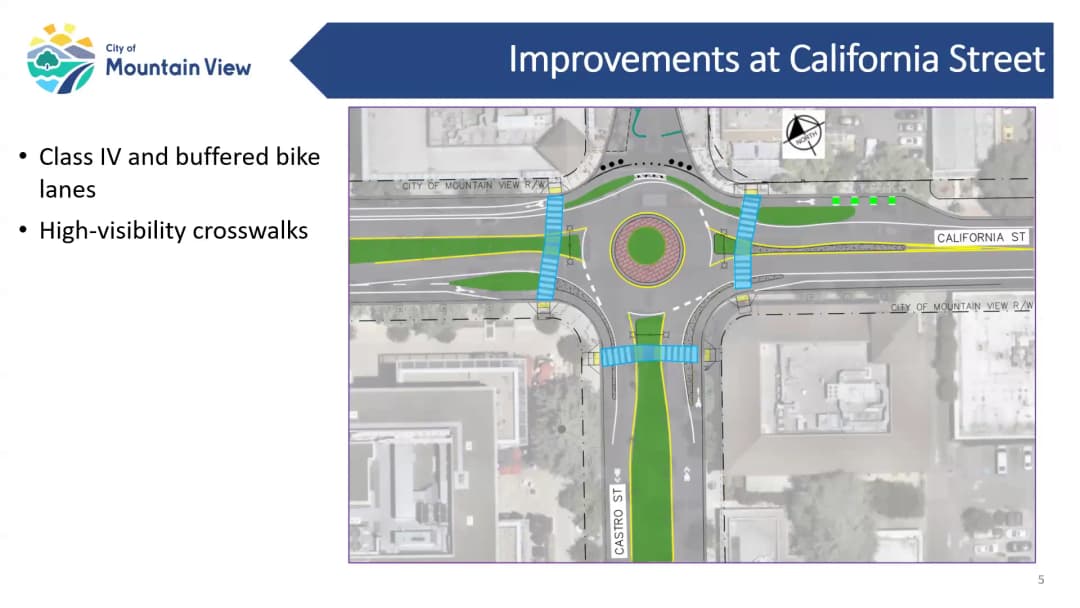
The Bicycle/Pedestrian Advisory Committee (BPAC) met to review an active transportation collision report, discuss interim pedestrian mall improvements for the Castro Street and California Street intersection, and receive staff updates. The committee approved the consent calendar and provided feedback on upcoming projects. Consent Calendar - Meeting Minutes (August 18, 2026): Approved 5-0, with a note about a technical discrepancy in vote logging that staff will address. - Safe Routes to School Final Report (FY 2025-26): Received and approved as part of the consent calendar. Public Comments & Testimony - Peter (during Item 6.2): Noted that the north side of the Castro/California intersection is currently very difficult for wheelchair users, as they must wedge between curbs, bollards, and a fence. He requested that the new design include a curb ramp allowing wheelchair access from the sidewalk into the pedestrian mall. Discussion Items 6.1 Active Transportation Collision Report - Police Presentation (Officer Golf): Reported 11 vehicle-bicycle collisions in a 15-month period (July 2024 – July 2025), noting an increase. A new e-citation system (e-cite) went live October 1, 2026, which will improve data collection. A juvenile bicycle diversion program has been launched in partnership with Stanford Hospital and LIBA 25, allowing citations for minors to be diverted to education classes. Enforcement priorities will include helmet violations, stop sign running, and red light violations, with some warnings transitioning to citations. Driver failure-to-yield from driveways, often due to vision obstruction from parked vehicles, was a common collision factor. - Committee Questions and Comments: Members asked about enforcement thresholds (e.g., blatant vs. marginal violations), the distinction between red and flashing yellow beacon compliance, and the potential for social media education to amplify the impact of citations. Members also requested that police continue sharing observational data to help prioritize intersection redesigns. 6.2 Interim Pedestrian Mall Improvements – Castro Street/California Street Intersection (Project 23-49) - Staff Presentation (Joseph Cervantes, Robert Gonzalez, and consultant Molly Tremley): Proposed replacing the current signalized intersection with a modern roundabout, removing traffic signals, adding protected bike lanes, curb extensions, and raised crosswalks (deferred due to bus concerns). The design aims to reduce vehicle speeds, improve pedestrian and bicycle safety, and serve as a gateway to the pedestrian mall. The concept layout includes a mountable apron for buses and emergency vehicles, new crosswalk placements, and potential loading zones. - Committee Feedback and Concerns: - Several members expressed concern about removing traffic signals, noting that signals provide clear guidance for pedestrians and may be safer given high pedestrian volumes on weekends. They requested examples of roundabouts with high pedestrian and bicycle activity to build confidence. - Members asked for separate marked bike crossings adjacent to pedestrian crossings to avoid conflicts between turning cyclists and vehicles. - Accessibility issues were highlighted: the existing curb ramps on the north side are inadequate for wheelchair users; a ramp into the pedestrian mall must be included. - Parking and loading zone design: members supported converting some parking to loading zones and ensuring that bike lane entrances/exits are clear to avoid door zone conflicts. - The transition from the new bike lane to the narrower portion of California Street near Hope Street was noted as potentially confusing; members suggested clear signage and pavement markings for cyclists to merge safely. - Design speeds (max 23 mph, actual 15 mph) were discussed; members appreciated the geometry-driven speed reduction but requested that raised crosswalks be reconsidered if feasible for buses. - Consultant Response: The roundabout geometry forces low speeds (15 mph typical), reducing fatal/injury crash risk compared to signalized intersections. The design separates conflict points (vehicle-to-cyclist, vehicle-to-pedestrian, vehicle-to-vehicle). Staff will consider adding crossbike markings, improving curb ramps, and evaluating the need for additional signage. Key Outcomes - Consent Calendar: Approved 5-0. - Collision Report: Received. Staff will continue to collect data and share enforcement insights with BPAC. - Intersection Concept Feedback: The committee provided verbal feedback on the roundabout design. Staff will incorporate comments into the design and present to the City Council Transportation Committee (CTC) next month. - Staff Announcements: The Active Transportation Plan was adopted unanimously by City Council on September 23, 2026; Monster Bash bike rodeo event attracted about 200 participants; two new staff positions are being recruited; Jessica Manzi introduced herself as the new Chief Transportation Officer (day 3 on the job). - Committee Reports: A BPAC representative provided updates from VTA BPAC meetings, including funding recommendations (El Camino & Castro intersection funded, others below threshold) and the cross-barrier connections plan update. - Next Meeting: Scheduled for Wednesday, November 18, 2026, at 6:30 p.m. (potential adjustment for the March 2027 meeting due to a holiday).
This was the tenth and final day of the 2027 Proposed Budget Hearings for the City of New Orleans, held on October 29, 2026. The council heard presentations from the City Planning Commission (CPC), Historic District Landmarks Commission (HDLC), Vieux Carre Commission (VCC), Parks and Parkways, New Orleans Recreation Development Commission (NORD), and received updates on the Parks Millage from Audubon Nature Institute and City Park. Discussions focused on budgetary constraints, staffing levels, enforcement of fines, and service delivery. Public comments were received on urban agriculture, historic preservation, parks maintenance, and recreation funding. Public Comments & Testimony - Dr. Felicia Stoller (Jazz Ferdinola) urged continued funding for the urban agriculture liaison, highlighting the public health, educational, and community benefits of urban agriculture. - Dimitri (Research Farms) expressed support for the urban agriculture liaison, noting assistance with navigating city processes and securing funding for the city's first food and agriculture plan. - Michael (Recirculating Farms, Central City) thanked the council for supporting urban agriculture, citing its role in food security, green infrastructure, youth engagement, and mental health. - Morgan Clevinger (on HDLC) defended the importance of the HDLC in preserving historic architecture, arguing against eliminating an inspector position that pays for itself through fines. - Bert Lodrig (3438 Annette St.) urged the VCC to develop a museum or building in the French Quarter representing the contributions of enslaved people and immigrants who built the city. - Morgan Clevinger (on Parks and Parkways) praised recent improvements but called for increased resources given the department's expanding responsibilities and the need for dedicated maintenance funding from the parks millage. - Morgan Clevinger (on NORD) advocated for increased funding for NORD, citing persistent deferred maintenance at facilities like Stallings Gentilly Playground, and asked that millage funds be more equitably allocated to NORD and Parks and Parkways rather than primarily to Audubon. Discussion Items City Planning Commission (CPC) - Deputy Director Larry Massey and Executive Director Bob Rivers presented the CPC's 2027 budget. The mayor's proposed budget retains 24 positions and includes a $500,000 allocation for professional services to begin a three-year effort to develop a new citywide master plan (the current plan dates to 2010). The CPC aims to streamline regulatory processes to free up staff capacity for long-range planning. - The urban agriculture liaison position was transferred from the Office of Resilience; the CPC is completing a citywide urban agriculture and food access master plan. - Councilmember Harris asked about the liaison's responsibilities and whether the food access plan addresses food deserts in her district (Central City, Hoffman Triangle, Gert Town). Bob Rivers confirmed it does and that outreach will begin in early 2027. - Councilmember Green encouraged strengthening ties with the Regional Planning Commission for transportation and infrastructure funding. - Councilmember Morel thanked CPC for its work on the transitional lodging study and the data center request, noting the council will act on data centers due to time constraints. Historic District Landmarks Commission (HDLC) - Executive Director Brian Block presented the HDLC budget, which decreases total funding by $104,453, partially due to the elimination of one inspector position (salary $53,000). HDLC generated $723,938 in fines and fees in 2026. - Councilmember Willard asked about fine collection rates; Block said the department assesses fines but the City Attorney's Bureau (CAB) handles collection. He committed to providing data on amounts collected. - Councilmember Harris questioned the cost-effectiveness of eliminating the inspector, noting that reducing inspections could lower fine revenue and that the position likely pays for itself. She requested a cost-benefit analysis by the following Tuesday. - Councilmember Green urged avoiding layoffs of productive staff and finding resources elsewhere. Vieux Carre Commission (VCC) - Brian Block (also VCC director) presented the VCC budget, which increases by $132,855 due to the correct placement of the deputy director position. The budget proposes eliminating one office assistant position. VCC generated $225,400 in fines and fees in 2026. - Councilmember Harris asked the same question about fine collection responsibility; VCC also relies on CAB for collections and she requested historical collection data from 2024-2026. Parks and Parkways - Interim Director Sharon Franklin Brown presented the budget, reflecting a $1.3 million reduction in general funds and $2.4 million reduction in non-general funds (primarily from expiring ARPA funds). The department has 124 positions with three vacancies. - Councilmember Harris raised concerns about illegal tree removal, noting that fines (up to $5,000 for protected species) are often not collected. Ernest (from the administration) responded that existing ordinances are sufficient but enforcement processes with CAB need streamlining. - Councilmember McCarron discussed grass-cutting schedules (currently 3-4 weeks, down from 6 weeks in summer), contractor costs, and tree trimming backlog (2,066 open work orders). Director Brown said the department has added 10 more field workers by having supervisors work alongside crews. - Councilmember Green requested enhanced landscaping along Downman Road and Johnny Jackson Boulevard. New Orleans Recreation Development Commission (NORD) - Interim CAO Natasha Robinson and new CEO Patrice Bell presented the NORD budget of $19.3 million, a modest decrease of $96,000. The budget maintains 202 FTEs and 141 seasonal hires. NORD manages 14 recreation centers, 5 natatoriums, 12 outdoor pools, 9 stadiums, and 122 parks/playgrounds. - NORD plans to open a sixth natatorium in Cutoff without additional FTEs, restore limited FIT NOLA programming, and address deferred maintenance. It also intends to update facility rental fees (unchanged since 2014) and implement an online payment system. - Councilmember McCarron asked about the rental fee update, online registration, and partnership with the NORD Foundation. Patrice Bell committed to district-specific listening tours starting December 1. - Councilmember Willard questioned revenue projections (self-generated revenue was $446,000 in 2025, expected to be $100,000 less in 2026), esports programming costs ($323,000), and maintenance contracts. Bell said she would review all contracts. - Councilmember Morell discussed the esports program (leader in the South), the boxing program at Milne, the need to reassess the portfolio of over 100 properties to focus resources, and the importance of a transparent background check policy for coaches that balances safety with rehabilitation. Parks Millage: Audubon Nature Institute and City Park - Audubon Nature Institute: Vice President Shimann Grant Saloy reported receiving $8.7 million in millage funds in FY26. In FY27, $5.3 million will go to operations at Audubon Park, Louisiana Nature Center, and Riverfront Park; $2.6 million for debt service; the remainder for deferred maintenance. Audubon provided over 40,000 free or reduced admissions to Orleans Parish residents in 2026. - City Park: CEO Rebecca Deeds reported receiving about $2 million in millage funds (9% of operating budget). Funds supported tree canopy preservation, stadium upgrades (Pan American, Tad Gormley), infrastructure repairs, and free community programming. City Park generates 85% of its revenue independently. - Councilmember Green praised both parks for their regional importance and programming. - Councilmember McCarron thanked them and remarked on the quality of City Park's master plan execution. Key Outcomes - No votes were taken on budget items during this hearing; the sessions were informational. The council will use the information to prepare the final 2027 budget. - The council requested additional data from HDLC and VCC on fine assessment and collection history (2024-2026) and from HDLC on the cost-benefit of retaining the inspector position (due by the following Tuesday). - The council directed NORD's new CEO to review all contracts, update facility rental fees, develop a transparent background check policy, and conduct a facilities inventory. - The hearing concluded with a motion to adjourn, which was seconded and passed. The meeting adjourned. Budget deliberations will continue before final adoption.
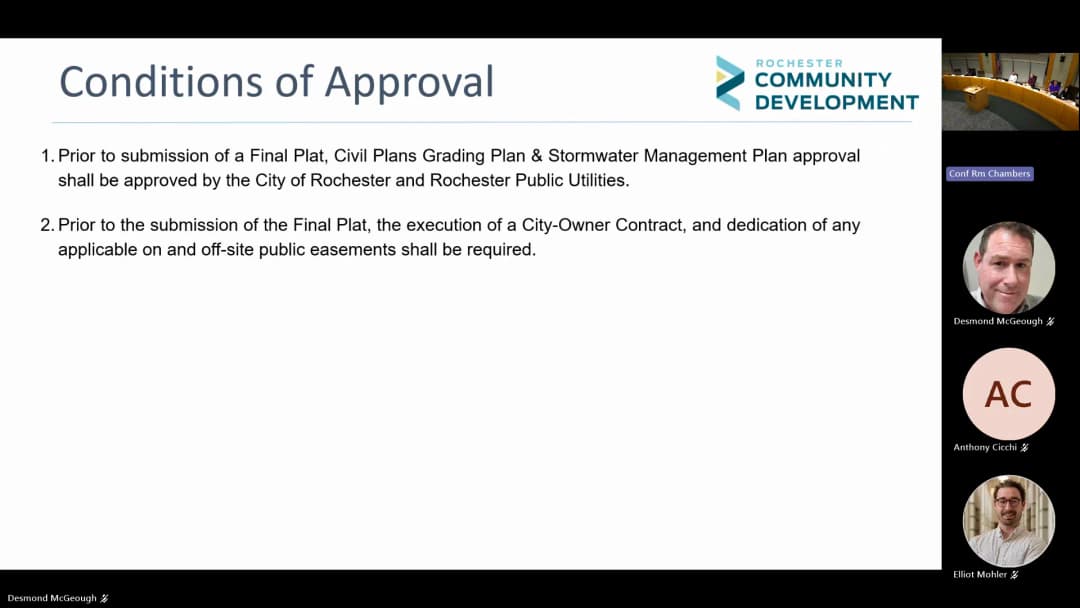
The Rochester (Minnesota) Planning & Zoning Commission convened on October 29, 2026, at the Government Center Council/Board Chambers. The meeting covered a major land subdivision recommendation for the Shannon Oaks Eighth development and combined public hearings for a veteran housing development proposed by Lennar on behalf of the Minnesota Assistance Council for Veterans (MACV). Discussions focused heavily on wetland protection, infrastructure planning, and parking demand management for infill projects. Commissioner Ross recused herself from votes on the two MACV items, and Commissioner Ahmed arrived after the first vote. Consent Calendar - The minutes of the September 30, 2026, Planning & Zoning Commission meeting were approved unanimously. Public Comments & Testimony - Kelly Rae Kirkpatrick addressed the commission during the open public comment period regarding the Shannon Oaks Eighth subdivision. Ms. Kirkpatrick urged the commission to table the plat to allow for the completion of a full environmental record. She specifically requested a formal wetland delineation and an assessment of the land's geology and drainage, arguing the current packet lacked sufficient technical evidence to ensure protection of wetlands, groundwater, and neighboring properties. She explicitly stated her position was "not against housing" but for proceeding with complete findings. Discussion Items Shannon Oaks Eighth Major Land Subdivision (CD2026-026PLAT): - Staff presented a recommendation to forward the subdivision of 25 single-family lots on 10.73 acres within the R-1 zone district by Castlewood Homes, Inc. to the City Council with five conditions. - Mark Welch (G-Cubed Engineering, representing the applicant) detailed a redesigned grading and drainage plan for the Phase 8 development. He argued the new plan reduced infrastructure depth and grading impact compared to previous designs. He confirmed a new wetland delineation and mitigation plan had been submitted to the Soil and Water Conservation District and that there are no decorah edge features present within the development footprint. He stated the applicant was comfortable with the five proposed conditions. - Commissioner Ross expressed concern about the outstanding wetland sequencing plan approval and community opposition, suggesting a lack of complete information. Staff confirmed that conditioning wetland mitigation approval is established precedent for preliminary plats, with a 60-day statutory review timeline. Commissioner Cline also expressed a need for more information before approving. - Vote (3-2): Motion to forward a recommendation of approval to the City Council with five conditions. Commissioners Boyum, Eischen, and Krull voted in favor; Commissioners Cline and Ross voted against. Commissioner Ahmed arrived late and was not present for the vote. MACV Veteran Housing – Parking & Setback Modifications (CD2026-015CUP & CD2026-014MOD): - Staff presented two applications for a single, 11-unit townhome development providing housing for veterans at 5th Street SE and 4th Avenue SE. - Jon Lovald (COO, MACV) described the mission of ending veteran homelessness. He stated that 15% of their residents statewide own vehicles and that 90% of their clients are at or below 50% of Area Median Income, making car ownership a luxury. He emphasized the project includes supportive services and residents are case-managed. - Ryan Schoenfelder (WSE Engineering) argued the parking reduction (from 10 code-minimum stalls to 2) was supported by abundant nearby frequent transit (Link BRT), on-street parking without permit restrictions, and future parking from the redevelopment of the adjacent AMP/Kmart site. He stated that additional off-street parking would result in lost housing units. - Public Comment (Andrew Knauff) expressed strong support for the project's mission but questioned the feasibility of the parking plan given high existing on-street parking demand in the downtown-adjacent neighborhood and proximity to an elementary school. - Commission Discussion (Parking): A motion to approve the Travel Demand Management Plan for a reduction to 2 stalls failed (2-3). After extensive deliberation, a second motion was made to approve the plan for a reduction to 4 parking stalls (from the code minimum of 10), factoring in the applicant's data on vehicle ownership, the surrounding transit network, and emergency vehicle access. Approved (4-1, with one recusal). The approval was tied specifically to this MACV project. - Commission Discussion (Setbacks & Buffer Yard): A motion to approve the Major Modification for reduced front setbacks (20 ft to 13 ft), rear setbacks (25 ft to 18.75 ft), and buffer yard width (25 ft to 10 ft) was made. The approval required the full Level 4 bufferyard plantings (6 canopy trees, 5 understory plants, 20 bushes per 100 linear feet) and a 6-foot privacy fence. - Vote (Unanimous): The motion passed 5-0 (Commissioner Ross recused herself). Other Business: - Community Development staff provided a recap of the October 19, 2026, City Council meeting, noting the approval of several other major subdivision projects (Graham Acres, Westbury 2nd, Pebble Creek 7th, Eastwood Townhomes, Danielson Farms). Key Outcomes - Shannon Oaks Eighth Subdivision: Forwarded to the City Council with a recommendation for approval on a 3-2 vote. The approval includes five conditions requiring final engineering plan approval, specific wetland replacement sequencing documentation from the Local Government Unit (LGU) and Technical Evaluation Panel (TEP), execution of a City owner contract, and payment of parkland and boulevard tree fees. - MACV Housing Parking (6A): Approved 4-1. The commission permitted a reduction in the minimum parking requirement from 10 on-site stalls to 4 stalls (including one ADA stall), relying on the applicant's data on resident characteristics and the abundance of nearby transit and on-street parking. - MACV Housing Setbacks (6B): Approved 5-0. The commission permitted reduced front and rear setbacks and a reduced buffer yard width, contingent on maintaining the required Level 4 bufferyard plantings and a 6-foot privacy fence. - Next Meeting: The next Planning & Zoning Commission meeting is scheduled for November 18, 2026.
This special meeting of the Hillsborough County Tourist Development Council (TDC) was convened to consider recommending a modification to the county's Tourist Development Plan to allocate approximately $300 million in tourist development tax revenues toward the construction of a new Tampa Bay Rays ballpark and mixed-use development. The project, located at the Hillsborough College Dale Maverick campus, has an estimated total cost of $2.3 billion, with $876 million in public funding split between the county and the City of Tampa. The council voted unanimously to recommend the plan modification to the Board of County Commissioners (BOCC). Discussion Items - Project Overview: Yaksa, a county staff member, presented the proposed framework. He noted that on August 28 (BOCC) and August 27 (City of Tampa), both governing bodies approved the development and funding agreement for the Rays ballpark project. The mixed-use development encompasses approximately 113 acres and includes residential, commercial, retail, office, and entertainment uses. Of the $300 million in TDT funds, $263 million would be raised through bonds secured by the 6% and the third-percent portions of the tourist development tax, with debt service repaid primarily from the 6% portion. An additional $40 million would come from reserves associated with those same tax portions. - Fiscal Impact Questions: Mayor Ross asked what percentage of the 6% tax revenue would be consumed by debt service. Chief Financial Administrator Tom responded that the plan envisions using the majority, if not all, of the 6% portion for debt service, with the third-percent portion only serving as debt service coverage. He noted that future growth in TDT revenue could free up capacity. - Convention Center Concerns: Mayor Castor expressed full support for the Rays stadium but raised a concern about the need for expansion of the convention center. She noted that existing conferences have outgrown available space and that the JW Marriott and other hotels have been filling the gap. Deputy County Administrator Greg Horwidale acknowledged the issue, stating that staff is in active discussions with developers about hotel capacity and convention center expansion, which remains a top priority. - Marketing Fund Protection: Mr. Manthe voiced support for the project but warned that using the third-percent portion (even as backup) would cross the 50% threshold for capital projects, potentially diverting funds from marketing. He stressed that marketing the destination is the original intent of the tax and that the council must be sensitive to preserving those funds. - Shortfall Contingency: Mr. Morrison supported the resolution but urged that if a shortfall in the 6% portion occurs, all recipients of TDT funds must recognize that telling the county's story (marketing) should be the priority. He advocated for developing a plan to address potential shortfalls. Key Outcomes - Motion and Vote: A motion was made by Mr. Manty (likely Mr. Manthe) and seconded by Mayor Castor to recommend the inclusion of the Tampa Bay Rays ballpark project in the Tourist Development Plan, thereby allowing the expenditure of TDT funds. The motion carried unanimously (all present voted "aye"). - Next Steps: The council's recommendation will be presented to the Board of County Commissioners (BOCC) for final action on the plan modification. The council also expressed intent to continue conversations about convention center expansion and preserving marketing funding. Public Comments & Testimony - No members of the public offered comments during the designated public comment period.