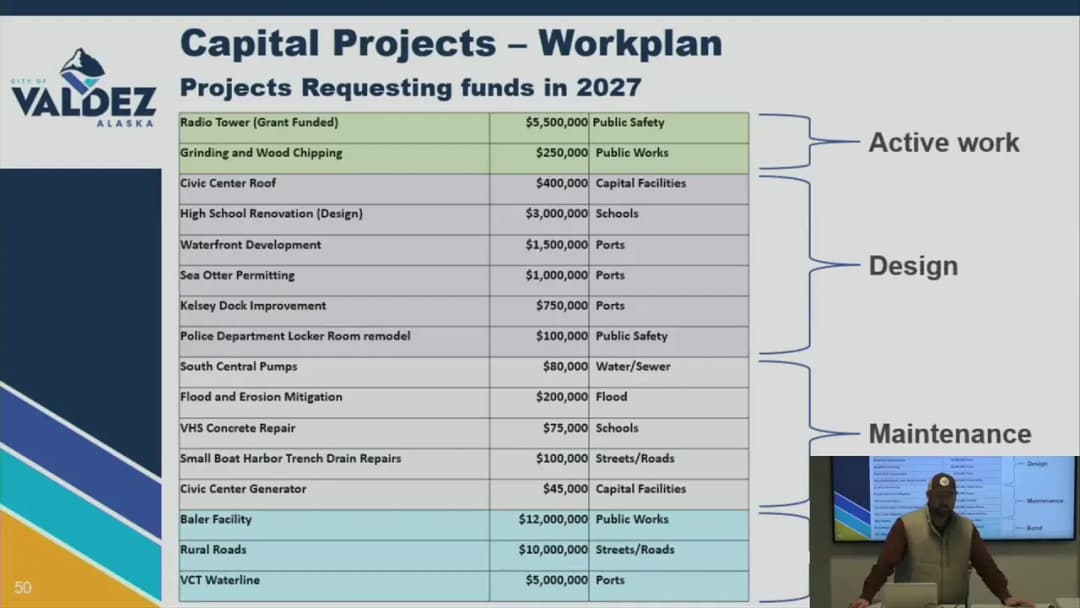
The Valdez City Council held a budget work session on October 15, 2026, focused on the Parks, Recreation & Cultural Services (PRCS) Division, Fire & EMS, and Capital Projects & Major Maintenance for the 2027 fiscal year. Discussions included department budgets, staffing, debt service, bond proposals, and a request from the Valdez Fisheries Development Association (VFDA). The council provided direction on several key items. Discussion Items - Finance Overview: Finance Director Jordan Nelson presented the financial schedule, noting a projected $96.8 million in total revenues for 2027, including $3 million in foregone revenue from expanded tax exemptions. He highlighted the impact of the 20-mil tax levy, which requires $18.1 million in debt service, leaving only $3.4 million in unassigned general revenues for one-time projects. He contrasted this with a potential 19-mil levy, which would reduce debt service to $1.3 million but lose about $4.5 million in total revenue. - Parks & Recreation: City Manager Nate presented the PRCS division budget. Parks Maintenance requested an additional 500 temporary hours for reclaiming the Glacier Campground (after terminating the MWR contract) and for disc golf course upgrades. Recreation proposed restructuring from coordinator to manager positions, adding $15,000 for Fourth of July events, and scaling back low-attendance programs like Friday after-school and middle school evening activities. The Library budget dropped 0.4 FTE but added a temporary position to support youth programming. Civic Center included $23,000 for furniture upgrades and preventive maintenance. Council members expressed concerns about workload without headcount increases; the City Manager acknowledged that new services may require additional personnel. - Fire & EMS: The Fire Department budget reflected the recently approved SAFER grant for three additional contracted full-time personnel. The operating budget increased by $333,000, including $23,000 for uniforms and equipment for the new hires. Overtime is expected to increase due to the new personnel working some overtime, despite a shift from 16.5-hour to 24-hour shifts reducing some overtime. Contractual services of $35,000 cover ambulance billing and Medicare reimbursement. Council asked about training and medical director costs. - VFDA Coho Facility Request: Mike Wells, Executive Director of VFDA, presented a request for a $5 million direct grant from the city to replace the aging Solomon Gulch hatchery coho facility. The project is estimated at $9.9 million, with VFDA committing $1.25 million in pre-construction improvements and seeking a $5 million loan from the state’s Fisheries Enhancement Revolving Loan Program. The new facility would house up to 3 million fish and support the sportfish program, which generates $10 million in annual economic output. Council members expressed full support, citing strong return on investment. - Capital Projects & Major Maintenance: Capital Facilities Director Casey Walker presented the 2027 work plan, including active projects (e.g., radio tower, grinding/wood chipping), design projects (e.g., Civic Center roof, police locker room remodel), and maintenance items. He noted that $40 million worth of work is planned for FY27, including bonded projects. Discussion focused on three bond proposals: Baylor facility, VCT water line, and rural roads phase one (Corbin subdivision). Council also considered a reimbursement bond for Meals Avenue and a waterfront development feasibility study ($1 million placeholder). The City Manager emphasized the need to start the bond process early to meet construction timelines. - Waterfront Development: The City Manager proposed a feasibility study for dry dock and marine services in Valdez, potentially in partnership with a private operator (e.g., Swiss). The study would assess market demand, geotechnical conditions, and suitable locations. Council supported the concept, noting it could benefit the Coast Guard and local fishing fleet. Key Outcomes - Consensus on Bond Proposals: Council expressed support for moving forward with a special election ballot proposition for bonds for the Baylor facility, VCT water line, and rural roads phase one. The reimbursement bond for Meals Avenue was also affirmed as a continuing priority. - VFDA Contribution: Council indicated no objections to including the $5 million VFDA grant in the budget as presented, pending formal approval. - Waterfront Feasibility Study: Council supported including the waterfront development feasibility study in the 2027 capital projects budget, with the understanding the $1 million placeholder is a starting point. - Next Steps: Staff will proceed with the budget as presented. The next budget work session is scheduled for Thursday, October 22, 2026, to discuss public works, major equipment, and IT. The regular council meeting is Tuesday, October 20, 2026.
The Public Meeting Index
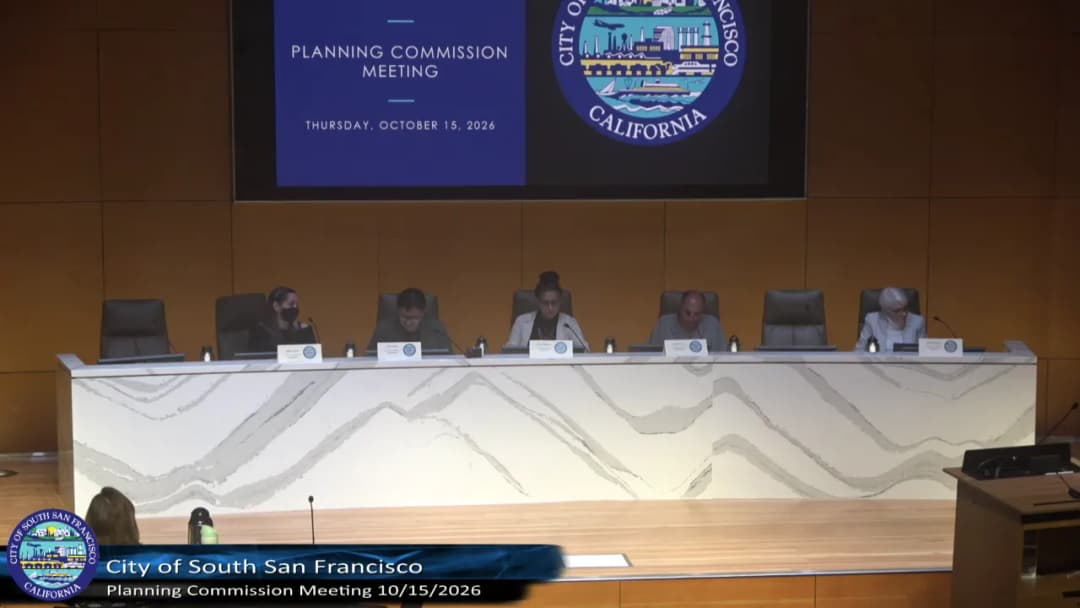
The Public Meeting IndexThe South San Francisco Planning Commission held a regular meeting on October 15, 2026, at 7:00 PM in the Council Chambers at 901 Civic Campus Way. The meeting was called to order with five commissioners present (Chairperson Pamukcu, Commissioners Shahade, Funes, Evans, Zhang) and two absent (Vice Chair Baker and Commissioner Faria). The meeting was brief, with a unanimous consent calendar approval and a continuance of the sole public hearing item. Consent Calendar - Item 1: Approval of minutes from the September 3, 2026 Planning Commission meeting. - Item 2: Master Sign Program for signage at 1400 Huntington Avenue (formerly 410 Noor Avenue), a residential mixed-use development, with a categorical exemption from CEQA. - Item 3: Master Sign Program Amendment to increase a skyline sign (TS8) from 360 to 700 square feet at the Genesis Campus (1-3 Tower Place), with a categorical exemption from CEQA. - Item 4 & 4a: Resolution finding that conveyance of a parcel (unassessed APN) from San Mateo County to the City, near Westborough Boulevard and Camaritas Avenue, conforms to the General Plan. - Action: All consent calendar items were approved unanimously (5-0) on a motion by Commissioner Shahade, seconded by Commissioner Funes, with no public comment. Public Comments & Testimony No members of the public provided comment on any agenda item or non-agenda matter. Discussion Items - Item 5: Zoning Text Amendment to Title 20 to allow separate sale/conveyance of accessory dwelling units per AB 1033, with a categorical exemption from CEQA. - Staff reported that after noticing this item, they determined further consideration was needed and recommended a continuance to a future date uncertain. - The Commission agreed and voted unanimously to continue the item with no public comment or further discussion. Key Outcomes - Consent Calendar: Approved unanimously (5-0). - Item 5 – ADU Sale/Conveyance: Continued to a future date uncertain, as recommended by staff, by a unanimous vote (5-0). - Adjournment: The meeting adjourned with a commissioner wishing the chairperson good luck in upcoming elections.
The Shoreline Planning Commission met on Thursday, October 15, 2026, at 7:00 PM in the Council Chamber at City Hall to discuss proposed updates to the city's tree code. The meeting focused on the second discussion of the tree code update, specifically addressing hazard, nuisance, and emergency tree removal, replanting requirements, and code exemptions. The meeting lasted approximately 2.5 hours and included a public comment period with 32 written comments and 14 in-person speakers. Consent Calendar - Roll call: Commissioners Povick, Cabe, Gedland, Susa, Laura, Vice Chair Mosier, and Chair Brinson were present. - Approval of the agenda and the October 1, 2026 meeting minutes were approved unanimously by acclamation (thumbs up). Public Comments & Testimony - Jack Malik (former planning commissioner) urged the commission to revise the tree code so that requirements are clear, proportionate, and grounded in both canopy data and housing feasibility. He noted a lawsuit where the city lost on counting trees in rights-of-way and argued that same reasoning applies to critical areas. - Siegrid Strom (Shoreline resident) stated that the overwhelming majority of residents value trees and that trees are integral to addressing climate change. She emphasized that a 50-year-old tree takes 50 years to replace. - Jean Link (Innis Arden) noted that many lots in Innis Arden have 80% critical area and asked for consideration of lots with extensive critical areas. - France Giddings (Shoreline resident) described herself as a "tree hugger" and asked the commission to think long-term, citing examples of urban cooling from trees in Nanjing, China. - Sarah Kennedy (Innis Arden Club board member) advocated for two changes: (1) trees in critical areas should count toward a property's minimum tree credits, and (2) an explicit exemption from replanting where recorded view covenants would conflict. She noted that Innis Arden has 84% of properties with mapped critical areas and 45% tree canopy coverage. - Robert Allen (Innis Arden) said residents maintain trees because they enhance property enjoyment and asked for a responsible, affordable, and practical tree policy. - John Husagan (retired tree care company owner, consulting arborist) urged that the term "hazard tree" be stricken in favor of "risk assessment," and supported counting trees in critical areas toward tree credits. - Sarah Kennedy (personal capacity) expressed concern that the draft tree code appears disconnected from the city's 2023 Urban Forest Strategic Plan and asked for a formal alignment process to ensure equitable canopy distribution. - Bonnie Beerie (Shoreline) noted the loss of trees from road expansions, light rail, and infill housing, and asked that every tree lost be replaced, suggesting rooftop plantings for multi-unit buildings. - Soren Suver (Shoreline) questioned the commission's sincerity in taking comments and warned that not counting critical area trees could reduce property values in high-revenue areas like Innis Arden. - Susan S (long-term Shoreline resident) asked that every tree lost be replaced to preserve the city's "Sylvan Beauty." - Lance Young (Shoreline Preservation Society, Tree Pack) urged the commission to keep the city's responsibility to the planet in mind and requested that every significant tree removed be replaced. - Kathleen Russell (Safe Shoreline Trees) requested that hazard and nuisance tree removals require replacement trees or fee-in-lieu, and that the city establish a program to sell replacement trees at wholesale cost to property owners. Discussion Items - Tree Code Update 2 – Hazard, Nuisance, and Emergency Trees: Senior Planner Sierra Carson and consultant Kim Frappier (Facet) presented the draft code's definitions and proposed regulations. Emergency trees (imminent danger) would remain exempt from permits and replacement. Hazard trees (high or extreme risk with defect and target) would require a TRAQ (Tree Risk Assessment Qualification) report from a certified arborist. Nuisance trees (causing physical damage to structures or hardscape) would require documentation—either clear photos or a professional report—but not necessarily from an arborist. - Commissioner Feedback on Hazard/Nuisance Trees: Commissioners expressed confusion about the distinction between emergency and hazard trees, concern about the cost of TRAQ reports (estimated $500–$1,000), and worry that requiring professional assessments for every scary tree would burden low-income homeowners. They suggested allowing alternative professional opinions (e.g., from plumbers or engineers) for nuisance trees and exploring fee waivers or subsidized assessments. They also discussed the need for clear, plain-language guidance for residents. - Replanting Requirements: Staff proposed that replacement trees be required only when the removed tree is the last tree on the property. Commissioners were divided, with some arguing that replacement should be required in all cases to preserve canopy, and others citing cost burdens and lack of space on small lots. They asked for a side-by-side cost comparison of all scenarios, including replacement tree costs. - Code Exemptions: Staff introduced new exemptions for hedges (defined as maintained shrubs not allowed to arborize), city-owned parks and facilities (still subject to public tree code and critical areas regulations), master plan developments and vegetation management plans, and trees in critical areas (regulated solely under critical areas code). Commissioners requested more information on how hedges are defined (with photos), how the city's public tree code aligns with canopy goals, and how vegetation management plans work. - Citywide Canopy Coordination: Several commissioners asked for a briefing from the city arborist and other departments (Parks, Public Works) on how all tree-related policies—private tree code, public tree code, urban forest strategic plan, PROSA plan—work together to achieve the city's 40% canopy goal. They noted that regulating private property owners without consistent city standards felt uneven. Key Outcomes - No formal votes were taken; the discussion was for direction to staff. - Staff will bring back at the November meeting (or a later date) additional information on: elective tree removal pathways, a comprehensive cost matrix for all removal scenarios (including arborist reports and replacement trees), and clearer definitions (including photos) for hedges and hedgerows. - Staff will coordinate a briefing from the city arborist and other departments on the citywide tree canopy strategy, to be scheduled on a non-discussion night. - The November 5, 2026 regular meeting was considered canceled by consensus (no formal vote, but Chair Brinson stated the meeting would be canceled).
This summary is derived solely from the posted agenda, as no minutes or transcript were provided. A discrepancy exists: the agenda lists the meeting date as Wednesday, October 14, 2026 at 7:00 PM, but the summary was instructed to use October 15, 2026. The meeting was a regular session of the Dublin Youth Advisory Committee held at the Dublin Senior Center. Consent Calendar - Approval of September 9, 2026 Minutes: The committee considered approving the minutes from the previous regular meeting. The staff recommendation was to approve. No further details are available. Public Comments & Testimony - The agenda included a period for public comment on non-agendized items, limited to three minutes per speaker. No specific comments are recorded. New Business - 2026-27 Youth Mini-Grant Presentations and Funding Recommendations: The committee heard presentations from Youth Mini‑Grant applicants, reviewed proposals, and was asked to rate applications and provide a funding recommendation. Staff recommended receiving the presentations, reviewing proposals, and making a recommendation. Attachments included the mini‑grant applications and a rating form. Staff and Committee Member Reports - Brief information‑only reports were scheduled from committee members and staff, including committee reports and reports on meetings attended at city expense (AB1234). Key Outcomes - The only actionable item on the agenda was the consideration and recommendation of Youth Mini‑Grant funding. No vote tallies or final decisions are available from the agenda alone. Note: The agenda indicates the meeting was scheduled for October 14, 2026. The user‑provided date of October 15, 2026 is used here per instructions, but the original agenda date is October 14.
On October 15, 2026, the Prince George's County Child Care Provider Work Group met virtually to review draft, action-oriented recommendations on child care access, affordability, and quality. Staff presented state legislative updates and eight recommendations, and work group members offered feedback and clarifications. No formal vote was taken; the recommendations remain draft. No written agenda or minutes were available; this summary is based on the transcript. Note: the transcript's adjournment motion says October 14th, 2:46 p.m., which conflicts with the supplied meeting date of October 15, 2026; this summary uses the supplied date. Discussion Items State legislative updates - Caleb, a work group staff member, explained HB 1321's co-payment provisions: households at or below the federal poverty line would not be required to pay co-payments, while higher co-payments from households above the poverty line would help cover more families below that line. MSDE (Maryland State Department of Education) estimated this change would serve an additional 1,000 children per year. - HB 0447, passed in Maryland's 2025 legislative session, requires analysis of Maryland's child care center framework, including staff requirements, facility standards, and operational regulations, compared with other states, to identify common barriers for providers. - HB 1321 also requires MSDE to report on the child care scholarship program's co-payment system. Draft recommendations presented Dr. Parakin presented eight draft recommendations: 1. Strengthen funding adequacy and administration of the Child Care Scholarship Program. The state already produces monthly and quarterly reports, but the work group recommends clearer projections of unmet need, waitlists, and funding shortfalls, plus transparent communication about payment corrections, disputes, and case resolution timelines. 2. Match child care investments to actual family demand by improving coordination and reporting of available spaces by age, geography, provider type, and scholarship participation, rather than relying only on licensed capacity. 3. Expand mixed-delivery pre-K while protecting infant and toddler capacity. This includes hands-on support for private centers and family providers in low-participation jurisdictions; building on the state's pre-K expansion report to track the provider pipeline; and state incentives such as enhanced reimbursement, stabilization funding, or per-slot support to help providers maintain or expand infant/toddler care. 4. Expand before- and aftercare access for pre-K students by reviewing mixed-age staffing and group size requirements that limit how many 3- and 4-year-olds programs can serve, while preserving supervision and health/safety requirements. 5. Strengthen the child care workforce by expanding paid, work-based credential pathways, tuition assistance, and wage support, especially for infant and toddler educators. 6. Strengthen state-local child care navigation and accountability through a clear state-local referral and escalation process and a provider-facing roadmap of required approvals, contacts, and steps. 7. Streamline county zoning, permitting, and facility requirements. The recommendation includes an alternative pathway meeting equivalent fire and safety requirements, particularly for child care homes expanding from 8 to 12 children where sprinkler installation costs are a barrier, plus coordinated permitting through the Department of Permitting, Inspections and Enforcement (DPIE), and monitoring of recent county zoning and parking reforms. 8. Implement and expand use of public facilities for child care by inventorying suitable county-owned properties, making eligibility, leasing, and licensing information transparent, and standardizing agreements for insurance, maintenance, and other responsibilities. Work Group Feedback and Clarifications - Ms. Ladonia Gomez said the recommendations sounded good and suggested using grants or contracts for infant/toddler slots, similar to Head Start, to provide more continuous funding for specific slots or types of children. - Keisha, from the state's Office of Early Childhood, said grant/contract slot funding had been used prior to COVID and that the office is open to suggestions depending on funding. She clarified that a family child care provider with a total maximum capacity of eight may serve three or four infants if an additional adult is present, and large family child care can have a maximum capacity of nine children under age two, though zoning restrictions sometimes limit this. - A member, Dr. Circe, cautioned that mixed-age grouping can reduce maximum group sizes; keeping 3- and 4-year-olds in their same classroom for before- and aftercare may preserve capacity. Safety concerns also arise when before/aftercare uses open gym areas, and parents may be concerned about mixing younger children with older children. - Dr. Circe raised a permitting question about vendor-operated child care in Prince George's County Public Schools buildings, asking whether school system documents could be reused by vendors. Keisha responded that fire officials often take the lead and that licensing serves as a second accountability check because issues such as missing inspections or staff clearances have been found in school settings. Next Steps and Key Outcomes - No formal vote was taken; the recommendations are still draft but are moving toward final form. - Work group members were asked to email additional examples of permitting or review processes that could be simplified and to submit quotes for the final report. - The next work group meeting will be held virtually on Wednesday, October 28, at 2 p.m., focused on defining and improving permitting and county review processes. - The draft recommendations will be presented to the County Council's EWD committee on Monday, October 19, at 1:30 p.m. - A motion to adjourn was made and seconded, and the meeting was adjourned.
The South San Francisco Planning Commission held a regular meeting on October 15, 2026 at 7:00 PM in the Library Parks & Recreation Building Council Chambers. Chairperson Aysha Pamukcu presided. Commissioners present: Michele Evans, Sarah Funes, Sam Shihadeh, Alex Zhang; Vice Chair John Baker and Commissioner Norman Faria were absent. The meeting was called to order, roll call taken, and Pledge of Allegiance recited. No agenda changes, staff announcements, or public comments on non-agenda items were made. No ex-parte communications were disclosed. Consent Calendar The commission approved the consent calendar unanimously (5-0) with a single motion. The consent calendar included: - Approval of minutes from the September 3, 2026 Planning Commission meeting. - Master Sign Program for a residential mixed-use development at 1400 Huntington Avenue (formerly 410 Noor Avenue), with a categorical CEQA exemption. - Master Sign Program amendment to increase one previously approved skyline sign (TS8) from 360 to 700 square feet at the Genesis Campus (1-3 Tower Place), with a CEQA exemption. - Resolution regarding the conveyance of a county parcel (near Westborough Boulevard and Camaritas Avenue) to the City, finding it consistent with the General Plan. Public Comments & Testimony No members of the public provided comment on the consent calendar or on Agenda Item 5. Discussion Items - Item 5: Zoning Text Amendment for Separate Sale of Accessory Dwelling Units (AB 1033). Staff presented the item and recommended that the commission continue it to a future date uncertain, stating that further consideration was needed. The commission unanimously approved a motion to continue the item. Key Outcomes - The consent calendar was approved 5-0. - Item 5 was continued to a future date uncertain by a 5-0 vote. - The meeting adjourned without further business; commissioners briefly wished the chairperson good luck in upcoming elections.
On October 15, 2026, the Boston City Council Government Operations Committee held a hearing on Docket 0807, an ordinance to address private way potholes. The matter was sponsored by Councillors Brian Warrell and Aaron Murphy and referred to the committee on April 15, 2026. Superintendent of Street Operations Daniel Knee testified for the city, and the committee heard public testimony, including two prerecorded videos. No vote was taken; the hearing was adjourned with follow-up requests and an anticipated working session. Discussion Items - Lead sponsor Councillor Warrell said the ordinance is intended to add the word asphalt to the city code’s temporary-repair authority for private ways and to make the city fill private-way potholes automatically, instead of closing 311 cases after deciding whether a public-safety repair is warranted. He noted that many residents buy on private ways without understanding that they are responsible for resurfacing, sidewalks, and underground utilities, and costs can reach six figures. - Superintendent Knee said private ways are private property and state law prohibits using public funds on private property. In practice, Public Works performs temporary repairs when emergency vehicle access, trash collection, or public safety requires it, using materials that match the existing surface: asphalt on asphalt ways, gravel or millings on gravel ways. He said potholes recur because water, runoff, and lack of catch basins are the underlying problem, and full resurfacing or reconstruction is the better long-term fix. - Knee described the city’s betterment/PIC process for converting a private way to a public way: more than 50 percent of homeowners must petition and vote, engineering surveys and a public meeting follow, and the street must be brought to city specifications, including accessible sidewalks and 53 feet of width. Only four streets had completed that process in the past 15 years; some residents voted conversion down, such as Sharon Street. - Councillors asked about the cost of city takeover of all private ways. Knee estimated hundreds of millions, or multiple hundreds of millions, of dollars plus significant staffing, and said engineering is already understaffed. Councillor Fitzgerald called it an extremely expensive undertaking. - Councillor Weber noted that paving a gravel private way can change drainage and push water into basements. Knee said asphalt is not appropriate on gravel surfaces because gravel moves with saturation and freezing; he also described Grove residents’ resistance to city work and an EPA complaint about millings that was not sustained because millings are an accepted roadway material. - Councillor Flynn asked about the 311 pothole process. Knee said cases come in as pothole even though the department internally treats them as roadway defects; cases on private ways are often closed with an abutters-are-responsible notice, but supervisors may still patch if a fire truck or ambulance needs access. The city does not bill residents for those public-safety pothole repairs. - The committee discussed ADA and legal implications: permanent resurfacing by the city would trigger ADA accessibility and full city-spec requirements, while private abutters resurfacing their own private way would not trigger those obligations but would receive no city cost share. A state-law threshold of up to 25 percent was mentioned, and the committee noted the metric was unclear. - The chair asked for follow-up data on average asphalt patch lifespan and citywide cost to fill currently unfilled private-way pothole complaints. Knee said asphalt is durable for 20 to 30 years absent underlying water or utility problems, but the pothole material is a finer tennis court top mix, not roadway asphalt. He agreed to try to produce cost information, cautioning about data accuracy. Public Comments & Testimony - Doug Woodhouse, a Roslindale private-way resident, supported the proposal. He described severe potholes, dangerous winter ice, postal service interruptions, risks to elderly residents and children using BPS door-to-door bus service, and repeated tire damage. He said his neighbors likely cannot afford to maintain the road themselves. - Feen Balomilee, a Dorchester private-way resident speaking by prerecorded video, supported the ordinance as a step in the right direction, while stating the city should ultimately resurface and completely replace private ways in disrepair. She cited safety, standing water, and vehicle damage concerns and said residents are taxpayers who use their streets alongside nonresidents. - Nancy Allio, a Stella Road resident since 1988, supported Docket 0807 but said it is only the start. She argued that private ways are heavily trafficked by the public, developers historically shifted costs onto homeowners, and current residents should not pay twice through taxes and private repairs. She proposed creative financing, such as a dedicated tax fund, and changes to outdated laws. - Rick, co-leader of the Mount Hope Canterbury Neighborhood Association, supported the ordinance as a step forward. He said the neighborhood has 10 private roads totaling 4,500 feet, only two of which are dead ends. He asked whether the city could repave such roads and build asphalt curbs to manage runoff without installing sidewalks, and whether that could avoid state-law problems. - Shirley, a Union Avenue private-way resident in Jamaica Plain for 33 years, raised broader private-way service gaps: police response, illegal dumping, towing disputes, and pedestrian safety near English High. She recommended assessing and prioritizing the worst private ways and exploring creative hard-pack surface alternatives beyond asphalt. She said potholes were not her biggest issue. - Chris Arena, a Grove homeowner for six years, supported a collaborative middle-ground solution. He described an ambulance having difficulty reaching a resident due to deep potholes on Linden Road, mail delivery problems, and a dead tree in the roadway that neighbors had to handle. He said the PIC process requiring 50 percent participation is hard in the Grove and urged solutions that activate willing neighbors. Key Outcomes - No motion or vote was taken; the hearing was adjourned. - Superintendent Knee was asked to provide a follow-up estimate for filling currently unfilled private-way pothole complaints, annual maintenance costs, and a ballpark citywide reconstruction figure based on private-way mileage. - Lead sponsor Warrell said he would pursue a working session, consider amendments and creative options, and explore whether state law allows defining temporary fix more broadly, including potential resurfacing or a separate PIC track. - The committee also agreed to take up legal questions raised in testimony, including the possibility of city repaving with runoff curbs but without sidewalks.
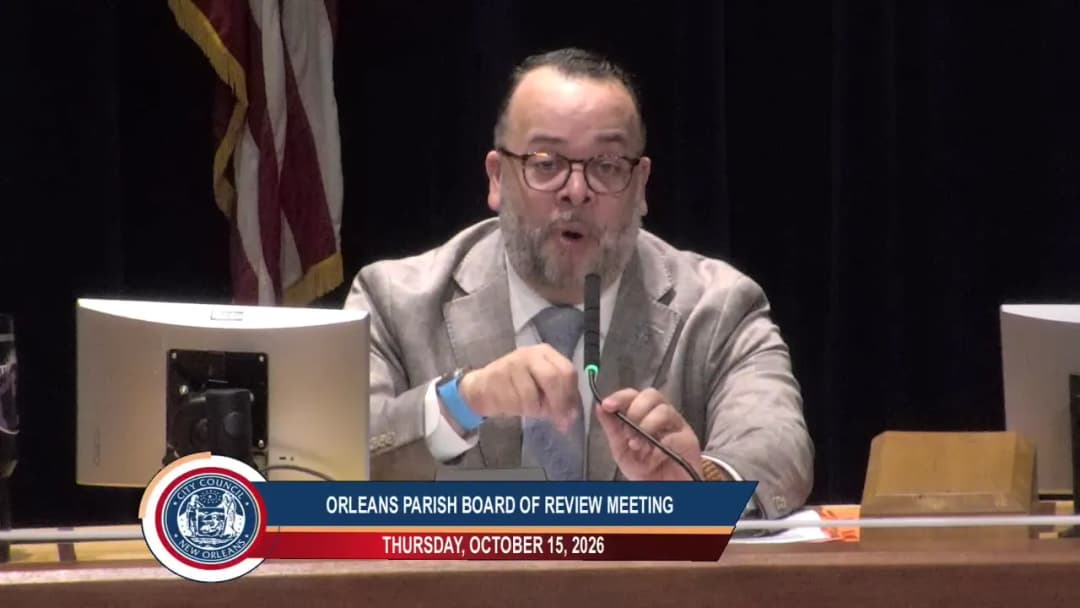
On Thursday, October 15, 2026, the Orleans Parish Board of Review met in Council Chambers to receive Hammerman & Gainer, LLC's recommendations on 2027 tax appeals, hear public testimony, and act on resolutions disposing of appeals and certifying adjusted assessments to the Louisiana Tax Commission. All seven members were present: JP Morrell, Matthew Willard, Aimee McCarron, Jason Hughes, Lesli D. Harris, Freddie King III, and Eugene J. Green Jr. The board voted 7-0 on all motions before it. Note: The posted agenda listed the meeting start time as 8:45 a.m., while the minutes list 9:00 a.m. The agenda and minutes also refer to "HDI's report," but the presentation and transcript identify the firm as Hammerman & Gainer, LLC (HGI). Public Comments & Testimony - Tiffany Pounds, representing Housing NOLA, expressed support for immediate action to address inequitable property tax assessments affecting seniors and homeowners with disabilities. She urged four actions: correct the assessments of over 2,700 seniors and homeowners with disabilities who were overcharged for the 2027 tax year; direct the assessor's office to treat the special assessment freeze as a ceiling, not a floor; establish a special extended appeals process for affected homeowners; and pursue a permanent legislative solution. - The council's attorney, Mr. McNell, responded that the appeals process is established by state law (La. R.S. 47:1992), that the City Council has no authority to amend state-law deadlines, and that the appeal deadline had expired on August 20, 2026. Councilmember Willard said the council could have granted relief if affected homeowners had filed timely appeals, but that the council cannot file appeals for taxpayers or grant retroactive refunds. - Morgan Clevinger, a resident, said she was dismissed in under two minutes during the review process, expressed concern for seniors and storm-damaged homeowners, and urged the council to fix the process. Councilmembers responded that the board's role is appellate and that process changes would require action by state legislators. Discussion Items - Lou Resweber, CEO of Hammerman & Gainer, LLC (HGI), presented the 2027 tax appeal recommendation process. HGI is a 98-year-old, locally owned, minority-owned firm that has performed third-party property tax appeal services for 14 years. - HGI reported reviewing 531 files this year, compared with 760 in 2026, 608 in 2023, and 6,227 in the prior quadrennial year. HGI hearing officers agreed with the assessor's office on 238 of the 531 cases, or about 44.5%. - HGI representatives addressed Assessor Williams' letter dated October 8, 2026, questioning 41 unique properties. HGI said it first learned of the letter from the Times-Picayune, had reached out to the assessor for a meeting, and was prepared to sit down with the assessor's office. One property representing about 25% of the differential involved a procedural error where the owner was not notified of an assessment change within 30 days of the open rolls period. - Councilmember Willard asked how a property could receive more than one reduction during a four-year reappraisal period. HGI cited changed property character, renovations, new information, and properties like the old Mercy Hospital/Lindy Boggs Center slated for demolition. - Councilmember King asked about a potential conflict raised in the assessor's letter. HGI responded that the individual referenced had previously worked for the assessor's office and the Louisiana Tax Commission, was highly qualified, and did not hear any properties with which she was affiliated. HGI said the assessor's staff was present at the hearings. - Councilmember Hughes questioned HGI's recommendation to grant appeals for some apartment complexes based on vacancies. HGI explained that for multifamily commercial properties, the income approach, including net operating income and vacancy rates, is a standard valuation method. Hughes asked whether landlords were under oath; HGI said it took submitted information at face value, which Hughes said gave him little comfort. - Councilmember McCarron moved to amend HGI's report to change the recommendations to "no change" for the 41 unique properties identified in Assessor Williams' October 8, 2026 letter. Councilmember Willard seconded the motion. Resolutions - R-26-1: Disposition of appeals in the First through Seventh Municipal Districts. Moved by Eugene J. Green Jr., seconded by Aimee McCarron. Passed 7-0. - R-26-2: Certification of Assessments for the First through Seventh Municipal Districts, as adjusted by the Board of Review, to be certified to the Louisiana Tax Commission. Moved by Aimee McCarron, seconded by Eugene J. Green Jr. Passed 7-0. Key Outcomes - The board voted 7-0 to amend HGI's report to recommend "no change" for the 41 disputed properties, without penalizing property owners who had already received relief through the appeals process. - The board approved R-26-1 and R-26-2, both by 7-0 votes. - Councilmembers urged enhanced communication between HGI and the assessor's office, and noted that the 2027 appeals window will be July 15 through August 17, 2027, with online appeals available. - HGI representatives noted that not all 41 properties on the assessor's disputed list involved the potential conflict, and that several residential properties were also included. - Unresolved properties may still pursue an appeal to the Louisiana Tax Commission. - The board adjourned by a 7-0 vote on a motion by Jason Hughes, seconded by Eugene J. Green Jr. The minutes record the adjournment action as "Reconsider," which appears to be a typographical error based on the transcript.
The city council held its regular meeting on October 15, 2026, with nine members present. The agenda included routine approvals, a proclamation for World Polio Day, swearing-in of two new firefighters, and several discussion and action items. Key decisions included advancing an IT ordinance to third consideration, approving a contract for occupational health services, and passing an amended resolution on homelessness and affordable housing that earmarks up to $1 million for regional efforts pending future council approval. Consent Calendar - Approved three sets of minutes: September 23, 2026; September 30, 2026 (special); and October 7, 2026 (special). - Approved the Committee of the Whole report for October 7, 2026. - The city administrator provided updates on fire department open houses, a PFM presentation on state budget impacts, and the citizen survey closing period. - The council unanimously approved the consent agenda as a whole (9-0). Public Comments & Testimony - IT Ordinance (Chapter 2.16): Jeff Collins, library director, speaking on behalf of the library board president, requested that the ordinance be revised to expressly exempt the library from city IT management and control, citing statutory authority in Davenport City Code Chapter 2.72 and Iowa Code Chapter 392.5. Latrice Lacey, civil rights director, echoed the request for an exemption for the Civil Rights Commission, citing Code section 2.58 and Iowa Code 216.19. - Homelessness Resolution: - Lane Pamper (ward unspecified) expressed support for addressing homelessness but raised concerns about Davenport funding a regional effort that could benefit other cities without their contribution, asking for more detail and further research. - Kelly Thompson (Rock Island, representing Quad Cities Community Foundation) spoke in favor of the resolution, explaining the plan’s inclusive steering committee, data integration goals, and ability to geographically restrict funding to Davenport if needed. - Paul Hardesty (ward unspecified) supported the concept of shelters but emphasized that stigma and safety are real issues, citing experiences in Dallas and urging attention to security for shelter residents. - General Public Comment: Paul Hardesty also spoke about increased tornado risk as the region becomes part of the new “Tornado Alley,” urging the city to prepare shelters and note existing advantages like basements. He shared a historical artifact from 1861. Discussion Items - Second Consideration – IT Ordinance (Chapter 2.16): Following public comments, council members Newton and Lenin requested time to review concerns raised by the library and civil rights commission. The city attorney agreed to provide a memo addressing the legal issues before third consideration. The council voted unanimously (9-0) to advance the ordinance to third reading. - Resolution – Occupational Health Services Contract: Resolution awarding a three-year contract (with two one-year renewal options) to Concentra Health Services of Addison, Texas. Alderman Newton abstained, citing discomfort with the item. The resolution passed 8-0-1. - Resolution – Homelessness and Affordable Housing: Alderman Holloway introduced a substitute amendment to clarify that the city earmarks up to $1 million for homelessness prevention and regional strategy implementation, with funds remaining in city control and requiring council approval for disbursement. The amendment was seconded and passed unanimously (9-0). The substituted resolution then passed unanimously (9-0). Key Outcomes - The IT ordinance (Chapter 2.16 amendment) advanced to third consideration; legal memo on library and civil rights commission exemptions to be provided. - The occupational health contract with Concentra was approved (8-0-1, Newton abstaining). - The homelessness resolution was adopted as amended, earmarking up to $1 million for regional collaboration on homelessness and affordable housing, subject to council approval of specific projects. - The council suspended rules to consider and unanimously approved two additional items: - Street closure for the Iowa High School Music Association State Marching Band Festival on October 17, 2026 (5 a.m. to 5 p.m., East 36th Street between Brady Street and Davenport Avenue). - Designation of East 12th Street between Harrison Street and Brady Street as “Roger Craig Way” in honor of Davenport Central High School graduate Roger Craig. - The council voted to enter executive session for litigation strategy and personnel evaluation (9-0). Proclamation & Ceremonial Items - World Polio Day Proclamation: Alderman Burkholder read a proclamation declaring October 24, 2026 as World Polio Day in Davenport. A Rotary representative accepted the proclamation and highlighted global progress, with only 30 wild polio cases reported in the prior year. - New Firefighter Oath: Two new firefighters, James Ali and Kyle Boomen, were sworn in after completing the DFD Fire Academy. Chief noted their assignments to Engine 2 (downtown) and Engine 7 (northwest side), respectively.
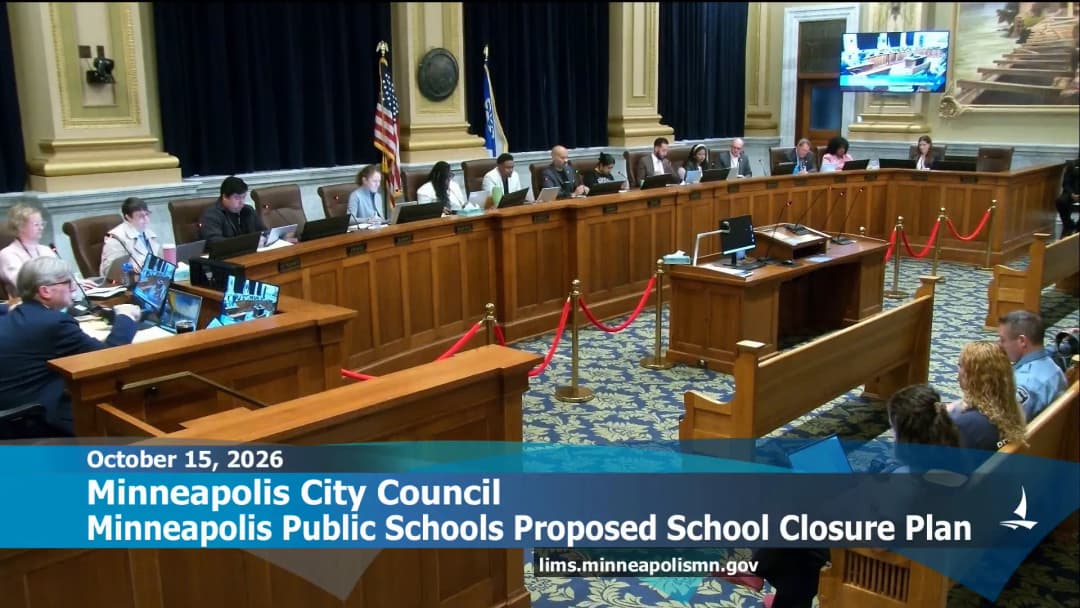
The Minneapolis City Council met on October 15, 2026, at 2:36 PM for a regular meeting. The session included a breast cancer awareness month resolution, reconsideration of the mayor's veto of autonomous vehicle regulations, reports from standing committees with multiple approvals and debates, and a detailed discussion on the behavioral crisis response contract. The meeting was adjourned for a brief recess to address procedural matters. Consent Calendar - Agenda Adoption: Approved unanimously (12 ayes). - Minutes Acceptance: Approved unanimously (12 ayes) for the October 1, 2026 regular meeting. - Referral of Petitions, Communications, and Reports: Approved unanimously (12 ayes). - Business Housing and Zoning Committee Report: Approved items 1-9 and 11-12 unanimously, except item 10 (Los Andes Latino Bistro) which was pulled for separate vote (see below). - Climate and Infrastructure Committee Report: Approved items 1-11 unanimously; item 12 (Hennepin County waste disposal contract) approved unanimously after discussion. - Committee of the Whole Report: Item 3 (gift acceptance for police chief conferences) approved unanimously. Items 1 and 2 pulled for separate votes (see below). - Enterprise and Labor Relations Committee Report: All nine items approved unanimously. - Public Health, Safety, and Equity (PHSE) Committee Report: Items 1, 11-20, and 26 approved unanimously as a consent block (12 ayes). Items 2-10 and 21-25 were pulled for separate votes (see Discussion Items). Discussion Items - Autonomous Vehicle Regulations Veto Override: The council considered overriding the mayor's veto of Ordinance 2026-034 (regulating autonomous vehicles for commercial purposes). The override required 9 votes but received only 7 ayes (Chowdhury, Stevenson, Chavez, Wandsley, Shugtai, Osman, Payne) vs 5 nays (Rainville, Vita, Palmisano, Schaefer, Whiting). The veto was sustained, and the ordinance was not adopted. Councilmember Wandsley announced plans to continue working on regulations. - Los Andes Latino Bistro Settlement (Item BHZ-10): Councilmember Shugtai moved to deny the settlement agreement due to sexual assault convictions at the business. The motion passed unanimously (12 ayes), sending the matter to an administrative law judge for a contested case hearing. - Committee of the Whole Item 1 – MPS School Closure Resolution: Councilmember Vita moved to withdraw the resolution after the Minneapolis School Board committed to no school closures for 2027-2028. Withdrawn unanimously (12 ayes). - Committee of the Whole Item 2 – Subpoena Authority Legal Analysis: Councilmember Payne moved to request a legal opinion from the city attorney on subpoena authority. Passed 9-3 (Rainville, Vita, Schaefer voted no). - PHSE Items 2-10 – Health Department Master Contracts: Councilmember Schaefer moved to refer these 80 contracts (totaling over $15 million) to the Committee of the Whole for further review. After debate and an amendment to postpone to the next council cycle (failed 4-8), the motion to refer to Cow failed unanimously (12 nays). The items were then approved unanimously (12 ayes). - PHSE Item 21 – Mariah Samuels After-Action Review: Resolution requesting the city auditor to conduct an independent review of the city's response to domestic violence calls related to Mariah Samuels. Approved unanimously (12 ayes). - PHSE Item 22 – Community Bridges Mobile Crisis Response (MCR) Contract: Extended debate. The motion to deny the contract was carried 7-5 (Chowdhury, Stevenson, Chavez, Wandsley, Shugtai, Osman, Payne ayes; Rainville, Vita, Palmisano, Schaefer, Whiting nays). Subsequently, Councilmember Wandsley moved to waive procurement rules to allow an interim contract extension with the current vendor (Canopy Roots) for up to 18 months to ensure service continuity while exploring future options. Debate was ongoing when the transcript ended; no vote recorded. - PHSE Item 23 – MPD Off-Duty Work Audit Legislative Directive: Approved unanimously (11 ayes; Rainville absent). - PHSE Items 24 & 25 – MPD Fleet Management and Overtime Audits: Both approved unanimously (11 ayes). Key Outcomes - Autonomous Vehicle Veto Sustained: The council failed to override the mayor's veto (7-5), so no new regulations are adopted. Council will explore alternative approaches. - Los Andes Settlement Denied: Matter returned to administrative law judge for a contested case hearing on licensing action. - MPS School Closure Resolution Withdrawn: School board committed to no closures for 2027-2028, so council action was moot. - Subpoena Authority Study Approved: City attorney to analyze whether the council can compel administration testimony and documents. - Health Contracts Approved: Despite fiscal concerns, all master contracts for health department services were approved unanimously. - Mariah Samuels Review Ordered: Independent after-action review of domestic violence response by the city auditor. - MCR Contract Denied: The council rejected the Community Bridges contract (7-5). A motion to waive procurement rules for a potential interim extension was pending as the meeting recessed. - MPD Oversight Measures Advanced: Legislative directives on off-duty work and fleet management, and a request for an audit of overtime spending, were all approved.