The Davenport City Council held a special meeting on October 15, 2026, to correct the procedural process for appointing Robert "Bob" Ingram to the vacant second ward city council seat. The council voted unanimously to approve the appointment after a brief explanation from the mayor regarding the need for transparency. Key Outcomes - The council approved Resolution [number not provided] by a vote of 8-0, formally appointing Robert "Bob" Ingram to fill the vacancy in the second ward city council seat. All eight aldermen present (Burkholder, Job Jen, Grip, Dunn, Vasquez, Newton, Holloway, and Lenin) voted in favor. - The meeting adjourned at approximately 5:30 PM, with the council set to reconvene at the bottom of the hour. Note: The transcript indicates the meeting was held on October 14, 2026, but the provided meeting date is October 15, 2026. Per instructions, the supplied date is used. No agenda or minutes were provided.
The Public Meeting Index
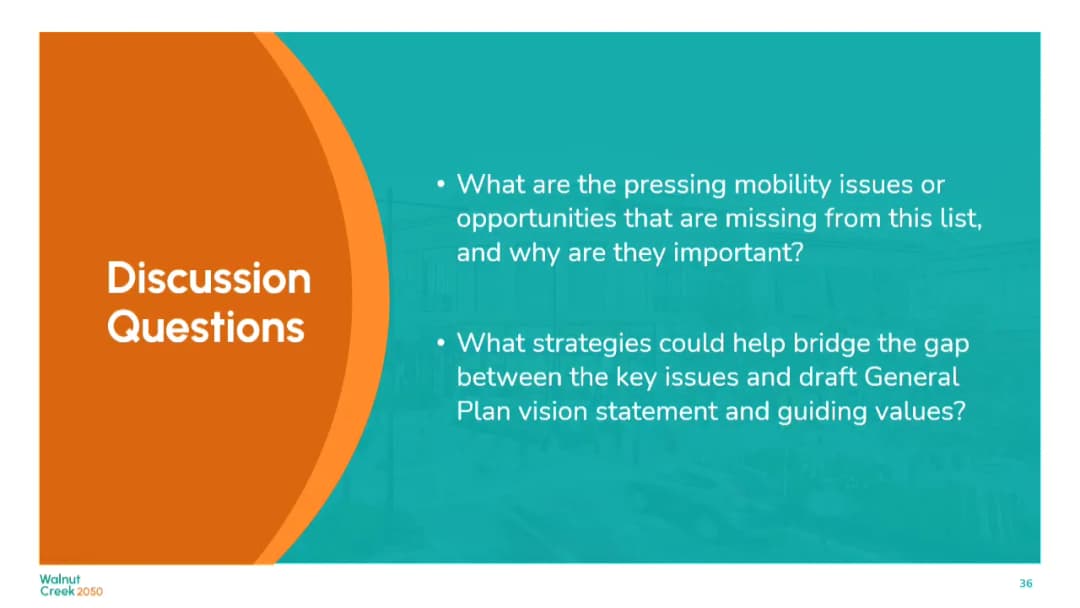
The Public Meeting IndexThe Walnut Creek Transportation Commission held a special meeting on Thursday, October 15, 2026, from 6:00 to 6:59 p.m. in the Council Chamber at City Hall, 1666 N. Main Street, Walnut Creek. The Transportation Commission is an advisory body to the City Council. The meeting was a study session on the 2050 General Plan Update, covering the Mobility Existing Conditions Report, the draft General Plan vision and guiding values, and community feedback received to date. It was for discussion only; no formal action or recommendation was requested or taken. Roll call showed Chair Charles Kreling, Vice Chair Laura Patch, Commissioners Edward Guerrero and Ryan McMahon, and Student Commissioner Adam Zelin present; Commissioner Jared Asch was absent. Chair Kreling left at 6:51 p.m. Note: The agenda packet lists a different commission membership (Kevin Wilk, Chris Hansel, Danny Milks, Thomas O'Toole, Melissa Ward) than the minutes/transcript roll call (Charles Kreling, Laura Patch, Jared Asch, Edward Guerrero, Ryan McMahon, Adam Zelin). The raw transcript opening says "October 13th, 2026" while the agenda and minutes state October 15, 2026. Consent Calendar - None. Public Comments & Testimony - Because this was a special meeting, public comments were limited to agenda items and were received during the Commission's consideration of the item. - Michael Vecchio commented that many mobility report themes—such as improving multimodal connectivity, creating low-stress bike connections, and addressing limited east-west bicycle facilities—were also in the 2025 General Plan adopted about 15 years earlier. He suggested extending the 16-foot multi-use path on the north side of Ygnacio Valley Road east of California to the Einharst Trail, and noted that a five-story building at the southwest corner of Ygnacio Valley Road and Civic could connect to the Iron Horse Trail and BART by crossing Ygnacio Valley Road. A written public comment was also received, provided to the Commission, and posted online as part of the meeting record. Discussion Items - Staff and consultants presented the update process and existing conditions. Erika Vandenbrande, Community Development Department Director, introduced the item; Eric Kirkevich, Principal at Alta Planning and Design, presented the draft vision and guiding values; and Sara Chan of Fehr & Peers reviewed the Mobility Existing Conditions Report. - The previous General Plan 2025 was adopted in 2006 with an emphasis on keeping traffic moving efficiently while expanding walk, bike, and transit networks. - The draft guiding value on mobility calls for a safe, connected, and accessible mobility network supporting convenient and comfortable travel for all users, including walking, biking, rolling, transit, shared mobility, and driving. - Demographics: Walnut Creek had about 71,000 residents in 2025, a 4% increase since 2015, and about 33,000 households, a 7% increase; household size is declining. The population of 25- to 34-year-olds grew 31% from 2015 to 2024, while youth declined and older adults increased. The city is becoming more diverse by race and ethnicity; in 2015 about 14% of residents identified as Asian or Pacific Islander. - Mobility existing conditions: Walnut Creek has about 200 miles of streets; Ygnacio Valley Road and Treat Boulevard are regional routes and are on the high-injury network. Total collisions increased from 2020 to 2024, and killed or seriously injured collisions rose from 6 to 25. Unsafe speed is the leading cause of injury collisions, while DUI and pedestrian-involved collisions are prominent among severe and fatal crashes. - Commute patterns changed sharply: driving alone fell from about 60% of commutes in 2019 to about 50% in 2024, working from home tripled from about 9% to 30%, transit fell from 19% to 6%, and walking/biking stayed around 4%. - About a third of all local trips are short enough to walk or bike, and about 30% of car trips by Walnut Creek residents and about 30% of downtown visitor trips are under two miles, yet very few of those trips are walked or biked. About 50% of BART travelers drive alone to the station; about 30% walk or bike to Pleasant Hill Station compared with about 20% to Walnut Creek Station, likely reflecting Iron Horse Trail access. - The city has over 50 miles of bike facilities, but most are shared lanes and only about one mile is separated bikeway; east-west and low-stress connections into downtown and BART are limited. There are over 240 miles of sidewalks and more than 800 marked crossings, with gaps near some elementary schools and parks. Transit includes two BART stations and County Connection routes, including free Routes 4 and 5 between BART, downtown, and Creekside; highest ridership is at BART/downtown stops and school routes. - Community feedback themes included improving walkability near centers of activity, improving traffic flow on corridors such as Ygnacio Valley Road, maintaining high-quality infrastructure, improving multimodal and low-stress bike connections, increasing transit ridership, and managing parking and curbside space. - State law now requires VMT-based transportation impact analysis and, under SB 932, a safe system approach and implementation of identified projects within two years of General Plan adoption. The city also recently adopted a curbside management plan. - Commissioners asked questions about crash trends despite increased working from home, data collection methods, Ygnacio Valley Road peaking and potential use of spare lane capacity, bike facility usage by type, and the share of residents who work in Walnut Creek. Staff said some data would need follow-up. - Chair Kreling urged looking at what is behind the data, including school siting, BART design and ridership changes, employers requiring return-to-office, Silicon Valley commutes, and weather-related barriers to walking and biking. - A commissioner raised concerns about regional transit funding uncertainty and coordination with Concord on signal timing, especially on Treat Boulevard. Another commissioner asked whether Vision Zero has reduced serious crashes; staff said the policy guides project decisions but the recent crash data does not yet show that result. - Student Commissioner Adam Zelin expressed support for more frequent bus service and transit signal priority, noting Routes 1 and 9 run only once an hour. Another commissioner called for more comfortable and enjoyable travel environments, greater investment in non-auto modes, bike parking that fits modern family bikes, and willingness to try innovative options such as a tram. Another commissioner supported more engagement with residents under 18. - Vice Chair Patch invited public comment, and commissioners gave their comments to the consultants. Key Outcomes - No formal action, vote, or recommendation was taken; the item was a discussion-only study session. - Staff will use commission comments as the General Plan Update continues. The online feedback form and virtual workshop remain available until October 25, 2026. - Upcoming milestones: Arts, Planning, and Design Review commission sessions next week; City Council consideration of vision and guiding values on December 15, 2026; next regular Transportation Commission meeting on November 19, 2026. - Staff indicated they would follow up on data questions, including the number of Walnut Creek residents who work in the city and bicycle facility usage by type.
Sacramento Active Transportation Commission Meeting - October 15, 2026\n\nThe Active Transportation Commission met on Thursday, October 15, 2026, at 5:30 PM. Vice Chair Gibson presided over the meeting, which included the approval of a community-named trail, an update on the Franklin Boulevard Complete Streets project, and detailed discussions on the commission's 2026 Annual Report recommendations.\n\n Consent Calendar\n- Approved the September 17, 2026 meeting minutes and adopted the commission log.\n- Vice Chair Gibson requested a future presentation from the City Clerk on the commission's agendizing authorities, which was noted for a future meeting log.\n\n Public Comments & Testimony\n- Michael Bevins (District 2): Spoke on the Franklin Boulevard project, expressing general support for the improvements but raising concerns about traffic congestion from the lane reduction. During the Annual Report discussion, he questioned the city's financial capacity for large-scale infrastructure projects.\n- Mark Harmon (District 7): Supported the Annual Report recommendations based on his recent long-distance bicycle tour, citing observed compliance with No Right on Red policies and the prevalence of Leading Pedestrian Intervals in other California cities.\n\n Discussion Items\n- North Natomas Community Trail Naming (Item 3): The commission reviewed the results of a robust community engagement process. Out of 450 public votes, \"Snowy Egret Trail\" was the winner with 39% of the vote. Chair Gonzalez abstained from the motion, citing the need for a uniform city-wide trail and park naming process. The motion to forward the name to City Council passed.\n- Franklin Boulevard Complete Street Phase 3 (Item 4): City engineer Matthew Johns presented the $16 million project to extend safety improvements from 38th Avenue to Fruitridge Road. The project includes a road diet, separated bike lanes, and a Rectangular Rapid Flashing Beacon (RRFB) at 33rd Avenue. The commission was almost universally critical of the RRFB, with multiple commissioners calling it a \"performative\" and ineffective safety device. Chair Gonzalez strongly advocated for full signalization or stop signs over the RRFB. No formal action was taken, but the feedback was provided to staff.\n- 2026 Annual Report Recommendations (Item 5): Staff presented the draft report. Commissioners debated the cost-effectiveness of recommendations. Commissioner Moore argued for prioritizing engineering improvements (Quick Build) over regulatory signs. Vice Chair Gibson advocated for the lower-cost options, such as traditional No Right on Red signs ($1.2M estimate) over electronic signs ($36M). The commission agreed to strike the recommendation to lower downtown speed limits. Commissioner Harris successfully proposed adding language supporting LPIs as a city standard for new signals and requesting a public hearing at City Council if the recommendations remain unfunded in the upcoming budget cycle.\n\n Key Outcomes\n- Trail Name Approved: Forwarded \"Snowy Egret Trail\" to City Council for adoption (10 ayes, Chair Gonzalez abstaining).\n- Franklin Blvd Feedback: The commission formally opposed the use of an RRFB at 33rd Avenue on the Franklin Boulevard Phase 3 project and requested stronger traffic calming measures.\n- Annual Report Direction:\n - Struck 2G (lower downtown speed limits).\n - Added a policy recommendation for LPIs on all new traffic signals.\n - Directed staff to add a request to City Council for a public hearing if the commission's recommendations are not funded.\n - Staff will revise the report with refined language and cost estimates for a vote at the November meeting.\n- Meeting Extension: The meeting was extended by 30 minutes to allow for the completion of the Annual Report discussion. The vote was 7 in favor, 0 opposed, with Chair Gonzalez abstaining.\n\n Commissioner Comments & Staff Reports\n- Commissioner Harris reported three pedestrian and bicyclist fatalities in the city since the last meeting (September 28, September 29, and October 2, 2026).\n- Staff reported on the new AI parking enforcement program for bike lanes, noting 56 citations issued from 108 detected events in the first six weeks.\n- Staff reported a grant award of $4.6 million for the Franklin Boulevard Phase 3 project from SACOG.
The Venice City Council held an airport workshop on October 15, 2026, from 9:00 AM. The workshop featured three presentations: an overview of FAA regulations and airport sponsor obligations by aviation attorney Christopher Wilson, an introduction to digital air traffic control towers by engineer Blake Swafford, and an update on airport projects and the master plan by Airport Director Nick Dumas. Council members discussed the legal constraints on airport operations, the potential benefits and concerns of a digital tower, and upcoming community outreach. The workshop concluded with public comments from nine speakers expressing both support and opposition to airport expansion. Presentation on FAA Regulations and Airport Sponsor Obligations - Christopher Wilson (C.J. Wilson Law P.A.) outlined the extensive federal regulations governing airports, including 40 grant assurances, surplus deed restrictions, and policies on revenue use, land use, and rates and charges. He emphasized that the city, as the airport sponsor, must keep the airport open 24/7 for aeronautical use without unjust discrimination, and cannot restrict users or impose landing fees unless self-sustaining without surplus. - Council members asked about alternatives to accepting grants, the possibility of buying out the airport, and tools to manage non-aeronautical uses like the golf course. Wilson noted that while the city could theoretically purchase the airport land and pay back grants, FAA approval is extremely unlikely. Leasing non-aeronautical land at fair market value is the preferred option, but FAA may still require aeronautical use. Presentation on Digital Air Traffic Control Towers - Blake Swafford (Hanson Professional Services) presented on digital tower technology, explaining how cameras, sensors, and screens replicate traditional control towers. He highlighted safety enhancements (pan-tilt-zoom, thermal imaging, overlays), cost savings (smaller footprint, lower construction and maintenance costs), and the current certification status (imminent, with FAA already issuing guidance). He noted that 13 airports applied for a digital tower under an FAA RFQ, with four expected to be awarded soon. - Council discussed whether a digital tower would increase traffic (Swafford said no, it only processes traffic safely), the ability to designate calm wind runways, and the local control option vs. remote control from Bartow (remote is cost-prohibitive due to dedicated fiber requirements). Swafford confirmed that with controlled airspace, controllers can direct traffic and reject touch-and-go operations if needed. Airport Director's Update and Master Plan - Nick Dumas reported that a $1.3 million T-hangar repair project was completed using enterprise funds. The AWOS replacement led to a 20% increase in calm wind runway compliance (from 50% to 70%). The replacement of PAPIs on Runway 5/23 now allows Tampa approach to vector aircraft to that runway. Ongoing projects include a general aviation terminal (not for commercial service), replacement of runway signage/lights, and the airport master plan, which must be submitted to the FAA by January 2026 (after 4.5 years of work). - Future projects include a digital tower, additional T-hangars (for piston aircraft only) to address the longest wait list in the country, sound walls along Airport Avenue, an observation area, a perimeter road, and an airport noise monitoring system (ANOMS). Dumas noted that the FAA will not support landing fees because the airport is self-sufficient from existing leases. On the runway protection zone, he stated there are no plans to acquire properties or easements. Public Comments & Testimony - Dave Wimberley (pilot and VASI representative) expressed full support for the digital tower, describing it as a safety enhancement after touring the Bartow facility. - Madeline Zubic (resident) opposed the digital tower, accusing the city of piecemealing the master plan to avoid an environmental assessment, and raised concerns about jet pollution in local waterways. - John Baylor (airport tenant) appreciated the factual presentations and supported sustainable growth. - Christine Davis (resident) criticized the remote tower application process, claiming it included inaccurate information and lacked genuine community support letters. - Brett Spengler (resident) complained about persistent jet noise and idling, asserting that updated minimum standards have not brought relief. - Martin Hyde (resident) strongly opposed expansion, warned of political consequences, and argued the city manager’s statement that "we cannot go backwards" disregards public opinion. - Lisa Meekley (no affiliation stated) spoke in support of general aviation and commended the airport staff for information sharing. Key Outcomes and Next Steps - No formal votes or binding decisions were made during the workshop; it served as an informational session and forum for council and public input. - The airport master plan update must be finished and submitted to the FAA by January 2026; remaining community meetings are scheduled for October 28 and December 2. - The city is awaiting an FAA announcement on digital tower grant awards (expected within weeks); staff was directed to continue preparations. - Council members expressed interest in exploring noise mitigation options, including sound walls, observation areas, and strategies to increase voluntary compliance with fly-friendly procedures. - The need for transparent communication was emphasized; a new community outreach manager was recently hired to improve dialogue with residents. Note: Throughout the workshop, a discrepancy emerged between the digital tower application (which cited insurance requirements for jet operations at non-towered airports) and the presenter’s assertion that he was unaware of such requirements. Several speakers noted this inconsistency.
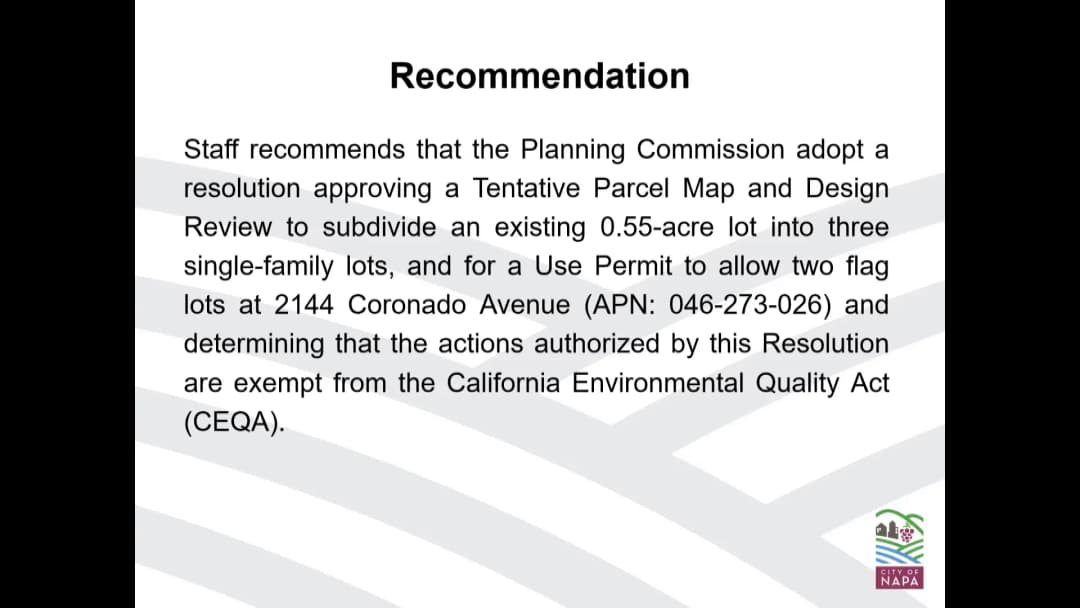
The Napa Planning Commission met on October 15, 2026, at 5:30 PM in City Hall Council Chambers. The commission approved the consent calendar, held public hearings on a vacation rental public nuisance and a tentative parcel map subdivision, and received a preview of an upcoming special meeting on zoning ordinance updates. Consent Calendar - Approved the regular meeting minutes of October 1, 2026, by unanimous vote. Public Comments & Testimony - No members of the public provided testimony on non-agenda items. - For Item 7A (2505 Redwood Road), the property owner did not appear despite proper notice via certified mail. No other public comments were made. - For Item 7B (2144 Coronado Avenue), no members of the public spoke. Discussion Items 7A – 2505 Redwood Road Public Nuisance (Unpermitted Vacation Rental) Community Resources and Development Director Molly Rattigan presented a case against an unpermitted short-term rental at 2505 Redwood Road. Staff used software to identify “vampire listings” – listings that appear and disappear to evade detection – showing multiple stays of less than 30 days between June and August 2026. The property owner was sent multiple notices but failed to respond. Administrative fines of $1,000 per day were already accruing. The commission was asked to affirm staff’s declaration of a public nuisance under Napa Municipal Code Section 17.52. After questions about the technology and fine structure, the commission voted unanimously to affirm the nuisance finding, allowing the city to pursue court action to abate the violation. 7B – 2144 Coronado Avenue Tentative Parcel Map Associate Planner Bond Mendez presented a proposal to subdivide a 0.55-acre lot into three single-family lots, including two flag lots requiring a use permit. The site already contains two residences and an accessory structure. Staff noted that Lot 3’s existing structure must be either demolished or converted to a primary residence before final map recordation. Commissioners discussed the condition of approval, clarifying that demolition is the default requirement but conversion could be handled via a separate design review permit. The commission adopted a resolution approving the tentative parcel map, design review, use permit, and CEQA exemption, with a two-year validity period for finalizing the map. Key Outcomes - 7A: Motion to affirm the public nuisance declaration and evidence of code violations passed 5-0. The city may proceed with court-ordered abatement. - 7B: Motion to adopt the resolution approving the tentative parcel map, design review, and use permit for 2144 Coronado Avenue passed 5-0. The subdivision must be finalized within two years, with the existing structure on Lot 3 either demolished or converted prior to recordation. - Upcoming: A special Planning Commission meeting is scheduled for October 28, 2026, to present the zoning ordinance update. An errata document will be published online by early next week.
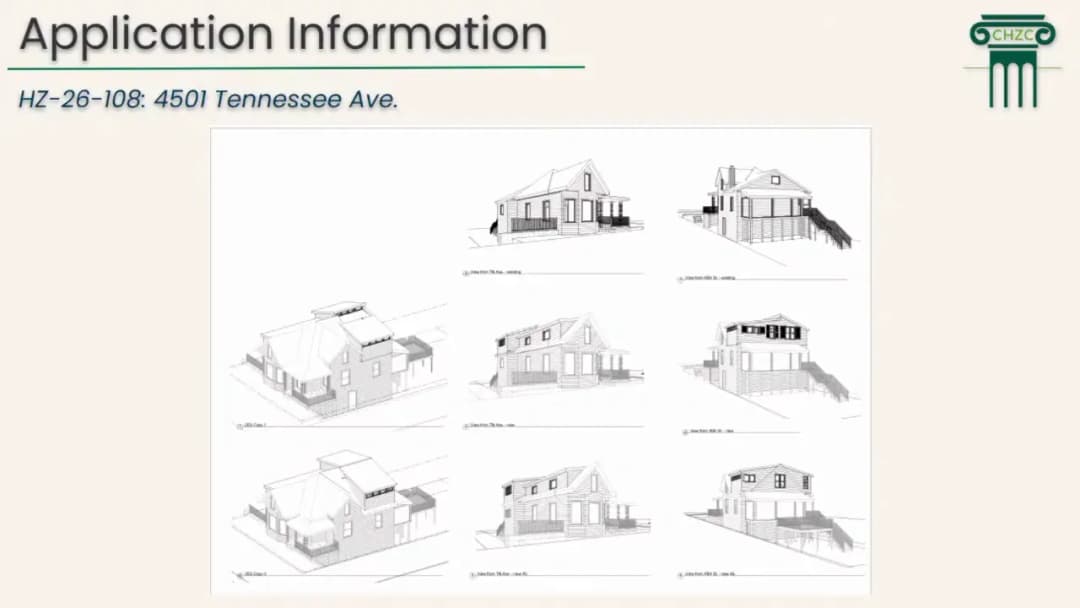
The Chattanooga Historic Zoning Commission met on October 15, 2026, to consider three certificate of appropriateness cases: two in the St. Elmo Historic District and one involving new construction. The meeting included approval of previous minutes, staff updates, and discussion of design guidelines for additions, new construction, and site improvements. Discussion Items - Case HZ2696 – 4313 San Almo Avenue (Old Business, New Construction on Vacant Lot): The applicant presented revised plans after previous feedback. The commission discussed the design's compatibility with the St. Elmo Historic District. Commissioner Cassie Courtney recused herself, initially causing a quorum issue; the case was tabled until Nathan Bird arrived. After Bird joined, the commission approved the case without conditions. - Case HZ26108 – 4501 Tennessee Avenue (Addition to Historic Structure): The applicant proposed a rear addition and a side shed dormer to expand attic space. The commission expressed concern about the size and prominence of the side dormer on the original facade. After discussion, the commission approved the rear addition options (both the offset gable with clerestory windows and the symmetrical shed dormer) but deferred the side dormer for further design refinement. The motion also allowed the applicant to choose the rear option based on pricing. - Case HZ26110 – 4613 Guild Trail (New Driveway): The applicant requested to demolish and replace an existing steep, ungraded driveway with a new concrete driveway to provide safe access to a non-contributing house on a flagpole lot. The commission approved the project with conditions that the driveway be concrete and the historic retaining wall remain undisturbed. - Staff Updates: Staff announced a public informational meeting for the Lupton City Local Historic District on Monday, October 26, 2026, from 6 to 8 p.m. at 1543 Mercer Street. A new Development Review Planner, Jody Corbin, will start on October 30, 2026, and be in training for the November meeting. The Lupton City Historic Deferral will be heard at the November 2026 meeting. Key Outcomes - Minutes Approved: Unanimously. - HZ2696 Approved: Motion to approve with no conditions; seconded and passed (with Cassie Courtney recused). - HZ26108 Partially Approved: Rear addition options approved; side dormer deferred to a future meeting for revised design. Motion carried. - HZ26110 Approved: Subject to conditions of concrete driveway and undisturbed historic retaining wall. Motion carried. - Meeting Adjourned: Motion made and seconded; passed.
The Virgin Valley Community Education Advisory Board (CEAB) met on Thursday, October 15, 2026, at 5:00 PM in the City Hall Council Chambers in Mesquite, Nevada. The board approved routine consent items, heard reports from school principals, discussed principal goals and the 2027 meeting schedule, reviewed bylaws, and appointed a new board member. No meeting minutes were available; this summary is drawn from the agenda and meeting transcript. Consent Calendar - The board approved the July 15, 2026 CEAB meeting minutes and the October 15, 2026 CEAB meeting agenda by motion and second. Public Comments & Testimony - No public comments were offered during the initial or final public comment periods. - During item 4.1, Chris Jenkins, principal of Joseph Bowler Elementary, expressed appreciation for CAP grant funding but asked the CEAB to consider asking the City Council to revisit the amount, noting that inflation has made it harder to provide extra student services. He stated his $15,000 share once covered a bus and two neighborhood moms, while now he can barely afford one neighborhood mom. Principal Comments and Reports - Jadal Wilson, Hughes Middle School principal, reported enrollment is now 546, up from 541 on count day in late August; chronic absenteeism is 17 percent. Both flag football teams are 7-2, with the girls in second place and the boys in third. Cross-country has consistently finished second. He announced a Family Resource Night at the high school on November 18 for self-contained students, connecting families with vocational rehabilitation, the Rural Regional Center, Special Olympics, and social groups. A middle school career day is scheduled for November 17. Security upgrades are underway, including cameras and buzzer-controlled front safety doors. Wilson said this was his last CEAB meeting because he is retiring in December, and the principal position has been posted. - Chris Jenkins, Joseph Bowler Elementary principal, described parent-teacher conferences held Monday and Tuesday, the October 7 Bike and Walk to School Day, and an upcoming pumpkin run and carnival. The fall festival is scheduled for October 29 from 5:00 to 7:30 PM. Red Ribbon Week will be October 23-31. He noted the area’s bus driver shortage has caused delays and forced the speed meet in Moapa to end by 12:30 PM. He also discussed LEAD graduation (not DREAM), a career fair planned for November 20, and the school’s leadership handshake program. - With Virgin Valley Elementary and Virgin Valley High School principals absent, the presiding board member read a message that Principal White could not attend because of senior night for girls’ tennis and volleyball. A participant who identified as the PTO president at Virgin Valley Elementary gave updates: the Halloween carnival is next Tuesday from 6:00 to 8:00 PM, the pumpkin run is Friday morning, and the Halloween party is October 29. The high school has completed its School Organization Team meeting and has a rivalry week against Moapa Valley in most sports, with football on Friday night. Discussion Items - Principal Goals and CEAB Assistance (4.1): The board discussed how to help principals address challenges from the past year and upcoming goals. Members supported sending principals an email to allow more thoughtful responses. Chris Jenkins added his comments on CAP grant funding. The board voted to table the item. - 2027 Meeting Schedule (4.2): Staff proposed quarterly meetings on the third Thursday: February 18, May 20, August 19, and November 18, 2027. Jadal Wilson cautioned that May 20 falls near graduation. The board decided to approve only February 18, 2027, and to table the remaining dates until absent members can be consulted. - Bylaws Review (4.3): No changes were proposed. The board moved and seconded a motion to keep the CEAB bylaws as written. - Appointment of CEAB Members (4.4): Mary Ann Tortorici introduced herself as a retiree, a Mesquite resident of about six years, with about 25 years in Nevada education, mostly in higher education. She stated an interest in serving on the board and asked about orientation for new members; board members offered training and mentoring. The board noted the at-large seat was vacant after Jeff Reynolds left, with the term running until August 31, 2028. She was approved by motion and second. Board Members Comments and Reports - The presiding board member said it would have been helpful to receive earlier notice of absences. - Nikki Metter of Mesquite Works Team Center reported a successful chili cook-off dinner with more than 100 attendees, a haunted house open Friday and Saturday nights in October, a special lights-on event on Friday, October 30 for younger children, and a craft fair on December 12. Chris Jenkins praised the haunted house as the best and top of the line. Key Outcomes - Approved the consent agenda. - Tabled discussion of principals’ goals for a future meeting. - Approved February 18, 2027, as the first 2027 CEAB meeting date; deferred the other proposed 2027 dates. - Retained existing CEAB bylaws without changes. - Appointed Mary Ann Tortorici to the at-large vacancy, with a term through August 31, 2028. - Noted Jadal Wilson’s upcoming retirement and the principals’ concerns about busing and CAP grant funding. The meeting adjourned after the final public comment period.
The Parks and Recreation Advisory Board (PRAB) met on October 15, 2026, at 6:00 p.m. to discuss the 2026 Master Plan Progress Update, receive reports from boards and commissions, and hear the Director's Report. Key topics included the formalization of quarterly master plan updates, progress on the Open Space Master Plan Phase 2 action items, and updates on capital projects, creek management, and wildfire mitigation. No public comments were received. The meeting adjourned unanimously. Consent Calendar - Approval of the Agenda: The agenda was approved unanimously with no amendments. - Approval of August 20, 2026, Regular Meeting Minutes: The minutes were approved unanimously after an amendment was added to include specific details from Board Member Catherine Hansen-Stamp's comments regarding the Open Space Master Plan discussion. The amendment was incorporated. Public Comments & Testimony - No public comments were received in person or via email. Discussion Items - Master Plan Progress Update Memo: Staff presented a consolidated memo outlining 2026 accomplishments aligned with the Parks and Recreation Master Plan (PRMP) and Open Space Master Plan (OSMP). PRAB members discussed the format and agreed to receive quarterly updates going forward. The board emphasized the importance of prioritizing OSMP Phase 2 action items, particularly the field-based inventories (SAP O9), as a foundational step for future decisions. Staff noted that a two-year action plan is being developed from internal strategy workshops held in September and October. - CAPRA Reaccreditation: Staff clarified that reaccreditation is on hold due to staff capacity, but best practices are being followed to facilitate future accreditation. - Open Space Master Plan Implementation: Cathy Hansen-Stamp and other members stressed the need for regular updates on OSMP priorities. The board discussed the critical nature of completing biological inventories before moving to Phase 3. Staff reported that a dedicated open space funding request has been submitted to City Council for the first time. - Citywide Sign Plan: A citywide sign planning effort is underway to create consistent standards for interpretive, wayfinding, and educational signs. Funding requests of $10,000 (2027) and $50,000 (2028-2031) have been submitted. Boards and Commissions Interface Items - Sandy Hazzard (Special Events Review Committee): Reported that the committee is finalizing its mission statement and considering changes to grant approval frequency (twice a year instead of monthly). Summer event attendance data is pending. - Laurel Starr (Arts and Culture Commission): Announced that the jury selected “Pollinators at Play” – three metal orbs with flower stamens – as the public art installation for the Lions Park Playground. The artist will coordinate with the developer. An open house on public art is scheduled for October 28 at the Golden History Museum. Director’s Report - Budget Update: City Council reviewed the budget on October 13. Several Parks and Recreation items were discussed. - Dinosaur Ridge License Agreement: Resolution 3368 approving the license agreement with Friends of Dinosaur Ridge will be a consent item on the October 27 City Council meeting. - Fossil Trace Irrigation Project: Underway, completion expected spring 2027. - Lions Park Playground: 60% design review completed; 90% design in progress. - Irrigation Audit: Completed; report pending. - Clear Creek Management: Staff reported on the impacts of low water and high visitation, including bank erosion, vegetation damage, and increased litter. Code enforcement focused on prohibited items (chairs, coolers) and closures were implemented. A potential request to convert a CSO position to a commissioned officer for creek corridor enforcement was discussed at City Council. - Water Conservation: The city reduced water use by 19% compared to 2025 and 26% compared to the five-year average during drought restrictions. Some turf loss occurred, but overall parks fared well due to careful turf management. - Heritage Road Traffic Circle: Staff are providing advice to a community group to transition to a zero-water garden. Board Member Comments - Forbes Cone: Thanked staff for their efforts and noted parks looked better than expected given the challenging year. - Michele Minihane: Highlighted the successful Wine Festival at Tony Grampsas Gym and suggested more events there. - Kermit Shields: Encouraged attendance at the upcoming talk by Brad Udall on the Colorado River on October 22 at 7 p.m. - Catherine Hansen-Stamp: Praised the drone show and Autumn Fest. She also mentioned Arborists trimmed her trees and recommended fall tree trimming. Key Outcomes - Staff will provide quarterly master plan updates to PRAB. - The board emphasized prioritizing OSMP Phase 2 inventories (SAP O9) and will continue to track implementation. - The Dinosaur Ridge license agreement will be presented to City Council for approval on October 27. - Staff will continue to work on citywide sign standards and capital project prioritization. - No formal votes were taken beyond consent items; all actions were advisory.
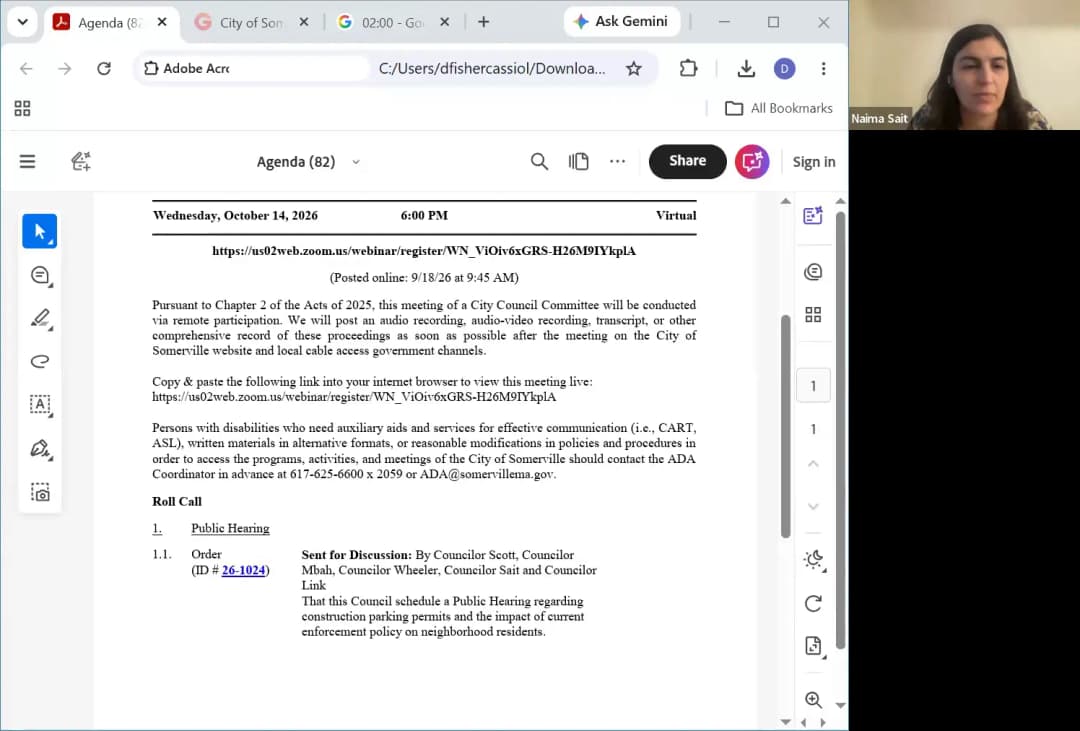
On October 15, 2026, the Somerville City Council Traffic and Parking Committee held a public hearing (ID 26-1024) regarding construction parking permits and the impact of current enforcement policies on neighborhood residents. Chair Naima Sait called the meeting to order at 6:02 PM, with all three committee members present (Councilors Wheeler, Mbah, and Sait). Ward 2 Councilor J.T. Scott introduced the item, noting that Ward 2 has the highest concentration of construction in the city but that challenges are citywide. Staff from the Engineering Division, Police Department, Inspectional Services, and Parking Department were present to listen. The hearing closed at 6:33 PM, and the committee marked the item as work completed, with plans to revisit the topic in a future meeting. Public Comments & Testimony - Serena Bodner (Bolton Street): Raised multiple concerns, including that eight of approximately 15 on-street parking spots on her block were occupied by contractor vehicles. She proposed suspending construction permits during snow emergencies, limiting permits per project, increasing pricing to encourage carpooling or transit, and revoking permits for violations. She noted workers using space savers (cones) illegally. - Greg (27 Oak Street): Highlighted safety hazards from construction vehicles parked in no-parking fire lanes at the end of Oak Street, creating blind spots for pedestrians, cyclists, and motorists. - Dorinda (address not given): Agreed with Councilor Scott that the low cost of permits (roughly $1/day) is a privilege not afforded to other groups. She noted Cambridge allows only three spots per construction project and pointed to empty spaces at the Boynton Yards and Webster Street garages. She also raised concerns about blocked sidewalks on Prospect Street. - Raquel Shot (21 Houghton Street): Described how vehicles blocking the fire lane at Houghton and Bolton Streets prevent garbage trucks from turning, causing prolonged horn-blaring and quality-of-life disruptions. Discussion Items - Councilor J.T. Scott: Introduced the item, emphasizing the need for creative solutions. He stressed that parking in fire lanes and blocking hydrants are serious safety issues. He suggested creating a process to revoke construction parking permits for egregious violations, similar to revocation of business licenses. - Staff introductions: Brian Postlewaite (Engineering – reviews street occupancy permits), Lt. Michael Holland (Police – enforces detail rules), Kevin Klein (Inspectional Services – engages contractors), Jackie Stagnari and Anna Rebelo (Parking – issues permits and enforces violations). - Kevin Klein (Director of Inspectional Services): Offered to visit Ward 2 with a ward inspector to meet contractors and encourage respectful behavior. He noted that keeping projects on schedule gives the city leverage. Councilor Scott welcomed the offer. Key Outcomes - The public hearing was closed at 6:33 PM. - The committee voted (3-0) to mark the item as work completed, with the understanding that Councilor Scott would file a new item to continue discussion at the next Traffic and Parking Committee meeting. - Director Klein committed to convening a meeting with contractors in Ward 2 within the week and to keep Councilor Scott informed. - The meeting adjourned at 6:37 PM.
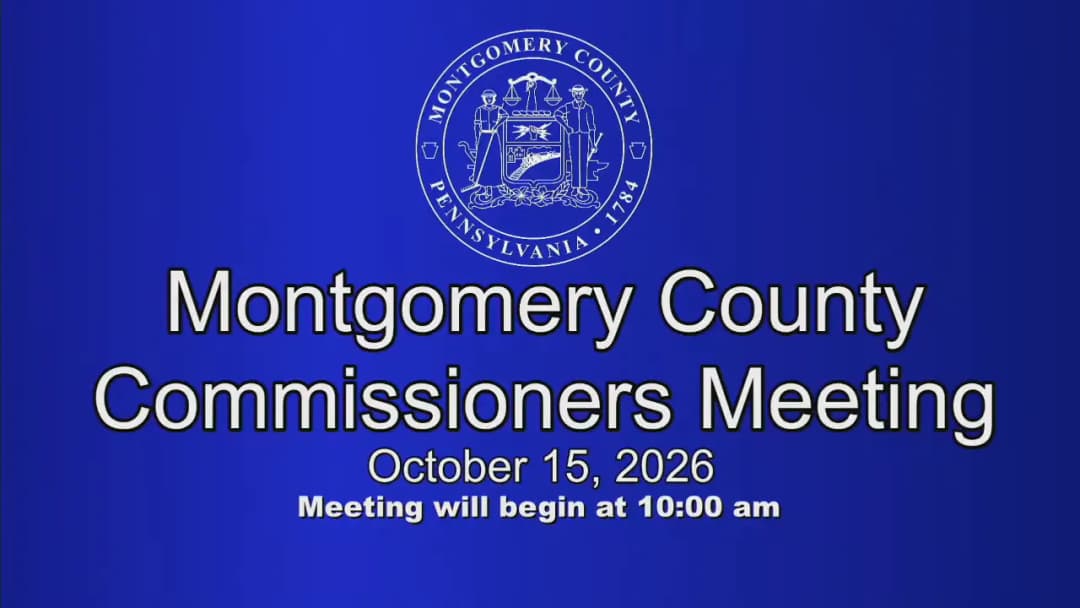
The Montgomery County Board of Commissioners convened on October 15, 2026, to address a hate incident in Abington, provide election updates, discuss major pharmaceutical investments (GSK and Merck), receive a fall respiratory season health presentation, review a voting system analysis, hear a Justice Center update, and debate election integrity concerns. Commissioner Remarks & Updates - Commissioner Weiner: Opened by condemning racist and anti-Semitic graffiti at Weldon Playground in Abington and noting that three juveniles were charged with ethnic intimidation. Highlighted the county's period products initiative, a re-entry simulation aimed at reducing recidivism, the Halloween Trick-or-Trails event, and expressed solidarity with faith communities following an averted mass shooting at a temple in Illinois. - Commissioner Makesha/McKeejah: Provided election updates (over 106,000 mail-in ballots sent, 60,000 returned, 251 auto-cured). Announced a GSK $800 million expansion in Upper Marion Township (creating over 300 jobs), the Merck facility opening, the Sunrise Mill grand opening (dated to 1767), and the county website winning a national award. Expressed serious concern over the Pennsylvania measles outbreak (over 1,000 confirmed cases, worst since 1991, over 25% of U.S. cases) and strongly encouraged vaccinations. - Commissioner DeBock: Reported on events including the Columbus Day celebration in Norristown, Italian Heritage Month at the Capitol, the upcoming Careers of Tomorrow event for high school students, a domestic violence awareness ceremony, and the retirement of Upper Providence Chief Mark Freeman after 35 years. Presentations - Fall Respiratory Season & Measles Update (Dr. Richard Lorraine): Recommended the flu vaccine for everyone six months and older by Halloween. Advocated for the COVID booster for high-risk groups and confirmed the safety of co-administering flu and COVID vaccines. Stressed the severity of the PA measles outbreak and urged MMR vaccination, noting the 93-97% effectiveness rate of the vaccine and the need for 95% community immunity to protect vulnerable populations. Announced remaining county vaccine clinic dates. - Justice Center Update (Jesse): Reported Phase 2 is nearing completion with high-tech, ADA-accessible courtrooms, improved security features (secure pathways for judges and inmates), and better jury capacity (200 seats). Facility expansions for the Clerk of Courts and District Attorney were highlighted. Phase 2 change orders are approximately 2.5% ($6 million of the $233 million contract value). Phase 3 contracts were awarded at $120 million against a $127 million budget. Life safety completion is expected in December 2026, with a full Phase 2 opening in Q1 2027 and Phase 3 scheduled for March 2029. - Voting System Review (Frank, Director of Elections): Presented an exploratory review comparing the current Liberty Vote system to an ESNS system. The current system was criticized for high waste, lengthy post-election write-in adjudication (taking two to three weeks with high overtime costs), and fragile equipment carts requiring full replacement for minor damage. The ESNS system was presented as a strong alternative, offering four-times-faster scanning, bulk write-in adjudication (saving weeks of work), an all-in-one secure design, a single manufacturer for support and parts, and reduced poll worker complexity. Public Comments & Testimony - Joe Rooney (Abington Resident): Questioned the $300,000 language translation services contract and the high daily per-child costs (over $1,000) in Health and Human Services programs, seeking oversight details. Later questioned the $250,000 for a dignified storage facility for the coroner and suggested a 3% across-the-board budget cut. - David Morgan (Ambler Resident): Questioned the total projected cost of the Justice Center (suggesting Phase 2 and 3 combined could exceed $470 million) and the impact of contract awards on tax increases. Later requested an adoption awareness presentation and suggested a tax decrease. - Tim Carrick (White Marsh Senior Village): Urged the county to install immediate interim traffic safety measures, including traffic feedback signs and a dedicated crosswalk on Butler Pike, citing cars clocked at 80-85 miles per hour and a resident hit by a car. Requested a visit from a county traffic engineer. Key Outcomes & Disputes - Election Integrity Dispute: Commissioner DeBock stated a video showed an individual dropping off multiple mail-in ballots at a drop box (a violation of the one-ballot rule). He claimed the District Attorney requested direction from the Board to prosecute. Commissioner Makesha/McKeejah strongly disputed this, stating the Board of Commissioners does not direct the DA on prosecutions and describing it as a matter for the election board and the DA's independent review, though she agreed the evidence should be provided to the DA. - Rally Concerns: Commissioner DeBock raised concerns about partisan rallies being advertised on county property at satellite election offices during early voting, calling it potential election interference. Commissioner Makesha/McKeejah noted any group can use public property under the First Amendment and the county has no control over external communications, but agreed to review the specific instances. - Approvals: The Board approved the consent calendar (including the personnel list, minutes, bid advertisements, contract awards), the trailheads easement agreement with Norristown, and the shared use path crossing agreement amendment with PennDOT for the SRT 422 connector. The salary board items were also approved.