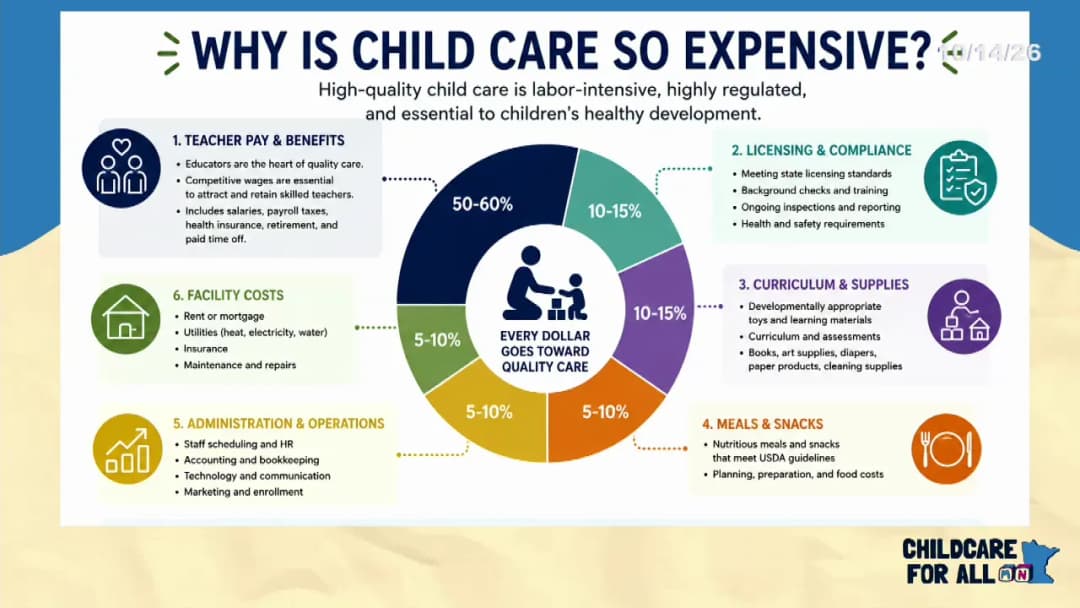
The Saint Paul City Council's Policy Committee met on Wednesday, October 14, 2026, at 1:00 PM in Council Chambers at Saint Paul City Hall for an informational briefing on SR 26-219, 'Overview on Affordability in St. Paul.' Six members were present and one was excused. Invited speakers from North Star Policy Action, the Alliance for Metropolitan Stability, and Child Care for All presented data and personal testimony on wages, housing costs, and child care costs. The committee received and filed the item without taking a formal vote. Presentations and Discussion Wages and Cost of Living - Aaron Rosenthal, North Star Policy Action - Rosenthal described affordability as a race between prices and wages, reporting that inflation peaked around 8% in 2022 and that the Consumer Price Index rose again to 3.6% in September 2026. - He said the basic cost of living in Ramsey County for a 'typical family' defined as one full-time worker, one part-time worker, and one child is just over $80,000, making Ramsey County the seventh most expensive county in Minnesota. - He cited fuel prices up about 57% since the start of the Iran War; a Minnesota family of four with two drivers has spent about $1,000 more year to date, projected to reach almost $1,800 more by the end of 2026. - Health insurance premiums were up 75% over 12 years and deductibles up 84%. He said 116,000 Minnesotans lost health insurance in 2025, another 140,000 to 180,000 are projected to lose coverage by 2034 because of Medicaid cuts, and hospitals could face $1 billion in uncompensated care. - He said tariffs cost the average Minnesota family about $1,300 in 2025 and are expected to worsen in 2026 with new tariffs on Canada. - On the job market, he said Minnesota added about 4,000 jobs in 2025, the lowest non-pandemic year since the Great Recession. Unemployment crossed the national rate for the first time since 2007, with black Minnesotans' unemployment rising from 4.8% to 7.6%. The labor force participation rate saw its largest six-month drop since at least 2000 from January to July 2026. - Median inflation-adjusted wages rose about 50 cents from 2024 to 2025, then fell during the first seven months of 2026, leaving essentially no median wage growth from early 2024 to mid-2026. Wages for the 90th percentile rose 4% over that period, widening inequality after roughly a decade of narrowing. - Since 1979, Minnesota worker productivity rose 86% while pay rose 36%. The statewide CEO-to-worker pay ratio rose to about 325 in 2025, and was between roughly 550 and 800 at selected companies such as Target, UnitedHealth, and Best Buy. The labor share of business income fell to an all-time low of 53%, down from 62-63% in 2000. - Union coverage in Minnesota rose to 15.8% in 2025 from 14.7%, and union members' wages rose while non-union wages fell. - Rosenthal said Ramsey County's affordability gap currently leaves a median working family about $5,500 short of basic costs; it is the third largest gap among Minnesota counties, behind Winona and Rice. With two full-time minimum-wage workers and one child, the shortfall is about $25,000; with two children, it exceeds $50,000. - Rosenthal argued that government can address wages more effectively than prices. He expressed support for boosting worker power, unions, sectoral bargaining, protecting immigrant workers, and raising St. Paul's minimum wage. He cited California's $20 fast-food minimum wage as producing a 12% wage increase with only a 2% price increase, and said raising the minimum wage does not reduce employment or meaningfully raise prices. Housing Affordability - Juan Luis River Reyes, Alliance for Metropolitan Stability - River Reyes, a St. Paul native and housing coalition organizer, presented Housing Link data showing median rents in St. Paul of $1,247 overall, $1,095 for one-bedroom units, $1,382 for two-bedrooms, and $1,918 for three-bedrooms. - He said 23% of St. Paul homeowners and 49% of renter households are cost burdened, meaning they spend more than 30% of income on housing. - Using assumptions of 40 hours per week and 52 weeks per year, he said a renter would need about $14,924 per year just to pay the median rent and would need to earn about $23.98 per hour to avoid cost burden at the 30% threshold; at a 33% threshold, the figure would be about $21.58 per hour. He clarified these figures are gross income and exclude utilities and renters insurance. - He said units described as affordable at 50% Area Median Income would require rent of about $1,233 per month, or an annual income of $49,320 and an hourly wage of $23.74; at 60% AMI, the rent would be about $1,479 per month, requiring $59,160 per year, or $28.44 per hour. - River Reyes argued that the current St. Paul minimum wage leaves tenants cost burdened and that the definition of affordable housing must go further. He noted that 33% of St. Paul households earn $50,000 or less, so a large share of residents cannot afford the median rent. Child Care Affordability - Maria, Albert Everline, and Martha Iguetta, Child Care for All - Maria, director of Rainbow Child Development Center, said 90% of brain development occurs before age five and 80% before age three, and that high-quality birth-to-five programs can deliver a 13% annual return on investment compared with 7-10% for preschool programs for three- and four-year-olds. - The speakers said the average cost of a child care center is $23,452 per year, compared with University of Minnesota tuition of $19,312. The federal affordability standard of 7% of income would require a one-child St. Paul family to earn $335,000 per year; Albert Everline said his family earns $120,000. - Albert's family's care costs rose from about $550 to $778 every two weeks. He described his son's teachers quitting abruptly in 2025 because of low wages and lack of immigration protections, which disrupted his son's trust and led to about five months of difficulty. - Martha Iguetta, a District 1 resident and early intervention teacher speaking personally, said early childhood educators are disproportionately women of color, earn $18-20 per hour in St. Paul, often lack benefits, and up to 90% report one or more adverse childhood experiences compared with about 55% of Minnesota residents. - The speakers said seven long-standing child care centers closed in St. Paul last year, that Minnesota lost $2.1 billion in economic activity last year because of the infant and toddler child care crisis, and that 6,700 children are enrolled in 87 licensed facilities, supporting an estimated 676 center jobs alone. - The group called child care a systemic problem requiring massive public investment, increased minimum wage, revenue from large businesses, and a universal child care system. They asked the Council to testify at the state capitol and to support policies that raise teacher wages without raising family costs, with particular attention to educators of color and immigrants. Council Discussion - Councilmember Jost asked whether the one-full-time/one-part-time/one-child family assumption is representative and noted the affordability gap would likely be larger for families with more children; Rosenthal agreed children raise the basic cost of living substantially. - Councilmember Johnson, speaking as a new mom, said her family pays $500 per week for child care, which can be double a mortgage, and argued that rent control alone does not address the core costs of housing, child care, and evictions. - Councilmember Kim said women and women of color are particularly affected by child care costs and workforce participation. She announced that her office will hold stakeholder engagement sessions on affordability, modeled on the Citizen's League process but without a paid consultant, similar to the tree ordinance process, and invited interested groups to contact her office. - Chair Noecker thanked the speakers, said she was eager to explore redistributing wealth from higher earners, and expressed continued commitment to working with child care advocates on state and local solutions. Key Outcomes - The committee received and filed SR 26-219, 'Overview on Affordability in St. Paul.' - No formal vote was taken. - Councilmember Kim stated next steps for additional community engagement sessions on affordability and minimum wage, with no date specified.
The Public Meeting Index
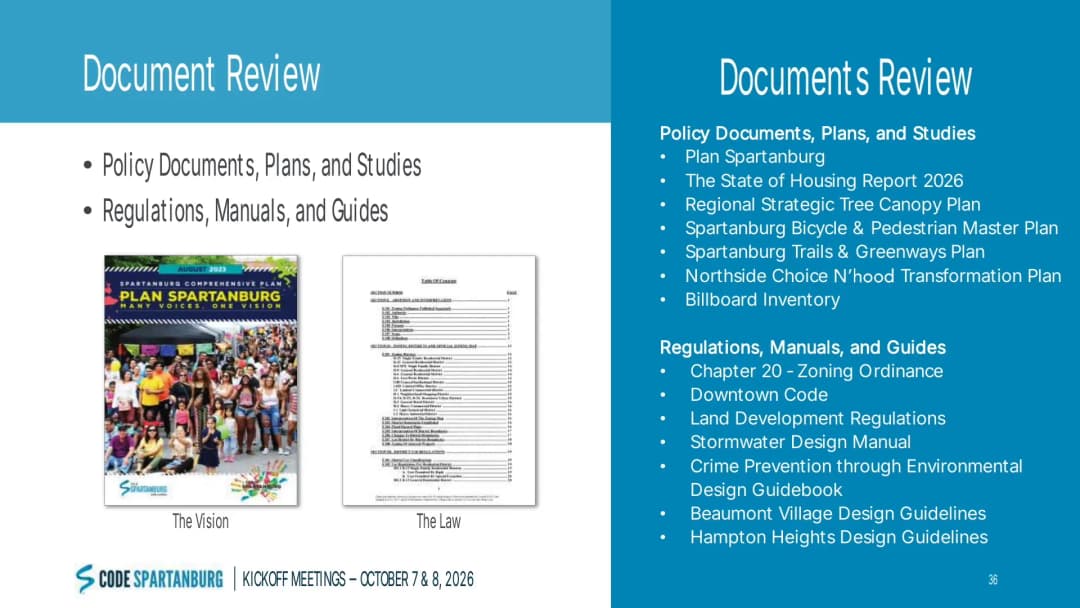
The Public Meeting IndexThe City of Spartanburg, in partnership with a consulting team led by TSW (including Code Studio, market analyst Erin Arnett, zoning attorney Andy Gowder, and Innerborough for community engagement), held a community workshop on the evening of October 14, 2026 to launch the "Code Spartanburg" process. The meeting marked the beginning of a 14-month effort to rewrite the city's zoning code. The consulting team presented preliminary diagnostic findings and requested community feedback to guide the drafting of a new code. Discussion Items Project Kickoff and Zoning 101 (Caleb Rosico & Christy Dotson) - Caleb Rosico, project manager for TSW, introduced the consulting team and outlined the 14-month timeline: Diagnosis, Framework, Drafting, and Adoption. He emphasized the team's commitment to writing a code uniquely tailored to Spartanburg's character via an open and inclusive process, stating that community help is "absolutely fundamental to getting this code done and getting this code done directly." - Christy Dotson of Code Studio provided a "Zoning 101" overview, explaining how zoning regulations shape physical outcomes (building mass, frontage, landscaping) and control uses and processes. She highlighted the current gap between the community's policy vision (e.g., from the comprehensive plan) and the existing regulations, noting that older zoning can create friction and unpredictable outcomes, and that the current code is "for a different era of Spartanburg." Preliminary Diagnostic Findings and Seven Themes (Caleb Rosico) Rosico detailed the team's preliminary analysis, organized around seven themes. He emphasized these were observations and potential concepts to determine community interest, not formal recommendations: 1. Expanding Housing Supply: The current code effectively protects single-family neighborhoods but lacks tools for "missing middle" housing (duplexes, accessory dwelling units, cottage courts, walk-ups). Rosico proposed legalizing these types in some locations and defining currently undefined uses like short-term rentals. 2. Directing Where Growth Occurs: The comprehensive plan envisions directing growth to corridors while preserving neighborhoods. The team suggested creating an industrial mixed-use zoning district and form-based standards for corridors to better align the zoning map with the plan. 3. Creating Walkable Places: Sidewalk requirements are inconsistent, and the parking regulations were characterized by Rosico as "the longest I have ever seen" and "very outdated." Potential improvements included consistent pedestrian access standards, parking reform, and connectivity requirements. 4. Preserving Character While Managing Change: Many older neighborhoods are technically non-conforming under the current code due to lot sizes and setbacks. The team proposed place-based zoning standards that measure and reflect existing physical patterns (e.g., roof pitch, front porches) and tools to encourage preservation outside historic districts. 5. Supporting Economic Opportunity: The use table is antiquated. Rosico suggested modernizing it to explicitly handle emerging uses (data centers, short-term rentals, artisanal manufacturing) and creating a neighborhood commercial standard for smaller-scale businesses. 6. Promoting Healthy and Resilient Development: Recommendations included revising open space standards (tying them to lot size rather than dwelling units), improving stormwater facility design standards, and extending tree ordinance requirements to single-family teardowns. 7. Creating a User-Friendly Code: The team committed to reformatting the code with graphics, charts, and hyperlinks to replace dense text, making it accessible to non-experts. Key Outcomes - No Formal Votes: This workshop was strictly an information and input-gathering session; no votes or binding decisions were made. - Community Input as Primary Outcome: The main outcome was the collection of stakeholder feedback through breakout exercises and comment cards. The consultant team explicitly stated that the seven themes and specific ideas were preliminary observations and that future recommendations will depend on the community interest expressed. - Timeline: The process remains on track for code adoption in late 2027, following the next phases of framework development and drafting.
No agenda, minutes, or transcript were provided for this meeting. Therefore, no summary can be generated. The meeting was scheduled for 6:15 PM on October 14, 2026, but no record of proceedings exists in the supplied materials.
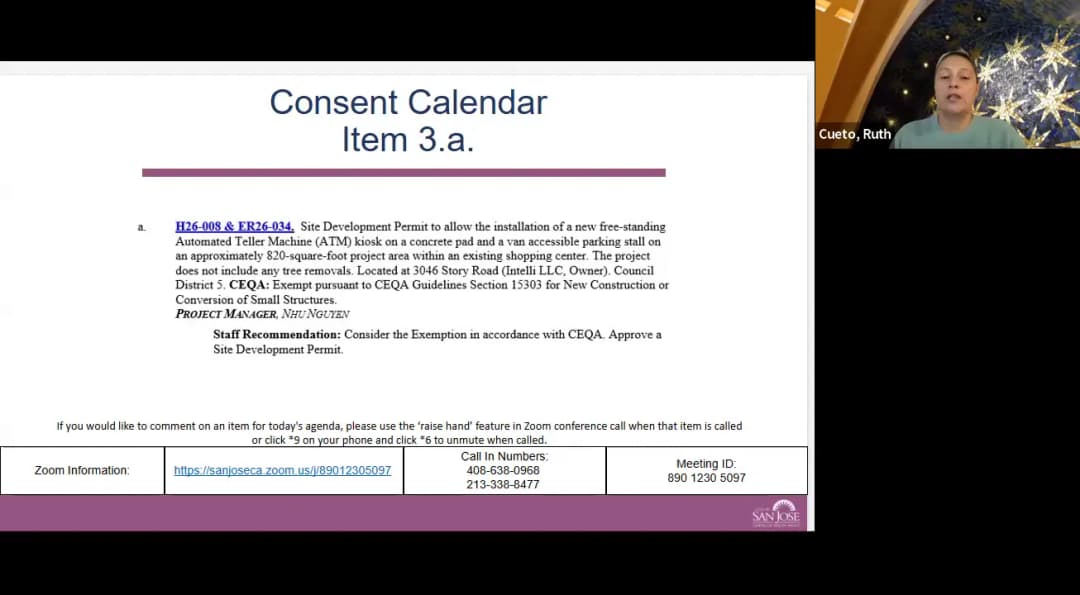
The hearing was called to order by Hearing Officer Ruth Gueto on behalf of the Director of Planning, Building, and Code Enforcement. The meeting was conducted via Zoom. The agenda included only consent calendar items, with no deferrals or public hearings requested. The consent calendar item was approved unanimously without public comment. Consent Calendar - Item 3a (H26-008 / ER26-034): A site development permit to install a new freestanding automated teller machine kiosk on a concrete pad and a van-accessible parking stall within an approximately 820-square-foot project area at 3046 Story Road, Council District 5. The project involved no tree removals and was found exempt from CEQA under Section 15303 (new construction or conversion of small structures). No requests to speak or public comments were received; the item was approved. Key Outcomes - The consent calendar item was approved as presented.
The Antigo Common Council met Wednesday, October 14, 2026, at 6:00 PM in Council Chambers at City Hall, 700 Edison Street. Roll call was completed with one member excused on vacation. The council approved minutes and the consent agenda, then handled licenses, Ordinance 1390B, appointments, bill payments, and committee referrals before voting 8-0 to enter closed session. Consent Calendar - Approved minutes from the September 9, 2026 Common Council meeting and the August 26 and September 9, 2026 Committee of the Whole meetings, excluding the September 30, 2026 Committee of the Whole minutes. The agenda had listed the September 30 minutes as contingent upon completion, but the transcript records them as excluded from the motion. - Approved the consent agenda resolutions: 63-26 (Ayres Associates contract amendment for additional Hudson Street/Pearl Avenue CDBG work), 64-26 (unused vacation rollover for a police officer), 65-26 (adoption of the Langlade County All Hazards Mitigation Plan update), 66-26 (replacement of water plant boilers), 67-26 (repair of two Fifth Avenue lift station pumps), and 68-26 (publication of Common Council minutes). - Accepted department manager reports and the Arbor Day Proclamation. Public Comments & Testimony - No members of the public signed up to speak; the presiding officer noted there were no citizen commenters. New Business and Licenses - Fifth Ave Diner LLC dba Fifth Ave Cafe, 714-716 Fifth Avenue: Council approved changing the agent on the Class B beer/fermented malt beverage, intoxicating liquor, and cigarette licenses to Jeton Ibraimi. The LLC remains the same, so only the agent change was required. - Dolgencorp LLC dba Dollar General Store 31777, 332 Superior Street: Council approved a Class A beer/fermented malt beverage and intoxicating liquor license for agent Amanda M. Myers, contingent upon completion of inspections. Note: one point in the transcript lists the address as 732 Superior Street, while the agenda and the formal motion state 332 Superior Street. Ordinances - Ordinance 1390B: Council approved revisions to Sections 38-302, 38-304, 38-306, and 38-308 regarding bicycles and play vehicles. The ordinance updates definitions and operation rules for bicycles, electric bicycles, electric motorized devices, electric scooters, and personal assisted mobility devices. It removes their operation from sidewalks unless the operator is under age 12 or accompanied by a parent or guardian. A council member noted there are no restrictions on Fifth Avenue roadway use for these devices. The ordinance passed on a roll-call vote. Appointments and Motions - Appointments to the Public Arts Committee: Council approved the appointments. One council member noted a previous member was no longer on the committee, and said the committee was being revitalized because of upcoming public art projects. Payment of Bills - Approved direct deposits for the September 11 and September 25, 2026 payrolls; BMO Bank accounts payable checks 86972-87161; and Self-Funding Health Insurance checks 2204-2206. Committee Referrals - A council member referred to the Public Works Committee a concern about weathered, insect-damaged electrical/utility poles, including one leaning in front of the member's building. The council member had contacted WPS with the pole number. WPS was described as active in pole inspection and replacement and obtains necessary permits; the council member asked for a report back to determine whether replacement is needed. - A council member relayed a constituent's concern about a barricaded, pothole-like damaged area near the dam. Staff responded that the repair is budgeted; next year the damaged surface/pavers will be removed and concrete will be placed. Closed Session - Council voted 8-0 to convene into closed session under Wis. Stat. § 19.85(1)(c) to consider employment, promotion, compensation, or performance evaluation data of public employees regarding the Antigo Fire Department collective bargaining agreement, Building Inspector, and Public Works Superintendent. The transcript ends with that vote; no subsequent open-session action on matters discussed was captured. Key Outcomes - Approved minutes and consent agenda as described above. - Approved the Fifth Ave Cafe agent change and the Dollar General Class A license (contingent on inspections). - Passed Ordinance 1390B. - Approved Public Arts Committee appointments. - Approved all bill payments. - Referred utility/electrical pole review to the Public Works Committee and discussed the scheduled dam-area repair. - Voted 8-0 to enter closed session.
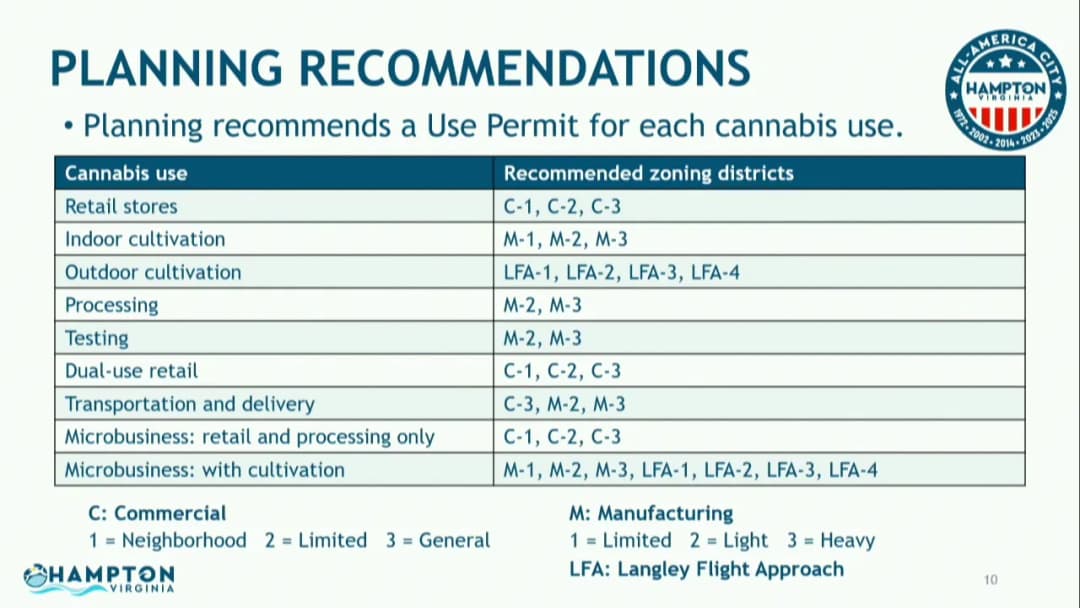
The Hampton City Council met in a work session on Wednesday, October 14, 2026, at 1:00 p.m. in Council Chambers. Mayor Jimmy Gray presided; all seven council members were present. The open session included four staff/guest presentations: Hampton University economic impact, towing advisory board recommendations, the development process assessment implementation, and cannabis legislation. No minutes were available; the summary is based on the agenda and transcript. Council later voted unanimously to enter closed session. Discussion Items Hampton University Economic Impact - Hampton University President Darrell Williams presented a study by Chamura, commissioned by a Virginia legislative subcommittee, on the economic impact of the Commonwealth’s four HBCUs. Combined impact was $1.6 billion; Hampton University-specific findings included nearly 2,100 jobs per year, about $115 million in economic impact, and $7.32 million per year in public revenue. - Enrollment is 4,891, a 49.9% increase; faculty grew from about 254 in 2022 to about 306. Williams said most new faculty come from outside the area and contribute to the local economy. - Williams highlighted university investments: a workforce development center on Butler Farm Road, culinary arts/business networking and digital/AI centers, a new School of Religion downtown, the Hampton Well Nest community pharmacy/wellness/mental health center, and an off-campus restaurant, Milk and Honey. - He also reported a new $2.4 million summer grant for workforce pathways for people ages 11–27, in addition to about $2.25 million in TRIO funding over 50 years. - The study ranked HU number one in Virginia for social mobility and top 50 nationally, with Williams noting that results vary by methodology. - Williams said HU helps fill the regional workforce gap: with about a 52% gap in certain jobs, the gap would be 63% without HU’s contribution. - Williams expressed support for deeper city-university collaboration, including consolidated workforce pathways and city-sponsored grants to HU for workforce upskilling, especially in digital/AI. - Councilmembers expressed pride and support. Councilmember Harper praised workforce development; Councilmember Ferebee noted her family ties and urged continued work on heritage tourism and entrepreneurship; Vice Mayor Brown called for treating downtown Hampton as a college town, and Williams agreed. Mayor Gray mentioned the youth climate action plan event with 150 high school students and HU students, and thanked Williams for the voting precinct effort. Towing Advisory Board Follow-Up - Deputy City Manager Brian DeProfiel, Towing Advisory Board Vice Chair Ashley Abbott, and former Councilman Hobbs presented. Background: Hampton’s police-initiated towing rates had not been amended since 2008; the towing advisory board was established in 2000, disbanded in 2011, and re-established in 2024. The board had presented recommendations on September 9, 2026, and council asked staff and the board to refine the rates. - Current Hampton rates: $125 base for most vehicles, $285 for very large vehicles over 26,000 pounds, $10 after-hours surcharge, $28/day storage, $62.50 per half hour for additional recovery, and $25 per half hour wait-time after the first hour. - Regional comparison: all other major Hampton Roads cities except Suffolk updated towing fees in the last two years; Suffolk’s rates are tied to the state default rate of $210. The state rate is reviewed annually and allows a $30 after-hours surcharge. Newport News has a lower base but allows add-ons such as a $45 dolly, $30 GoJack, and $25 administrative fee. - Abbott stated the board was addressing police rotation tows, not private property tows. The board originally proposed a flat $240 fee, but accepted the state-based structure: $210 daytime plus $30 after-hours. Proposed increases included storage to $55/day, a DMV processing fee with documentation, additional recovery at $62.50 per half hour, and wait-time standby at $62.50 per half hour. The board also requested annual rate review. - Staff recommended adding the city manager’s office as an appeal step for towing-related violations. - Vice Mayor Brown confirmed that the board and staff were aligned on the state-rate approach rather than the flat $240 rate. - The item was scheduled for final council action at the 6:30 p.m. meeting that evening. Development Process Assessment Implementation - Community Development Director Kim Michael reported on implementation of the Clarion development process assessment. The assessment identified five challenges: staffing and retention, workflow and technology limitations, inconsistent procedures, outdated planning guidance, and complexity of the zoning ordinance. - Achievements included about 35 workflow and portal improvements to the permitting system, a new departmental mission/vision/values framework, improved SOPs, clearer comment letters, appointment scheduling, staff cross-training, concurrent review, major/minor site plan review, and reduced site plan/subdivision review times. - A new permitting software is being pursued; the comprehensive plan update has an RFP out, and a full zoning ordinance rewrite is expected in roughly two to three years, likely with outside consulting help. The city manager said funding steps have been taken. - Customer surveys are ongoing, with 20–30 responses per month. Councilmember Campbell encouraged continuing the feedback loop; Councilmember Harper asked about surveys; Councilmember Ferebee requested a consolidated annual report for citizens; Vice Mayor Brown asked for percentage-based progress updates and suggested a post-call survey. Cannabis Legislation Briefing - Assistant City Attorney Corey Wolf and Senior City Planner James Randolph briefed Council on the state’s coming retail cannabis marketplace. They emphasized Virginia’s Dillon Rule and said localities cannot prohibit newly legalized cannabis uses, including by de facto bans. - Retail sales can begin as early as July 1, 2027. The state will issue 350 retail licenses. Retail stores cannot sell tobacco or alcohol and cannot allow on-site consumption. A statutory 1,000-foot buffer from hospitals, schools, universities, and child day programs cannot be reduced, though other buffers may be considered. - Cultivation licenses are tiered by canopy; tiers 1–4 are uncapped up to 25,000 square feet, and only five larger tier 5 licenses are available. Microbusinesses, limited to 5,000 square feet of indoor canopy or 10,000 square feet of outdoor canopy, may combine cultivation, processing, and retail at one site. - Staff recommended requiring a use permit for each cannabis use and proposed zoning districts: retail in C1/C2/C3; indoor cultivation in M1/M2/M3; outdoor cultivation in the Langley flight approach zones 1–4; processing/testing and transport/delivery in manufacturing/commercial districts. The existing Cunningham Drive medical dispensary could seek dual-use retail, with the retail portion going through a use permit. - Proposed operating hours mirrored ABC retail store hours: 10 a.m.–9 p.m. Monday–Saturday and 10 a.m.–6 p.m. Sunday. The city is required to adopt a local cannabis sales/use tax, likely through the spring budget process; tax returns go to the state and revenue is disbursed quarterly. Staff also recommended local penalties for public consumption mirroring state penalties. - The Cannabis Control Authority will begin accepting preliminary applications starting February 1. The city would have 30 days from notice to file a written objection. Draft regulations are still incomplete and could supersede local rules if conflicts arise. - Council feedback included: Councilmember Ferebee raised equity concerns about manufacturing zones near homes, and staff noted the use permit process would include public notice; Councilmember Muggler questioned Langley flight approach residential pockets and preferred starting with more restrictive hours; Councilmember Campbell suggested a noon opening instead of 10 a.m. and considering buffers similar to vape shops; Councilman Bowman asked about the two-ounce per-transaction limit and license background checks. Staff responded that background checks are required, with exceptions for cannabis offenses, and the city cannot change the transaction limit. Councilmembers noted VML discussion about license allocation possibly using regional usage data; the city attorney said staff would follow up. Key Outcomes - No ordinance votes were taken during the work session. The towing rate ordinance was scheduled for a final vote at the 6:30 p.m. council meeting on the same date. - Cannabis staff recommendations were presented for Council feedback; staff will use the comments to draft local ordinance language. - Council voted unanimously to enter closed session under Virginia Code Section 2.2-3711(A)(8) for consultation with legal counsel regarding collective bargaining, and under Section 2.2-3711(A)(7) and (8) for pending litigation and other legal issues/transactions. The open session ended at approximately 3:00 p.m. The agenda listed a resolution certifying the closed session for after the closed session; no certification vote appears in the transcript.
The Board of Public Works convened on October 14, 2026, at 1:00 PM in the Public Assembly Room of the City-County Building, chaired by Todd Wilson. Board members Bob Perrin, Dan Haight, Leslie Schulte, and Sebeka Jawanza were present. The board adopted a revised agenda, approved prior minutes, and considered a range of routine and discussed items. All actions were approved unanimously. Consent Calendar - Adoption of Agenda: The agenda was amended to consider items 10F through J together. Approved. - Approval of Minutes: Minutes from September 23, 2026, were approved. - Street Acceptances: Staff from the Department of Business and Neighborhood Services requested approval for Abbington Sections 1 and 2 (Owen McCarski) and Weaver's Landing Section 1 (Ella Buckner). Approved. - Resolutions: Three encroachment petitions were approved: Resolution No. 28 (Albert Parsley Regulated Drain - AES Indiana), Resolution No. 29 (Richardson Regulated Drain - AES Indiana), and Resolution No. 30 (White-Wells Regulated Drain - QC Communications Spectrum). Presented by Stormwater Administrator Natalie Stevens. Approved. - Purchase Agreement: A brine system and related equipment were purchased from Brown Equipment Company for $663,968.84 through the SourceWell cooperative (Sam Barris). Approved. - Change Orders: Three change orders approved: C/O No. 2 for Pogues Run Trail ($16,016.25, Morphey Construction), C/O No. 1 for Audubon Road and Lesley Avenue over Devon Creek ($31,545.76, HIS Constructors), and C/O No. 4 for Madison Avenue Road Diet ($269,548.54, Calumet Civil Contractors). - Final Change Orders: Two final change orders approved: C/O No. 2 (Final) for Small Structure Rehabilitation at 7790 E. Thompson Rd. ($33,862.75, Morphey Construction) and C/O No. 1 (Final) for Keystone Avenue over Howland Ditch ($97,180.12, Pontem Contractors). - Professional Services Amendments: Ten amendments approved. These included: Amendment No. 3 for Country Club Road over Tansel Creek ($27,900, Kimley-Horn); Amendment No. 4 for On-Call Stormwater Design and Inspection ($250,000, HNTB); Amendment No. 3 for On-Call Transportation Inspection ($350,000, Clark Dietz); Amendment No. 3 for On-Call Transportation Design ($0, Janssen & Spaans); Amendment No. 6 for On-Call Transportation Design ($150,000, SJCA); Amendments No. 3, 2, 4, 2 for various on-call stormwater/dam services with DLZ Indiana, HWC Engineering, United Consulting, Christopher B. Burke Engineering, and A&F Engineering (all $0, rate/time extensions); Amendment No. 5 for On-Call Stormwater Design and Inspection ($50,000, Resolution Group); and Amendment No. 3 for On-Call Dam and Levee Services ($300,000, Christopher B. Burke Engineering). Approved. - Final Acceptance: Haverstick Regional Detention Basin was granted final acceptance with a final contract amount of $595,632.77 (William Charles Construction). Approved. Discussion Items - Bid Award: Supply of Quick Build Materials: LeAndre Level (Vision Zero Administrator) recommended a one-year term agreement with A&A Safety, Inc. for $300,000 for materials like delineators, barriers, and curb extensions. Board member Bob Perrin asked about deployment locations. Level explained the materials will support the Rapid Response Program, tactical urbanism projects, and the CPI program, allowing the department to test safety treatments before permanent capital projects. Approved. - Bid Award: 2024 Concrete Street Rehabilitation: Jamie Cole recommended awarding the Georgetown Road project (38th Street to Lafayette Road) to E&B Paving, Inc. for $3,574,470, which was 24% below the engineer's estimate of $4,690,686.15. Board member Dan Haight asked whether other bids were similarly low; Cole confirmed they were close. The project has a substantial completion date of May 26, 2028, and final completion by July 10, 2028. MBE/WBE/BBE/DOBE goals were met through a good faith effort. Approved. - Services Agreement: Media Consulting: Lindsay Trameri (Sustainability Project Manager) recommended a three-year agreement with SmallBox Consulting, Inc. for $1,038,000 to provide media consulting for the No-Zone regional air quality public education initiative. Board member Bob Perrin asked if the contract is monthly (yes) and why the city administers it instead of the MPO. Trameri explained the initiative's 30-year history and that the city retained the public education component after air permitting was transferred to the state. Approved. - Final Acceptance: Video Detection at Crash Sensitive Intersections: Jamie Cole recommended final acceptance for project TS-25-019 with T.C. Electric, Inc. for $661,907.32. Board member Bob Perrin asked how many intersections were involved; Cole estimated five high-crash locations combined with another project. Cole noted the system captures traffic timing, motion, and speed to adjust traffic signal timing. Approved. - Walk-On: Amendment No. 7 for Government Affairs Services: Sam Barris (Chief Financial Officer) recommended extending the agreement with 1816 Public Affairs Group LLC for one year (through August 31, 2027) at $72,000 per year for state road funding advocacy. Board member Bob Perrin asked if it is an hourly contract (Barris clarified it is a capped retainer), whether other city departments have similar lobbyists (Barris said no, this is specific to DPW), and questioned the number of renewals. Barris justified the renewals by citing outcomes: Senate Bill 283 (2023) provided up to $8 million in additional annual road funding distributions, HB 1461 (2025) included a $50 million CCMG distribution, and SB 179 (2026) made follow-up adjustments. Approved. Key Outcomes - All motions were passed unanimously. - The board approved three street acceptances and three drain encroachment resolutions. - Two bid awards were made: quick build materials ($300,000) and concrete rehabilitation ($3.57 million). - A new brine system purchase ($663,968.84) and a media consulting services agreement ($1,038,000) were authorized. - Multiple change orders and final change orders were executed, totaling additional funds and schedule adjustments. - Ten professional services amendments were approved, mostly extending contract terms and updating rates. - Final acceptance was granted for the Haverstick Regional Detention Basin and the video detection system at crash-sensitive intersections. - The board approved a one-year extension of the government affairs services contract with 1816 Public Affairs Group.
The Miami-Dade County Housing Committee met on October 14, 2026, with Chairwoman Marleine Bastien presiding. The committee addressed several housing items, including public hearings on amendments to the Public Housing Agency Plan and the Consolidated Plan, and approved resolutions related to affordable housing development and homeless services. Consent Calendar - Transferred a previously conveyed property from Gouls BH to HIVE Residences LLC and granted an extension for obtaining certificates of occupancy (Item 2A, Resolution 261653). - Approved a second amendment to the master development agreement for the redevelopment of Culmer Place and Culmer Gardens public housing sites via the RAD program (Item 3B, Resolution 261698). - Approved a $250,000 Community Project Funding grant for improvements at MIA CASA (Item 3C, Resolution 261799). - Ratified the issuance of a request for applications for homeless prevention services and allocated $10 million in funding from Destination: Home and Food and Beverage Tax (Item 3D, Resolution 261800). - Ratified the application for and acceptance of an $11.9 million SAMHSA grant for substance abuse and mental health treatment (Item 3E, Resolution 261802), with co-sponsorships from multiple commissioners. - Approved the Clerk's Summary of Minutes from the September 9, 2026 meeting (Item 6A). Public Comments & Testimony - Daniela Pierre (President, NAACP) spoke during the public hearing on Item 1G2, expressing concerns about transparency in the amended plan for RAD and North Park, including a checked demolition box, designation of a lead continuum of care, deconcentration policy impacts, and outstanding maintenance issues. Chairwoman Bastien later noted these comments related primarily to Item 1G1. - John Waudrey (Director, Miami Day Digital Commission; owner, Vet Tech Ventures) offered resources and assistance for housing development, expressing support for the committee's efforts. Discussion Items - Item 1G1: Amendment to FY 2026-2027 Annual Public Housing Agency Plan – Chairwoman Bastien opened the public hearing, stating the amendment allows flexibility for preservation strategies but insisted existing residents' needs must remain a priority, with continued community engagement. A departmental amendment to include newspaper advertisements was added. The resolution passed unanimously (4-0). - Item 1G2: Amendment to FY 2025-2029 Consolidated Plan – Chairwoman Bastien emphasized the additional public hearing for the CAPER report to improve transparency and federal compliance. The resolution passed unanimously (4-0). - Item 3E: SAMHSA Grant for Safety Through Recovery Program – Vice Chairwoman Lopez spoke in support, citing her work on the Miami Beach RDA and the importance of wraparound services for homeless individuals placed with seniors. The item was bifurcated from the consent agenda and passed unanimously. - Response to Public Comments – Director of Housing and Community Development Nathan Cogan clarified that there is no redevelopment intent for the property in question; the RAD process aims to secure renovation funds and address management issues. He agreed to meet with Daniela Pierre. Key Outcomes - Item 3A (Development Agreement for Metrorail Right-of-Way Affordable Housing) was deferred to no date certain. - All other items on the agenda were approved unanimously. - Items 3C, 3D, and 3E were advanced to the next Board of County Commissioners meeting.
The Madison City Council met in a work session on Wednesday, October 14, 2026. Roll call established a quorum. The two agenda items were the proposed five-year capital improvement plan and Alabama's new hemp law. No formal votes were taken. No written agenda or minutes were included in the source materials. Five-Year Capital Improvement Plan - Finance staff explained that this is the city's first five-year capital plan. Each project is identified by project ID, name, category, funding status, estimated cost by fiscal year, five-year total, and annual operations and maintenance (O&M) impact. The first 14 highlighted items reflect council priorities. - The top council priority is 20 police cars, with 9 planned in 2027 and the remaining 11 in 2028 if approved, reflecting different funding sources. - Engineering staff recommended funding-neutral adjustments: reduce County Line Road resurfacing (engineering 34) from $750,000 to $350,000 by limiting the project to the Madison Boulevard-to-Production segment, because the railroad overpass-to-Production portion is already funded this year with gas-tax dollars; consolidate the paving of Church, Arnet, College, Front, and Maple (engineering 33) and delete the separately listed engineering items 36–39 because they are already covered; and move the Town Madison/565 signal project (engineering 11 and 12) into the current year by moving the Madison Boulevard bridge project (engineering 40) to 2028. - Engineering staff said they have roughly $24–$25 million in road projects and plan about $6 million per year. Major priorities discussed included Mill/Sullivan, the Powell/Burger Green school signal, the Garner extension, and the Balch/Browns Ferry roundabout. - The Balch and Gooch roundabout is scheduled for contractors to start in November 2026, pending utility relocations. The Hughes and Old Madison Pike right-turn lane project has been bid and awarded; right-of-way acquisition is ongoing, with two closings complete, two closing, and one in condemnation. An early-spring 2027 start was described as a rough estimate. - Facilities staff said City Hall renovations have $1.7 million available for 2026, consisting of a $1 million placeholder from the previous council and $700,000 funded in August, and will need an additional $1.3 million in 2028. The work will occur in six phases. Bids are due in two weeks, award is scheduled for the November 9 council meeting, and construction would start 60 days after award. - The aquatic center appears on the schedule as roughly $3 million because those amounts are amortized annual payments over a proposed 30-year borrowing by the park and recreation board, not the total project cost. Council would authorize a funding agreement before any borrowing. - The mayor and councilmembers described the plan as a living document rather than a final appropriation. A council prioritization list is to be presented at the last council meeting in October. Finance committee members emphasized reviewing O&M costs, labor needs, and funding sources before each project comes forward. Alabama Hemp Law Discussion - Staff presented Alabama's new hemp law, codified at Title 28, Chapter 12 of the Alabama Code. Hemp is defined as cannabis with no more than 0.3% delta-9 THC by dry weight. Smokable hemp and synthetic psychoactive cannabinoids are prohibited statewide. - The law caps THC content: 10 milligrams per beverage, with servings no larger than 12 ounces and packs of no more than four; 40 milligrams per container for topical and sublingual products; and 40 milligrams per package for edibles, with each piece individually wrapped. Products must have certificates of analysis, follow packaging and labeling rules, and cannot contain alcohol except as a flavoring or any other intoxicant. - Retail food stores must devote at least 75% of selling area and at least 14,000 square feet to food, with hemp beverages behind glass and hemp-only areas not visible from children's product sections. - The ABC Board licenses retailers, but a city letter of approval must be issued before a license can be granted. Eligible retailers include pharmacies, retail food stores, liquor stores, hemp-only retailers, and specialty vape retailers. On-premises consumption, vending machines or self-service displays, and online/delivery/drive-thru/shipping sales are prohibited. - The state imposes a 10% tax on the retail price of consumable hemp products; 10% of that tax is returned to the city where the sale occurred and is earmarked for enforcement, making the local share modest. - Staff reviewed Alabama's 10 largest cities. Five, including Madison, have no regulations on record. Among cities with regulations, buffer distances from sensitive uses range from 200 feet (Dothan), 250 feet (Auburn), and 500 feet (Huntsville) to 1,000 feet (Hoover). Huntsville also uses a 1,500-foot spacing rule between specialty retailers in some districts. - Madison Police Department said at least two vape shops and two liquor stores have already asked about selling hemp products. MPD maps showed existing vape and liquor sellers overlapping with the city's busiest drug-, alcohol-, and paraphernalia-related contact areas. The chief cited unreliable testing, hidden stronger products, increased loitering and crime in comparable cities, children consuming entire bags of gummies, and a local 19-year-old who ran into traffic during a psychotic episode linked to Delta-8/Delta-9 products. - During discussion, a councilmember observed that hemp products are already being sold in at least one Madison store, even though no city letter of approval has been issued. Staff responded that unauthorized sales could be reported to ABC and that local enforcement could be addressed if the council adopts penalties. - Staff recommended that Madison prohibit the sale of all consumable hemp products in the city and adopt penalties for unauthorized sales. If the council chooses to allow sales, staff recommended a minimum ordinance with distance buffers from sensitive uses, a ban on city property, local licensing with public notice and council approval, revocation procedures, a local fee of at least $1,000, and penalties or site reviews. Council Positions on Hemp Sales - One councilmember questioned whether prohibition would simply push sales and tax revenue to Huntsville, noting that hemp is legal and that Madison cannot stop residents from buying the products elsewhere. - Another councilmember said he leaned against allowing sales, arguing that ease of access changes behavior, the stores change the character of the city, and the concerns outweighed the limited revenue potential. - The police chief reiterated MPD's opposition, emphasizing law-enforcement burden, unreliable testing, and Madison's limited geographic size of about 30 square miles. Key Outcomes - No ordinance, resolution, or appropriation was adopted at the work session. - Councilmembers will email their hemp-policy positions to staff by Monday, October 19, 2026. Staff will use those positions to prepare possible ordinance language, which could go through a first reading and another work session. - The council is expected to provide its completed capital-plan prioritization at the last council meeting in late October 2026. - City Hall renovation bids are due in two weeks, with a possible award vote at the November 9, 2026 council meeting.
The Historic Preservation Commission met on Wednesday, October 14, 2026, at 11:29 AM. Four members were present (Guy Crouch, Pam Guthrie, Philip R. Hooper, Michael Dixon), constituting a quorum. The meeting was chaired by Chairman Derrick W. McDowell (absent). The commission approved two certificate of appropriateness applications, discussed a commissioner seat revision, and received updates on staff-level approvals and the demolition-by-neglect ordinance. Consent Calendar - Approval of Minutes – The minutes from July 8, 2026, were moved and seconded, and approved unanimously by voice vote. Public Comments & Testimony - 26-HPCOA-06 – 406 SE First Street – Kidney Miller (environmental cleaning solutions) and owner Rick Flatter presented plans to abate vermiculite insulation, replace siding (with C-grade upgrade), repair rotted window sills and trim, install new storm windows, and repaint in existing colors. Historic Preservation Officer Timothy Miller confirmed the work was needed and appropriate. The commission approved the application by a unanimous voice vote. - 26-HPCOA-07 – 809 SE Riverside Drive – The owner (name not stated) requested approval to replace a deteriorating slate roof with Owens Corning Supreme Onyx Black three-tab asphalt shingles, citing cost and urgent water damage. The property was under a stop-work order for unapproved window work, but legal counsel Dirk Stahl clarified the roof was a separate, appropriate matter. Despite concerns from one commissioner, the motion to approve was made, seconded, and passed with four aye votes (the commissioner who wished to abstain was instructed it would break quorum). Discussion Items - Staff Level Approval Update – Timothy Miller reported numerous completed or ongoing staff-level approvals, including roof replacements, porch repairs, repointing, gutter liners, and a new shed. Notable: the historic Hallman building has sold (cash purchase) with plans to renovate the garage first, then convert the main building into a hotel (or possibly housing). - Commissioner Seat Revision Discussion – Following the addition of a new historic district (Bayard Park), the commission debated how to maintain representation. The current ordinance requires at least one member from Lincolnshire Historic District. The proposal was to keep the commission at seven members (five from Riverside, two from any “first phase” district, e.g., Lincolnshire, Bayard Park, or future districts) without requiring an eighth member. A motion to recommend an ordinance revision to city council with that language passed unanimously. Key Outcomes - Application 26-HPCOA-06 (406 SE First Street) – Approved unanimously. - Application 26-HPCOA-07 (809 SE Riverside Drive) – Approved with 4 ayes (the sole abstention was not permitted). - Commissioner Seat Revision – Motion passed to recommend keeping the commission at seven members with two seats reserved for first-phase districts. The ordinance revision will be prepared for city council. - Demolition by Neglect Ordinance Update – Dirk Stahl reported that the city attorney (Sarah Dower) has other priorities, but commissioners expressed strong support for moving forward, citing deteriorating properties. The new neighborhood inspector Ann Skete (812-435-8636) was introduced. Further discussion is planned for the next meeting.