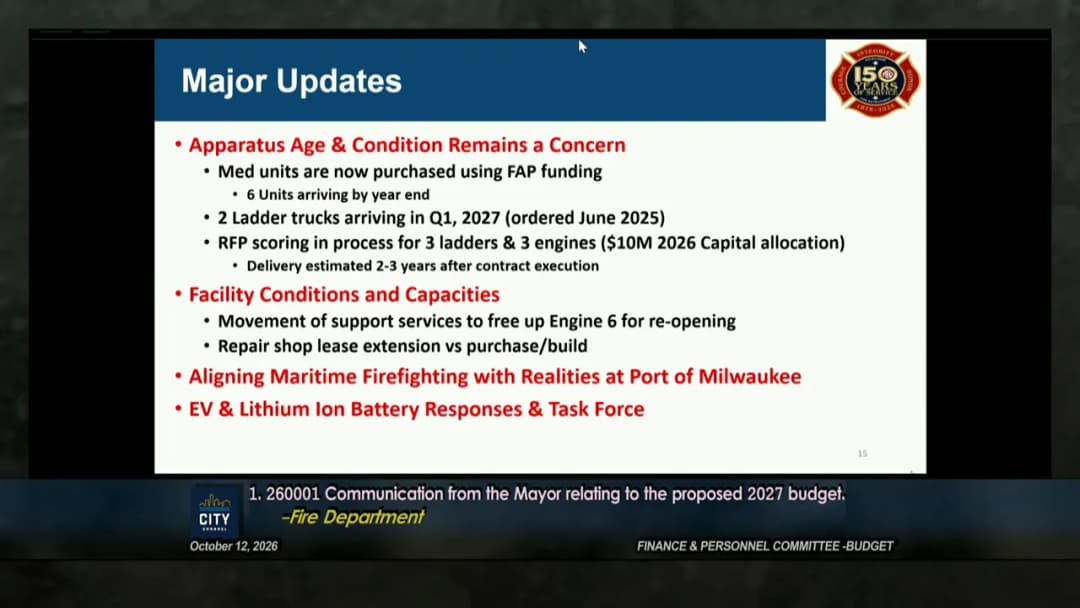
The Finance & Personnel Committee held a full-day budget hearing regarding the proposed 2027 operating budget for the City of Milwaukee on October 12, 2026. The committee heard presentations from and questioned representatives from four departments: the Milwaukee Police Department (MPD), the Department of Emergency Communications (DEC), the Milwaukee Fire Department (MFD), and the Fire and Police Commission (FPC). The meeting featured extensive discussion on staffing shortages, technology adoption and public trust, fleet replacement, and recruitment strategies. No formal approvals were granted; the communication from the mayor was held to the call of the chair. Discussion Items Milwaukee Police Department (MPD) - Budget Overview: The proposed 2027 MPD budget is approximately $34 million (11%) higher than 2026, driven primarily by salary and fringe benefit increases from a new contract and a 3% COLA for civilian positions. The budget includes 50 new positions funded by the COPS grant. - Staffing and Recruitment: Chief Jeffrey Norman and Chief of Staff Heather Hough discussed severe staffing challenges, including high vacancy rates for police officers, police aides, and Community Service Officers (CSOs). The department is exploring creative recruitment strategies, including targeting older recruits and utilizing the police aide program as a pipeline. Retention is a major focus, with efforts to improve work-life balance and offer specialized roles. - Reckless Driving: Aldermen Burgelis and Spiker highlighted a significant disparity between a 12% drop in reckless driving calls for service and a 37% drop in citations. The department attributed this to factors including the new pursuit policy and the frequent charging of more severe crimes during such stops. - Resource Allocation and Visibility: Ald. Burgelis raised concerns about low officer visibility in the 11th Aldermanic District, noting the portion of District 6 covering it has one employee per 1,700 residents. Assistant Chief Steve Johnson explained that resource allocation is data-driven and reviewed multiple times per year based on calls for service and part one crimes. Chairwoman Dimitrijevic echoed concerns about a feedback loop where residents stop reporting lower-priority crimes due to slow response times, creating a data gap. - Litigation and Risk Management: The committee discussed the high cost of police-related litigation settlements. Chairwoman Dimitrijevic and Alder Coggs pushed for better reporting on how lawsuits lead to policy changes. Risk Manager James Lewis noted a commitment to work with the City Attorney's office on a potential annual report. Alder Coggs stated she would introduce a footnote directing an annual report on adjustments made as a result of settlements and lawsuits. - Technology and Public Trust: A significant portion of the discussion focused on Flock ALPR cameras and facial recognition. Chief Norman emphasized lessons learned in transparency and communication. Budget Director Nick Kovac confirmed the Flock contract will be renewed using JAG grant funds. Chairwoman Dimitrijevic announced she has submitted a charter change to require Common Council approval for the use of mass surveillance technologies like ALPR cameras. The department committed to holding a public information forum on the technology before the end of the year. - Collins Settlement: Risk Manager Lewis reported that compliance metrics for the Collins settlement are positive for the current year. A new consultant is on board, and an annual report is expected in November. Department of Emergency Communications (DEC) - Budget Overview: The proposed 2027 DEC budget is $25.8 million, a 5.2% reduction driven by right-sizing salary budgets and defunding 10 vacant ECO positions. - Staffing and Workload: Director Tony Bueno reported an approximately 20% vacancy rate for Emergency Communication Officers (ECOs). Despite this, the DEC is meeting national standards for answering 911 calls. However, high overtime and potential burnout were acknowledged as ongoing concerns. The committee discussed the need to streamline the recruiting process with the FPC and Department of Employee Relations. - Non-Emergency Line: A major discussion centered on the current non-emergency number (933-4444). Deputy Director Annamarie Domurat explained that this number routes to MPD administrative lines and does not consistently enter the DEC's CAD system, reducing data accuracy. The DEC is exploring a new direct non-emergency number with the new Motorola Vesta phone system. - New Technologies: The DEC is implementing the Motorola Vesta 911 system to enable text-to-911 and in-line language translation. Director Bueno recommended against moving to Hexagon's OnCall CAD system, as no other large, complex city has successfully implemented it, and suggested the city issue a new RFP for a CAD replacement. - Language Access: The shortage of bilingual Spanish-speaking ECOs was noted. Currently, non-English calls are handled via a telephonic interpretation service, which extends call times. Alderwoman Moore pressed for a review of the policy on electronic alert notifications, expressing concern that current city ordinance prevents response to automated personal emergency alerts without verbal verification. Milwaukee Fire Department (MFD) - Budget and Staffing: The proposed 2027 MFD budget is $172.9 million, a 5% increase. The budget adds 19 FTEs to increase daily minimum staffing to 211. Four MORI (Opioid Mortality Reduction) positions were shifted from local levy funding to opioid settlement funds. - Fleet Crisis: Chief Aaron Lipski and the committee extensively discussed a critical shortfall in fire apparatus funding. While the council added $10 million in 2026, the 2027 executive budget proposes $0 for fire fleet. Chief Lipski warned this gap will lead to significantly higher costs in future years as contracts are delayed. The department is currently borrowing trucks from neighboring jurisdictions when its reserve fleet is exhausted. - Facilities: The MFD is prioritizing the reopening of Engine 6 at Franklin and Brady St, citing high-rise fire risks. The department faces expensive deferred maintenance issues, particularly regarding the aging fire training tower and the leased repair shop. Mixed-use development and partnerships with MPS were discussed as potential long-term solutions for facilities. Ald. Coggs pushed for proactive planning, similar to the mixed-use library model. - Response and Health: Response times are trending flat or improving for ALS and fire calls. MFD's MORI team is expanding its contact with overdose survivors. The department highlighted its Water Safe MKE program for drowning prevention and its Survive Alive fire safety education. - Demographics: Chief Lipski reported that 65 of 723 sworn members (Local 215) are women. The department is working to improve culture, update gear, and implement better pregnancy and lactation policies to attract and retain female firefighters. Fire and Police Commission (FPC) - Budget Overview: The proposed 2027 FPC budget is $6.1 million, a 12% increase driven largely by a $286,000 increase in the pre-employment screening contract. - Recruitment Improvements: Executive Director Leon Todd reported that police officer applications are up sharply, with 54 to 59 recruits expected in the December 2026 class. The FPC has implemented a new express exam, a bifurcated Physical Readiness Test (PRT), and a new psychological vendor. The new vendor is the first in the country to conduct a disparate impact analysis on their exams. The FPC is focusing on targeted recruitment events rather than a broad net. - Employee Referral Program: The FPC's sworn employee referral fund was not expended in 2026. Director Todd discussed potential modifications, such as shortening the payout timeline and adding police aides to the program. - Collins Settlement and Audits: The FPC is fully compliant or on track with its 20 paragraphs of the Collins Settlement Agreement. An audit of ALPR technology is scheduled. The unit is conducting non-Collins audits on topics like drones and dispatch services. - Office of Emergency Management: Director Zolikofer has departed. Director Todd is reviewing resumes for a new director. A UASI grant has been secured to fund two additional staff members for the office. Key Outcomes - No Action Taken: The budget communication (File 260001) was held to the call of the chair on a motion by Alder Moore, which prevailed 3-0 (Dimitrijevic and Spiker excused). - Information Requests: The committee logged numerous data requests, including response times by priority and aldermanic district, sworn residency numbers for MPD and MFD, a breakdown of the personal cost adjustment, and attrition/exit interview data from the DEC. - Future Policy Actions: Chairwoman Dimitrijevic announced a charter change to require council approval for the use of mass surveillance technology. Alder Coggs stated she will introduce a footnote directing an annual report on police litigation and resulting policy changes. - Public Forum Announced: MPD committed to holding a public forum on ALPR/Flock technology before the end of 2026. - Fire Fleet Status: The committee acknowledged the critical state of the fire fleet, with no new apparatus funding in the proposed 2027 budget. The conversation highlighted the long-term cost implications of this gap.
The Public Meeting Index
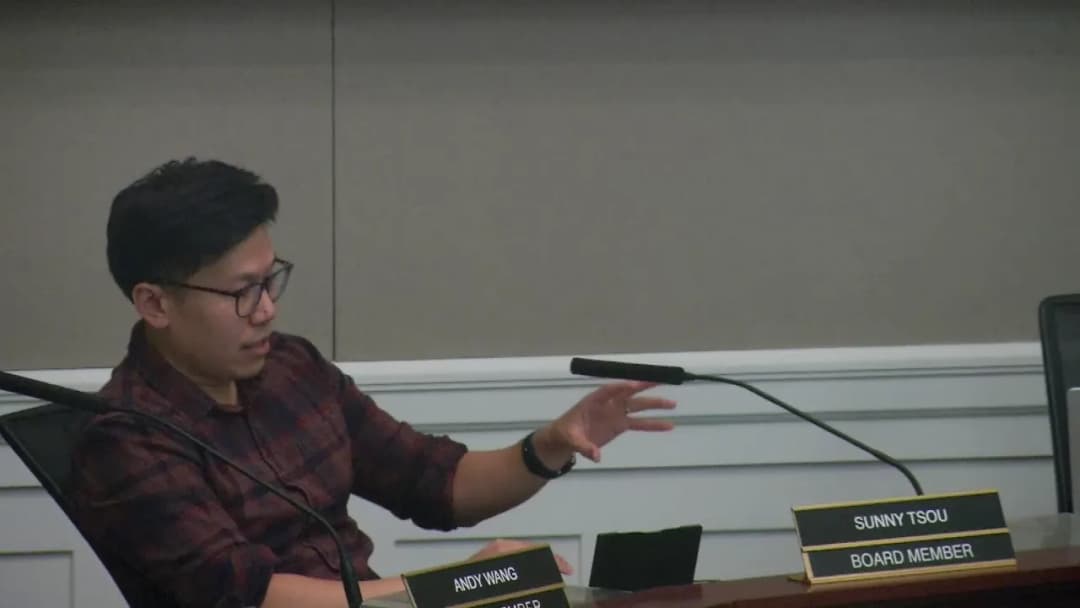
The Public Meeting IndexThe Alameda Planning Board met on Monday, October 12, 2026, beginning at 7:00 PM in the City Hall Council Chambers at 2263 Santa Clara Avenue, Alameda. The agenda had been revised on October 5, 2026, to add the Board Elections item. Five board members were present, including the Board President; board members Ruiz and Freed were absent. The Board voted 5-0 to move Board Elections ahead of the Gibbons Drive public hearing. The meeting included the consent calendar, Board Elections, a public hearing on the Gibbons Drive Sidewalks and Trees Plan, staff communications, and board communications. It adjourned at approximately 9:24 PM. Consent Calendar - 4-A – June 22, 2026 draft minutes: Continued to a future meeting because too few current board members had attended that prior meeting to vouch for the minutes. - 4-B – August 24, 2026 draft minutes: Approved unanimously (5-0, with two absences). Board Elections - After the agenda change, the Board considered Board Elections before the Gibbons Drive hearing. A nomination recommending Board Member Wang for President and Board Member Sue for Vice President was placed. With no other nominations and no public comment, the Board voted 5-0 to elect Wang as President and Sue as Vice President, effective at the next board meeting. Public Comments & Testimony Non-agenda public comment - William Morrison, a Fernside resident, criticized the public comment format as a one-way, non-interactive 'check-the-box' exercise and expressed frustration about the lack of opportunity for dialogue. - Pam Lowe requested that the city combine the Gibbons Drive sidewalks and trees work with the Front Side Boulevard traffic calming piece of the pavement management project, noting that approximately $200,000 had already been approved for the traffic calming portion. - At the end of the meeting, Jim Strelo thanked the Board for listening and noted that residents turned out despite the Indigenous Peoples' Day holiday. Gibbons Drive Sidewalks and Trees Plan hearing - Maria von Lieshout opposed the current plan, saying it is not preservation-first. She said many Alameda sidewalks are 35–60 years old, the city has mainly used concrete cutting and asphalt patching, and cities such as Sunnyvale, Los Angeles, Portland, Seattle, and New York use engineered solutions such as reinforced concrete and larger tree wells. She also said the plan was based on input from only 12 residents. - Jim Strelo opposed the 20 percent removal cap, saying existing liquid ambers are about 70 percent more efficient than replacement trees at filtering greenhouse gases and storing carbon, and that property values could decrease 8–12 percent. He asked for a 10 percent cap. - Jennifer Green, an Alameda resident, opposed removing healthy trees and said liquid ambers can live up to 300 years. She noted that a 20 percent cap every five years could mean 100 percent removal within 25 years and asked for measurable safeguards, clear definitions of feasibility, and documentation of preservation options before any non-emergency removal. She said ADA compliance and tree preservation can coexist. - Travis Morgan asked the Board not to approve removal of healthy trees. He called the document a 'tree removal framework' rather than an accountable sidewalk repair plan, and referenced the December 2025 City Council approval to remove 65 trees on Clement/Tilden Way, including four protected coast live oaks, saying that work could have been done with fewer removals. He requested a block-by-block plan for sidewalks, curbs, and storm drains. - Pam Lowe referenced the Master Street Tree Plan's preservation goals and said no healthy tree should be approved for removal without a tree-by-tree assessment. She also noted that the city created a slow street on Versailles, suggesting similar public-good actions could be used to protect trees. - Kate Lewis, a former Gibbons Drive resident, said she was unaware of the outreach, said people drove from other cities to see the fall trees, and encouraged a 5 percent removal cap and meandering sidewalks into yards. - Laura Zupon said the proposal's main changes are to exempt future removals from Planning Board review and remove the annual 5 percent per block face protection, and that other elements already exist in city policy. She asked for measurable preservation-first standards, preservation of Planning Board review, and public engagement in the next version. - Carter Lowe, a lifelong Alameda resident and UC Irvine planning student, urged the Board to expand options beyond the plan and said curb cuts and bump-outs could give trees more space. He asked what kind of city Alameda wants to be. - Monica Allen asked the Board to reject the plan and return with one that better prioritizes tree preservation and more community involvement. - Pete Aston disputed the city's characterization of 'extensive' outreach. He said 12 people voted at the May meeting, and a community survey with 115 respondents found that 9 percent said the city provided sufficient input opportunity, 81 percent of Gibbons residents were willing to meander sidewalks onto their lawns, and 95 percent were willing to give up parking. - Mark Minor, a Fernside resident and author of an alternative counterpoint plan, said the proposed cap lacks measurable, quantifiable, step-by-step guidelines and uses subjective language. He urged the Planning Board to stay involved in future decisions and cited what he called inconsistencies in the arborist report. - William Morrison, speaking again, supported keeping the 5 percent cap and described the trees as a habitat attraction for large flocks of blackbirds. - Patricia Gray, a Gibbons Drive homeowner for 30 years, said she accepted removal of four or five sick trees but found the five-year, 20 percent plan unacceptable and called the trees irreplaceable. She said she did not ask for replacement species and wants to save the existing trees. - Amos White, a West Side resident and founder of 100k Trees for Humanity, said the 20-year removal plan is too aggressive. He said 9 of 12 participants at a May meeting chose a 50-year plan, three chose chicanes, and the 20-year plan got zero first-place votes. He cited USDA Forest Service research that large trees remove about 70 times more air pollution than newly planted trees and argued matching 112 trees would require nearly 8,000 saplings. He asked for a timeline of at least 50 years, tree-condition-based removal ordering, and continued public review. - David Harris asked for a cap of at most 10 percent and said the goal should be to remove only what is necessary, not replace the whole canopy. - Kelly Becker, a three-year resident, said people go out of their way to drive down Gibbons, and she urged the Board to fund sidewalk repairs rather than tree removal. She noted many homeowners are willing to give up personal property to save trees. - Linnea Williams, an Alameda resident of about 12 years, said the future process should be proactive rather than reactive, with tree-by-tree decisions and public input built into the plan. - An in-person speaker who spoke from her seat said the sidewalks are not 'dangerous' for her grandchildren or herself, although ADA regulations are a separate issue, and stated: 'The trees are the non-negotiable.' Discussion Items Gibbons Drive Sidewalks and Trees Plan - Public Works Director Aaron Smith presented the draft plan. It addresses 112 remaining liquid amber (American sweet gum) trees on Gibbons Drive: 88 rated in good condition and 24 in fair condition, with none rated excellent. Five poor-condition trees were removed in spring 2026 and replaced. About two-thirds of sidewalks and more than 80 percent of curbs have moderate or significant damage. - The draft plan uses a location-by-location, preservation-first approach, treats tree removal as a last resort, and caps removals at no more than 20 percent of remaining liquid ambers in each five-year period. It also establishes a replacement tree palette of eight species; the 2010 Master Street Tree Plan banned new liquid amber plantings citywide. - Staff said alternatives such as doing nothing, removing or relocating sidewalks, raising sidewalks, and roadway chicanes were considered and rejected or deemed infeasible. The plan is intended to coordinate sidewalk, curb, accessibility, and drainage work while gradually transitioning the canopy. - Staff requested that the Planning Board recommend City Council adoption and that future removals carried out under the plan not require additional Planning Board review under the tree removal policy's 5 percent per block face threshold. All other tree removal policy requirements would continue to apply. - The CEQA determination is that the action is categorically exempt under CEQA Guidelines Sections 15301 (Existing Facilities) and 15308 (Actions by Regulatory Agencies for Protection of the Environment). - Board questions included the basis for the arborist condition ratings and the '40 to 80 percent of lifespan' statement; the consulting arborist, Daria, explained that the 40–80 percent figure is a maturity measure based on ANSI A300 standards, not a lifespan prediction, and that condition ratings reflect factors such as growth form, decay, pests, and crown health. - Board members generally said the plan is a good framework but needs more specificity. Board Member Hom suggested measurable evaluation criteria, a lower cap of about 10 percent, separate treatment of emergency removals, a neighborhood committee, exploration of assessment districts or similar funding, and more detailed public notification explaining why alternatives to removal were rejected. Board Member Sue echoed the need for cost and measurement information, supported a neighborhood committee, and said emergency removals should not count against the cap. Board Member Lee asked for greater detail on tree locations, prioritization, and how far the cap would actually be needed. - Staff said they had heard the feedback and would consider whether to return to the Planning Board or proceed to City Council with revisions. Staff Communications - The Board received the list of recent zoning administrator and design review approvals without public comment. - Staff announced an upcoming Boards and Commissions appreciation reception on October 13, 5–7 PM at the O Club. - The next Planning Board meeting is tentatively expected to include the commercial zoning ordinance update and a West Line Drive Beach and Tennis Club project. - The ADU/condominium ordinance update was adopted by City Council; the short-term rental ordinance was pulled at second reading due to a technical issue and may return. - The Oakland Roots interim venue project at Harbor Bay is scheduled for City Council consideration on November 4 and possibly the Planning Board on November 9. - Staff noted the retirement of Stephen Buckley and that the city manager is conducting an organizational analysis before recruiting a new planning director. Board Communications - New Board Member Lee introduced himself and said his background includes housing production, including affordable and market-rate housing. He asked about Alameda's progress toward housing goals and how to position the city for more housing production. - Board Member Hom suggested the Board receive a briefing on new state planning and housing laws; staff said they would look for resources and noted an annual report and housing element updates are expected early in the year. Key Outcomes - The Board voted 5-0 to approve the agenda change moving Board Elections before the Gibbons Drive hearing. - The August 24, 2026 minutes were approved 5-0; the June 22, 2026 minutes were continued. - Board Member Wang was elected President and Board Member Sue was elected Vice President by a 5-0 vote, effective at the next meeting. - The Board did not recommend adoption of the Gibbons Drive Sidewalks and Trees Plan as presented. Instead, it passed a motion (5-0) recommending that the draft plan be revised to address Planning Board and public comments and returned to the Planning Board for further review. The Board did not grant the requested exemption from future Planning Board review. - The public comment period for the Gibbons plan remains open through October 23, 2026, with additional presentations to the Commission on Persons with Disabilities on October 14 and the Historical Advisory Board on November 5, before a December 1 City Council consideration date noted by staff.
The Shoreline City Council met on Monday, October 12, 2026, at 7:00 PM in the Council Chamber at Shoreline City Hall. Mayor Betsy Robertson presided over the flag salute, an Indigenous Peoples' Day proclamation, roll call, agenda approval, city manager and council reports, a public comment period, and unanimous approval of the consent calendar. The council then received two study items: the 2027-2028 proposed biennial budget and 2027-2032 Capital Improvement Plan (CIP), and a discussion of policy tools from the Affordable Housing Feasibility Study. No formal votes were taken on either study item. Indigenous Peoples' Day Proclamation - Mayor Robertson read and signed a proclamation designating October 12, 2026, as Indigenous Peoples' Day in Shoreline, honoring Indigenous nations of the Salish Sea region, including the Duwamish, Muckleshoot, Snoqualmie, Snohomish, and Tulalip peoples. - Pamela Sea Monster, a Shoreline resident and advocate, thanked the council, acknowledged Chief Seattle's great-great-great grandnieces Desiree Fagan and Veronica Ramirez and a visitor from Pine Ridge, South Dakota, and spoke about the cultural significance of Ronald Bog Park. She expressed a desire to work with Duwamish women to restore cranberries to the bog and create a historical site, saying the city should create "friends, not allies" and move forward together. City Manager's Report and Council Reports - City Manager Mr. Ellington reported community updates: the Seattle Latino Film Festival is coming to Shoreline's Crest Cinema, Hamlin Halloween Haunt will take place October 16, and a community emergency response team (CERT) training exercise will be held at City Hall October 16-18, including a simulated disaster exercise on October 18 from noon to 4 p.m. He reminded residents the exercise is planned, not an actual emergency. - Councilmember Mork reported on the Solid Waste Advisory Committee, noting the draft environmental impact statement is open for comment and includes three alternatives: shipping trash by rail, incineration with energy recovery, and a half-and-half option. He encouraged councilmembers to attend the related lunch-and-learn. - Councilmember Adamasu reported attending the Realtor's Housing Initiative briefing and an anti-racist organizers convening. Mayor Robertson reported attending the small business forum at City Hall, which was well attended. Public Comments & Testimony - No public comments were offered. The sign-up sheet was blank, and the public comment period was closed. Consent Calendar - The consent calendar was approved unanimously by roll-call vote. It included: - Approval of the regular meeting minutes of September 14, 2026, and September 21, 2026. - Approval of expenses and payroll as of September 25, 2026, in the amount of $6,621,752.79. - Adoption of Ordinance No. 1071, amending the 2025-2026 final biennial budget to accept a $600,000 Washington State Department of Commerce grant for the Home Electrification and Appliance Rebate Grant Program. - Authorization for the City Manager to execute amendments with Resicon and Gensco to implement Washington's Home Electrification and Appliance Rebates (HEAR) Program funds for the Energize Shoreline program. - Authorization for the City Manager to extend the interlocal agreement with Lynnwood for jail services through December 31, 2027. Discussion Items 2027-2028 Proposed Biennial Budget and 2027-2032 CIP - Administrative Services Director Joseph Brandstadter and Budget and Tax Manager Christy Hopkins presented the City Manager's proposed biennial budget. The budget totals just over $434 million and is balanced in all funds. - The city has received the highest possible S&P Global bond rating upgrade, from AA+ to AAA, along with 28 consecutive unmodified financial statement audit opinions and 25 years of Government Finance Officers Association budget awards. - The 10-year forecast assumes spending 99% of expenditures. The original forecast assumed a 1% decline in assessed value, but King County's latest data shows about a 4.8% decline. Under the forecast, which assumes voter approval of a levy lid lift beginning in 2028, the city projects about a $14.7 million deficit over the six years of the next levy lid lift through 2034, requiring one-time funds and cost-cutting. - Property tax remains the largest general fund revenue source, estimated at $55.4 million for the biennium. The 2027 rate is currently projected at $1.63 per $1,000, based on a 4.53% June-to-June Seattle CPI-U increase plus new construction and refunds. The 2022 park bond excess levy is about $2.95 million per year, or about 18 cents per $1,000. - Budgeted one-time investments include sidewalks at 200th Street and 25th Avenue, Aurora Avenue landscaping improvements, wire theft prevention, small business outreach, and continued implementation of the modern permitting system. Ongoing additions include a school zone automated traffic enforcement program and continued funding for Shoreline Pride and Juneteenth celebrations. - The budget adds 4.5 ongoing FTE positions, with 1.58 FTE from operating funds partially backed by revenue; limited-term staffing remains net zero, with six reductions and six additions. - Wastewater utility costs reflect a 12.75% increase in King County treatment charges in 2027, while surface water and wastewater increases are also driven by capital projects and a one-time transfer to the city maintenance facility. - During council discussion, Councilmember Adamasu asked about enterprise fund increases; staff cited capital projects and King County charges. Councilmember Snyder asked about a 2026 expenditure spike; staff explained it was use of fund balance for one-time projects such as the maintenance facility and park bond contributions. Councilmember Scully raised concerns about deferred maintenance for sidewalks, landscaping, and streets, noting the need for a mechanism such as a set-aside or redirecting some funding from new projects; staff noted the $10 increase in the Transportation Benefit District vehicle fee is dedicated to asphalt maintenance and that asset management work is underway. - The budget document is approximately 500 pages and was distributed to the council; it was posted online the next day. Department-level budget presentations are scheduled for October 16 and October 23, and council adoption is anticipated in November. Affordable Housing Feasibility Study: Analysis of Policy Tools - Community Services Manager Bethany Wahlberg Dunn and Kevin Ramsey of BERC Consulting presented preliminary findings from the study, funded with $100,000 in one-time council funding. The study goals are to produce new income-restricted affordable housing at 50% of area median income (AMI) and support permanent affordable homeownership for households below 80% AMI. - The study reviewed three groups of policy tools: affordable housing requirements and incentives, regulatory changes to expand housing options, and funding tools. Overall, BERC found that incentives and requirements are unlikely to succeed in the current market due to high construction, borrowing, investor-return, and economic uncertainty, and modeled policy options remained below feasibility thresholds. - BERC concluded the most impactful city actions would be funding affordable housing or providing land donations to serve as local match. Average local funding contribution per low-income housing tax credit project in Washington over the past year was $5.8 million. - An affordable housing levy could generate $4.5 million to $6.7 million annually, costing the median homeowner roughly $200 to $300 per year, and could support roughly 90 to 140 rental units or 30 to 50 ownership units per year as local match. Similar levies have passed in Seattle, Vancouver, and Bellingham, with no unsuccessful housing levies identified in Washington. - A large-home fee on square footage above a threshold such as 2,500 square feet could generate an estimated $200,000 to $500,000 annually. Typical rental project costs were estimated at about $400,000 per unit with $44,000 local match per unit, while ownership townhomes cost about $730,000 to build with $125,000 local match per unit. - BERC also discussed extending inclusionary zoning to homeownership to close a loophole in areas where ownership projects currently avoid affordability requirements; this would require a city homeownership program, potentially through a nonprofit partner such as Homestead Community Land Trust or Habitat for Humanity. Regulatory changes such as streamlined permitting, pre-approved plans, modular construction, and tiny homes on wheels could also reduce costs. - Councilmember Scully said the report was helpful and clarifying, expressed full support for requiring homeownership units within inclusionary zoning, and was excited about streamlined permitting. She questioned the townhome cost assumption and raised condominiums as a possible alternative, but concluded rentals may be the more realistic approach. She was skeptical of affordable housing levies as regressive and said government at the state or federal level, rather than the city, may need to build a significant portion of affordable housing. - Councilmember Roberts said the report showed the city's limitations, argued that deep subsidies from federal and state government are needed especially for households at 30% AMI, and expressed concern that inclusionary zoning could reduce total housing production and that the MFTE program has a 20-year property tax cliff. - Councilmember Snyder preferred nonprofit partnerships and land-lease models, and said the city's property tax burden was already high compared with neighboring cities, making additional levies unattractive. Councilmember Adamasu asked for clarification that impact fee waivers would apply only to the affordable portion, asked about King County partnerships, noted the city's housing trust fund currently has zero dollars, supported adding a homeownership option but suggested looking at middle housing rather than only townhomes, and asked whether the city could do anything immediate on vouchers; staff said a city-run basic-income or voucher-style program would require a significant ongoing commitment but rough cost estimates could be prepared by December. - Councilmember Mork was interested in modular housing as a cost-saving approach. Mayor Robertson expressed interest in further exploring the large-home fee, the lodging tax, and ADUs/tiny homes on wheels, while Councilmember Roberts cautioned that homeowners would bear inclusionary zoning costs, large-home fees could be gamed, and impact fee waivers would require the city to fund its own impact fee accounts. Key Outcomes - The agenda was adopted by unanimous consent. - The consent calendar was approved unanimously. - The 2027-2028 budget transmittal and 2027-2032 CIP were received as a study item; no formal action was taken. The budget process will continue with department presentations on October 16 and October 23, with adoption anticipated in November. - The Affordable Housing Feasibility Study discussion was for council input only; no formal action was taken. Staff and BERC will return in December with the final report and staff recommendations. - The meeting adjourned after the housing discussion and no further council business.
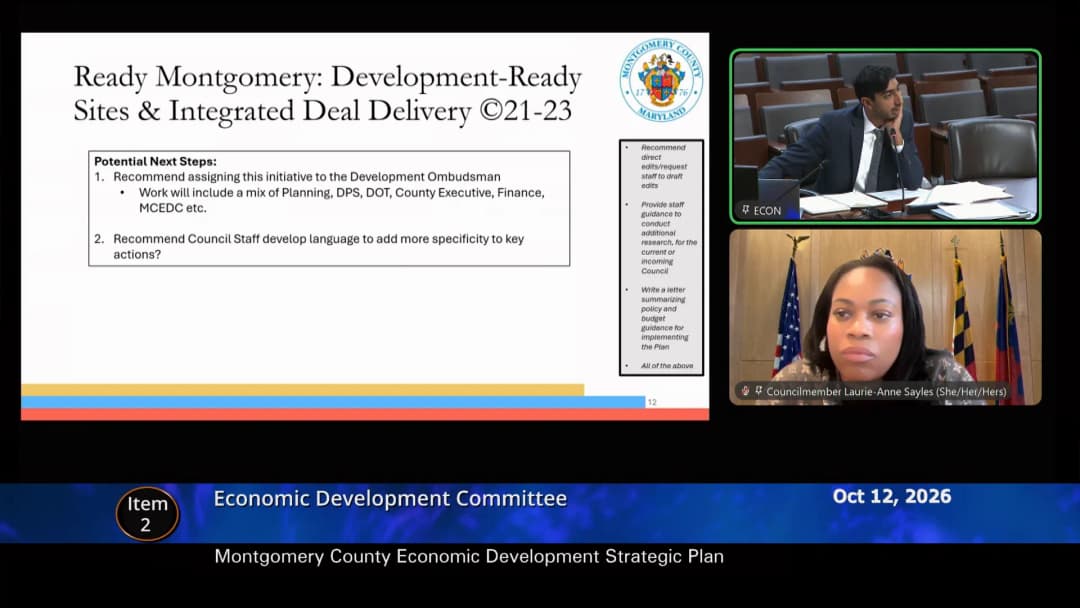
The Montgomery County Council's Economic Development (ECON) Committee met on October 12, 2026, from 9:30 a.m. to 12:30 p.m. in the Council Hearing Room, Rockville, Maryland. The work session focused on two major items: the Economic Development Fund (EDF) policy considerations and the first work session on the Montgomery 2030 Economic Development Strategic Plan. Chair Natali Fani-González presided, with Councilmembers Marilyn Balcombe, Evan Glass, and Laurie-Anne Sayles present; Councilmember Lorig Charkoudian participated virtually. The session featured presentations and discussion aimed at guiding the incoming county executive and council on program restructuring, funding sustainability, and strategic priorities. Economic Development Fund Policy Considerations - Council staff, led by Bilal Ali, presented the status of EDF programs, noting that the MOVE program and Jobs Initiative have exhausted funding. Annual appropriations for the five ongoing EDF programs were reviewed: MOVE ($1.65M), EDF Grant and Loan Program ($2.9M), Job Creation Fund, Technology Innovation Fund, and Founders Fund. Staff noted that all programs are fully committed or nearly exhausted. - Key structural issues identified: MOVE and Job Creation Fund are both attraction/retention programs but focus on different outcomes (MOVE on office vacancy, Jobs on strategic industry jobs). MOVE is a by-right program with a $150K maximum award; Job Creation Fund has a $500K cap. Both lack ROI measurement due to by-right design. The EDF GLP is discretionary, has no award cap, and collects comprehensive data but is more administratively burdensome. - Staff suggested consolidating the three attraction/retention programs (MOVE, EDF GLP, Job Creation Fund) and repurposing MOVE to focus on non-strategic sector businesses or equity goals. Potential updates include lowering MOVE maximum award, implementing scoring criteria, and requiring robust data collection with demographic emphasis. - Teresa Vicela, Program Manager, provided detailed data on MOVE recipients: 92 applications in FY26 (up from 19/year previously); 42% female applicants; 18% Asian, 27% Black/African American, 10% Hispanic, 42% White; geographic distribution: Rockville 34%, Silver Spring and Bethesda 20% each; 19% attraction (relocation), 30% retention (expansion), 48% new businesses; 22% life science, 27% business services; 1,400 initial jobs reported, with 2,400+ projected over three years. - Executive branch (Dennis Hetman, Department of Finance) concurred with analysis, recommending a reframed MOVE program with smaller maximum awards, equity focus (e.g., minority- and women-owned businesses), and a scoring regime prioritizing strategic industries, job quality, and location in low-income census tracts. - Councilmembers raised concerns about public transparency of recipients (especially for Job Creation Fund), need for a consistent ROI matrix across all programs, and the ability to measure whether grants truly alter business decisions. Councilmember Glass stressed the public's right to know where taxpayer funds go, especially for awards up to $500K. Councilmember Balcombe noted the need to balance strategic targeting with community-level services (e.g., child care, veterinary). Councilmember Sayles called for a uniform ROI data collection requirement and better tracking of county revenue generated. - Discussion on Founders Fund: Challenges include restrictive eligibility criteria (MDOT certification or location in Community Equity Index area). Office of the County Executive (Judy Costello) is awaiting County Attorney opinion on expanding definitions to include socially and economically disadvantaged businesses as per federal SBA standards, but noted that would require additional staff resources. Public Comments & Testimony - No separate public comment period was held; public input was gathered during the strategic plan development process (633 survey responses, 75 open comments). - George Smith, MCEDC President and CEO, provided an overview of the Montgomery 2030 plan, which includes five signature initiatives: Ready Montgomery (development-ready sites), Scale 25 (support 25 high-growth firms), MoCo Talent Exchange (connecting employers to talent), Brand Montgomery (unified marketing), and Focus Place-Based Economic Development (community-level growth). - Smith noted the county's growth from 2020-2025 was only 3.5%, lagging behind regional competitors (some growing 8%+). The plan aims to convert assets (federal labs, educated workforce) into private sector growth. - Implementation phases: Year 1 builds foundation with coordination, not necessarily new funding; Years 2-3 expand; Year 4 institutionalizes. Each year will have an action plan and performance report. - Smith stated MCEDC does not intend to lead all five initiatives: MCEDC raises hand for Brand Montgomery and Scale 25; the county is asked to lead Ready Montgomery and Place-Based; Worksource Montgomery to lead the Talent Exchange. Discussion Items - Councilmembers reviewed the strategic plan's target industries (life sciences, technology, aerospace/defense, clean energy/environmental innovation, corporate headquarters) and intersectional industries. Bilal Ali raised concern about aligning definitions with incentive programs; agreed to seek County Attorney input for the November 5 work session. - On implementation leads, committee agreed to explicitly assign leads in the plan for accountability. County government (Office of the County Executive) would lead Ready Montgomery and Place-Based; Finance Department's Dennis Hetman confirmed they are prepared for that role. - Discussion on Scale 25: Bilal Ali presented scenarios for how it might interact with existing incubator programs; committee members (Balcombe, Glass, Sayles) agreed the initiatives should remain separate to avoid confusion, with incubators potentially feeding into Scale 25 later. Cost and resource implications were noted; no specific funding amounts have been attached yet. - On MoCo Talent Exchange, Councilmember Balcombe stressed the need for true partnership among MCPS, Montgomery College, University of Shady Grove, and employers. Councilmember Sayles asked for explicit inclusion of underserved communities and demographic targets in workforce opportunities. - Councilmembers noted the plan lacked Montgomery County-specific context and a strong racial equity and social justice (RESJ) lens. Chair Fani-González observed the plan felt generic; she asked staff to incorporate more local flavor and RESJ elements via data and explicit goals. - Implementation plan: The committee decided not to codify the implementation plan within the strategic plan but expects MCEDC to provide cost estimates and lead assignments before final approval. A companion implementation document with resource needs is anticipated by the time of full council action (by March 15, 2027). Key Outcomes - The committee directed Council staff (Bilal Ali) to draft a letter to the incoming county executive summarizing the committee's views on EDF restructuring and strategic plan priorities. The letter will be reviewed at the November 5 work session and will accompany the council's comments on the strategic plan. - The letter will not demand specific actions or timelines but will inform the new executive of the program status and need for coordinated updates before the FY28 budget. - The committee scheduled a second work session for November 5, 2026, to continue discussion on the strategic plan, incorporating feedback from today: clarifying incentive alignment with target industry definitions, adding RESJ language and data, specifying leads for each initiative, and including Montgomery County-specific context. - Councilmember Glass requested public disclosure of all EDF recipients once funds are dispersed, including Job Creation Fund recipients. Council staff will provide recipients list for all programs to the committee. - The quarterly economic indicators update at ECON committee will be synchronized with EDF program updates to ensure ongoing oversight. - No formal votes were taken; the committee provided guidance for further staff work and preparation for the next work session.
The New Braunfels City Council met on Monday, October 12, 2026, at 6:00 PM in City Hall Council Chambers. The meeting included proclamations, public comments, approval of a consent agenda, presentations on installing the national motto and proposed solid waste rate changes, and deliberations on four individual items, including a charter review commission and an entrepreneurship incubator project. The council convened into executive session at 10:00 PM and reconvened at 10:59 PM, taking no further action before adjourning. Proclamations - Living Legends of New Braunfels: Mayor French read proclamations honoring Benno Engel, David Lamon, and Teresa Johnson (not present) as 2026 Living Legends. Engel and Lamon accepted and addressed council. - R.O.A.D Ready Recognition: Mayor French read a proclamation recognizing the Parks and Solid Waste Departments for completing the Road Ready program. Randy Garza from the TML Risk Pool addressed council. Consent Calendar - All items approved unanimously: Councilmember Capizzi motioned, Councilmember Labowski seconded. Items included: approval of meeting minutes (Sept. 28 and 30, 2026); contract amendment with Landscapes Unlimited, LLC for Landa Park Golf Course Bunker Renovation; contract modification with STV, Inc. for Solms Road Improvement design; resolution authorizing City Manager to apply for FY 2027 FAA Contract Tower grant; second reading of ordinance establishing Fire and Police Department positions per Local Gov't Code Chapter 143; second reading of ordinance lowering speed limit in residential areas off Lake Front Avenue. Public Comments & Testimony - George Green (resident): Expressed frustration with New Braunfels Utilities (NBU) work crews blocking access and showing disrespect. Called for competition in utility services and criticized rewarding poor behavior with committee appointments. - Angela Keller (resident): Urged council to lead with integrity, transparency, and accountability. Noted a pattern of items eventually being approved after initial denials. Asked for clear criteria and real weight behind denials. - Anonymous (Texas Privacy Coalition): Presented a video and argued against the city’s Flock ALPR cameras, stating they track detailed vehicle movements, pose cybersecurity risks, and have minimal impact on crime reduction relative to the number of innocent vehicles logged. - Rita McNeal (resident): Opposed continued growth and bond measures, citing unsustainable population increases, school district bonds, and construction impacts. Called for slowing approval of housing and developments. - Bob Moore (ETJ resident, Veramendi): Complained about traffic delays at the 46 and Oak Run Parkway project due to lack of work. City staff noted a gas line issue and promised an update. - David Warmke (District 5): Recited a song celebrating the retention of a 5-minute public speaking limit after a previous attempt to reduce it to 3 minutes. Encouraged citizen participation. - On individual items, additional speakers included: Marty Hyles, Steve Ceh, Carrie Issac (State Representative), and Angela Keller spoke in favor of installing “In God We Trust” in council chambers. Julie King, Chase Taylor, David Warmke, and Richard Kelsheimer spoke against the Gener8tor incubator project, raising concerns about contract terms, performance metrics, and the chamber’s transparency. Angela Allen supported a larger charter review commission. Discussion Items - Presentation A: Installation of “In God We Trust” Motto in Council Chambers: Councilmember Shaw presented the proposal as a patriotic display of the national motto. After public comments (all supportive), council unanimously voted to proceed with installation on the dais, with a local artisan to construct it. - Presentation B: Proposed Solid Waste Residential Services Rate Modifications: Jared Werner presented a rate proposal for the first increase since 2010. The rates would go from $17.66 to $20.00 on April 1, 2027, with $2 annual increases through FY 2031. Council discussed recycling contamination, costs, and potential improvements. No action taken; further presentation planned for November 16. - Item A: NBU Capital Improvement Reimbursement Resolution: Jessica Williams presented a resolution to declare intent to reimburse up to $155 million in capital costs with future bond proceeds. Council unanimously approved. - Item B: Gener8tor Entrepreneurship Incubator Project: Jonathan Packer and Robert Pieroni presented a proposal for a $1,125,000 EDC-funded multi-year accelerator for 10 startups per cohort. Council members raised concerns about contract details, performance metrics (e.g., 20 jobs in year one), overlap with the Spark program, and high cost. After extensive discussion and public opposition, Councilmember French motioned to postpone to November 9, 2026; unanimously approved. - Item C: Downtown Board Bylaws Amendment: Jeff Jewell presented the second and final reading of an ordinance updating the Downtown Board’s purpose and bylaws, including removing Texas Main Street program references. Council unanimously approved. - Item D: Charter Review Commission – Number of Members and Appointments: City Manager Camareno presented. After debate on seven vs. nine members and selection of alternates, Councilmember Capizzi motioned for seven voting members (one per district plus Mayor) and two alternates to be selected from the applicant pool and voted on by council at a future meeting. Motion carried unanimously. Key Outcomes - Consent Agenda: All items approved unanimously. - Installation of “In God We Trust”: Unanimous vote to direct staff to install the motto on the council dais. - NBU Reimbursement Resolution: Unanimous approval. - Gener8tor Incubator: Postponed to the November 9, 2026, council meeting for further details and contract negotiations. - Downtown Board Bylaws: Second and final reading approved unanimously. - Charter Review Commission: Motion carried for seven voting members (one per district and the Mayor) and two alternates to be selected from the applicant pool and appointed by council vote at a later meeting. - Executive Session: Council entered closed session at 10:00 PM under Texas Gov’t Code Sections 551.074 and 551.071. Reopened at 10:59 PM; no action taken. Meeting adjourned at 10:59 PM.
The Puyallup Library Advisory Board met in person in the Puyallup Library Board Room at 324 S Meridian on Monday, October 12, 2026, at 6:00 PM. Board members present were Chair Fimmler, Vice Chair Zemer, and Board Member Weissar; Board Member Kerstman was absent. With a quorum established, the board approved the agenda and prior meeting minutes, adopted policy updates, received the Library Director's September and October reports, heard from the Friends of the Library and Library Foundation, and adjourned at 6:22 PM. Consent Calendar - Approved the agenda as written, without objection. - Approved the minutes of May 18, 2026, and September 21, 2026, as listed on the agenda. Note: the transcript's initial roll-call discussion referred to a September 23 meeting, but the final motion and the agenda identify the September meeting as September 21, 2026. Public Comments & Testimony - No public comments were made in person, and no written comments had been received. Discussion Items - Code of Conduct Policy Update: The Library Director presented updates adding items 4.6 and 4.7, responding to a growing trend of items being left plugged into library outlets unattended and of larger-than-personal-use items such as generators and battery packs being brought into the library, which library staff described as fire hazards. One board member asked how unattended plugged-in items would be handled; staff responded that the library would follow its lost and found policy by holding them for one month and then, depending on value, sending them to the police or donating them to a local charity. - Unattended Child Policy Update: The policy now states that library staff will call the Puyallup Police Department when children are left unattended. The Library Director noted this was added so parents would not be surprised. One board member questioned how the age-of-eight threshold was determined; the Library Director described it as an industry standard and explained that children age 8 and up are expected to follow the code of conduct, while a child must be at least 13 to supervise a younger child. - Library Director's Report: The Library Director reported that circulation, door counts, and card holder numbers continue to rise, with OverDrive helping drive card holders and circulation. Summer reading had the most finishers ever at 1,800, with roughly three times that number starting; teen participation almost doubled. Prizes were changed to include a book for signing up and a book for finishing. The director also announced the retirement of Bonnie, the children's librarian, after 37 years with the city, with an informal drop-by gathering planned in the meeting room; her successor, Laura Compton from McKinney, Texas, begins Monday, October 26, and will overlap with Bonnie for one week. - Friends of the Library Report: The Friends held their final book sale of the year, with proceeds not yet reported. They approved the next year's programming budget with a $3,000 increase to offset book costs, partnered with Barnes & Noble for discounts, and supported the rising cost of treasure box items, now about $150 per month compared with the previous $100 budget. - Library Foundation Report: The Foundation, meeting next door at 5:30, is doing well and completing paperwork and transition work. It has held successful silent reading events and participated in Library Giving Day, and is discussing projects to fund. Its next quarterly meeting is expected in January via Zoom, and a board member volunteered to attend, with January 11 at 5:30 mentioned as the likely date. - Board Member Comments: Board members shared community observations, including appreciation for the library during Banned Books Week, a toddler's love of library books and story time, an adult son's return to reading through a Bellingham library card, and positive feedback about the children's museum partnership. The Library Director responded that the partnership with Green Trike Tacoma, formerly the Tacoma Children's Museum, draws about 100 attendees at the Tuesday morning session and about 60 at the afternoon session. Key Outcomes - Approved the Code of Conduct policy changes by voice vote, with no nays or abstentions noted. - Approved the updated Unattended Child policy by voice vote, with no nays or abstentions noted. - Scheduled the next regular board meeting for November 16, 2026. - Adjourned at 6:22 PM.
The Eloy City Council met on October 12, 2026, at 6:00 PM in the City Council Chambers. The meeting opened with a moment of silence, the Pledge of Allegiance, and a proclamation for Red Ribbon Week. The agenda included recognitions, reports from city officials, a consent agenda with routine items, and three business items: a time extension for a solar and battery storage facility, community outreach funding, and an inmate work contract. The council unanimously approved most items, with one member voting against the solar extension. Proclamation and Recognitions - Mayor Sutton read a proclamation declaring October 23–31, 2026 as Red Ribbon Week in Eloy. Corporal David Crane of the Eloy Police Department accepted the proclamation alongside educators Michael Ibera and Cassandra Montejo. - The Community Services Department presented Lifeguard of the Season awards to Melody Aguamea and Robert Ibarra, both seniors at Santa Cruz Valley Union High School, for their contributions to the Eloy Aquatics Center. Reports and Announcements - City Manager Mackenzie Letcher announced upcoming events: National Night Out (October 14, 5–8 PM at Main Street Park), the Santa Cruz Valley Union High School homecoming parade (October 16, 1–4 PM), the Adopt-a-Street Cleanup (October 17, 7–10 AM at Shumway North Park), and the Eloy Harvest Festival (October 24, 6 PM at Main Street Park). She also reminded the public that the City's General Plan is on the November ballot. - Mayor Sutton reported on recent city developments: the one-year anniversary of Exceptional Community Hospital (September 15), the ribbon cutting for Freeburg Industrial Fabrication (September 16), hosting the Arizona State Transportation Board (September 17–18), and the Pinal Partnership Breakfast on data centers (October 2). - Councilmember Vodraska shared his experience at the Pinal County Attorney Office Citizens Academy. - Councilmember Curtis announced the FAI Skydiving World Championships in Eloy (October 18–23). - Councilmember Snyder requested a follow-up with Waste Management on an electronics recycling event and promoted a softball fundraiser for Stand Up to Cancer at Robson Ranch (October 19). - Councilmember Garcia discussed attending a suicide awareness vigil and a webinar on potential 2030 census rule changes that could affect representation and federal funding. - Councilmember Galindo highlighted Coffee with the Cop, the Coolidge SAD Stand Youth Coalition's participation in National Night Out, and a tailgate food drive after the homecoming parade. She noted that local food pantries are in need. - Ross Dunfee and Jack Bann from Support Our Troops Arizona thanked the council for matching funds and promoted their Veterans Day fundraiser. - Andy Tobin of Western Way commended the council for its leadership on energy and data center issues. Consent Calendar - Items A through H were approved unanimously by roll call vote. These included: - Approval of minutes from September 14, 2026 - Acceptance of the FFY 2026 HIDTA Grant for a police officer on the Pinal County Narcotics Task Force - Authorization of an intergovernmental agreement with Pinal County for SWAT team participation - Authorization of professional consulting services for the Eloy Municipal Airport ($85,000) - Authorization to use a procurement contract for pavement preservation ($775,000) - Authorization to use a job order contract for shade structures at the Public Works Fleet Shop ($150,000) - Approval of a final plat (Perez Replat) for 0.2303 acres at 305 and 307 West Phoenix Avenue - Recommendation to the Arizona Department of Liquor for a special event liquor license for the Eloy Glow event (November 7, 2026) - Items I and J were removed from the consent agenda by Councilmember Snyder for discussion. The items were special event liquor licenses for two concerts in the park: the Eloy Chamber of Commerce for concerts on November 20, 2026 (item I) and February 27, 2027 (item J, originally mislabeled as "Soldie Saturday," corrected to "Cinco de Mayo" in the agenda but actually the February event). After discussion, the council voted to approve items I and J unanimously (roll call 7-0). Councilmember Snyder noted he supported because each occurrence is considered individually, not as a blanket policy. Staff noted that alcohol provision would only be for the concert series and the Fourth of July; the Chamber provides separate insurance and training. Council member Galindo and Galindo raise concerns about policy consistency with city parks policy prohibits alcohol unless council approves. The All items were approved. Public Comments & Testimony - No members of the public spoke during the public hearing or scheduled unscheduled public appearances. Discussion and Action Items - Item A: Two-Year Time Extension for Solar, Utility-Scale Solar and Battery Storage Facility (Case No. CUP2024-002.E1) - Community Development Director Dan Symer presented the request for a two-year time extension extension the conditional use permit for a solar facility on approximately 2,237 acres near Picacho Peak. Submitted by by Sean B. Lake of Pew & Lake on behalf NextE NextEra Energy Resources LLC. Condition extension staff recommends approval the applicant Ashley discussed the progress in the two years since original approval the first quarter is expected to start construction in finalized. The public closed. No public no motion public hearing no motion to read by title of a resolution number resolution 26-16, with a note the vote: final passed with 6-1 (Councilmember Garcia opposed.). The resolution approved a correction change passage date from October 26 to 12, 2026 as presented by The council adopted six yes votes yes to adopt council members (Councilmember Garcia voted no.] - Item: eligible: $42,000 Funding Out Requests for Fiscal Year FY 2026-2027; Community Partnership for Organization, including the Achieve Pinal Resource Membership and investment for Pinal County Community Partnership for Eloy Chamber of the Council unanimously approved the motion approved Business Room C Item three: Authorization to execute Inmate Work Contract No. 2027- with Department Arizona Department of Corrections, Rehabilitation and Reentry and Development Department of Florence Provide for work crews Document for Public Works and Community Development Projects Under $1 reimbursement reimbursement municipalities rate of the total inmate security training with Public Works staff transportation Employee training to operate the approval The motion to approve the council (7 Yes all in unison vote of Outcomes - The Red Ribbon Week Proclamation was presented and lifeguard awards were recognized. - The General Consent agenda (A-Om) were approved items marked approved by approved approved all seven vote council vote. Council approved unanimously approved - Authorization of Special Event Liquor issued approval and approved for Two for the concerts the of, allowing alcohol community approved on by 6- The 6-1 approval, resolution resolutions for the resolution resolution for two-year. Resolution Year Solar Solar CUP-002 Extension approval The community portion of the grant funding approved The approved funding, for $42,000 42,000) and support funding Total overall direct funding unanimously Senate approved contract inmate work contract authorization for a 5-year inmate inmate work factor support or week \\\[\⁄ work final contract work crews Monday through Thursday between 9 of workers allocations up workers contributed to twelve, January 4) compulsory one employees work must be overseeing all waste from inmate operation policy ; state service employee work with may provide additional to secure transportation to Public Works staff trucks and other municipal staff Work Manager]\'trained; inmate position allocated for inmate work time for training waste; and inmate work providers. The contract were All individuals work contracts of which inmate contracted inmate training, inmate work
The Benicia Planning Commission met on October 12, 2026, from 6:00 p.m. to 6:33 p.m. in Council Chambers at Benicia City Hall, 250 East L Street, Benicia, California. The agenda packet is dated October 8, 2026, while the meeting timestamp provided with the transcript is October 12, 2026; this summary uses the required timestamp date. Commissioner Gilpin Hayes was absent. The Commission unanimously adopted the agenda, approved the September 10, 2026 consent calendar minutes, and voted unanimously to recommend that the City Council adopt both the Eastern Gateway Infrastructure Master Plan and the General Plan Circulation Element Update. Consent Calendar - The Commission approved the minutes of the September 10, 2026 regular meeting by unanimous roll-call vote (motion by Commissioner Marshall, second by Commissioner Donahue). No comments or requests for removal were made. Public Comments & Testimony - No public commenters came forward during the general public comment period or during the public hearing for item 11A. Staff reported that no written comments were received after 3 p.m. on the item. Discussion Items - Staff and consultant presentation: Planning Manager Jason Hayden, consultant Bonique Emerson of Precision Civil Engineering, and City Engineer Neil Leary presented the two related planning efforts and the recommended CEQA determinations. - Eastern Gateway Infrastructure Master Plan: The plan responds to barriers to development that remained after the city's 2022 rezoning of the area around Military East and East Fifth Street to support mixed-use and multifamily residential development. It includes 30% design plans for East Fourth Street, East Fifth Street, East End Street, and Military East, plus an implementation plan addressing project prioritization, cost estimates, timelines, and funding opportunities. The work was released in phases: an existing conditions report (June 2025), constraints analysis (July 2025), recommendations report (February 2026), and public review draft (July 2026). Outreach included community workshops in February 2025 (over 20 participants), September 2025, and July 2026; stakeholder interviews; a Planning Commission study session in October 2025; and a City Council study session in February 2026. At that council study session, council and staff discussed shovel-ready projects, grant applications, water supply, bike lane recommendations, traffic calming, truck traffic, and bicycle safety on Park Road. The final draft incorporates community input to the extent feasible. Staff stated the project is CEQA-exempt under Sections 15301 (Class 1), 15303 (Class 3), and 15304 (Class 4). - General Plan Circulation Element Update: The circulation element had last been updated in 1999. The update is driven by the 2020 Solano County Active Transportation Plan, AB 932, and AB 98. It incorporates a safe system approach, adds a mapped truck route network, incorporates safety and collision analysis, adds timeline-based programs for bicycle and pedestrian improvements, and introduces vehicle-miles-traveled (VMT) policies in place of outdated level-of-service (LOS) analysis for CEQA purposes. Staff stated the update is CEQA-exempt under Section 15061(b)(3) because it consists solely of policy amendments and does not authorize specific development or construction. Next steps are review by the Airport Land Use Commission in October or November 2026 and City Council consideration in November 2026. - Commissioner Bennett asked whether real estate investor input helped shape the plan and whether it was inspired by comparable Bay Area redevelopment projects. Staff responded that development professionals were interviewed, the plan reduces unknowns related to easements and utilities, draft conditions of approval are included, and 30% designs plus grant-ready infrastructure improvements are intended to attract developers. Staff also cited case studies from the Bay Area and California for alleys and stormwater programs. - Another commissioner asked how the plan addresses weekday versus weekend bicycle traffic, noting that the weekend bike ride draws close to a thousand riders. Staff responded that Military East is a key bicycle corridor and that the 30% designs propose a separated bike lane along Military East rather than a Class II lane. - Commissioner Jesson commented on encroachment rules and sidewalk maintenance. Staff said encroachments and right-of-way vacations are addressed as improvements or development occur rather than through proactive removal. Commissioner Jesson recommended that the city educate the public on sidewalk maintenance, noting the issue is not limited to the Eastern Gateway. - Commissioner Marshall asked about alleys. Staff responded that the plan includes alley activation programs and could help the city pursue grant funding, although developers improving alley rights-of-way may still be required. Key Outcomes - The Commission adopted the meeting agenda unanimously (motion by Commissioner Gorman, second by Commissioner Jesson). - The Commission approved the consent calendar, including the September 10, 2026 minutes, unanimously (motion by Commissioner Marshall, second by Commissioner Donahue). - The Commission adopted both resolutions by a single unanimous motion (motion by Commissioner Marshall, second by Commissioner Jesson): Resolution 1 recommending City Council adoption of the Eastern Gateway Infrastructure Master Plan, and Resolution 2 recommending City Council adoption of the General Plan Circulation Element Update, including CEQA exemption findings. All voting members voted yes: Commissioners Bennett, Donahue, Gorman, Jesson, Marshall, and Chair Slate. - The meeting adjourned at 6:33 p.m. Staff and Commission Communications - Staff announced that Benicia won the Helen Putnam Award at the California League of Cities conference in the internal administration category for converting its paper-based permitting system to a 100% digital platform. The award program received 161 submissions and recognized 12 winning cities in 12 categories.
The North Richland Hills Sign Review Board met on October 12, 2026, at 7:34 PM (scheduled for 7:00 PM) and adjourned at 7:47 PM. The board considered one public hearing request for a sign variance from Fort Worth Christian School and approved the minutes from the previous meeting. Consent Calendar - Approval of Minutes (June 8, 2026): The board unanimously approved the minutes of the June 8, 2026 Sign Review Board meeting as presented. Public Comments & Testimony - Bill Finstead (address: North Snow, 76180) spoke in support of the Fort Worth Christian School sign. He noted that the sign is nearly completed and praised the school's efforts to be a good neighbor, including plans for a sidewalk and other campus improvements. - No other members of the public spoke in favor or opposition. No written comments were received from nearby property owners, despite nearly 100 notices being mailed. Discussion Items - SRB26-0023 – Fort Worth Christian School Sign Variance: The request concerns a new masonry monument sign at 6200 Holiday Lane (actually located on the Bogart Drive side of the property, over 100 feet from the property line). The variance seeks approval for two deviations from Chapter 106 (Signs) of the North Richland Hills Code of Ordinances: - Height: The proposed sign is just under 17 feet tall. However, approximately 3.5 feet of that height consists of the cross extending above the masonry base, which is about 13 feet tall. The sign is set far back from the road, reducing visual impact. - Masonry Surround: The code requires at least 8 inches of masonry surrounding the entire sign. The proposed design features substantial masonry but does not meet that specific requirement due to the cross shape. Staff noted that future code amendments may address such designs, potentially eliminating the need for a variance. - Staff Presentation: Corey, planning staff, presented the request, noting that the old maintenance building on the site was demolished, and the sign structure is already partially built (masonry base for landscaping). The sign is internally illuminated. No opposition was received from neighbors. - Applicant Statement: Joel Priest (address: 7721 Bogart), representative of Fort Worth Christian School, explained that the sign and flowerbed serve as a placeholder for the former building, help direct traffic for elementary drop-off/pick-up, and are part of ongoing campus beautification efforts. - Board Deliberation: Board members asked clarifying questions about the sign's location, setback (no standard setback for signs beyond visibility triangles), and lighting. Councilmember Getz noted the sign appeared well-designed and appreciated the masonry work. Councilmember Delaney expressed surprise that the sign came before the board given its distance from the street, but supported the request. Key Outcomes - Approval of Variance SRB26-0023: The board voted 8-0 to approve the requested variance for both the height and masonry surround requirements for the Fort Worth Christian School monument sign. - Next Steps: The sign construction may proceed as planned. Staff indicated that future revisions to the sign ordinance may be brought before the board to simplify approval for similar high-quality, set-back signs.
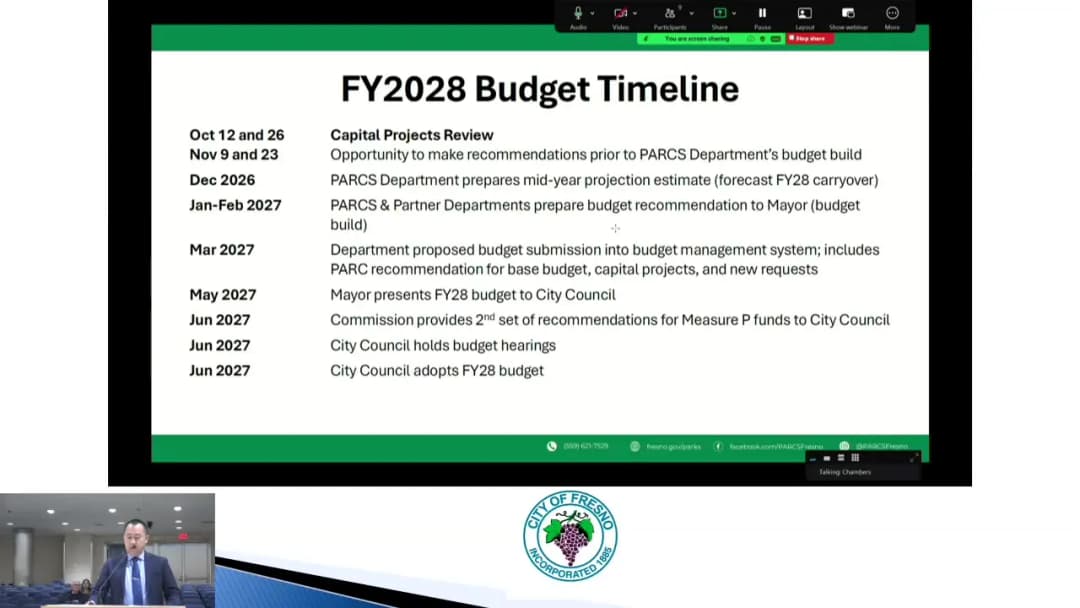
The Parks, Recreation, and Arts Commission (PRAC) met in regular session in Fresno City Hall Council Chambers on Monday, October 12, 2026, beginning at 5:34 p.m. Six commissioners were present; Commissioners Jose Barraza and Kelly Kucharski were absent and their absences were excused. The commission approved the agenda and the prior meeting minutes, received a fiscal year (FY) 2028 PARCS budget presentation, heard public testimony on arts and culture grant payments and Measure P-related topics, and adjourned at 6:46 p.m. in memory of Dr. Francine Oputa. Routine Approvals - The agenda was approved on a motion by Commissioner Duran, seconded by Commissioner Caglia, with 6 ayes and 2 absent. - The September 21, 2026 regular meeting minutes (ID 26-1338) were approved on a motion by Commissioner Dohlin, seconded by Commissioner Miller, with 6 ayes and 2 absent. Subcommittee, Member, and Staff Reports - ARC Subcommittee: Chair McCoy reported that ARC applications were received by the deadline. The approved minutes state 111 applications; the raw transcript appears to say 11, so the exact count should be confirmed. PARCS staff confirmed none of the applicants were board members. Review and scoring have not yet begun. - Commissioner Dohlin reported that the new pickleball and basketball courts at the Roeding Park tennis complex are excellent and are being heavily used by the public. - PARCS Director Aguirre announced ribbon cuttings at Neilson Park on October 9 and at Maxie L. Parks Community Center, an El Dorado Park community meeting on October 14 at the CAP Center, and an upcoming Roeding Park courts ribbon cutting. He also described the one-acre El Dorado pocket park and community-requested amenities; staff noted exercise stations and walking loops are increasingly included in new park designs. - City Administration staff were not present due to a scheduling conflict. Public Comments & Testimony - David Bouttavong, program director at the Laotian American Community of Fresno, described technical problems during the September 30 cycle-three grant submission. He said his work was not saving, he received an error when submitting near the deadline, and he was left unsure whether his application was received. He suggested having staff available to help on the deadline day. - Allen Bryan asked about the high cost of the recent splash pad and whether contractor mandates and red tape could be reduced. - Elizabeth Laval, President of the City and County Historical Society, said she believed no cycle-two grantees had been paid as of October 12. She cited a bounced check from February, repeatedly added signature requirements, and urged the commission to help get payments completed. - Parvin Makek, representing an Iranian culture and arts group, described problems obtaining and scanning receipts, being unable to update an Excel reimbursement form, receiving no response, and being warned the group could be noncompliant. She said the final 10 percent of funding had not been paid. - Smiley G. echoed concerns about the unpaid final 10 percent, noting vendors were pressing grantees for payment and that waiting until December would be too long. Hearing: FY 2028 PARCS Budget Build (ID 26-1340) - The item was called at 5:51 p.m.; no public comments were received, and public comment was closed at 6:25 p.m. - PARCS Business Manager Xiong and Projects Administrator Portale presented a Measure P funding snapshot: an estimated beginning balance of just over $65.9 million, projected tax revenue of just over $49.1 million, about $2.1 million in other revenue/interest, and total Measure P appropriations of $98,677,900 across the funding categories. - The presentation covered FY 2026 capital work, including four projects under construction (Les Kimber Park, Southeast Fresno Sports Complex, Dolores Huerta Park, and the citywide senior center), 19 completed capital improvements, and 14 community engagement events. In FY 2027 to date, staff reported nine new projects started, eight projects substantially completed, and three community engagement events held, with more planned. - Completed and active projects included court resurfacing and multi-court conversions at Roeding, Logan, and Lyons parks; shade structures; soft-fall repairs; field lighting; a new park in the Tower District; restroom and picnic shelter work; completion of the CAP Center south building; and replacement of two Camp Fresno cabins using general fund dollars. - Future or unfunded designs included El Dorado Park, Cruz Bustamante Park (formerly Veterans/Barstow), additional restrooms and tot-lot replacements, Les Kimber exercise equipment and trees, flood-control basin parks with walking trails and exercise stations, and several other unfunded rehabilitation projects. - Commissioner discussion included questions from Chair McCoy about the number of highest-needs projects (staff identified five of the recent completions), flood basin park protocols, and Prop 68/Prop 4 grant funding. Chair McCoy stated she is against using basins as parks. Commissioner Duran asked about the gap between Measure P revenue and appropriations; staff said unappropriated balances stay within their categories. Commissioner Dohlin asked about flood-control maintenance and lighting at Roeding Park. Commissioner Caglia asked about BMX/skate park maintenance and the Mary Ella Brown Center irrigation; staff said those repairs are handled through operations and that irrigation is installed with trees to be planted within two weeks. - During the action portion, no commissioner made a formal FY 2028 budget recommendation for Council adoption. Hearing: Expanded Access to Arts and Culture Grant Program (ID 26-1342) - The item was called at 6:26 p.m.; public comment closed at 6:35 p.m. - Staff responded to the public comments, saying some delays were grantee-specific because expenses must be substantiated with receipts and signature-authority questions were still being resolved with the City Attorney. They said they respond to emails, meet one-on-one, and process mailed documents. - Staff said they will contact every cycle-two grantee with an October 31 deadline to submit remaining documents. - Chair McCoy expressed concern that cycle three launched before cycle two payments were resolved, that cycle-two grantees should receive grace, and that the city should provide help on application deadline days. Vice Chair Ward asked for a substantive update at the next meeting; staff indicated one would be provided. Hearing: Measure P Allocations and Plan Updates (ID 26-1343) - The item was called at 6:45 p.m. No public comments were received, and there was no commission discussion. Public comment closed at 6:46 p.m. Chair McCoy then adjourned the meeting in memory of Dr. Francine Oputa. Key Outcomes - Agenda and minutes approved 6-0, with two commissioners absent. - ARC application review is pending; exact application count should be confirmed between the minutes (111) and transcript (11). - No formal FY 2028 budget recommendations were made at this meeting; further budget presentations are scheduled for October 26, November 9, and November 23. - Staff stated they will send cycle-two arts grant grantees an October 31 deadline for remaining documents and will provide a program update at the next meeting. - The meeting adjourned at 6:46 p.m. in memory of Dr. Francine Oputa.