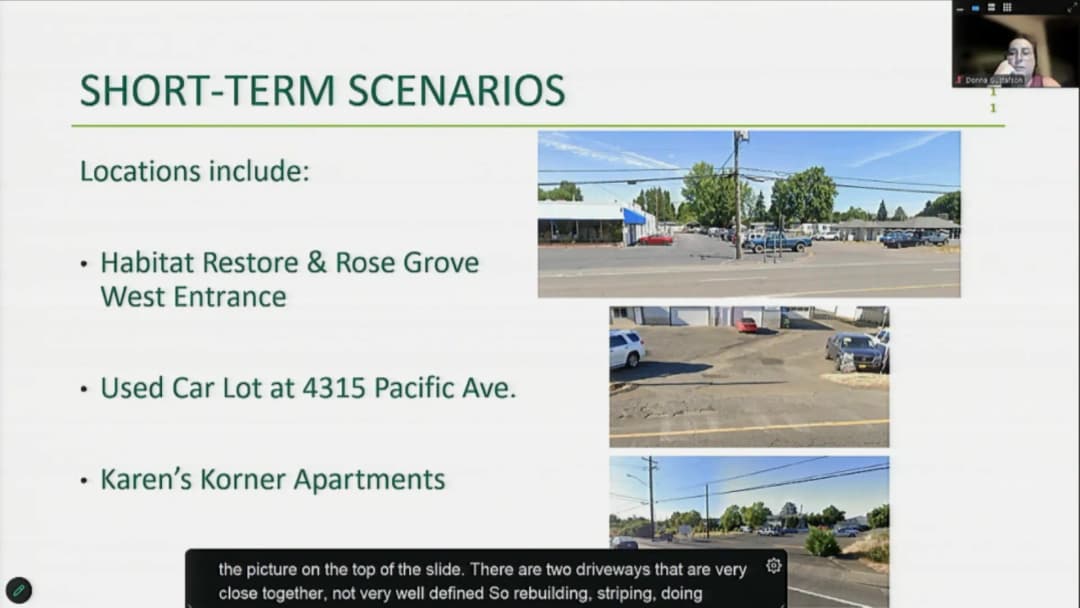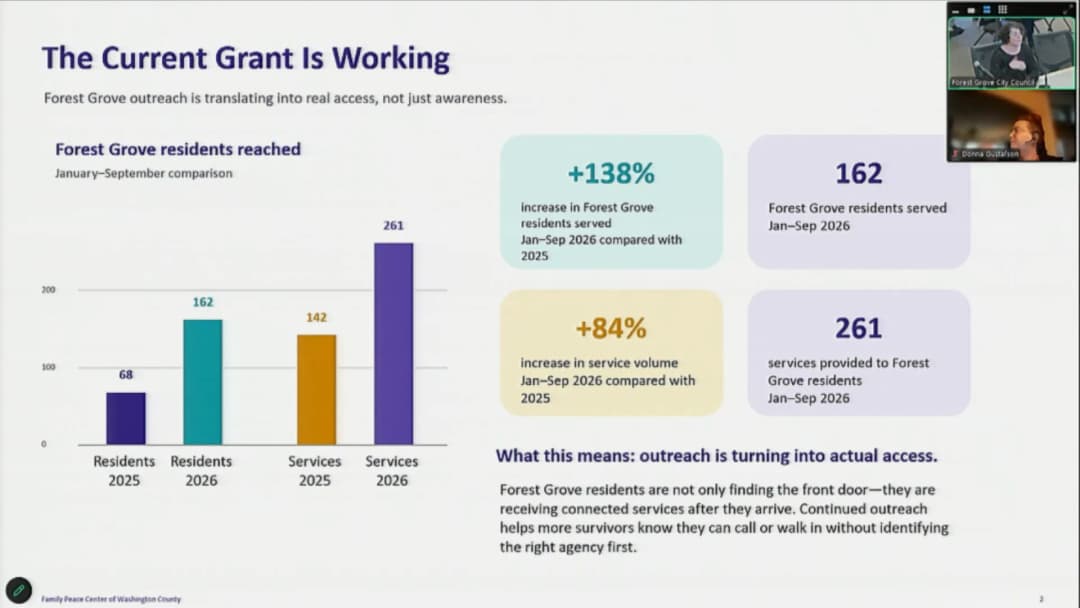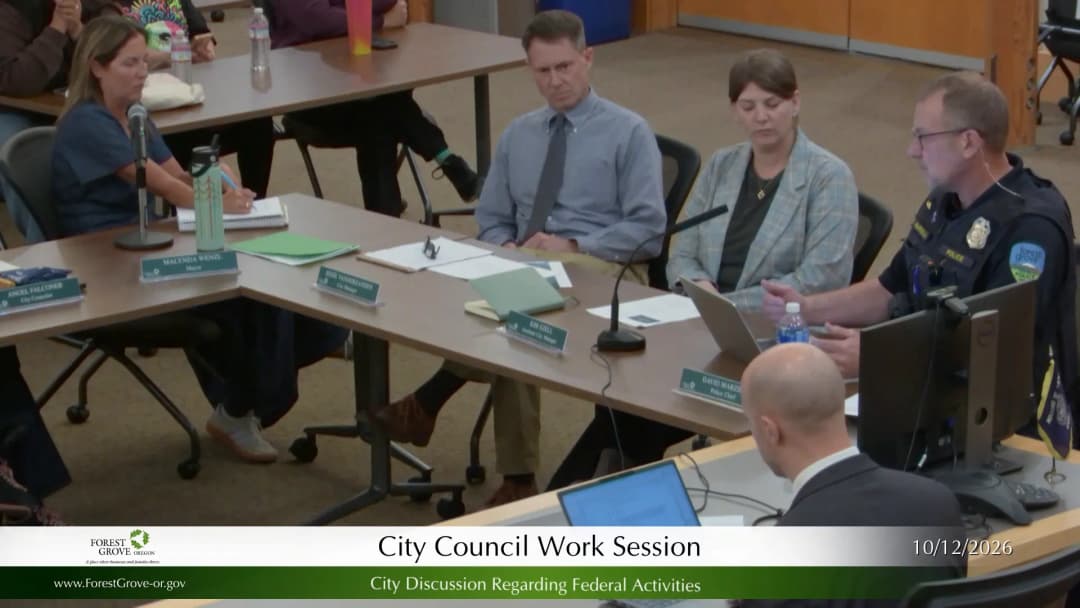
This document summarizes two related meetings held on October 12, 2026: a Community Enhancement Program (CEP) Committee meeting and a regular City Council meeting followed by a work session on an ICE incident at the police department. The CEP Committee approved three grant awards. The City Council conducted routine business, received public testimony on traffic safety and the ICE incident, heard presentations on the Family Peace Center, federal affairs, and TV Highway safety, and then held a work session on the police department's encounter with an ICE agent. Consent Calendar - City Council: Approved the monthly building activity report (C1) on a 7-0 vote. - Item C2 (October 2026 Tourism Sponsorship Award) was removed by Councillor Govson (who abstained due to a board membership) and then approved 6-0. Public Comments & Testimony - Susan and Ron Field (1025 Gough Road): Submitted a petition with 81 signatures requesting speed-reducing measures on Gough Road after a hit-and-run driver killed a dog in a crosswalk. Asked for a four-way stop at Heatherway and Gough. - Ron Robin Orson (Gough Road): Supported the request and also asked for a four-way stop at Gough and Falls. Suggested police monitor speeding from his driveway. - Dale Feek (resident since 1966): Discussed three topics: (1) urging monitoring of the Crane Data Center's diesel generators; (2) warning about the SAFE database inaccuracy for mail-in ballots, recommending early mailing or drop-box use; (3) supporting the Forest Grove Police Department after the ICE incident, noting they acknowledged a mistake. - Lauren Miller (1520 Elm Street): Expressed concern about the former police chief's statements on immigration enforcement and the recent ICE agent incident. Questioned who authorized the agent into a restricted area and demanded accountability. Stated that a sanctuary city commitment must be reflected in enforceable policies, not just resolutions. - Beth Genley (Indivisible Forest Grove): Called the ICE incident a violation of small-town values. Urged police training to address the public's fear of ICE and emphasized that police should never offer camaraderie to ICE agents. Thanked city officials who acknowledged the fear. - Kylie Delgado: Showed a photo of the ICE agent and demonstrated that his vest clearly identified “ICE.” Accused officers of lying about not recognizing the agent. Urged release of footage and an internal audit, claiming the agent never used the restroom. - Sandra Pareta (speaking for Antonia Lopez): Presented an actionable policy for sanctuary status, similar to those adopted by Hillsboro and Beaverton. Stated that the ICE incident erodes trust, especially in the Latina community, and recommended reprimanding the officer who allowed it. - Antonia Lopez: Began as a domestic violence advocate. Said the ICE incident will cost lives. Asked that officers wearing purple patches should mean something. Called for an investigation of Sergeant Martino for either lying or allowing a masked gunman into a secure area. - Red Wortham: Noted the backpack program has served triple the families. Criticized the city for instilling more fear. Demanded Chief Marzilli acknowledge the mistake and call for accountability for the sergeant and the officer who ridiculed a legal observer. - Hope Kramer: Requested an independent investigator not from law enforcement and asked that lobby video be made public to clarify the incident. Discussion Items - Proclamation: Mayor read a proclamation declaring October 2026 as Domestic Violence Awareness Month in Forest Grove. Rachel Schutz from the Family Justice Center accepted. - Family Peace Center Presentation: Executive Director Rachel Schutz and Board President Judy Welley reported on the new Family Peace Center, which opened nine months ago. Services provided to 3,479 survivors in Washington County (6,754 total services). Physical access increased 34% compared to the former Family Justice Center. Forest Grove residents served rose 138% to 162 (from 68 the previous year). The center offers a single door for survivors with co-located services, removing barriers like transportation and child care. Councillor Falkner asked about sustainable funding models; other cities fund through general fund or public safety levies. - Federal Affairs Update: Michael Skipper (senior vice president) presented the city's 2026 federal agenda. Earmark requests submitted for TV Highway Safety ($1M secured in House bill; $3M possible from Senate), Forest Grove Loop Trail, and Campus Corridor Gateway. Also submitted an $11.2M grant request for TV Highway safety. Water Quest Reservoir grant pending after a Trump administration hold. Election outlook: Democrats favored to take the House; Senate also in play. Congress recessed until after election; must pass FY27 appropriations by Dec 11. Councillor Falkner asked about the certainty of the $1M given minority status; Skipper confirmed that was the maximum achievable. - TV Highway Access Management Strategy: Senior Planner Dan Rudin provided an update on a project to improve safety on a 2/3-mile segment from Quint St to 1st St. 33 driveways were evaluated. Short-term solutions include signage, rebuilding driveways; long-term options involve driveway closures, medians, and pedestrian improvements (e.g., rapid flashing beacons). Community outreach included two focus groups, a public open house, and 600+ letters. Next steps: draft amendments to the Transportation System Plan and development code, with adoption targeted by June 2027. Councillor Falconer asked about incentives for property owners; staff noted the city can use development code requirements and ODOT's ability to reevaluate access permits. Councillor Martinez asked about the delayed mid-block crossing at Rose Grove (utility issues with ODOT); Rudin agreed to raise it at the next project meeting. - Council Communication: Brief reports from councillors on committee meetings (PAB, library commission), upcoming events (Eastside Park grand opening Oct 16, Sister City student delegation Oct 28–Nov 1 needing host families, CCE open house Oct 27, TV Highway project committee meeting). - City Manager's Report: Responding to public testimony on Gough Road, a crash and traffic warrant analysis will be conducted for the intersection at Gough and Heatherway. Also, water rights transfer from a newly purchased property on Gales Creek, and interviews for an economic development strategic plan consultant. - Work Session on ICE Incident: Chief Dave Marzilli and City Manager presented a timeline of the Oct 7 incident at the police station. An ICE agent parked outside; an officer allowed him into a restricted area to use the restroom after the agent identified himself. A community member filmed the interaction. No law was broken, but policy was violated. Immediate actions: policy clarified (no federal agents in non-public areas without official business), press release issued, training refreshed. Next steps: independent third-party review (council consensus for a non-law enforcement agency), release of video (council asked staff and city attorney to investigate feasibility), and development of a new video restating sanctuary city commitments. Councillors discussed trust, accountability, training gaps, and need for transparent communication. Key Outcomes - CEP Committee: Approved grant funding for Forest Grove Backpack Program, Forest Grove School District Family Resource Center, and Gigi's House on a 10-0 vote. - Consent Agenda Approval: C1 approved 7-0; C2 approved 6-0 (Councillor Govson abstained). - Gough Road Speeding: City Manager confirmed crash and warrant analysis will be conducted. - ICE Incident Review: Council directed staff to engage a third-party investigator not affiliated with law enforcement; also asked city attorney to explore options for releasing video footage. Staff will provide updates via a future work session. - Policy & Training: Police Department will refresh all training on sanctuary city policies and facility access procedures. A new video reiterating the city's sanctuary commitments will be produced.
The Public Meeting Index
The Public Meeting IndexThe October 12, 2026 work session covered two main agenda items: an update on the Tualatin-Sherwood Road rail crossing study and a discussion on allocating city funds to outside agencies for fiscal year 2026-2027. The meeting concluded with council and city manager round table reports. Discussion Items Tualatin-Sherwood Road Rail Crossing Study Update - Presenters from Kittleson & Associates (Mark Bitork, Amy Griffiths) and city staff (Mike McCarthy, Abby) presented the final alternatives from a six-month study. Three primary build alternatives were considered: roadway over (south alignment), roadway under (south alignment), and at-grade widening. A no-build option was also discussed. - Public feedback from a virtual open house (September 14-27, 108 responses) showed 29% preferred no-build, citing cost. The project advisory committee ranked road-under highest; the planning commission ranked at-grade improvements highest. Both groups requested additional details on pedestrian/bicycle facilities, safety benefits, and travel times. - Council members raised concerns about federal funding (RCE and BUILD grants), local match requirements, visual impacts, business disruption, and safety improvements. Staff noted grade separation eliminates two signals and the rail crossing, significantly improving safety and travel reliability, while at-grade widening only provides about half the needed 20-year capacity. - Cost estimates: roadway over $135-250 million; roadway under higher (pumping and utility relocation); at-grade widening $25-60 million; minor at-grade $6-12 million. Federal grants could cover up to 90-95% of grade separation costs, but competition is high. - Council requested additional information: breakdown of survey respondents (business vs. resident), travel time and accident data by time of day, visual renderings of grade separation options, and clarity on the 4,000-5,000 annual hours of delay caused by freight trains. Allocation of Funds to Outside Agencies for Fiscal Year 2026-2027 - Council reviewed proposed allocations to 22 agencies. Councilor Hilliard recused himself due to a conflict of interest (his agency applied for funding). - Councilor Reyes proposed starting allocations totaling $50,000, with zeros for agencies not aligned with city goals (e.g., Abuse Recovery Ministry, Cascade Amateur Sports). Councilor Brooks suggested adjustments: redirect $500 from Byron Elementary to the food pantry, and split $1,000 from Family Peace Center equally between Domestic Violence Resource Center and Sexual Assault Resource Center to give them more direct control. - After brief discussion, council reached consensus on the revised allocation. Specific amounts included: Byron Elementary $1,500, Domestic Violence Resource Center $4,000, Family Peace Center $4,500, Food Pantry $5,500, etc. The process was noted as efficient after eight years of practice. Key Outcomes - Rail Crossing Study: No final decision was made. Council directed staff to provide additional analysis on funding options, survey demographics, travel time data, and visual concepts. Next steps include coordinating with downtown redevelopment and riverfront park consultants. - Funding Allocation: Council reached consensus on the distribution of $50,000 in outside agency funding for FY 2026-2027, pending formal approval at a future regular meeting. Round Table Reports - City Manager reported on all-employee meetings, Washington County managers gathering, upcoming events (pumpkin regatta, housing forum, playground construction at Community Park, Riverfront Park community engagement), and a $300,000 grant for Fality Park restroom replacement. - Council members reported on committee meetings (CCA, R1 Act, downtown advisory), conferences (LOC, Future 50 Vision Summit), and community events (Mitch Fox trot, Good Neighbor Center tour, industrial readiness forum).
The Forest Grove City Council met on October 12, 2026, at 7:00 PM. The meeting included a proclamation for Domestic Violence Awareness Month, public comments on speeding concerns and a recent ICE agent incident at the police department, consent agenda approvals, presentations on the Family Peace Center, federal affairs updates, and the TV Highway Access Management Strategy, along with council communication and a city manager report. Proclamation - Mayor Wensel proclaimed October 2026 as Domestic Violence Awareness Month in Forest Grove, highlighting that 1 in 2 women and 1 in 6 men in Oregon have experienced domestic violence, stalking, sexual assault, or physical assault by an intimate partner. The Family Justice Center served 6,000 survivors in 2025, and the Domestic Violence Resource Center provided over 7,400 crisis services. Public Comments & Testimony - Ron and Susan Field (residents of Gough Road for 50 years) presented a petition with 81 signatures requesting speed-reducing solutions on Gough Road, including a four-way stop at Heatherway and Gough, after a hit-and-run driver killed a pedestrian's dog in a crosswalk. They urged police to ticket speeders. - Ron Robin Orson (Gough Road resident) also requested a four-way stop at Gough and Falls and criticized the placement of mobile radar signs, suggesting police monitor speeds near his home. - Dale Feek (resident since 1966) raised three topics: monitoring diesel generators at the data center, mail-in ballot concerns related to the SAVE database (citing a 20% inaccuracy rate), and support for the Forest Grove Police Department after the ICE restroom incident, acknowledging a mistake. - Lauren Miller (1520 Elm Street) expressed ongoing concerns about police response to federal immigration agents, calling for accountability and clear policies following the incident where an ICE agent was escorted into a restricted area. She linked this to the upcoming $29 million police facility bond, urging transparency. - Beth Jenley (Indivisible Forest Grove) criticized Chief Marzilli’s characterization of the ICE bathroom incident as “small town values,” stating it undermines sanctuary city commitments and public trust. She thanked council members who acknowledged community fear. - Kylie Delgado (filmed the incident) questioned the sergeant’s claim that he couldn’t identify ICE from the patch, demonstrating the “bossy E” phonics rule. She alleged the agent never used the restroom and called for releasing footage and holding officers accountable. - Sandra Pareta (speaking for Antonia Lopez) presented actionable sanctuary policy language, citing fear in the Latina community and urging reprimands for the involved officer. She noted that residents are avoiding police and medical help due to fear of ICE. - Antonia Lopez (former domestic violence advocate) demanded an investigation of Sergeant Martino for lying or allowing a masked, armed man into a secured area. She stated the incident would cost lives and that community trust is broken. - Red Wortham (21-year sheriff’s office veteran) criticized the department for not admitting a mistake, called for an independent investigation (not by another police agency), and requested that lobby video be made public. He challenged the sergeant’s denial of ICE affiliation and an officer’s treatment of a legal observer. Consent Calendar - C1: Monthly Building Activity Report — Approved 7-0. - C2: October 2026 Tourism Sponsorship Award — Removed by Councillor Govson (who abstained as a volunteer board member). Approved 6-0. Presentations - Family Peace Center (Rachel Schutz, Executive Director; Judy Welley, Board President) — Reported a 138% increase in Forest Grove residents served (162 vs. 68 last year) and 84% more services accessed. The new center has provided 6,754 services to 3,479 survivors since opening, with a 34% increase in physical access. The center offers a single door for survivors in Washington County, including transportation via Ride Connection. Judy Welley announced her retirement in December. - Federal Affairs Updates (Michael Skipper, Senior Vice President) — Updated on 2026 federal agenda: $1 million secured for TV Highway Safety Improvements in the draft FY27 House bill (cut from $3 million due to minority status); pending Senate bill may add $3 million. Also submitted $11.2 million Safe Streets grant and a Watercrest Reservoir FEMA application. Provided midterm election analysis, noting Democrats are favored to regain the House and have a path to the Senate. Congress will return after elections to pass FY27 appropriations and reauthorizations. - TV Highway Access Management Strategy (Dan Rudin, Senior Planner) — Presented short- and long-term scenarios to improve safety and ODOT compliance along a two-thirds mile corridor (33 driveways). Short-term options include signage and driveway rebuilding; long-term includes medians, driveway closures, and pedestrian improvements. Outreach included focus groups and an open house. Next steps: finalize recommendations, develop code amendments, and hold work sessions in early 2027, with adoption by June 2027. Council Communications - Councillor Marshall announced the opening of East Side Park on Friday, October 16, at 5:30 PM. Mayor Wensel added that students from nearby schools will name the park. - Councillor Martinez reported the Sister City student delegation visit October 28–November 1, needing host families. - Councillor Schimmel noted a community open house for CCE on October 27 and a Tualatin Valley Highway project committee meeting. - Councillor Falconer mentioned a tour with the state delegation regarding TV Highway funding. City Manager Report - A traffic review board meeting will conduct a crash analysis and traffic warrants analysis for a potential four-way stop at Gough Road and Heather. - The city is consulting on water rights transfer for the recently purchased property on Gales Creek and will do a full water rights inventory. - Interviews for the Economic Development Strategic Plan consultant contract are scheduled. Key Outcomes - Consent agenda items approved as noted. - The city will investigate the Gough Road intersection for a four-way stop. - The council will hold a work session immediately following the meeting at 8:30 PM to discuss the ICE incident and policy. - Council members expressed support for making TV Highway safer and urged progress on the mid-block crossing at Rose Grove.
The Tualatin City Council met on October 12, 2026, in a regular meeting that included a youth substance-use prevention presentation, the introduction of the new library director, public comment on non-agenda items, approval of a routine consent calendar, and a decision on the Lamb Research land-use appeal. No written agenda or minutes were available for this summary; it is based solely on the raw transcript. Pledge of Allegiance and LEAP Youth Alliance Presentation - Council President Pratt led the Pledge of Allegiance. - Representatives from Tualatin High School’s LEAP Youth Alliance, including seniors Cozy Slider and Kaylin Castro, presented the group’s 2026–2027 goals: grow membership, strengthen awareness of LEAP, and raise community awareness about youth choices around alcohol and other substances. - LEAP described Red Ribbon Week activities at the high school on October 19–21, 2026, including tabling, red ribbon distribution, interactive lunchtime activities, and a prevention parade at Tualatin’s football game on October 30 in partnership with Tigard High School. - LEAP highlighted its Positive Community Norms campaign, which focuses on correcting misconceptions and promoting the healthy choices young people are already making. The group trained with the Montana Institute and plans to test and launch a community-wide campaign. - LEAP is fundraising through donations and a greenery fundraiser to attend CADCA’s National Leadership Forum near Washington, D.C., in February. - With 30 active members, LEAP plans to participate in community events including the Pumpkin Regatta, Winona Grange Harvest Festival, and Tualatin Elementary’s Trunk Retreat. - Mayor Bubenick read a proclamation designating October 23–31, 2026, as Red Ribbon Week in Tualatin and encouraging participation in drug-prevention education activities. New Employee Introduction - City Manager Sherilyn Lombos introduced Magdi Anami Careo Sotomayor as Tualatin’s new library director; her first day was October 12, 2026. - Sotomayor previously served as Shute Park Library manager in Hillsboro and previously worked for WCCLS, as well as in Florida, New York, and Puerto Rico. She said she has dedicated 24 years to libraries and believes libraries can save people’s lives. - Mayor Bubenick welcomed her and noted the library’s importance to the community, especially with upcoming changes related to the library levy and collections. Public Comments & Testimony - Jared Ray, a local McDonald’s owner with his wife Randy and 15 area restaurants, said all 150 Oregon McDonald’s restaurants are family-owned. He asked the council to keep small family businesses in mind as it considers a major road project and said he learned about the project from a Dutch Bros. owner rather than from direct city outreach. - Randy Ray said the local Tualatin McDonald’s employs more than 60 people and described the company’s community support, including more than $1 million in grants to Oregon schools, a work-exchange program with Victory Academy, food donation programs, and Ronald McDonald House fundraising. She asked the council to conduct a business impact study so family businesses can remain community pillars. - Bert Hamilton urged the council to prioritize the residents of Tualatin over out-of-state corporations and their shareholders. - Victoria, who said she advocates for community building in Tualatin, spoke against the city-ordered closure of her community share shed and little free pantry. She read a comment written on the closure sign: “This is so sad. I would feed my sisters from here.” She described the space as a meaningful, safe place for teens and neighbors and asked why the city does not protect community builders and instead threatens them. - Chloe Eve asked why no permanent plan exists for Tualatin-Sherwood Road and the railroad crossing, called the temporary approach a waste of money, and requested transparency about businesses having to move. She also commented that the words “under God” were added to the Pledge of Allegiance during the Eisenhower era and that children of atheists could be forced to recite a religious statement. - No additional in-person or Zoom public comments were offered. Consent Calendar - The council unanimously adopted the consent agenda by one motion with no items removed. It included: - Approval of the September 28, 2026 work session and regular meeting minutes. - Resolutions 5999-26, 6000-26, and 6001-26 accepting Oregon Department of Transportation grant funds for traffic safety enforcement. - Resolution 6002-26 awarding a contract to Consort North America Inc. for engineering and construction management services for the Seismic Valve Improvement Project. Discussion Items: Lamb Research Appeal (AR 26-0002) - The council resumed consideration of two appeals of a Type II architectural review staff decision for AR 26-0002, approved June 17, 2026, with conditions. The project is an approximately 3,900-square-foot addition to Building B at 11259 SW Leventon Drive, submitted by McKenzie on behalf of Lamb Research Corporation. - The public hearing was held September 14, 2026. The record was reopened for additional written submissions and then closed; the additional material was filed as Exhibits I and J, and no further participant evidence was allowed. - Council members disclosed ex parte contacts and declared they could be unbiased. Councilor Hillier confirmed she had participated in the September 14 hearing. - The central question was whether TDC 63 environmental regulations are mandatory approval standards at the time of architectural review or performance standards that apply once the project is operating. Council and staff noted earlier council findings treated them as performance standards, so topics such as operational noise, chemical storage, and hazardous materials are outside architectural review criteria for this application. - Councilor Sacco moved to deny the appeal and affirm the June 17, 2026 staff decision, directing staff to bring a proposed resolution with findings to the November 9, 2026 council meeting. Councilor Sacco also noted that upholding the appeal would require specific findings and could lead to an appeal to LUBA. - After a roll-call vote, the council unanimously denied the appeals. Post-Decision Discussion - Councilor Brooks said her vote was not about this application but raised broader concerns about code enforcement consistency, noise complaints, and livability. She asked how noise violations are investigated and how code enforcement priorities are set. - Mayor Bubenick said noise complaints are investigated by code enforcement officers and can proceed through the civil infraction process in municipal court if there is evidence. City staff also explained that code enforcement is currently complaint-based rather than proactive because of staff resources. - Councilors Brooks, Hillier, and Reyes expressed interest in a future work session with Tualatin Valley Fire & Rescue, TTSD, and other partners on hazardous materials, emergency preparedness, chemical releases, and community notification. No formal vote was taken on that work session. Key Outcomes - The council unanimously denied the appeals and affirmed the June 17, 2026 staff decision approving AR 26-0002 with conditions. - Staff was directed to prepare a resolution with findings for the November 9, 2026 council meeting. The staff memoranda identified as attachments B and B1 control where they differ from findings proposed by Lamb Research. - The consent agenda was adopted unanimously. - Red Ribbon Week was proclaimed for October 23–31, 2026. - The council discussed, but did not formally vote on, a future informational work session with TVF&R about hazardous materials and emergency response. Councilor Brooks also requested more information about code enforcement objectivity and resources. Council Communications and Adjournment - Councilor Sacco announced a Tualatin Housing Forum on Wednesday at 6 p.m., describing it as a state requirement and an opportunity for residents to share housing stories. - Mayor Bubenick encouraged attendance at the Pumpkin Regatta and community events during the fall season. - A motion to adjourn was made, seconded, and passed unanimously.
The Lake Oswego Planning Commission held a work session on October 12, 2026, primarily to review the draft methodology for the Rezoning for Housing project (PP 25‑0001). The project aims to identify commercial, mixed‑use, and non‑residential areas that could be rezoned to address a shortfall of approximately 600 housing units identified in the city's 2023 Housing Capacity Analysis. Staff from Cascadia Partners presented three analytical themes – favorable development economics, land suitability, and advancement of community goals – equally weighted to score candidate parcels. Commissioners discussed the methodology, weighting, the role of landowner interest, and the appropriate focus areas for further study. Consent Calendar - September 14, 2026 Minutes: Approved unanimously (motion by Commissioner Guinea, second by Commissioner Sly). - September 28, 2026 Minutes: Approved unanimously (motion by Commissioner Avishon, second by Commissioner Sly). Public Comments & Testimony - No oral public comment was offered. - A written comment from Ms. Anderson was received earlier in the day and shared with the commission. The comment raised concerns about preserving employment land. Staff and consultants noted that the rezoning effort would expand allowances rather than preclude existing uses and that the city’s Economic Opportunities Analysis (EOA) shows sufficient employment land remains available. Discussion Items 1. Rezoning for Housing (PP 25‑0001) – Draft Methodology Presentation - Ray Haggerty and Paul Runsch of Cascadia Partners presented the project background, timeline (through June 2027), and the three‑theme scoring methodology: - Favorable development economics: parcel size and utilization (underused parcels preferred). - Land suitability: infrastructure capacity, natural hazard risk, physical constraints. - Advances community goals: walkability, proximity to transit, parks, jobs, grocery stores, schools. - The methodology was applied to all candidate non‑residential parcels; scores were mapped. Higher‑scoring clusters emerged in: eastern Cruise Way, Boons Ferry/Lakeview Boulevard, Westlake Grove, and First Edition/Downtown. Lower‑scoring areas included Mountain Park, McVay, Foothills, and the former Marylhurst campus. 2. Commission Discussion on Methodology - Commissioner Guinea asked whether landowner interest is considered. Staff noted it is not part of the current methodology but will be addressed through stakeholder interviews with large property owners. Commissioner Guinea suggested a survey to gauge owner interest. - Commissioner Call questioned the minimum parcel size for viable redevelopment and whether very small parcels should be excluded. The consultant explained that smaller parcels are scored lower but are not excluded because they can be assembled over time. - Commissioner Sly raised a concern about underutilized commercial space, questioning why the city is not first trying to fill office vacancies (e.g., the 20% vacancy on Meadows Road). Staff noted a separate economic development strategy is being drafted to address that issue. - Commissioner Tween asked about the logic of equal weighting across the three themes. Staff responded that the equal weighting serves as a neutral baseline, and input from the commission, council, and public will inform any adjustments. Several commissioners supported keeping equal weighting until more public feedback is gathered. - Commissioner Avishon noted that market‑driven development is already occurring in the identified high‑scoring areas, validating the methodology. He also cautioned against re‑zoning western Cruise Way due to the presence of major office employers (e.g., Yakima headquarters) and supported preserving industrial land on lower Boons Ferry. - Commissioner Guinea emphasized that rezoning only enables development, it does not guarantee it, and that larger parcels attract developers more effectively, though smaller infill projects are also possible. - Commissioner Avishon and others reiterated that the project is not about forcing changes but about expanding long‑term options; the city wants to maintain local control over land use rather than have state mandates. 3. Public Open House Planning - The first public open house is planned for early November 2026. Commissioners advised that the open house should clearly communicate that the project does not force anyone to change current uses or displace businesses, and that the goal is to raise the theoretical housing capacity to meet identified needs. Emphasizing local control and the connection to the Housing Needs Analysis and Housing Production Strategy was also recommended. Key Outcomes - The commission expressed general support for the draft methodology and for proceeding with the four identified high‑scoring areas (eastern Cruise Way, Boons Ferry/Lakeview Boulevard, Westlake Grove, First Edition/Downtown) as focus areas for further study. - Lower‑scoring areas (Mountain Park, McVay, Foothills, Marylhurst campus, western/central Cruise Way) were set aside for potential master planning efforts rather than near‑term rezoning. - No formal vote was taken; the feedback will inform the project team’s revisions and presentation to city council. - The commission did not direct a change in the equal weighting of the three themes, but agreed to gather public input before finalizing. - Schedule update: the next commission work session is October 26, 2026 (Foothills schematic plan). The November 9 meeting is canceled; the November 23 meeting will include the code audit work session and work plan review.
The Forest Grove Community Enhancement Program (CEP) committee met on October 12, 2026, to hear presentations from six finalists for the city's $15,000 community enhancement grants. Of 11 grant applications submitted, committee members had scored all applications, and the six highest-scoring organizations presented. Each organization received six minutes to present and up to four minutes for committee questions. After discussion, the committee voted to award one-year $15,000 grants to three organizations. Presentations - Adelante Mujeres – Forest Grove Farmers Market Activities: Adelante Mujeres described the market's community impact, including approximately 100,000 visitors per year, 120 unique vendors, and the Kids Pop Club/Power of Produce program serving children ages 3–12 with $2 food vouchers. The representative said the organization served just over 2,000 children last year, with a majority from Forest Grove, and that the grant would support staff time, chef demonstrations, supplies, and vouchers. She also noted the organization is "almost 12 million dollars" and reduced its budget by 6% from last year due to federal funding cuts. - GG's House – Do the Next Right Thing: GG's House founders described a 13-year-old volunteer-run organization that provides emergency, flexible assistance including bus tickets, schooling, funerals, household needs, and more. They reported feeding over 500 meals a month, supporting over seven food banks, and serving 61 people from January 1 to August 31, not counting food giveaways. They stated the organization is 100% volunteer-run and tracks every person and expense. They also mentioned their building was recently sold, and the grant would help them continue responding to community needs. - Growing Gardens – Forest Grove Home Gardens Project: Growing Gardens presented its home gardens program, which connects qualifying participants with bilingual education, plants, seeds, and three years of classes and peer mentoring. In Washington County, Growing Gardens has distributed over 2,000 plant starts and had 125 people participate in gardening and green cleaning workshops this year. Only four families are currently in Forest Grove; the grant would add about 10 families per year and fund a community organizer and gardening supplies. - Family Peace Center – Expanding the Circle of Care: The Family Peace Center reported 138% growth in targeted Forest Grove outreach for residents served and an 84% increase in service volume since starting the CEP grant, plus a 95% increase in rural participants from 2025 to 2026. Overall, 21% of its population now comes from rural Washington County. This summer, the center held six Forest Grove outreach events and had individual conversations with 327 people. A 2027 grant would fund targeted outreach materials, creative access campaigns such as social media, bathroom signage, salon training, and Highway 26 signage, and continued navigation and coordinated services. - Forest Grove School District Family Resource Center: The coordinator said the center, housed at Cornelius Elementary, provides food, hygiene items, clothing, school supplies, and referrals to families in the district. Last year it provided direct resources to 340 students or families, holiday assistance to 397 students, and helped 38 families with city funding for ICE-impacted families. The school district does not fund the center; it relies on grants and donations. The grant would purchase food, hygiene supplies, clothing, school supplies, and emergency basic needs. - Forest Grove Backpack Program: Board members presented the program's fifth year of providing weekend food bags to Forest Grove School District students. Last year, the program provided 4,382 weekend bags; in the first six weeks of this school year, it delivered 678 bags. It currently serves 128 families, including 22 students with dietary restrictions, 71 Hispanic/non-white children, and 19 McKinney-Vento students. Food costs are up approximately 4.2%. The Elks Lodge provides space, and the program is funded entirely by grants and donations. Committee Discussion - Committee members praised all six applicants and noted that many groups already collaborate, with GG's House repeatedly mentioned as a community anchor. - One committee member expressed concern that the application scoring process may favor professionally written applications over demonstrated community need and suggested adding grant-writing or technical assistance for future applicants. - The committee reached consensus to hold a future CEP work session to review and improve the application and scoring process. - A committee member disclosed that they are on the Family Peace Center board of directors during the discussion. - One committee member on Zoom said she approaches ranking by asking which vulnerable populations are most likely to fall through the cracks and need help most urgently. Key Outcomes - The committee approved a motion to award one-year $15,000 CEP grants to the top three ranked organizations: Forest Grove Backpack Program, Forest Grove School District Family Resource Center, and GG's House. - The vote was 10–0. - The committee also agreed to schedule a work session to reassess the CEP process for next year.
The Forest Grove City Council held a special meeting on October 12, 2026, at 4:02 p.m. to conduct a public hearing on Resolution 2026-47, which proposed adopting a temporary 120-day moratorium on data center development and expansions within the city. After staff reports, public testimony, and council discussion, the council voted 7-0 to adopt the resolution. The moratorium is a temporary pause, not a permanent ban, intended to give the city time to study four areas of concern and consider development code amendments. It does not apply retroactively to projects that have already received land use approval. Public Comments & Testimony - A resident of 1405 Elm Street, a lung cancer survivor and non-smoker, spoke as a proponent. He said he hoped every council member would vote yes, argued the moratorium was needed, possibly for more than 120 days, and said emissions from data centers could hurt high-risk people like himself who have difficulty breathing. He said he had moved to Forest Grove for cleaner air and found data center development devastating. - A second resident of 1405 Elm Street also spoke in support. He said he was upset that the planning commission approved a data center next to Fernhill Wetlands and an elementary school because it met current ordinances. He asked whether the city could update its ordinances within 120 days, cited evidence of white noise, thermal, and groundwater pollution from data centers elsewhere in the U.S., argued data centers create few jobs, and said they could lower adjacent property values. - A resident of 1637 23rd Avenue asked neutral questions about whether the 120-day timeline was enough, whether the moratorium could be renewed, what work would occur during it, and what the plan was afterward. Staff responded that the city would review its code and possible amendments, intended to complete that work within 120 days, and noted state law allows extensions when progress is being made. No opponents testified. Discussion Items - Senior Planner Dan Reardon, identified in the transcript as Dan Rudin when he spoke, presented the staff report. He tied the proposal to the Forest Grove Forward Vision 2040 goals: a balanced and diversified economy with high-paying jobs; increased diverse and affordable housing; and resilient, financially sustainable infrastructure. He also referenced the city's 2025 economic opportunities analysis and 2019 housing needs analysis. - The city followed state notice requirements. It notified the Oregon Department of Land Conservation and Development on August 26, 2026, 47 days before the hearing, and public notice of the special meeting was given on October 11, 2026, at 3 p.m., 25 hours in advance. State law requires at least 45 days notice to DLCD and 24 hours notice for a special meeting. - Assistant City Attorney Josh Soper, identified in the transcript as Josh Silver when he spoke, explained that the moratorium is based on the statutory compelling-need standard rather than the public-facilities-shortage standard. He read the five statutory criteria: existing regulations are inadequate to prevent irrevocable public harm; the moratorium is sufficiently limited so needed housing and commercial/industrial supplies are not unreasonably restricted; alternative methods are unsatisfactory; the public harm from no moratorium outweighs adverse effects on other local governments; and the city has sufficient resources to complete needed changes within the moratorium period. - Draft findings identified four areas of concern: data centers' rapid growth, land-extensive nature, and low employment density could harm the city's economic mix; the city's housing capacity analysis may show a need to rezone some industrial land for housing; data centers' very large electricity consumption raises infrastructure and customer-demand concerns; and data centers may have negative public health and environmental effects through air and noise pollution, waste heat emissions, heat island effects, and chemical discharges to wastewater. - A clarification was added to Section 1 of the resolution stating that the moratorium is not retroactive to projects that have already received land use approval, consistent with the vested rights doctrine. In response to Councilor Schimmel, who characterized the Crane project as having a 2024 land use approval for three phases, staff clarified that the approval covered two buildings that could be constructed in multiple phases. The approved two buildings and associated site improvements would not be affected, but new land use applications for expansions or additional phases would be prohibited during the moratorium. - During council discussion, Councilor Gustafson requested clear public communication on the timeline and next steps, and staff nodded in agreement. Councilor Falconer emphasized that the 120-day period allows a proper conversation about changing rules but the council must comply with legal processes to avoid litigation and wasted city resources. Councilor Schimmel raised the possibility of partnering with Hillsboro on an environmental analysis; council members agreed this should be discussed at a future work session rather than decided that evening. Key Outcomes - After the public hearing was closed, Councilor Schimmel moved to approve Resolution 2026-47, and Council President Valenzuela seconded the motion. - The council voted 7-0 to adopt the temporary moratorium. Voting yes were Council President Valenzuela, Councilors Schimmel, Falconer, Martinez, Marshall, and Gustafson, and Mayor Wensell. Councilor Marshall arrived after the meeting was called to order and joined the vote. - Mayor Wensell declared Resolution 2026-47 passed and adjourned the special meeting.
The Aurora City Council held a regular meeting on October 12, 2026, beginning at approximately 6:00 PM. The meeting included approval of previous minutes, councilmember reports, public testimony, and action on two ordinances. A significant portion of the meeting was dedicated to public comment regarding police accountability and proposed data center development. Consent Calendar - Approved meeting minutes from September 14 and September 28, 2026, unanimously. - Adopted the agenda for the meeting unanimously. Councilmember Reports - Councilmember Andrews read letters from youth requesting extended hours at parks and rec centers and a citywide talent show. - Councilmember Jackson reported on conversations about Fletcher Plaza, the Aurora Black Forum series, budget workshops, and celebrated Indigenous People's Day. She also asked the city attorney about council's role in commenting on data centers before a vote. - Councilmember Horton announced a listening session for Fletcher Plaza and a Ward 1 Town Hall. - Councilmember Wiles noted Indigenous People's Day, thanked attendees, and announced a data center town hall on November 2nd. - Councilmember Medina reported on school visits and an upcoming town hall. - Councilmember Hancock read a letter from a Gateway High School student requesting support for an urban farm, and reported on other community events. - Councilmember Lawson announced town halls about fire rescue and ADA updates. Public Comments & Testimony - Numerous members of the public spoke during two public comment periods. The first period was limited to one hour, causing many speakers to be moved to the second period, which the council voted to make unlimited. - Many speakers demanded the firing of Police Chief Todd Chamberlain, citing a pattern of lying and excessive force, and referred to several individuals killed by Aurora police (e.g., Kylan Lewis, Corey Dillard). Some speakers noted that protests have been ongoing for nearly three years. - Several speakers opposed the Trident Vantage Data Center proposed near residential neighborhoods in Green Valley Ranch and the Reserve, citing concerns about noise, air and water pollution, property values, and lack of community notification. Speakers questioned the rezoning process and called for a moratorium on data centers. One speaker mentioned a poll showing 77% of Coloradans and 82% of Coloradans oppose data centers in their city/town. - A nine-year-old resident, Marcus, spoke against the data center. Other speakers also addressed flock safety cameras, police accountability, and city finances. - Hashim Coates spoke on multiple agenda items, supporting the zoning change but calling for stronger action, and also addressed police accountability and data centers. Discussion Items - Item 13A: Ordinance amending section 146-3.2 of the Unified Development Ordinance to remove data centers as a permitted use in the Mixed-Use Office-Institutional (MUOI) zone. Staff presented the background, noting council direction from August 24, 2026, a unanimous Planning and Zoning Commission recommendation on September 23, 2026, and that the change applies citywide. Public hearing included several speakers in support but urging a broader moratorium. Council voted unanimously to approve. - Item 13B: Ordinance designating Bethlehem Church (built 1963, addition 1976) as a local historic landmark. Staff presented three criteria met. Public hearing included one speaker in support who also urged the church to serve the community in line with social justice values. Council voted unanimously to approve. Key Outcomes - Unanimously approved Item 13A (data center zoning change). - Unanimously approved Item 13B (Bethlehem Church historic landmark). - Unanimously approved a motion to suspend rules to make the second public comment period unlimited in duration, allowing all remaining registered speakers to be heard.
The Aurora City Council met on October 12, 2026, to discuss and act on several items including homeless services funding, a transition to self-funded health insurance for city employees, proposed water rate and fee increases for 2027, Fourth of July display options, council rules amendments, and zoning changes for industrial districts to promote water conservation. Consent Calendar - Items 2A through 2K were approved collectively. This included a presentation on the Notice of Funding Opportunity (NOFO) for homeless services, detailing funding allocations for emergency solutions grants, rental assistance, marijuana grant funds, and public safety assistance programs. Discussion Items - Homeless Services Funding (NOFO): Stephanie Kuiper, Manager of Homelessness, presented the NOFO results. Four funding categories: Emergency Solutions Grants (ESG), Home Tenant-Based Rental Assistance (Home TIBRA), marijuana tax funds, and public safety assistance. Review panels recommended funding for Advanced Pathways ($142,490.40) and Aurora Housing Authority ($77,182.36) for ESG; Aurora Housing Authority ($200,000) for Home TIBRA; partial funding for Family Tree ($351,381), Aurora Housing Authority, and Three Birds Alliance from marijuana funds; and full funding for Jesus on Colfax ($144,647) for public safety assistance. Councilmember Andrews asked about funding gaps for Advanced Pathways; staff noted the organization has other funding sources. - Self-Funded Health Insurance (Item 3A): Tyra Litzu, City Controller, presented a proposal to transition the United Healthcare medical plan from fully insured to self-funded effective January 1, 2027. The new self-insurance fund will be an internal service fund. Ryan Lance, HR Director, stated the move allows cost savings and a 5% rate increase compared to the 11.7% increase under the fully insured model. Councilmember Hancock asked about management and savings. The ordinance to create the fund was approved without objection. - 2027 Water Rates and Fees (Item 3B): Catherine Wilkatoon, Deputy Director of Financial Administration for Aurora Water, presented proposed increases. Water rates will increase by small incremental amounts across tiers; irrigation accounts see a larger increase. Connection fees for water increase 5% (higher increases expected after 2027). No increase for sewer connection fees; stormwater connection fees increase 5%. Discussion included the Wild Horse Reservoir project, bond issuance plans for 2027-2028, and potential WIFIA federal loan application. The proposal was moved forward without objection. - Fourth of July Display Options (Item 4C): Brian Green presented options: traditional fireworks ($65,000, 20-22 minutes) vs. a drone show ($90,000, 16 minutes with 500 drones). Councilmembers expressed support for drones citing wildfire risk, noise, and neighborhood congestion. Mayor noted consistency with fire bans. Consensus was to proceed with the drone show; staff directed to finalize contract and conduct public messaging. - Council Rules Amendment (Item 5A): Councilmembers Hancock and Andrews sponsored amendments to define a public health emergency and require most legislative items to go through policy committee and study session unless meeting specific exceptions (public safety/health emergency, negative fiscal impact, or legal deadline). Councilmember Coombs added a definition for public health emergency. Councilmember Jackson questioned uniform application. A vote was taken; the majority supported moving the amendment forward. - UDO Amendment for Industrial Zones (Item 5B): Kelly Bish, Senior Planner/Landscape Architect, presented amendments to reduce landscaping requirements in industrial districts to save water. Changes include optional curbside shrubs/grasses, elimination of street frontage buffers, elimination of non-street buffers between like uses, reduced detention pond landscaping, and increased low-water-use tree requirements. Marshall Brown from Aurora Water supported the changes. Councilmember Hancock asked about residential curbside areas; staff clarified the changes apply to industrial zones only. The amendment was moved forward without objection. Key Outcomes - Consent calendar (items 2A-2K) approved. - Ordinance creating a self-insurance fund for United Healthcare approved (3A). - 2027 water rates and fees approved (3B). - Council directed staff to proceed with a drone show for the Fourth of July spectacular (4C). - Council rules amendment regarding emergency items and committee process moved forward (5A). - Unified Development Ordinance amendments for industrial landscaping moved forward (5B).
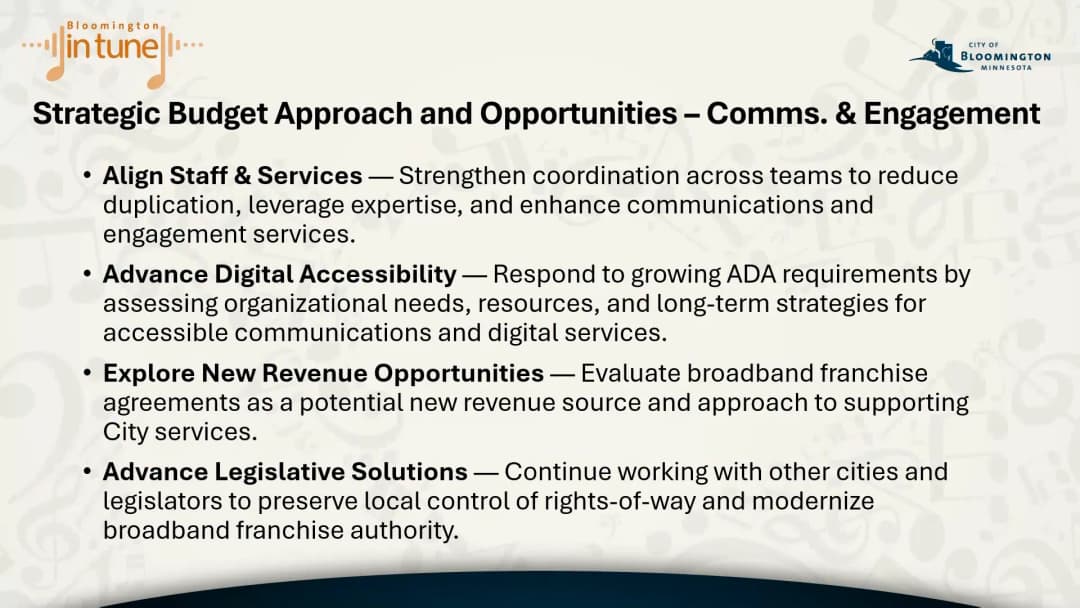
Mayor Tim Bussey convened the regular Bloomington, Minnesota, City Council meeting on Monday, October 12, 2026, in the Council Chambers with online viewing. The council approved the agenda 7-0 and then moved through ceremonial items, a 12-item consent agenda, public hearings on assessments and parking requirements, a continued rezoning and townhome proposal, and an informational budget discussion for the city's internal enterprise service departments. Ceremonial and Recognition Items - Mayor Bussey proclaimed October 2026 as National Chiropractic Health Month in Bloomington, recognizing Northwestern Health Sciences University and musculoskeletal health care. Student Elise and Dr. Bo Foshi of the Minnesota Chiropractic Association accepted the proclamation and thanked the city. - Communications staff introduced Trisha O'Brien, the city's new part-time communication specialist. O'Brien has more than 10 years of communications experience and a master's degree in journalism from the University of Southern California. - The city presented its 2026 communications awards. Bloomington won five Minnesota Association of Government Communicators Northern Lights awards: first place for the Annual Report and for the Public Works/Police Open House promotional video; second place for Bloomington Today and the We Mean Business series; and third place for The Briefing. Nationally, the Bloomington Police Department's Instagram reel, 'Valentine's Day Special,' won a first-place 3CMA Savvy Award and was nominated for a Diamond Award. The reel generated more than 6.3 million Instagram views, reaching 4.7 million accounts, 98% of them non-followers. Consent Calendar - Councilmember Robertson presented the consent agenda. Items 3.1 through 3.3 and 3.5 through 3.11 were approved 7-0. - Item 3.4 was approved 6-0, with Councilmember Loman abstaining. - Item 3.12, the Axon Enterprise agreement expansion, was discussed in detail. Police Chief Hodges said it would add drone-as-first-responder capability, translation tools, and dispatch technology. He said the program is not spyware, that Axon data is audited and tracked, and that misuse is subject to discipline up to termination. Councilmember Carter moved to approve the agreement through the State of Minnesota NASPO cooperative procurement contract No. 247327. City Manager Zach Walker said the new spending had been programmed into the budget. The motion carried 7-0. Public Comments & Testimony - At the council listening session held in connection with the meeting, seven community members addressed the council. Lee and Sue Lang Sheridan voiced concerns about tobacco industry efforts to weaken local regulations as federal oversight declines, and urged Bloomington to remain a public health leader. Matthew Hallett spoke about the budget, climate resiliency, and recent city issues. Paul Coate discussed gun violence. Greg Kyle raised concerns about neighbor code compliance and said the city was not doing enough. Ali Jarvis urged consideration of preemptive animal protection ordinances, including limits on the sale of animals and animal shows such as circuses. Kathy Jones spoke about R1-to-R3 zoning changes and townhomes. Jamie Anthony asked questions about Axon technology, which City Manager Walker answered. - The public hearings on the 2026 pavement assessment roll and the off-street parking ordinance drew no speakers in chambers or online. Discussion Items and Public Hearings 2026 Pavement Management Program Assessment Roll (Item 4.1) - Staff presented the assessment roll for the 2026 P.M.P. street reconstruction project. The total project cost was just over $8.6 million across 13 street segments, with 170 parcels assessed. Single-, two-, and three-family properties are assessed at a 25% rate; other property types are assessed at 50%. Final assessment notices were mailed in September. Property owners may prepay without interest until November 24, 2026, with a $100 minimum. Remaining balances will be rolled onto property taxes, beginning with May 2027 statements, at 5.5% interest over 10 years. Hardship deferral and appeal options were also described. - Councilmember Robertson moved to adopt Assessment Roll 2026-1. The motion carried 7-0. James Avenue City Homes (Item 4.2) - This item was a continuation of a public hearing closed at the September 14, 2026 council meeting. The requests were to rezone 9025 and 9033 James Avenue South from R1 to R3, approve final site and building plans for nine detached townhomes, and approve a Type III preliminary/final plat creating nine townhome lots and one outlot. Staff and the Planning Commission recommended approval. A construction management plan condition was added after earlier neighborhood concerns. Following prior discussion, a 40-foot maximum building height condition was proposed; the applicant agreed on the record to the 40-foot limit. The applicant also did not object to adding approximately 12 trees. - Councilmembers expressed a range of views. Supporters noted that the area had been guided toward medium-density housing since 1981 and that the project would expand homeownership opportunities, including smaller single-family homes. Councilmembers Dalessandro and Carter opposed, citing uncertainty about whether the two extra lots compared to R1 development would actually result in homes being built, and Carter also objected to what she called piecemeal R3 zoning in the middle of an R1 neighborhood. - Votes: the rezoning ordinance was adopted 5-2, with Councilmembers Dalessandro and Carter opposed; summary publication was approved 7-0; the final site and building plans were approved 5-2; and the preliminary/final plat was approved 5-2, with the same two councilmembers opposed. Off-Street Parking Requirements Ordinance (Item 4.3) - Staff presented amendments to Chapters 12 and 21 of the City Code to right-size off-street parking requirements. The proposal included reductions of about 10-30% for many uses, 50% reductions for some uses, a 10% by-right reduction in designated development districts, a cap of two parking flexibility requests per site, an increase in the number of vehicles allowed to park outside garages at single- and two-family residences, and several clarifications. - The Sustainability Commission submitted a letter of support, and the Planning Commission recommended approval 4-1. Council discussion focused on enforcement, commercial vehicles, the 24-hour street parking rule, consistency with alternative transportation goals, and Councilmember Rivas's concern that some commercial areas already have difficult parking conditions. Staff noted that larger reductions target industrial uses and that general retail reductions are more modest. - The council adopted the ordinance 7-0 and authorized summary publication 7-0. Internal Enterprise Services Budget (Item 5.1) - The council extended the meeting to no later than 9:30 p.m. and received the budget presentations as an informational item only; no vote was taken. - Deputy City Manager Elizabeth Tolsman presented an overview of the Internal Enterprise Service Team. The proposed 2027 net budget was reduced by nearly $197,000 while maintaining services. She also highlighted state and federal advocacy results, including $4 million in state funding for the North Sanitary Sewer Project and $1.69 million in federal infrastructure funding. - City Clerk Jamie Hanson reported that the 2027 clerk's office budget decreases by about $307,000, or 20.42%, primarily due to lower election judge costs in a non-statewide-election year. The 2027 request has a negative net impact of $36,319. The 2028 conceptual budget rises due to the 2028 election, but remains below the 2026 level. Accomplishments included a record-setting 33% primary voter turnout. Plans include consolidating election precincts from 30 to 20 and moving to flat-rate cemetery pricing. - Communications Director Janine Hill said the newly aligned Communications and Engagement Department's 2027 net budget decreases by $66,441, or 4.15%. Operating reductions totaled about $156,590 after offsets. The department reported 4.9 million media impressions in 2026, worth $368,000 in publicity, and the Hatch program has generated $11.7 million in earned media since its launch. A website redesign is being delayed until 2029 to reduce costs. - Finance staff reported a 2027 net budget impact of approximately $1.7 million, an increase of 7.7%, with a 2028 conceptual increase of 6.2%. Line-by-line cuts totaled $36,000, but unavoidable cost increases left a net reduction of about $2,500. Finance also assisted in bringing the preliminary 2026 levy to 6.64% in September and is planning to replace the utility billing system before its platform reaches end of life in 2029. - City Attorney Melissa Vanderscheid reported a 2027 legal budget request of about $3 million, up 5.24%. The city attorney salary allocation changed from 50% city/50% Port Authority-HRA to 70% city/30% Port Authority-HRA. Legal reduced operating costs by about $43,333 after offsets. Accomplishments included trying three criminal jury trials to verdict, a 150% increase over 2025, prosecuting about 5,000 cases annually, generating more than $400,000 in fine revenue, and recovering unpaid wages on city-funded projects. - IT Director Cheney said the IT budget for 2027 increases expenditures by 3.4% and revenues by 3.7%, lowering the net budget impact by $19,000. The 2028 conceptual budget includes a planned use of about $1 million in fund balance. IT implemented a new firewall, migrated to a cloud-based phone system, and is managing a 30% increase in data requests. - Councilmember Loman asked whether expenditure growth is being driven by prior compensation policy decisions; no immediate answer was required. City Manager Walker said external services departments would present the following Monday. Key Outcomes - Agenda approved 7-0. - Consent agenda items approved, including the Axon Enterprise agreement expansion, which passed 7-0. - The 2026 P.M.P. Assessment Roll 2026-1 was adopted 7-0. - The James Avenue City Homes rezoning, final site and building plans, and preliminary/final plat were approved 5-2 on each land-use action; summary publication was approved 7-0. - The off-street parking requirements ordinance was adopted 7-0, and summary publication was approved 7-0. - The budget discussion was informational only; no budget vote was taken. - Council directed staff to look into potential humane pet store and wild animal-free circus ordinances, agreed to a future study session on parking sign policy, and noted the Comprehensive Plan update as the appropriate forum for broader R3 zoning policy discussion. - The meeting adjourned 7-0.