The Committee of the Whole of the Council of the District of Columbia, chaired by Chairman Phil Mendelssohn and joined by Councilmember Matt Fruman, held a nearly eight-hour public hearing on Friday, October 9, 2026, to examine the use of technology, screen time, and artificial intelligence across District schools. Drawing testimony from over 100 witnesses—including charter leaders, national researchers, state board members, teachers, parents, and government officials—the hearing weighed the benefits of personalized learning and digital literacy against rising concerns over screen time, mental health, data privacy, and the efficacy of tools like iReady. A central tension emerged between calls for stricter limits and pleas for equitable access to functional devices, particularly from communities East of the River. Public Comments & Testimony - Charter and School Leaders: David Lowry (Friendship), Adam Browning (WLA), and Francisco Duran (Arlington Superintendent) jointly emphasized that technology is a tool meant to support, not replace, effective teaching. Duran detailed Arlington's age-based device restrictions (e.g., no devices for PreK-K unless for an IEP), while Browning shared WLA's four-year journey integrating AI, stressing the need for strong guardrails and significant teacher professional development. All agreed that AI literacy is critical, but human judgment and connection remain paramount. Duran highlighted that the most important driver of the policy was the learning goal. - Expert Research Panel: John Murtz (Children and Screens), Josh Boots (Empower K-12), Nicole Barnes (APA), and Lily Fessler (Stanford) provided a cautionary framework. Boots cited a study showing student homework scores rose 18% while exam scores fell 20% after unguided AI adoption. Barnes urged distinguishing between performance on a platform and durable learning. Murtz advised that foundational educational science should guide decisions. Fessler noted the evidence base is still emerging, especially in US K-12. - State Board of Education: Robert Henderson (Ward 5), LaJoy Johnson Law (Ward 8), Eric Goulet (Ward 3), and Ebony Rose Thompson (Ward 7) stressed the need for cross-sector equity. Johnson Law and Thompson shared that an East of the River engagement session revealed families' top priorities are working devices, reliable Wi-Fi, and digital literacy, not restrictions. They cautioned the council against one-size-fits-all policies. - Parents, Educators, and Advocacy Groups: Deep divisions were evident. PAVE parent leaders urged balance and warned against bans that could worsen the digital divide. Schools Beyond Screens DC parents and teachers shared specific harms, including data privacy lapses, exposure to pharmaceutical ads, and punitive iReady practices (e.g., "iReady jail"). Teachers from EmpowerEd and WTU demanded resources and teacher voice, with Ward 8 middle school teacher Regina Leggett powerfully recounting having only 14 laptops for 25 students at Johnson Middle School. - Curriculum Associates (Dr. Mary Wall, Woody Peck): Defended iReady, describing it as a diagnostic and supplemental tool designed to work under teacher direction. They stated independent research shows growth within their recommended 30–49 minutes per subject per week, acknowledged overuse outliers, and denied sharing student data with third parties without permission. - Government Officials: Corrine Colgan (DCPS) highlighted new 2026-27 screen time guidance. Paul Kine (DME) framed the issue around human-centered skills for an AI future. Glenn Starnes (OSSE) announced the release of an AI model policy for LEAs employing a "stoplight framework" for staff use, with student-facing guidance under development. Discussion Items - Screen Time and Instructional Quality: A consensus formed that the quality and purpose of screen time matters more than strict minute counts. Councilmember Fruman questioned how DCPS enforces its new guidance and how to effectively evaluate quality. - Efficacy of iReady and Ed Tech: The hearing became a flashpoint for the broader debate on ed tech evidence. Witnesses for the vendor cited independent peer-reviewed studies, while critics noted these studies often involved the vendor and challenged the collection of sensitive student data (e.g., homelessness, disability status). DCPS admitted to tackling overuse with new limits but defended the tool's diagnostic value. - Artificial Intelligence (AI) in Education: AI sparked intense debate. The risk of "cognitive offloading"—students using AI to bypass the productive struggle required for learning—was a primary concern highlighted by the expert panel. The Capital AI Education Collective was praised as a proactive cross-sector forum for sharing best practices. - Digital Equity: The absence of working devices in Wards 7 and 8 schools served as a stark counterpoint. Testimony from Dr. Johnson Law, Ms. Leggett, and others made it clear that for many students, the primary technology crisis is a lack of access and functional infrastructure, not an overabundance. - Data Privacy and Vendor Oversight: Witnesses, including technology policy expert and parent Erie Meyer, raised detailed concerns about the scope of data collected by ed tech companies and the difficulty for parents to know how it is used or retained. - Teacher Support and Professional Development: Universal agreement emerged that robust, ongoing teacher professional development is essential for any policy to succeed. Teacher witnesses argued that shifting away from technology requires investing in people and providing time and resources, not just removing screens. Key Outcomes - Public Hearing Concluded, No Votes Taken: The hearing was a legislative fact-finding session. No bills or resolutions were voted upon. - Directives Issued: Chairman Mendelssohn directed DCPS to promptly follow up and resolve the acute laptop shortage reported at Johnson Middle School in Ward 8. - Acknowledged Need for Policy Evolution: Government witnesses committed to developing further cross-sector guidance. OSSE pledged to develop student-facing AI policies and procurement resources. DCPS committed to an overhaul of its annual technology plan to address criticisms regarding accuracy and gaps. - Cross-Sector Collaboration Highlighted: The Capital AI Education Collective and the work of the State Board of Education were recognized as valuable non-legislative pathways for developing shared best practices and frameworks. - Record Remains Open: The public record for the hearing will remain open until 5:00 PM on Friday, October 23, 2026, for submission of additional written testimony.
The Public Meeting Index
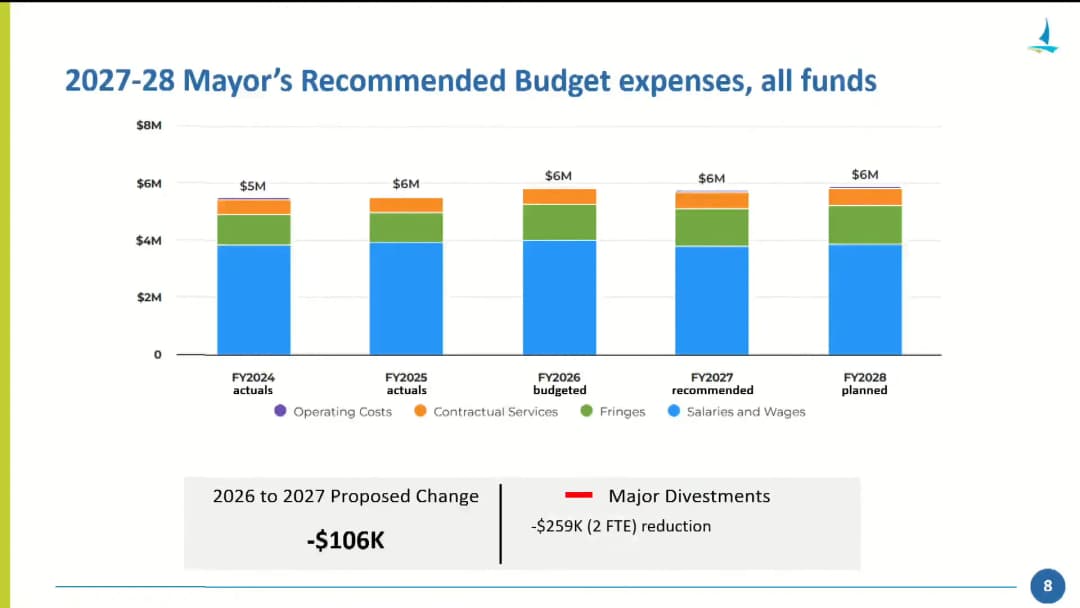
The Public Meeting IndexThe Budget Committee, chaired by Aisha Chugtai, convened on October 9, 2026, to hear three presentations on the mayor's recommended 2027 budget from the Mayor's Office, the Office of City Auditor, and the Office of City Clerk. The meeting focused on proposed staffing reductions, service impacts, and the balance between executive and legislative branch funding. Public Comments & Testimony - No public comments were offered during the meeting. Discussion Items - Mayor's Office Presentation (Grace Waltz, Chief of Staff): Waltz outlined the office's restructuring into communications/engagement and policy/government affairs verticals, achieved within existing FTE counts. The mayor's priorities remain affordable housing, economic development, public safety, climate action, and good governance. Constituent outreach reached over 38,000 calls and emails as of September 29, 2026 – a 287% increase from 2025, with 71% of that volume occurring in January and February. The proposed 2027 budget reduces the office's FTE count from 16 to 15 (eliminating a vacant position) and shows a slight increase in operating costs due to internal service charges. Councilmembers questioned the role of policy aides versus department heads and the 2% increase in the mayor's office budget compared to a 21% decrease for the legislative department. - City Auditor Presentation (Robert Timmerman, City Auditor): Timmerman detailed the mayor's proposed $125,000 net decrease in the auditor's budget, which includes a reduction of two FTEs (from 14 to 12) and elimination of $105,000 in professional services. He emphasized that these cuts would reduce capacity for planned and unannounced oversight, increase enterprise-wide governance risk, and threaten the office's charter-required independence. The auditor noted that his office has already absorbed contracting costs and built in-house solutions to avoid software expenses. He also highlighted the value of independent audits, referencing the after-action review of the shooting of Davis Maturi and the death of Alice Lucher, which yielded 37 findings and recommendations. Councilmembers expressed concern about the threat to independence and the potential for increased fraud, waste, and abuse risks. - City Clerk Presentation (Casey Carl, City Clerk; Destiny Zhang, Director of Administration; Christian Rommelhoff, Assistant City Clerk; Katie Smith, Director of Elections and Voter Services): The clerk's office presentation outlined a 21% reduction in the legislative department's budget, driven by a $5.6 million decrease in non-election year funding, $1.3 million in personnel reductions (6 FTEs, reducing from 70 to 63 authorized positions, plus an administrative funding equivalent for one additional FTE), and $437,000 in contractual services cuts. The records and information management division reported a surge in data requests: citywide requests are projected to more than double between 2022 and 2027 (117% increase), and police-related requests handled by the clerk's office are projected to increase by 270% over the same period. With proposed staffing reductions, requests per staff member for the police team would triple to 870 per year. The elections division requested funding for election management software upgrades, automated vote-by-mail printing and inserting equipment, and a mobile voting trailer – none of which were included in the mayor's proposed budget. Councilmembers noted the unsustainability of data practices staffing given demand and called for a deeper analysis of request drivers, including potential use by AI companies. Key Outcomes - No formal votes were taken during this session. The committee received the presentations and filed them for further deliberation as part of the overall 2027 budget process. Chair Chugtai adjourned the meeting without objection.
Note on date discrepancy: The meeting agenda is dated Thursday, October 8, 2026, at 7:00 PM, but the provided timestamp for this summary is 2026-10-09 15:00:00+00:00. No transcript or minutes are available to confirm the actual date or proceedings. The following summary is based solely on the agenda. The Heritage and Cultural Arts Commission held a regular meeting to consider routine consent items and two new business items. No public comment or discussion records are available. Consent Calendar - Approval of September 10, 2026 Regular Meeting Minutes: Staff recommended approval of the September 10, 2026 minutes. No action outcome is recorded. Public Comments & Testimony - No public comments are documented on non-agendized items. Discussion Items - 6.1 Selection of Poet Laureate: The Commission was to receive presentations from applicants and make a recommendation for the position of Poet Laureate. Staff recommended receiving presentations and making a recommendation. No transcript of presentations or deliberation is available. - 6.2 2027 Temporary Public Art Program – Decorated Shamrocks: The Commission was to review the proposed program featuring decorated shamrocks at parks, City facilities, and community gathering spaces. Staff recommended review and input. No discussion details are recorded. Key Outcomes - No decisions, votes, or referrals are documented due to the absence of transcript or minutes.
The Education and Human Services Standing Committee of the Richmond City Council met on October 9, 2026, to hear a public comment on homelessness, receive a detailed presentation on the updated strategic plan to end homelessness, and vote on several ordinances related to opioid settlement funds, shelter operations, and other initiatives. The meeting ran approximately one hour and fifteen minutes. Public Comments & Testimony - Rhonda Sneed (Blessing Warriors RBA) spoke about persistent challenges for unsheltered families, criticizing the existing protocol that limits shelter referral eligibility to children under three, children under 18 with chronic health conditions, or individuals three months pregnant. She stated that a four-year-old child should not be discriminated against and questioned who made this protocol. She also highlighted the lack of a 24-hour hotline for families and seniors in crisis, noting that first responders often have no option but to call 911, which is inappropriate. She expressed appreciation for the cooling center but said it was activated too late (after 12 hours of rain). She called for faster action, stating "it's not moving fast enough." Discussion Items - Strategic Plan Update to End Homelessness – Alison Sailors, Manager of the Office of Homeless Services, presented the "Greater Richmond Partnership to Address Homelessness and Housing Instability," an update to the 2020 plan. Key points included: - The update was required by city ordinance and responds to changing trends: the July 2025 point-in-time (PIT) count showed more unsheltered than sheltered people for the first time; the July 2026 PIT count showed unsheltered numbers dropping to 286, with 326 sheltered. - Regionally, rents have risen 24% since 2020, and there is a deficit of 27,000 rental units affordable to households at 30% area median income or below. - Federal funding shifts (HUD) have eliminated rapid rehousing as an intervention and reduced funding for permanent supportive housing (PSH). - The plan is organized around five strategy groups: Governance, Shelter & Outreach, Permanent Supportive Housing, Housing Instability, and Older Adults. - Governance: Formalize regional partnership with written agreements. - Shelter & Outreach: Goal 2.2 – expand equitable access to shelter, noting only 28 of 147 year-round beds are for women, and there is a shortage of beds accessible to people with disabilities and older adults. Goal 2.1 – scale the regional outreach team. - PSH: Three main funding sources (HUD, DBHDS, Virginia Housing target population leasing preference) are not coordinated; utilization of the Virginia Housing units is below 15%. The plan aims to better coordinate and expand capacity. - Housing Instability: Focus on families and older adults. Families often fall through gaps due to differing definitions of homelessness (McKinney-Vento vs. HUD). Older adults are a recurring priority. - Winter shelter: The inclement weather shelter at 1900 Chamberlain Avenue must move next year to allow Salvation Army renovations. The city is responsible for finding alternative space for the 50-bed men’s shelter, 106-bed inclement weather shelter, and city resource and training center. The winter shelter plan for this season (Nov 15 – Apr 15) includes CARITAS surge and warming centers. - Councilmember Jones asked about total housing needed for unsheltered individuals, requesting specific numbers. She noted that a 350-unit PSH shortage was cited in the Richmond 300 plan and asked how regional origins of homeless individuals are tracked. She also asked about coordination with the Department of Corrections for re-entry. - Councilmember Lynch requested an inventory of PSH units and vacant public housing units from RRHA, and asked about multiple access points to shelter. He noted that the single homeless connection line is a barrier. - The committee requested that Daily Planet bring forward their contingency management plan (related to item 6) and that Home Again explore reserving 10–15 beds for after-hours family referrals. - Ordinance Approvals – The committee voted on several ordinances in blocks: - Items 1 & 8 (Opioid Settlement): Ordinance 2026-275 (accept $614,426 from National Opioid Settlement Fund) and Ordinance 2026-288 (nation's foundation grant for harm reduction) were approved unanimously. - Items 3, 4, 5, 6, 7, 9: Included: 2026-283 (SARA grant for warm line), 2026-284 (amendment to lease for 50-bed emergency shelter at 7 N. Second St.), 2026-285 (amendment to sub-lease for family shelter), 2026-286 (Daily Planet contingency management), 2026-287 (La Casa de la Salud opioid prevention), and 2026-289 (extension of grant for Home Again family shelter). Approved with the condition that Daily Planet present its plan at the next meeting. - Item 2: Ordinance 2026-282 (transfer $700,000 from outside agencies to ACTS for Family Crisis Fund) approved. - Item 10: Ordinance 2026-290 (fiscal agency agreement with Next Up RVA for youth program) approved. - Board Vacancies: The committee approved reappointments to the Richmond Behavioral Health Authority (Taylor Davis, Arya Kirkland Harris, Dana Sally Allen) and continued the vacancy for the Advisory Board of Recreation and Parks. Key Outcomes - Approved nine ordinances (2026-275, 2026-288, 2026-282, 2026-284, 2026-285, 2026-286, 2026-287, 2026-289, 2026-290) forwarding to full council with recommendation to approve. - Requested the Daily Planet to present its contingency management program plan at the next committee meeting. - Requested Home Again to explore reserving 10–15 shelter beds for after-hours family referrals. - Requested an inventory of housing units by AMI levels and occupancy/vacancy data from RRHA. - Approved RBHA board appointments; held vacancy for Parks and Recreation board. - The committee’s next meeting is scheduled for November 8, 2026, with an anticipated update from Richmond Behavioral Health Authority.
The Barre City Council held its regular meeting on October 9, 2026, addressing routine city business alongside major capital projects and a critical discussion on the future of the Barre Municipal Auditorium (BOR) ice rink. The meeting featured public testimony on the BOR and updates on infrastructure, public safety, and community grants. Consent Calendar - The council approved the consent agenda, including minutes, contracts with Downstreet Housing, and liquor licenses for Random Mexican Cuisine and Reynolds House. - Warrants were approved, including a special $600,000 warrant for a grant fund transfer to Turning Point Center of Central Vermont. One abstention was noted. Public Comments & Testimony - BOR Support: Three youth hockey players (Gabrielle Bog, Pete LaPurle, Finley Boyd) spoke in strong support of long-term solutions for the BOR, emphasizing its vital role in the community and their personal disappointment over the potential loss of their senior ice season. They described the BOR as central to Barre's identity as a "hockey town." - Community Appreciation & DPW Question: Byrne Rose thanked staff and volunteers for the Granite Museum and the "Everybody Wins" literacy program and inquired about the DPW campus status. The City Manager reported Act 250 approval is secured, but appeal periods are ongoing. - Fire Department Appointment: Chief Cushman introduced Nick Copping as the new Deputy Fire Chief, who was sworn in the previous Friday after a nationwide search. Discussion Items - Cow Pasture Stewardship Plaque: The committee requested final approval for a plaque recognizing donors (Semper Bond, RK Miles, Fontaine Millworks) for a new pedestrian bridge, completing a $50,600 grant project that increased trail mileage by 17%. The plaque design was approved. - Bruce Trust Fuel Assistance Donation: A $5,000 donation to Capstone was approved, with the eligibility expanded from solely "poor children" to any Barre City resident in need, as requested by the organization. - Voice of Vermont Micro Grant: A permit and a $2,500 micro grant were approved for "Neighbors at the Table," a free community cookout at City Hall Park. The requirement for Parks and Rec committee approval was waived due to a lack of quorum ahead of the event date. - Fire Engine 1 Repair: The council approved spending $32,000 from gym membership savings to install an aftermarket remanufactured engine with a two-year warranty following a catastrophic connecting rod failure that put the engine block out of service. - City Hall Fire Alarm Replacement: A $31,250 contract with DuBois for an engineering study and design of a new fire alarm system for City Hall and the Opera House was approved, funded by leftover bond funds. The existing system dates to 1989 and is a failure away from being non-functional. - Verkada Building Security System: A $115,000 campus-wide FOB access control system was approved for multiple city buildings, funded by savings from unfilled police officer positions. The system includes a 10-year warranty and licensing. - Paving Update: Public Works provided an update, noting the main paving push for Seminary, Plain, Warren, and lower Berlin Streets is scheduled for early November. The council praised the aggressive paving efforts over the last three seasons. - Wastewater Treatment Plant Headworks Upgrade: The council awarded the headworks upgrade bid to Snack Enterprises of Burlington. The year-long project will prevent grit and rag buildup that has damaged the plant's digesters. - BOR Update and Strategy Discussion: - A volunteer team successfully tested a proof-of-concept repair on a single loop at 40 PSI. They plan to repair all 300 loops, followed by a 72-hour pressure test. - The council debated the risk of charging the system with $25,000 worth of glycol if the pressure test passes. A decision on authorizing the risk of the glycol was deferred pending the test results, with the understanding the mayor could call an emergency meeting if a failure occurs. - Mid-term options (a $100k-$150k temporary mat system) and long-term strategies (a bond vote for floor, roof, and humidity repair vs. a new facility) were discussed. Some councilors raised concerns about taxpayer burden and suggested regional cost-sharing or user fees. A full facility condition assessment was requested. - Flood Resiliency Update: Councilor Gussen announced the success of a major CDBG-DR grant application ($4.236 million) for the Wobby Park project, enabling the construction of 17 townhomes and the relocation of green space to North Main Street buyout properties. Key Outcomes - Approved: Cow Pasture plaque, Bruce Trust donation, Voice of Vermont micro grant and permit, Fire Engine repair ($32,000), Fire Alarm engineering study ($31,250), Verkada security system ($115,000), WWTP Headworks contract. - Deferred: Decision on risking $25,000 in glycol for the BOR ice rink, pending the outcome of the 72-hour pressure test. Volunteer repair efforts were authorized to proceed immediately. - Noted: The successful Wobby Park Flood Resiliency grant application. - Next Steps: A full facility condition assessment for the BOR was discussed. Councilors planned "meet your councilor" events for the fall. The public was urged to vote in the November 3rd school budget revote. - Adjourned: The council entered executive session for legal and personnel matters and subsequently adjourned.
On October 9, 2026, city officials, staff, and community members gathered in the Rotunda at New Rochelle City Hall to celebrate Italian American Heritage Month. The event featured remarks by officials, a proclamation by the mayor, a historical presentation by the city historian, a flag raising, a group photo, and an Italian-style dinner. The agenda and minutes were not available; this summary is based on the raw transcript. Opening Remarks - Parks Commissioner Vim Parisi served as MC, welcomed attendees, and thanked Samantha Vargas, Sam Gomez, and the Italian American committee. He described the celebration as a new October tradition the city wants to continue growing. - Carmelina DiMarco, a committee member and New Rochelle resident for 52 and a half years, welcomed guests in Italian and English. She said there were no particular honorees because all attendees are honored in their own right and invited everyone to enjoy conversation and Italian-style dining. - Deputy City Manager Todd Costaldo welcomed guests on behalf of City Manager Will Melendez. He noted his Irish and Italian heritage, with grandparents from Piacenza, Calabria, and Afragola near Naples. Proclamation - Mayor Yadira Ramos Herbert praised Italian Americans for helping make New Rochelle a great community and read a proclamation recognizing Italian American Heritage Month. The proclamation commended the Italian American community for its enduring contributions to the city, state, and nation and thanked those who preserve, share, and celebrate Italian American heritage. She said the proclamation would be hung on the wall. Historical Presentation - City historian Barbara Davis highlighted Italian American history in New Rochelle, focusing on early 20th-century immigrants and the West New Rochelle neighborhood formerly known as Dutch Hill. - She read from a 1988 oral history by Joseph E. Pisani, born in 1895, who came to America in 1902 at almost seven years old. He sailed from Naples on January 15 and arrived on January 29, after his father had worked on the Brooklyn Bridge and received his final citizenship papers in 1903. - Davis read a description of West New Rochelle from Samuel Friedman's book The Inheritance, including fig trees, gardens, grape vines, Union Avenue shops, a Columbus school, and St. Joseph's Church. She noted that four books by New Rochelle residents of Italian descent recall growing up in West New Rochelle, a distinction unique among the city's neighborhoods. - Davis said Italian Americans made up approximately 10% of the entire U.S. military during World War II and that about a quarter of the names on the World War II monument in front of City Hall are Italian. - She highlighted Italian American cultural figures, including Walter Lantz, creator of Woody Woodpecker, who grew up in West New Rochelle; his brother Michael Lantz, a sculptor; and Leonardo Nola, a New Rochelle-born model for the Prometheus statue at Rockefeller Center. - Davis closed with another excerpt from Pisani's oral history in which his mother explained the meaning of the Statue of Liberty to her children. Davis urged attendees to remember the anonymous Italian builders, grandmothers, aunts, and backyard gardeners who helped shape New Rochelle. Key Outcomes - The mayor issued and displayed a proclamation recognizing Italian American Heritage Month in New Rochelle. - The Italian flag was raised outside City Hall by the Department of Public Works. - City Hall was scheduled to be lit red, white, and green at night. - Attendees were invited to take a group photo on the city council chambers/auditorium stairs before enjoying dinner courtesy of Grandma Jamellies.
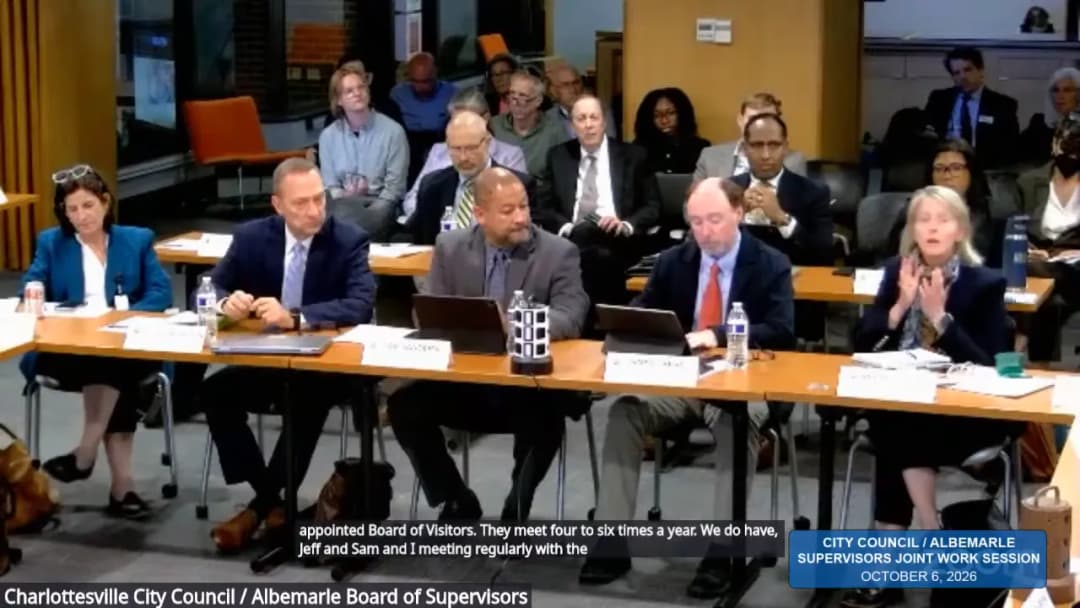
Note on Date: The raw transcript of this meeting indicates it occurred on Tuesday, October 6, 2026, at 6 PM. The meeting summary below adheres to the specified reporting date of October 9, 2026, as provided in the official meeting record request. The discrepancy between the transcript date and the record date is noted for transparency. Consent Calendar - A motion to approve Vice Mayor Oshran's electronic participation due to illness was passed unanimously. No other items were addressed on a consent calendar. County and City Manager Reports - County Executive Jeff Richardson highlighted a successful two-day benchmarking visit from the Greater Chapel Hill-Carrboro Chamber, noting the region's strong collaboration. He pointed to the alignment of upcoming strategic plans for the city, county, and UVA as a key opportunity for deeper partnership. - City Manager Sam Sanders presented the FY26 Revenue Sharing Report, indicating $20,175,533 was received from the county, with $11.5 million allocated to the city's operating budget and $8.6 million to the Capital Improvement Program (CIP). He detailed the mutual benefits in parks, transportation, and public safety. He also noted the city is developing its first strategic plan since 2018. University of Virginia Update - JJ Davis reviewed UVA's strategic planning, its Pipelines & Pathways program (500 local residents employed), and a new child care center funded by a $43 million gift. He highlighted major capital projects, including the $380 million Manning Institute for biotech and the $205 million Center for the Arts, supported by a $130 million gift from the Ader family. Charlottesville Area Transit (CAT) Four-Year Plan - Garland, Director of Transit, presented a four-year plan focusing on increasing operator counts (76 in Year 1) and frequency. Year 1 priorities include 15-minute peak service on Route 7 starting October 26 and Route 5 improvements in February 2027. - STIC Funding: Garland proposed utilizing federal Small Transit Intensive City (STIC) funding by pairing CAT data with UVA's transit system through voluntary reporting, unlocking an estimated $500,000 annually. - Discussion: - Supervisor Malik asked about hospital connectivity (goal: midnight service). - Chair Galloway asked about hiring; Garland reported 69 active operators with 7 offers pending. - Councilor Smith asked about fuel costs (rose from $2.35 to $5.85) and EV buses (2 operational, 2 on order). - Councilor Payne asked about funding for future plan years, noting only Year 1 is fully funded in the current budget cycle. - Councilor Fleisha asked about on-time performance (currently 67%, goal is high 80%). - Councilor Smith asked about route alignment adaptation for future developments (e.g., AstraZeneca, Manning Institute). Homelessness Intervention Presentation - Deputy City Manager Sam Roman and Misty (Director of Human Services) detailed the city's holistic approach. - Holiday Drive Shelter: A 27,000 sq ft, 24/7 emergency shelter now operational, averaging 70 guests per night, with positive exits to treatment and permanent housing. - Regional Outreach: The city is adding 3 staff; Albemarle is adding 2 staff. - Permanent Supportive Housing (PSH): - Kaki Demick (Albemarle County) presented Vista 29, an 80-unit PSH project opening in December/January. - 67 units are reserved for people experiencing chronic homelessness, funded by county project-based vouchers. - The $26 million project is a collaborative achievement. - Discussion: - Councilor Smith praised the city's operational response. - Councilor Payne raised concerns about a non-regional approach to vouchers potentially re-entrenching segregation, as the city is statistically poorer and Blacker than the county. He advocated for a regional strategy. - Chair Galloway questioned capacity; Demick noted the need for resources across the housing continuum. LUPEC Land Use Report - Jeffrey Dumars, Chair of the Land Use and Environmental Planning Committee (LUPEC), outlined its role in staff-level coordination of capital projects and land use planning between the city, county, and UVA. - Discussion: - Councilor Payne criticized the committee's lack of public access and transparent summaries, making it difficult for elected officials and the community to engage. - JJ Davis noted UVA staff are accessible. - Councilor Smith suggested a formal "Town and Gown" committee to improve structured dialogue with UVA. - Councilor Payne and Chair Galloway agreed that improving information sharing between the entities' planning cycles is a critical need. Revenue Sharing and Regional Governance Discussion - Revenue Sharing: A county representative characterized the revenue sharing agreement as potentially reaching "absurd levels" due to the county's higher growth potential, constraining investment in shared priorities like housing. They proposed the city consider a "voluntary hard cap" on future payments. - Transit Authority (CARTA): Councilor Payne described the current transit governance as lacking shared authority, and identified a true regional transit authority as his preferred solution. City Manager Sanders confirmed executive-level conversations on CARTA have been initiated. - Housing Density: Vice Mayor Oshran noted Charlottesville has the second-highest daytime-to-nighttime population differential in the U.S. and urged the county to increase density in the urban ring to support transit-oriented growth. Key Outcomes - Votes: The meeting began with a unanimous vote to approve Vice Mayor Oshran's electronic participation and concluded with a vote to adjourn. - Meeting Cadence: Strong consensus emerged on resuming annual joint meetings, with the city manager and county executive tasked to schedule the next one. - Next Steps: - UVA and CAT will continue exploring voluntary transit data reporting. - Staff-level discussions on CARTA governance will accelerate. - The county's proposal regarding a voluntary hard cap on revenue sharing was introduced for future dialogue.
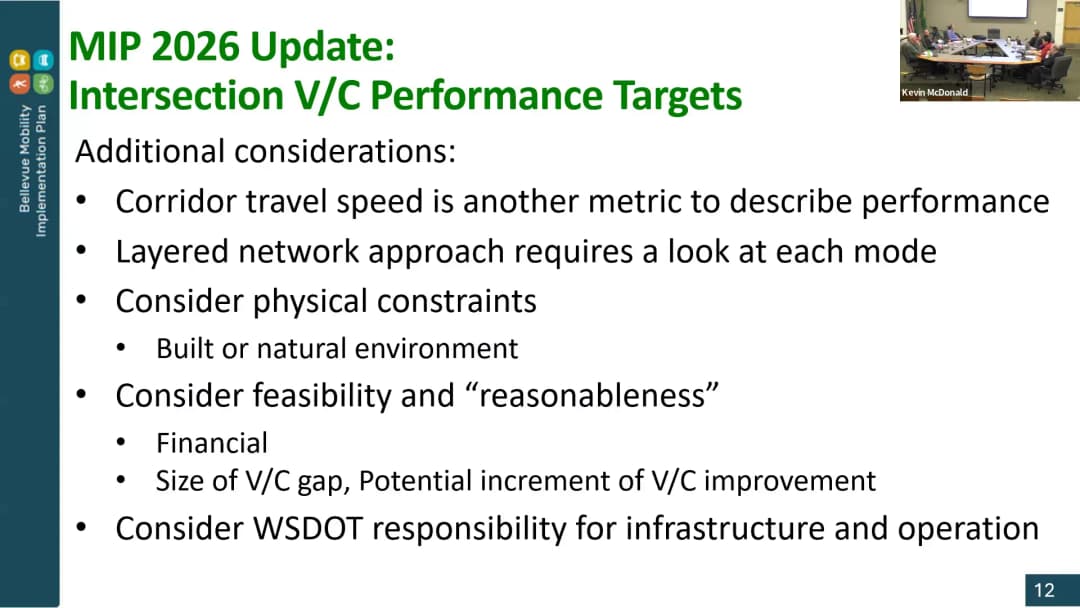
The Bellevue Transportation Commission met in a hybrid in-person/virtual session on October 9, 2026 (the chair opened the meeting as the 'October 8th' meeting, but the meeting record is dated October 9, 2026). Present were Chair McGill, Vice Chair Williams, and Commissioners Keelman (in person), Ting, and Welcher. The commission noted two vacancies created by the resignations of Commissioners Raboon and Stash. Members approved the agenda and minutes, heard two public comments, received a city council update from Deputy Mayor Dave Hamilton, reviewed newly completed Urban Core Bike Network projects, and held a study session on the 2026 Mobility Implementation Plan (MIP). The meeting adjourned at 8:07 PM. Consent Calendar - Agenda approved unanimously (motion: Commissioner Williams; second: Commissioner Ting). - Meeting minutes approved unanimously (motion: Commissioner Keelman; second: Commissioner Ting). Public Comments & Testimony - Al Diedeman, a Vassa Park resident for over 30 years, said Attachment B to the agenda omitted arterials that have no shoulders and urged the commission to prioritize a minimum four-foot shoulder on all Bellevue arterial roads for pedestrian and bicycle safety. He described many transportation CIP projects as focused on driver inconvenience, including what he called 'vanity projects,' and said the city has neglected this basic necessity for 30 years. - Alex Zimmerman, president of the 'Send Up America Party,' opposed new city taxes, claiming the City of Bellevue has a $1 billion budget and a $150 billion GDP from Amazon and Microsoft, and argued residents should not pay new taxes, including 'four car taxes.' He used profane and insulting language toward the city council. (These figures are the speaker's claims.) Communications from City Council - Deputy Mayor Dave Hamilton reported that the council has identified five finalist candidates for the two vacant commission seats and will interview them in about two weeks. He said transportation is the 'star of the show' in the city budget this year, with the council considering different funding approaches and ways to advance transportation projects, and more transportation work will mean more work for the commission. He encouraged commissioners to watch recorded council meetings on the city's YouTube channel. - Responding to Vice Chair Williams, Deputy Mayor Hamilton clarified that the council's transportation budget meeting was held Tuesday, October 6, not October 7, and suggested watching the recording at 1.5x speed. Staff Report: Urban Core Bike Network - Staff (Kevin, with drone footage by colleague Chris Brayland) highlighted recently completed bike facilities, formerly known as the Bike Bellevue network: - 116th Ave NE north of Main St: bike lanes added by narrowing existing travel lanes; southbound lanes pick up at NE 4th; northbound lanes repurpose former car-dealership load/unload zones. - 100th Ave NE (west end of downtown), Main St to NE 1st: bike lanes installed by narrowing travel lanes, with green paint and bike logos at driveways; speeds and volumes are low enough to keep bicycle level of traffic stress (BLTS) consistent with the MIP target; bike signals are planned for the intersection. - Lake Washington Blvd: westbound begins with sharrows, then widens into bike lanes; eastbound has striped or buffered bike lanes from 99th to 100th/Main St; a short parking stretch was converted to bike space after strong neighborhood support during the Meydenbauer Bay phase 2 planning (about five or six spaces). - Main St east of 100th: sharrows deferred until the roadway is repaved in a couple of years; NE 1st and NE 2nd sharrows between Bellevue Way and 100th; new bike wayfinding installed. - Commissioner Ting asked about downsides of narrowing travel lanes. Staff said narrower 10-foot lanes are used from a safety perspective, with more cautious driver behavior and no known collisions from the narrowing; most car dealerships have relocated from Wilburton, so there has been no negative feedback on the lost load/unload zones. - Commissioner Gilman, an e-bike rider on Lake Washington Blvd, raised concerns about speeding cars, garbage and recycling bins placed in bike lanes, and visitor parking encroachment. Staff said parking enforcement outside downtown is a police matter and committed to research the city policy on trash cans in bike lanes and report back at the next meeting. Study Session: 2026 Mobility Implementation Plan (MIP) Update - Administrative updates: The MIP will reflect council-adopted speed limits from last summer, including a new 20 mph speed limit on certain downtown streets (Main St, NE 1st and 2nd, and 100th Ave NE south of NE 4th). The frequent transit network map will be updated for route changes, most notably the former Route 271, which was rerouted from Medina onto Bellevue Way to reach SR 520 and split into separate east/west segments at the Bellevue Transit Center; Medina retains a bus route, though possibly less frequent. - PLTS/BLTS performance metric: Staff recommended using the adopted posted speed limit instead of the 1.2 speed factor currently used to estimate pedestrian and bicycle level of traffic stress (PLTS/BLTS), since measured speeds average close to posted limits and the 1.2 factor exaggerates gaps and diverts attention from places with no facilities. Staff noted that locations with no shoulder would still be rated worst-case (PLTS/BLTS 4), either through narrative or a new column in the table. Commissioner Ting supported the change and cited 132nd Ave NE between Bel-Red and NE 8th as a no-shoulder road where pedestrians walk through blackberry growth. - A commissioner flagged apparent data anomalies in the packet, including a 2045 forecast BLTS citywide share that appears to drop from 34% (2025 MIP version) to 27% (2026 proposed version) despite lower posted speed limits, and a possible math error (2025 MIP citywide BLTS should be 32%, not 24%). Staff said they would double-check the data and report back at the next meeting. - The commission voted unanimously (motion: Commissioner Ting; second: Commissioner Keelman) to approve staff's Option 1: use the adopted speed limit as the primary performance metric for PLTS/BLTS in the MIP. Intersection Performance (V/C Ratio) Discussion - Staff described intersections forecast to miss the volume-to-capacity (V/C) performance target in the 2044/2045 horizon. The targets are 1.0 in downtown, Bel-Red, and Wilburton; 1.9 in Crossroads, Factoria, and Eastgate (as stated in the transcript); and 0.85 in the rest of the city. Staff presented three options: (1) retain current targets and monitor intersections, developing project concepts case-by-case; (2) adjust performance targets at certain contexts, such as freeway-access ramps or the 148th Ave corridor; and (3) categorize intersections, such as improvable, state-controlled, or at 'ultimate build' with no feasible expansion. An example at 112th Ave NE and NE 8th St was shown: V/C of about 1.05 in 2024 rising to about 1.1 in 2045, and all feasible turn lanes would bring it to 0.99. - Commissioners generally favored retaining the current performance targets (Option 1) for transparency. Commissioner Ting argued that changing metrics or creating permanent categories could 'sweep under the rug' the consequences of the 2045 growth plan, and that 148th, despite functioning as a regional corridor, still serves surrounding neighborhoods and should not be recharacterized. Commissioner Ting also stressed separating performance measurement from feasibility discussion. Vice Chair Williams noted that even where capacity cannot be expanded, the volume side could be addressed through multimodal investments and parallel corridors. Chair McGill suggested combining Option 1 with a separate designation and narrative for state-owned and operated intersections (e.g., Coal Creek Parkway/I-405 and 124th Ave NE/Northup Way for SR 520 access), noting the council's legislative agenda already seeks regional funding for those locations. No formal vote was taken; staff will return with a refined recommendation at the November meeting. Quarterly Report to City Council - The commission reviewed and unanimously approved the draft Transportation Commission report to the city council (motion: Commissioner Keelman; second: Vice Chair Williams). Staff will aim to have it in the November 3 council packet under reports from boards and commissions. Key Outcomes - Agenda, meeting minutes, and the quarterly report to city council were each approved unanimously. - Motion passed unanimously to use the adopted speed limit (replacing the 1.2 factor) as the PLTS/BLTS performance metric in the 2026 MIP. - No vote was taken on intersection options; staff will bring a recommendation in November. The November 12 commission meeting will focus on the MIP. - Staff will verify the BLTS data anomalies and research the city policy on trash cans in bike lanes, with follow-up at the next meeting. - Deputy Mayor Hamilton reported that interviews for the two vacant commission seats will occur in about two weeks. - Assistant Director Molly Johnson reported that the council will choose among transportation budget alternatives in November, and staff will bring a full budget briefing to the commission on December 10, ensuring new commissioners can attend. - A commissioner requested a future joint review of the city's capital projects website; staff said transportation project information on the site is current.
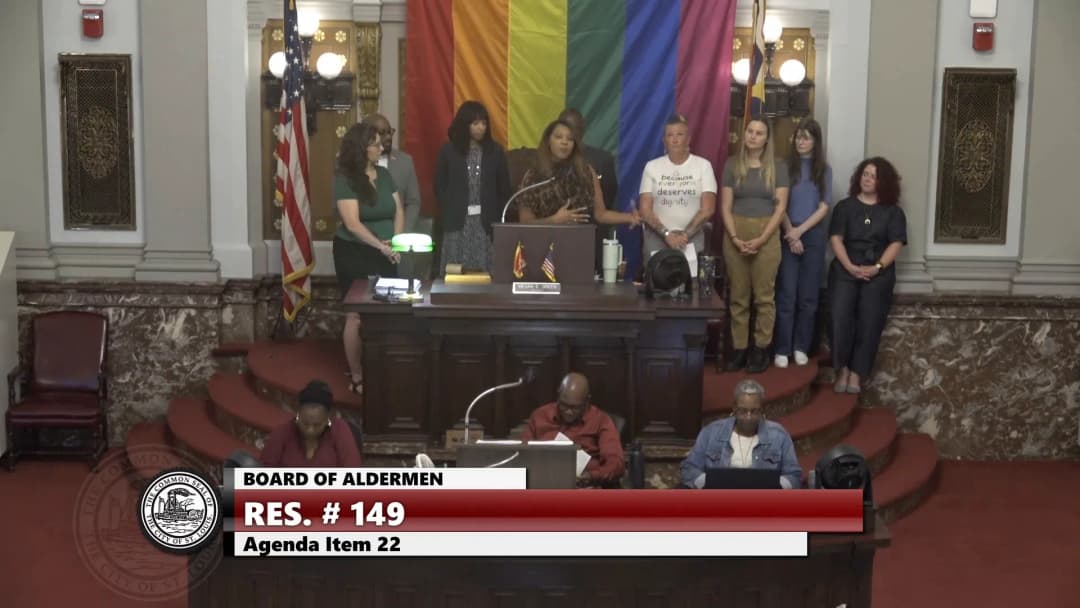
The St. Louis Board of Aldermen convened on Friday, October 9, 2026, with 13 members present. The meeting opened with a reflection by the alderman from the 3rd ward in honor of National Coming Out Day and a moment of silence for Matthew Shepard, followed by a recognition ceremony for the Code Blue Winter Response Team, first readings of new board bills, and final passage of the neighborhood traffic calming ordinance (Board Bill 75) after extended debate. Consent Calendar - The board approved the minutes of Friday, October 2, 2026, by voice vote. - Resolution 150 was adopted by mistake; the board voted 12–1 (Alderman Aldrich dissenting) to reconsider, leaving it on the first-reading calendar, after which Resolution 149 was taken up. - The perfection consent calendar — Board Bills 64 (closing the 2800 block of Oregon Avenue), 81 (defining and regulating smoke shops), and 76 (codifying the Office of Sustainability) — was adopted by voice vote. The alderman from the 8th ward was added as a co-sponsor of Board Bill 81. - The third-reading and final-passage consent calendar — Board Bills 69 committee substitute, 51 committee substitute, and 71 — passed by roll call, 14–0. - The courtesy resolution consent calendar (Resolutions 147, 148, 151, and 152) was adopted en bloc (described in the meeting as "in bank"). The board added several co-sponsors to Resolution 148 and to Resolutions 151 and 152. Code Blue Winter Response Team Recognition (Resolution 149) - Resolution 149, introduced by Alderwoman Sonier, honors the Code Blue Winter Response Team. The clerk's reading noted that Code Blue is the city's emergency cold-weather response program with activation levels one through four, and that the 2025 winter season made emergency shelters available to over 600 individuals on the most dangerous nights. - Alderwoman Sonier said a group of unhoused providers approached her about Code Blue about a year and a half ago, and that the city moved a $3.3 million allocation from the Rams settlement to fund the operation (Director Pearson later cited the figure as $3.34 million). - Dr. Pearson, Director of Human Services, reported that Code Blue produced nearly 25,000 bed nights and approximately 1,066 shelter transportation riders, and that the city's 400 year-round emergency beds would not have sufficed after the May 16, 2025 tornado displaced thousands of residents. He stated the effort saved lives. - Ann Warry, Commissioner of the Department of Health, said the department's role was rooted in public health protection, disease prevention, and safety for vulnerable residents. - Michael Gilbert, of the Department of Health's emergency preparedness team, called the work emotionally powerful and invited every alderman to volunteer to ride along with Code Blue outreach this winter. - Christina Sturman, of the Code Blue Coalition and St. Louis Winter Outreach, described a man who refused shuttle rides repeatedly before accepting on the third round of pickups on a very cold night, saying Code Blue ensured that "when he was ready to come inside, there was somewhere for him to go." She said the response was built on outreach workers, shelter providers, volunteers, and people with lived experience, and called for Code Blue to become a permanent part of the city's winter response. - Alderwoman Sonier and President Green noted that the city budget now includes dedicated Code Blue funding and that the Board of Estimate and Apportionment approved contracts for Code Blue providers for the coming winter. President Green said she had never seen the city this prepared for winter by October. Discussion Items - First readings: Board Bill 88 (honorary street name "Pruitt Igoe Lane," at North 20th Street and Cass Avenue), sponsored by Alderman Aldrich and Alderwoman Clark Hubbard; Board Bill 89 (honorary street name "Lois Conley Lane," at St. Louis Avenue and North 25th Street), sponsored by Alderman Aldrich; Board Bill 90 (municipal receivership for vacant nuisance properties) and Board Bill 91 (establishing a Code Blue emergency weather response program with a dedicated fund from the city's 3% local sales tax on adult-use marijuana), both sponsored by Alderwoman Sonier with co-sponsors. Board Bill 90 was referred to the Housing, Urban Development and Zoning Committee; Board Bill 91 to the Health and Human Development Committee. - Second reading: Board Bill 80 (amended and restated lease consent for the Homer G. Phillips Senior Apartments at 2601 Whittier Street) was reported out of the Housing, Urban Development and Zoning Committee with a do-pass recommendation. - Board Bill 75 (neighborhood traffic calming system), sponsored by Alderman Browning and co-sponsors, was debated at length. Browning said the bill would professionalize traffic calming, create an online portal tracking requests, funding decisions, and completion dates, and require the Department of Transportation to report annually to the Public Infrastructure and Utilities Committee. He noted that nearly 90% of city voters approved Proposition T to create the Department of Transportation. The alderwoman from the 12th ward expressed deep distrust of the Streets Department, recalled that ward capital was created by voters in November 1993, called the $900 fee a "farce," and said she would vote present; the alderwoman from the 13th ward voted no, saying she had waited 10 years for speed humps in her ward. The alderwoman from the 12th also said she planned to introduce legislation holding department directors accountable for projects delayed beyond a year. Final roll call: 12 ayes, 1 no, 1 present. Key Outcomes - Resolution 149 was adopted, recognizing the Code Blue Winter Response Team. - Board Bill 75 passed as amended on the floor (12–1–1) and, with Board Bills 51 committee substitute and 71, was signed by the President and ordered to become law. - Board Bills 88, 89, 90, and 91 received first readings; Board Bills 90 and 91 were referred to committees. - Board Bill 80 advanced to the floor with a do-pass recommendation. - The courtesy resolutions (147, 148, 151, 152) were adopted. - The board excused the alderman from the 5th ward for necessary absence and adjourned until Friday, October 16, 2026, at 10 a.m. Announcements - The 24th annual Mary Meachum Freedom Crossing reenactment will take place Saturday, October 10, 2–4 p.m., under the Gateway Arch (Resolution 151 celebrates this event). - Soulard Octoberfest runs October 9–10. - A "People's Parade" to Ameren headquarters will be held Saturday, October 10, 11 a.m.–2 p.m., starting at the Carondelet Pavilion in Lafayette Park, protesting Ameren's 20-year plan to abandon carbon reduction commitments and increase fossil fuel reliance from 5% to 60%. - Shaw Art Fair runs Saturday and Sunday, 10 a.m.–6 p.m. - The Continuum of Care holds a town hall on homelessness Thursday, October 15, 5:30–8 p.m., at 1315 Chestnut Street. - The board honored STL TV; speakers cited both 35 years and 30 years of service to the city (the transcript contains both figures). - The alderwoman from the 10th ward recognized 9-year-old Cadence Lewis, national record holder in the 800-meter run for 9-year-old girls (time of 2:25.32 in June 2026, breaking a 10-year standing record) and a 2026 Junior Olympic National Champion in the 800-meter run and the 4x400 relay.
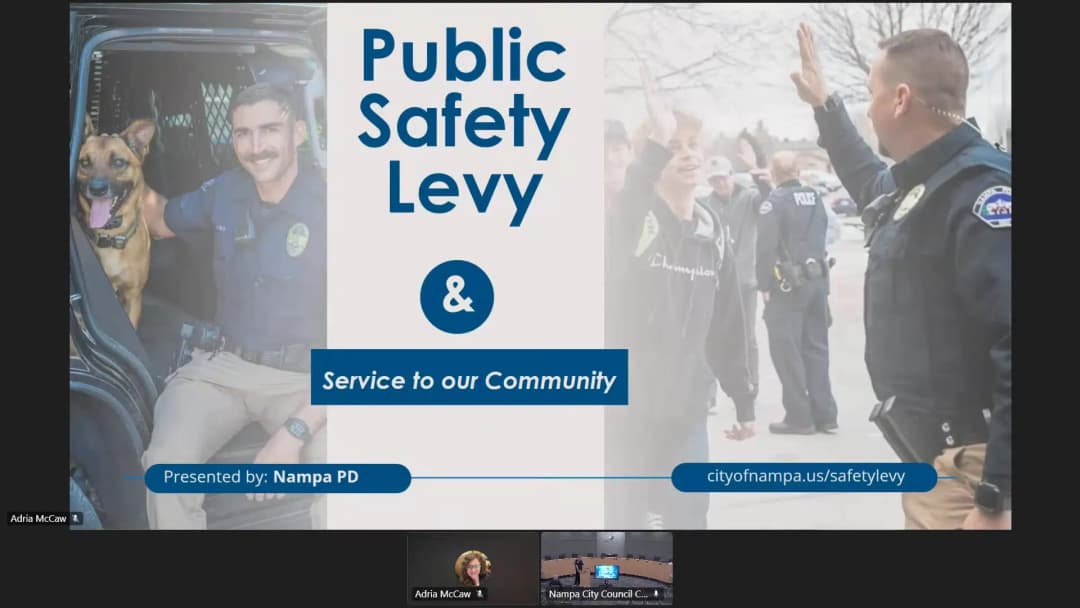
On October 8, 2026, the Nampa Police Department held a live-streamed community presentation, led by the Chief and Deputy Chief Kurt Schenkel, to explain a proposed permanent public safety levy. The $5 million-per-year levy would add 24 patrol officers, provide a one-time 4% cost-of-living adjustment to retain current police personnel, and fund the department's first training facility. Officials also described the consequences if the levy fails and answered an audience question. Note: the raw transcript sometimes renders "Nampa" as "Napa." Public Comments & Testimony - An audience member asked about patrol staffing; the Chief clarified that the levy is limited to the patrol division and that the city council retains responsibility for specialty units. He said if the levy fails, the department would face hard decisions, including shrinking specialty units to return officers to patrol. He agreed that growth should pay for itself and said he wants officers on the road as new residents move in, not a year later. Discussion Items - Patrol staffing shortage: The Chief said the department is becoming "reactive rather than proactive." He noted the response plan has already been adjusted over the last couple of years, and the department is reaching a point where it is not the type of department it wants to be. He added that when residents call 911, the department should not have to choose between sending an officer or using an online report. Patrol has eight teams averaging seven officers per team; when the Chief joined 33 years ago, a patrol shift had six officers for roughly 30,000 residents, compared with about 130,000 now. The department handles 250–350 calls for service daily. - Levy proposal: The permanent levy would raise $5 million per year (not increasing annually) and add 24 patrol officers in phases — eight in year one, eight in year two, four in year three, and four in year four. The average household would pay between $7 and $11 per month, described as 28.93 cents per $100,000 of taxable home value. - Retention and recruitment: The one-time 4% COLA would not fully close the wage gap with neighboring agencies, but the Chief said he is confident it would retain current staff. Losing an officer costs Nampa taxpayers roughly $140,000 to hire and train a replacement. Nampa has lost 13 officers to neighboring agencies in the last three years and about five before 2023, costing an estimated $4.5–5 million. If the levy fails, the Chief warned, applicants may go to agencies east of Nampa paying $10–15 more per hour. - Training facility: Nampa currently trains at Meridian's facility, with 80% of recruit training time there; Meridian is nearing capacity. The department wants its own facility, funded through levy salary savings while hiring is phased in: roughly $2.3 million in year one and $1 million in year two would go into a dedicated fund. The current Hugh Nichols public safety building, built in 2012 as a 30-year building, is already out of room due to growth. The Chief said they are "not asking for a Taj Mahal." - Impact fees: Deputy Chief Schenkel explained impact fees can only be used for one-time purchases such as land, buildings, or vehicles, not ongoing salaries and benefits. - State funding losses: The city has lost roughly $6.2 million from its budget due to state legislation, including House Bill 389 and another bill. The Deputy Chief cited an interview stating that over four years the city collected $170 million in property taxes while those house bills caused almost $33–34 million in lost funds. He also noted the mayor and city council have supported the police by dedicating funding authority and prior forgone funds to add positions. - 2024 allocation study: The study identified a need for 12 more officers immediately and another 15 over the following years; even with 24 new officers, staffing would not reach the recommended level until 2030. - Specialty-unit strain: Sixteen school resource officers cover 38 schools; the Chief said he may have to pull SROs and other specialty-unit officers into patrol if staffing does not improve. - Community reassurance: Both officials said the department will continue serving the community whether or not the levy passes, and emphasized that every levy dollar would stay within the police department budget. Key Outcomes - No formal vote or council decision occurred at this presentation. - The levy will be on the ballot; the Chief said this is the first time Nampa Police has asked for a levy and encouraged residents to educate themselves before voting. - Residents were invited to call Nampa Police at 465-2257 and ask for community engagement coordinator Carmen Voger to schedule follow-up meetings.