Browse by city
Date range
Search help

Search titles, summaries, topics and stored transcripts together. Keywords may match separately; put the whole query in double quotes for a phrase. Matching follows word analysis, so punctuation is not exact. Both dates are included. Documents are not searched.

SHOWING 3121–3130 ENTRIES
3121
OCT 6, 2026 · LOUISVILLE, KENTUCKY · METRO COUNCIL & COMMITTEES
Louisville Metro Planning and Zoning Committee Hearing and Data Center Briefing - October 6, 2026

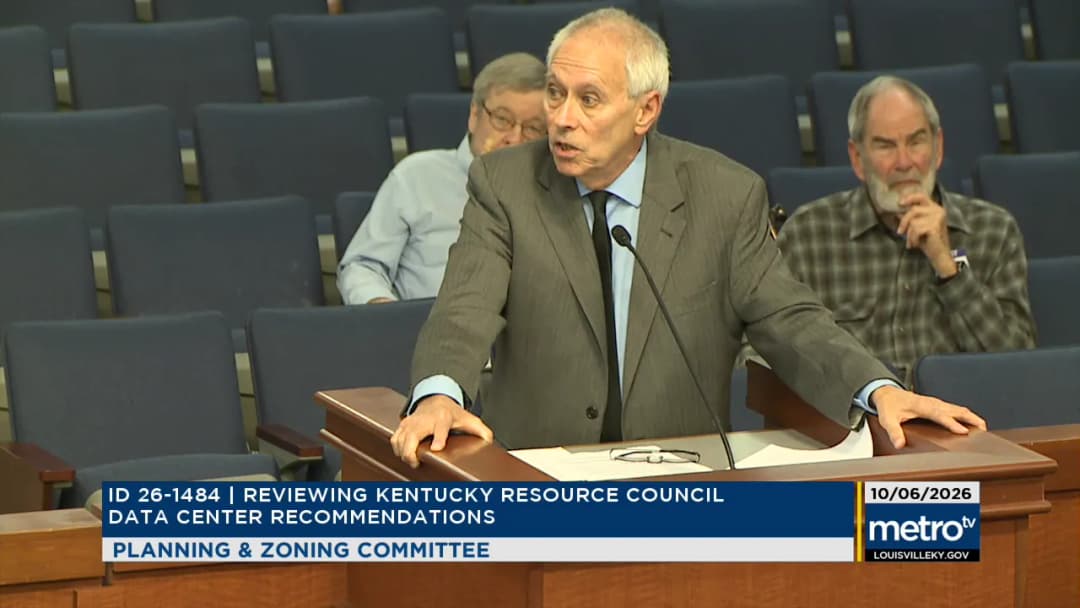
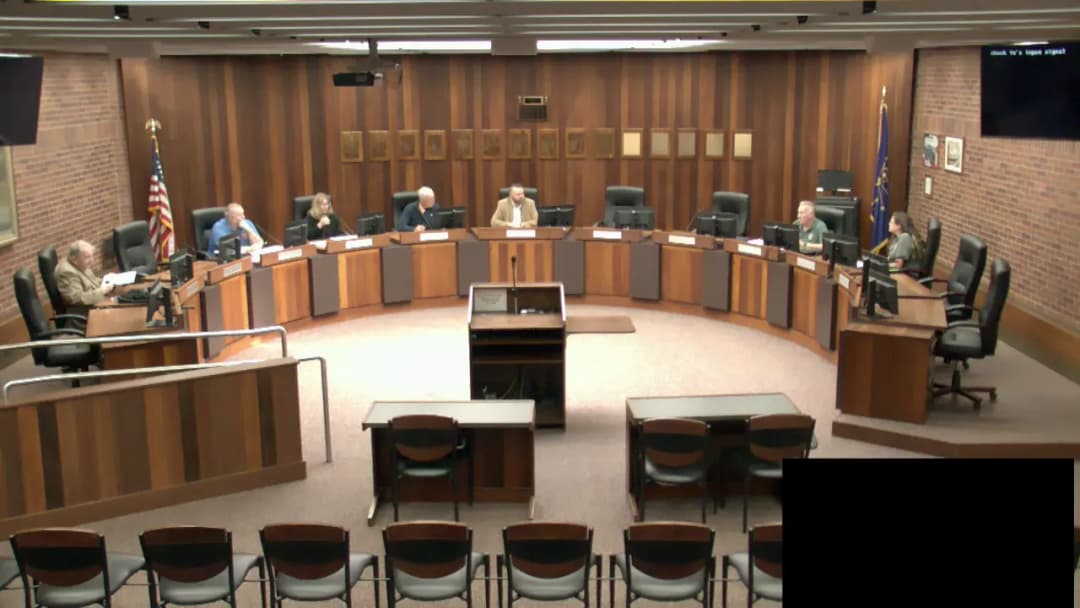
The Louisville Metro Planning and Zoning Committee met on Tuesday, October 6, 2026, in Council Chambers and by video teleconference, beginning at approximately 1:03 p.m.; the tentative minutes record the call to order at 1:04 p.m. Chair Andrew Owen (D-9) presided, with Vice Chair Scott Reed (R-16) attending virtually. A quorum was present. The tentative minutes roll call lists Shameka Parrish-Wright (D-3) as present, but the recorded vote on O-281-26 lists her as absent; the transcript indicates she arrived later during the meeting. Josie Raymond (D-10) was excused. Non-committee council members present included Tammy Hawkins (D-1), Ken Herndon (D-4), JP Lyninger (D-6), Jonathan Joseph (R-12), and Anthony Piagentini (R-19). The committee recommended one zoning ordinance for approval, held two pending ordinances, heard invited expert testimony on data center regulation, and adjourned without objection at 2:58 p.m. No public comment period was held. Pending Legislation O-281-26 - Zoning change at 211 South 41st Street (Case No. 25ZONE0142) - Brian Davis of the Louisville Metro Office of Planning presented the Planning Commission's recommendation. The approximately 0.1-acre property, located in Metro Council District 5, is currently zoned R-5 and would be rezoned to R-7 to make an existing residential triplex compliant with zoning law. No exterior changes are proposed. The applicant's neighborhood meeting was held August 27, 2025, and the Planning Commission held a public hearing September 3, 2026, voting 5-2 to recommend approval. The committee voted 6-0 to recommend approval, with Owen, Reed, Benson, Ruhe, Hudson, and Batshon voting yes; Raymond was excused and Parrish-Wright was absent for that vote. The ordinance was sent to Old Business for the full Metro Council meeting on October 15, 2026. Council Member Donna L. Purvis (D-5) is eligible to vote on this zoning change. The statutory action deadline is December 12, 2026. O-282-26 - Closure of unnamed rights-of-way near Old Manslick Road (Case No. 26STRCLOSURE0025) - This ordinance would close unnamed portions of right-of-way directly south and southwest of Old Manslick Road, containing approximately 39,500 square feet. The item was held in committee with no vote. The statutory action deadline is March 24, 2027. O-251-26 - Land Development Code amendments regarding data centers (Case No. 25-LDC-0014) - This ordinance remained held in committee with no vote. The statutory action deadline is March 10, 2027. Special Discussion: Massive Data Center Experience - Robin Palm, AICP (ID 26-1517) Robin Palm, planning administrator for the Village of Mt. Pleasant, Wisconsin, described his community's experience with a large data center buildout. Palm noted that Microsoft's Fairwater campus, which opened in June 2026, is about 1.5 million square feet. The first phase included four data centers totaling about 4 million square feet; 15 more data centers were approved in January 2026, bringing the total pipeline to about 12 million square feet with a projected total assessed value of $23 billion. For context, the village's total assessed value in 2017 was about $3.4 billion. Palm explained that the Foxconn project, which originally promised 13,000 jobs, set up the land, infrastructure, and zoning that later attracted Microsoft. Foxconn is now expected to reach 2,000 permanent jobs by 2030. Microsoft currently has about 400 employees at its first completed building and another 400 expected at the second building, which Palm said exceeded initial job expectations. Microsoft did not request new incentives and later returned a $5 million incentive to the village, an amount Palm described as about one-quarter of the village's operating budget. At the January 2026 approval, Palm said the largest public contingent was union members from the local engineering and workers union supporting continued construction jobs. Palm recommended forward-looking, predictable zoning standards and clear decision points, warning that opposition often escalates after approvals are vested. On impacts, Palm reported noise complaints from the neighboring community of Sturtevant, though his own unscientific visit to the site found the closest housing development about one-half to three-quarters of a mile away. The operator requested 30-foot sound walls even though the village's code allowed 10-foot walls in industrial districts, leading the village to amend its code to allow taller walls when needed to meet sound ordinances. Palm emphasized that low-frequency noise is difficult to measure with standard dBA meters and recommended separating noise standards by octave and frequency. Palm said the data centers receive power from the regulated utility We Energies rather than generating their own power. At full buildout, the campus could use about 25% of Wisconsin's pre-campus power supply. He noted statewide utility bills have been rising roughly 5-6% due to multiple factors, and he could not attribute the increase solely to data centers. Diesel generators are used only as a backup redundancy and are tested about once a month. The campus draws water from Lake Michigan, about six miles away, under approvals allowing up to 7 million gallons per day; Palm noted liquid cooling uses less water but more electricity. He also highlighted waste heat as a major planning opportunity, saying the Fairwater campus alone could heat the roughly 700,000 square feet of indoor water parks in Wisconsin Dells about 20 times over, or heat all homes in Racine County over the winter, if district heating systems were built from the start. Special Discussion: Kentucky Resource Council Data Center Recommendations - Tom Fitzgerald (ID 26-1484) Tom Fitzgerald, attorney and former longtime director of the Kentucky Resources Council, presented the KRC model data center ordinance and described research he conducted into best practices in Northern Virginia, Pennsylvania, and other locations. Fitzgerald described KRC as a nonprofit environmental legal aid organization that accepts no corporate or government money and typically represents communities downhill, downwind, and downstream. He said the model ordinance is not meant to be adopted in its entirety, but provides tools for local governments. Fitzgerald stated that KRC's recommendations apply to all data centers, not just hyperscale facilities, because there is no accepted definition of hyperscale and because a facility's square footage does not necessarily correlate with its off-site impacts. He recommended performance standards based on the intensity of the use, requiring acoustical and vibration studies, monitoring, and mitigation; treating existing data centers as accessory uses; applying standards to new or expanded facilities rather than retroactively; and avoiding exemptions for telecom hotels. He also recommended creating a new data center zoning district and requiring a rezoning paired with a conditional use permit, rather than allowing data centers by right based on square footage. Fitzgerald cautioned that a categorical ban on facilities over 500,000 square feet would be harder to defend than a regulatory framework, and if the ban is retained, the ordinance should include fallback standards and legislative findings explaining its rationale. Fitzgerald cited OstraGuard v. Microsoft, a federal class action filed in July 2026, alleging that low-frequency infrasound from Microsoft's Fairwater campus is causing off-site harm. He said standard dBA decibel measurements can miss low-frequency noise, and recommended using broader noise metrics, evaluating tonality and cumulative impacts, and requiring post-operation monitoring. He also said emerging peer-reviewed research associates chronic low-frequency noise exposure with elevated blood pressure and other physiological stress responses. He offered to provide peer-reviewed studies and a copy of the lawsuit to committee members. Fitzgerald argued against concentrating data centers in existing industrial areas, noting that older industrial corridors such as Rubbertown and parts of Southwest Louisville already carry disproportionate environmental burdens. He stated that a new zoning district with a conditional use permit process would allow data centers to be sited countywide, but only after public review, rather than automatically placing them in areas zoned M-3. Chair Owen added that when the Planning Commission examined M-3 zoning, it was almost exclusively located in South and Southwest Louisville, which he said was not acceptable; a new zoning category would open other parts of the county to data centers, though not by right. During discussion, Committee Member Shameka Parrish-Wright called for adding a health impact statement to the ordinance and said the committee should incorporate more of KRC's recommendations. She referenced high cancer, heart disease, and respiratory illness rates in West Louisville and Southwest Louisville and described the data center ordinance as a chance to avoid repeating past land-use mistakes. Council Member Tammy Hawkins asked whether the recommendations applied to all data centers and how consistency would be achieved; Fitzgerald said the rules would apply to new and expanded facilities, while existing nuisances could be addressed through existing nuisance law. Committee Member Jeff Hudson asked about health effects of low-frequency noise and comparisons to other industries; Fitzgerald said he would provide peer-reviewed literature. Committee Member Khalil Batshon questioned whether a new zoning district was simply another way to stop development; Fitzgerald responded that reasonable standards would not amount to improper outzoning. Vice Chair Reed asked about the village's decibel limits; Palm described octave-based limits that vary by zone and offered to share his code. Palm also advised that universal noise limits could be set through general police power and nuisance law, like speed limits, rather than through zoning alone. Key Outcomes - O-281-26 was recommended for approval by a vote of 6-0 and sent to Old Business for the full Metro Council meeting on October 15, 2026. - O-282-26 and O-251-26 were held in committee without votes. - The committee heard extended presentations from Robin Palm and Tom Fitzgerald to inform its ongoing work on O-251-26. - Chair Owen said the next committee meeting will be held on October 20, 2026, and that he planned to distribute a topic-based agenda by the end of the week. He also said his office would collect any additional questions for Palm. - The meeting adjourned without objection at 2:58 p.m.
DATA CENTER REGULATION 63% · ZONING REGULATION 15% · PROCEDURAL 6% · ENVIRONMENTAL PROTECTION 4%
3122
OCT 6, 2026 · EVANSVILLE, INDIANA · CITY COUNCIL
Mesker Park Zoo Advisory Board Meeting - October 6, 2026

The Mesker Park Zoo and Botanic Garden Advisory Board met on October 6, 2026, at 12:00 PM to hear the Executive Director's report, approve routine items, and vote on several new business requests including early zoo closures for Boo at the Zoo, a tree removal contract, a veterinary hospital design addendum, a solar panel interconnection agreement, and authorizations to seek quotes for a takin fence and Amazonia flat roof repairs. All new business items were approved unanimously. Consent Calendar - Minutes Approval: The board approved the minutes from the July 2026 meeting unanimously (note: the agenda listed an "August 2026 Meeting Memorandum," but the transcript indicates the minutes approved were from the July meeting). Discussion Items - Executive Director's Report: Director Erik Beck presented the attendance and revenue report. September saw 17,000 visitors, August 10,389, and the year-to-date total was 154,000 visitors. Gross revenue for the year is $1.16 million ($78,000 in September, $64,000 in August). Gift shop sales reached $305,000, and concession sales reported by Venue Works were $285,000. The lantern event (which concluded October 4) drew 15–16,000 nighttime visitors, down significantly from last year due to extreme heat and the event's operator scaling back; they will not return for the third contractual year. Director Beck reported staffing updates: a new guest services manager (internal hire Rihanna) and a veterinary technician (Sheridan) were hired; the animal curator position remains open. Animal updates included baby peccaries, a colobus monkey named Opal, new cockatiels, and a planned giraffe swap—sending female Clementine to Indianapolis Zoo and receiving a male Maasai giraffe from San Diego Zoo. Project updates: rehabbing the front entry exterior, closing Amazonia for boardwalk replacement (using different material), replacing Komodo exhibit glass, repairing skylights, and replacing playground surfacing at the Hippo playground. Director Beck also attended the AZA National Conference in Portland and noted that Carl the Abyssinian ground hornbill won the AZA SAFE Hornbill campaign, raising nearly $5,000 toward conservation (overall campaign raised nearly $200,000). - Boo at the Zoo Early Closure Request: The board discussed and approved early closures on October 16–18 and 23–25: 2:00 PM on Fridays and Saturdays, 1:00 PM on Sundays to accommodate the event. - Tree Removal Contract: Director Beck presented a $25,000 hazard tree removal contract with American Eagle Tree, covering about 15 trees identified as diseased or damaged. One such tree recently dropped a limb that crushed a perimeter fence, leading to an insurance claim. The contract requires final approval by the Board of Park Commissioners. - Vet Hospital Design Agreement Addendum: A design agreement with Three Eye Design for renovations to the veterinary hospital (specifically the hoofstock quarantine area) for $80,000 was presented. Construction is estimated at $500,000–$800,000. The agreement is pending legal review and city approval. - Centerpoint Service Agreement for Solar Panels: An interconnection service agreement with CenterPoint Energy for a solar array in the front parking lot (300 kW AC) was presented. The project will lose about 12 parking spots. This is one of three solar projects at the zoo. Agreement pending legal. - Permission to Seek Quotes for Takin Fence: The board authorized seeking quotes for a takin fence, funded by $180,000 in additional city funds approved by City Council to complete projects by year-end. The fence will allow training, separation, and voluntary hoof work. - Permission to Seek Quotes for Amazonia Flat Roof: The board authorized seeking quotes for repairing the flat roof over behind-the-scenes areas at Amazonia, budgeted at approximately $70,000, using the same additional funding. Key Outcomes - Approved: Early zoo closure for Boo at the Zoo (unanimous). - Approved: Tree removal contract with American Eagle Tree (unanimous). - Approved: Vet hospital design agreement addendum (unanimous). - Approved: CenterPoint service agreement for solar panels (unanimous). - Approved: Permission to seek quotes for takin fence (unanimous). - Approved: Permission to seek quotes for Amazonia flat roof (unanimous). - Next Meeting: November 10, 2026.

PARKS AND RECREATION 97% · INFRASTRUCTURE 3%
3123
OCT 6, 2026 · ALAMEDA COUNTY, CALIFORNIA · BOARD OF SUPERVISORS
Alameda County T&P Committee Discusses Wildlife Crossings, Solar Ordinance, Vallecitos (Oct 6, 2026)

The Transportation/Planning Committee met on October 6, 2026, with only Supervisor David Haubert present, resulting in a non-quorum discussion-only session. No formal votes or actions were taken. The committee reviewed three informational items: the Alameda County Resource Conservation District Wildlife Connectivity Project, the status of ordinance adoption for solar and battery storage projects, and a general plan amendment for the Vallecitos Nuclear Center. Public Comments & Testimony - Juan Pablo Galvan Martinez, Land Advocacy Director for Save Mount Diablo, expressed full-throated support for the wildlife crossings, emphasizing the Altamont Pass area as a critical narrow point in the Diablo Range and urging that crossings be dedicated exclusively to wildlife to maximize biodiversity benefits. - Celeste Garimendi, a long-time observer, voiced strong support for the project, highlighting its importance for landscape-level planning and noting that the Diablo Range was recently designated a state conservation priority via Assembly Concurrent Resolution 107. - Patrick Hannigan, facility manager for North Star (owner of the Vallecitos site), explained that the company is a demolition and nuclear decommissioning contractor, not a developer. He requested correction of a mapping error to encompass existing developed areas (roads, utilities, tenant buildings) that were inadvertently omitted from the industrial overlay. - Splend Splendorio, representing North Star, clarified that the county initiated the amendment to correct the mapping error and emphasized that the goal is simply to legitimize current operations, not to pursue new development. He supported the proposed approach. Discussion Items Wildlife Connectivity Project (ACRCD) Courtney Kuhn and Farley Connolly (Alameda County Resource Conservation District) presented an update on designing four priority wildlife crossings across I-580 and I-680. The project uses a $7.9 million Wildlife Conservation Board grant to reach 65% design by 2027. Two crossings (Schaefer Ranch Road undercrossing and a large overcrossing east of Greenville Road) are prioritized, with estimated construction costs of $70–80 million. Supervisor Haubert asked about funding sources (likely combination of state and private), public input (three stakeholder meetings with 20–25 attendees), and economic benefits (potential tourism). The project aligns with Assembly Bill 1889 requirements for analyzing wildlife corridors in general plan updates. Solar and Battery Storage Ordinance Status Albert Lopez (Planning Director) reported that draft general plan amendment and zoning code ordinances are complete, but still require County Counsel review, CEQA consultant work ($200,000 budgeted), and road show presentations to the Agricultural Advisory Committee and Planning Commission. The existing 2022 policy sets a 1,000-acre cap for solar and a 300-acre cap for battery storage. One project (Potentia Veridi, 100 acres) was approved via the state AB 205 process. Supervisor Haubert expressed concern that if applicants use the state process, the county loses control over acreage limits, and urged expediting the local ordinance. He noted that without an ordinance, he would advise applicants to use the state process, which he wants to avoid. Staff indicated the ordinance could be completed within six months. Vallecitos Nuclear Center General Plan Amendment Albert Lopez described a mapping error in the East County Area Plan (ECAP) where only 105 acres of the 600-acre Vallecitos site received the industrial designation, despite the entire footprint being zoned M-2 heavy industrial since the 1990s. North Star, the current owner, seeks a technical correction to restore the full footprint (about 400 acres, excluding undeveloped portions) to the industrial land use designation to allow continued decommissioning and existing tenant operations. Supervisor Haubert directed staff to determine the minimal CEQA required to fix the map error within one month, separate from any future development proposals. The amendment will go to the Planning Commission and full Board, but not to community advisory councils. North Star representatives confirmed they are not currently pursuing new development, just correcting the error. Key Outcomes - No formal actions or votes were taken due to lack of quorum. Supervisor Haubert provided guidance for staff. - Wildlife Connectivity Project: Staff will continue working with ACRCD and partners. No specific directive. - Solar/Battery Ordinance: Staff to continue County Counsel review, CEQA consultant recruitment, and road show preparation, with a target of completing the ordinance within approximately six months. - Vallecitos Amendment: Supervisor Haubert directed staff to identify the minimal CEQA needed for a pure map correction (no new development) within a month. A separate conversation with the property owner about potential future development will proceed in parallel. The technical amendment will go through Planning Commission and full Board of Supervisors.

ENVIRONMENTAL PROTECTION 27% · WILDLIFE CONSERVATION 24% · LAND USE PLANNING 20% · PUBLIC COMMENT 18%
3124
OCT 6, 2026 · WASHINGTON, DISTRICT OF COLUMBIA · COUNCIL OF THE DISTRICT OF COLUMBIA
District of Columbia Council 37th Legislative Meeting - October 6, 2026

The Council of the District of Columbia held its 37th Legislative Meeting of Period 26 on October 6, 2026, commencing at 12:36 PM in the Johnny Wilson Building. The hybrid meeting addressed a wide range of legislation including utility affordability, parking enforcement, the initiative process, and major transportation funding agreements with WMATA. Consent Calendar - 22 ceremonial resolutions were approved without objection. - Final reading bills for property tax exemptions (Food & Friends, Archdiocese of Washington, Reservoir District) and several Congressional Review emergency measures were approved. - Bill 26-619, the Eric's ID Amendment Act, was pulled from the consent agenda to non-consent for remarks by its sponsors. Discussion Items - Eric's ID Amendment Act (Bill 26-619): Councilmember Allen removed the bill from the consent agenda to recognize advocates Eric Carpenter Grantham and Linda Carpenter Grantham. Councilmembers Allen, Lewis George, Parker, and Trayon White praised the Granthams for their advocacy establishing a non-apparent disability marker (a butterfly symbol) on DC licenses, modeled after a Maryland program that has enrolled over 30,000 residents. The bill passed its final reading unanimously. - Automatic Enrollment for Utility Affordability Programs Act (Bill 26-243): Councilmember Allen presented the bill, noting that energy costs surged 70% between 2017 and 2025 and that low-income households spend 16% of their income on energy. The bill directs DOEE to automatically enroll households eligible for SNAP, TANF, WIC, or Medicaid into utility affordability programs. DOEE estimates this will enroll 31,000 additional low- and median-income households, saving them up to $475 annually on electric bills and $276 on gas. Councilmember Frumin raised concerns about the impact on other ratepayers through tariff adjustments, requesting a specific estimate before the second vote. Councilmember Lewis George strongly supported the bill, citing 25,673 PEPCO disconnection notices in August 2026 (a 218% increase) and stating it is a common sense step to remove barriers to access relief. The bill passed first reading unanimously. - Strategic Parking Enforcement Enhancement Act (Bill 26-16): Councilmember Nadeau moved an amendment in the nature of a substitute, expanding the default list of entities eligible for reimbursable parking enforcement details to include universities and nonprofits, and requiring certification that campus police receive training comparable to DPW. Councilmember Robert White offered an amendment to cut all parking fines in half, citing a 5.7% unemployment rate, 0.8% economic growth, and residents \"drowning in costs.\" The fiscal impact statement estimated a revenue loss of $10-20 million. The amendment failed. Councilmember Silverman offered an amendment requiring a council hearing one year after implementation. Chairman Mendelson opposed legislating council process, stating he would hold a hearing as Chair of the Committee of the Whole if the next chair did not. The amendment failed. The underlying bill as amended passed with Councilmembers Trayon White and Robert White voting no, and Councilmembers Henderson, Parker, Felder, and Lewis George voting present. - Fair Initiatives Lend Transparency to Every Resident (FAIR ELECT) Amendment Act (Bill 26-436): Councilmember Bonds moved an amendment clarifying that the Board of Elections must accept an initiative measure unless specific statutory grounds for refusal exist. Councilmember Parker expressed concern the language was not clear enough to force a yes-or-no vote, but his competing amendment was not taken up after debate was closed on Bonds\' amendment. Councilmember Bonds confirmed her legislative intent was limited to grounds stipulated in existing law. Councilmembers Silverman and Parker voted against the final bill, with Silverman arguing the bill does not address the core issue of complex policy initiatives bypassing the legislature. - Climatizing Our Overheated Living Spaces Regulation Amendment Act (Bill 26-285): Councilmember Henderson moved a successful amendment changing the effective date to April 1, 2027, from May 1, 2027, to allow tenants to benefit from the cooling requirements during the spring of 2027. The bill passed unanimously. - Homeless Services Contract Adjustment Emergency Act (Bill 26-850): Councilmember Frumin presented the bill to address $3.9 million in 2026 federal Service Contract Act (SCA) compliance costs for homeless shelter providers. The bill creates an expedited equitable adjustment process at OCP. Councilmember Frumin amended the timeline from 45 to 60 days at the mayor\'s request. Councilmember Robert White added a technical amendment clarifying that the pet breed ban and pet rent/fee provisions from a previous act apply to leases beginning after October 1, 2026, rather than retroactively. The bill passed unanimously. - WMATA Emergency Legislation: Councilmember Allen presented three emergency measures at the request of the Mayor. - Stadium-Armory Station Improvements: Approved a reimbursable agreement up to $300 million for station capacity expansion related to the RFK campus redevelopment. - Gold Line Bus Rapid Transit Phase 1: Approved a $5.2 million agreement for planning, environmental review, and 30% design of a BRT route from Union Station to RFK Stadium, extended to Benning Road. Councilmember Felder urged inclusion of the Benning Road extension in Phase 1. - FY27-32 Dedicated Funding Grant Agreement: Approved the district\'s $178.5 million annual contribution to WMATA (not adjusted for inflation) for the next six years. An amendment corrected the measure from a resolution to an emergency act. All measures passed unanimously. Key Outcomes - Decisions and Votes: - Automatic Utility Enrollment (Bill 26-243): Passed first reading unanimously. - Cybersecurity Act (Bill 26-427): Passed final reading unanimously. - Parking Enforcement (Bill 26-16): Passed (Councilmembers Trayon White and Robert White voted no; 4 members voted present). - FAIR ELECT Act (Bill 26-436): Passed (Councilmembers Silverman and Parker voted no). - Cooling Regulation (Bill 26-285): Passed final reading unanimously. - Substance Use/Targeted Outreach Grants Temporary (Bill 26-792): Passed (Councilmembers Henderson and Bonds voted no). - All Emergency and Temporary Acts: Passed unanimously. - Next Steps: - The Automatic Enrollment bill will return for a second reading. - DOEE is directed to implement data-sharing protocols for automatic enrollment. - OCP is directed to process equitable adjustment requests for homeless service providers within 60 days. - WMATA will proceed with Stadium-Armory station improvements, Gold Line BRT planning, and the execution of the new dedicated funding grant agreement. - The next legislative meeting is scheduled for November 10, 2026, at 12:00 PM. The next Committee of the Whole meeting is October 20, 2026.

PROCEDURAL 20% · PARKING REGULATIONS 17% · PUBLIC ENGAGEMENT 11% · ENERGY AFFORDABILITY 10%
3125
OCT 6, 2026 · DENVER, COLORADO · COUNCIL COMMITTEES
Parks, Art and Culture Committee Meeting - October 6, 2026

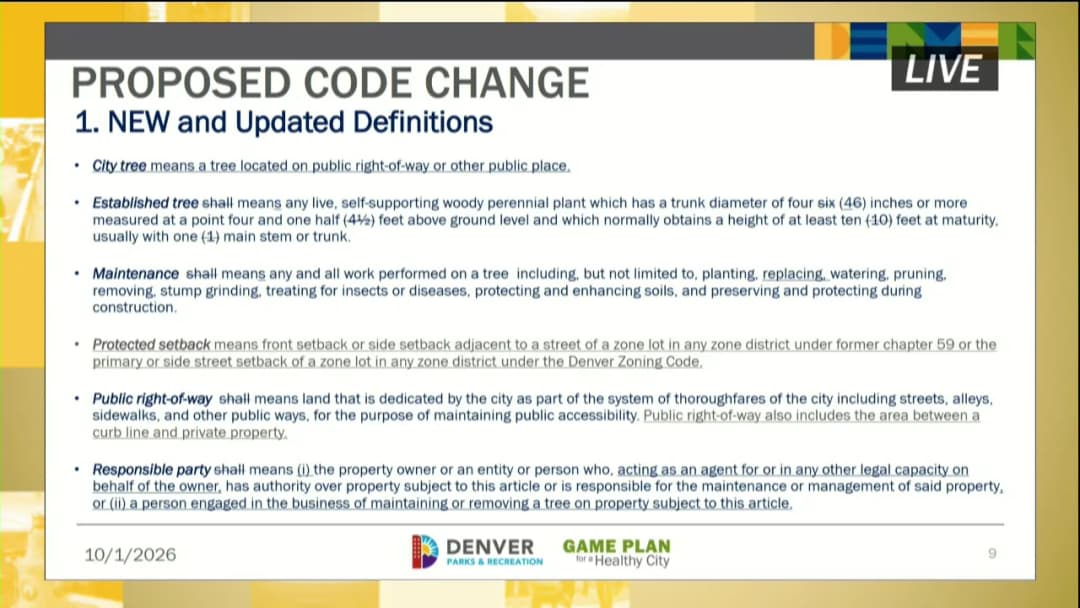
On Tuesday, October 6, 2026, the Denver City Council Parks, Art and Culture Committee met at 10:30 AM in Room 391 of the City and County Building. Chair Shontel Lewis presided with Vice Chair Paul Kashmann and members Flor Alvidrez, Serena Gonzales-Gutierrez, Chris Hinds, Diana Romero Campbell, and Amanda Sawyer present. The committee considered three action items: a $3,005,589.87 contract for library and cultural plaza design services, amendments to the city’s tree preservation code (Chapter 57), and a package of 15 on-call parks maintenance and construction contracts with a combined potential value of up to $287.5 million. Public Comments & Testimony No public testimony was offered on any of the agenda items, though the agenda had scheduled 15 minutes for item 26-1451. Discussion Items 26-1452 – Architectural and Engineering Design Services for Library Renovations and Cultural Plaza Mandy Vink and Patrick Riley (Denver Bond Office) presented a contract with Handprint Architecture Inc. for $3,005,589.87 to design renovations to the Blair-Caldwell African American Research Library & Museum, Montebello Branch Library, and the Montbello Civic Center Park Cultural Plaza and Shade Structure. The projects are part of the 58 Vibrant Bond projects with a combined construction value of $25 million. The design scope includes HVAC, climate controls, roof and window inspections, space reconfiguration, and community-driven shade structure design. The contract has a 21% MWBE goal. Councilmember Watson asked about incorporating prior community engagement (over a year at Blair Caldwell) and avoiding engagement fatigue. Councilmember Kashmann inquired about library closure during construction; staff estimated Q2 2028 to Q4 2029 for construction, with bookmobile services and relocation to rec centers available. Councilmember Sawyer raised concerns about not overlapping library closures in Southeast Denver. The committee approved the contract 7-0 after a motion by Alvidrez and second by Sawyer. 26-1451 – Amendments to Tree Preservation Code (Chapter 57) Elizabeth Judd and Luke Killoran (Office of the City Forester) presented eight proposed changes to strengthen tree preservation and protection, stemming from the 2024 Urban Forest Strategic Plan. Key changes include expanding definition of "city tree," clarifying street tree planting requirements on private streets, enabling authority to require consulting arborists for certain development projects, creating a "Legacy Tree" program for private property listing, updating appeals processes, and establishing a payment-in-lieu fee of $1,600 per tree for infeasible planting. Councilmember Alvidrez raised equity concerns about cost impacts on low-income communities and the inclusion of invasive species like Tree of Heaven. Councilmember Kashmann questioned resident cost for dead tree removal and the value of the Legacy Tree program. Councilmember Hinds noted conflicts between forestry and DOTI over sidewalk repairs and tree root protection. Councilmember Romero Campbell asked about fee implementation and impacts on housing choices. Multiple members expressed concerns about costs to homeowners. Following discussion, Councilmember Alvidrez moved to postpone the bill to the December 2, 2026 meeting, citing a full November 3 agenda; the motion was seconded by Hinds and passed 6-0 (with Sawyer absent). 26-1436 through 26-1450 – Parks On-Call Construction Contracts Kent Sondgerath and Aratiya (Parks and Recreation) presented 15 on-call contracts for citywide parks installation, maintenance, rehabilitation, and restoration services over five years. The contracts are split into a Prime pool (10 firms, $20 million cap each, max $6 million per work order) and an SBE pool (5 firms, $7.5 million cap each, max $1.5 million per work order). Five of the firms are new to Denver Parks work. Possible scopes include concrete trails, playgrounds, irrigation, fencing, and improvements to 58 Vibrant Denver bond projects. Councilmember Kashmann asked about total potential expenditure if all contracts are maxed. A motion by Alvidrez, seconded by Hinds, to approve the 15 resolutions as a block carried 6-0 (Sawyer absent). Key Outcomes - Item 26-1452 (Library Design Contract): Approved by a vote of 7-0. Contract value $3,005,589.87, end date March 15, 2030. - Item 26-1451 (Tree Code Amendments): Postponed to December 2, 2026, by a vote of 6-0 (Sawyer absent). The proposal includes a $1,600 payment-in-lieu fee, Legacy Tree program, and new arborist requirements. - Items 26-1436 through 26-1450 (Parks On-Call Contracts): Approved in a block by a vote of 6-0 (Sawyer absent). Total contract capacity: up to $287.5 million over five years.

COMMUNITY ENGAGEMENT 23% · URBAN FORESTRY 23% · LIBRARIES 18% · URBAN RENEWAL 16%
3127
OCT 6, 2026 · CLARK COUNTY, NEVADA · MEETING PORTAL
Clark County Board of Commissioners & Agency Joint Meeting – October 6, 2026

The Clark County Board of Commissioners, sitting jointly as several boards (Redevelopment Agency, Fire Protection, Water Reclamation, UMC Hospital Trustees, and Liquor and Gaming Licensing), convened a regular meeting on October 6, 2026. The lengthy session was dominated by the approval of the College Football Playoff (CFP) National Championship special event in January 2027, an extensive debate over the expiring Interlocal Agreement with the City of Las Vegas, a presentation on the status of expiring general aviation hangar leases, and discussion on the creation of a dedicated County Veterans Services office. Public comment was heavily focused on hangar lease renewals and the protection of the Northwest Rural Preservation Area. Consent Calendar - The consent calendar (Items 7–50) was approved in a single motion. Items included amendments to contracts for St. Jude's Ranch and NaphCare Nevada, an Interlocal Agreement with the Clark County School District for bus transportation, the selection of Deloitte for an Enterprise Resource Planning (ERP) system, donation of 10,000 pairs of socks from Bombas, the awarding of the Annual Traffic Paint contract to Ennis-Flint, approval of various aviation support contracts, the listing of 13.89 acres of county property for a minimum of $16.34 million, a $1 land purchase from the City of Henderson, and the establishment of the 2027 meeting calendar. Public Hearings - Items 51, 52, 53: Routine approvals were passed for an ordinance regarding street closures, a liquor license location waiver for Dean Martin Liquor LLC, and a telecommunications franchise for Level 3 Communications. - Item 54: CFP National Championship Special Event: The CFP Host Committee (Byron Yost, Brian Hatch) presented a detailed plan for the January 22-25, 2027 events at the Las Vegas Convention Center, Grand Prix Plaza, Allegiant Stadium, and Las Vegas Boulevard. The presentation outlined expected crowds (30,000 at Fan Central, 35,000 at the tailgate, 65,000 at the game), a $4 million community investment in Clark County School District programs, a small business portal with over 220 vendors, and an 800-volunteer program. Traffic modifications mirroring Raiders game days were detailed. Commissioner Gibson moved approval, and the motion passed. Discussion Items 1. Interlocal Agreement with the City of Las Vegas (Item 61) Commissioners Kirkpatrick and Becker led a comprehensive discussion on the expiring boundary and service agreement. Commissioner Kirkpatrick provided a historical narrative of the agreement, strongly opposing future city annexations and defending the rural preservation areas. She stated the city's recent actions felt like a personal affront to her district. Commissioner Becker focused on the fire service mutual aid system, bringing in Fire Chief Billy Samuels. Chief Samuels clarified the seamless automatic aid system, noting Las Vegas Fire and Rescue responded to 3,300 more incidents in the county than vice versa in FY26, representing a significant un-reimbursed cost to the county (estimated $1.5M for a rescue unit's annual cost). County Manager Schiller reported ongoing talks with the city manager. The board directed staff to negotiate a short-term extension while working towards a comprehensive, longer-term agreement that includes an annexation moratorium. 2. Hangar Leases at General Aviation Airports (Item 63) Director Chrisley from the Department of Aviation (DOA) presented on the expiration of historic land leases for 366 private hangars. He emphasized the FAA mandate (Grant Assurance 5) on airport control, stating new leases would require new capital investment or could result in reversion of the hangar to the county. Commissioner Kirkpatrick was heavily critical of the process, the use of outside consultants, the lack of a proper amortization formula, and the inconsistent handling of leases compared to standard commercial real estate. She demanded transparency on FAA guidance and comparable lease structures. Commissioner Gibson echoed the need for clear FAA citations and a defined vision. Later, numerous hangar owners (Thomas Morley, Larry Jocelyn, Walter Meller, Lawrence Frank, Sammy Vasilev) spoke during public comment. They accused the DOA of misrepresenting FAA rules, arguing the 50-year lease guidance was not a hard limit and that the real motive was financial gain. Walter Meller described the situation as "plain extortion." The board directed the DOA to return in November with a plan for lease extensions, detailed FAA compliance documentation, and the formula for capital investment. 3. Creation of a County Office of Veterans Services (Item 64) County Manager Schiller outlined two models: a standalone office or a coordinator within the Department of Social Services. Commissioner McCurdy strongly advocated for a standalone office to help veterans navigate benefits and avoid predatory practices. Commissioner Gibson expressed caution regarding creating new positions during cost containment and noted the existing network of VSOs and federal caseworkers. Commissioner Kirkpatrick opposed a new stand-alone office due to budget constraints but supported utilizing existing resources and space. The board coalesced around Option 2, directing staff to establish a Veterans Service point of contact within the Department of Social Services. 4. Transportation Improvement Bonds (Items 59, 60) The board approved two ordinances authorizing the issuance of General Obligation (Limited Tax) Transportation Improvement Bonds. Series 2026A ($101.19M for Beltway projects) and Series 2026B ($101.19M for the Strip Resort Corridor) were both adopted with an emergency declaration. 5. Clark County In-Lieu Fee Program (Item 58) Approved. The enabling instrument allows the county to pool mitigation obligations from Clean Water Act permits into larger restoration projects. Kimberly Goodwin presented the program, which begins with the Bunkerville East mitigation project. Public Comments & Testimony (End of Meeting) The general public comment period featured a wide range of topics. Several speakers addressed the hangar lease issues (see Item 63 notes). Speakers from the Northwest Rural Preservation area (Shelley Seeback, Christian Salmon, Bridget Salvey) urged the board to extend the Interlocal Agreement with the city for 20 years. A resident, Shoshan, requested the removal of religious invocations from meeting agendas, linking it to domestic violence awareness month. Eric King advocated for a shade tree program at bus stops. Michael Bruffy raised concerns about trash on East Lake Mead and golf rates for locals. Joyce Sparrow Henderson offered personal praise for the Pearson Community Center's Leaders of Future program. Kenneth Nelson discussed ongoing safety issues at Desert Breeze Skate Park. Dr. John Maxim requested the board to consider alternatives to the fuel index tax in light of electric vehicles. Key Outcomes - CFP Special Event (Item 54): Approved. - Transportation Bonds (Items 59, 60): Approved ($202.38M total). - In-Lieu Fee Program (Item 58): Approved. - Interlocal Agreement (Item 61): Staff directed to negotiate a short-term extension and a comprehensive long-term agreement. - Hangar Leases (Item 63): Staff directed to return in November with a more detailed plan and lease language. - Veterans Services (Item 64): Staff directed to create a coordinator within Social Services (Option 2). - Closed Session (Item 65): The board recessed into closed session for potential litigation and labor negotiations.

AVIATION COMMUNITY DEVELOPMENT 13% · AIRPORT MANAGEMENT 13% · PUBLIC SAFETY 12% · PUBLIC ENGAGEMENT 10%
3128
OCT 6, 2026 · MILWAUKEE, WISCONSIN · COMMON COUNCIL
Joint Public Hearing on Proposed 2027 Budget, Milwaukee Common Council, October 6, 2026

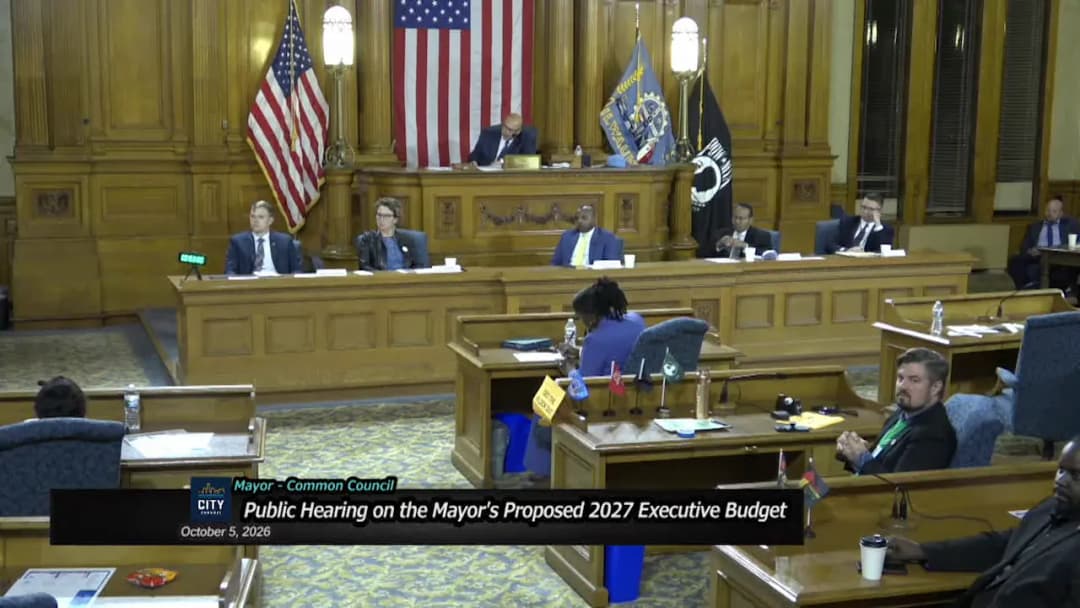
The Milwaukee Common Council held a joint public hearing on the proposed 2027 city budget on Monday, October 6, 2026, starting at 5:30 p.m. Over 50 community members registered to speak, voicing a wide range of positions on funding priorities. The hearing was presided over by Council President Jose Perez, with Mayor Cavalier Johnson and 13 council members present. No formal council deliberation or votes occurred; the hearing served solely to gather public input. Public Comments & Testimony - Food Access & Feed the Change MKE – A large coalition of speakers, including Sue Blosline, Lily Celestine, Lisa Yang, Artena Westfall, Jason Donald, Elise Che, Patricia Wilson, Janaya Trishay Johnson, Marquesa Tucker Harris, Viana Lingrady, Shirley Funches Tucker, Shanika Moore, Tracy Watford, Taylor Corslin, Maya Rimmer, and Shiracha Berry, urged the council to fully fund the $1 million Healthy Food Establishment Fund (also called Feed the Change MKE). Speakers described the loss of grocery stores on the Northwest Side, food apartheid, the health and dignity benefits of community gardens and local food systems, and the need for community-led solutions rather than corporate chains. - Opposition to Flock & Mass Surveillance – Over 20 speakers, including Emilio De Torre, Michelle Bolou, Peg Schrader, Amanda Avalos, Nikolás Dorty, Chrissy Fung, Alex Larson, Vaughn Mays, Brittany Vullich, Angela Lang, Tiffany Stark (on the issue), Kevin Wendelberger, Patrick Holston, Patrick Rahim, and Minister Khalif, strongly opposed continued funding of Flock automatic license plate readers (ALPRs) and other mass surveillance technologies. Speakers cited Fourth Amendment violations, misuse by officers for stalking, data sharing with ICE, national investigations, and the lack of transparency and oversight. Many noted that Milwaukee County and other communities have already ended their Flock contracts. Several speakers also urged removal of all ALPRs and a moratorium on new surveillance tech. - Support for City Worker Pay Raise – Many union members and supporters from AFSCME Local 33, Local 47, and others (Josh King, Venetia Youngblood Campbell, Patra Athens, Ian Gunther, Megan Keys, Lucy Schmidt, Johnstone Buhr, Alice Oliver, TJ Hamilink, and several others) demanded a $2 per hour flat raise for all general city employees rather than the proposed 2% increase (approximately $0.50/hr for low-wage workers). They argued that inflation, rising health care premiums (6% increase), and years of inadequate raises have made it impossible for workers to afford to live in Milwaukee. They also asked for no changes to health insurance coverage and a reduction of mandatory probation from 12 months to 6 months. - Election Commission Funding – Peg Schrader (League of Women Voters), Chrissy Fung, Brittany Vullich, and others urged the council to increase funding for the Milwaukee Election Commission, noting the proposed $3.5 million budget is $1.8 million below the 2026 adopted level and $400,000 below the commission’s request. They highlighted that similar-sized cities like Detroit and Baltimore have far larger election staff (115 and 50 employees respectively, compared to Milwaukee’s 10-11). Adequate funding is essential for year-round operations, poll worker training, cybersecurity, and public trust, especially with increased federal scrutiny. - Public Utility Feasibility Study (Chapter 197) – Several speakers (Amanda Avalos, Amanda Merkway, Matt Marhefley, Bryce Sekarias, Andy Barbour, Ian Gunther, and others) supported Alderman Brouwer’s amendment to fund a feasibility study for replacing We Energies with a publicly owned utility. They argued that We Energies’ rates are among the highest in the nation (30-40% higher than public power utilities), that the company prioritizes fossil fuel profits over clean energy, and that residents are being priced out. The study would explore the use of Wisconsin Statute Chapter 197 to create a municipal utility. - Housing & Neighborhood Development – Joanna Jimenez (Community Development Alliance) and others thanked the Mayor and Council for the Year of Housing and programs like down payment assistance and Strong Homes, and urged continued support. Speakers also supported the Good Neighbor Grant (block club funding) and interim plaza programs, as well as investments in libraries and the fire department. - Prevention over Policing – Several speakers, including Lily Celestine (nursing student), Vaughn Mays, and Casey Serrano, argued that the budget should prioritize mental health, substance abuse treatment, youth programs, and violence prevention over punitive measures. Lily Celestine cited that 31 per 100 youth avoid reoffending through the credible messengers program, saving $14.35 million long-term compared to incarceration costs of $463,000 per youth. - Police Budget & Accountability – Multiple speakers criticized the 10% increase in the police budget (to over 15% of total city funds) while violent crime is declining. Emilio De Torre noted $7 million in lawsuit settlements involving MPD. Tiffany Stark and others detailed a failure to update police pursuit policies after a family member’s death, criticizing lack of transparency and disrespect from council members. Several called for community control of the police and a redirection of funds to social services. - Other Topics – Speakers also addressed: support for the LGBT Community Center’s request for $100,000 (Richie Martin), opposition to property tax increases (Ben Burr), youth food access (Janaya Johnson), food sovereignty and urban agriculture (Shirley Tucker), a proposed shelter for the homeless (Charles Sanchez), redevelopment of Interstate 794 as community wealth (Taylor Forslin), and general calls for self-determination and justice (Tiffany Stark and Minister Khalif). Key Outcomes - No votes or formal decisions were taken; the hearing was solely for public input. The Common Council and Mayor listened to comments to inform their budget deliberations. The council will consider the proposed budget and any amendments before final adoption later in the budget cycle.

PUBLIC SAFETY 18% · FOOD ACCESS 12% · PUBLIC HEALTH 9% · ELECTION ADMINISTRATION 7%
3129
OCT 6, 2026 · SOMERVILLE, MASSACHUSETTS · MEETING PORTAL
Somerville Traffic and Parking Committee Meeting - October 6, 2026

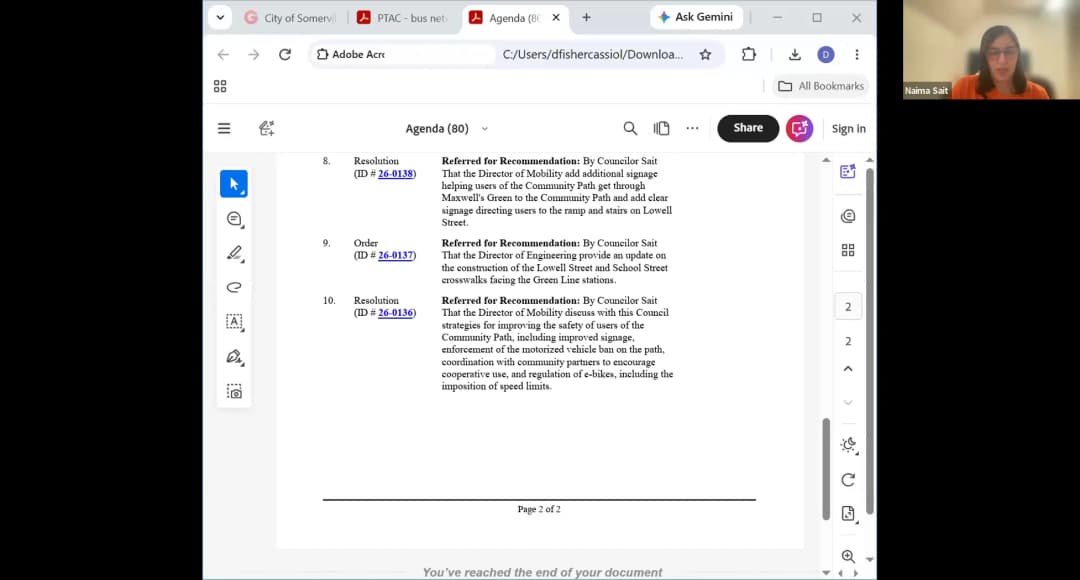
The Traffic and Parking Committee of the Somerville City Council met on October 6, 2026 (per system; meeting minutes list the date as October 5, 2026). The meeting was called to order at 6:05 PM and adjourned at 7:48 PM. Chair Naima Sait presided, with Councilors Ben Wheeler and Wilfred N. Mbah present. Also in attendance were Director of Transportation & Infrastructure Brad Rawson and Director of Engineering Brian Postlewaite. Several agenda items were discussed, including the MBTA bus network redesign, intersection safety improvements, and community path enhancements. Consent Calendar - Approval of Minutes (ID 26-1148): The minutes from the June 22, 2026 meeting were approved unanimously. Discussion Items 4. MBTA Bus Network Redesign (ID 26-1183) - The Pedestrian and Transit Advisory Committee (PTAC) submitted comments on the MBTA's proposal to eliminate Route 80, which currently serves Ball Square, Magoun Square, Gilman Square, East Somerville, and Lechmere. Director Rawson explained that the MBTA’s approved plan would reroute the west side to Davis Square, but the city has consistently expressed concerns. Mayor Wilson has communicated with MBTA General Manager Phil Eng. Route 80 ridership is at approximately 30% of pre-pandemic levels. The MBTA completed a community feedback round in September and will provide an update in winter 2026-2027. Chair Sait noted the potential loss of service for the 115 Sycamore School. Councilor Wheeler highlighted issues with Route 85’s early last bus and limited weekend service. The item was recommended to be marked work complete, with a commitment to submit a new order in January to continue tracking. 5. No Turn on Red Sign at Broadway and Cedar (ID 26-1425) - Chair Sait described unsafe conditions at the intersection, especially during baseball season due to proximity to Trum Field and heavy truck traffic from DPW. Director Rawson noted that 97% of city-owned signalized intersections already have no-turn-on-red regulations. Staff will assess signal timing and bring a recommendation to the Traffic Commission. The intersection is part of the upcoming Broadway-Magoun reconstruction project (bidding winter 2026-2027, construction next summer). Councilor Wheeler suggested a citywide no-turn-on-red policy similar to Cambridge. The item was kept in committee pending further staff analysis. 6. Vernon and Partridge Intersection Safety (ID 26-1426) - Director Rawson reported that data has been collected, but the traffic calming program has limited resources. Staff prioritize based on speeds, volumes, and proximity to schools, senior centers, etc. An update is expected in fall 2026. In the meantime, other safety improvements (e.g., Clear Corners program) can be considered. The item was recommended to be marked work complete. 7. Traffic Calming in Prospect Hill (ID 26-1112) - Director Rawson acknowledged significant resident advocacy. Data collection on identified streets will occur in October 2026, with processing taking a few months. Results will be posted on the city’s traffic calming webpage. The item was recommended to be marked work complete. 8 & 10. Community Path Safety and Signage (IDs 26-0138 & 26-0136) - Director Rawson presented short-term safety measures: thermoplastic speed humps (already tested), upgraded signage with graphics, and pavement markings. These are based on a 1,200-person survey and are being implemented fall 2026. The measures aim to slow faster-moving users (e-bikes, scooters) and improve sharing of the path. Chair Sait noted that enforcement will be discussed at the next meeting. Item 8 (signage) was recommended approved; item 10 (broader safety strategies) was kept in committee for future enforcement discussions. 9. Lowell and School Street Crosswalks (ID 26-0137) - Director Postlewaite provided updates: For Lowell Street near Maxwell’s Green, the original crossing at the station was not feasible due to fire department access. A raised crossing at Lowell and Vernon Streets was selected instead, which does not require MassDOT approval. It will be incorporated into the Broadway-Magoun project (bidding winter 2026-2027, construction next summer). For School Street near Montrose, the crossing design is complicated by the bridge structure and fire department turning needs. Staff are working with MassDOT and expect to present a final design for approval before the end of 2026, with construction documents by mid-summer/fall 2027 for the FY28 annual streets contract. The item was recommended approved. Key Outcomes - Approvals: Minutes (unanimous), Items 8 and 9 (2-0, Mbah absent), Items 4, 6, 7 (recommended work complete). - Kept in Committee: Items 2, 3 (parking permits), 5 (no turn on red), and 10 (community path safety strategies). - Next Steps: Staff to assess signal timing for Broadway/Cedar, continue data collection for Prospect Hill and Vernon/Partridge, implement community path treatments, and advance crosswalk designs. A future meeting in November will address enforcement on the community path and elsewhere. - Note on Date: The meeting minutes list the date as October 5, 2026, but the official system records the meeting as October 6, 2026. The summary uses the system date as instructed.

TRANSPORTATION SAFETY 20% · ENGINEERING AND INFRASTRUCTURE 20% · PUBLIC TRANSPORTATION 16% · PUBLIC ENGAGEMENT 12%
3130
OCT 6, 2026 · ALBUQUERQUE, NEW MEXICO · CITY COUNCIL
Albuquerque City Council Meeting Summary - October 6, 2026

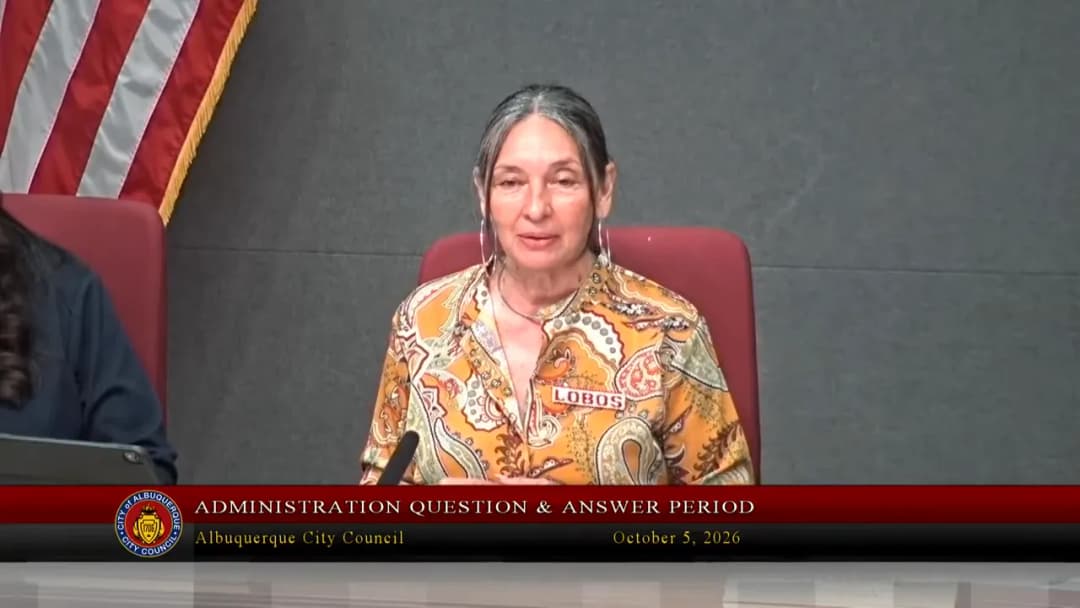
The Albuquerque City Council held its 19th meeting of the 27th Council at the Vincent E. Griego Chambers, One Civic Plaza NW, with all nine councilors present. Note: the minutes and raw transcript date the session as Monday, October 5, 2026, convening at 5:00 p.m.; the title above uses the 2026-10-06 identifier supplied for this record. The Council suspended rules to extend the meeting twice, and adjourned at 10:52 p.m., leaving the opioid settlement appropriation (R-26-69) pending for October 19, 2026. Administration Question & Answer Period - Councilor Champine asked how often the city has used the new civil enforcement option in the nuisance abatement ordinance (effective August 23, 2025). Planning Director Allen replied that the specific criminal-activity-triggered procedure has not yet been used, though similar $500-per-day penalty provisions in other ordinances are used regularly. Animal Welfare Director Ortega added that 499 civil fines have been issued under the newer nuisance abatement ordinance, including for animal welfare violations. Champine requested a comprehensive cross-departmental answer in the future. - Councilor Fiebelkorn asked about enforcement of the 2025 ordinance (O-25-84) requiring confiscation of companion animals sold in public places. Director Ortega reported 66 calls received and 14 animals confiscated. Fiebelkorn expressed concern that enforcement is not occurring in every instance; Ortega said sellers often leave before officers arrive, some calls are erroneous, and some residents buy the animals themselves instead of calling 311. - President Peña requested an update on the 98th and Mule Mesa intersection after a recent fatal crash. Director Turner acknowledged the tragic loss, noted the APD investigative report is pending, cited $4 million spent on the 98th/Gibson signal improvements, and said the city would work on design for a Mule Mesa signal. Peña asked the Mayor to make the intersection a capital priority, noting that ECs cannot be amended and would require a new submittal. - Councilor Telles raised concerns about federal awards at risk under OMB changes: her office identified $26.7 million in federal awards at risk of disappearing mid-year, while the administration's assessment stated $23 million, and no reconciliation was provided. The city attorney directed the DFAS director to consult counsel before answering, citing pending OMB litigation; Telles expressed frustration that the Council learned of the litigation late. - Telles and Fiebelkorn questioned Robinson Park closures, citing conflicting signs and observing that no one cleared the park during a posted closure on the afternoon of October 5. The CAO described coordinated park maintenance, security/APD patrols, and ACS outreach offering shelter, transportation, and case management. Councilor Baca (District 2) described the park as a difficult situation with no easy answers, said the policy appears to be working, and invited colleagues to meet with downtown community members. - Councilor Rogers asked for the current encampment policy (the posted version is dated April 9, 2026) and requested that notification forms document what services or shelter beds were offered. The city attorney cited pending litigation regarding the form's language. Rogers expressed concern about the form's statement that unattended items may be removed and destroyed and about the lack of data proving what services were offered. She also noted courts face a 400% increase in cases and that the Council has been absent from the Criminal Justice Coordinating Council for over a year. - Rogers asked what happens when balloons hit power lines; the CAO explained PNM owns and addresses the lines, while the city (AFR, APD, and partner agencies) responds from a public-safety perspective. - Councilor Grout asked about the 2026 Goals Forum: it was held August 29, 2026, at the downtown public library with 7 attendees, and the survey drew 157 responses (closing on 9/5/26), compared with 77 participants and 39 surveys at the prior forum. Grout said the results are important for pending legislation. - Vice President Champine asked about the city clerk appointment timeline (search is active; no date given) and construction during Balloon Fiesta; the CAO said city-controlled work is generally paused, and the Paseo cones Champine saw are believed to be non-city work. Proclamations & Presentations - The Council suspended rules (two-thirds vote) to allow more than four proclamations per councilor. President Peña and Councilor Telles presented a proclamation recognizing October 2026 as National Disability Employment Awareness Month (81st anniversary) to Dr. Stefan Scott and Anthony Harkins of the Division of Vocational Rehabilitation, Christopher Love of Pomegranate Orchards, and Melissa McHugh of Mandy's Farm. Consent Calendar - All consent items were approved or confirmed unanimously (9-0), including: EC-26-230 (aviation construction project manager/construction manager services award); EC-26-242 (RIN credit management for renewable natural gas); EC-26-244 (Gateway Center security guard services); EC-26-246 (2027 Administration Priority Capital and Policy Requests), withdrawn by the Administration; more than 20 Mayor's appointments and re-appointments to boards and commissions confirmed (including the Indicators Progress Commission, ADA Advisory Council, Arts Board, Library Advisory Board, Commission on American Indian and Alaska Native Affairs, Senior Affairs Advisory Council, Transit Advisory Board, Albuquerque Development Commission, and Alma Domingo to the Civilian Police Oversight Advisory Board); OC-26-16 (FY2026 second and third quarter IPRA report), receipt noted; R-26-65 (accepting a NM State Tourism Department Destination Forward Grant for the Metropolitan Redevelopment Agency); and R-26-67 (adjusting FY2027 operating appropriations for Transit Department positions and Planning Department vehicles). Appeals - AC-26-06, Jolynn Maestas' appeal of the Zoning Hearing Examiner's decision to approve a major wall/fence permit at 637 Solar Rd NW (R-1), was decided 8-1 to accept the findings for adoption, with Councilor Bassan opposed. Approvals - EC-26-209 (Final Objectives Report for Fiscal Year 2026) — receipt noted. - EC-26-273 (2027 Administration Priority Capital and Policy Requests) — receipt noted. - OC-26-19 (technical correction to the Council Legislative Program for the first session of the 58th New Mexico State Legislature) — receipt noted. Final Actions - O-26-60 (IDO application fees, Lewis): Amendments 1 and 2 adopted unanimously; postponed as amended to October 19, 2026 by an 8-1 vote, with President Peña opposed. - O-26-61 (Neighborhood Association Recognition Ordinance, Lewis): Amendments 1 and 2 adopted 8-1 (Peña opposed); Amendment 3 adopted 7-2 (Baca and Rogers opposed); Amendment 4 adopted 9-0; the ordinance passed as amended 5-4 (Champine, Fiebelkorn, Grout, Lewis, and Telles in favor; Baca, Bassan, Peña, and Rogers opposed). - M-26-1 (urging the Legislature to remove statutory restrictions on municipal authority to set standing requirements for zoning appeals, Lewis): Amendments 1-3 adopted unanimously; passed as amended 9-0. - M-26-2 (urging the Legislature to authorize municipalities, at their option, to direct certain zoning appeals for district court review, Lewis): Amendments 1-3 adopted unanimously; passed as amended 6-3 (Bassan, Peña, and Rogers opposed). - R-26-69 (appropriation of opioid settlement funds, Rogers): After a rules suspension extending the meeting to 10:52 p.m. (7-2) and a failed extension to 11:15 p.m. (3-6), the Council adjourned without completing consideration; the item remains pending for the October 19, 2026 meeting. Key Outcomes - All consent calendar items passed 9-0; EC-26-246 was withdrawn by the Administration. - The fence-permit appeal (AC-26-06) was upheld, 8-1. - O-26-60 was postponed to October 19, 2026; O-26-61 passed as amended, 5-4; M-26-1 passed as amended, 9-0; M-26-2 passed as amended, 6-3; R-26-69 was carried over to October 19, 2026.

PUBLIC SAFETY 19% · PARKS AND RECREATION 12% · CODE ENFORCEMENT 10% · HOMELESSNESS 9%
OPENPUBLICA · PUBLIC MEETING INDEXUPDATED DAILY · openpublica.com