Date discrepancy note: The agenda and transcript indicate the meeting was held on Monday, October 5, 2026, at 7:00 PM. However, the summary is instructed to use the date October 6, 2026. This discrepancy is noted. Introductory paragraph: The Common Council conducted a regular meeting that began with a special presentation honoring outgoing Councilman Grady L. Faulkner Jr. for his 20 years of service. The council then approved minutes, held public hearings, passed an appropriation for the LGBTQIA+ Pride parade contract, and approved a series of resolutions including a fiscal agency agreement with Triangle Community Center, a building permit fee cap for the YMCA renovation, naming of open space, lease agreements, and grant distributions. All votes were unanimous except one abstention on the CDBG resolution. Consent Calendar - Appropriation (Item 7A): $13,110 from the General Fund for a five-year contract with Triangle Community Center (TCC) as fiscal agent for the LGBTQIA+ Commission's Pride parade. (Approved 11-0-1, one absent) - Department Reports (Items 8A-8O): Approved en bloc: City Clerk's Certificate, Finance transfer reports for FY25-26 and FY26-27, appropriation reports for both fiscal years, LoCIP (no report), HR Vacancy (no report), and six grant acceptances for Youth Services, Health, and Board of Education totaling over $6.8 million. (Approved by voice vote) - Payment of Bills (Item 10): Approved by voice vote. Public Comments & Testimony - YMCA Building Permit Fee (Item 11I): Multiple speakers (Jay Kaiser, Patty Ann Bassia, Michelle Rolnick, and others) urged the council to waive or cap the building permit fee for the Northern Middlesex YMCA's $22 million renovation project. Speakers noted the YMCA's long service to the community, its programs for youth, seniors, and child care, and the need to close a $1 million funding gap. Councilman Faulkner's motto "Is it good for our community?" was invoked. - Middletown Pride / Triangle Community Center Contract (Item 11J): Nearly 20 speakers voiced strong support for approving a five-year fiscal agency agreement between Middletown Pride and Triangle Community Center (TCC). Speakers included LGBTQIA+ commission members, business owners, residents, and TCC representatives. They emphasized that Middletown Pride is Connecticut's largest Pride event, drives economic impact (e.g., a local business reported 97.54% sales increase on Pride Saturday), attracts residents and visitors, and provides life-saving community programming. Several speakers shared personal stories of feeling unsafe elsewhere and finding acceptance in Middletown. Rachel Simon, TCC executive director, and Amanda Redfern, TCC director of programs, also spoke in favor. - No public comment on other agenda items: The public hearings for the open space naming and lease agreements (Razor to Rosary and Project Big Sky) had no speakers. Discussion Items - Honoring Councilman Grady Faulkner: The mayor read a proclamation declaring October 6, 2026 as "Grady L. Faulkner Jr. Day." State citations from the Connecticut Senate and House, and a certificate from Senator Christopher Murphy were presented. Council members and community leaders (including clergy and former colleagues) delivered tributes highlighting Faulkner's two decades of service, his mentorship of youth, his work on Black History Month resolutions, and his objective, community-first approach. Faulkner was gifted a custom windbreaker and a resolution of appreciation. - Infrastructure and Public Works Update: Mayor Nocera reported that the city has paved over 15 miles of roads this year (goal was 10 miles); City Hall renovations continue (steps, blinds, bathrooms); Green Street School HVAC design is complete; Melilli Plaza bidding is imminent; and the Public Works Director position has 16 applicants (6 qualified) with interviews expected the week of October 19. Councilman Kovach also provided an update on 142 South Main Street: storm water infiltration occurred two weekends prior, the health department issued orders, roof repairs are ongoing and expected to complete in October. Councilwoman Blackwell requested follow-up to ensure landlord accountability. - Route 9 Public Forum: Announced for November 18, 2026, at 6:00 PM. - Mayor's Appointments: Approved three appointments: James Allabus to the Housing Authority (partial term to May 31, 2029); Michelle White to the Fair Rent Commission (three-year term); Aaron Jones to the McDonough School Building Committee (member of the public). All approved unanimously. Key Outcomes - Resolution 11J (Pride Fiscal Agent) – Approved 11-0-1: The council awarded a five-year, $345,091 contract to Triangle Community Center (TCC) as fiscal agent for Middletown Pride, effective immediately. The mayor is authorized to execute the agreement. - Resolution 11I (YMCA Building Permit Fee Cap) – Approved by voice vote (unanimous): The mayor is authorized to cap building permit fees at $100,000 for the YMCA's $13.38 million in construction costs (part of a $22 million renovation/expansion), excluding state education fees. This action supports the YMCA's efforts to close a $1 million funding gap. - Resolution 11A (Open Space Naming) – Approved by voice vote: 19 acres of Boston Road open space (three parcels) named "Robert D. Cyranowicz Open Space." - Resolution 11B (Splash Pad Repairs) – Approved: Authorizes application for a $36,750 LoCIP grant and creates a new capital line item. - Resolution 11C (Opioid Settlement Funds) – Approved: Distributes $175,000 to eight organizations: All-In Recovery ($30,000), Community Health Center Inc. ($30,000), Community Renewal Team ($20,000), Gilead ($19,000), Governor's Prevention Partnership ($20,000), Rushford Center ($25,000), St. Vincent DePaul ($25,000), and The Connection ($6,000), subject to matching fund requirements. - Resolution 11D (Educational Incentive Grant) – Approved: Distributes $30,000 to four organizations: Oddfellows Playhouse ($7,500), Cross Street Training & Academic Center ($7,500), YMCA Kid's Korner ($7,500), and Ekklesia Contemporary Ballet ($7,500), subject to matching fund requirements. - Resolutions 11E, 11F, 11G, 11H (Leases and Map) – Approved: Five-year leases with option for one additional five-year term for Razor to Rosary LLC (900 sq. ft.) and Project Big Sky LLC (6,600 sq. ft.) at Keating Park; map attachment to Memorandum of Agreement; rescission of Resolution 146-2025 to allow new lease consideration. - Resolution 11K (CDBG) – Approved with one abstention (Councilwoman Fulton): Authorizes the mayor to submit a 2026 Annual Action Plan to access $513,605 in CDBG entitlement funding and reprogram prior years' unspent dollars and program income. Note on votes: Unless otherwise stated, votes were unanimous with no recorded opposition.
The Public Meeting Index
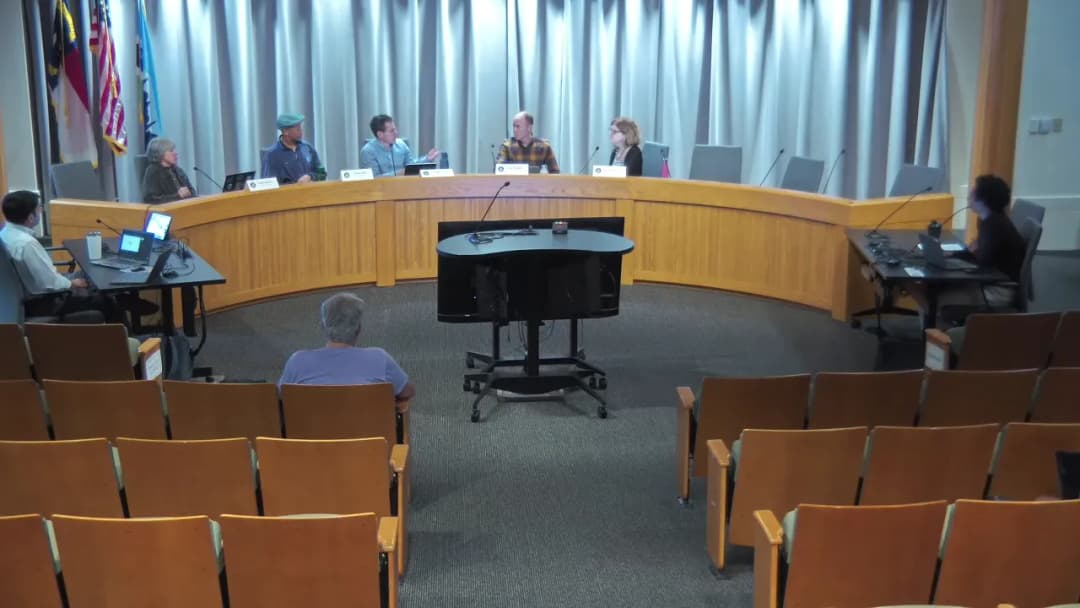
The Public Meeting IndexThe Chapel Hill Planning Commission held a meeting on October 6, 2026, to continue discussions on the Land Use Management Ordinance (LUMO) revisions. The meeting included a staff presentation, public comment, and extensive commission deliberation on key topics including housing, stormwater, trees, by-right thresholds, and enforcement. Consent Calendar - The commission unanimously approved the minutes from August 18, September 1, and September 15, 2026 meetings. Chair John Mitchell noted that the minutes were routine with no substantive votes. Public Comments & Testimony - Jacques El Chayev (320 University Drive resident, 45-year real estate professional) expressed strong opposition to policies he perceived as favoring UNC students over Chapel Hill citizens. He stated it is not the town's responsibility to house students, criticized current code enforcement, and urged the commission not to follow California's example. He submitted a letter for the record regarding unrelated students living together. Discussion Items - Staff Presentation (Taz, Planning Department): Taz provided an overview of the tentative schedule, highlighting the October 20 continued discussion and council meetings starting October 21. He summarized key changes from the July to September LUMO drafts: decreased by-right thresholds in downtown (maintaining 20,000 sq ft threshold), refined density bonus criteria for missing middle housing (replacing collector street classification with collector streets with sidewalks), added quarter-mile proximity to public schools as a criterion, restrictions on vape shops in new commercial areas, parking disincentives (85-100% of max triggers additional tree planting and pervious pavement requirements), and downstream impact analysis requirements for larger projects. - Housing Discussion: Commissioner Jeff Green raised concerns about gross floor area limits (5,000 sq ft for duplexes, 6,000 sq ft for triplexes/quadplexes) that restrict missing middle housing. He argued these limits are not evidence-based and disproportionately limit student housing options. He suggested eliminating or increasing the limits, or developing overlay districts near UNC to control student occupancy. Commissioner Libby Thomas suggested scaling floor area to lot size. The commission agreed to have Jeff write up recommendations. - Density Bonus Criteria: Commissioner John Mitchell criticized the quarter-mile from greenway entrance criterion as arbitrary and fragmented, and questioned the quarter-mile from school criterion as not effectively directing density. Commissioner Jeff Green preferred allowing quadplexes town-wide but found the collector-with-sidewalks and arterial criteria defensible, while recommending removing the greenway and school criteria. The commission generally agreed to omit greenway and school criteria for now. - Stormwater Management: Commissioner Liz Loss presented a detailed analysis of proposed stormwater regulations, including a breakdown of requirements by land use and disturbance size. She advocated for a risk-based approach rather than use- or unit-based triggers, and proposed developing a stormwater overlay district. She also recommended strengthening the downstream impact analysis requirement by adding criteria for the town manager's discretion. Commissioner Jeff Green expressed concern about costs and potential barriers to missing middle housing, but others supported stronger risk-based rules. The commission agreed that Liz would draft recommendations. - Tree Canopy Requirements: Commissioner Libby Thomas noted inconsistencies (e.g., 85% vs 75% root zone protection) and concerns about reduced canopy for dense housing. She suggested increasing the starting percentage of native species, removing the "adapted species" category, starting at 70% or higher, and restricting turf under canopy. Commissioner Green noted the auto-ratcheting timeline could be confusing. Commissioner Charles Mills had no strong objection to the current proposal. The commission agreed Libby would draft tree-related recommendations in consultation with Liz. - By-Right Thresholds: The commission reviewed tiered thresholds for residential (starting at 30 units) and commercial (starting at 40,000 sq ft) development, with affordability incentives. Commissioner Mitchell expressed skepticism about the curated downtown approach, noting past projects struggled. The commission had no further substantive changes. - Enforcement: Commissioner Thomas raised concerns about inspection and follow-up for tree protection. Staff noted limitations: fines capped at $500 per day per violation due to state law, and primary leverage is withholding permits. The commission acknowledged enforcement is resource-dependent and not easily legislated. Key Outcomes - The commission will meet again on October 20, 2026, to finalize recommendations for the Town Council on the draft LUMO. - Assignment of drafting work: Jeff Green will draft recommendations on housing (floor area limits, overlay districts); Liz Loss will draft on stormwater (risk-based approach, criteria for downstream analysis); Libby Thomas will draft on trees (canopy percentages, native species, enforcement). Drafts are to be sent to Josh (commissioner) before the October 20 meeting. - The commission will attend the October 21 council meeting to present their recommendations in person. - The next meeting is confirmed in person to facilitate discussion and public input. Note: No formal votes were taken on substantive issues; the minutes approval was the only formal action.
The New Albany Board of Zoning Appeals held its October 2026 regular meeting on October 6, 2026, with four members present; at least three members were required to carry a motion. The meeting was streamed and will be archived at City of New Albany City Hall dot com. The board acted on two variance dockets, a continued docket, and the September 1 meeting minutes. Public Comments & Testimony - No public comment was offered on any docket. The board opened the floor for public comment on Docket B-25-26 and heard none; no one testified on the other matters. Docket B-24-26 – Dustin Witsett / 3204 Chapel Lane - The applicant requested a special exception and development standards variance to allow a 2,000-square-foot accessory garage (40 x 50 feet) without a principal dwelling in the steep slope district. The proposed structure would have 14-foot eaves, a poured concrete foundation, stone veneer and board-and-batten exterior, electricity and no plumbing, plus a reworked asphalt driveway. - The applicant's representative stated the garage is for personal storage of groundskeeping equipment, trailers, and vehicles, with no commercial use and no current plan to build a house on the parcel. The existing barn/garage would remain and could receive exterior updates to match the new structure. - Staff reported the parcel is 205 x 200 feet and part of a more-than-3-acre holding in the two-mile fringe area. The site is owned by the applicant's LLC, while the applicant owns a nearby residence. The plan commission gave a favorable recommendation on September 15. Staff found the proposal meets special exception criteria except criterion seven, and variance relief is needed for three accessory-structure standards: no principal building, a second accessory building, and the 600-square-foot limit for accessory buildings in the steep slope district. A 28 x 60-foot garage on the adjacent lot was cited as comparable. - Staff recommended approval with stipulations including personal use only, no commercial activity, no drainage onto adjoining properties, a high-quality Chapel Lane-facing facade, final elevations subject to staff approval, and durable dust-proof paving of all parking and circulation areas. A board member observed similar structures along Chapel Lane, supporting the finding that it fits the area's character. - The board voted unanimously to approve Docket B-24-26 with staff stipulations. Docket B-25-26 – Robert Schaefer / Silver Slate Drive - The applicant requested a development standards variance for a detached garage exceeding the 600-square-foot accessory-building limit in the mixed-density residential district. The proposed garage is 24 x 30 feet, or 720 square feet. The transcript lists the address as 1414; the applicant stated 1442 Silver Slate Drive. - Schaefer said he collects British sports cars and needs lockable garage space for insurance purposes, with room for tools, workbench, and up to three small cars. He said he does no body work or spray painting, uses ordinary electric tools, and plans insulation and a mini-split. A small existing shed with termite damage would be removed. - Staff reported the lot is just under 10,000 square feet, with steep slope at the front and MDR at the rear; the garage would sit entirely in the MDR district. Aerial analysis found side-yard widths of approximately 11–14 feet, leaving only about 6–9 feet of buildable width, and similar detached garages exist along Slate Run Road. - Staff recommended approval with stipulations: personal use only, no commercial activity, staff approval of elevations and site plan, removal of the existing accessory structure before construction, and durable dust-proof paving. The board voted unanimously to approve. Docket B-18-26 – Al Cardozo (Continued) - Attorney John Kraft represented the applicant. The original docket had two issues; the driveway/curb-cut portion was resolved when the Board of Public Works approved a second curb cut, leaving only the shed request before the board. - Kraft said the shed replaced a temporary shed that existed when Cardozo bought the property; the replacement is permanent but no building permit was obtained. The shed does not meet setback standards, but a survey shows it within property lines, near a triangular fenced area associated with adjacent Lot 34, and the neighboring owner has no objection. The rear setback area is a Duke Energy transmission easement rather than a residential property. - Staff noted the approved driveway still needs durable dust-proof paving. Discussion acknowledged that a survey identified driveway encroachments onto Lot 34 and a 200-foot utility easement, but the board concluded that issue was not before it and explicitly stated it was not authorizing any encroachment onto adjoining property. - The board voted unanimously to approve Docket B-18-26 as presented, with action limited to the shed. Other Board Discussion - A board member discussed the history of the Chapel Lane area, brought into the two-mile fringe around 2000–2001, and county-approved family conveyance splits that created irregular parcels. Another member noted the accessory structures could limit future residential development on the parcel, though it remains the owner's economic decision. Staff said work continues on an accessory-building formula based on lot-size ratios or percentages rather than only a fixed square-foot limit. Key Outcomes - Docket B-24-26: approved unanimously with staff stipulations. - Docket B-25-26: approved unanimously with staff stipulations. - Docket B-18-26: approved as presented, limited to the shed; no encroachment onto adjoining property was authorized. - Minutes of the September 1 meeting were approved unanimously. - A board member noted the recent passing of former BZA and Planning Commission member Jenny Cottner and expressed condolences to her family.
Presiding Officer Commissioner Shaker Johnson welcomed attendees to the nighttime Committee of the Whole meeting, hosted by the City of Dunwoody. The meeting included committee reports, review of the proposed executive agenda, walk-on items, public comments, and presentations on the CIP monitor and health care expansions. Key discussions focused on mid-year budget adjustments, public safety investments, data center regulations, and funding for health care access for uninsured residents. Consent Calendar - Airport Lease Agreements: Two standardized T-hangar space lease agreements (items 1309 and 1422) with Spencer Clark and Raymond Dale, at no cost to the county, were placed on consent. - Fire Rescue Walk-On Grants: Two grants were walked on as consent items: - Item 2026-1428: Assistance to Firefighters Grant (AFG) for 400 cancer screenings and seven vehicle exhaust capture systems. Total budget $410,520.32, with $37,320.30 county match. - Item 2026-1453: Fire Prevention and Safety Grant for 4,688 smoke and CO detectors. Total budget $267,216.00, with $12,724.58 county match. Both grants require acceptance by October 22, 2026. - District 7 Appropriations: Five items allocating district reserve funds (totaling $23,000) to various community organizations were placed on consent. Public Comments & Testimony - Joyce Clemens (Dunwoody resident): Expressed privacy concerns about Flock cameras installed near her apartment building, asking about camera range, who views footage, and whether it captures close-ups. - Gina Mangum (DeKalb resident, DeKalb Citizens Coalition): Urged the board to work with the community on a data center text amendment, stating the current proposal lacks protections and does not reflect community views. Offered an alternative that limits size and location. - Rosalind McIntyre (Brookhaven resident): Contrasted a small 88,000 sq ft data center in Dunwoody (converted office building, no diesel generators) with the proposed Shadow Box data center (5 million sq ft, 100 diesel generators, near homes). Pleaded for protections similar to those in Dunwoody. - Additional speakers at the September 22 business meeting (excerpts included in transcript): Multiple residents spoke against data centers, citing water consumption, tax losses, property value declines, and environmental harm. Others raised concerns about police accountability, 911 response times, blight, and election security. A speaker also requested a health and environmental impact study before lifting the data center moratorium. Discussion Items - Finance, Audit & Budget (FAB) Committee Report (Commissioner Terry): The committee met September 29 to review mid-year budget adjustments. A special call FAB meeting is scheduled for October 12 at 1:00 p.m. to finalize the mid-year amendment. Several items were held; item 0839 (financial advisor services RFP) was approved. Discussion continued on the LSB program. - Employee Relations & Public Safety (ERPS) Committee Report (Commissioner Bolton): The committee met earlier on October 6. Key updates: - Police department has 90% retention rate and nearly 10% more officers than last year. - 2027 Medicare retiree rates will remain consistent with no increase. - Approved funding for preliminary design of a police special operations storage facility. - Approved $300,000 renewal for the Bright Futures leadership development program (Columbus State University). - Approved $2.1 million for a backup public safety radio simulcast system (Motorola). - Discussed tethering ordinance with emphasis on not penalizing unhoused individuals. - Public Works & Infrastructure (PWI) Committee Report (Presiding Officer Johnson): Special call PWI meeting scheduled for October 12 at 2:00 p.m. Previous meeting included watershed CIP update and discussion on CIP monitor. - Proposed Executive Agenda Review: Staff reviewed multiple items assigned to various committees. Notable: Item 1319 (budget amendment for CIP funding) to FAB; item 1411 (declaring 30 surplus properties to Land Bank) to PECS; item 1390 (lease extension for Memorial Drive property) to ERPS; item 1426 (Bright Futures program) to ERPS; item 1413 (property transfer to Brookhaven) to PECS; item 1336 (public safety radio upgrade) to ERPS. - CIP Monitor Presentation (Chief of Staff May & Policy Analyst Allen): Updated resolution to establish an independent CIP monitor, with changes including: - Selection via RFQ (not RFP) to maintain independence. - Monitor cannot bid on or perform CIP work during its term. - Scope ensures no duplication with Office of Independent Internal Audit. - Funding ($800,000 originally budgeted in 2025) will come from watershed fund; actual cost expected lower. - Timeline: Firm selected and contract in place by Q1 2027 (ideally January). - Central staff will vet qualified firms and bring recommendation to board. - Commissioners raised concerns about independence, expertise, and cost. Some questioned whether central staff has capacity to evaluate specialized firms. - Health Care Expansion Presentations: - Mosaic Health Center (Dr. Carlin Tunnell): Serves uninsured; 9,000 patients since 2015; 40% increase in volume in 2026 vs 2025. Plans include hiring an additional provider, launching a mobile home-visit program (Mosaic Mobile), expanding dental and mental health services, and a food distribution program (9,000 lbs distributed on launch day). County funding ($1.5 million) not yet received; contract recently executed. Funds intended for three pillars: expanding access, community-based services, and strengthening the health care ecosystem. - MedCura Health (Jeff Taylor): 18 sites, 13 in DeKalb; served 25,000 DeKalb residents in 2025. Plans include expanding maternal health, renovating a pediatric facility, and deploying a mobile unit for schools and Buford Highway corridor. County funding ($1.4 million) not yet received; contract in final signature stages. Both providers confirmed most patients are DeKalb residents; data on exact percentages will be provided later. Key Outcomes - Mid-Year Budget Amendment: Will be finalized at special FAB meeting on October 12 at 1:00 p.m. - CIP Monitor: Resolution will be updated and brought back for approval. Board expects a more refined cost estimate and assurance of independence. Funding will be allocated from watershed fund. - Data Center Text Amendment: Multiple public commenters urged stronger protections. The board deferred related items (e.g., environmental study, dividend fund) to future meetings with committee stops. - Health Care Contracts: Both Mosaic and MedCura have executed contracts but await fund disbursement. Commissioners requested detailed reporting on DeKalb resident impact and spending timelines. Funding is expected to carry over into FY2027. - Fire Rescue Grants: Both grants (cancer screenings and smoke detectors) were approved as consent items, with acceptance deadline October 22. - Public Safety Investments: Police retention rate of 90% and increased officer count noted; $2.1 million approved for radio backup system. - Animal Ordinance and NDO: Items on tethering, pet sales, and non-discrimination ordinance were deferred to October 13 business meeting with prior committee stops. - Blasting Ordinance: Deferred to allow finalization of substitute. - Electric Landscape Rebate Program: Deferred to October 27 BLC for further refinement. - Charter Review Commission Report: Deferred to OPS committee with goal of approval by end of year. - Executive Session: Brief session held for litigation update; no action taken.
The Radnor Township Planning Commission met on October 6, 2026, to review a sketch plan from Sacred Heart School, consider a zoning hearing board (ZHB) application from Waverly Senior Services for a life care residence at 452 South Roberts Road, discuss the Vision for Wayne draft master plan, and consider a proposed data center ordinance amendment. The Commission unanimously approved the data center ordinance with comments, took no action on the Sacred Heart sketch plan, and made no recommendation on the Waverly application after a motion to recommend approval of the special exception failed for lack of a second. Note on the record: The agenda supplied with these records is dated September 8, 2026, and lists wireless antenna applications that are not discussed in the transcript; the transcript instead references approval of September 8 minutes and upcoming October 12 and October 15 hearings. This summary uses the October 6, 2026 meeting date and flags discrepancies where relevant. Consent Calendar - Minutes: The Commission unanimously approved the meeting minutes. The agenda identifies the minutes as the August 3, 2026 minutes; the transcript states the September 8, 2026 minutes were approved — a discrepancy. Discussion Items Sacred Heart School Sketch Plan – 480 South Brynmore Avenue - David Falcone presented on behalf of Sacred Heart School, joined by Head of School Robin Nolan and engineer Jeremy Mazars of Chester Valley Engineers. The Commission treated the item as an informational sketch plan; no vote was taken. - Proposal: conversion of one of the two existing athletic fields (the northern field) to an artificial-turf multi-purpose field (330 by 160 feet); a roughly 720 sq ft vestibule entry addition to the gymnasium; a roughly 5,000 sq ft telatorium/chapel addition; a roughly 600 sq ft environmental learning gazebo along the stream; and 10 additional parking spaces created by switching from parallel to angle parking. - Nolan said the projects serve the existing student body, with no intention to grow enrollment, and defined a telatorium as an auditorium with audio/visual capabilities for virtual and distance learning. - The applicant stated that any zoning relief would be requested in later applications, and that two neighbor outreach meetings had been held, with one resident attending one meeting and none attending the second. - Commissioner questions and concerns: steep slope disturbance was not quantified (the applicant said it would be de minimis and that it was too early to state whether the slopes are man-made); the telatorium/chapel addition and the parking area would extend existing nonconforming setback and parking conditions; no preliminary parking analysis had been completed and prior record plans were unavailable; roughly 6-8 foot retaining walls (preliminary) are planned around the turf field to minimize slope disturbance. The Shade Tree Commission liaison noted that tree removals and plantings will be reviewed by the Shade Tree Commission. Zoning Hearing Board Appeal 3275 – 452 South Roberts Road (Waverly Senior Services) - Attorney Jamie John presented for Waverly Senior Services, joined by Mark Heil (Vice President of Campus Development, Waverly Heights), Chris Pazinus of Polar Engineering, and Carson Parr of RLPS Architects. The applicant will appear before the ZHB on October 15, 2026. - The applicant seeks a special exception for a life care residence in the PI (Planned Institutional) district, plus three dimensional variances: steep slope disturbance, building height (from the 38-foot limit to 45 feet), and building width/depth (facades longer than 160 feet). - The applicant argued the life care residence would have a lesser impact than uses permitted by right in the PI district (such as colleges, dormitories, and residential halls), stated that a traffic study is being prepared to show impacts lower than uses permitted by right, and said the variances would allow use of existing driveways, retention of existing buildings, reduced grading and retaining walls, and mansard roofs that conceal rooftop mechanical equipment. - Nine three-story buildings would exceed the height limit; two buildings (Building A and Building B) would exceed the 160-foot building length limit. Steep slope disturbance was not quantified; the disturbed slopes are mostly 15-25 percent, with some over 25 percent, and the applicant believes the majority are man-made based on a right-to-know request that found no approved grading records. - The EMS substation remains under discussion with the township and is not part of the special exception application, since a municipal use is permitted in all zoning districts. - Commissioner concerns included the lack of quantified steep slope data, the absence of three-dimensional renderings or viewshed studies (a resident had previously presented alternative elevations), the project density, the absence of heritage tree preservation details, a perceived lack of a sense of place, and site visit observations that the property sits at the site's highest point and falls away toward neighboring properties. - In response to public legal challenges, the Commission's solicitor disagreed, stating that the proposed use falls under Section 280-68, resembles other approved continuing-care applications in Radnor, and would be the 21st-century equivalent of a nursing home. The solicitor also advised that the Planning Commission is not required to make a recommendation and that declining to comment has no impact on the ZHB proceeding. Vision for Wayne / Wayne Business Overlay District Master Plan - The draft master plan for downtown Wayne has been released. Written comments were due by the close of the meeting date (October 6, 2026) via the email address given as 'Vision for Wayne comments at Radner.org.' The Board of Commissioners will hold a public hearing on the draft on Monday, October 12, 2026. Data Center Ordinance Amendment - Ms. Donovan presented a proposed ordinance to regulate data centers by conditional use approval only in the PLO (Planned Laboratory and Office) district. No data centers are currently proposed; the amendment is intended to be preemptive. - The next steps are referral to the Delaware County Planning Commission for review and then consideration by the Board of Commissioners at its first November meeting, believed to be November 12, 2026. - Commissioner comments described the ordinance as thorough and 'soup to nuts,' appropriately scaled for small facilities (an estimated 10,000 to 20,000 sq ft) rather than hyperscale data centers. Suggestions included defining sensitive receptors (schools, daycares, hospitals, residences) with additional setbacks or buffering; establishing a decommissioning bond standard (such as 110 percent of decommissioning cost minus residual value, with periodic engineer review); and reconsidering prescriptive solar requirements in favor of an energy efficiency study. One commissioner asked whether the broad solar panel requirements are unique; Ms. Donovan responded that similar requirements have been seen elsewhere. - A motion to approve the proposed data center ordinance with the Commission's comments was seconded by Commissioner Kunda and passed unanimously. Public Comments & Testimony - Ken LaFiandra (798 Woodley Road): Challenged whether a life care residence qualifies as a permitted similar institution under Section 280-68 of the zoning code, arguing the PI exception was intended to preserve existing estates, not to allow what he characterized as a '350-person apartment complex' in a residential area. He cited prior failed attempts to change the property, argued the application does not meet the general standards of Section 280-45B regarding consistency with the character of surrounding development, and said residents nearly universally consider the project damaging to the area. - Lynn LaFiandra (798 Woodley Road): Said the property is at roughly 433 feet elevation, so a 38-foot building would peak near 471 feet and a 45-foot building near 477 feet, making it visible throughout the township; asked that the proposed walking trail not be open to the public because of safety and privacy concerns for 25 homes on the property perimeter; opposed placing an EMS station in a quiet neighborhood; requested a traffic study; and suggested the property could become a park if the Waverly project does not proceed. - Ed Soto (Mainline Classical Academy, 455 South Roberts Road, directly across the street): Expressed concern about additional traffic on top of the school's existing 8-9 a.m. and 3-4 p.m. traffic, construction impacts on children who are outdoors from 9 a.m. to 4 p.m., and stormwater runoff affecting the downhill school. - Lee Hopkins (Portland's Drive): Questioned whether the property's zoning ever properly changed from R1 with an exception to planned institutional, said Roberts Road is narrow, hilly, and lacks pedestrian access, and called the proposed EMS station 'a terrible idea.' - Ken LaFiandra (second appearance): Presented documents dated 1995 and 1997 (a denial by Michael Flag and a withdrawal by Lauren Preheim) and asserted the township has no record of a successful conversion to PI zoning, arguing the burden is on Radnor Township to produce such documentation before the October 15 hearing. - Dr. Constable (physician): Opposed the project, describing a 20-minute commute over 1.5 miles on Bryn Mawr Avenue caused by previously approved developments, characterizing the proposal as a '700-person residency' (a figure not stated by the applicant), and asking whether residents have any rights to reject large institutional developments. Key Outcomes - Minutes approved unanimously (with an agenda/transcript discrepancy noted). - Sacred Heart School sketch plan: informational only; no vote. The applicant is expected to return with a formal submission, quantified grading and steep slope data, a parking analysis, and tree and landscape plans. - Waverly ZHB appeal: a motion to recommend approval of the special exception failed for lack of a second; the Commission made no recommendation on the special exception or the variances. The ZHB hearing remains scheduled for October 15, 2026. - Data center ordinance: approved unanimously with comments; will be referred to the Delaware County Planning Commission and then to the Board of Commissioners (believed November 12, 2026). - Vision for Wayne: written comments were due October 6, 2026; the Board of Commissioners public hearing is October 12, 2026.
The Killeen City Council and the Planning and Zoning Commission held a joint work session on October 6, 2026, to improve communication, define strategic expectations, and discuss proposed ordinance changes. The meeting was designated as informational, with no formal votes planned, but the council could issue motions of direction to staff. Public Comments & Testimony - Michael Fornino criticized a council representative's conduct and expressed frustration with the Mayor for not addressing his concerns, implying potential legal action. - Edward Frazy, a retired IT professional, spoke against allowing data centers in Killeen, citing high water and electricity consumption, environmental heat from cooling systems, and noise pollution. Discussion Items - Council Priorities and P&Z Roles (DS-26-086 & DS-26-087): Council members emphasized that P&Z serves as an independent recommending body guided by the 2040 Comprehensive Plan. P&Z commissioners requested clearer strategic direction from the council and better communication regarding major policy shifts and development trends. Council members stressed the need for professionalism, respect for staff, and adherence to the zoning process. Council agreed to improve communication by providing briefings on their priorities and planned ordinance changes. - Proposed Data Center Ordinance (DS-26-088): Staff reviewed a previously proposed three-tier system (small, medium, large) that would allow data centers by right in specific districts with strict supplemental regulations. Council had previously directed staff to draft an ordinance requiring a Conditional Use Permit (CUP) for all data centers. Following discussion, Councilmember Kimball moved to change this direction. Council voted 6-1 to direct staff to return to the original tiered approach (by right with strict stipulations), favoring predictable rules over project-by-project discretion. The city attorney cautioned that the CUP route is often viewed by investors as a de facto ban. - Short-Term Rental Regulations: Staff noted an ordinance removing inspection requirements from the registration process is being drafted to improve compliance and hotel occupancy tax collection. - Joint Meeting Frequency (DS-26-089): The group discussed holding 1-2 joint meetings per year. Mayor Prow proposed one for informational updates and one for strategic planning. Some commissioners suggested a single annual meeting to align with the fiscal year and commissioner terms. Key Outcomes - The City Council directed staff (6-1 vote) to draft a data center zoning ordinance based on a tiered system allowing them by right with strict stipulations, reversing the previous direction for a CUP-only ordinance. - Council committed to providing the P&Z commission with regular briefings on strategic priorities, proposed ordinances, and emerging city planning issues. - The groups agreed to formalize their joint meetings, tentatively scheduling at least one per year for strategic planning. - A consensus was reached to explore better public education tools regarding zoning, such as website content, citizen academy modules, and town halls.
The San Francisco Board of Supervisors held its regular meeting on Tuesday, October 6, 2026, with all 11 members present. The board approved a routine consent calendar, advanced multiple ordinances and resolutions, heard public testimony, held a 2:30 p.m. special order of commendations, introduced new legislation, and adopted ceremonial and policy resolutions. Consent Calendar - Items 1 through 7 were approved unanimously on a roll call vote of 11 ayes. Approved consent items included the amended and restated Infrastructure Financing Plan for Treasure Island Infrastructure and Revitalization Financing District No. 1; airport employer health care expenditure requirements; a $0 settlement of Airlines for America litigation; the Sylvester House landmark designation amendment; the amended Potrero Power Station development agreement and Special Use District; and the establishment of the Office of Food Security Coordination. Public Comments & Testimony - Rory Gambriel described an eviction notice and housing conditions at 1190 Mission Street and asked supervisors to review his case. - Jazzy supported Supervisor Walton's data center moratorium and cited air-quality burdens on underserved neighborhoods through AB 617. - Peter Warfield of the Library Users Association urged the board to study comprehensive risks of artificial intelligence, including public safety, privacy, and human survival. - Maina Young of the Business and Housing Network opposed File 260962, calling it 'barbaric' and warning it would worsen San Francisco's housing shortage and hurt small immigrant housing providers. - Moto defended rent stabilization, saying renters do not have enough protections. - Leah McGeever, a transgender Mexican American, expressed distress that Latino Heritage Month no longer uses 'Latinx' and asked for more inclusive language. - A speaker in recovery supported banning high-pressure butane torch lighters to reduce outdoor drug use. - Multiple members of the HIV Advocacy Network and San Francisco AIDS Foundation, including Andy Stone, William Dean, Xander Breyer, Terry Miller, Adam Varokwa, and Justice Duma, urged support for the National PrEP Day resolution and emphasized access, equity, and reaching zero new HIV transmissions. - Todd, an SFMTA employee, described being placed on administrative leave and referred for a psychological exam after requesting religious and disability accommodations, and asked the board to examine SFMTA's treatment of employees exercising civil rights. - Lisa Siegel, a District 8 constituent and volunteer with NICABOO Companion Bird Rescue, encouraged the board to expand the retail animal sales ban beyond cats, dogs, and rabbits. - David Grace warned that funding cuts and staff restructuring at homeRise buildings were jeopardizing services for formerly homeless residents. - A remote caller who attempted to comment on the data center moratorium was informed that the item had already received public comment in committee and was not open for comment. - Additional comments addressed a District 10 safety website and Flock camera contract, homelessness services, and other neighborhood concerns. Special Order - Commendations - At the 2:30 p.m. special order, the board issued commendations for Latino Heritage Month and other recognitions. - Supervisor Fielder honored Diana Ponce de Leon and Rafael Moreno of the Office of Economic and Workforce Development. - Supervisor Melgar honored Josie Dominguez, an SFMTA Safe Routes to School program leader and co-founder of the SF Latina Social Club. - Supervisor Walton honored the San Francisco Lowrider Council on its 45th anniversary; founder Jerry Griego and other members spoke about the council's history and civil rights advocacy. - Supervisor Chan honored SFPD Lieutenant Alan Levy and retired Lieutenant Dan Dedette for solving the 1978 homicide of Marissa Harvey. Captain Kevin Lee reported homicide clearance rates of 125 percent in 2025, 94 percent in 2023, and 88 percent in 2024, above the national average of about 50 to 60 percent. - Supervisor Cheryl honored journalist Leanne Melendez. - Supervisor Wong honored Virginia Ho, founder of SV Collections in the Sunset, for 34 years of service. - Supervisor Mahmoud recognized the Council on American-Islamic Relations, San Francisco Bay Area, on its 32nd anniversary; Mahmoud criticized Governor Ron DeSantis' decision to place CAIR on a watch list. - Supervisor Dorsey recognized CARECEN SF, the Central American Resource Center of Northern California, and executive director Larisa Dugan-Cuadra. - President Mandelman recognized former Supervisor, Treasurer, and PUC General Manager Susan Leal for decades of public service. - The board also approved a full-board in memoriam for Leona Bridges, president of the San Francisco Employees' Retirement System board. Roll Call Introductions - Supervisor Mandelman introduced legislation to require a human attendant for every three self-checkout stations in large grocery stores and drugstores, citing shrinkage rates of 3.5 percent of sales at self-checkout versus 0.21 percent at staffed lanes and a 22 percent average rise in total store losses after self-checkout introduction. - Supervisor Sauter introduced legislation to rename and strengthen the 'expanded compliance control' program as the 'compliance oversight program,' extending the violation lookback period from 18 to 48 months and increasing Planning Department involvement. - Supervisor Dorsey introduced the Soberspaces Program and Fund to make city-owned community rooms available at no cost to abstinence-based recovery groups and to support sober nonprofits. - Supervisor Walton introduced a resolution celebrating 100 years of the dahlia as San Francisco's official flower. - Supervisor Chen introduced a resolution commemorating the 100th anniversary of John McLaren Park. - Supervisor Cheryl announced the passing of Leona Bridges, and the board later adjourned in her memory. Discussion Items - Unfinished Business: Item 8, an ordinance to eliminate disclosure and reporting requirements for candidates for the Retirement Board, Health Service Board, and Retiree Health Care Trust Fund Board, was sent back to committee on a motion by Supervisor Mandelman, seconded by Supervisor Dorsey, without objection. - Item 9: The board passed on first reading an ordinance authorizing PUC revenue bonds and other indebtedness for 525 Golden Gate Avenue, with agenda amounts of up to $492,820,000 for the water enterprise, $24,570,000 for wastewater, and $12,610,000 for power. - Items 10 through 20: The board adopted resolutions accepting retroactive grants, approving leases and contract amendments, and authorizing SFPUC contracts. These included a $475,000 OES grant via the San Francisco General Hospital Foundation; a Ryan White HIV/AIDS Program grant increase for a new total of approximately $6.1 million; a United Airlines lease abatement of about $7.175 million; a Polydyne wastewater treatment polymers contract increase to about $12.06 million; a retroactive 555 Polk Street lease; four $20 million as-needed services contracts with Stantec, AECOM, Jacobs, and LEE Inc.; a $30 million power capital program management contract with Deloitte; and a no-cost Caltrans maintenance agreement. - Item 21: The CEQA local implementation ordinance passed on first reading, 10-1, with Supervisor Chan voting no. It removes shadow analysis as a specific environmental impact and shortens the appeal period for CEQA determinations from 30 to 15 days. - Item 22: The ordinance updating municipal green building requirements passed on first reading unanimously. - Item 23: The Fillmore Heritage Center parcel transfer to the Mayor's Office of Housing and Community Development was approved. - Items 24 through 26: Three liquor license transfers were approved for Coit Liquors, Mission Bay Community Market, and Narayana Farmers Market. - Item 27: Appointments to the Animal Advisory Council were approved. - Item 28: The Planning Code landmark designation amendment for the 'Site of the Compton's Cafeteria Riot' passed on first reading. - Item 29: An urgency ordinance imposing a 45-day citywide interim moratorium on data center approvals passed immediately on first reading. Supervisor Walton stated the moratorium is authorized under state law and requires the Planning Department to report back within 25 days, with a hearing no later than 35 days after the ordinance takes effect. For Adoption Without Committee Reference - Items 32, 34, and 35, covering Globus Books Day, Filipino American History Month, and National PrEP Day, were adopted unanimously. - Item 33, urging the Census Bureau to reconsider harmful changes to the 2030 Census, was severed by Supervisor Chen. Chen's amendment removed a specific dollar amount from the loss-of-funding finding and changed 'the 14th Amendment' to 'the Constitution' in the final whereas clause. The amended resolution was then adopted without objection. Key Outcomes - The consent calendar passed unanimously. - Item 8 was remanded to committee without objection. - The 525 Golden Gate Avenue bond ordinance, CEQA ordinance, Compton's Cafeteria Riot landmark ordinance, and green building ordinance each advanced on first reading. - The data center urgency ordinance took effect immediately upon passage. - New legislation on self-checkout staffing, compliance oversight, and Soberspaces was introduced. - All four first-appearance resolutions, Items 32 through 35, were adopted, with Item 33 as amended. - The meeting adjourned in memory of Leona Bridges.
The Memphis City Council met in regular session on Tuesday, October 6, 2026. After an invocation, roll call, and approval of prior minutes, the council presented honorary resolutions, then held extended debate on Ordinance 5982, a temporary moratorium on data-center permits. A motion to hold the moratorium and related items for further work passed 7-5, and the meeting recessed. No written agenda or minutes were supplied with the source transcript. Opening & Administrative Items - Pastor Percy Hunter of Christ United Baptist Church, invited by Councilwoman Cooper Sutton, delivered the invocation and received the chaplain-of-the-day certificate for October 6, 2026. - A quorum was confirmed by roll call. Vice Chair Carlisle reviewed the September 15, 2026 minutes, moved their adoption, and the council approved them unanimously. Presentations & Recognitions - Hispanic Heritage Month: Councilmembers Easter Thomas and Cooper Sutton presented a resolution recognizing September 15 through October 15 as Hispanic Heritage Month. Representatives from Vicendarios 901 and the University of Memphis Hispanic Student Association attended. Maria Oseja said the Hispanic community is the fastest-growing demographic in Memphis and thanked the council for honoring the community; she also thanked the council for a separate resolution against ICE, saying ICE had caused damage in the community over the past year. - Stage Road Honorary Street: Councilwoman Logan presented a resolution designating Stage Road between Coleman Road and Fargo Road as Bishop Gregory M. Askew Senior Street. Bishop Askew and family members spoke; the resolution was approved by acclamation. - Dr. Murray Heinberg Memorial: Councilman Warren presented a resolution honoring Dr. Murray Heinberg, a World War II veteran and former POW, professor at the University of Tennessee Health Science Center, and founder of Tennessee’s first lipid clinic, who died in November 2025 shortly before turning 101. His family thanked the council; the resolution was approved by acclamation. Discussion Items - Ordinance 5982, third/final reading: a temporary moratorium on accepting, processing, approving, and issuing zoning, land use, building, and other associated infrastructure permits for data center developments. It was sponsored by Councilmembers Smiley, Green, Swearing Washington, and Easter Thomas, and had been held from September 15. - Councilman Smiley urged a final vote, saying communities had been waiting and that data center operators had shown disrespect and a lack of transparency; he said a Thursday working session could still refine the ordinance without delaying the vote. - Councilwoman Green supported the moratorium, noting other Tennessee localities had adopted 12- or 18-month moratoriums and saying the community was overlooked by Elon Musk and xAI when they came to Memphis. - Councilman Warren opposed the moratorium, warning of an “AI desert” and lost tax revenue to surrounding counties, and argued the council should pass permanent regulations instead. - Councilwoman Easter Thomas offered three friendly amendments to Ordinance 5982: requiring inclusion of environmental and community organizations in the Section 4 study process; correcting the recommendation timeline to 90 days and adding monthly updates; and extending the moratorium duration from 12 months to 18 months. The amendments were accepted after discussion. - Councilman Walker flagged concern that 18 months could slow progress, but accepted that the ordinance requires recommendations in 90 days. He also said data centers grew from 1 percent of TVA’s industrial load in 2019 to 19 percent in 2025, and that $10.3 million in community-benefits appropriations from xAI tax revenue—$3.2 million from the first year and $7 million from the second year—remained unvoted and should be addressed. - Councilman Carlisle moved to hold Items 19, 20, 21, and 31 for a working session and to return them on October 20. Councilman Spinoza said the planning and zoning working session would meet Thursday at 1 p.m. - Councilwoman White said she was not against the moratorium but wanted a meaningful, funded product with an administrator and allocated resources, and cautioned against relying on a pause alone. - Councilwoman Logan said the council’s purview is land use, zoning, and siting—not environmental or electrical issues—and argued the moratorium alone would not protect communities unless the zoning code and UDC upgrade were completed. - Councilman Smiley responded that the moratorium could be amended after the working session, and that voting it down was preferable to holding it if the body no longer supported it. - Councilwoman Cooper Sutton said she supported the pause but would vote for the hold until the xAI contract and related NDAs were produced, citing safety concerns and noting she lives in 38109, seven miles from Colossus 2. - Councilwoman White clarified that she had not signed an NDA or taken contract-related money and urged care in public statements. Public Comments & Testimony - No formal comment cards were read during the meeting. Audience members repeatedly shouted support for the moratorium, and the chair and several councilmembers warned that continued disruptions could lead to the room being cleared. The meeting was recessed shortly after the hold vote. Key Outcomes - The September 15, 2026 meeting minutes were approved unanimously. - Hispanic Heritage Month, Bishop Gregory M. Askew Senior Street, and the Dr. Murray Heinberg memorial resolutions were approved by acclamation. - The sponsor accepted the three friendly amendments to Ordinance 5982 described above, but no final vote was taken on the ordinance. - A motion to hold Items 19, 20, 21, and 31 passed 7-5. Yes: Canale, Carlisle, Logan, Spinoza, Warren, White, and Cooper Sutton. No: Easter Thomas, Green, Smiley, Walker, and Chairwoman Swearing Washington. The transcribed roll call does not list Councilmember Ford’s vote. - The held items are scheduled to return on October 20, 2026; a planning and zoning working session is set for Thursday, October 8, 2026, at 1 p.m. The regular meeting recessed immediately after the vote.
The Allegheny County Council held a regular meeting on Tuesday, October 6, 2026, at approximately 5:00 PM, with 13 members present. The main agenda items included the presentation of the FY2027 comprehensive fiscal plan by the county executive, introduction of bills including paid parental leave and a resolution supporting striking IBEW workers, and extensive public comment on paid parental leave. The meeting lasted several hours and included multiple roll call votes. Consent Calendar - Minutes of the August 18, 2026 regular meeting (14080-26) were approved by voice vote. - Minutes of the August 25, 2026 regular meeting (14081-26) were approved by voice vote. Proclamations & Certificates - Four proclamations were read into the record: celebrating the 47th annual powwow of the Council of Three Rivers American Indian Center (14076-26), recognizing the Clariton Public Library grand opening (14077-26), congratulating Brianna Rogers as 2026 Junior Ms. Wheelchair Pennsylvania (14078-26), and congratulating Laura Power as 2026 Ms. Wheelchair Pennsylvania first runner-up (14079-26). Public Comments & Testimony Paid Parental Leave (proposal to amend Article 24 of the Health Department regulations): - Armin Samai (District 10, Friendship) expressed strong support, urging passage and calling it a "slippery slope" in a positive sense. - Sarah Fishbein (Executive Vice President, SEIU Healthcare Pennsylvania) spoke in favor, emphasizing the historic opportunity and broad community support; noted two-thirds of comments favor the policy. - Harry Luler (Mount Washington) opposed the current proposal, offering his own alternative plan (mother receives workers' compensation, father receives unemployment compensation) and criticized the media and politicians. - Billy Heilman (President, Pittsburgh Federation of Teachers) supported the policy, arguing that school district opposition is misplaced and that the policy provides needed guardrails for workers. - Mindy Kinney supported paid parental leave and also raised concerns about poor housing conditions in low-income properties. - Michael Jarrett (representing American Sustainable Business Network and Pennsylvania Sustainable Business Network) urged a yes vote, citing research showing revenue and profit growth for businesses that offer paid leave. - Justine Hackemer (on behalf of Ohio River Valley Institute) read a letter supporting the policy, citing economic analysis predicting 2,744 to 5,000 additional workers and $100-215 million in wages annually. - Amy Green (small business owner, integrative wellness clinic) expressed support for paid parental leave in concept but opposed the current regulation, arguing it unfairly burdens small service businesses with part-time staff; requested a higher employee threshold (50 instead of 15) and a publicly funded program. - Jessica Orledge (Swissvale) strongly supported the policy, sharing personal experience with unpaid FMLA and expressing hope to brag about Allegheny County's leadership. - John Graf (Ben Avon, business owner) opposed the implementation, calling it "economically illiterate" and harmful to small businesses and government entities; advocated for a publicly funded system. - Sarita Milligan (Mt. Oliver) supported paid parental leave, citing benefits for bonding and maternal mental health. - Camilla Rivera Tinsley (Executive Director, Women and Girls Foundation) spoke in favor on behalf of 30+ public health organizations, highlighting maternal health and infant mortality crises. - Kelly Bender (tax and accounting firm owner, real estate in county) opposed the mandate as written, arguing it penalizes growing small businesses and could drive them out of the county. Other Public Comments: - Annie McCoy spoke about UPMC's decision to remove transgender youth healthcare access, requesting a budget line item to support gender-affirming care. - Catherine Dickey (social worker, disability rights advocate) raised concerns about threats to disabled people, including cuts to community-based services, measles outbreaks, and lack of paid parental leave as a threat to newborns; invited council to engage with disabled community. - Jacob Poole (Edgewood) alleged widespread human trafficking of Eastern Europeans through church networks in Allegheny County, calling for documentation via Pittsburgh 311 and Pennsylvania CrimeWatch. - Jade Wyant (speaking late in meeting) supported paid parental leave, reading from a union letter about how the policy would create a floor for workers. Discussion Items FY2027 Budget Presentation: County Executive Sarah Innamorato presented the FY2027 comprehensive fiscal plan. Key points: - No new taxes and no layoffs requested. - Proposed operating budget increase of 4.7%, but including one-time costs (e.g., $10 million for 2010 bond issuance, $21 million to draw down state DHS and juvenile probation funding), the effective increase is 2%. - Majority of the 2% increase goes to boosting worker wages. - Cost drivers: tariffs (gasoline, diesel, road salt), pharmaceuticals for Kane and jail residents (projected $1 million increase), federal cuts to Medicaid and other programs. - Revenues: sales, hotel, and drink taxes up; property revenues flat post-pandemic. - Cost savings: changes to employee health plan, closing 150 vacant positions, refinancing debt, centralizing IT and HR. - Investments: Main Street Allegheny, site development, child care, housing and trail development, Schumann Center. - Introduction of paid parental leave bill (sponsored by Chief Executive). Council questions and responses: - Councilmember Katena asked about hiring slowdown – response: no hiring slowdown, but closed vacant positions and deliberate hiring. - Councilmember Grisbeck asked about pension deficit – executive acknowledged $100 million annual deficit but said solution requires state action, not a "performative" line item; discussions ongoing with state delegation. - Councilmember Hallum questioned CCAC contribution – executive stated contribution is at record high and believes they are in compliance; councilmember disputed, noting legal requirement of 33% of operating budget ($122 million) and that only $33 million is budgeted, leaving a $7 million shortfall. Executive deferred to CCAC president for comment. - Councilmember Hallum also asked about jail budget cost increases – executive noted Jail Oversight Board efforts, population manager, and working with courts to reduce population and costs. - Councilmember Rose asked about new revenue sources – executive cited the "Ford with Families" initiative (child care slots funded via block grants and philanthropy) and airport advertising opportunities. - Councilmember Walton asked about rainy day fund drawdown – executive confirmed no drawdown; instead contributing to maintain Moody's and S&P ratings, recovering from a $140 million deficit inherited in first year. - Councilmember Walton also asked about Medicaid/Medicare cuts anticipated in 2027 – executive said yes, planning for impacts on DHS, behavioral health, and substance use disorder treatment; Director Jutka implementing holistic recovery approach. - Councilmember Walton asked about property reassessment court order – executive said no money in this budget, but likely funded through bonds over next five years. - Councilmember Klein thanked executive for paid parental leave effort, noting committee consideration on October 8 and full council vote expected October 20. Introduction of Budget Bills: - The four budget bills (tax levy, operating budget, grants budget, capital budget) were introduced by the Chief Executive and referred to the Budget and Finance Committee after a voice vote to accept. Resolution Supporting IBEW Local 29 (14084-26): - Sponsored by multiple councilmembers, the resolution supports resolving the collective bargaining impasse between Duquesne Light Company and striking IBEW Local 29 workers. - Motion to waive second reading passed on roll call (15-0). - Discussion: Councilmember Bada (former IBEW member) urged Duquesne Light to negotiate in good faith. Councilmember Grisbeck noted the strikers' demands focus on safety conditions, not just pay. Councilmember Fatulis announced a rally on October 7 at 1 PM. - The resolution was approved on roll call (15-0). Other New Business: - Ordinance 14082-26: Amending assessment standards for tax-exempt entities entering PILOT agreements; referred to Committee on Assessment Practices. - Ordinance 14083-26: Ratifying revisions to Article 24 of Health Department rules on paid sick leave and introducing paid parental leave; referred to Committee on Health. Key Outcomes - FY2027 budget bills were introduced and referred to the Budget and Finance Committee for further review. - Ordinance 14083-26 (paid sick/parental leave) was introduced and referred to the Committee on Health; public comment will continue on October 20. - Resolution 14084-26 supporting IBEW Local 29 passed unanimously (15-0) after waiving second reading. - Proclamations were read into the record and accepted. - Meeting minutes from August 18 and August 25 were approved. - Public comment on general items was heard; additional comment will be accepted on October 20.
The Veterans Advisory Commission of Green, Ohio, held a meeting on October 6, 2026, at 5:00 PM in Council Chambers. The meeting was called to order with the Pledge of Allegiance and roll call. The agenda included approval of previous minutes, public comments, unfinished business, and new business. No minutes or transcript were provided, so the summary is based solely on the published agenda. Consent Calendar - Approval of the September 1, 2026 Veterans Advisory Commission minutes (TMP-5513) was listed as an agenda item, but no outcome is recorded. Public Comments & Testimony - The agenda included a "Citizen Comments" segment, but no details on speakers or content are available. Unfinished Business - Update on the Veterans Friendly Business initiative. - Discussion of Veterans Day Agenda and Veteran Recognition Nominee. New Business - Presentation on the Warriors Journey Home Witness Tree Program by Chris Reynold and Karl Nejdl. - Discussion of Veterans Advisory Commission participation in the Joiner Fair. - Distribution of literature, handouts, business cards, and email addresses. Key Outcomes - No decisions, votes, or directives are documented in the available agenda. The meeting concluded with adjournment. Note: This summary is derived only from the agenda because minutes and transcript were not provided. Actual discussion, positions, and outcomes are unknown.