The Public Works Committee convened on October 5, 2026 to receive a detailed briefing on the 1% sales tax street program, review public works vacancies and hiring efforts, and discuss the launch of the blight team's operational plan. 1% Sales Tax Program Updates and Phase Status - Director Lorenzo Anderson reported that Phase 1A (approximately $11 million) is complete, Phase 1B is roughly 60% complete, and Phase 1C is about 90% complete. All Phase 1 work is expected to finish by the end of 2026, pending weather. - Phase 2 has received $550,000 in commission-approved design funding. The city is contracting with EJES for design and is exploring term bids with AdCamp (the Phase 1 contractor) to accelerate paving and avoid mobilization costs. - Councilman Parkinson expressed strong support for term bids, stating they are an efficient way to pave streets and should be utilized for Phase 2. - Councilman Foote requested clarification on funding for Old Canton Road (item 22). Anderson explained the project includes dedicated 1% funds (used for initial engineering) and CMPD money from the county ($3.5 million). The city is pursuing a hybrid project with the county to create a comprehensive corridor improvement, avoiding separate partial projects. Foote also noted approximately $96,000 in county funds that must be used by year-end. - Councilman Foote raised concerns over the lack of modernization tax projects in the project list and questioned bond fund availability. Terry Williamson (City Attorney) clarified that the sales tax commission has obligated $16 million for Phase 2 construction and $550,000 for engineering. Mr. Perry (1% commission member) added that the original 2020 bond issue ($35 million) is largely depleted due to previous administration accounting issues; remaining bond funds are being used to complete Phase 1B and 1C. - Councilwoman Brown asked about delays on the Elton Road project (now pushed to January). Anderson cited a slower-than-expected legal review and design process, but noted MDOT may waive the normal lengthy LPA process due to the funding being earmarked for the city. Bridge Inspections, Detours, and Funding Needs - Responding to citizen complaints about lengthy detours, Anderson stated most city detours are 15–20 minutes long. He cited a Dixon Road detour as approximately 20 minutes. - Regarding multiple bridge closures on a single commute (e.g., Officer Catching Bridge and Forest), Anderson explained the city has no advance notice because the state inspects and immediately closes bridges deemed impassable. He noted that the city has over 200 bridges, and proactive assessments are not currently possible without significant funding (e.g., May Street bridge is estimated at $6–7 million). - Councilman Parkinson questioned why the city cannot conduct proactive condition assessments rather than waiting for state inspections. He urged exploring a proactive bridge maintenance program. Public Works Personnel, Vacancies, and Recruitment - Tory Martin (HR Director) stated that Public Works has 24 funded vacancies. Seven of those positions are actively being recruited. She listed specific vacancies including an Environmental Program Coordinator, Sanitation Inspector, Heavy Equipment Operators, Mechanics, Custodians, a Fleet Manager (interim), a Purchasing Supervisor, and Equipment Operators. - Councilman Foote stressed the urgent need for professional engineers and support staff in Public Works, noting a severe loss of institutional knowledge over the past eight years. He said it is unfair for Director Anderson to manage alone and called for more engineering staff to sign off on plans and improve departmental effectiveness. - Councilman Parkinson supported reclassifying unfilled or unnecessary positions (e.g., a painter vacancy) to create critical new roles (e.g., an engineer). He confirmed these positions are funded and ready to hire. - Councilwoman Clay requested adding road striping personnel, calling it a high priority due to safety concerns on unstriped roads, especially at night. Anderson confirmed only one staff member currently handles striping. - Council President asked HR to provide an updated chart of critical vacancies for the next meeting and to work with IT to better organize job listings by department on the city website to simplify the application process for the public. Blight Team Operational Plan Launch - Council President noted the blight team's "week one" began on the morning of October 5. - Anderson reported that the team is currently focusing on right-of-way clearing, line-of-sight visibility, safety issues, and cutting overgrown private lots. Full demolition operations are delayed until the city landfill is fully operational with a new dozer, expected around December 1 at a cost of approximately $400,000. - Council President shared that the Lieutenant Governor approached him with a potential state reimbursement plan offering $1,000 per cleaned-up or demolished property. The President expressed support and stressed the need to maintain momentum to encourage state assistance. Key Outcomes - Public Works Director Anderson was directed to present a formal street prioritization formula (rating system) to the committee at the next meeting to explain ranking decisions to residents. - HR Director Martin agreed to coordinate with IT to reorganize job vacancy listings by department on the city website and provide a prioritized list of critical vacancies. - Council members voiced support for reclassifying existing vacancies to hire professional engineers and road striping staff. - The blight team launched operations with a focus on lot clearing and safety; full demolition capabilities await landfill equipment expected in December. - Next meeting agenda will include: street prioritization methodology, critical vacancy updates, and potential Phase 2 execution strategies (including term bids with AdCamp).
The Public Meeting Index
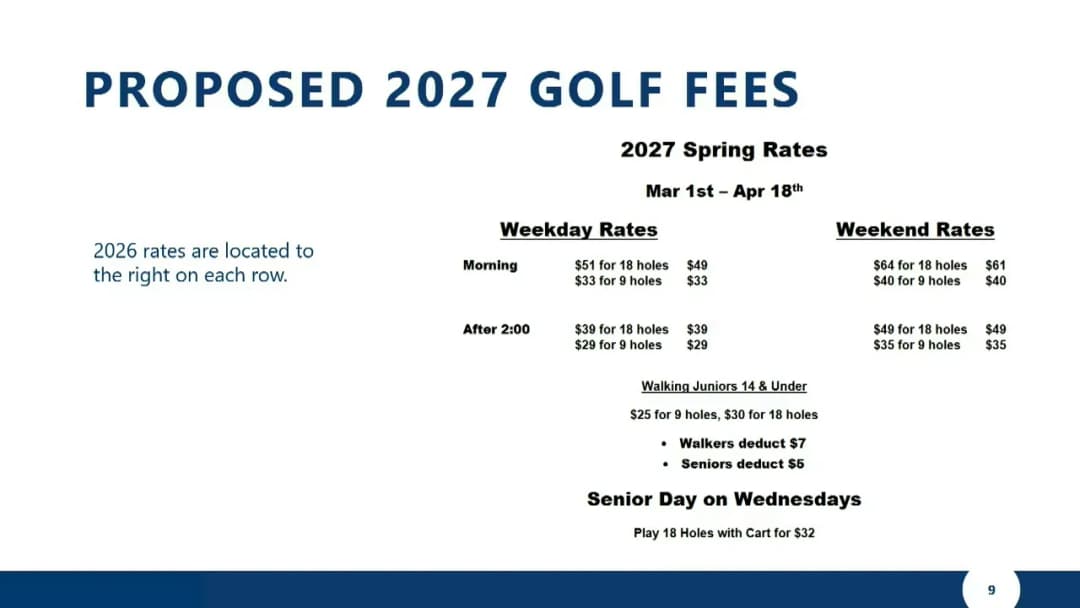
The Public Meeting IndexThe Carmel Finance Utilities and Rules Committee met on Monday, October 5, 2026, at 4:56 p.m. to consider two agenda items: Ordinance D 2847-26, approving Brookshire Golf Course fees and rates for calendar year 2027, and Ordinance D 2772-25, adopting requirements for nonprofit organizations receiving public support from the city. The committee voted to advance the golf course ordinance to the full council with a positive recommendation, while the nonprofit ordinance was deferred to the next council meeting on October 19, 2026. Consent Calendar - None noted; both items were presented as regular agenda items. Public Comments & Testimony - No formal public comments were made during the meeting. Discussion Items - Brookshire Golf Course Rates (Ordinance D 2847-26) – Zach Jackson, CFO and controller for the city, presented the proposed rates for 2027, joined by Bob Higgins, golf course superintendent. Highlights included: - The course, established in 1971 as a private course, was purchased by the city in 2007 to prevent development and now operates as a standalone city department. - The current ordinance requires annual rate approval by November 1; the city code had last been updated in 2011, and the last rate review was in 2025 (with a significant rate increase). - Proposed rates show modest increases: roughly half of rates remain unchanged, and those increasing go up by $2–$3 for green and cart fees, and $25–$75 for membership fees. - The food and beverage vendor (MTS Collective, also known as Mustard Seed Collective) pays monthly rent, with additional fees for patio and simulator room usage; the snack bar vendor (Par Five Group LLC) pays monthly rent plus a share of sales over $30,000 per month. - A 2025 study by Carmel Clay Parks and Recreation recommended rate adjustments, improved marketing, and noted deferred maintenance issues, including an undersized parking lot and aging assets (notably a maintenance building from 1971). - Financial projections: 2026 revenues are on pace to be about $1.8 million, covering operating expenses for the first time in many years, achieving structural cost recovery. The 2027 budget forecasts revenue just under $2 million. - Council members expressed support for the modest increases, noting that last year’s larger rate increase helped catch up to market. Questions were raised about deferred maintenance (capital plan status) and the operation’s cost recovery structure; Jackson confirmed capital leases are excluded from operating expenses. - Councilman Rural supported the proposal, citing Bob Higgins’ leadership and the course’s improved financial performance. The committee discussed the possibility of aligning rate-setting with the budget cycle to better respond to market changes. - Nonprofit Organization Requirements (Ordinance D 2772-25) – The ordinance was briefly acknowledged but not discussed in detail; it was deferred to the next council meeting. Key Outcomes - The committee moved and seconded Ordinance D 2847-26, approving the 2027 Brookshire Golf Course fees and rates, with a positive recommendation to the full council. The motion passed unanimously (no dissenting votes noted). - Ordinance D 2772-25 was deferred to the next city council meeting on October 19, 2026, at 3 p.m. - The meeting adjourned at 4:56 p.m.
The Carmel City Council held its regular meeting on Monday, October 5, 2026, beginning at approximately 6:30 p.m. The agenda included public comments on micromobility and parking enforcement, approval of consent items, committee reports, second reading and approval of Brookshire Golf Course fees, introduction of the 2027 budget and additional appropriations for Human Resources and the Fire Department, a resolution to transfer funds for fire department fuel, and the appointment of a new Historic Preservation Commission administrator. Consent Calendar - Minutes Approved: Minutes from the September 21 executive session and regular meeting were approved unanimously. - Claims and Payroll: Approved claims and payroll totaling $4,400,616.19 (general payroll), $9,716.84 (CFD bonus payroll), and $5,299.50 (general claims). Public Comments & Testimony - Jack Feldman (Carmel resident): Expressed continued concerns about the micromobility ordinance, urging the council to study successful programs like Springfield, Missouri’s enforcement system, and noted ongoing issues with the proposed dismount zone on the Monon Trail. He asked for more data and academic studies to guide improvements. - Allie Messler (resident): Raised multiple questions about the new parking enforcement system: - Where can residents find an official map and schedule of designated school zones? - Are parking restrictions enforced daily, school‑days only, or during specific hours? - How are guests, contractors, and caregivers supposed to obtain permits under the new Passport system? - Expressed privacy concerns: under the old system residents obtained stickers from the police department; now they must create a Passport account, upload vehicle registration and license, and have their license plate serve as a residential sticker. She questioned whether Carmel’s contract fully protects personal data shared with or processed by Passport, and whether the company could sell or share that data. - Banks Piller (fifth‑grade student, Mohawk Trails Elementary): Presented the Deputy Mayor’s report, highlighting community events: Carmel International Arts Festival (130+ artists), final neighborhood pop‑up celebrating Carmel’s 50th anniversary and Sophia Square’s 15th birthday, homecoming pep rally, Oktoberfest, and the upcoming Diwali celebration on October 10. Discussion Items - Micromobility Ordinance and Land Use Committee Rescheduling: Councilor Covens announced that the Land Use Committee meeting scheduled for Thursday, October 8 would be rescheduled to Thursday, October 15 at 6:30 p.m. at Carmel Public Library due to unavailability of two council members. - Brookshire Golf Course Fee Schedule (Ordinance D‑2847‑26): Councilor Taylor presented the finance committee’s unanimous positive recommendation. Superintendent Higgins and CFO Zach Jackson reported that course fee increases were “very nominal” (less than 2%, with over half unchanged). The course is expected to achieve 100% cost recovery for the first time. The ordinance was approved (second reading and final vote). - 2027 Budget Introduction (Ordinance D‑2848‑26): Introduced and held at the dais; a public hearing was opened and closed without comment. Further discussion is planned. - Additional Appropriation – Human Resources (Ordinance D‑2853‑26): CFO Zach Jackson explained the $416,000 appropriation: $336,000 for a projected workers’ compensation shortfall (increased claim costs, not claim volume) and $80,000 for salary/benefits gaps due to a part‑time addition and a temporary double fill. The council suspended rules and approved the ordinance unanimously. - Additional Appropriation – Fire Department (Ordinance D‑2854‑26): Fire Chief Joel Thacker detailed two needs: - $1.6 million for unscheduled overtime (covering vacation, sick leave, FMLA, and retirements). $1.5 million is available from a prior‑year purchase order; $100,000 is new money. - $350,000 for HVAC repairs: $295,000 for a complete replacement at Station 44 (built 2016 with ongoing issues) and $55,000 for repairs at Station 43. - Chief noted 17 retirements in 2026 and that the department needs 48 personnel daily to staff apparatus; overtime is often necessary due to vacancies and leave. He and CFO Jackson explained that fully staffing with 48 additional firefighters would cost about $7.2 million (salary/benefits), making overtime a cost‑effective option in many cases. - Councilors discussed the balance between overtime and hiring, concerns about firefighter fatigue (monitored via new health program), and the need for empirical data on staffing levels. The ordinance was approved after suspending rules. - Resolution – Fire Department Fund Transfer (R‑052601‑26): Approved a $158,000 transfer from existing appropriations for higher‑than‑anticipated diesel and gasoline costs. Moved and approved. - Tax Cap Resolution (R‑ of the Common Council): Introduced to direct the Department of Local Government Finance that the city’s tax rate will remain at 0.7783 per $100,000 assessed value for 2027. Referred to the Finance Committee. - Salary Ordinances (D‑2849‑26, D‑2850‑26, D‑2851‑26, D‑2852‑26): First readings held at the dais to be approved with the full budget. Set 2027 salaries for appointed officers/employees of the City Court, City Clerk, general city employees, and elected officials. - Historic Preservation Commission Administrator Appointment: Sam Burgess (Indiana Landmarks) was nominated and confirmed as the new administrator, replacing Mark DeLossi. The council voted to approve the appointment, with discussion about possibly updating the ordinance to allow naming an institution or designee; a committee review was suggested by year‑end. Key Outcomes - Approvals (all unanimous unless noted): - Consent agenda (minutes, claims/payroll). - Ordinance D‑2847‑26 (Brookshire Golf Course fees). - Ordinance D‑2853‑26 (HR additional appropriation $416,000). - Ordinance D‑2854‑26 (Fire Department additional appropriation $1.95 million). - Resolution R‑052601‑26 (Fire Department fund transfer $158,000). - Appointment of Sam Burgess as Historic Preservation Commission administrator. - Introductions / Held at Dais: - 2027 Budget (D‑2848‑26) – introduced, public hearing held. - Tax cap resolution – introduced, referred to Finance Committee. - Salary ordinances for court, clerk, city employees, and elected officials – introduced to be approved with budget. - Next Steps: - Land Use Committee rescheduled to October 15, 6:30 p.m. (Carmel Public Library) – will discuss micromobility ordinance. - Council expects administration to publish clear maps and enforcement hours for school zones before parking citations begin; privacy concerns with Passport to be addressed. - Fire Department overtime and staffing data to be further analyzed; council seeks empirical analysis of optimal staffing vs. overtime costs. - Historic Preservation Commission ordinance to be reviewed by committee with Sam Burgess’s assistance. Committee & Staff Reports (Highlights) - Redevelopment Commission (Henry Mostetsky): Provided updates on multiple projects: Monon Square North, Magnolia’s final buildings, Hamilton Crossing (Republic HQ and captive hotel), Presidium 3 (financing not yet closed), Icon on Maine (plaza opening TBD), Third Avenue Residences, Ardon Plaza, Heron Club, and North End Phase 2. Councilors raised concerns about sidewalk closures and pedestrian detours during construction; staff agreed to improve monitoring. - Historic Preservation Commission (Sam Burgess): Quarterly report noted attendance at state preservation conference, ongoing efforts to save the Blue School, certified local government compliance, and a draft of conservation district guidelines for North Rangeline Road. Two community engagement sessions with property owners are planned before year‑end. Staff changes confirmed; new administrator appointment followed.
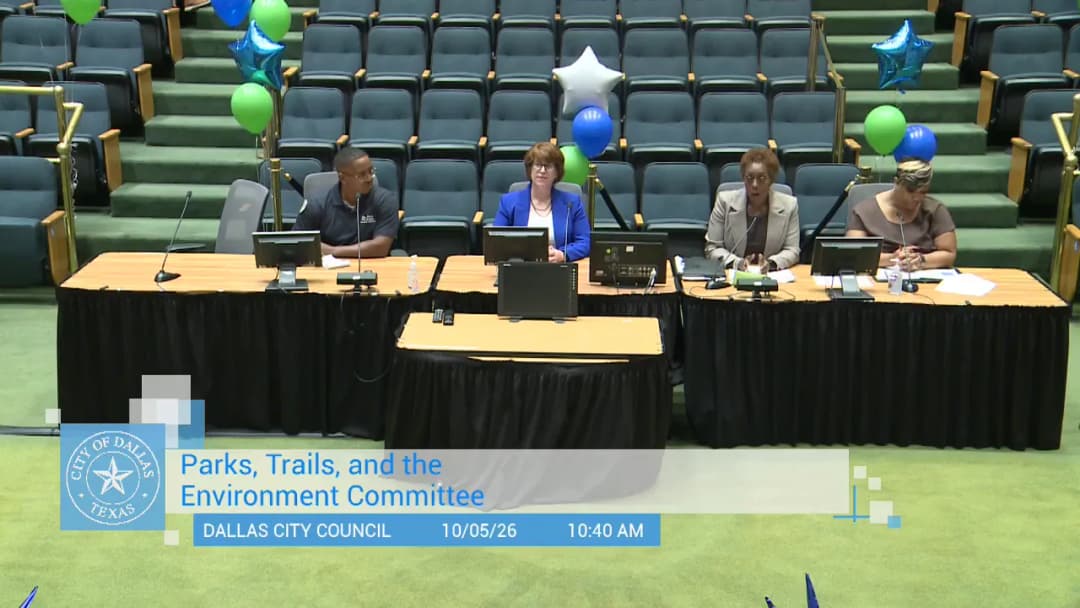
The Parks, Trails, and Environment Committee of the Dallas City Council met on October 5, 2026, at 9:00 AM. The meeting included approval of previous minutes, briefings on the park system's 150th anniversary, Fair Park operations and improvements, and the Code Compliance Nuisance Abatement Division. Committee members offered comments and asked questions on each topic. Consent Calendar - Approval of September 1, 2026, Minutes: The committee unanimously approved the minutes from the September 1, 2026, Parks, Trails, and the Environment Committee meeting. Discussion Items - Dallas Park and Recreation – Celebrating 150 Years (Sesquicentennial): Ryan O’Connor (Senior Deputy Director) and Robin Steinshnider (Assistant Director) presented the campaign, which includes a historic timeline exhibit, a Parks 150 Passport (25 parks with stamp stations), a memory bank for public memories, commemorative coins representing seven eras, a time capsule, and an endowment fund established on North Texas Giving Day. The park system began in 1876 and now includes over 420 parks, 43 recreation centers, 6 golf courses, 225 playgrounds, and nearly 200 miles of trails. Committee members expressed support, particularly for the passport program and endowment. Councilmember Bazaldua noted the need for clear policy on endowment fund use and highlighted the department's national recognition at the NRPA conference. Councilmember Ridley asked about other city endowment models (e.g., Atlanta's Park Pride). Councilmember Stewart emphasized the endowment's focus on neighborhood and community parks. - Fair Park Year in Review: General Manager Brett Wulke and Ryan O’Connor reported on progress since the city resumed daily operations on September 16, 2025. Key accomplishments include a new fire panel at Pan Am (ending fire watch), a 13,000-square-foot walkway replacement at the Music Hall, pressure washing, a master paint list for historic approval, and $3.5 million in deferred maintenance addressed. Security improvements include a 24/7 command center, QR-code-based rover accountability, and updated emergency plans. Notable events drew large crowds: FoodieLand (46,000+), the FIFA Fan Festival, Texas Black Invitational Rodeo, and Mayor’s Back to School. Cotton Bowl programming included six training sessions for Spain’s World Cup-winning team, a high school doubleheader, and the upcoming Red River Rivalry. A request for proposals for a Cotton Bowl operator is in procurement. Community outreach includes a farmers market, tours of the Natural History Museum, and a tree lighting event. Financials are on track to meet budget. Councilmembers praised the stabilization efforts. Councilmember Bazaldua raised concerns about rust on the Hall of State and the need for sustainable maintenance, urged proactive communication of positive stories, and asked for detailed future revenue plans and a prioritization of Fair Park in the next bond program. Councilmember Blair asked about elevator repairs at the African American Museum. Councilmember Ridley requested visibility on how Brimer bill funds are deployed. Director Jenkins stated the next Brimer tranche (targeting Music Hall, Automobile Building, and Centennial Building) will be presented to the committee when bond issuance occurs (likely Jan/Feb 2027). - Nuisance Abatement Division Overview: Assistant Director Christylla Miles provided an overview of the Code Compliance Nuisance Abatement program, which focuses on prevention, responsiveness, and partnerships. The division has four proactive illegal dumping teams, a graffiti abatement team that offers free removal with property owner consent, a heavy clean team (working with EMCR on homelessness-related debris), hand crews, tire abatement, and zero-turn mowers. In August 2026, the division received over 22,000 requests for nuisance abatement, with an average closure time of 4–5 days for general cases and about one day for illegal dumping. Councilmember Blair noted the challenges of private property enforcement and commended the partnership with EMCR. Councilmember Ridley asked about definition and cost recovery for illegal dumping (property owner is liable; liens are placed). He also inquired about the use of imaging cameras on trash trucks, which the division finds productive for identifying potential violations. Councilmember Johnson expressed frustration with inconsistent follow-through from other city departments on homeless encampment cleanups and requested direct coordination with his office. Councilmember Bazaldua suggested using innovative technology (e.g., robots on trails) for proactive monitoring. Briefing Memos - 2024 Bond CECAP Resolution Annual Status Update for 2026: The committee acknowledged the memo without questions. Key Outcomes - The committee approved the September 1, 2026, meeting minutes unanimously. - The committee received briefings on the Parks 150 campaign, Fair Park progress, and the Nuisance Abatement Division, with no formal votes taken. - The committee noted the upcoming agenda item for the October 14, 2026, City Council meeting: authorizing a master agreement for park and recreation equipment (total estimated $21,076,500 across five vendors). No questions were raised. - The committee forecast noted that the multi-year funds briefing originally scheduled for October was postponed to the November meeting. - Councilmembers directed staff to provide more detailed future presentations on Fair Park revenue plans, Brimer fund deployment, and a prioritized maintenance plan.
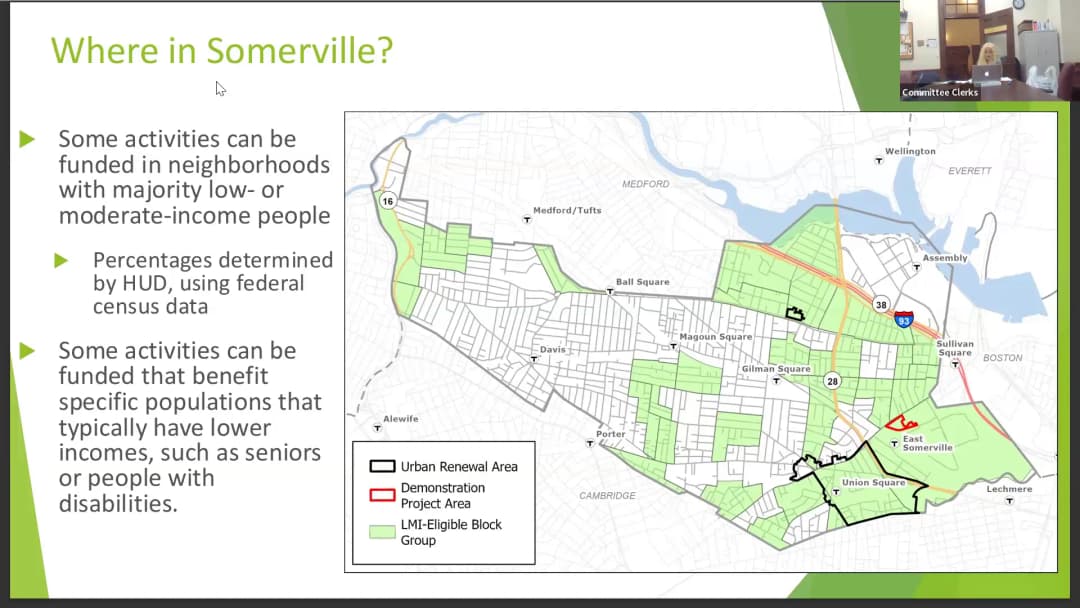
The Housing, Community Development and Equity Committee of the Somerville City Council met on October 4, 2026, at 6:04 PM via Zoom and in person. The meeting was called to order by Chair Strezo and adjourned at 7:14 PM with a roll call vote of 3-0 (Councilors Sait, Link, Strezo). The committee reviewed the HUD One Year Action Plan, received an update on the ADA Coordinator vacancy, discussed community space inventory, and considered a partnership with St. James Church. Consent Calendar - Approval of Minutes (ID 26-1211): The minutes of the July 1, 2026 committee meeting were accepted unanimously. - HUD Action Plan (Items 26-0870 and 26-0688): After discussion, the committee voted to place the older item ( 26-0870) on file and approved the replacement item ( 26-0688), the 2026-2027 One Year Action Plan for CDBG, HOME, and ESG programs, by a 3-0 vote. Public Comments & Testimony - Holly Simione, Chair, Somerville Commission for Persons with Disabilities (SCPD): Read a letter on behalf of the commission expressing concerns about the prolonged vacancy of the ADA Coordinator position. She highlighted that the current interim structure (a team of employees) creates gaps, particularly around the use of a shared email address (ADA@SomervilleMA.gov) that conflates commission and city staff functions. The commission requested that the city: prioritize hiring a dedicated ADA coordinator with appropriate experience; reconsider combining the role with HR investigator duties; include commission representatives in the interview process; and establish a clear documented process for ADA complaints and coordination while the position remains vacant. Discussion Items - ADA Coordinator Vacancy (ID 26-1033): Following Commissioner Simione’s testimony, Councilors discussed the need for a response from the administration. Director Galligani noted the job description was revised and reposted on September 10, 2026. Chair Strezo asked about recruitment efforts and agreed to keep the item in committee pending further information from Human Resources. - Community Spaces List (ID 26-0831): Tom Galligani, Executive Director of Strategy and Development, reported that a 2021 study cataloged publicly available community spaces, but the list is outdated. He noted that Community Preservation Act (CPA) funds are available to improve accessibility of such spaces. Councilor Link suggested a sustainable, crowdsourced update method. Chair Strezo requested the current list be made public along with instructions on how residents can reserve spaces. The item was kept in committee. - St. James Church Partnership (ID 26-0821): Brenna Broderick, Community Partnerships Liaison, described three underutilized spaces in the church rectory (capacities of 80, 50, and 15). Logistical challenges include physical accessibility (steps, non-ADA restrooms) and security (limited key distribution). The city has been working to relocate AA meetings from the Ralph and Jenny Center; two of three groups have moved to St. James, but one Sunday morning group remains unplaced due to conflict with church services. Councilor Sait raised the possibility of using the space for a teen center; Broderick noted the church prefers short-term, non-permanent uses. Councilor Link expressed concern about the distance for AA attendees. The committee recommended the item be marked work completed (3-0). Key Outcomes - Minutes Approved: 3-0. - HUD Action Plan: Item 26-0870 placed on file; Item 26-0688 approved (3-0) to allow the city to receive federal grant funds (CDBG $2.5M, HOME $0.5M, ESG $200K). - ADA Coordinator: Item kept in committee; administration to provide updates on recruitment and response to commission’s requests. - Community Spaces List: Item kept in committee; director to share the existing 2021 list and develop a user-friendly public version with sign-up instructions. - St. James Church Partnership: Item marked work completed (3-0); continued coordination on remaining AA group relocation and accessibility improvements. - Adjournment: Motion passed 3-0.
The Somerville City Council Land Use Committee and Planning Board held a joint virtual public hearing on Thursday, October 4, 2026 (called to order at 6:31 PM, adjourned at 8:39 PM) to hear presentations and public testimony on five proposed zoning amendments. No votes were taken; all items were kept in committee with a written public comment period open until October 30, 2026. Director of Planning Dan Bartman provided an overview of three drivers for the amendments: the five-year zoning review, permit streamlining (FY27 budget priority), and significant state law changes to MGL 40A (variance standards, site plan review) and pending economic development bond bill. Public Comments & Testimony Protected Accessory Dwelling Units (Item 1.4, ID 26-1336) - 16 residents spoke. Many expressed concerns about the proposed maximum gross floor area of 1,750 sq ft, arguing it is excessively large compared to the state's default 900 sq ft and could exacerbate displacement, loss of green space, and conversion of affordable rentals to luxury condos. Speakers urged the city to set a lower square footage cap and to consider broader impacts on density, tree removal, and fire safety. - Some residents supported the amendment for enabling multi-generational living and increasing housing stock, but requested public workshops and clearer renter protections. - Becca Wolfson shared her personal experience of being displaced from her rental due to an ADU conversion and requested a requirement for tenant notification. - Joshua Michel and Julian Lewis expressed conditional support, emphasizing the need for dimensional flexibility and design feasibility. Parking Corrections (Item 1.1, ID 26-1258) - One resident, Joshua Michel, supported reducing parking maximums but noted that the proposed increase for Urban Residential (UR) districts (from no maximum to 0.5 spaces per 1,000 sq ft) should be reconsidered. - Planning Board Chair Mike Capuano (read by Vice Chair Aboff) stated that the amendment is a "solution in want of a problem," citing data that parking stickers have remained flat despite a 3,000-car decrease in registrations, and that restricting parking through zoning is less effective than limiting residential parking stickers. Ground Story Elevation (Item 1.2, ID 26-1259) - Two residents spoke in support. Joshua Michel supported the change to improve ADA compliance and endorsed including Councilor Link's related proposal for full-size windows. Crystal Huff requested that all references to ground story elevation be removed consistently from both tables and text. Principal Entrances (Item 1.5, ID 26-1337) - Three residents spoke. Jane Bestor voiced concern that allowing rear/side entrances for ADUs could create problems for neighbors on small lots. Joshua Michel supported the flexibility. Denise Provost raised issues about new construction not complying with ADA standards despite variances being sought. Terminology Updates (Item 1.6, ID 26-1338) - No public testimony was offered. Discussion Items 1. Protected Accessory Dwelling Units (ADU) Compliance Senior Planner Kortney Cena presented the amendment to align Somerville's zoning with state law (760 CMR 71). Key proposals: align dimensional standards with principal buildings; set maximum gross floor area at 1,750 sq ft; allow adaptive reuse of existing structures; remove orientation restrictions; relax height, setbacks, and component standards. Chair Ewen-Campen clarified that state law requires ADU height to match the principal building, but the city can regulate square footage down to a minimum of 900 sq ft. Staff noted that additional related amendments (terminology, accessory structures) are forthcoming. 2. Parking Corrections Senior Transportation Planner Justin Schreiber presented corrections to previous parking maximum amendments: fixes for approximately a dozen out of 1,200 redlines to restore intended maximums for six use categories (including commercial services, lab/R&D, and UR district). The goal is to limit new parking near transit and simplify tables. 3. Ground Story Elevation Requirements The amendment would eliminate minimum ground story elevation requirements for all building types and districts, intended to facilitate ADA compliance and simplify standards. The change mirrors a separate proposal by Councilor Link, which also addresses window size. 4. Principal Entrances The amendment allows principal entrances on side facades (if a front entrance is provided), permits rear/side entrances for ADUs, and removes the 30-foot maximum entrance spacing requirement for ground-floor commercial spaces. It also allows street numbers on facade walls when the principal entrance is not in front. 5. Terminology Updates The amendment renames "affordable dwelling unit" to "price restricted dwelling unit" (PRDU) and "commercial space" to "commercial unit" to reduce confusion with accessory dwelling units (ADUs) and align with common usage. Key Outcomes - All five items were kept in committee (no votes taken). - Public comment periods for each item will remain open until Friday, October 30, 2026, at 12:00 PM; written comments can be submitted to publiccomments@somervillema.gov. - The committee plans to continue deliberation and amendment processes in future meetings, taking into account public feedback and further discussion with the Planning Board. - No next steps or future meeting dates were announced.
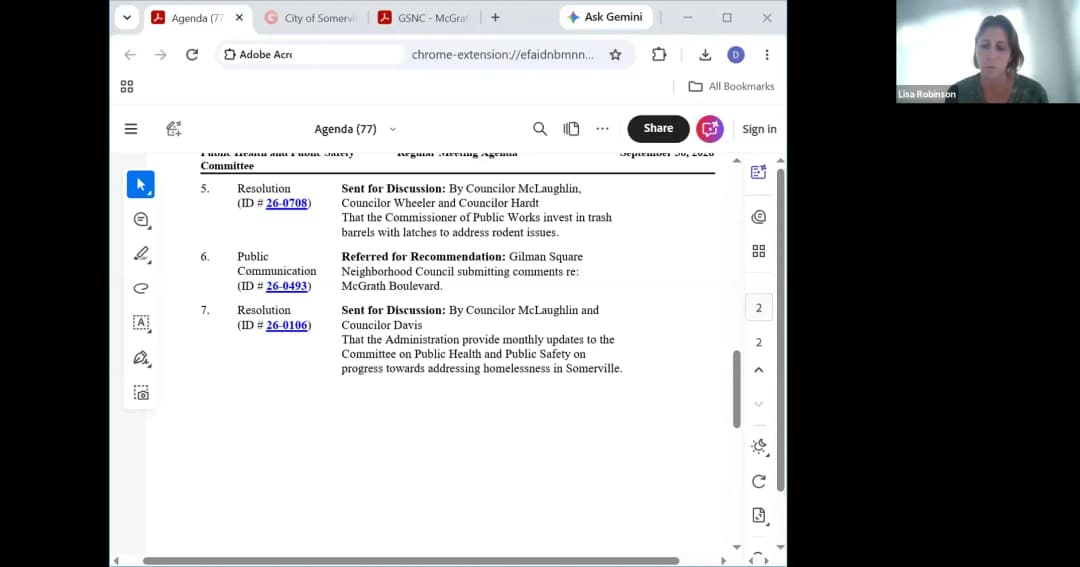
The Somerville City Council Public Health and Public Safety Committee met via Zoom. Chair McLaughlin called the meeting to order at 6:03 pm; quorum consisted of Councilors Clingan and McLaughlin, with Councilor Strezo absent. The meeting adjourned at approximately 6:38 pm on a roll call vote of 2 in favor, 0 opposed, and 1 absent. Note: The minutes header lists Wednesday, September 30, 2026, while the meeting metadata date is 2026-10-04T14:15:00+00:00; this summary uses the supplied metadata date. Consent Calendar - Approval of the minutes of the July 1, 2026 Public Health and Public Safety Committee meeting (ID 26-1212): accepted by a 2-0 roll call with Councilor Strezo absent. Public Comments & Testimony - Christopher Rosol submitted written comments about off-leash dogs (ID 26-0914). Councilor Clingan acknowledged resident concerns, noted that off-leash dogs are not allowed in public parks and that dog parks are available, and stated that enforcement rests largely with the Somerville Police and animal control; he also noted that FOSS Park is state property. - The Gilman Square Neighborhood Council submitted written comments regarding McGrath Boulevard (ID 26-0493). Chair McLaughlin reviewed the comments and voiced concerns about the loss of the pedestrian footbridge and the use of a HAWK signal instead of a full stoplight, as well as traffic being pushed onto small side streets. - Several members of the public attended to testify about the Warming Center, but no testimony was taken because city staff were unavailable due to a five-alarm fire in Ward 7 / Teel Square; Chair McLaughlin said the Warming Center would be discussed at a future full council or committee meeting. Discussion Items - Warming Center After Action Report (ID 26-1339) and street harassment resolution (ID 26-1305): Both were kept in committee / laid on the table without a vote because staff were responding to the fire. The Director of Emergency Management had been scheduled to present the 2025-2026 Cummings School Winter Warming Center After Action Report and Improvement Plan. - Off-leash dogs communication: Director Nagim-Williams said the administration had no additional comment; the item was placed on file and recommended to be marked work completed. - Trash barrels with latches (ID 26-0708): Chair McLaughlin explained that the City has a major rodent problem and referenced the Ward 1 composting pilot, noting that rodents do not chew through the composting barrels because of the latches. DPW Commissioner Eric Weisman said the City had piloted latches on trash barrels at 50 addresses; the latches need to be automatic-release when barrels are tipped, and the pilot had mixed success, with some latches chewed through within a few days. Adding latches to existing barrels costs approximately $10 per barrel, and residents would still need to manually engage the latches. The City has switched over the past year from medium-density to higher-density plastic barrels; the new barrels are smoother and reportedly more rodent-resistant but may be more prone to cracking. Commissioner Weisman said he would check with the vendor about the composting barrels and follow up. The item was recommended to be marked work completed. - McGrath Boulevard communication (ID 26-0493): Kept in committee. Chair McLaughlin expressed concern about the loss of the pedestrian footbridge connecting the east and west sides of McGrath Boulevard, the use of a HAWK signal instead of a traditional stoplight, and diverted traffic on Virginia and Aldrich streets. He requested that IGA Director Amanda Nagim-Williams consider adding a footbridge or a traditional stoplight and provide an update at the next meeting. - Homelessness monthly update (ID 26-0106): Director of Community Wellness Lisa Robinson reviewed the monthly handout. She reported that the Somerville Homeless Coalition shower van is now operational; the Engagement Center is open and had 10 new intakes in one week, compared with the usual 2-3 intakes per week; the weekly Friday interdepartmental huddle continues; a public campaign called Caring is Calling and the Together in Public Spaces webpage are being promoted; and a community meeting recently addressed extreme weather planning for unhoused residents. The number of unhoused people in Somerville has not changed since the last report. Councilor Clingan asked for clarification that the 31 unsheltered people are those fully on the streets, not in cars or shelters; Director Robinson confirmed this and said the 148 sheltered number includes people in emergency shelters. Community health workers are in Davis Square in the mornings and at the Engagement Center in the afternoons, helping with MassHealth and SNAP applications. The City renewed a contract with Healthcare for the Homeless and expects the first invoice soon. Public health vending machines have switched from warm-weather to cold-weather products; from July to September, Narcan was dispensed 72 times total, including 31 in July, with bathing wipes, safe sex kits, hygiene kits, baby wipes, sunscreen, naloxone, and insect repellent also dispensed. The sharps box weighed 250 pounds in one month; Director Robinson and Director Tina Los attributed part of the increase to GLP-1 injectable disposal and are working on a proper sharps disposal campaign. Director Los said improper needle disposal creates extra cleanup costs, and the City is working with pharmacies because some pharmacies accept needles and some do not. On ISD, Director Robinson said Inspectional Services is now part of Health and Human Services as of July 1 and the transition has been going well, including daily morning needle and sharps sweeps. Councilor Clingan asked whether anyone had been moved into permanent housing; Director Robinson said there have been success stories but the process takes time, and she would try to collect more specifics. Director Robinson also said the number of unhoused people may increase due to federal housing policy changes and the City is preparing for that. The item was kept in committee. Key Outcomes - Minutes of July 1, 2026 approved 2-0-1. - Off-leash dog communication recommended to be marked work completed. - Trash barrel latch resolution recommended to be marked work completed; DPW Commissioner to follow up with the vendor on composting barrel rodent resistance. - Warming Center After Action Report and street harassment resolution kept in committee without a vote. - McGrath Boulevard communication kept in committee; IGA Director to explore a footbridge or traditional stoplight and report back. - Homelessness update kept in committee; monthly updates to continue. - Meeting adjourned at approximately 6:38 pm by a 2-0-1 roll call.
The Beloit City Council convened for a Strategic Planning Workshop on Saturday, October 3, 2026 (official meeting timestamp recorded as 2026-10-03 15:00:00+00:00). The workshop was scheduled for 9:30 AM CT at the Beloit Public Library (605 Eclipse Boulevard), though the general public notice header listed the start at 9:00 AM CT. No meeting minutes or a transcript of the proceedings were provided in the source materials. Consequently, this summary can only report the confirmed logistics and scheduling framework, as no substantive discussions, public testimony, or formal council decisions are available for summarization.
The Aurora City Council held a full-day budget workshop on Saturday, October 3, 2026, to review proposed departmental budgets for fiscal year 2027, discuss cuts, and consider additions. Key topics included a contentious $2 million reduction to the court system, public safety technology (Flock cameras, drones, mobile response teams), and proposals to add or cut staff. The council also discussed furlough days and data discrepancies between the court and public defender systems. Consent Calendar - No consent calendar items were noted. Public Comments & Testimony - No public testimony was presented. Discussion Items - Budget Rules (Item 2A) : The city manager outlined the process: department-by-department review, proposals needing five votes to be placed on the board, final approval requiring six votes, and the requirement to balance the budget. The council agreed to proceed. - City Attorney (Pete Shulze) : Reported a reduction of three attorney FTEs (over $500,000 savings) and participation in five furlough days ($181,000 savings). The office now handles 90% of litigation in-house, reducing outside counsel costs. The proposed 2027 budget is $11,313,339 with 68 FTEs (down from 71). - Civil Service Commission (Matt Cain) : No additions; maintained four FTEs. Commission stated Denver has nine FTEs for the same function. - Judicial (Judge Day) : Presented data on in-custody cases, which are down by about half due to a new standing order releasing most petty offenders on PR bonds without a court appearance. The court will close one division, not fill a retiring judge position, and shift resources to handle increased traffic registration cases (over 11,000 cases in one division). The judge expressed that the $500,000 cut is challenging. Councilmember Lawson questioned data accuracy and workload justification. - Public Defender (Ms. Cadiz) : Reported a 5.7% decrease in total cases opened but a 27% increase in non-DV cases. The office is cutting two FTEs (vacant positions) and noted data discrepancies with the court. Councilmember Hancock proposed cutting an additional two FTEs, arguing reduced DV workload. The proposal failed 5-4. Councilmember Horton proposed an audit of the court and PD data systems; agreed to explore cost and bring back for spring supplemental. - Housing and Community Services (Key Kim) : Presented on the Mobile Response Team (AMRT). Currently three teams cover daytime hours with some weekend coverage. Adding a fourth unit ($243,000 ongoing) could increase mental health calls answered by 86 per month and divert 440 ER/jail visits yearly. Council approved funding for one additional unit, with possible a second unit from opioid settlement funds. - Code Enforcement : Councilmember Horton proposed adding one full-time code enforcement FTE ($93,400 ongoing) to address workload, especially in Ward 1. The proposal was placed on the board with five votes. - Police Department (Chief Chamberlain) : Presented on technology use (Flock cameras, drones, real-time information center) and crime reduction (38.8% reduction over two years). Councilmember Horton proposed eliminating Flock camera funding at Aurora Public Schools ($65,000 reduction), which passed 5-4 and was placed on the board. Councilmember Jackson expressed concerns about warrantless data collection and bias. - Furlough Days & Pay Table : City manager indicated likely reduction from five to four furlough days in Q1 2027, citing improving revenue. The 3% council pay raise is charter-mandated; members may donate back. Key Outcomes - Net Budget Gap : The total additions (approx. $268,000 ongoing, $9,000 one-time) minus reductions ($69,000) leaves a net gap of about $268,000 ongoing. Staff will manage the gap internally through operational adjustments. - Furlough Reduction : Council directed the city manager to reduce furlough days from five to four, with implementation targeted for the first quarter of 2027. - Mobile Response Team : Council approved funding for a fourth AMRT unit ($243,000 ongoing); staff will explore a second unit via opioid settlement funds. - Flock Cameras : Council voted 5-4 to eliminate funding for Flock cameras at Aurora Public Schools ($65,000 reduction), placed on the board for further consideration. - Code Enforcement : A proposal for one additional code enforcement FTE ($93,400 ongoing) was placed on the board. - Data System Audit : Council directed staff to explore the cost and scope of an audit of the court and public defender data systems, to be reported back for the spring supplemental. - Council Pay Raise : Councilmember Wiles proposed forgoing the 3% annual raise; charter requires the raise but members may donate the amount back to the city; no formal vote was taken. - Supplemental Items : Several items (commercial kitchen retrofit program, additional code enforcement FTE, data audit) were deferred to the spring supplemental budget discussion.
The Anchorage Assembly held a work session on October 2, 2026, to receive a comprehensive briefing on the assembly's role in collective bargaining agreements (CBAs). The session was led by Chief Human Resource Officer Aaron Billingsley and Assistant Municipal Attorney Jason Bachins. The meeting was recorded due to internet outages preventing a live stream. Assembly members present included Ms. Park, Mr. Raleigh, Mr. Handlin, and Ms. Holly Day, with Mr. Martinez joining by phone. Discussion Items - CBA Structure and Overview: The presenters defined CBAs as multi-year contracts (3-5 years) negotiated with nine certified bargaining units. They cover negotiable subjects such as wages, hours, benefits, and grievance procedures. Subjects excluded from bargaining include management rights, substance misuse testing, and retiree medical. - Employee Categories: Employees are classified as represented (union CBAs), non-represented (exempted by code and governed by Title 330 personnel rules), or executive (at-will). The non-represented category is designed to include roles like HR, law, IT, and assembly staff to avoid conflicts of interest in bargaining. - Negotiation Process and Arbitration: The process begins with a 180-day notice to bargain. If impasse occurs, steps include mediation, fact-finding, and arbitration. For essential services (Police, Fire, EMS, Water/Sewer), binding interest arbitration applies; the arbitrator chooses an article-by-article best final offer, and the assembly has no ratification role as the award is final for two years. For other units, the assembly must ratify by majority vote or the municipality implements its last best offer. - Assembly Role and Guidance: The assembly sets policy via resolutions (AR 2019-417-S, AR 2024-23). During active negotiations, assembly members are barred from communicating with the bargaining unit about the negotiations. The assembly can issue general guidance, which the administration recommended remain high-level to allow bargaining flexibility. The assembly must ratify contracts and any mid-term administrative agreements requiring an appropriation. - Essential Services Classification: Mr. Handlin questioned why water/sewer treatment is an essential non-strike service while electric generation is not. The administration noted the classification is established in code and that the municipality no longer operates the electric utility. - Budget Implications: Once ratified, CBA financial terms are fixed multi-year obligations in the budget. The municipality lacks discretion to reduce these costs unilaterally. Approved benefits for non-represented employees can prompt unions to request mid-contract meet-and-confer sessions to extend similar benefits. Key Outcomes - No Formal Action: The work session was for informational purposes only; no votes were taken. - Upcoming IBEW Negotiations: The assembly will receive a memorandum within the next two meetings notifying them of upcoming negotiations for the IBEW contract (expiring June 2027), opening a 30-45 day window for assembly guidance. - Current Teamsters Negotiations: The administration confirmed it is actively engaged in negotiations with the Teamsters. - Process Clarifications: Assembly members received clarifications on the binding nature of essential service arbitration, the statutory restrictions on member communication during active bargaining, and the lack of discretion over approved union wage and benefit costs in the budget.