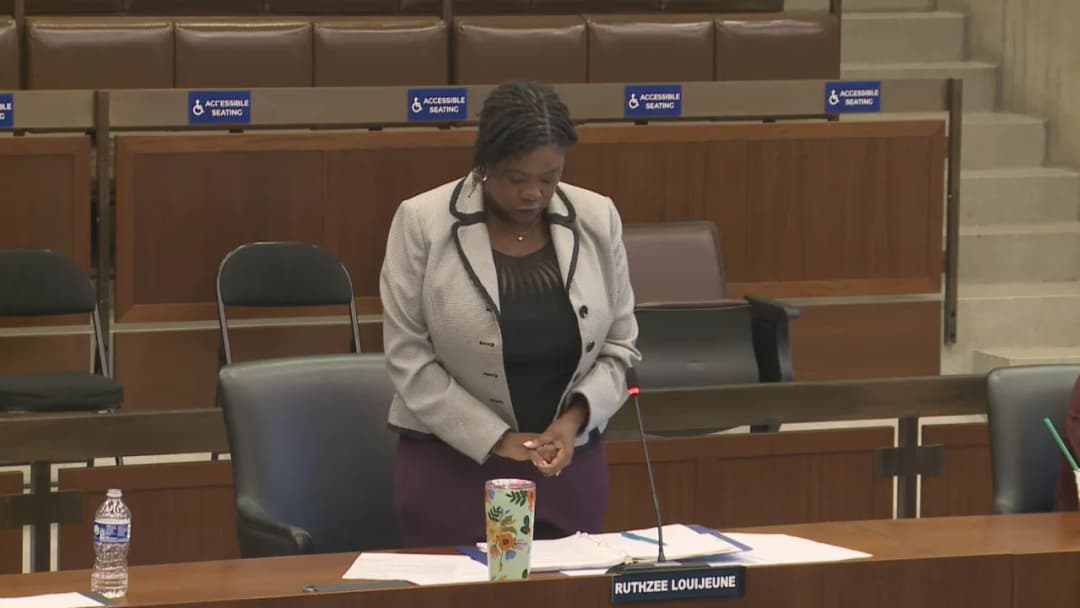
The Boston City Council held its regular meeting on Wednesday, September 30, 2026, at 12:10 PM in the Christopher A. Iannella Chamber. The meeting was called to order by President Breadon and adjourned at 3:33 PM. All 13 councilors were present. The meeting included the approval of prior minutes, multiple collective bargaining agreements for Boston Public Schools and Boston Police, adoption of resolutions, and handling of late-filed matters, including an emergency resolution for businesses affected by a six-alarm fire at the Edison Building in Nubian Square. Consent Calendar - The minutes from the September 23, 2026 City Council meeting were approved unanimously. - A consent agenda containing 18 congratulatory and recognition resolutions (Dockets 1864–1881) was adopted without objection. Public Comments & Testimony - No public comment period was held during the meeting. However, two presentations were made before the regular agenda: the Boston chapter of the National Forum for Black Public Administrators (NFBPA) and open-water swimmer Maura Toomey were recognized by Councilors Culpepper and Breadon, respectively. Discussion Items - Collective Bargaining Agreements – Boston Public Schools (BPS): The Council referred to the Committee on Ways and Means six messages and orders (Dockets 1829–1838) totaling $517,573 to fund FY27 wage increases for Boston School Police Patrolmen’s Association ($268,887), School Police Superior Officers Federation ($111,802), SEIU Local 888 Professional Employees Chapter ($85,879), Plant Administrators Association ($40,365), and Storekeepers and Stores Deliverymen Union ($10,320). Contracts include 2% base wage increases and flat-dollar increases in various years. - Grant Acceptance: Docket 1839, a $4,350 scholarship grant from the Massachusetts Historical Commission for the National Alliance of Preservation Commissions FORUM conference, was unanimously passed after suspension of the rules. - Police Collective Bargaining Agreements: The Council passed four orders (Dockets 1671–1674) to transfer a total of $3,318,000 from the Reserve for Collective Bargaining to the Boston Police Department to cover FY27 costs of contracts with the Boston Police Detectives Benevolent Society (BPDBS) and its Superior Officers Unit (BPDBS-SO). The contracts include a 2% wage increase, hazardous duty pay updates, sick time buyback, and paid detail adjustments. Discussion highlighted that police officers are funding their own wellness and cancer screenings, with Councilors Murphy and Flynn advocating for future city budget inclusion. - Fair Housing Assessment Hearing: Docket 0695, an order for a hearing on implementation of the City's Assessment of Fair Housing, remained in the Committee on Housing and Community Development after a September 29 hearing attended by multiple councilors and advocates. - Neighborhood Impact Commission Ordinance (Dkt 1843): Councilors Worrell, Mejia, and Culpepper introduced an ordinance to reform and formalize the Neighborhood Impact Commission to promote anti-displacement measures and equitable development. Referred to Government Operations. - Other Hearing Orders: The Council introduced and referred multiple hearing orders, including topics such as: - Boston Water and Sewer Commission lead replacement incentive program (1844) - Busking and support for local performers (1845) - Combined sewer overflow long-term control planning (1846) - Declining MCAS scores (1847) - Resident parking policy in South Boston (1848) - Parking garage at West Broadway municipal lot (1849) - Economic impacts of immigrant fear flight and federal enforcement (1850) - Section 17F Information Requests: Dockets 1852, 1853, and 1855 were passed, requesting information on BPS residency and procurement, and the Reparations Task Force. Docket 1854 (roadway alterations at Tremont and Parker Streets) passed 11–0–2. - Resolutions Adopted: The Council adopted resolutions supporting: - Question 6 (creating a natural resource conservation fund) – unanimous - U.S. Army Corps of Engineers’ Boston Harbor Coastal Storm Risk Management Plan – unanimous - H.1544/S.998, a tenant's first right of refusal – unanimous - Recognizing Tu Hispanidad Flag Day, Turkish Republic anniversary, Nigerian Independence Day, Pedestrian Safety Month, and Domestic Violence Awareness Month – all unanimous - Late-Filed Emergency Resolution: An emergency resolution (Dkt 1882) calling for immediate relief for businesses devastated by a six-alarm fire at the historic Edison Building in Nubian Square was introduced by Councilors Culpepper, Santana, and Louijeune. After brief discussion, it was adopted unanimously. A second late-filed hearing order regarding health screenings for first responders was objected to by Councilor Durkan and thus not added to the agenda, prompting debate on the definition of an emergency under Rule 46. Key Outcomes - Approved collective bargaining transfers: $517,573 for BPS unions and $3,318,000 for BPD unions, all unanimous. - Grant accepted: $4,350 for historic preservation conference attendance, unanimous. - Emergency resolution passed: Unanimous support for Edison Building fire relief. - Information orders passed: Three 17F orders approved; one passed 11-0-2. - All other resolutions adopted unanimously on suspension of the rules. - Next meeting: Scheduled for Wednesday, October 7, 2026, at 12:00 PM.
The Public Meeting Index
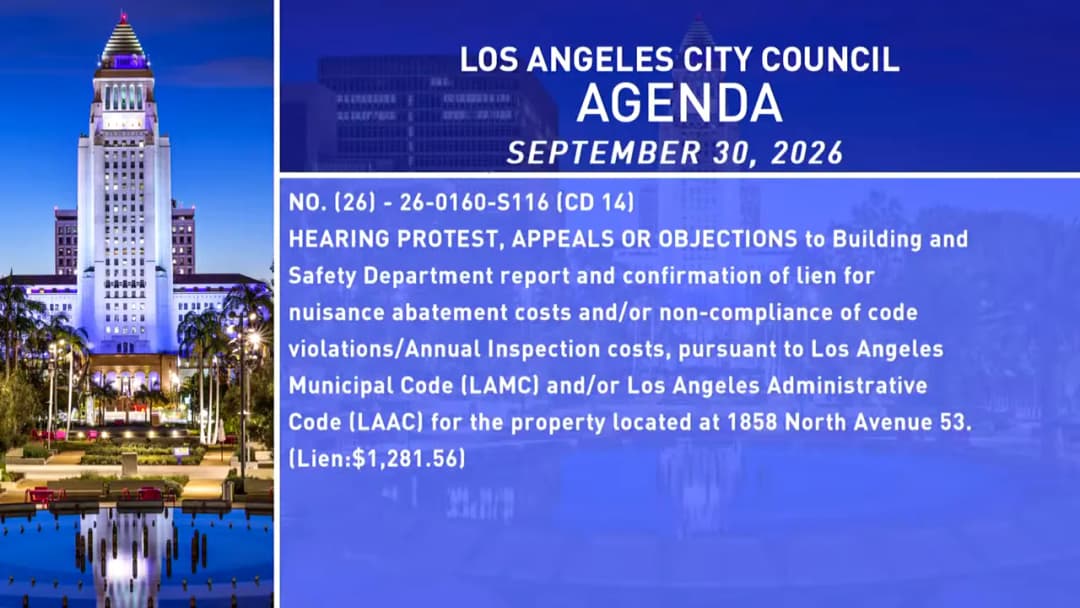
The Public Meeting IndexThe Los Angeles City Council met in regular session on Wednesday, September 30, 2026. Councilmember John Lee convened the meeting; the clerk reported 11 members present and a quorum, although later roll-call votes recorded 14 ayes. Public comment was taken in person and by teleconference, with one-minute-per-item limits and a three-minute total for agenda items under new SP 707 instructions. The agenda and minutes were not available, so this summary is based on the raw transcript. Consent Calendar - Approved the minutes of September 29, 2026, on a motion by Councilmember McCosker and a second by Councilmember Park. - Approved commendatory resolutions on a motion by Councilmember Hernandez and a second by Councilmember Soto-Martinez. - Agreed to the agenda structure: items 1-33 were noticed for public hearing, items 34-64 had hearings held, and items 65-72 required 10 votes because public hearings had not been held. - Adopted the consent package of items 35-61 and 64 with 13 ayes. - Received and filed items 12, 14, 19, and 25 in a 14-0 vote; item 14 was received and filed because it had been paid. - Approved item 3 as amended by amending motion 3A (Park/Nazarian) in a 14-0 vote. - Continued items 1, 4, 5, 16, 21, 26, and 30 to November 18, 2026; item 21 was also called special. Public Comments & Testimony - Item 65: A speaker criticized the continued renewal of the local emergency for the January 2025 Palisades and other fires, saying recovery was too slow and appeared focused on MAGA Olympics rebuilding rather than community rebuilding. - Item 65: Kissud Roha of the Apartment Association of Greater Los Angeles strongly opposed further extending citywide emergency price restrictions without supporting data, noting that Los Angeles County and the state ended their emergency restrictions after 20 months. He urged the council to direct LAHD to report on fire-impacted homeowners renting in multifamily properties or, alternatively, exclude multifamily properties from further extensions. - Item 66: A speaker said the Boyle Heights fire recovery was being handled even worse than the Palisades recovery and questioned whether community demographics affected the response. - Items 68/69: Jacqueline Iniguez of the LA Area Chamber of Commerce supported raising the small business tax exemption threshold from the current $100,000 in gross receipts to at least $500,000. She cited the Office of Finance analysis showing 91,000 businesses generate less than $350 in annual business tax liability and supported a phased approach like the one used in 2004. - Items 68/71/72: A self-employed speaker who described himself as an immigrant and transgender worker supported the small business tax exemption, called for stronger enforcement of workers' rights, including healthcare, overtime, holidays, and weekly hour limits, and supported the unarmed crisis response program while asking that unarmed responders be kept safe. - Item 67: Virtual caller Daniel Gus argued the city cannot stop federal immigration enforcement due to the supremacy clause, criticized the item for having no financial impact statement, and warned the city could lose federal funds under Executive Order 14159. He also called item 65 misleading and item 66 inadequate. - Item 67/general: Photographer Eric supported stronger sanctuary-city preparation, citing Bloomberg Law reporting that the DOJ is seeking military lawyers for an expected prosecution surge and a DHS announcement of a nationwide public safety surge in sanctuary cities. - Items 65/66/68: A caller supported fire-prevention measures and Boyle Heights recovery, backed the small business exemption but with a time limit to prevent manipulation, and urged the city to pursue underground businesses that pay no taxes. - Items 68/69: A caller supported lower taxes to keep businesses in Los Angeles, citing a business owner who moved to Orange, and urged audits of federal and city spending, referencing an arrest for misuse of homeless services funds. - General: Other speakers welcomed Belem Lamas as Chief of Policy for Council District 8/Council President Harris-Dawson, invited the council to the LA Italian Festival, urged denial of a LADBS lien and accountability for delayed appeals, raised unsafe conditions at Glory Homes, requested investigation support in a DCFS/family court case, asked for an audit of LA Animal Services, and thanked councilmembers for work on ranked-choice voting. - General: One virtual caller made offensive remarks during public comment; the Council President apologized, stating the views did not reflect the council, its members, or the city. Discussion Items - Item 34 - Street Sweeping and Parking Enforcement: Councilmember Hernandez urged support for the motion directing the Bureau of Street Services and LA Department of Transportation to report on the disconnect between street sweeping and parking enforcement, modernize constituent notifications, and establish proactive citation refunds. She noted pandemic budget cuts dropped some street-sweeping services while posted signs were never updated. The motion would stop citations when sweeping is canceled or after the sweeper has passed, analyze data on missed routes and disputed tickets, and require reimbursement within 15 days. - Item 67 - Sanctuary City Protections: Councilmember Hernandez urged codifying Mayor Karen Bass' Executive Directive 17, stating no city land should be used for federal immigration enforcement staging, detention, or raid launch pads and no city funds should pay for surveillance of neighbors. She also called for holding contractors who profit from family separation accountable. - Item 72 - Unarmed Crisis Response: Councilmember Hernandez described the directive asking the CAO and CLA to inventory all existing city safety and diversion programs and organize them into three categories: community-based crisis response and mental health services, crime and violence prevention including domestic and gender-based violence, and victim and survivor support. She said the goal is a permanent care-first public safety infrastructure, with a model applying lessons from programs like UMCR and Circle. Key Outcomes - Adopted the public-comment eligible items (2, 6-11, 13, 15, 17, 18, 20, 22-24, 27-29, 31-33, 65, 66, 68, 70, and 71) with 14 ayes. - Adopted items 34, 67, and 72 in a combined 14-0 vote. - Adopted items 62 and 63 in a separate vote, 11 ayes and 3 noes. - Adopted item 69, moving the Budget and Finance Committee report, with 14 ayes. - Approved item 3 as amended and received and filed items 12, 14, 19, and 25, each with 14 ayes. - Ordered item 67 posted and referred after adoption. - Continued multiple items to November 18, 2026, as noted above.
This meeting transcript, though incomplete (no minutes were available), focused on the supplementary budget and community priorities. Two councilmembers spoke about the mayor's proposed budget and a potential cut to the library budget. Discussion Items - A councilmember (unnamed) expressed that they had learned from community members what they truly value, emphasizing that the final budget should reflect those priorities. - Councilmember Ms. Johnson shared similar sentiments, noting she was prepared to discuss the maximum levy in depth. She referenced Councilmember Joseph's earlier point and mentioned a proposal to remove $286,000 from the library budget, stating that while some may applaud that cut, her statement was cut off before elaborating on her position. Key Outcomes - No formal decisions, votes, or next steps were captured in the available transcript.
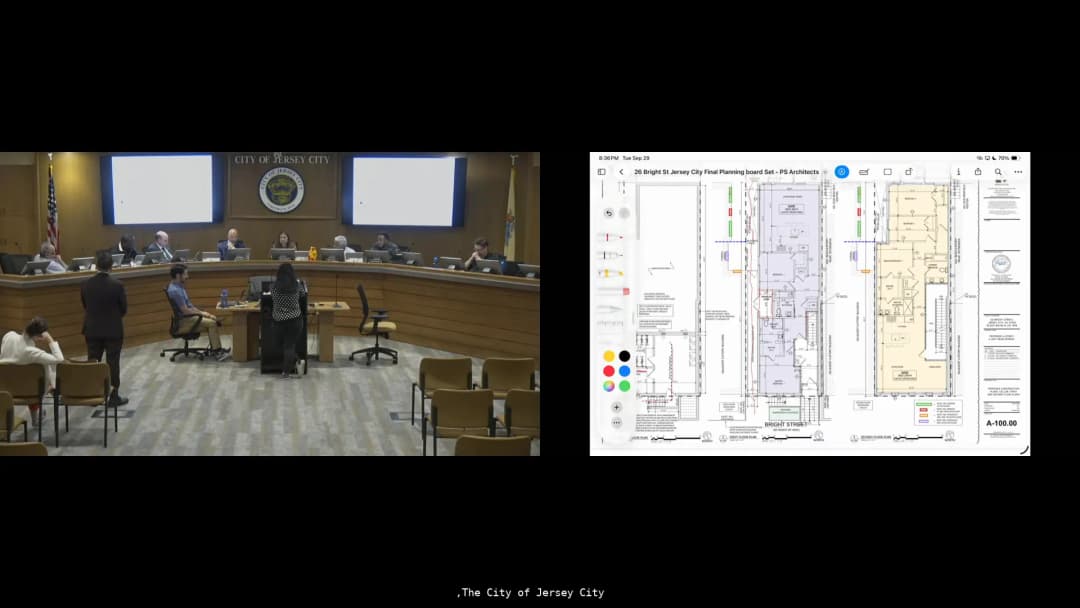
The Jersey City Planning Board convened on Tuesday, September 30, 2026 (noting the transcript indicates the meeting began on September 29, 2026, but the official date provided for this summary is September 30, 2026). The board addressed several agenda items, including two one-year site plan extensions, a contested major site plan with a landscaping variance, approval of the Let's Move JC Transportation Master Plan, a scatter site redevelopment study, and multiple minor and major site plan applications. Six commissioners were present, establishing a quorum. Consent Calendar - Case B2026-0133 (381 Route 440): One-year extension of a preliminary site plan approval for a retail pad on a former bank drive-thru site. Applicant's attorney Tom Lean stated the extension was needed due to completion of a nearby Target building. The board approved the extension unanimously with conditions from the original approval (P23-072). - Case P2026-0100 (535 Monmouth Street): One-year extension of a site plan approval for a 246-unit mixed-use building in Newport. Attorney Ronald Shalgin cited economic conditions. Approved unanimously with conditions from original case P22-030. Public Comments & Testimony - Case P2025-0138 (292 Van Horn Street): Several residents spoke in opposition: Juan Davila (353 & 355 Holiday Street) cited property tax increases, traffic, safety, and neighborhood character; Marie Celestin (daughter of adjacent property owner) feared foundation damage to her mother’s home and parking/traffic impacts; Franny Salcedo (300-302 Van Horn Street) expressed emotional opposition about losing community legacy; Terrain Fillmore (142-144 Maple Street) noted flood zone concerns and incompatibility with existing low-rise homes; Marlin Manegro (296-298 Van Horn Street) read a prepared statement opposing the project’s scale and requesting denial of the C variance; Clarissa Fillmore Brown (142-144 Maple Street) questioned the completeness checklist and compliance with redevelopment plan requirements. - Case B2026-0117 (Scatter Site Study Area 6): Property owners and their counsel objected to inclusion: Tom Lean (for owner of 185 Bidwell Avenue) argued the owners are active developers ready to move forward; Nicholas Carrado (for owner of 358 Central Avenue) said his client was stalled by historic preservation requirements; Jimmy Gindy (owner of 358 Central Avenue) detailed his investment and efforts to demolish an unsafe structure; Charles Kim (97 Charles Street) stated his renovation is 70% complete and requested removal from the plan. - Case B2025-0255 (26 Bright Street): Nicholas Wilk (28 Bright Street, unit 507) expressed support on behalf of the homeowners association after collaborative design changes; Sarah Angelini (28 Bright Street, unit 405) supported the current plans and asked about the construction timeline. - Case P2024-0008 (33 Division Street): Robin Chu (396 7th Street) requested that a high wooden fence be erected during construction to prevent graffiti and encroachment; applicant’s counsel agreed to accommodate the request. Discussion Items - Case P2025-0138 (292 Van Horn Street) – Preliminary & Final Major Site Plan with C Variance: Architect Russell Bond testified that the required 525 sq ft of landscaping could not be fully provided on-site due to a rear easement; they achieved 22.4% of the requirement on-site and proposed additional measures including grass pavers (180 sq ft credited) and a planting bed in the public right-of-way (125 sq ft), bringing the total to 51.5% of the requirement. Applicant argued that reducing parking to meet landscaping would create a parking variance, and the neighborhood preferred maximum parking. Board discussed flood zone compliance (GAR increased from 30 to 44) and safety concerns. Public testimony was strongly opposed. The board voted 5-1 to approve, with Commissioner Conway opposed; a condition was added for the applicant to offer a community meeting prior to construction. - Case B2026-0114 (Certified Artist Designation – Joe Velez): Staff recommended approval based on criteria 1–5. No public comment. Approved unanimously. - Case P2026-0120 (Let's Move JC Transportation Master Plan): Transportation planner Eli Goosman presented a year-long study with extensive public outreach (over 4,000 participants). Key findings: 51% of trips by driving, 49% by other modes; biking tripled since 2019; population projected to grow 25% more over 25 years. Seven “big moves” were identified: Journal Square improvements, expanded greenway network, community rounds/low-traffic neighborhoods, parking system overhaul, policy/governance strategies, bus rapid transit on JFK Boulevard, and redesign of Route 440. Public comment from Jack McKee (Hudson County Complete Streets) supported the plan, emphasizing parking management and regional transit. Staff confirmed alignment with city master plan. Board voted unanimously to recommend approval to City Council (Commissioner Kaplan recused). - Case B2026-0117 (Scatter Site Study Area 6 – Redevelopment Determination): Principal Planner Joseph Penlin presented the study of seven vacant/blighted properties citywide, each meeting at least two of the eight statutory criteria (A, B, D) for an area in need of redevelopment, including condemnation. Properties: 97 Charles Street, 358 Central Avenue, 195 Baldwin Avenue, 221 Olean Avenue, 205 Clinton Avenue, 479 Bramhall Avenue, and 185 Bidwell Avenue. Objections from owners led to testimony about stalled projects and historic preservation conflicts. Staff recommended approval, noting that the City Council will make the final determination. The board voted unanimously to make a favorable recommendation to City Council. - Case B2025-0255 (26 Bright Street) – Minor Site Plan with C Variance: Proposed four-story, four-unit building in Van Vorst Park Historic District, requiring a height variance of 3 ft 11 in (43 ft 11 in proposed vs. 40 ft permitted) due to flood zone elevation requirements (base flood elevation 7 ft; first floor at 12 ft). Architect Prital Shukla testified that the design matches the historic streetscape and received HPC approval. Issues discussed: cellar in flood zone used for storage, utility meters below floodplain (gas meters flagged as potential code issue), trash storage, and secondary egress. Engineer Guy Lagomarsino testified the design meets code. Planner Carolyn Worstell argued the variance meets hardship and positive/negative criteria. Neighbors spoke in support after design modifications. The board approved 5-1 with one abstention (Commissioner Stamato expressed concerns about floodproofing but ultimately voted in favor; the chair noted one abstention). - Case B2024-0198 (300 Central Avenue) – Preliminary & Final Major Site Plan: Proposed two-story addition to existing three-story building, creating 16 one-bedroom units and ground-floor commercial space in the NC zone. No variances requested. Architect Richard Garber presented the design, which preserves historic facade elements. MUA comments and staff conditions were accepted. No public comment. Approved unanimously. - Case B2025-0161 (146 Academy Street) – Preliminary & Final Major Site Plan with C Variances: Proposed four-story, 13-unit building with cellar in the Journal Square redevelopment plan and Palisade Protection Overlay District (Peapod). Variances sought: front yard setback (to match existing retaining wall), height (2.8 ft above 44 ft maximum), and Peapod buffer setback (within 30 ft of cliff face). Engineer Guy Lagomarsino testified the cliff is stable and excavation feasible. Architect Jeffrey Lewis presented plans with a trash chute and direct cellar access to the street (alternate plan with ramp). Planner Carolyn Worstell argued the Peapod variance is minimal due to existing disturbance and topography-driven height. Staff recommended approval. No public comment. Approved unanimously. - Case P2024-0008 (33 Division Street) – Preliminary & Final Major Site Plan with C Variances: Proposed eight-story, 115-unit building with 86 parking spaces (stacker system), 58 bike spaces, and ground-floor retail. Variances: curb cut width (16 ft vs. 14 ft), sixth-floor step-back (0 ft vs. 8 ft), and height (90 ft vs. 88 ft above VFE). Community input led to relocation of garage entrance to Division Street and additional parking. Architect Anthony Vandermark presented a contemporary design. Planner Samuel Bellamy argued benefits outweigh detriments. Public comment from adjacent neighbor Robin Chu requested a construction fence; counsel agreed. Staff recommended approval with conditions including a payment schedule for the $1.68 million park improvement contribution. Approved unanimously. Key Outcomes - Case P2025-0138 (292 Van Horn Street): Approved 5-1 (Commissioner Conway opposed) with conditions; applicant to meet with community prior to construction. - Case B2026-0114 (Certified Artist): Approved unanimously. - Case P2026-0120 (Transportation Master Plan): Approved unanimously (Commissioner Kaplan recused) and recommended to City Council. - Case B2026-0117 (Scatter Site Area 6): Board voted 6-0 to forward a favorable recommendation to City Council. - Case B2025-0255 (26 Bright Street): Approved 5-1 (one abstention) with staff conditions and HPC conditions. - Case B2024-0198 (300 Central Avenue): Approved unanimously. - Case B2025-0161 (146 Academy Street): Approved unanimously. - Case P2024-0008 (33 Division Street): Approved unanimously with conditions including payment schedule for park contribution. - Case B2025-0169 (506 Summit Avenue): Carried to October 13, 2026 with preservation of notice. - Resolutions: 13 resolutions approving prior meeting decisions were adopted unanimously.
The Urban & Economic Development Committee met on Wednesday, September 30, 2026, at One Technology Center in Tulsa. The committee heard a reappointment presentation and held a detailed discussion with department representatives on a proposed ordinance creating an Office of Independent Review and Oversight of Public Safety. No formal votes were taken; a reappointment vote and continued ordinance discussion are scheduled for October 14, 2026. Reappointment to HUD Community Development Committee - Michelle Lara was interviewed for reappointment to the HUD Community Development Committee, with a term expiring June 30, 2027 (agenda item 26-821-1). - Lara shared that she lives in District 3, has experienced housing instability, and went through programs like Habitat for Humanity. She expressed passion for housing issues and noted barriers to engagement, including limited access to meeting information and complex city processes. - Councilors praised her service and discussed bilingual outreach needs, including languages beyond Spanish and English, such as Burmese. The committee indicated the full City Council would vote on her reappointment on October 14 at 5:00 PM. Public Safety Oversight Ordinance - Discussion - Agenda item 26-734-5 is an ordinance adopting a new Title 16, Tulsa Revised Ordinances, titled "Independent Review and Oversight of Public Safety," creating the Office of Independent Review and Oversight of Public Safety (OIR), a Director position, and a civilian oversight board. Councilors Hall-Harper and Decter Wright are listed as sponsors. - Council Administrator Sarah Davis outlined the questions sent to departments: current practices for reviewing employee behavior and processing community concerns; mechanisms for community feedback and policy generation; historical policy improvements; alternative oversight proposals; workforce impacts; and how policy changes are communicated to the public. - Only three of the six listed departments were present: Tulsa Animal Services, Tulsa Fire Department, and Code Enforcement. Police, City Security, Emergency Management, and a nonprofit organization were scheduled for the October 14 morning committee meeting. Tulsa Animal Services Presentation & Discussion - Animal Services leadership (Director Sherry and Colton) and Animal Welfare Commission Chair Dr. Kutzweiler and Commissioner Hall presented. - They described the current employee discipline process: management investigates complaints, HR may be involved, a neutral hearing officer from another department makes recommendations, and employees can appeal to the Civil Service Commission. - Reported outcomes: the animal life-saving rate has risen 17% since 2023 to 83%, above national and state averages; the department received a 2.6 out of 3 maturity score in a City Auditor community engagement study; and programs such as neighbors helping neighbors, school patrols, and affordable vet care are in place. - They estimated 20-30 complaints per year, mostly minor, with investigations ranging from quick conversations to months-long HR cases. - Positions expressed: Animal Services leadership and commission members voiced concern that the proposed OIR duplicates the Animal Welfare Commission's existing advisory and oversight role, adds administrative burden, and could distract from operations. They suggested enhancing the existing commission, adding body cameras for field staff, and call recording for dispatch instead of creating a new layer. - Councilor Decter Wright clarified that the proposal is not intended to oppose or denigrate existing department work. Councilor Dunn said oversight could build resident trust, especially around dog bite enforcement and liability insurance. Councilor Archie raised the need to define commissioner qualifications if the commission takes on more oversight. Tulsa Fire Department Presentation & Discussion - Fire Chief Michael Baker and Chief Carner presented. - They described a personnel performance review system tied to promotion, a new personnel management system developed with Local 176, and a disciplinary process in which the chief is the final decision maker after a pre-action hearing. - Community complaints average about one per month. Policy is organized through administrative operating procedures, emergency operating guidelines, and clinical protocols; a Lexipol software platform is being implemented for more transparent policy access. - The department reported it is nearly fully staffed (3 vacancies out of 730), has improved apparatus reliability through bonding, uses CPAT physical testing, maintains an ISO 1 rating, and received a 94.5% trust rating in the 918 survey. - Positions expressed: Chief Baker said the fire service is generally not included in such oversight models elsewhere, raised concerns about administrative burden and 3-day/10-day response timelines conflicting with 24/48 shift schedules, and noted difficulty filling headquarters positions. He was open to public dashboards and an annual report, but gave a "thumbs to the side" reaction to the OIR proposal. Councilor Archie suggested considering a quarterly public safety committee that includes Fire, Police, Animal Services, and other agencies as an alternative. Code Enforcement Presentation & Discussion - James Wagner, Director of Planning and Neighborhoods, presented in place of Code Enforcement Director Brant. - He described the city's 11 work rules, respectful workplace policy, HR investigations for discrimination complaints, neutral hearing officer process, and appeal to the Civil Service Commission. - Community feedback mechanisms include 311, the ethics hotline, the mayor's email, the public advocate, and town halls. Feedback led to courtesy notices on summary abatement and a "two-customer" approach that proactively contacts property owners. - Code Enforcement officers have the option to wear ballistic vests; no annual report is currently produced. - Wagner stated that most OIR triggers would likely not apply to Code Enforcement, and he gave a positive reaction to the proposal, calling it "useful, helpful, additive." Councilor Dunn advocated for a cohesive cross-department dashboard to track interactions among Code Enforcement, TPD, and Animal Services. Key Outcomes - No votes were taken on the public safety oversight ordinance during this meeting. - The committee will continue discussions on October 14, 2026, with Police, City Security, Emergency Management, and a nonprofit organization scheduled to appear. - Michelle Lara's reappointment to the HUD Community Development Committee will be voted on by the full City Council on October 14, 2026. - The proposed ordinance remains on the council calendar for October 14, 2026.
On Wednesday, September 30, 2026, at 10:00 AM in Council Chambers at the 510 City-County Building, Pittsburgh City Council convened its Standing Committees meeting. The official minutes record seven members present (Wilson, Salinetro, Charland, Warwick, Lavelle, Strassburger, and Mosley) and two absent (Coghill and Gross); the raw transcript states "five members present" during roll call, a minor discrepancy with the minutes. The agenda covered the Finance and Law, Public Works and Infrastructure, Land Use and Economic Development, Innovation, Performance, Asset Management, and Technology, and Intergovernmental and Educational Affairs committees, with most items receiving affirmative recommendations. Public Comments & Testimony - Matthew W. King, a Dormont resident, asked Council to examine his record involving two police encounters (an off-duty Leedsdale Borough officer on October 29, 2024, and Dormont officers on June 9, 2026) that led to charges against him. He stated that neither he nor his attorneys received Pittsburgh police body-worn camera footage despite requests, and he asked that the matter be brought before the Public Safety and Wellness Committee, including a post-agenda meeting. - Dr. Ronald Lynn Miller (Hayes neighborhood) advocated for locating a proposed Quantum Computation, Supercomputation, and Superhuman Intelligence Information Optimization Center and Factory in Hayes, asserting Hayes is "decimated economically" and Oakland Central does not need it. He criticized Carnegie Mellon University President Farnam Jahanian's diversity record, citing an undergraduate population of 5% people of African descent and 30% Asian as an "undergraduate body distortion." - Carleno Giampolo (Panther Hollow) called on Mayor Corey O'Connor to shut down the "illegal Oakland Do-It-Yourself skate park," saying the Mayor's inaction makes him appear to protect wrongdoing. He also asked Council to ban cell phone use during public comment, criticizing Council Members Warwick and Charland for scrolling on their phones while residents speak. - Rafiq Brookins presented "Project Prosper," a proposed $200 million philanthropic-public collaboration to create two companies (Hypernova Energy Systems and Luminara Biofusion Technologies, approximately $90 million each). He projected that at $1 billion valuations, the foundations and the City would each hold approximately $200 million in equity; at $10 billion valuations, approximately $2 billion each; and at $100 billion valuations, $20 billion each. - Unique Brown criticized Council's response to her homelessness and domestic violence situation, stating she was treated differently from another woman who received a resource packet and staff attention. She said she has lawsuits pending and reported that her email was hacked after she confronted Council. - Yvonne F. Brown (715 Mercer Street) requested a letter from the Council President documenting her efforts to obtain bus service and security for her neighborhood. She criticized Allegheny County Councilman DeWitt Walton for saying community members could not tell him what they need, and referenced the legacy of the late K. Leroy Irvis. - Special Agent Sunshine delivered a faith-based testimony accusing Council members of "stealing from the poor," forcing homelessness, and putting "hits" out on her; she demanded answers about her identity, power of attorney, and the budget deficit. - Chief Ikhana hal-makina (joining online), of the Grand Evil to Eric Law Confederacy of Aboriginal American People, said Brown people in Pittsburgh have been "ostracized, marginalized," and called on Council, the Mayor, federal partners, and the Governor to better represent their constituencies. He cited the Christopher Columbus statue and hate leaflets in Edgewood and Regent Square, and declared, "We will not be intimidated." - Several registered speakers (Paul Canani, Kit Knight, David Fisher) were called but were not present to speak. Finance and Law Committee - 2026-0847 (Vibrant Pittsburgh membership dues, not to exceed $50,000): Held in committee for three weeks, due back October 21, 2026. Council Member Strassburger requested the hold so briefings with Vibrant Pittsburgh could be scheduled, allowing members to ask questions and make an informed vote. - 2026-0039 (Referendum on amending the Pittsburgh Home Rule Charter budget approval rules): Held in committee for four weeks, due back October 28, 2026. - 2026-0895 (Claim settlement for Jerald S. Foresman, $6,197.48 for damage to his parked vehicle from a City ES vehicle on December 2, 2025): Affirmatively recommended. - 2026-0896 (Claim settlement for Sage Melody Grodin, $3,726.40 for damage to her parked vehicle from felled branches of a City right-of-way tree on June 25 or 26, 2026): Affirmatively recommended. - Invoices: Approved, covering departmental expenditures including community sponsorships (e.g., Hazelwood Initiative, Hilltop Alliance, Knoxville Community Council), technology services (Crayon Software Experts LLC), police, fire, and EMS supplies, Parks & Recreation programs, and Mobility & Infrastructure equipment. - P-Card Approvals (Item 0034-2026): Approved. Public Works and Infrastructure Committee - 2026-0920 (License agreement with the Buncher Company for temporary placement of City vehicles at Block and Lot 25-L-26 in the 6th Ward, at no cost to the City, to allow resurfacing at the Environmental Services Center at 3001 Railroad Street): Affirmatively recommended. - 2026-0921 (License agreement with Friends of South Side Park to plant native trees, shrubs, and herbaceous perennials, contingent on the group receiving a USDA grant, at no cost to the City): Affirmatively recommended. - 2026-0893 (Swindell Bridge project temporary construction easements, aerial easements, and permanent right-of-way acquisitions in the 26th Ward, not to exceed $90,000, reimbursable at 95%): Affirmatively recommended. - 2026-0894 (Close-out of a Department of Conservation and Natural Resources Community Conservation Partnerships Program grant agreement for the Trail Maintenance Master Plan, at no cost to the City): Affirmatively recommended. Land Use and Economic Development Committee - 2026-0714 (Zoning amendment adding a new subsection to Multi-Suite Residential (General) use standards in the UC-E District, sponsored by Council Member Lavelle): Held for a Cablecast Public Hearing, following a Planning Commission report received September 25, 2026. Innovation, Performance, Asset Management, and Technology Committee - 2026-0891 (Agreement with ePlus Technology, Inc. for firewall upgrade professional services, not to exceed $47,800 over one year): Affirmatively recommended. Intergovernmental and Educational Affairs Committee - 2026-0892 (Plan Revision to the City's Official Sewage Facilities Plan for 929 Liberty Avenue, at no cost to the City): Affirmatively recommended. Key Outcomes - All resolutions receiving affirmative recommendations will advance to the full Council; the Vibrant Pittsburgh dues resolution and the Charter referendum were held for further briefings, and the UC-E zoning amendment was held for a public hearing. - Pre-agenda interviews for the Housing Opportunity Fund Advisory Board were announced for 1:30 PM that afternoon. - The next regular Council meeting is Tuesday, October 6, 2026, and the next Standing Committees meeting is Wednesday, October 7, 2026, both at 10:00 AM; speaker registration closes at 9:00 AM on each day. - A motion to excuse the absent members, approve the minutes, and adjourn carried.
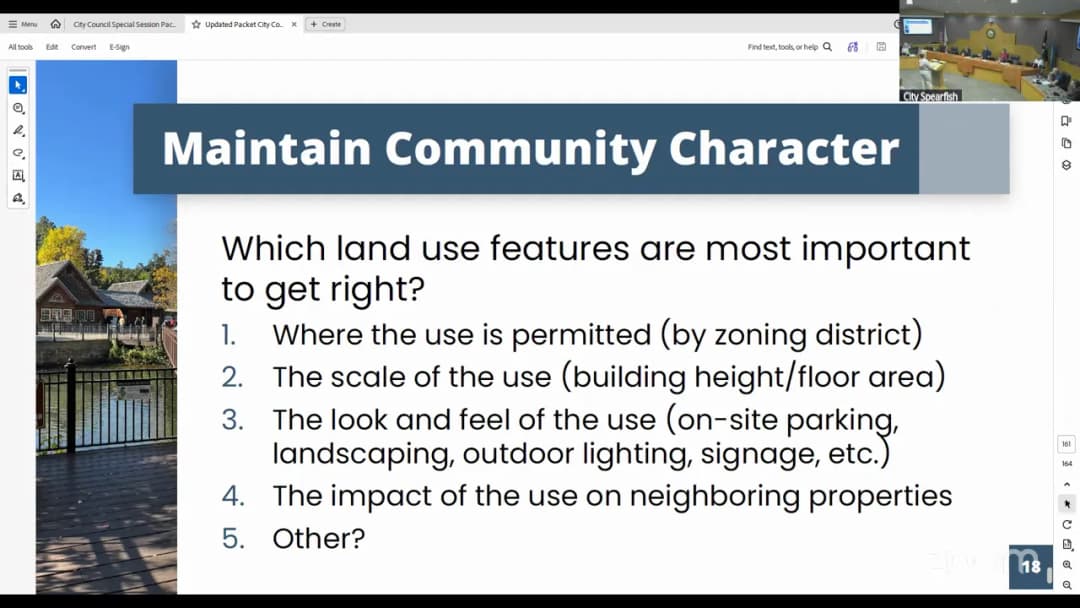
The Spearfish City Council met in study session on September 30, 2026, at 4:23 p.m. The meeting focused on a presentation from Clarion Associates regarding the Shape Spearfish Unified Development Code (UDC) rewrite, a review of the upcoming October 5, 2026 regular council agenda, and departmental updates on public works, planning, and police staffing. No public comments were received. The council approved the study session agenda and later adjourned at 5:07 p.m. Review of October 5, 2026 City Council Regular Session Agenda - Staff and council reviewed each item on the draft agenda for the regular meeting. Key items included: an amendment to the development agreement with Hillsview Homes to reduce the required financial assurance from $600,000 to $450,000; donation of a 2002 Spartan Type 1 fire truck to the NEMO Fire Department; a public hearing and renewal of the cannabis establishment license for Genesis Farms through 2027; two state grant agreements for the airport apron expansion project, with a state contribution of approximately $130,000; a special event on-sale wine license for the Friends of Music Fundraiser; the second reading of an ordinance to amend the budget for camera systems at the rec center, police department, and city hall, and library furniture; a proposed agreement with Beetle Electric for electrical service at the sawmill development; a proposal from Eden Hunt for construction staking, materials testing, and construction administration for the airport apron project for $610,000; and a certificate of final completion for the Spearfish Creek Bank Stabilization project. The meeting will also include an executive session on electronic and cybersecurity data. Shape Spearfish Unified Development Code Presentation - Assistant Planning Director Ecker introduced Elizabeth Garvin, AICP, ESQ, and Maggie Squyer, AICP, from Clarion Associates. Squyer, the project manager, presented the purpose, timeline, and community engagement plan for the 18-month UDC rewrite, which aims to implement the Adventure Ahead Comprehensive Plan by creating and updating land development regulations. The project will revise chapters on mobile and manufactured homes, subdivisions, trees and landscaping, and zoning. - The project has four key objectives: implement adopted plans, clarify development review processes, establish regulations supporting well-managed growth, and create a user-friendly code. It is divided into three phases: technical drafting (August 2026 – March 2027), public review (April – September 2027), and adoption (October 2027 – January 2028). - Community participation opportunities include public open houses, an online survey, staff-led office hours, a project advisory board (20 members from various stakeholder groups), and public hearings. The first advisory board meeting occurred earlier that day, covering topics such as agricultural conservation, housing affordability, infrastructure costs, downtown vibrancy, and process improvements. - Garvin and Squyer solicited council input on land use priorities. Council member Hafner emphasized the importance of maintaining neighborhood consistency and character, citing Eastide Acres as a model for mixed-use development that transitions from light commercial to multifamily to single-family. He expressed support for the Development Review Mixed (DRM) zoning district. - Future council presentations are planned approximately every six to eight weeks during the first phase, with two in the second phase and one in the third. Departmental Discussion - Public Works Director McMahon announced that the downtown mill and overlay project is on schedule and nearing completion with pavement marking. - Assistant Planning Director Ecker noted a recent vacancy on the Planning Commission and encouraged interested individuals to apply. - Police Chief Smith provided a detailed briefing on staffing challenges. The department is currently down eight officers, soon to be nine, due to high hiring standards and difficulty finding qualified applicants. He emphasized that the department will not lower its standards, as rigorous background checks have washed out three applicants in the last 72 hours. Officers are working significant overtime, and the department has handled 11 emergency mental health committals in the past four weeks, one requiring 329 consecutive officer hours. Smith asked for patience and highlighted that two applicants are currently in the background process (down from five earlier in the week). Council member Jacobs praised the department's performance and expressed no complaints. - City Administrator Wysocki reminded council of the upcoming Planning Commission meeting on October 6, 2026, to review a conditional use permit for a used car lot at Grant and Main. He also noted that a working group of city, county, and community members will meet on October 2, 2026, to begin updating the Extraterritorial Jurisdiction (ETJ) ordinance. Wysocki thanked Ecker, Mathis, and Spiering for their extra work on the UDC. Key Outcomes - The council approved the study session agenda and adjourned with no other formal votes. The UDC presentation was informational, with future presentations scheduled to provide guidance and policy interpretation. The next regular City Council meeting is set for October 5, 2026, where the reviewed agenda items will be considered for action.
The CHESS (Community Development, Housing, Education, Social Services, State & Commerce) Committee met on Wednesday, September 30, 2026, at 6:31 p.m. in the Republican Caucus Room and via Zoom. Co-Chairs Maureen Pollack and Stephanie Sylvestre presided. The meeting focused on two agenda items: a review of Stamford's non-compliance with CDBG expenditure requirements and an ordinance amendment for the Affordable Housing Trust Fund. Discussion Items - CDBG Non-Compliance (Item CHESS32.021): The committee continued its review from the prior meeting. Anita Carpenter clarified that the Law Department was not sitting on 52 contracts; rather, the Grants Department was awaiting a template. Anthony Romano, Director of Administration, reported that process issues (submission, tracking, assignment, communication) had been identified and a clearer process established. Moira Sawch announced that HUD approved the City's workout plan on September 21, 2026, and the PY52 funding agreement was received the next day. She stated that public service agreements for PY50 and PY51 were substantially completed, and a template for public infrastructure agreements had been approved that afternoon. The committee asked about the annual grant cycle, reimbursement processes, and accumulated unspent balances. No vote was taken on this item. - Affordable Housing Trust Fund Ordinance (Item CHESS32.024): President Ramya Shaw introduced the proposed ordinance changes. Ralph Blessing and Emily Gordon provided background. Key proposed changes included: reducing the number of trustees from 7 to 5, adding 3 alternates, changing ex-officio membership (removing Land Use Bureau Chief, Zoning Board Chair, Director of Social Services, and Board of Finance member; adding a Planning Board member), broadening qualifications for public members (removing requirement to live in affordable housing), reducing the quorum from 5 to 3, and increasing the threshold requiring Board of Representatives review from $100,000 to $1 million. Discussion covered tenant representation, conflicts of interest, land acquisition, and the $1 million threshold. An amendment was made to change "the Board" to "the Board of Trustees" on page 4, section 2. Key Outcomes - Amendment Vote: A motion to amend page 4, section 2 by substituting "the Board of Trustees" for "the Board" passed 8-0-0 (Pollack, Sylvestre, Gross, McKeown, Price, Walston, Wirz, Yeager in favor). - Ordinance Approval: A motion to approve the ordinance for publication as amended (including the substitution of the draft with all highlighted changes and the evening's amendment) passed 7-0-1 (Pollack, Sylvestre, Gross, McKeown, Price, Wirz, Yeager in favor; Walston abstained). Rep. Walston stated she would abstain until she received answers to additional questions. Rep. de la Cruz asked about legal review; it was noted that the draft had been reviewed by the Law Department and the email response would be added to the record, though the amendment made that evening had not been part of that prior review. - The meeting was adjourned at 8:33 p.m.
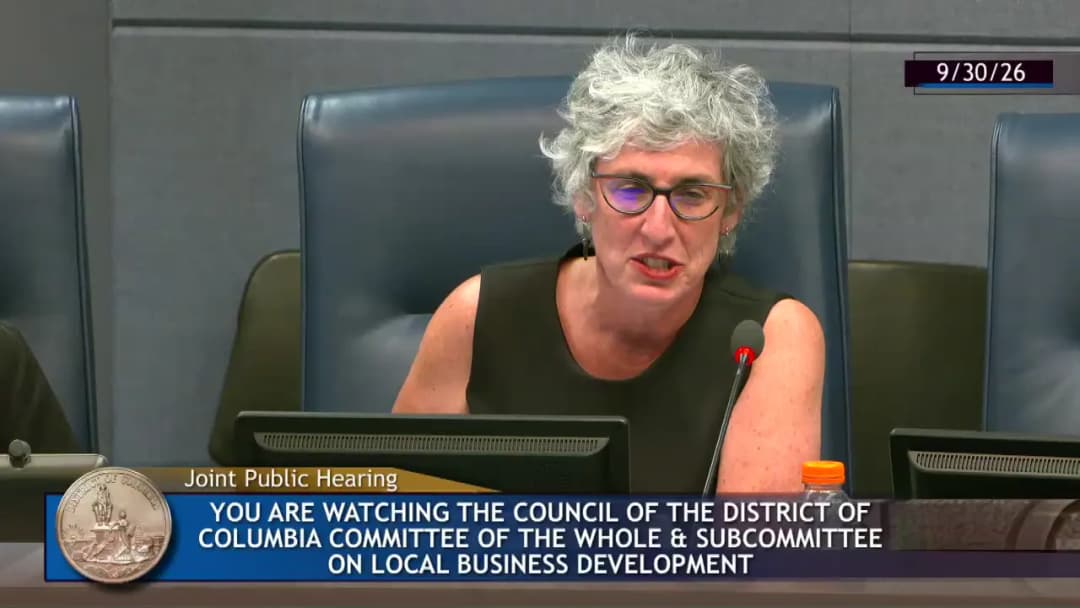
The Committee of the Whole of the Council of the District of Columbia, jointly with the Subcommittee on Local Business Development, held a public hearing on September 30, 2026, to receive testimony on the Robert F. Kennedy Memorial Stadium Campus Master Plan, Small Area Plan, and related amendments to the District's Comprehensive Plan Future Land Use Map. The hearing was chaired by Council Chair Phil Mendelson and co-chaired by Councilmember Wendell Felder. Sixty-seven witnesses registered to testify, addressing a wide range of concerns including parking garages, energy generation, transportation, housing affordability, displacement, and recreational facilities. The record remained open until October 14, 2026. Public Comments & Testimony - Energy and Fossil Fuels: Multiple witnesses, including Mark Rodifer (Sierra Club), Barbara Briggs (Friends Meeting of Washington), Matthew Gravat, Carol Spring, and others urged the council to explicitly prohibit combustion of fossil fuels on the RFK campus, citing DC laws (Clean Energy DC Act, Greener Government Buildings Act) and public health impacts. They expressed concern about a potential gas-fired combined heat and power plant, arguing it would violate existing laws and harm air quality, especially in Wards 7 and 8 which already have high asthma rates. Some called for battery storage and geothermal alternatives. - Parking Garages: A central theme was opposition to the massive G2 parking garage (3,600 spaces, 110 feet tall) in Kingman Commons. Witnesses from Kingman Park Civic Association (Alexis Pasmino, Ebony Payne), Committee of 100 (Laura Richards, Shelley Rep), and others argued that the garage is too large, too close to the neighborhood, lacks ground-floor retail, and should be moved or reduced. They proposed swapping G2 with G1 (located near the riverfront) or reducing parking counts. Testimony noted that eight thousand total parking spaces are planned, with only 6,000 in structures but the legislation allows up to 8,000. Councilmember Allen emphasized that the garages are five times larger than the structured parking at Nationals Park. - Displacement and Neighborhood Protections: Laura Richards and other witnesses called for concrete anti-displacement measures, including prohibiting eminent domain in surrounding census tracts and providing property tax relief for long-term homeowners. The master plan’s language on displacement was criticized as weak. - Transportation and Transit: Many witnesses supported the Gold Line Bus Rapid Transit but criticized the plan’s reliance on cars. Suggestions included an infill Metro station near Oklahoma Avenue, a transit plaza close to the stadium, and dedicated bus lanes. Some questioned the feasibility of center-running bus lanes on H Street. - Recreation and Pickleball: Representatives from DC Pickleball League (Maya Ben David, Eileen Doherty, Jesse Abraham) requested at least 24 dedicated pickleball courts with lighting and indoor capacity, noting that only four courts are currently shown in renderings. They highlighted the sport's rapid growth and community benefits. - Housing and Affordability: Witnesses emphasized the need for homeownership opportunities, mixed-income housing, and timely delivery of affordable units. Commissioner Alfred Swales (Black Business Task Force) called for binding requirements for local hiring and retail space for black-owned businesses. - Other Topics: Testimony also addressed the need for a veteran service center (Lenetia Shelton), universal design for hearing accessibility (Neil Snyder), preserving the Langston Golf Course (Vincent Orange), and the potential use of the DC Armory for a sportsplex and community uses (Dennis Chestnut, Ebony Payne). Discussion Items - Government Presentation: Brian Hanlon (Director, Department of Buildings and RFK Project Management Office) and Anita Cozart (Director, Office of Planning) presented the master plan. They noted over 30 community engagement events, 3,100 comments from 1,200 participants, and revisions based on feedback. The plan envisions six districts: Stadium, Plaza, Riverfront, Kingman Commons, Recreation, and Anacostia Commons. It includes up to 6,500 new homes (30% affordable), 30% open space, an expanded stadium, and new transportation connections. Key design guidelines address building heights (up to 130 feet in Riverfront), parking garages, and sustainability. - Parking Garage Debate: Councilmembers questioned the location and size of G2. Officials cited vehicular flow studies, utility constraints (Metro tunnel), and cost as reasons for the current placement. They stated that underground parking is not feasible due to the water table and WMATA infrastructure, and that ground-floor retail could be added through future zoning but not immediately due to legal exemptions. Councilmembers expressed frustration with inflexibility. - Energy Master Plan: Mr. Hanlon confirmed that an energy master plan contract was awarded about four weeks ago to SETI Engineers and is underway. The study will evaluate all options (solar, geothermal, battery storage, gas) and is expected to conclude with an RFP for an energy developer in late 2026. He stated that PEPCO can supply baseline electricity but that redundancy for NFL requirements (likely a redundant feed) is needed, possibly by 2030. Exemptions from the Green Building Advisory Committee may be sought, but no timeline was given. Councilmembers pressed for transparency and noted that a 26 MW peak demand for the stadium seemed high compared to other new NFL stadiums (10-12 MW). - Transit and Housing Timelines: The plan incorporates the Gold Line BRT and stadium armory metro expansion, but an infill metro station was deemed not feasible. Housing delivery: the commanders must meet development milestones starting three years after zoning is effective (estimated 2028), meaning housing likely won’t appear until 2031-2035. The district-owned Kingman Commons parcel has no set timeline. Councilmembers expressed concern about the gap between stadium opening (2030) and housing delivery. - Floodplain and Environmental: Mr. Hanlon acknowledged the riverfront district lies in a 100-year floodplain and that fill will be used to elevate buildings, but promised no increased flood risk. Several witnesses urged a full-site stormwater management plan. Key Outcomes - No votes were taken; the hearing was for public testimony and council discussion. - The record remains open until 5 p.m. on October 14, 2026. Written comments will be accepted. - Councilmembers indicated they would consider amendments to the Comprehensive Plan and the Small Area Plan resolution. Key areas for potential action include: limiting fossil fuel combustion on site, reducing parking garage sizes, improving transit connections, and strengthening displacement protections. - The council expects to receive the executed energy master plan contract and the parking garage lease from the administration. - Further hearings may be scheduled before a final vote on the master plan and land use map amendments later in fall 2026.
The meeting on September 30, 2026, had no available agenda or minutes. The only transcription provided was a brief technical comment: I'm just gonna talk here real quick and then I'll cut off and see if it picks up and then see how we switch it out. No substantive discussion, testimony, or decisions were recorded. It is unclear if the meeting formally convened or if this was a test recording.