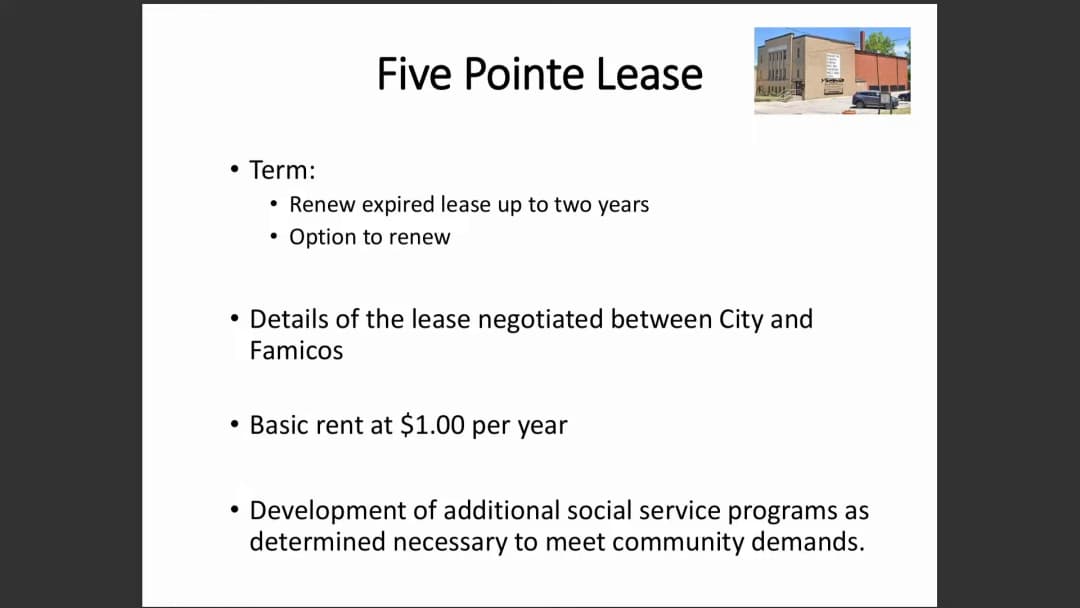
The Cleveland Development Planning and Sustainability Committee met on Tuesday, September 29, 2026, and approved three ordinances: a $1-per-year lease renewal with Famicos Foundation for a Collinwood social services facility, a street vacation enabling industrial redevelopment of about 30 acres near Cleveland Hopkins International Airport, and a land exchange with the Cleveland Metropolitan School District (CMSD) involving a health center and two former schools. Ordinance 1031-2026 was deferred to the following Tuesday. Famicos Foundation Lease Renewal — Ordinance 1034-2026 - The city owns a building on East 152nd Street in Collinwood (between I-90 and St. Clair Avenue) plus an adjacent parking lot; the building features artwork by renowned national artists and houses eight Famicos Foundation programs, including senior programs, meal programs, children's programs, and Kindred Health Care for seniors. - With the prior lease expired, the Department of Community Development proposed a $1-per-year lease so Famicos can continue existing programs and expand them as community needs arise. - John Analifo, Director of Famicos Foundation, said the building serves as his satellite office for "residential first" services in Collingwood. - The administration confirmed the city owns the building, has repair dollars budgeted, and that the lease would not block future city investment; the building is one of two community development-owned buildings the city hopes to add to the capital improvement plan. - The ward's councilman, Councilman Polencick, expressed support for the lease. Street Vacation for Airport-Area Industrial Site — Ordinance 921-2026 - Ordinance 921-2026, sponsored by Councilmembers Slife, Bishop, Santana, and Griffin, vacates portions of Forestwood Avenue SW, Midville Avenue SW, West 185th Street, West 188th Street, and West 190th Street on roughly 30 acres of city-owned vacant land north of Cleveland Hopkins International Airport and west of Rocky River Drive. - In the early 1990s, a couple hundred homes and thousands of residents were relocated from the area for noise abatement under federal decibel rules governing proximity to airplane flight paths. Councilman Jones recalled the relocation vote as contentious during Mayor Mike White's administration and asked for follow-up records on the number of homes removed and federal funds used; the director said the information could be retrieved. - David Lucas, Director of Business Growth, said the street vacation advances legal assembly of the site for industrial redevelopment under semi-industrial zoning, targeting high job density uses such as advanced manufacturing. He called the site one of the city's most attractive future industrial development sites, cited nearby industrial users including Cisco and an aviation company on Cleveland Parkway, and noted that development rights had been granted to Chelm Properties in the early 2000s without further development after the initial phase. - The director explained the historical relocation involved residents, not industrial uses, so industrial development would remain compatible even if a future runway were ever planned. - An amendment was accepted that corrected the legal description (striking language about Midville Avenue SW and inserting language concerning West 188th Street, Elmwood Avenue, and a portion of Midville Avenue SW in the Conger Helper Realty Companies Home Gardens Allotment plat) and added a paragraph allowing release or relocation of utility easements no longer needed, subject to Section 129.20 of the Codified Ordinances of Cleveland. Land Exchange with Cleveland Metropolitan School District — Ordinance 927-2026 - Ordinance 927-2026, sponsored by Councilmembers Camwell, Santana, Polencick, and Griffin, authorizes the directors of public health, development, and public safety to exchange properties with the CMSD Board of Education, as permitted by the Ohio Revised Code. - The city will transfer to CMSD the J. Glenn Smith House Center at 1110 St. Clair Avenue for the new Glenville High School, two land bank parcels near the new high school site, and a land bank lot near Dallas and Dennison Elementary School. CMSD will transfer to the city the former Walton School at 3409 Walton Avenue — to become a future fire station replacing Fire Station 24, which is too small and lacks parking — and the former Newton D. Baker School for future redevelopment. - The J. Glenn site adjoins the current Glenville High School and Forest Hills Park. The city is not transferring any parkland; CMSD already owns the parking area east of the site, and a sewer district facility and houses sit to the south. A master plan under an MOU envisions a new high school plus a companion YMCA. - Dr. Margolius is working with Metro Health (which shares the J. Glenn building) to secure a replacement health services location; Councilmembers Camwell and Polencick stated there must be a replacement site. - CMSD will demolish J. Glenn, with the city paying its share; the city previously obtained better demolition pricing by bundling buildings at the JFK High School site. - Walton School has been closed about five years (predating the Building Brighter Futures program) and is in poor condition. Newton D. Baker School has been closed for several years, is in poor condition, has a fence, and has experienced a few attempted break-ins. Councilman Slife noted he attended Newton D. Baker when it opened in 1978. - The city is responsible for demolishing both schools, with combined costs estimated at $1.3–1.5 million. The administration is applying to the county land bank for state grant funds, with the city providing a match: bond-eligible Capital Plan funds for Walton, and Department of Development funds for Newton D. Baker. - Demolition of Walton and Newton D. Baker is targeted for next year, pending capital plan approval and grant awards (the application is about two weeks away). For J. Glenn and the current Glenville High School, CMSD would begin abatement after the school year ends in June, with demolition in late fall. - The Walton fire station rebuild is not among the first priorities; the Fire and EMS Modernization Plan, to be presented at the Safety Committee meeting the next day, will rank station improvements and rebuilds by need. - CMSD's Board of Education has already approved the land swap. The new Glenville High School budget and footprint were not available at the meeting, though the project is approved by the Ohio Facilities Construction Commission (OFCC). - Future use of the Newton D. Baker site would be determined through a community process with Councilman Slife; residential development is one possibility given the surrounding residential area. Key Outcomes - Ordinance 1034-2026 was approved without objection. - Ordinance 921-2026 was approved without objection, as amended. - Ordinance 927-2026 was approved without objection. - Ordinance 1031-2026 was deferred to the next Tuesday's meeting; the chair stated that many council members did not understand the funding source for the measure.
The Public Meeting Index
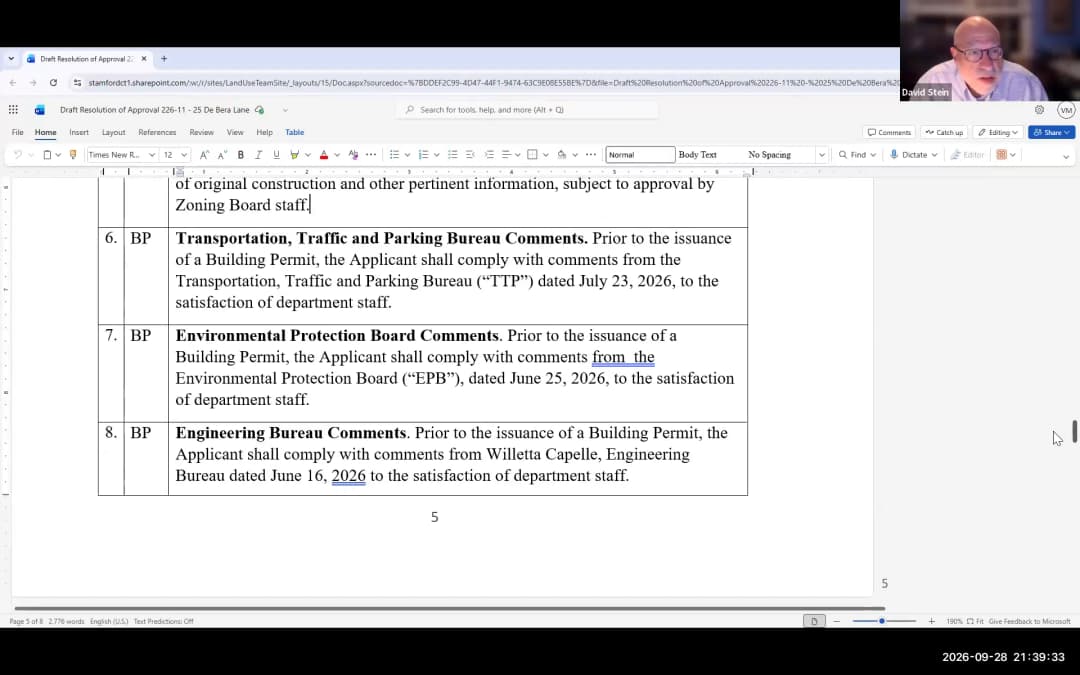
The Public Meeting IndexThe Stamford Zoning Board convened for a public hearing followed by a regular meeting on September 29, 2026 (the transcript states the meeting date as September 28, 2026). The public hearing focused on three major city-wide zoning text and map changes aimed at improving urban design standards and simplifying the city's 48 zoning districts. The regular meeting included approvals for a major hospital expansion, a historic preservation project, and individual site modifications. Public Comments & Testimony - Ray Mazio (speaking on behalf of property owner Regency, regarding the BD to CN rezone of the Newfield Green Shopping Center): Expressed general support for the change but noted the new CN regulations would introduce non-conformities for the existing site. Requested that appropriate flexibilities for non-conforming sites be maintained. Discussion Items - Zoning Modernization Efforts (Public Hearing): - CN District Update (226-16): Land Use Bureau Chief Ralph Blessing detailed proposed changes to the Neighborhood Commercial district, including incentives for mixed-use development, new architectural design standards, a lowered threshold for zoning board review, and enhanced setbacks and screening for abutting single-family districts. Board members praised the work. - ML District Update (226-20): A proposal to align the structure of the Light Industrial regulations with other districts, add protections for abutting residential uses, and establish urban design standards. The application was continued to allow for further public review. - BD District Elimination (226-21 & 226-22): A proposal to rezone the city's sole BD (Design Business) district, located at the Newfield Green Shopping Center, to CN and delete the BD regulations entirely. Blessing noted this would reduce the number of zoning districts and add design controls to the site. - Major Project Reviews (Regular Meeting): - Stamford Hospital Expansion (226-17 & 226-18): The board discussed a map change from VC to HCD and a General Development Plan for a new medical building, parking garage, and surface parking. Key debate centered on the temporary status of surface parking closest to the street (to be discontinued six months after the cancer center parking garage CO or March 31, 2030) and conditions for a Transportation Demand Management (TDM) plan to decrease single-occupancy vehicle use. - Historic Preservation (226-11): A review of conditions for a project at 25 de Burle Lane to preserve portions of an existing house and construct two townhomes, including requirements for a preservation bond, easement, and historic plaque. - Pacific Street Rezoning (226-12 & 226-13): Discussion on the map change to VC2 and the designation of a segment of Pacific Street as a commercial street. Staff clarified the impact on state law parking exemptions for sites smaller than one acre. - Administrative Matters: - Deer Fence Modification: A request for an eight-foot fence in lieu of the standard six-foot height at 57 Chesterfield Road due to deer issues. No formal notification of neighbors had been made, but the owner reported neighbor support. - Pickleball Courts: An administrative modification for four new pickleball courts with sound attenuation fencing at the Rock Room and Country Club. Key Outcomes Public Hearing: - Application 226-16 (CN Text Change): Public hearing closed. No vote taken. - Application 226-20 (ML Text Change): Continued to the next meeting on October 19, 2026. - Applications 226-21 & 226-22 (BD District Map and Text Change): Public hearing closed. No vote taken. Regular Meeting: - Minutes Approval: Minutes from September 14, 2026, approved. - CSPR 1238 (16 Fairview Ave, Patio and Spa): Approved unanimously. - CSPR 1239 (279 Stamford Ave, Interior Renovation): Approved unanimously. - Application 226-17 (Hospital Map Change): Approved unanimously. - Application 226-18 (Hospital GDP & Special Permit): Approved unanimously with conditions. - Application 226-11 (25 de Burle Lane Townhomes): Approved unanimously with conditions. - Application 226-12 (Pacific Street Map Change): Approved unanimously. - Application 226-13 (Pacific Street Text Change): Approved unanimously. - Escrow Agreement (St. John's Towers): Approved unanimously, subject to staff finalization. - Administrative Modification (Rock Room Pickleball Courts): Approved unanimously. - Deer Fence (57 Chesterfield Road): Approved unanimously. Next Steps - The next regular meeting was scheduled for October 19, 2026, and will include the continued hearing on the ML district, as well as further text changes for the CD, MD, and CS districts, and a McDonald's drive-through proposal.
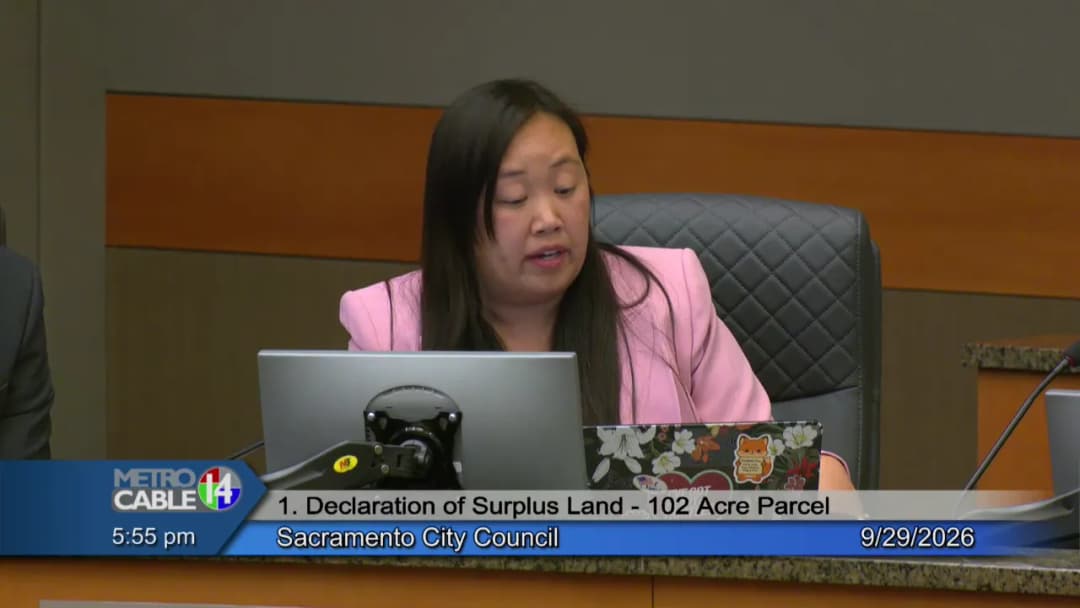
The Sacramento City Council held a regular meeting on Tuesday, September 29, 2026, from 5:04 p.m. to 6:29 p.m. at City Hall. The primary action was the unanimous declaration of a city-owned 102-acre parcel at 3100 Meadowview Road as surplus land under the California Surplus Land Act, initiating a 60-day notice of availability and subsequent negotiation process. The meeting also included a special presentation honoring community leader Señora Angelbertha Cobb on her 95th birthday. No consent calendar items were considered. Special Presentation / General Communications - Mayor Pro Tem Guerra presented a proclamation declaring October 10, 2026 as Señora Angelbertha Cobb Day in Sacramento, recognizing her decades of cultural and educational leadership, including founding danza groups and co-founding D-Q University. Her son thanked the council on behalf of the family. Public Comments & Testimony - Carisha Calvin (District 8 resident, Cabrilla Park Neighborhood Association president) asked for guarantees that community priorities (recreation, housing, open space) would be enforceable in future negotiations, stating "listening alone is not protection." - Silverio Rizzo (102 Acres Advisory Committee member, Detroit neighborhood resident) expressed support for declaring surplus land but with two reservations: mixed-use transit-oriented development (due to proximity to Morrison Creek Light Rail) and inclusion of open/recreational spaces (e.g., fishing pond, skate park, sports fields). He referenced West Sacramento's use of state/federal dollars for parks. - Mark Velasquez spoke in opposition to declaring the entire parcel surplus, urging the council to reserve half for a future public cemetery. He argued that a $6 million investment for a cemetery could serve residents for centuries and called for more vision beyond financial gain. - Leanna H criticized alleged ICE collaboration with Sacramento Police, citing an incident where police responded to traffic cones instead of a weapons call. She urged the council to take meaningful action to protect sanctuary city policies. - Kevin Boltz opposed the surplus declaration conditionally but raised concerns about public-private partnerships, citing cost overruns for the Golden 1 Center (e.g., $5.7 million budget shortfall over two years). He questioned the city's commitment to affordable housing, noting only 500 units built last year against a need for thousands. - Leah Morris (Animal Well-Being Commission member, former chair) requested retaining 8–10 acres of the 102-acre site for a new animal shelter. She cited a 2024 needs assessment showing the current 1.8-acre shelter on Front Street is inadequate and that an 8–10 acre facility could house 300 animals and co-locate social services, training, and community space. - Clarence Griffin (speaking for Jubilee Training Center) supported the surplus declaration but requested that Jubilee be considered as a community anchor. He described a campus concept with senior/affordable housing, workforce training, business incubator, health services, and open space, noting the site's need for partners and outside funding. - Chinwa Rhodes urged the council to ensure that community voices from years of dreaming and planning (e.g., eight guiding principles) are not forgotten when development proceeds. Discussion Items - Item 1: Declaration of Surplus Land – 102-Acre Parcel (File ID 2026-01324) Staff Presentation: Ginger Weagraff (Economic Development) explained that the city purchased the land in 2022. A feasibility study showed at least $50 million needed for infrastructure, making a private partner essential. A $500,000 grant application for pre-development work was unsuccessful in 2025. In January 2026, a Request for Expressions of Interest (RFEI) found that none of the three submissions met the conditions for an exemption under the Surplus Land Act (specifically Exemption H, which would have required significant affordable housing tied to non-residential uses). Staff concluded the only viable path is the traditional surplus land process: a 60-day Notice of Availability, then at least 90 days of good-faith negotiation with qualified entities. Tonight's action does not approve a sale or specific project; any future development agreement requires council approval. Community engagement produced eight guiding principles (affordable housing, community center, civic amenities, natural features like open parks, connectivity, equitable neighborhoods, job/education opportunities) that staff will embed in the Notice of Availability. Councilmember Mai Vang (District 8) spoke of her long-standing commitment to a community-led process, referencing the 102 Acres Advisory Committee formed to ensure continuity. She highlighted that eight guiding principles will be incorporated and that a Disposition and Development Agreement (DDA) coming back to council will include legally enforceable public benefits. She moved to adopt the resolution with the guiding principles embedded, directing staff to negotiate a DDA consistent with the Surplus Land Act. Councilmember Eric Guerra raised the possibility of retaining 8–10 acres for a potential new animal shelter, citing the Front Street shelter's limitations and the Animal Well-Being Commission's needs assessment. He asked if the city could later rescind surplus status on a portion for city use. Staff (Richard Sanders, Facilities & Real Property Superintendent) confirmed the city could declare only a portion surplus, issue a Notice of Availability on the remainder, and if later determined that a portion is needed for city purposes, council could rescind the surplus declaration on that portion. Vice Mayor Karina Talamantes asked how the city evaluates proposals with equal affordable housing numbers (e.g., 25% affordability and same unit count). Richard Sanders explained the Surplus Land Act prioritizes first the highest number of affordable units, then the greatest depth of affordability (lowest AMI). The city can negotiate with multiple respondents and place additional priorities (e.g., guiding principles) in the solicitation. Council ultimately reviews and approves any final agreement. Mayor Kevin McCarty emphasized that the city retains leverage through the DDA and zoning process, and that the eight community priorities should serve as the "North Star" for evaluation. He reaffirmed that the 102 Acres Advisory Committee will continue to advise as the project advances. Councilmember Roger Dickinson asked about the parcel map: the southwest corner is already excluded for a planned water reservoir by the Department of Utilities. He supported directing public works to evaluate feasibility of setting aside acreage for an animal shelter before issuing the Notice of Availability. Councilmember Lisa Kaplan commended the community engagement process and supported moving forward. The motion by Councilmember Vang, seconded by Mayor McCarty, carried unanimously 8-0 (Councilmember Caity Maple absent). Key Outcomes - Adopted Resolution No. 2026-0259 declaring the 102-acre parcel at 3100 Meadowview Road as surplus land under the California Surplus Land Act. The resolution directs staff to: - Issue a Notice of Availability for at least 60 days. - Embed the community-developed eight guiding principles (affordable housing, community center, civic amenities, parks, connectivity, etc.) into the solicitation. - Negotiate in good faith with qualified entities for at least 90 days, prioritizing proposals with the highest number and deepest affordability of housing units. - Return to Council for approval of any Disposition and Development Agreement, which will include public benefits and regulatory agreements for affordable housing. - Commitment to continue the 102 Acres Advisory Committee to provide ongoing community oversight and input throughout the negotiation and development stages. - Direction to City Manager and Public Works to evaluate the feasibility of retaining up to 8–10 acres for a potential animal shelter (as requested by the Animal Well-Being Commission and Councilmember Guerra) and report back before issuing the Notice of Availability. - No other items were discussed or voted on. The meeting adjourned at 6:29 p.m.
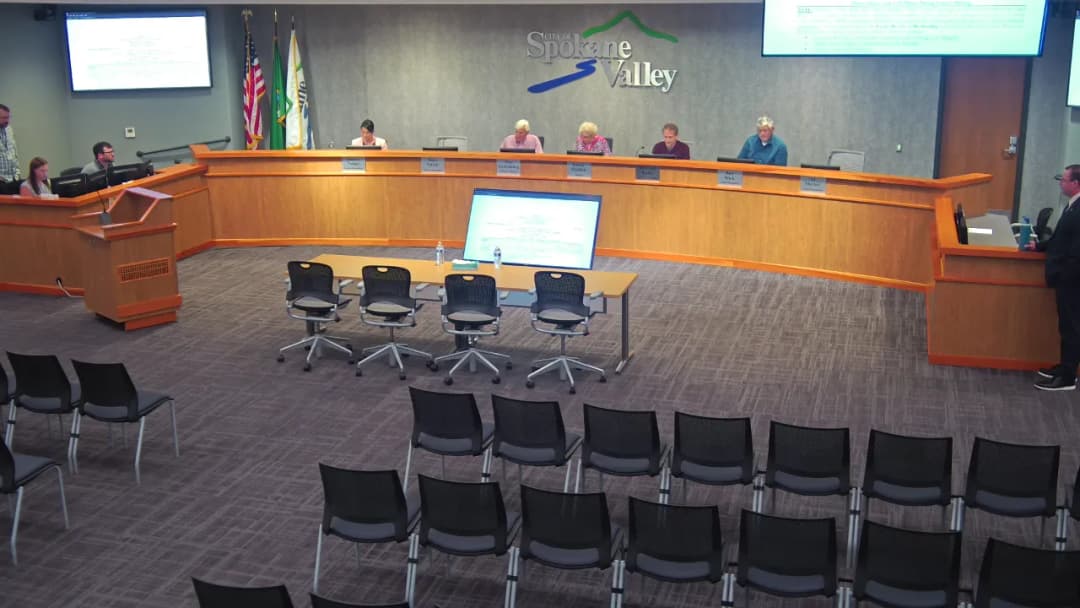
The Spokane Valley City Council held a special meeting on Tuesday, September 29, 2026, at 5:15 PM at City Hall. The meeting was called solely for the purpose of convening an executive session to discuss potential litigation. No formal public comments or testimony were accepted. Roll Call and Attendance - Deputy Mayor Hattenberg, Councilmembers Yeager, Kelly, Wick, and Haley were present. - Councilmember Merkel was excused by a unanimous vote. Executive Session - The council voted unanimously to adjourn into executive session for approximately 30 minutes to discuss potential litigation under RCW 42.30.110(1)(i), with no action to be taken upon return to open session. Key Outcomes - Councilmember Merkel was excused (motion carried with all in favor, none opposed). - Council entered executive session at 5:16 PM.
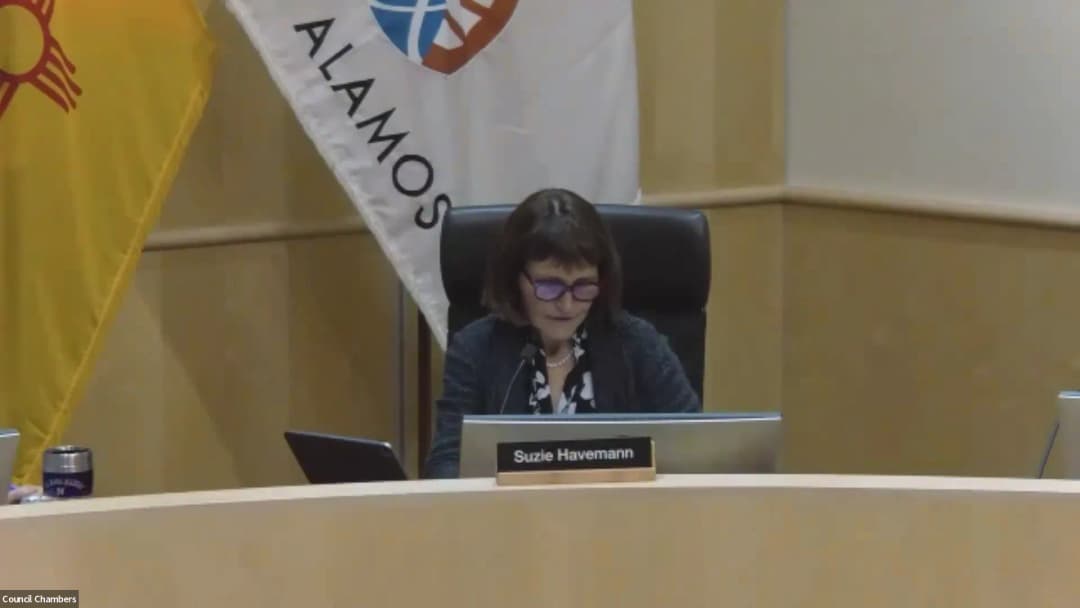
The Los Alamos County Council held a regular session on Tuesday, September 29, 2026, at 6:00 PM in Council Chambers and via Zoom. The meeting included proclamations, a consent agenda, public hearings on water rate increases and write-offs of uncollectible accounts, a board appointment, and the County Manager's report. Notable decisions included adoption of a corrected water rate ordinance (Code Ordinance No. 02-387) and appointments to the Environmental Sustainability Board. Consent Calendar - Acknowledgement of Receipt: Approved receipt of the State of New Mexico Department of Finance and Administration approval of the FY2027 Los Alamos County Budget (Legislative File 22102-26). - Engineering Services: Approved Agreement No. AGR26-60 with Black & Veatch Corporation for an amount not to exceed $551,775.00 (plus a contingency of $75,000 and NMGRT of $48,183.33) for a condition assessment of Abiquiu and El Vado hydroelectric plants for one year, with an option to renew for one year (Legislative File AGR1219-26). Also approved Budget Revision 2027-20. - Draft Tube Repairs: Approved Amendment No. 1 to Agreement No. AGR 25-925 with Andritz Hydro Corp. in the amount of $663,720.70 (including $81,771.75 for tariff fees and NMGRT of $5,417.38) for repairs to the Abiquiu Hydroelectric Plant draft tube, and approved Budget Revision 2027-22 for $87,190.00 (Legislative File AGR1239-26). - DPU Budget Carryovers: Approved Budget Revision No. 2027-01A for DPU carryovers from FY2026 to FY2027 totaling $14,507,148 in expenditures, $3,619,826 in revenues, and a decrease in fund balance of $10,887,322 (Legislative File 21713-26). - Grant Application: Approved the Department of Public Utilities' application to the New Mexico Finance and Administration Capital Development Program Fund for a grant to fund the EA-4 Power Line Replacement from Pajarito Cliffs Site to Rendija Road (Legislative File 22169-26). - Broadband Easement: Approved a temporary construction, access, and utility easement for community broadband network infrastructure in the Mirador Subdivision, Phase III, Cadena Loop, owned by A-19-A-1 Acquisition Group, LLC in White Rock (Legislative File 22167-26). - Library GO Bond Grant: Accepted the FY27 Library GO Bond Grant awarded by the New Mexico State Library in the amount not to exceed $57,529.61 (no match required) and approved Budget Revision 2027-19 (Legislative File 22166-26). - Power Purchase Agreements: Approved execution of one or more Power Purchase Agreements in an aggregate amount not to exceed $18,509,400.00 plus applicable GRT, for the period October 1, 2026 through March 31, 2027 (Legislative File 22168-26). - Fiber Asset Management: Approved Agreement No. AGR26-66 with Vetro, Inc. in the amount of $423,258 plus applicable GRT, for asset management and tracking of county fiber lines for a term of up to seven years (Legislative File 22193-26). - Easement Dedications: Approved acceptance of public utility and public drainage easements and vacation of existing easements for The Hill Development (Legislative File 22104-26). - Senior Center HVAC and Renovations: Approved Task Order No. 33, Revision No. 1 under Agreement No. AGR 22-18a with All Rite Construction Inc. in the amount of $3,640,246.52 plus applicable GRT for the Betty Ehart Senior Center HVAC replacement and general renovations project, established a revised project budget of $9,120,000, and approved Budget Revision 2027-25 (Legislative File 21900-26). The consent agenda was approved unanimously (7-0). Public Comments & Testimony - Sam Gardner (191 Dome Road) expressed concern about increased security cameras and armed guards at Los Alamos National Laboratory gates, stating that surveillance and lockdowns undermine citizen safety and that the Council should prioritize people over GRT revenue from nuclear weapons development. - Brandy Ingemann praised the recent mountain bike race (TransRockies SingleTrack) for its excellent organization, signage directing visitors to local businesses, and positive community impact, calling for more such events. - James Warniky (speaking on behalf of East Park Pool) requested the Council direct county staff to assign lifeguards to East Park Pool instead of sending them off the hill, citing traffic risk, cost, and greenhouse gas emissions. He noted East Park Pool is 80°F, clean, and open, and proposed a short-term agreement for $2,000/week to cover chemicals and utilities. - Mike Hargither (parent of two swimmers) emphasized the importance of local swimming for exercise, social connection, and youth swim programs (Aquatomics, high school). He urged creative solutions to use East Park Pool while the Aquatic Center remains delayed. - Rowan Wademan (youth) preferred East Park Pool stay open to avoid a 30-minute drive to Española. - Claire (youth, no last name given) noted that driving off the hill conflicts with homework and family time. - Catherine Snelson (parent of a diver) highlighted that East Park Pool does not have diving boards, so divers have no local facility. She criticized the County for shortsighted planning given known supply chain issues and urged a solution for the high school dive team. - Aki Koshina (high school swim and dive coach) emphasized that forcing swimmers to travel off the hill impacts study time and student enjoyment, and urged support for teenagers. - Heath McLaughlin (coach and parent) seconded the request to keep East Park Pool open, noting that outdoor swimming can continue into colder months as demonstrated in other locations. - Holly Smith Wilson (online) requested increased funding for bear-proof trash cans, stating she has been on a wait list for a long time and a recent bear tore apart her trash can lid. - Becky Hubbard (online) opposed the water rate increase, stating her utility bill has already increased significantly (electric up 15%, gas expected additional increase), and asked what justifies hikes exceeding CPI (currently 3-4%). She said such increases force families to use credit cards. - Holly Smith Wilson (second comment) echoed opposition, stating young families find living in Los Alamos economically unaffordable due to cumulative rate increases and recent council salary increases, and urged DPU to become more economically efficient. - Lyda Valdez (online) strongly opposed the water rate increase, saying she cannot afford to live on one income and must take a second job. She accused the Council of harming residents, especially elderly and young families, and said she would not vote for any of them. Discussion Items - Water Rate Ordinance (9A): Presenter Joann Gentry explained that the previous water rate ordinance (02-380) was adopted on June 30, 2026, but is void due to a clerical error that used an incorrect version. The new ordinance (02-387) corrects date references in service charge periods (changing "From 10/1/2027 through 9/30/2028" to "After 9/30/2027" and similar). No other rate amounts changed. The two-year increase (8% per year) remains as originally proposed, effective October 1, 2026, and October 1, 2027. The new ordinance also formalizes rates for irrigation meters, bulk sales to LANL, and Pajarito Mountain Service Area. - Councilor Neal-Clinton asked about safeguards to prevent future errors. Gentry stated that staff now manually reattach correct documents rather than relying on system duplication. County Attorney also signs the ordinance. - Neal-Clinton asked what happens if rate increases bring in less revenue than projected. Gentry replied that budget analysis will determine if rates suffice, and further increases may be needed. - Neal-Clinton asked what cost reductions were made before raising rates. Gentry said all line items were reviewed and reduced where possible, and low-interest loans from the Water Trust Board are being pursued. - Councilor Ryti clarified that the new LANL rate is based on their water usage (26% of produced water) and includes O&M costs; the Pajarito Mountain rate includes an energy charge for pumping. - Councilor Rieger confirmed no changes in rates from the prior version. - Public comment included opposition from multiple speakers citing financial hardship and cumulative rate increases. - Councilor Hand and Rieger voted against the ordinance, with Rieger arguing for better cost controls rather than rate increases. - The ordinance passed 5-2. - Uncollectible Utility Accounts (9B): Resolution 26-22 authorizes write-off of 76 utility accounts totaling $31,800.33 from FY2022, deemed uncollectible after four years. Staff noted that collection agencies are used for utility accounts and paid 14% of collected amounts. Councilor Hand voted no; motion passed 6-1. - Uncollectible Non-Utility Accounts (9C): Resolution 26-23 authorizes write-off of COBRA, Environmental Services, Airport, Library Services, and Ambulance Billing accounts totaling $263,145.73 from FY2022. Staff noted these accounts have been offset 100% by allowance for uncollectible accounts, so the write-off merely cleans up the books. Councilor Hand voted no; motion passed 6-1. - Environmental Sustainability Board Appointment (10B1): Two candidates interviewed: Anastasia Letaw (Independent, 7 months in county, PM at LANL, master's in environmental planning) and John Key (originally Democrat but changed to DTS, freelance art director, applied for three boards). The interview panel recommended John Key. Council discussion noted Key's application also mentioned Art in Public Places, but staff clarified he applied for multiple boards. Key was appointed by a vote of 5-2 (Councillors Cole and Rieger voted for Letaw). - County Manager's Report: Manager Laurent highlighted upcoming meetings, including a December 1 special meeting for ALPR discussion. She reported that bear-resistant trash cans are on order with an anticipated delivery of October 14, 2026 (funding is not the issue; availability is). Regarding the Aquatic Center closure and swimming alternatives, Laurent stated that staffing is the primary obstacle; the County is exploring opening Lucero Center in Española but faces staffing challenges (Española down to one guard, County has two potential guards). A government-to-government agreement is easier than a public-private partnership with East Park Pool. Laurent also addressed the September 28 Lumen fiber cut outage, noting that the County followed its after-action report from a previous outage, deployed message boards and Starlinks, but that communication with Lumen is difficult and expectations may be unrealistic. Long-term broadband investments will improve redundancy. - Council Liaison Reports: - Councilor Havemann reported on the Planning and Zoning Commission meeting (Sept 23) regarding the Comprehensive Plan update. Key public feedback included opposition to conservation residential zoning, support for housing regulation reforms, concerns about the term "character," and mixed views on growth projections. The revised draft plan is expected to go to Planning and Zoning in November and to Council in December. - Councilor Cole reported on the Parks and Recreation Board meeting, covering the Los Alamos Mesa Trail project, North Mesa picnic grounds upgrades, and the FY26 year-in review. - Councilor Rieger reported on the Arts in Public Places Board meeting, which approved a joint process with the state arts board for art at the new fire station, discussed a deaccession policy, and unanimously rejected hanging banners on public art (e.g., Oppenheimer sculpture). - Councilor Neal-Clinton noted she missed the BPU meeting but would provide notes. - Councilor Hand reported on Health Council, the Northern Area Local Workforce Development Board, NCRTD executive session, and North Central New Mexico Economic Development Board meetings. Key Outcomes - Water Rate Ordinance 02-387: Adopted 5-2 (Hand and Rieger opposed). Amends water rate schedules with 8% increases effective October 1, 2026, and October 1, 2027, and adds new sections for irrigation, LANL bulk, and Pajarito Mountain rates. Corrects date errors from prior voided ordinance. - Resolution 26-22 (Utility Write-offs): Approved 6-1 (Hand opposed). Removes 76 uncollectible utility accounts ($31,800.33) from accounts receivable. - Resolution 26-23 (Non-Utility Write-offs): Approved 6-1 (Hand opposed). Removes uncollectible accounts for COBRA, Environmental Services, Airport, Library Services, and Ambulance Billing ($263,145.73). - Environmental Sustainability Board: Appointed John Key to fill a vacancy (term: August 1, 2026 – July 31, 2028). Vote: Key 5, Letaw 2. The interview panel recommended Key. - Consent Agenda: Approved unanimously (7-0), including all items A through K as presented. - Next Steps: A December 1 special meeting will address ALPR policy. The Council will hold a work session on October 6, 2026, to discuss the swimming pool situation and communication resilience. The County Manager will provide additional updates on the Aquatic Center alternative (Lucero Center) when details are finalized. The bear cart delivery is anticipated October 14.
Note: The agenda and transcript list the meeting date as September 28, 2026, but the user-provided timestamp is September 29, 2026. This summary uses the user-provided date. This was a marathon meeting dominated by controversial annexations and zoning changes to facilitate multiple data center developments, alongside routine business and a climate action plan. The council approved several large annexations and rezonings but denied one rezoning amid significant public opposition. Consent Calendar - Approved with removal of items 18 (Climate Action Plan) and 23 (Future Land Use Map for Cox Ranch) for separate discussion. - Routine approvals included minutes, budget re-appropriation, special use permits, and various contracts and purchases. Public Comments & Testimony - Cox Ranch Annexation (Items 6-8): Many residents opposed, citing concerns over noise, light, water, traffic, and loss of Western identity. Speakers included Mindim Levins (opposed, citing dismissive council), Heather Madrid (opposed, calling growth dangerous), Rick Kessler (opposed, mourning loss of historic ranch), and Charles Miller (legal objections). Supporters included Tom Glismeyer (project sponsor), Marin Kellis (reluctant approval for regulation), and Gay Woodhouse (representing Cox family, support after mausoleum agreement). - Hitching Post District (PRCA) (Items 9-11): Speakers overwhelmingly supportive, including Jim Walter (Visit Cheyenne) who highlighted tourism benefits and the PRCA relocation from Colorado Springs. No public opposition heard. - HR Land Company Rezoning (Item 12): Strong opposition from residents and environmental groups. Vicky Heron and Dr. Lori Wayne Chestnut (Audubon Society) advocated for bird habitat conservation. Residents like Todd Doyle and Spencer Straub cited noise, traffic, and lack of notification. Supporters included the landowner Mark Loham, who stated no end user yet but noted development challenges. - Orchard Hills Annexation and Rezoning (Items 13-15): Mixed public comment. Opponents like Heather Madrid (passionate opposition, calling data centers a destruction of south Cheyenne) and Jim Sutter (light pollution from existing Meta facility). Supporters like Ross Gensel (preferred data center over housing for less traffic) and Orlando Flores (support after community benefits). - Climate Action Plan (Item 18): Public speakers opposed, including Ben Reighley (calling it a waste of federal dollars) and Alan Sheldon (concern over costs). Charles Miller argued the plan was fraudulent for excluding data center energy use. - Cheyenne Depot Lease (Item 29C): Charles Miller objected to lack of financial analysis, but no public opposition from residents. Discussion Items - Item 6: Cox Ranch Annexation (3rd Reading): Passed 7-2 (Wolf and Moody dissenting). Council debated water impacts, traffic, and community benefit agreements. Councilman Wolf criticized the council for ad-hoc decision-making and lack of data center regulations. Councilman Labourne supported due to water flow protection. - Items 7-8: Zoning for Cox Ranch: Passed 7-2 (Moody dissenting on zoning establishment; Wolf and Moody dissenting on business park rezoning). Council emphasized that a signed community commitment agreement addressed some concerns but not all. - Items 9-11: Hitching Post District: Passed unanimously on second reading. Council expressed excitement for PRCA relocation and year-round tourism. - Item 12: HR Land Company Rezoning (2nd Reading): Failed after council vote (5 no: Escobel, Aldrich, Labourne, Moody, Wolf; 4 yes). Council cited lack of end user, incomplete bird study, and neighbor concerns. - Items 13-15: Orchard Hills Annexation and Rezoning (2nd Reading): Annexation passed 7-2 (Moody and Wolf dissenting). Rezoning to Light Industrial passed 7-2 (same dissenters). Developer offered community benefits including road and greenway improvements. Council noted extensive neighborhood engagement. - Item 16: Optional 1% Sales Tax Resolution: Adopted after amendments to correct percentages. Funds primarily for roads and public safety. - Item 18: Climate Action Plan: Heavily debated. Amended by Dr. Aldrich to “acknowledge receipt” rather than “adopt,” and further amended to state the plan “may be used as a planning document.” Adopted as amended 5-2 (Emmons and Moody dissenting). Some council members worried about unfunded mandates, while others saw value as a baseline for grants. - Item 20: Overruling Planning Commission for Orchard Hills Land Use: Adopted 6-2 (Moody and Wolf dissenting). Council argued the commission lacked expertise and quorum issues. Key Outcomes - Votes: - Cox Ranch Annexation (Item 6): Approved 7-2. - Zoning establishment (Item 7): Approved 6-1 (Moody no). - Rezone to BP (Item 8): Approved 7-2. - Hitching Post Annexation (Item 9): Approved unanimously on second reading. - HR Land Rezone (Item 12): Denied on second reading (5-4). - Orchard Hills Annexation (Item 13): Approved 7-2 on second reading. - Orchard Hills Rezone to LI (Item 15): Approved 7-2 on second reading. - Optional Sales Tax (Item 16): Adopted. - Climate Action Plan (Item 18): Adopted as amended 5-2. - Overruling Planning Commission (Item 20): Adopted 6-2. - Postponements: Items 19 and 21 (future land use map amendments) postponed to October 12, 2026. - Appointments: Kristin Lee reappointed to Cheyenne Housing Authority; Matthew Hurt, Jessica Nyffler, Richard Brown Jr. appointed to Mayor’s Council for People with Disabilities. - Leases and Contracts: Cheyenne Depot Museum 10-year lease approved; firefighting turnout gear purchase approved with amended model. - Public Hearings Announced: October 12, 2026 for compliance of annexation conditions for 8.18 acres near US-30 and Commerce Circle.
The Planning and Zoning Commission met on Tuesday, September 29, 2026 at 7:00 p.m. in City Hall Council Chambers to continue the public hearing on applications for a Map Amendment (MA-26-05) and Planned Unit Development (PUD-26-03) for a hotel and multi-family development at 809 W Touhy Avenue, 5 Third Street, 11 Third Street, 13 Third Street, 19 Third Street, 21 Third Street, 25 Third Street, 850 Garden Street, and 842 Garden Street. The meeting also included approval of prior minutes, public comment on non-agenda items, and a City Council liaison report. Consent Calendar - Approval of the minutes from the September 15, 2026 meeting. The minutes were approved as amended, with Commissioner Gilpin abstaining due to absence. The motion passed with all other commissioners voting in favor. Public Comments & Testimony - No members of the public spoke on non-agenda items. - The public hearing on the development case drew extensive testimony. Approximately 30 minutes of public comment were heard, with speakers largely opposing the project. Key concerns included excessive height (61.5 feet vs. 40-foot limit), density (37 residential units vs. 18 allowed under R2 zoning), traffic congestion, inadequate parking despite claims of surplus, and lack of substantial public benefit. Some speakers acknowledged the applicant’s efforts to reduce density and improve circulation but argued the project remained too large. Letters of support from residents on the block were read by the applicant, indicating the block has transitioned to commercial use and that the development aligns with the Uptown Master Plan. Discussion Items - Continued Development Case MA-26-05 and PUD-26-03: The applicant, Andrew Nass, and architect Teo Scorte presented revised plans. Changes from the August 25, 2026 iteration included: reduction of residential units from 52 to 37, removal of one floor, a 10-foot setback on the fourth floor, and a 24-foot wide pass-through to improve traffic circulation. The hotel component remained at 95 rooms with a height of 61.5 feet at its peak. The event space was reconfigured to direct noise toward Touhy Avenue. The applicant argued that the PUD process allows exceptions and that the plan provides substantial public benefits, including underground parking, $250,000 in escrow for city-directed use, and compliance with the Uptown Master Plan’s goals for a hotel and event space. Commissioners questioned the accuracy of renderings, the event space design, traffic flow, and the compatibility of the massing with the surrounding neighborhood. The public works traffic study was noted as still pending updates. The commission discussed findings of fact for both the map amendment and the planned unit development. Key Outcomes - Map Amendment (MA-26-05): A motion to recommend approval of the map amendment (rezoning from R2 to B4) with a condition that the PUD be completed was voted on. The vote resulted in a 4-4 tie (Commissioners Karstens, Shepherd, Hutchinson, and Chair Hanlin voting yes; Commissioners Gilpin, Papraki, Schubert, and McMillan voting no). The chair ruled that the motion failed, but the recommendation (with the tie) will be forwarded to the City Council for final decision. - Planned Unit Development (PUD-26-03): A motion to recommend approval of the PUD was defeated by a vote of 2-5-1 (Commissioners Hutchinson and Karstens voting yes; Commissioners Schubert, McMillan, Papraki, Shepherd, and Gilpin voting no; Chair Hanlin abstaining). The commission does not recommend approval of the PUD. The application will still be sent to the City Council with the recommendation. - City Council Liaison Report: Alderman Steinfels reported on recent council actions, including a moratorium on historic districts, approval of a green alley contract, library patio repairs, holiday lights budget, and Metro station improvements. He also noted ongoing discussions about the affordable housing plan and potential tiering of public benefits. - Upcoming meetings: October 13, 2026 and October 27, 2026.
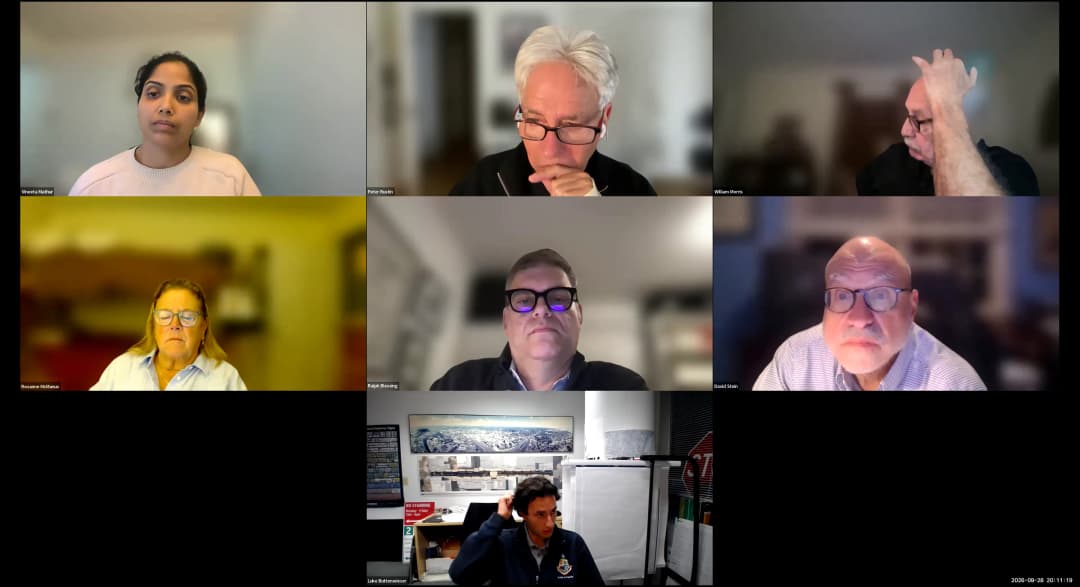
Note: The transcript indicates the meeting began on September 28, 2026, but the official date provided is September 29, 2026. This summary uses the official date. Chair David Stein called the Stamford Zoning Board meeting to order at 6:33 PM via Zoom. Roll call confirmed members Bill Morris (present) and staff Ralph Blessing and Vanita Monter. The public attended by video and teleconference. The public hearing portion was scheduled to end at 9:30 PM. Public Comments & Testimony - Sue Halpern (Elmcroft Ave) opposed the proposed reduction in parking requirements, especially in the south end. She cited high‑rise apartments, businesses on Pacific Street, and multi‑family homes relying on street parking, and noted that commuters use the train station lots. She questioned the practicality of 8.5‑foot parking spaces for large vehicles. - Dave Adams (Glenbrook Road) expressed concern that the state law forces the city’s hand and urged the board to adhere only to the minimum required by the state. He doubted that residents would give up cars and warned of spillover parking. - Mike Moore (President of Stamford Downtown) supported reducing parking minimums on parcels up to one acre in downtown, arguing it would lower housing costs, make neighborhoods more walkable, and allow efficient land use. He cited a developer’s per‑space cost of $50,000–$60,000 for structured parking. Discussion Items Application 226‑27 – Parking & Mobility Text Change (PA 25‑01 Implementation) Transportation Planner Luke Buttonweaser presented a comprehensive update to Section 12 of the zoning regulations, driven by state Public Act 25‑01 (passed November 2025) and aligned with the city’s comprehensive plan. Key proposed changes include: - State‑mandated: No parking required for residential developments with 16 or fewer units (except in designated Traffic Mitigation Areas); maximum of one space per studio/one‑bedroom and two spaces per larger unit (city already compliant). - City‑initiated: - Standardize parking space width to 8.5 feet citywide (from 9 feet in Category 3). Allow 8‑foot spaces for deeply affordable housing or historic preservation by administrative approval (previously special permit). - Eliminate the 1,000‑foot distance requirement for off‑site parking in Category 1 (downtown/core). - Exempt parcels up to one acre (was 25,000 sq ft) in parking Category 1 from providing any parking, provided they are in certain zoning districts (CC, CG, MXD, RH, RHD, SRDN, SRDS, TCD). - Create two Traffic Mitigation Areas (Category 2) totaling ≤4% of the city’s land area, each ≤4% and contiguous. These areas (west side, waterside, cove, east side, excluding areas near transit) retain parking requirements for all residential developments. - Reorganize commercial parking requirements into a single chart with default 3 spaces per 1,000 sq ft gross floor area. - Allow reductions of up to 50% (from 25%) via special permit with fee‑in‑lieu. - Introduce a Parking Needs Assessment process allowing developers to use their own study to reduce parking if it meets state‑defined standards (reviewed by Transportation Department). - Update loading, bike parking, EV charging, and sidewalk design standards. Board members raised concerns about the one‑acre exemption leading to zero‑parking developments, potential spillover into residential streets, and the feasibility of shared parking. They requested additional materials before voting: overlays of proposed parking categories with zoning districts, existing vs. proposed category maps, location and occupancy of public/private parking garages, comparison of residential parking requirements (proposed vs. existing), a detailed map of Springdale, the acreage of each mitigation area, and a legal review of the criteria for fee‑in‑lieu reductions. Application 226‑15 – Corrections and Updates to Zoning Regulations Ralph Blessing presented a technical clean‑up package including: reinstating ZBA approval for gas stations/repair shops (per state law), clarifying notice requirements for ZBA applications, expanding staff‑approved minor modifications to ZBA approvals, defining temporary structures, adding city facilities as eligible for transfer of development rights, updating R6 two‑family district references, enhancing Publicly Accessible Amenity Space (PAS) requirements (including a double‑count for community rooms, allowance of public restrooms), increasing fee‑in‑lieu rates from $150 to $200/sq ft in several residential districts to encourage on‑site affordable units, and correcting footnotes in Appendix B. The planning board unanimously recommended approval. Application 226‑16 – CN Neighborhood Commercial District Regulations Ralph Blessing introduced a text change to add comprehensive site and urban design requirements to the CN district, currently governed only by use and bulk tables. No new uses or density changes were proposed. The planning board unanimously recommended approval. Key Outcomes - Application 226‑27 – Public hearing was held but not closed. The board continued the application to October 19, 2026 at 6:30 PM to allow staff to provide the requested maps, comparisons, and legal clarification. - Application 226‑15 – Public hearing was closed after no public testimony. The board indicated the matter was straightforward; a vote is expected at a future meeting. - Application 226‑16 – The hearing was opened but the transcript ends before further discussion or closure. The board will continue consideration. - No votes were taken on any application during this meeting.
The meeting began with a closed session at 9:30 a.m., followed by public comment on labor negotiations (Agenda Item 3.2). The regular session was scheduled for 1:30 p.m., but the provided transcript only covers the start of the closed session and public comments. No votes or decisions are recorded in the available material. Public Comments & Testimony - Three speakers from IFPTE Local 21 (CAMP and AMSP bargaining units) spoke in favor of including binding grievance arbitration in their next labor contract. Michael Jun, a senior development officer and union president, argued that arbitration provides a neutral third party for dispute resolution, noting other city unions already have this right. Mary Morse, a senior environmental program manager, asked the council to listen to workers who want a fair contract that keeps up with cost of living and inflation, and noted that 5% of wages do not contribute to pensions. Riley Knight, a supervising environmental service specialist and union treasurer, stated that arbitration is a standard union contract provision and that the process cannot create new benefits but resolves disputes fairly. Discussion Items - No discussion items from the regular session are present in the transcript. Key Outcomes - No actions or votes are recorded. The council adjourned to closed session after public comments. Note: The agenda included numerous items (consent calendar, strategic support, public safety, transportation, environmental services, land use, etc.) but no decisions are reflected in the provided transcript. This summary is based solely on the available material.
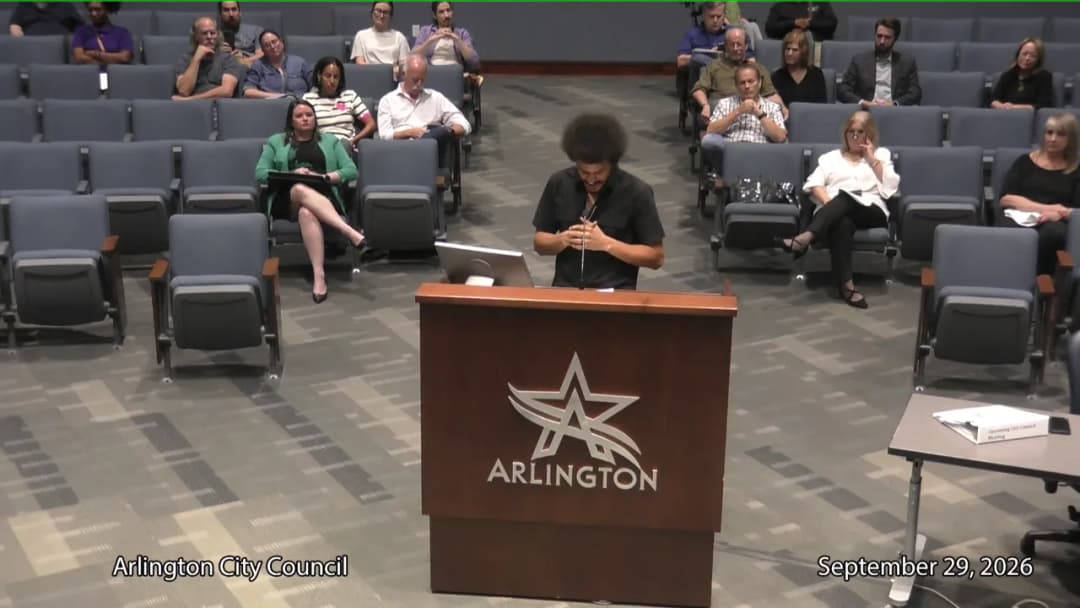
The Arlington City Council convened in Regular Session on September 29, 2026, starting at 6:30 PM (local time, CT) at City Hall Council Chamber, 101 W. Abram Street. Mayor J. Ross presided. Councilmember B. Hogg was absent. The meeting featured a large consent agenda, two public hearings on zoning cases, a resolution on polling places in Tarrant County, and a contested resolution for a master agreement and lease with SiNaCa Studios. Note: The agenda and minutes consistently indicate a 6:30 PM start, conflicting with the prompt-supplied metadata timestamp of 12:30 UTC. Consent Agenda - Approved by an 8-0 vote, with Item 7.19 pulled for a separate vote. The approved items included minute orders for contracts (water chemicals, masonry, barricades, VMware, insurance, security, website, library architecture, water tank rehabilitation, sculpture site prep, athletic center renovations, elevated storage tank engineering, Safe Routes to School Master Plan, playground equipment) and final readings of ordinances (one-way street revisions, amendments to construction/electrical/fire prevention codes). Consent resolutions covered the 2027 Council calendar, public comment rules, a Tourism PID contract, certificates of obligation, tax/municipal debt collection contracts with Linebarger Goggan Blair & Sampson, an RFP authorization for public safety tech consulting, interlocal agreements (Smart Irrigation, Tarrant County sidewalk replacement, Household Hazardous Waste), a Sister Cities contract, a Downtown Arlington Management Corporation amendment, an AEDC grant for Advanced Composite Structures, a Center Street Gateway site assessment, and a BIRD program agreement with Takpar Technologies. - Public speakers appeared on items 7.18 and 7.22/7.23 before the vote. Public Comments & Testimony - Item 7.18 (City Council Rules for Public Comment): Dee Jay Johannesen, a resident, spoke in support of the amended rules, characterizing them as a compliance measure and hoping the previous climate of respectful dialogue would continue. - Items 7.22 & 7.23 (Linebarger Debt Collection Contracts): Glenn Lewis, Corey Fickes, and Charles Brady, partners at Linebarger Goggan Blair & Sampson, spoke in support. They argued the city's own RFP and staff recommendation validated their performance. Elizabeth Calvo, a partner at the competing local firm Purdue, Brandon, Fielder, Collins & Mott, spoke in opposition, expressing respect for the process but disappointment in the outcome. - Public Hearing 10.1 (Havenwood Drive SUP): Applicant Pedro Ramirez spoke in support of the project, detailing his family's need to provide housing for his 85-year-old mother. - Public Hearing 10.2 (Mitchell Parkway PD): Holly Raeder, representing Encore Electric, spoke in support of the rezoning for a substation. Matthew Rodriguez registered in support but did not speak. - Item 11.1 (SiNaCa Studios): Seven speakers (Jeremy Scidmore, Dee Jay Johannessen, Clifton Crofford, Breinn Richter, Bob Pruitt, Justin Ginsberg, Maggie Campbell) appeared in support, emphasizing the cultural and economic benefits for downtown. Two speakers (Darron Hensley Jr. and Josh Yunker, co-owners of Gray Area Studios) opposed, calling the project a subsidized competitor and requesting a postponement for further review. - Citizen Participation: Tracy Anders, a resident, expressed critical views of the council and city staff. Key Discussion & Outcomes - Item 7.19 – Tarrant County Polling Places: Councilmember B. Garcia-Dumas moved, and Councilmember T. Ware seconded a resolution requesting the Commissioners Court reconsider a reduction in polling places. Councilmember J. Shelton presented an analysis showing the share of locations in census tracts with median incomes under $40,000 dropped from 44% in 2022 to 38% in 2026. Councilmember R. Gonzalez expressed concern about the loss of a UTA polling location. Vote: 7-1 (Galante nay). Passed. - Item 10.1 – SUP26-02 (2401 Havenwood Drive): A Specific Use Permit for a secondary living unit to house the applicant's mother. The council discussed a staff recommendation to maintain a full master bathroom. Vote on First Reading: 6-2 (Galante and Ware nays). Passed. - Item 10.2 – PD26-08 (7204 Mitchell Parkway): Rezoning for a Planned Development for an electric utility substation. The ordinance was amended to limit equipment height to 70 feet. Vote on First Reading: 8-0. Passed. - Item 11.1 – SiNaCa Studios Master Agreement and Lease: The resolution authorized a master agreement and 10-year lease for a glass arts nonprofit to relocate to 300 W. Front Street. The deal included a $150k design grant and an $850k reimbursable construction grant. - Council Deliberation: Councilmembers expressed deep conflict. Dr. Shelton empathized with existing local business Gray Area Studios but voted for the "greater good" of downtown. Councilmember Ware challenged SiNaCa to prove the public investment would foster collaboration. Councilmember Galante voted no, citing a need to support existing small businesses. Vote: 5-3 (Galante, Hunter, Ware nays). Passed. - Appointments: Approved appointments to the Convention & Visitors Bureau, Higher Education Finance Corporation, and Zoning Board of Adjustment. - Upcoming Events: Mayor Ross announced the first "Arlington Unfiltered" town hall for Oct 1st. Councilmember Gonzalez promoted the Hispanic Heritage Celebration on Oct 3rd.