Browse by city
Date range
Search help

Search titles, summaries, topics and stored transcripts together. Keywords may match separately; put the whole query in double quotes for a phrase. Matching follows word analysis, so punctuation is not exact. Both dates are included. Documents are not searched.

SHOWING 4081–4090 ENTRIES
4081
SEP 28, 2026 · RED WING, MINNESOTA · CITY COUNCIL
Red Wing City Council EMS Workshop: Operations and Finances – September 28, 2026

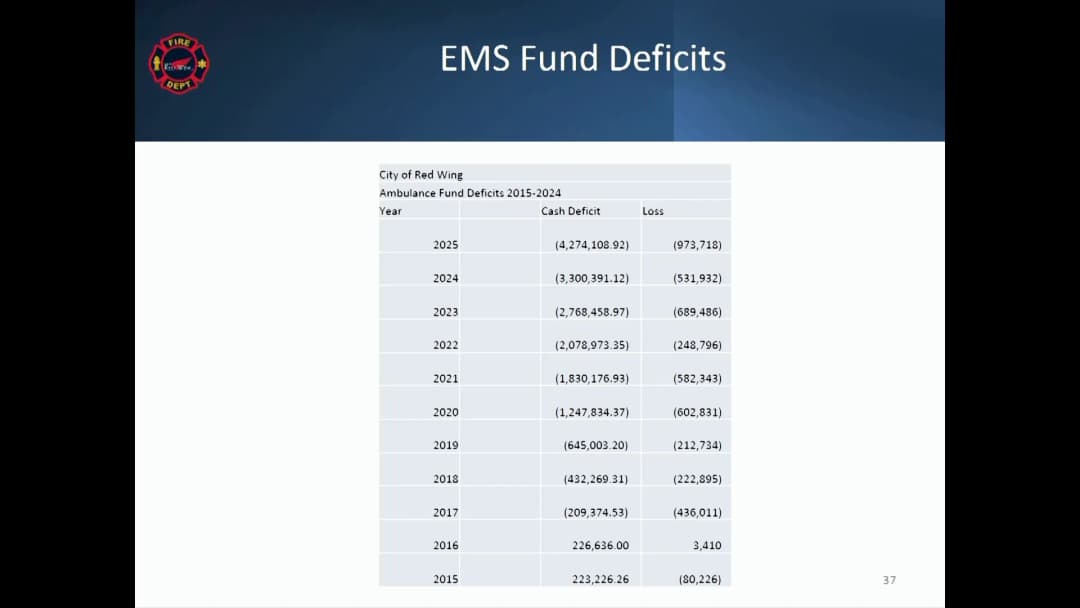
The Red Wing City Council met in workshop on Monday, September 28, 2026, from 5:00 p.m. to 6:06 p.m. in City Hall Council Chambers. Council President Janie Farrar called the meeting to order; all council members were present, with Vicki Jo Lambert arriving at 5:01 p.m. Also present were Mayor Gary Iocco, City Council Administrator Chris Heineman, Fire Chief Mike Warner, Finance Director Marshall Hallock, Assistant Finance Director Tony Schultz, City Attorney's Office representative Zach Cronin, and EMSMC billing specialist Becky Mork. The workshop's sole agenda item was an operational and financial update on Red Wing's ambulance and EMS services, including billing, reimbursement, interfacility transfers, township funding, and long-term sustainability. Discussion Items - Chief Warner presented the EMS mission, Minnesota statutory requirements, and the service area, explaining that the city operates within its primary service area and also responds outside city limits in townships. - Becky Mork reviewed the billing and reimbursement process, including EMSMC's billing work and the PWW compliance/advisory partnership, plus 2025 data. The city billed over $10 million on the ambulance fund but received $2.5 million in cash, for a 62.9% collection rate. Average cash per trip was about $964; 911 transports averaged about $758 per trip and interfacility transports just under $1,300 per trip. - Mork said roughly 75% of the payer mix is Medicare/Medicaid, which pays regulated rates well below billed charges and cannot be balance-billed. She also noted that Medicaid changes taking effect in 2027 could reduce Medicaid enrollment by an estimated 10%. - Chief Warner said the annual cost difference between advanced life support (paramedic) and basic life support (EMT) is about $51,000. Downgrading to BLS would likely reduce collections, not improve finances. If the city stopped operating an ambulance, it would still respond to 911 calls with fire apparatus but could no longer recover transport revenue, shifting more costs to the general fund. - The chief used an epinephrine pen example to illustrate reimbursement shortfalls: a $650 pen would only be reimbursed at about $430–$450 on the roughly 75% of calls covered by Medicare/Medicaid. - Chief Warner discussed interfacility transfers, which generate about $1.5 million in cash annually. He said the city has limited transfers to roughly 60 miles to avoid tying up ambulances and crews. - Finance Director Hallock and Assistant Finance Director Schultz explained the ambulance fund deficit. General fund operating transfers were $250,000 in 2023, $300,000 in 2024, $500,000 in 2025, and $750,000 in 2026. The preliminary 2027 budget proposes $750,000 plus a $3.2 million one-time transfer to address the accumulated deficit. Staff said unsubsidized losses had accumulated since 2017 and totaled about $4.5 million over ten years; the 2025 cash loss was around $973,000. - Chief Warner reviewed the current fund allocation of 48% general fund and 52% ambulance fund, and raised a 75/25 allocation as a starting point for discussion. - The chief cited a state methodology putting Red Wing's per-response EMS operating cost at about $1,147.01 versus a statewide average of $705.38, attributing the gap partly to the 262-square-mile service area and diesel fuel costs. - Chief Warner reviewed township outreach: the city requested roughly $32 per capita from townships, and two townships are considering $20 per capita, but none have committed. Townships that do not pay would still receive service. Mayor Iocco noted townships vote on budgets in March. - Attorney Zach Cronin updated the council on the default judgment against former billing provider Expert Billing LLC. The judgment is final, has been docketed in Minnesota and South Dakota, and no payment or response has been received. He recommended a future closed session to discuss litigation strategy. - Chief Warner said a community risk assessment and standards of coverage draft will be presented in the coming weeks or months. Council Positions and Questions - Council President Farrar asked who sets interfacility rates. Billing specialist Mork responded that rates are influenced by Medicare/Medicaid releases and by comparisons with other agencies, with final approval through the city/chief. - Council Member Snyder asked whether both an ambulance and fire truck respond to every 911 call. Chief Warner said the ambulance responds to the call; fire apparatus is used for severe calls or when extra paramedics are needed. - Council Member Kliewer asked whether any townships had committed to contributing. Chief Warner said none had committed; two were considering it. - Council Member Lambert confirmed that the operating transfers were coming from the general fund, and Finance Director Hallock agreed. - Council Member Goggin asked about the yearly deficit. Finance staff explained the deficit growth and the impact of Medicare/Medicaid reimbursement changes. - Council Member Norton expressed support for funding EMS through the general fund as a community service, comparing it to law enforcement, but she was concerned about losing leverage for state subsidies. Chief Warner replied that the city could still apply for grants as long as it tracks operating costs and receivables. - Council President Farrar requested additional discussion about transfers coming from reserve funds. Key Outcomes - No formal votes or decisions were made at the workshop; it was an informational session. - Follow-up items identified include continuing township funding discussions, performing a cost analysis of resident versus non-resident rates, considering future fund allocation options, scheduling a closed session on the billing-provider litigation, and presenting the community risk assessment at a future meeting. - Chief Warner indicated he expects to bring a treatment-in-place grant to a future council meeting for approval. - The workshop adjourned at 6:06 p.m., with the regular city council meeting scheduled for 6:30 p.m.

HEALTHCARE ACCESS 40% · EMERGENCY MEDICAL SERVICES 29% · BUDGET EQUITY ANALYSIS 23% · PUBLIC SAFETY 4%
4082
SEP 28, 2026 · WASHOUGAL, WASHINGTON · CITY COUNCIL
Washougal City Council Workshop: Development Code Updates and 2027-2028 Budget - September 28, 2026

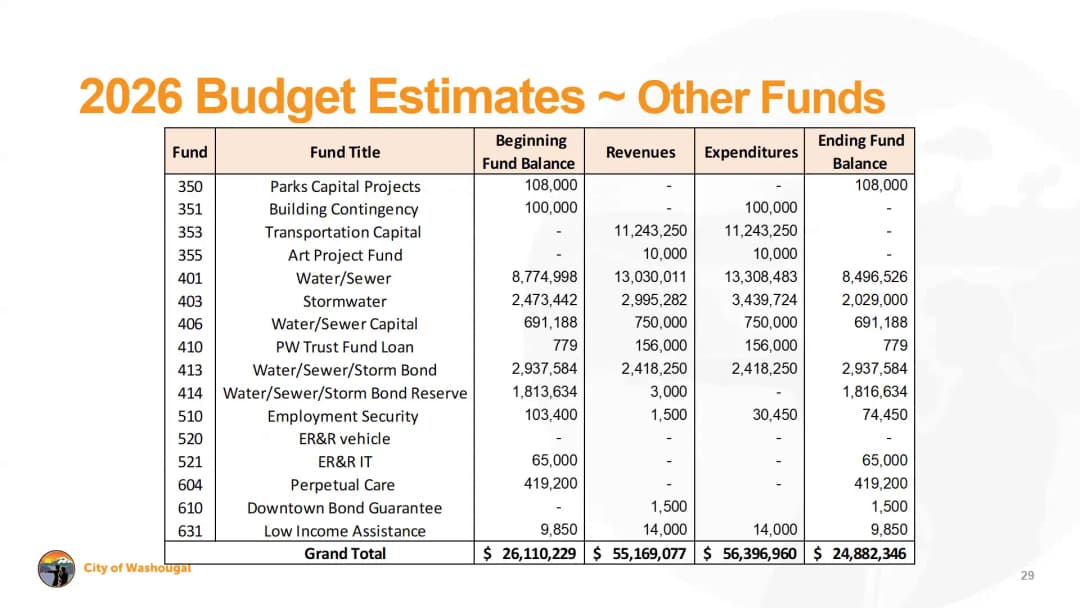
The Washougal City Council met in a workshop on Monday, September 28, 2026, at 5:00 p.m. via Zoom. The agenda covered the consolidated development code update, the statutorily required preliminary 2027-2028 revenue and expenditure estimates, and department-level budget presentations. No official minutes were available; this summary is based on the agenda and the raw transcript. No formal council votes were taken. The workshop adjourned shortly before the 7:00 p.m. regular council meeting. Public Comments & Testimony - One audience member reported that an encampment near the brush and beach area had been moved out but relocated to a nearby area. The speaker said a brush/security concern remained because the beach area is not visibly clear unless someone walks down to it. Discussion Items Community Development: Consolidated Development Code Updates - Community Development Director Mitch and consultant Jessica presented the consolidated code update, emphasizing that they were not rehashing all updates but reviewing changes made after prior council and planning commission feedback. - Regulatory drivers were grouped into three categories: state-mandated periodic update housing requirements (middle housing, ADUs, co-living), the critical areas ordinance update tied to best available science for riparian areas, wetlands, and Oregon white oak, and recommended code updates aligned with the 20-year comprehensive plan growth strategy. - Process status: the city issued a mitigated determination of non-significance under SEPA; the SEPA comment period concluded September 18; the city is in the middle of the 60-day notice to Commerce; hearings are scheduled before the planning commission and city council in November; the council is targeted to take a single action on December 7 on the comp plan, code updates, and parks and transportation capital plans. - A middle housing table was presented showing permitted and prohibited housing types across residential zones. State law requires Washougal, as a tier-three city, to allow two middle housing units per lot and five middle housing types. The city is also proposing triplex and fourplex allowances in higher-density zones on larger lots to increase housing opportunity without rezoning. - Council members asked about HOAs and CC&Rs. Staff responded that the city cannot enforce or regulate private covenants, so a property owner would need to resolve HOA restrictions privately; staff noted the state legislature could change that landscape in the future. - Several council members questioned triplex/fourplex allowances on hillside residential areas such as Lookout Ridge and Woodburn, citing topography, traffic, and neighborhood character concerns. Staff replied that the allowances are permissive, that parking and other site regulations still apply, that the strategy avoids rezoning, and that the city needs both town-center density and middle-housing flexibility on the hill to meet the 20-year housing math. - Staff explained that multifamily is being redefined as seven or more units; buildings with three or more units remain permitted where apartments were historically allowed, such as Woodburn Hill. - The lot performance table for residential districts includes a new minimum density, sets maximum density on a square-feet-per-unit basis so two units fit on a minimum lot (for example, two 2,500-square-foot units on a 5,000-square-foot lot), slightly increases maximum lot coverage, and clarifies that state law requires two middle housing units on pre-existing lots regardless of lot size. The table also establishes one primary residential use per lot, preventing two duplexes or two detached single-family homes on one lot. - A new unit lot subdivision chapter was discussed. It is state-required, applies to single-family homes, middle housing, and ADUs, is proposed in residential districts, Woodburn Hill, and Town Center, and allows units to be sold as separate lots. A unit lot cannot be further divided; the subdivision can occur before or after construction. - Low-income housing impact fee incentives were reviewed. The city is updating its existing program, scaling exemptions by affordability level, and limiting exemptions to 80 percent so the city does not have to backfill exempted fees. Permanent supportive housing falls in the zero-to-30 percent affordability range. - Park and transportation impact fee rates are being moved out of code into capital plans; an annual escalation is being considered. Finance staff said updated transportation impact fee numbers will need to come back to the council because six-year TIP construction costs and funding assumptions changed for projects such as 32nd and Shepherd Road. - Fire and school impact fees must be updated within six months of plan adoption; fire fee updates are expected in 2027. The new regional fire authority will likely develop the capital facilities plan, with the council adopting resulting fees. Finance: 2027-2028 Budget - Revenue and Expenditure Estimates - Finance staff presented the statutorily required preliminary revenue and expenditure estimates for the 2027-2028 biennial budget, noting that many numbers remain subject to refinement through October. - The budget approach builds on the May council planning session and the city's strategic plan, continuing investments such as the small business education and networking program, partially moving positions off the SPIF fund, and completing the comprehensive plan update. - The county provided new assessed value estimates on Friday before the meeting: new construction came in at 1.78 percent versus the roughly 2 percent staff had estimated, and total assessed value increased 1.71 percent. - With the regional fire authority now stood up, the city is removing $3.4 million of fire department expenses and a corresponding $3.4 million of revenue from the general budget. Staff projected a property tax rate reduction of 84 to 85 cents, comprised of about 7 to 8 cents from the expiring 10-cent levy lid lift and about 70-something cents from a property tax levy reduction. Staff said the city was keeping its promise to give back $3.4 million. - General fund revenue assumptions include sales and use tax growth of about 2 to 3 percent per year; two new voter-approved sales taxes, one for transportation and one for public safety, are each estimated at $390,000 per year; utility revenues follow the adopted rate plan at roughly 3 percent growth. - For 2027, real property tax revenue shows a negative $5 million change, reflecting removal of the EMS levy and fire-related levy revenue. Fire expenses in the 2026 amended budget were about $5.2 million, with the EMS levy around $1.6 to $1.8 million. - Preliminary 2027 general fund expenditures include a placeholder 5 percent increase for public works. General government services decrease because there are fewer transfers out of the general fund, with more capital project support now coming from grants. - The 2027 general fund expenditure presentation includes a $100,000 fire impact-fee placeholder; the city will continue collecting fire impact fees and, per state auditor and BARS requirements, records the revenue and corresponding expense. - The strategic fund is projected to start the year with $567,000, and the plan is to use the entire fund by the end of 2028. The fund originated from prior surplus and has been used for strategic initiatives. - The 2028 general fund revenue estimate shows 2.35 percent growth over 2027. The general fund balance is projected to remain stable around $5.4 million to $5.3 million. - Utility revenue projections follow the FCS rate study for its final two years: water revenue growth of 3.8 percent, sewer growth of 2 percent, and stormwater growth of 3.8 percent. A new rate study will begin in 2028. - Opioid settlement funds have been used for AEDs for police and fire vehicles; a planned NARCAN purchase was instead covered by a grant. Funds are still accumulating because some settlements are paid over ten years. Staff suggested a working group could consider eligible uses. - Budget calendar: the city manager's proposed budget and third-quarter 2026 update are scheduled for October 26; a public hearing and possible first budget adoption is set for November 9; all levies must be approved by November 30; the budget must be adopted by the end of the year. Finance: 2027-2028 Budget - Council, City Manager's Office, Human Resources, Finance/IT, and Others - City Manager's office: the 2027 proposed budget is 6.21 percent above the amended 2026 budget, and 2028 is projected 14.66 percent lower. The current city manager has submitted retirement effective April 15, 2027 (tax day), and the 2027 budget includes about a month and a half of overlap with a new city manager plus payout costs. Salary and benefits are budgeted at $449,000 in 2027 and $381,000 in 2028; professional services are $50,000 in 2027 and $35,000 in 2028; $40,000 for brand strategy implementation and $10,000 in supplies are funded through the SPIF fund; $25,000 is available for council and administrative incentives. - Council budget: salaries and wages remain subject to salary commission approval. Intergovernmental services drop in 2027 and then increase from $25,000 to $35,000 in 2028 because of county election and voter registration fees in a general election year. The budget includes $8,000 for travel and training and roughly $1,000 for advertising and $1,200 for insurance related to public hearing notices. - Finance and information technology: the 2027 budget is about 2 percent above 2026. The department has nine FTEs, with two in IT and seven in finance. IT services include citywide software and capital leases of about $210,000, covering systems such as Tyler ERP, Civic Plus, the agenda system, Office 365, and the website, plus citywide phones, internet, and networking. The finance budget includes $10,000 for an accounting intern, with a WFOA intern scholarship expected to offset half the cost. - Computer and equipment fund: the city transfers about $50,000 per year from the general fund into this fund for citywide computer equipment and software, maintaining the level established in 2022. - Human resources: the 2027 budget is a modest increase over 2026, and 2028 is projected at 3.1 percent above 2027. It includes a $30,000 tuition reimbursement program, $5,600 for wellness, and about $2,000 per year for professional services such as training, background checks, and legal expenses. Human resources is a department of one. - Legal: the citywide legal budget is set at $20,000 per year for council meeting attendance, executive sessions, and resolution review. Legal costs for individual departments are charged directly to those departments. - Arts fund: the city contributes $10,000 per year, with a $28,000 reappropriation in 2027 and a $10,000 reappropriation in 2028. About $18,000 is expected to roll over after payments for the mural and other expenditures; the fund is also earning interest. Reports & Communications - The mayor reported attending a WPPA environmental conference in Seattle the prior week. The mayor discussed industrial symbiosis, including a delegation in Denmark, a potential future trip, and tying future 41st Street infrastructure to hot water from the sewer plant area. - A report noted that this year's downtown Trick or Treat falls on Halloween, a Saturday, and city staff cannot participate because it would require overtime pay. Several council members volunteered to staff the city's candy table, continuing the past practice of setting up outside City Hall. - The mayor noted that C-TRAN's annual survey for 2027 priorities is out and proposed scheduling a council conversation so the response reflects the full council's perspective rather than only the mayor's. Key Outcomes - No formal motions or votes were taken; the meeting was a workshop. - The development code update will proceed to planning commission and council hearings in November, with a single consolidated council action scheduled for December 7. - The 2027-2028 budget process will continue with department presentations in October. The city manager's proposed budget is due October 26, the public hearing and possible adoption date is November 9, levy approvals must occur by November 30, and final budget adoption is required by the end of the year. - Updated transportation impact fee figures will be brought back to council because six-year TIP construction cost and funding assumptions changed. - Council members volunteered to represent the city at downtown Trick or Treat, and a council conversation on C-TRAN priorities will be scheduled. - The next scheduled workshop and council meeting is Monday, October 12, 2026, at 5:00 p.m. and 7:00 p.m., respectively.

AFFORDABLE HOUSING 31% · BUDGET EQUITY ANALYSIS 24% · FISCAL SUSTAINABILITY 18% · ENVIRONMENTAL PROTECTION 6%
4083
SEP 28, 2026 · SYRACUSE, NEW YORK · PUBLIC MEETINGS
Syracuse Common Council Regular Meeting – September 28, 2026

The Syracuse Common Council held a regular meeting on September 28, 2026, beginning at approximately 4:55 PM. The meeting included a public hearing on a proposed six-month extension of a moratorium on battery energy storage systems, committee reports, and votes on numerous agenda items. The most notable action was the unanimous revocation of the special use permit for the Westcott Theater following a public hearing and committee review. Public Hearing – Battery Energy Storage Systems (BESS) Moratorium - Agenda Item 40: A public hearing was held on a proposal to amend Ordinance 587 (adopted August 3, 2026) to extend a citywide six-month moratorium on permits and approvals for BESS facilities through August 22, 2026, allowing the city time to assess public concerns. The amendment also added language allowing small-scale accessory commercial BESS (600 kWh or less) to obtain a development permit with inspection by the Code Enforcement and Permitting Offices. No members of the public spoke in favor or opposition. Committee Reports - Public Transportation Committee (September 22, 2026): Discussed VO and a bicycle firm. - Parks and Recreation Committee (September 24, 2026): Discussed the Deer and Tick Management Program. - AHR Committee (September 16, 2026): Discussed AHR and employment in Syracuse. - Economic Development Committee (September 21, 2026): Discussed revocation of the special use permit for the Westcott Theater. Discussion Items - Item 10 and 11: Item 10 was withdrawn; Item 11 was held pending a letter not yet received. - Item 41 – Westcott Theater Special Use Permit Revocation: Councilors debated revoking SP-08-08 for 524-532 Westcott Street. The district councilor cited the right to safe neighborhoods. The council president noted the court case is separate from zoning responsibilities. A councilor stated the decision was not against the arts but about ensuring the venue meets community responsibilities. The permit was revoked unanimously. - Item 45 – Smoking Establishment Permit: The district councilor opposed the permit, stating it would be the third smoking establishment on North Salina Street in an area of poverty and addiction. The councilor voted no out of respect for constituents. The item passed 8–1. Key Outcomes - Minutes Approved: Minutes from September 14, 19, 2026 were approved. - Items 12–23 (sponsored by Councilor Montook): All passed unanimously except Item 18, which passed 8–1 (Councilor Erin Rick opposed). - Items 24–29 (sponsored by Councilor Erin Rick): All passed unanimously. - Items 30–33 (sponsored by Councilor Moore): Item 30 withdrawn; Items 31–33 passed unanimously. - Items 34–38 (sponsored by Councilor Williams): All passed unanimously. - Items 39–46 (sponsored by Councilor Monto): Items 39–40, 42–44 passed unanimously. Item 41 (Westcott Theater) unanimously revoked. Item 45 passed 8–1. Item 46 was held for further deliberation. - Supplemental Agenda: Items 47 and 48 passed unanimously after a motion to waive rules. Item 49 was held. - Adjournment: The meeting adjourned after the final votes.

PROCEDURAL 52% · ZONING REGULATION 27% · PUBLIC SAFETY 12% · ENERGY INFRASTRUCTURE 9%
4084
SEP 28, 2026 · BIRMINGHAM, ALABAMA · CITY COUNCIL
Birmingham City Council Regular Meeting – September 28, 2026 (Date Discrepancy)

Note: The meeting agenda is dated September 29, 2026 at 9:30 AM CT, but the provided source metadata indicates the meeting took place on 2026-09-28 at 16:30 UTC. Minutes were not ready and the audio transcript is garbled, providing no substantive discussion. This summary is derived solely from the agenda and reflects items scheduled for consideration, not necessarily final outcomes. Consent Calendar - Item 8: Operating Authority Permit for DK’s Event Transportation for low-speed vehicle service. - Items 9 (ph): Nuisance abatement resolutions authorizing lien assessments for weed/ debris removal on 96 properties across Birmingham — public hearings were set. - Items 10–13 (ph): Inoperable motor vehicle abatement for a yellow Olds Cutlass Supreme, a silver Dodge Ram 2500, a green 4‑door Mercedes Benz, and a black Mercedes S350 — all at 1624 55th Street. - Items 16–30: Approval of various agreements and resolutions, including: - Birmingham Zoo, Inc. ($50,000, District 3 funds) - Birmingham Times Media Group ($40,000 for advertising and newspaper distribution) - Carahsoft Technology Corp. for Canva software ($17,608.50) - Greenlining Realty USA for a 35–40‑unit Druid Hills development (at least 10% at or below 100% AMI; $167,245) - Interface Studio, LLC for Urban Villages Initiative planning ($299,980) - Amendment to Jefferson County Family Resource Center grant for youth violence prevention ($1,135,282.20; expands services to ages 11–19) - Motorola Solutions radio maintenance ($731,643.37; covered by Motorola credit, zero city funds) - Offender Alumni Association for hospital‑based violence intervention ($585,000) - Parkside Hotel Partners lodging tax rebate (up to $1,500,000 under Sweet Home Alabama Tourism Investment Act) - Rebirth Community Corporation ARPA amendment ($172,500) - Tunnell, Spangler & Associates (TSW) for Urban Villages planning ($299,575) - University of Alabama Health Services Foundation paramedicine consulting ($93,000) - USGS streamflow gaging station maintenance ($95,240 city share) - Wilbron Industries for Urban Villages community engagement ($99,600) - ADECA Volkswagen Settlement grant request (up to $3,500,000, 20% local match) - Settlement of Outpatient Services East, LTD v. City ($90,000) - Insurance settlement from State Farm ($10,333.53) - Items 33–34: Appointment of five regular and five annual members to the Birmingham Museum of Art Board, and three members to the Design Review Committee. - Items 35–66: Demolition resolutions for 32 unsafe structures citywide. - Items 67–78: Contract awards: - Gillespie Construction for failing box culvert repair under 66th St South ($119,200 emergency contract) - Gillespie Construction for 20th Avenue South gate closure ($47,025) - Alabama Guardrail, LLC for citywide guardrail repairs ($95,270.40) - Gillespie Construction for ADA/sidewalk bond package ($560,615; six bids received) - Various equipment maintenance and purchases (Volvo parts, golf cart parts, SCBA flow testing, police ammunition, wreck repair, Vactor/Elgin parts, emergency vehicles, tire repair) - Items 79–82: Itemized and advanced expense accounts for appointed officials and city employees. Public Hearings (Removed from Consent) - Items 1–7: Liquor license applications and transfers, each with “No Recommendation” from the Public Safety Committee: - S & M Meat & Grocery (off‑premise beer/wine for Graymont Foods) - Shiv Krupa 2620 (off‑premise beer/wine for Welcome Mart) - Bargoods, LLC (off‑premise beer/wine for Suite 101 and Lounge Retail Liquor Class II for Suite 102) - Picnics, LLC (restaurant retail liquor for Rock N Roll Sushi 280) - La Cabana, LLC (Special Retail Liquor 160) - Greenawalt Hospitality, LLC (Special Retail Liquor 160 for Legion Field) Items for First Reading (P Items) - Item 14: Ordinance authorizing a three‑year interlocal agreement with Mountain Brook for joint law enforcement patrol at Alabama Veterans Memorial Park (22 acres, 100 Overton Access Road). - Item 15: Ordinance authorizing sale of city‑owned property at 1220 30th Street North to Saracorp Properties, LLC for $7,565.48. - Item 83: Resolution setting a public hearing for October 20, 2026 on proposed zoning text amendments to remove the D‑5 density bonus from the Affordable Housing Density Bonus program (affects all property within city corporate limits). Key Outcomes - No voting tallies, decisions, or directives can be confirmed because minutes were not ready and the audio transcript is unintelligible. The agenda indicates that consent items were intended for en‑bloc approval unless removed, and public hearings were scheduled for specific items. Actual council action is unknown. Date Discrepancy: The agenda lists the meeting as September 29, 2026 at 9:30 AM, but the provided metadata states the meeting occurred on September 28, 2026 at 16:30 UTC. This summary uses the metadata date per instruction.

PROCEDURAL 100%
4085
SEP 28, 2026 · EVANSVILLE, INDIANA · CITY COUNCIL
Pigeon Creek Watershed Development Commission Meeting – September 28, 2026

The Pigeon Creek Watershed Development Commission met on Monday, September 28, 2026, from 10:02 AM to 11:48 AM. Members present included Linda Freeman, Cheryl Muskart, Christy, Karen, and Justin. The meeting focused on a GIS inventory tool demonstration, work plan finalization, new business including aerial flights and debris removal, and a legal review of the commission's authority. Consent Calendar - A motion to approve the consent agenda was made, seconded, and passed unanimously. No specific consent items were read into the record. Public Comments & Testimony - No members of the public were present to speak. Discussion Items - GIS Inventory Tool Demonstration: Matt Rummel (BERC GIS manager) presented a crowdsourcing app for public reporting of watershed issues. The commission discussed requiring name, email, phone number, and address as mandatory fields; adding photo attachment capability; implementing a screening process where Justin (watershed manager) would review and approve or reject submissions before public posting; adding a status column color-coded by progress (under review, addressed, completed); and exploring CAPTCHA to prevent bot submissions. Members Linda and Cheryl emphasized the need to prevent spam and ensure contact information is collected. The tool will include stationing, lat/long auto-calculation, and a splash screen with rules. The commission also requested inclusion of a legal drains layer and a separate map for projects. - Work Plan Update: Beth (Christopher Burke Engineering) noted that remaining items include presenting the GIS tool and finalizing the work plan. The public stakeholder meeting is set for October 26, 2026. Revisions to the work plan based on email comments (including Christy's comments on bridges and tributaries) will be due back to the commission by October 5, 2026. Public comments from those unable to attend the stakeholder meeting must be submitted by October 21, 2026. The final work plan is expected by the end of December 2026. - Legal Authority and Administrative Rules: Craig (attorney) clarified that the commission has exclusive authority over projects within 75 feet of the top of the channel bank for activities like bank stabilization, tree removal, and sediment removal. He recommended drafting administrative rules to guide applicants and to provide enforcement mechanisms (currently only through lawsuit). Members supported adopting rules, especially given Karen's upcoming retirement in June 2026. - Stream Gauge Update: A new stream gauge was installed on September 8, 2026, and is operational. Data collection will take six months to a year to calculate flow rates. Interest was expressed in adding a gauge in Warrick County, using a similar 205J grant tied to water quality sampling stations. Key Outcomes - Motion to issue RFP for biannual aerial flights: Passed unanimously. The RFP will separate components (flights and ground control) and must adhere to the work plan's goals. - Motion to authorize Justin to approach landowners for permanent ground control points: Passed unanimously. If a landowner refuses, Justin will move to alternate locations. - Motion to approve 2027 board meeting dates as sent: Passed with a caveat that dates may change if the building authority requires. - Motion to issue RFP for debris removal at Stringtown Road Bridge: Passed unanimously. The RFP will be developed in cooperation with the county engineer and will consider the county's responsibility for the bridge right-of-way. - Discussion on on-call woody debris removal contract: No formal motion; staff will explore and report back. - Discussion on purchasing property at Stringtown Road: No formal action; staff will work with the attorney on appraisal and acquisition procedures. - Direction to draft administrative rules: Craig will prepare rules for review at a future meeting, with a goal to have them adopted before Karen's retirement. - CD renewal: Noted as automatically rolled at the same rate; officers were reminded to track maturity dates.

ENGINEERING AND INFRASTRUCTURE 29% · PROCUREMENT 17% · TECHNOLOGY AND INNOVATION 10% · PROCEDURAL 8%
4087
SEP 28, 2026 · LA CROSSE, WISCONSIN · COMMON COUNCIL & COMMITTEES
La Crosse Board of Public Works Meeting - September 28, 2026

The Board of Public Works of La Crosse, Wisconsin, convened on Monday, September 28, 2026, at 10:00 AM in the Council Chambers of City Hall. The meeting was open for in-person attendance and also available via video conferencing. Mayor Shaundel Washington-Spivey, Tamra Dickinson, Erin Goggin, Matthew Gallager, and Andrea Trane were listed as members. The agenda included the call to order, roll call, approval of previous minutes, and a series of agenda items. No minutes or transcript were available to document the actual proceedings, public comments, discussions, or decisions made during the meeting. Discussion Items - 25-1199: Bidder's Proof of Responsibility. - 26-1013: Construction Contract Final Payments. - 26-1014: Utility Business Services Quarterly update and possible action on Sewer Study and Annual Adjustment. - 26-1018: Finding and Order to establish No Overnight Parking at the Eagle Watch Public Parking Lot located on the 2600 block of Rose Street. - 26-1019: Approval of TID 11 funds by Water and Street Department. - 26-0968: Resolution authorizing the acquisition of sanitary sewer easements related to the Sunset Lane Sanitary Sewer project. - 26-0970: Resolution to re-allocate unused funds from completed Capital purchases and/or projects to newly requested capital equipment purchases for the Water Utility. - 26-0991: Resolution to re-purpose three fleet trucks that were to be sold in the standard capital equipment cycle, and retain and re-purpose as light duty trucks for the Water Utility. - 26-0992: Resolution allocating unencumbered funds for scope change at 16th & State Streets to CIP project 2026 159. - 25-1453: Presentation: Utilities Business Services Quarterly Update. - Adjournment Key Outcomes No decisions, votes, or outcomes were recorded in the available materials. The meeting agenda was presented as listed above, but without minutes or a transcript, the actions taken on each item cannot be confirmed.

4088
SEP 28, 2026 · LA CROSSE, WISCONSIN · COMMON COUNCIL & COMMITTEES
Board of Public Works Meeting – September 28, 2026: Routine Approvals, Parking Restrictions, and Utility Rate Actions

The Board of Public Works met at 10:00 AM in Council Chambers on September 28, 2026, to consider a range of routine approvals, a new overnight parking restriction, resolutions for utility equipment and funding, and a quarterly business services update with two rate-related actions. All votes were unanimous (5‑0). Consent Calendar - Approval of Minutes – The minutes of September 21, 2026, were approved (motion by Trane, second by Dickinson). - 25‑1199: Bidder’s Proof of Responsibility – Approved without discussion (motion by Goggin, second by Dickinson). - 26‑1013: Construction Contract Final Payments – Approved without discussion (motion by Gallager, second by Dickinson). Discussion Items - 26‑1018: No Overnight Parking at Eagle Watch Lot – The board established a restriction on overnight parking (10 PM to 6 AM) at the Eagle Watch public parking lot (2600 block of Rose Street). Staff explained the change, requested by the police department, aims to improve safety after incidents of late‑night motorcycle gatherings, racing, and a fatal crash. Council President Dickinson noted a recent fatality as an example. The restriction is consistent with other city facilities. - 26‑1019: Approval of TID 11 Funds for Water & Street Department – The board approved using TID 11 funds to replace 10 ADA‑compliant bubbler water fountains (part of a prior council‑approved project). Staff clarified that the work will be done in‑house by the water utility and street department, at a cost significantly lower than originally budgeted. Coordination with upcoming state construction on 3rd and 4th Streets was discussed. - 26‑0968: Sanitary Sewer Easements for Sunset Lane Project – A resolution of necessity authorizing the acquisition of easements (potentially via eminent domain) for a sanitary sewer extension serving three lots north of Sunset Lane. Staff explained the lots need reconnection after a demolition; the new main would run through the rear of the properties. - 26‑0970: Reallocation of Unused Capital Funds for Forklift – The board approved reallocating funds from completed capital purchases to buy a propane‑powered forklift for the water utility’s new building. Staff indicated this would allow safe indoor maneuvering (unlike the existing wheel loader) and that purchasing now saved $2,500 and 13 weeks of lead time. - 26‑0991: Repurpose Three Fleet Trucks as Light Duty Vehicles – Rather than selling three aging trucks (≈10 years old, 120,000 miles each) through the normal cycle, the board approved retaining them for lighter tasks such as flushing and valve turning. Staff estimated retaining each truck costs $4,000/year in maintenance versus $2,000/month rental if they were sold, making retention more cost‑effective. - 26‑0992: Unencumbered Funds for 16th & State Streets Scope Change – The board approved adding unencumbered CIP funds to construct a raised intersection at 16th and State Streets this year, leveraging a bid that came in under budget and avoiding future rework. - 25‑1453: Utilities Business Services Quarterly Update (Presentation) – Staff presented the September 2026 quarterly report, which covered a new online water rate comparison calculator (launching in weeks), software improvements to replace a 1998 billing system (go‑live July 2027), and a detailed explanation of how sewer, stormwater, and water rates are set and approved. Key statistics included: - $620 billion estimated need over 20 years for water infrastructure and another $620 billion for wastewater nationwide. - Approximately $11,500 per week spent on chemicals to meet low‑level phosphorus requirements at the wastewater treatment plant. - The water utility’s last rate case (authorized by the PSC) took effect October 1, 2026; the earliest eligibility for an inflationary adjustment is May 1, 2028. - 26‑1014: Sewer Rate Study and Annual Adjustment – Staff presented two requests related to the sewer utility: 1. Approval of a 4% sewer utility rate adjustment based on the June‑to‑June CPI, with an effective date of either December 1, 2026 or January 1, 2027, to align with Clean Water Fund loan requirements. 2. Authorization to engage Trilogy Consulting for a comprehensive sewer rate study, using two years of post‑upgrade operational data, with results to be brought back to the board in 2027. Both items were approved unanimously. Key Outcomes - All agenda items were approved unanimously (5‑0). - The board approved the sewer rate study (motion by Gallager, second by Dickinson) and the 4% annual sewer rate adjustment (motion by Gallager, second by Dickinson). - The next meeting will likely receive the sewer study findings in 2027.

WATER AND WASTEWATER MANAGEMENT 49% · ENGINEERING AND INFRASTRUCTURE 16% · PROCEDURAL 15% · PUBLIC SAFETY 6%
4090
SEP 28, 2026 · NEW ORLEANS, LOUISIANA · CITY COUNCIL
Criminal Justice Committee Meeting – September 28, 2026: Youth Voices and Ubuntu Contract

The Criminal Justice Committee met on September 28, 2026, to hear directly from youth incarcerated at the Juvenile Justice Intervention Center (JJIC) about their lived experiences, and to vote on a contract amendment for Ubuntu Village NOLA. The meeting featured powerful testimony from five young people, discussion of systemic failures, and a committee vote to forward a contract extension to the full council. Consent Calendar - Approval of minutes from the August 27, 2026 meeting: Motion by Councilmember Harris, seconded, and unanimously approved. Public Comments & Testimony - Larry Morgan urged support for the youth, stating they are “our future” and that he has sought help beyond city borders. - Belden Batiste praised JJIC Executive Director Dichelle Williams, highlighted the work of community partners (e.g., Kevin Kimbrough, New Orleans Youth Coalition), and called for addressing root causes of crime such as poverty, education, and housing. He also announced a new group, “Know Who Whom Bow,” in memory of Jerome Smith. Discussion Items Juvenile Justice Intervention Center (JJIC) Presentations - Executive Director Dichelle Williams introduced the session, emphasizing that the purpose was to hear the children’s stories, not to discuss charges. She shared two anecdotes of youth in crisis (a teenage mother with a newborn and a homeless teen) to illustrate the unresolved trauma and lack of resources that precede incarceration. - Five youth (Voices 1–5) spoke about their lives, including: poverty, single mothers, domestic violence, absent fathers, homelessness, hunger, grief from losing siblings to violence, and lack of mental health support. They expressed accountability for their actions but also explained how systemic and family failures contributed to their circumstances. Many noted that JJIC provides stability (meals, education, safety) that they lacked outside. - Voice Number 2 added later that his mother chose an abusive partner over her children, and he has no home to return to upon release. - Voice Number 1 disclosed that her mother is missing (kidnapped) and that she struggles with thoughts of self-harm, but is determined to improve. - Statistics shared: Current JJIC population is 51 youth (down from a capacity of 76); 3 are girls, all are African American; only 3 active fathers are involved in the youth’s lives (visits, calls, etc.). - Councilmember Eugene Green thanked the youth for their courage and noted that the system fails both victims and offenders. He mentioned resources such as social workers at NOPD districts and youth & family planning at City Hall. - Councilmember Morel praised the youth’s accountability and emphasized that adults and elected officials bear responsibility for creating opportunities post-incarceration. - Councilmember King expressed disappointment at the low public and media attendance. He thanked Ms. Williams for turning around JJIC and noted common themes of absent fathers and domestic violence. He questioned Voice Number 4 about being blocked from employment because his mother would lose subsidy income—the youth confirmed this. - Councilmember King also asked the youth why JJIC is predominantly African American; they responded that other races have better resources and stable households, while black youth are often misled and lack guidance. Discussion and Vote on Contract Amendment for Ubuntu Village NOLA - Dr. Vegno (Health Department) presented Amendment No. 2 to the Professional Services Agreement with Ubuntu Village NOLA. The amendment extends the term to December 2027 and increases compensation by $1.2 million (no additional funds in FY2026; the increase accounts for future years and allows billing under current budget). Ubuntu provides violence prevention: street outreach, conflict mediation, hospital response, family bereavement support, and the “four by six” block-by-block environmental crime remediation. - Councilmember Green praised Ubuntu’s role in reducing violence, noting New Orleans is on track for its lowest violent crime rate since 1957. - Councilmember King moved to accept the contract; seconded by Councilmember Harris; all in favor. The item will go before the full council at the next meeting. Key Outcomes - Minutes approved unanimously. - JJIC presentation concluded with acknowledgment of the youth’s stories; no formal vote taken. - Ubuntu Village NOLA contract amendment (Amendment No. 2) was approved by the committee (motion by King, second by Harris) for full council consideration. The amendment extends the term to December 2027 and increases compensation by $1.2 million. - Adjourned at approximately [time not specified] after motions by Councilmember Morel and second.

JUVENILE JUSTICE 58% · PROCEDURAL 12% · PUBLIC ENGAGEMENT 7% · MENTAL HEALTH AWARENESS 7%
OPENPUBLICA · PUBLIC MEETING INDEXUPDATED DAILY · openpublica.com