The San Francisco Board of Supervisors Public Safety and Neighborhood Services Committee held a special meeting on October 29, 2026, chaired by Supervisor Danny Sauter, with Members Alan Wong, Supervisor Cheryl (replacing Vice Chair Bilal Mahmood), and the hearing organizer Supervisor Matt Dorsey. The meeting focused on a comprehensive El Niño storm preparedness hearing and two legislative ordinances. Public Comments & Testimony - An unnamed speaker who previously worked with the federal government criticized the city for lacking operable warning sirens and noted the Department of Emergency Management's watch center has been disbanded, stating "the poorest jurisdictions in this land have operable warning sirens." The speaker also pointed to the exclusion of San Francisco International Airport's workforce from the city's emergency management planning. - Anna Savage, an oceanographer at the San Francisco-based company SoFar Ocean, spoke about the value of collecting and maintaining real-time ocean observations locally and across the Pacific. She stated that "we're not able to prepare for conditions we're not measuring" and highlighted the company's partnership with the Port of San Francisco to deploy monitoring instrumentation in the Bay. Discussion Items - El Niño Storm Preparedness Hearing: Supervisor Dorsey opened the hearing by describing the unprecedented strength of the current El Niño. He stated the highest October tide ever measured had occurred earlier that week and cited UC climate scientist Daniel Swain's findings that the Oceanic Niño Index is running at 3.3 degrees Celsius above normal (previous record 2.1), with a greater than 90 percent chance of a wetter than average winter, a 5 times normal chance of an extremely wet winter, and a roughly 20 times normal chance of a record wet season. He warned that King Tides on Thanksgiving (Nov 24-26), Christmas (Dec 22-25), and in January (20-23) coinciding with storms could cause historic coastal flooding, calling his District 6 "ground zero." Department of Emergency Management Director Mary Ellen Carroll noted the ocean is already running 1 to 2 feet above normal tide predictions due to Kelvin waves, and stated the city has 76,000 Alert SF subscribers and a 55,000-member WhatsApp emergency alert channel. PUC's Joel Prather reported that 4,700 catch basins have been cleaned and the combined sewer system can treat up to 565 million gallons per day, activating "Stormwatch" when more than one inch of rain is forecast in a 24-hour period. The Port's Michael Martin detailed the construction of seasonal flood walls at Pier 45, Pier 14/Rincon Park, and Piers 80 and 96 using HESCO barriers and industrial sandbags. BCDC Executive Director Larry Goldspend noted that the flooding witnessed at Pier 14 this week is double the level projected for 2050, calling the current situation a "lesson for the future" and emphasizing that "the future is now." HSH's Emily Cohen described a three-phase inclement weather protocol for scaling shelter and outreach. SFFD Assistant Deputy Chief Erica Brown reported that the department analyzed tide predictions and identified 12 days this winter where water could reach flood levels, peaking on Christmas Eve morning. Public Works Nick Holzappel reported 27,000 sandbags on hand with a goal of 50,000. - Fire Code – Banning Lockable Butane Lighters: Sophie Marie from Supervisor Mandelman's office presented an ordinance prohibiting the sale of lockable butane lighters with plastic components. Fire Chief Dean Crispin reported 31 butane-related fire incidents from 2020 to 2025 causing an estimated 3.2 million dollars in property damage, representing a seven-fold increase since 2020. He stated that in 2026, the department has already recorded 3 documented lockable butane lighter fires and 1 death. The ordinance is deliberately narrow to avoid unintended consequences for commercial kitchens, and it does not ban unlocked lighters, metal lighters, or online sales. - Police Code – Cannabis Business Equity Applicant Status: Sophie Marie and Jeremy Schwartz from the Office of Cannabis presented an ordinance allowing the posthumous transfer of verified equity applicant status to up to four designated beneficiaries. Since 2020, the city has issued 71 social equity permits and distributed over 15 million dollars in grants. The ordinance establishes a one-year redemption period and requires beneficiaries to register and verify their familial relationship to the decedent. Key Outcomes - Item 1 (El Niño Preparedness): The committee voted unanimously to hear and file the report. - Item 2 (Butane Lighters): The committee voted unanimously to forward the ordinance to the full Board of Supervisors with a positive recommendation. - Item 3 (Cannabis Equity): The committee voted unanimously to forward the ordinance to the full Board of Supervisors with a positive recommendation.
The Public Meeting Index
The Public Meeting IndexThe Des Moines City Council held its regular meeting on October 29, 2026. The agenda included routine consent approvals; three public hearings on the 2027 property tax levy, 2026 budget amendments, and the 2027–2028 biennial budget; first readings on tax and budget ordinances; an update to the square-footage B&O tax; a holiday tree purchase; and adoption of the Comprehensive Safety Action Plan. Councilmember Simons arrived late, so the consent agenda passed 6-0 before he joined. The meeting ended with a 40-minute executive session on property acquisition and potential litigation; no action was taken. Consent Calendar - Approved vouchers through Oct. 14, 2026 and payroll transfers through Oct. 20, 2026 totaling $4,835,359.38: EFT payments $2,294,335.84; wires $1,201,865.65; checks $287,939.73; payroll checks $871.16; payroll advice $526,946.62 and $523,400.38. Passed 6-0. - Approved minutes from the Sept. 24 and Oct. 1, 2026 regular meetings. - Approved the Service Electric agreement for $157,550.00, including a 15% contingency, for power cabling and charging equipment for future electric vessels at Marina guest moorage. - Approved the Green Earthworks Construction NW contract for $97,659.84 plus a $15,000 project contingency for demolition, utility improvements, and site preparation at the Marina tenant restrooms; increased the ROMTEC contract total to $1,063,107.84 for restroom installation, sales tax, and bonding. - Accepted the King County Youth and Amateur Sports Grant for the Midway Park Open Space Design Project. - Approved Parametrix 2026-2027 On-Call General Civil Engineering Task Assignment 2026-06 for the 6th and 287th Stormwater Project, $126,100.00. Public Comments & Testimony - Barbara McMichael, Des Moines resident, thanked Mayor Grace Matsui for joining other area mayors in a Seattle Times letter raising concerns about Port Commission attention to SeaTac Airport expansion. She invited port commissioners to experience aircraft noise from her terrace under the second runway; one commissioner accepted. She urged native tree replacement at 216th and consultation with Defenders of Highline Forest, and promoted the group's Nov. 4 speaker-series event at the Des Moines Library on birds. - Judy Grandy, Des Moines resident, opposed Flock safety cameras, arguing they do more harm than good and threaten Fourth Amendment privacy. She said Des Moines Police conducted only about 2% of searches while 98% came from outside entities, cited UW reporting on Border Patrol access, and asked the council to turn off, cover, or remove the cameras and end the Flock contract. She also raised concern that a warehouse could proceed through zoning without a known end use, referencing ICE detention-center concerns and a recently disclosed lease. - Bill Linscott, Des Moines resident, asked during the biennial budget hearing whether marina leasehold tax revenue is allocated back to the marina and other collection areas. Staff later answered that the marina pays leasehold tax to the state, a portion returns to the city's general fund, and it stays in the general fund rather than being reallocated back. - No public speakers signed up for the 2027 property tax levy or 2026 budget amendment hearings. Public Hearings: 2027 Property Tax Levy, 2026 Budget Amendments, and 2027–2028 Biennial Budget - 2027 Property Tax Levy (Ordinances 26-106 and 26-107): Finance Director Jeff Friend said the recommended levy is a little over $6.1 million; the city receives 6.89% of a property tax bill and ranks sixth among taxing authorities, with the top five taking just under 75%. Assessed valuation decreased 2.1%; the proposed 2027 rate was estimated at a little over 90 cents per $1,000 of assessed valuation, matching the 2024 rate of 90.8 cents. The 1% cap component was $58,364. Friend noted the city's rate was $1.30 in 2018 and bottomed at 86.5 cents in 2023. A Wesley nonprofit property-tax dispute remained unresolved; about $133,000 was cited for last year, unpaid, and any ruling in the city's favor would accrue to past and current budgets. Both ordinances advanced to second reading 7-0. - 2026 Budget Amendments (Ordinance 26-108): Friend reported proposed general-fund revenue amendments of almost $900,000 and expenditure amendments of $1.05 million, netting about a $163,000 cash decrease while ending cash remained above beginning cash. Public defender costs rose from $55,000 budgeted to about $280,000; an additional grant-funded patrol officer cost $140,000; red-light camera revenue fell $400,000; sales and B&O taxes were up; and indirect-cost allocations were corrected. Outside the general fund, the marina faced an $885,000 mortgage-revenue decrease from the dock replacement, a $400,000 equipment-fund transfer for travel-lift maintenance, and $38,444 less owed to the general fund; surface water removed $733,000 in state grants from the budget, saved $11,269 in indirect costs, and increased a capital transfer to $192,000. Advanced to second reading 7-0. - 2027–2028 Biennial Budget (Ordinance 26-105): Friend said council priorities set Aug. 6 were public safety staffing, making Des Moines easier to develop, long-term marina direction, and stronger fund-balance reserves, with honorable mentions for communications staffing and technology. Health-care costs were budgeted around 11.4% after a 10-16% range. Public safety was about 60% of expenditures, and salaries/benefits about 68%. The budget adds two police officers (July 2027 and July 2028), drone replacement, canine patrol, a police staffing study, a permit services manager, a communications manager, a parks/recreation director, a parks maintenance employee, a 2027 parks master plan, a Tyler Munis cloud migration in 2027, and streetlight/tree-canopy work. It raises contingency from $50,000 in 2026 to $100,000 in each of 2027 and 2028 and aims to add $125,000 to reserves each year. Revenue assumptions included 1% property tax growth, 2% sales-tax growth, stable B&O tax, $300,000 gambling tax, declining red-light revenue, and falling one-time taxes. General-fund revenue was projected to increase about $169,000; fines/penalties were down $589,000, or 40%, due to red-light cameras. Property tax was budgeted at $5.65 million for 2027 and $5.75 million for 2028, below the $6.1 million levy request because of county reductions, Wesley uncertainty, and conservatism. Sales tax was projected at about $4.8 million this year, with lower amounts budgeted for 2027-2028; utility taxes were $5.1 million this year and about $5.4 million in each budget year. General-fund cash was projected to begin at almost $3.1 million and end the biennium at $3.45 million. Marina ending cash was projected at $9.9 million in 2027 and $7.4 million in 2028, reflecting the $3 million South Seawall design/project management and marina master-plan investments; surface water was projected to end near $7.92 million while using about $2 million over the biennium for capital. Advanced to second reading on Nov. 12, 2026, 7-0. New Business - Square Footage Tax Update (Ordinance 26-109): Assistant City Attorney Matt Hutchins explained the 2024-enacted square-footage tax, effective Jan. 1, 2025, as an alternative to the gross-receipts B&O tax for warehouse/storage space; the rate began at 13.5 cents per square foot per quarter, about 4.5 cents per month, with 3% annual adjustments and a 4,000-square-foot threshold. Revenue lagged due to compliance issues, the Bartels/Right Aid vacancy, businesses paying higher gross-receipts tax, and non-warehouse businesses generating little gross receipts. The proposal expands the tax to non-warehouse business space inside buildings, keeps the threshold and calculation rules, and exempts landlords, with the tenant paying instead, and hotels. Staff estimated $100,000-$150,000 in additional annual revenue. The main motion advanced 7-0 to the next regular meeting. Councilmember Harris's motion to cap increases at CPI with annual review failed for lack of a second; Councilmember Bloss's CPI-indexing amendment also failed for lack of a second. Staff said it could return with a comparison of 3% versus CPI over recent years. - Holiday Tree Purchase: Assistant City Manager AJ Johnson-Newton described the Dec. 4 Winter Wonderland event at the marina, 5-8 p.m., following last year's tree lighting that drew about 1,000 people. Staff described a 40-foot tree with a 5-foot topper, just under 50 feet, with lights and ornaments, a five-year warranty, and an expected 10-year useful life; the agenda and adopted motion specified a 44-foot Majestic Mountain Pine package. Alternatives were reusing the prior mushroom tree at about $25,000 in labor and materials, renting for about $32,000 per year, or purchasing with an annualized cost around $25,000 over five years. The revised quote was $126,503.37. Staff proposed funding from the marina fund, waterfront zone fund, and lodging tax, with at least $40,000 in lodging tax described as pending or advanced through LTAC. The purchase was authorized not to exceed $135,000, including sales tax and shipping, on a 4-3 vote. Deputy Mayor Oxiger's amendment to instead use the marina steps contingency fund failed 2-5; several members argued that using bond-backed contingency funds would mean paying interest for 30 years on a 10-year asset. - Comprehensive Safety Action Plan (Resolution 26-041): City Engineer Tommy Owen and Chris Como of Transpo presented the 76-page final plan. The city adopted Vision Zero in May and had completed a Local Road Safety Plan; a recent $1.5 million HSIP grant will fund a Sixth Avenue South streetscape project. Crash analysis covered 2022-2025; high-injury networks concentrated in north-central Des Moines. The plan uses the Safe System Approach and Washington's added safer-land-use focus. Priority locations included South 16th Street, Des Moines Memorial Drive, Marine View Drive, 16th Avenue South, and downtown active transportation improvements. The policy audit found the city generally in good shape, but the 2012 Complete Streets policy needs refreshing and safety data must be updated every two years to remain HSIP-eligible. Future grants included SS4A, uncertain pending federal reauthorization, TIB, HSIP, Safe Routes to School, and PSRC-administered federal funds. Adopted 7-0. Regional & Council Reports - Councilmember Harris reported on the West Emergency Management Advisory Committee, where FEMA funding uncertainty was discussed, and the Regional Transit Committee at Starfire Sports in Tukwila, which reviewed FIFA World Cup transit performance; the area had the third-highest ridership across platforms, and agencies discussed making big-event service routine. - Councilmember Bloss, on the King County Board of Health, urged flu vaccination, noting an early and potentially severe season, earlier than in the past 30 years, with the current vaccine well matched. - Councilmember Nutting reminded residents of the downtown trick-or-treat path and Halloween safety. - Councilmember Bloss described a tour of Cedar Grove Compost and Cedar Hills landfill in Maple Valley; the landfill has roughly 10 years or less of capacity, and King County is seeking input on future trash options, including rail to Oregon or waste-to-energy. He also thanked staff for landscaping and the Des Moines Theater for events, including a 21+ Halloween party Saturday, doors at 7 p.m. and live music at 8 p.m. - Councilmember Harris discussed the airport Part 150 process, saying the first half was complete and engagement now matters for sound insulation, air quality, and water quality funding; he said a $1.4 million annual community fund would cost the average King County taxpayer about 75 cents. - Deputy Mayor Oxiger promoted the Legacy Foundation's Back to the Brunch on Sunday at Anthony's Homeport, 9:30 a.m.-12:30 p.m., $75 tickets, benefiting kids, seniors, and the arts. - Mayor Matsui thanked staff for budget preparation, noted the new ballot drop box outside City Hall, and announced the Veterans Day program at the park near the marina plaza starting at 11:11 a.m., with refreshments around 10:30 a.m.; daylight saving time ends that weekend. Key Outcomes - Consent agenda approved 6-0 while Councilmember Simons was still arriving. - 2027 property tax levy ordinances 26-106 and 26-107 advanced to second reading 7-0. - 2026 budget amendments Ordinance 26-108 advanced to second reading 7-0. - 2027–2028 biennial budget Ordinance 26-105 advanced to second reading on Nov. 12, 2026, 7-0. - Square footage tax Ordinance 26-109 advanced to the next regular meeting 7-0; CPI-related amendments failed for lack of a second; staff is to return with a rate comparison. - Holiday tree purchase authorized up to $135,000 on a 4-3 vote; the amendment to use marina steps contingency funds failed 2-5. - Comprehensive Safety Action Plan Resolution 26-041 adopted 7-0. - Executive session held on property acquisition and potential litigation; no action taken. Next meeting: Nov. 5, 2026 Committee of the Whole and joint study session with the Planning Commission.
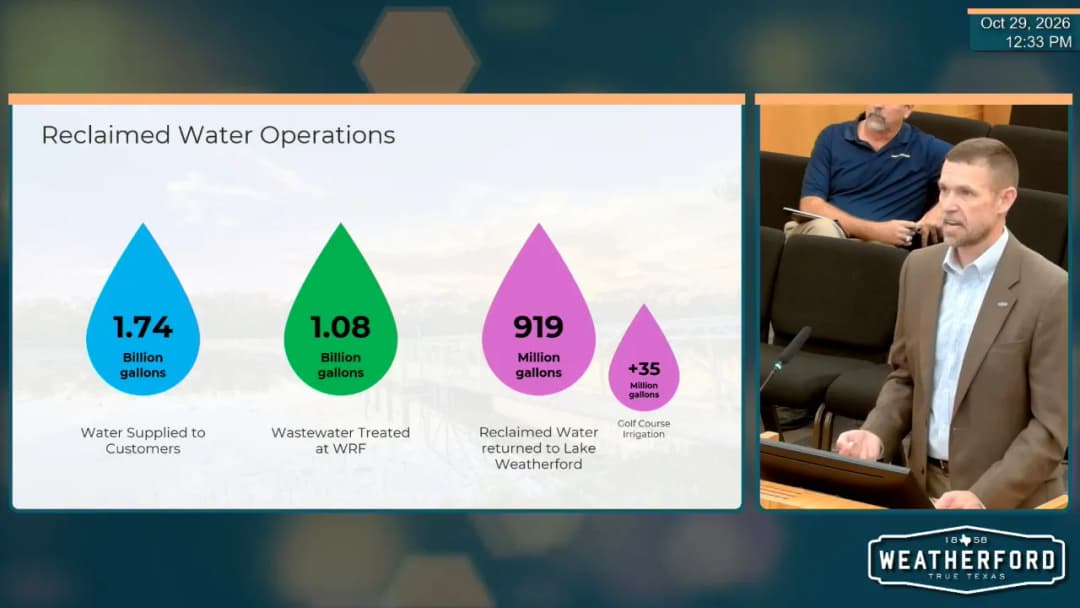
The Weatherford Municipal Utility Board held a regular and executive session meeting on October 29, 2026, at Weatherford City Hall. Mayor Paul Paschall was absent. The meeting was called to order at approximately 12:03 PM and adjourned at 1:15 PM. Presentations & Proclamations - Service Awards: The board recognized four employees: Josh Clements (Electric Warehouse, 10 years), Nick Benson (Public Works Engineering, 10 years), Valerie Escobelle (Utility Billing Manager, 10 years), and Rosa Palacios (Service Center, 30 years). - Take Back Meds Update: The 24th semiannual event collected 378 pounds of medication and 183 pounds of sharps. The city has collected over 10,000 pounds of medication since the program's creation. Consent Calendar The board approved the following items (6A-6G) with a single motion as routine business: - Authorized laboratory equipment and maintenance services from Hach Company and HD Supply (up to $200,000). - Awarded Bid No. 2026-020 to Evoqua Water Technologies, LLC. - Authorized professional services from Schneider Engineering for energy management consulting (up to $274,000). - Authorized expenditures with Anixter, Inc., Texas Electric Cooperatives, Inc., Techline, Inc., and Wesco Distribution, Inc. (up to $4 million). - Authorized pole attachment engineering services from TechServ Consulting (up to $200,000). - Authorized expenditure with Thirkettle Corporation (up to $1 million) through a cooperative agreement. - Renewed a utility forestry services contract with Northeast Service (dba Horton Tree Services) (up to $500,000). Discussion Items - Electric Line Construction Labor (Item 6H): The board approved the award of RFP 2026-017 for annual electric line construction labor to B&L Pole Line Construction Company as the primary vendor, with Last Call Line Services, Source Power, and Revolution Power as alternates (up to $1.5 million). Board Member Rod White asked about the purpose of the multiple alternates. Staff explained the alternates are a critical contingency for disaster response, and the bid tabulation process ensures the lowest available qualified vendor is used. - Water Purification Plant Expansion (Item 7A): The board approved Guaranteed Maximum Price (GMP) 4 for the Dr. Paul Phillips Water Purification Plant expansion to 18 MGD, increasing the total contract value to $96,856,978.55. GMP 4, valued at $43.88 million, includes a new raw water pump station and 36-inch raw water pipeline. Director Rick Shaffer reported that the price reflects a $3.2 million reduction from original bids due to negotiated fee reductions and the carryover of contingency funds from Phase 2, which is trending $2 million under budget. Construction on Phase 3 is scheduled to begin November 3, 2026, with completion expected in June 2029. - Annual Performance Dashboard (Item 8A): Directors Joe Farley (Electric) and Rick Shaffer (Water) presented the annual utility report. Electric rates have remained at 13 cents per kWh for 48 months, averaging 39% below the national average. System reliability numbers (CAID and SAID) were slightly above target due to major substation outages in February. Water rates remain 21% below the local average. The water loss rolling average is 11% (target 10%). An aerial leak detection program identified 50 leaks, saving an estimated 121 million gallons of water. The reclaimed water program returned 919 million gallons of treated water to Lake Weatherford, roughly a 50% return rate of water drawn from the lake. - Executive Session (Item 11A): The board recessed into executive session to discuss a Qualified Scheduling Service (QSE) agreement under the competitive matters exemption. Upon reconvening, the board approved a motion to authorize the City Manager to execute the QSE agreement and a credit agreement with Guidepost Energy LLC. Key Outcomes - The consent agenda (Items 6A-6G) was approved unanimously. - Electric line construction labor services were awarded to B&L Pole Line and three alternates (Item 6H). - GMP 4 for the water plant expansion was approved, setting the total project contract at $96.86 million (Item 7A). - The City Manager was authorized to execute agreements with Guidepost Energy LLC for qualified scheduling services (Item 11A). - Future performance dashboard updates will be provided to the board as written memos.
The Mesa City Council held a study session on October 29, 2026, to discuss proposed changes to the Large Water User Ordinance and an updated Water Shortage Management Plan. The meeting also included review of the upcoming November 2 council meeting agenda, brief remarks on historic preservation guidelines, and acknowledgment of board minutes. Consent Calendar - Council unanimously approved receipt of board minutes (item 3). Discussion Items Agenda Review for November 2 Council Meeting - City Manager Butler noted that item 4C (McFlood) currently displayed placeholder language that would be updated later in the day with corrected numbers from Maricopa County. Council also corrected a district designation error on item 4A. The council agreed to postpone the historic preservation guidelines and text amendments presentation to the Monday study session to allow for better public viewing, with Councilmember Taylor expressing support for the simplified new handbook and noting it clarifies that the overlay can be declined by property owners. Large Water User Ordinance Enhancements - Water Resources Director Joe Judice, Kathy McDonald, Lauren Whitaker, and Nicole Petker presented recommended enhancements to the Large Water User Ordinance (adopted 2019, updated 2024). Proposed changes include lowering the demand ceiling from 330 acre-feet to 224 acre-feet, aligning with Phoenix and Tucson. Mayor and staff emphasized that Mesa has had no new water-cooled data centers since 2021; only two exist in Mesa. The ordinance has driven innovation among large users, including advanced cooling treatment and air-cooling technologies. - The proposal expands allowable water resources customers can bring to meet allowance requirements (currently only long-term storage credits) to include groundwater rights and other acceptable supplies. A conservation plan would be required with permit applications. Permit terms could be adapted (3, 5, or 10 years), with longer terms requiring the user to provide water for the demand ceiling as well. Schools and hospitals remain excluded; landscape irrigation meters for excluded uses are still subject to the ceiling. - Councilmembers discussed flexibility options: Councilmember Duff inquired about smart meters and rebates for schools (staff noted non-residential irrigation equipment rebates exist); Councilmember Adams asked about groundwater rights mechanics; Councilmember Taylor questioned how business expansions are handled (demand ceiling not increased; allowance adjusted). Mayor proposed that council should have voting oversight when large users seek to increase their allowance beyond the ceiling. City Attorney Smith confirmed staff is developing details and will return for ordinance adoption later in fall 2026. - Vice Mayor raised concerns about externalities of air-cooling (noise, heat island effects) and chemical discharges into wastewater. Councilmember Duff emphasized the need for innovation funding and federal/state help for expensive water infrastructure. Councilmember Heredia suggested exploring whether customers could pay for infrastructure instead of providing credits, but staff noted capacity fee legislation now falls under impact fee statute. Water Shortage Management Plan Update - Nicole Petker presented an updated framework for Mesa's Water Shortage Management Plan, moving from single-source shortage planning to a portfolio-based evaluation. The framework uses four stages (currently Stage 1: awareness and voluntary efficiencies). Key principles: protect essential services first, act proportionately, communicate clearly, and adapt based on performance. The plan does not automatically trigger mandatory responses; it allows voluntary, phased, or mandatory measures depending on severity. - Examples of potential savings measures (from independent consultant) include AMI leak alerts, landscape optimization, watering schedules, and winter overseeding limits. Staff emphasized they would not impose all measures at once; they would start with communication and voluntary actions. - Council discussed HOA and community engagement. Councilmember Duff asked about adding a water rate surcharge for HOAs while considering differentiating useful vs. ornamental turf. Joe Judice confirmed they are working on rate proposals and will discuss with council in a few weeks. Councilmember Taylor raised the citrus sub-area plan requiring high-water-use orange trees; City Manager agreed to work with planning on options to allow replacement with lower-water-use plants. Councilmember Duff requested a community survey to gauge preferences on conservation measures, which staff supported. Councilmember Heredia noted the need for community input on potential restrictions like winter overseeding. Key Outcomes - Staff will return later in fall 2026 for ordinance adoption on both the Large Water User Ordinance updates and the Water Shortage Management Plan. - Council asked that future proposals include details on council oversight for large allowances and on community input (e.g., survey) regarding conservation measures. - The City Manager indicated the team will review landscape requirements for citrus grove areas to allow HOA flexibility for water conservation. - The next study session is scheduled for Monday, November 2, 2026, with a council meeting at 5:45 PM; the November 5 study session is canceled. Current Events & Future Meetings - Councilmembers reported on attended events: Youth Climate Action Fund ($50,000 from Bloomberg Philanthropies), One Community spotlight on success, Virgin Galactic's first Delta rocket departure from Mesa Gateway Airport, Halloween event at Red Mountain Library, ASU flight simulator tour, and semiconductor industry roundtable. City Manager noted six strong candidates for fire chief are being interviewed. - No further business; meeting adjourned.
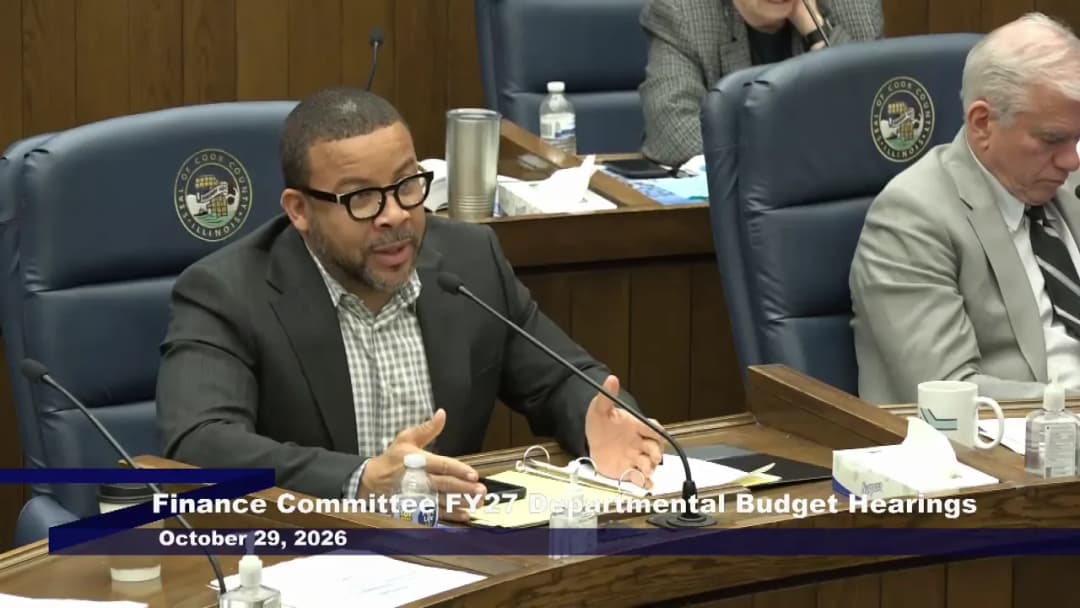
The Cook County Board Finance Committee, chaired by Chairman Daly, convened on October 29, 2026, to review the Fiscal Year 2027 budget request for the Cook County Clerk's Office. Clerk Monica Gordon presented the budget, highlighting the upcoming November 3rd election, technological improvements, and significant challenges with the Tyler property tax system. Commissioners engaged in detailed questioning on election integrity, budget line items, and vendor accountability. Discussion Items - Clerk's FY2027 Budget Presentation & Election Update: Clerk Gordon presented the budget, emphasizing investments in in-house technology, such as the clerk recording system. She reported that as of that morning, more than 157,000 residents had cast early ballots and nearly 84,000 mail ballots had been returned. The clerk's office serves 1.7 million registered voters in suburban Cook County. She described the Tyler project as the office's most significant operational challenge, noting critical defects remain unresolved as the December 15th tax sale approaches. - Election Security and Misinformation: Commissioners Degman, Naya, and Morrison raised concerns about election equipment reliability, potential federal presence at polls, and the spread of misinformation. Clerk Gordon and Deputy Clerk Ed Michaelowski detailed safeguards, including the election lens real-time analytics platform, paper ballot backups, and a clear chain of command requiring election judges to report incidents to an election center. Commissioner Degman directly questioned a claim about voting machines flipping votes, which Deputy Clerk Michaelowski stated is impossible with the county's equipment. Clerk Gordon declared misinformation the biggest threat to democracy. - Tyler Technologies System Failures: Significant discussion focused on the Tyler property tax system. Deputy Clerk Carolyn Ellaby outlined that Tyler must fix 17 specific defects by a November 13th checkpoint meeting to meet the December 1st go-live deadline. Of the 60 total defects, 43 need resolution. If these benchmarks are not met, the office will build workarounds for the December 15th tax sale. The Clerk's office has assumed project management to hold Tyler accountable. Commissioner Britton requested that Tyler Technologies attend a future committee meeting, which Chairman Daly confirmed. - Budget Line Item Questions: - Staffing: Deputy Clerk Christina Saldana clarified that an apparent reduction of seven customer service positions was a realignment to a special purpose fund. The net loss of four positions were all previously vacant, and the office is actively hiring for one customer service position in real estate. - Moving Expenses: A $740,000 increase on line J3 was attributed to the upcoming municipal elections and rising contractor costs. - Overtime: The overtime budget decreased because Tyler system testing costs were not expected to continue into FY2027. - Maintenance Subscriptions: A $1.4 million increase on page J2 was explained by the Bureau of Technology distributing the operating costs of the Tyler system across county agencies, charging the Clerk's office that portion. - Community Outreach and Youth Engagement: Commissioners Britton, Scott, McCask, and Naya praised the Clerk's outreach initiatives. The 'Defenders of Democracy' program, which trains high school students as election judges, has expanded to 27 schools and won national awards. A new early voting site in Wheeling was highlighted as highly successful. Commissioner Naya acknowledged the 'Love Purse' initiative for domestic violence survivors, which collected 432 purses. Key Outcomes - Directive for Vendor Accountability: Chairman Daly and Commissioner Britton directed that representatives from Tyler Technologies must attend an upcoming committee meeting to answer questions regarding the contract and persistent system defects. - Firm Benchmarks Established: The Clerk's office set a strict November 13th deadline for Tyler to resolve 17 critical defects, with a final decision point on November 24th. Failure to meet these benchmarks removes the possibility of going live on the system by December 1st. - Contractual Protections: The Clerk's office confirmed that the upcoming contract amendment with Tyler includes provisions to withhold payment for modules until they are fully functional. - Budget Amendment Planned: The Clerk's office will bring a budget amendment reflecting updated revenue projections to absorb higher turnover costs while maintaining direct customer service capacity.
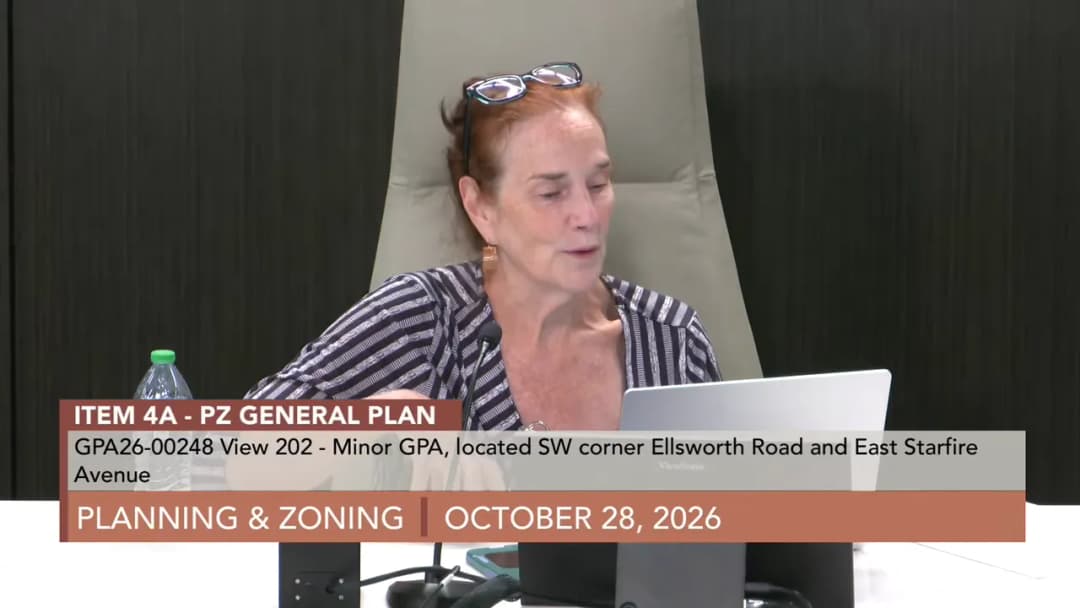
This meeting of the City of Mesa Planning and Zoning Board covered a consent agenda with multiple items, a separate vote on a site plan modification, and a general plan amendment with associated rezoning. Chairperson Peterson presided; Vice Chair Pitcher recused himself from one item. All motions passed with unanimous support except where noted. Consent Calendar - Item 2A: Approved the minutes from the October 14, 2026 Planning and Zoning Board meeting. - Item 3A (ZON 26-00129): Rezoning of 21.8 acres (2,450 feet west of South Ellsworth Road and East Starfire Avenue) from Light Industrial with PAD overlay to Light Industrial and site plan review, to allow a battery energy storage system facility. Staff recommendation: approval with conditions. Passed. - Item 3C (ZON 25-00660): Special use permit and site plan review for a 37-acre site at the southwest corner of East Williamsfield Road and the 24 Gateway Freeway, permitting a 360,895-square-foot group commercial center. Staff recommendation: approval with conditions. Passed. - Item 3E (ZON 26-00614): Rezoning of 35.3 acres (northeast corner of East Pecos Road and South Sossaman Road) from Employment Opportunity to Light Industrial with PAD overlay, for modifications to an existing industrial development. Staff recommendation: approval with conditions. Passed. - The consent agenda was voted on as a single block and passed unanimously. Public Comments & Testimony - No members of the public submitted blue cards or spoke during the public hearing. The public hearing for Item 4A was formally opened and closed with no testimony. Discussion Items - Item 3D (ZON 26-00217): A request for a major site plan modification on 4.5 acres approximately 250 feet north of the northeast corner of El Vista Drive and East Southern Avenue, to allow a 2,200-square-foot minor auto repair facility. Vice Chair Pitcher recused himself because the applicant was a client. The Board moved to approve with conditions. Vote: 6 in favor, 0 opposed, 1 abstention (Pitcher). - Items 4A and 4B (GPA 26-00248 and associated rezoning): Agenda items considered together. - 4A (GPA 26-00248): Minor General Plan Amendment for 21.6 acres at the southwest corner of South Ellsworth Road and East Starfire Avenue, changing the place type from Urban Residential (Evolved Growth Strategy) to Local Employment Center (Evolved Growth Strategy). - 4B: Rezoning the same 21.6 acres: 17.1 acres from Multiple Residence with PAD overlay and Limited Commercial with PAD overlay to Light Industrial with PAD overlay; and 4.5 acres from RM4-PAD and LC-PAD to Limited Commercial with PAD overlay, plus a council use permit for future industrial/commercial development. - Chairperson Peterson expressed concern that the area is dominated by single-use zoning and that residents may need to drive one to two miles for commercial services, creating future traffic congestion. Staff responded that numerous commercial projects (Hawes Crossing, Legacy, Gateway Crossing, East Market, etc.) are approved or under development in the broader Eastmark area, and that the proposal focuses on land-use compatibility (surrounded by industrial uses). After discussion, the Board voted unanimously to recommend approval to City Council with conditions. Key Outcomes - Consent agenda and Items 3D, 4A, and 4B all received recommendations for approval from the Board, with Item 3D passing 6-0-1 (one abstention). - The Board directed staff to consider broader network traffic impacts and the need for proximate commercial services when reviewing future zoning cases. - Chairperson Peterson announced a study session later that evening (October 29 at 6:00 PM) with a video link to be provided. - The meeting adjourned unanimously.
The Spokane Valley Land Use Hearing Examiner, Jay Istone, convened a public hearing at 9:02 AM on October 29, 2026, to consider four subdivision applications: Cooper Subdivision (SUB-2026-0005), Peak Homes Subdivision (SUB-2026-0008), Evergreen Road Subdivision (SUB-2026-0009), and 12th Avenue Subdivision (SUB-2026-0010). The examiner reviewed staff reports, applicant testimony, and public comments for each proposal. Written decisions will be issued within 20 calendar days following the hearing. Cooper Subdivision (SUB-2026-0005) - Project Description: 30-lot subdivision on 1.94 acres in the multifamily residential zone, featuring townhouses and duplexes accessed by two new private streets. Applicant: Matt Kelly (Simpson Engineers, Inc.) on behalf of Cooper Living Trust. - Staff Presentation: Adam Knight (City Planner) recommended approval with conditions, noting the project is consistent with zoning and comprehensive plan requirements. A mitigated determination of non-significance (MDNS) was issued on September 23, 2026. He clarified a setback discrepancy (flanking street setback should be 5 feet for private street, not 15 feet). - Applicant Position: Mr. Kelly expressed full support, emphasizing the project provides affordable ownership opportunities (condos/duplexes) rather than apartments, aligning with community housing needs. - Public Comments: One written comment from Todd Ziff raised concerns about traffic at the Sprague & Tschirley intersection and safety for the Spokane Valley Trail crossing. He noted 400+ apartments being built nearby, adding up to 800 cars. The applicant responded that traffic concurrency was issued, and a sidewalk connection to the Appleway Trail is proposed. - Examiner Questions: Inquired about traffic concurrency (7 net new PM trips reserved) and the city’s housing need (planning for 16,600 new units over 20 years). Staff indicated the project is in a fee impact area. The evidentiary record was kept open until end of day for a clarifying note from traffic engineering. Peak Homes Subdivision (SUB-2026-0008) - Project Description: 11-lot subdivision on 1.63 acres in single-family residential zone (R3), with two new private roads (East 7th Lane and South Donwood Court). Owner/Applicant: Peak Homes and Development LLC (Daniel Stefaglo). - Staff Presentation: Adam Knight recommended approval. The project density is 7 dwelling units per acre (max allowed: 8). A portion of the site was acquired for the 8th & Barker roundabout project. No public comments were received. - Applicant Position: Engineer Mamdouh Elarag testified on behalf of the owner, confirming agreement with staff’s factual statements and conditions of approval, and requesting approval. - Examiner Questions: Confirmed the city’s 20-year housing plan (16,600+ units) and the city’s role in zoning, not building. No further issues raised. Evidentiary record closed immediately. Evergreen Road Subdivision (SUB-2026-0009) - Project Description: 17-lot subdivision on 2.47 acres in single-family residential zone (R3), with two new private streets (South Davis Lane and East 11th Lane). Applicant: Matt Kelly for owners Zac Scott & Brian Offield (B&Z Design Group). - Staff Presentation: Brannon McNellis recommended approval with conditions, including a voluntary mitigation agreement for a rectangular rapid flashing beacon at Evergreen & 12th (60% contribution). A public comment during SEPA led to this mitigation. - Applicant Position: Mr. Kelly supported the project, stating it meets code and addresses housing needs. He defended the private street design to achieve desired density and community feel. - Public Comments: - Svetlana C. (written) opposed the density (17 lots on 2.5 acres), citing concerns about increased traffic, taxes, water pressure, and loss of neighborhood spaciousness. - Lindsay Taylor (oral) testified that traffic on 12th & Evergreen has significantly increased over her 18 years living nearby, and a nearby active fire station adds to the issue. - Examiner Questions: Confirmed housing need figures and the role of the voluntary mitigation agreement. No rebuttal requested. Evidentiary record closed. 12th Avenue Subdivision (SUB-2026-0010) - Project Description: 12-lot subdivision on 2.36 acres in single-family residential zone (R3), with one public street (South Mamer Road stub and cul-de-sac) and one private street (South Mamer Lane). Applicant: Matt Kelly for owners Zac Scott & Brian Offield. - Staff Presentation: Brannon McNellis recommended approval with conditions, noting a voluntary mitigation agreement for 40% contribution to the same rectangular rapid flashing beacon. Development engineering raised multiple design issues (e.g., 15-degree skew at intersection, cul-de-sac radius, fence line alignment, side lot lines not radial). Staff believes these can be resolved in final plat. - Applicant Position: Mr. Kelly expressed confidence in working with engineering to address all conditions, stating the 15-degree skew is within design standards (up to 15 degrees allowed). He explained the private street allows for better lot utilization in a narrow parcel. - Public Comments: - Mark & Stephanie Felgenhauer (written and oral) expressed concerns about loss of mature trees (chain-link fence from 1974), privacy, potential two-story homes, and property line accuracy. They requested a one-story height limit adjacent to their property. The applicant noted the fence is about 6 inches inside the development side and that trees may not be preserved. - Hal & Charlotte Mullah (written) opposed the subdivision due to increased traffic, privacy loss, garbage pickup, and lack of a traffic light at 12th & Evergreen. Applicant cited traffic concurrency and stop sign plans. - Examiner Questions: Discussed engineering conditions in detail, including the requirement for the public street to be perpendicular to 12th Avenue and the need for a full cul-de-sac. Applicant believes modifications will be minor (e.g., reducing skew to 10 degrees). The examiner noted the applicant does not agree with the condition prohibiting the 15-degree skew but is open to negotiation. Evidentiary record closed. Key Outcomes - No final decisions were made at the hearing. The hearing examiner will issue written decisions for each subdivision within 20 calendar days (by approximately November 18, 2026). - For SUB-2026-0005, the evidentiary record was kept open until the end of the day to receive a written clarification from traffic engineering regarding the concurrency certificate and reserved trips. - All other records were closed at the hearing. - Appeals of the examiner’s decisions may be filed with Spokane County Superior Court within 21 days after issuance.
The Syracuse Board of Zoning Appeals met on October 29, 2026, to hold public hearings on two area variance requests. The board voted to approve both requests. One board member recused herself from the second application because she works for the Greater Syracuse Land Bank, the applicant. No agenda or minutes were provided with the source material; this summary is based solely on the raw transcript. Near the end of the meeting, a board member noted that it was almost 2:00 p.m. Minutes Approval - The board approved the minutes from the October 8, 2026 meeting after a motion and second. No one opposed, but one member abstained. Public Comments & Testimony - For the Norman Avenue fence variance, no members of the public spoke for or against the request. - For the 229 Orlando Avenue variance, no one spoke in favor. Three nearby residents spoke in opposition: - Sarah Hill, 160 Monticello Drive North, opposed the 10-foot setback, saying it was too close to the street, would block sight lines at the three-way stop, and that speeding and stop-sign violations are already a problem. She also said the house was too large for the lot and that she received notice only two days before the meeting. - Kathy Stribly, 316 Monticello Drive North, raised drainage and flooding concerns, stating the area has no storm sewer infrastructure, the corner site receives runoff from the neighborhood, and a previously undergrounded spring had caused flooding. She also described cut-through traffic problems and said the applicant should go back to the drawing board. - Jeanette Davis, 200 North Monticello Drive, who said she has lived nearly 50 years directly across from the proposed site, opposed moving the house closer to the corner, citing traffic dangers, pets killed by traffic over the years, and major water problems. Discussion Items Area Variance 2026-20 – Six-Foot Fence on Norman Avenue - The applicant, addressed by the board as Griff, requested an area variance to install a six-foot white vinyl privacy fence on a corner lot. The applicant stated that a standard four-foot fence was inadequate because the household's 50-pound mixed-breed dog Baxter can clear it, and the household also fosters rescue dogs. - The applicant explained that moving the fence inward to comply with the setback was blocked by an existing deck and a mature tree and would cost about 500 square feet of usable yard. The fence would be placed about two feet outside the existing chain-link fence and about 30 to 34 feet from the road edge. A petition signed by nine neighbors was submitted. - The applicant said wireless or GPS fencing was not trusted, chain-link was rejected because dogs can climb it, and colored vinyl was not considered because of cost. Board members discussed alternatives such as a trellis, planting in front of the fence, or reducing the encroachment, but did not require landscaping. - The board found no undesirable change to neighborhood character and no substantial adverse effect. The motion to approve included the staff condition that proper permits be obtained before any work. The motion passed. Area Variance B-2026-24 – 229 Orlando Avenue / North Monticello Drive - Luke Avery Doherty of the Greater Syracuse Land Bank, 1941 South Salina Street, presented the request for a variance from the required 25.4-foot front setback to a 10-foot setback on the North Monticello Drive side of the vacant corner lot. The lot slopes down on its western edge, requiring a 14-foot side setback, and the proposal is a three-bedroom, two-bath manufactured home on a slab, priced at $215,000. - The applicant argued that the only alternative would be a large retaining wall and extensive fill, which would be disruptive and financially infeasible. The proposed design was chosen to fit the neighborhood's bungalows and Cape Cods, and the land bank planned to repair the existing retaining wall and install gutters to manage runoff. - Board discussion acknowledged that traffic and drainage issues are broader neighborhood concerns, but several members did not see the requested setback as the cause of those problems. One member noted the project's structural coverage of 31.7 percent exceeds the R-1 zone's 30 percent maximum, which is handled by a separate zoning administrator adjustment. Another member said the difficulty was partly self-created because the house model was selected before the site was studied in detail, but found three of the five variance factors passing. - The board approved the variance with two conditions: the building must maintain a minimum 10-foot front setback along North Monticello, and before a building permit is issued the applicant must obtain a zoning administrator adjustment for the 31.7 percent structural coverage or revise the site plan to comply with the 30 percent limit. Key Outcomes - Approved Area Variance 2026-20 for the six-foot fence on Norman Avenue, with the condition that proper permits be obtained before work begins. - Approved Area Variance B-2026-24 for the 10-foot front setback at 229 Orlando Avenue / North Monticello Drive, with conditions regarding the minimum setback and the structural coverage adjustment. - The second motion passed with all four voting members in favor; the recused board member did not participate, and no one voted against or abstained. A procedural question was raised that, with four voting members remaining, all four affirmative votes were needed for a majority of the full board. - Board members encouraged city planning and engineering staff to address the neighborhood-level traffic and stormwater concerns raised during the hearing.
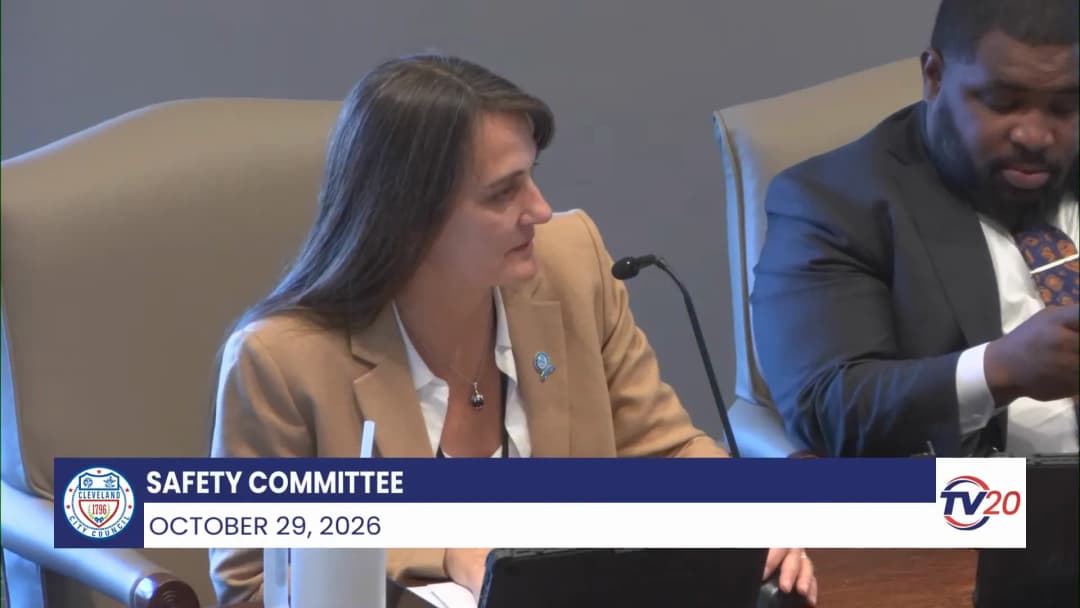
The Cleveland City Council Safety Committee, chaired by Councilman Michael Polinsick, convened at approximately 4:54 PM on October 29, 2026, for an operational review of four key police accountability and oversight bodies: the Community Police Commission (CPC), the Community Relations Board (CRB), the Police Accountability Team (PAT), and the Civilian Police Review Board/Office of Professional Standards (CPRB/OPS). The presentations detailed progress, challenges, and budget requests ahead of the 2027 budget process. Staffing, consent decree compliance, community engagement, and the conflict between the City Charter and the police union contract were recurring themes. The meeting adjourned after 6:00 PM. Community Police Commission (CPC) - Executive Director Shalina Williams reported rebuilding the office from one employee in January 2026 to a fully staffed team of eight. She highlighted the clearance of policy and grant backlogs, the first commander promotion interviews in two years, and technical progress on records access. - Assistant Director Timothy Scott described aligning each current and requested position to specific consent decree and charter duties. He noted that Detroit’s police oversight board operates with 43 employees and a $4.7 million budget, and requested additions including a compliance officer, an investigator, a second community engagement coordinator, and policy fellows. - Grants Administrator Lisa Johnson stated that the 2023–2024 grant backlog fell from $388,000 to $57,261 (over 80% resolved), and $508,147 has been disbursed. The 2026–2028 cycle will award $1.2 million through a three‑tier structure (grassroots $25,000, building momentum $47,000, high impact $75,000) to 20 organizations. - Community Engagement Coordinator Wally Sharif reported participating in 30 meetings and reaching over 350 individuals in his first month, covering 60% of Cleveland wards. - Marketing Manager Sean Shapiro reported 50 YouTube uploads, 13 press releases, and 75,000 Facebook views year‑to‑date. - Councilman Richard Starr challenged the lack of Cleveland residents on the CPC’s paid staff; Director Williams acknowledged the gap and committed to a written recruitment plan. Councilman Starr also requested that the CPC coordinate with the safety committee on ALPR policy. - Councilman Charlie Slife questioned the effectiveness of spreading grant dollars among many small organizations and asked about outcome monitoring. The CPC described new internal controls including site visits and mandatory in‑person check pickup. - Councilwoman Stephanie House Jones proposed quarterly joint meetings between the Safety Committee and the CPC; Chairman Polinsick indicated openness. - The CPC has not conducted any disciplinary hearings due to a conflict between the City Charter and the police union contract (CBA). Director Williams reported that negotiations are ongoing, and the commission hopes to gain earlier involvement in the discipline process. - Two commissioners (Adriano Rodriguez and Luther Roddy) are chronically absent; both terms are expiring. Seven of 13 commissioners are rotating off; only one requested reappointment. - The commission lacks direct access to full police disciplinary case files; it currently receives only pre‑disciplinary and final discipline letters automatically. Community Relations Board (CRB) - Executive Director Angela Shu Woodson stated the CRB operates with 19 staff and five vacancies (four currently posted). The 2027 budget requests a 2% increase ($60,000) mainly for cost‑of‑living adjustments, with a realignment from contractual services to materials and supplies for community outreach. - Fiscal Manager Raymond McDaniel noted unfavorable variances in separation payments (369% over budget), travel (122% over), and property rental (over 100% due to off‑site space). He is conducting a deeper analysis to verify charges. - The CRB oversees district representatives, outreach specialists, cultural liaisons, and youth diversion. The PAST police‑diversion pilot received 18 referrals since January 2026, primarily from the third (8) and fourth (5) districts. - The office engaged 2,219 youth and conducted 1,002 one‑on‑one interventions; high school fights in CRB‑staffed schools decreased 40%. - Councilman Kevin Conwell urged the CRB to require grant recipients to report individual outcomes and to increase presence at ward meetings. He also suggested stationing CRB staff in recreation centers. - Councilwoman House Jones called for a dedicated downtown liaison, noting the burden on current district representatives. The director agreed but said resources are insufficient. Police Accountability Team (PAT) - Executive Director Dr. Lee Anderson and Performance Auditor Hannah Rose provided an update on consent decree compliance. The 19th semi‑annual report (January–June 2026) awarded 11 upgrades. - Use of Force Assessment (filed February 4, 2026): 75 upgrades, 4 downgrades; 97% of reviewed incidents were deemed necessary, proportional, and reasonably objective. - Inspector General Assessment (September 2026): 6 upgrades. - Data Collection & Analysis Assessment (October 15, 2026): 3 upgrades. - Discipline Assessment (filed October 25, 2026): 9 upgrades, achieving the highest level of compliance for all nine city‑assigned paragraphs. - According to Dr. Anderson, only 22 of the 343 operational consent decree paragraphs remain in non‑compliance. Councilman Slife requested a complete inventory distinguishing non‑compliance from not‑yet‑assessed areas. - PAT is partnering with Kent State University on a community trust survey (501 residents started, 6 of 10 focus groups completed) and has secured no‑cost technical assistance for supervisory training and coordination among oversight agencies. Civilian Police Review Board (CPRB) & Office of Professional Standards (OPS) - Chair Brandon Brown and Administrator Jeff Weninger (former LAPD lieutenant) presented operational data and a planned reorganization. - OPS has 16 staff, including 8 investigators (budgeted for 10) and 1 senior investigator (budgeted for 3). Five staff reside in Cleveland. - The office is on track for 277 complaints in 2026 (up from 242 in 2025). 409 cases are active, 19 are in referred status, and approximately 100 await board adjudication. - Average investigation length is 295 days; discipline implementation averages 133 days. - Of 124 bias policing allegations (2022–2026), only one was sustained (the officer resigned). The most common allegation categories are lack of service, unprofessional behavior, and improper procedure. Allegations of excessive force and bias policing have declined since 2024. - Board activity increased 40% year‑over‑year, with 560 allegations heard across 144 cases. - Administrator Weninger is restructuring OPS into three units (preliminary, primary, and review) to enhance quality control and efficiency. He has also changed policy to continue investigations even when officers separate from employment. - A significant barrier is timely records access from the division; OPS is exploring embedding an investigator in police records. - Chairman Polinsick requested a ward‑level breakdown of allegations and clear definitions of allegation categories. Key Outcomes - No formal votes were cast; the operational reviews were informational in preparation for the 2027 budget hearings. - Directives issued during the meeting: - CPC must provide a written plan to recruit and retain Cleveland residents on staff (Councilman Starr). - CRB must submit a list of contracted violence prevention organizations, funding amounts, and the neighborhoods they serve (Chairman Polinsick). - PAT must supply a complete list of consent decree paragraphs in non‑compliance, with a clear indication of which have been assessed (Councilman Slife). - CPRB/OPS must break down complaints by ward and explain allegation categories (Chairman Polinsick). - Other next steps: - The Safety Committee and CPC are expected to establish a joint quarterly meeting schedule, as proposed by Councilwoman House Jones. - CPC will continue negotiations with the police division, law department, and union to resolve the charter–CBA conflict and achieve direct records access. - The federal consent decree remains in place; the monitoring team is projected to remain for at least two more years. The PAT will present a compliance update to council.