The Syracuse Board of Zoning Appeals met on October 29, 2026, to hold public hearings on two area variance requests. The board voted to approve both requests. One board member recused herself from the second application because she works for the Greater Syracuse Land Bank, the applicant. No agenda or minutes were provided with the source material; this summary is based solely on the raw transcript. Near the end of the meeting, a board member noted that it was almost 2:00 p.m. Minutes Approval - The board approved the minutes from the October 8, 2026 meeting after a motion and second. No one opposed, but one member abstained. Public Comments & Testimony - For the Norman Avenue fence variance, no members of the public spoke for or against the request. - For the 229 Orlando Avenue variance, no one spoke in favor. Three nearby residents spoke in opposition: - Sarah Hill, 160 Monticello Drive North, opposed the 10-foot setback, saying it was too close to the street, would block sight lines at the three-way stop, and that speeding and stop-sign violations are already a problem. She also said the house was too large for the lot and that she received notice only two days before the meeting. - Kathy Stribly, 316 Monticello Drive North, raised drainage and flooding concerns, stating the area has no storm sewer infrastructure, the corner site receives runoff from the neighborhood, and a previously undergrounded spring had caused flooding. She also described cut-through traffic problems and said the applicant should go back to the drawing board. - Jeanette Davis, 200 North Monticello Drive, who said she has lived nearly 50 years directly across from the proposed site, opposed moving the house closer to the corner, citing traffic dangers, pets killed by traffic over the years, and major water problems. Discussion Items Area Variance 2026-20 – Six-Foot Fence on Norman Avenue - The applicant, addressed by the board as Griff, requested an area variance to install a six-foot white vinyl privacy fence on a corner lot. The applicant stated that a standard four-foot fence was inadequate because the household's 50-pound mixed-breed dog Baxter can clear it, and the household also fosters rescue dogs. - The applicant explained that moving the fence inward to comply with the setback was blocked by an existing deck and a mature tree and would cost about 500 square feet of usable yard. The fence would be placed about two feet outside the existing chain-link fence and about 30 to 34 feet from the road edge. A petition signed by nine neighbors was submitted. - The applicant said wireless or GPS fencing was not trusted, chain-link was rejected because dogs can climb it, and colored vinyl was not considered because of cost. Board members discussed alternatives such as a trellis, planting in front of the fence, or reducing the encroachment, but did not require landscaping. - The board found no undesirable change to neighborhood character and no substantial adverse effect. The motion to approve included the staff condition that proper permits be obtained before any work. The motion passed. Area Variance B-2026-24 – 229 Orlando Avenue / North Monticello Drive - Luke Avery Doherty of the Greater Syracuse Land Bank, 1941 South Salina Street, presented the request for a variance from the required 25.4-foot front setback to a 10-foot setback on the North Monticello Drive side of the vacant corner lot. The lot slopes down on its western edge, requiring a 14-foot side setback, and the proposal is a three-bedroom, two-bath manufactured home on a slab, priced at $215,000. - The applicant argued that the only alternative would be a large retaining wall and extensive fill, which would be disruptive and financially infeasible. The proposed design was chosen to fit the neighborhood's bungalows and Cape Cods, and the land bank planned to repair the existing retaining wall and install gutters to manage runoff. - Board discussion acknowledged that traffic and drainage issues are broader neighborhood concerns, but several members did not see the requested setback as the cause of those problems. One member noted the project's structural coverage of 31.7 percent exceeds the R-1 zone's 30 percent maximum, which is handled by a separate zoning administrator adjustment. Another member said the difficulty was partly self-created because the house model was selected before the site was studied in detail, but found three of the five variance factors passing. - The board approved the variance with two conditions: the building must maintain a minimum 10-foot front setback along North Monticello, and before a building permit is issued the applicant must obtain a zoning administrator adjustment for the 31.7 percent structural coverage or revise the site plan to comply with the 30 percent limit. Key Outcomes - Approved Area Variance 2026-20 for the six-foot fence on Norman Avenue, with the condition that proper permits be obtained before work begins. - Approved Area Variance B-2026-24 for the 10-foot front setback at 229 Orlando Avenue / North Monticello Drive, with conditions regarding the minimum setback and the structural coverage adjustment. - The second motion passed with all four voting members in favor; the recused board member did not participate, and no one voted against or abstained. A procedural question was raised that, with four voting members remaining, all four affirmative votes were needed for a majority of the full board. - Board members encouraged city planning and engineering staff to address the neighborhood-level traffic and stormwater concerns raised during the hearing.
The Public Meeting Index
The Public Meeting IndexThe Cleveland City Council Safety Committee, chaired by Councilman Michael Polinsick, convened at approximately 4:54 PM on October 29, 2026, for an operational review of four key police accountability and oversight bodies: the Community Police Commission (CPC), the Community Relations Board (CRB), the Police Accountability Team (PAT), and the Civilian Police Review Board/Office of Professional Standards (CPRB/OPS). The presentations detailed progress, challenges, and budget requests ahead of the 2027 budget process. Staffing, consent decree compliance, community engagement, and the conflict between the City Charter and the police union contract were recurring themes. The meeting adjourned after 6:00 PM. Community Police Commission (CPC) - Executive Director Shalina Williams reported rebuilding the office from one employee in January 2026 to a fully staffed team of eight. She highlighted the clearance of policy and grant backlogs, the first commander promotion interviews in two years, and technical progress on records access. - Assistant Director Timothy Scott described aligning each current and requested position to specific consent decree and charter duties. He noted that Detroit’s police oversight board operates with 43 employees and a $4.7 million budget, and requested additions including a compliance officer, an investigator, a second community engagement coordinator, and policy fellows. - Grants Administrator Lisa Johnson stated that the 2023–2024 grant backlog fell from $388,000 to $57,261 (over 80% resolved), and $508,147 has been disbursed. The 2026–2028 cycle will award $1.2 million through a three‑tier structure (grassroots $25,000, building momentum $47,000, high impact $75,000) to 20 organizations. - Community Engagement Coordinator Wally Sharif reported participating in 30 meetings and reaching over 350 individuals in his first month, covering 60% of Cleveland wards. - Marketing Manager Sean Shapiro reported 50 YouTube uploads, 13 press releases, and 75,000 Facebook views year‑to‑date. - Councilman Richard Starr challenged the lack of Cleveland residents on the CPC’s paid staff; Director Williams acknowledged the gap and committed to a written recruitment plan. Councilman Starr also requested that the CPC coordinate with the safety committee on ALPR policy. - Councilman Charlie Slife questioned the effectiveness of spreading grant dollars among many small organizations and asked about outcome monitoring. The CPC described new internal controls including site visits and mandatory in‑person check pickup. - Councilwoman Stephanie House Jones proposed quarterly joint meetings between the Safety Committee and the CPC; Chairman Polinsick indicated openness. - The CPC has not conducted any disciplinary hearings due to a conflict between the City Charter and the police union contract (CBA). Director Williams reported that negotiations are ongoing, and the commission hopes to gain earlier involvement in the discipline process. - Two commissioners (Adriano Rodriguez and Luther Roddy) are chronically absent; both terms are expiring. Seven of 13 commissioners are rotating off; only one requested reappointment. - The commission lacks direct access to full police disciplinary case files; it currently receives only pre‑disciplinary and final discipline letters automatically. Community Relations Board (CRB) - Executive Director Angela Shu Woodson stated the CRB operates with 19 staff and five vacancies (four currently posted). The 2027 budget requests a 2% increase ($60,000) mainly for cost‑of‑living adjustments, with a realignment from contractual services to materials and supplies for community outreach. - Fiscal Manager Raymond McDaniel noted unfavorable variances in separation payments (369% over budget), travel (122% over), and property rental (over 100% due to off‑site space). He is conducting a deeper analysis to verify charges. - The CRB oversees district representatives, outreach specialists, cultural liaisons, and youth diversion. The PAST police‑diversion pilot received 18 referrals since January 2026, primarily from the third (8) and fourth (5) districts. - The office engaged 2,219 youth and conducted 1,002 one‑on‑one interventions; high school fights in CRB‑staffed schools decreased 40%. - Councilman Kevin Conwell urged the CRB to require grant recipients to report individual outcomes and to increase presence at ward meetings. He also suggested stationing CRB staff in recreation centers. - Councilwoman House Jones called for a dedicated downtown liaison, noting the burden on current district representatives. The director agreed but said resources are insufficient. Police Accountability Team (PAT) - Executive Director Dr. Lee Anderson and Performance Auditor Hannah Rose provided an update on consent decree compliance. The 19th semi‑annual report (January–June 2026) awarded 11 upgrades. - Use of Force Assessment (filed February 4, 2026): 75 upgrades, 4 downgrades; 97% of reviewed incidents were deemed necessary, proportional, and reasonably objective. - Inspector General Assessment (September 2026): 6 upgrades. - Data Collection & Analysis Assessment (October 15, 2026): 3 upgrades. - Discipline Assessment (filed October 25, 2026): 9 upgrades, achieving the highest level of compliance for all nine city‑assigned paragraphs. - According to Dr. Anderson, only 22 of the 343 operational consent decree paragraphs remain in non‑compliance. Councilman Slife requested a complete inventory distinguishing non‑compliance from not‑yet‑assessed areas. - PAT is partnering with Kent State University on a community trust survey (501 residents started, 6 of 10 focus groups completed) and has secured no‑cost technical assistance for supervisory training and coordination among oversight agencies. Civilian Police Review Board (CPRB) & Office of Professional Standards (OPS) - Chair Brandon Brown and Administrator Jeff Weninger (former LAPD lieutenant) presented operational data and a planned reorganization. - OPS has 16 staff, including 8 investigators (budgeted for 10) and 1 senior investigator (budgeted for 3). Five staff reside in Cleveland. - The office is on track for 277 complaints in 2026 (up from 242 in 2025). 409 cases are active, 19 are in referred status, and approximately 100 await board adjudication. - Average investigation length is 295 days; discipline implementation averages 133 days. - Of 124 bias policing allegations (2022–2026), only one was sustained (the officer resigned). The most common allegation categories are lack of service, unprofessional behavior, and improper procedure. Allegations of excessive force and bias policing have declined since 2024. - Board activity increased 40% year‑over‑year, with 560 allegations heard across 144 cases. - Administrator Weninger is restructuring OPS into three units (preliminary, primary, and review) to enhance quality control and efficiency. He has also changed policy to continue investigations even when officers separate from employment. - A significant barrier is timely records access from the division; OPS is exploring embedding an investigator in police records. - Chairman Polinsick requested a ward‑level breakdown of allegations and clear definitions of allegation categories. Key Outcomes - No formal votes were cast; the operational reviews were informational in preparation for the 2027 budget hearings. - Directives issued during the meeting: - CPC must provide a written plan to recruit and retain Cleveland residents on staff (Councilman Starr). - CRB must submit a list of contracted violence prevention organizations, funding amounts, and the neighborhoods they serve (Chairman Polinsick). - PAT must supply a complete list of consent decree paragraphs in non‑compliance, with a clear indication of which have been assessed (Councilman Slife). - CPRB/OPS must break down complaints by ward and explain allegation categories (Chairman Polinsick). - Other next steps: - The Safety Committee and CPC are expected to establish a joint quarterly meeting schedule, as proposed by Councilwoman House Jones. - CPC will continue negotiations with the police division, law department, and union to resolve the charter–CBA conflict and achieve direct records access. - The federal consent decree remains in place; the monitoring team is projected to remain for at least two more years. The PAT will present a compliance update to council.
The Clarksville City Council met at 4:30 PM on October 29, 2026, in City Council Chambers at 106 Public Square, Clarksville, Tennessee. The agenda was styled as an Executive Session, but the transcript reflects an open council work session. The meeting covered five first-reading zoning ordinances, the consent calendar, finance and public safety reports, and council member comments. No final roll-call votes are recorded in the transcript; several items were brought forward with committee and Regional Planning Commission (RPC) recommendations. Consent Calendar - The clerk read the consent agenda and no council member requested separate consideration. The transcript shows no vote before the meeting moved to the Finance Committee. - Items included: Ordinance 11-2026-27 (second reading) amending the FY 2026-27 Clarksville Police Special Revenue Fund operating budget; Ordinance 15-2026-27 (second reading) amending purchasing and competitive bidding provisions; Resolution 28-2026-27 approving a wine sales certificate for CGS Stores LLC / Casey's 4556, 698 Tiny Town Road; Resolution 29-2026-27 approving a wine sales certificate for The Butcher Company LLC / New York Butcher Shoppe, 2670 Trenton Road; and adoption of the October 1, 2026 minutes. Public Comments & Testimony - No members of the public came forward during the public comment period. Planning Commission Report - RPC Director Jeffrey Tyndall Ordinance 19-2026-27 (Z-30-2026) - Ringgold Road R-1/R-3 to R-2A - Proposed by Anba Kyrillos, LLC on a 1.82-acre, two-parcel tract on the eastern frontage of Ringgold Road, about 1,500 feet north of 101st Airborne Division Parkway, Ward 3. RPC staff and the Planning Commission recommended approval. - The applicant wants to create additional single-family housing; the proposal would replace R-1 and R-3 zoning with R-2A and remove multifamily potential. Under current zoning the property could yield about 6-8 units; the applicant anticipates 5 lots, with historic estimates up to 7. - Staff said a grading plan would improve sight distance to more than 500 feet and create one shared driveway. Councilman Streetman and Councilman Marquis asked how the property could be developed under current zoning; Councilman Brown noted the shared driveway and HOA maintenance. - Councilman Chandler opposed the change, citing traffic congestion on Ringgold Road, nearby Wawa development, and what he called a surplus of homes, saying the Council should not keep 'stacking home after home.' Ordinance 20-2026-27 (Z-31-2026) - Athletic Avenue C-3 to C-2 - Proposed by the Virginia James & Jason Feltner Foundation on a 6.11-acre portion of a larger tract at the southeast corner of Athletic Avenue and Dunlop Lane, Ward 11. RPC staff and Planning Commission recommended approval. - The applicant stated C-3 does not permit a new hospital and C-2 does. The intended use is a rehabilitation hospital; the applicant has a certificate of need. A gravity sewer extension would be required. No council questions or objections were recorded. Ordinance 21-2026-27 (Z-32-2026) - Alfred Thun Road R-1 to M-1 - Proposed by the Wilson Family Community Property Trust on a 3.45-acre parcel at the corner of Corporate Parkway Boulevard and Alfred Thun Road, Ward 11. RPC staff and Planning Commission recommended approval. - The future land use designation is commercial/industrial hybrid; staff said an R-1 house would not be appropriate on the narrow, encumbered property. The change would allow small storage or warehouse use. A TVA tower and overhead electric lines encumber part of the site. - RPC staff told the Council that the Planning Commission plans to initiate a related rezoning of an adjacent CEMC substation parcel from R-1 to M-1 for consistency. Councilman Lovato discussed the three legal methods to initiate rezoning and noted the Planning Commission would notify the owner and bring any objection to the public process. Ordinance 22-2026-27 (Z-33-2026) - Fairview Lane / West Rossview Road O-1 to R-6 - Proposed by Milan Holdings, LLC on a 1.48-acre portion of a larger tract at the southwest corner of Fairview Lane and West Rossview Road, Ward 11. RPC staff and Planning Commission recommended approval; staff estimated about 18 single-family units could be developed. - The parcel was part of a former church property; the church sold the gymnasium, now described as a business incubator called 'The Block.' The applicant wants R-6 to align with existing R-6 development across the street. - Street Department staff said the applicant would be required to widen Fairview Lane to city, fire, and school standards, with about 22 feet as a common minimum, and off-site lift station and sewer extension work would be needed. - Councilman Haywood raised traffic-safety concerns about the Fairview/Wilma Rudolph stop sign and the additional vehicles from 18 homes. Councilman Brown questioned the loss of the existing parking lot; RPC staff responded that it is the owner's property and the owner must solve its own parking needs. Councilman Marquis said the gym has been lightly used and parking is often empty. - Mr. Smith (Streets Department) noted flooding on lower Trenton Road in the past and said the site could provide compensatory stormwater storage, but the city could not require additional storage beyond what new impervious surface requires. Councilman Lovato said she would not vote for the rezoning until a full layout and drainage plan is provided, and she suggested asking the applicant for that information before the next meeting. Ordinance 23-2026-27 (Z-34-2026) - Collinwood Drive R-1 to R-2A - Proposed by Gary Norris on a 0.57-acre wooded lot on the western frontage of Collinwood Drive, about 250 feet north of Dover Road, Ward 2. RPC staff and Planning Commission recommended approval. - The property is currently one R-1 lot that cannot be subdivided; it is about 3,000 square feet short of a second 15,000-square-foot R-1 lot. Rezoning to R-2A would permit about 3 to 4 lots, not 5, according to staff and Councilman Lovato. - Several council members opposed the request. Councilman Chandler said residents on Collinwood Drive had petitioned against it and he would vote no. Councilman Claunch called the density inappropriate for the mature, working-class North Clarksville neighborhood, corrected school-capacity figures to Liberty Elementary at 93%, New Providence Middle at 79%, and Northwest High at 83% (versus an RPC preferred cap of 85%), and said the homes would not be affordable at an estimated $300,000-$375,000. Councilman Holman said approving one rezone would lead to more 'chiseling away' at the neighborhood and would vote no. - Councilman Streetman supported staff's recommendation, saying the corridor designation does not extend into the property and that three to four smaller, under-1,500-square-foot homes could serve as starter homes and infill affordable housing. Councilman Chandler and Claunch rejected that affordability argument. - RPC Director Tyndall stated the 'run down' characterization did not come from RPC staff; the Mayor described Collinwood Drive as a beautiful street with mature trees, brick single-level homes, and large yards. Finance Committee - Resolution 26-2026-27 - Withdrawal from Local Option Sales Tax agreements with Montgomery County: Because Councilman Zacharias needed to leave, this item was moved to the top of the agenda. The Finance Committee had recommended disapproval. Zacharias said the measure is not a bailout and not a tax removal, argued that a 50/50 city/school split is standard in Tennessee, and cited a recent Shelbyville/Bedford County court case as precedent for a city exiting such an agreement. He said school funding would not be at risk because the county has the maintenance-of-effort obligation and the proposed joint committee would manage the transition. Councilman Lovato countered that the 1977 referendum text gave voters a direct role in allocating sales tax proceeds to schools and that unilateral withdrawal may be inappropriate. Councilman Streetman asked whether the county could sue; City Attorney Bittner said yes, and described a prior sales-tax dispute in which money was tied up and eventually settled, estimating litigation could take 18 months to two years with funds possibly escrowed. Councilman Brown asked whether the resolution means immediate withdrawal; Zacharias replied that withdrawal is intended to bring the county to the table in good faith, with the committee setting timing milestones. No council vote is recorded in the transcript. - Resolution 25-2026-27 - TDOT SR 12 road improvement project: Finance Committee recommended approval. Street Department staff described a state safety-audit project on SR 12 from near Queens Bluff Way to near Riverwood Place, including widening, signalization at Glendale, lane additions, pavement markings, and signage. The state will make the improvements, and the city would later take ownership of the signal infrastructure. - Resolution 27-2026-26 - Centerstone Behavioral Health Mobile Crisis Team MOU: Finance Committee recommended approval. Police Chief Birdine said Centerstone would hire about three employees to co-respond with officers to crisis calls, providing licensed therapists, reducing repeat calls, and improving efficiency; they would use office space on International Boulevard. Councilman Claunch praised the program. The Mayor said the federal grant is approximately $750,000 per year for four years. Committee & Department Reports - Neighborhood & Community Services: Chairman Shakeenab deferred a full report to the following week. - Parks & Recreation: Chairman Zacharias was not present; no report was given. - Public Safety: Chairman Lovato said she would have another full report the following week. - Transportation-Streets-Garage: Chairman Smith was not present; no report was given. Public Safety Committee - Ordinance 17-2026-27 (first reading): Would adopt updated International Code Council building, gas, plumbing, residential, mechanical, pool/spa, and existing building codes. Staff said the update is required by the state and occurs about every three years. Committee recommended approval. - Ordinance 18-2026-27 (first reading): Would adopt an updated International Fire Code and clean up permit/approval language. Committee recommended approval. - Resolutions 22-2026-27, 23-2026-27, and 24-2026-27: Request the Building and Codes Department, Clarksville Fire Rescue, and Clarksville Police Department, respectively, to conduct internal staffing, workload, qualifications, recruitment, retention, and compensation analyses and prepare five-year improvement plans. Sponsor Lovato said these are transition reports due in February 2027. Councilman Streetman said all three department heads were supportive and the reports would inform the May budget season. Committee recommended approval. Mayor and Council Member Comments - Councilman Claunch highlighted progress on the Storybook Trail sidewalk from the library to Ringgold and thanked the CFO for answering constituent questions. - Councilman Brown urged residents to vote on November 3, 2026, saying every vote matters even when many people stay home. - Councilman Chandler apologized to residents near Cynthia Drive and Dover Road for the Council's earlier approval of a liquor store at 386 Cynthia Drive, saying the July budget crisis distracted the Council. He announced he would introduce legislation to prevent similar future approvals. He also paid tribute to former city councilman and police officer Gino Grubbs, who had recently died. Key Outcomes - No final roll-call votes appear in the transcript; most items received committee or RPC recommendations for future action. - Resolution 26-2026-27 was fully discussed but not voted on in the transcript; Councilman Zacharias said he would have additional answers for the next meeting. - Zoning cases Z-30 through Z-34 were presented as first readings with RPC staff and Planning Commission approval recommendations. Councilman Chandler and several North Clarksville council members indicated they would vote no on Z-34, and Councilman Lovato conditioned support for Z-33 on receiving a layout and drainage plan. - The public safety committee recommended approval of the updated building/fire code ordinances and the three staffing-analysis resolutions; transition reports are expected by February 2027. - Councilman Chandler announced forthcoming legislation regarding liquor store siting near residential areas. The Mayor adjourned with the next Council meeting expected the following week.
The St. Charles Parish Hospital District Board held its regular meeting on October 29, 2026, at 4:30 PM. The board approved multiple routine items, received reports on quality, patient experience, and finances, and heard the CEO's update on physician recruitment and community outreach. All votes were unanimous. Consent Calendar - Approval of 2027 Board Meeting Dates: The board approved the schedule of hospital district board meetings for the year 2027. - Payment to Ochsner Health System: Approved a payment of $6,236,118.39 for purchased services. - Surplus Property List: Approved the surplus property list as presented. - Publication of Public Notice and Bid Process: Authorized moving forward with the public notice and bid process for the hospital's official journal. - Approval of Minutes: Approved the minutes of the September 30, 2026 Hospital District Board meeting. - Medical Staff Report: Accepted the Medical Executive Committee (MEC) recommendations, including approval of the October 22, 2026 MEC meeting minutes, 12 physicians (one with waiver), five advanced practice providers, five resignations, 14 provisional reviews, two category changes, and 45 reappointments. Public Comments & Testimony - No members of the public came forward to address the board during the public hearing. Discussion Items - Special Recognition: Linda Thider was recognized as the Team Member of the Month for August. Her supervisor Blair highlighted her seven years of service, teamwork, and willingness to fill in for others. - Quality and Patient Experience Report: The hospital reported 623 days since the last reportable patient harm event (zero harm events). Patient experience scores: inpatient NPS scores thriving, ER at top decile, ambulatory surgery in top quartile, and outpatient at top decile compared to the system. Clinic quality: Destrehan clinic all green; improvements in smoking quit rate; opportunities in blood pressure control, statin therapy, and colorectal cancer screening. Unique patient volume exceeded 22,000, a 6.31% year-over-year increase, serving residents across the parish. - September Financial Report: Inpatient volumes were strong with 1,076 total patient days (exceeding budget and prior year), driven by behavioral health and med-psych units. Infusion completed 917 treatments in September, with year-to-date volumes 20% over budget. Total operating revenue was 2.5% ahead of budget; income from operations exceeded budget by $300,000 for the month. Year-to-date total net income is $10.5 million. - CEO Report: Dr. Khan highlighted moments of quality including the Battle for the Paddle event (rehab services team placed second) and Team Member Appreciation Week. Physician recruitment: Dr. Bryant King (joint surgeon) signed to backfill retiring Dr. Howard Hirsch; Dr. Charles Long (sports medicine) signed; Dr. Natalie Atala (rheumatologist) and Dr. Michael Stanley (primary care) started. Community outreach: Destrehan High School Workforce Expo, blood drive, and upcoming Thanksgiving food drive (November 7). Dr. Khan noted the process to backfill the full-time CEO is underway, with an announcement expected by the next meeting. Key Outcomes - All votes were unanimous and carried as presented. - The next hospital district board meeting is scheduled for Wednesday, December 2, 2026, at 2:00 PM.
The Public Safety & Health Committee of the Stamford Board of Representatives met remotely on Thursday, October 29, 2026, at 6:32 p.m. The meeting covered three agenda items: a review of blighted property procedures (recommitted to steering), an overview of e-bike laws and enforcement, and an update on the Stamford air quality monitoring program. Discussions highlighted enforcement challenges, the need for education, and potential local ordinances. Consent Calendar - None. No routine approvals or unanimous actions were taken outside of the main agenda items. Discussion Items 1. PS32.010 – Review of Blighted Property Procedures - Chief Building Official Sean Reed was unable to attend. The committee voted unanimously (voice vote) to recommit the item to steering for further review. 2. PS32.014 – Overview of E-Bike Laws and Regulations - Presentation: Sgt. Jeff Booth (Stamford Police Department) presented state laws effective July 2025. Key points: - E-bikes exceeding 28 mph or 750 watts are classified as motor-driven cycles requiring a driver’s license; over 3,500 watts are motorcycles requiring license, registration, and insurance. - No local ordinances currently exist; enforcement is challenging due to riders fleeing (90% of stops result in flight). - The police department uses a fusion center to track offenders via cameras. - Helmets are required by state law but enforcement is prioritized for moving violations. - Discussion: - Rep. Blank proposed a local ordinance requiring reflective vests and other safety measures, and volunteered to lead a subcommittee to draft it. Director Lou DeRubeis supported a comprehensive approach, including education and partnerships with the Board of Education. - Rep. De La Cruz raised the possibility of stricter local regulations (e.g., sidewalk prohibitions, seizure authority for repeat offenders). Sgt. Booth confirmed the city can pass ordinances to ban bicycles on sidewalks and allow seizure of illegally operated e-bikes, similar to existing ATV/dirt bike ordinances. - Rep. Adams suggested requiring sellers to verify driver’s licenses for high-speed bikes, but enforcement was questioned. - Rep. Walston expressed concern about very young children on e-bikes; state law prohibits class 3 e-bike operation under age 16. - Director DeRubeis emphasized the goal of education over punitive measures, noting that state statutes already cover reckless driving. - Outcome: The committee agreed to conclude discussion and move to item 3, with Rep. Blank leading the ordinance development effort. 3. PS32.015 – Review of Stamford Air Quality Monitoring Program - Presentation: Jody Bishop-Pullan (Director of Health and Human Services) and Dibica Khushalani (Manager of Public Health Programs) presented the program: - Started in 2021 with 10 PurpleAir monitors (low-grade, measuring PM2.5). Now 7 comprehensive monitors deployed across the city, with data displayed on a public dashboard. - Community engagement in South and West End guided monitor placement. Materials provided in English, Haitian Creole, and Spanish. - Data shows generally good air quality, with slightly higher readings in the west side. Monitors provide real-time alerts for sensitive groups. - The program is funded by an EPA grant and presented at the American Public Health Association conference. - Discussion: - Rep. Adams requested a monitor closer to industrial areas (e.g., Cornell Street) but was informed of mounting and electricity constraints. - Rep. De La Cruz raised concerns about monitor height (15-20 feet vs. EPA breathing zone of 3-6 feet) and that the monitors are not enforceable quality. He referenced a prior board resolution requiring a state-approved enforcement plan, which has not been submitted. He promised to share historical documents. - Chair Bouchard noted the program is for baseline data, not enforcement, and suggested future collaboration with schools and students. - Outcome: The committee received the update and will follow up on Rep. De La Cruz’s historical resolution. The meeting was adjourned at approximately 7:47 p.m. Key Outcomes - Blighted Property Procedures: Recommitted to steering (voice vote, unanimous). - E-Bike Regulations: Rep. Blank will lead a subcommittee to draft a comprehensive ordinance focusing on education, safety (vests, helmets, sidewalk restrictions), and potential seizure authority. Input will be sought from all board members, the Board of Education, and community stakeholders. - Air Quality Monitoring: The program continues to expand data collection and public outreach. Rep. De La Cruz will provide historical documentation on the enforcement plan resolution. No formal vote was taken.
On Thursday, October 29, 2026, the Colorado Springs City Council met for a special work session to conduct a detailed markup of the proposed 2027 budget. The session resulted in significant amendments including a major restructuring of public safety financing, the elimination of a mill levy credit to let voters decide on a $9.2 million TABOR surplus, and the addition of positions in parks and the city clerk's office. Chief Financial Officer Charae McDaniel led council through the agenda. Consent Calendar / Uncontested Items - Special Improvement Maintenance Districts (SIMDs): Council reviewed resolutions for 7 SIMDs, all setting 2027 mill levies at their current rates. Briargate SIMD was set at 0 mills as it is now inactive. Platte Avenue SIMD uses a front-footage fee ($1.10). Rates for Colorado Avenue Gateway (1.009 mills), Nor'wood (3.935 mills), Old Colorado City (13.416 mills), Stetson Hills (3.858 mills), and Woodstone (3.615 mills) remained unchanged from the prior year. - 2027 Salary Structure: The ordinance establishing the city's salary schedule was introduced with a redline version provided to council. - Administrative Changes: Council approved a net-neutral accounting entry for a Valley High Golf Course lease purchase and approved adding a City Clerk license specialist position ($81k) funded by newly approved licensing fees. Public Comments & Testimony - No public testimony was taken during this work session. The meeting was focused on council deliberation. Discussion Items - City Council Legal Representation ($187,689): Council considered a proposal to allocate funds for independent legal counsel. City Attorney Stephanie Boster clarified the office's independence from the mayor, stating the office is bound by ethics rules. Councilman Risley and others argued the current structure creates a conflict of interest when the council and mayor disagree. Over the objections of the CFO and City Attorney, council voted to move $137,689 from the City Attorney's budget to the general cost legal defense line, combining it with an existing $50,000 fund for city council support. - Municipal Court Staffing: Council President Crow Iverson advocated for a new position to handle red light camera citations. CFO McDaniel noted the court has five funded vacancies and a new software system on the way. Councilman Gold questioned funding a sixth vacant position. The item was ultimately not funded in the final amendments. - Parks and Recreation Funding: Councilmember Lineweber proposed several initiatives to address a $52 million gap in parks maintenance and safety, citing a survey where 51% of citizens do not feel safe in city parks. - Parks Maintenance Positions ($196k): Approved. - Parks Strategic Safety Position ($143k): Initially failed in a show of hands, later approved when funds were freed up by the cardiac monitor restructure. - Graffiti Removal Machine and Deerfield Hills Spray Ground ($55k): Approved. - Parks Homeless/Bathroom Response Pilot Program ($75k): Approved as a flexible fund for the department to determine best use. - Public Safety Compensation and Equipment: - Councilman Rainey proposed a 1% pay increase for sworn Police and Fire personnel. - Councilman Donaldson advocated funding this via two new Sales Tax Auditor/Investigator positions, projected to generate $1.4 million in net new revenue. - The Fire Chief confirmed that lifesaving cardiac monitors were the top equipment priority over a new fire apparatus. - Council agreed to fund the monitors outright from reserves ($3.75M net draw, reducing the fund balance from 20.2% to 19.0%), freeing $600k in the annual budget. The proposed $1M draw from reserves for a new fire apparatus was not funded. - TABOR Mill Levy Policy Change: Councilmember Hindum proposed reverting to the historic practice of not providing the temporary mill levy credit, allowing a voter retention measure. Key Outcomes - TABOR Policy Change: Council voted 6-0 to repeal the temporary 1.070 mill levy credit for taxes payable in 2027. The mill levy is set at the full operating rate of 4.279 mills. This creates a TABOR surplus of approximately $9.2 million that will require voter approval to retain and spend. - City Council Legal Fund: $187,689 allocated for city council outside legal services. - Parks Enhancements: $469,000 in new funding approved for maintenance positions, a safety position, capital improvements, and a homeless/restroom response pilot program. - Public Safety Pay Raise: A 1% compensation increase for sworn police and firefighters was funded by the creation of two new sales tax compliance positions. - Emergency Equipment: Cardiac monitors for the fire department will be purchased outright from the city's reserves to save future interest costs. - Next Steps: The finalized budget ordinance reflecting these changes will be presented for a first vote at the first regular meeting in November and a final vote at the second regular meeting in November.
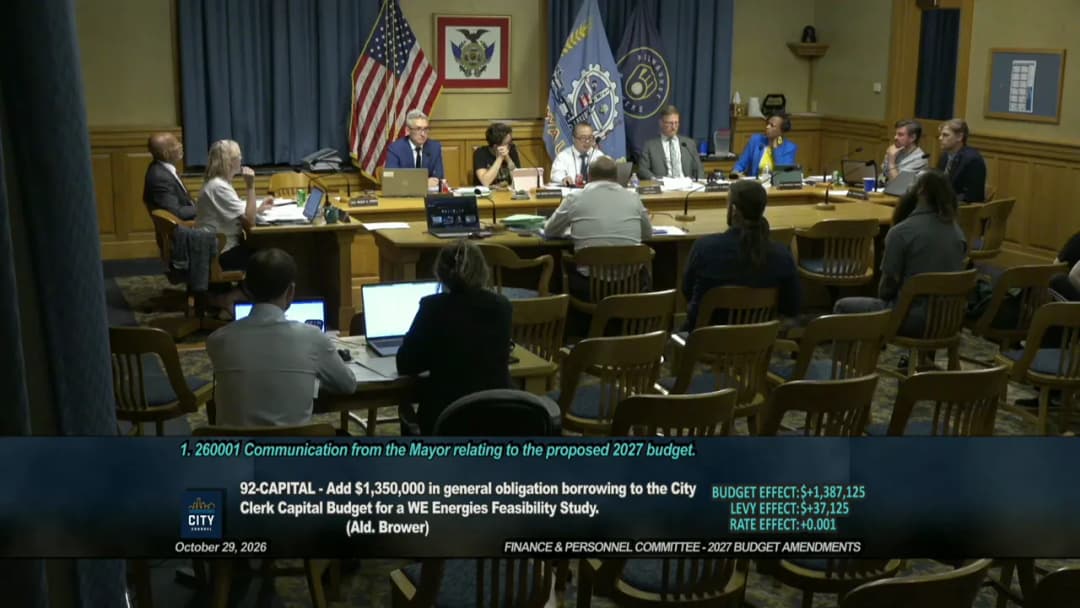
The Milwaukee Finance and Personnel Committee convened on October 29, 2026, for its annual Budget Amendment Day. The marathon session was scheduled to begin at 9:00 AM but actually convened at 9:38 AM and adjourned at 8:53 PM. The committee, chaired by Alderwoman Marina Dimitrijevic and including Aldermen Burgelis, Spiker, Coggs, and Moore, considered over 100 amendments to the Mayor's proposed 2027 budget. After extensive debate on funding priorities, the committee approved a final budget package that increased the total city budget from $2.261 billion to $2.266 billion, raised the levy-supported budget from $1.768 billion to $1.773 billion, and increased the property tax levy from $341.412 million to $345.3 million. Discussion Items Wages, Employee Compensation, and Personnel - Amendment 1 (Omnibus): Sponsored by the Chair and supported by Ald. Spiker as a citywide improvement, this sweeping amendment was approved 5-0. It restored Sunday hours at four library branches plus Central Library, restored position authority for nine street light positions, and created a $50,000 bonus fund for electrical workers. It added $750,000 to the Wages Supplement Fund to increase the residency incentive by 0.5% and boost Healthy Rewards benefits to $500. The amendment reduced the planned overnight parking permit increase to $75 from the mayor's proposed $110 and shifted $6 million towards borrowing for High Impact Paving. - Amendment 14 & 85 (Wage Increases): Ald. Brower and others proposed several versions of a $1 or $2 per hour raise for general city employees, intended to replace the mayor's 2% raise. Proponents argued this would disproportionately benefit the lowest-paid workers. Proposals faced significant hurdles regarding funding sources, often requiring cuts to other departments, and legal complications regarding implementation. Multiple substitutes failed. - Amendment 24 (Executive Assistants): Chair Dimitrijevic restructured the Executive Administrative Assistant program in the City Clerk's office, converting six part-time positions into three full-time positions with benefits to improve stability and retention. The bilingual designation was removed per the Department of Employee Relations guidance. Ald. Spiker expressed concerns about reduced scheduling flexibility. The amendment passed 3-1-1. - Amendment 37 (Equal Rights Specialist): The committee considered two versions to restore an Equal Rights Specialist position in the Department of Compliance and Engagement that was omitted from the mayor's budget. DCE Director Mary Reed did not contest the position but argued the proposed funding sources were problematic. Deputy Director Ramos stated the work could be absorbed. The Chair of the Equal Rights Commission advocated for the distinct role. Both the levy-funded version (37A) and the facility-rental funded version (37B) failed. Public Safety - Amendment 27 (27A): Ald. Chambers offered a major reallocation package approved 3-2. It reduced police vehicle borrowing by $1.6 million to fund a new fire engine, cut $500,000 from police facilities maintenance for traffic calming measures, and created a $300,000 Good Neighbor Special Fund for block clubs. Ald. Spiker and Ald. Burgelis opposed the cuts to police operations, while Alds. Coggs and Moore supported the community investments. - Amendment 62 (Patrol Coverage): Ald. Burgelis offered a footnote urging the Chief of Police to close the gap in neighborhood patrol coverage. The original language was a directive ('shall'), which the City Attorney flagged as overstepping the council's authority. The language was softened to 'urge' (62B), and it passed 5-0. - Amendment 63 (Litigation Reporting): Ald. Coggs directed the Police Department to report annually on changes to procedures and training resulting from settlements and litigation. Passed 5-0. Infrastructure and Public Works - Amendment 73: Ald. Burgelis redirected $350,000 allocated for a fifth pothole-filling machine to purchase vehicles for the Electrical Services division. The amendment passed 3-2. - Amendments 67-72: A series of footnotes directing DPW on operational transparency were passed unanimously. These included creating a public-facing dashboard for pothole and streetlight repairs, developing a youth electrical apprenticeship program, conducting an audit of streetlights on main streets, creating a street sweeping map, and exploring external partnerships. Economic Development and Food Access - Amendment 29 (29A): Ald. Jackson (via Ald. Burgelis) created a $1.8 million Grocery Store and Pharmacy Retention special purpose account. The funding was offset by a withdrawal from the Tax Stabilization Fund. The City Attorney recommended an SPA assigned to a department, but the amended version accepted an unassigned SPA requiring council resolutions for disbursement. Passed 5-0. - Amendment 23 (Corridor Beautification): Ald. Stamper proposed a $100,000 levy-funded program for painting city-owned commercial properties. The department noted potential operational challenges. Ald. Spiker and Ald. Coggs had concerns about the levy impact. The amendment was withdrawn for revision. - Amendment 92 (We Energies Study): Ald. Brower proposed $1.35 million in borrowing for a feasibility study on creating a municipal utility. Ald. Spiker questioned the financial prudence of borrowing for an exploratory study. The Environmental Collaboration Office Director suggested lower-cost options. Ald. Moore supported the investment. The amendment failed 2-2-1. Department Oversight and Governance - Amendments 33-36: Ald. Moore directed the Department of Community Wellness and Safety to provide plans, closeout reports, carryover reports, and quarterly reports. All passed 5-0. - Amendments 40-42: A series of footnotes directed the Department of Employee Relations to conduct a market study for electrical services, report on chronically vacant positions, and develop a plan to expedite eligible lists for hiring. All passed. Citizen Services and Library - Amendments 55-60: A package of footnotes was passed unanimously. These included directing the library to explore a historic preservation surcharge for facility rentals, urging work on philanthropic sponsorship of Sunday hours, promoting seed libraries, exploring checking out cultural institution memberships, developing a marketing plan for Sunday hours, and moving positions between branch libraries and Central Library. - Amendments 50-51: Ald. Coggs directed the Health Department to work with established doula programs to create contract bidding opportunities and to report biannually on doula contracting. Both passed 5-0. Rejected and Withdrawn Items - Amendment 26 (Eviction Free MKE): Ald. Brower's $100,000 for the Legal Aid Society's eviction defense program failed 1-3-1. Ald. Moore and Ald. Spiker voted no, citing concerns about setting a precedent for directly funding non-profits. - Amendment 81 (League of Municipalities): Ald. Burgelis's attempt to cut $47,000 from the League of Wisconsin Municipalities membership failed 2-3. - Amendment 94 (Fire Apparatus): Ald. Burgelis's proposal to borrow $4.8 million for three new fire engines failed 2-2-1. - Amendment 109 (Hop Fare System): A footnote creating a voluntary QR-based fare system for the Hop to fund homeless outreach failed 2-3. Key Outcomes - Budget Approved by Committee: The entire 2027 budget package (Item 1) and its companion bills were referred to the full Common Council without recommendation by a vote of 5-0. - Major Levy Increase: The committee approved a property tax levy increase to $345.3 million. - Library Services Expanded: Sunday hours were restored at four branches plus Central Library, defying the mayor's proposal to cut them. - Wage Debates Deferred: Decisions on a $1 per hour raise and targeted raises for low-wage workers failed to pass in committee, pushing the discussion to the full Common Council. - Fire vs. Police Funding Rebalanced: Ald. Chambers' reallocation plan, which cut police vehicle borrowing and facilities funding to pay for a fire engine and community programs, passed 3-2. - Oversight Increased: Numerous footnotes were adopted, requiring enhanced transparency and reporting from the DPW, Police Department, Library, DER, DCWS, and Health Department. - Major Proposals Rejected: The We Energies feasibility study and a major fire apparatus borrowing request were rejected by the committee.
The Cook County Board Finance Committee reconvened for its FY2027 budget hearings on October 29, 2026, featuring Sheriff Tom Dart. The Sheriff presented a $799 million budget request and responded to commissioner questions on a wide range of topics including electronic monitoring, mental health services, overtime costs, and public safety technology. Budget Overview - Sheriff Dart presented an FY2027 budget of $799 million, a $24 million increase from the $774 million FY2026 budget. The increase is primarily driven by salary and benefit increases totaling $34 million. The department made $10 million in cuts, largely in IT, to offset the increase. Electronic Monitoring (EM) - Sheriff Dart reported the department is currently monitoring 109 individuals under the EM program. He expressed frustration that the transfer to the statewide EM program and Chief Judge's office has been delayed on their end. Commissioner McCaskill noted the program costs approximately $2.5 million annually and involves around 45 staff. Public Safety & Technology - Commissioner Degnan raised concerns about the use of Flock license plate readers, citing ethical issues with the company and stating she "regrets" her previous vote on the contract. Sheriff Dart shared concerns about over-surveillance, noting access is restricted to fewer than 30 employees within his office. He stated that 177 out of 230 external agencies chose not to participate with the Sheriff's office due to strict data usage rules, and expressed openness to other vendors. Overtime & Staffing - The budget projects a $4.1 million reduction in overtime, bringing the total to $69 million. Commissioner Vasquez highlighted that overtime per employee has risen sharply from $3,500 in 2022 to $19,000. Sheriff Dart attributed high overtime to an average of 440 daily sick calls out of 1,300 needed staff, as well as labor-intensive hospital runs. The department is 233 officers below its full staffing target, with 55 currently in training. Targeted home checks following high call-in days (e.g., after sporting events) have reduced call-ins by 13%. Treatment Response Team (TRT) & Mental Health - The TRT is expanding, with funding for an additional two FTEs in FY2027, bringing the total growth to 18 from 7 in 2024. Sheriff Dart highlighted the program's expansion to over 60 external agencies and its role on the CTA. He noted a new Medicaid funding formula in June or July will allow provider reimbursement for in-jail services, which he hopes will improve the "warm handoff" to community care and reduce recidivism. Retail Theft & ICE Investigations - Commissioner Britton asked about an increase in detained individuals on felony retail theft charges. Sheriff Dart stated most of these have underlying failure-to-appear issues and their stays are short. The Sheriff's office opened a portal for law enforcement misconduct tips, which received 950 submissions, though none related to ICE. Commissioner Vasquez pushed for the Sheriff's office to accept direct police reports for ICE misconduct, which Sheriff Dart agreed to do, provided his office coordinates with potentially involved municipal agencies first to avoid interfering with existing investigations. Court Services & Domestic Violence - Sheriff Dart provided an update on Order of Protection service. The first-attempt success rate is in the 80% range. Over three attempts, the service rate hovers around 50%, largely because law enforcement cannot enter a residence to serve the order. The office is pushing for electronic service legislation. Key Outcomes - The Sheriff agreed to provide Commissioner Vasquez with data on overtime patterns and repeat call-ins. - The Sheriff agreed to coordinate with Commissioner Vasquez's office to directly take police reports from individuals alleging ICE misconduct if local police lack resources. - Commissioner Degnan noted that the collaborative issues on the EM system between the Sheriff, Clerk, and Chief Judge have been resolved, pending a "go live" date.
The Cook County Board of Commissioners held a special meeting on Thursday, October 29, 2026, at 9:30 a.m. at 118 North Clark Street, Room 567, Chicago, Illinois. The clerk confirmed a quorum was present. The board approved two transfer-of-funds items for the 12th District and adjourned. Public Comments & Testimony - The clerk called the names of late-registered public speakers, including Andre Thomas, Jason Perry, Charla Luella, and Latanya Simmons. None responded, so no public comments were made. Committee Items - Item 26-2665 – Proposed Transfer of Funds, 12th District: Sponsored by Commissioner Bridget Degnan. The Finance Committee recommended approval. A motion to concur with that recommendation carried by voice vote with no opposition noted. Suspension of Rules / New Items - The board voted to suspend the rules, as required, to take up the Finance Committee item. - The board then voted to suspend the rules again to take up new items. - Item 26-2709 – Transfer of Funds: Approved by voice vote. Commissioner Britton was added to the roll call for this vote. Key Outcomes - Approved item 26-2665 (proposed transfer of funds for the 12th District). - Approved item 26-2709 (transfer of funds). - Suspended rules on two occasions to permit the above actions. - Motion to adjourn passed.
On Thursday, October 29, 2026, from 10:26 a.m. to 12:56 p.m., the Council of the District of Columbia Committee of the Whole, chaired by Phil Mendelson, held a public oversight roundtable in Room 500 of the John A. Wilson Building. The roundtable examined three issues: agency spending above amounts appropriated in annual budgets; executive and OCFO enforcement of council-approved budgets; and OCFO budget formulation rules for the fiscal year 2028 budget. The hearing was limited to invited witnesses, and the executive branch declined to send witnesses. Written testimony may be submitted until 5:30 p.m. on Thursday, November 12, 2026. Invited Witness Testimony - D.C. Auditor Kathy Patterson testified virtually from Massachusetts. She said the council's roundtables a year ago offered hope for better cooperation on spending, but she remained concerned about large post-fiscal-year reprogrammings. She highlighted Reprogramming 26-175 transferring $4.2 million from the Office of the Chief Technology Officer to the OCFO, primarily for personal services; Reprogramming 26-162 transferring just under $2 million from the Department of Buildings because of unfilled inspector and plan reviewer positions; two October reprogrammings moving more than $8 million to the Fire and Emergency Medical Services Department for overtime, in part because costs could not be covered through Medicaid reimbursements; and Reprogramming 26-172 providing $3 million to the Deputy Mayor for Economic Development for the Fletcher Johnson capital project, with no explanation of what costs were not suitable for bond funding. - Patterson argued the District's budget is not structurally balanced, quoting the Government Finance Officers Association on the difference between statutory balance and structural sustainability. She said the current budget uses one-time resources for parts of the uniform per-student funding formula, and the multi-year plan assumes a $552 million local fund gap between FY27 and FY28, including a 35% cut to the Office of Victim Services and Justice Grants, a 50% cut to the Office of Neighborhood Safety and Engagement, a $95 million cut to DC Public Schools, a $78 million cut to DC public charter schools, and almost $40 million cut from the Department of Energy and Environment. She called this a steep fiscal cliff. - Patterson recommended bringing budget and finance functions back under the elected chief executive, arguing that the independent CFO's usefulness has outlived itself and that taxpayers pay for two separate budget execution operations that do not communicate effectively. She also said her office found both the executive and the CFO responsible for anti-deficiency violations and improper reserve use. - CFO Glenn Lee testified that OCFO has refined budget formulation so known and reasonably predictable expenses are included in appropriations, implemented new budgeting systems, and reviews quarterly financial review process reports. He said the District faces fiscal stress driven by a sharp decline in federal employment and spending and post-pandemic office worker patterns, and the approved FY28 general fund budget is 4.5% below FY27. Discussion Items - In response to Councilmember Felder's questions, Patterson said overspending results from failures of budget deliberation and execution, with some agencies overspending year after year. She noted that MPD, DHS, and DHCD have recurring patterns. On federal events, she said the District should carefully track costs and bill the federal government for overtime, and that Medicaid reimbursement remains a record-keeping challenge. - Chair Mendelson disagreed with Patterson's proposal to eliminate the independent CFO, recalling pre-control-board finance directors who overstated revenues, the fifth-quarter accounting device, and the role of the independent CFO and Office of Revenue Analysis in pushing back on agency cost estimates. Patterson responded that ORA sometimes accepts agency claims and that council budget staff have improved by pushing back. - Mendelson raised the example of $100,000 appropriated for a unified juvenile justice study by the Deputy Mayor for Public Safety and Justice that was never spent. CFO Lee said OCFO cannot force agencies to spend money, but can block reprogramming of council-designated funds. Deputy CFO Eric Kennedy said OCFO denies such reprogrammings and coordinates with the council budget office. Lee and Kennedy agreed to provide a written explanation of why the SNAP benefits contingency language compelled spending while the juvenile justice study language did not. - Mendelson asked for the total amount of FY26 agency overspending before year-end reprogrammings. Lee said the final reprogrammings before the council total approximately $21 million, about 0.2% of the budget, and that with reprogrammings there would be no overspending relative to final appropriations. He identified MPD as receiving the largest year-end reprogramming at $13.3 million and DYRS at roughly $6.7 million. Kennedy offered a detailed written summary. - Mendelson cited third-quarter FRPs showing unresolved spending pressures: DPW projected $6.4 million in personal services pressure and proposed gap-closing measures covering only $1.3 million, leaving $5.15 million unresolved; DHS had about $4.4 million unaddressed; settlements and judgments forecast a $3.4 million gap with no closing plan; OSSE said $1.5 million would be resolved through cluster-wide year-end reprogramming; and DYRS did not address $6.46 million in overtime and direct services pressures. Kennedy acknowledged this was not okay and said OCFO is making improvements. - On DPW, Mendelson noted one snowstorm cost $50.5 million and questioned spending controls. Lee and Kennedy said specific operational decisions during emergencies are executive discretion, while accountability questions belong with DPW. - On MPD overtime, Lee said $22 million in additional overtime was tied to the Safe and Beautiful Act Task Force and was ultimately chargeable to the federal government. - On budget formulation, Lee said the growth rate in the financial plan is aligned with the Office of Revenue Analysis's CPI projection, currently about 2.6%, and is not tailored by agency. Kennedy said new rules include putting non-union COLA funding in agency budgets and exploring a set-aside for charter school enrollment changes. Mendelson suggested using workforce investment funds as a contingency, which Kennedy said would be considered. - Lee discussed restrictions on pushing fund balance through the financial plan, saying the District will have no accumulated surpluses and that using one-time fund balance in out-years to support ongoing expenses undermines a structurally balanced plan. On the capital improvement plan, Lee said borrowing costs have climbed, and OCFO estimates the District would exceed the 12% debt cap in FY29 unless the CIP is reduced by roughly $350 million to $400 million. He also agreed to provide capital spending accomplishment rates for the last five years. Key Outcomes - No votes or formal decisions were taken; the roundtable was an oversight hearing. - The executive branch did not appear, declining the committee's invitation to send agency directors and representatives. - The record remains open until 5:30 p.m. on Thursday, November 12, 2026, for written testimony. - OCFO committed to provide written follow-ups on year-end reprogramming details, the legal difference between the SNAP contingency and the juvenile justice study appropriation, the Fletcher Johnson reprogramming costs, and capital spending accomplishment rates.