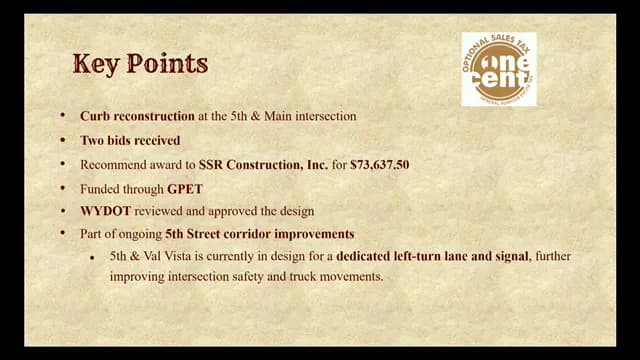
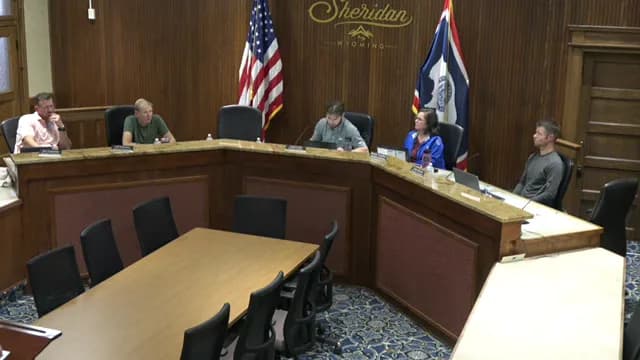
The Sheridan City Council held a study session on September 28, 2026, at 5:30 PM. The meeting covered six agenda items: distribution of American Recovery Plan Act (ARPA) interest earnings, a professional services agreement for a municipal court prosecuting attorney, the final plat of Blacktooth Business Park, a bid award for the Fifth and Main curb reconstruction project, and a brief update on the citizen academy. No formal votes were taken; discussions were held to provide staff with direction for future action. Discussion of ARPA Interest Funds - City Treasurer Darla Hawkins reported that $70,700 in interest earnings from ARPA funds previously designated for the housing land trust project were now unrestricted. She presented options: allocate the funds to another housing project (such as Habitat for Humanity), other city priorities, or retain in the general fund. - Mayor and Council discussed the request from Habitat for Humanity for the funds. Councilmember Steve Brant expressed concern that the discussion had already occurred with the organization before council input, and suggested holding the funds due to uncertain future revenues, particularly from a potential property tax proposition. Councilmember (unnamed, referred to as Councilwoman) echoed concerns about city finances, noting reserves at minimum levels and the need for equipment funding. Another councilmember (unnamed) supported rolling the interest into the original housing program, calling it "clean." A fourth councilmember (unnamed) agreed with the majority to return the money to the general fund, stating Habitat for Humanity's housing production was minor relative to need and opposing government-subsidized construction. Legal counsel confirmed the interest was unrestricted general fund money because ARPA obligations were satisfied. Staff had no position and sought council guidance. - Outcome: The council consensus leaned toward retaining the funds in the general fund, but no formal action was taken. The item is expected to appear on a future council agenda for a vote. Discussion of Professional Services Agreement for Municipal Court Prosecuting Attorney - City Clerk Ashley Tragmo presented a proposal to contract with Shannon and Franklin LLC (currently the city attorney firm) for the prosecuting attorney position, left vacant by the appointment of Mr. Lanegar as municipal court judge. The contract is identical to the previous one and will not affect the FY27 budget. The transition is expected to be effective next week. - No council questions or opposition were voiced. The item is anticipated to be approved at the next regular council meeting. Discussion of Final Plat of Blacktooth Business Park (PL-26-34) - City Planner Kelly Shorterwalk presented the final plat for 53 acres at the bottom of Dry Ranch Road (3150 Heartland Drive), zoned B-2 business district. The subdivision proposes 15 lots (0.84 to 12.5 acres) with no minimum lot size or open space requirements. New right-of-way dedications for Heartland Drive and Dry Ranch Road are included. A variance request seeks to improve Dry Ranch Road with a 20-foot gravel emergency access instead of full city standard (39-foot paved). Secondary access will be satisfied via a connection to a transportation corridor identified in the 2026 Transportation Master Plan (Middle East Corridor and Dry Ranch Road projects). Utility extensions (16-inch water main, 8-inch sewer main) will be installed by the developer. Fire flow limitations on lots 13–15 may require future suppression systems. No public comments were received. Planning commission was to consider the plat the same evening, with a recommendation to council contingent on dedication of Heartland Drive right-of-way through the Whitney Benefits property. - Council members asked about gateway zoning (entryway corridor overlay district applies to lots along I-90), the developer (Heartland Assets, LLC, registered in Las Vegas), and the awkward jog at Solutions Way. Staff noted the jog is not part of this subdivision due to unclear jurisdiction. The council expressed support for the commercial development opportunities. Discussion of Bid Award for Fifth and Main Curb Reconstruction Project - City Engineer Thomas Mono presented a project to improve the turning radius at the northwest corner of Fifth and Main streets from 30 feet to 44 feet, addressing truck tire tracks on sidewalks and ADA ramps. The city acquired 120 square feet of right-of-way behind the signal pole. Bids were opened September 15; SSR Construction Inc. was the low qualified bidder at $73,637.50 (engineer's estimate was $79,000). The project is funded by the "extra penny" sales tax. Construction is expected to take 30–45 days, with pedestrian detours but likely no vehicular detours. The project is the first phase of improvements to Fifth Street; a design for the Fifth and Valvista intersection (including dedicated left-turn lanes) is underway, with construction planned for spring/summer 2027. The Mydland Bridge deck replacement is also scheduled for summer 2027. - Council members praised the project for addressing truck safety. Questions focused on eliminating on-street parking along Fifth Street between Valvista and Main as part of the upcoming project, and coordinating detours during bridge work. Direction was given to proceed with awarding the contract at the next council meeting. Other Business - Mayor noted that Wednesday would conclude the seven-week citizen academy with a graduation ceremony and a "citizens choice award" for a city department. Councilmembers also commended the new 20-mph school zone light on Midland Avenue near the high school for improving traffic safety. Key Outcomes - ARPA Interest Funds: Council direction leaned toward retaining the $70,700 in the general fund, though no formal vote was taken. The item will return for action. - Municipal Court Prosecutor: The council will consider approving the contract with Shannon and Franklin LLC at the next regular meeting. - Blacktooth Business Park Plat: Staff will forward the planning commission's recommendation (contingent on Heartland Drive dedication) to the city council for final approval. - Fifth and Main Curb Project: The council will vote to award the bid to SSR Construction Inc. at the next meeting. Construction is targeted for fall 2026. - Fifth and Valvista Project: Design completion expected by late fall/early winter; bidding in winter; construction spring/summer 2027. On-street parking elimination on Fifth Street from Valvista to Main will be evaluated.
The Public Meeting Index
The Public Meeting IndexThe Sheridan City Planning Commission met on September 28, 2026, to consider the final plat of Blacktooth Business Park (PL 26-34). The meeting began with roll call (Commissioner Franklin absent, others present), approval of the agenda, and approval of the September 14 minutes. The sole business item was the final plat, which was recommended for approval after discussion and public comment. Consent Calendar - Agenda approved unanimously. - Minutes from September 14, 2026, approved unanimously. Discussion Items - Final Plat of Blacktooth Business Park (PL 26-34, Resolution 20-26): City Planner Schroeder presented the proposal to subdivide 53.19 acres of B2-zoned land at 3150 Heartland Drive into 15 lots (0.84 to 12.5 acres). The plat includes a 10-foot pathway, a 39-foot roadway for Heartland Drive, a 20-foot gravel improvement on Dry Ranch Road (variance from full city standard), and utility extensions (16-inch water main, sewer) designed to support future development. Secondary access is provided via a physical connection to the Middle Eastern Corridor identified in the Transportation Master Plan, rather than a second roadway, due to jurisdictional complexities. Fire safety concerns were noted for lots 13-15 (inadequate commercial fire flows without additional suppression), addressed by a plat note requiring fire suppression at development. No public comments were received prior to the meeting. Staff recommended approval contingent on the dedication of Heartland Drive right-of-way through the Whitney Benefits property. Public Comments & Testimony - Jessica White (formerly Rome): Expressed concerns about traffic congestion, parking issues (U-Haul, MDU semi-trucks blocking Dry Ranch Road), and safety during construction. She requested that current parking problems be addressed before new development adds traffic. - Aaron Whiting: Raised visibility issues at the Dry Ranch Road and Brundage Lane intersection (blind corner, 40 mph speed limit, overgrown shrubs) and noted existing safety problems from businesses using the dirt road. He supported the project overall but urged mitigation of existing hazards. - The applicant’s engineer assured that access for neighbors would be maintained during construction. Key Outcomes - Motion: Commissioner moved to recommend approval of PL 26-34 final plat to the governing body, including the variance for the 20-foot gravel improvement on Dry Ranch Road adjacent to lots 6, 9, 10, and 11. Seconded. Motion passed unanimously (all ayes, no nays). - Contingency: Approval is contingent upon recording of the Heartland Drive right-of-way dedication through Whitney Benefits. - Next Steps: The item will go to the city council meeting next Monday (week of September 28). Staff also noted a vacancy on the Planning Commission due to Commissioner Morneau’s resignation, to be advertised soon. - Procedural Note: The chair initially forgot to call for public comment before the vote; public comments were heard after the vote, and the applicant and staff responded to concerns.
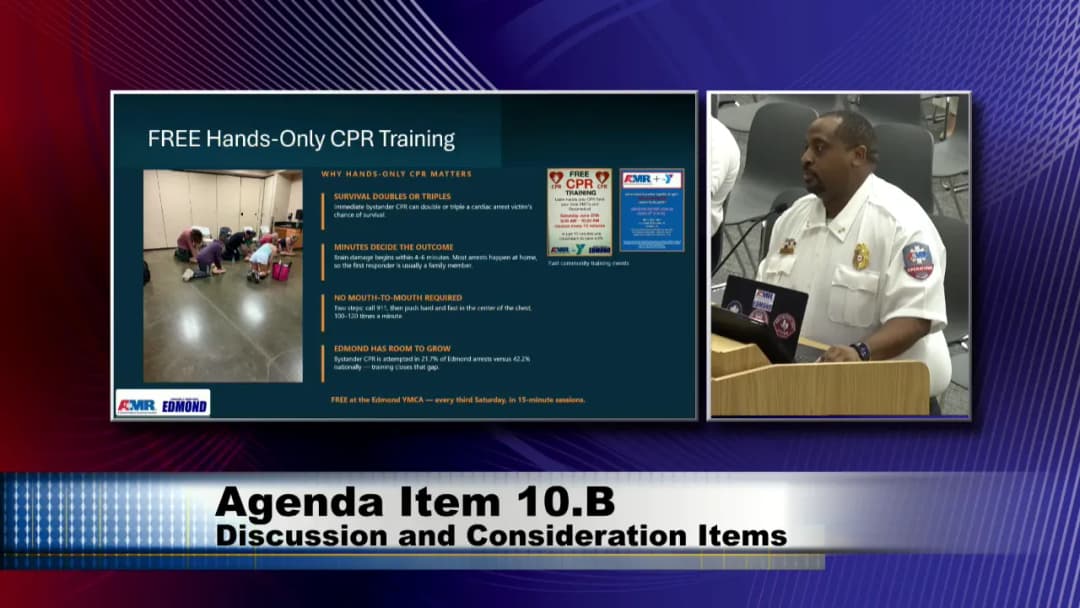
The Edmond City Council met on September 28, 2026, to consider a range of agenda items including site plans, specific use permits, budget amendments, and community reports. Key outcomes included the denial of the Brakes Plus auto repair site plan and plat following significant public opposition, approval of several massage business permits under new supplemental use standards, and approval of a grant and budget amendment for the West Downtown Walkability project. The meeting also featured a presentation from American Medical Response (AMR) and the annual report from the Community Action Review Commission (CARC). Consent Calendar - Reappointment of Jeff Lux to the Stormwater Drainage Advisory Board (term through September 30, 2029) – approved 5–0. - Approval of general consent docket items for the Public Works Authority (8 items) – approved 5–0. - Approval of general consent items for the City Council, except items 9I and 9M which were pulled for individual consideration – approved 5–0. Public Comments & Testimony - Brakes Plus Site Plan (Item 4A/4B): Several residents spoke in opposition. - Victor Canero (104 Hanover Drive): Expressed concerns about noise from pneumatic tools, hydraulic lifts, traffic at the entrance to his neighborhood, decreased property values, and lack of buffer. He presented a letter from neighbors and requested denial or strict conditions (masonry wall, landscape buffer, restricted hours, closed bay doors, service doors facing away from homes). He stated the applicant had not contacted the neighborhood. - Todd Oberding: Stated that a commercial shop 50 feet from a residence is inconsistent with past Edmond approvals, citing a Google study of 24 shops showing an average distance of 330 feet from homes. - Rhonda Canero (wife of Victor): Described audio and video recordings from a local Brakes Plus showing open bay doors, frequent bell noises, car horn honking, and audible employee music. She also raised concerns about chemical smells, cameras overlooking backyards, and lack of prior communication from the applicant. - Lori Fornell (next-door neighbor): Emphasized the close proximity (gestured distance) and asked for consideration. - Former Mayor Dan O’Neill (101 Stoning Break): Suggested that a city representative attend the applicant’s meeting scheduled for September 30 and that a memo of the discussion be provided to council and planning commission. - Lydia Lee (1517 Walnut Cove Road): Urged the council to follow the planning commission’s recommendation to deny, stating the applicant should not get a “do-over” after the September 8 planning commission vote of 1–4. - Other items: No public comments on lot split (4C), massage permits (4E–4I), utility easement closure (4K), ordinance amendments (4L, 4M), walkability grant (4N), or CARC report. Discussion Items - Item 4A/4B – Brakes Plus Site Plan and Final Plat: Staff requested referral to the October 20 planning commission meeting for further study; the applicant concurred. Councilmember Waterson moved to vote that night, expressing opposition to referral. The motion to approve the variance (80-foot right-of-way) failed 0–5, followed by motions on the site plan and plat, both failing 0–5. The applications were denied. - Item 4C – Lot Split at Herd and Story: Approved 5–0 with no discussion. - Item 4D – Specific Use Permit for Home Spa Massage (151 E 33rd St, Suite 103): Staff recommended denial because the applicant had not come into compliance with building codes. A motion to approve failed (0–5), resulting in denial. - Item 4E – Specific Use Permit for Admin Massage and Body Contouring (3409 S Broadway, Suite 612): Approved 5–0, with council agreeing to remove an operating hours condition added by the planning commission, citing lack of applicable criteria. - Item 4F – Specific Use Permit for Vitality Massage and Shiatsu (3509 S Broadway, Suite 611): Continued to October 12, 2026, to correct an address error (actual address is 3409 S Broadway). Council directed that the item be placed on the consent docket for the next meeting after correction. - Items 4G, 4H, 4I – Specific Use Permits for Massage by Niche, QM Massage, and Do Massage & Spa: All approved 5–0 after staff confirmed compliance with supplemental use standards. - Item 4J – Rezoning (Sooner Road): Continued to October 12, 2026, for additional discussions with the applicant. - Item 4K – Utility Easement Closure: Approved 5–0. - Item 4L – Ordinance Amendment on Juvenile Records Confidentiality: Approved 5–0. - Item 4M – Ordinance Amendment on Disorderly Conduct: Approved 5–0 (motion initially miscast by mayor, corrected). - Item 4N1 – Budget Amendment for West Downtown Walkability Grant: Approved 5–0, adding $258,435 from CIP reserves to cover increased costs from BNSF railroad requirements. Council noted that the CIP board did not vote on the amendment but acknowledged the funds were necessary. - Item 4N2 – Invoices for Walkability Project ($1,042,254): Approved 5–0. - Item 9I – Behavioral Health Mobile Crisis Team Grant: Approved 5–0. The grant provides $750,000 per year for four years with no city match, using existing staff to enhance the mobile crisis unit partnership with Community Bridges, Healthy Minds, and DECA. - Item 9M – Regional Transportation Authority Contribution: Continued to October 12, 2026, due to a $30,000 discrepancy in the invoice amount. - Item 10B – AMR Presentation: Kier Smith, AMR Operations Manager, presented on staffing investments (Earn Where You Learn program with paramedic school), clinical quality management, upcoming whole blood program (by end of 2026), and cardiac arrest survival statistics. Key data: overall survival rate 17.4% (national 10.4%), bystander CPR rate 21.7% (national 42%), AED use 37% (national 13.8%). AMR provides six day units and four night units in Edmond, with low mutual aid calls. Council discussed options to improve bystander CPR and commended the partnership with Edmond Fire. - Item 10C – CARC Annual Report: Christy Batterson presented highlights of the $1 million allocation for fiscal year 2026. Funds served over 89,000 individuals through 22 organizations, addressing social/economic disparities and mental health services. Notable: Edmond Mobile Meals served 98,000 meals; Project 66 distributed 1.1 million pounds of food; Heartline 211 provided referrals; Oasis Clubhouse supported adults with mental illness. Council expressed appreciation. Key Outcomes - Denied: Brakes Plus site plan, final plat, and variance (all 0–5). Home spa massage specific use permit (motion to approve failed 0–5). - Approved 5–0: Reappointment (Lux), lot split (4C), massage permits (4E, 4G, 4H, 4I), utility easement closure (4K), ordinances 4L and 4M, walkability budget amendment and invoices (4N1, 4N2), behavioral health grant (9I), all general consent dockets. - Continued to October 12, 2026: Vitality massage permit (4F) for address correction, rezoning (4J), RTA contribution (9M). - Next Steps: Staff directed to correct address for 4F and place on consent docket; applicant for Brakes Plus referred to planning commission on October 20, 2026, though applications were denied; AMR to explore options to reduce mutual aid costs; CPR classes continue at Mitch Park; CARC report accepted as information.
The Edmond City Council held a special meeting on Monday, September 28, 2026, to address the employment of the city attorney. The council entered executive session to discuss the matter, then returned to open session to place City Attorney Madeline Sawyer on administrative leave and to appoint an acting city attorney. Executive Session - The council voted 5-0 to enter executive session to discuss the employment of the city attorney, as authorized pursuant to 25 OS Section 307B1. - Following the closed session, the council voted 5-0 to reconvene in open session. Discussion Items - Item three – Employment of the city attorney: A council member moved to approve immediately placing City Attorney Madeline Sawyer on administrative leave with pay and benefits, pending further review. The motion passed 4-1, with one council member voting against it. - Item four – Acting city attorney: A council member moved to appoint Taylor Clark as acting city attorney at pay grade 32, step four, effective immediately. The motion passed 5-0. Key Outcomes - City Attorney Madeline Sawyer was placed on administrative leave with pay and benefits, pending further review (motion passed 4-1). - Taylor Clark was appointed acting city attorney at pay grade 32, step four, effective immediately (motion passed 5-0). - The council adjourned the special meeting after completing these actions.
The regular meeting of the Municipal Fire and Police Civil Service Board was held on September 28, 2026, with a quorum present. The board addressed routine approvals, discussed a new digital submission system for personnel action forms, accepted employment applications and test scores, and received an update on the board's upcoming office relocation. Consent Calendar - Approved the meeting agenda without modifications. - Approved the minutes from the August 24, 2026 meeting. Public Comments & Testimony - No public comments were made during the public comment period. Discussion Items - Personnel Action Forms (PAFs) and New OSE Digital System: Chairman explained that the Office of State Examiner (OSE) is rolling out a new digital system that will replace hand-signed paper forms. OSE can now comment on PAFs before they reach the board. Two PAFs (for Sherwin Brooks and Blaine Nance) were flagged by OSE as incorrectly coded under "other" instead of "pay change," with instructions to reject and resubmit. Board member Bradley Briggs noted that historically these would have been rejected by OSE later anyway, but the new process allows early rejection. The board voted to reject those two PAFs and approve all other PAFs. - Fire Department Applications: The board reviewed and accepted applications for Hazardous Materials Chief and Fire Services and Supply Technician positions. - Police Captain Test Scores: Test scores from the police captain examination administered on August 27, 2026 were reviewed. Of the candidates, zero did not pass and two did not show. The scores were accepted. - Office Relocation Update: Ms. Harris provided an update on the board's move to a new building, likely to occur around the end of 2026 or early 2027. The building is an existing structure with internal build-out underway. The board discussed parking availability and a possible meeting space. Chairman requested designated parking spots for board staff and visitors. A site visit may be arranged. Key Outcomes - Motion to approve all PAFs except those for Sherwin Brooks and Blaine Nance, which were rejected, passed without opposition. - Motion to accept applications for Hazardous Materials Chief and Fire Services and Supply Technician passed. - Motion to accept police captain test scores passed. - No formal action was taken on the office relocation, but staff will coordinate on parking and potential site visit. Additional Notes - Board member Bradley Briggs humorously noted that he had not been called by name accurately during roll call. - The meeting was adjourned after all agenda items were addressed.
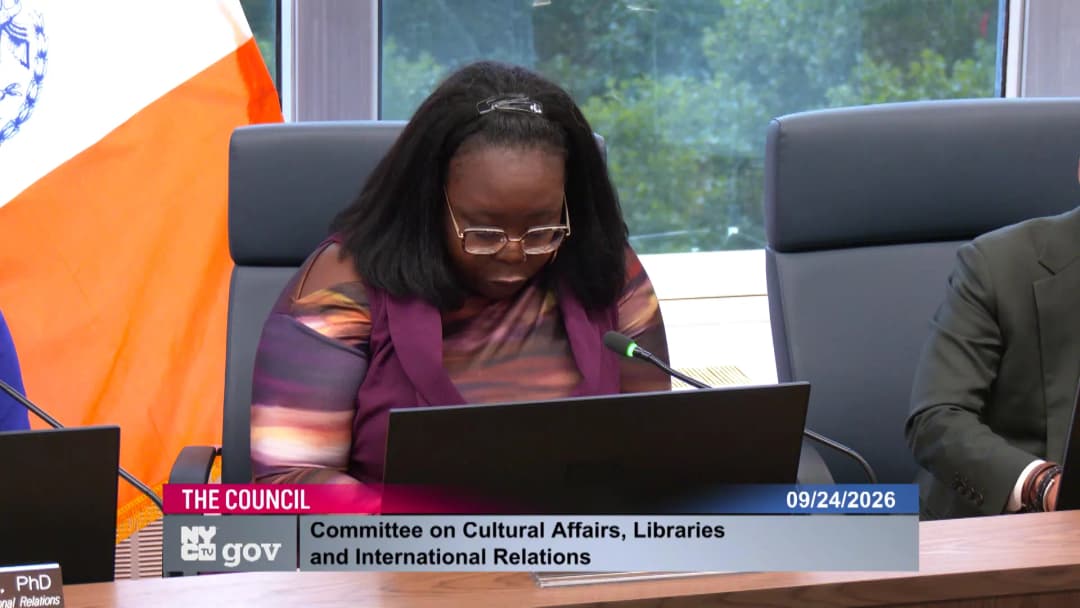
On Monday, September 28, 2026, at 11:00 AM, the New York City Council Committee on Cultural Affairs, Libraries, and International Relations, chaired by Deputy Speaker Nantasha M. Williams, met off-site at The New York Public Library at 515 Malcolm X Boulevard (135th Street and Malcolm X Boulevard). The published agenda listed an oversight hearing and four resolutions related to Puerto Rico; the raw transcript instead records a different set of three celebratory resolutions being considered and adopted by a 6-0 vote. Both records are summarized below, and the discrepancy is noted. Agenda and Minutes Record - Oversight T2026-2301, titled Telling Our Stories: Examining the Research Collections of New York City's Public Libraries, was heard and filed by the committee. - Resolution 0027-2026, calling upon the New York State Legislature to pass, and the Governor to sign, S.05623/A.05290 regarding the purchase of claims by corporations or collection agencies and certain instruments calling for payment of a monetary obligation by a foreign state, was heard and laid over. - Resolution 0028-2026, calling on the United States Congress to establish a date certain for ending the Financial Oversight and Management Board for Puerto Rico, was heard and laid over. - Resolution 0372-2026, calling on the Legislative Assembly of Puerto Rico to pass, and the Governor of Puerto Rico to sign, legislation to repeal Act 22 and implement a progressive tax policy, was heard and laid over. - Resolution 0494-2026, standing with the people of Puerto Rico to stop the construction of Project Esencia, a luxury development in Cabo Rojo, was heard and laid over. - Members present according to the minutes: Williams, Hudson, Louis, Maloney, Stevens, and Ung. Ossé was absent. Other Council members attending included Salaam, Brewer, Thomas-Henry, Avilés, and J. Sanchez. Discussion Items Per the Transcript - Resolution 184, sponsored by Councilmember Fadius, would declare October 3rd annually as Korean Cultural Awareness Day in New York City to commemorate the mythological beginning of the Korean people and to celebrate their continued pride and shared ancestry. - Resolution 606, sponsored by Councilmember Althea Stevens, would declare August as Black Pride Month in New York City, recognizing the legacy of the New York City Black Pride Movement in uplifting the Black LGBTQIA+ community and its continuing contributions to a more equitable city. Councilmember Stevens noted that the first New York City Black Pride event was organized by James Sanders in August 1997, that Bronx native Lee Soldiers later founded New York City Black Pride, and that the Bronx held its inaugural Black Pride celebration this year. - Resolution 607, also sponsored by Councilmember Stevens, would declare September as African Immigrant Heritage Month in New York City to celebrate the contributions of African immigrants to the city and the United States. Councilmember Stevens said approximately 60,000 African immigrants live in the Bronx, with many in the West Bronx. Public Comments and Testimony - Sadiqi, Chair of the African Advisory Council, testified in strong support of Resolution 607. He stated that African immigrants are nurses, doctors, teachers, small business owners, taxi and livery drivers, engineers, social workers, faith leaders, students, entrepreneurs, public servants, and community organizers. He cited that approximately 167,000 African immigrants live in New York City, representing about 5.4% of the city's foreign-born population, and that the Bronx is home to approximately 60,000 African immigrants. He concluded that African immigrant history is New York history. No other public testimony was reported. Key Outcomes - The transcript records a coupled roll call vote on Resolutions 184, 606, and 607: six votes in the affirmative, zero in the negative, with no abstentions, and all three items adopted by the committee. - According to the official minutes, the agenda's oversight item was filed and the four listed Puerto Rico resolutions were laid over; the minutes do not record adoption of Resolutions 184, 606, or 607. - Discrepancy note: The agenda and minutes conflict with the raw transcript. The agenda and minutes describe hearings on the research collections of public libraries and four Puerto Rico-related resolutions, while the transcript describes a vote on three cultural recognition resolutions. This summary preserves the conflicting records rather than choosing one version.
The City Council held a meeting on September 26, 2026 at 1:00 PM. The only agenda item was a public notice regarding the council's invitation to the Milton House Museum Signature Event scheduled for 7:00 PM that evening at the Janesville Performing Arts Center. The notice stated that while a quorum of the city council may be in attendance at the event, no official city business would take place. No meeting minutes or transcript were provided. No other agenda items were listed, and no discussion, public comments, or votes are recorded.
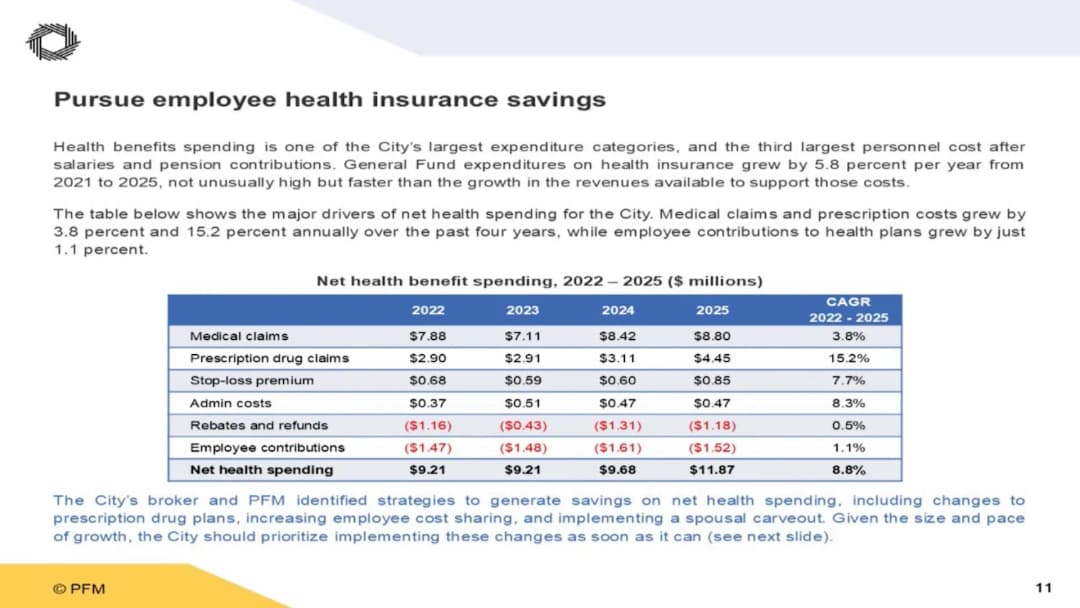
On September 26, 2026, Erie City Council held a budget analysis session with PFM (Public Financial Management) consultants Gordon and Lauren Sokovich. The session focused on the city's financial condition, a projected $12.3 million general fund deficit for 2027, and a range of short- and long-term options to close the gap. PFM emphasized that recent reclassification of pension-restricted reserves had boosted unrestricted fund balance to $30 million, buying the city more time to implement structural solutions. Discussion Items Financial Condition & Reserve Update PFM reported that the baseline projection shows a $12.3 million deficit driven by spending growth outpacing revenues, particularly from positions added since COVID, and the structural mismatch between flat real estate tax revenues and rising costs. Positive news: the finance director’s work allowed reclassification of previously restricted pension funds, raising the unassigned fund balance from $14.5 million (below the recommended 17% threshold) to $30 million (well above the 17% minimum). PFM advised maintaining a two-month reserve (17%) plus a disaster reserve (about 3%), leaving roughly $10 million in available reserves that could be used as a bridge—provided it is tied to specific long-term reforms, not a band-aid. Tax Increase Consideration PFM presented the likely need for a real estate tax increase after several years without one. A one-mill increase would raise approximately $2.9 million (quarter of the deficit) and cost the owner of a $100,000 assessed home about $100/year; a two-mill increase would double both the revenue ($5.8 million) and taxpayer impact ($200/year). PFM noted that when adjusted over multiple years, a one-mill increase amounts to an average annual increase of about 1.2% since 2020, close to cost of living. Council members expressed concern about burdening residents, especially given the city’s low median income, and stressed that any tax increase must be paired with expenditure reductions and aggressive collection of money owed to the city (e.g., by the parking authority). Personnel & Health Insurance PFM highlighted that full-time equivalents in the general fund grew from roughly 516 to nearly 560 over the past decade. A framework was proposed to evaluate added positions by weighing cost (salaries, benefits) against value to the city. Positions would be categorized as high priority (keep if value justifies cost), high priority with offsetting reductions/revenue (set aside for investment), or not justifiable (eliminate). For health insurance, costs have grown about 6% annually (prescription drugs up 15%) while employee contributions rose only 1%. PFM recommended implementing savings strategies for non‑bargaining employees immediately, and using contract reopeners (AFSME) or negotiations to extend changes to unionized staff. Operating Expenses PFM noted that operating expenditures in top departments grew by $2 million over five years and another $2.5 million in the 2026 budget alone. They recommended scrutinizing large increases and considering a holistic capital budget approach to evaluate equipment and vehicle purchases. Home Rule Discussion PFM included home rule as a long-term option to gain flexibility in raising the earned income tax beyond the current 1% cap, enabling revenue diversification and growth. Council members raised strong concerns, particularly about the risk of gerrymandering if council districts are created, and potential threats to state pension aid. A councilor stated that without a provision for citywide at-large representation, public support would be absent. The mayor confirmed that the city has engaged legal counsel to analyze pension risk and expects an answer within two weeks. PFM stressed that home rule requires extensive public education and cannot succeed without community buy-in. Parking Authority Dispute Multiple council members expressed frustration that the parking authority, which the city created and backstops, has not made its full annual contribution (estimated at $500,000–550,000 in prior agreements) for several years. One councilor stated the authority owes the city $4 million and argued that asking residents for tax increases while the parking authority withholds payment is unfair. The mayor reported that the city has demanded a negotiation response by October 1, with a goal of finalizing an agreement by year-end, and warned that if no progress is made, she will replace the board. PFM recommended formalizing a transparent multi-year agreement and considering applying the parking tax to authority properties, as other cities do. Other Revenue Options - Amusement Tax: PFM noted Erie’s current rate is 3% while many cities use 5%, and suggested raising it to 5% while exempting small events (e.g., youth or church gatherings) to aid compliance. - Mechanical Device Tax (skill games): On hold pending state legislation. - Fees & Collections: Recommend reviewing fees for inflation and improving delinquent collection by placing liens on properties, particularly for trash and sewer bills. Debt Outlook PFM warned that the city’s debt service is currently around $5 million but is projected to double to $10 million by 2033. Using the freed-up reserves can help address this future spike if set aside early. Key Outcomes - Council will use the PFM framework to evaluate department budget requests, starting in late October. - A real estate tax increase of at least one mill appears likely; the final amount will be debated during budget sessions. - The mayor will pursue a negotiated settlement with the parking authority, with a response deadline of October 1 and a resolution by year-end; failure may lead to board replacement. - Legal counsel is investigating pension risks related to home rule; the mayor expects an answer within two weeks. - The city will consider changes to the amusement tax and other fees as part of the 2027 budget. - PFM will deliver a final report in the coming weeks with detailed analysis and recommendations.
The Anchorage Assembly held a work session on September 25, 2026, to discuss proposed Ordinance AO 2026-108 and its substitute versions (S and S1), which establish rules for the use of surveillance technology by the Anchorage Police Department (APD), particularly the Real-Time Crime Center (RTCC) and automated license plate readers (ALPRs). The session included presentations from ordinance sponsors, invited legal experts, the Municipal Attorney, and APD Chief, along with extensive deliberation on privacy protections, data retention, interagency data sharing, and oversight mechanisms. No votes were taken; the ordinance is scheduled for debate and possible amendments on October 20, 2026. Presentations and Discussion - Sponsors' Presentation: Assembly members Sydney Scout and others outlined the history of the RTCC, noting that the $12.4 million RTCC build-out and a $598,000 asset forfeiture approval preceded any code protections. They presented three versions: the original AO 2026-108 (broad definition of surveillance technology, 14-day retention in code), the S version (narrowed definition, retention in policy, sharing for criminal justice purposes), and the S1 version (tightened sharing to require warrant/court order, lower suspension threshold, prohibition on sharing ALPR data with DMV without assembly approval). Key questions were raised about scope, retention, and suspension provisions. - Invited Guest – Daryl Thompson (Attorney): Mr. Thompson discussed Alaska’s express constitutional right to privacy (Article 1, Section 22) and argued that warrantless use of ALPR data for historical tracking may violate both the U.S. and Alaska constitutions, citing United States v. Jones and Carpenter mosaic theory. He urged the assembly to require warrants for accessing stored data. - Invited Guest – Mike Garvey (ACLU of Alaska): Mr. Garvey recommended preserving the original broad definition of surveillance technology, including an explicit data retention limit in code (rather than policy), and strengthening the private right of action to allow direct court access rather than an administrative exhaustion requirement. - Municipal Attorney Eva Gardner and Chief Case: Ms. Gardner explained existing guardrails (state/federal law, APD policies, assembly oversight) and walked through the S version’s structure. Chief Case described current APD technologies: RTCC staffed by sworn personnel, ALPRs on dash cameras with 14-day retention, traffic cameras (250+ intersections, 3-5 day overwrite, limited live access due to copper wiring), and private camera integration (one commercial site). They noted that APD’s Axon contract (approved September 23, 2025) includes body cameras, dash cameras, tasers, and other items, not solely RTCC technology. - Key Debate Points: - Sharing Standard: The S version allows APD to share surveillance data with other law enforcement for criminal justice purposes without a warrant. The S1 version requires a warrant or court order for any sharing with non-municipal agencies. Ms. Gardner argued the S1 could hinder joint investigations (e.g., human trafficking, drug operations). Mr. Thompson and Mr. Garvey supported warrant requirements. - Data Retention: The original ordinance had 14-day retention in code; the S and S1 versions place retention limits in internal policy with mandatory 30-day notification of changes to the assembly. - Definition of Surveillance Technology: The original broad definition was narrowed in the S version to technology “primarily designed to surveil using automated ML/AI.” The ACLU urged restoration of the original definition to avoid loopholes. - Suspension Provision: The S version requires a “knowing, material, and consistent” violation before the assembly can suspend a technology’s use; the S1 removes that qualifier, allowing suspension for any unresolved code violation. Key Outcomes - No formal actions or votes were taken; the session was informational. - The ordinance will return for public hearing and possible amendments on October 20, 2026. - Sponsors agreed to accept written questions from assembly members through the clerk and will provide responses. - A follow-up work session may be scheduled, and a red-line copy of the S1 version was requested. - The assembly noted that the existing contractor (Axon) does not have access to APD’s data, and that current APD policies include robust auditing and training requirements.
The Anchorage Assembly held a work session on Friday, September 25, 2026, to discuss AO 2026-98, an ordinance sponsored by Chair Brawley and Assembly Member Volland to create a formal advisory board for the Chugach Access Service Area (CASA). The meeting included a presentation on the need for the board, its proposed structure, and a discussion of unresolved issues such as membership composition, cooperative agreements with road service areas, and maintenance responsibilities. The ordinance was introduced July 7, had a first public hearing August 4, and is continued to October 6, 2026. Consent Calendar No consent calendar items were discussed. Public Comments & Testimony No public testimony was taken during this work session, but the sponsors noted they have received feedback from the CASA advisory working group, limited road service area representatives, the Basher Community Council (which passed a resolution with amendments), HOA representatives, and individual members of the public. The sponsors are incorporating feedback into an S version to be considered on October 6. Discussion Items - Presentation by Co-Sponsors: Chair Brawley and Assembly Member Volland presented the rationale for an advisory board, citing the need for a clear public process for prioritizing CASA projects, balancing access improvements with neighborhood impacts, and integrating CASA decisions with the municipality's Capital Improvement Program (CIP). They highlighted that CASA was created by voters in 2023 and has funded bond projects in 2024, 2025, and 2026 (e.g., Canyon Road improvements, Basher parking lot, wayfinding for Stuart Trail). They also showed voter support maps, noting that precincts in downtown Anchorage showed 81% support for establishing CASA, while some hillside and Eagle River/Chugiak precincts had lower support (corrected to show opposition percentages). The proposed board would be advisory to both the mayor and assembly, with membership modeled after the Public Naming Commission: seven voting members (one with trail design expertise, one with transportation infrastructure experience, one with outdoor recreation background, and four at-large members – two from ARTSA and two from road service areas within CASA) plus an ex officio non-voting member from Chugach State Park. - Membership Composition: Assembly Member Yaro Silvers expressed concern about overly prescriptive seat requirements that could hinder filling positions and suggested flexibility. Assembly Member Donald Handelin proposed considering assembly districts for geographic diversity. Chair Brawley and Assembly Member Volland noted challenges of balancing expertise with accessibility and avoiding an oversized board. The sponsors are already working to refine language to require at-large members from road service areas that are adjacent to Chugach State Park and to emphasize demonstrated familiarity with public access over specific technical expertise. - Cooperative Agreements: Assembly Member Zach Johnson asked about maintenance responsibility for new projects and the removal of the requirement for cooperative agreements with road service areas. Assembly Member Volland argued that cooperative agreements allow a single stakeholder group to unilaterally veto projects, which is not representative of the entire service area. He stated that all CASA-funded infrastructure is public right-of-way and should benefit all residents. Chair Brawley clarified that consulting with road service area boards would still be required, but the ordinance deletes the specific term "cooperative agreement." They noted that maintenance questions (e.g., who plows new parking lots) need to be resolved before bonds are presented to voters, possibly through the advisory board's recommendations. - Bond Maintenance Funding: Assembly Member Baldwin Day asked if maintenance costs can be included in bonds. Assembly Member Yaro Silvers confirmed that for the Basher trailhead bond, $75,000 per year for maintenance was built in. Assembly Member Volland added that this is typical for road projects to cover staffing and maintenance. - Scope and Next Steps: The sponsors emphasized that the ordinance does not adopt specific CIP projects, change the existing CIP process, or resolve all implementation issues. It establishes the board and defines its advisory role on budgeting and planning. An S version is being drafted for the October 6 meeting, incorporating public feedback including more explicit public hearing requirements for board recommendations. Key Outcomes - The work session concluded with no formal votes. The ordinance remains on the agenda for continued consideration on October 6, 2026. - The sponsors will release an S version with amendments based on feedback, including refined membership criteria and a required public hearing process. - Assembly members indicated they may offer further amendments, such as those from the Basher Community Council resolution, when the ordinance is heard on October 6.