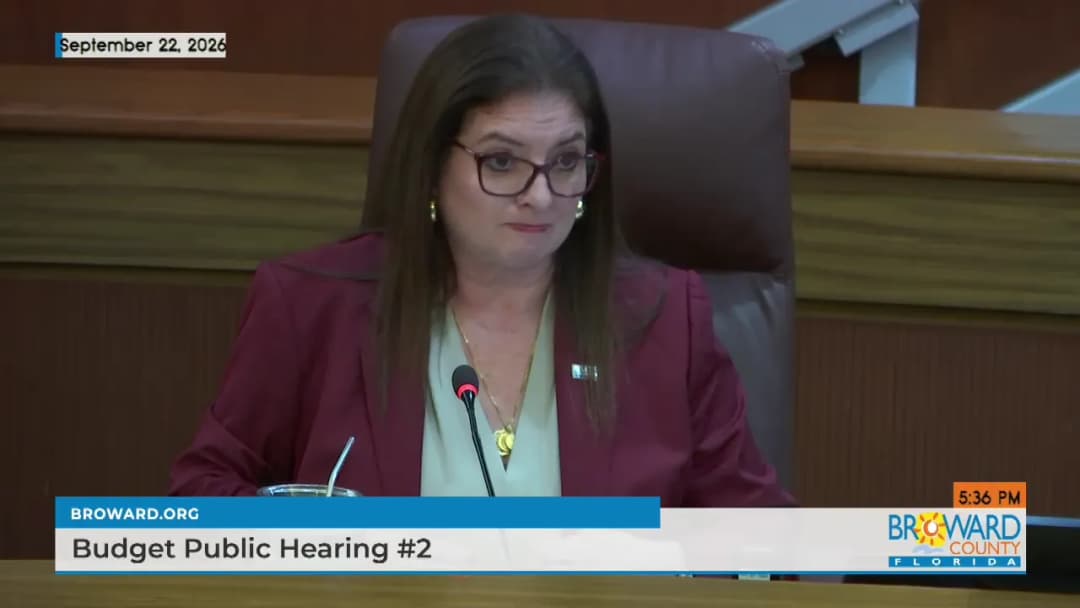
The Broward County Board of County Commissioners held its final public hearing on September 22, 2026, to adopt final millage rates and budgets for Fiscal Year 2027 (FY27) and the FY2027-2031 five-year capital program. The meeting, which began at 5:01 PM, covered countywide and Broward Municipal Services District (BMSD) millage and budgets, dependent water control districts, and the capital program. Public testimony focused on affordable housing funding and community cat program support. Public Comments & Testimony - Reverend Aaron Lauer (United Church of Christ Fort Lauderdale, Bold Justice) expressed support for affordable housing but noted that the proposed budget falls $1.6 million short of fully implementing the board's 90% policy for the affordable housing trust fund, which he said would result in 30 fewer affordable homes. He urged full funding. - Adeline Lubin (Plantation Seventh-day Adventist Church, Bold Justice) shared personal stories of housing unaffordability from community listening sessions, including residents unable to rent or return to Broward County, and asked the commission to fully fund the 90% policy. - Susan White Basley (Trinity Lutheran Church, Bold Justice) recounted her daughter's inability to afford housing in Broward and urged the board to allocate the full 90% of expired TIFF money to affordable housing. - Annabelle Yupanqui (Oakland Park resident) requested that each commissioner direct available discretionary funds to additional TNR (trap-neuter-return) vouchers for community cats, citing resident burdens under the current system. Discussion Items - Affordable Housing Funding: County Administrator Monica C. explained that the FY27 budget includes $33.7 million for affordable housing, representing 103% of expired CRA (Community Redevelopment Agency) dollars, exceeding the board's 90% resolution. This includes $27.7 million (85% of expired CRA dollars) from the capital program, $5.87 million from a Hollywood set-aside, and $250,000 for an Oakland Park project. Commissioners debated whether the Hollywood set-aside should count toward the 90% goal; staff noted it is restricted to Hollywood low-to-moderate income areas. Commissioner Davis questioned whether the Hollywood set-aside is recurring; staff confirmed it increased from $4.1 million to $5.8 million this year but future amounts are not guaranteed. - General County Millage Reduction: Commissioner Udine proposed a motion to reduce the general county millage rate from its current level to 5.6628 mills (a 4.97% increase over the rollback rate), arguing for tax relief for residents. After discussion—during which Commissioner Rich noted the reduction would amount to about $0.84 per homestead and Commissioner Furr cautioned that service cuts would harm lower-income residents—the motion passed 7-2. The reduction decreased ad valorem taxes by $1,078? (actually $1,070,810 from the later read) and reduced the reserve for ad valorem by $957,420. - Broward Municipal Services District (BMSD) Millage Reduction: Commissioner Udine then proposed an additional millage reduction for the BMSD (unincorporated areas). Vice Mayor McKenzie supported it, arguing that BMSD residents on fixed incomes need relief. Commissioners Fisher and Geller opposed, citing potential service cuts in the small district. A substitute motion to reduce the BMSD millage rate to 2.3341 (an 8.80% increase over rollback) passed 6-3, reducing BMSD revenues by $1,960 and cutting a reserve line by $1,860. - Millage and Budget Adoption for Other Districts: The County Administrator presented overviews for the Fire Rescue Municipal Services District (millage 2.6191, unchanged), Street Lighting Subdistrict (millage 0.3743, unchanged), and four Water Control Districts (all at rollback rates, 0.00% increase). The public hearing on each was opened and closed with no public speakers. All were adopted unanimously (9-0) except for the Fire Rescue budget, which also passed unanimously. - Five-Year Capital Program: The board adopted the FY2027-2031 Capital Program (Resolution 2026-598 as amended) unanimously (9-0). Key Outcomes - General County Millage and Budget: The board adopted a final millage rate of 5.6628 mills for general county purposes (4.97% increase over rollback) and a FY27 general fund budget of $2,143,686,430 (total all funds $9,217,557,140). The vote on the millage resolution was 7-2; the budget adoption vote was 8-1. - Broward Municipal Services District (BMSD): The BMSD millage rate was set at 2.3341 mills (8.80% increase over rollback), and the budget was amended to $14,185,330 (total all funds $9,217,557,140). The millage resolution passed 6-3; the budget resolution passed 8-1. - Fire Rescue Municipal Services District: Millage rate of 2.6191 mills and budget adopted unanimously. - Street Lighting Subdistrict: Millage rate of 0.3743 mills and budget adopted unanimously. - Water Control Districts 2, 3, 4, and Cocomar Unit Area 1: All millage rates were set at rollback (0.00% increase) and budgets adopted unanimously (9-0). - Five-Year Capital Program (FY2027-2031): Adopted unanimously (9-0). - The board recognized county staff for their work on the budget.
The Public Meeting Index
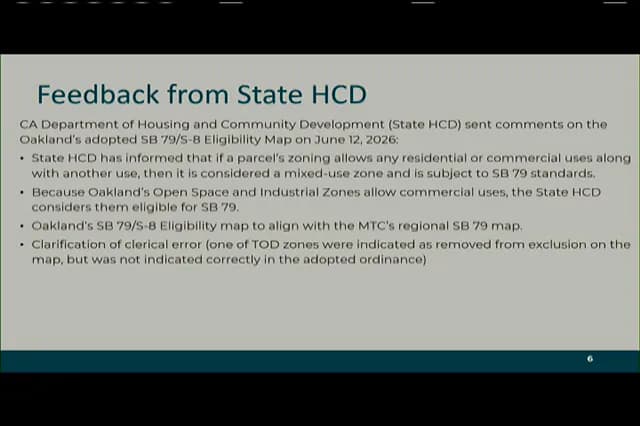
The Public Meeting IndexThe Oakland City Council Community and Economic Development Committee met on Tuesday, September 22, 2026, in the City Council Chamber at Oakland City Hall. Although the agenda listed a 1:30 p.m. start, the meeting convened at 1:56 p.m., with Chairperson Rowena Brown presiding. Councilmembers Janani Ramachandran and Zac Unger were present; Councilmember Carroll Fife was excused. Because Councilmember Houston (District 7, not a committee member) was present, a quorum of the full City Council was noted; the committee adjourned at 2:16 p.m. and reconvened as a Special Meeting of the Full Council. No final City Council action could be taken at this noticed special meeting. The meeting adjourned at 2:52 p.m. Consent Calendar - Item 1 (Draft Minutes, July 14, 2026): Approved unanimously on a motion by Councilmember Unger, seconded by Councilmember Ramachandran. Vote: 3 ayes (Ramachandran, Unger, Brown); 1 excused (Fife). - Item 2 (Determination of Schedule of Outstanding Committee Items): Accepted as presented, with no changes to the pending list. Motion by Councilmember Unger, seconded by Councilmember Ramachandran. Vote: 3 ayes; 1 excused (Fife). Public Comments & Testimony - On Item 2, Sado Olabala said unemployment for foundational Black individuals in Oakland has been at 10% and in double digits for quite some time. She requested that workforce-related items include racial demographic representation, and that data separately identify foundational Black Americans (descendants of enslaved people) from Black people from the Caribbean, Africa, and Central and South America. - On Item 3, Sado Olabala argued the city reacted to SB 79 after its passage instead of shaping the bill to serve the city. She said the bill's purpose of increasing affordable housing near BART and AC Transit is a good idea, but noted some communities do not want high density, and criticized what she called a lack of consistency in the city addressing gentrification. - On Item 4, Sado Olabala disputed the director's statement that Oakland has a diverse economic base, saying the city does not support foundational Black Americans in employment. She cited unemployment statistics (as transcribed): 5.1% for African Americans in California, 7.5% unemployment, and 9% in Oakland; 15.9% for Black men in California without a high school diploma; and unemployment for Black women in California with college degrees tripling from 2.7% to 8.5%. She referenced a Budget Advisory Commission document stating crime and economic development are intertwined, and that Oakland residents spend roughly $1.5 billion annually in other cities due to crime concerns. She recommended focused job training and support for people re-entering from prison. - Open Forum: David Boltwright (also transcribed as 'David Botroye,' District 4) requested a housing presentation documenting housing funded with city and other sources over the last five years, including units completed, persons housed, total amount spent, average time from conception to occupation, and percentage by construction type. He cited a modular housing project on EDS Avenue (as transcribed) that took about 1.5 years to construct and six months to fully occupy, at roughly $350,000 per unit. Sado Olabala repeated concerns about gentrification and what she called continual redlining affecting foundational Black Americans. Discussion Items - Item 3 (S-8 Ordinance Amendments / SB 79): Kelly Cha of the Planning and Building Department presented amendments to Planning Code Chapter 17.86, the S-8 Abundant and Affordable Homes Near Transit combining zone (Senate Bill 79), with Laura Kaminsky, Strategic Planning Manager, also available. SB 79 was enacted in October 2025 with an effective date of July 1, 2026. Oakland adopted its local S-8 regulations in March 2026, then received comments from the Metropolitan Transportation Commission (MTC) on June 10, 2026, and from the California Department of Housing and Community Development (HCD) on June 12, 2026. HCD determined that Oakland's open space and industrial zones that allow commercial uses are mixed-use zones subject to SB 79. The proposed amendments would: remove the 20th Avenue AC Transit stop (map 28); remove open space and industrial zones from the ineligibility list; add parcels without Oakland permitting authority; redesignate all industrial parcels within TOD zones, including areas around the Coliseum BART Station and the 14th Avenue AC Transit stop, from ineligible to excluded; align TOD zones with MTC's final regional map; and add four additional transit stops, with analysis confirming all four are eligible for exclusion. The Planning Commission gave a unanimous recommendation in September 2026 without modifications. Councilmember Unger asked for clarification on the industrial zone changes; staff explained that industrial uses remain allowed under local zoning, and the changes only prevent SB 79 from mandating housing on those parcels at this time. Councilmember Houston requested that staff (Kelly Cha and Mr. Gilcrest) come to the East Oakland Gateway meeting before the October 6 or October 20 council dates to explain the maps, saying the many colors and outlines were confusing for constituents. - Item 4 (Economic Development Action Plan Implementation Status Update): Ashley Canett, Director of Economic and Workforce Development, presented the first annual implementation update for the 2025-2029 Economic Development Action Plan (EDAP) for fiscal year 2025/26, organized around five goals: attracting and growing key sectors; supporting existing businesses; connecting Oaklanders to jobs; investing in places; and arts, culture, and social activity. Key statistics included: more than 24,300 employers in 2025 (a peak, per EDD data); nearly 185,000 jobs in 2025, still below 193,000 jobs in 2023 and below the peak of nearly 200,000 in 2020; healthcare and social assistance as the largest employment sector with more than 46,000 jobs; information employment up 66% from 2010 to 2025, healthcare and social assistance up 54%, and public administration up 39%; more than 90% of businesses with fewer than 10 employees and most with annual revenues below $250,000; 21 neighborhood business corridors; $1 million dispersed for community-led safety initiatives and 47 city-funded positions on the street; 329 Neighborhood Business Assistance appointments across every council district; unemployment of about 9% for Black Oaklanders compared with 6% for Latino and Asian Oaklanders and 5% for white Oaklanders; the $240 million Samuel Merritt University project and the 4,000-square-foot Native American Health Center, both on city-owned land; five affordable housing projects (295 units) in the pipeline or under construction on city-owned property; 26 arts organizations supported through operating grants; 52 public art projects in development or completed; roughly 200 leases and licenses managed; reported crime down year over year and versus the five-year average in all six police areas in 2025; office rents beginning to stabilize in 2025 while downtown vacancy remains elevated and retail vacancy increased. Chair Brown asked about commercial rents and a decline in businesses from 2023 to 2025 (4,749 businesses in 2023, reduced by almost 700 by 2025, as she cited from the report), noted the county may place a $30 minimum wage measure on the ballot, and asked about collaboration with California GoBiz. Director Canett responded that GoBiz issues requests for information on behalf of companies seeking locations (the city is currently negotiating with a business that came through that process) and oversees state-level fiscal incentives such as tax abatements and waivers. Key Outcomes - Item 1: Draft minutes accepted unanimously (3-0; Fife excused). - Item 2: Outstanding committee items schedule accepted unanimously (3-0; Fife excused). - Item 3: Approved the staff recommendation on a motion by Chair Brown, seconded by Councilmember Ramachandran, and forwarded the ordinance to the October 6, 2026 Concurrent Meeting of the Oakland Redevelopment Successor Agency and the City Council as a public hearing, with a request that staff include the letters from state HCD and MTC in a supplemental report. Vote: 3-0 (Fife excused). - Item 4: Received and filed in committee (informational report) on a motion by Councilmember Unger, seconded by Chair Brown. Vote: 3-0 (Fife excused).
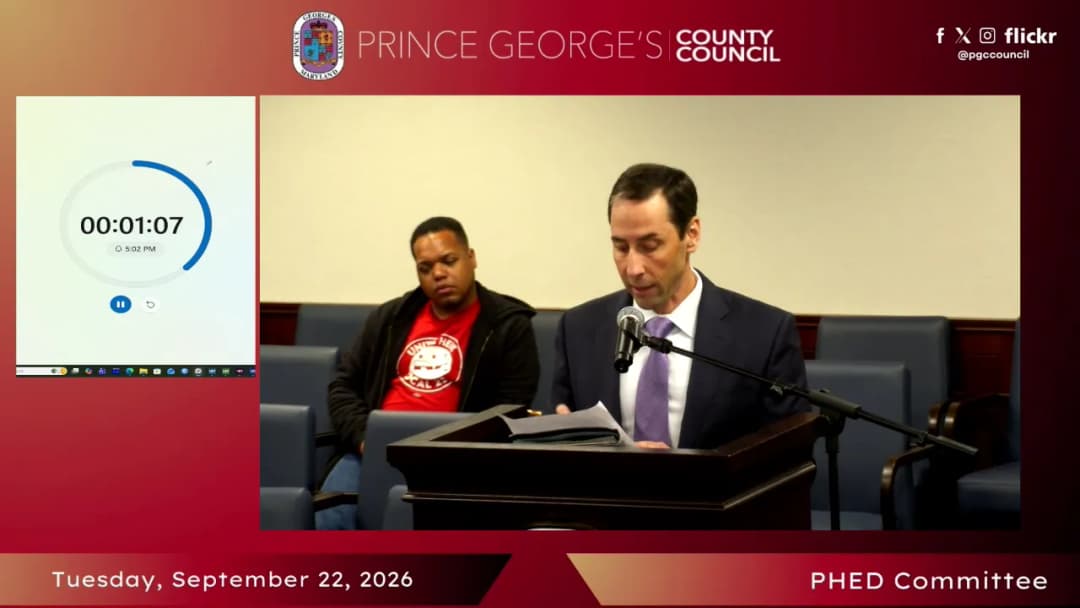
The Planning, Housing and Economic Development (PHED) Committee of the Prince George's County Council met on Tuesday, September 22, 2026, at 4:30 PM in Committee Room 2027. Chair Wala Blegay presided, with Vice Chair Krystal Oriadha, Council Member Shayla Adams-Stafford, and Council Member Thomas Dernoga present (4 of 5 members; Council Member Eric Olson absent). Council Member Jolene Ivey also attended. The committee considered two legislative items and voted to favorably recommend both to the full County Council. Public Comments & Testimony - CB-080-2026 (Universal Design for Housing): Peter Goldsmith, of the law firm Lerch, Early & Brewer, testified in support of the bill on behalf of the Housing Initiative Partnership, Green Street Housing, and team associates. He explained that the original universal design legislation had unintended consequences on multifamily development, potentially increasing unit square footage by over 20% and threatening housing affordability. He stated that the bill was a compromise reached after extensive collaboration with the Department of Permitting, Inspections and Enforcement (DPIE) and that it retains significant civil penalties to ensure compliance. He requested a favorable vote. Discussion Items - CB-087-2026 – Electrical Code of Prince George's County: Committee Director Rana Hightower presented the bill, which adds enforcement provisions to the electrical code (Subtitle 11) consistent with Subtitles 4 and 13, including administrative adjudication of appeals, additional civil and criminal penalties, citation issuance, and provisions to prevent property transfers with existing violations. The bill is sponsored by the County Executive, not Council Member Ivey as initially thought (a clarification was made during the meeting). No public speakers signed up. The committee moved to a vote without further discussion. - CB-080-2026 – Universal Design for Housing: Rana Hightower introduced the bill, which revises definitions, clarifies applicability, establishes exemptions, sets new universal design requirements for specified multifamily properties, updates waiver provisions, revises penalties, and makes technical corrections to strengthen universal design standards. Council Member Ivey, a co-sponsor (with Council Member Adams), noted that the bill addresses affordability concerns that arose after the original law took effect on July 1, 2026, by ensuring sufficient units for lower-income households. Peter Goldsmith's supportive testimony followed (see Public Comments). No amendments were offered. Key Outcomes - CB-087-2026: A motion by Council Member Dernoga, seconded by Vice Chair Oriadha, to favorably recommend the bill to the County Council passed unanimously (4-0; Blegay, Oriadha, Adams-Stafford, Dernoga voting aye). - CB-080-2026: A motion by Council Member Dernoga, seconded by Chair Blegay, to favorably recommend the bill to the County Council passed unanimously (4-0; Blegay, Oriadha, Adams-Stafford, Dernoga voting aye). - The committee adjourned after completing its agenda.
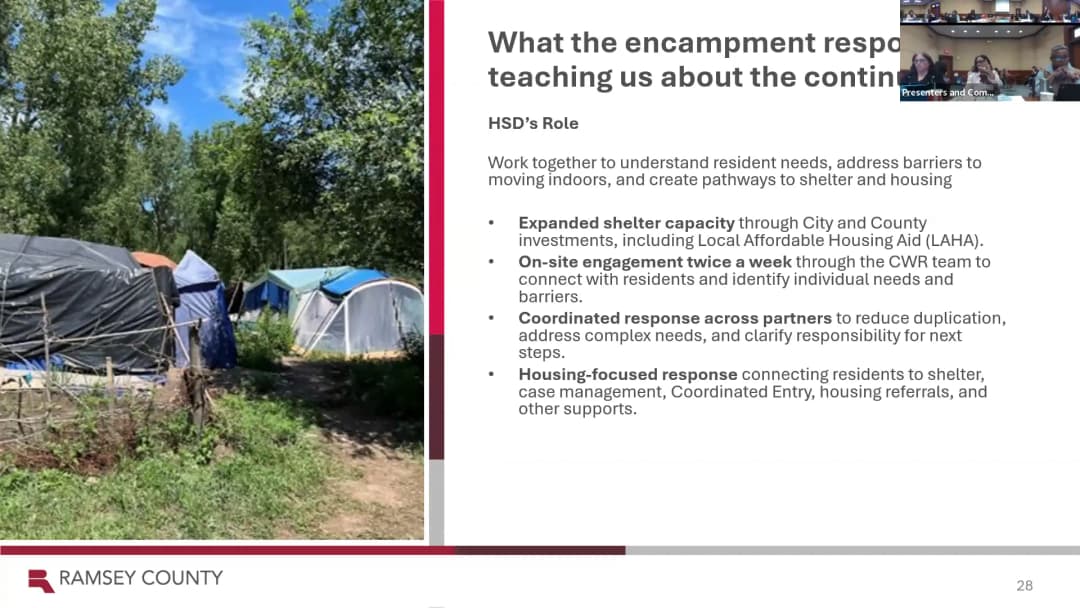
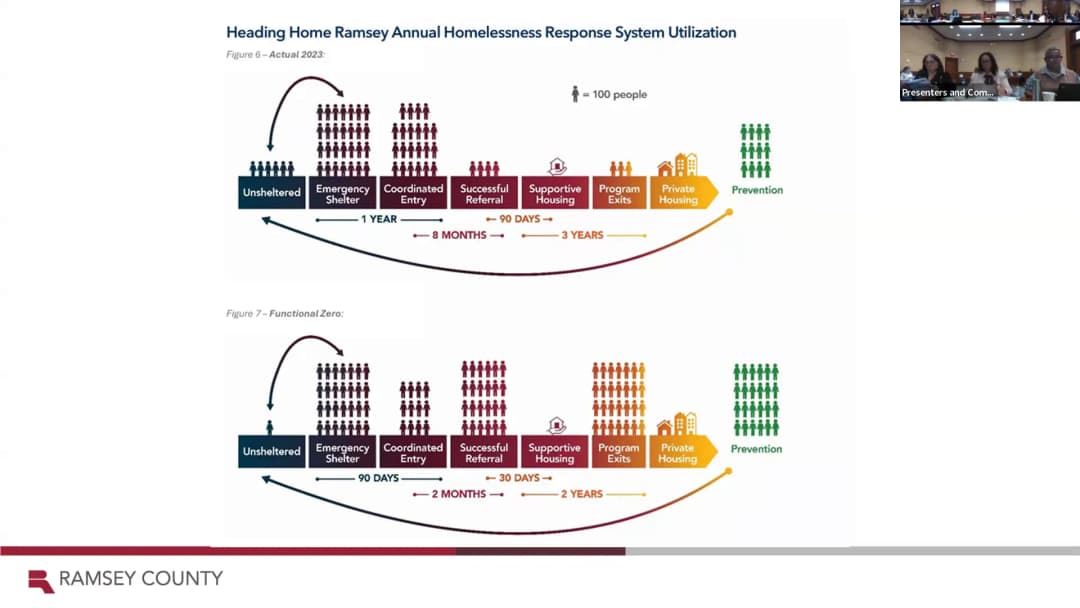
The workshop, held on September 22, 2026, from 1:30 p.m. in Courthouse Room 220, focused on Ramsey County's Housing Stability Department (HSD) and its role in the homelessness response system. Commissioners reviewed HSD's current work, funding, system pressures, and the encampment response. No formal votes were taken, but commissioners shared priorities for resource allocation. Discussion Items - HSD Overview & Strategic Priorities: HSD Director Denise Wilkins and Deputy Director Shmeha presented a detailed overview of the department's 33-person team. Key strategic priorities include alignment across the housing continuum, equity (75.6% of people in the homelessness response system identify as persons of color), and collaboration with community providers, cities, and other county departments. HSD's work spans prevention, shelter coordination, coordinated entry, supportive services, and system performance. - Funding Breakdown: HSD's current revenue is approximately $19.3 million, consisting of 33% levy, 28% state, 21% Local Affordable Housing Aid (LAHA), 11% Local Homeless Prevention Aid (LHPA), and 7% federal funds. Federal continuum of care (COC) funding primarily supports permanent supportive housing (PSH), though policy shifts may prioritize rapid rehousing and transitional housing. Commissioner questions clarified that PSH has no time limit, but federal changes may reduce its funding. The county does not fund PSH directly; it uses federal and state dollars. - System Pressures & Opportunities: Rising rents, limited affordable units, insufficient shelter and housing capacity, longer pathways to housing, and differing needs across populations (single adults, families, youth) are straining the system. Opportunities include a redesign of coordinated entry (procurement passed, work expected within 30 days), strengthening shelter capacity, improving adverse weather response, clarifying staff roles, and updating policies. The adverse weather task force has begun meeting. - Encampment Response: HSD is focusing on strengthening pathways from unsheltered homelessness to shelter and housing. Efforts include expanding shelter beds via city/county investments, providing case management services (using LAHA dollars), and a weekly "by-name list" case consultation meeting involving partners. Data as of the meeting: 235 residents identified on the encampment list since inception; 204 currently active; 20 placed in housing; 11 no longer at encampment; 117 completed coordinated entry assessments; 12 not completed; 20 need updates; 6 not eligible. Coordinated entry uses HUD's definition of homelessness (chronic/long-term), which may not align with state definitions—an issue noted for system redesign. - Commissioner & Staff Comments: Commissioner Moran emphasized upstream prevention. Commissioner Jebinsing highlighted the need for a broader ecosystem beyond housing (e.g., Medicaid, informal supports). Commissioner McMurtry requested data on PSH bed gaps (est. 1,500 beds short) and average costs. Commissioner Miller asked about definitions of homelessness and funding streams. Commissioner Mills noted the importance of partnerships with cities and faith-based organizations. - Resource Allocation Exercise: Commissioners were asked to place a hypothetical dollar on one area: prevention, shelter, coordinated entry, or supportive housing. Three chose prevention, three chose supportive housing, and one chose coordinated entry. Key Outcomes - No formal resolutions or votes were taken. The workshop concluded with a commitment to continue strengthening system connections and to provide the board with regular updates on coordinated entry redesign and other initiatives. The adverse weather response plan and encampment closure coordination with the city of St. Paul are ongoing.
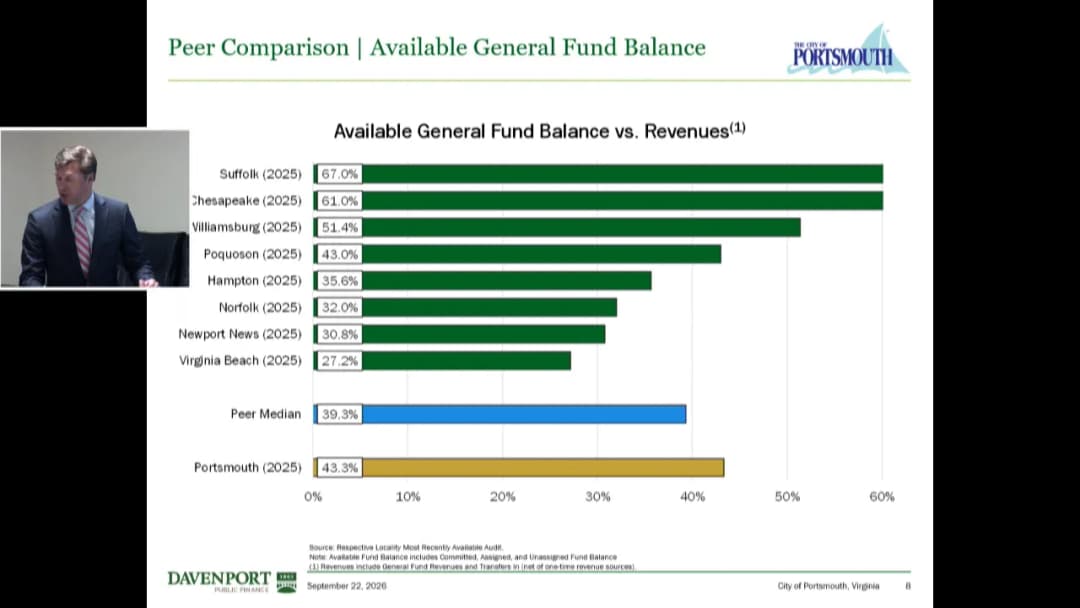
On September 22, 2026, the Portsmouth City Council held a public work session followed by a regular meeting at City Hall (801 Crawford Street). The agenda packet listed the work session as a called Joint Meeting with the Planning Commission for Monday, September 21, 2026, but the transcript indicates the session took place on Tuesday, September 22; this summary follows the transcript date. Six council members were present, with Dr. William S. Dodson, Jr. absent from the regular meeting. The work session covered the regional food bank, a $155 million City Hall financing plan, the bulk waste collection program, and political signs at City Hall. The regular meeting included a recognition, public hearings, the consent agenda, and adoption of a collective bargaining ordinance. Work Session: Food Bank of Southeastern Virginia & the Eastern Shore - Chris Tan presented, noting the food bank was founded in 1981 (45 years old), has delivered 442 million meals across a 4,400-square-mile service area covering 11 cities and counties, and works through 240+ partner agencies (up from 110 four years ago). - Portsmouth distributions increased 79% over five years, from 1.5 million pounds in FY22 to 2.7 million pounds last year — the equivalent of 1.9 million meals, or 25 meals per city resident. - The food bank set distribution records four consecutive years, growing 48% while most of the 199 U.S. food banks saw about a 5% decline. - Produce distribution nearly doubled, from 4.5 million pounds in FY23 to 9.5 million pounds last year, including a 44% increase in Portsmouth alone. Protein doubled in two years; donated Purdue chicken rose from 300,000 pounds per year to 1.4 million pounds last year. - Portsmouth represents about 9% of food-insecure individuals in the service area but received 18.6% of duplicated-count services. The food bank served 5,000 unique Portsmouth households last year, with 28 partner agencies distributing about 75% of Portsmouth food. - Direct city funding over the last five years totaled about $65,000; the food bank returned more than $15 million in food. Last year, a $15,000 city investment returned $5.2 million in food — a 348-times return on investment, calculated at Feeding America's $1.92-per-pound standard. - The food bank distributed 26 million pounds last year, including 11 million pounds of rescued grocery-store food; every 2,500 pounds rescued saves one ton of methane. Purchased food rose from about $1 million in 2019 to $5 million last year; roughly 10% of food comes from federal commodities. - Mobile pantries at Craddock, the SportsPlex, and Third Baptist serve about 20,000 people monthly and distribute about 380,000 pounds per year. Seven backpack sites deliver about 6,000 backpacks per year. The TCC Portsmouth campus market serves about 10,000 students and distributes about 45,000 pounds, with TCC reporting a 10% higher re-enrollment rate among users. - A Bethel Worship Center Church pilot delivers food to homebound seniors — 93 orders delivered in Portsmouth — and a DoorDash delivery pilot is underway. - Food hubs (three in Norfolk, one in Franklin) are rent-free, choice-based distribution sites connecting neighbors to legal aid, health screenings, and SNAP re-enrollment. A Portsmouth hub would cost about $10,000 per month in food ($120,000 per year); Tan suggested splitting roughly $30,000 each among the city, the food bank, and a corporate partner, with a three-year commitment. - Councilwoman Thomas expressed full support for a hub and noted a possible food-desert location; Vice Mayor Moody, a former food bank board member, asked about site scouting; Councilman Hugel asked how nonprofits can partner (via foodbankonline.org, with a waitlist); Councilwoman Bryant called the hub a trust-building channel for city services. Mayor Glover directed the city manager to continue the conversation. Work Session: City Hall Financing / 2026 Bond Plan - Interim CFO Stephanie Council and Davenport advisors Kyle Laps and David Rose presented a plan of finance for a new City Hall. - The estimated City Hall cost is about $125 million, plus about $30 million to reimburse the city for already-completed capital projects — approximately $155 million in total funding. The plan includes no increase in sales or other taxes. - Credit ratings are Moody's Aa2, S&P AA+, and Fitch AA-. General fund revenues and expenditures have each grown about 7% annually, with positive net changes in fund balance every year. Available fund balance is about 43% of the total budget versus a peer median of about 39%. - Tax-supported debt is about $300 million with a 10-year payout ratio of about 80%; pension bonds are expected to be fully paid off in about 10 years. Current debt service is about 7.5% of the budget (policy cap 10%), and debt is about 2.7% of assessed value (policy cap 4%). - Planning assumptions include a 30-year repayment and a conservative 5% interest rate. Even with the $155 million layered in, the city remains within its debt policies. Davenport expects to return in November 2026 for a public hearing and ordinance, with borrowing completed by the end of the calendar year; a broader capital planning discussion is anticipated for winter/spring 2027. - Councilman Dodson asked how other CIP and school projects fit; Councilman Hugel asked for ROI projections for developing the current City Hall waterfront site. Davenport confirmed the plan assumes only 1% assessed-value growth and 3% budget growth and does not rely on future economic development revenue. Mayor Glover called the project 'generational,' noted the city is financially strong, and urged patience to let the financial team complete its work. Work Session: Bulk Waste Program Update - City Manager Carter described the failed rollout of the scheduled bulk waste pickup system, saying the city tried to run scheduling and old canvassing simultaneously. Beginning October 1, scheduling would become the standard, with aggressive education, documentation, and readiness evaluations at 30, 60, and 90 days. The target is 95% successful service delivery before full enforcement, rather than an arbitrary January 1 date. - Dashboard data showed 171 stops planned for the next day with four trucks; daily requests up 21% (17 vs. 14); weekly submissions 165 vs. 164; and September submissions about 1,400 vs. 837 last month. Plans include truck cameras, door hangers, bin stickers, a management dashboard, and a 'one city, one message' education campaign. - Vice Mayor Moody called the rollout a failure, cited conflicting information (24-hour vs. 48-hour windows, confirmed by his own phone call that morning), said trash is accumulating citywide, and called for a timeout until January with a possible small-area pilot. Councilman Tillage concurred, noting residents were told different timeframes (including five days) and had trouble reaching staff by phone or online. Councilwoman Thomas supported delaying implementation while starting communication immediately; Councilman Hugel said the city has 'strike one' and must explain why the change is needed; Councilwoman Bryant recommended a communication playbook (press releases, home page icon, QR codes, door hangers), no fines starting October 1, and a citywide cleanup sweep. - Consensus: return to the prior collection system through January, and remain on it until the city manager can demonstrate the new system will be an improvement. The manager will report back with data-driven improvements. Councilman Dodson also noted the front desk/phone system is not working well. Work Session: Political Signs at City Hall - Council discussed political signs during early voting. Councilman Tillage said the May consensus barred all political signs on city property, and his email asking for reconsideration drew no responses (Councilwoman Bryant corrected that she did reply). Mayor Glover said there was no intent to deny anyone sign rights, only to establish rules. - Consensus: a limit of two yard signs per candidate, placed in designated grass areas on the Columbia Street side of City Hall and the small grass area next to the Water Street parking lot; signs may remain overnight but must be removed for maintenance, with the city providing notice; code enforcement will collect signs exceeding the limit. The city manager will send the policy to the registrar, candidates, and enforcement staff. Regular Meeting: Consent Calendar & Public Hearings - Alpha Phi Alpha Fraternity, Epsilon Nu Lambda chapter, was recognized for its 75th charter week; chapter president Keith Bailey addressed council. - Public hearing 26-218 (resolution requesting the General Assembly to amend the city charter to delete Chapter 11, the Civil Service Commission) was held with no speakers; the resolution was later adopted as consent item H. - Item 26-219 (CF Honeycutt use permit UP-01-08, 4592 George Washington Highway) was deferred to the November 10, 2026 meeting by unanimous roll-call vote. - Public hearing 26-206 (UP-2608, T Cross event space/banquet hall at 500 Rodman Avenue) was approved 6-0 with conditions. - The consent agenda (items A–H) was adopted 6-0, including: a $502,494.87 U.S. Department of Justice bulletproof vest partnership grant; $5,226,000 in FEMA BRIC funding through VDEM for phase one of the Lake Meade Dam adaptations; $500,000 from the Virginia Opioid Abatement Authority; $53,715 in PATH funding for homelessness outreach; $111,856 in Partnership for Success funding for youth substance misuse; adoption of the Portsmouth Flood Resilience Strategy; a Dominion Energy easement over 2045, 2017, and 2023 Frederick Boulevard; and the Civil Service Commission charter amendment resolution. Regular Meeting: Collective Bargaining Ordinance (26-221) - The council considered an ordinance adding Section 2-118 to the city code to establish a collective bargaining framework. - Speakers in support included Tiffany Stewart (EMS lieutenant and president of IAF Local 539), who said negotiations with staff were productive and that contracts serve as long-term financial planning tools; Kurt Dietrich (president of the Virginia Professional Firefighters), who called it a historic opportunity; Todd Riley, speaking on behalf of the City of Roanoke's fire and EMS workforce as a sister locality; and Garland Alexander, a retired Local 539 member of 58 years. - Rhoda Young expressed support but argued the proposed structure makes it harder for non-sworn and general employees — including human services, behavioral health, and 911 dispatchers — to organize, and warned of political consequences if workers are denied a voice. - Chris Hollis (Laborers) expressed support but asked for four bargaining units instead of three, arguing the 'others' category unfairly groups distinct worker types; he cited the Richmond and Alexandria models and said collective bargaining has not broken those cities. - The ordinance was adopted 6-0. Council Member Reports & City Manager Announcements - Councilman Hugel reported on a Minus 9 to 5 / ODU presentation on the state of child care in Portsmouth: 6,351 children under age five; two-thirds have all available parents in the workforce; 86 regulated programs with capacity for 4,490 children; and two pages of strategy recommendations. National Night Out is rescheduled for October 6. - Councilwoman Bryant reported an urgent need for foster homes in Portsmouth, noted the assessor's office recertified for the Certificate of Excellence in Assessment Administration, and asked colleagues for policy direction on the community and regional funding framework. - Councilwoman Thomas highlighted the PRHA Youth Build workforce development home at 605 London Street, now on the market for eligible buyers. - Councilman Tillage promoted the Symphony on the River event and the 79th annual Fishbowl Parade on Saturday. - Mayor Glover announced a community day Saturday at 1701 High Street. - City Manager Carter announced: possible localized flooding with parking garages free starting tomorrow afternoon; Government 101 beginning Monday, September 28 at 6 p.m.; a peanut butter and jelly food drive competition; and Portsmouth being named a 2026 Virginia Municipal League Innovation Award winner for Rock the Block (environmental quality award), to be presented October 11. Public Comments & Testimony (Regular Meeting) - Desani Wilkerson (consent agenda speaker) described a planned organization for independent living, second-chance shared housing, and a Portsmouth wellness center offering digital literacy, job readiness, mentorship, and sound therapy; she said the effort is currently self-funded. - Sergi O'Neill thanked council for clarity on the Portsmouth United funding structure, decried misinformation about participating nonprofits, and encouraged citizen engagement. - Sherman Tyler expressed anger about the sign restrictions, saying candidates were not informed and that a candidate stood outside City Hall for eight hours; he suggested the timing near the election amounted to suppression. Councilwoman Bryant responded that the decision was made in May and that the work session had created a pathway forward. - Sheila Joseph complained about overgrown grass, trees, and right-of-way maintenance along Frederick Boulevard and in neighborhoods, noted new security screening at waste management, and asked for better public notice of street work. - Brian Williams (Parkview) requested speed tables or bumps and signage on Elm Avenue due to excessive speeding, military-base congestion, and vehicles being struck; Mayor Glover directed him to the traffic-calming request process. - Rhoda Young thanked council for the sign compromise and urged continued listening to residents. - Nicole Hardy (president, Charles Pete Little League) reported that the Charles Pete Little League Complex renovation is stalled; the contract with Turner Strategic Technologies (IFB E500, $6,540,252.75, executed March 19, 2025) anticipated a 270-day completion, but the league remains displaced at an inadequate field since spring 2025. She said a $210,000 covered pavilion (item 91) was omitted from the final construction drawings. Councilwoman Thomas requested a report back and a designated communication contact. Key Outcomes - Bulk waste: consensus to revert to the previous collection system through January and until the city manager can demonstrate the new system will improve service; data-driven updates to council expected. - Political signs: consensus allowing two yard signs per candidate in designated areas at City Hall, overnight placement allowed, removal for maintenance with notice; city manager to issue guidance. - CF Honeycutt use permit (26-219) deferred to November 10, 2026, by unanimous vote. - T Cross event space use permit (UP-2608) approved 6-0. - Consent agenda adopted 6-0. - Collective bargaining framework ordinance (26-221) adopted 6-0. - Direction given to the city manager to: advance the food bank hub conversation; report back on the Charles Pete Little League project status, scope changes, and communication contact; and provide CIP/school integration and waterfront ROI projections ahead of the November financing decision.
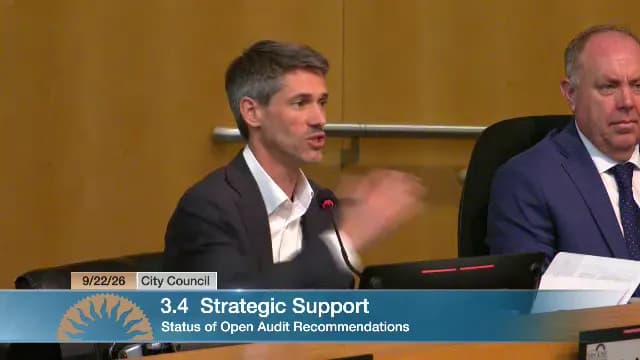
The San José City Council convened on September 22, 2026, at 1:30 PM in a hybrid meeting to discuss ceremonial recognitions, routine consent items, and several major reports. Key topics included the 2026 Summer Intergovernmental Relations (IGR) Report, the status of open audit recommendations, an employee turnover audit, and the stormwater management annual report. A robust debate occurred over a resolution to restore local land-use control, ultimately adopted 9-2 after a substitute motion failed 4-7. Ceremonial Items - Rhonda Berry, Executive Director of Our City Forest, was honored for 30 years of service. Under her leadership, over 80,000 trees and 20,000 shrubs were planted, mobilizing more than 175,000 volunteers and 35,000 students. The city saved an estimated net $75 million in tree-planting costs. - MLV NorCal (NorCal Rumble), a new professional women’s volleyball team, was welcomed with a proclamation. The team will play at Tech CU Arena starting in 2027. Heather Vaughn, President, emphasized the brand’s connection to Northern California’s natural landscapes. - The Billy DeFrank LGBTQ+ Community Center was recognized for its 45th anniversary. CEO Gabrielle Antalovich highlighted the center’s volunteer-run model and ongoing challenges facing the LGBTQ+ community, including attacks on trans women. - A proclamation declared September 2026 as International Literacy Month. Councilmember Kamei noted that only 54% of Santa Clara County third graders read at grade level, while the San José Public Library hosted over 8,100 literacy programs reaching nearly 170,000 participants. Consent Calendar - Councilmember Candelas pulled Item 2.9 (Amendment to Funding Agreement with East Side Union High School District for a Community Wireless Network), highlighting that the agreement provides free internet access to 200,000 students and families at Overfelt, Evergreen Valley, and Silver Creek high schools. Councilmember Doan also thanked library staff for including digital equity efforts at Yerba Buena and Andrew Hill high schools. The consent calendar, including all routine approvals, was adopted unanimously. Public Comments & Testimony - Brian (speaker) expressed appreciation for audit work and raised concerns about police overtime spending and the need to focus on state-level issues. - Jordan Muldaur (District 3) urged the city to conduct regular employee engagement surveys and follow up on results, citing his private-sector experience. - User one (Michael Censini) complained about trash piles on Speake and Luchessi avenues (District 9) and urged better coordination with Valley Water for flood preparation, noting that the city’s electrical grid and sewer system are not ready for growth. - Betsy spoke during Open Forum about her brother’s homelessness and banishment, criticizing the city’s policies. - Additional speakers during stormwater and turnover audits offered brief supportive comments. Discussion Items - 3.3 – 2026 Summer Intergovernmental Relations Report: - Emily Lamb (Director of IGR) and Han Kang (Chief IGR Officer) presented the report. Key achievements included securing approximately $6.2 million in federal earmarks for mobile home repairs, fire equipment, and park improvements; $21 million for transportation infrastructure; $3.3 million for seven firefighter positions to open Fire Station 32 in Little Saigon; and state funding for homeless housing assistance (HHAP). - The city successfully advocated for two bills now before the governor: SB 1375 (CEQA exemption for Diridon Station modernization) and AB 1941 (anti-copper wire theft). E-bike safety bills were also shaped (SB 1167 and AB 2346), and a Superior Court ruling protected 3,000 cardroom jobs. - Mayor Mahan thanked the IGR team and highlighted the city’s proactive stance on data centers, emphasizing that local standards will go beyond state regulation. - Councilmembers Casey and Candelas introduced a memo calling for the city to support a League of California Cities resolution to restore local control over housing and land use. Councilmember Tordillos offered a substitute motion to instead direct staff to return with recommendations for providing flexibility to pro-housing cities while retaining enforcement tools for bad actors. After debate, the substitute motion failed 4-7 (with Kamei, Cohen, Tordillos, and Campos in favor). The underlying motion to adopt the IGR staff recommendation and support the Casey/Candelas memo passed 9-2 (Kamei and Tordillos opposed). - 3.4 – Status of Open Audit Recommendations: - City Auditor Joe Royce reported that 102 recommendations were tracked; 29 were implemented since the last update, leaving 73 open. Over 10 years, 90% of all recommendations have been closed. Of the 12 priority recommendations, three were implemented (vacant land reporting, SEQA guidelines, procurement handbook), and two new ones were added (police overtime monitoring and encampment abatement outreach protocols). - Mayor Mahan and Councilmembers Campos, Doan, and Vice Mayor Foley engaged: The administration committed to closing the remaining seven priorities within six months. Eric Sullivan (Housing Director) confirmed that outreach and BSJ databases are now aligned, and the Bell Properties contract will implement a work-order system for interim housing maintenance, saving an estimated $900,000 over six months. - The report was accepted unanimously. - 3.5 – Employee Turnover Audit Report: - Joe Royce and Michelle Millary presented the audit. Non-sworn annual turnover averaged 8.7% (including retirements) from FY 2022-2025, well below the public-sector average of 18%. Two key findings: (1) limited employee sentiment data hinders retention efforts; (2) inconsistent succession planning practices across departments. Four recommendations included: provide guidance on stay/exit interviews, re-establish a citywide employee survey, share workforce analytics with departments, and develop succession planning guidance. - Ram Kayum (HR) noted the administration has already started work and expects to implement recommendations within the fiscal year. Councilmember Campos underscored the importance of acting on survey results, citing San Diego’s example of a child-care subsidy. The report was accepted unanimously. - 6.1 – Stormwater Management Annual Report FY 2025-2026: - Jeff Provenzano (ESD), Reggie Nair, Garrett Hurdle (Public Works), and Olympia Williams (PRNS) presented. The city met the critical December 31, 2025 deadline for 100% trash load reduction, a result of 15 years of investment and installation of 40 small trash capture devices last year. 30 miles of no-encampment zones were established, 3.4 million pounds of trash collected, and bio-waste services provided to 2,600 lived-in vehicles. The total stormwater program investment was estimated at $88 million, down $34 million from the previous year due to the completion of interim housing facilities. - The current permit is expected to be extended through June 2028. Councilmembers Mulcahy and Kamei raised issues about jurisdictional coordination with Valley Water, particularly regarding woody debris and flood preparation, and the need for a public dialogue. The report was accepted unanimously. - 8.2 – FY 2025-2026 Consolidated Annual Performance and Evaluation Report (CAPER): - Councilmember Ortiz highlighted successes in East San Jose: 725 door-to-door visits, Somos Mayfair’s leadership program reaching 170 residents, and Vivo serving 182 residents (nearly double its goal of 100). The report was accepted unanimously (with Councilmember Tordillos absent). Key Outcomes - Consent Calendar: Approved unanimously. - IGR Report (3.3): The council adopted the staff recommendation and supported the Casey/Candelas memo directing the city to advocate for restoring local land-use control. Substitute motion failed 4-7; underlying motion passed 9-2. - Open Audit Recommendations (3.4): Accepted unanimously; administration to prioritize seven remaining recommendations by next report. - Employee Turnover Audit (3.5): Accepted unanimously; HR to implement all four recommendations by end of fiscal year. - Stormwater Report (6.1): Accepted unanimously; city to continue coordination with Valley Water and regulators on creeks and flood preparedness. - CAPER (8.2): Accepted unanimously.
Date: September 22, 2026 Time: 4:05 PM (called to order) Location: City Hall Council Chambers, La Crosse, WI Meeting Type: Special Meeting per Sec. 2-34 La Crosse Municipal Code The City Plan Commission convened a special meeting with all commissioners present. The sole agenda item was a rezoning request to facilitate the development of a new Chipotle restaurant with a drive-thru facility at 4358 Mormon Coulee Road. The meeting lasted approximately five minutes, and the item was approved unanimously without public comment. Discussion Items Rezoning for Chipotle Restaurant (26-0932): Staff presented a request to amend Subsection 115-110 of the City Code to transfer property from Planned Development District – Specific to Commercial District. The property is a satellite parcel in front of Aldi and the former Shopko site. The applicant (representatives for Chipotle) sought the rezoning to allow more flexibility and control of their parcel and to begin construction. Staff noted the project had gone through design review with minor revisions still pending but was close to building permits. Planning staff recommended approval. Approval of Minutes: The chair briefly inquired about approving prior meeting minutes but proceeded directly to the agenda item without action on the minutes. Key Outcomes Motion to Approve (26-0932): Councilmember Stein moved, seconded by Councilmember Newberry, to adopt the ordinance rezoning the property to Commercial District. The motion passed unanimously with all commissioners voting aye (no opposition or abstentions recorded). Next Steps: With approval, the applicant can proceed with building permits and construction of the Chipotle restaurant with a drive-thru facility.
The meeting began with roll call and public participation instructions. The committee received federal and state legislative updates from The Picard Group and Full Moon Strategies, and voted on one action item: to support H.R. 8355/S.5267. An informational item on EEOC rulemaking was noted. The state legislative update covered end-of-session activities, governor actions, and wildfire legislation, but no action was taken on the state action items listed in the agenda during the portion of the meeting captured in the transcript. Consent Calendar (No consent calendar items identified.) Public Comments & Testimony - No public comments were made during the federal legislative update. No other public comment periods are recorded in the transcript. Discussion Items - Federal Legislative Update (The Picard Group): Emily Bacche Desilva reported on Congress's schedule, the continuing resolution funding through December 11, 2026, and issues including LIHEAP funding (90% allocation by November 1, 2026, per statutory deadline), HUD CoC NOFO for FY26 ($4.04 billion available) with legal challenges to reduced renewal protections, and Senate Agriculture Committee markup of farm bill including SNAP cost-sharing changes. Supervisor Tam asked about LIHEAP funding levels; it was clarified that current levels are flat under the CR. - Action Item – H.R. 8355/S.5267 (Accountable Produce is Medicine Act): The committee considered a recommendation to support the legislation, which would account for the effects of produce-as-medicine programs. Supervisor Bas moved to forward a support recommendation to the full board, seconded by Supervisor Tam. The motion passed unanimously (2-0). - Informational Item – EEOC Rulemaking: The committee was informed that opposition comments had already been submitted regarding a proposed rule that would remove reporting requirements for workplace discrimination data. No formal board position was required. - State Legislative Update (Full Moon Strategies): The update covered the end of the 2025-2026 legislative session, governor actions pending by September 30, key bills (SB 1193 signed, SB 1400 and SB 811 pending), the budget bill junior ($92.1M for OES, $89.8M for HCD), and wildfire legislation including the governor’s proposals that would have limited local government recovery costs and the failure of SB 492. A special session on wildfire liability may be called. The update also noted 14 statewide ballot propositions for November 2026. Key Outcomes - Vote on H.R. 8355/S.5267: Motion to recommend support passed 2-0 (Supervisor Fortunato Bas and Supervisor Tam both voting aye). - EEOC Rulemaking: No action taken; opposition comments already submitted. - State Action Items Not Addressed: The agenda listed action items on AB 152 (Oppose) and Proposition 44 (Oppose), but the provided transcript does not include any discussion or vote on these items. Note: The agenda date is September 21, 2026, but the instruction specifies using September 22, 2026 as the meeting date for the summary.
On September 22, 2026, the Ramsey County Board convened a workshop in Courthouse Room 220, 15 West Kellogg Blvd., Saint Paul, MN, to examine the county's homelessness response. The workshop was live-streamed and recorded, and no votes were taken. The sole agenda item (2026-367, sponsored by Housing Stability) was split into two parts: the morning session focused on system governance and strategy of the Heading Home Ramsey continuum, and the afternoon session at 1:30 p.m., led by Chair Moran, was scheduled to cover the county's role, funding buckets, and shared work. Public Comments & Testimony - No formal public comment period was held. One community member affiliated with Union Gospel Mission attended and was publicly welcomed by the board. Discussion Items - Heading Home Ramsey governance: Presenters described the 23-member governing board, composed of senior leaders with decision-making authority, supported by a steering committee, standing committees, and work groups. The City of St. Paul is represented on the governing board, and Assistant Mayor Cedric Baker serves as the mayor's proxy. Pam Axberg, CEO/President of Union Gospel Mission and member at large, was unable to attend. - System strategy and performance: Housing Stability staff presented the 2026 needs assessment, which took roughly one and a half years to complete, and described system goals of making homelessness rare, brief, and non-recurrent. Staff noted that more than 80% of households do not return to the homelessness response system after entering it. - Coordinated entry wait times: A commissioner asked why the time between enrollment and consideration in coordinated entry had nearly doubled. Staff attributed the longer waits to the county's internal single list and the lack of affordable housing stock. - Eligibility and voucher portability: Commissioners asked whether coordinated entry requires Ramsey County residency and whether successful referrals must be housed in Ramsey County. Staff responded that Ramsey County vouchers could be used statewide. - Cross-county coordination: A commissioner asked how coordinated entry and continuums of care in different counties (e.g., Hennepin County) could coordinate across county lines. Staff noted that the Ramsey County coordinated entry list connects to housing programs funded through the county's Continuum of Care and other sources, while acknowledging differences between Hennepin and Ramsey counties. - Encampment policy: A commissioner asked whether Heading Home Ramsey had discussed a county-wide approach to encampments. Staff cited a meeting with the mayor's office and stressed the importance of connecting with the continuum of care on encampment next steps. - Elected official representation: A commissioner recounted that when a Ramsey County delegation met with Representative Hussein, who suggested forming a work group, the county pushed back on the premise, consistent with the absence of elected officials on the Continuum of Care. A related discussion addressed how governing board elections could yield more diverse representation. - Federal policy concerns: A commissioner expressed concern about the federal shift away from Housing First policy (housing with no preconditions plus support services) and about local barriers and restrictions on harm-mitigation approaches facing people experiencing homelessness. - NACO advocacy: Commissioners discussed providing local data and stories to the National Association of Counties (NACO) to counter federal narratives, with county attorneys helping ensure the data is accurate. - County roles: The board chair, who departed around 11:20 a.m., emphasized that Ramsey County is one of several critical partners and, as the administrative entity, should not take on roles, responsibilities, or funding beyond its scope. A commissioner also stressed the importance of city roles such as zoning and approvals in supporting housing development and expansion. Key Outcomes - No votes were taken; the workshop was informational. - Part One concluded in the morning; Part Two was scheduled for 1:30 p.m. with Chair Moran to discuss the county's role, funding buckets (e.g., prevention, outreach, shelter, coordinated entry, housing), and shared work with partner agencies. - The board indicated support for sharing local data and examples with NACO, with county attorneys involved to verify accuracy.
The City Council held a public hearing to adopt the final ad valorem tax levy and the official budget for Fiscal Year 2026-2027. Both ordinances passed unanimously with no public comment or council discussion. Public Hearings - Ordinance 2026-25 (Final reading – Ad Valorem Tax Levy): The ordinance adopts the final levying of ad valorem taxes for FY2026-2027. The operating millage rate is set at 3.8450 mills, below the rolled-back rate of 3.9261 mills. The voted debt service millage is 0.3451 mills. The City declared itself a taxing authority. No written or oral public comment was received. The ordinance passed unanimously. - Ordinance 2026-26 (Final reading – Official Budget Adoption): The ordinance adopts the official budget for the fiscal year beginning October 1, 2026, and ending September 30, 2027. It provides that disbursements shall not exceed fund budgets without City Council approval and grants the City Manager authority to make certain departmental transfers within approved fund budgets. No written or oral public comment was received. The ordinance passed unanimously. Key Outcomes - Both ordinances were approved unanimously, with no council discussion or amendments. - The final operating millage for FY2026-2027 is set at 3.8450 mills, with a voted debt service millage of 0.3451 mills. - The City’s official budget for FY2026-2027 is adopted, and the City Manager is authorized to make limited transfers within approved fund budgets.