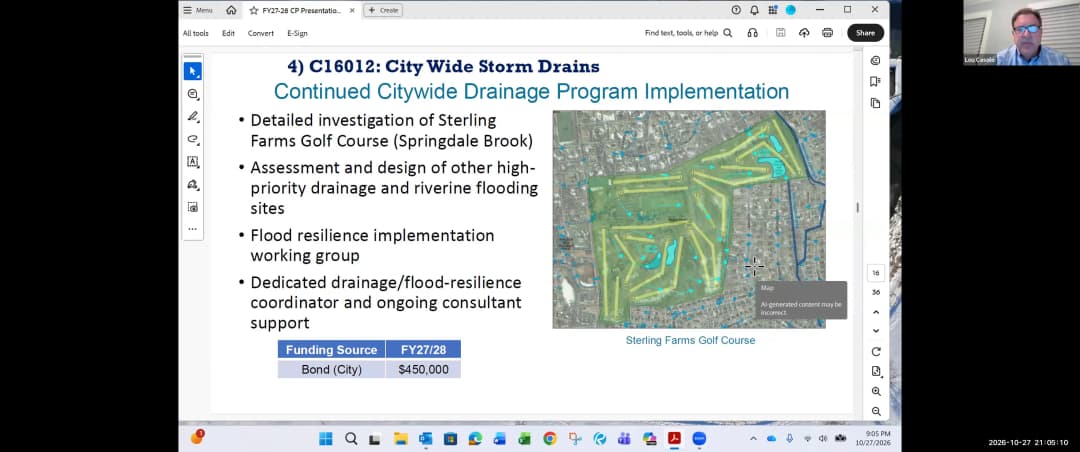
The Stamford Planning Board convened for a regular meeting and capital budget review. Chair Jennifer Gadzeno presided. The board welcomed new alternate member Peter Janoff (nominated by Mayor Simmons), acknowledged Drew McKay's recent promotion from alternate to full member by the Board of Representatives, and noted the absence of Secretary Ravi Supermanian. Board of Representatives member Zachary joined to observe the capital budget presentations. The meeting included two supplemental appropriation votes and department-by-department capital budget presentations for FY 2027-28 and out-year forecasts. The transcript states the meeting occurred Tuesday, October 27th; the date provided for the record is October 28, 2026. The board adjourned at 9:48 PM. Consent Calendar - The October 13, 2026 meeting minutes were approved unanimously (motion by Chet Salad, second by Drew McKay). Supplemental Capital Project Appropriations - SEMS Vine Road Trailer (CP4000) – $33,913, approved unanimously. Public Safety Director Lou DeRubis and Chief Ed Brown presented the replacement of the Medic 4 trailer on Vine Road, manned 24 hours per day and in severe disrepair. The project began in 2018 but was derailed by COVID; bids exceeded available funding, and a $33,913 donation filled the shortfall to fund the full $287,000 project (new trailer, removal of the old, concrete piers and utility connections). Motion by Jeremy Linder, second by Drew McKay; Ashley Wye voted. - Stamford Forward Microtransit Program (CP400030) – $2,314,195.34, approved unanimously. Senior Transportation Planner Luke Button presented additional state grant funding to continue the existing service area. Since launching in November 2024, the service has completed about 145,000 rides within Stamford (roughly Bullshead southward), operating Monday-Sunday, 6 a.m.-8 p.m., with a $1.75 fare. Button noted expansion scenarios (Clembrook, Springdale, Long Ridge/High Ridge) would require additional funding, and the city is exploring private corporate contributions. Motion by Drew McKay, second by Chet Salad; Peter Janoff voted. Public Comments & Testimony - No formal public testimony was taken. A resident sent photographs to planning board members and district representatives documenting trash and debris (including at an old iron bridge), failed solar lights, and potholes at Cosquiesco Park, and expressed support for investment in the park. The chair forwarded the message to staff as part of the record; Parks and Recreation Director Kevin Murray committed to an on-site follow-up. Capital Budget Presentations Office of Public Safety, Health and Welfare – Public Safety Complex - Lou DeRubis presented Phase 2 of a three-phase project to consolidate Fire Headquarters (Main Street) and Station Five (in a flood zone) into a new city-owned site. The request is approximately $1.469 million toward a $2.5 million architectural and engineering design phase, with $1,031,000 already secured via a federal earmark from Congressman Himes. The facility would add a cybercrime/digital forensics/fusion center, an EMS footprint, a new primary 911 center (the current one is over 50 years old), and a regional emergency operations center. - The $66 million out-year hard and soft cost estimate was pushed from 2029-30 to 2030-31 to avoid conflicting with school building investments. Board member Chet Salad requested the feasibility study, conceptual designs, and project cost worksheet (costs increased 6% over last year); DeRubis committed to distributing the packet. DeRubis stated he was confident roughly one-third of costs could come from grants and estimated $10-15 million in savings from avoiding major capital work at the two old fire facilities, with the old sites available for other uses. Operations Short-Term Financing – Fleet and Equipment - Fleet Manager Jason Thurman presented priority-ranked requests. The fleet account balance is expected to be nearly fully depleted by fiscal year-end. - Vehicle replacement: a leaf vac truck (one-person operation, reduces CDL and manpower needs); 2-3 HD plow trucks annually to correct a 10-year spending gap; a stormwater vector truck (sole-source vendor; one of two is inoperable); Ford F-250 supervisor trucks with plows and lift gates (rotated to day-to-day operations after 4-5 years); a Freightliner 114SD hook lift for leaf vac containers; and a marina utility body pickup truck ($65,000; current truck is rotted and smoking). Thurman noted repairs to eight Mack trucks cost $250,000-260,000 annually, roughly the cost of a new truck. - Equipment replacement: OSHA-regulated safety equipment ($7,182; wheel chalks, drip pans, fire extinguishers, triangles, first aid kits); cab heaters for 100 HD plow trucks (the highway fleet logged 9,017 idling hours during snowstorms; heaters run on 0.01 gallons/hour versus 1 gallon/hour); conversion to battery-powered parks equipment (backpack blowers, grass trimmers, hedge trimmers, mowers, battery banks) required by state legislation (chapter 211.3) with about a year left to comply; highway wheel loader bucket replacements; and enclosed leaf vac catch containers. - Board member Andrew flagged math errors in the spreadsheet (battery banks listed as 6 x $900 = $54,000, corrected to $9,000 per unit; line 22 listed 2 x $44,000 = $132,000, corrected to 3 units), and noted row 15 also appeared incorrect. Ashley Wye confirmed the blowers and trimmers are battery-powered electric, consistent with the city's EV conversion ordinance. - Fleet management facilities: a hydraulic room tooling package to bring hydraulic repairs in-house (last winter a payment dispute left 14 plow trucks down mid-storm); North Bay tooling to separate heavy truck and equipment mechanics for safety and production; vehicle maintenance equipment; and fuel island upgrades including a centralized DEF (diesel exhaust fluid) dispensing system, replacement of rotted fuel pump dispensers, fire suppression system electrical work, and sensor upgrades. Fuel islands were confirmed as priority 1 over vehicle maintenance equipment. Special Revenue – Terry Connors Rink and Marina Fund - Parks and Recreation Director Kevin Murray requested $105,000 for the Terry Connors Ice Rink low-E high-ceiling reflective ceiling system (last replaced in 2011; 15-20 year lifespan). As special revenue, it counts against the bond limit but is repaid by rink operating revenue. - Murray requested $1 million from the marina fund for CZIC Marina dock replacements (pilings and decking), following the recent Cove Island Marina project. Funded by marina bonds and repaid by marina revenue. Murray cited safety, legality, and permit obligations for the "mandated legal" justification; the chair noted the term is usually reserved for specific external mandates. Operations Maintenance – Parks - Cosquiesco Park – $500,000 for design/concept plans for the parking lot, drainage, pedestrian pathways, and park lighting. The park sits on a landfill, requiring DEEP approvals that drive costs (a water main break repair cost up to $75,000 and closed bathrooms for three months). Lighting design will address failed solar lights and upward fixtures that blind boaters entering the harbor; Murray said the engineering department would specify downward LED fixtures. Ashley Wye asked whether lighting would be dark-sky compliant (3,000 Kelvin or less) and less impactful to migrating birds; Murray committed to including those specifications. Trash and debris cleanup would be an operating, not capital, expense. - Cummings Park – $2.5 million total ($1.25 million bonds + $1.25 million anticipated federal ORLP grant) for basketball court and playground design and completion. The grant is not yet in hand; fallback options include contributions through the Stamford Park Partnership. The grant design funds must be spent down by 2027. - Seasonal accessible park bathrooms – $5,000 request with a sizable unfunded balance earmarked for the Cove Island Red Brick Building ADA-compliant bathroom facility as part of the "365 bathrooms" program. Future sites include K Park, Courtland Avenue, Barra Park, Cummings Pavilion, and West Beach Pavilion. Murray acknowledged operating cost increases and noted savings from removing portable toilets; the chair encouraged adding out-year forecasts. - Revolving accounts (expected to be zeroed out by fiscal year-end): park amenities ($75,000; benches, bleachers, signage, picnic tables), park fencing ($100,000), playground rehabilitation ($75,000), and paving and drainage ($100,000; including a new catch basin at Cove Island between Terry Connors and Troy Field). - Northrop Park – $75,000 request plus $125,000 unfunded (about $200,000) for design/concept plans to relocate the basketball court and playground adjacent to Stark School; the city is applying for a $2 million state grant. - Rosa Hartman Park (Phase 2) – $150,000 for walking paths connecting to Greenwich's upgraded park side, with landscaping and amenities. - Baseball/softball field upgrades – $250,000 out-year (FY 2028-29) for Grother Field at Springdale School, followed by a girls' softball field. - The chair explained the out-year capital forecast process for new members. Operations – Solid Waste and GIS - Josie Carpentano (solid waste lead) requested $560,000 for transfer station safety upgrades: replacement of the Holloway scale ($410,000), inbound scale concrete repairs, safety lighting, cameras for DEEP compliance monitoring, two-way speakers so residents need not enter the scale house, and perimeter fence repairs. Current funding will complete a misting system and jersey barriers within the next month. - 200 Big Belly pedestrian receptacles to replace open toters and metal-framed receptacles. Small openings (less than 12 inches) would prevent commercial dumping that drives up tonnage; embedded software would optimize collection routes and reduce summer overtime. Carpentano cited Philadelphia's 70% reduction in public receptacle tonnage after adopting Big Belly units. - Waste diversion roll-off containers and a metal-separation magnet to sort glass, clean wood, and construction debris, enabling the city to secure better hauling pricing and pull materials out of the municipal solid waste stream; an RFP for a waste characterization study is underway. - GIS revitalization – enterprise ESRI platform migration. The current platform is set to sunset at fiscal year-end, creating liability. A three-month citywide needs assessment was completed; funds would cover migration to an online platform and LIDAR scans providing four-dimensional data (topography and buildings). Carpentano said the GIS team would move under Operations administration. Ashley Wye asked about network upgrades; Carpentano said the hosted online model avoids bogging down systems. The full amount is needed in one phase to avoid running unsupported software. Land Use Bureau - Ralph Blessing (Land Use Bureau chief) presented: - Courtland Park comprehensive plan – out-year request to support improvements, including a possible library branch. - Citywide invasive species plan – $200,000 to continue work from the completed plan covering 32 parks of one acre and larger; work is underway at Cove River Park, Scalzi Park, and K Park, with funds supporting both professional contractors and neighborhood groups. - Housing growth plan – legally mandated by Public Act 25-01, due June 2029; would build on the city's prior housing plan work (Blessing referenced both 2023 and 2022 at different points) and implement comprehensive plan goals. Scheduling it in the 2027-28 budget would allow completion by 2029. - East Main Street land use and zoning study – $200,000. Following the Cove neighborhood study, this would create a comprehensive zoning concept for the corridor amid development activity (WWE building conversion, Lafayette apartments, McDonald's site zoning change) and complement a separate transportation department traffic safety project. Blessing confirmed the study is land-use only, not traffic modeling; Ashley Wye and the chair suggested the price seemed high without traffic modeling. Luke Button confirmed the transportation project includes a full traffic study. - Open space acquisition and flood control – $1 million to begin acquiring frequent-loss properties and converting them to parkland for flood storage. Three flood resiliency studies (coastal resiliency, Toilsome Brook, Springdale) will help identify target properties; a list has not yet been established. Peter Janoff asked about eminent domain; Blessing said it would be a last resort and the process would be collaborative. The chair noted the cost-savings rationale versus culverts and hard infrastructure. - Historic preservation trust fund – $50,000 to jump-start the fund created with the Board of Representatives but never capitalized; funds would support historic signage and voluntary cultural resources inventory listings. The historic zoning bonus fee, which feeds the fund, may need to be increased. - Sleepy Hollow Park master plan – Springdale conservation-area park (mostly wetlands) with an active friends group; focus on walking trails and interpretive signage about wetlands and flood protection. - Overall needs assessment for city fields – additional funding on top of last year's $500,000 request, which the Board of Finance cut to $250,000; the balance sits as unfunded bond authorization and cannot be spent until the full amount is funded. The study would holistically assess city and Board of Education athletic fields, lighting, drainage, bathrooms, and changing demographics (e.g., pickleball demand, aging population). Operations – Engineering - City Engineer Lou Castle presented nine FY 2027-28 projects totaling $7.9 million, of which $3.4 million (about 43%) is grant-funded; most grants are anticipated or submitted but not yet confirmed. - Municipal bridge replacement and rehabilitation – approximately $1.1 million for design of three aging structures: Cascade Road (100 years old), Farms Road (76 years old), and Bridge Street (about 75-76 years old; state inspection found deteriorated girder ends, deck, bearings, and abutments, with one of four lanes closed). Rather than submitting separate applications, design funds are pooled until the state selects which project receives aid; Castle will return for construction funding once awarded. If grants fall through, fallbacks include interim repairs and traffic reductions; the bridges are past their useful life and deteriorating annually. - Citywide seawall replacement – Cove Island revetment failure along roughly 1,000 feet, exposing utility conduits; design is underway with bidding next summer. Funding was partially received last year. - John Buccutsi Park Phase 2 – completion of the South End park with baseball fields, tennis/basketball courts, splash pad, protective fencing along private property lines, and soil remediation. Phase 1 (Soundwaters education building, parking, access road aligned with Congress Street, trails) is complete. A National Park Service grant supports the request; design completion is targeted for July, with construction beginning early 2028. - Citywide storm drains – $600,000 for compound flood modeling plus $450,000 for drainage assessment recommendations and $200,000 for fix-it drainage complaints. The city submitted a roughly $5.9 million US DOT grant. Modeling identified Sterling Farms golf course as a contributor to Old Colony and Minivale flooding; pond dredging and storage options are being evaluated. - Briarwood and Pheasant Lane – prior year request was zeroed out; steep topography causes runoff impacting four properties and the roadway drainage system. A design is proposed. - Drainage design completion – $100,000 to finish a design from the ARPA-funded citywide drainage assessment (Holliwell area pipe network to a golf course pond); the project did not clear the state bond commission for construction funding. - Resiliency and climate adaptation implementation – federal grant funding for backflow preventers on storm lines outfalling to Long Island Sound and a real-time flood sensor network, both priorities from the coastal resiliency study. The coastal flood resiliency plan will be presented to the board in November/December. - Toilsome Brook – $650,000 state grant request to complete evaluation of the upper watershed riverine flooding and the lower urbanized pipe network; a prior DEEP grant was pulled back at the state bond commission. A public meeting was held the prior week; a website and QR code provide study information. - Bridge safety repairs and design – a small emergency account for urgent bridge evaluations and repairs. - Environmental assessments – for soil testing under Connecticut's new release-based soil regulations (replacing the transfer act). - Out-year requests include Cummings Marina (lost during Hurricane Sandy), Stillwater/Progress Drive, and Leone Park underground detention. Operations – Facilities - Facilities Director Scott Butch presented: - Citywide facilities lifecycle planning and assessment (department priority 1): a 10-year strategic capital plan modeled on the schools' effort; an RFP is currently out. Last year's request was cut by the Board of Finance; the department is seeking the funds again. - Heating system replacement: end-of-life units replaced with high-efficiency systems; Eversource incentives up to $200,000 remain available. Funds would cover an entire building (potentially South End Fire Department 2) plus reactive replacements; 30 units have been replaced in three years, and a boiler control replacement at Government Center was funded this year. - Citywide building and energy management systems (BMS): continued Siemens partnership expansions at Government Center, police, central fire, Lathan Wider, Yearwood Center, and potentially the historical society center. - Government Center renovations: the 1986 building has spaces untouched for 40+ years; funds would add touchless weapons detection/magnetometers, MEP upgrades for first-floor cashiering/permitting and town clerk areas (not designed as office space), and fourth-floor board chambers/multi-purpose space renovation (design funds already in hand). - Citywide floor replacement: 40-year-old flooring at Government Center, expanding to Old Town Hall and Lathan Wider. - Buildings and utilities: CCTV installation at outer facilities (highways fleet, Schofields, Hague Town Yard) for safety and liability reduction. Operations – Transportation - Transportation Director Thomas Turk presented routine accounts: environmental compliance ($100,000 this year, $50,000 out-years) due to new state permits for five regulated sites (about $15,000 registration fee each); citywide manhole and basin repairs (emergency account, about 200 outstanding issues); street patch and resurfacing ($10 million requested) for the top-200 road list (10 roads currently being paved); citywide sidewalks; utility paving to coordinate curb-to-curb completion with utility trenching (expected spent down); and guardrails (minimum request; hit-and-run damage is a safety priority). - Luke Button presented traffic engineering accounts: - Roadway design and reconstruction (CP1281): city design funds prime the pump for roughly $50 million in state infrastructure investment, including pedestrian/cycle upgrades at about 40 signalized intersections, six new signals (CMAC Phase H), McGee Avenue design ($3 million grant), and Lockwood Avenue safety improvements ($6 million state grant; the corridor was the site of a recent fatality and supports a new elementary school). The balance will be spent down. - Citywide signals (CP56174) – $1 million: $800,000 for Lafayette Street signal replacement, $100,000 for ADA signal upgrades, and $100,000 for communication upgrades. Stamford operates 211 traffic signals (second-largest system in the state); $3 million of the account balance is state grant and private contributions earmarked for specific intersections. - Vision Zero action plan: Stamford was the first city in the state to adopt Vision Zero (eliminating serious and fatal traffic fatalities by 2032); $800,000 will be spent spring/summer 2027 and $500,000 for spring 2028 on high-injury network projects. - Bicycle and pedestrian master plan – $250,000 focused on bike facilities; a citywide bike parking plan is being developed in-house. - ADA transition plan – $750,000 to begin a cycle of pedestrian ramp upgrades once the legally mandated plan is complete (in about a month); the city will use a state contract for ramps. - Transportation facilities (new project): upgrades at Hague Avenue town yard, including a salt shed past its useful life and WPA-era garages not built for modern equipment. Losing the salt shed would remove about one-third of salt capacity; last winter the city nearly exhausted its supply. Asked to quantify ongoing maintenance costs, Button said facilities staff would provide the numbers. - CT Transit upgrades: about 3 million bus rides per year on CT Transit; 76% of parcels are within a 10-minute walk of a bus stop. Bus shelter ad revenue now only covers maintenance; capital funds would support shelter replacements (e.g., at Old Town Hall), with the state partnering on shelters along state roads. Key Outcomes - Minutes (October 13, 2026): approved unanimously. - SEMS Vine Road Trailer supplemental appropriation ($33,913): approved unanimously. - Stamford Forward Microtransit supplemental appropriation ($2,314,195.34): approved unanimously. - The capital budget presentations were informational; no votes were taken. Departments committed to follow-ups including: distributing the public safety complex feasibility study packet, correcting spreadsheet math errors, adding out-year capital forecasts, quantifying salt shed maintenance costs, and presenting the coastal flood resiliency plan in November/December. - The next meetings are November 4 (Wednesday, due to Election Day on Tuesday), November 10, and November 17 (capital budget callback) for follow-up questions to presenters.
The Public Meeting Index
The Public Meeting IndexThe Omaha City Council held its regular meeting on October 28, 2026, starting at 2:01 PM. President Bagley presided with six members present (Councilmember Professorson absent). The meeting opened with the Pledge of Allegiance, remarks from Councilmember Don Rowe encouraging voter turnout for the November 3 election, and a proclamation declaring November 2026 as Ramiah Worthington Child Vehicle Safety and Protection Month. The council then proceeded through a consent calendar, public hearings, and debated a major proposed overhaul of the Omaha Plumbing Code, ultimately delaying a final vote. Public Comments & Testimony - Items 12–23 (Consent Agenda): Donnie R. Johnson (Johnson Question Foundation) opposed items 12–15, expressing concern about liquor licenses and wanting more city oversight. Larry Store (5015 Lafayette Ave) opposed item 20, asking whether traffic signal infrastructure included flock cameras or automated enforcement; the Law Department clarified such cameras are not permitted in Nebraska and OPD does not use flock cameras. Soleil Rodriguez (1005 N 49th St) opposed items 13 and 15, noting the high density of liquor stores in North Omaha near churches and schools; Councilmember Goodwin acknowledged the concern and noted the Law Committee is reviewing liquor license density in District 2. - Item 24 (TIF for affordable senior housing): Donnie R. Johnson opposed, requesting more funding for plumbing education in high schools. - Item 30 (Point-of-sale system for golf): Donnie R. Johnson raised a humorous concern about golf balls clogging sewers. - Item 35 (SAFER grant for firefighters): Donnie R. Johnson urged firefighters to be willing to enter creeks for water samples, referencing Navy training. - Item 38 (Plumbing code revision): Extensive testimony from both proponents and opponents. Discussion Items - Items 6–9 (Liquor license and rezoning): All passed 6–0. - Item 6: Class D liquor license for Snake Bite Liquor & Smoke (3706 N 90th St). - Item 7: Rezone from R4/DR to R4 at 804 N 143rd Ct and 805 N 143rd Plaza. - Item 8: Rezone from LO to CC at 6402 N 71st St. - Item 9: Puritan Manufacturing TIF redevelopment plan for 1302 Grace St, up to $423,477, for demolition and new facility to address flooding. Project owner Dave Waters noted the company will celebrate 100 years in 2027. - Items 10–23 (Consent agenda): Passed 6–0 after public hearing. - Items 24–37 (Various ordinances): All passed 6–0, including: - Item 24: TIF for 1053 Park Ave – 50 units of affordable senior housing (55+) at Park Ave and Pacific St, represented by Rob Woodling. - Item 25: Lab testing contract with Midwest Laboratories Inc. - Item 26: Interlocal agreement for hazardous waste collection. - Item 27: Streetscape maintenance agreement for Kiwitz subdivision. - Item 28: Property acquisition for George Miller Parkway. - Item 29: Amendment to South Streams Mixed Use District development agreement. - Item 30: Point-of-sale system for golf division ($123,840). - Item 31: Special tax revenue bonds for mutual tower garages ($115 million). - Item 32: Various purpose bonds for public facilities ($110 million). - Item 33: Highway safety grant for nightlife expansion ($122,378). - Item 34: Purchase of 100 sets of PPE bunker gear from Hyman Fire Equipment. - Item 35: SAFER grant for 18 new firefighters – Fire Chief Kathy Bossman and union president Trevor Towey expressed support, noting the grant will help staff future Fire Station 70. - Item 36: Omaha Public Library Foundation grant ($1,325,160) for four new positions for due space integration. - Item 37: Interlocal agreement for Brady/Giglio officer disclosure process (explained by Law Department). - Item 38 (Omaha Plumbing Code Revision – Major Discussion): - Planning Director Dave Fanslow and Permits & Inspections Superintendent Lei Wen presented the proposal, which revises the 2015 code to expand allowable materials (PVC, PEX-A) in commercial and multifamily buildings, change apprentice ratio from 1:1 to 2:1, allow licensed sewer contractors for demolition permits, and reduce continuing education requirements. They argued it would lower construction costs for affordable housing and align Omaha with national model codes. - Proponents included developers (DR Horton, Foundations Development), the Metro Omaha Builders Association, Front Porch Investments, and plumbing contractors. They claimed PVC can save 60–80% in material costs (e.g., $5,600 more per house in Omaha vs. Des Moines) and cited national and regional acceptance. - Opponents included Plumbers Local 16, the Cast Iron Soil Pipe Institute, and several master plumbers and engineers. They raised concerns about fire safety (PVC melting/combusting, toxic smoke), long-term durability, water quality, and insufficient training under the 2:1 ratio. They argued cost savings may not reach renters and that the process was rushed without adequate transparency. - Councilmember Hug asked about fire suppression systems; it was clarified PVC is already allowed for fire sprinklers. Councilmember Goodwin questioned committee composition; the committee had 9 members (7 plumbers, 3 union, 4 non-union, plus an engineer and developer) and no formal vote. The Plumbing Board voted 5–3 and later 4–2; the Building Board Review voted 6–1 to recommend. - Councilmember Melton noted only Chicago, New York, and Omaha (plus limited Boston) restrict PVC for high-rise, and that the entire nation uses model codes. She moved to lay over the final vote to November 10, 2026, to allow further study. Motion passed 6–0. - Item 39 (Playground Boss bid appeal): The company failed to provide an electronic copy of the bid bond. The Law Department recommended denial. Motion to deny passed 6–0. - Items 40–56 (Non-action items): Placed on future agendas. Key Outcomes - All consent calendar and routine items (Items 6–37) passed 6–0. - Item 38 (Plumbing code revision) was laid over for third reading and final vote on November 10, 2026, by a 6–0 vote. - Item 39 (Playground Boss appeal) was denied 6–0. - Meeting adjourned at approximately 4:54 PM.
On October 28, 2026, at 6:00 PM in West Linn City Hall, Hearings Officer Daniel Kearns presided over a de novo appeal hearing (AP-26-02). The appeal was filed by Tandler Holdings LLC seeking to overturn the Planning Commission's 5-0 decision to deny a Class II Design Review and Property Line Adjustment for a mixed-use development at 2410/2422/2444 Tannler Drive and 1800 Blankenship Road. The project proposes 320 residential units in 11 buildings with ground-floor commercial space, a realignment of Tannler Drive, and a traffic signal. The hearing extensively debated the applicability of state housing laws (SB 1537, HB 4037), the role of HAPO guidance, the jurisdiction of the Hearings Officer, and whether the project meets local code standards under the 'clear and objective' requirements of state law. Public Comments & Testimony Jurisdictional Objections - Andrew Mulkey (representing Ed and Roberta Schwartz) argued the City Council lacked the authority to delegate the appeal, citing Development Code Section 99.240 which assigns appeals to the City Council. He stated the Council resolution appointing the Hearings Officer conflicts with state land use statutes. - Mike Cap echoed this, stating the Development Code does not allow for a Hearings Officer in this context and that the Council should follow its own ordinances. - Ed Schwartz noted the City Council's oath of office requires members to hear land use appeals. Opposition Testimony - Roberta Schwartz argued the project is flawed, stating the Planning Commission's unanimous denial was correct. She contested the necessity of the Tannler Drive realignment, asserting the applicant's own planning manager described it as a street closure. She cited a 361-person petition and an ODOT letter indicating the realignment is not mandatory, advocating instead for TSP Project M23 (road widening). - Ed Schwartz (Savannah Oaks Neighborhood Association Treasurer) said the neighborhood voted unanimously to oppose. Concerns included density (50% larger than prior proposals), parking (400 spaces for 320 units), stormwater vaults over surface detention, 80% tree removal, impacts to White Oak Savannah Park, and the lack of affordable units (project rents of $1,988 to $3,200 per month are market-rate). - Shannon Knight argued the applicant's private driveways qualify as streets under the city's development code, triggering ground-floor commercial requirements. She stated the applicant is setting buildings 22-23 feet from the street to avoid the 20-foot statutory threshold, effectively eliminating commercial frontage. - Greg Hathaway (attorney for the Schwartzes) argued the TSP does not mandate the applicant's specific realignment. He stated the supporting traffic impact analysis was inadequate and requested time for expert review of late-filed evidence from the applicant. - Kathy Hallecky raised safety concerns regarding parking ratios (1.2 spaces per unit), traffic, and the lack of elevators in the buildings. - Vicki Constantino and Dave Farmer voiced concerns about fire access and existing traffic congestion on Salamo and Blankenship. Testimony in Support - No members of the public testified in favor of the appeal during the hearing. Discussion Items Hearings Officer Role and Process Daniel Kearns established the de novo nature of the hearing and the requirements for preserving rights for a LUBA appeal. He noted the statutory duty under ORS 197A.402 to allow the applicant to propose revisions or conditions if denial is considered. He also explained his impartial role, having been appointed by the City Council under Resolution 2026-08. Staff Presentation - Darren Wise (Principal Planner) provided a procedural timeline from the original application in September 2025 through the appeal and noted the 120-day clock extension. - Steve Cooper (Community Development Director) argued that the state's 'clear and objective' standards apply to the residential component, but the city can apply discretionary criteria to the commercial portion of this mixed-use project, directly contradicting the positions of the applicant and HAPO. He stated the TSP studies a level of service C today, while the applicant's traffic study finds the intersection fails (LOS F) currently. Applicant's Case (Carrie Richter, Bateman Seidel) - The applicant argued the project satisfies all criteria, facilitated by SB 1537. The HAPO letter of October 21 was cited as supporting the applicant's position that the city's grading and stormwater standards are not clear and objective and that the ground-floor commercial requirement is eligible for waiver. - Traffic and Proportionality: The applicant presented a new proportionality analysis proposing a 29% cost share for the roughly $5 million road realignment. The applicant argued the city's earlier estimate of a 51% share was based on flawed data that did not account for pass-by trips or background traffic from the adjacent office building. The applicant requested the Hearings Officer set the percentage as a condition of approval. - Block Length and Commercial Standards: The applicant argued the 800-foot block length standard is not clear and objective and offered alternative solutions (pedestrian path, topographic exception). The applicant defended its definition of 'street,' arguing private driveways should not be classified as public streets triggering commercial requirements. City Staff Rebuttal - Staff disagreed with the applicant's and HAPO's interpretation, differentiating the project from the ICON case (purely housing) and arguing the city could apply standards to the commercial component. Staff insisted the proportionality analysis is a negotiation topic for a Development Agreement and should not be decided by the Hearings Officer, as financial authorities were not delegated and the numbers are still in flux. Traffic Engineer Testimony (Chris Bremer, Kittelson & Associates) Bremer clarified no new traffic model was created; the new memos re-analyze existing data for the proportionality calculation. He detailed that the existing intersection operates at level of service F today and cannot be fixed without the realignment and signal. He stated the TSP realignment (Project M2) is the only feasible solution. Key Outcomes - Schedule for Decision: The Hearings Officer kept the record open under a strict schedule: Public and staff responses to new evidence due November 4, 2026; cross-responses due November 12, 2026; and the applicant's final written rebuttal due November 18, 2026. The written decision is due December 16, 2026. - Extension: The applicant agreed to a 35-day extension of the statutory 120-day clock. - Procedural Nuance: A discrepancy was noted in the hearing regarding the scope of the Planning Commission's denial. The Hearings Officer initially summarized it as a denial of the commercial component, but city staff clarified the final written decision denied the entire application in a single order. - Core Issues for Decision: The Hearings Officer identified the primary legal questions for the written decision: (1) the Hearings Officer's jurisdiction to hear the appeal; (2) whether state 'clear and objective' standards apply to the entire mixed-use project or only the residential component; (3) the definition of 'street' in relation to ground-floor commercial requirements; and (4) the proportionality of the required road improvements. No final decision or votes were taken.
The Elk Grove City Council convened on Wednesday, October 28, 2026, at 6:00 PM at City Hall. Mayor Bobbie Singh-Allen presided. Present were Vice Mayor Darren Suen, Councilmember Sergio Robles, and Councilmember Kevin Spease. Councilmember Rod Brewer was absent. The meeting adjourned at 7:45 PM. Proclamations and New Hire Introductions - Council issued proclamations recognizing October 2026 as Hindu Heritage Month (accepted by Dr. Parik and community members) and Filipino American History Month (accepted by Edna de los Reyes). - The City Manager and department heads introduced new hires and recognized promotions across the Police, Finance, Public Works, Economic Development, and Information Technology departments. Public Comments & Testimony - Margie Jones and Beth Headland (Strauss Festival of Elk Grove): Thanked the council for financial and in-kind support for the festival, noting the upcoming 40th anniversary. - Cynthia Gaus: Appealed to the council to reject the funding for Kelsey Drive speed humps, arguing the survey was skewed by non-resident business owners and suggesting alternative solutions like fog line striping. - Lynn Wheat: Corrected her previous statement on the zoo project cost to nearly $14 million and urged the council to engage residents on the future of the zoo site. She also requested the library lease guarantee free meeting room access for residents and non-profits; staff clarified the Sacramento Public Library policy already provides this free of charge. - Margaret Mello: Expressed frustration over unaddressed parking violations at Cowington Family Park and a lack of response from the traffic department. - Justin: Strongly opposed the adoption of Flock and Axon ALPR technology, citing predatory contracts, cybersecurity vulnerabilities, misuse risks, and a lack of independent audits, formally warning the council against proceeding. Consent Calendar - Council unanimously approved the Consent Calendar (Items 7.1–7.19) by voice vote, including routine approvals, budget amendments, and the contract award for the Old Town Streetscape Phase 2 construction project. Discussion Items - Item 9.1: Future Use of Former Library (8900 Elk Grove Blvd) and Former Teen Center (8978 Elk Grove Blvd) - Assistant City Manager Jaqui Guzmán and Senior Management Analyst Aishwarya Kumar presented findings from extensive community engagement (April–September 2026), which generated 700 contributions and 3,478 written ideas. - The top six preferred uses identified by staff in priority order were: a Teen and Youth Center; a Creative Arts, Music, and Digital Media Center; a Community Learning Hub; a Community Resource Hub; a Community Meeting and Co-working Space for Nonprofits; and a Community Kitchen and Cafe. - Council reached a consensus to remove the Community Kitchen and Cafe from the feasibility study scope, citing high operational costs, health code complexity, and the availability of other facilities. Members expressed strong support for the Teen and Youth Center as the highest priority, followed by the Creative Arts and Digital Media Center, and the Nonprofit Co-working Space. There was agreement that the Community Learning and Resource Hub functions could be integrated into the top priority spaces. - Staff was directed to initiate a feasibility study evaluating operational models, space plans, and costs for the prioritized uses. Council also directed staff to begin the process of repaying the Community Development Block Grant (CDBG) funds for the former Teen Center property to increase flexibility for its future use. Key Outcomes - Consent Calendar: Approved unanimously. - Community Kitchen/Cafe: Removed from the list of preferred uses for the feasibility study. - Future Use Priorities: Council affirmed the top three priorities for the feasibility study as a Teen and Youth Center, a Creative Arts/Music/Digital Media Center, and a Nonprofit Meeting/Co-working Space, with Learning and Resource Hub functions integrated. - Feasibility Study: Staff directed to proceed with a feasibility study for the prioritized uses at 8900 Elk Grove Boulevard. - CDBG Repayment: Staff directed to initiate the public process for repaying CDBG funds for the property at 8978 Elk Grove Boulevard to remove use restrictions. - Memorial Adjournment: The meeting was adjourned in memory of Dolores Huerta and community member Ori.
The meeting was called to order at 6:00 PM by the Chair. A quorum was present with three members absent. The agenda was approved unanimously. Principal Planner Derek Dunworth clarified that the draft mobile vending ordinance was delayed for additional outreach and analysis, with a revised target of early 2027. Staff announced the hiring of Associate Planner Hadley Ward. The Chair made announcements regarding community events and called for applicants for upcoming Planning Commission vacancies. Consent Calendar - No items were on the consent calendar. Public Comments & Testimony - General Public Comment: Kathy Crow (College Park Neighborhood Association) thanked the Commission for approving the College Park Historical Design Guidelines. Dan raised concerns regarding non-citizen voting, the Confucius Institute, and mobile vending. - Item 6a (SB9 Ordinance): Dan questioned the interaction of the ordinance with rent control and urged caution regarding owner identity verification. - Item 6b (General Plan Update): Marjorie Longo (Acting Chair, North Central Wild Horse Neighborhood Assoc.) expressed concern over the expanded Urban Limit Line (ULL), development on floodplains, and the Village Farms site, urging respect for Measure V. Jim Flanagan questioned the role of the new planning consultants (Alta/Trilon). Ziv Lang spoke against data centers, development above Channel A, and the expanded ULL. Elizabeth Ray stated the process had been "usurped" and ignored voter intent. John Cooper called the October 14 workshop "perfunctory." Rena Nyar requested the process be slowed down. Eileen Sametz (former Commissioner) called the process a "charade," criticizing the 21,000 housing unit projection and the enlarged ULL, warning of a potential referendum. Discussion Items - Zoning Ordinance Amendment – SB9 (Item 6a): Presented as a public hearing. Staff recommended a resolution to allow up to four units per parcel as required by state law. Discussion focused on whether to allow more than four units (the Commission opted not to recommend this), equity concerns over short-term rental restrictions for SB9 properties raised by Commissioner Alan, and impacts of FEMA floodplain restrictions. A motion was made and seconded to approve the resolution, with two comments to the City Council: 1) analyze the equity of the short-term rental restriction for primary residences, and 2) provide data on how many parcels are impacted by the floodplain restriction. The motion passed unanimously. - General Plan Update (Item 6b): Informational item. Staff reported on the October 14th public workshop (attended by over 100 people), the third online survey (open until Nov 13), and a planned webinar (Oct 29). Staff clarified the feedback loop between the GPC, home commissions, and the Planning Commission, noting the PC was not in the direct feedback loop as previously discussed. A correction was made that the Emerson Junior High fields were incorrectly labeled as high-density residential. Plans for 21,000 new housing units by 2050 were presented. - Land Use Subcommittee Report: Commissioners presented recommendations. City-owned lands: Recommend creating a map, policy statement, and feasibility study to relocate the Corporation Yard for infill housing. Open Space Easements: Recommend against modifying or swapping existing open space easements. Floodplain Areas: Recommend an updated flood map and a comprehensive city-wide stormwater and flood control plan. City Income Properties: Recommend a consolidated spreadsheet of all city leases. The Commission approved all the subcommittee recommendations. - Commission Deliberation on General Plan: Commissioner Greg emphasized that the lack of a city-wide flood control plan is the biggest barrier to development and economic growth, pointing to the city’s half-billion dollars in unfunded liabilities ($265M capital, $240M pensions, $40M OPEB) as a driving factor. Commissioner Alan stated the expanded ULL provided flexibility and should not be viewed as a prescriptive development plan. The Chair and others expressed strong reservations about development north of Channel A and the pace of the update process. Key Outcomes - SB9 Ordinance: The Planning Commission approved the resolution recommending the "Two-Unit Projects" ordinance amendment to the City Council. The approval included specific requests for the Council to study the short-term rental equity issue and the impact of FEMA floodplain restrictions. - Subcommittee Recommendations: All four sets of recommendations from the Land Use Subcommittee regarding city-owned lands, open space easements, floodplain management, and city income properties were approved and will be forwarded to staff, the General Plan Committee, and the City Council. - General Plan Feedback: Commissioners voiced strong opposition to development designations north of Channel A at the Village Farms site and expressed concern over the expanded Urban Limit Line. The need for a prioritized, city-funded comprehensive flood control plan was heavily emphasized as a necessary catalyst for any growth. - Next Steps: The next regularly scheduled meeting is January 13, 2027. No meetings are planned for November or December 2026. The next public webinar for the General Plan Update is on October 29, 2026, and the third public survey closes on November 13, 2026.
The Chesterfield County Board of Supervisors held its scheduled evening session on October 28, 2026, at the Public Meeting Room, 10001 Iron Bridge Road. The agenda also listed a 2 p.m. work session; no minutes for that session were provided, and the available transcript begins with the 6 p.m. evening session. The evening session opened with invocations by Supervisor Hylton and Supervisor Schneider and the Pledge of Allegiance led by Deputy County Administrator Matt Harris. The board approved employee retirement resolutions, appointments, a consent agenda, four zoning cases, and five public hearing items, and heard ten citizen comments. Resolutions and Special Recognitions - Recognized Corporal John C. Stone Jr. (Police Department) upon his retirement after 25 years of service, effective October 1, 2026. The resolution detailed his roles, including field training officer, school resource officer, drug court officer, and special response unit member, and his life-saving award in 2002. He received a commemorative brick, and board members thanked his family. - Recognized Firefighter Robert L. Trimmer (Fire and EMS) upon his retirement after 41 years of service, effective September 1, 2026. The resolution highlighted his work as a flight medic, EMS specialist, hazardous materials specialist, infection control officer, and equipment purchaser for more than 80 ambulances. He also received a commemorative brick. Consent Calendar - Approved appointments to the Board of Building and Fire Code Appeals. - Approved the consent agenda with no items removed. It included retirement resolutions for Corporal Matthew L. Jeffries, Corporal Jennifer S. Samuels, Lieutenant David R. Samuels, Donald Andrews, Corporal Michael J. Mellina, W. Craig Condrey, Firefighter Joseph M. Coleman, and Captain Jason M. Namola; recognition of the Village of Bon Air and Hazen Memorial Library anniversaries; approval of Mare Transportation, Inc. to operate non-emergency ambulance service; real property requests including land acceptances and a quitclaim to Converge Church Inc.; acceptance of state roads; adoption of the 2027 Legislative Program; additional funding for the Appomattox Regional Governor’s School; a National Park Service agreement with the Police Department; authorization for a VDOT easement for the Fall Line Trail southern section; and setting public hearings for November 18, 2026, and December 16, 2026 (PlanMod). Public Comments & Testimony First citizen comment period: - Amy Beth Mullen expressed concern about data centers and AI, citing Virginia’s 680 data centers and environmental incidents involving Google, including a reported 29.45 acres of protected wetland damage at Project Peanut and delayed self-reporting. She called for a moratorium and a community “make it right” campaign. - Lisa Thompson said opposition arose late because the projects were developed for almost seven years under the names Lock, Peanut, and Sky before Google’s role was publicly announced in late August 2025. She cited JLARC’s projection of 183% more energy demand by 2040 and argued data centers impose financial and environmental costs on residents. - Catherine McMahon said the county should stop asking residents “where were you before” and should adopt formal, enforceable measures to halt further data center development and strengthen oversight of existing facilities. - Thomas Carroll, speaking for Chesterfield Citizens for Responsible Government, requested a full public accounting of the Timmins/Springline lease and related EDA expenditures, including final lease terms, a forensic audit, an executed CETA controls MOU, and release of withheld FOIA documents by the end of 2026. - Mike Yuzell opposed the proposed 1% sales tax referendum, citing a 24-cent data center equipment tax rate compared to a $3.35 state average, roughly $700,000 in reported Timmins lease overpayments, and infrastructure strain from new housing. Second citizen comment period: - Kyle Woods described a FOIA request to the EDA that he said drew a response only at the legal deadline and a $2,000 fee, even after narrowing the scope. He said the community feels “managed, not represented.” - David Pattison, a retired teacher, said a former student died from an asthma attack and that diesel backup generators worsen asthma. He cited Chesterfield’s third-highest asthma hospitalization rate in Virginia and proposed solar-plus-battery backup, cleaner tier-four generators, and tier-two diesel only as a last resort, along with a data center moratorium and retrofits. - Evelyn Tucker, a Bermuda Hundred resident, described the village’s long residential history and said the Allied Chemical plant and later Kepone disaster were mistakes; she urged the board to acknowledge mistakes and avoid incompatible industrial uses in residential communities. - Katie Sitterson, with RVA Indivisible, said the Department of General Services policy 05-09 barred nonpartisan groups, including the NAACP, from poll greeting events while allowing political parties. She asked the board to require DGS to amend the policy to align with Virginia Code. - Vanessa Castro raised concerns about Project Peanut, citing a Google data center in New Albany, Ohio, that used over one billion gallons of water, health impacts of fossil-fuel pollution, a 22% rise in Ohio electricity bills, and Project Peanut’s ties to an ARC nuclear fusion project not expected to be active until 2030. She asked for a stop-work order or delay until air permits are adjusted. Zoning Requests - 25SN1330 Ramos Goodes Bridge Rezoning and Adjustments (Midlothian) – approved. The 4.31-acre property at 2611 Goodes Bridge Road was rezoned to CC with a conditional use for a contractor’s services business with outside storage and fleet parking, along with adjustments to parking, landscaping, buffering, and setbacks. No speakers. - 26SN2080 Charleston Landing Rezoning (Matoaca) – approved. The 60.2-acre property at 6700 Magnolia Green Parkway was rezoned to SU for a maximum of 90 single-family dwellings. Applicant Jeff Geiger described updated plans, including a dog park and a 200-foot buffer from the future Powhite Parkway. Jerry Turner spoke against densities above one unit per acre; another speaker asked about proximity to data centers. - 26SN2113 Weatherford Clay Point Road Rezoning (Matoaca) – approved. The 41.48-acre property at 620 Clay Point Road was rezoned to Agricultural A for a farm and animal keeping, consolidating a parcel lacking road frontage. Jerry Turner supported the request. - 26SN2144 Rountrey Phase 5 Lot Coverage Modification and Amendment (Clover Hill) – approved. The 51.11-acre property at 3101 Otterdale Road received an increase in the lot coverage limit from 30% to 50% for larger homes without increasing density, while keeping 30% coverage along Otterdale Road and adding right-of-way for the Swift Creek crossing. Public Hearings - Melinda Rothhaar surplus tax sale funds – approved. A 2021 tax sale produced $83,092.04 in surplus; because the owner did not claim it within two years, it passed to the county. Staff recommended returning the funds after paying delinquent taxes and utility bills; the agenda item listed amounts of $438.21, $1,225.90, and $1,431.52, plus any accrued interest. Rothhaar’s attorney, Lenny Brew, appeared pro bono and said she is a widow living on Social Security and veterans benefits. Jerry Turner objected to the board acting before the final amounts were known. The board approved returning the money in accordance with the agenda item. - Powhite Parkway Extension Phase 1 eminent domain – approved. Staff requested authorization to exercise eminent domain for nine parcels owned by three parties. Two owners were cooperative or near settlement; the Grove Apartments parcel was in opposition. Jerry Turner and Renee Aldred supported eminent domain for the apartment parcel, and a representative of one property owner spoke in favor of the project. The board approved the request. - Street naming ordinance amendments – approved. The Chapter 16 and 17.1 amendments transfer street-name approval from Environmental Engineering to Planning/Geospatial Services, clarify unique and intuitive addressing, align with USPS guidelines, and address vacant and landlocked parcels. No speakers; board members discussed the public safety need to avoid duplicate street names. - Vacation of drainage and general easements across Lot 13, Bexley East Section 2 – approved. The 16-foot drainage easement and 8-foot general easement are no longer needed, and vacating them improves lot functionality. No speakers. - Underground easements to Virginia Electric and Power Company – approved. The easements support Dominion’s Strategic Underground Program along Conifer Road and unimproved streets; the county retains prior rights in unimproved rights-of-way. Amy Beth Mullen asked for an explanation; Supervisor Hylton spoke in support, noting frequent outages and vulnerable residents in the Dale District. Key Outcomes - All motions before the board were approved by voice vote; no roll-call tallies were recorded in the transcript. - The board approved the consent agenda, appointments, four zoning cases, and all five public hearing items. - There were no deferred items from previous meetings. - The board acknowledged upcoming events: the Chesterfield Chamber of Commerce annual legislative reception on November 5 at 5 p.m., Supervisor Hylton’s swearing-in ceremony on November 16 at 3 p.m., and the next Board of Supervisors meeting on November 18 at 2 p.m., before adjourning.
On October 28, 2026, the Carroll County Board of Zoning Appeals (BZA) convened the fifth day of hearings in Case 6609, a continuation of Rachann Mayer's application for a conditional use and multiple variances for a commercial kennel of more than 10 dogs at 6270 Davis Road, Woodbine, Maryland, on property zoned Conservation District. The hearing included rebuttal testimony by the applicant's witnesses, questions from unrepresented neighbors, closing arguments from both attorneys, and a unanimous board vote to deny the application. Applicant's counsel noted the hearing had previously convened on May 26, June 26, July 28, September 22, and now October 28, 2026. Rebuttal Testimony - Rachel Mayor, the applicant and owner of the existing Mariah Bell Kennel, testified that the traffic data she provided was a raw, unaltered export from Paul Partner, an industry-standard customer management database; she also described industry employee-ratio standards of 1 staff to 15 daycare dogs and 1 staff to 20 to 25 boarding dogs. She confirmed the six comparable kennels identified by appraiser Tom Wygand all hold Class D licenses (more than 50 dogs), and introduced applicant exhibits 17 and 18 showing those kennels are on agricultural or conservation-zoned parcels ranging from 6 to 37 acres. She said the existing outdoor riding arena was installed by the previous owner and confirmed as permitted at closing, that she planted 50 additional trees near that property line, and that she intentionally placed the proposed kennel at the bottom of a hill for buffering at added excavation cost. She also said 38 of her current clients signed the opposition petition, and that her discussion of the petition aligned with letters received by the board saying some signers did not realize the applicant was Mariah Bell. She withdrew the access-drive width variance and agreed to conditions comparable to her 2025 BZA Case 6574 approval: a maximum of 140 dogs on site and supervision of dogs outdoors between 8 p.m. and 7 a.m. - Mike Van Sant, a professional land surveyor previously qualified as an expert in surveying and site design, testified that site-distance issues at existing county intersections are not a county requirement for a property owner to fix, and that fire and EMS review is part of site plan approval. He presented applicant exhibit 19 comparing Davis Road to seven other county roads: Brick Church Road (11.5 to 13 feet wide), Dr. Stitely Road (14 to 18 feet), Jordan's Retreat Road (12 to 16 feet), Hoffman Road (12 to 14 feet), Old Westminster Road (13 to 16 feet), Sam's Creek Road (12 to 16 feet), and Stellar Road (11 to 13 feet). He found no sidewalks on any of them. He also measured substandard sight distances at Old Westminster/Stone Chapel (126 feet available versus 555 feet required) and Stellar/Nicodemus (95 feet versus 390 feet). He described Davis Road as recently paved with asphalt, about 20 to 22 feet wide near the site but 15 to 16 feet in some sections, and said he had no reason to believe the project could not meet stormwater management and health department requirements during site plan review. - Tom Wygand, the applicant's appraisal expert, presented applicant exhibit 20: 13 closed sales near the subject property since March 2026, with nine agents confirming fair negotiation and no influence from the proposed kennel, plus 14 sales within 0.5 miles of Green Acres Pet Center, with 11 agents confirming no influence from that kennel. He criticized opposition appraiser Tom Casper's 10 percent external-obsolescence conclusion as not credible, testifying that Casper did not verify the sale and that Mr. Wygand's own contact with the listing agent for 683 East Watersville Road confirmed the adjacent kennel had no effect on the $350,000 sale price. The board admitted the exhibits with continuing hearsay objections from opposing counsel. - Nick Dribben, the applicant's traffic engineering expert, rebutted opposition traffic expert Lawrence Green. He said the daycare-center trip-generation analogy was inappropriate for a dog daycare/boarding operation with staggered arrivals and overnight boarders. He cited zero police-reported crashes on Davis Road in the vicinity and on Gillis Falls Road near Davis Road from January 1, 2019 through the most recent available 2026 data. Applicant exhibit 21 doubled the previously analyzed traffic to 80 trips per peak hour, and all study intersections still operated at level of service A. Dribben said his best estimate was 28 total trips per peak hour (14 in and 14 out), versus 40 in the original analysis, and that Green's daycare approach assumed 140 dogs instead of the proposed 92 daycare dogs. He also discussed driver familiarity factors, the availability of speed and queuing studies, and said he observed no queuing problems at Mariah Bell. Public Comments & Testimony - Today's unrepresented public participants did not give new formal testimony; they asked cross-examination questions of the applicant's witnesses. McKenzie Cantrus of 6245 Davis Road asked Mr. Van Sant about pedestrian use along Davis Road and the lack of sidewalk space near the subject property. Stephen Uphoff and Julie Uphoff of 6120 Davis Road asked about sidewalks, school bus stops, the recent asphalt paving of Davis Road, whether paved roads encourage higher speeds, and whether sight-distance code requirements have changed over time. Several safety-related questions were objected to and not answered because roadway safety was outside the surveyor's expertise. Closing Arguments - Applicant's attorney Kelly Schaefer Miller argued that the applicant had met the conditional-use standard of Schultz v. Pritz because the proposed kennel would not create adverse effects above and beyond those inherent to any commercial kennel, regardless of location in the zone. She argued the variance standard was satisfied through the property's unique topography, stormwater easement, and irregular shape, and that purchasing property that cannot comply with zoning is not a self-created hardship under Maryland case law. She characterized opposition testimony as based on presumptions rather than evidence, noted the use is permitted by the code in the Conservation District, requested approval of the conditional use and distance variances, and confirmed withdrawal of the access-drive variance. - Opposing counsel Grant Hamadayas Keel argued that the applicant failed both the conditional-use and variance standards. He said the property was not unique, that more than a dozen distance variances could not be justified, that the traffic study underestimated trips and ignored local road conditions and school bus stops, that the external obsolescence analysis relied on distant and non-comparable sales, and that the petition and testimony from nearby residents showed substantial opposition and impacts on quiet enjoyment, property values, school children, a nearby church, and an autistic neighbor. He asked the board to deny the conditional use and variances. Board Deliberation - Board members expressed concerns about the size and intensity of the proposed kennel, which they described as much larger than other kennels in the record, and about the large number of distance variances, with more than half of the requested variances for distances less than 300 feet when 600 feet is the code requirement. - Board Member Caldwell said the use would harm the community, reduce surrounding property values, create a potentially dangerous unmarked left-turn entrance on Davis Road, and impose noise and visual impacts on close neighbors; he did not find the uniqueness argument persuasive. - Another board member said a smaller request, such as a 35-dog kennel, would be a different conversation and would be open to discussing a cap on dogs, but would not approve the current plan with roughly 15 or 16 variances. - Another board member said the case had not shown the use was compatible or appropriate for the location under Section 158.133G and voted no. - Another board member noted the property's very small usable footprint for a kennel without variances, but concluded the scale and intensity of up to roughly 150 dogs, the lack of comparable kennels that size, the road width, sight-distance problems, and impacts on nearby homeowners made the location unsuitable. Key Outcomes - The applicant withdrew the access-drive width variance during rebuttal testimony; the conditional use and remaining multiple variances were considered by the board. - Applicant exhibits 17, 18, 19, 20, and 21 were entered into evidence, with hearsay/relevance objections noted for several exhibits. - The BZA voted unanimously on a motion to deny Case 6609, denying the conditional use for a commercial kennel of more than 10 dogs and the associated distance variances. - The board's written decision is to be issued within 30 days, and any appeal must be filed with the Carroll County Circuit Court within 30 days of the written decision.
The Hillsborough County Board of County Commissioners held its Quarterly Awards and Recognition Ceremony on October 28, 2026, honoring county employees, nonprofit organizations, and health awareness campaigns. Commissioner Myers gave the invocation and led the Pledge of Allegiance. The ceremony recognized four county departments for achieving American Public Works Association (APWA) reaccreditation and presented proclamations for World Sight Month and Breast Cancer Awareness Month. APWA Reaccreditation Recognition - The board honored Public Works Administration, Facilities Management and Real Estate Services, Fleet Services, and Solid Waste Management for their APWA reaccreditation. Recognized leaders included Assistant County Administrator Kim Beyer, Engineering and Operations Director Josh Bellotti, Business Operations Division Director Marissa Ramirez, Facilities Management and Real Estate Services Director John Mueller, Solid Waste Management Director Damien Trommel, Assistant County Administrator for Public Utilities George Cassidy, Fleet Services Director Justin Laffler, and APWA regional director Larry Ingram. - The accreditation process involved a review of 40 chapters and 525 best practices, with six reaccreditation managers and over 30 chapter leaders working in addition to their regular duties. Public Works Administration earned its fifth reaccreditation (first accredited in 2006), while Facilities Management and Real Estate Services, Fleet Services, and Solid Waste Management each earned their second reaccreditation. - The departments were described as four of 231 accredited agencies; Larry Ingram later said the latest count was 241 accredited agencies. Ingram also said there are roughly 23,000 public works agencies across the U.S. and Canada, placing Hillsborough County departments in the 99th percentile, and that the departments are four of approximately 42 accredited agencies in Florida. - Ingram noted that October 28 is National First Responders Day and said public works employees should be considered first responders because they are first in after disasters and last out, clearing roads and helping communities recover. - Ingram described the reaccreditation threshold as requiring '957% of the 528 practices' to be in full compliance (as transcribed; this figure was followed by the statement that the departments earned 100% full compliance). - Note: The transcript contains an internal discrepancy: the earlier description cites 525 best practices in 40 chapters, while Ingram's remarks refer to 528 practices. The transcript also reads '957%' where a lower percentage was expected. - Kim Beyer thanked the employees and credited Division Director Rob Sees with the original vision for the accreditation. Ingram thanked county administration and commissioners for supporting the accreditation effort. Proclamation: World Sight Month - Commissioner Cohen presented a proclamation to Preserve Vision Florida Board Chair Kevin Bakewell and Director of Programs Marilee Berrios, recognizing October 2026 as World Sight Month in Hillsborough County. - The proclamation cited World Health Organization data that at least 2.2 billion people have near or distance vision impairment and at least one billion of those cases could have been prevented or are yet to be addressed. - It also noted that one in three children enter school with vision loss, 75% of adults use some type of vision correction, and seniors with vision issues face increased risks of falls, social isolation, and depression. - Preserve Vision Florida, a 501(c)(3) nonprofit founded in 1957 by Mildred Baynard of St. Petersburg, will celebrate its 70th anniversary in 2027 and provides more than 16,000 services, including vision screenings, eye exams, glasses, and vision health education. - Commissioner Cohen spoke about her personal reliance on glasses since second grade. Kevin Bakewell expressed gratitude, said Preserve Vision is not only the organization's name but also what it does, and noted that losing vision is one of people's top health worries. Proclamation: Breast Cancer Awareness Month and Making Strides Against Breast Cancer Day - Commissioner Cohen also recognized the American Cancer Society and Making Strides Against Breast Cancer of Tampa Bay, including Paige Carbon, Megan Arnold, Doug Abate, and representatives from Portraits of Hope and Men Wear Pink. - The proclamation declared October 2026 as Breast Cancer Awareness Month and October 24, 2026 as Making Strides Against Breast Cancer Day in Hillsborough County. - It cited American Cancer Society estimates that more than 323,000 people in the U.S. will be diagnosed with invasive breast cancer in 2026, that breast cancer death rates have declined 44% since 1989, and that more than four million breast cancer survivors live in the U.S. - Paige Carbon, executive ambassador co-chair for Making Strides Against Breast Cancer of Tampa Bay, thanked the county and said more than 32,000 people attended the October 24, 2026 event at Raymond James Stadium. She said the community was on track to reach a $1.2 million fundraising goal, making Tampa Bay the number three Making Strides event in the country. She encouraged people to talk with healthcare providers about risk and screening and to support those facing a diagnosis. Key Outcomes - Four county departments were celebrated for APWA reaccreditation with 100% full compliance. - The board issued proclamations declaring World Sight Month, Breast Cancer Awareness Month, and Making Strides Against Breast Cancer Day. - No formal votes were taken during the ceremony.
The City Council Division One, led by Councilmember Mero, held a town hall meeting on October 28, 2026, at Blue Cypress Park to bring city services to the community. Presentations were given on senior services, street drainage, code enforcement, and historic preservation, followed by extensive public comments and discussion on neighborhood issues including a proposed zoning change for a batting cage facility, sidewalk needs, and code enforcement challenges. Presentations - Digital Seeker Services (Senior Programs): A representative described free programs for adults aged 60 and older, including nutrition, wellness, and recreational activities at 16 senior centers across Jacksonville. Services include in-home care, respite for caregivers, transportation to centers, and large annual events such as the holiday party (December 4, 2026, at the Prime Osborne Center, $10 tickets) and senior games. The program requires an assessment but is free and aims to help seniors age in place. The River City Senior newsletter and website (Jacksonville.gov/seniors) provide additional information. - Street Drainage Division (James Carroll): Carroll reported that the division is complaint-driven, with a citywide backlog of 3,323 complaints and 11 active issues in District One. He highlighted recent resurfacing dollars ($11 million additional), sidewalk repair ($4 million additional), and $1.5 million for drainage rehab. Completed projects include the Lone Star Road connection. He noted obstacles like weather, equipment breakdowns, and staffing. Residents were encouraged to report issues via 630-CITY. - Code Enforcement (Robert): Robert explained that his department handles zoning (Chapter 656), property safety (Chapter 518), signs (Chapter 741), and addressing (Chapter 745). He noted the office currently has five officers (soon to be six) and completed nearly 12,000 inspections last fiscal year. Complaints require a name and address. He discussed procedures for violations, including citations, special magistrate hearings, and daily fines for non-compliance. The city is working on major corridor overlays, particularly on Arlington roads. - Old Arlington Ink (Trish Plitska and Steve Hatchett): Plitska reported the fall home tour set a record attendance of 800 despite stormy weather, with over 50% first-time visitors. The next OAI meeting is November 19, 2026, at JU with Dr. Wayne Wood. Hatchett then detailed a controversial PUD request for a batting cage site on Fort Caroline Road. The current owner seeks to expand the use to include beer/wine and food service, with up to 173 seats and a focus on corporate outings, on a one-acre site with only eight parking spaces. Hatchett explained the original PUD (30 years ago) was a covenant limiting the operation to a residential-scale youth activity, with no alcohol and early hours. The property also has a Recreation and Open Space zoning designation to prevent commercial expansion. Six public hearings have been held, and the item is deferred to the next Land Use and Zoning (LUZ) committee meeting on November 5, 2026 (Wednesday after election day). Residents were urged to attend and write to LUZ members opposing the change. Public Comments & Testimony - Residents raised concerns about the lack of sidewalks on Mill Creek Road, especially for children walking to school, and questioned the city's priorities when installing sidewalks on Townsend Boulevard instead. Carroll noted challenges with the box culvert width and engineering studies. - Questions about paving on Lone Star Road near Strawberry Creek and pothole reporting: Carroll advised using 630-CITY for multiple tickets and noted the division targets repairs based on priority. - A resident asked about a malfunctioning traffic light at Lone Star and Mill Creek; Carroll said he would follow up with Traffic Engineering. - Concerns about a boarded-up Walgreens property attracting illegal activity, and the city's code enforcement process for neglected commercial properties. Robert explained the citation and fine process, and that the property owner is responsible. - Discussion about an extended-stay hotel built at Fort Caroline and 295, which residents felt was out of scale with the residential neighborhood. Councilmember Mero explained it was built by right on commercially zoned land and noted efforts to require branded hotels in other areas. - A resident highlighted that the batting cage PUD applicant has rarely appeared at hearings, and community members expressed strong opposition, emphasizing the need to protect the residential character. - A resident requested a full presentation on the city's proposed text amendment regarding urban infill corridors (specifically University Boulevard), which the councilmember agreed to schedule for a future town hall. - Updates on the College Park church property sale: an agreement for 21 single-family homes (R-60, 6,000 sq ft lots) was reached after earlier opposition to townhomes. Infrastructure concerns were raised. - Discussion about the city's planned improvements to University Boulevard (Matthews Bridge to the Navy roundabout) – two of four public meetings held, with design starting in early 2027. - A resident urged the community to submit ideas for a transformative initiative for District One. Key Outcomes - No formal votes were taken as this was a town hall meeting. - Directives: Councilmember Mero directed code enforcement to remain vigilant about the Walgreens property and surrounding area. He also committed to scheduling a presentation on the corridor text amendment. - Next Steps: The next town hall meeting is scheduled for Monday, December 7, 2026, at the University Park Branch Library, adjusted due to the holiday schedule. - Action Item: Residents were encouraged to attend the LUZ committee meeting on November 5, 2026, to oppose the batting cage PUD request, and to contact councilmembers. - Follow-up: Carroll will look into the traffic light and sidewalk requests on Mill Creek. Code enforcement will continue to monitor reported violations.