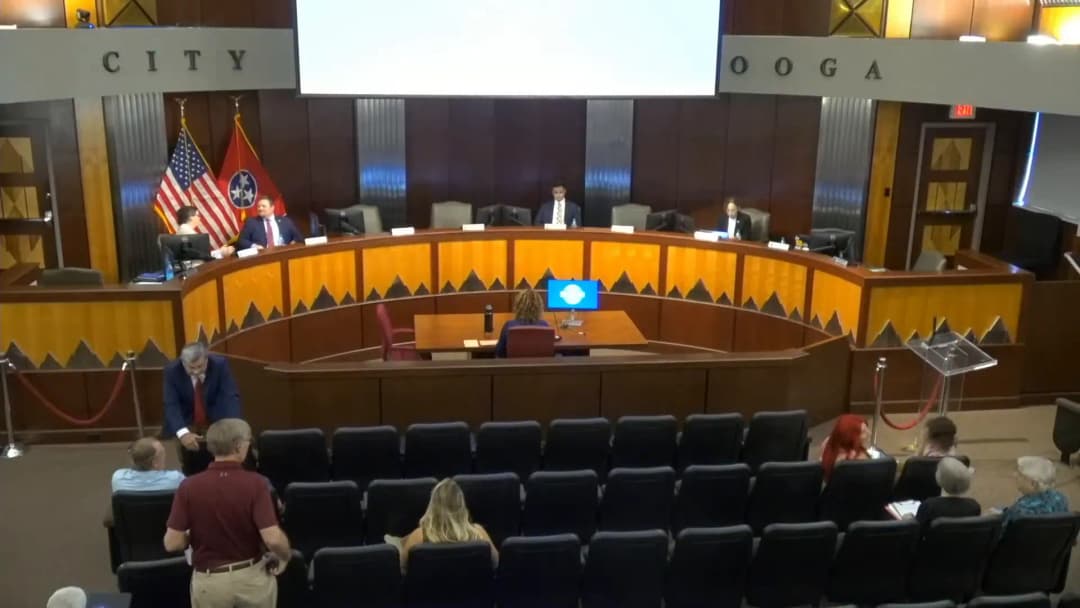
The Chattanooga City Council convened on Tuesday, September 15, 2026, beginning at an unspecified afternoon time for an agenda session and later reconvening for a voting session. The meeting included a presentation from Chief of Police John Chambers on the Motorola License Plate Reader (LPR) technology, followed by council discussion, a closed attorney-client session, public comment, and a series of votes on ordinances, resolutions, and purchases. The meeting was adjourned after public comments. Consent Calendar & Routine Approvals - Minutes from the previous week's meeting were approved as published. - First-reading ordinances passed unanimously (all with a voice vote, no recorded dissent): - Item 8A: Ordinance amending city code on expiration of beer permits (aligning with state law). - Item 8B: Ordinance reducing speed limit on Lake Resort Drive from 45 to 40 mph. - Item 8D: Ordinance rezoning property at 5502 Dayton Boulevard to CNT zone (subject to conditions). - Item 8F: Ordinance rezoning property at 1307 Hicks Pike to CNT zone. - Item 8G: Ordinance lifting conditions 3, 4, and 6 and amending condition 5 for property at 5313 Champion Road (subject to new conditions, supported by absent councilman Clark). - Item 8H: Ordinance amending zoning code to allow drive-throughs as permitted use outside the urban overlay zone (with stacking requirements and no egress crossing riverwalk/greenway). - Items 8C and 8E (rezoning ordinances) were withdrawn at the applicant's request. - Resolutions adopted unanimously (voice votes): - 9A: Appointing Ruth Walker to Head Start Governing Board (District 3). - 9B: License agreement with Four J's Ducks LLC for Ross's Landing ramp ($300/month, two years with renewal option). - 9C: Second amendment to lease with Friends of the Zoo Inc. (expanding leased premises). - 9D: Declaring surplus property at 1517 Old Ringgold Road. - 9E: Appointing Naman Maori as special commissioner police officer (unarmed) for the Housing Authority. - 9F: Continuing on-call professional services for Birchwood and Summit Landfill gas monitoring (four firms, $345,000 annual). - 9G: Continuing on-call professional services for landfill deficiency repairs (four firms, $900,000 annual). - 9H: Awarding contract for East Lake Community Center parking lot ($515,299 total). - 9I: Change order for Development Resource Center interior improvements ($242,433 revised total). - 9J: Accepting donation of office furniture from Volkswagen ($112,000 estimated value, plus $4,999 moving expenses). - 9K: Appointing six special police officers (unarmed) for Public Works Land Development Office. - 9L: Permanent easement agreement with Chattanooga Golf and Country Club ($75,000). Public Comments & Testimony - Blake Wright (District 9): Addressed the council in support of the “Farm Park” project in East Lake, requesting $250,000 from the city. He cited the area's high percentage of youth and poverty (77% of children under 15 live in poverty), emphasized food and energy security concerns, and stated that the project has secured over 100 donations and support from neighborhood associations. He argued that Farm Park offers a blueprint for community green spaces and that investment would not create precedent but rather encourage similar projects. He noted a letter of support from Chief John Chambers regarding the security benefits of maintained green spaces. - Jan Purdy (District 3): Expressed support for safety improvements and meaningful citizen participation in the Plan Chattanooga update. She proposed adding language in the Hickson chapter (or citywide) that values safety and citizen input, and requested a placeholder or mechanism for ridge and floodplain communities to have a voice in planning. She stated she had forwarded a proposal to council and seeks feedback on how citizens can participate. Discussion Items - Chief John Chambers Presentation on Motorola LPR Cameras (Discussion & Q&A): Chief Chambers and Lieutenant Billy Atwell presented an overview of CPD's License Plate Reader technology. Key points: - CPD uses Motorola (formerly Vigilant) LPRs, not Flock cameras. Chief Chambers emphasized that the city does not use and has never procured Flock cameras. - Capabilities: LPRs take still images of license plates; they are not video cameras or constant feeds. Officers cannot log in to view live footage. The system searches for rectangular objects with letters/numbers (AI for this purpose). - Data retention: Images not used for investigations are deleted after 90 days (consistent with state law). Chief Chambers announced a planned policy change to reduce this to 30 days to align with CPD's public safety camera policy. - Guardrails: All searches require a case number and authorized purpose (law enforcement or training); violations are recorded for audit. Officers must log in every 90 days or be deactivated. Hits are clues, not probable cause; officers must verify information before taking action. - Effectiveness: Chief Chambers cited several examples of successful investigations aided by LPRs, including solving violent crimes (e.g., road rage shooting, attempted child luring, locating missing persons) and noted a 48% reduction in homicides and 24% reduction in non-fatal shootings compared to prior years, with an over 90% clearance rate. - Policy: All CPD policies are public online; LPR policy will be reviewed annually and deployed based on violent crime data and community input. - Council Q&A: Council members Hill and Harvey praised the transparency and guardrails. Councilman Henderson confirmed that the database can be used for investigative leads (including proximity analysis) and that the city owns the data (Motorola does not). No council members expressed opposition to the current technology. - Motion to Reconsider Security Services Contract: Councilwoman Burrs made a motion (seconded by Councilman Harvey) to reconsider a previously deferred security contract for parks, community centers, and the Family Justice Center. The motion passed unanimously (voice vote). The item was later added to the purchases agenda and approved (see Key Outcomes). - Purchases Review/Discussion (Agenda Session): - Councilwoman Hill questioned the $145,000 increase for fleet maintenance (PMB services). Bill Payne (Public Works) explained that the increase resulted from drivers taking vehicles directly to vendors who performed additional services (e.g., brake pads) outside the PMB scope, incurring higher costs. Hill expressed concern about process oversight; Payne stated they are working to tighten procedures. - Fleet Purchase of Red Dot Reflex Sights: Councilwoman Hill asked about the $171,676 purchase (400 sights for 400 replacement rifles). Chief Chambers confirmed the quantity and use. - Public Comment on Plan Chattanooga: Jan Purdy requested adding safety and citizen participation language to the Plan Chattanooga update, specifically the Hickson chapter, and asked for a placeholder to allow further community input. Key Outcomes - Votes on Ordinances and Resolutions: All 6 ordinances on first reading (items 8A, 8B, 8D, 8F, 8G, 8H) passed unanimously. Items 8C and 8E were withdrawn. All 12 resolutions (items 9A–9L) were adopted unanimously. - Purchases Approved (all unanimously): - 9 purchases recommended by administration, including: - One-time increase of $200,000 to Chattanooga Armature Works agreement (wastewater). - One-year extension for integrated networking technologies (DTS). - Increase for GoGov by $10,800 (year three) and $14,400 (year four). - Two-year agreement with Tyler Technologies Inc. ($275,000). - One-time purchase of red dot reflex sights for CPD ($171,676). - One-time purchase of 2026 Freightliner leaf collection truck ($307,000). - Name change from Highland Tire and Auto Inc. to Sun Auto Tire and Services Inc. - Fleet PMB increase: $145,000 increase (revised total $275,000). - Security services contract (previously deferred, now added): Four-year agreement with Walden Security and SEI Inc. (annual amount not to exceed $2,000,000). - RFP and Sole Source Approvals: - RFP format approved for Head Start cleaning services (5 buildings). - Three sole source purchases reported (library streaming $25,000, DTS enterprise platform $31,634.75, wastewater grinder pump $27,733.82). - Administrative Actions: - All board appointments (15 total) accepted (future consideration agenda). - Council recessed for attorney-client meeting (time not specified). - Meeting adjourned after public comments.
The Public Meeting Index
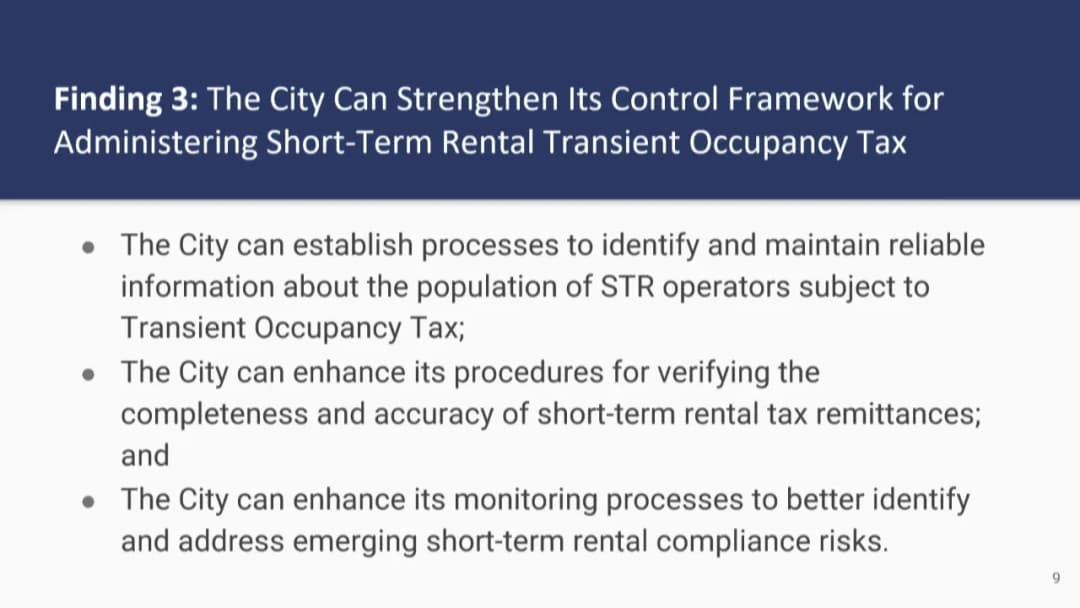
The Public Meeting IndexThe Budget and Audit Committee of the Sacramento City Council met on Tuesday, September 15, 2026, at City Hall, 915 I Street, Sacramento. Chair Roger Dickinson presided; Vice Chair Karina Talamantes and Member Eric Guerra were present; Member Caity Maple was absent. The agenda listed the meeting for 11:00 a.m.; it was called to order at 11:11 a.m. and adjourned at 11:51 a.m. The committee adopted the consent calendar and voted to accept and forward the Audit of the Transient Occupancy Tax to the full City Council. Consent Calendar - Member Talamantes moved and Member Guerra seconded adoption of the consent calendar; it passed with ayes from Talamantes, Guerra, and Chair Dickinson, with Member Maple absent. - Item 1 (File ID 2026-01613): Approved the Budget and Audit Committee meeting minutes of August 11, 2026. - Item 2 (File ID 2026-01462): Accepted the City Auditor's Recommendation Follow-Up Report for the six-month period ending June 30, 2026, and forwarded it to the City Council for approval. - During discussion, Vice Chair Talamantes praised the City Auditor's online recommendations dashboard, which tracks recommendations, estimated realized benefits, potential monetary benefits, and department breakdowns back to 2010. Chair Dickinson suggested scheduling a future committee meeting for the City Auditor to return with open recommendations that have not yet been completed. Public Comments & Testimony - Lambert Davis spoke during the consent calendar, expressing strong support for the City Auditor and whistleblowing departments. He raised concerns about an unidentified company that reportedly received over $100,000 without being required to submit an application and said he had experienced difficulties receiving Measure U funds. - During public comment on matters not on the agenda, Mr. Davis asked the city to recognize the 80th anniversary of a Del Paso Heights organization, describing it as scandal-free and politically active. He shared a related document with the committee. Discussion Items - City Auditor Farishta Ahrary, joined by Jessica Lugo and Kevin Christensen, presented the Audit of the Transient Occupancy Tax (TOT) (File ID 2026-01458), covering fiscal years 2023 through 2025. The audit evaluated the city's administration and oversight of TOT, including restricted revenue expenditures, hotel remittance activity, short-term rental oversight, and benchmarking against the ten most populated cities in California. - Ahrary explained TOT history: a 4% tax established in 1965 with restricted uses; an increase to 11% in 1990 with 1% directed to the general fund; and a 12% rate since 1994, with 2% to the general fund and 10% to the Community Center Fund. Measure N, approved by voters in November 2022, broadened restricted TOT uses to include economic development projects and visitor-serving facilities that promote tourism and the local economy. TOT revenue reached more than $40 million in fiscal year 2025 after a pandemic-era low in 2021. - The audit contains four findings and 10 recommendations: - Finding 1 (informational): Sacramento's 12% TOT rate is on the lower side among benchmarked cities, but total visitor assessments are slightly on the higher side when including tourism marketing district (STMD) assessments ranging from 1.15% to 3.45% and the 1% tourism infrastructure district (STID) assessment. Sacramento restricts 10% of its 12% TOT; San Diego has the next highest restriction at 9% of up to 13.75%, and Bakersfield has no restrictions. Ahrary confirmed that changing the restricted-use structure would require a public vote. - Finding 2: The audit found no inappropriate expenditures of restricted TOT revenue and no recommendations were made. - Finding 3 (largest finding): Short-term rental oversight and TOT administration need improvement. The city has good controls over hotels, but limitations exist in identifying all short-term rental operators and new hosting platforms, verifying permit numbers and correct tax rates, and reconciling aggregate platform payments. The audit noted that Airbnb and other platforms do not verify permit numbers, cities can request listing removals through Airbnb's government portal but listings can be re-listed, and the city had a similar vendor contract from 2018 to 2024 that was canceled because service quality declined. Revenue was receiving TOT from four hosting platforms, while about a dozen other platforms with Sacramento listings were not remitting TOT, although the audit could not verify that taxable bookings occurred through each. In one instance, a single operator's monthly reported remittance for one property exceeded the amount the city received from an entire platform for the month. About half of benchmarked cities require more detailed platform-reported data; Sacramento is working on an ordinance update to require detailed monthly property-level information. - Finding 4: The revenue division should reduce manual data entry in TOT tracking and consider automation or system upgrades to prevent data entry errors, which were mostly related to applying remittances to different reporting months. - Finance department staff, including Pete Coletto and revenue manager Brian Howard, agreed with the audit findings. They described enforcement as 'a game of whack-a-mole,' noted that most short-term operators comply, and said the city is working on an ordinance update, enabled by state law, to require detailed monthly property-level reporting from hosting platforms. They also discussed the possible use of third-party vendors to identify unpermitted operators and said new systems would be weighed in the budget process. - Committee members expressed support for the audit. Vice Chair Talamantes called the issue one of fairness to compliant operators, said the city is leaving money on the table, and encouraged collaboration among revenue, finance, and economic development. Member Guerra supported preserving the restricted structure for bond ratings and warned against using TOT revenues outside their purpose. Chair Dickinson noted the short-term rental portion of TOT is about 5%, or around $2 million per year. Key Outcomes - Motion by Member Talamantes, seconded by Member Guerra, to accept the Audit of the Transient Occupancy Tax and forward it to the City Council for approval passed with ayes from Talamantes, Guerra, and Chair Dickinson; Member Maple was absent. - The consent calendar passed 3-0 with Member Maple absent, approving the August 11, 2026 minutes and forwarding the City Auditor's Recommendation Follow-Up Report to the City Council. - Chair Dickinson suggested scheduling a future committee review of open/uncompleted City Auditor recommendations. - Finance staff indicated that a short-term rental ordinance update with new hosting-platform reporting requirements will come to the City Council in the near future, and the city will evaluate options for automated TOT tracking systems.
The Westchester County Board of Legislators Parks and Environment Committee, chaired by Legislator Erika Pierce, met on September 15, 2026, to discuss the County’s Green Initiatives Repository and the status of the Climate Action Plan. Peter McCartt, Director of the Office of Energy Conservation and Sustainability, presented to the committee. Attendees included Legislators Pierce, Williams Johnson (remote), and Williams (belatedly), with Legislator Barr auditing. A quorum was not present due to the absences of Legislators Nolan and Tubiolo, but the discussion proceeded. The meeting was adjourned at 2:36 PM. Discussion Items - Green Initiatives Repository: Mr. McCartt demonstrated the new online repository, which organizes sustainability activities across 11 categories. (Note: The draft minutes list 17 specific initiatives, while the meeting transcript records 70 initiatives.) The site is searchable by category, municipality, and program, and provides contact information for municipal leads. Chair Pierce noted a minor error in the electric transportation section and suggested future enhancements such as GIS mapping and case study videos. McCartt noted that the repository relies on municipalities to submit and update their information. A template will be provided to municipalities, and legislators will contact non-respondents. - Climate Action Plan and Greenhouse Gas Inventory: Chair Pierce expressed concern over the lack of an updated Greenhouse Gas (GHG) emissions inventory, which is necessary to measure progress toward 2030 and 2050 goals. Pierce noted that state funding for the inventory from the DEC had ended and advocated for seeking state-level assistance, particularly in obtaining data from NYSERDA. McCartt acknowledged that completing and maintaining the inventory requires dedicated time and budget, calling it a significant project that is not currently resourced. - County Operations and Sustainability Projects: McCartt reported on the County’s own initiatives, including the $2 million per month electricity bill, energy audits of County buildings, the gas capture project at the Yonkers wastewater treatment plant, and the electrification of the bus fleet and park equipment. McCartt expressed confidence in progress on wastewater treatment energy reduction goals. Chair Pierce requested a formal mechanism—such as a public-facing dashboard or regular progress report—to track sustainability metrics. McCartt committed to providing a bullet-by-bullet written update on the 11 identified climate action goals. - Composting and Community Resilience: Chair Pierce and McCartt discussed practical solutions to improve community resilience, identifying composting as a key area for further exploration. They discussed the feasibility of shared composting facilities and collaboration among municipalities. Key Outcomes - No formal votes were taken due to the lack of a quorum. - Next Steps: - A template will be provided to municipalities to facilitate their participation in the green initiatives repository. - Legislators will contact municipalities that have not yet responded to the repository survey. - Peter McCartt will develop a progress report tracking the County’s climate action plan goals and greenhouse gas emissions reductions, covering the 11 identified bullet points. - The committee will explore options for composting facilities and opportunities for communities to collaborate on composting initiatives. - Chair Pierce indicated she would pursue a resolution through the New York State Association of Counties (NYSAC) to advocate for state assistance with data and funding for greenhouse gas tracking.
The Marion County Commissioners met on September 15, 2026, at approximately 2:03 PM in Room 260 of the City-County Building in Indianapolis, Indiana. President Joseph O'Connor presided, joined by Auditor Milo Eldrich (Secretary) and Treasurer Barbara Lawrence (Vice President). The meeting covered approval of prior minutes, nonprofit tax lien applications, a property transfer process, and updates on tax-sale-funded housing projects. Consent Calendar - Approval of Minutes: The minutes from the August 18, 2026 meeting were approved unanimously (all in favor, no opposition). - Nonprofit Tax Lien Sale Applications: Three nonprofits were approved to participate in the 2026 nonprofit tax sale: Indianapolis Neighborhood Housing Partnership (INHP), Near North Development Corporation, and C Hughes School of Change Incorporated. Staff recommended approval, noting that C Hughes had satisfied delinquent nuisance liens on their main property. Discussion revealed that C Hughes has completed two home rehabilitations (one in 2024, one in 2025) and has $40,000 in committed charitable pledges ready for new projects. The motion carried unanimously. Public Comments & Testimony - No public comments were made during the meeting. Discussion Items - Transfer of Property to a Person Able to Repair and Maintain: Two parcels were identified from the 2014 Marion County Tax Lien sale: a strip of land near the Kroger parking lot (10th Street) and a sliver near the former Irish Mutt on Shayland Road. Staff declared the properties suitable for transfer, opened an application process, and scheduled a hearing for November 17, 2026 to select an applicant. Deputy Treasurer Mickey Rogers explained that the parcels were originally private access roads retained by a now-defunct trust; they have fallen into disrepair and are currently unmaintained. The motion to proceed passed unanimously. - Nonprofit Tax Sale Updates: - Jasmine Buchanan of Martindale Brightwood Community Development Corporation (MBCDC) reported on parcels from the 2022–2024 tax sales. Notably, 2749 Station Street was sold on September 11, 2026 to Keith Edmonds, a 62-year-old buyer on fixed income at approximately 60% AMI – the first completed and sold project from the program. The property was fully gutted and remodeled (including asbestos removal and sewer line work). Other projects: 2844 Brookside Avenue (new construction after demolition; demolition permit approved after four months, scheduled for September 21); 2641 Dr. Martin Luther King Jr. Street (applying for HOME funds); 2873 Stewart Street (future HOME application); 4500 Hillside (double lot, exploring partnership with Habitat for Humanity). MBCDC requested and was granted release of the project agreement for 2749 Station Street. - Kelly Mergot, President of Southeast Neighborhood Development (Send), provided an update on their portfolio. Since 2019, Send has completed 25 homes, using funding from HOME, new market tax credits, and ARPA vacant-to-vibrant funds. Specific tax-sale parcels: 1341 East Minnesota (demolished at $16,000, now in 2027 HOME application); 234 South Oxford (triple lot, not yet in HOME application); 3333 Prospect Street (needs further neighborhood engagement). No action was needed on the update. Key Outcomes - Minutes Approved: Unanimous approval of August 18, 2026 meeting minutes. - Nonprofit Applications Approved: Three nonprofits were approved for the 2026 tax lien sale (INHP, Near North, C Hughes). - Property Transfer Process Launched: Two parcels were declared suitable for transfer; applications are open, and a public hearing will be held on November 17, 2026. - Project Agreement Released: MBCDC’s project agreement for 2749 Station Street was released unanimously after sale to an income-qualified buyer. - Next Meeting: October 20, 2026 at 2:00 PM in Room 260 of the City-County Building. The meeting was adjourned.
This was a test meeting of the Common Council held on September 15, 2026, at 1:00 PM (agenda time; user note indicates 19:15 UTC). No minutes or transcript are available. The agenda consisted entirely of test items with no substantive business conducted. The meeting was opened with roll call, pledge of allegiance, and a moment of silence. The only action on the agenda was approval of test meeting minutes. Discussion Items - Test Item with Very Long Caption (26-0926): A report item with an extended caption repeated multiple times. - Test Ordinance (26-0927): A proposed ordinance; the agenda noted the possibility of convening in closed session under Wis. Stats. sec. 19.85(1)(a) to deliberate a decision, with a possible return to open session. - Resolution Doubling Pay of Clerk's Office Staff (26-0928): A test resolution; the agenda noted the possibility of convening in closed session under Wis. Stat. 19.85(1)(g) to confer with legal counsel. - Review of Plans for Expansion of Clerk's Office (26-0929): A test item; again with a note about possible closed session for legal counsel consultation. Key Outcomes - No votes, decisions, or substantive actions were recorded. The meeting appears to have been a procedural test with no official outcomes. No public comments or testimony were documented. The closed session notes were conditional and not confirmed as having occurred.
The Rockville Youth Commission met on Wednesday, April 9, 2026 at 4:10 PM. The meeting was chaired by Becca. Commissioners discussed the youth survey distribution, updates on recruitment for the 2025-2026 term, and plans for electing an interim chairperson following the current chair's departure in June. The meeting also included approval of previous meeting minutes and a brief discussion of the annual report to the Mayor and Council. Meeting Minutes - The meeting minutes from the previous session were approved by unanimous consent. Public Comments & Testimony - No public comments or testimony were recorded. Discussion Items - Youth Survey Action Plan: The commission reviewed survey responses, noting that most responses came from Richard Montgomery (RM) seniors and a few Woodson (Wood) sophomores, limiting diversity. Commissioners discussed ways to increase outreach, including sharing the survey with school SGA reps, placing it on advisory slides, promoting it at school events (e.g., teacher–student basketball games), and using word of mouth. A raffle with six movie tickets (secured by Jordan) and tying survey completion to attendance at the end-of-year pool party (tentatively June 6 or 13, pending renovation completion) were proposed as incentives. The chair emphasized the importance of getting a wider range of responses, especially from middle schoolers at Julius West (JW), to ensure diverse input. Commissioners agreed to each send the survey to at least 5 people before the next meeting. - Recruitment Update for 2025-2026 Term: Staff liaison Jordan reported that the city is recruiting for the next term (starting October 2025). Current members (except Becca) whose terms end in October must submit an expression of interest form by May 31 to reapply. The mayor will conduct interviews and make appointments in September for an 11-member commission (currently 8 members). Summer job opportunities with the city were also mentioned. - Interim Chairperson Election Process: The chair (Becca) will leave in June. Under the resolution, the chair must be in 11th or 12th grade. Eligible members (Ilala, Alice, and Sam—juniors) were encouraged to consider the role. An interim chair will be elected at the next meeting to serve from June to October, when a new full-term chair will be elected. The responsibilities of the chair were outlined: setting agendas, running meetings, acting as the face of the commission, and representing the commission at events. Members were asked to think about their interest and be ready to vote at the next meeting. Daniela (a sophomore) expressed interest in being chair in the fall (after October), pending eligibility. - Annual Report to Mayor and Council: The commission is required to submit an annual report (PowerPoint slides) summarizing activities from the year. Planned highlights include developing the youth survey, attending the King Farm event, and the pool party. Staff will share examples from other commissions, but the report will be short. Survey results will be a key component. The report does not need to be submitted in person. Key Outcomes - The previous meeting minutes were approved unanimously. - The youth survey distribution strategy was discussed; members will each send the survey to at least 5 people before the next meeting. A raffle and pool party requirement were set as incentives. - Recruitment timeline confirmed: expression of interest forms due by May 31 for reappointment; mayor's appointments in September for October start. - Interim chair election will occur at the next meeting; eligible juniors (Ilala, Alice, Sam) were asked to consider running. Daniela (sophomore) may be eligible for chair in the fall, pending confirmation. - Annual report preparation will be a team effort; survey results will be a central highlight. - The meeting was adjourned by unanimous vote.
The Edina City Council met on September 15, 2026, at 7:00 PM in City Hall. The council acted on several significant items, including setting a preliminary 2027 property tax levy increase of 6.5%, authorizing the use of surplus funds for debt reduction, granting a variance appeal, and approving a site plan extension for the former Macy's site. The public comment period featured discussions on the city budget, a major ice rink construction delay, and concerns over automated license plate reader technology. Consent Calendar - The council approved the bulk of the consent agenda, which included routine approvals such as meeting minutes, various purchase requests (comprehensive finance operations evaluation, fire ladder truck repair, park playground accessibility improvements, well 9 emergency repair), grant agreement authorizations (IGNITE grant, Solar on Public Buildings grant), and a special permit for the Edina Car Show. Items 6.4 and 6.14 were removed for separate discussion. Public Comments & Testimony - Ralph Sickert: Criticized the proposed budget, questioning a "$7 million windfall" and the $542 million five-year capital forecast. He accused the council of presenting a "smoke and mirrors budget" and failing to hold the City Manager accountable for not answering previously submitted questions. - Art Boylan (Edina Hockey Association): Reported that the East Rink renovations at Braemar are significantly delayed due to the discovery of permafrost, resulting in a projected loss of 1,000 hours of ice-time. He appealed for an urgent solution to secure indoor ice space, suggesting the temporary enclosure of the Backyard Rink. He noted the delay impacts neighboring communities beyond Edina. - Derek: Expressed strong opposition to the use of Flock cameras (ALPR technology), citing nationwide instances of police misuse (69 officials), false identifications (28 cases), and violations of privacy. He argued the technology represents a false promise from the vendor. - David Frankel: Calculated the lost ice time cost at roughly $220,000. He questioned a $33 million change work order for Braemar that lacked council discussion. He also urged caution on the city's AI investments, recommending the city seek guidance from the Minnesota Department of Information Technology (MN.IT) to avoid common pitfalls. - City Manager's Response (Manager Neal): Addressed questions from a previous meeting, stating the Edina Police Department retains ALPR data for 30 days, soil tests at the East Rink found no contamination, and no walls need to be removed for equipment access into the East Rink. Discussion Items - Item 6.4 (France Avenue Pedestrian Safety Study): Councilmember Agnew pulled this item from the consent agenda, requesting it be tabled to allow for a deeper conversation with the county on the project's scope. Councilmember Risser expressed concerns about ensuring the study covers the challenging intersection at the northeast corner. The council voted unanimously to table the item. - Item 6.14 (Lawful Gambling Premises Permit): Councilmember Agnew pulled this item to discuss the possibility of allowing only paper-based gambling, citing concerns about youth addiction to electronic wagering. The City Attorney stated that while highly unusual, the city could potentially attempt to restrict electronic games, though it would carry legal risk due to the prevailing "all or nothing" interpretation of state law. The council voted 3-1 to approve the permit, with Councilmember Agnew voting against. - Public Hearing: 5620 Woodcrest Drive Variance Appeal: The Beck family appealed a Planning Commission denial of variances to build a four-season porch and deck on a non-conforming lot. The owners presented a revised, smaller plan. The council voted 3-1 to grant the appeal, finding the lot's unique circumstances and the proposed design to be reasonable. Councilmember Risser dissented, citing process and standard concerns. - Resolution 2026-50 (Enclave Site Plan Extension): The developer of the former Macy's site successfully requested a three-month extension to December 31, 2026. Councilmember Agnew supported the extension but requested staff to develop mechanisms to better ensure the full vision of large multi-phase projects is delivered. Councilmember Risser expressed concerns about the project's scope and TIFF financing, voting against. The motion was approved 3-1. - Resolutions 2026-47 & 2026-45 (HRA Levy & Preliminary Budget): The council unanimously approved the Housing and Redevelopment Authority (HRA) tax levy of $275,100 and the preliminary 2027 property tax levy with a maximum increase of 6.5%. Key Outcomes - Preliminary 2027 City Tax Levy: Adopted unanimously at a maximum increase of 6.5% (Res. 2026-45). - General Fund Surplus: $1.45 million authorized to pay off debt for Fire Station 1 and the Public Works facility (Res. 2026-53, 3-1 vote). - Bond Redemptions: Early payoff authorized for Series 2016A (Fire Station 1) and Series 2017C (Public Works) bonds, a move that saved $94,805 in interest (Res. 2026-42 and 2026-43). - Variance Granted: The appeal of the Planning Commission's denial at 5620 Woodcrest Drive was approved (3-1), granting variances for a four-season porch subject to the homeowners' revised plan. - Enclave Extension: A site plan extension for the former Macy's redevelopment was approved through December 31, 2026 (Res. 2026-50, 3-1 vote). - Gambling Permit: A lawful gambling premises permit was approved for the Edina Athletic Booster Club at General Sports Bar (Res. 2026-54, 3-1 vote). - Future Studies & Staff Direction: The France Avenue Pedestrian Safety Study was tabled for further council and county discussion. Staff will also bring options to a future work session for structuring approvals on large, multi-phase projects. Manager Neal noted that enterprise fund budgets are still in development and will be presented at the October 6 work session.
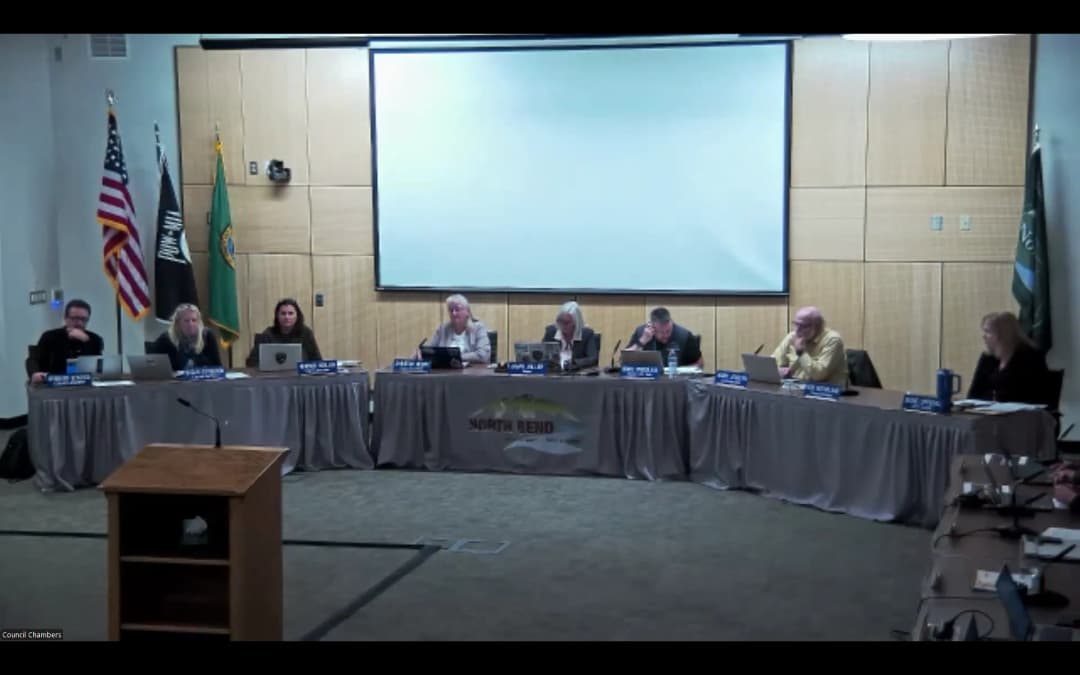
The North Bend City Council met on September 15, 2026, at 7:00 PM at City Hall, 920 SE Cedar Falls Way. Mayor Miller presided. Councilmembers Elwood, Joselyn, Koellen, Rustik, Torguson, and Tremolada were present; Councilmember McFarland was excused. The meeting included the consent calendar, committee reports, and introductions for five action items (AB26-081 through AB26-085), all of which passed unanimously by 6-0 votes. The meeting adjourned at 8:26 PM. Consent Calendar - Minutes: Approved for the City Council Meeting of September 1, 2026, and the City Council Work Study of August 25, 2026. - Payroll: Approved for September 4, 2026, in the amount of $411,303.35. - AB26-079 / AB26-080 (Utility Rate Discounts): Approved ordinances amending the North Bend Municipal Code and the Taxes, Rates & Fees Schedule to provide a discounted residential utility rate for low-income senior citizens and disabled customers residing outside the city limits. - Item 3 (Checks): Councilmember Torguson pulled this item for discussion to confirm that a $7,500 quarterly payment to North Bend Art & Industry was included and properly authorized. Following clarification from the Deputy Finance Director, the item was approved 6-0. Public Comments & Testimony - No members of the public provided comments during the Audience Participation portion of the meeting. - No testimony was provided during the public hearing for Ordinance AB26-081 (School Impact Fees). Discussion Items - AB26-081: School Impact Fees Ordinance: Senior Planner Jamie Burrell introduced the ordinance. Ryan Stokes, Assistant Superintendent of the Snoqualmie Valley School District, presented the district's updated Capital Facilities Plan, which includes a rebuild of North Bend Elementary School. The new fee schedule responds to state law changes requiring six fee categories based on housing type and bedroom count, moving from an annual to a biennial update cycle. Fees for smaller single-family homes (2 bedrooms or less) will decrease under the new structure, while fees for larger homes (3+ bedrooms) will increase. Councilmembers engaged in significant deliberation. Councilmember Rustik confirmed the fees apply only to new development burdens. Councilmember Joselyn supported the “growth pays for growth” principle and stressed the need to advocate for future school bond measures. Councilmember Tremolada expressed skepticism about state growth management projections but supported the ordinance. Councilmember Torguson voiced concerns regarding the cumulative tax burden on residents but ultimately approved the measure. The motion passed 6-0. - AB26-082: SCORE Jail Services Interlocal Agreement Amendment: City Administrator Amber Emery presented a recommendation to shift the city’s primary misdemeanor jail booking from the City of Issaquah to SCORE. The city was paying approximately $25,000 per month for five guaranteed beds at Issaquah that were underutilized. Additionally, Issaquah frequently declined bookings for medical reasons, forcing officers to take detainees to the hospital and then to SCORE anyway, wasting significant staff time. The new agreement provides a lower daily rate ($78.75 vs. over $100) and robust virtual court services. The motion passed 6-0. The city will issue a 90-day notice to terminate the Issaquah contract. - AB26-083: FHWA RTCC Grant for North Bend Way / Mt Si Road Roundabout: Public Works Director Tom Mohr presented a resolution accepting a federal grant of just over $2 million for roundabout construction. The city’s match is $346,000, funded by transportation impact fees and transportation benefit district funds. Councilmember Elwood praised the favorable grant match ratio. Construction is planned for 2027 or 2028. The motion passed 6-0. - AB26-084: FHWA TAP Grant for Tanner Trail Extension: Public Works Director Mohr presented a resolution accepting a federal grant of just over $1.18 million to extend the Tanner Trail from the Public Works entrance to the Snoqualmie Valley Trail crossing. The local match is $184,000. Councilmember Joselyn highlighted the benefits of connecting downtown to the regional trail network and commended staff for securing the grant. Construction is planned for 2028. The motion passed 6-0. - AB26-085: Collective Bargaining Agreement (Office, Clerical & Technical Employees): Administrative Services Director Lisa Escobar presented the ratified CBA with Teamsters Local 763 covering 12 employees. The agreement provides cost-of-living salary increases and matches the longevity bonus structure of the public works department. The motion passed 6-0. Key Outcomes - All five main agenda items (AB26-081 through AB26-085) were approved by unanimous 6-0 votes. - The City Council authorized the mayor to execute the SCORE jail services amendment and was informed of the city’s plan to terminate the contract with the City of Issaquah jail. - Upcoming events highlighted by Mayor Miller and City Administrator Emery included: a Community Shred Event on September 19, a Police Chief meet-up on September 16, a Town Hall on e-bikes/scooters/motorcycles on October 6, and the North Bend Blues Walk on October 3. - Councilmember Joselyn’s suggestion for informational signage at active city capital projects was positively received and is being explored by staff.
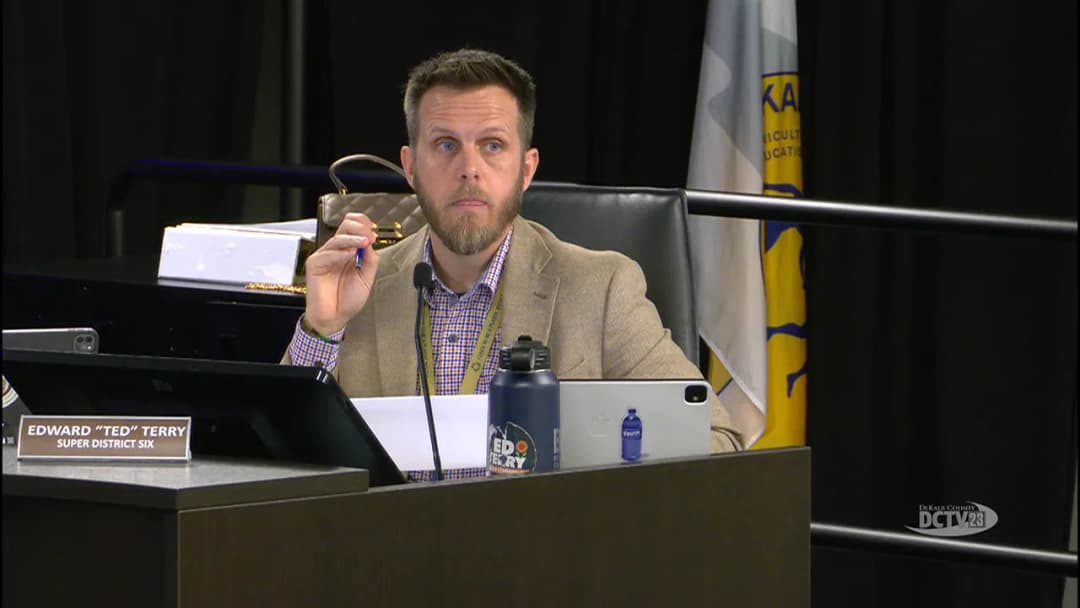
The Finance, Audit, and Budget (FAB) Committee, chaired by Commissioner Ted Terry and joined by Commissioners Michelle Longspears and Shekauer Johnson, met on Tuesday, September 15, 2026, at 3:00 PM. The agenda included financial statements review, a tree bank audit presentation, several contracting items, and extensive mid-year budget discussions. Key decisions included approval of minutes and a change order, while major financial advisory services procurement and mid-year budget requests were deferred for further refinement. Consent Calendar - Meeting Minutes (August 25, 2026): Approved unanimously with no questions or edits. - Ratification of Change Order (Item 1226): Approved for additional phone lines and call management system (Avaya, amount not to exceed $67,873.46). Discussion Items - Financial Statements (Governmental and Enterprise Funds): Director McNabb presented a new consolidated summary report for the six-month period ending June 30, 2026. Key points: - General Fund: revenues at 25% of budget (normal due to property tax timing), expenditures at 42%, net negative $102 million (similar to prior year $101 million). - Fire Fund: revenues 8%, expenditures 42%, net negative $41 million. - Hospital Fund: only fund over 50% expenditures (55%) due to a timing disbursement. - Unincorporated Fund: revenues at 48% (higher than prior year's 36%) due to increased licenses and permits ($8.9M vs $7.2M). - Enterprise funds: Watershed at 50% revenues, 34% expenditures; Sanitation at 17% revenues, 45% expenditures; Airport at 28% revenues, 95% expenditures (with a $22M budgeted
The Vanderburgh County Data Center Research Committee held its second meeting on Tuesday, September 15, 2026, from 1:00 PM to 2:48 PM in Room 301 of the Civic Center Complex in Evansville, Indiana. Chair Lloyd Lamberton presided. Members Scott Ambrose and Richard Reed were absent. The committee reviewed a draft ordinance template, discussed definitions for data centers, and began outlining categories based on size and community impact. Key decisions included establishing a framework for small, medium, large, and hyperscale data center categories, and directing staff to compile definitions for further refinement. Approvals and Administrative Items - Minutes from the September 2, 2026 meeting were acknowledged but no formal vote was recorded. - Committee membership changes: A member resigned, and Mark Murry was appointed as replacement. Susan Hardwick and Mark Murry introduced themselves, noting their backgrounds in utilities and data analysis, respectively. - Communication: John Bates and Susan Hardwick still needed access to the SharePoint site, which had been populated with ordinance-related files. Discussion Items Draft Ordinance Template Review - Jenna Richardt presented a draft ordinance template compiled from multiple existing ordinances. Susan Hardwick asked whether decommissioning standards were included; Jenna confirmed it was a bullet point but not fully developed. - Committee members agreed to use the template as a starting point and make edits iteratively in future meetings. Data Center Definitions and Applicability - Chair Lamberton referenced model ordinances from Kentucky and other sources. Definitions from the Kentucky model ordinance were read aloud, including definitions for "data center" and "data center accessory use structure." - Tom Shetler, Jr. recommended using the phrase "sole purpose of" to distinguish data centers from businesses with incidental data processing. - Mark Murry suggested definitions should be based on measurable community impacts (e.g., noise, utility usage) rather than just size or power demand. - Lauren Lynch emphasized the need to define the purpose of the regulated use (e.g., on-site vs. regional/global services). - Jason Naab recommended defining a data center first, then establishing thresholds (size, megawatts) and applicable zoning districts. - Susan Hardwick recommended keeping "grandfathering" under consideration to avoid impacting existing businesses. Proposed Data Center Categories - The committee discussed categories: small, medium, large, and hyperscale. Examples from existing ordinances were cited: Warwick County (small <10,000 sq ft, medium <40,000 sq ft, large 40,000 sq ft) and a data center tracker using energy use (mega campuses 1 GW, hyperscale 100 MW, large 51-99 MW, medium 11-50 MW). - Mark Murry proposed defining categories by size, power, and typical characteristics. An example framework was presented: small (<20,000 sq ft, <5 MW), medium (20,000-100,000 sq ft, 5-20 MW), large (100,000-500,000 sq ft, 20-100 MW), with threshold details to be refined. - The committee generally agreed to use at least three categories (small, medium, large) and possibly a hyperscale category, with parameters to be finalized. Electric Infrastructure, Reliability, and Cost Allocation - Jon Robertson explained that large data centers often build or fund dedicated power infrastructure (e.g., combined-cycle natural gas plants) and may construct their own water/wastewater treatment facilities. Service terms are typically negotiated in contracts approved by the Indiana Utility Regulatory Commission (IURC). - A representative from CenterPoint (unidentified speaker) stated that the utility requires data center developers to pay 100% of infrastructure costs to serve them, and that rates are set by the Indiana Commission for the local territory only, not shared across other regions. The representative noted that customers could potentially benefit from feed-in tariffs or spreading fixed costs. - Susan Hardwick cautioned against blurring ordinance requirements with contractual matters; Lauren Lynch asked how residents could be assured they wouldn't bear project-related costs. Discussion included bonding for decommissioning and infrastructure to protect ratepayers. - Committee members underscored the importance of ensuring that infrastructure upgrades are fully funded by the developer, and that the ordinance should include decommissioning standards. Community Impact and Additional Definitions - Lauren Lynch expressed a desire to allocate time to discuss community impacts (e.g., noise, water usage, transportation) rather than just contractual terms. - Chair Lamberton noted that further definitions would be added as the committee reviews other sections of the ordinance. - Committee members identified the need to inventory existing data centers in Vanderburgh County and determine applicability/grandfathering. Upcoming Meeting Calendar and Site Visits - The committee reviewed the upcoming review calendar: September 29 (Sections 6-8), October 13 (Sections 9-11), October 20 (Sections 12-14), November 10 (Sections 15-17), November 17 (Sections 18-19), December 8 (public comment meeting), December 15 (final vote on recommendations). - It was suggested to reorganize the calendar to group energy-related topics (electric, water) for more focused discussion, and to invite speakers from Evansville Water & Sewer Utility and CenterPoint. - Site visits were discussed: a large hyperscale campus in New Albany, Ohio (no longer offering tours but viewable externally) and a smaller facility in Hammond, Indiana that offers tours. Committee members considered sending a few representatives due to travel costs. Key Outcomes - The committee agreed to define a "data center" using a primary definition and to develop subsets for small, medium, large, and hyperscale facilities, with parameters for square footage, megawatt demand, and typical characteristics to be refined. - Jenna Richardt will compile the draft definitions based on the discussion and circulate them for edits before the next meeting. - The committee will continue to consider measurable community impacts, existing facilities, grandfathering, applicable zoning districts, infrastructure reliability, and cost allocation. - The committee directed staff to arrange presentations from Evansville Water & Sewer Utility and CenterPoint for upcoming meetings. - Adjournment: Motion by Jenna Richardt, seconded by John Bates, unanimously passed at 2:48 PM.