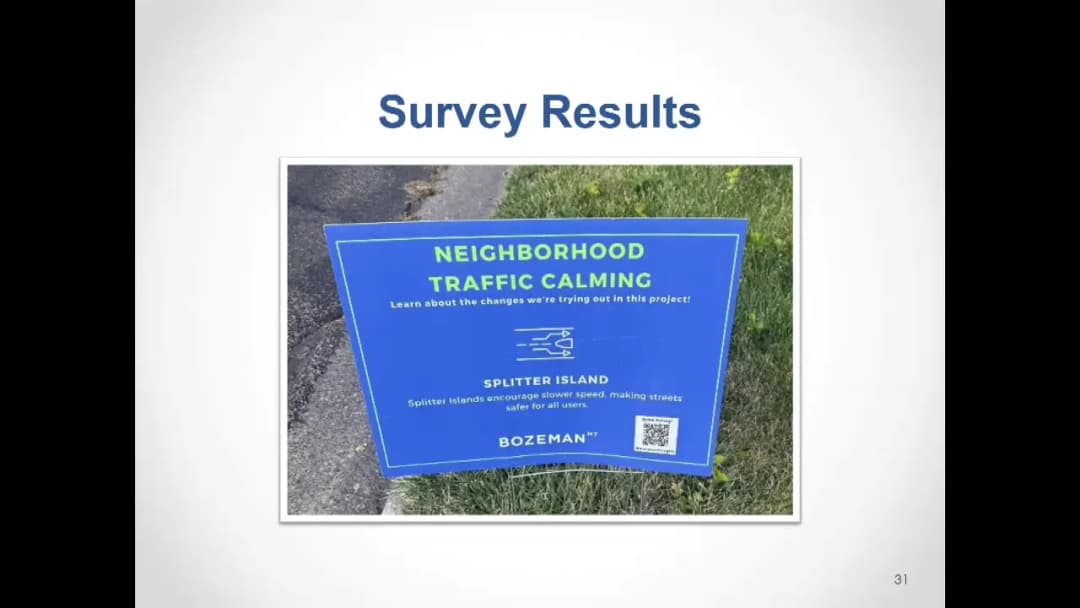
The Bozeman Transportation Board met on Wednesday, October 28, 2026, beginning at 6:00 PM per the agenda, in a hybrid in-person and videoconference meeting. The board approved the September 23, 2026 minutes, heard public comment, received the Neighborhood Traffic Calming Program update, and set a December meeting date. No consent items were listed, and there were no disclosures. Public Comments & Testimony - Haley Wood, a Bozeman resident and Montana State University student, urged the board to prioritize pedestrian and bicycle safety improvements. She identified West College Street from 8th to 11th and the Durston/North 11th intersection as high-risk locations and asked for physically separated bike lanes, HAWK signals at College/7th and Durston/11th, lower speed limits on high-traffic corridors, and transportation demand management programs. She framed safe infrastructure as an equity and public safety issue. - Jolene Hall, transportation planner at the Gallatin Valley Metropolitan Planning Organization (MPO), announced that the MPO's long-range transportation plan public comment period opens November 9 and pointed the public to gvmpo.org for e-notifications and more information. - Linda Simonis, a Church Street resident, thanked Dene Giannetti and staff for the traffic calming program. She said the Church Street installation has become a neighborhood volunteer project, with neighbors buying flowers, donating water, and maintaining a watering schedule, and that it has reduced recognizable cut-through traffic. Staff Updates - Taylor Lonsdale reported that the City Commission passed updated board resolutions, including adding a non-voting Montana State University student member to the Transportation Board. - The Safety Action Plan and SS4A grant work is progressing: new safety data equipment is operational and receiving data, algorithms are being fine-tuned, crash-data-platform training is complete, and the Engage page for the safety action plan is expected within the next couple of weeks. - The Transportation Master Plan is close to launching its Engage page, and the first technical working group meeting is scheduled for next week. - Construction updates included completed paving on M.L. Hatton Road with opening expected the second week of November; the reopened Oak/Ferguson intersection with new left-turn lanes, updated signals, and new signing; the paved Flanders Mill pathway connection down to Durston; and ongoing work on North 19th between Baxter and Rawhide Ridge. - The Katie Boulevard project is moving toward 100% plans, with an open house scheduled for November 18 from 3:30 to 6:00 PM at Pilgrim United Church, 2118 South Third Avenue. Construction is expected to begin in early spring, with the large effort between 7th and 11th slated for May through August. - Maintenance activities have included snowstorm cleanup, fall leaf pickup, winter preparation, and stop-sign installation at uncontrolled intersections. Staff member Nick Ross is expected back in the office on November 12. Neighborhood Traffic Calming Program Update - Dene Giannetti presented the first full-cycle update on the revamped Neighborhood Traffic Calming Program. She explained that board feedback from October and November 2025 led to a hybrid proactive/reactive approach, formal eligibility criteria, a petition process requiring either 50% of addresses within one block or an HOA/neighborhood council letter, and a temporary/seasonal phase before any permanent installation. - The program's toolbox includes horizontal deflection devices such as splitter islands, curb extensions, traffic circles, and pedestrian refuge islands. Vertical treatments like speed tables are not used as temporary installations because one temporary speed table requires about 50 holes in the asphalt and several hours to install; projects start with horizontal devices and may move to vertical devices if speed/volume objectives are not met. - Of 20 applications received, one was a duplicate, three were ineligible based on street classification, eight were addressed through other programs or solutions, and eight requests became six projects. New permanent installations included traffic circles on Black Avenue at Olive and 6th and speed tables on 18th and 25th. Carryover projects at Grand/Cottonwood and West College were also evaluated. - Giannetti reported that permanent projects cost roughly 10 times temporary projects. The 2026 speed tables were bid at about $10,000 each and need to be spaced no more than 500 feet apart; the break-even point with temporary installations is about a decade. For that reason, staff are exploring year-round interim designs that fall between the roughly $1,000 temporary circles and the $12,000 permanent circles. - Evaluation results were mixed. On Yellowstone Avenue, near where Leslie Brown was fatally struck last winter, a project champion collected over 52 signatures in a few days. Data at the 15 mph Oak Springs Park zone showed a nearly 50% reduction in vehicles going 25 mph or faster, with the 50th and 85th percentile speeds down only about 1 mph and the most egregious speeders dropping from seven or eight to one. At Grand and Cottonwood, northbound speed improved, but vehicles going 10 mph or more over the posted limit increased, mostly southbound; Giannetti theorized this was related to one traffic circle lacking art and plants. At West Olive and 4th, a roughly 600 vehicles-per-day increase and higher speeds for vehicles going 35 mph or faster were red flags, while eastbound traffic through the new permanent traffic circle showed better results. At West College, a 2.6% decrease translated to roughly 100 vehicles per day out of about 4,600 now traveling below 35 mph in a 25 mph zone; the temporary project had been damaged and was not fully in place when data was collected, and Giannetti credited enforcement by the revitalized traffic enforcement unit as part of a larger culture shift. - Survey responses were limited, with the highest response about six and some projects receiving zero or one. Among pedestrian and bicyclist respondents, 62% said the project made them feel safer and were supportive, while 38% said no. Among motorists, 75% said the project did not make them feel safer, though support for permanent installation was slightly higher. Open-ended feedback included a cyclist on College saying splitter islands pushed them into traffic, a comment that a Mar and Broadwater circle was hard to navigate with a trailer, and strong neighborhood support at West Olive. - Lessons learned included improved project longevity compared with 2025, evidence that art and planters may encourage lower speeds, and recognition that high-volume streets may exceed the upper limits of temporary designs. Staff are working with the streets department on year-round interim feasibility, a clearer temporary-to-permanent transition policy, and coordination with project champions on evaluation data. Giannetti said staff plan to return in late winter or early spring with a 2027 plan. Key Outcomes - The board approved the September 23, 2026 Transportation Board meeting minutes by voice vote. - The board approved a motion to excuse board member Mike Veslitch from the meeting. - The board selected December 3, 2026 as the combined November/December meeting date by voice vote; the regular fourth-Wednesday meetings in those months fell on holidays. - The board received the traffic calming program update and staff indicated they would return in late winter/early spring with the 2027 program plan.
The Public Meeting Index
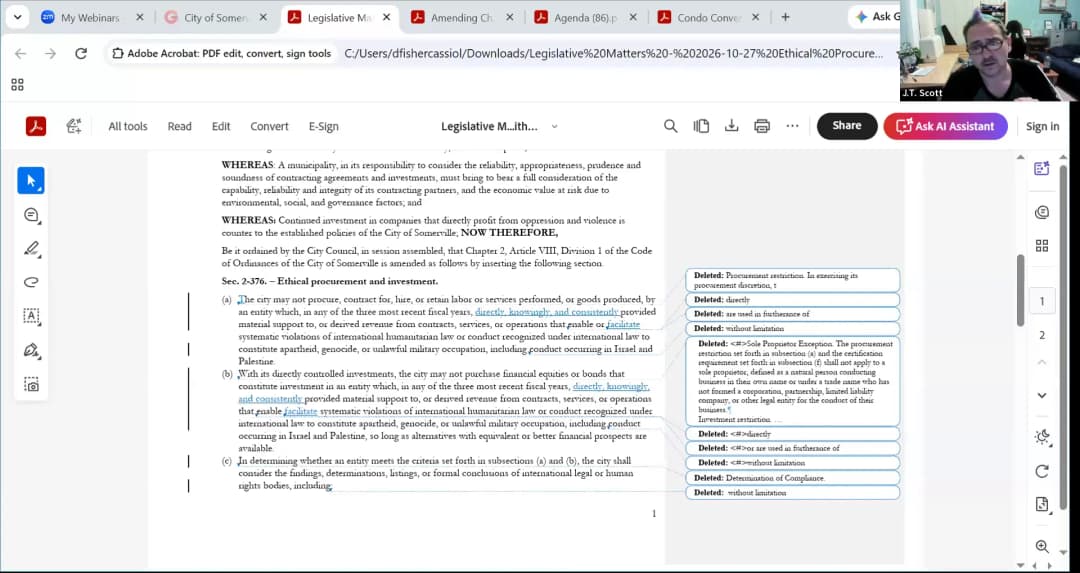
The Public Meeting IndexThe Somerville City Council Legislative Matters Committee met remotely on October 28, 2026. The raw transcript opens by saying 'Good evening. This is Tuesday, October 27th at 6 p.m.,' so the date discrepancy is noted; this summary uses the supplied date of 2026-10-28 12:45 UTC. Chair JT Scott (Ward 2) presided, a quorum was present, and the meeting adjourned at 8:41 p.m. No agenda or minutes were available, so this summary is based solely on the raw transcript. Several agenda items were taken out of order to accommodate city staff schedules. Consent Calendar - The committee approved the October 13, 2026 meeting minutes and voted to adjourn in a single roll call vote, 5-0. Discussion Items Short-Term Rental Ordinance (26-1501) - Councilor Ewan Campen introduced amendments, on behalf of Councilors Link, Hart, and Ewan Campen, to tighten proof-of-primary-residence requirements for short-term rental operators. Under the amendments, applicants would need an income tax return for the last tax year, a recent utility/cable/phone bill or motor vehicle registration, and annual recertification. - Director Ziegler said he was satisfied with the changes but requested that the added documentation also be reflected in the registration information section. Policy Analyst Salisbury said no additional update was needed because the definition is cross-referenced, though he anticipated removing it during a future substantive review. - Councilor Mbah expressed support, saying the amendment strikes the right balance between legitimate property owner interests and preserving housing for people who live in the city. - The committee voted unanimously to recommend approval. Condominium Conversion Ordinance (26-1551) - Councilor Davis explained the amendment, filed by Councilor McLaughlin, would close a loophole in condo conversion notice requirements. It would treat demolition with intent to convert as a conversion event requiring notice to the condo review board, including for unoccupied or owner-occupied housing accommodations. - Director Davidson said the Housing Division had only received the amendments on Monday, had not yet reviewed them, and had not spoken with Councilor McLaughlin. She asked for time to assess the additional burden on staff and applicants. - Councilor Davis flagged possible drafting ambiguities, and Policy Analyst Salisbury offered to help clean up the language. Chair Scott supported the policy intent but agreed to hold the item in committee. Ethical Procurement Ordinance (26-1023) - Councilor Ewan Campen presented substitute text from a handout. He described non-substantive style changes, removal of the sole-proprietor definition with the exemption moved to subsection D2, and the addition of 'directly, knowingly and consistently' to describe companies that provide material support to, or derive revenue from, contract services or operations that enable or facilitate systematic violations of international humanitarian law, apartheid, genocide, or unlawful military occupation, including in Israel and Palestine. - Councilor Davis questioned whether the certification language in subsection F matched the apparent intent to exclude companies on referenced lists. Councilor Ewan Campen said a company should assess subsection A and that appearing on one of the listed sources would guide the city's non-compliance determination; he was open to clarifying the certification language. - City Solicitor Amara and Attorney Peaks said nothing in the amendments changed their legal opinion that, if challenged, the ordinance 'will not survive.' They cited federal preemption, commerce clause, international affairs concerns, and unresolved state procurement issues. - Director Allen raised practical implementation concerns: the city would need to determine what lists to consult, who would make disqualification judgments, whether the city has authority to debar bidders, and how to avoid confusion and delay while still obtaining essential city services. She said she had not determined that she could fully comply with the ordinance. - Councilor Strezzo opposed the ordinance, calling it illegal, discriminatory, dangerous, and harmful to community members, including Jewish residents who say they feel targeted. Councilor Mbah supported it, calling it a modest ordinance responding to genocide in Palestine and the public mandate to act. Chair Scott said legal outcomes cannot be predicted and expressed support for moving the policy forward. - The substitute text was adopted 4-1, and the committee recommended approval 4-1, with Councilor Strezzo voting no. Pay-to-Play Ordinance (26-1408) - Assistant City Solicitor Peaks presented administration amendments and timelines involving two grantees that were ineligible under the current ordinance. The current ordinance limits contributions by persons seeking no-bid contracts or financial assistance, with a disqualifying period covering the calendar year of application and the preceding calendar year, plus a four-year post-award prohibition on contributions over $500 to any candidate. - Proposed changes would: exempt financial assistance recommended by multi-member bodies, such as Community Preservation Act grants; allow the city to request more information; align the 12-month disclosure period with the disqualification period; require disclosure of post-award contributions; and clarify that remedies apply to grants as well as contracts. - Councilor Ewan Campen asked whether the multi-member body exemption would remove grants from bodies such as the Community Preservation Commission, Affordable Housing Trust Fund, and Jobs Creation and Retention Trust Fund from pay-to-play screening. Attorney Peaks confirmed that it would. - The committee adopted an immediate amendment to section 15-73B, striking 'in their capacity' so contributions made while serving as an officer, director, or manager are attributed regardless of capacity. The vote was 4-0, with Councilor Ewan Campen recused. Councilor Ewan Campen later said he would follow up about whether recusal was required due to his volunteer service on the Somerville Community Land Trust; Councilor Mbah did not recuse because his multi-member body service is in his official city capacity. - Chair Scott expressed concern about the moral hazard of exempting grants recommended by mayor-appointed multi-member bodies and suggested considering the ordinance's curative refund provision in section 15-76 instead. Councilor Davis supported letting the proposal 'stew' and possibly considering a short look-back period. Policy Analyst Salisbury said the faster fix was intentional, with a larger substantive review expected later. - The item remained in committee without a recommendation. Private Significant Trees During Construction (26-146) - Chair Scott introduced the amendment filed by Councilor Saeed. It would require protection measures for significant trees on an abutting lot impacted by construction, addressing situations where excavation severs a large tree's roots and threatens its survival. - Director Najim Williams said city staff were not available that evening, but a conversation with ISD, engineering, and the law department was being scheduled. Councilor Davis suggested that the phrase 'impacted by construction' could be misread to exempt projects unless the abutting lot itself is affected, and he requested legal and property-law review. - The item was held in committee. Artificial Intelligence Ordinance (26-1557) - Councilor Mbah introduced the proposed AI ordinance on behalf of Councilors Link, Wheeler, and himself. He said it would establish responsible guardrails for city government use of AI, addressing bias, privacy violations, inaccurate information, and lack of transparency while keeping human judgment central for decisions affecting residents' rights, services, and opportunities. - Councilor Davis said he had done a first quick read, saw some potentially overbroad sections, and noted that the administration may also be developing an AI policy. He urged collaboration to avoid duplication or contradictions. Policy Analyst Salisbury said the submitted ordinance differed significantly from an earlier draft discussed with staff and offered to reconvene the staff working group. - The item was held in committee. Key Outcomes - Recommended approval: short-term rental ordinance amendments (unanimous) and ethical procurement ordinance (4-1). - Held in committee for further discussion: condominium conversion amendment, pay-to-play amendments, private tree protection amendment, and artificial intelligence ordinance. - Adopted the pay-to-play section 15-73B amendment, 4-0, with one recusal. - Approved minutes and adjourned by a 5-0 roll call vote at 8:41 p.m. The committee indicated it would return in approximately two weeks; the transcript references November 10.
This summary is based on the transcript of the October 28, 2026 meetings of the City of New Rochelle Corporation for Local Development (CLD), called to order at 7:43 PM, and the New Rochelle Industrial Development Agency (IDA), called to order at 7:53 PM in City Council chambers. No agenda or minutes were available. The boards approved 2027 budgets, the IDA revised its Uniform Tax Exemption Policy (UTEP), and both bodies set the next meeting for November 18, 2026. Consent Calendar - The CLD unanimously approved the minutes of its September 30, 2026 meeting. - The IDA unanimously approved the minutes of its September 30, 2026 meeting. Discussion Items - CLD 2027 budget: The resolution adopted and submitted the 2027 CLD budget, plus proposed budgets for 2028-2030, under Section 2800 of the New York Public Authorities Law. Through September 30, 2026, the CLD had received approximately $1.1 million in operating revenue; year-end projections were about $2 million in revenue and $932,000 in operating expenses. The proposed 2027 budget was about $2.6 million in operating revenue and $953,000 in operating expenses. Workforce development and job training remained the largest expenditure at $556,000. New obligations exceeding $20,000 will continue to require board approval. Staff noted that project closings drive revenue; an unprojected closing at 277 North Avenue generated a social equity fee used for workforce programs such as the First Source Referral Center and the Booker T. Washington program. The CLD approved the budget unanimously. - IDA 2027 budget: The IDA adopted its 2027 budget and submitted 2028-2030 projections under Section 2800. Through September 30, 2026, the IDA had received about $341,000 in revenue; year-end projections were approximately $672,000 in total revenue and $406,000 in expenditures, for a positive change in net position of about $266,000. The proposed 2027 budget was about $680,000 in revenue and $394,000 in expenditures. Staff answered questions about a projected $200,000 professional services contract that was invoiced but unpaid as of September 30, and explained that revenue shortfalls versus earlier projections were tied to project closings delayed into 2027. The IDA approved the budget unanimously. - UTEP revisions: Staff proposed changes focused on local workforce participation and compliance and updated PILOT schedules. The existing 15% social equity program requirement would remain, with new requirements that New Rochelle residents perform at least 7% of construction work hours, up from 5% presented in September, and 10% of work hours associated with ongoing project operations. Compliance would be strengthened through certified payroll reporting, an independent compliance monitor, quarterly compliance reports, and a pre-construction workforce roadmap; a waiver process and the existing $30-per-net-square-foot penalty would apply. PILOT schedule changes included a revised 20-year maximum benefit schedule and a new 25-year adverse financial circumstance schedule; Grow America's analysis indicated revenue neutrality was generally achieved by year three under both scenarios. - Board discussion on UTEP included support for a more competitive and predictable framework; one board member said 7% was still too low and raised concerns that waivers could be too easy to obtain. Staff described waivers as intentionally onerous and requiring board approval. Members discussed using real certified payroll data to recalibrate the local workforce target, the value of a roadmap, and the need to balance mandates with project feasibility. The board also discussed PLAs, with staff saying conversations with unions were continuing and a possible future PILOT incentive for Project Labor Agreements was not yet revenue-neutral. A board member requested more granular MWBE and entrepreneurship data; staff said such data is not currently collected. The UTEP revisions passed with one no vote and no abstentions. - 2 Sherwood Place inducement: The IDA considered an application from Coastal Capital, DJK Equity, and SK Development for 369 residential units, including 10% affordable units, and 381 parking spaces at 2 Sherwood Place. The applicant requested sales tax exemption, mortgage recording tax exemption, and a PILOT. David Manheimer of SK Development presented, emphasizing the project's gateway location, family-oriented unit mix, and the team's experience with local workforce reporting; he also suggested PILOT-related funds could support train station beautification. Board members asked about affordable unit count, union outreach, retail, parking, and unit mix. Staff noted the PILOT schedule in the packet was the developer's ask and would be peer-reviewed by Grow America. The board unanimously approved the inducement and set a public hearing for November 18, 2026. - 50 Lockwood LLC inducement: The IDA considered an application from PRC, People Restoring Communities, for 89 fully affordable senior rental apartments at 50 Lockwood Avenue, serving households at 30%, 50%, and 60% of area median income. Janet Giris and Vidy Advani presented. The project is a $60.5 million investment on the former Zion Baptist Church site, with a nine-story building, 30 parking spaces, 24 studio units, 64 one-bedroom units, and one superintendent's two-bedroom unit. It includes a roughly 2,200-square-foot community center and 3,000-square-foot civic plaza, is all-electric with solar, EV chargers, and a bioswale, and was expected to create about 150 construction jobs and eight permanent jobs. Staff described the project as the first approved under the 2026 downtown overlay zone amendments, with design and programming integrated with the future Link project. The applicant requested only a PILOT at 4% of shelter rent for a 30-year term consistent with bond financing, not mortgage recording or sales tax exemptions. The board approved the inducement with one abstention from a member who disclosed a client relationship with the applicant. Key Outcomes - CLD and IDA each approved their September 30, 2026 minutes unanimously. - CLD 2027 budget approved unanimously. - IDA 2027 budget approved unanimously. - UTEP revisions approved with one no vote and no abstentions. - 2 Sherwood Place inducement approved unanimously; public hearing set for November 18, 2026. - 50 Lockwood LLC inducement approved with one abstention; public hearing set for November 18, 2026. - The next meeting is scheduled for November 18, 2026 at 7:30 PM.
The Planning & Zoning Commission held a work study session on October 28, 2026, to discuss the Queen Creek General Plan update. Principal Planner Les Johnson and consultant Robbie Aaron of Michael Baker International presented community outreach findings and draft goals and policies. No formal action or votes were taken. The agenda listed the meeting at 4:00 PM at Community Chambers, 20727 E. Civic Parkway; the timestamp associated with the source was 12:15 UTC, and no minutes were available. General Plan Update – Community Outreach Findings - Les Johnson reported on ongoing outreach, including a project website, social media, two community workshops, citizen focus groups, public events, and presentations to town committees and commissions. - Staff-reported community feedback highlighted pride in Queen Creek's people, public events, parks and open space, trails, schools, gathering areas, and small-town feel. Residents reportedly want continued investment in gathering places, rural land uses, road safety and congestion relief, connectivity, parks and the trail loop, unique destinations, local and small businesses, public facilities, office development, and 'third place' gathering opportunities. - Commissioner Baldwin identified road work and traffic as the feedback that resonated most with her, noting road concerns affect residents daily and asking how the town communicates upcoming road projects. - Several commissioners praised schools, parks, trails, and the small-town feel. One commissioner asked for better trail signage and bike parking for e-bikes, especially near downtown. - Commissioner Borders suggested engagement tactics used by the school district, including weekly social-media quick facts and virtual town halls, and noted the General Plan website was not well known even among engaged residents. - A commissioner mentioned the farmers market as a valued small-business and community gathering draw and hoped it would continue near the heart of Queen Creek. - Commissioner Hale raised the perception that Queen Creek has water problems. Staff responded that the town has sufficient water to serve build-out and that the issue is resource stewardship and regional water management, not a shortage. - Commissioner Hale also asked whether rising water costs would affect park maintenance and the small-town feel; she noted water costs have essentially doubled. Staff said active-use fields will remain, but passive turf areas may shift to more water-conscious or drought-tolerant designs, and park acreage overall is not expected to change dramatically. - Staff noted the town's parks master plan update is upcoming, with large undeveloped park areas including roughly 40-50 acres north of the Olive Mill and about 30 acres across the street to the east. - Commissioners said transportation and traffic remain critical to sustaining growth and supported housing diversification for different income levels and life stages, while acknowledging community resistance to some housing change. General Plan Update – Draft Goals and Policies - Robbie Aaron presented draft goals and policies organized under four themes aligned with the Town Council strategic plan: Quality Lifestyle, Superior Infrastructure, Secure Future, and Safe Community Effective Government. - Quality Lifestyle goals address preserving community identity, balanced residential and non-residential growth, economic diversity, regional coordination with Gilbert/Mesa/Santan Valley, housing variety, growth areas, economic development, agritainment, trails, parks and open space, redevelopment, and neighborhood preservation. - A commissioner asked about cultural destinations such as arts, museums, and theaters. Aaron responded that public outreach, including the youth advisory council, expressed interest in museums and a large concert venue, and that partnerships such as library art exhibits could help. - Superior Infrastructure goals focus on a connected transportation system aligned with the adopted transportation master plan, alternative mobility options, the 11-mile loop trail, regional transportation partnerships, signal technology, comprehensive parks, and recreation facilities. Aaron noted transit is not currently a community priority but must be addressed per state law. - Secure Future goals address water portfolio and stewardship, conservation, reclaimed water, energy resources, efficiency, and resiliency. - Safe Community Effective Government goals cover infrastructure planning, development cost and fair share, police and fire services, municipal services, wastewater, and hazard mitigation. - Aaron explained the plan includes an implementation action matrix with short-, mid-, and long-range timeframes and an annual reporting process to track implementation. Next Steps - Staff said virtual engagement activities remain available on the General Plan webpage. - The next community workshop was announced for December 14, 2026. - The draft General Plan is expected to be completed in December 2026, followed by a 60-day review period. - Hearings before the Planning & Zoning Commission and Town Council are planned for spring 2027. - The commission was told comments on the draft goals and policies remain welcome until the plan advances to Council. Key Outcomes - No motions, votes, or formal decisions were made; the session was informational and advisory. - Commissioner feedback on outreach, transportation, housing, trails, parks, water perception, and small-town identity will inform continued General Plan drafting. - The work study session was adjourned after staff and consultant presentations and commission discussion.
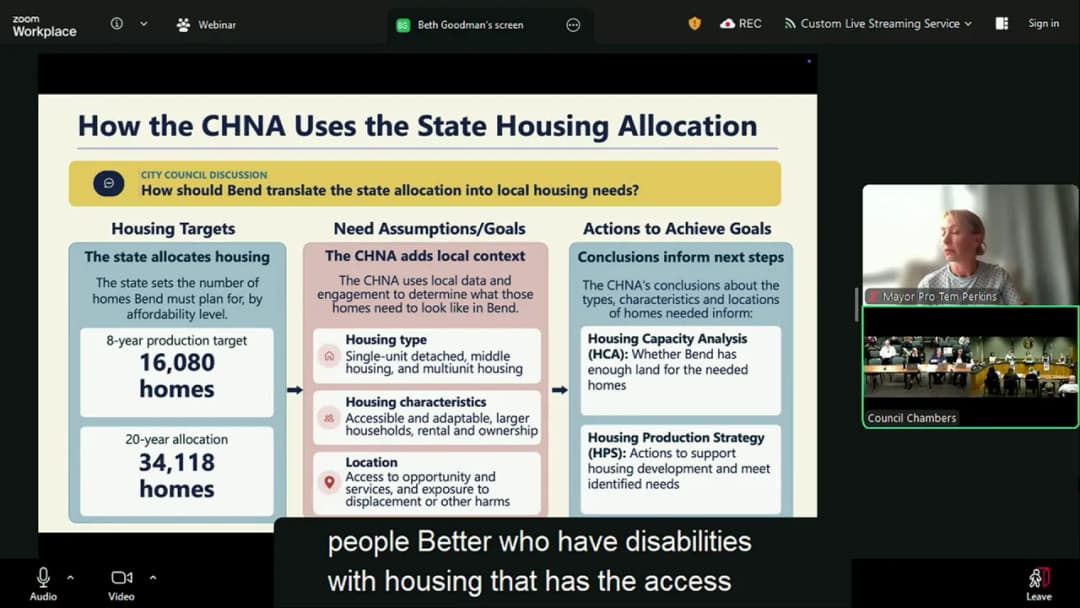
The Bend City Council held a Bend Made work session on October 28, 2026, to review the contextualized housing needs analysis and the economic opportunities analysis. Staff from growth management, economic development, housing, legal, and consulting presented data and safe-harbor options and asked the Council for planning direction. Councilor Mike Riley was excused. Public comment was not taken and no formal votes were cast; direction was given by consensus. The agenda listed the meeting as a 4:00 p.m. work session. Housing Needs: Process and Data - The work is part of the Bend Made growth management process. Staff recapped the timeline: September workshops launched visioning; large visioning workshops were moved to January through April and will occur about every two weeks; targeted engagement with service providers, affordable housing providers, residents, and high school students continues; joint committee working group appointments are expected in November; and the next Council touchpoint is January 20. - The September workshop summary was not posted in the packet; staff said it will be provided to the Council and reviewed on January 20. - The contextualized housing needs analysis will identify need by housing type, housing characteristics, and location, with emphasis on communities of color, low-income households, people with disabilities, and tribal communities. A community survey closed October 19; staff conducted about two dozen one-on-one conversations; tribes were notified. - Staff described the state housing allocation in three horizons: a 20-year allocation, an eight-year target of about 16,000 units, and a front-loaded one-year target of about 2,000 units. About 46% of the eight-year target is for households below 80% of area median income. - About 43% of Bend households have income above 120% of area median income. Staff said the analysis focuses on households below 120% of AMI and especially below 80% of AMI. - At 80% of AMI, a four-person household earns $96,000 and can afford about $2,400 per month in housing costs without being cost burdened. The typical home value of $738,000 becomes affordable around 85% of AMI; average two-bedroom rent is affordable just below 80% of AMI, while three-bedroom rent becomes affordable above 80% of AMI. - About 28% of Bend workers work from home, tending to be white-collar workers. Preliminary findings include housing costs outpacing local wages, a need for a broader mix of housing types and sizes, more middle housing, and fair housing issues such as discriminatory screening and weak enforcement. Housing Safe Harbors and Council Direction - Housing type: Staff recommended the state safe harbor of 40% multi-unit, 20% middle housing, and 40% single-unit detached, with the multi-unit and middle housing shares as floors. Councilors accepted the mix, while noting middle housing production would need to be roughly double recent trends and that some developers favor smaller detached units. Councilors agreed the how is a housing production strategy question, not a needs question. - Homeownership: The state safe harbor would apply a 66.7% ownership share and produce about 4,957 ownership units below 80% of AMI and about 5,700 above 80% of AMI. Existing ownership rates are about 46% below 80% of AMI and 69% above 80% of AMI. Staff recommended an alternative approach using AMI bands: substantial need from 60 to 120 percent of AMI, more limited need from 30 to 60 percent, and a below-30 percent band focused primarily on stable rental and supportive housing. Councilors supported the alternative, cited a Habitat for Humanity letter showing about 40 buyers under 60% of AMI over five years, emphasized homeownership as a path to generational wealth, and noted the subsidy trade-off: about $77,000 per ownership unit versus about $9,000 per rental unit. - Accessible housing: Staff recommended the safe harbor, which uses the ambulatory disability rate multiplied by 1.2 and translates to about 1,150 new accessible units over eight years, or about 145 per year compared with about 34 per year currently. Council agreed. - Adaptable housing: Staff recommended not using the safe harbor because it would require about 4,358 adaptable units. Instead, staff will use local data, count adaptable units already required in new multi-unit housing, and address retrofitting and aging in place. Council agreed. - Larger units: Staff recommended not using the safe harbor, which relies on family-household share and would classify about 61% of units as needing three or more bedrooms. Instead, staff will use household size, target about 16.9% of new rental units as three or more bedrooms, and plan for smaller ownership units and middle housing. Council agreed. Employment Needs Analysis and Growth Rate - The economic opportunities analysis is part of Goal 9 planning. Bend is a regional employment center with about 63,000 covered jobs in 2024; the six largest sectors account for about 70% of employment, with health care largest. The average wage is about $69,000, with health care, professional services, government, and construction above average and retail, accommodation, and food services below average. - From 2007 to 2024, Bend added nearly 18,000 jobs, about 2% annual growth. Health care accounted for about one-third of the growth. Jobs grew about 40% while population grew about 35%. - The EOA builds on Bend's target sectors: recreation and tourism, health systems, build for growth, and technology and innovation. - Staff presented three planning assumptions: the Oregon Employment Department regional rate of 0.68%, the Portland State University population forecast of 1.37%, and Bend's historical employment growth rate of 2%. The first two are state-recognized safe harbors; the 2% rate would require additional justification. Staff recommended the 1.37% PSU rate as a balanced, defensible assumption. - Council discussion noted Bend has roughly 50% of the county's population but about 65% of county jobs. Councilors supported the 1.37% middle path, noting it is a safe harbor and that the buildable lands inventory will help compare future employment land supply with projected needs. Staff also acknowledged that the prior UGB expansion oversupplied employment land and that some sites, such as Juniper Ridge, developed slowly due to infrastructure timing. Key Outcomes - Council directed staff to use the safe harbor for housing type and for accessible housing. - Council directed staff to develop alternative approaches for homeownership, adaptable housing, and larger units, with more detailed proposals to return on January 20. - Council indicated support for using the PSU 1.37% employment growth forecast as the planning assumption. - Next steps include finalizing joint committee appointments in November, holding visioning workshops from January through April, and returning to Council on January 20.
The Common Council of New Britain, Connecticut met on October 28, 2026, at 7:00 PM in the Council Chambers. The meeting included public participation, responses to petitions, and the adoption of six resolutions. Key actions included approving funds for a tennis court rehabilitation and a roof replacement, accepting donations for a city celebration, and referring petitions for financial disclosures. Consent Calendar - The consent agenda (covering a traffic study report, a handicap parking report, a report on amending the Standing Claims Subcommittee ordinance, and a claims settlement report) was approved 13-0. Public Comments & Testimony - Jessica Angelo Julian (167 Reservoir Road) urged the Council to fill the vacant CHRO (Commission on Human Rights and Opportunities) officer position. She argued the role is essential for ensuring the city's compliance with affirmative action and discrimination prevention requirements, and that leaving it vacant weakens the city's commitment to equal opportunity. - Paul Edwards (717 Shuttle Meadow Avenue) addressed the council's failure to fill a vacant ward seat, which he noted had been empty for nine months. He disputed claims that the city charter or lack of a suitable candidate was the issue, stating the previous appointee (Colin Osborne) had been voted on favorably (10-4) with a motion seconded by Alderperson Simpson, and challenged the council to either vote on the pending nominee or appoint someone else. Council Responses to Public Comment - Alderperson Dilernia agreed the CHRO position is critical. Alderperson Scott assured the public the administration is looking into it. - In response to Paul Edwards, Alderperson Simpson stated they did not vote for or approve the motion for Colin Osborne's appointment despite being listed as a signatory, and that video footage of the meeting clarifies their opposition to the motion. Discussion Items - Petitions: Two petitions were referred for review. The first requested a complete accounting of the city's relationship with Crumbie Law Group, LLC (referred to Corporate Counsel). The second requested a financial accounting of the One City Celebration (referred to the Finance Department). - Resolution 1: Standing Claims Subcommittee (Adopted): The Council adopted the amendment to Section 2-44 of the city code, as recommended by the committee report. - Resolution 2: One City Celebration Donations (Adopted): The Council accepted $37,750 in private donations. Council members praised the unity and success of the event, noting it placed no burden on taxpayers. - Resolution 3: Willow Brook Park Tennis Courts (Adopted): A $825,600 contract was awarded for rehabilitation using post-tension concrete (30-40 year lifespan). Ald. Dilernia inquired about the warranty (standard 1 year, contractor offers 20 years on concrete work). - Resolution 4: Equity in Heart Health Initiative (Adopted): A $3,000 grant from the American Heart Association for blood pressure cuffs and educational materials was accepted. - Resolution 5: Health Per Capita Grant (Adopted): $475,521.23 in state health funding was appropriated. - Resolution 6: Stanley Golf Course Roof (Adopted): A $171,492.60 contract for a complete roof replacement was awarded. Staff confirmed a 50-year warranty with ice and water shield will be provided, with work expected before winter. Key Outcomes - The consent agenda and all six resolutions were adopted unanimously. - Two petitions were formally referred for investigation. - A dispute over the record of a previous appointment vote occurred between a public speaker and Alderperson Simpson; no action was taken on the vacant ward seat itself. - The meeting was adjourned at 7:45 PM.
The Payson Common Council held its regular meeting on October 28, 2026, at 4:00 p.m. per the agenda, in the Town Hall Council Chambers, 303 N. Beeline Highway, Payson, Arizona. All seven council members were present. The council approved a consent agenda, heard a magistrate-court ordinance, received public testimony on a proposed manufactured-home rezoning, discussed emergency-clause policy, and held an executive session related to a Payson Golf Club agreement. Consent Calendar - The council approved the consent agenda 7-0, including: (B.1) minutes of the September 9 and October 14, 2026 regular meetings; and (B.2) the Fiscal Year 2026-2027 Pension Funding Policy decision request submitted by Finance Director Dave Christian. Public Comments & Testimony - During Call to the Public, Tom Dunning described himself as a 'perennial gadfly.' He praised town operations but urged the council to avoid ideological decisions that cost taxpayers, to keep residents informed, and to use merit-based hiring rather than a 'crony system.' - Gary Cordell appeared via Zoom and deferred his comments to agenda item F.1. - During the F.1 public hearing, Gary Cordell, a Wildwood subdivision homeowner and realtor, opposed the rezoning. He argued that changing established zoning would harm surrounding property values and buyer confidence, and suggested the applicant consider a Habitat for Humanity-style leased-land ownership model that could preserve existing zoning. - Also during the F.1 public hearing, Mark Wolski, a nearby homeowner, opposed the proposal. He cited concerns about independent traffic and property-value studies, the project being a 'glorified mobile home,' the applicant's lack of a current certificate of occupancy for earlier changes, a history of paying fines rather than completing promised fixes, and the applicant's framing that the project was 'better than the alternative.' Ceremonial and Current Events - The Town Manager reported that the town sold its bonds the prior week and would use the proceeds to pay off $20 million in outstanding Public Safety Personnel Retirement System (PSPRS) debt, with a plan to retire the debt within 10 years. - The Town Manager announced Tiffany Brown-Carcroft, code enforcement officer, as Employee of the Year. - Council members praised the Parks and Recreation Department for a successful Halloween event and setup. Hearings and Ordinances - F.2 — First public hearing, Ordinance No. 2026-110: Staff presented a proposal to amend Payson Town Code Title III, Chapter 34, Section 34.02(C) to allow appointment of the town magistrate for a term of up to four years instead of two, aligning with the four-year justice of the peace term. No action was taken; the second public hearing and the magistrate agreement were scheduled for November 10, 2026, with any new contract to begin January 1, 2027. No public comments were made on this item. - F.1 — Second public hearing, Ordinance No. 2026-109: The ordinance would rezone approximately 26.85 acres at 1504 W. Country Club Drive (Gila County Parcel No. 304-13-001F) from R-3 multi-family residential to Planned Area Development with a Manufactured Home overlay for a 125-lot detached single-family manufactured-home community. At the start of the item, council members requested to move it until after H.4 because the same applicant was involved in an existing development agreement; the mayor agreed to take it up after executive session. Following the F.1 public testimony, the council voted 6-1 to postpone the item to a later date. New Business and Discussion Items - H.1 — Waste Collection Agreement: Capital Improvements Director Kyle Christiansen presented the Group One waste collection and disposal contract for town facilities following an RFP. The staff recommendation was to award the contract to Waste Management of Northern Arizona/Arizona. A question from the audience clarified that the contract covers town-owned facilities and curbside pickup, not all trash service in Payson; multiple private haulers remain available to residents. The council voted 7-0 to award the contract in the amount of $63,827.30 per year. - H.2 — Professional Services Agreement with Collaborative Partnerships LLC: The council removed this item and postponed it to a future meeting with no action. - H.3 — Emergency Clause Policy Discussion: Council Members Jim Ferris and Charlie Bell requested that the council define an 'emergency' for purposes of the emergency clause, citing Arizona Constitution Article 4, Part 1, Sections 2 and 8, and Arizona Revised Statutes Title 19, Section 142. They argued that past emergency clauses were used for bonds rather than true emergencies, that residents' referendum rights should be protected, and that interest-rate changes should not be treated as an emergency. The Town Attorney advised that Payson, as a general-law town, follows state statute; that ARS 19-142 governs referendum signature calculations and emergency clauses; that invoking the emergency clause requires a supermajority vote of six of seven council members; that courts defer to elected officials' judgment; and that she was not aware of other towns adopting a separate definition. Several council members opposed changing the current approach, stating that the statute is sufficient, that prior bonds met the peace, health, and safety test, and that a locally written definition could create legal risk. One council member mentioned that Stifel had indicated using the emergency clause for the recent $20 million bond could have locked in a 5.44% interest rate sooner, rather than the higher rate ultimately received. No formal action was taken; the consensus direction was to leave the emergency-clause process under state statute. - H.4 — Payson Golf Club Escrow and Funding Agreement: The council voted to enter executive session with six votes in favor and one abstention under A.R.S. § 38-431.03(A)(3), (4), and (7) for legal advice and real-property negotiation discussions. Upon returning to open session, the council reported that no action was necessary on H.4. Key Outcomes - Consent agenda approved 7-0. - Waste collection contract awarded to Waste Management for $63,827.30 per year, 7-0. - Ordinance 2026-110 scheduled for a second public hearing on November 10, 2026. - Ordinance 2026-109 postponed to a later date by a 6-1 vote. - H.2 postponed to a future meeting without action. - H.3 resulted in no formal action; council consensus was against creating a new emergency definition. - H.4 produced no action; executive session completed. - The meeting adjourned after the F.1 postponement vote.
The Manitowoc Plan Commission met on Wednesday, October 28, 2026, at 6:00 PM in Council Chambers and via Zoom. The commission approved prior minutes, held a public hearing on a conditional use permit for outdoor storage, heard updates on the zoning and subdivision code rewrites, and approved two final plats. Approval of Minutes - Motion by Commissioner Dan, seconded by Commissioner Steinbrenner, approved the September 23, 2026 Plan Commission minutes as presented. Public Comments & Testimony - Pat Tice, a neighboring property owner across the street, telephoned opposition to the Brey CUP but did not attend; he said outdoor storage would not complement the neighborhood and noted the site's history of garbage issues. - Kirk Bry, applicant and owner of Brey Property Management/360 Storage, testified in support. He said he initially thought the parking lot could be used for neighbor storage, that most users live nearby, and he requested a larger mapped storage area and flexibility on screening. Public Hearing: PC 16-2026 - Brey Property Management, 601 Reed Avenue (Conditional Use Permit for Outside Storage) - Staff said the property was rezoned in 2025 from B-1 neighborhood business to B-3 general business for an interior climate-controlled storage use; outdoor storage in B-3 requires a conditional use permit. - In September 2026, the zoning administrator issued a violation letter for unauthorized outdoor storage, including trailers, boats, campers, snowmobiles, a trampoline, a vending machine, building materials, and debris. Most of the items were cleaned up after the letter. - The proposed CUP would allow only campers, RVs, boats, and trailers that are maintained, roadworthy, properly licensed/registered, and moveable; no abandoned or junk vehicles; no other outside items; and natural screening along property lines. - Staff counted about 100 parking-stall equivalents in the three mapped storage areas. The applicant said he would use far fewer, estimating about 14 spaces on the west side, 9 on the east side, and minimal use of the rear lot. - Staff noted that under 2017 state law, a city cannot simply deny a conditional use permit but can impose and enforce conditions. Staff recommended approval with the mapped areas and conditions, and did not support enlarging the area. - Commissioners discussed the large scale of the change from B-1 to outdoor storage and the future zoning code, under which the use would become legal non-conforming and could not be expanded. Item M was amended to require maintaining existing screening vegetation to the city planner's satisfaction, rather than all existing trees and shrubs. - The motion to approve the CUP as presented, with amended item M, carried. Recorded nays included Brock and Dan Horning. Old Business: PC 3-2024 - Chapter 15 Zoning Code Rewrite (Update) - Staff reported that the Committee of the Whole review raised no major concerns; the only item mentioned was a state statute provision on possible compensation for plan commissioners. - Next steps: Plan Commission formal recommendation on November 18, 2026; Common Council public hearing on December 21, 2026; adoption targeted for January 1, 2027. - The city attorney is drafting language on emergency warming shelters, warming shelters, and transitional housing, and the consultant's legal review is expected in early November. Commissioners requested final draft language early enough to review before the November meeting. New Business: PC 14-2026 - Chapter 21 Subdivision Code Rewrite (Update) - Staff described the rewrite as a reorganization and clarification of the existing subdivision code rather than a major substantive change. - It incorporates the new state statute prohibiting cities from tying subdivision plat approval to utility installation and moves technical specifications into the engineering design manual. The target adoption date is January 1, 2027. No action was taken. New Business: PC 8-2026 - TLG Holdings LLC, Final Plat for Deerbrook Crossing Subdivision No. 1 - Staff recommended approval for the 16-lot subdivision near Deerbrook Lane and Kellner Street. Prior street vacation and official map amendment were completed; state and county review were completed; fees were paid; only a drainage plan remained outstanding. - The commission unanimously approved the final plat. New Business: PC 16-2026 - Row, Row, Row LLC / Radue Homes Inc., Final Plat for The Row at Riverpoint Subdivision - Staff recommended approval for the 21-lot townhome subdivision at the 1100 and 1200 block of River Point Drive. Streets and utilities are installed, but the plat had not yet been sent to the state. - Because of substandard soils, the developer needs to install a substantial number of helical piers before frost and requested an early start permit. Since two lots already exist, early work on those lots could begin before final plat approval. - The commission approved the final plat. Motion by Commissioner Brock, seconded by Commissioner Bill. Miscellaneous - The agenda listed a certified survey map for Roger Holschbach in the NE 1/4 of the NE 1/4, Section 13, T18N, R23E, Town of Newton, and a site plan summary for SP 13-2026, 7 Brews, 4441 Calumet Avenue. No county activities were reported. No discussion was held on these items before adjournment. Key Outcomes - Approved the September 23, 2026 Plan Commission minutes. - Approved the Brey Property Management CUP with conditions and amended item M; Brock and Dan Horning voted no. - Approved the Deerbrook Crossing Subdivision No. 1 final plat unanimously. - Approved The Row at Riverpoint Subdivision final plat. - Received updates on the zoning and subdivision code rewrites; formal zoning recommendation is scheduled for November 18, 2026, council public hearing on December 21, 2026, with January 1, 2027 as the targeted adoption date. - The next Plan Commission meeting is November 18, 2026; the meeting then adjourned. Note: The printed agenda assigns the same case number, PC 16-2026, to both the Brey public hearing and The Row at Riverpoint final plat item; this summary uses the agenda headings as listed.
The Waukesha Plan Commission met at 6:00 PM on Wednesday, October 28, 2026, in Council Chambers at City Hall. Six members were present. The commission approved the prior meeting minutes and unanimously approved all three business items on the agenda: a land use plan amendment for 222 Maple Avenue, a rezoning petition for Elkhart Drive, and a minor site plan and architectural review with relief for Winterberry Reserve Phase 2. No in-person public comments were offered. Approval of Minutes - The commission voted 6-0 to approve the September 23, 2026 Plan Commission minutes. The agenda listed the minutes as an attachment, but the minutes themselves were not included in the source packet. Land Use Plan Amendment - 222 Maple Avenue - Staff (Doug Koeher) presented a request from Spoerl Commercial to change the land use designation for the 2.42-acre former Lindholm property at 222 Maple Avenue from Civic and Institutional (CIV) to Residential Flexible (RF). The property, formerly used by the Waukesha School District, was recently acquired by Carroll University, which determined it has no current use for the site. - The applicant's concept is a multifamily building with 53 apartment units. Staff recommended approval, noting that residential uses are compatible with surrounding neighborhoods and that the parcel's shape is not well suited to single-family lot division. - Developer Brian Spurl said the project is in the concept phase and that he has 30 years of development experience. Asked about preserving the facade of the existing Lindholm building, he said the building has been added onto over the years with different elevations and floor levels, making it difficult to feasibly save. - Commissioner discussion included questions about why Residential Flexible was chosen over mixed-use, the possibility of retaining the facade, and railroad noise. Commissioner Keller asked about train noise and the building's orientation along the tracks. Spurl estimated only one or two trains per day on this line and said he was open to suggestions. - Commissioner Molson voiced support for residential use and encouraged the developer to preserve facade elements to maintain neighborhood goodwill. - The commission voted 6-0 to approve the land use plan amendment as a recommendation to the Common Council, with a public hearing expected in early December. Rezoning Petition - Elkhart Drive - Staff (Megan Steiner Potier) presented a request from Horizon Development Group to rezone approximately 6.7 acres at the current terminus of Elkhart Drive, south of Les Paul Parkway and east of Genesee Road, from T-1 Temporary District to RN-4 Residential Neighborhood District 4. The property was formerly right-of-way and is now vacant land. - The proposed "Residences at Fox River" project includes six two-story multifamily buildings with 84 total units, 68 covered parking stalls, and 92 surface parking stalls, a ratio of 1.9 stalls per unit. - Commissioner Molson said he liked the project, though he noted the name "Residences at Fox River" is very similar to the nearby "Village at Fox River" development. - The commission voted 6-0 to approve the rezoning. Minor Site Plan and Architectural Review - Winterberry Reserve Phase 2 - Staff presented a relief request from the developer of Winterberry Reserve Phase 2, located north of Summit Avenue and east of Meadowbrook Road. The developer sought relief from zoning code Section 23.06(8), which prohibits ground-mounted transformers and similar utility equipment in required front yards or street side yards. - The request originally covered many transformer locations, but after coordination with We Energies and city staff, it was reduced to three transformers on the north side of Cranberry Circle, serving lots 54, 55, 56, 57, and 58. A new We Energies policy requires cables connecting transformers to be at least 10 feet from excavated foundations, making rear-yard placement difficult due to steep grading. - The developer agreed to a 19-foot front-yard setback for the three transformers, compared with the normally required 25 feet, and to provide landscape screening. - During discussion, Commissioner Frank Hoor asked about visibility from surrounding areas. Staff said the transformers would not be visible from the adjacent "Tall Grass" neighborhood or common open space and that the apartments to the north had provided a landscaping buffer. - The commission voted 6-0 to approve the minor site plan and architectural review with conditions, including the 19-foot setback and landscaping screening. The matter will be forwarded to the Common Council with an updated cover sheet. Public Comments and Testimony - No members of the public spoke during the public comment period or during individual agenda items. - For the Maple Avenue item, the mayor noted that emailed comments had been distributed to all commissioners, including requests to preserve the historic facade. Key Outcomes - Motion to approve the 222 Maple Avenue land use plan amendment passed 6-0; the recommendation will go to the Common Council, with a public hearing anticipated in early December. - Motion to approve the Elkhart Drive rezoning passed 6-0. - Motion to approve the Winterberry Reserve Phase 2 minor site plan and architectural review passed 6-0, with conditions. - The meeting adjourned without objection.
The Clarksville Board of Zoning Appeals met on October 28, 2026, at the Clarksville Administration Building. The board approved the prior meeting minutes, approved two variances, and tabled one old-business item and one new-business signage item. Consent Calendar - The board approved the minutes of the August 26, 2026 regular session by show of hands after a motion and second. Discussion Items V-26-0020 — Use Variance for a Car Wash at 950 E Lewis & Clark Parkway (Old Business) - This item was tabled; the board indicated it would likely return at a future meeting. V-26-0022 — Variance for Off-Site Signage in Town Right-of-Way for Origin Park - The applicant was not present. The board noted this is a joint park and town project for traffic signage directing people toward Origin Park. Although the agenda listed Melissa Holt as attending, no applicant appeared, and the board voted to table the item. V-26-0023 — Wall Sign Height Variance, 706 E Lewis & Clark Parkway - Applicant Jim Glass attended. Staff reported the property, zoned B2, is an approximately 11.6-acre site with multiple buildings; the existing trampoline park site is being sold and rebranded as Hype Kids Park. - The proposed signage would have a maximum letter height of five feet. Under the current sign ordinance, the maximum letter height is two feet, or three feet maximum element; with a waiver from the planning director, it could be four feet maximum letter and five feet logo/element. The proposed five-foot letter height exceeds the allowed height without a waiver by three feet and the allowed height with a waiver by one foot. - Staff stated the existing signage was approved under the pre-2019 sign ordinance, is larger than the proposed signage, and the new sign is about 550 feet from the road behind other outbuildings. Staff recommended approval with no conditions. - Jim Glass said the existing sign is 4 by 61, which is 244 square feet, while the proposed sign is 80 square feet; it would be halo lit/backlit and not obtrusive. He agreed with the staff report. - A motion to approve the waiver, concurring with the staff report, passed with all in favor. V-26-0024 — Corner Yard Fence Variance, 658 N Clark Boulevard - Applicant Aurora Alcala attended. The property is a 0.28-acre corner lot zoned West River Front District with a roughly 1,200-square-foot house. Because it is a corner lot, the town considers it to have two front yards. - The applicant requested a variance for a six-foot wood privacy fence in the required front yard to provide a safe area for children to play. Staff reported the fence would be about 30 feet from the intersection and should maintain the vision triangle, and the build line would be preserved along North Clark Boulevard. Staff recommended approval with one condition: a three-foot gate along Carter for access to the wastewater line. - Aurora Alcala stated placing the fence at the required setback would cut through an existing fireplace and a vineyard, place the fence about 30 feet inside the property line, reduce her usable backyard, and create safety concerns because people cut through the property. - A motion to approve under the recommended condition passed with all in favor. Key Outcomes - Approved the August 26, 2026 regular session minutes. - Approved V-26-0023 (wall sign height variance at 706 E Lewis & Clark Parkway). - Approved V-26-0024 (corner yard fence variance at 658 N Clark Boulevard) with the wastewater-access gate condition. - Tabled V-26-0020 (car wash use variance, old business) and V-26-0022 (Origin Park off-site signage variance). - The board noted the November and December meeting dates had been adjusted earlier in the year to avoid holiday conflicts; V-26-0020 and V-26-0022 were expected to return, and a garage/carport item might be added in December.