6011
SEP 14, 2026 · WESTCHESTER COUNTY, NEW YORK · BOARD OF LEGISLATORS & COMMITTEES
Emergency Meeting on 2026-09-14 10:30:00+00:00
This was a meeting held on 2026-09-14 10:30:00+00:00. The agenda was printed on that date. No minutes or transcript are available for this meeting.
The Evansville Police Merit Commission met in open session on Monday, September 14, 2026, at 4:23 p.m. in Room 307 of the Civic Center Complex, following a closed executive session. The Commission approved routine items, received updates on probationary officers and pending discipline, and certified the 2026 lieutenant promotional list. Guest Scott Altered was acknowledged. Executive Session - Before the open session, the Commission held an executive session closed under I.C. 5-14-1.5-6.1(b)(5) (interviews of prospective employees), I.C. 5-14-1.5-6.1(b)(6)(A) (information about alleged misconduct of an individual under the Commission’s jurisdiction), and I.C. 5-14-1.5-6.1(b)(9) (job performance evaluations of individual employees). No action was reported from the executive session. Consent Calendar - Minutes: The Commission approved the minutes of the August 24, 2026 meeting. (Agenda lists Johnson-Kincaid, Sutton, and Thompson as the minutes committee.) - Claims: The Commission approved claims totaling $599.10. Discussion Items - Probationary Officer Update: The Commission received an update on probationary officers in field training and at SWILEA. No action was taken. - Pending Discipline: The Commission was updated on pending discipline in case 26-PDO-11/26-PDO-11A: Officer Anthony Stephenson, Badge Number 1596, whose 21-day suspension was modified to termination. The appeal hearing is set for October 12, 2026. (The transcript refers to the officer as “Anthony Stevenson”; the agenda lists “Anthony Stephenson.”) - Promotional Process: A motion to certify the 2026 Lieutenant Promotional List, retroactively effective from September 11, 2026, through September 10, 2028, was seconded and passed unanimously. - Applicants: The agenda listed applicant 26-108 for consideration, but no related discussion or action appeared in the transcript. Key Outcomes - Approved the August 24, 2026 minutes. - Approved claims totaling $599.10. - Certified the 2026 Lieutenant Promotional List retroactive to September 11, 2026, through September 10, 2028. - Scheduled the next meeting for Monday, September 28, 2026, at 4:15 p.m. - Adjourned after a motion and second.
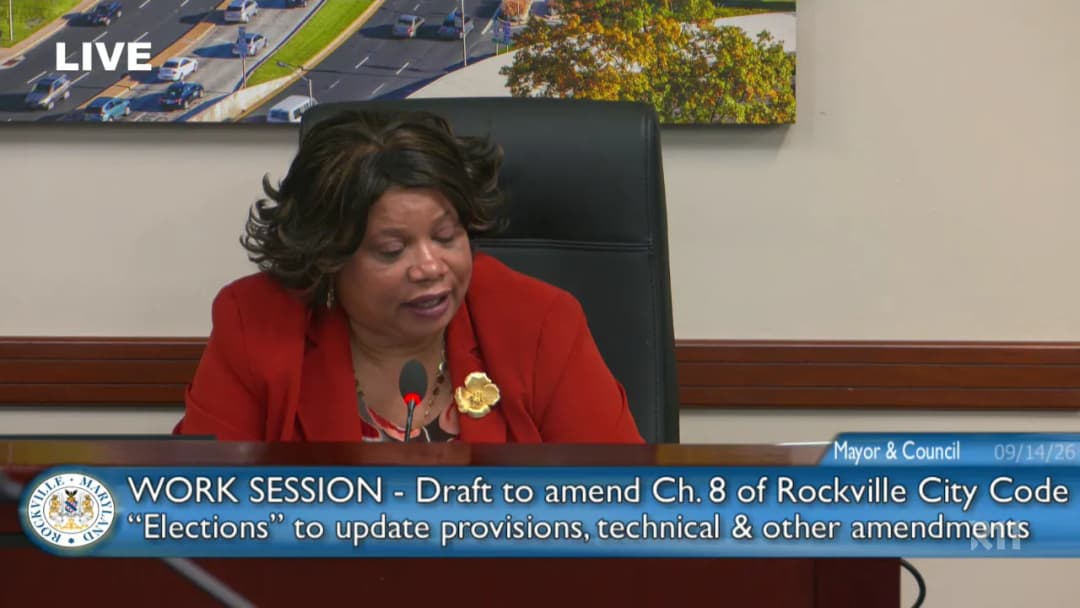
On September 14, 2026, the Rockville Mayor and Council convened at 5:30 PM for a hybrid meeting. The agenda included numerous proclamations and recognitions, a public hearing on a historic district zoning amendment, and worksessions on state legislative priorities and revisions to the city's election code. The meeting ran until approximately 11:15 PM. Proclamations and Recognitions - Certificate of Recognition: Presented to four lifeguards—Jack, Alex, Ava, and Katie—for aiding Judge Deborah Dwyer after a serious fall on July 29, 2026. - 2026 Rockville Recreation and Parks Foundation Community Achievement Awards: Recognized Lily Fisher (animal care volunteer, 230+ hours), Montcare Potomac (business partner supporting senior center events), and Capital Area Food Bank (provides fresh produce to 300+ people monthly). - Proclamations: Declared September 14-18 as Disability Voting Rights Week, September 15 as National Voter Registration Day, September 15-October 15 as National Hispanic Heritage Month, September 22 as Car Free Day, September 28-October 2 as Economic Development Week, September as National Preparedness Month, September as National Recovery Month, and September as National Service Dog Month. All proclamations were adopted unanimously. - Video Tribute and Moment of Silence: Honored former Councilmember Beryl L. Feinberg, who served from 2013 to 2023, and acknowledged other recent losses including Radufa Khalifi and Edward Duffy. Consent Calendar - Approved six items unanimously: A. Contract for David Scull Park Improvements (IFB 38-26) to County Contractors, LLC, 12-month term, not-to-exceed $1,116,847. B. Right of Entry Agreement with 1010 Aster Boulevard for Senior Center Entrance Project impacts. C. Federal-Aid Project Guidelines agreement with MDOT SHA for Twinbrook Bikeshare Project under the Carbon Reduction Program. D. Resolution supporting the Bird City Maryland Initiative and World Migratory Bird Day. E. Amendment I to MOU with Maryland State Highway Administration for stormwater project partnership. F. Approval of minutes for July 27, 2026 and August 3, 2026. Public Comments & Testimony - Mark Pushela (former councilmember): Urged expanding champion project concepts into full planned developments to encourage housing. - Samir Merchant (Rockville resident): Advocated for implementing ranked-choice voting (RCV) starting in 2027, citing benefits seen in Tacoma Park and Greenbelt. - Owen Anderson (Ranked Choice Voting Maryland): Recommended keeping RCV moving forward for 2031 elections; noted resident disappointment about 2027 timeline. - Jake Jacobeck (Bicycle Advisory Committee chair): Invited council to the Family Bike Festival on September 27. - Hanele Quigley: Invited the public to Rockville Cemetery's 300th anniversary celebration on September 20. - Libby Adams (former resident): Complained about mold and city inaction at Fields of Rockville apartments, stating the city ignored her complaints. City Manager Mihalek responded that the city is in compliance with state mold law and that the situation is a dispute between tenant and property owner. - Dave Hill (Rockville Sister Cities Corp.): Promoted the Bubble Tea Festival on September 14. - Paul Bowman: Supported RCV, arguing it gives more voice to underrepresented voters. - A resident raised trash issues near David Scull Park; council pledged follow-up. Special Presentation: Transportation and Mobility Commission Annual Report - Commissioner Mike Brooks and Chair Kathleen Kleiman presented the commission's work over the past year, including evaluation of a residential parking permit on Crab Avenue, analysis of state transportation bills, comments on the zoning ordinance update, and ongoing work on T-intersection crossings. Guiding principles emphasized safety, multimodal access, accessibility, and Vision Zero. The commission meets the fourth Tuesday of each month. Public Hearing: Sectional Map Amendment MAP 2026-127 (24 Martins Lane) - Proposal: Rezone 24 Martins Lane from R-60 to R-60(HD) to place the property in the Historic District Zone, following HDC and Planning Commission recommendations. - Public Testimony: - Jason Ekas (owner's representative): Opposed, arguing the structure is in severe disrepair and lacks integrity; the owner inherited the property through foreclosure and did not seek designation. - David Hill (private individual): Supported, stating the property is historically significant as part of the Hayti African American community and critical to neighborhood context. - Kevin Zeletsky (neighbor): Supported, emphasizing the site's importance to Rockville's black history and consistency with the comprehensive plan. - Nancy Picard (Peerless Rockville): Strongly supported, noting the property meets five of six designation criteria, including cultural significance. - LaShane Crutchfield (descendant): Supported for family heritage and community pride. - Others echoed support. - Council Discussion: Councilmembers acknowledged the historic and cultural significance. A supermajority vote was required due to owner opposition. After debate, Councilmember Shaw introduced the ordinance; Councilmember Fulton moved adoption. The ordinance passed 6-0 (with one member absent or not voting? The transcript says "All those in favor" and six raised hands; no nays heard.) Worksession: 2027 State Legislative Priorities and Legislative Bond Initiatives - Staff presented proposed priorities including modernizing municipal revenue, school impact fee consultation, flexibility in family/medical leave, tenant protections, property tax credit expansion, Vision Zero support, and climate action. Council directed staff to add a priority for enabling legislation to allow municipalities to negotiate MOUs with counties for a guaranteed share of school impact fees generated within city boundaries. - Bond Initiatives: Staff recommended three projects: Lone Oak Park Playground ($350,000), Matty Stepanic Park accessibility ($350,000), and City Hall accessibility/security ($550,000). Council supported submitting all three to District 17 delegation. Council asked for a complete list of eligible CIP projects for future consideration. - Next steps: Resolution on October 5; testimony to county delegation November 16. Worksession: Draft Amendments to Chapter 8 (Elections) - Staff, with input from the Board of Supervisors of Elections (BSE) and consultants, presented targeted amendments to the election code. Key discussion points and directions: - Definitions: Clarified candidate vs. official candidate; improved plain language; added $300 threshold for candidate status. Council requested consistency in dollar amounts and tightening of language on "nominal fee." - Powers of BSE: Clarified that BSE administers elections with support from city clerk and all departments; BSE does not regulate campaign signs, use of city facilities, or parades. Council suggested adding signs to the list of excluded authorities. Investigatory powers to be detailed in enforcement section. - Campaign Finance: Maintained $1,000 individual contribution limit but agreed to index it to CPI (adjusted to nearest $25) annually. Raised late filing penalties for the pre-election report to $200 per day (instead of $50). Removed requirement for a campaign chairperson for individual candidates; retained requirement for campaign committees to have both a treasurer and a chairperson. Treasurer must be a Montgomery County resident (may show state ID if not a voter). - Ranked-Choice Voting and Public Financing: Council directed staff to draft language to implement ranked-choice voting for 2031, not a non-binding referendum. Public financing to be studied further. Council agreed to codify intent to move to RCV in a future election cycle. - Charter Amendments: Council supported allowing 16- and 17-year-olds to vote in municipal elections and imposing a limit of four consecutive four-year terms for mayor and council. Staff will prepare charter amendment language for October 5 introduction. - Other: Random ballot order was discussed; council directed staff to research costs and data. Drop box locations were specified (City Hall, Montrose, Twinbrook). - Council agreed to add stronger enforcement provisions, including a formal notice of violation process and prohibition on threatening election officials (fine only, not jail time). Key Outcomes - Consent Calendar: All six items approved unanimously. - Public Hearing MAP 2026-127: Approved (6-0) to rezone 24 Martins Lane to R-60(HD), placing the property in the Historic District Zone. Owner consent was not required due to supermajority vote. - 2027 State Legislative Priorities: Direction given to include school impact fee legislation and to submit three bond initiatives. Resolution to be adopted October 5. - Election Code Amendments: Council provided extensive direction on definitions, campaign finance, enforcement, and future reforms. Staff will return October 5 with final ordinance and charter amendments. - Charter Amendments: Support confirmed for lowering voting age to 16/17 (requires charter change) and imposing four-term consecutive limit on mayor and council. - Future Work: Council directed staff to bring back data on ranked-choice voting costs and implementation timeline for 2031; also requested a work session on historical designation processes to avoid future conflicts.
The Johns Creek City Council met for a work session at 5:01 p.m. on September 14, 2026, at 11360 Lakefield Drive. The mayor reported no remarks, and no strategic priorities were presented. The council discussed the 2027 meeting calendar, the 2027 renewal of employee health and other benefits, landscaping at the Medlock Bridge pedestrian tunnel, and Town Center monument signage. A routine non-discussion item, the Service Delivery Strategy Resolution with SDS Form 4 Certification, was listed but not discussed. The meeting concluded with an executive session for land, legal, and personnel matters. Consent Calendar - 2027 Meeting Calendar: Council reached consensus on date changes and asked staff to bring the calendar back on the consent calendar. - Annual Renewal of Employee Health and Other Benefits: Council agreed to advance staff's renewal recommendation, including a $6.6 million not-to-exceed authorization, to the consent agenda. - Service Delivery Strategy Resolution and SDS Form 4 Certification were listed as routine non-discussion business and were not discussed. Discussion Items 2027 Meeting Calendar - Staff presented a draft based on the 2026 calendar: meetings every three weeks, shifting to every two weeks during budget season, with accommodations for holidays and school breaks. The June meeting was left open as either a regular meeting or a possible mini-retreat. - Council moved the February 1 meeting to February 8, adjusted March dates to March 1 and March 22, and agreed to decide the June format at the January retreat. Council also planned to discuss retreat details in January. Annual Renewal of Employee Health and Other Benefits - Director Papu presented the 2027 renewal recommendation of approximately $6.6 million, compared with the $7.5 million anticipated in the proposed FY27 budget. - Medical: Cigna came in at a 4 percent increase, far below the assumed 16 percent. Staff attributed the lower rate to wellness investments and preventive care and negotiated a 100 percent surplus return for 2027, up from 50 percent in the current plan year. - Dental: Cigna's renewal was 31 percent; Guardian offered a self-funded plan at 24 percent. Staff recommended switching to the Guardian self-funded dental plan for lower cost, more plan control, and as a low-risk step toward possible future self-funded medical coverage. - Vision: no cost increase. Basic life came in at 17 percent, short-term disability at 9 percent, and long-term disability had no increase. - The HRA introduced in 2026 is being used by employees, and its 2 percent renewal increase was due mainly to headcount. - Councilmembers praised the result, asked about maintaining the roughly 80/20 cost share, and discussed using surplus funds and the 100 percent surplus return as seed money toward a future self-funded medical plan. GLP-1 drug coverage was confirmed as already included through the plan's formulary rider, with the HRA helping with out-of-pocket costs. - No formal vote was taken; the item was directed to the consent agenda as a $6.6 million not-to-exceed item. Landscaping and Tree Replanting Policy Implementation - Pedestrian Tunnel - Director O'Connor reported that the council approved the roadway landscaping and tree replanting policy on August 24, 2026, and asked for direction on three potential additional landscape areas on the west side of the Medlock Bridge pedestrian tunnel. - Funding options included the previously authorized tunnel contingency or TSPLOST II revenues assigned to the landscape/streetscape bucket. Rough staff estimates for the enhanced planting were about $65,000 to $75,000, and about $400,000 remained in the tunnel contingency, though invoices were not final. - Several council members expressed support for more shade trees, including full-sized oaks in areas one and two, and some suggested crepe myrtles, boxwoods, or ornamental plantings in area three. Others said the tunnel area already looks good and wanted to preserve TSPLOST funds for other priorities such as the boardwalk and other projects. - Staff said they would synthesize the council's direction and, after final consensus, develop a layout and send the plan out for installation bids to complete planting in the fall. Monument Signage - Town Center - City Manager Grear continued the previous work session discussion on the first Town Center monument sign. Staff reviewed the Medley sign design: painted neutral brick base, painted aluminum dark teal elements, and white channel letters. - Council discussed the gray option C color versus blue, and three locations along Medlock Bridge: north of Johns Creek Parkway, near the pedestrian tunnel, and at East Johns Crossing. - Council reached consensus on the gray/option C sign and on placing it on Medlock Bridge at Johns Creek Parkway, with design work allowing appropriate setback and scale so it would not be lost in the terrain and would preserve future right-of-way options. Some members preferred a more prominent or larger sign, and staff agreed to prepare additional renderings. - A council member said they did not want more than one sign and wanted the funding to come from tourism product development dollars. - Staff also recapped earlier archway marker concepts at the pedestrian tunnel; road-spanning arches were previously eliminated because of high cost, and side markers were estimated at $400,000 to $500,000 each, with the topic available for future discussion. Key Outcomes - The 2027 meeting calendar dates were revised to February 8, March 1, and March 22; the June format was deferred to the January retreat. - The employee benefits renewal was directed to the consent agenda with a $6.6 million not-to-exceed authorization and guidance to keep employee cost share near 80/20 while building reserves toward self-funded options. - For pedestrian tunnel landscaping, no formal vote was taken; staff were expected to incorporate council comments, refine costs, and return for fall installation, with funds kept within allowed TSPLOST/tunnel sources. - For Town Center monument signage, consensus was for a gray option C sign on Medlock Bridge at Johns Creek Parkway, with additional renderings and right-of-way/setback considerations to follow. - After the work session, the council moved into executive session for land, legal, and personnel matters. Upon returning, the council reported handling four real estate items, one personnel item, and one legal item, then adjourned.
The Fort Lauderdale City Commission held its second public hearing on the fiscal year 2027 budget on Monday, September 14, 2026, at 5:01 PM in the Fort Lauderdale Police Department Community Room. Mayor Dean J. Trantalis presided, with Commissioners John C. Herbst, Steven Glassman, Pam Beasley-Pittman, Vice Mayor Ben Sorensen, Acting City Manager Christopher Cooper, City Attorney Shari L. McCartney, City Auditor Patrick Reilly, and City Clerk Solomon present. The commission considered 10 budget items, including the final five-year capital improvement plan, special district assessments and millage rates, the city's final millage rate, the $1,283,327,106 all-funds budget, and the personnel complement for the fiscal year beginning October 1, 2026 and ending September 30, 2027. Public Comments & Testimony - Capital Improvement Plan: A resident said they supported fixing drainage and flooding problems but objected to a 20% increase applied in one single year. They questioned why the increase was not phased and noted that substantial wastewater items had already been discussed with a rate increase. - Beach Business Improvement Special District: A resident said residents do not experience government decisions in separate budget categories and asked whether the city looks at the total tax picture. - Final millage rate: A speaker said the millage rate had not changed in 20 years, questioned why the city needed to absorb all of that revenue and spend it, and asked the commission to adopt the 3.9408 rollback rate instead of the proposed 4.1193 rate. - Final budget: Four public speakers were listed. One said the city's budget and decision making were not correctly anticipating Fort Lauderdale's needs over the next five to ten years, criticized the lack of focus on attracting jobs, and urged the city to work with the private sector as a partner rather than a counterparty. Another thanked the commission for consistent support of programs helping children be ready for kindergarten and stay healthy and safe. Another urged the commission to distinguish needs from wants, phase immediate obligations, separate core services from discretionary spending, and stop spending money the city does not have. Discussion Items - The acting city manager presented the final five-year Capital Improvement Plan for October 1, 2026 through September 30, 2031. - The acting city manager presented the Lauderdale Isles Water Management District non-ad valorem assessment and budget. At the district's June 15, 2026 meeting, the board voted to continue levying an assessment of $15 per parcel for fiscal year 2027, generating $8,265. Vice Mayor Sorensen thanked district board members and noted improving waterways. - A public hearing was held on the Beach Business Improvement Special District; the resolution text was not included in the supplied agenda excerpt. - The Sunrise Key Neighborhood Improvement District held its second required public hearing. The district taxes residents to provide neighborhood security; the proposed final millage rate was 1.0000 mills and the proposed final budget was $230,007 for fiscal year 2027. The commission took two votes, one on the millage rate and one on the budget. - In response to questions about the total tax burden, city staff said the city looks at the overall picture with the Budget Advisory Board and described the breakdown in the Neighbor's Guide to the Budget: school board 35%, Broward County 31%, City of Fort Lauderdale 24%, public hospitals 7%, Children's Services Council 2%, and all other items 1%. Staff noted that the Budget Advisory Board's recommendation reflected a year of meetings with departments, and that one board member's approach was a minority position rather than consensus. - Discussion of fire and emergency medical services included the daytime population being larger than the city's resident population of about 200,000, different service demands and fees for commercial versus residential structures under Florida law, and the relationship between staffing levels and survivability. An official noted that equipment was purchased with a grant, blood was provided through an agreement with Broward Health, and the program had full cost recovery. A commissioner rejected the idea that supporting a fiscally prudent and responsible government means not supporting public safety personnel. - The final all-funds budget of $1,283,327,106 was presented, along with the final personnel complement for fiscal year 2027. The mayor encouraged adoption, saying the city must be maintained, the community protected, and the commission must provide for both. Key Outcomes - The commission adopted the final five-year Capital Improvement Plan for FY 2026-2031. - The commission approved the Lauderdale Isles Water Management District assessment and budget at $15 per parcel, with projected revenue of $8,265 for FY 2027. - The commission approved the Sunrise Key Neighborhood Improvement District final millage rate of 1.0000 mills and the final district budget of $230,007, in two separate votes. - The commission approved the city's FY 2027 final budget, including the $1,283,327,106 all-funds budget and the personnel complement, for the period beginning October 1, 2026 and ending September 30, 2027. - The supplied minutes record a 5-0 yea vote for one budget action and a four-member yea vote (Commissioners Glassman, Beasley-Pittman, Sorensen, and Mayor Trantalis) for another; Commissioner Herbst's vote is not shown in the provided minutes excerpt. The final budget item was declared approved, and no further business was brought before the commission.
The Joplin Planning and Zoning Commission met on September 14, 2026, at 10:00:00 UTC per the meeting record. The chair opened the public hearing by reading the hearing procedures, which included accepting into evidence the city's 2012 Comprehensive Plan, the Joplin Development Code (Appendix 29A of the Municipal Code), related design guides and regulations, staff recommendations, and all other written evidence. The commission voted unanimously to approve two rezoning requests for new single-family homes. Both approved cases are scheduled to be presented to the Joplin City Council on Monday, October 5, 2026. Consent Calendar - Motion to excuse Ms. Clue Michael (absent): made by Mr. Spruce, seconded by Mrs. Harrison. All in favor; motion carried. - Motion to approve the minutes from the previous meeting: made by Mrs. Harrison, seconded by Mr. Spruce. All in favor; motion carried. Public Comments & Testimony - Case 029-26: The applicant, identified as "Bow and Grinnegar" of 906 Grand Avenue, spoke in favor of the rezoning. They stated the rezoning application came after they had already applied to build a new single-family home without knowing the property's zoning district. - Case 030-26: Oscar Sarseno of Shuber Mitchell, 2030 Mia Faith Place, Joplin, spoke in favor of the application, describing the proposed 1,050-square-foot home as great for a first-time buyer or an empty nester. - No members of the audience testified in favor of or against either case. Discussion Items - Case 029-26: City staff presenter Tyler said the block has a mixed character, with single-family homes to the north and south and R3 zoning on the west half of the block. Staff recommended R3 because it is the infill zoning district for 50-foot lots, permits single-family use by right, and keeps the new home compatible with the neighborhood; the same use would also be allowed under R1. When a commissioner asked about the two neighboring C1 lots, staff explained the block had previously been rezoned for commercial development that never materialized; those existing homes are legally non-conforming and would need to be rezoned only if demolished and rebuilt. - Case 030-26: Staff explained the property is a 50-foot-wide corner lot on a block where all other lots are zoned R2. Although the future land use plan anticipated commercial uses along Broadway, that redevelopment never occurred on some blocks, and the small lot size severely limits commercial development. Staff therefore recommended R2 to be consistent with the rest of the block. Sarseno confirmed the applicant intends to build a single-family home on the lot. Key Outcomes - Case 029-26: Approved unanimously. Motion by Mr. Spruce, seconded by Mr. Skinsel (also recorded as "Skinzel" in the transcript). All in favor; motion carried. - Case 030-26: Approved unanimously. Motion by Ms. Harrison, seconded by Mr. Skinsel. All in favor; motion carried. - Adjournment: Motion made by Mr. Spruce, seconded by Mrs. Harrison. All in favor; motion carried. Note: No agenda or minutes were available in the source material, so this summary is based solely on the meeting transcript. The transcript includes minor audio-quality issues and inconsistent spellings of some commissioner names (e.g., Skinsel/Skinzel, Harrison/Harrington).
The City of Miramar City Commission held its first public hearing on September 14, 2026, to consider the proposed FY 2027 operating millage rate, the tentative FY 2027 operating and capital budget, the fire protection assessment update, and the stormwater management assessment. Staff presented the budget, a five-year financial forecast, and the impact of a proposed property tax amendment. The commission tentatively adopted the millage rate by a 4-1 vote and approved the budget, fire assessment, and stormwater assessment unanimously. A second and final public hearing is scheduled for Monday, September 28, 2026, at 5:01 p.m. Budget and Millage Presentation - The proposed operating millage rate is 7.1172 mills, or $7.11 per $1,000 of taxable assessed property value. The mayor read the required announcement stating that this rate is 5.18% above the rollback rate of 6.7664 mills. - City Manager Dr. Virgin stated there is no proposal to increase the millage rate from the current rate. - Budget staff member Rafael San Miguel presented the FY 2027 tentative budget. Total proposed spending for all funds is $442 million. The general fund accounts for 57% of the total, or $252.9 million; enterprise funds, including utilities and stormwater, account for 23%, or $101 million; internal service funds account for 13%, or $58.2 million; debt service funds account for 2%, or $11 million; capital projects and special revenue funds total $15.6 million, or 3% and 1% respectively; and subfunds total $3.4 million, or less than 1%. - Total proposed spending reflects a net decrease of $15.7 million compared to the FY 2026 adopted budget. Changes by fund type include a general fund increase of $11.2 million, an enterprise fund decrease of $26.2 million, an internal service fund increase of $4.6 million, a capital projects fund decrease of $5.4 million, a debt service fund decrease of $0.5 million, and an increase of just over $0.5 million in special revenue funds and subfunds. - General fund expenditures increase by 4.6%, or $11.2 million. Personal services increase by 5.7%, or $9 million, mainly due to collective bargaining increases, pensions, and the addition of 12 firefighters to fully staff the fourth firefighter shift under the IAFF contract. Operating expenses decrease by less than 1%, or $200,000. Capital outlay decreases by 51%, or $3.5 million, primarily due to reduced vehicle replacement funding. Transfers increase by 19%, or $2.4 million, and grants, debt, and other items, including OPEB and appropriated fund balance, increase by $3 million. - Salaries and benefits are just under 70% of general fund expenditures, or $174.9 million. Public safety is the largest general fund category at 50%, or $126.5 million. - General fund revenue sources include ad valorem taxes at 46%, or $117 million; permit fees and special assessments at 21%, or $53 million; charges for services at 11%, or $26.5 million; other taxes at 10%, or $26.4 million; intergovernmental revenues at 8%, or $19.9 million; and other revenues at 4%, or $10.3 million. - The average homesteaded single-family home taxable value increased from $272,000 to $280,000, an increase of just over $8,000, due to the 2.7% Save Our Homes cap. That home would see a city tax increase of $57.23 for the year. Combined with the fire assessment increase, the average homesteaded home would see an overall increase of $152.24 per year, or $12.69 per month. - A typical commercial space of just under 17,000 square feet would see its city tax increase by $326 for the year and its average fire fee increase by $4,200, for a total average increase of about $4,500 for the year. - The proposed fire protection assessment for residential properties is $574.22 per dwelling unit. This is an increase of about $95, or roughly 20%, and would generate about $32.4 million in revenue, an increase of $6.2 million. The current residential rate is $479 per dwelling unit, which represented about 80% of cost recovery. - Staff noted that Miramar is roughly 35% of the total ad valorem bill for the average homesteaded property. The remaining 65% consists of the Broward County School Board at 32%, Broward County at 28%, and other taxing authorities at 5%. - Staff highlighted exemptions available through the Broward County Property Appraiser, including low-income senior, long-term residency senior, widow/widower, disability/blindness, deployed military, veterans disability, first responder disability, and others. Residents with certain exemptions may be automatically exempt from the fire fee. The application deadline is September 18, 2026. - The city's hardship assistance program for fire assessments is available to properties with an assessed value of $300,000 or less, which was increased by $50,000 from the prior year. Applicants must meet income qualifications and the property must not be rented. Residents aged 65 or older who receive the Broward County senior exemption are automatically enrolled. - Peter Napoli of Stantec Consulting Services presented the five-year general fund sustainability analysis and fire assessment study. The analysis maintains the proposed millage rate of 7.1172 mills across all five projected years, includes no additional personnel beyond FY 2027 operating levels, and assumes the fire assessment increase is adopted. - Without the fire assessment increase, Stantec projected the city's general fund balance would fall below its minimum reserve policy by FY 2028. With the proposed property tax amendment impacts included, the fund balance is projected to be depleted by FY 2029. - Stantec presented illustrative scenarios to close the projected gap. Reducing personnel alone would require about 115 employees in FY 2028 and another 115 in FY 2029, a total reduction of about 230 employees, or 30% of the city's workforce. Increasing the millage alone would require about a 1.1 mill increase in 2028 and another 1.1 mill increase in 2029, bringing the total millage rate to about 9.3 mills, or 93% of the statutory maximum. A 50-50 approach would require a 0.5 mill increase in each year and reductions of about 60 employees in each year, or about 15% of the workforce. - Staff explained that if the proposed homestead exemption amendment is approved, the homestead exemption would increase from $50,000 to $150,000 on January 1, 2027, and the assessment growth cap would drop from 10% to 5%. This would have an estimated first-year impact of $19.1 million on the city's FY 2028 budget. The exemption would increase to $250,000 on January 1, 2028, with a total cumulative recurring impact of about $32.5 million by FY 2029. Over the first five years, the estimated loss to the city is approximately $150 million. - There are currently about 27,089 homesteaded residential units in the city. Of those, 299 currently pay no city ad valorem taxes. If the amendment passes, staff estimated 10,876 units, or 40% of all homestead properties, would pay no city ad valorem taxes. The median city taxable value would drop from $240,000 to $40,000, and the median homestead property bill would drop from $1,708 per year to $285 per year. Public Comments & Testimony - Celestine Fountain, 9750 Atlantic Drive, asked why her taxes are going up when her home value went down, and whether the additional fire personnel would improve response times. Staff explained that taxes are based on taxable value, not market value, that the assessed value is capped by Save Our Homes, and that the city is only one of multiple taxing authorities on the property bill. Fire Rescue Chief Jermaine McFarland said the SAFER grant provided 19 firefighters and expired in February, that average response time is about six minutes, and that the negotiated fourth shift supports improved service and recruitment. - Marie Joan Result, 6816 Southwest 37th Street, questioned why the fire assessment increase is so much larger than other increases and asked how the additional firefighter shift was justified. Stantec explained that the fire assessment had not been increased since 2023, that the current rate reflected 80% cost recovery, and that the fee is based on updated fire service costs. The fire chief said the fourth shift aligns with a statewide trend toward a 42-hour work week for firefighters. - Felix A. Pegueiro, 1402 Southwest 32nd Street in Catalina Bay, congratulated the city for its $40 million reserve but expressed concern that the city would be broke by 2029 if the proposed property tax amendment passes. He suggested the city may need to increase the millage rate toward the 10-mill cap or find other revenue tools. - Denise Mack and James Evans asked for a plain-language explanation, said their proposed bill appears to increase by roughly $1,000, and expressed fear of losing their home due to rising taxes, HOA fees, and possible special assessments. They asked when the final vote would occur and said they support public safety. - Felicia Gobaria asked why taxes are not going down despite development, why her second home tax bill rose from about $5,000 to $13,000, and whether budget cuts could give homeowners relief. Staff explained that portability, non-homestead status, and state statute determine assessed value, and that utility rate increases are separate from the property tax-funded general fund. - Sheena Flick asked for staff assistance in reviewing her comparison/sales grid to identify where she might get relief. Staff agreed to have a budget team member meet with her. - Several residents expressed appreciation for the city but said it is becoming unaffordable. The mayor encouraged residents to also attend Broward County and School Board budget hearings because Miramar controls only one of the 12 millage items on the property tax bill. Commission Discussion - Vice Mayor Edwards said Miramar receives only 35 cents of every property tax dollar paid by residents and that cutting the city's share alone would not produce major savings. He thanked residents for participating. - Commissioner Colburn asked for clarification of the 30% workforce reduction scenario. Staff confirmed that, in that illustrative scenario, reducing 30% of FTEs would likely reduce service levels across the city. - Commissioner Chambers said he was disappointed that he could not offer tax relief. He stated that the collective bargaining agreement and the fourth firefighter shift were missed opportunities to reduce costs, and he suggested earlier resident workshops in future budget cycles. - Commissioner Sherizard voted against the proposed millage rate and expressed strong concern that current residents are being asked to pay for the cost of growth. She said she wished the budget could roll back to the rollback rate or provide at least a symbolic decrease, and warned that failing to provide incremental relief can lead to drastic ballot measures. - The mayor said department heads had to defend their budgets and that the exercise produced about a 5% reduction across departments. He said the proposed 5.18% increase over the rollback rate partly reflects inflation and collective bargaining costs, and he emphasized the difficulty of balancing service levels, affordability, and the pending constitutional amendment. Key Outcomes - Item 1, Ordinance 1871, establishing the proposed FY 2027 operating millage rate at 7.1172 mills, was approved on first reading by a vote of 4-1. Commissioner Chambers voted yes, Commissioner Sherizard voted no, Commissioner Colburn voted yes, Vice Mayor Edwards voted yes, and Mayor Massum voted yes. - Item 2, Ordinance 1872, adopting the tentative FY 2027 operating and capital improvement budget, was approved unanimously. - Item 3, Resolution 8766, reimposing and updating the fire protection assessment, including the proposed residential rate of $574.22 per dwelling unit, was approved unanimously. - Item 4, the resolution reimposing the stormwater management service assessment at $135 per equivalent residential unit, or ERU, was approved unanimously. One ERU is equivalent to 3,619 square feet, each residential home is assessed one ERU, there are 60,795 ERUs citywide, and the projected revenue of approximately $7 million will fund stormwater operations, capital improvement projects, debt service, and equipment purchases. - The second and final public hearing to adopt the final millage rate and FY 2027 budget will be held Monday, September 28, 2026, at 5:01 p.m.
The Land Use and Transportation Committee of the San Francisco Board of Supervisors met on Monday, September 14, 2026, beginning at 9:45 AM, with Chair Melgar presiding. The clerk announced that public comment would be taken on each agenda item and that written comments could be submitted to the clerk's office. The committee considered three items: signage allowances in mixed-use districts, commercial-to-residential adaptive reuse code amendments, and the Transbay Under Ramp Park project involving the Oscar Alley street vacation and conveyance. Items acted upon during the meeting are expected to appear on the Board of Supervisors Agenda of September 22, 2026, unless otherwise stated. Public Comments & Testimony - No members of the public offered comment on Item 1 (Signs in Mixed Use Districts) or Item 3 (Transbay Under Ramp Park). - Mark Babson, representing Emerald Fund, San Francisco Housing Developers, expressed support for the adaptive reuse legislation (Item 2). He stated that Emerald Fund converted 100 Van Ness Avenue into 418 apartments in 2015 and has worked with the planning department and other city departments to create incentives to bring projects into financial feasibility. He noted the planning department had been forward-looking but additional adjustments were needed, and he supported the modifications to the legislation. Discussion Items Item 1 (File 260679): Planning Code - Signs in Mixed Use Districts Supervisor Dorsey (District 6) presented the ordinance amending the Planning Code to increase the allowable number and size of signs in mixed-use districts on lots over one half acre and in the mixed-use office district south of Townsend Street, affirming the Planning Department's CEQA determination and making required findings. Dorsey expressed support for the legislation, stating that Mission Bay is leading San Francisco's economic recovery and that good signage is part of what makes a commercial area work, particularly in mixed-use areas still working to attract tenants and visitors in the post-pandemic recovery. He acknowledged the committee was taking a narrow approach and noted the city will adapt the code's existing assumptions around signage as new residential districts are created. Planning staff presented the item. The Planning Commission heard the item on July 30, 2026 and unanimously adopted a recommendation of approval. The committee voted by roll call to send the item to the full Board of Supervisors with a positive recommendation. Item 2 (File 260771): Planning Code - Commercial to Residential Adaptive Reuse Supervisor Dorsey presented the ordinance, which builds on prior board actions to facilitate converting underutilized office and commercial space into housing. Dorsey stated that existing code obligations may be incompatible with the physical layout of buildings being converted, and satisfying them can be the difference between a project penciling out and a project never happening. He noted that several new adaptive reuse applications have been submitted and that his office supported the staff recommendations, which were incorporated into version two of the legislation before the committee. The recommended modifications included: waiving the bike parking requirement only where a project does not provide accessory off-street automobile parking; waiving the street frontage requirement for any project providing ground floor accessory off-street parking; and providing that off-street parking and loading requirements in Section 155S shall not apply to any existing off-street parking and loading retained to serve the new residential uses as long as the parking is located within or... (the remainder of the sentence and one additional modification were not captured in the transcript). Staff referenced included Jake Jacob Bentleff of the Office of Economic and Workforce Development and Lily Langwa of the Planning Department. The committee voted to send the item to the full Board of Supervisors with a positive recommendation. Item 3 (File 260873): Transbay Under Ramp Park Project - Oscar Alley Street Vacation and Conveyance Supervisor Dorsey presented the ordinance on behalf of Public Works, the Office of Community Investment and Infrastructure (OCII), and the Transbay Joint Powers Authority (TJPA) to facilitate construction of the Under Ramp Park (East Cut Sports and Dog Park), an approximately two-and-a-half-acre public open space planned beneath and around the elevated bus ramp connecting the Salesforce Transit Center to I-80, spanning the blocks between the Transit Center and Folsom Street. The park is a long-planned public amenity identified in multiple city-approved frameworks and essential to the neighborhood's open space network. Planned amenities include multi-sport courts for pickleball, basketball, and soccer; a roughly 20,000-square-foot dog park; a pavilion and amphitheater with retail space; a lawn; and an outdoor fitness area. The ordinance requests: vacation and conveyance of Oscar Alley, a small paper street above the Transbay bus off-ramp, to the TJPA for a nominal fee, with the area found not necessary for city use, containing no utilities, and exempt surplus property under the California Surplus Lands Act; waiver of the Administrative Code Chapter 23 appraisal requirement; sidewalk width changes on Folsom Street between Essex and Second Streets and on Clementina Street between First and Second Streets, including narrowing the sidewalk to create an ADA-accessible passenger loading zone with curb ramps and cutting back the Folsom Street sidewalk to create a 'jog handle' so eastbound bicyclists can turn north into the park when the traffic signal changes; acceptance of a public sidewalk easement from the TJPA; and acceptance of traffic signal infrastructure. Dorsey noted that the board previously vacated the airspace rights over Oscar Alley for the ramp's construction several years ago, and that continued discussions and negotiations with the TJPA since introduction prompted additional amendments circulated in revised legislation, but the overall concept remained unchanged. A motion was made to amend the legislation as described in the revised legislation and continue the item to the September 21, 2026 committee meeting. Key Outcomes - Item 1 (Signs in Mixed Use Districts): Forwarded to the full Board of Supervisors with a positive recommendation following a roll call vote. - Item 2 (Commercial to Residential Adaptive Reuse): Forwarded to the full Board of Supervisors with a positive recommendation. - Item 3 (Transbay Under Ramp Park): Amended as described in the revised legislation and continued to the September 21, 2026 Land Use and Transportation Committee meeting. - Items acted upon are expected to appear on the Board of Supervisors Agenda of September 22, 2026, unless otherwise stated. Note: The agenda also listed numerous items under 'Legislation Under the 30-Day Rule,' including landmark designation ordinances for properties such as the Transamerica Pyramid, Presidio Theatre, Vesuvio Cafe, Finocchio's, and the First AME Zion Church, as well as an item on noncomplying unpermitted residential yard structures. These items were not addressed in the portion of the meeting captured by the available transcript.
The Hooksett Conservation Commission met on September 14, 2026, to discuss a variety of topics including a memorial bench donation at Heads Pond, trail safety concerns on the Access for All trail, invasive species management, a stewardship plan for Clay Pond, beaver activity, deck repairs on the Riverwalk Trail, and the proposed Quimby Mountain parking lot. The meeting included public comments, votes on invoices, and motions for future actions. Consent Calendar - Minutes Approval: The minutes from the August 10, 2026 meeting were approved as amended (corrections to member designations and addition of a property identifier on line 70). - Sign Invoice: A $53.97 invoice for signs placed on the Heads Pond trail (to ask people to stay off new grass) was approved (one abstention). Public Comments & Testimony - Mark Gregoire (Manchester resident, teacher in Hooksett): Proposed a memorial bench at Heads Pond for his friend's 13-year-old son who passed away from cancer. The bench would be made of natural stone boulders (not finished granite), about 6–8 feet long, with a small brass plaque. Gregoire offered to provide labor and machinery. He stated the bench would be low-maintenance and blend with the environment. He requested approval to install it in a clearing about half a mile in, off the trail. Discussion Items - Memorial Bench at Heads Pond: Commissioners debated whether to standardize bench designs. Joe Carroll expressed concern about opening a "Pandora's box" of varied DIY benches. Others noted the stone bench would not rot and would simply look like a pile of rocks if it fell apart. A motion was made to approve the bench provided it is on town property and the plaque language is approved separately. An amendment was added that Alan (co-chair) would approve the ground materials (e.g., river rock) and the footprint area. The motion passed with one opposed. - Heads Pond Access for All Trail – Safety & Design: Several commissioners raised concerns about the trail's gate opening (narrow for wheelchairs), the actual trail width (8 feet vs. the promised 10 feet), and a steep drop-off near a culvert. John Peroni stated the trail was not welcoming to people with disabilities and called the drop-off a "lawsuit waiting to happen." He criticized Stantec's oversight, saying the engineer should have flagged the need for a fence earlier. Others noted the trail was designed to U.S. Forest Service accessible trail standards. A motion was made to obtain quotes for a safety fence or railing along the entry trail that meets the same standard to which the trail was built. The motion passed (votes not recorded, but no opposition noted). - Stantec Invoice: Discussion ensued about approving a $3,124 Stantec invoice (final for design work). Some commissioners wanted to table it until the trail issues were discussed. Ultimately, a motion to approve passed (one opposed, from a commissioner who had voted against the whole project). - Keep It Native Estimate: An estimate of $4,700 was presented for invasive species treatment on Field 3 and brush hogging/mowing on Field 1 at Riverwalk Trail. Commissioner Peroni expressed opposition to using glyphosate near the river. The motion to approve the work passed, with one opposed (Peroni). The funding source was designated as the Conservation Land Improvement Fund. - Clay Pond Stewardship Plan: A contract with Moosewood Ecological for $12,000 (plus $150 for additional insurance) was approved for a stewardship plan at Clay Pond. An invoice for $3,807.50 (first of at least two) was also approved. Both were to come from the Conservation Land Improvement Fund. - Hini Property (Map 26, Lot 4): A 27-acre landlocked parcel adjacent to the middle school was discussed. The owner had offered to sell to the town. The commission considered a motion to express interest in acquiring the property by donation or minimal cost. The motion failed in a 3–3 tie (Phil, Steve, John in favor; others opposed). - Beaver Activity on Riverwalk Trail: A landowner reported beaver activity blocking a brook. The commission voted to have a trapper handle the beaver on the trail as well. The motion passed unanimously. - Riverwalk Trail Deck Repairs: Several decking boards were reported as spongy and dangerous. Commissioners noted the wood (pressure-treated southern yellow pine) had deteriorated due to UV exposure, not moisture. Some felt the engineer (Stantec) should be responsible, but others noted the deck is 11 years old. An emergency motion to spend up to $500 to replace the worst boards passed unanimously. A longer-term discussion on full deck replacement was tabled. - Quimby Mountain Parking Lot: The commission reviewed a $36,000 Stantec estimate for design and permitting of a 10-car parking lot. Several commissioners wanted a total cost estimate for the entire project (design + construction) before approving the design work. A motion was made to request from Stantec a total estimated cost for designing and building a gravel parking lot for up to 10 cars (including fire department turnaround) on the Quimby Mountain property. The motion passed (one opposed). Public comment from Mark Lacas (34 Quimby Mountain Road) raised concerns about the parking lot location being too far from the road, potentially attracting illicit activity. He suggested a site closer to the road for better visibility. Key Outcomes - Memorial Bench: Approved with conditions (must be on town property; plaque language to be approved; materials and footprint approved by Alan). - Safety Fence/Railing: Motion passed to obtain quotes for a barrier along the Heads Pond Access for All trail entry. - Stantec Invoice: Approved ($3,124) from Conservation Land Improvement Fund. - Keep It Native Work: Approved ($4,700) from Conservation Land Improvement Fund; one opposed. - Clay Pond Stewardship Contract: Approved ($12,000) and first invoice ($3,807.50) from Conservation Land Improvement Fund. - Hini Property: Motion to express interest failed (3–3 tie). - Beaver Trapping: Approved. - Riverwalk Deck Emergency Repair: Approved up to $500 from current budget. - Quimby Mountain Parking Lot: Motion passed to request a total estimated cost from Stantec for design and construction of a 10-car gravel parking lot with fire truck turnaround. - Old Home Day: A volunteer (Steve) offered to staff the Riverwalk Trail booth for two hours on September 19, 2026, if the shuttle event occurs. - Farming Issue on Riverwalk Trail: A certified letter was sent to a farmer regarding improper practices and debris; no response yet (30-day response window).
The Rochester City Council held a study session on September 14, 2026, to discuss the 2027 supplemental recommended operating budget, a payment card processing fee analysis, and the 2026 mid-year action plan. The session lasted from approximately 3:30 p.m. to after 6:30 p.m., with no formal votes taken; instead, staff received direction for preparing future resolutions and policies. 2027 Supplemental Recommended Operating Budget - Staff presented a recommended tax levy increase of 5.59% (to $124.9 million) and a total budget of $799.3 million (including Rochester Public Utilities). The increase is driven by capital improvements, equipment stabilization, and decision packages. - Councilmember Palmer proposed reducing the contingency fund from $1 million to $500,000 to lower the levy increase to 5.21%, matching the preliminary market value growth of 5.21%. Several council members (Keene, Wall, Miller) opposed, arguing the contingency provides necessary margin and that the reduction is a one-time budget trick that would not produce ongoing savings. No consensus was reached; staff will prepare the preliminary levy resolution reflecting the 5.59% increase but with the option for council to adjust at the September 21st action meeting. - A request for $100,000 in AnyPath Home funding was discussed. The council generally supported using one-time state affordable housing aid (projected $249,000 in 2027) rather than adding the amount to the property tax levy. Councilmember Doring preferred a levy-based approach, but the majority favored state aid. Staff will include a designation of $100,000 from that aid for AnyPath Home in the preliminary budget resolution. - Council Communications: Staff recommended MailChimp as an opt-in email tool ($9,300/year). Mayor Norton and several council members expressed disappointment, preferring a more robust platform like Indigov that allows geographic targeting and two-way communication. No direction was given; staff noted the current contract expires in November and a policy discussion will continue. - Shared Services: Deputy Administrator Parrish highlighted potential efficiencies in IT, fleet, GIS, and finance, but noted limited progress due to governance and cultural challenges. Council encouraged staff to sequence deeper dives into specific areas for future study sessions. - Mayor’s Initiatives & Council Travel Budget: Council President Schubring raised the possibility of combining council travel and training budgets into one pool, and of having council oversight over mayor’s initiative spending (currently $30,000). Mayor Norton defended the separate budget, noting her initiatives are funded by the council-approved budget and are reported monthly. Councilmember Palmer and Fredericks supported maintaining the mayor’s discretion. No changes were adopted; the topic may be revisited in a future study session on boards and commissions. Payment Card Processing Fee Analysis - Finance Manager Anderson presented a detailed analysis of the city’s 21 merchant IDs, six acquiring banks, and an average processing fee of 4.86% on credit card transactions, costing the city approximately $511,000 in 2025 (excluding pass-through fees). - The city could implement a surcharge or convenience fee (up to 5% per state statute) to recover most of the cost. Staff recommended a uniform 3% fee for most transactions, with some flat-fee options for small-ticket items (e.g., 25 cents for under-$3 purchases). The proposed policy would be broad, allowing the finance director to adjust fees by merchant as needed. - Council generally supported moving forward with a user-pay model, but raised concerns about alternatives for services where credit cards are the only payment method (e.g., parking ramps, bus fare via mobile app). Councilmember Keene cautioned against unintended customer frustration. Staff will bring a formal policy and implementation plan to a future meeting. 2026 Mid-Year Action Plan - Deputy Administrator Parrish reported that most action plan items are on track, with a few off-track items (e.g., some capital projects). The action plan links strategic priorities to departmental initiatives and is used to inform budget decisions. - Key updates included: 36 lead service lines replaced (RPU); 702 housing units supported through sales tax investment; 10% growth in transit ridership; progress on the ERP project (one go-live in fall 2027); and the $42.8 million Public Works/Parks Maintenance Center nearing completion. - Council asked about metrics for short-term rentals, lead service line funding, and air quality public communication. Staff will follow up on data trends and opportunities for more visible air quality information. - Councilmember Keene questioned whether the action plan is the best management tool; staff acknowledged continuous improvement and noted that a strategic priorities update will occur in early 2027, which may refine the action plan. Key Outcomes - Preliminary Levy Resolution: Staff will prepare the resolution with the 5.59% levy increase and $100,000 for AnyPath Home funded from state affordable housing aid. Council may adjust at the September 21 action meeting. - Contingency Reduction: No direction to reduce contingency; the 5.59% levy recommendation stands for now. - Payment Card Fee Policy: Staff will develop a policy to implement a surcharge/convenience fee, targeting cost recovery, and return to council for adoption. - Future Study Sessions: The next study session on September 28 will cover housing access, mode shift, and stormwater credit policy; October 12 will include the Red Owl/Time Theater history, youth council trip report, and parks and recreation marketing updates. - ERP Project: On track for a single go-live in fall 2027.