Browse by city
Date range
Search help

Search titles, summaries, topics and stored transcripts together. Keywords may match separately; put the whole query in double quotes for a phrase. Matching follows word analysis, so punctuation is not exact. Both dates are included. Documents are not searched.

SHOWING 7881–7890 ENTRIES
7881
SEP 2, 2026 · DELAWARE, OHIO · MEETING PORTAL
Civil Service Commission Meeting – September 2, 2026: Approvals of Firefighter/Police Lists and Promotional Processes

The Civil Service Commission of Delaware, Ohio, met on September 2, 2026, at 3:30 PM in City Hall Council Chambers. Commissioners Hollyhead Mansell, Vice Chair Hurley, and Chair Santos were present. The meeting covered approvals of certified employment lists and updated promotional processes for the fire and police departments, and included discussion of training requirements. Consent Calendar - Approval of Motion Summary (August 10, 2026): Unanimously approved as recorded. Public Comments - None received. Discussion Items - September 2026 Firefighter Certified List: Fire Chief Pyle reported nine changes: seven new hires (six allocated to the upcoming new fire station) and two removals (one candidate passed up five times per rules, one disqualified for not passing all test components). The list was approved unanimously. - September 2026 Police Certified List: Police Chief Moore presented an updated list of 24 candidates; two have received conditional offers and will begin the Delaware County Sheriff's Office academy on December 9, 2026. Chief Moore described academy costs: free for the city when using the State Highway Patrol academy (funded by casino gambling revenue), while other academies cost $5,000–$6,000 per candidate plus salary and equipment. The list was approved unanimously. - 2026 Police Captain Recruitment Process: Human Resources representative Ms. Faust outlined a revised process partnering with an external entity to ensure impartiality. Scoring will be 50% oral interview and 50% assessment center (excluding seniority points). Approved unanimously. - Police Sergeant Promotional Process (Revised August 2026): Ms. Faust detailed a three-component scoring system: written exam (40%), oral interview (40%), and a leadership assessment via Pradco (20%). The written exam is now customized to Delaware-specific policies, collective bargaining agreements, and state law, addressing feedback from unions about over-reliance on a single vendor. Chief Moore explained the multi-phase design aims to test different competencies predictive of supervisory success. Approved unanimously. - Firefighter Training Discussion (Commissioner Comments): A commissioner asked about firefighter training. Chief Pyle stated entry-level requirements include Firefighter I & II certification (approx. 300 hours) and EMT basic (150 hours), plus paramedic school (1,100 hours over 15 months) covering clinical rotations in cardiac lab, OB, trauma, and pediatrics. Key Outcomes - All four agenda items (firefighter list, police list, captain recruitment process, sergeant promotional process) were approved unanimously by the commission. - The meeting adjourned at 3:51 PM.

PERSONNEL MATTERS 56% · FIRE DEPARTMENT OPERATIONS 26% · PROCEDURAL 13% · BUDGET EQUITY ANALYSIS 5%
7882
SEP 2, 2026 · FORT WORTH, TEXAS · CITY COUNCIL
Fort Worth District 4 FY 2027 Budget Town Hall Meeting - September 2, 2026

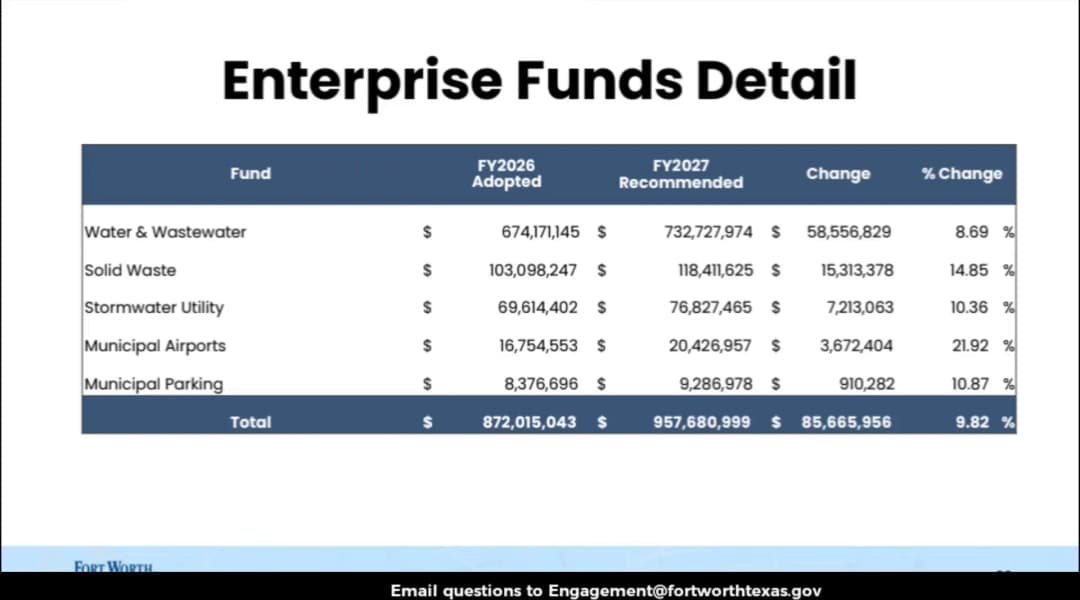
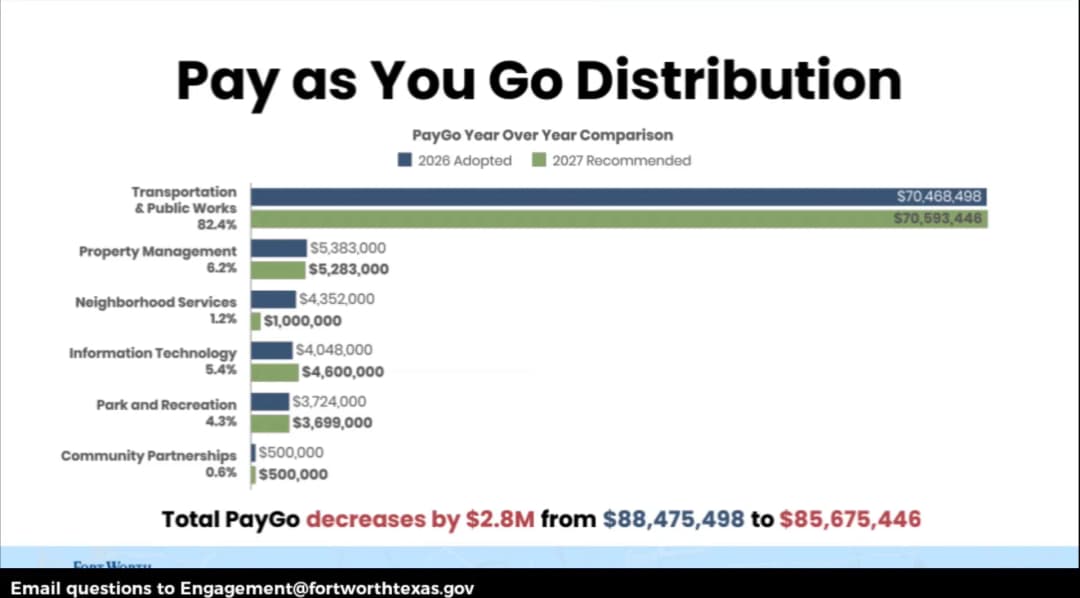
City Manager Jay Chapa and Fort Worth Lab Director Christiane Simmons presented the proposed FY 2027 budget to District 4 residents. The meeting highlighted a $94 million budget gap driven by flat property tax values due to Tarrant Appraisal District's reappraisal plan, and detailed the recommended cuts, tax rate increase, and investments in public safety. The council is scheduled to vote on the budget and tax rate on September 15, 2026, with a public hearing on September 1. Public Comments & Testimony - Resident (regarding code ranger program): Questioned why the volunteer program was cut, expressing concern about lost community engagement. - Resident (revenue from code violations): Asked how much revenue code compliance generates and criticized the use of liens on rental properties, noting that absentee owners avoid payment. - Resident (CCPD funding): Stated that the CCPD (Crime Control and Prevention District) sales tax was sold to voters as funding for police, but a portion ($11 million in 2025) goes to nonprofits with little accountability. She called for transparency and for the money to be used for police equipment and salaries. - Resident (homelessness funding): Noted that despite millions in funding to homeless service providers, homelessness has increased, and questioned the effectiveness of permanent supportive housing and lack of accountability. - Resident (pavement management fee): Expressed concern that the fee could be raised in the future without a public vote, as seen in Austin. - Resident (public art funding): Argued that the 1% for public art bond set-aside should be redirected to police or fire, and that wealthy donors could fund art instead. - Resident (remote participation): Asked if the city would reinstate remote call-in for council meetings to improve accessibility. Discussion Items - Budget Overview: City Manager Jay Chapa explained that the $3.32 billion operating budget must be balanced by state law. The general fund is $1.1 billion, only one-third of the total, and the gap must be closed within the general fund. He emphasized that public safety investments were prioritized, forcing cuts elsewhere. - Property Tax Revenue Shortfall: Christiane Simmons showed that Tarrant County's average taxable value has flattened and fallen due to the appraisal district's reappraisal plan, while Collin and Dallas counties grew. The city initially projected a $49 million gap, which grew to $94 million after adding contractual police and fire costs and mid-year value losses. - Budget Balancing Measures: Departments initially cut 1% and submitted 3% reduction packages ($22 million). Deeper cuts of $28 million eliminated vacant positions and frozen pay. Revenue increases and a proposed tax rate increase of 3.2 cents per $100 valuation (from 67 to 70.2 cents) closed the remaining gap. After council feedback, the rate was adjusted to 70.565 cents to restore the PetSmart Alliance adoption center, some park and library positions, and increase general employee pay-for-performance from 1.5% to 3% (mid-year). - Public Safety Investments: The budget adds 76 patrol officers, 30 corporal positions for a promotional path in patrol, funding for fire overtime and fleet, and a 911 assistive call-taking technology pilot. The Fire HOPE program will shift to a mobile integrated health team to save overtime. - Cuts and Service Level Impacts: Cuts include a 90% reduction in general fund transfer to economic development initiatives ($5M to $500K), smoothing of the neighborhood improvement program (from $4M to $1M in year one), a 25% reduction in the mobile tool shed program (reducing staff from 4 to 3), and a 3% cut to the priority repair program. The code ranger program was eliminated because it was no longer effective. - Enterprise Funds: Water, solid waste, stormwater, and other enterprise funds are funded by user fees. Water rates increase $7.09/month for typical usage to support capital projects. The pavement management fee (formerly street maintenance fee) is proposed to supplement existing maintenance funding, with rates proportional to property use. - CCPD and Nonprofit Funding: In response to resident concerns, Chief Garcia stated that the police department will use criminologists to evaluate all CCPD-funded programs for effectiveness and return on investment. The councilman acknowledged the need for better transparency and promised to publish CCPD board meeting information. - Public Art Policy: The 1% for art bond policy was discussed. The councilman said he has asked staff to explore putting the policy to a public vote. The city manager noted that the policy can only be changed by the city council. Key Outcomes - Proposed Tax Rate: The city manager recommended a tax rate of 70.2 cents per $100 valuation, later adjusted to 70.565 cents after council feedback. The council will vote on the final rate on September 15. - No Furloughs or Layoffs: The budget does not include furloughs or layoffs. The city manager indicated that if the council chose not to raise the tax rate, those would be the next options. - Next Steps: A public hearing on the budget will be held on September 1, 2026, at 2:00 PM at City Hall. The city council will adopt the budget and set the tax rate on September 15. Residents can sign up to speak at the hearing or provide feedback via Connect Fort Worth. - CCPD Program Evaluation: Chief Garcia committed to a data-driven review of all CCPD-funded programs, using criminologists, with results expected to inform the FY 2028 budget process starting April 2027. - Better Communication Promised: The district councilman pledged to improve communication of CCPD board meetings and other public information, and to investigate feasibility of clawing back Trinity Metro sales tax for road repairs.

PUBLIC SAFETY 20% · BUDGET EQUITY ANALYSIS 14% · PUBLIC ENGAGEMENT 10% · ECONOMIC DEVELOPMENT 8%
7883
SEP 2, 2026 · DAVENPORT, IOWA · CITY COUNCIL
Davenport City Council Work Session with Zoning Board of Adjustment – September 2, 2026

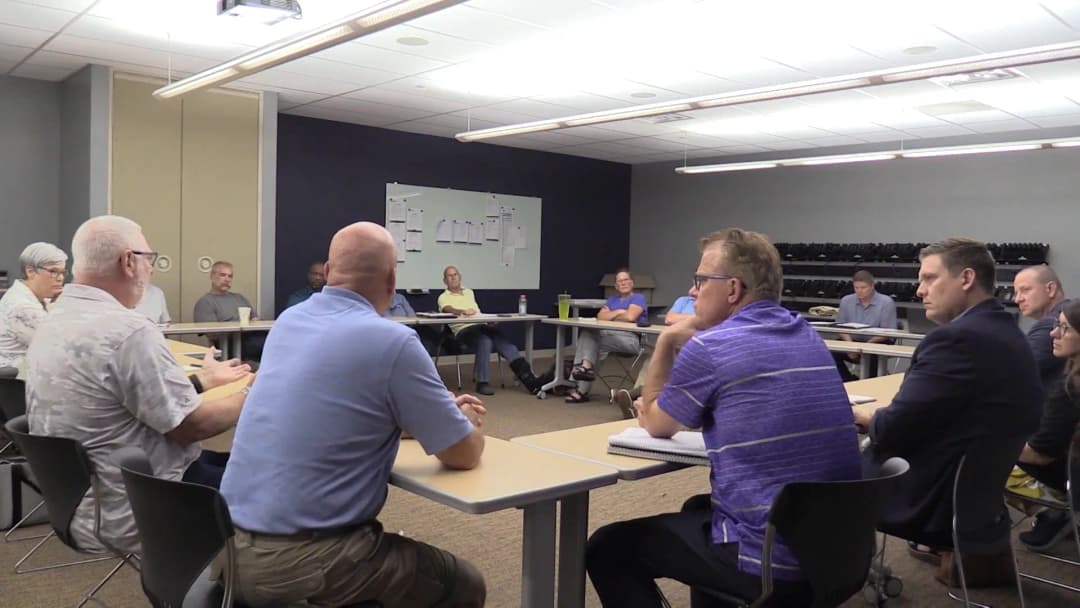
This was a joint work session between the Davenport City Council and the Zoning Board of Adjustment (ZBA), the first such meeting in several years due to the pandemic. The purpose was an open discussion about the ZBA's operations, challenges, and any support needed from the council. ZBA chair Dan Darrell and other members described the board's role, typical caseload, common types of cases, and their appreciation for city staff support. Discussion Items - ZBA Role and Composition: Dan Darrell, ZBA chair for 3-4 of his nearly 6 years on the board, explained that the ZBA is a quasi‑judicial board that makes final decisions on hardship variances, special use permits, and appeals of code interpretations, rather than making recommendations to the council. The board has five members appointed by the mayor and confirmed by the council. State law requires at least three affirmative votes for approval; if only three members are present, a vote must be unanimous. - Caseload and Trends: The number of cases has dropped significantly since the 2019 zoning code update, which addressed common issues. Annual cases range from 8 (in 2022) to about 25, whereas under the old code there were up to 80 per year. The board meets twice a month (second and fourth Thursdays) if petitions are filed, averaging 16‑18 meetings annually. - Types of Cases: Most hardship variances are dimensional (setbacks, garage size, swimming pool placement) while special use permits focus on whether a use (e.g., a small engine shop) is appropriate in a neighborhood. Cases are roughly half commercial and half residential, with occasional city projects (e.g., Fire Station 3). Appeals of administrative interpretations are rare—only one since 2019. - Key Challenges: Board members discussed the difficulty of saying “no” to petitioners, especially when neighbors support a project, because the board must enforce the code strictly and consider long‑term impacts. One past case involved an auto dealership that the board approved based on personal feelings; the city sued (the suit was later dropped), reinforcing the need for strict code adherence. Members emphasized that recommendations from staff are valuable but the board makes final decisions. - Staff Support: Multiple board members praised city staff (development and legal) for their guidance, knowledge of code changes, and help in navigating decisions. The Iowa State Sanction Service and legal department also assist with case law. - Example Decisions: The board approved a handicap ramp that encroached 3–7 feet into a 25‑foot setback because it was the right thing to do. They also approved a pool on a triangular lot with streets on three sides where the only feasible location was in a backyard that abutted a street. Another case allowed parking near the front of a house due to topographical hardship. - Council Questions: Aldermen asked about the criteria for board membership (must be a legal resident with “strong positive experience or interest in urban planning, urban design, and city development”) and the distinction between Planning & Zoning (advisory to council on rules) and ZBA (adjudicative on individual cases). Key Outcomes - No votes or formal decisions were made during this work session. - The council expressed appreciation for the ZBA's volunteer service and the important role they play. - The ZBA chair noted that continued excellent staff support and careful zoning in new developments would help the board going forward. - The meeting was adjourned informally with thanks for everyone's flexibility in rescheduling.

COMMUNITY ENGAGEMENT 43% · ENGINEERING AND INFRASTRUCTURE 40% · PROCEDURAL 8% · PERSONNEL MATTERS 5%
7884
SEP 2, 2026 · LOUISVILLE, KENTUCKY · METRO COUNCIL & COMMITTEES
Louisville Metro Appropriations Committee Meeting - September 2, 2026

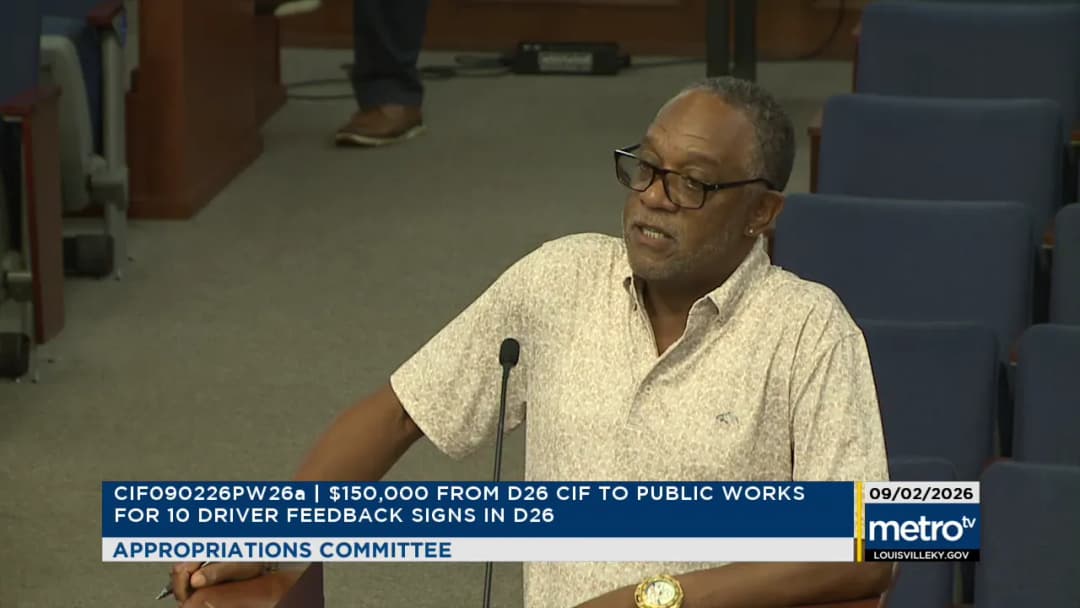
The Appropriations Committee of the Louisville Metro Council met on Wednesday, September 2, 2026, at 3:02 PM in Council Chambers with virtual participation. Chair Jonathan Joseph (R-12) presided. Present were Vice Chair Marilyn Parker (R-18, virtual), Committee Members Barbara Shanklin (D-2), Ken Herndon (D-4), JP Lyninger (D-6), and Markus Winkler (D-17, virtual). Dan Seum Jr. (R-13) was excused. The committee considered eight funding requests totaling approximately $259,775 (original amounts, before amendments). The meeting adjourned at 3:15 PM. Public Comments & Testimony - Justin Soforo, Legislative Assistant for Councilwoman Josie Raymond (D-10), presented the $22,000 sidewalk survey for District 10, explaining the survey would prioritize future repairs. - Charles Weathers, Legislative Assistant for Councilman Brent Ackerson (D-26), spoke on three items: the $30,000 traffic enforcement overtime ordinance, the $50,000 sidewalk connection project on Hurstbourne Lane, and the $150,000 driver feedback sign installation. - Caleb Howard, Legislative Assistant for Councilwoman Barbara Shanklin (D-2), described the $475 weed-eating and spraying project for a t-ball field behind the Boys & Girls Club at 5020 East Indian Trail. - Councilman Ken Herndon (D-4) presented the $6,000 (amended) ordinance for the Coalition for the Homeless Project Stand Down/Homeless Connect and the $1,000 appropriation to Families Who Conquer, Inc. for their Well-Being Legacy Lounge event. Discussion Items - Item 1 – CIF090226PW10 ($22,000 for District 10 sidewalk survey): Chairman Joseph clarified the funds cover only the survey, not repairs. Justin Soforo confirmed the survey is separate from Public Works’ normal operations. Lyninger asked about timeline; Soforo said they hope to start quickly. - Item 2 – O-238-26 ($30,000 from District 26 NDF for LMPD 6th Division overtime for traffic enforcement): Lyninger raised concerns about prior instances where LMPD canceled overtime funds and whether directing specific enforcement violates separation of powers. Charles Weathers noted the division had accepted the funds and previously provided results (arrests, speeding citations). The motion passed on a roll call: Yes – Joseph, Parker, Shanklin, Herndon, Winkler; Present – Lyninger; Excused – Seum. - Item 3 – CIF090226PW26 ($50,000 for Hurstbourne Lane sidewalk connection from Bardstown Road to Taylorsville Road): Lyninger expressed strong support, citing pedestrian safety needs and a personal connection to a past fatality. - Item 4 – CIF090226PW26a ($150,000 for 10 driver feedback signs in District 26 for traffic calming): No discussion; approved by voice vote. - Item 5 – NDF090226MP02 ($475 for weed-eating and spraying a t-ball field): Caleb Howard explained the overgrowth made the field unusable. Approved by voice vote. - Item 6 – O-237-26 (Originally $4,500 from D4, D15, D24, D10 for Coalition for the Homeless; amended to $6,000): Councilman Herndon moved to amend the ordinance to include $1,000 from District 9 (Councilman Owen) and $500 from District 13 (Councilman Seum), bringing the total to $6,000. The amendment passed by voice vote. Herndon noted they hope to raise at least $10,000–$15,000 and honored retiring director Natalie Harris. The amended ordinance passed on a roll call: Yes – Joseph, Parker, Shanklin, Herndon, Lyninger; Absent – Winkler; Excused – Seum. - Item 7 – NDF090226FWC04 ($1,000 from District 4 to Families Who Conquer, Inc. for a well-being event on November 1, 2026): Herndon highlighted the event’s focus on mental health services. Approved by voice vote. - Item 8 – CIF090226BS17 ($2,300 from District 17 to Brightside, Inc. for repairing the damaged leg on the Fleur de Lis horse statue at Hounz Lane Park): Councilman Winkler (sponsor) appeared virtually but had connectivity issues. No questions; approved by voice vote. Key Outcomes - All eight items were approved either by voice vote or recorded vote. - Item 2 (O-238-26) and Item 6 (O-237-26) were sent to Old Business for consideration by the full Metro Council on September 10, 2026. The remaining items were forwarded to the Consent Calendar. - Amendment: Item 6 was amended by voice vote to add $1,000 from District 9 and $500 from District 13, increasing the total appropriation to $6,000. - Vote tallies: - Item 2: 5 yes, 1 present, 1 excused. - Item 6 (as amended): 5 yes, 1 absent, 1 excused. - Action required by: February 27, 2027 for Items 2 and 6 (ordinances).

PROCEDURAL 39% · ENGINEERING AND INFRASTRUCTURE 20% · FISCAL SUSTAINABILITY 13% · PUBLIC SAFETY 12%
7885
SEP 2, 2026 · HAWAII COUNTY, HAWAII · COUNTY COUNCIL & COMMITTEES
Hawai'i County Council 48th Session: Budget Items, Legislation, and Community Grants Approved on September 2, 2026

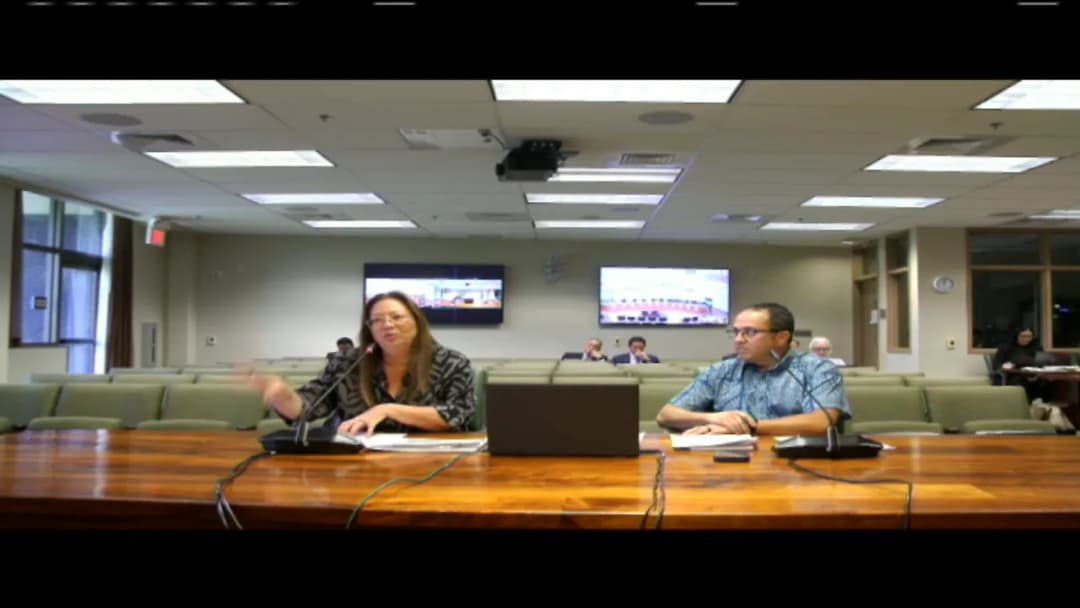
The Hawaii County Council held its 48th session on September 2, 2026, at the Hawaii County Building in Hilo. The meeting began with presentations recognizing two youth representatives to a national AI symposium, Officer Blake Bragos as the August 2026 HVEO Award recipient, and lifeguards in appreciation of Lifeguard Appreciation Week (August 17-23, 2026). The Council then proceeded through a lengthy agenda including over 30 resolutions, multiple bills for first and second readings, and two executive session items. The meeting lasted from 9:03 a.m. to 1:04 p.m., with a brief recess. Public Comments & Testimony - Josephine Kili Pio opposed Resolution 633-26 (Kona Cat Commons Sanctuary Project), noting the D-FIN Foundation has been registered less than two years and lacks a known track record. - Nicole Sasaki Simmons from the County of Hawaii Parks and Recreation supported Resolution 650-26 for the 40th annual Kupuna Hula Festival, highlighting its role in honoring kupuna and perpetuating Hawaiian culture. - Julie Eliason testified in support of Bills 173 and 175, describing the property tax burden on her hosted transient vacation rental and urging passage of a bed-and-breakfast tax class and amnesty. - Stephanie Bath supported the nominations of Jaylyn Brendlen and Gary Rosenberg to the Puna Community Development Plan Action Committee, citing their community involvement and expertise. - Tom Wazinski, president of the West Hawaii Veterans Cemetery Development and Expansion Association, strongly supported Resolution 657-26 for a Medal of Honor Memorial, noting Sgt. 1st Class Rodney J. Yano's connection to the island. - Lilinoi Kili Pio Young supported Resolution 641-26 for a ceremony honoring Honolulu Landing, expressing gratitude for the county's acquisition and preservation efforts. - Celia Bardwell Jones supported Resolution 661-26 for the Barrio Fiesta, emphasizing its educational value for Filipino diaspora and UH Hilo students. - Renee Godoy, founder of Friends of First Responders, supported Resolutions 636, 655, and 656 for the Robust Conference and officer wellness resources, sharing a story of a couple whose marriage was saved by the conference. - Del Otsuka supported Resolution 609-26 (HGEA contract) but urged the council to prioritize filling vacancies over spending on consultants. - Mitchell Marks, executive director of the D-FIN Foundation, testified on Resolutions 633 and 649, explaining the Kona Cat Commons will serve as a pilot project with a template for other cat sanctuaries island-wide. Discussion Items - Communications (Nominations): The Council confirmed Jaylyn Brendlen (Puna CDP Action Committee), Gary Rosenberg (Puna CDP Action Committee), and Grace Reinhard (Tax Board of Review) unanimously (9-0 each). Brendlen and Rosenberg received detailed introductions from Mayor's representative Mike Alameda and supportive comments from council members. - Resolutions: Most resolutions were approved without debate, including: - Res. 609-26 (HGEA Unit 15 contract, estimated cost $1,819,315 over four years) – approved 9-0. - Res. 610-26 (MRI Software licensing agreement, approx. $55,593/yr) – approved 7-0 (two excused). - Res. 611-26 (Police de-escalation training grant, $129,033) – approved 9-0. - Res. 612-26 (Legal research services, approx. $13,522/month increasing 7% yearly) – approved 9-0. - Res. 614-26 (Handheld mass spectrometers for HPD fentanyl detection) – approved 9-0. - Res. 615-26 (Domestic violence prosecution grant, one deputy prosecutor) – approved 9-0. - Res. 616-26 (Naloxone nasal spray distribution boxes) – approved 9-0. - Res. 617-26 (NACo and WIR board nominations) – approved 9-0. - Res. 627-26 (Preservation forum travel stipends, $20,192) – approved 9-0. - Numerous community grant resolutions (Res. 633-26 through Res. 663-26, and Res. 647-26, 648-26, 649-26, 650-26, 652-26, 653-26, 654-26, 655-26, 656-26, 657-26, 659-26, 660-26, 661-26, 662-26, 663-26, 667-26) were approved, mostly 9-0. Some had brief sponsor remarks highlighting the funded programs. - Res. 634-26 (Ocean View Skatepark Association grant) was amended via Comm. 1008.1 to extend the project completion deadline to May 31, 2027. The amendment and suspension of Rule 23 passed on a 7-2 roll call (Councilmembers Houstis and Kimball opposed). The resolution as amended passed 9-0. - Bills for First Reading: - Bill 169 (Draft 2) – PONC program amendments: Approved with an amendment (Comm. 939.6) to align language, then passed first reading 8-0 (one excused). - Bill 173 (Draft 2) – Bed and breakfast home tax class and amnesty: Extensive discussion occurred. Councilmember Kimball introduced an amendment (Comm. 960.6) to remove the waiver of rollback taxes, which failed 2-7. The main motion failed on a roll call vote of 3-6 (Ayes: Galimba, Kagiwada, Campbell; Noes: Houstis, Kānealiʻi-Kleinfelder, Kierkiewicz, Onishi, Villegas, Inaba). - Bill 176 (Draft 2) – General Plan amendment procedures: Passed first reading 9-0. - Bill 177 – Budget amendment for de-escalation training: Passed first reading 9-0 (companion to Res. 611-26). - Bill 178 – Budget amendment for special response team grant: Passed first reading 9-0. - Bill 179 – Research and Development Department responsibilities and grant program: Passed first reading 9-0. - Bill 180 – Budget amendment for preservation forum travel: Passed first reading 9-0 (companion to Res. 627-26). - Bills for Second Reading: - Bill 172 – Motor vehicle weight tax budget: Passed final reading 9-0. - Bill 174 – Kona Low Small Business Recovery Grant ($500,000): Passed final reading 9-0. - Bill 175 (Draft 2) – Transient accommodations law amendments: Passed final reading 9-0. - Executive Session: The Council entered executive session on Communication 1034 (enumeration & settlement of property acquisition and inverse condemnation claim) and accepted the Office of Corporation Counsel's recommendation. The file was closed (9-0). Communication 1006 (litigation against the county) was also closed after accepting counsel's recommendation (9-0). Key Outcomes - Nominations Confirmed: Jaylyn Brendlen (Puna CDP Action Committee), Gary Rosenberg (Puna CDP Action Committee), and Grace Reinhard (Tax Board of Review) all confirmed unanimously. - Resolutions Approved: All 30+ resolutions passed, most unanimously. Res. 634-26 was amended and passed 7-2 on the suspension vote but 9-0 on final. - Bill 173 Failed: The bed-and-breakfast tax class bill did not pass first reading (3-6). - Other Bills Advanced: Bills 169, 176, 177, 178, 179, 180 passed first reading; Bills 172, 174, 175 passed second/final reading. - Executive Session Actions: The Council approved legal recommendations for two matters (litigation and property settlement), closing the files. - Presentation Recognition: The Council honored student AI symposium delegates, Officer Blake Bragos (HVEO Award), and lifeguards for Lifeguard Appreciation Week.

TAXATION POLICY 19% · PROCEDURAL 15% · PUBLIC SAFETY 12% · COMMUNITY ENGAGEMENT 7%
7886
SEP 2, 2026 · MAUI COUNTY, HAWAII · COUNTY COUNCIL & COMMITTEES
Maui County Housing and Land Use Committee Meeting on Pāʻia Sugar Mill and Publication Notices – September 2, 2026

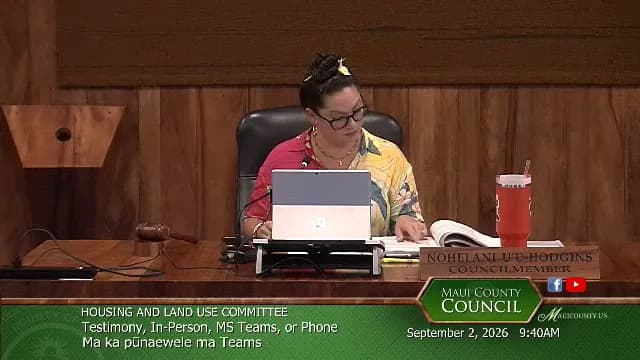
The Housing and Land Use Committee of the Maui County Council met on Wednesday, September 2, 2026, from 9:06 a.m. to 12:45 p.m. to consider two agenda items: Bills 109 and 115 (2026) for the Pāʻia Sugar Mill Redevelopment Project, and Bill 85 (2026) to amend public hearing notice publication requirements. The committee voted unanimously to recommend passage of all three bills on first reading, with significant amendments and conditions added to the Pāʻia project. Public Comments & Testimony - Bill Kamae (in person) testified in support of Bills 109 and 115, representing his long association with the applicants. - Barry Hulse (via Teams) testified in support, citing a similar successful manufacturing initiative in Vermont that he led. - William Spence (via Teams) testified in support, noting that the 1995 Pāʻia-Haʻikū Community Plan always intended industrial uses for the site. - Olena Aleck (via Teams) testified in support, born and raised in Pāʻia, describing the mill as the heartbeat of the town and supporting the reduction in zoning intensity from heavy to light industrial. - James Langford (via Teams) expressed concerns about a colonizing approach and urged more ʻāina-based solutions. - Jesse Long (via phone, last four digits 4945) raised historical questions about land patents and colonization, criticizing workforce development language as colonial. - For Bill 85, Jesse Long testified in support but urged better public posting at county buildings and criticized government “laziness.” Discussion Items Bills 109 and 115 (2026) – Pāʻia Sugar Mill Redevelopment Project - The committee considered two bills to rezone 19.933 acres (TMK (2) 2-5-005:023 and 054) from Heavy Industrial and Agriculture to Light Industrial (M-1 Conditional Zoning). The Maui Planning Commission had recommended approval with conditions limiting uses to those represented and requiring 20% open space in perpetuity. - Applicant presentation: Dan Ellis and Wayne Thibodeau of Pāʻia Village Company presented a vision for a manufacturing village, including workforce training, waste plastics recycling, ag processing, and community events. They emphasized restoring Pāʻia’s industrial heart and creating local jobs. - Councilmember Paltin proposed six conditions: (1) water conservation best management practices (BMPs) from Dept. of Water Supply, (2) no transient vacation rentals or bed-and-breakfasts (except humanitarian sheltering), (3) maintain/establish an emergency evacuation route, (4) build to hurricane Category 3 standards, (5) require an ag processing facility (e.g., commercial kitchen), (6) ban corporate franchises (or formula businesses). - Applicant supported conditions 1, 2, 3, and 5 in principle, expressed concerns about cost of hurricane standard, and requested flexibility on franchise ban language. - Councilmembers debated amendments. The committee voted to restore M-1 uses (including B-1, B-2, B-3) with removals: animal kennels, pet shops, boarding facilities, harbor facilities/marinas, sanitariums, nursing homes, car lots. B&Bs were also prohibited except in disasters. - Open space condition: Councilmember Rawlins-Fernandez moved to adopt the Planning Commission’s 20% open space requirement, with allowed uses including park, assembly area, agriculture, passive land use, and Native Hawaiian traditional/customary uses (including shade structures, weddings, etc.). Applicant called the 20% burdensome; after compromise, the evacuation route (approx. 1.74 acres) was allowed to count toward the 20% (amendment passed 6-1). - The main motion as amended passed 7-0. Bill 85 (2026) – Publication of Public Hearing Notices - The department-initiated bill would change publication requirements from a twice-weekly newspaper to a “suitable publication generally circulated throughout the County,” intended to allow use of the Maui News and save costs. - Planning staff noted support from all three planning commissions. - No public testimony beyond one brief supportive comment. - Motion to recommend passage on first reading with non-substantive revisions passed 7-0. Key Outcomes - Bills 109 and 115 (Pāʻia Sugar Mill): Recommended passage on first reading with amendments. Key conditions include: - Water conservation BMPs (list from Dept. of Water Supply) enforced by that department. - No transient vacation rentals, B&Bs, or short-term rentals (humanitarian sheltering excepted). - Emergency evacuation route to be maintained in consultation with MEMA; no upgrade required, but must be passable. - Restriction on formula businesses: no businesses with more than 10 locations worldwide sharing standardized features (architecture, uniforms, signage, menus, etc.). - 20% of property must remain in open space (non-contiguous, including the evacuation route), with allowed uses: parks, assembly areas (including food trucks, weddings, community events), agriculture, passive land use, and Native Hawaiian traditional/customary uses. - M-1 zoning with B-1, B-2, B-3 uses permitted, except removed uses (animal kennels, pet shops, boarding facilities, harbor facilities, marinas, sanitariums, nursing homes, car lots). - Bill requires six votes at full council due to planning commission recommendation. - Bill 85: Recommended passage on first reading with non-substantive revisions. Will move to full council. - Written testimony continues to be accepted for both items.

LAND USE PLANNING 29% · ZONING CODE REVISION 20% · ECONOMIC DEVELOPMENT 15% · PROCEDURAL 5%
7887
SEP 2, 2026 · FORT WORTH, TEXAS · CITY COUNCIL
Fort Worth District 5 Budget Town Hall – September 2, 2026

On September 2, 2026, Councilmember (not named in transcript) hosted a District 5 budget town hall at which City Manager Jay Choppa and Fort Worth Lab Director Christian Simmons presented the proposed Fiscal Year 2027 budget. The meeting, the eighth of ten, was attended by approximately 20-50 people in person and streamed to about 200 viewers. The presentation focused on a $3.3 billion total operating budget, a general fund shortfall driven by Tarrant Appraisal District (TAD) practices, and the recommended property tax rate increase from 67 cents to 70.2 cents per $100 valuation (later adjusted to 70.565 cents after council-directed restorations). Residents asked questions and offered comments on spending priorities, service cuts, and the impact of TAD’s reappraisal plan. Public Comments & Testimony - Bob (resident): Expressed strong opposition to what he termed wasteful spending, specifically calling for the elimination of the community engagement office and the police oversight monitor. He stated these positions cost more than the Texas Attorney General and are unnecessary. - Evelyn Bagley (transplant resident): Raised concerns about rapid development, loss of mature trees, and lack of shade in parks. She criticized the city for not preserving large trees and replacing them with smaller ones, and for playgrounds without shade. - Colita (resident): Asked about neighborhood services programs and whether they factor in preserving nature; expressed hope that green space is being protected. - Unidentified male resident: Asked whether TAD’s practices caused the tax rate increase and questioned what the tax rate would be if Fort Worth values grew like Collin and Dallas counties. He also asked about the police budget increase and the inevitability of those costs. - Unidentified female resident: Questioned the reduction in the neighborhood improvement program, asking if it was a real cut or just a funding shift. She also asked about CCPD funding and its original intent for community programs. - Multiple speakers: Expressed concerns about specific program cuts (e.g., Alliance PetSmart Adoption Center, mobile tool shed) and advocated for restoring services. Discussion Items - Budget Overview: City Manager Jay Choppa explained that Texas law requires a balanced budget. The total operating budget is $3.3 billion, with the general fund at $1.15 billion. About 60% of general fund revenue comes from property taxes. Christian Simmons noted that because of TAD’s every-other-year reappraisal plan and a high number of protests, property tax growth was only 0.89% (well below the projected 2%), creating a $49 million gap that later narrowed to $37 million after cuts. - TAD Impact: Simmons presented a graph comparing average taxable home values in Collin, Dallas, and Tarrant counties, showing Tarrant values flat then falling, while other counties grew. The city manager noted TAD is the only appraisal district in Texas using its current methodology. - Budget Reductions: Departments were asked for 1% and 3% reduction ideas, yielding $7.8 million in savings. Deeper cuts included: eliminating vacant positions, reducing employee pay-for-performance from 4% to 1.5% (later partially restored), and reducing the transfer to the Economic Development Initiatives Fund from $5 million to $500,000. The proposed budget originally cut the Alliance PetSmart Adoption Center and removed six code compliance positions, but council and public pushback led to restorations. - Police and Fire Funding: The police budget increases by about $23 million, mostly due to contractual pay raises (averaging 6%). The budget also adds 76 patrol officers (funded by CCPD initially) and creates 30 corporal positions to allow promotions within patrol. Fire’s budget grows $52.6 million, largely due to a $30 million subsidy for EMS, a placeholder for a new labor contract, and fleet/overtime cost adjustments. - Fee Increases: Various fee increases were proposed, most notably a four-year phased solid waste fee increase after 22 years without an increase. The city manager cited the need to replenish reserves and plan for future landfill replacement. Average resident bill impact: about $7.09 more per month from stormwater, water, solid waste, and environmental fees combined. - Property Tax Bill Effect: Despite a recommended tax rate increase (70.2 to 70.565 cents), the average homestead taxable value is falling, so the city portion of the tax bill is slightly lower than the current year. The councilmember emphasized that the city lowered the tax rate 8 of the last 10 years, and this increase is needed to maintain services. - Neighborhood Improvement Program (NIP): The budget reduces NIP funding from $4 million to $1 million in year one, but officials explained this is a funding delivery shift (matching actual spending) and not a service cut; the program will still select a neighborhood each year but fund projects over three years. - Will Rogers Complex: The city is transitioning management of Will Rogers Memorial Complex to a third-party operator to increase efficiency and reduce subsidy from hotel occupancy tax. The city retains ownership. Public events budget declines due to convention center expansion taking key spaces offline. - Employee Pay for Performance: Originally cut to 1.5% (mid-year), council sought to restore to 4% (2% budget impact), costing $4 million and raising the tax rate to 70.565 cents. Key Outcomes - No formal votes were taken; this was a public engagement session. The councilmember stated she would carry feedback to upcoming council budget meetings. - The recommended tax rate as of the meeting was 70.565 cents per $100 valuation (up from 70.2 cents) to restore the Alliance PetSmart Adoption Center, six code positions, seven development services positions, and restore employee pay-for-performance. - Departments with the largest budget increases: Fire (+$52.6M), Police (+$23M), Emergency Management & Communications (+$1.2M). Decreases: Property Management (shift of vehicle replacement to debt), Economic Development (reduced transfer), Neighborhood Services (funding smoothing). - The city will continue to work with TAD to understand future valuation impacts and adjust budgeting accordingly. - Public comment will be accepted at the formal public hearing on September 3, 2026 at 2:00 PM at City Hall. Two more district meetings will be held.

BUDGET EQUITY ANALYSIS 48% · PUBLIC SAFETY 13% · PUBLIC ENGAGEMENT 8% · CODE ENFORCEMENT 7%
7888
SEP 2, 2026 · GREENBELT, MARYLAND · CITY COUNCIL
Greenbelt City Council Work Session - September 2, 2026

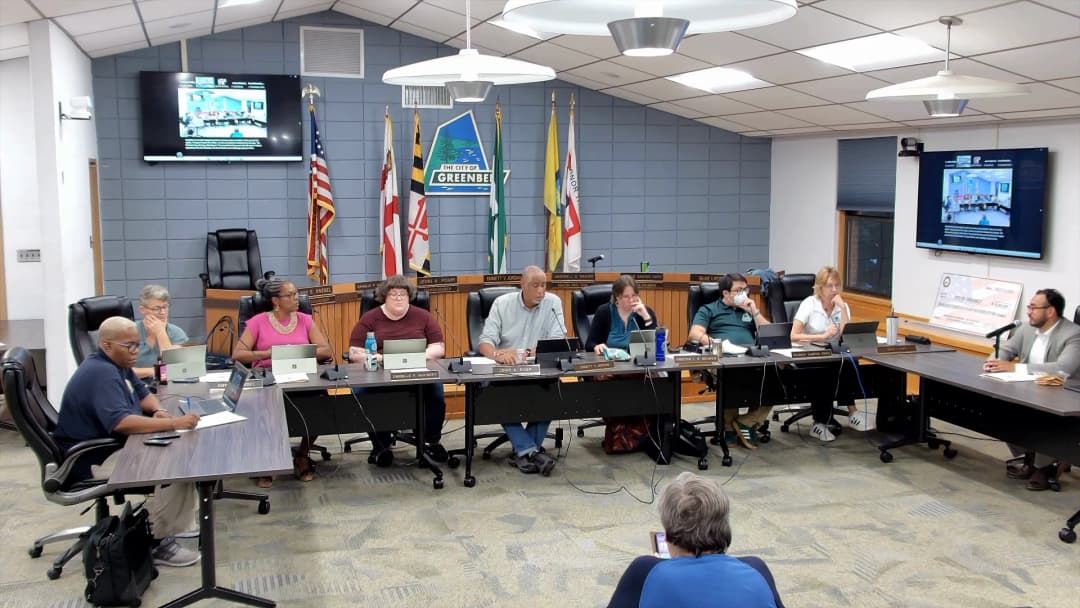
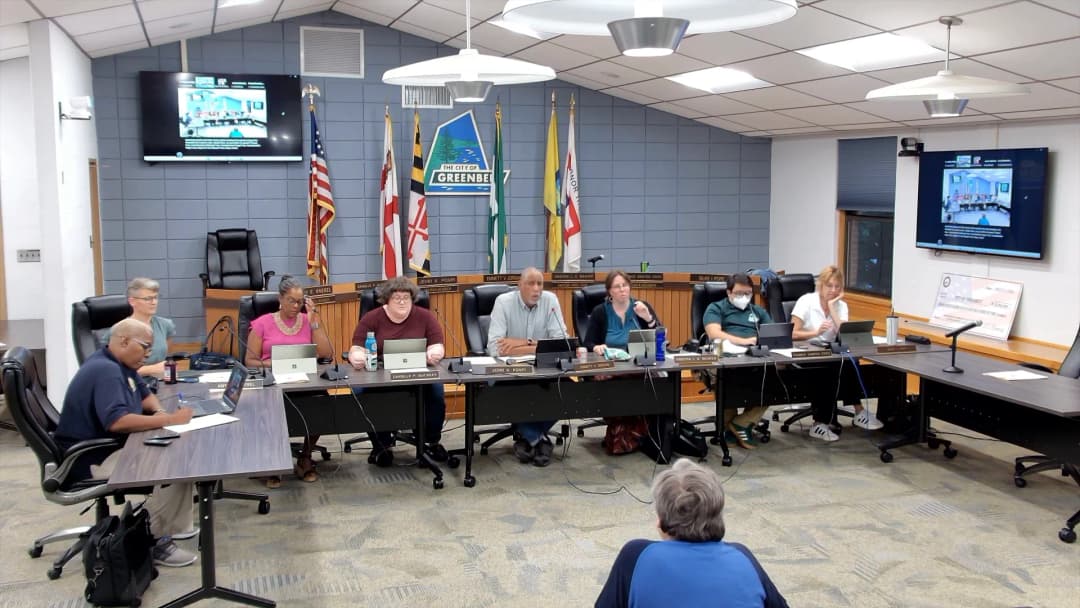
The Greenbelt City Council convened a work session on September 2, 2026, at 7:30 PM. The primary purpose was to enter a closed executive session to discuss the City Manager's evaluation, the appointment of an appointee or official, and a pending fire department lawsuit. Prior to the closed session, council members received updates on the upcoming Labor Day Festival and ongoing community safety efforts in the Greenbelt Station neighborhood. Information Items - Labor Day Festival Update: City Manager Samaron reported that fire and health inspections are scheduled for Friday morning. The city's fire marshal, Gilberto Cabrera, will take on a greater role in inspections. Vendor equipment testing was observed on-site. The city aims to assist the Labor Day committee while ensuring a safe event. This year marks the ninth anniversary of the festival. - Community Safety Update: Mayor Pro Tem Weaver thanked the police chief, city manager, and officers for attending a Monday meeting with Greenbelt Station residents about recent vandalism. A trailer-mounted camera has been placed in central park near a vandalized home, and police patrols have increased. The suspect has been arrested twice; the first time released without bond, the second time held on a $2,500 bond posted by a relative. Residents were urged to share any additional camera footage for an upcoming court hearing. Closed Session Motion Councilmember McKinney moved to enter closed session under Maryland General Provisions Article §3-305(b)(1) and (8) to discuss personnel matters and pending litigation. The motion was seconded by Councilmember Pope. The roll call vote was unanimous (5-0). Council entered closed session at 7:36 PM and did not return to open session.

PROCEDURAL 66% · PUBLIC SAFETY 34%
7889
SEP 2, 2026 · GREENBELT, MARYLAND · CITY COUNCIL
Greenbelt City Council Special Meeting - September 2, 2026

The Greenbelt City Council held a special meeting on September 2, 2026, primarily to enter executive session. Prior to the closed session, council members shared updates on the upcoming Labor Day Festival and recent vandalism in the Greenbelt Station neighborhood. Discussion Items - Labor Day Festival Update: City Manager Samaron reported that fire and health inspections are scheduled for Friday morning, with a joint inspection by the county and city. The city's fire marshal, Gilberto Cabrera, will take on a greater role in inspections. Structural inspections for festival equipment are taking place Thursday and Friday. The Labor Day Festival is the 90th anniversary, and the city is assisting the Labor Day committee to ensure a safe event. - Greenbelt Station Vandalism Update: Council member (not named directly) thanked the city manager, Chief Bowers, and Deputy Chief White for attending a meeting with residents on Monday. A trailer camera has been set up in central park near a vandalized house, and police patrols have increased. The suspect has been arrested twice; the first time released without bond, the second time held on a $2,500 bond, later posted by a relative. Residents were reminded to share any additional camera footage for the upcoming court hearing. Key Outcomes - The council voted unanimously (7-0) to enter executive session at 7:36 PM under Maryland General Provisions Article §3-305(b)(1) and (8) to discuss the city manager's evaluation, appointment of an appointee or official, and pending fire department litigation. The session included City Manager Samaron for portions. Council did not return to open session thereafter.

PROCEDURAL 88% · PUBLIC SAFETY 12%
7890
SEP 2, 2026 · LA CROSSE, WISCONSIN · COMMON COUNCIL & COMMITTEES
La Crosse Common Council Test Meeting - September 2, 2026

This meeting was a test meeting of the La Crosse Common Council. The agenda (originally dated August 31, 2026) listed four items under Common Council Matters (resolutions 26-0926 through 26-0929) but provided no descriptions. No transcript or minutes are available, so the substance of the meeting cannot be determined. Note the discrepancy: the agenda date and the actual meeting date differ. Key Outcomes - No votes, decisions, or other actions are recorded in the available materials.

OPENPUBLICA · PUBLIC MEETING INDEXUPDATED DAILY · openpublica.com