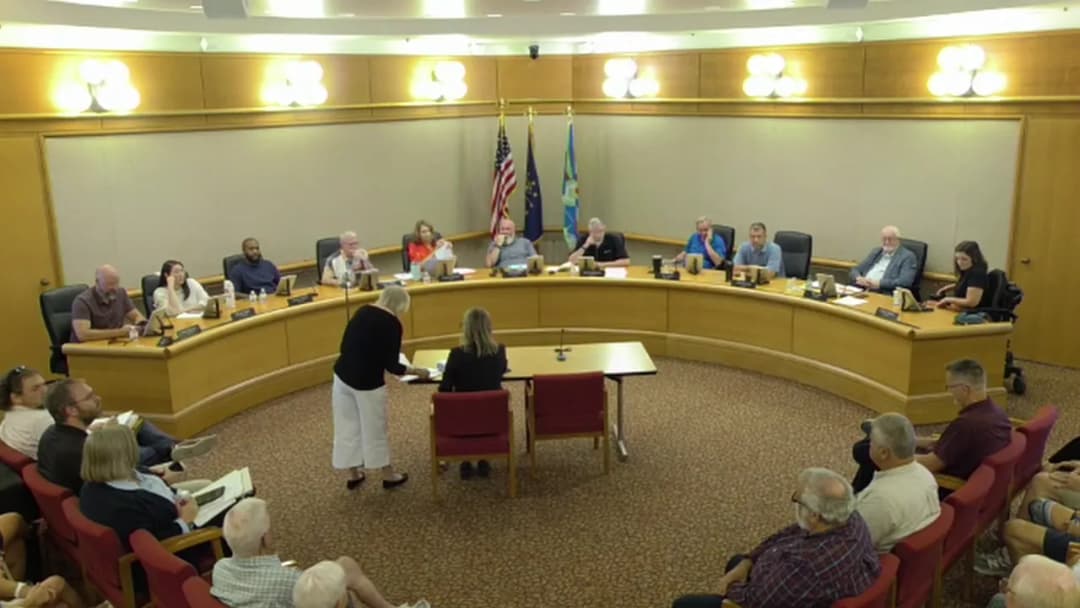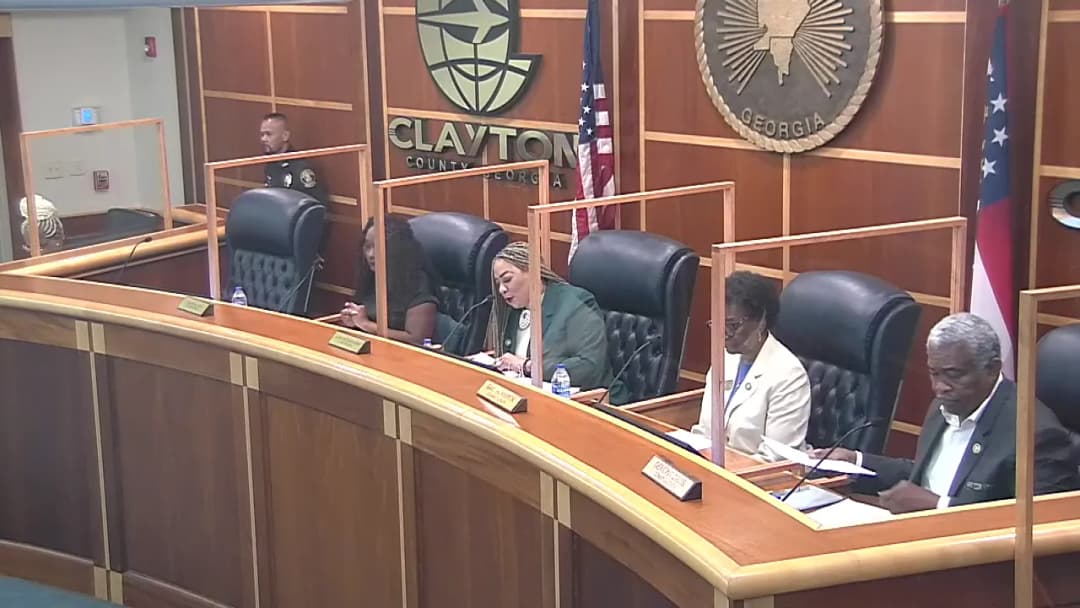
The Clayton County Board of Commissioners held its regular business meeting on September 1, 2026, at 6:00 PM, adjourning at 7:53 PM. The meeting included invocation, pledge, adoption of the agenda with two emergency additions from Central Services (contract extensions for River's Edge walking trail and Fire Station 15), presentations and proclamations, public comments, consent and regular agenda items, board appointments, and an executive session on litigation and real estate. The board approved a consent agenda of 22 routine items, debated and defeated a travel expense management software purchase, approved a fire truck and a telehealth MOU, made several board appointments, and approved two legal settlements and a resolution objecting to a City of Hampton annexation. Consent Calendar - Approved the August 18, 2026, regular business meeting minutes. - Contract Amendment RFP 16-42: Renewed ERP system services with UKG Kronos (formerly Kronos) for $77,005.06 for July 26, 2026 – July 25, 2027. - Contract Amendment RFP 21-04: Changed vendor name from Pieper O’Brien Herr Architects to POH+W Architects. - Contract Amendment ITB 22-09: Amended Valley Hill Road widening contract with Baldwin Paving Co. for $749,261.34, extending term to July 31, 2027. - Cooperative Purchase CP 26-153: Purchased a Pierce Custom Aerial fire truck for $1,480,000 (item moved to regular agenda, but approved separately). (Note: This item was pulled to regular agenda and approved there; consent agenda included the other items.) - Cooperative Purchase CP 26-167: Approved cloud migration and annual support for UKG Pro Workforce Management software for $420,280. - Budget Amendments: BA 2-13 ($1,000 donation for District 1 cookout), BA 4-3 ($1,000,000 SPLOST 2015 for Riverdale Library renovation), BA 4-4 ($170,000 SPLOST 2021 for District 2 Pocket Park), BA 4-5 ($6,000,000 SPLOST 2021 for Public Safety Water Rescue Training Center). - Resolution 2026-193: Authorized MOU with City of South Fulton for fire training academy clinical experience. - Resolution 2026-194: Granted easement to Georgia Power at 1740 Flat Shoals Road. - Resolution 2026-195: Authorized grant application to Thanks Mom and Dad Foundation for Senior Center innovation (up to $2,000 per facility, 37 grants available). - Resolution 2026-196: Set holiday hours for Parks, Recreation, Senior Services, and Library Services. - Resolution 2026-197: Authorized telehealth MOU with RightSite Health (pulled to regular agenda, approved there). - Resolution 2026-198: Removed Lois Hunter from MARTA Citizens Advisory Board for cause. - Resolution 2026-199: Rescinded removal of certain board members who later submitted required affidavits. - Resolution 2026-200: Accepted $5,400,000 ARC grant for Tara Boulevard Safety Improvement Project. - Resolution 2026-201: Accepted $8,000,000 ARC grant for multipurpose transit operations and maintenance facility. - Resolution 2026-202: Authorized second supplemental GDOT agreement for Tara Boulevard Pedestrian Safety Improvements (total design fee $5,300,000, up to $1,060,000 from 2021 SPLOST). - Resolution 2026-203: Granted temporary construction easement to Dominion Acquisitions and permanent easement to Water Authority for sewer line at 3199 Anvilblock Road. - Emergency additions (approved via separate motion): Contract extensions for ITB 24-26B (River’s Edge walking trail, Phase 3 & 4) and ITB 24-113B (Fire Station 15) at no additional cost, through November 2, 2026. Public Comments & Testimony - Carrie Lewis (District 3): Expressed strong support for law enforcement, stating “personal safety should not be attached to a price tag.” Demanded the board “stay on code” and raise the bar on education and economic opportunity, not settle for the “bare minimum.” - Juanita Thornton (District 3): Appealed as a homeowner and taxpayer feeling “distressed beyond” by high taxes. Urged approval of more homes in Clayton County to reduce tax burdens, comparing that adjacent counties (Henry, Fayette) pay less tax yet receive more services. - Charles Brooks (Solicitor General): Expressed disappointment and disgust with the board’s actions. Cited that on June 16, 2026, his request for two positions (litigation support specialist, investigative assistant, total $141,822) was denied due to lack of funds, yet the board later approved a new position for the county attorney’s office costing $173,030. He argued this was inconsistent and unfair. Demanded the positions be funded at mid-year budget review. - Dr. Henry Anderson (District 3): Commended Commissioner Allen’s presence, stating had she been present two weeks ago, Solicitor Brooks would have gotten his staff. Praised the HR Director and team for a successful Employee Gratitude Day on August 28, 2026. Also praised the grants administrator for a Fox 5 news segment on the down payment assistance program. Corrected his earlier statement that all public safety employees received a 10% raise; clarified it was only sworn and POST-certified personnel, plus two from E-911. Promised to address code enforcement issues at future meetings. - Dr. Marla Thompson Kendall: Commended the board for swiftly acting on a name change (not specified further) and thanked Commissioner Allen for support. - China McLean (District 2): Shared deep disappointment in the justice system regarding her son’s murder case. Noted one defendant was apprehended in Kentucky after three years, but she was not notified of extradition or first appearance. The other defendant, out on bond, was incarcerated in Florida for 226 days before release without her knowledge. She criticized officials for lack of compassion and accountability. - Mickey Garber (Unincorporated Rex): Encouraged support for local businesses and entrepreneurs, highlighting magazines that promote Clayton County’s food, film, and tourism. Suggested the board issue proclamations for such publications. - David Hambrick (State House District 79): Urged residents who appealed property taxes to check for Board of Equalization hearing letters. Noted Forest Park passed a 90-day moratorium on data centers, citing unanswered questions about long-term viability and potential for abandoned properties. Called for written commitments before approving data centers. - Simeon Nunnley & Caleb Jones (DOT youth): Thanked the board for engagement. Caleb Jones, a 4-year DOT employee, raised three issues: difficulty recruiting young workers due to low starting pay; lack of covered equipment storage leading to weather damage; and the need to promote DOT as a career with benefits. Suggested investing in youth recruitment to avoid losing them to warehouses or prisons. - Senator Gail Davenport (8170 Field Road, Jonesboro): Complained that campaign signs on her own property (near International Park) are repeatedly removed by unknown parties. She asked the board to stop the removal, noting each sign costs $200 to replace. She had previously raised the issue in June and July. Commissioner Hambrick suggested checking park cameras. Senator Davenport requested the issue be put on record. Discussion Items - Item 5 – Travel and Expense Management Software (GSA 26-148): CFO Jack presented the proposal to purchase software as a service from Carahsoft Technology Corp. for $98,662 total ($27,504 per year plus set-up fees). He argued the system would improve compliance with the county travel policy and achieve cost savings through better rates on hotels, flights, and rental cars. The travel budget for FY2026 was over $1 million. Commissioner Hambrick questioned why the county could not train existing staff to enforce compliance rather than pay for software, and noted that early conference registration already offers discounts. The motion to approve failed on a voice vote (nays). - Item 6 – Purchase of Pierce Custom Aerial Fire Truck (CP 26-153): The fire department requested approval to purchase a 107-foot ladder truck for $1,480,000 using a cooperative contract. The chief explained this is a different type of truck from the six traditional engines purchased in FY2025. The motion approved unanimously. - Item 16 – Telehealth MOU with RightSite Health (Resolution 2026-197): Fire Chief Tim Sweat explained that the MOU would allow fire/EMS to offer telehealth consultations with physicians for non-emergency patients met during 911 calls. Patients who consent and are uninsured would not be billed; insured patients would be billed through their insurance. The county incurs no cost. Commissioner Davis asked about liability and confirmation that physicians have malpractice insurance. The chief confirmed they do. The motion approved unanimously. - Emergency Additions (discussed during agenda adoption): Central Services requested two contract extensions: (1) ITB 24-26B for River’s Edge walking trail (Phase 3 & 4, vendor Pride Contracted Inc.) extended to November 2, 2026, at no additional cost; (2) ITB 24-113B for Fire Station 15 (vendor Grant Construction Co. 2) extended to November 2, 2026. Both were approved without objection. Key Outcomes - Item 5 Failed: The motion to approve the travel expense management software purchase (GSA 26-148) was defeated on a voice vote (nays majority). The board directed the CFO to provide a list of past non-compliance issues for further review. - Item 6 Approved: Purchase of Pierce Custom Aerial fire truck ($1,480,000) approved. - Item 16 Approved: Telehealth MOU with RightSite Health approved. - Board Appointments: - Board of Zoning Appeals: Larry Bussey reappointed (term expires September 15, 2029). - Library Board of Trustees: Chrishana Davis appointed (term expires May 20, 2028). - MARTA Citizens Advisory Board: Carey Lewis appointed (term expires April 5, 2027). - MARTA Transit Authority Board: Valencia Williamson reappointed (term expires December 30, 2026). - Sports & Entertainment Council: Held until September 15, 2026 meeting. - Tourism Authority Board: Myla Chapman reappointed (term expires August 31, 2030). - Tourism Authority Board: Lynda Browning reappointed (term expires August 31, 2030). - View Point Health Board (three at-large positions): Held until September 15, 2026, pending request for role description. - Zoning Advisory Group (Commissioner Reaves’ appointment): Held until September 15, 2026. - Zoning Advisory Group (Commissioner Davis’ appointment): Arnold Goodson reappointed (term expires September 2, 2029). - Resolutions Approved: - Resolution 2026-204: Objected to City of Hampton’s proposed annexation and rezoning requests. The board voted to approve the resolution, authorizing the county to submit an official response. - Settlement Agreements Approved: Two settlements totaling $435,850: $23,350 for a traffic accident case (Tommy Jones vs. county) and $412,500 for an auto accident case (Kim Bemby Mayemba vs. county and Sheriff). - Executive Session: The board entered executive session for litigation and real estate matters. - Adjournment: Meeting adjourned at 7:53 PM.
The Public Meeting Index
The Public Meeting IndexThe Huntington Beach City Council/Public Financing Authority held a regular meeting on Tuesday, September 1, 2026, beginning at 3:30 PM with a closed session and reconvening at 6:00 PM for the regular session. The meeting included discussions on legislative advocacy contracts, the Edison Park design phase, the America 250 plaque, a financial review of the proposed Police Officers Association (POA) Memorandum of Understanding (MOU), and a final vote on the MOU. Public comments were heavily focused on police staffing, compensation, and fiscal concerns. Closed Session - The city attorney reported no action from closed session. Consent Calendar - Items 16-24 were voted on as a block, with items 17, 19, and 22 pulled for separate discussion. The remaining items (16, 18, 20, 21, 23, 24) passed unanimously (7-0). These included: approval of minutes, intergovernmental relations committee contracts (deferred to item 17), Downtown Business Improvement District annual report, Edison Park reconfiguration design contract (deferred to item 19), Sons of the American Revolution memorial bench, vehicle and traffic ordinances, sales tax audit contract (deferred to item 22), rejection of bids for Old Pirate Drive water well, and the OCTA traffic signal synchronization agreement. Public Comments & Testimony - Police Officers Association (POA) MOU Support: Multiple Huntington Beach Police Department officers (including Sgt. Sean McDonald, Sgt. William Brownley, Bernard Atkins, Det. Reed Parker, Det. Zach Pricer, Officer Cole Swain, Officer Tony, Officer Danny Evans, Officer Luis Castillo, Officer Tommy Higgs, Officer Brennan Laraba, Det. Aaron Etchity, Officer Jason) spoke in favor of the proposed POA MOU. They highlighted recruitment and retention challenges, noting that HBPD has approximately 188 working officers out of 211 funded positions (down from 224), that officers rank 12th in compensation among Orange County agencies, and that forced overtime and burnout are increasing. They argued the contract would improve competitiveness and stabilize staffing. - POA MOU Opposition: Resident Peggy Hepler opposed the 17% pay raise over three years, citing the city's structural deficit of over $15 million and warning of potential bankruptcy. Resident Roger also opposed, calling the raise excessive and noting high pension benefits. - Edison Park Support: Several members of the Edison Park Community Group (Nancy Bukos, Tony Riccobono, Ding Joe Curry) expressed strong support for agenda item 19, praising the selection of RRM Design Group and the inclusion of community-preferred design elements, particularly the involvement of landscape architect Max Moriyama. - America 250 Plaque: Resident Aimory Hansen spoke in favor of the plaque honoring America's semiquincentennial. - Other Comments: A resident criticized the city's use of reserve funds for operational expenses. Another speaker questioned the city's compliance with a Public Records Act request and lawsuit. A speaker expressed concern about new offshore oil drilling and suggested selling police helicopters for drones. A speaker criticized council decisions on the library, the Symphony of Flowers, and lawsuits. A speaker discussed the city's financial mismanagement and urged fiscal discipline. Discussion Items Item 17: Legislative Advocacy Contracts (Kahn, Soares and Conway LLP; Stapleton & Associates) - Councilmember Gruel and others questioned the value of the two lobbying contracts totaling $504,000 over three years. Staff (Shannon) explained the firms provide legislative monitoring, advocacy, and help secure federal/state grants, citing $850,000 in recent grant funding for the navigation center. Some councilmembers proposed a one-year contract with options, but after debate, a motion passed (6-1, with Councilman Williams opposed) to approve three-year pricing with a unilateral right to exit after two years, contingent on vendor agreement. The item was continued to a future meeting for final execution. Item 19: Edison Park Reconfiguration Design Contract - Councilmember Twining questioned the $1.5 million contract (including $500,000 amendment) for design and construction documents. Staff clarified that the total cost for the design phase is approximately $1.37 million, funded by Quimby, DIF, and AES funds (not the general fund). The design includes community input at 30%, 60%, and 90% phases, an arborist report, and engineering studies. Council approved the motion unanimously (7-0). Item 22: Sales and Use Tax Audit Services (HdL) - Councilwoman Van Der Mark clarified that the contract is for monitoring and auditing sales tax allocations, not for increasing taxes. The base cost is $14,000/year plus contingent fees on recovered revenue. A motion to strike language in the contract that could be misinterpreted as supporting a tax increase passed unanimously (7-0). Item 25: America 250 Plaque at Pier Plaza - Staff presented two design options (sandblasted vs. laser-engraved). Council debated whether to include specific veteran names (e.g., Chris Carr) or a general statement honoring all veterans. Councilman Kennedy proposed removing council names and using the phrase “America’s veterans, past, present, and future, forever America’s heroes.” A motion to proceed with a revised design using this inclusive language and bring back final approval passed 5-2 (Councilmembers Gruel and Williams opposed, preferring to retain specific veteran names). Item 26: Finance Commission Subcommittee Report on POA MOU & Long-Range Financial Projections - CFO Zach Zithisakthanakul and staff presented a 10-year financial forecast, showing structural deficits even with 5% salary attrition. Key points: - Baseline scenario shows deficits growing from $10M in FY26-27 to $75M by FY35-36. - The POA MOU adds $2.7M in year one, escalating to $7.5M annually by year 10. - The city has $99M in general fund reserves (3.64 months of expenditures), above the GFOA benchmark of 2 months. - Staff emphasized the forecast is a planning tool, not a prediction of insolvency, and the city has historically managed deficits through hiring freezes and revenue enhancements. - Council debated the projections: Councilman Kennedy expressed concern that cumulative deficits would deplete reserves, while Councilman Twining noted that the MOU cost is relatively small compared to overall deficits. The item was received and filed unanimously (7-0). Item 27: Approval of POA MOU (July 1, 2026 – June 30, 2029) - Staff presented the MOU with 8%, 4%, and 5% salary increases in each year, plus increased medical contributions. The total cost is $19.5 million over three years, with a $2.7 million appropriation from general fund reserves for FY26-27. - Council members debated: Supporters (Twining, Van Der Mark, Burns, Williams) argued the contract is essential for recruitment and retention, and that public safety is the city’s top priority. Opponents (Gruel, Kennedy, McKeon) cited fiscal unsustainability, noting that salary growth outpaces revenue growth and the city cannot afford the increases without raising taxes or cutting services. - The motion passed 4-3 (Gruel, Kennedy, McKeon opposed; Twining, Burns, Van Der Mark, Williams in favor). Key Outcomes - Consent Calendar: Items 16, 18, 20, 21, 23, 24 passed 7-0. - Item 17 (Legislative Advocacy): Approved in concept (6-1) with directive to negotiate three-year contracts including a unilateral exit clause after two years; final execution to return. - Item 19 (Edison Park Design): Approved 7-0. - Item 22 (Sales Tax Audit): Approved 7-0 with language amendment. - Item 25 (America 250 Plaque): Approved direction to staff to revise design with inclusive veteran language and remove council names; final approval at a later meeting (5-2). - Item 26 (Finance Report): Received and filed 7-0. - Item 27 (POA MOU): Approved 4-3, appropriating $2.7 million from general fund reserves for FY26-27. - Next Meeting: Scheduled for September 15, 2026.
The regular Planning Commission meeting scheduled for September 1, 2026 at 6:00 PM was cancelled. According to the official meeting notice, the September 1, 2026 Planning Commission meeting was previously cancelled. No agenda items were discussed, and no public comments or decisions were made. This notice serves as the only available record for the meeting.
The Columbus City Council met on September 1, 2026, for an evening legislative session. After an invocation by Nakshata Linkidi, a local attorney and Hindu community member, and the Pledge of Allegiance, the council approved minutes, elected new officers after Frank Miller's resignation, heard public testimony and staff presentations on the Abundant Home Solutions annexation and rezoning, and passed first readings of the 2027 salary ordinances. Procedural Actions - The council approved the prior meeting minutes by voice vote. - The council suspended rules to add an agenda item and elected Ken Anderson as council president and Elaine Hilbert as vice president following Frank Miller's resignation. Council members thanked Miller for his last 32 months of service. Annexation and Rezoning: Abundant Home Solutions - The proposal covers approximately 80 acres off Solwyn Drive, seeking annexation into the city and rezoning from Agriculture Preferred (AP) to Residential Two-Family (RT). - Planning staff said the property is contiguous with the city limits at approximately 16%, above the 12.5% state-law requirement, and that all city departments confirmed municipal services could serve the site. - The city's future land use map designates the area residential. The site has no FEMA floodplain, though staff noted possible drainage areas. Surrounding land is mostly Agriculture Preferred; the Villas at Stonecrest PUD sits directly across the street. - Permitted uses in the requested RT district are single-family dwellings, two-family dwellings, and parks. Green-space requirements would depend on final lot count; staff said a development over 300 lots would trigger about a three-acre park requirement. - Planning staff stated the city notified BCSC about the significant development and that Solwyn Drive is on the city's improvement schedule, with construction expected in the early 2030s. The developer would be responsible for road frontage improvements, and city engineering reported no traffic concerns. A council member asked for interim safety and visibility work on Solwyn Drive, noting recent tree trimming and speed signs. - The developer said it intends to mirror a higher-end product like the Villas at Stonecrest rather than a high-density child-heavy development, but another council member reminded the public that the rezoning applies to the zoning district, not to a specific developer's promises. Public Comments & Testimony - Jackie Strittlmeyer, 5015 Sanibel Drive, asked whether council members physically inspect proposed sites, requested a feasibility study of Solwyn Road's ability to handle traffic, and raised concerns about a hidden street, the hill, utility poles close to the road, and the development company's track record. - Jane Cooney, 4942 Delray Drive, asked whether road improvements would precede construction, how Abundant Homes would be compensated, and whether the city's goal is added housing density or property tax revenue. She cited an average Villas at Stonecrest property tax of about $5,250 per year across 144 units, compared with about half that in the high-density Windstar area, and asked whether the current owner could continue cash-leasing the land while development is pending. - Al McGalm, 5144 Sanibel Drive, a Stonecrest resident, said buyers accept the high taxes and HOA fees because of the location, safety, and country/city feel, and feared traffic and density would lower property values. She noted many residents are 80 and 90 years old, opposed converting 80 acres of prime farmland, and offered comparables and assistance to encourage a high-end product if the project proceeds. - Jason Major, 3241 Overlook Drive, a school board member, said he learned about the project only through a text message. He urged coordinated planning among the city, county, and the school corporation (BCSC), warning that 100–300 additional students could affect Richards Elementary capacity and finances. - In a later comment period, Jane Cooney asked whether the roughly 300-homes-per-year city goal depends on this one site. Council and staff responded that multiple developments are in the pipeline and that the city does not proactively recruit subdivisions; developers bring proposals to the city. Salary Ordinances: 2027 First Readings - Fire sworn salary ordinance: incorporated a 3.5% COLA into base pay within the 20-year pay matrix and added no new positions. Passed on first reading. - Police sworn salary ordinance: same approach as last year, with 3.5% COLA built into the 20-year matrix and no new positions. Passed on first reading. - Civilian non-sworn salary ordinance: covers civilian employees except police, fire, elected officials, and Department of Utilities employees. Proposed changes included adjusting range maximums to make room for the 3.5% CPI-W-based COLA while leaving minimums and midpoints unchanged due to budget constraints; limiting certain aviation part-time hiring by budget rather than head count; adding a 0.12 FTE planning intern (240 hours); and adding an assistant mechanic in Public Works for the collaborative police/fire/utilities/transit fleet operation. Staff noted the 2028 compensation study is underway with the firm Crowe and that no current employee would be cut if market data shows a position is overpaid. Passed on first reading. - Common council salary ordinance: proposed a 3.5% COLA, structured as an annual amount under state statute. Council members debated whether to accept the increase; some argued salaries had fallen behind and that small annual increases prevent a future large jump, while one member said she would vote no because the body had not sufficiently advocated for a better budget or alternatives. The total annual increase for all nine council seats was about $5,000. Jason Major also spoke, noting the school board salary is $2,000 per year and that he voted against a permitted increase to about $5,000, saying public service is not about pay. The ordinance passed 7–2. - Elected officials salary ordinance (mayor and clerk): proposed a 3.5% COLA for both offices. Discussion noted the mayor's salary appears low relative to some department heads and specialized positions, and that market data will inform the ongoing compensation study. Passed on first reading. Key Outcomes - Prior meeting minutes approved. - Ken Anderson elected council president and Elaine Hilbert elected vice president. - The Abundant Home Solutions fiscal plan resolution was adopted on first reading. - The annexation ordinance passed on second reading and was ordered to proper channels. - The rezoning ordinance from AP to RT passed on second reading. - One council member who resides in the Villas of Stonecrest abstained from the Abundant Home Solutions fiscal plan, annexation, and rezoning votes. - Fire, police, civilian, common council, and elected official salary ordinances all passed first reading; the common council salary ordinance passed 7–2. The meeting adjourned after no further public comment.
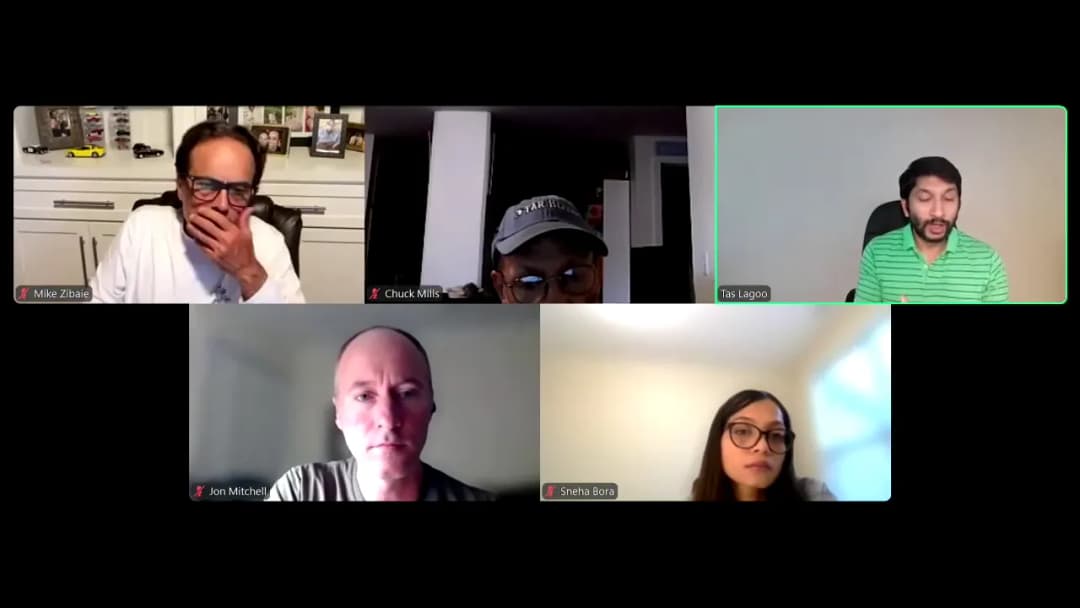
The Chapel Hill Planning Commission met virtually on September 1, 2026, to continue informal discussions on the draft Land Use Management Ordinance (LUMO). The meeting focused on two of five council-identified goal areas: housing diversity, attainability, and supply, and environment and resilience. Commissioners heard a staff presentation, public comments, and deliberated on trade-offs between densification and environmental protections. Consent Calendar - Approval of Minutes: The minutes from the August 18, 2026 meeting were approved unanimously (3-0, with members Mitchell, Mills, and Thomas voting yes; Green and Zibaie absent). Public Comments & Testimony - Kimberly Sanchez (CEO, Community Home Trust) questioned whether the proposed incentives for affordable housing would provide enough financial value to developers, noting that the current mandatory inclusionary zoning requirement has not deterred development in her experience. - Jenny expressed concern that allowing up to four units on connector roads and near greenways could increase light pollution and reduce tree canopy in critical habitat areas, undermining environmental goals. - Jake asked about a 13-acre property on Kenmore Drive (R1 district) and whether four units per lot would be exempt from stormwater and tree canopy regulations, especially given the site’s proximity to Eastwood Lake watershed. - Caroline echoed concerns about unintended consequences of reduced stormwater and canopy requirements near greenways and older neighborhoods like Coker Hills, citing increased storm intensity from recent storms. Discussion Items - Housing Diversity, Attainability, and Supply: Staff (Taz) presented proposed changes including updated inclusionary zoning (removing mandatory multifamily requirements but adding voluntary incentives with higher by-right thresholds), increasing residential occupancy limits from four to eight unrelated people (except Northside and Pine Knolls), allowing additional density (e.g., from two to four units per lot) on arterial/collector streets and near greenway entrances, and imposing size limits and design standards (e.g., front yard parking restrictions, street trees) to mitigate neighborhood impacts. - Environment and Resilience: Staff noted that stream buffer (RCD) protections are unchanged, new tree canopy standards for single-family homes (30% for homes over 1,500 sq ft) are added, while canopy requirements for missing middle and mixed-use are moderately reduced. New tree preservation mandates and incentives for native species are included. Stormwater standards are strengthened: 100-year storm requirement applies to subdivisions with 4+ lots or 40,000+ sq ft land disturbance; graduated requirements for duplexes/triplexes/fourplexes based on impervious surface (50% threshold) and land disturbance (20,000 sq ft). - Commissioner Concerns and Questions: - Commissioner Mills asked about the gap between Tier 1 (9-13% affordable) and Tier 2 (40%+ affordable) incentives; staff explained Tier 2 targets LIHTC projects and an intermediate tier could be added. - Commissioner Thomas questioned whether the arterial/collector street map appropriately identifies corridors for density, noting that streets like Caswell, Dixie Drive, and Kenmore appear as connectors despite being low-traffic, single-family loops. She suggested limiting density bonuses to arterial streets plus a short distance (e.g., 1/8 mile) from intersections to concentrate nodes. - Commissioner Losos raised concerns about stormwater modeling and the need for overlays in sensitive areas (e.g., Booker Creek watershed), and questioned the continued relevance of Neighborhood Conservation Districts (NCDs) other than Northside and Pine Knolls, given their exclusionary origins. Staff noted no imminent changes to NCDs but that new NCD creation procedures are removed in the draft. - Commissioner Mitchell inquired about the feasibility of a placeholder overlay for stormwater; staff indicated it is possible but requires time and resources to calibrate. - Economic Feasibility of Incentives: Staff confirmed that density bonuses were calibrated based on prior economic analysis recommending at least a 50% increase in developable floor area; the draft offers 60% increase at the lower tier. Key Outcomes - The minutes from August 18 were approved unanimously. - No formal motion was made on the LUMO draft; the discussion was informational. - The next Planning Commission meeting is scheduled for September 15, 2026, with development projects on the agenda (not LUMO). The next LUMO-related meeting is October 6, 2026, where the Commission will be asked to provide a formal recommendation to the Town Council (state law requires a month for the report). Council will have informal discussions on September 9 (public comment available) and September 16 (work session). - The Commission expects to compile their feedback and potentially submit a report or recommendation at the October 6 meeting. Council’s earliest possible vote on the LUMO is November 2026.
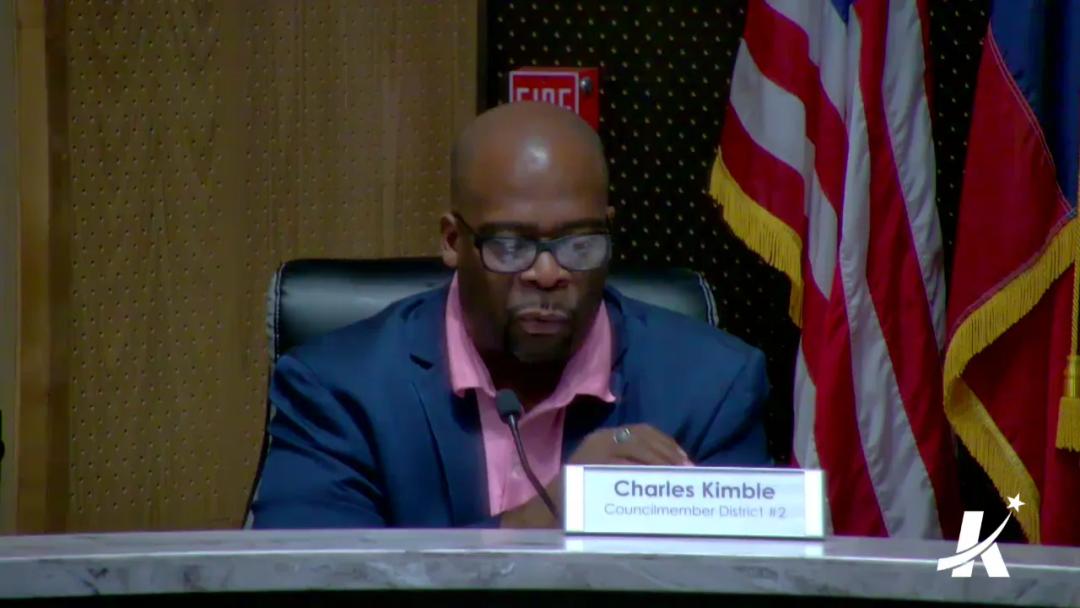
The Killeen City Council met on September 1, 2026, at 5:00 PM in City Hall. The meeting included a proclamation for National Preparedness Month, a work session, citizen comments, and a regular session that approved the FY2027 budget, set a tax rate of $0.7301 per $100 valuation, and acted on several zoning and policy items. The council voted on consent and regular agenda items, with final votes recorded for the budget and tax rate. Consent Calendar - Minutes Approval (Items 2–4): Approved minutes of the Special City Council meetings on June 16 and June 22, 2026, and the Special Open House Meeting on June 23, 2026. - RS-26-130 (Police Mutual Aid Agreement): Approved a memorandum of agreement with Fort Hood Garrison Command for mutual aid and information sharing. - RS-26-131 (Rejection of Street Construction Bids): Approved rejection of all bids for FY27 Annual Street Construction Materials (Bid No. 27-02). - All consent items passed 7-0. Public Comments & Testimony - Nasira Zachary (Resident/Social Worker): Expressed concern about the FY2027 budget, noting 70 unfunded requests totaling over $6 million and 44.5 positions. Asked how the city will measure the impact of spending on residents. - Michael Fernino (Resident): Criticized the proposed tax rate, calling it a burden on residents and businesses. Questioned the $28,000 spent on a city manager search and urged fiscal responsibility. - Dr. Sue Necy Croft (Resident): Spoke on the Capital Improvement Program (CIP), specifically Project 92504 (North Killeen Grocery Site) with $250,000 budgeted but no expenditures, and Project 92503 (strategic land acquisition) with $500,000. Asked about implementation plans and whether the projects could be coordinated. - Christian Bishop (Resident): Opposed the City Council retreat and team-building workshop, questioning funding and transparency. Suggested the retreat be held locally to save money. - Jamie Carroll (Resident): Proposed a low-cost, local team-building activity (e.g., sack races) in a city park, livestreamed, to improve community engagement and reduce costs. - Leo Kukison (Resident): Opposed the retreat, citing timing with tax increases and past controversies. Supported holding the event locally if necessary. - Anka Negu (Resident): Criticized the planned $1.7 million remodel of the Animal Adoption Center, stating the building was misrepresented in 2023. Opposed the tax rate increase, asking for a no-new-revenue rate. Discussion Items - Youth Advisory Commission Appointments (RS-26-132): Staff presented 13 recommended student commissioners for FY2027. Councilmember Bass praised the selection process. Approved 6-0 (Councilmember Nash-King absent). - Schlueter Group Amendment (RS-26-133): Approved an amendment to reduce the annual fee from $100,000 to $1 for year two of the agreement. Councilmember Kimball noted appreciation for the firm’s services but stated the city should pay for services rendered. Approved 6-0. - Rezoning – 312 East Texas Avenue (OR-26-015): City-initiated rezoning from B-3 to R-1 on 0.16 acres. The property owner’s consent form was received after the agenda was posted, so staff recommended approval. Planning and Zoning Commission had recommended approval unanimously. Approved 6-0. - Rezoning – 1401 and 1411 Mulford Street (PH-26-027): Proposed rezoning of 0.144 acres from B-3 to R-2 (1411 Mulford) and R-1 (1401 Mulford). Consent form was obtained for 1411 but not for 1401. Staff recommended approval for 1411 and disapproval for 1401. Councilmember Brown moved to approve 1411 and disapprove 1401; Councilmember Kimball expressed concern about waiting for the owner. Approved 6-0. - Solid Waste Ordinance Amendment (PH-26-028): Established fees for curbside brush collection and non-collectible materials. Staff explained the fee structure: $10 for up to 6 cubic yards of brush, plus $7.50 per additional cubic yard; non-collectible items have a $150 base fee plus $10 per cubic yard. The ordinance aims to recover costs and reduce subsidies. Councilmember Brown requested a grace period for implementation. Approved 6-0 with Brown proposing (vote margin unclear but passed). - Water/Sewer Rate Amendment (PH-26-029): Approved 5% residential water rate increase, phase five of commercial water rate increase, and $0.65 increase to residential sewer base rate. Average residential customer (5,600 gallons) will see a $2.05 monthly increase (2.16%). Councilmember Brown opposed, citing cumulative burden of multiple increases. City Manager Cagle noted that the water fund is tight and that rates remain below many peer cities. Approved 6-1 (Brown opposed). - Budget and Tax Rate (Items 13–17): - Public Hearing on Tax Rate (PH-26-030): Held and closed. Staff explained the proposed rate of $0.7301, an increase of $0.0287 over the current rate, generating $78.2 million in revenue. The median homestead value increase is $68.48 per year ($5.71/month). - Budget Adoption (OR-26-016): Approved the FY2027 Annual Budget. Roll call vote: 6-1 (Brown opposed, all others yes). - Ratification of Property Tax Revenue Increase (RS-26-134): Approved a 3.59% increase in the tax rate. Roll call: 5-2 (Bass and Brown opposed; Gonzalez, Kendrick, Kimball, Nash-King, Williams yes). - Setting Tax Rate (OR-26-017): Set the tax rate at $0.7301 per $100 valuation. Roll call: 5-2 (same votes as above). - Five-Year Capital Improvement Program (RS-26-135): Adopted the FY2027-2031 CIP. Councilmember Brown clarified that CIP funds come from excess fund balance, not current tax dollars. Approved by voice vote. - City Council Retreat and Team Building Workshop (DS-26-079): Discussed but no formal action. Mayor Solomon clarified the retreat would be local, possibly at CTC, with a proposed cost of $5,000–$6,000 for an outside moderator. Several councilmembers expressed mixed views; some supported a local, low-cost event, while others questioned the need and timing. No consensus was reached, and the item was not put to a vote. Key Outcomes - Consent Agenda: Approved 7-0. - Youth Advisory Commission Appointments: Approved 6-0. - Schlueter Group Amendment: Approved 6-0. - Rezoning – 312 East Texas Avenue: Approved 6-0. - Rezoning – Mulford Street: Approved 6-0 (1411 rezoned to R-2, 1401 denied). - Solid Waste Ordinance: Approved 6-0. - Water/Sewer Rate Amendment: Approved 6-1 (Brown opposed). - FY2027 Budget Adoption: Approved 6-1 (Brown opposed). - Tax Rate Ratification and Setting: Approved 5-2 (Bass and Brown opposed; required 60% approval met). - Five-Year CIP Adoption: Approved by voice vote. - Retreat Discussion: No action taken. The council will consider future options. Note: Minutes were not available for this meeting; the summary is based on the agenda and transcript.
The Public Works Council Committee met on September 1, 2026, at 11:00 AM to consider a proposed annexation ordinance and a traffic control device agreement. The committee approved previous minutes and ultimately recommended the traffic agreement to the full council, while voting against recommending the annexation. Consent Calendar - Approval of minutes from the August 4, 2026 meeting (MIN-26:074): Motion by Chris Moore, seconded by Charles Coleman, passed with 7 ayes (present: 8 members, Chair John Street did not vote). Public Comments & Testimony - Jim Gramling (Gramling Law Firm), on behalf of the applicant Browning Family Trust, expressed support for annexing 160 acres south of Valley View. He argued that City Water and Light's plan to install a lift station on the property necessitated annexation to avoid creating an enclave, and that without annexation the city would have no control over future development due to the 2025 repeal of extraterritorial jurisdiction. He stated there were no current development plans. - Terry Browning, a family member of the trust, expressed support for annexation, providing historical background on the farm and confirming no immediate development plans, but noting inevitable future development. He suggested City Water and Light would prefer to supply its own power rather than pay Craighead Electric. Discussion Items - Annexation Ordinance (ORD-26:029): Councilmembers debated the proposal extensively. Councilmember Chris Moore voiced strong opposition, noting the property would be surrounded on three sides by county land and that annexing 160 acres would multiply the burden on city services. He stated the city has ample undeveloped land within current limits. Councilmember Kevin Miller opposed, citing existing weaknesses in city services and describing annexation as "one more straw on the camel's back." Councilmember LJ Bryant suggested that future annexations should require a tangible benefit for the city, such as park land. Chairman John Street echoed opposition, pointing out that Jonesboro is the second-largest city in Arkansas by area (82.5 square miles) and that an impact fee study is underway; he argued no further annexation should occur until impact fees are in place. He also noted that City Water and Light will proceed with the lift station regardless of annexation. - Traffic Control Device Resolution (RES-26:105): The committee reviewed a resolution authorizing an agreement with the Arkansas Department of Transportation for modifying traffic signals on Highway 91 at Marion Berry Parkway and Caraway Road, installing a pedestrian hybrid beacon at Melrose Street, and installing a rectangular rapid-flashing beacon (RRFB) at Dean Street. No opposition or discussion was offered. Key Outcomes - The motion to recommend the annexation ordinance (ORD-26:029) to the full City Council failed (2 ayes, 5 nays). Voting in favor: Charles Coleman and Janice Porter. Voting against: Kevin Miller, LJ Bryant, Anthony Coleman, Ann Williams, and Chris Moore. - The motion to recommend the traffic control device resolution (RES-26:105) to the full City Council passed (7-0). All present members voted aye. - The meeting was adjourned by unanimous consent.
The New Rochelle Zoning Board of Appeals (ZBA) met on Tuesday, September 1, 2026, at 7:00 PM to hear applications for area variances and administrative extensions. Chair Erica Aisner presided, with Clerk Regina O’Hara calling the roll. The board considered five variance cases and two 12-month extension requests. Consent Calendar - Case 17-2025 (33 Ferdinand Place): Approved a 12-month extension for the demolition of an existing one-car garage and construction of a new two-car garage. (Unanimous) - Case 16-2025 (27 Balu Avenue): Approved a 12-month extension for a one-story kitchen addition. (Unanimous) Public Comments & Testimony Case 20-2026 – 40 Beach Road - Opposition: Joseph Ariel (attorney for 27 Springdale) argued the variance was for increased living space, not a garage rebuild, and that the applicant had not met the five-factor test. Jacob Yanovia (resident at 27 Springdale) stated neighbor support was not well-informed and that the proposed addition would negatively impact his property. - Support: Ed Akerzall (architect) noted that the neighborhood’s fabric includes many non‑conforming setbacks, and that the requested 12-foot rear setback is consistent with surrounding properties. Applicant Devin Hammonds emphasized the need to accommodate her mother and expressed frustration that opposition only arose after months of engagement. No public comments were made on cases 24-2026, 27-2026, 28-2026, or 29-2026. Discussion Items Case 20-2026 – 40 Beach Road (Variance Denied) The applicants sought to demolish a dilapidated detached garage and construct a two-story attached garage addition, requiring a rear-yard variance from 30 feet to 12 feet (a 60% reduction). Architect James Fleming presented revised plans that moved the addition closer to the house and further from Springdale. Opposition attorney Joseph Ariel argued the variance was for living space, not a garage, and that the applicant could rebuild the garage at one level without increasing nonconformity. Board members questioned the size and impact; the motion to deny passed unanimously. Case 24-2026 – 22 Dearborn Street (Variance Approved) Architect John Woodruff presented a revised plan reducing the number of requested variances from four to three. The applicant sought to demolish a dilapidated garage and build a new two-car detached garage, along with an exterior stair and door. The board found the variances feasible, not detrimental, and approved the application unanimously. Case 26-2026 – 777 Webster Avenue (Referred to Planning Board) The board referred this application to the planning board without hearing, deferring presentation until after the planning board’s review. Case 27-2026 – 31 Clover Place (Variance Approved) Architect John Woodruff requested a floor-area-ratio (FAR) variance to convert a two-story loft into a second-floor bedroom within the existing building envelope. The existing house already exceeded the permitted FAR due to a prior 1989 expansion. The board found the 6% FAR increase minor, with no external changes, and approved unanimously. Case 28-2026 – 25 Walnut Street (Variance Approved) Architect JC Calderon sought two area variances for exterior stairs and a landing that deviated from previously approved plans. The board noted the existing non‑conforming setbacks and found the variances necessary for access, with no adverse neighborhood impact. Approved unanimously. Case 29-2026 – 287 Beachmont Drive (Variance Approved) Architect Paige Lewis presented a two-story rear addition that increased the FAR from 0.322 to 0.336 (a 4.3% increase). The existing house was already non‑conforming. The board considered the increase minimal and consistent with neighborhood character, and approved the variance unanimously. Key Outcomes - Case 20-2026: Variance denied (unanimous). - Case 24-2026: Variances approved (unanimous). - Case 26-2026: Referred to planning board. - Case 27-2026: Variance approved (unanimous). - Case 28-2026: Variances approved (unanimous). - Case 29-2026: Variance approved (unanimous). - Administrative extensions: Both approved unanimously. The meeting adjourned at approximately 8:45 PM.
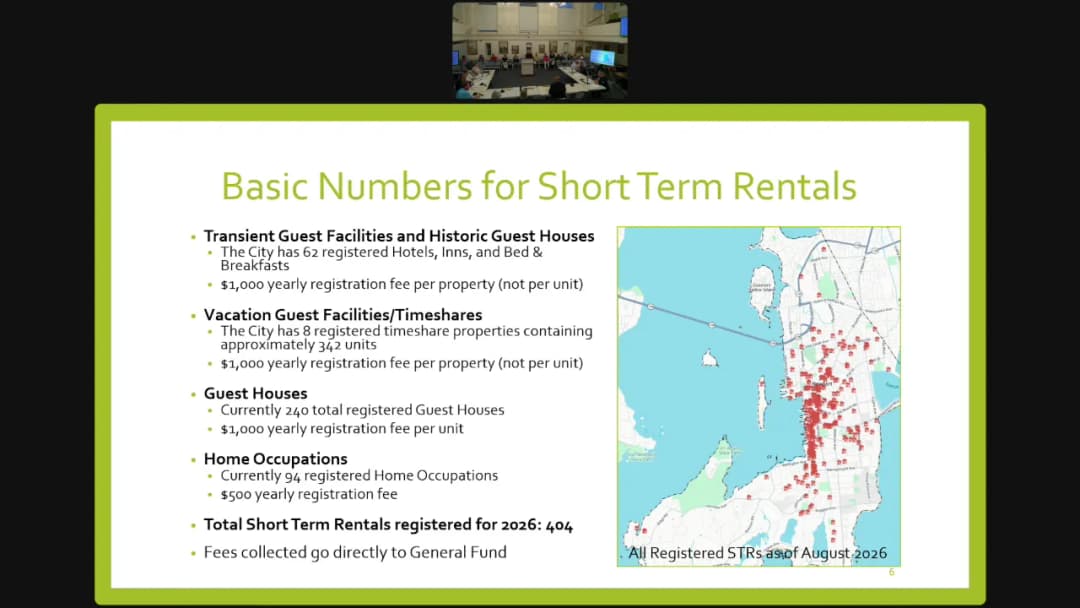
The Newport City Council held a workshop on September 1, 2026, to discuss potential ordinance changes regarding short-term rentals following Resolution 2025-88. Staff presented an overview of rental categories, registration data, enforcement efforts, parking variances, and proposed modifications. Public comments were heard from residents and business owners. No votes were taken; the workshop was informational and aimed at gathering input for future council action. Public Comments & Testimony - Mitch Edwards (representing Rhode Island Short Term Rental Association and Newport Property Rights Association) expressed concern that requiring one parking space per bedroom in commercial zones would effectively eliminate new short-term rentals. He noted existing properties would be grandfathered but prospective owners could be impacted. He supported a survey to gather data on guest vehicle usage. - Sarah Adams (owner of 9 Goodwin Street) objected to the parking requirement disparity between short-term and long-term rentals, stating her property has driveway space not counted under current rules. She argued that short-term rentals represent less than 2% of housing stock and that proposed changes would unfairly segregate streets and harm property values. She suggested differentiating between whole-house and room rentals at registration. - Shane Cooper (Barrington resident, frequent visitor) argued that the root issue is inadequate parking, not short-term rentals themselves. He urged the council to focus on creating more parking infrastructure (e.g., expanding Mary Street lot) rather than restricting rentals. He noted that tourism is vital to the city and that parking shortages cause congestion. - Olivia Nagel (553 Bellevue Avenue) questioned the discrepancy between 993 Airbnb advertisements and only 404 registered short-term rentals, clarifying that multiple ads per property and timeshare listings skew the numbers. She advocated for scaling registration fees (currently $1,000 for both a single guest house and a large hotel) and increasing penalties for repeat offenders. - Martin Fisk (owner at 8 Franklin Street) expressed uncertainty about grandfathering provisions—whether continuous registration is required and if rights transfer to new owners. He called for segmentation of registration fees based on business scale, questioned where the $1.5 million in collected fees has been spent, and raised the issue of “zombie houses” (wealthy owners leaving properties vacant for months) as a housing stock concern. - Lynn Sanzo (Spring Street resident) reported parking issues from short-term rental guests who leave cars for days with hang tags, impacting residents. She praised enforcement efforts but underscored that insufficient parking in neighborhoods bordering commercial districts is a long-standing problem. - Emily Hawley (119 Ruggles, registered voter) shared the story of an 83-year-old resident on John Street who cannot park near her home due to short-term rental vehicles, urging the council to prioritize resident needs. - Linda Stevenson (Dixon Street) supported stricter enforcement and scaling fees. She noted that short-term rentals generate trash, safety concerns, and loss of housing; she cited a murder near her home five years ago and conversions of commercial spaces (e.g., dry cleaner) into rentals. She advocated banning short-term rentals in limited business zones to preserve neighborhood fabric. - Linda Pereira (3 Goodwin Street, registered voter and property owner) testified that she rents her home to supplement income, that most guests are families attending weddings, and that parking issues are mainly caused by Salve Regina University students, not short-term guests. She called the focus on short-term rentals “discrimination” and urged a holistic parking solution. - Karen Pinelli (39 Toro Street) operates two short-term rentals in her building with on-site parking. She noted that many guests arrive without cars and that long-term rentals could generate more vehicles per unit. She opposed restrictions that would prevent her from converting her primary residence into a rental or that would limit her ability to sell the property with the same rights. - Casey Horton (Goodwin Street, Boston resident) cautioned against using weak data to justify restrictive ordinances, arguing that observed increases in short-term listings may reflect tech adoption rather than housing conversion. He urged the council to focus on zoning reform that permits multifamily housing as-of-right to address the housing crisis, rather than attacking short-term rentals. (Shortened due to time; council acknowledged receipt of his written comments.) Discussion Items - Staff Presentation: Nick Armor (Zoning Officer) and Drew Estebrook (Short-Term Rental Supervisor) presented an overview of rental types (long-term, seasonal, short-term categories), current zoning rules, registration data (404 total registered properties in 2026: 62 hotels, 8 timeshare properties, 240 guest houses, 94 home occupations), fee collections (from $269,000 in 2022 to $365,500 in 2026 to date), and enforcement statistics (84 citations in 2025, 41 in 2026 to date). They explained that parking variances for short-term rentals often require lease parking within half a mile, but the city does not monitor compliance. Proposed ordinance changes include: moving guest houses from by-right to special use permit in general business and waterfront business zones, requiring on-site parking for all bedrooms (eliminating parking credits and the ability to seek variances), and prohibiting conversion of ground-floor commercial space to guest house or manager units. Staff also raised the idea of scaling registration fees and improving enforcement (e.g., using default judgments and liens for non-payment). - Council Questions: Council members inquired about the discrepancy between state and local registration numbers (626 state vs. 397 city), the impact of uncounted long-term rentals and timeshares, the effectiveness of off-site parking leases, and the process for defaulting no-shows in municipal court. The city solicitor clarified that bench warrants are issued but that fines are limited to $1,000 under state law. Council also discussed the prohibition of owner-occupied short-term rentals in residential zones and the need for better enforcement coordination with the parking authority. - Parking & Compliance: Council expressed concern that short-term rental guests often park on residential streets despite lease agreements, and that the city lacks a monitoring system. The deputy city manager noted ongoing discussions with the parking superintendent to address double-dipping in commercial lots. Council suggested a survey of short-term rental operators to determine actual vehicle usage per rental. Key Outcomes - No formal votes or ordinance adoptions occurred; the workshop was for discussion and education. - Council directed staff to consider several potential actions: - Study the feasibility of scaling registration fees based on property size or rental type. - Explore improvements to enforcement, including stronger penalties for repeat offenders and mechanisms for default judgments or liens. - Investigate the impact of short-term rentals on parking and housing availability, potentially through a survey of operators and guests. - Review the proposed ordinance changes (banning parking credits, requiring on-site parking, special use permit requirement) for possible future introduction. - Coordinate with the parking authority to ensure that off-site leased parking is not double-counted and that guest parking passes are not issued to short-term rental properties. - Council members expressed varying positions: some supported tightening regulations (especially in limited business zones), while others emphasized the need for data-driven decisions and cautioned against harming existing businesses. - The workshop concluded with thanks to staff and participants; further council discussions are expected before any ordinance amendments are brought to a vote.
The New Albany Board of Zoning Appeals met on September 1, 2026, with a recorded start time of 10:30:00 UTC. Four board members were present, so a minimum of three votes was required to carry motions. The meeting was streamed and was to be archived at New Albany CityHall.com. No agenda or minutes were provided in the source materials; this summary is based on the raw transcript. Docket B-20-26 — Small Concert Venue at 416 East Spring Street - Jeff MacMahan presented the docket on behalf of the owner, Josh Rostalls, identified with Long Tail Ventures. The applicant requested approval to convert a former German American church into a recording studio, vinyl archive, and occasional small acoustic/bluegrass concert venue. The owner emphasized historic preservation and said concerts would likely occur about once or twice a month, with the space open perhaps one to two days a week. - Although the docket was listed as a land-use variance, staff clarified that the actual request was a development-standards variance for parking because the recording and concert uses are permitted in the Downtown District. - At a maximum occupancy of about 130 people, the venue would require 22 parking spaces. The applicant showed 17 available on-site and on-street parking spaces and proposed a shuttle to and from a downtown parking garage before and after live concerts. - No public comment was offered. - Staff recommended approval with conditions: shuttle service one hour before and after any live concerts, signage subject to approval by the Historic Preservation Commission and plan commission staff, and a six-month staff-level review. - The board approved the docket unanimously by voice vote. Docket B-22-26 — Baptist Health Floyd Rooftop Helipad Special Exception - The applicant, Matthew Davis for Hagerman Group, requested a special exception to permit a helicopter pad on the roof of Baptist Health Floyd at 1850 State Street in the Institutional District. - Applicant representatives said the rooftop installation would exceed 70 feet above ground and helicopters would cross nearby homes at an optimum elevation of about 100 to 500 feet. They also cited a Bell helicopter noise level of roughly 83 decibels along the flight path, compared with about 71 decibels in the current meeting room. - Staff provided background: a helipad previously operated on the Professional Arts Building, and a ground-level helipad at 210 East Cotton Avenue operated without a special exception. A notice of violation was issued, and a September 2025 special-exception application was tabled. The proposed rooftop location is higher and uses the hospital parking lot as a buffer. - Public comment: Amanda Maier, a Martin Drive resident, said residents already hear and sometimes feel helicopter landings. She questioned the relocation, flight-path notification, safety, lack of an independent noise study, and the cumulative noise from the hospital's chiller units over the past five to six summers. Elaine Murphy, a New Albany city council member and resident of 3508 Joseph Court, said the city council is working on a sound ordinance related to the Baptist Health chiller incident and asked the hospital to remedy chiller noise and be a good neighbor as the helipad moves forward. - Staff found that the six statutory special-exception criteria were met, noting that the nearest residence to the proposed helipad is about 400 feet away and not on a flight path, compared with about 270 feet for the previous Professional Arts Building helipad. The nearest residence on the northern flight path is about 500 feet away, and on the eastern flight path about 580 feet away. - Staff recommended approval subject to a written commitment to obtain a favorable FAA airspace determination under 14 CFR Part 157 and an NDOT Office of Aviation certificate of site approval under 105 IAC 33, Rule 3. The board approved the special exception unanimously by voice vote. Docket B-23-26 — E-Commerce Warehouse and Office at 1423 East Oak Street - Stephen Lunn requested a use variance to permit a warehousing and office use for his e-commerce sports cards and collectibles business in the Traditional Residential District at 1423 East Oak Street. - Lunn said the business has no retail storefront, no customer visits, and no events. He said USPS handles about 95 percent of shipments, with FedEx and UPS used periodically, and the business employs roughly three to five people. He currently rents warehouse space in Sellersburg and wants to purchase and use the Oak Street building. - Staff noted that the building is zoned residential but is not a residential building and will not become one, which establishes the unnecessary hardship needed for the variance. Staff recommended approval with stipulations that any future sign would require a permit and that the approval is personal to Mr. Lunn and is not transferable. - Staff also said it would check with the right-of-way coordinator about possible delivery or truck-crossing signage because the property had been vacant. - No public comment was offered. The board approved the variance unanimously by voice vote. Minutes Approval - Minutes from the July 7, 2026 meeting were approved by voice vote. - Minutes from the August 4, 2026 meeting were approved by voice vote. Enforcement Case — Mr. Cardoso - The board discussed a lingering enforcement case involving Mr. Cardoso, who created a curb cut from a cul-de-sac without Board of Works approval and installed a gravel driveway and an accessory structure that appeared to violate side and rear setback requirements. - Mr. Cardoso subsequently received Board of Works approval for the curb cut, but he had not yet paved the driveway, and the accessory structure remained in the noncompliant location. - The board voted to direct Mr. Cardoso to appear at the October 2026 meeting to resolve the matter, or the case would be referred to the city attorney for enforcement. Key Outcomes - Docket B-20-26 was approved unanimously with staff conditions. - Docket B-22-26 was approved unanimously with staff conditions, including the state and federal approval commitment. - Docket B-23-26 was approved unanimously with staff conditions. - July 7, 2026 and August 4, 2026 meeting minutes were approved. - Mr. Cardoso was directed to appear in October 2026 or face referral to the city attorney.