Browse by city
Date range
Search help

Search titles, summaries, topics and stored transcripts together. Keywords may match separately; put the whole query in double quotes for a phrase. Matching follows word analysis, so punctuation is not exact. Both dates are included. Documents are not searched.

SHOWING 8571–8580 ENTRIES
8571
AUG 28, 2026 · FAYETTEVILLE, NORTH CAROLINA · CITY COUNCIL
Granicus Legistar Approval Tracking and Administration Working Session for City of Fayetteville – August 28, 2026

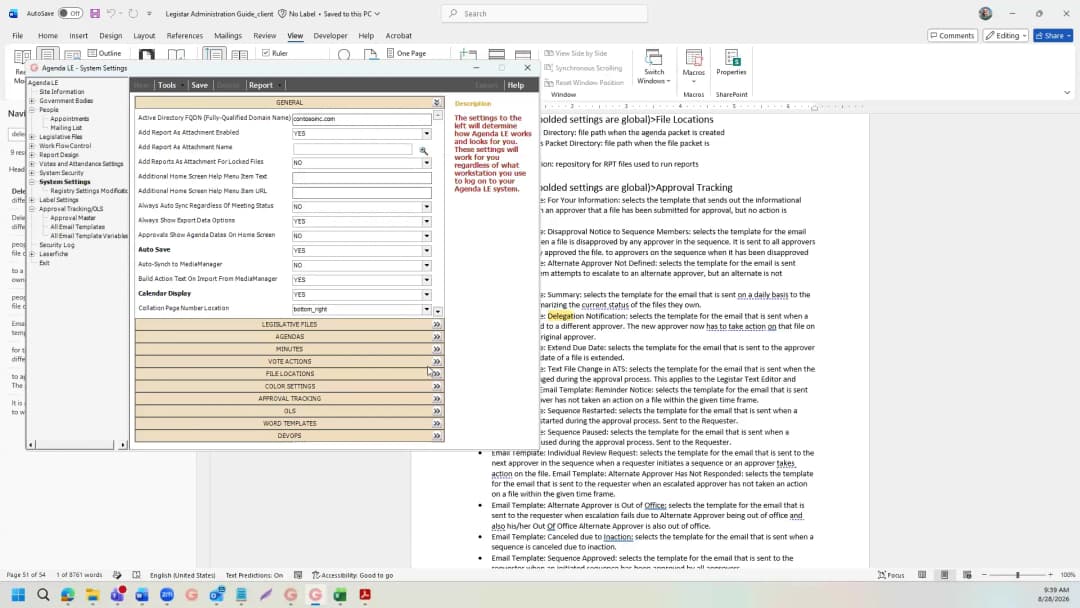
On August 28, 2026, City of Fayetteville staff met with Granicus consultant Sam for a virtual working session focused on Legistar pre-meeting processes, approval tracking, administration settings, email notifications, and out-of-office/alternate approver workflows. No agenda or minutes were available for this meeting; the summary is based on the transcript of the session. Discussion Items - Sam reviewed the administration settings related to approval tracking, noting that the Legistar Administration Guide is an almost 60-page reference covering each setting with screenshots and descriptions. - The group discussed user-level settings, including email preferences, daily summaries for approvers in multiple sequences, active status, and the "approver" checkbox, which only controls whether a person appears in approval sequence drop-downs and does not change security group access. - Staff asked about removing Rochelle Small Tony from approval tracking after deactivation failed because the system reported she was still in an approval sequence, even though the approval sequence report did not show her. Sam said this would be sent to Granicus engineering for cleanup. - Staff noted that Jerry Dietson still appears in settings despite having left about 10 years ago, indicating a need for general people-record cleanup. - Sam demonstrated local user preferences, such as default controlling body, default department, default file type, default meeting body, color settings, password resets, and out-of-office settings with alternate approver delegation. - Sam and staff discussed using the out-of-office feature and alternate approvers more intentionally. Staff expressed interest, noting that training members would be a consideration. - The group reviewed inactive email templates, including item disapproved, alternate approver not responding, alternate approver out of office, canceled sequence, reminders, approval sequence complete, paused/restarted sequence, attachment changed, file changed, delegated to you, and disapproved review sequence. - Staff requested that the disapproved review sequence notification go to the initiating party rather than the approver, and Sam adjusted the template/recipient settings accordingly. - Staff did not want the overdue individual review request email because they already send direct reminders to overdue approvers. - Sam explained the "from" email address setting and changed it so approval-related emails appear to come from the staff member's email address rather than the Granicus do-not-reply address. - A staff member asked whether Legistar out-of-office status could be set through an API, ideally syncing from their Exchange environment to automatically update Legistar and route items to backup approvers. Sam checked the API documentation, did not see that function, offered to submit a feature request, and said API access could be enabled with authentication tokens and IP restrictions if desired. - Staff declined to enable the API at this time, preferring not to turn on unused features. Key Outcomes - Agreed to enable or keep enabled several approval email notifications, including disapproval notices, reminders, canceled sequence notifications, approval sequence complete notifications, delegated-item notifications, attachment-change notifications, and file-change notifications. - Changed the default from-email behavior so approval notifications appear to originate from the staff member's email address. - Sam will send a follow-up email with a session summary, the administration guide, the people list, the email template report, and the meeting recording. - Sam will submit an engineering ticket to resolve Rochelle Small Tony's hidden approval sequence association so she can be deactivated. - Sam will submit a feature request for API-based out-of-office/away status integration. - The next session will be a deep dive into meeting minutes workflows.
TECHNOLOGY AND INNOVATION 87% · PROCEDURAL 7% · PERSONNEL MATTERS 5% · LEGAL AFFAIRS 1%
8572
AUG 28, 2026 · ANCHORAGE, ALASKA · ASSEMBLY & COMMITTEE MEETINGS
Anchorage Assembly Housing Action Plan Work Session - August 28, 2026

The Anchorage Assembly held a work session on Friday, August 28, 2026, from 11:00 AM to 1:00 PM to review the Housing Action Plan, housing policy progress, and hear from administration and private developers on current challenges and successes. The session was chaired by Assembly Chair Brawley and included introductions from members, presentations from the administration on the 10,000 Homes Plan, from ACDA on their pipeline and catalytic efforts, and from three private developers (Cook Inlet Housing Authority, Debenham Properties, and the Home Builders Association). No public testimony was taken. The work session did not include any formal votes but identified multiple priorities for future assembly action. Discussion Items - Housing Action Plan Overview: Chair Brawley provided a history of housing work since 2012, noting that many challenges remain unchanged. The plan adopted December 2023 includes six strategies and a toolbox of assembly actions. She asked members to consider whether to update the plan. - Progress Report: Claire Ross presented the second edition of the progress report, tracking actions under each strategy. She noted some metrics (e.g., evictions) are difficult to track and may be replaced with data from the 10,000 Homes dashboard and new permitting software expected in six months. - Administration Presentation (Bob Dole, Director of CED): Dole highlighted the 10,000 Homes in 10 Years plan, focusing on cutting red tape, fixing municipal processes, capital contributions, and remediating neglect. He reported that housing permits issued in 2026 already exceed all of 2024 or 2025, with multifamily growth leading. He mentioned a pending AO to give planning director more discretion on dimensional variances, and a future AO to better protect vacant/abandoned properties from trespass. He also noted that the Urban Design Commission was sunset, with its fence variance function moved to Planning and Zoning. - ACDA Presentation (Mike Robbins): Robbins described ACDA's role as a catalyst for development, highlighting recent projects (Block 96, North Point, Willow Commons modular project in 120 days). He noted a new real estate market study due in December that will break down housing needs by price point and unit type. ACDA is working on land acquisition from the state, a modular manufacturing prospect, and a land lease program. - Private Developer Presentations: - Tyler Robinson (Cook Inlet Housing): Cited multifamily design standards pause and major site plan review pause as critical – without them, the 24-unit Baxter project would not be leasing now. He noted improved municipal coordination but asked for permanent adoption of the design standards pause (ends 2028), improved RFP process (invitation for partnership rather than full design upfront), infrastructure funding challenges ($900,000 water main extension for 40 homes), and tax abatement expansion to include smaller projects like fourplexes on adjacent parcels. He also called for sample site plans to clarify what is allowed on R1 parcels. - Sean Debenham (Debenham Properties): Emphasized that permitting remains a bottleneck – Raspberry Townhomes took nine months to permit. He advocated for a culture of “how do we get to yes,” reducing fire lane requirements that cost 15 units at that project, and increasing lot coverage allowances (R3 allows 40%, but he achieved only 30%). He noted that fire lanes currently dictate multifamily housing policy. - Bill Taylor (Home Builders Association): Described a case where DEC contamination standards were replaced by stricter city standards, adding $82,000 in unnecessary costs. He called for a single point of authority or “housing czar” to arbitrate interdepartmental disputes and a philosophy of “substantially in compliance” from the mayor to allow flexibility. - Member Discussions: - Member Baldwin Day raised the need for a municipal infrastructure funding mechanism, noting AWO’s constraints and the lack of a clean funding stream. She also pressed for more strategic use of municipal land to ensure it produces the housing types most needed. - Member Scout requested a public-facing graphic or timeline for vacant/abandoned property enforcement to manage community expectations. - Member Martinez encouraged use of the Economic Development Framework’s four pillars (stackable return on investment, preemptive resiliency, equity) to evaluate housing investments. - Member Voland noted the need for 2,600 new very low to moderate income rental units (from a mayor’s office 2025 study) and asked who will build them without public dollars. - Single Most Impactful Action: Developers gave rapid responses: Bill Taylor – ability to contract out permitting and inspections; Tyler Robinson – infrastructure funding and realistic municipal standards; Sean Debenham – streamline permitting process including accepting private certification. Key Outcomes - No formal resolutions or votes were taken. - Assembly members will consider updating the Housing Action Plan to reflect current priorities and align with the 10,000 Homes strategy. - Chair Brawley indicated intent to work on making the multifamily design standards pause permanent (currently set to expire in 2028). - The administration committed to developing a graphic or timeline for vacant/abandoned property processes for public communication. - A proposed ordinance to give planning director more variance discretion is headed to the Planning and Zoning Commission. - An administration AO to better protect vacant/abandoned properties from trespass is forthcoming. - ACDA expects to release a real estate market study in December 2026. - The assembly will hold a separate work session on the proposed Tojo Block 102 land swap later that day (1:20 PM-2:30 PM). - Members will follow up on infrastructure funding options, sample site plans for R1 parcels, and the status of the rehab and repair fund (to be addressed by AHD).

HOUSING 31% · AFFORDABLE HOUSING 22% · PERMITTING 10% · ECONOMIC DEVELOPMENT 9%
8573
AUG 28, 2026 · JACKSONVILLE, FLORIDA · CITY COUNCIL
Jacksonville City Council Meeting on Automated Surveillance Equipment and Proposed Moratorium - August 28, 2026

Councilmember Jimmy Peluso called the meeting to order at 10:31 a.m. on August 28, 2026, to discuss automated surveillance cameras (e.g., Flock), their installation, data use, constitutional concerns, and a possible temporary moratorium. No draft legislation was presented, but Peluso outlined potential goals. The meeting included introductions, discussion among council members, and public testimony from over a dozen speakers. Public Comments & Testimony - Aaron Perkins (Springfield resident) raised fiduciary concerns about maintenance costs, urged a pause to avoid deploying technology before establishing policies, and called for clear public information to prevent speculation. - Brooke Benur (Babano?) expressed concern over Flock companies accessing driver’s license information and questioned how private cameras were installed on public right-of-way without restrictions. - Frederick Rudolph argued against broad collection of movement data, citing recent historical parallels, and noted that current legal thresholds for accessing ALPR data are too low (only a case number required). He described the surveillance as an invasive cancer. - Tim Vergenz (software engineer) stressed security flaws at Flock and other tech companies, predicted that penalties for misuse would be ineffective, and suggested a moratorium that includes disabling existing cameras (e.g., bagging them) until policy is decided. - Michael Melton (archaeologist) compared data collection to Facebook’s model and warned of risks if Flock goes bankrupt and sells its data assets. - Ben Alcorn (construction industry) supported a moratorium as a pause, not a ban, called for transparency on costs and data sharing (e.g., with ICE), and noted JSO’s budget authorization should be scrutinized. - Laura Harris described her 2022 car theft experience and argued cameras could have helped recover her vehicle faster, costing her over $5,000. She acknowledged privacy concerns but said tracking already exists via phones. - Matt Hammond cited U.S. Supreme Court cases (U.S. v. Jones, Carpenter v. U.S.) to argue warrantless ALPR use violates Fourth Amendment, and questioned conflict with Florida’s anti-stalking statute. - Addison Patrick raised national security concerns about data stored on AWS, noted a 9-month backlog for body camera records requests, and opposed all such surveillance, supporting either full contract cancellation or a moratorium. - Jennifer Dean distinguished security from surveillance, called for clear limits on data collection, audits, and public input before expansion, and suggested less intrusive alternatives. - Rachel Beabout (first-time speaker) spoke on behalf of her son, quoted Thomas Jefferson, and referenced a researcher’s comparison of Flock to pre-crime. - Marshall Branick (retired Navy) warned that aggregated movement data could be exploited by foreign adversaries, especially given Jacksonville’s military presence, and compared risks to the military’s prohibition of Fitbits on base. - Latasha Hobbs (mother of murdered son) cited JSO statistics: Flock cameras helped solve 15 murders, 17 kidnappings, 6 forcible sex offenses, nearly 100 shootings, and 172 missing person cases since 2024. She strongly supported continued use with safeguards. - Chad Sharland (State House candidate) argued he is under constant surveillance while driving from Fernandina Beach, opposed mass surveillance, and warned of targeting political minorities. - Albert Stern criticized Flock’s history of abuse, called it a tech company not a security company, warned of price changes and hacking risks, and supported a moratorium. - Dragon Balloit noted cameras were installed overnight by Dish, raised safety issues (no breakaway plates), criticized lack of accountability in JSO, and mentioned Pasco County canceling its Flock contract. - Casey Jones (South Jacksonville Beach) cited Fourth Amendment violations via third-party loophole and quoted Governor DeSantis calling ALPR usage out of control. - Yadhira Gonzalez (UNF student) argued against compromising privacy for crime-solving, called for investment in violence prevention programs, and said camera funds should address homelessness and food insecurity. - Robert Jeffers urged proactive rather than reactive policy, supported moratorium, and flagged AI risks. - Andrew Scott (software developer) warned that a year-long data retention (as JSO reportedly extended) enables massive correlation, that data is vulnerable to hacking even on AWS, and that Flock’s recommendations for retention are insufficient. - DL Cummings questioned actual efficacy of cameras, provided a case study where cameras were only supplemental, and argued that solving crimes does not automatically mean cameras were necessary. - Sean Costello noted a camera pointed at a community pool where it could not read license plates, raising concerns about capabilities and purpose. Discussion Items - Councilmember Peluso outlined four draft proposal goals: (1) a 120-day moratorium on new camera installations; (2) an inventory of all cameras in Jacksonville; (3) a new public participation process via Community Planning Advisory Committees (CPACs) for future installations; (4) a petition process for neighborhoods to request camera removal, similar to speed hump petitions. He acknowledged JSO’s support for the cameras but stressed constitutional and community awareness concerns. - Council President Helen urged a careful, community-wide debate, noting she is the JSO liaison and that Sheriff Waters shares concerns about misuse and Fourth Amendment rights. She mentioned the state legislature may also address the issue and suggested proactive measures like increased penalties for LPR data misuse. - State Representative Dean Black (in attendance) emphasized balancing security and liberty, warning against creating tools that could enable a police surveillance state. He expressed support for local discourse. - Councilmember-elect Monet Holder recognized the need to align benefits of public safety with concerns about surveillance and privacy. - Brittany Norris (administration) committed to researching how cameras were installed and other questions. - Shannon Matt Gillis (General Counsel) noted that legal authority depends on facts (e.g., ownership, location of road) and warned that ordinances passed elsewhere may not be fully lawful; she offered to research further. Key Outcomes - No formal votes were taken; the meeting was informational. - Councilmember Peluso stated he intends to continue working on draft legislation and will move forward, but wants to ensure JSO can still solve crimes while protecting privacy. - Public comment was cut short due to time; Peluso remained after adjournment to speak with remaining audience members. - Peluso provided his email (jpeluso@coj.net) for additional comments. - The meeting adjourned at approximately 11:30 a.m.

PUBLIC SAFETY 55% · TECHNOLOGY AND INNOVATION 34% · PUBLIC COMMENT 11%
8574
AUG 28, 2026 · MACON BIBB, GEORGIA · COMMISSION MEETINGS
Macon-Bibb County Public Hearing on Proposed Millage Rate - August 28, 2026

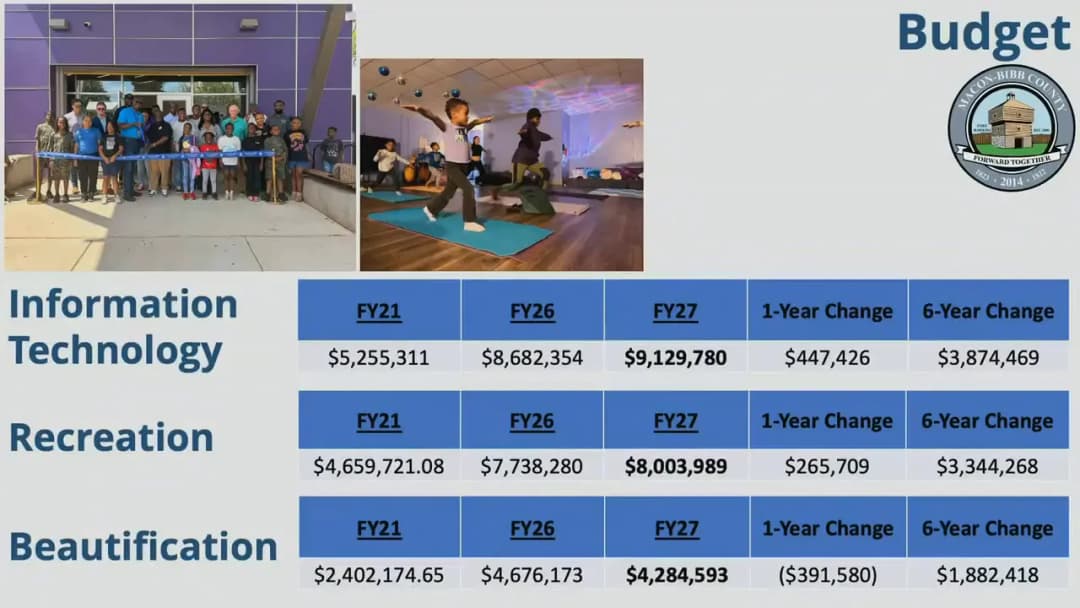
The Macon-Bibb County Commission held a public hearing on August 28, 2026, at approximately 12:00 PM to discuss the proposed millage rate for Fiscal Year 2027. The hearing was required by Georgia law due to the county maintaining the same tax rate, despite increases in property values. Mayor Lester Miller presented a detailed overview of the tax assessment process, millage rate history, and budget allocations, emphasizing public safety spending. Two members of the public provided testimony expressing concerns about the impact on renters and low-income residents. Public Comments & Testimony - Joe Booz – Executive Director and Founder of Well BASAP (financial literacy and economic stability nonprofit) and Interim Director of Houston Avenue Neighborhood Association. He noted that 63% of residents in the Houston Avenue Corridor are renters, 32% of residents in zip code 3120C live below the poverty line, and countywide 49% of households are cost-burdened (paying more than 30% of income for housing). He expressed concern that any property tax increase (even indirect through rent) would harm vulnerable populations, including the disabled and those on fixed incomes, and stated "we cannot tax our way out of a problem." - Phyllis Hightower – Concerned citizen. She echoed concerns about the effect on renters in low-income neighborhoods and financially strapped individuals, urging the commission to consider options to prevent negative impacts on housing affordability. Presentation by Mayor Lester Miller - The mayor explained that the county's role is to set the millage rate (tax rate), not property values or tax bills. He outlined the millage rate history: from 20.331 in 2021 down to 9.575 in the current year, with FY2027 proposed at the same 9.575. - Public safety spending has increased by $31 million from 2021 to 2026, despite collecting $20–30 million less in property taxes over that period. The total property tax collection of approximately $67 million barely covers the sheriff's budget alone, and combined with fire department costs reaches $103 million. - Other budget increases: Information Technology (+$3.8 million), Recreation (+$3.3 million), Beautification (+$1.88 million). - The county is holding three hearings (August 28, September 1 at 9:00 AM and 6:01 PM) with final adoption scheduled for the September 1 evening meeting. - The mayor clarified that the school system also maintained its millage rate, and noted a November referendum on senior citizen property tax exemptions for ages 65, 75, and 85. Key Outcomes - No votes were taken at this hearing. - The proposed millage rate remains at 9.575 for FY2027, unchanged from the previous year. - Two additional public hearings are scheduled for September 1, 2026 at 9:00 AM and 6:01 PM, at which the final millage rate will be adopted. - The county will continue to use the same millage rate to fund departments, with a focus on public safety.

BUDGET EQUITY ANALYSIS 51% · PUBLIC ENGAGEMENT 35% · AFFORDABLE HOUSING 14%
8575
AUG 28, 2026 · LAKE HAVASU CITY, ARIZONA · CITY COUNCIL & PLANNING AND ZONING
Lake Havasu City Council Meeting Summary – August 28, 2026

The Lake Havasu City Council met in regular session on August 28, 2026. The agenda included a legislative session update from city lobbyists, the city manager's report, a downtown sidewalk dining pilot program, approval of the second bridge construction manager-at-risk contract, discussion of the call-to-the-public placement, and routine purchase and service contract awards. Legislative Session Update - Nick Simonetta, Brittany, and city intergovernmental affairs staff presented a recap of the Arizona legislative session, noting a split government with a Democratic governor and Republican legislative majorities of 33-27 in the House and 17-13 in the Senate. - They reported nearly 2,200 bills introduced, with 415 passing the legislature, 264 signed into law, and 151 vetoed. They noted House bill numbering reached the 4,000 series for the first time in history. - They said the state budget included a 2.5% across-the-board cut to state agencies, but state shared revenue for cities was not reduced. - They described successful defense of local control against bills related to housing, water credits, and a proposed four-year freeze on city fees, and highlighted the long effort to restore limited local control over short-term rentals after the 2016 state preemption. - They said eight statewide referendums will appear on the ballot after three of 11 were removed by court rulings, and that all 90 legislators and all five statewide offices are up for election. - Council members discussed how city advocacy priorities are set, with staff relying on the League of Arizona Cities and Towns' good/bad bill list and three guiding tests: local control, protection of state shared revenue, and no unfunded mandates. City Manager Report - City Manager Knutson recognized Mayor Cal Sheehy and Councilmember Michelle Lynn for 12 years of service and Jim Dolan for 8 years of service through the League of Arizona Cities and Towns, and Councilmember Virginie Koch for completing the inaugural CivicCraft leadership program. - He announced a $910 donation from Accurate Auto Care to the Parks and Recreation after-school program scholarship fund. - Upcoming events included the city career fair on August 28, the Secretary of State's mobile business service on August 27, Coffee with the Mayor and City Manager on September 4 at 8:30 a.m., and the 25th anniversary 9/11 Memorial Ceremony on September 11 at 8:15 a.m. at London Bridge Beach. Downtown Sidewalk Dining and Beverage Pilot Program - The council considered Resolution 26-3938, creating a one-year pilot program requested by the Downtown Lake Havasu Association to allow Main Street food and beverage businesses to use temporary barriers for sidewalk dining on public right-of-way. - Downtown association president JP Thornton presented renderings and argued the pilot would enhance downtown, preserve at least a four-foot ADA-accessible route, and slow unsafe bike and e-bike traffic. He noted standard removable stanchions are 36 inches tall, while the draft resolution required 48 inches and set 10 p.m./11 p.m. closing times. - Public comment included concerns that the written resolution conflicted with the presentation, that renderings were not to scale, that actual sidewalk measurements were narrower than stated, and that enforcement and nonprofit transparency remained unclear. Others supported the program as a collective downtown effort and said insurance and additional-insured coverage would not be an obstacle. - Council discussion raised concerns about permanent alcohol service on city property, liability, uniform design, ADA clearance, and lessons from Kingman's downtown efforts. The council briefly moved to table the item, then held an executive session for legal direction. - After returning, the council adopted the resolution 6-1, effective September 1, 2026 through August 31, 2027, and directed staff to develop and design a standard temporary barrier with the downtown association. One council member spoke against the final version, saying it did not match the downtown group's request and that the program should not become a nightclub experience. Second Bridge and Roadway Improvement Project - Public Works staff and Ames Construction presented the construction manager-at-risk (CMAR) contract and guaranteed maximum price for the second bridge and roadway improvement project: $39,921,502.30. - The project includes roadway connections, a bridge over the channel with no pier in the water, utility crossings providing redundancy, ADA ramps, crosswalks, and associated water, wastewater, and drainage work. Construction is estimated at 18 months, with a mid-October 2026 start and completion in April 2028. - Funding was described as $35.5 million from the state legislature plus interest and $1 million from a waterfront development agreement, with no local taxpayer dollars directly funding the bridge work. - Public comments raised questions about ADOT approval on state land, the city project manager's experience, use of state taxpayer money, and potential traffic backups at the new stop-controlled intersections. City staff responded that the roadway is a city roadway, the project is managed by qualified city staff and expert consultants, and traffic analysis was done. - The council approved the contract and GMP with Ames Construction 6-1, with Councilmember Dolan voting no and reiterating opposition to the island development bridge. Call to the Public Procedure - Councilmember Moses asked the council to discuss the current placement of call to the public at the end of meetings and consider moving it earlier. He read the existing ordinance and proposed guardrails such as a 30-minute cap. - Most council members supported moving call to the public to the beginning of meetings, while several differed on whether a time limit was needed. Councilmember Moses said he would not support moving it without some guardrails. - Public comments included a suggestion to hold call to the public before the consent agenda and at the end of the meeting. - No code change was made. The mayor stated that, by consensus, call to the public will be moved administratively to the front of the agenda beginning with the next meeting, with no fixed time limit; the mayor will manage the room and may ask people with shared viewpoints to designate a spokesperson for large groups. Other Action Items - The electric vehicle charging station site license agreement under item 7.3 was pulled and will return at a future meeting. - The council approved 7-0 the cooperative purchase of a 250-horsepower Flygt submersible pump for the London Bridge lift station from James Cook/Hobson Inc. The pump had been in service about 20 years and conveys roughly 1 to 1.5 million gallons of wastewater per day. - The council approved 7-0 citywide pest and weed control awards: Parker Pest Control LLC for pest categories A, C, and D, and URW LLC (United Right-of-Way) for weed control category B, allowing expenditures above the purchase threshold but within the annual departmental budget. Councilmember Campbell urged more aggressive weed control along bike paths and highways. Key Outcomes - Adopted Resolution 26-3938 (downtown sidewalk dining pilot) 6-1. - Approved the $39,921,502.30 CMAR contract and GMP with Ames Construction for the second bridge 6-1. - Directed administrative move of call to the public to the beginning of future agendas, without code change. - Approved the London Bridge lift station submersible pump purchase 7-0. - Approved citywide pest and weed control contract awards 7-0. - Noted next regular council meetings on September 8, 2026, and September 22, 2026, at 5:30 p.m.

PUBLIC ENGAGEMENT 27% · PROCEDURAL 25% · ENGINEERING AND INFRASTRUCTURE 16% · LOCAL CONTROL 6%
8576
AUG 28, 2026 · CLEVELAND, OHIO · CITY COUNCIL MEETINGS
Cleveland City Council Emergency Liquor Permit Resolution – August 28, 2026

The Cleveland City Council convened on August 28, 2026, at 16:50:26 UTC, with a moment of silence and the Pledge of Allegiance. No agenda or minutes were available for this meeting, so this summary is based on the raw transcript. The council considered an emergency resolution objecting to the renewal of a liquor permit, handled the previous meeting's journal, excused three absences, and adjourned. Consent Calendar - Councilmember Casey moved, seconded by Councilmember Hudson, to suspend the rules so the reading of the previous meeting's minutes could be dispensed with and the journal approved. The transcript records the roll call as eleven yeas. Emergency Resolution 1021-2026 - Councilmember Hudson introduced Resolution 1021-2026 as a first-reading emergency resolution objecting to the renewal of a C2 and C2X liquor permit at a location transcribed as 'seventy.' - On the roll call for passage of the emergency resolution, the transcript records twelve yes votes; no no votes are transcribed. Key Outcomes - Resolution 1021-2026 passed with twelve affirmative votes. - By motion of Councilmember Casey, the absences of Councilmembers House Jones, Jones, and Starr were excused. - Council adjourned to the call of the chair; the next meeting is scheduled for September 14, 2026.

PROCEDURAL 100%
8577
AUG 28, 2026 · KIRKLAND, WASHINGTON · PLANNING COMMISSION
Kirkland Planning Commission Meeting Summary - August 28, 2026

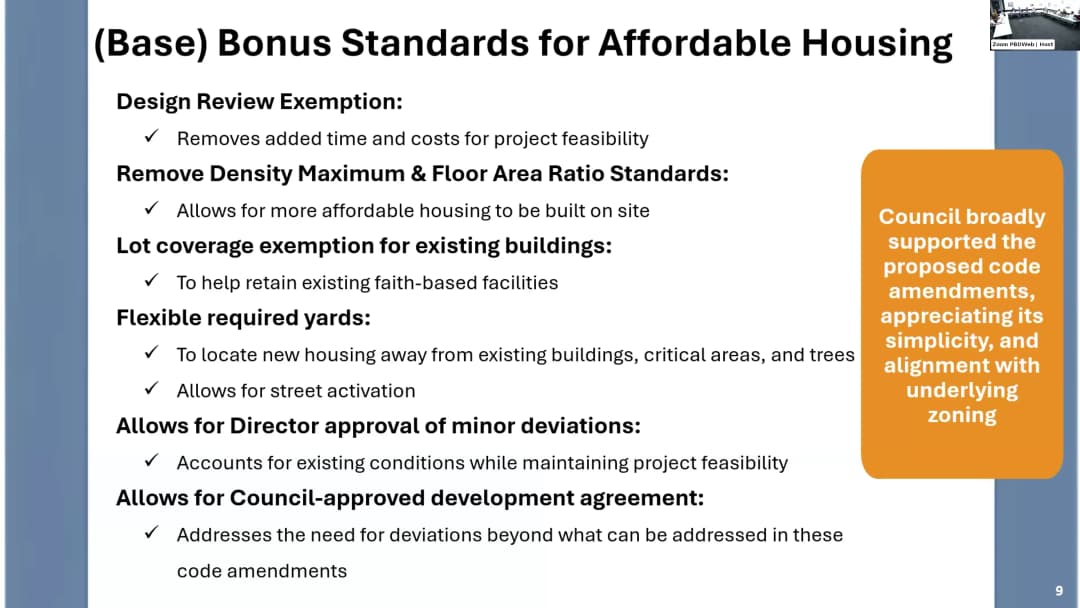
The Kirkland Planning Commission met on August 28, 2026, for a study session and two public hearings. The study session focused on the Neighborhood Stores and Services Code Amendment project, exploring updates to regulations for home occupations and introducing small-scale neighborhood commercial uses. The public hearings addressed code cleanup for state-mandated parking reforms and zoning amendments to facilitate affordable housing on faith-owned land. The Commission voted unanimously on the parking reform recommendations after amending bike parking standards, and unanimously recommended the faith-owned land amendments with additions to support homeownership and property transfer provisions. Public Comments & Testimony - B Naon, a 30-year downtown Kirkland resident, spoke during the public comment period (non-hearing items) about the importance of physical accessibility in any new neighborhood commercial regulations. They argued that current building codes are insufficient and urged the Commission to consider stronger accessibility standards beyond zoning code, citing Seattle as an example. - Mike O'Ryan, representing St. John's Episcopal Church, expressed support for the faith-owned land affordable housing amendments, stating the goal of his parish is to be an irresistible institution for the neighborhood and that the proposal creates possibilities for human flourishing. - Alicia Ruiz, Advocacy and Policy Manager for Habitat for Humanity Seattle King and Kittitas Counties, expressed support for the faith-owned land amendments. She urged the Commission to ensure the code explicitly allows homeownership opportunities and allows faith communities to sell land to mission-aligned developers (like Habitat) while retaining incentive benefits, citing a real-world example from Bellevue where lack of clarity caused two-year delays. Study Session: Neighborhood Stores and Services Code Amendment - Staff (LeAndra Baker-Lewis, Senior Planner) presented a two-phase project to update home occupation regulations and introduce neighborhood-serving commercial uses. Staff outlined policy assumptions, reviewed existing regulations, and shared comparative analysis with neighboring cities. Key discussion points included: - Commissioner Nolan questioned whether loosening home occupation rules would significantly reduce car trips, noting that truly trip-reducing uses (e.g., cafes, corner stores) require much larger changes. - Commissioner Bunyan emphasized the need to bring unregistered home-based businesses into the system and to understand the impact of current codes on the 4,000 existing license holders. - Commissioner Chowdhury noted that square footage limits in other cities vary widely; some are too restrictive (e.g., 50-foot buffers) and may make businesses infeasible. - Commissioner Bunyan raised concerns about enforcement challenges given the difficulty of distinguishing business visitors from personal guests. - Commissioners discussed the line between home occupations and neighborhood commercial, with ideas including limiting hours of operation, square footage, and requiring on-site residency for commercial uses. - Commissioner Rutherford suggested a conservative initial implementation with a feedback mechanism, while Commissioner Nolan argued against arbitrary customer-per-day limits for businesses like coffee shops. - Commissioner Medea highlighted the importance of regulating light and glare. - Commissioner Ricer expressed concerns about noise and traffic from food service businesses, using Daru as an example of unintended consequences. - Commissioner Jacobson proposed allowing neighborhood commercial citywide with tiers: low-impact uses (e.g., record stores) at 500 sq ft, and alcohol-serving uses only on arterial streets up to 1,200 sq ft, noting the trade-off between discouraging drunk driving and neighborhood compatibility. - No formal decisions were made; staff will use the feedback to refine regulatory options and return for a second discussion. Public Hearing: Parking Reform Code Clean-up Amendments - Staff (Martha Rubardt) presented phase two of implementing state parking reform (SB 5184). The proposal included code cleanup, ADA parking recommendations (maintaining building code standards), and bicycle parking adjustments. The Commission discussed: - The option to either retain existing bike parking standards for the Station Area and Goodwill site or apply citywide standards (lower rates). - An amendment to add a reference to ADA building code requirements in the zoning code (passed 7-0). - A later amendment to lower bike parking ratios in the Station Area and Goodwill site to match citywide standards while retaining design standards for the Goodwill site (passed 6-1, Commissioner Ricer opposed). - The main motion, as amended, was approved unanimously. Public Hearing: Affordable Housing on Faith-Owned Land Zoning Amendments - Staff (Scott Guter) presented the proposal to allow affordable housing on faith-owned properties with density bonus incentives, including height increases, lot coverage flexibility, reduced design review, and an exchange ratio for affordability levels. The Commission discussed: - Commissioner Bunyan asked about the long-term funding of the A Regional Coalition for Housing (ARCH) support position; staff noted it is currently permanently funded but acknowledged future risks. - Commissioner Rutherford clarified that setback adjustments apply to the entire building above a threshold and only at the perimeter of the faith-owned land. - Commissioner Bunyan raised a question from a letter by the Housing Development Consortium about ensuring homeownership eligibility and property transfer provisions. - Public testimony supported the proposal, with additional requests to explicitly include homeownership and allow transfer of incentives when faith organizations sell to affordable housing developers. - A motion to adopt staff recommendation was made, followed by an amendment to direct staff to draft language ensuring homeownership opportunities and transfer of rights to mission-aligned developers (passed unanimously). - The main motion, as amended, passed unanimously. Administrative Reports - Staff announced calendar updates: the September 10th miscellaneous code amendments public hearing is moved to September 24th; the next Planning Commission meeting will be in Council Chambers. The next City Council meeting will include briefings on short-term rental regulations, a square footage exemption threshold vote, and adoption of detention facility code amendments. Key Outcomes - Neighborhood Stores and Services Code Amendment: No vote; direction provided for staff to continue community engagement and refine options for a second study session. - Parking Reform Code Clean-up: Commission voted 7-0 to recommend the code amendments with an ADA reference. A subsequent amendment to standardize bike parking requirements across the city passed 6-1. The final recommendation passed unanimously. - Affordable Housing on Faith-Owned Land: Commission voted unanimously to recommend the code amendments as presented, with an added direction to include language ensuring homeownership eligibility and transferability of incentives when property is sold to affordable housing developers.

ZONING REGULATIONS 45% · AFFORDABLE HOUSING 12% · ACTIVE TRANSPORTATION 11% · PUBLIC ENGAGEMENT 9%
8578
AUG 28, 2026 · LOS ANGELES, CALIFORNIA · CITY COUNCIL
Los Angeles City Council Regular Meeting - August 28, 2026

The Los Angeles City Council convened on Friday, August 28, 2026, at approximately 10:00 AM (inferred from references to "good morning") under the chairmanship of Councilwoman Monica Rodriguez acting as Council President. The meeting featured presentations recognizing Guatemalan Heritage Week, artist Lalo Garcia, and an Eagle Scout project, followed by public comment and approval of multiple agenda items. Consent Calendar - Items 10 through 12, 14 through 17, 19, 20, 24, 26, and 27 were adopted unanimously (10 ayes) after roll call. Item 26 was later reconsidered and approved as amended (13 ayes). - Item 26, as amended by amendment 26A, was approved 13-0. Public Comments & Testimony - Channel 35 Contractors: Numerous contractors (including Diana Jenkins, Val Logan, Sebron Benson, Michael Ryan, Landa Stokes, and others) spoke during general public comment, urging the council to investigate the transition to a new subcontractor (Squadron), citing concerns about reduced work hours, delayed payment, and diminished coverage of city events. Several speakers requested an independent investigation of ITA and LA City View management, termination of the Squadron contract, and protection of the existing workforce. - Property Liens: Dr. Lisa Catanzarite appealed a lien on her property at 2150 North Beverly Glen, noting a 1,050-day wait for a building department report. She requested the council direct LADBS to complete the report within 30 days or deny the lien. - Housing and Discrimination: Multiple speakers from the Africatown Coalition and other residents described anti-Black racism, hate crimes, and lack of representation in Council Districts 8 and 10. Specific incidents included a child molestation at Avalon Gardens and attacks at Ramona Gardens. - Other: Speakers addressed liquor license applications (items 1-3), towing permits for police vehicles (items 28-30), and the need for military-level investigations of public misconduct. - A member of the public (Mr. Herman) was warned multiple times for disruptive behavior, use of racial slurs, and signing up under multiple names, and was eventually removed from the meeting. Discussion Items - Guatemalan Heritage Week Presentation (Councilmember Hernandez): Recognized the contributions of the Guatemalan community. Consul General Patricia Santiso de Calderon, Walter Batres (Red Migrante Guatemalteca), and Jocelyn Duarte (SALEF) spoke. City Hall was lit in Guatemalan colors. Unanimous support. - Lalo Garcia Recognition (Councilwoman Rodriguez): Honored the artist for decades of religious and cultural art, including work at the Cathedral of Our Lady of the Angels and vestments for Pope John Paul II. Councilmember McCosker shared a personal memory of Garcia's artwork at Providence Holy Cross Medical Center. - Eagle Scout Valentine Cinnamon (Councilmember Price): Recognized for achieving Eagle Scout rank and creating the Tom LaBonge Spirit of Los Angeles Award. Valentine (attending Yale) sent a video message. Lee Harrison (Scout Executive) and Bridget LaBonge (Tom LaBonge Civic Project) spoke. The project involved a community cleanup along Broadway. - Item 18 – Neighborhood Tables Pilot (Councilwoman Rodriguez): Approved to launch a pilot program in her district to feature small restaurants (50 tables or less) in partnership with LA Tourism, with potential expansion citywide. Approved 13-0. - Item 21 – Sepulveda Basin Streets (Councilmember Padilla): Technical amendment to clarify street names (Balboa Blvd, Burbank Blvd, Woodley Ave, White Oak Ave, Oxnard St) for a referral. Approved 13-0. - Item 22 – Memorial for Michael Guerra (Councilmember Padilla): Recognized the late community advocate and former Sun Valley Neighborhood Council member. Approved 13-0. - Item 23 – Memorial for Sergeant Adrian Carillo (Councilmember Padilla): Honored the Marine Corps sergeant who died in a December 2025 traffic accident. Approved 13-0. - Item 18 – Neighborhood Tables Pilot (Councilwoman Rodriguez): Approved to launch a pilot program in her district to feature small restaurants (50 tables or less) in partnership with LA Tourism, with potential expansion citywide. Approved 13-0. Key Outcomes - Votes: - Items 10-12, 14-17, 19, 20, 24, 26, 27: Approved on consent (10 ayes). Item 26 later approved as amended (13 ayes). - Items 2, 3, 13, 18, 21, 22, 23: Approved as amended or received (each 13-0). - Items 9, 28-30: Approved 13-0. - Continuances: Item 1 continued to September 22, 2026; Items 4, 5, 6, 7, 8, 13 (partially) continued to September 30, 2026; Item 25 continued to September 4, 2026. - Directives: Councilmembers Hernandez and Rodriguez committed to introducing a motion to investigate the Channel 35 contract transition. Councilmember Padilla noted upcoming action on the Franklin Fields bridge repairs and directed focus on Woodman Corridor safety improvements in memory of Sergeant Carillo. - Future Dates: The next meeting was not announced, but the council will continue items in September.

PUBLIC COMMENT 25% · PUBLIC SAFETY 12% · PARKS AND RECREATION 12% · PROCEDURAL 6%
8579
AUG 28, 2026 · EVANSVILLE, INDIANA · CITY COUNCIL
Evansville City Meeting: 2025 CAPER Presentation - August 28, 2026

The City of Evansville held a public meeting on August 28, 2026, at 10:30 a.m. to present the 2025 Consolidated Annual Performance and Evaluation Report (CAPER). The presentation was delivered by Haley Hale, Community Development Coordinator for the Department of Metropolitan Development (DMD). The CAPER covers the program year from July 1, 2025, to June 30, 2026, and is due to HUD by September 30, 2026. The meeting outlined accomplishments using HUD funds (CDBG, HOME, ESG), including data on homelessness, public services, housing projects, and neighborhood initiatives. No public comments were made during the meeting, but a 30-day public comment period opened on August 29, 2026. Discussion Items - ESG (Emergency Solutions Grant) Accomplishments: The city received $225,602 in ESG funds, funding nine programs. Seven homeless shelters served over 1,493 people (final data pending). Coordinated entry served 347 people, and Rapid Rehousing served 27 people. Total estimated homeless individuals and families served using ESG was over 2,800 (pending HMIS data). Other notable homelessness efforts included preparations for year-round white flag shelter at UCS and services by Evansville Rescue Mission (anticipated to serve 29,000 people). The Susan H. Snyder Center for women and children did not receive ESG funds. - ESG Performance Measures: Three measurable goals from the Evansville Destination Home Plan: increase exits to permanent housing, decrease chronic homelessness, and decrease homeless households with children. All goals target a 10% improvement by 2030. Preliminary Point-in-Time count data from January 28, 2026, showed 5,192 people experiencing homelessness, compared to 4,860 on January 29, 2025—an increase of about 332 people. - CDBG Accomplishments: Total CDBG allocation was $2,485,311, plus $34,914 in program income, for a total of $2,520,225. Public services (capped at 15%) received $352,000 (14%), serving 27,806 people total (direct benefit 18,471; area benefit 9,335; plus 2,210 from CDBG-CV). Non-public service activities (25 programs) included employment training, owner-occupied home repairs, child care, senior services, public facility improvements, housing counseling, down payment assistance, and permanent supportive housing. Non-housing activities served 811 individuals/households; housing counseling served 299 people. Public facilities served 266 homeless individuals at UCS shelter (direct benefit) and 1,980 (area benefit). Down payment assistance helped 8 households (up to $15,000 each); owner-occupied rehab completed 13 units. Additional projects underway (Memorial CDC and CAPE rehabs, Van Pollock Park playground, Tri-State Food Bank repairs). - HOME Accomplishments: Three completed projects produced 5 HOME units: Hope of Evansville (618 Delaware, 1 single-family home), Gratis Development (Cedar Trace, 71 rental units, 2 HOME-designated), House Investments (Delhaven Estates, 119 rental units, 2 HOME-designated). Tenant-based rental assistance (Aurora) served 14 people re-entering society after incarceration. Six projects allocated HOME funds are underway or planned: Grandview Towers (170 rental units), Phoenix Apartments (40 rental units), Memorial Ravenswood Commons (8 rental units), River City Homes (44 leased-to-purchase units), 521 Madison Avenue (1 single-family unit). Pre-development projects include Vision 1505 (32 units), Jacobsville home buyer rehab, and Memorial Villas (Ten Home Blitz). - Neighborhood and Affordable Housing Updates: DMD attends neighborhood association meetings and United Neighborhoods of Evansville (UNO) meetings. The Focus Neighborhood Council is being revised, with new focus on Central City and Jacobsville. The Affordable Housing Trust Fund (local, $1 million annually) completed 20 owner-occupied home repairs, 2 full rehabs by Community One, 1 new Habitat home buyer unit, and down payment assistance for 18 home buyers (Hope and Habitat, $2,000 each). ECHO received pre-development funding for the Reed Street low-income housing tax credit project. - Funding Process and Other Sources: Grant training held June 24-28, 2024. Citizen Advisory Committee met Jan 16 and Feb 5, 2025; mayor's recommendations; City Council approved allocations and action plan on June 23, 2025. The 2025-2029 Consolidated Plan covers this period. HOME-ARP funds ($2,739,593) are nearly fully expended (1.5% remaining); remaining funds will support acquisition of Grandview Towers and supportive services by Aurora. CDBG-CV (CARES Act) funds fully expended; grant closeout in progress. Key Outcomes - The first draft of the 2025 CAPER will be posted on the city website by the end of the day on August 28, 2026. - Public comment period begins August 29, 2026, and lasts 30 days. Comments can be emailed to Haley Hale at the address provided in the slides. - No formal votes or decisions were taken during the meeting; the presentation served as an information session.

HOUSING 35% · HOMELESSNESS 21% · AFFORDABLE HOUSING 16% · PROCEDURAL 16%
8580
AUG 28, 2026 · BLOOMINGTON, INDIANA · BOARD OF ZONING APPEALS
Board of Zoning Appeals Meeting Summary - August 28, 2026

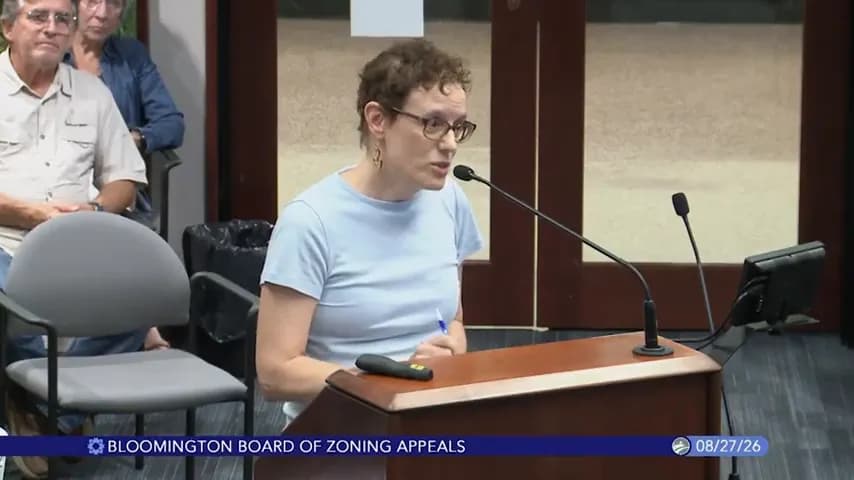
The Board of Zoning Appeals (BZA) convened on August 28, 2026, at 4:19 PM UTC to hear four petitions, including conditional use requests, a variance, and an administrative appeal. The meeting included approval of prior minutes, extensive public testimony, and board deliberations. Three petitions received final votes, while one was continued. Consent Calendar - The board approved five sets of minutes from prior meetings via a single motion. One member abstained. Public Comments & Testimony - 412 East Wiley (Conditional Use & Variances): Numerous residents and council members spoke in opposition. Julie Vonderschmidt, John Lawrence, Corey Gearhart, Tatiana Moyer, Eric Oost, Jeff Vonderschmidt, Dave Rallo (City Council District 4), Isabel Piedmont Smith (City Council District 1), Jan Sorby, Jane St. John, Kim Vint, and Marcus Moore read a statement from Jody Atkins. Common concerns included the duplex's size (43% larger than the largest house on the block face), lack of sidewalks on narrow Wiley Street, inadequate on-site parking, demolition of a single-family home, and potential for increased student rentals harming neighborhood character. Several speakers argued that the proposal violates UDO criteria for neighborhood compatibility. Councilmembers Rallo and Piedmont Smith emphasized that the code's intent was to ensure size and design similarity, which they said was not met. Petitioner Kevin Spicer argued the project met all UDO standards and that similar duplexes had been approved elsewhere. He noted the revised design was an attempt to address earlier concerns. - 210 South West Plex (Variance): Mary Sutherland, owner of adjacent property, opposed the sidewalk variance, claiming it would encroach on her land and create maintenance burdens. Petitioner AJ Willis explained the sidewalk is a replacement of existing infrastructure at 5-foot width, not a new extension, and that cost and topography made 6-foot expansion impractical. - 530 South Washington (Administrative Appeal): No public testimony was heard as the board granted a continuance at the petitioner's request. - 712 West Third (Conditional Use): Richard Lewis spoke in support, noting minimal exterior changes and approval from the local historic district design review committee and the Historic Preservation Commission. He praised the project for preserving architectural character. Discussion Items - 412 East Wiley (Conditional Use ZR 2026 0522 & ZR 2026 0735): Staff recommended approval of the conditional use and denial of two variances (for an additional parking space and for a 20x40-foot parking area off the alley). The board questioned the design compatibility with the block face. Member Chris Throckmorton expressed strong dissatisfaction with the revised building's appearance, calling it "a barn" and not consistent with surrounding homes. Other members noted the prior design was preferred. The board voted to continue the petition to give the petitioner an opportunity to revise the architecture and address parking concerns. - 210 South West Plex (Variance ZR 2026 0631): Staff recommended denial, citing that the 6-foot sidewalk requirement is standard and that the petitioner could widen the sidewalk into the street without practical difficulty. The petitioner argued financial hardship and that a 5-foot sidewalk meets ADA standards. Board members debated the city's own practices, noting that five-foot sidewalks are common elsewhere. A motion to approve the variance passed 4-0, with findings that the variance would not harm public welfare and that the property's topography and existing conditions create practical difficulties. - 530 South Washington (Administrative Appeal ZR 2026 0733): The petitioner requested a continuance, which was initially denied 2-2. A subsequent motion to continue passed 3-1. The matter was continued to a future meeting. - 712 West Third (Conditional Use ZR 2026 0734): Staff recommended approval, noting the project involves interior conversion of an existing home with minimal exterior changes, historic district approval, and neighborhood association support. The board unanimously approved the conditional use with conditions, including rental inspection requirements. Key Outcomes - 412 East Wiley: Continued. No final decision. The petitioner is expected to return with revised architectural designs and parking solutions. - 210 South West Plex: Variance approved (4-0). The petitioner may install a 5-foot sidewalk instead of the required 6-foot width. - 530 South Washington: Continued to a future hearing. - 712 West Third: Conditional use approved (4-0). The duplex is limited to four bedrooms, and units must be registered and inspected if rented.

ZONING REGULATIONS 39% · PARKING MANAGEMENT 11% · HOUSING DEVELOPMENT 8% · AFFORDABLE HOUSING 8%
OPENPUBLICA · PUBLIC MEETING INDEXUPDATED DAILY · openpublica.com