The Leesburg Planning Commission held a work session on September 3, 2026, to review and forward draft zoning ordinance revisions related to solar facilities and portable solar generation devices. The revisions respond to 2026 Virginia General Assembly legislation (HB 711, SB 250, SB 443). Commissioners discussed implementation details, including HOA conflicts, use standards, and definitions, and voted to recommend the changes to the Town Council. The meeting also included staff updates, a retirement announcement, and a new business item to invite the Economic Development Director for a presentation. Consent Calendar - The agenda for September 3, 2026, was adopted by unanimous voice vote. - The minutes of the August 6, 2026, meeting were approved by unanimous voice vote. Discussion Items - Solar Zoning Ordinance Rewrite (Work Session): Deputy Town Attorney Tina Newton, Zoning Administrator Michael Watkins, and Director David presented draft revisions to implement state code changes for solar photovoltaic projects, battery energy storage, accessory solar facilities, and portable solar generation devices. Key provisions include: - Adding accessory solar facility and portable solar generation device as limited uses in residential, non-residential, mixed-use, and Crescent districts. - Use standards for solar photovoltaic projects: 100-foot setback from roads, 150-foot from residential/civic uses, 50-foot from wetlands/streams, 25-foot maximum height, opaque vegetative screen, view shed analysis, decommissioning plans, and airport impact review. - Battery energy storage as an accessory use to approved solar photovoltaic special exceptions, with ventilation, fire suppression, and structural requirements. - Definitions for accessory solar facility, battery energy storage project, portable solar generation device, and solar photovoltaic project, drawn from state code. - Portable solar generation device limited to 1,200 watts per residential unit. - Commission Questions and Concerns: - Commissioner Steinberg asked about HOA covenants potentially overriding solar allowances; staff clarified that state law does not supersede private covenants, but HOA documents must comply with the zoning ordinance. - Commissioner Robinson inquired about solar installations on commercial parking lots (e.g., Giant shopping center) and asked for more cross-referencing in the online ordinance to improve user-friendliness. Staff agreed to explore cross-references. - Commissioner Barnes asked about portable solar generators and panel placement; staff noted state code does not regulate orientation beyond setbacks. - Commissioner Steinberg asked about height and reflection from tilting panels; staff pointed to view shed analysis and lighting standards, and noted that photovoltaic projects must generate at least 1 megawatt. - Chair Campbell noted that full understanding will come with the first application. - Staff and Committee Reports: - Director David announced the retirement of Brian Boucher, longtime planning and zoning staff member, effective August 31, 2026. The commission expressed appreciation. - Director David proposed swapping the agenda: the Islamic Center special exception will be moved to September 17, and the affordable housing/faith-based nonprofit discussion to October 1. Commissioners agreed. - BAR Report: Commissioner Ron reported staying abreast of BAR minutes and development impacts. - Town Council Liaison Report: The Town Council is reviewing the draft zoning ordinance from the commission. - New Business: Commissioner Steinberg proposed inviting Economic Development Director Russell Seymour to present on five-year business trends, growth sectors, and land use implications. All commissioners supported the idea, and it will be arranged for a future agenda. Key Outcomes - The commission unanimously approved a motion to forward the recommended zoning ordinance revisions to the Town Council with a recommendation of approval, citing implementation of HB 711, SB 250, and SB 443, consistency with the Town Plan, and public necessity. (Voice vote: all ayes) - The Islamic Center special exception hearing was rescheduled to September 17, 2026; the affordable housing discussion to October 1, 2026. - The commission agreed to schedule a presentation by Economic Development Director Russell Seymour at a future meeting.
The Public Meeting Index
The Public Meeting IndexThe Everett City Council met on September 2, 2026, at 4:00 PM in Council Chambers. The meeting included public comments, mostly focused on the proposed consolidation of Everett Transit with Community Transit, a briefing on land division code updates, and action on several items including property acquisition for the Everett Outdoor Events Center. Councilmember Burbano was excused, and Council President Schwab was excused. Consent Calendar - Approved minutes of August 26, 2026 (Councilmember Weir abstained). - Approved Resolution authorizing claims against the city in the amount of $12,057,706.19 for the period August 15–21, 2026. - Approved Contract Change Order No. 1 with American Process Group for biosolids removal/disposal, increasing the contract to $6,472,504.60. - Authorized Professional Services Agreement with Black & Veatch Corporation for WFP Standpipe Replacement Project ($749,719.00). - Authorized Amendment No. 3 with Brown and Caldwell, Inc. for Port Gardner Storage Facility design services, total not to exceed $16,129,982.00. - Approved Contract Change Order No. 12 with Granite Construction Company for Edgewater Creek Bridge Replacement, total $28,018,511.31. - Authorized Call for Bids for Lift Station 24 Conveyance Improvements. Public Comments & Testimony - Rob Workman (unincorporated Snohomish County, adjacent to Everett) spoke against the proposed Everett Transit–Community Transit merger, citing his positive experience with Everett Paratransit (less than 10% late pickups) versus Community Transit Dart (80% issues). He urged enforceable protections for accessibility standards and that voters should decide. - Keith Jacobson (Everett) opposed the merger, calling the resulting 0.6% sales tax increase the largest in state history without a public vote. He noted it would generate $30 million per year, equivalent to buying a baseball stadium every four years, and argued citizens would lose control of sales tax revenue permanently. - René Baidoa (Everett) opposed the merger from a taxpayer perspective, stating the sales tax would double from 0.6% to 1.2%, costing an additional $30 million/year ($450 per household). He argued only 6–10% of residents use transit and urged council to let voters decide on the tax increase. - Jack Williams (Everett), a former Everett Transit driver now disabled, described being injured when a Community Transit driver failed to secure his wheelchair. He praised Everett Transit’s quality and urged against diluting it through merger. - William Parent (Silver Lake) advocated for attracting the Goodyear Blimp to Everett to boost tourism and local businesses. - Jordan Beardsley (Everett) requested support for a mobile childcare bus business and asked the city to explore a permitting pathway for retail properties to host it. - Said Hagigi (Mount Vernon) argued the merger decision should be made by voters, noting that many disabled riders limit paratransit use due to the $2 fare. He suggested surveying paratransit users before moving forward. - Daryl Sullivan (Everett) opposed the merger, characterizing it as “higher taxes, less good bus service” and a loss for local residents. - Evan Reed (Everett), director of Bunker Arts Collective, spoke about downtown systemic issues such as vacant properties and lack of historical preservation. He announced a “Refresh Everett” program. - Duane Doe (Everett), a 33-year Everett Paratransit driver, echoed concerns about service quality, potential fare increases from $2 to $3, and loss of local control. - Steve Oce (Everett) opposed the merger without a public vote, expressed skepticism about promised double bus service, and warned that the city would never regain its transit agency. He also raised concerns about union attrition if merger proceeds. - Deborah Papenthine (Marysville, employee of Everett Transit and retiree of Community Transit) asked for more time to allow employees to arrange personal finances, suggesting the merger priority be lowered. Discussion Items - Councilmember Ryan reported on the New Start Center (transitional housing) ribbon cutting and his appointment to the Snohomish County Partnership to End Homelessness. - Councilmember Tui added details on the New Start Center: 71 rooms, 90-day transitional housing, with 75% of rooms reserved for Everett residents experiencing homelessness. - Councilmember Weir spoke about regional meetings: PUD’s “growth pays for growth” policy on data centers and power rates; Fusion Week highlighting Zap Energy and Helion in Everett; and the PSRC Economic Development District Board. - City Attorney had no executive session. - Item 11 (CB 2608-48) – Land Division Code Update: Planning Director Yorick Stevens-Wajda presented a first reading of amendments to implement House Bill 1096 (residential lot splits) and modernize land division procedures. Key changes include reducing minimum lot size in NR and UR4 zones from 5,000 sq ft to 2,000 sq ft (with 25 ft width), streamlining lot splits to administrative review, allowing timing of improvements to be tied to building permits rather than before subdivision recording, and combining four chapters into one. The state agency review period runs through October 13, so final council action is expected in October. Councilmember Bader asked about discretionary elements; Stevens-Wajda noted nearly all provisions are city-initiated beyond state requirements. Councilmember Weir asked about neighbor notice; no public notice for small lot splits under state law, but future code updates may address notification. Key Outcomes - Item 12 (CB 2608-42) – Evergreen Way at Center Rd Pedestrian Safety Fund: Adopted unanimously (5-0). - Item 13 (CB 2608-43) – Everett Outdoor Events Center Special Improvement Project Fund: Adopted 4-1 (Councilmember Tui voted no, citing need for full financial report before approving additional $3.5 million interfund loan). - Item 14 – Resolution Approving Purchase of Property (Lot 28) for the Everett Outdoor Events Center: Adopted 4-1 (Councilmember Tui voted no). The address was corrected from 2302 to 2303 Pacific Avenue. The closing is expected in two weeks (by mid-September 2026). - Consent Calendar: Approved with one abstention. - Items 7–10 (first/second readings) were presented with no votes taken; third readings scheduled for September 9 or 16.
The Everett City Council's Community Health and Safety Committee met on September 3, 2026, to receive a detailed update from Snohomish County officials and the Salvation Army on the new Everett New Start Center, a bridge housing program designed to transition homeless individuals to permanent housing. The presentation covered the center's structure, eligibility criteria, referral process, services, and community impact plans. Discussion Items - Snohomish County Update on New Start Center: County Chief of Staff Julie Moore provided background: the center is one of two bridge housing facilities (the other in Edmonds) purchased four years ago with ARPA and county funds. The Edmonds center, operated by YWCA, opened June 29, 2026, and currently houses 11 clients (expected to reach 13 by the end of the week). The Everett center, located in a converted two-story hotel, has 71 client rooms and will be operated by the Salvation Army. A grand opening was held on August 28, 2026, with over 100 attendees. - Program Model: Susan Christ (Snohomish County Office of Community and Homeless Services) explained the model is a new form of temporary, structured bridge housing with a 90-day intended stay. It is not a low-barrier shelter; clients must be referred by designated partners (e.g., Everett Care Team, Everett Gospel Mission, Cocoon House) and must meet minimum eligibility requirements set by the County Council, including no convictions in the last five years, no substance use within 30 days, and no children or couples in the same room. The program targets individuals already engaged in housing stability planning. 75% of clients are expected to come from the Everett area. - Client Services and Conduct: Captain Jen Pack and Program Director McKenzie Orr (Salvation Army) described wraparound services: intensive case management, on-site health and behavioral health support, employment and benefits assistance, three meals daily, laundry, and a 10 p.m. curfew with exceptions. A code of conduct prohibits weapons, drugs, alcohol, and violence. Violations are handled with a tiered approach; immediate exit is reserved for safety threats. The center will have 24/7 security, a camera system, and a Good Neighbor Plan with regular community meetings. - Councilmember Questions and Discussion: Councilmember Weir asked clarifying questions about couples being housed separately (logistical and programmatic reasons), eligibility for individuals with mental health challenges (allowed if they can perform daily living activities and are engaged in treatment), permanent housing pathways after the 90-day stay (case managers will seek creative options, but no guaranteed housing), referral and intake timeline (goal of one week or less), curfew exceptions (accommodations for work or school), visitor policies (case-by-case, common areas only), and health care access (partners available for benefits enrollment and mobile clinics). Councilmember Weir expressed support and excitement for the program, noting it fills a needed niche. Key Outcomes - The committee received the update without a formal vote. Next steps: The county will collect data and produce a report by the end of 2026 to evaluate client eligibility criteria and program outcomes, which the County Council will use to consider potential changes. - The Salvation Army will begin accepting referrals from partner agencies this week and anticipates a four-month ramp-up to full occupancy. - Ongoing communication between the city, county, and Salvation Army will continue through community meetings and the Good Neighbor Plan.
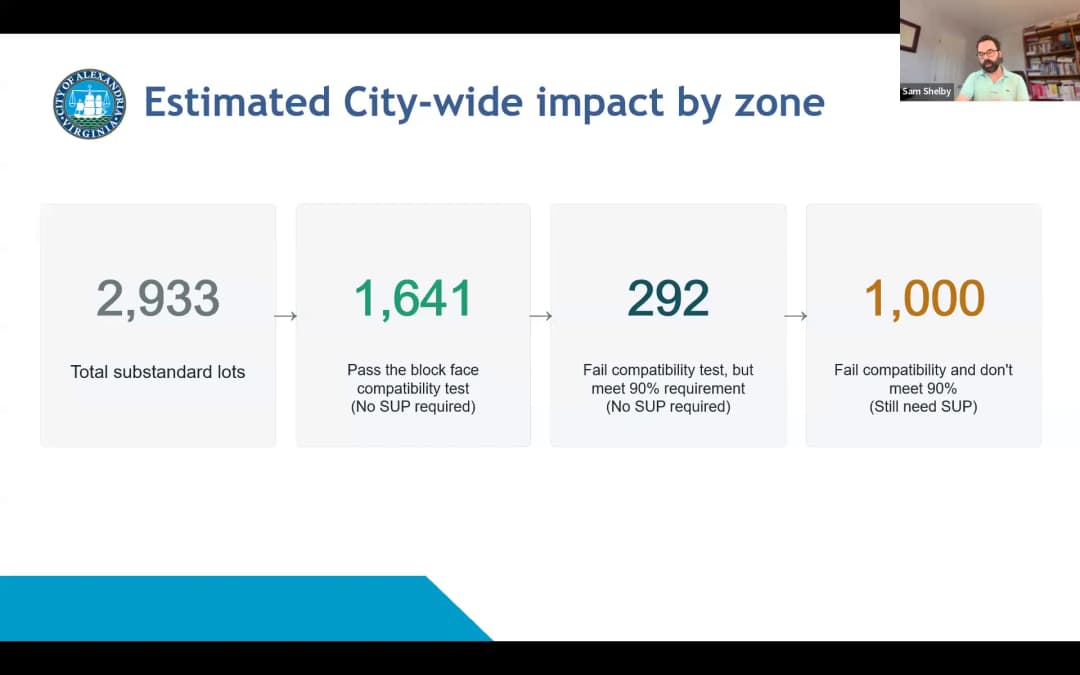
This was the second community meeting hosted by city planning staff (Sam and Katie) to present findings from a citywide inventory of substandard lots and to gather public feedback on draft recommendations to modify the special use permit (SUP) process for these lots. The meeting took place virtually via Zoom, with a Q&A format. Public Comments & Testimony - Phoebe: Asked whether staff planned to review lot size requirements as part of zoning for housing part two. Staff responded that it would require consensus from planning leadership and City Council endorsement. - Catherine: Asked whether height and size on substandard lots are the same as on regular lots, and how many approved SUP cases requested FAR variances. Staff clarified that no FAR modifications were granted; only setback modifications occurred on very substantially substandard lots. - Sunny: Asked whether variances that allow taller/larger buildings obviate requirements. Staff explained that variances require demonstrating unique property conditions, with a very high hurdle. - Brett: Asked if the draft recommendation would set a threshold percentage of buy-right lot size (e.g., 75% or 90%) for by-right development. Staff confirmed they are considering 75% or 90% of lot requirements. - Hans: Asked if substandard lots would be held to the same canopy coverage requirements as other zones. Staff confirmed 25% canopy coverage applies on redevelopment. - Catherine: Asked how “surrounding lots” would be defined, citing a past inconsistency in her neighborhood. Staff responded that the definition would be tightened to only adjoining lots in the same zone. - Annie: Asked what the impact numbers would look like using the 75% criteria instead of 90%. Staff committed to posting that analysis on the website. - Catherine: Asked whether the public could get a list of addresses so neighbors could provide feedback, given 1,600 lots would be removed from SUP. Staff said they cannot release addresses due to privacy concerns but will post a high-resolution interactive map and may provide block-level information. - Andrew: Asked whether “development” includes only full teardowns and reconstruction, or also remodeling. Staff clarified that development means building a new house on a vacant lot or teardown/rebuild on an occupied lot; rules for additions would also be simplified. - Brett: Asked about the distinction between developed and non-developed lots. Staff explained: vacant lots currently have limited SUP eligibility; developed lots have a separate process. Both would be treated similarly under the new rules. - Han: Asked about concerns about unintended impacts. Staff responded that they have conducted thorough research and believe the measured approach minimizes surprises. - Annie: Asked if lots currently in the SUP process would be affected by a November rule change. Staff said only applications submitted after final passage would be affected; existing docketed cases would proceed unless applicants defer. Discussion Items - Presentation of Inventory Findings: Staff presented that approximately 33% of the city’s single-unit detached lots (about 2,900 lots) are substandard, primarily in the R8 zone (tree streets, Northridge, Beverly Hills), with pockets in R5 and R25 (Rosemont, Delray). Most substandard lots fall modestly short of minimum requirements: 71% meet at least 75% of lot size, width, and frontage. Nearly all are clustered with similar lots on the same block. House sizes and widths on substandard lots are proportionally smaller due to FAR and setback requirements. - SUP Case History: Since the 1970s, 32 vacant substandard lot SUPs were processed (26 approved, 6 denied). Since 2008 rules for teardowns on occupied substandard lots, 35 cases have all been approved. Approved SUP houses have similar FAR and height to by-right teardowns. - Draft Recommendations: 1. Expand SUP eligibility to all vacant substandard lots (remove the current strict threshold). 2. Allow by-right development for substandard lots that either (a) have similar size and shape to surrounding lots (block face compatibility test) or (b) meet 75% or 90% of the zone’s minimum requirements (staff seeking feedback to decide). 3. Retain SUP requirement for “outlier” lots that are significantly smaller than surroundings and not close to meeting requirements, and for lots without frontage. - Analysis of How Rules Would Apply: Of 2,900 total substandard lots, about 1,600 would pass the block face compatibility test (by-right). About 292 would fail compatibility but meet 90% of requirements (by-right). The remainder (outliers) would still need SUP. - Next Steps: Staff will finalize recommendations based on feedback, release a staff report on September 25, 2026. Planning Commission public hearing on October 6, 2026. City Council hearing and final vote on October 17, 2026. If approved, rules take effect in November 2026. Key Outcomes - Draft recommendations presented with two key thresholds (75% or 90%) still under consideration pending public feedback. - Staff committed to posting additional analysis (e.g., impact of using 75% vs. 90%), a high-resolution interactive map, and block-level lot counts on the project website. - Staff offered to attend civic association meetings in September and hold virtual office hours for one-on-one discussion. - Timeline confirmed: Staff report September 25, Planning Commission October 6, City Council October 17, with November effective date if approved.
The Rules and City Government Committee met on September 3, 2026, at 6:30 PM in City Council Chambers. The meeting focused on two legislative items: O-9-26 (updating standing committees) and O-14-26 (Art in Public Places). The committee heard a presentation on the Prescription Drug Affordability Board and spent the majority of the meeting deliberating on a comprehensive substitute amendment (Amendment 11) for O-14-26. The committee ultimately voted to withdraw Amendments 1–10 and to favorably recommend Amendment 11 and the legislation as amended to the full City Council. Public Comments & Testimony - Vincent DeMarco, president of the Maryland Health Care for All Coalition, and Dr. Andrew York, executive director of the Prescription Drug Affordability Board, presented an update on the board's progress. DeMarco highlighted that 43% of people cannot afford needed drugs and that high drug costs contribute to 25–33% of health insurance premiums. He thanked the council for past endorsements and noted that Governor Wes Moore’s support had enabled the board to move forward after delays under the previous administration. - Members of the arts community, including Cynthia Reuter (legislative and policy analyst) and the Director of Planning and Zoning, provided technical input during the discussion of O-14-26. Several speakers emphasized the need to restore authority to the Art in Public Places Commission and to ensure timely payments to artists. Discussion Items - O-9-26 – Updating Standing Committees: This legislation was listed on the agenda but no discussion or action was recorded in the transcript. The committee did not appear to take it up during the meeting. - O-14-26 – Art in Public Places: The committee considered a substitute amendment (Amendment 11) consolidating 10 prior amendments. Key changes included: shifting authority from the Planning and Zoning Director back to the commission; updating definitions to be more inclusive of various art forms and mediums; dedicating hotel tax revenue to the art fund; requiring the finance director to report fund status by October 1; establishing a procedure for the city manager, finance department, and office of law to review projects costing $50,000 or more; and setting membership at nine members with staggered three-year terms, including a preference for one member from each ward and one at-large member with professional art expertise. The committee debated the appeals process and large expenditure review, ultimately removing the proposed appeals mechanism and replacing the Rules and City Government Committee role with a report to the full council. The commission was given authority to establish procedures rather than merely recommend them. Key Outcomes - Motion to withdraw Amendments 1–10 (all previous amendments to O-14-26) was seconded and passed with one abstention (Alderman Shannon). - Motion to give a favorable recommendation to Amendment 11 (the substitute amendment) was seconded and passed with one abstention (Alderman Shannon). - Motion to recommend the legislation as amended (O-14-26 with Amendment 11) to the full council at the next meeting was seconded and passed with one abstention (Alderman Shannon). - The committee adjourned after the vote. No action was taken on O-9-26 during this meeting.
The City of Manitowoc Public Works Committee met on Thursday, September 3, 2026, at 5:30 p.m. in Council Chambers and via Zoom. Chairman Bill Schlei called the meeting to order; all five committee members were present: Schlei, Anderson, Sitkiewitz, Brey, and Benzinger. Staff members D. Koski, G. Minikel, and S. Birr also attended. The committee unanimously approved the consent agenda, an ordinance amendment, a state-municipal financial agreement, and three subdivision street lighting resolutions. Consent Calendar - Approved the minutes from the August 6, 2026 Public Works Committee meeting by unanimous vote. No items were removed. Public Comments & Testimony - No public comments were made. One attendee joined online, but offered no comment. Discussion Items - Ordinance to Amend 13.010 Solid Waste Recycling and Disposal (26-0789): Staff explained a request from the Fire Department to move the waste oil drop-off from the Public Safety building to the Department of Public Works (DPW). The new DPW location would be by overhead door A, covered by security cameras, and available from 7 a.m. to 3 p.m. when staffed. Chairman Schlei noted that residents can also take waste oil to AutoZone or O'Reilly Auto Parts after 3 p.m. until 9 p.m., with accepted amounts varying by store. The committee approved the ordinance and referred it to Council. - Maritime Metro Transit Development Plan (TDP) (26-0780): Staff presented the roughly 100-page plan, developed over the past year. No action was requested. The plan was placed on file, and staff said it will return in October with rate increases reflected in the plan. - State-Municipal Financial Agreement (SMFA) for Waldo Blvd - Fleetwood Drive to I-43 (26-0779): Staff said the agreement initiates design work for funding anticipated in 2034, following a prior two-inch overlay that typically lasts 10 to 15 years. The city is responsible for a portion of design costs, capped at $20,189 for priority one plan development, with no construction cost to the city. Alderperson Sitkiewitz noted the project was originally part of the Waldo redesign before being pulled out during the design phase. The committee approved the agreement and referred it to Council. - Street Lighting Resolutions for Abbey Ridge Phase 2, Mariner's Lux, and Deerbrook Crossing Phase 1 (26-0777, 26-0776, 26-0775): Staff described the resolutions as standard roadway lighting for developments, with a 0% city contribution toward installation; developers pay the full installation cost, while the city is responsible for maintenance and energy costs, including a fixed charge of $12 per month depending on the location. The Mariner's Lux charge was slightly higher. The resolutions were approved pending staff finalization, including a fiscal note, and were referred to Council. Key Outcomes - Approved the August 6, 2026 meeting minutes unanimously. - Approved Ordinance 26-0789 and referred it to Council unanimously. - Placed the Maritime Metro Transit Development Plan on file; no action taken. - Approved SMFA 26-0779 and referred it to Council unanimously. - Approved street lighting Resolutions 26-0777, 26-0776, and 26-0775 pending staff finalization, each unanimously, and referred them to Council. - Adjourned at 5:41 p.m.
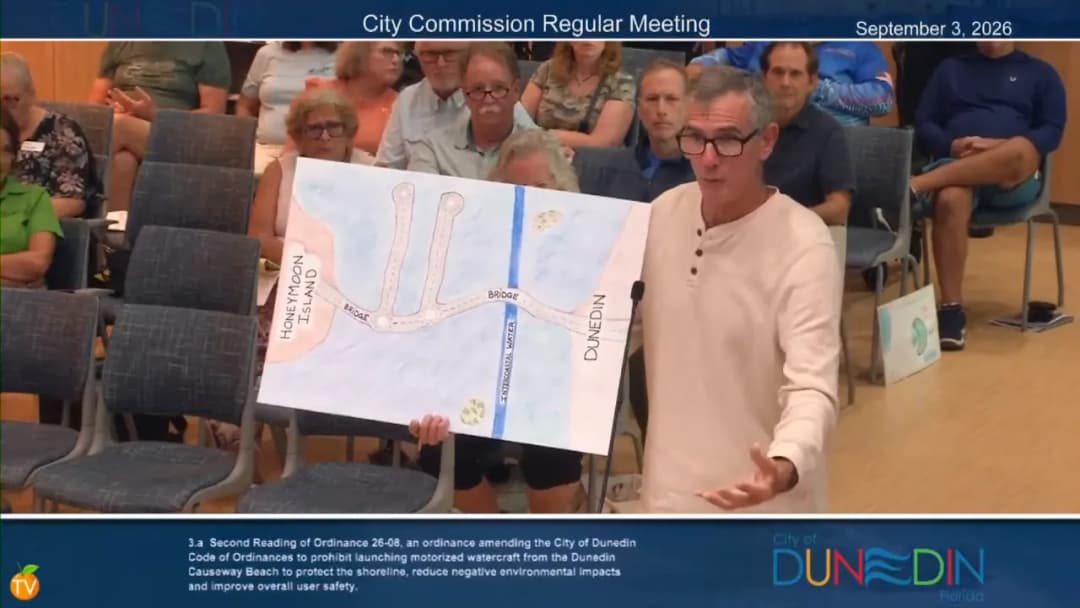
The Dunedin City Commission held a regular meeting on September 3, 2026, at 6:00 PM at City Hall. The meeting included presentations, citizen input, consent agenda approvals, and key action items including a ban on motorized watercraft launches from the Dunedin Causeway, adoption of a tentative millage rate and budget, and an increase in marina slip fees. Presentations - Artist Recognition: Richard Logan was recognized for his artwork displayed in the Commission Chambers from June to December 2026. Logan discussed his creative process and inspirations. - National Constitution Week Proclamation (September 17-23, 2026): Presented to the Caladesi Chapter of the Daughters of the American Revolution by Vice Mayor Walker. The DAR presented a Constitution flag to fly over City Hall during the week. - "A Day to Remember" Proclamation (Patriot Day, September 11, 2026): Presented to the American Legion Auxiliary Dunedin Memorial Unit 275 and Dunedin Fire Rescue by Commissioner Dugard. The proclamation marked the 25th anniversary of the 9/11 attacks. Public Comments & Testimony - David Ballard Geddis Jr. (Palm Harbor) spoke during Citizen Input about bond debt at the Tampa Bay Water Authority, arguing that interest payments on bonds consume a large portion of the budget and that water should not be treated as a privilege. - Numerous speakers addressed Ordinance 26-08 (see Discussion Items). Positions were mixed: many Dunedin residents and organizations supported the ban citing safety, environmental, and quality-of-life concerns; some non-resident jet ski enthusiasts opposed it, arguing it would reduce tourism and economic activity. Specific testimony included: - Mark Clark (Dunedin) argued stormwater runoff, not jet skis, is the primary cause of seagrass damage, and suggested a no-wake zone instead. - Eric Graves (Dunedin) supported the ban, noting improved water clarity and seagrass since the causeway closed. - Carol Horner (Dunedin) a former jet ski user, supported the ban for safety reasons, citing dangerous sandbar changes. - Michelle Birnbaum (Dunedin) expressed concerns about enforcement and safety, recounting a friend injured by a jet ski. - Cleveland Laycock (Dunedin) supported the ban, praising the committee process. - Matt Norman (Dunedin) proposed a compromise: a small, permit-only launch area restricted to Dunedin residents with a one-year pilot. - Sean Spencer (Holiday) opposed the ban, threatening a boycott of Dunedin businesses by a large enthusiast group. - Nancy Schmidt (Dunedin), a Causeway & Coastal Waterways Committee member, explained the committee's decision was driven by safety and enforcement issues, not seagrass. - Rita Foley (Dunedin) urged prioritizing safety and environment. - On Resolution 26-21 and the budget, no public comments were made. - On marina fees, Cleveland Laycock (Dunedin) thanked staff for transparency and noted the Marina Advisory Committee would discuss the boat ramp. Discussion Items - Ordinance 26-08 (Second Reading): Prohibits launching or landing motorized watercraft from the Dunedin Causeway Beach. Staff presented history, safety data (two fatal accidents from 2021-2024), environmental benefits, and support from Pinellas County, Sierra Club, and others. The Commission discussed enforcement (warning, Class 5 citation, trespass), signage, and the distinction between launching and anchoring offshore. The ordinance was adopted unanimously after extensive public testimony. - Resolution 26-21 (Starred Item): Updates the map (Exhibit A) of allowable motorized watercraft operations around the Dunedin Causeway for clarity and readability, without changing waterway designations. The Commission noted needed corrections (zip code, legend consistency). Adopted unanimously. - Resolution 26-12 & 26-13 (Tentative Millage & Budget): Establishes a tentative millage rate of 4.1345 mills ($4.13 per $1,000 assessed value) and a tentative combined operating and capital budget of $138,845,566 — an 11% decrease from FY2026. The budget is balanced, maintains service levels, and includes a state appropriation of $750,000 for a high-water rescue vehicle and Bayshore water main design. Staff noted the budget is advertised as a tax increase due to rising property values. The Commission discussed credit card fees for city services, directing staff to research passing on fees for the golf course first. The contingency plan for Amendment 3 will be presented September 17, 2026. Resolutions adopted unanimously. - Resolution 26-17 (Marina User Fees): Increases marina slip user fees by 7% effective October 1, 2026, rather than the originally planned 10%, due to a $3 million state appropriation for hurricane repairs. The increase is needed to keep the marina fund self-sustaining. The Commission confirmed that five slip sizes changed and that FEMA reimbursement risk could require future adjustments. Adopted unanimously. - Proposed Agenda for September 17, 2026: Approved unanimously. Key Outcomes - Ordinance 26-08 adopted (5-0) — bans motorized watercraft launches from Dunedin Causeway Beach. - Resolution 26-21 adopted (5-0) — updates the causeway watercraft map. - Resolution 26-12 adopted (5-0) — tentative millage rate of 4.1345 mills for FY2027. - Resolution 26-13 adopted (5-0) — tentative operating and capital budget of $138,845,566 for FY2027. - Resolution 26-17 adopted (5-0) — 7% increase in marina slip user fees, effective October 1, 2026. - Agenda for September 17, 2026 approved unanimously. - Staff directed to research steps for passing on credit card fees at the golf course and report back. - Next steps: Final public hearing on millage and budget on September 17, 2026, at 6:00 PM at City Hall. The contingency plan for Amendment 3 will be presented at a workshop at 12:30 PM on the same day.
The Zoning Board of Appeals held a meeting on September 3, 2026, to consider five public hearing applications and several other business items. All applications were granted unanimously, with no public opposition voiced during the hearings. The board also approved amendments to prior decisions, confirmed a minor encroachment, corrected a scrivener's error, and issued preliminary letters of approval for two accessory dwelling units (ADUs). Consent Calendar - Minutes of the August 13, 2026 meeting were approved by a motion (Mr. McGrath) and second (Mr. Castagna), with all in favor. - Confirmation of a lawful minor encroachment for a pool at 18 Hillside Avenue (12-inch variation from the required 5-foot setback) was approved. - Correction of a scrivener's error on ZBA 23736 (change description of garage from detached to attached) was approved. - Preliminary letter of approval for ADU 2256 (689th Avenue) was authorized, with a notation correction regarding the garage connection. - Preliminary letter of approval for ADU 2064 (23 Jane Avenue) was authorized. Discussion Items Public Hearing 23750 (89 Luyster Street, Huntington Station) – Applicant: Daniel and Ashley Marra. Attorney Michael McCarthy presented on behalf of the owners, requesting a variance to maintain an existing semi-inground swimming pool in a technical front yard on a corner lot. The pool was properly screened and fenced; the property had limited depth. No public comments. Board noted the pool had been in place for some time and was not visible from the street. Motion to grant by Mr. Castagna, seconded by Mr. Basso; all in favor. Public Hearing 23741 (267 Lenox Road, Huntington Station) – Applicant: Jeremy Deeg and Stephanie Murphy. The representative requested a rear yard variance for a one-story addition built in 1962. The addition was 21.75 feet from the rear lot line, where 25 feet was required (3.25-foot deficiency). No feasible alternative existed short of demolition. The condition resulted from a prior owner's failure to close out a certificate of occupancy (CO). No public comments. Board clarified that the noncompliance was to both the northerly and westerly lines. Motion to grant by Ms. Whalen, seconded by Mr. Capadano; all in favor. Public Hearing 23726 (86 W. 9th Street, Huntington Station) – Applicant: Armando Dominguez. Attorney Alan M. Davis requested variances to legalize a roofed-over BBQ conversion, porch additions, and a detached garage with habitable features (finished walls but no plumbing or heating). The front porch was 4.5 feet deficient from the required 20-foot setback. The garage was used for storage and a car. No public comments. Board characterized the relief as minor. Motion to grant by Mr. McGrath, seconded by Mr. Basso; all in favor. Public Hearing 23742 (14 2nd Avenue, Huntington Station) – Applicant: Shay Granov / Second Ave. HS Inc. Expiditor Julie Vatrano presented. The buyer in 2016 was unaware of open permits from a 1979 addition and a detached garage. The application sought relief for a 4.5-foot side yard variance (5 feet required) and a 1.75-foot variance for the garage (2 feet required). The addition and garage had existed unchanged since 1979. No public comments. Board clarified the specific relief requested. Motion to grant by Mr. Castagna, seconded by Mr. Campadano; all in favor. Public Hearing 23731 (326 W. Jericho Turnpike, Huntington Station) – Applicant: Paul Schweid (Harley's Grill LLC). Attorney Michael McCarthy returned to request a special use permit, parking variance (80 stalls required, 55 provided), and depth extension for a 550-square-foot seasonal outdoor dining addition. The restaurant would not increase seating; valet parking would be used during peak times. Traffic engineer Wayne Muller (RM Engineering) testified that the valet system and available on-street parking on Jones Lane made the 55 stalls adequate. No public comments. Board found the application fit the neighborhood pattern. Motion to grant (including a negative declaration under SEQRA) by Mr. Whalen, seconded by Mr. Cote; all in favor. Other Business – Amendment to ZBA 23712 (Cabana relief) – Board amended a prior decision to allow air conditioning in the cabana, consistent with previously approved fireplace use. Other Business – Notification on Cornerstone at Melville – Town board notified the ZBA of a pending application; the board chose to take no action at this time. Other Business – ZBA 22647 – Matter adjourned to September 24, 2026, pending clarification from counsel. Other Business – ZBA 23715 (7 Olympia Court, chicken coop) – Board voted to grant the variance for a chicken coop and run, with conditions including no roosters, a limit on the number of chickens, and installation of an odor filtration system as agreed by the applicant. Motion by Mr. Capitano, seconded by Mr. Castagno; all in favor. Key Outcomes - All five public hearing applications were granted unanimously. - The board amended the cabana decision (ZBA 23712) to permit air conditioning. - A 12-inch pool setback encroachment (18 Hillside Avenue) was confirmed as lawful. - A scrivener's error on ZBA 23736 was corrected. - Two ADU preliminary approval letters were authorized. - The regular meeting scheduled for September 10, 2026 was canceled due to incomplete publication; the next meeting will be September 24, 2026.
The Chapel Hill Board of Adjustment met on Thursday, September 3, 2026, at 6:30 PM in the Council Chamber. The meeting included approval of the agenda and minutes from July 2, 2026, a public hearing and deliberation on a dimensional variance for 219 Glenhill Lane, and a discussion on filling the remaining alternate seat on the board. The variance was granted unanimously (7-0), and the membership recommendation was tabled to the next meeting on October 1, 2026, pending further outreach to applicants. Approval of Agenda and Minutes - The agenda was approved unanimously. - The draft minutes from the July 2, 2026 meeting were approved unanimously. Public Comments & Testimony - No members of the public offered testimony on the variance. One attendee asked a procedural question about variance applications but did not comment on the case. Dimensional Variance: 219 Glenhill Lane - Applicant Presentation: Coulter and Kelsey Brinkley, residents of 219 Glenhill Lane, requested a variance to reduce the required 26-foot street setback to 20 feet to construct a 10-foot by 12-foot storage shed. They cited the property's steep topography and irregular corner lot as unique hardships, noting that the only flat area for the shed lies within the setback. They argued the variance would have minimal visual impact, preserve existing trees, and maintain sight lines. - Board Discussion: Board members questioned the applicants about alternative locations, the cost of grading, and the impact on driveway use. The applicants stated that other flat areas were either within other setbacks or would require significant grading and tree removal, which would be financially burdensome. The board considered the four criteria for a variance: unnecessary hardship, unique property conditions, self-created hardship, and consistency with ordinance intent. - Key Support: Board members expressed that the topography and corner lot created a unique hardship, that the applicants did not create the conditions, and that the variance would not affect neighboring properties or streetscape. The board noted the small size of the encroachment (6 feet) and the limited visibility of the shed. - Vote: The motion to grant the variance (Resolution A) passed unanimously (7 ayes, 0 nays). Membership Recommendations - The board reviewed four applications for the remaining alternate seat. Applicants included David (preferred Board of Adjustment), Peter (preferred Planning Commission), Bert Bennett (preferred Downtown Partnership), and Trevor Leatherwood (an ETJ resident). - Discussion: Several members favored David due to his enthusiasm for the BOA and a student perspective, while others noted Peter's environmental background. Concerns were raised about Trevor Leatherwood's application quality (misspellings, grammar) and Bert Bennett's focus on downtown development. The board decided to contact the top two candidates (David and Peter) to confirm their continued interest before making a recommendation. - Decision: A motion to continue the item to the next meeting on October 1, 2026, passed unanimously (7 ayes). Staff will reach out to the applicants and report back. Key Outcomes - Dimensional Variance Granted: The variance for 219 Glenhill Lane (6-foot encroachment into the street setback for a 10x12 shed) was approved unanimously. - Membership Recommendation Tabled: The board will reconsider the alternate seat at its October 1, 2026 meeting after staff contact David and Peter about their interest.
The Gulfport City Council met on Thursday, September 3, 2026, at 6:00 PM at City Hall. The meeting focused on the first readings of the FY 2026-2027 millage rate and operating budget ordinances, along with presentations, public comments, and discussions on various city policies. Key outcomes included approval of a reduced millage rate, a modified budget with several amendments, and a decision to remove funding for e-comments software while maintaining an email alternative. The council also debated the future of Flock automated license plate readers, deferring a final decision to the second reading. Public Hearings: FY 2026-2027 Millage Rate and Budget Ordinances - Millage Rate (Ordinance 2026-09): Councilmember Webb noted the reduction from 4.0258 to 4.026 and asked about exploring a fire assessment fee to reduce the ad valorem burden. City Manager O'Reilly explained that an RFP for a consultant would be needed and could be ready for the next fiscal year. Council gave consensus to proceed with the RFP. The millage rate ordinance passed unanimously (5-0). - Budget (Ordinance 2026-10): City Manager O'Reilly presented adjustments, including transferring $500,000 from the waterfront TIF to the senior center trust fund and reserving $500,000 for stormwater projects. He also noted a reduction in the sanitation fee increase from 8% to 5%, saving $14,000. Extensive council discussion followed on various budget items. Presentations - Spirit of Gulfport Award: Vice Mayor Shaw presented the award to Eileen Navarro for her 30+ years of community service, including leadership of the Gulfport Community Players and the waterfront redevelopment committee. - Florida League of Cities Service Delivery Improvement Award: Mayor Love accepted the award on behalf of the Gulfport Recovers group, which developed a post-hurricane recovery guide after the 2024 floods. Public Comments & Testimony - Flock Cameras: Multiple residents (Metria Jones, Amy Costa reading for Jonathan McCoachy, and others) urged removal of Flock cameras, citing privacy concerns, surveillance state fears, and the need for public trust. One resident requested data on immigration-related arrests. - Budget Items: Residents spoke in favor of restoring the tree budget, eliminating Flock cameras, and maintaining e-comments. Concerns were raised about the tree budget cut (66%), the looper's low ridership, and the need for grant writing services. - Other: Bob Canning advocated for a stormwater backflow preventer program, noting a $200,000 project with a $100,000 EPA grant. April asked about immigration arrests and permitting issues. Discussion Items - Budget Amendments: Councilmember Shaw proposed eliminating the dog run ($20,000), reducing the looper service, increasing the tree budget by $5,000 (from $10,000 to $15,000), reducing COLA from 4.5% to 4%, removing Flock camera funding ($9,000 this year), and eliminating the siding for the little league. Councilmember Webb supported removing Flock, citing state-level concerns and data privacy. Councilmember Early suggested tracking usage of single-use technologies like C Click Fix and short-term rental software. Councilmember Donch supported keeping the leisure services director position frozen but wanted to pursue a grant writer RFP. - Flock Cameras: Police Chief Holloway defended the cameras, citing crime-solving, stolen vehicle recovery, and missing persons cases. He noted that audits are conducted and that only six cameras exist at $9,000/year. Councilmember Webb argued that upcoming state legislation may restrict usage and that the data is owned by Flock, not the city. Council agreed to defer a final vote on Flock to the second reading after hearing from the chief. - Leisure Services Director: Council decided to keep the position frozen (unfunded) but agreed to issue an RFP for grant writing services, using funds from that line item if needed. - Strategic Plan: Councilmember Webb proposed a strategic planning workshop before the comprehensive plan update, but consensus was deferred due to timing concerns. Council agreed to hear a presentation on the Time Weaving project at the first October meeting. - New Business: Council approved holding a town hall on mosquito control on September 21, and a monthly meeting between a rotating council member and the Gulfport Merchants Chamber. Vice Mayor Shaw requested a formal application process for the Spirit of Gulfport Award and a discussion on dinghy dock rules at a future meeting. Key Outcomes - Millage Rate: Ordinance 2026-09 passed unanimously (5-0). - Budget: Ordinance 2026-10 passed unanimously (5-0) after incorporating the following amendments: sanitation increase reduced to 5%, tree budget increased by $5,000, dog run funding removed, little league siding funding removed, COLA set at 4%, e-comments software eliminated but email alternative implemented, Flock camera funding deferred to second reading, leisure services director position kept frozen, and RFP authorized for grant writing services and fire assessment fee consultant. - Consent Agenda: Minutes from July 21, August 4, and August 6, 2026 approved unanimously. - Sanitation Fee Ordinance: Ordinance 2026-11 (first reading) passed unanimously, setting a 5% increase for the coming year and 8% for the following year. - Flock Cameras: Final decision postponed to the second reading of the budget, pending further discussion. - Other: Council gave consensus for a town hall on mosquito control (September 21), a GMC monthly meeting, and an update from the Gulfport Arts and Heritage Board at the first October meeting.