Browse by city
Date range
Search help

Search titles, summaries, topics and stored transcripts together. Keywords may match separately; put the whole query in double quotes for a phrase. Matching follows word analysis, so punctuation is not exact. Both dates are included. Documents are not searched.

SHOWING 161–170 ENTRIES
161
JAN 13, 2026 · ANCHORAGE, ALASKA · ASSEMBLY & COMMITTEE MEETINGS
January 12, 2026 Planning and Zoning Commission Meeting Summary

The Planning and Zoning Commission convened on January 12, 2026, to address the "Food and Agricultural Uses Ordinance" (Case 2026-0003). Staff presented a proposal designed to enhance local food security and economic activity by modernizing zoning regulations for commercial horticulture, grocery stores, food production, and accessory uses like beekeeping. Following staff presentation and public testimony supporting local agriculture, the Commission voted unanimously to recommend the ordinance to the Anchorage Assembly for approval. Consent Calendar - No items discussed; the meeting proceeded directly to public hearings. Public Comments & Testimony - Mike Mosisian (Bell's Nursery): Expressed full support for the ordinance to encourage local food production and food security. He highlighted that Anchorage is at the end of the supply chain, with food sources potentially weeks away in the event of a disaster. He noted that while he grows 500,000 pounds of tomatoes annually for the state, he is cutting back production by 30% in the current year due to increased difficulty in marketing produce through major chains like Safeway, Walmart, and Fred Meyer, which prioritize contracts with farms in Canada and Mexico. He also requested that wine produced from locally grown grapes be allowed for sale to address similar market access issues in the state liquor system. - Nolan Cado (Mayor's Office): Stated strong support, emphasizing that strengthening the local food ecosystem is a priority for the Mayor. He noted that commercial farms often operate on thin margins and that the proposed accessory use provisions for on-site processing aim to strengthen their business case. Discussion Items - Commercial Food Production: Proposed to become a permitted use in B3, I1, and I2 zones, addressing past challenges where existing businesses faced burdensome conditional use processes. - New Accessory Food and Beverage Production: A new use category created to allow a portion of a property (by area or time) to be used for food production without it being connected to a residence (unlike home occupations). This allows for flexibility while maintaining standards; specifically, deliveries are limited to 9:00 AM–5:00 PM in residential districts to prevent excessive traffic, and no equipment creating detectable noise, vibration, glare, fumes, or odors is permitted. - Governance Clarifications: Staff clarified that while zoning restrictions are being eased, all uses remain subject to existing health code, state alcohol licensing, and safety regulations. The ordinance does not authorize home occupations in industrial zones unless a residence exists on the property. - Delivery and Enforcement: Commissioner Ron expressed concern regarding enforcement language in section 9B2 and 3, noting potential issues with current provisions. He agreed to support the motion but requested staff investigate further how to better manage delivery traffic parity with existing residential neighborhood issues. - Hobby Farms: Commissioner Gardner inquired about the distinction between hobby farms and home gardens; staff confirmed hobby farms allow for sales on the premises, whereas home gardens do not, and hobby farms are expressly not home occupations. Key Outcomes - Motion: Commissioner Gardner moved to recommend the Anchorage Assembly approve an amendment to Title 21 to ease restrictions on agricultural uses and food production in the Anchorage Bowl. - Vote: The motion was seconded by Commissioner Polis. All five commissioners (Gardner, Krishna, Polis, Ron, Abaza) voted Yes. - Result: The motion passed unanimously. The case is now forwarded to the Anchorage Assembly for final consideration.

FOOD AND AGRICULTURAL USES 47% · PUBLIC ENGAGEMENT 20% · PROCEDURAL 19% · AGRICULTURAL POLICY 14%
162
JAN 12, 2026 · ANCHORAGE, ALASKA · ASSEMBLY & COMMITTEE MEETINGS
Public Work Session Summary for Girdwood PCC Meeting on 2026-01-12

The Planning and Zoning Commission convened a work session to discuss the Conditional Use Permit (Case 2026-005) and Subdivision (Case S12867) for the Quincy Arms project, a 39-lot residential development. Staff presented that the project aligns with the 2006 Crow Creek Area Master Plan and the 2025 Girdwood Comprehensive Plan, which calls for moderate-density housing. While the PCC is required to review and approve the subdivision and CUP, discussions regarding HOA bylaws, articles of incorporation, and specific leasing provisions (including short-term rentals) were deferred for future review, as these matters are constrained by the Assembly-adopted Development Agreement (AO 2023-137). Consent Calendar No routine consent calendar items were reported; all agenda items were treated as discussion items within the work session. Public Comments & Testimony No members of the public or external organizations provided formal comments during this work session; the time was dedicated to questions from Commissioners to staff and the applicant. Discussion Items Scope of Review and HOA Leasing Provisions Commissioner Krishna and Chair inquired about the Commission's authority regarding leasing provisions and HOA documents currently included in the application narrative. Daniel McKenna Foster (Staff) and Quincy Arms clarified that due to the Assembly's prior approval of the Development Agreement via AO 2023-137, the Commission cannot currently amend or adjudicate those specific provisions. It was stated that HOA articles of incorporation and bylaws will be subject to review at a future informational item or case when details are finalized. Commissioner Krishna further clarified if the Commission is currently accepting the proposed short-term rental regulations as laid out in the application. Staff confirmed that approval of these specific provisions is held pending the future review of the HOA documents. Project History and Planning Consistency Daniel McKenna Foster (Staff) outlined a 20-year history starting with the 2006 Crow Creek Area Master Plan (AO 2006-47) and noting the 2024 Assembly adoption of AO 2023-137. Staff noted the project represents a shift from the 1995 plan's "single-family" designation to the 2025 plan's "moderate intensity residential" designation, aligning with community needs for varied housing types. Commissioner Gardner noted the housing analysis indicating a need for approximately 303 total housing units in Girdwood, supporting the approval of this modest 39-lot development. Technical Standards and Variances (Subdivision) Scott (Staff) explained that the 39-lot subdivision includes two tracks, with variances required for a private street due to topography and cul-de-sac lengths. He clarified that while Chapter 9 (Development Design Standards) allows for a 450-foot cul-de-sac length under the PUD process, the statutory Chapter 8 Subdivision Standards still require a 600-foot cul-de-sac, necessitating a variance. Commissioner Spinelli questioned the applicability of Chapter 9's 20-foot maximum driveway width. Staff indicated that minimum driveway standards would likely still apply due to slope and snow storage requirements. Commissioner Gardner asked about the horizontal curve radius, confirming the project is not varying and must redesign to meet the 150-foot standard, or apply for a variance to the Municipal Engineer if unable to do so. Commissioner Spinelli raised a "soapbox" comment regarding the lack of a formal, signed letter from the Traffic Department regarding the traffic impact analysis, specifically questioning the assertion that 600 daily trips (with a 100 peak-hour trip threshold) does not require a Traffic Impact Analysis (TIA). Brandon Marcott (Triad Engineering, Applicant) clarified that the 100-trip threshold applies specifically to the "peak hour," not daily trips, and acknowledged the need for a formal Traffic Department letter regarding the waiver of the TIA requirement. Documentation Discrepancies Commissioner Gardner noted a discrepancy on the agenda packet stating three resolutions from the Girdwood Board of Supervisors were received, while only two were visible in the packet. Staff located the third document (regarding dark skies) on page 105. Commissioner Spinelli questioned the absence of pedestrian lighting plans given the project's "dark skies" goals. Staff indicated this would be a question for the design team. Key Outcomes Staff Recommendation: Staff recommended approval of both the Conditional Use Permit (Case 2026-005) and the Subdivision (Case S12867) subject to three primary conditions: adherence to all residential planning standards, submission of HOA articles and bylaws for future commission review prior to property sales, and filing of zoning action notices with the State Recorder. Procedural Directives: The Commission is directed to address the specific leasing and HOA provisions at a future meeting once the documents are finalized, as the current approval cannot bind those specific terms due to the Assembly-adopted Development Agreement. Next Steps: The work session was adjourned to allow the Commission to proceed to the regular meeting at 6:30 PM. No final vote was taken during the work session; the session served to clarify project details and procedural boundaries.

LAND USE PLANNING 70% · PROCEDURAL 10% · TRANSPORTATION SAFETY 8% · SHORT TERM RENTALS 4%
163
JAN 12, 2026 · ANCHORAGE, ALASKA · ASSEMBLY & COMMITTEE MEETINGS
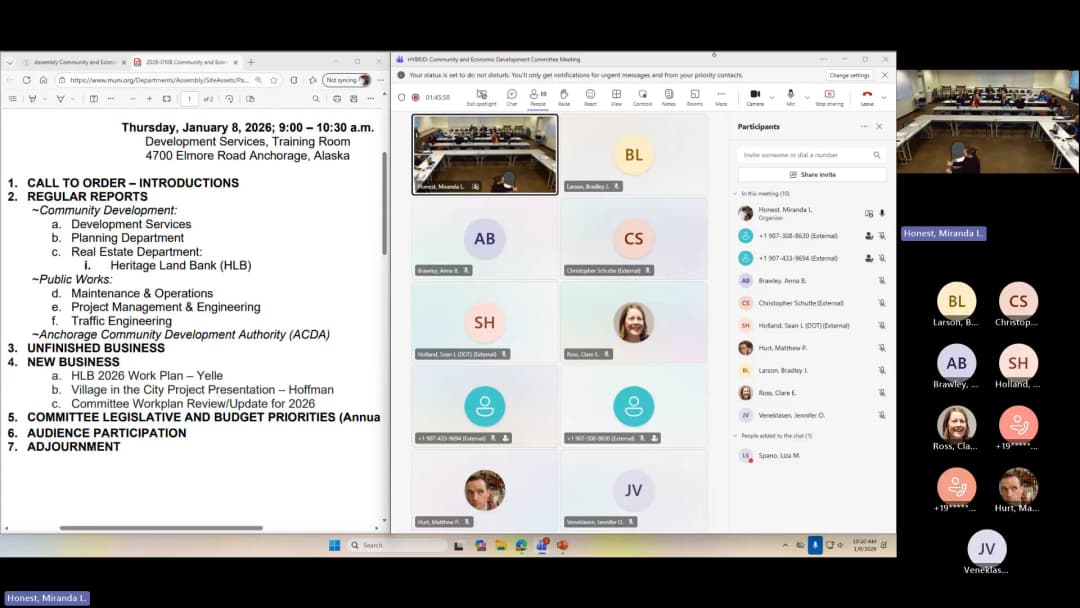
Community & Economic Development Committee Meeting - Jan 12, 2026

The Committee convened on Thursday, January 8th (noting the transcript title and date discrepancy as January 12, 2026) to review regular reports from the Community and Economic Development Department, Planning, Real Estate, and Public Works, followed by new business presentations regarding the 2026 Heritage Land Bank work plan and the "Village in the City" project. The meeting emphasized ongoing municipal reorganization, increased construction activity in 2025, and strategic discussions on snow removal efficiency, capital planning, and community development priorities. Consent Calendar - No specific consent calendar items were voted on during the recorded session; the meeting proceeded directly to regular reports and new business. Public Comments & Testimony - Community Member (Anecdotal): Reported that they observed plows on all streets driven, expressing general satisfaction with snow removal efforts compared to previous years. - Member Baldwin Day: Expressed concern regarding the frequency of snow events and the need for the city to maintain a year-round readiness posture, stating that a city that stops its mobility stops its economy. - Member Myers: Highlighted the economic impact of Alaska Native regional corporations, noting they generate $21 billion in revenue within a four-mile radius (approx. 40% of the state's GDP), and advocated for renaming 36th Avenue to highlight indigenous contributions. Discussion Items - Community Development Update (Bob Dole): Reported a reorganization effective January 1st, separating planning and development services from public works. Highlighted a 7% increase in total construction valuation ($636 million) and a 30% increase in dwelling units permitted (639 units) in 2025 compared to 2024. - Development Services: Discussed the first approved ADU design, two new student-designed ADUs anticipated from UAA in 2026, and four new subdivisions under review totaling 88 residential lots. - Planning: Confirmed PCC approval of the Holton Hills preliminary plat and noted 10 rezoning requests to implement the Comprehensive Plan are heading to the assembly. Discussed consolidating the 2020 and 2040 plans and upcoming code updates regarding agricultural production. - Real Estate (Tidney Briggs & HLB): Reported Planning Board approval for the Gardwin Industrial Park Phase 2 and the subdivision of an HLB parcel. Outlined HLB's 2026 work plan, including projects for Girdwood Industrial Park, Orca Mountain View, and a potential cemetery project with Alaska Natural. - Public Works (Mr. Collins): Explained the current plow-out is proceeding efficiently due to "light fluffy snow" rather than heavy wet snow, supported by new equipment (four sanders, road graders) and increased staffing. Discussed the reconfiguration of the right-of-way contract to focus on non-motorized (sidewalk) snow removal and the ongoing process to update the Design Criteria Manual (DCM) streets chapter, expected to conclude in late summer 2027. - Heritage Land Bank (HLB) 2026 Work Plan: Presenters detailed the drafting process, which included 100 public comments, and outlined priorities including the recording of plats for Girdwood projects, the former Clifford Center training lease with law enforcement, and a market study for Tower Track. - Chugach Alaska Corporation "Village in the City": Sherry Baretta presented a vision for a multi-phase project at 36th Avenue and Cuddy Family Park, featuring a museum, resource hub, and housing. She expressed support for the project's potential to address homelessness and connect rural Native people to Anchorage resources, noting the project is supported by a $3 million EDI grant and $12 million in contributions. - Committee Work Plan Reorganization: Members discussed restructuring the annual legislative work plan to focus on goals (e.g., "housing activation," "food security," "capital investment reform") rather than specific projects or one-time items. Member Myers proposed adding priorities regarding wildfire interface resiliency and fiscal constraints on city expansion. Key Outcomes - Data Confirmation: Staff confirmed a 7% year-over-year increase in construction valuation and a 30% increase in dwelling units for 2025. - Planning Approvals: Preliminary plat and conditional use for Holton Hills were confirmed as approved by PCC. - Equipment Procurement: Public Works reported success in utilizing the fleet levy to procure new snow removal equipment, with heavy equipment expected to replace close to half of the older graders by 2026. - Project Introduction: The "Village in the City" project was formally presented to the committee with support for future coordination on housing, cultural programming, and corridor revitalization. - Committee Direction: The committee agreed to solicit member input for reorganizing the annual work plan priorities by the next meeting, focusing on holistic goals like resiliency, fire mitigation, and efficient land development. - Discrepancy Note: The meeting transcript header and opening remarks state the date as "Thursday, January 8th," while the instruction prompt specifies the meeting date as 2026-01-12. The transcript references "next week" for an AO on January 12th, suggesting the meeting occurred on January 8th, 2026.

LAND USE PLANNING 24% · AFFORDABLE HOUSING 17% · TRANSPORTATION SAFETY 15% · ECONOMIC DEVELOPMENT 14%
164
JAN 10, 2026 · ANCHORAGE, ALASKA · ASSEMBLY & COMMITTEE MEETINGS
Anchorage Assessor's Annual Property Valuation Work Session - Jan 9, 2026

On Friday, January 9, 2026, the Anchorage Assembly convened for a work session to review the 2026 annual property valuations presented by Assessor Jackie Davis. The session covered the total and taxable property values ($59.8 billion total; significant shift in the tax base due to exemptions), the impact of new personal property exemptions, updates to residential and commercial modeling, and the appeal process timeline. Speakers expressed interest in data accuracy regarding zoning classifications and sought clarification on the regressivity of assessments and the mechanics of disaster relief provisions. Consent Calendar - No formal consent calendar items were listed; the session functioned as a work/discussion meeting. Public Comments & Testimony - Council Members: Expressed curiosity and requested data clarification regarding the discrepancy between zoning designations (residential four-plexes) and assessor classifications (historically commercial, now residential). - Council Members: Expressed concern and asked for a breakdown of commercial new construction data to distinguish between business investments and residential multifamily housing (Debonham units) to better understand the housing market versus commercial development. - Council Members: Inquired about the regressivity of the assessment process, seeking confirmation that the statistical tests indicate compliance with national expectations regarding fairness. - Council Members: Expressed interest in the "non-disclosure state" limitations, requesting data on the volume of voluntarily disclosed sales versus the total universe of properties to understand the data reliability. Discussion Items - Total Tax Base & Exemptions: Assessor Davis presented that the total taxable value is near an all-time high, with a $15 billion portion of the total value exempt. The largest exemption bucket is senior/disabled/veteran (3.2 billion), followed by municipality and charitable/religious exemptions. - Personal Property Exemption Impact: Davis reported that the personal property exemption has increased significantly from $20,000 to $100,000 for 2026, expected to result in a nearly 4% drop in the personal property tax base and a total tax base reduction of less than 0.5%. - Reclassification of Four-Plexes: The Board discussed a recent shift in classification where four-plexes are now categorized as residential rather than commercial, aligning with the Planning Department's zoning, which reduced the commercial pie slice by approximately 1.5%. - New Construction Trends: Commercial new construction increased 22% due to major projects including a FedEx warehouse, Marriott Hotel, and Kendall Auto dealership. Council members debated whether current data includes multifamily units under commercial classification and noted that historically, anything over five units was commercial, while four-plexes are now residential. - Modeling Improvements: The Assessor's office hired the War 48 consultant to refine cost tables, simplify quality of construction ratings, and consolidate geographic market areas from hundreds down to 17–18 to reduce overstratification. - Sale Ratios and Accuracy: The assessor noted a goal sale ratio of 96% (single-family achieved 95%, condos 97%) to account for seasonality and avoid overassessing. Discussion confirmed that while regressivity is monitored, current tests show results within expected thresholds. - Appeal Process: The Board noted that 85% of last year's 455 appeals were withdrawn before the Board of Equalization hearing, and 85% of those withdrawn appeals resulted in reduced values. Concerns were raised regarding a significant increase in no-shows for scheduled hearings (26 in one period vs. historical lows). - Disaster Relief Code: A council member requested a follow-up on a code section allowing tax proration for properties that burn down during construction, noting the process has been used primarily for residential properties. Key Outcomes - Tax Base Changes Confirmed: The 2026 personal property exemption is officially $100,000 (up from $20,000), resulting in 4% reduction in personal property valuation and <0.5% total revenue impact. - Data Requests Issued: The Assembly directed the Assessor to provide a breakdown of 2026 new construction data by land use (distinguishing commercial vs. residential) and to verify the impact of the four-plex reclassification on historical data tables. - Deadline Established: The appeal filing deadline for 2026 is confirmed as February 11, 2026, with notices mailed on Monday, January 12, 2026. - Board of Equalization Recruitment: The Assembly issued a call for prospective members to apply for the Board of Equalization positions. - Follow-up on Disaster Relief: The Assessor agreed to analyze and report back on the specific implementation and numbers of the disaster relief code section within the next month or two.

DATA MANAGEMENT 27% · TAX INCENTIVES 26% · LAND USE PLANNING 11% · PUBLIC ENGAGEMENT 11%
165
JAN 9, 2026 · ANCHORAGE, ALASKA · ASSEMBLY & COMMITTEE MEETINGS
Jan 9, 2026: Bob Dole Confirmation Hearing as Director of CED

On January 9, 2026, the Anchorage Assembly held a confirmation hearing for Mayor's nominee Bob Dole to serve as the new Director of Community and Economic Development. Dole, formerly the city's Building Official, was nominated to lead a reorganized department focused on the administration's goal of building 10,000 homes in 10 years, commercial development, and neighborhood revitalization. The hearing featured an exchange regarding Anchorage's constraints, departmental reorganization, and strategies for shifting the city's regulatory culture. Consent Calendar - No consent calendar items were listed for this specific executive appointment confirmation hearing. Public Comments & Testimony - Council Member Brawley: Expressed concern that the reorganization risks losing focus on aligning transportation planning with housing policy. Asked how Dole ensures these sectors remain tightly bound to prevent conflicts like highways intersecting with pedestrian pathways. Stated she expects the director to be the primary point person for holding the role responsible for creating a lower-risk environment for developers. - Council Member Baldwin Day: Expressed hope to move from a "culture of no" to a "culture of how." Questioned how this cultural shift will be accomplished within the permit center and scored the city's implementation of existing plans (2020, 2040, neighborhood plans), noting a lack of public education on why plans exist. Raised a concern about a "circular process" where the public repeatedly relitigates plans during implementation rather than executing them. - Council Member Gates: Expressed concern that despite efforts, a "culture of no" persists with some staff. Inquired if Dole has a mandate to change this. - Council Member (Phone/Unidentified): Noted the community council survey process is "historically quite broken" and requested Dole's leadership in harmonizing it. Discussion Items - Dole's Role and Mandate: Dole described his role as a "connector" (facilitating communication between developers and government) and a "border collie" (directing efforts toward the 10,000 homes goal). He accepted the Mayor's unequivocal mandate to advance Anchorage's interests, emphasizing a non-one-size-fits-all approach for different communities like Girdwood, Eagle River, and the Bowl. - Reputation with Developers: Council members cited a historical poor reputation with developers. Dole agreed the department must act as a business partner, not just a regulator. He stated he is already reaching out to developers to understand friction, noting that waiting for developers to show up at the counter is insufficient. - Shifting to a "Culture of How": Dole referenced Simon Sinek's "Start with Why," proposing a three-tier decision framework: "Can we?" (within existing authority), "Should we?" (aligns with goals), and "Do we want to?". He committed to exploring flexibility in code updates to avoid hard "no's" and suggested using appendices for pathways forward. - Plan Implementation and Public Education: Dole acknowledged that while the city has robust planning processes, it has failed to adequately educate the public on those plans, leading to surprises and headwinds during execution. He stated the Planning Department must play a key role in outreach, noting they are currently under-resourced but seeking to leverage assets like GIS and infographics to explain plans digestibly. - Transportation and Housing Alignment: Dole confirmed that the Community and Economic Development department and Planning are housed in the same building to facilitate daily coordination. He stated he attends transportation meetings and works with AMATS to ensure housing and transportation plans move in sync. - Operational Coordination: When asked about daily interfacing, Dole requested that Assembly members CC him on relevant emails to ensure all stakeholders are aware of issues and to prevent fragmented decision-making. - Code Flexibility: A Council Member suggested adding code sections allowing the Planning Director to issue project-specific waivers for bureaucratic blockades to meet mandates. Dole did not explicitly address the legal feasibility of this specific waiver concept but affirmed his broad authority to find partnerships and solve problems. Key Outcomes - Nomination Status: The hearing concluded successfully with no recorded objections or questions remaining; the Assembly proceeded to stand adjourn for a work session, implying the confirmation process is complete or will proceed to a vote. - Strategic Directives: Dole committed to: - Acting as a "connector" and "border collie" for the 10,000 homes initiative. - Shifting the department's culture from "no" to "how" by using flexible code appendices and existing authority. - Prioritizing public education on implemented plans to reduce relitigation. - Increasing outreach to attract and support developers rather than waiting for applications. - Maintaining daily integration between housing, planning, and transportation departments.

ECONOMIC DEVELOPMENT 53% · URBAN PLANNING 11% · STRATEGIC PLANNING 11% · PERSONNEL MATTERS 9%
166
JAN 9, 2026 · ANCHORAGE, ALASKA · ASSEMBLY & COMMITTEE MEETINGS
Muni Budget Workshop 2026-01-09: Fiscal Future Discussion

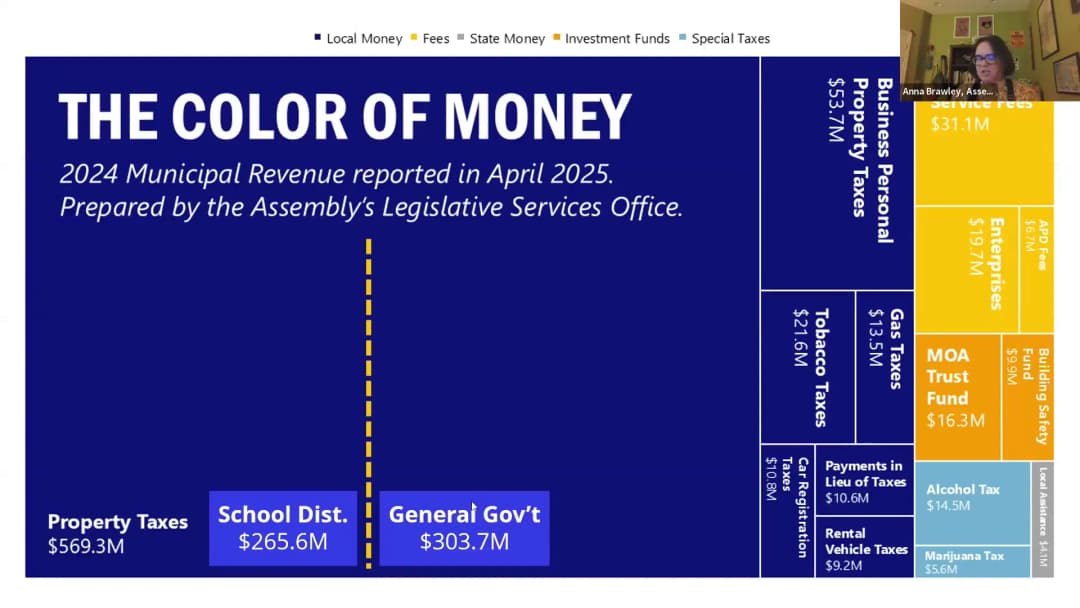
The Anchorage Assembly, led by Assemblyperson Erin Baldwin-Day and Vice Chair Anna Brawley, hosted a virtual workshop on January 9, 2026, to educate the public on the structure, challenges, and future of the municipal budget. The session aimed to clarify the complex interplay of revenue sources, the impact of the 1983 property tax cap, and the shift from state/federal funding to local property taxes over the last four decades. Consent Calendar - No specific consent calendar items or routine unanimous actions were processed during this educational workshop; the meeting focused exclusively on information sharing and public dialogue. Public Comments & Testimony - This section was reserved for questions and feedback after the presentation, but the provided transcript focuses on the presentation itself. The Assembly members invited attendees to submit questions via chat, email, or social media for future follow-up and encouraged participation in school board and state legislative processes. Discussion Items - Budget Structure and Categories: Members of staff distinguished between the operating budget (staffing and services) and the capital budget (owned assets/infrastructure). The budget was described as covering core services (police, fire, roads, health), publicly owned assets (e.g., Anchorage Golf Course), and enterprise entities (Water and Wastewater, Port of Alaska, Solid Waste, Merrill Field). - Revenue Sources and the "Color of Money": - Assemblyperson Baldwin-Day explained that property taxes are the largest revenue source (approx. $569 million, nearly 60% of the operating budget), noting that almost half of these taxes pay for the Anchorage School District, not the municipality. - Other revenue streams include other taxes (gas, vehicle rental, alcohol, marijuana), fees, permits, fines, and dedicated funds (e.g., MOA trust fund, building safety fund). - Speakers emphasized that not all revenue is fungible; for instance, alcohol and marijuana taxes are dedicated and too small to fund general operations. - The Property Tax Cap: - The group discussed the 1983 voter-approved property tax cap, a formulaic constraint based on inflation, population changes, and new construction. - The speaker stated that the cap is not a current policy choice but a charter formula; when population declines, the formula dictates budget cuts. - Taxation Disparities and Service Areas: - A map of taxable value per acre highlighted "limited road service areas" primarily on the hillside, where residents pay for road maintenance only, not police, fire, or parks. - Significant areas like Ted Stevens International Airport, Gatch State Park, and J Bear do not contribute to the general tax base despite requiring infrastructure support, creating a disparity in who pays versus who uses services. - Comparison to Historical Conditions (1980s vs. 2020s): - Speakers contrasted the 1980s, characterized by population growth, a boom economy, and significant state/federal investment, with the current stagnation and population decline. - The municipality now maintains twice the road and pipe mileage from 1983 but faces exponentially higher maintenance costs. - State investment has shifted from a significant portion of the budget in the 80s to less than 1% of operations and capital needs in the 2020s, with a corresponding billion-dollar drop in state funding between the 2005-2015 decade and the 2015-present decade. - Departmental Spending: - Police, Fire, and Maintenance (roads/vehicles) constitute just over 50% of the departmental budget. The speakers noted that while the assembly desires more police service, it is the largest and most costly department. - Homelessness Funding: - The discussion clarified that the majority of homelessness spending (shelter, prevention) was federally funded via HUD and COVID-related grants, with a significant portion reimbursed by FEMA. - Local funding for shelter is now drawn from general government property taxes, alcohol taxes, and state Housing Finance Corporation vouchers. - Reasons for Rising Tax Bills: - Speakers identified three main drivers for increased bills despite a "flat" budget: increased home values (higher assessed valuation), decreased state/federal funding, and rising inflation for operational costs (gas, materials, labor). - Capital Improvement and Bonds: - Bond revenues fund large capital projects (roads, parks). The speakers noted a heavy reliance on voter-approved bonds for local capital needs due to reduced state and federal infrastructure funding. Key Outcomes - No Decisions or Votes: The workshop was explicitly defined as an educational session to open dialogue; therefore, no binding decisions, votes, or budget allocations were made. - Directives for Engagement: - The Assembly directed residents to review the published slides and handouts available online. - Citizens were encouraged to contact their state legislators regarding state funding issues and the upcoming Juneau legislative session. - The public was encouraged to participate in the current Anchorage School District budget process, clarifying that the Assembly does not set the school budget. - Next Steps: The Assembly committed to addressing the submitted chat questions via follow-up email and continued civic dialogue on fiscal priorities.

BUDGET EQUITY ANALYSIS 55% · PUBLIC ENGAGEMENT 26% · FISCAL SUSTAINABILITY 10% · ENGINEERING AND INFRASTRUCTURE 9%
167
JAN 8, 2026 · ANCHORAGE, ALASKA · ASSEMBLY & COMMITTEE MEETINGS
Anchorage Rules Committee Meeting Summary - January 8, 2026

The Rules Committee convened on January 8, 2026, to recognize employee contributions, review the 2025 accomplishments and 2026 work plan, and address upcoming legislative priorities including elections and public safety initiatives. The meeting highlighted significant strides in municipal operations, staff collaboration, and community engagement efforts for the upcoming legislative session. Consent Calendar - N/A (No routine consent items processed; all business was discussed as new business or reports) Public Comments & Testimony - N/A (No public testimony or comments from members of the public were recorded in this session; all input came from committee members and staff.) Discussion Items Employee Recognition - Vice Chair Brawley proposed and the committee approved "Above and Beyond" awards for legislative service staff members Ali, Claire, and Jennifer for their exceptional organization of the 50th munification anniversary events, which achieved high community engagement with lower public expenditure than the 2015 centennial. - Chair Constant presented trophies and medallions to the recipients. Commissioner Brawley noted the successful nature of the events, citing the First Friday Civics Fair at the museum as a standout success. Legislative and Departmental Reports - Mayor: Briefed on public safety initiatives, including a coming ordinance amendment to Title VIII (penal code) to address gaps in indecent exposure and disorderly conduct laws, enabling better law officer engagement. The Mayor also announced a new collaborative resource-pooling agreement with the State's Criminal Division to align misdemeanor and felony handling, and a housekeeping charter update to remove references to the sold telephone utility. - Elections (Madam Clerk): Outlined the 2026 election timeline, including the alphabet random draw (Jan 15), candidate filing (Jan 16–30), ballot mailing (March 17), and election day (April 7). - Ombudsman: Reported a 100% decrease in employee complaints in 2025, attributed to a mild winter and improved workplace relations. The office announced a proactive shift toward community outreach, with new deputy deputies assigned to specific focus areas (investigations and communications). - Legislative Services: Reported on civic education campaigns, including the launch of a pre-approved ADU website, coordination of the Youth Assembly tour with the Mayor, and preparation for the 2026 legislative priorities presentation. Member Baldwin Day stepped in to assist with the MOA 101 presentation at the League of Women Voters fair. 2026 Work Plan Finalization - The committee reviewed and finalized the draft 2026 progress report and work plan. Members added initials to specific projects: - Housing Action Projects: Members committed to leading multiple items (IDs 1-10) related to ADUs, revenue identification, homelessness dashboard improvements, and process improvements (permitting/urban design). - Good Government & Assembly Business: Members allocated leadership roles for assembly duties, with a specific focus on ensuring smooth transitions for terming-off members and new hires (Item AB1). - Public Health, Safety, Quality of Life: Members认领 (claimed) specific tasks including wildfire safety, food policy expansion along the Tudor corridor, and various other health and safety initiatives. - Energy, Infrastructure, Transportation: Members assigned themselves to lead multiple transportation and energy projects. Individual Member Updates - Member Rivera (Felix): No new updates provided. - Member Anna: Announced upcoming ordinances to extend the Urban Design Commission sunset date to May 2026 and introduce a review process expansion for the Parks and Rec Service Area Commission (CASA) effective 2027. Also previewed future process improvements to Title 21. - Member Yarrow: Stated the public records Administrative Ordinance (AO) is pending legal review (delayed by two weeks) and is approaching introduction. Noted an upcoming difficult discussion regarding a downtown bar application and announced a marijuana code omnibus update scheduled for introduction on January 23. Yarrow also detailed an amendment to ensure health screening candidates have a right to their own medical records, bypassing the current contractor/municipality deadlock, and proposed making the Fire Department Chief Medical Officer the final authority on health screening eligibility. - Member Eva (Legislative Services): Shared personal news of pregnancy due in June and confirmed this aligns with the 2026 transition plan. Reported on the successful cross-training between civil and criminal divisions, resulting in civil attorneys covering misdemeanor trials. Announced a second budget public dialogue event in person on January 22. Key Outcomes - 2026 Work Plan: The draft 2026 work plan was conceptually finalized with members adding their initials to prioritize projects across Housing, Good Government, Public Safety, and Infrastructure. Claire will incorporate these changes and submit the document for adoption. - Committee Structure: No changes to the committee list were made this meeting; the full committee review will be tabled until the next assembly to allow for leadership changes. A proposal to move Jared to co-chair/vice chair of the Housing and Homelessness Committee was tentatively affirmed without objection. - Administrative Directives: The Clerk was instructed to ensure the work plan is posted online. The Office of the Mayor will proceed with the public safety ordinance and charter updates for Tuesday's addendum. The Ombudsman office will proceed with its new outreach strategy. - Adjournment: Meeting adjourned at 2:00 PM. }

PROCEDURAL 26% · PUBLIC SAFETY 10% · ELECTION PROCEDURES 9% · AFFORDABLE HOUSING 9%
168
JAN 8, 2026 · ANCHORAGE, ALASKA · ASSEMBLY & COMMITTEE MEETINGS
January 7, 2026 Plating Board Meeting Summary

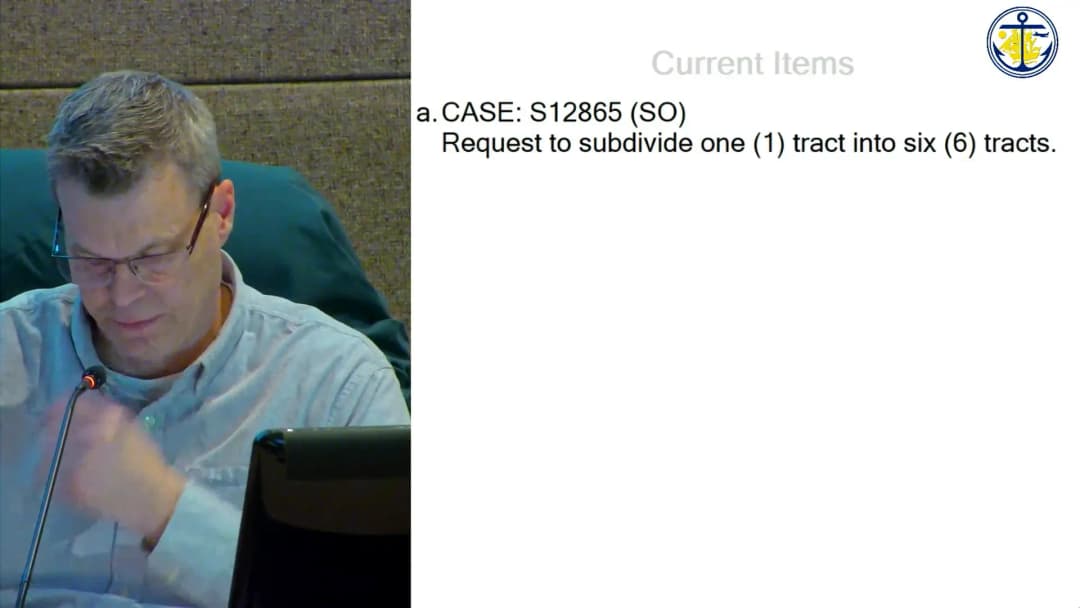
The Plating Board convened on January 7, 2026, to conduct monthly business, including the approval of minutes and the Consent Agenda. The board deliberated on two primary public hearing cases regarding preliminary plats in the Girdwood Industrial Park area: Girdway Industrial Park Case S12865 and the Orca Mountain View subdivision Case S12866. Both cases were presented by staff for their conformity with zoning and the 2025 Comprehensive Plan, and were supported by the petitioner, Heritage Land Bank. Consent Calendar - Minutes from the previous meeting were approved after a minor correction was noted regarding a member's last name. - The Consent Agenda was approved unanimously without any items pulled for separate discussion. Public Comments & Testimony - Crystal Hoke (Individual Resident): Expressed strong support for community-led development and explicitly requested a plat note dedicating 50% of the residentially zoned land in Case S12866 to community/workforce housing. She argued this was necessary to address the lack of affordable housing, citing past resolutions of support from local committees. - Board Member Responses to Testimony: Council members expressed skepticism regarding the feasibility of imposing affordable housing plat notes at this preliminary stage. They noted that defining "affordable" in Girdwood is complex due to the high local median income. Board members clarified that the Plating Board's role is limited to subdivision geometry and lot sizing ("slicing the pizza") rather than dictating land use content ("what goes on the pizza"), suggesting that housing restrictions are better addressed through future zoning, development agreements, or financial incentives rather than preliminary plat notes. Discussion Items - Case S12865 (Girdway Industrial Park Subdivision): Staff presented a proposal to subdivide a 156-acre tract into six tracks to align with zoning districts and resolve split-zone issues. The petitioner, Heritage Land Bank, confirmed support for the conditions and the goal of creating light industrial space and a dedicated fire training area. The board discussed the dedication of a 10-foot pedestrian easement for trail connectivity and the dedication of future road extensions. - Case S12866 (Orca Mountain View Subdivision): Staff presented a proposal to subdivide a 68-acre tract into three large tracks (3.5, 14, and 50 acres) to separate residential zoning from open space. The petitioner highlighted that access to Alyesca Highway is currently prohibited by DOT comments and that future development would rely on Ruan Road. During testimony, the board discussed the implications of this access restriction and the timing of potential affordable housing requirements, reinforcing that such restrictions would be addressed in future subdivision phases rather than this preliminary tract approval. Key Outcomes - Case S12865 (Girdway Industrial Park): Motion to approve the preliminary plat for 24 months, subject to conditions 1 through 4 A through D (as found in the staff report page six). Vote: 7-0 in favor. - Case S12866 (Orca Mountain View): Motion to approve the preliminary plat for 24 months, subject to conditions 1 through 3 A through E and 4A (as found in the staff report pages five and six). Vote: 7-0 in favor. - Both plats were approved with conditions regarding easement dedications, drainage, and future design reviews. The request for an immediate 50% affordable housing restriction on Case S12866 was not enacted, with the board deferring such discussions to the final subdivision stage.

LAND USE PLANNING 61% · PROCEDURAL 15% · PUBLIC ENGAGEMENT 13% · AFFORDABLE HOUSING 8%
169
JAN 6, 2026 · ANCHORAGE, ALASKA · ASSEMBLY & COMMITTEE MEETINGS
Anchorage Planning & Zoning Commission Meeting Summary - January 6, 2026

The Anchorage Planning and Zoning Commission convened on January 6, 2026, to vote on five major agenda items involving rezoning requests and a Complex Conditional Use Permit (PUD) and preliminary plat for the Holton Hills development in Girdwood. Commissioner Spinelli received ethics disclosures from fellow commissioners regarding local business interests but was authorized to participate in all cases. The meeting featured significant public testimony regarding housing needs, infrastructure constraints, and environmental concerns, particularly concerning drainage and the Iditarod Trail. The Commission approved four rezoning cases unanimously and approved the Holton Hills PUD and plat with specific amendments regarding road dedication and lighting standards, while deferring the review of Homeowners Association bylaws to a future date. Consent Calendar - Minutes: Approved the minutes from the December 8, 2025, meeting (Moved by Commissioner Bullis, Seconded by Commissioner Eber). - Disclosures: Commissioner Eber disclosed a past financial appraisal engagement regarding a property in cases 2026-0005 and S12867, stated she had no conflict, and abstained from the consent agenda vote. Commissioner Krishna disclosed she is a home builder in Girdwood; the Commission voted to direct Commissioner Spinelli to participate in cases 2026-0005 and S12867 despite the disclosure. - Procedures: Motion passed to combine cases 2025-0145 and 2025-0147, and cases 2026-0005 and S12867, doubling the allotted testimony time. - General: The entire Consent Agenda was approved without pull items (Moved by Commissioner Bullis, Seconded by Commissioner Eber). Public Comments & Testimony - Case 2025-0143 (Kimberley Court Area): - Joe Scarso: Expressed strong opposition to the R4 rezone due to concerns about increased traffic on Kimberley Court, which he described as having poor road conditions, potential crime, and the displacement of long-term renters. He requested specific details on traffic volume and road paving costs. - Paul Hatcher: Representing his family (four generations on Wright Street) and Functional Therapy of Alaska. Expressed opposition to the rezone, citing concerns over traffic, the loss of a wooded "jewel" in the city, and the desire to maintain a residential character rather than adding more condominiums. - Peter Johnson: Expressed opposition to the rezoning without elaboration. - Corinne Heffington: Owner of the adjacent property. Stated strong opposition to the rezone. - Julie Patty: Resident of Kimberley Court. Expressed opposition to the rezone. - Reap Reed: Resident of Kimberley Court. Expressed opposition based on traffic, road conditions, and the destruction of bird habitat. Stated neighbors are already suffering from potholed streets. - Case 2025-0145/0147 (Moorhand Subdivision): - Jason Jeffards: Representing himself as a long-term resident. Expressed strong opposition to the R3 rezone, citing outdated water utilities, lack of sidewalks, speeding traffic due to nearby businesses, and the argument that this project does not solve Anchorage's affordability or housing shortage crises. - Case 2026-0004 (Geneva Woods): - Eve Schoenrock: A prospective buyer. Expressed support for the rezone, noting that R3 aligns better with Homeowners Association covenants than R0. - Dave Forstland: President of the Geneva Woods HOA. Expressed support for the rezone to allow duplex development consistent with existing structures on other R0 lots. - Case 2026-0005/S12867 (Holton Hills, Girdwood): - Amanda Tuttle: Business owner and fire department board member. Expressed strong opposition and requested postponement. Cited failure to conduct environmental/downstream assessments, the condition of the failing levee (federal project), and the risk of unregulated runoff overwhelming critical infrastructure like the Alaska Railroad trestle and Seward Highway. - Crystal Hoke: Girdwood resident. Spoke via poetry. Expressed strong opposition, arguing the project serves private self-interest rather than community needs, highlighted the lack of community representation in the assembly process, and criticized the minimal benefit to workforce housing. - Mike Edgington: Co-chair of the Girdwood Board of Supervisors. Expressed mixed positions: supported variances for road geometry but opposed the designation of Holton Hill Circle as a private road (preferring municipal ownership). Expressed concern that the project fails to address the actual occupancy of housing units (high vacancy rates) and proposed specific conditions requiring owner-occupancy for four lots to prevent short-term rentals and second homes. - Ben Bowman (Assistant Municipal Attorney): Clarified that the Assembly's development agreement (AO 2023-137) already addressed several of the concerns raised by the Girdwood Board, but legal guidance suggested certain occupancy covenants proposed by the Board were unenforceable by this commission. - Connie Yoshimura (CY Investments): Stated the development team supports dark sky lighting and has agreed to bear the cost of the Iditarod Trail realignment. Clarified that 50% of multifamily units and all single-family units in the project are already restricted from being short-term rentals per the Assembly ordinance. Discussion Items - Case 2025-0143 (R2M to R4, Kimbrey/Court area): Staff recommended approval citing consistency with the Anchorage 2040 Land Use Plan (Urban Residential High). The Commission discussed the lack of specific site plans and noted that future plating would trigger major site plan reviews and road improvements. Commissioners agreed that public traffic concerns would be addressed in future permitting phases. - Case 2025-0145/0147 (R5 to R3, Moorhand): Staff recommended approval. Commissioners noted that while street improvements and water utility concerns were raised, they are separate from the current zoning action, which primarily aligns the district with the 2040 Land Use Plan. - Case 2026-0004 (R0 to R3, Geneva Woods): Discussed the rationale for the rezone, specifically to align with HOA covenants that previously restricted the property to no higher than a duplex, whereas the R0 code required a triplex. Approval was deemed necessary to resolve this conflict. - Case 2026-0005 (PUD/Conditional Use): Extensive discussion occurred regarding the Holton Hills PUD. Commission members and the public debated: - Infrastructure: Concerns about the failing levee and drainage were raised. Staff and legal counsel stated that drainage and environmental assessments would be handled in subsequent phases (planning review, site plan, and building permits), not during the current PUD approval. - Road Dedication: The Girdwood Board of Supervisors opposed the private road designation (Holton Hill Circle), arguing the municipality should maintain it. The Petitioner initially preferred a private road to distribute snow maintenance costs to large lots via the HOA but indicated willingness to convert to a public road if directed by the Commission. - Occupancy Restrictions: The Board of Supervisors requested restrictions requiring 4 lots to be owner-occupied by residents working in Girdwood. Staff and legal counsel advised that such specific employer/location covenants were likely unenforceable and fell outside the Commission's authority given the existing Assembly ordinance. - Lighting: Discussion regarding dark sky-friendly lighting led to a proposal to amend conditions to prioritize low-level trail lighting over standard street lighting. - HOA Review: Commissioners confirmed that the Homeowners Association bylaws and restrictions would be reviewed at a future informational meeting, not during this public hearing. Key Outcomes - Case 2025-0143: Motion passed to recommend approval of the rezone from R2M to R4 for approval by the Anchorage Assembly. - Case 2025-0145: Motion passed to recommend approval of the rezone from R5 to R3. - Case 2025-0147: Motion passed to recommend approval of the rezone from R5 to R3. - Case 2026-0004: Motion passed to recommend approval of the rezone from R0 to R3. - Case 2026-0005 (PUD): Motion passed to approve the Conditional Use for Planned Unit Development, subject to conditions 1-3, with amendments: - Condition 11D amended to include "consideration for dark sky friendly lighting strategy." - Variances A (lot frontage/access) and B (dedication of streets) denied (effectively converting Holton Hill Circle to a public street). - Conditions 4, 5, and 13C removed/removed references to private road maintenance. - Condition 16 added: Dedicate 50 feet of right-of-way for Holton Hill Circle. - Case S12867 (Preliminary Plat): Motion passed to approve the plat subject to conditions, effectively incorporating the PUD amendments: - Approved variance for cul-de-sac length (670 feet). - Approved phasing plan. - Revised Conditions: The plat conditions were updated to reflect the conversion of Holton Hill Circle to a public street (dedication of 50-foot right-of-way) and the denial of the private road variance. - Future Actions: - The Commission will review HOA bylaws and leasing restrictions at a future informational meeting. - Short-term rental registration and new regulations are effective May 1, 2026. - The Commission adopted a work plan for the upcoming year, including R6 updates, food production ordinances, and Anchorage School District items.

LAND USE PLANNING 52% · AFFORDABLE HOUSING 13% · COMMUNITY ENGAGEMENT 7% · PUBLIC ENGAGEMENT 6%
170
DEC 24, 2025 · ANCHORAGE, ALASKA · ASSEMBLY & COMMITTEE MEETINGS
Summary of City Council Meeting on 2025-12-24

The provided text contains no data regarding a city council meeting. The content consists of nonsensical phrases, repeated lyrical fragments, and incoherent sentence structures that do not correspond to a formal governmental proceeding, agenda items, or public discourse. Consent Calendar - No content found. Public Comments & Testimony - No content found. Discussion Items - No content found. Key Outcomes - No content found.

MISCELLANEOUS 100%
OPENPUBLICA · PUBLIC MEETING INDEXUPDATED DAILY · openpublica.com