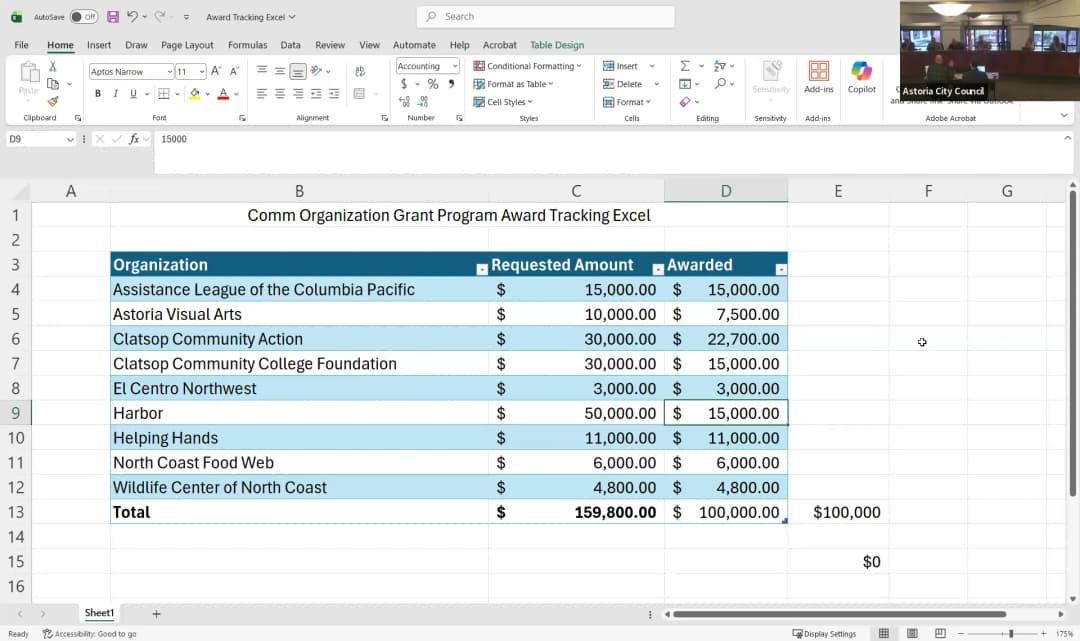
The Astoria Budget Committee's Community Organization Subcommittee met on March 11, 2026, beginning at 5:32 PM and adjourning at 6:13 PM, to review community organization grant applications and make tentative funding recommendations. The subcommittee elected a chair, discussed approximately $100,000 in available grant funds against nine applications requesting more than $159,000, and approved a motion recommending awards totaling $100,000. Note: The agenda and transcript list the meeting date as March 10, 2026; this summary uses the provided meeting timestamp of 2026-03-11. Call to Order, Roll Call, and Chair Election - City Manager Spence conducted roll call. Present were Committee Members Davis, Hardy, Ramel, Fitzpatrick, Johnson, and Conklin. - Tom Hardy, a citizen member, was elected subcommittee chair by voice vote with no opposition. - The meeting was called to order at 5:32 PM and adjourned at 6:13 PM. Discussion Items - City Manager Spence provided an overview: the Community Organization Grant Program had roughly $100,000 to distribute, and nine applications were received with requests totaling over $159,000. - Council-established priorities for the grants include mental health services, drug use and addiction treatment, permanent assets, leveraging funds as matching dollars, alignment with Astoria priorities, the organization's relationship with the community, the percentage of the organization's budget from city funding, and past grant performance. - Spence cautioned that the City Council is considering a designated campsite, and if that project moves forward, this grant program could be a funding source that goes away. - The committee discussed whether to favor smaller organizations with fewer funding sources or larger organizations serving broader populations. Members noted past practice has varied, with a tendency in recent years to help smaller organizations. - Committee Member Conklin suggested fully funding several lower-request applicants with small year-over-year increases: the Wildlife Center of the North Coast, North Coast Food Web, Helping Hands, and El Centro Northwest. She also noted The Harbor's $50,000 request for building purchase was high and suggested reducing it. - Chair Hardy expressed concerns about The Harbor, including its past property ownership, the director's residence in Portland, and the director's lack of presence locally. He also questioned whether the Wildlife Center and El Centro Northwest aligned with the council's funding priorities, while expressing support for arts programs. - Mr. Spence noted that a separate $20,000 community resilience grant program with a one-for-one match could be another avenue for The Harbor. - Members discussed the importance of Assistance League of Columbia Pacific, which buys clothing for low-income children, and Clatsop Community Action, which provides a broader swath of services. CCA's request covers two programs: the regional food bank and continuum care. - The committee discussed allowing Clatsop Community Action flexibility to allocate its award between the regional food bank and continuum care programs rather than requiring a 50/50 split. - The Harbor's building purchase was discussed as a permanent asset, but multiple members felt $50,000 was too large given the overall pool, and some suggested shifting funds from The Harbor to Clatsop Community Action. Key Outcomes - A motion was made, seconded, and passed unanimously by voice vote to tentatively recommend the following community organization grant awards: - Assistance League of Columbia Pacific: $15,000 - Astoria Visual Arts: $7,500 - Clatsop Community Action: $27,700 - Clatsop Community College Foundation: $15,000 - El Centro Northwest: $3,000 - The Harbor: $10,000 - Helping Hands: $11,000 - North Coast Food Web: $6,000 - Wildlife Center of the North Coast: $4,800 - The total recommended awards equal $100,000. - The recommendation is tentative and will be reviewed again by the full Budget Committee and City Council; council will hear it again before the final budget is adopted.
Public Meetings - Astoria, Oregon
Public Meetings - Astoria, OregonThe Astoria Budget Committee met on March 6, 2026, to elect a chair and vice chair, receive presentations from four tourism grant applicants, and allocate $650,000 in transient room tax (TRT) funding for fiscal year 2026-2027. The committee unanimously approved funding for all four organizations, with full requests granted to two smaller groups and proportional increases to the larger entities. Consent Calendar - None. Public Comments & Testimony - No public comments were recorded. Discussion Items Election of Budget Committee Chair and Vice Chair - Linda Morland was nominated and unanimously elected as Chair. - A vice chair (Tom Hardy, based on context) was nominated and elected unanimously. Tourism Organization Grant Program Applications Four organizations presented five-minute pitches, followed by five minutes of questions each. Astoria Downtown Historic District Association (ADHDA) - Quinn Hayes (Executive Director) and Tamra Cameron (Sunday Market Director) presented. - ADHDA’s website generates 2,000–5,000 unique impressions per month. They distribute 25,000 paper maps annually. - The Astoria Sunday Market generated $2.3 million in vendor sales in 2024, up from $1.5 million in 2022. Crowd counts range from 10,000–12,000 on opening day to 4,000 on rainy days. - A survey showed 27% of market visitors live outside Oregon/Washington, a 10% increase from 2023. 92 new vendor applications were received for 2025. - Requested $133,000 (full amount granted). Astoria–Warrenton Travel Alliance (AWTA) - David Reid (Executive Director, Chamber of Commerce) represented AWTA. - AWTA reported 4,117 tourism-related jobs, $49 million in wages, and $131 million total economic impact from visitation in 2024. Visitor spending generated $5.2 million in local taxes. - Citing a UMass study, Reid stated that 14.7% of travel is attributable to marketing, yielding $19 million of the $131 million in visitor spending. AWTA’s $267,000 total spending produced an ROI of $71.19 per dollar in economic activity and $11.40 in TRT revenue per dollar invested. - AWTA focuses on shoulder and off-season marketing, collaborates regionally (Cannon Beach, Seaside, Clatsop County), and rebranded from Lower Columbia to clarify its geographic scope. - Requested $300,000; received $229,737.50 (a $29,700 increase over last year). Astoria Uppertown Business Association (AUBA) - Stacey Stahl (President) presented. - AUBA formed in 2022, serves 90 businesses (20 active members). Events include Christmas Troll, Love Locks, and a new Astoria Rainbow Connection. No dues; sponsorships totaled $7,000 in 2024. - Reported 25–30% of trolley event attendees from outside the area, based on ticket sales zip codes. - Marketing materials (maps, field guide, activity book) distributed to hotels, businesses, and Portland-area contacts. - Requested $79,000 (up from $69,600 last year) to cover shared office space, reprints, and new event marketing. Full amount granted. Astoria–Warrenton Visitor Center (operated by Chamber of Commerce) - David Reid presented the visitor center’s request. - The visitor center is open seven days a week year-round; paid staff always on duty. It provides maps, community calendar, GPS trolley tracking, public restroom, and outlet for event ticket sales. - Reid detailed a “conversion” model: visitors with a few hours spend $20/person; those staying two days spend $300/person and generate TRT. - The building has deferred maintenance needs (roof patching $5,000). Last year’s allocation was $183,653; this year’s request (not explicitly stated) was higher. - Requested amount implied to be near $394,000 for full operations; received $208,262.50 (a $24,600 increase over last year). Funding Allocation Decision - Total requests: $777,000; available budget: $650,000 (84% of requests). - Last year’s allocation was $573,263. The committee debated across-the-board percentage cuts, prioritizing smaller organizations, and considering the visitor center’s physical plant needs. - Final consensus: Fund ADHDA and AUBA at their full requests ($133,000 and $79,000 respectively), then split the remaining $438,000 between AWTA and the Visitor Center, with a slight extra boost to AWTA. - Motion passed unanimously, with encouragement for the Chamber to provide more detail on building maintenance costs before final budget approval. Key Outcomes - Elections: Linda Morland elected Chair; Tom Hardy elected Vice Chair (both unanimously). - Funding Approved (FY 2026–2027): - Astoria Downtown Historic District Association: $133,000 (full request) - Astoria–Warrenton Travel Alliance: $229,737.50 - Astoria Uppertown Business Association: $79,000 (full request) - Astoria–Warrenton Visitor Center (Chamber of Commerce): $208,262.50 - Total: $650,000 - Next Steps: The Chamber will provide a cost estimate for visitor center building repairs; final budget adoption will occur at a later meeting.
Note: The meeting was originally scheduled and transcribed as occurring on Wednesday, March 4, 2026. Per the given instruction, the date used here is March 5, 2026. The Astoria City Council held a work session to continue discussions on homeless response, focusing on the feasibility of establishing a designated managed campsite. The meeting featured presentations from leaders of Clatsop Community Action (CCA) who operate the Stepping Stones campsite in Seaside, followed by a legal framework overview by attorney Chad Jacobs. Council also outlined a potential timeline for next steps. Public Comments & Testimony - No public comments were recorded during this session. The meeting primarily consisted of presentations and council discussion. Discussion Items - Presentation from Clatsop Community Action (CCA) on Stepping Stones (Seaside): - Viviana Matthews (CCA Executive Director) and Kenny Hansen (formerly ASPD, now CCA camp manager) described the operations of Stepping Stones, a designated managed campsite in Seaside that opened in August 2025. Key points: - The camp has 25 sites plus 4 overflow sites, with a maximum of two people per site (total capacity 58). Current occupancy: 27 people (as of the meeting). - Participants complete an intake process, sign a code of conduct, and receive case management. The camp has a no-drugs/alcohol policy, cameras, body cameras for staff, and on-site management 20–25 hours per week (Monday–Friday). No showers or meals are provided on site to encourage self-sufficiency. - Since opening, 45 people have exited the program: some to treatment, shelters (Columbia Inn, Esperanza Village, Helping Hands), an apartment (1 person), jail (4), or simply left. They estimated that over 50% but no more than 70% moved to a higher level of shelter or housing. Exits due to rule violations were approximately 10–12, with a possible return after 30 days. - Safety measures include de-escalation training, mental health support, and coordination with Seaside Police. The camp has not reached full capacity (highest 40 people). - Jonathan Never (CCA case manager) noted a significant reduction in homeless individuals loitering at Providence Seaside Hospital since the camp opened. - City Manager Spencer Kyle and Councilor Seamus McBay of Seaside attended via video. They reported that illegal camping in Seaside is now rare (only a handful of instances) and that the camp has reduced visibility of homelessness. Costs: one-time capital of $200,000–$220,000; ongoing annual costs of $50,000 contract with CCA plus $30,000–$40,000 for operations (portable restrooms, trash, electricity etc.). Funding comes from city general funds; no state shelter funds are available for campsites. - Council asked about staffing challenges (high turnover), capacity, and the incentive structure. CCA noted that requiring participants to leave the site for meals and showers helps prevent complacency and encourages progress toward permanent housing. - Legal Framework Presentation by Attorney Chad Jacobs (Barry Elsner & Hammond): - Jacobs explained the state law (ORS) requiring camping regulations to be “objectively reasonable under the totality of the circumstances” – a fact‑specific test. He distinguished legal minimums from policy choices. - Under a managed camp model, the city would need to ensure adequate capacity and possibly an overflow area to avoid legal challenges. Exiting participants without an available shelter bed or alternative camping location could create risk. - Jacobs emphasized the importance of community outreach, working with experienced community‑based organizations, and creating a record that demonstrates the city’s intent to help rather than remove homeless individuals. He also noted ADA exposure if camping on sidewalks blocks access. - Council asked about shelter availability and the definition of “available shelter bed.” Jacobs clarified that factors like substance‑free requirements or pet restrictions may make a bed unavailable for a particular individual. - Timeline and Next Steps Discussion: - City Manager Spence proposed a timeline: March 16 (public meeting on the concept), April 6 (decision on site criteria and funding), April 20 (potential sites), May 4 (final direction), May 18/25 (ordinance readings), June (contract with community‑based organization). - Councilor Davis suggested ordering decisions: first, whether to proceed with a managed camp; second, how to fund it; third, where to locate it. Councilor Adams requested data on current costs of responding to homelessness (police, parks, etc.) to inform the funding discussion. Councilor Mazzarelli asked for the number of people currently sleeping on sidewalks (staff estimated 32 individuals). - Council agreed to hold ward‑level community meetings before the March 16 public meeting to gather additional input. Key Outcomes - The council directed staff to prepare information on current costs of homelessness response (staff time, police, parks) and the estimated homeless population sleeping on sidewalks. - Staff will proceed to plan a public engagement session at the March 16 city council meeting to discuss the concept of a managed campsite. - The council will hold individual ward meetings on the topic before March 16. - A final decision on whether to proceed with a designated managed campsite is expected by May 4, 2026, with potential code amendments and contract approvals in late May/June. - No formal votes were taken; the meeting was a work session for discussion and direction.
On Tuesday, March 3, 2026, at 5:30 PM in City Hall Council Chambers, the Astoria Budget Committee convened for a training and orientation session led by Finance Director Hilary Norton and Budget Officer Scott Smigan. The committee elected a presiding officer, reviewed the budget process, and received guidance on Transient Lodging Tax (TLT) fund allocations and a planned financial software transition. No public testimony was heard, and no votes were taken on the proposed budget. Election of Presiding Officer - Linda Moreland was nominated by Gilbert Rammel and unanimously elected by the committee to serve as Chair for the 2026 budget cycle. She accepted the role. Discussion Items - Budget Process Overview: Director Norton explained Oregon’s budget law, emphasizing transparency, citizen involvement, and the requirement that the budget committee (composed equally of elected officials and citizen members) approve the budget and tax levy by June 30. She noted that the committee must hold public hearings, deliberate, and may revise the proposed budget. The city’s fiscal year runs July 1–June 30, and property tax revenue is not received until November 15, creating a cash-flow gap that requires adequate contingency reserves. - Budget Calendar and Schedule: The committee reviewed the meeting calendar: a March 5 tourist organization work session, March 10–12 community organization and arts/culture grant subcommittee meetings, March 21 first budget committee meeting (including public hearings), and additional meetings through March 24 and into the following week if needed. The final approved budget must be presented to the City Council on June 1. - Transient Lodging Tax (TLT) Training: Norton presented TLT background: 50% of TLT revenue goes to the Promote Astoria fund, 50% to the general fund. TLT dollars must be used per state law (ORS 320.300) for tourism promotion activities. Three grant programs exist: one general fund community organization grant, and two TLT-funded programs (tourist organizations and arts/culture). Total requests for TLT funding were $777,000, but staff recommended capping awards at $650,000 to maintain a healthy ending fund balance for resilience against economic downturns. The committee will hear presentations from tourist organizations on March 5. - Financial Software Transition: The city is replacing its 14-year-old financial software (Springbrook) with Cassella, at a cost of approximately $140,000–$150,000 for implementation and $48,000 annual licensing (down from Springbrook’s 7% annual increases). The new system will provide customizable reports, an online payment portal for parking tickets and library fees, and improved transparency. A finance team will train in Utah, and on-site training will occur for city departments. The transition is expected to be completed by June 2026. Committee members asked about cybersecurity, online payments, and the status of the current fiscal year (Norton reported the city is on track). - Urban Renewal Districts: Scott Smigan noted the committee will also need to approve budgets for the Astoria East and Astoria West urban renewal districts. Astoria West no longer generates revenue; Astoria East (formed in 1980) has not yet reached its maximum indebtedness. Funds are used for economic development, including housing and storefront improvements. - Current Year Performance: Norton stated the current fiscal year is in good shape, with no major concerns. The committee discussed how unanticipated grants and budget amendments are handled: grants are not included in the budget until awarded, and then brought to council for appropriation. The committee asked about mid-year budget reviews; Norton explained there is no formal hearing process, but the new software will enable regular financial reports. Key Outcomes - Chair Elected: Linda Moreland elected as Budget Committee Chair for the 2026 term. - Calendar Set: The meeting schedule for March 5, 10, 12, 21, and subsequent dates was confirmed. Subcommittee assignments will be made by the mayor. - TLT Funding Guidance: Staff recommended limiting TLT awards to $650,000 (below the $777,000 requested) to ensure fund sustainability; the committee will discuss this further at the March 5 meeting. - Software Transition: The committee acknowledged the progress on the Cassella financial software implementation, which is on schedule for June 2026. - Next Steps: The committee will receive meeting packets for the March 5 tourist organization work session, including application summaries and semi-annual reports. The first official budget committee meeting with public hearings is set for March 21.
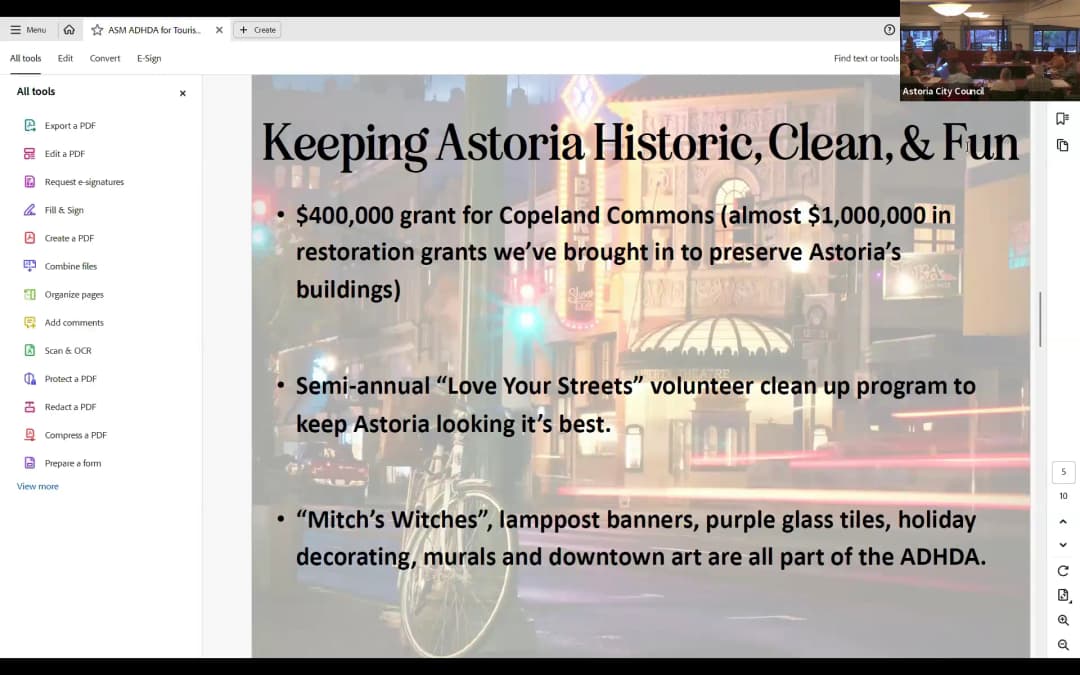
The Astoria City Council held a regular meeting on March 2, 2026, at 6:00 PM in the Council Chambers. The meeting featured presentations from three local organizations, approval of the consent calendar, discussions on a proposed System Development Charge (SDC) deferral program and a Coast Guard lease amendment, public comments, and an executive session. The Baker Tilly audit presentation was rescheduled to April. Presentations - Astoria Downtown Historic District Association (ADHDA): Executive Director Quinn Haase reported on the organization's accomplishments, including a $400,000 Main Street revitalization grant for the Copeland Commons project, cumulative gross vendor sales of over $2 million at the Astoria Sunday Market, recognition as a semifinalist for the Great American Main Street Award, and new committees. The ADHDA uses $120,000 in Promote Astoria (Transit Lodging Tax) funds for tourism promotion. Councilor Adams asked about employee benefits, funding sources, and the relationship between historic preservation and tourism. - Astoria Uppertown Business Association (AUBA): President Stacey Stahl presented updates on events (Christmas Trolley, Halloween Carnival, Spread the Love campaign), the temporary suspension of the Uppertown Farmers Market due to funding limitations, and future goals including fundraising and new events. The AUBA received $69,600 in TLT funds. Councilors discussed the farmers market attendance (150–300 visitors per week) and collaboration with ADHDA. - Astoria Warrenton Chamber of Commerce & Lower Columbia Tourism Committee (AWTA): David Reid, Executive Director, provided mid-year reports. He noted that the visitor center costs over $377,000 annually to operate, and in 2024, tourism directly supported 4,117 local jobs and generated $131.1 million in direct visitor spending, with $5.2 million in local tax revenue. The AWTA (formerly LCTC) spent $266,945 in 2024, attributing $19.3 million in travel spending to marketing efforts (a 71.19 cents per dollar ROI). Councilors asked about capital improvements for the visitor center and data collection. Consent Calendar - Approved by a 5-0 vote: Councilor Andy Davis moved, Councilor Andrea Mazzarella seconded. Items included: - Draft minutes from October 22, 2025, October 27, 2025 (work session), and November 3, 2025. - Memorandum of Agreement for fire protection services with US Coast Guard Cutter David Duren at Tongue Point Pier. - Application for Assistance to Firefighters Grant (AFG) for a new Breathing Air System (total cost $210,000; city match $21,000). - Approval to apply for the 2026 Wildfire Staffing Grant (no matching funds required). - Amendment No. 7 to the GMP contract with O'Brien & Co. for the Library Renovation Project (additional $75,800.17). Discussion Items - SDC Deferral Program: City Manager Scott Spence introduced the discussion, which originated from a request by Councilor Davis and Councilor Mazzarella. Staff recommended a pilot program, limiting eligibility to affordable or workforce housing projects with 10+ units, and evaluating administrative impacts. Councilors debated the merits: Councilor Davis emphasized reducing carrying costs for developers, Councilor Mazzarella supported easing burdens for small businesses, Councilor Conklin favored a pilot and opposed restricting to housing only, and Councilor Adams called for clear definitions of “workforce housing” and “public benefit.” Community Development Director John Roberts cautioned that SDC deferral programs are staff-intensive and noted Astoria has over 520 outstanding temporary certificates of occupancy (TCOs), which could complicate collection. Public comment from Jim Spence suggested requiring letters of credit as security. Council directed staff to develop an ordinance for a limited pilot program (initially two projects) and report back by May 2026. - Coast Guard Lease Amendment (SLA No. 13): City Manager Spence explained that the amendment returns approximately 40 parking spaces near the Astoria Armory to city control, reflecting the Coast Guard’s reduced parking needs following the transition to Fast Response Cutters. The annual rent will decrease by $13,000 (from $245,000). Councilors supported the move, with Councilor Conklin suggesting time limits for parking, Councilor Adams clarifying the lot’s full city control, and Councilor Davis encouraging creative use for DHS employees, residents, and downtown businesses. The motion to authorize the city manager to execute the amendment passed 5-0. Public Comments & Testimony - Jim Spence (912 Kensington, Astoria): Proposed the city consider purchasing the former Central School site (between 8th, Irving, 10th, and Jerome) for a park, using a bond measure for acquisition and improvement, with long-term maintenance funded by user fees or property taxes. - Mary Eng (no address given): Thanked outgoing council members, expressed support for nonprofit transparency, and raised concerns about inadequate sanitation facilities for unhoused individuals, particularly women. She praised medical outreach efforts by providers like Dr. Von Stelot. Key Outcomes - Consent Calendar approved (5-0). - SDC Deferral Program: Council directed staff to draft an ordinance for a pilot program limited to two projects, with eligibility criteria and a target completion date of May 2026. - Coast Guard Lease Amendment approved (5-0), authorizing the city manager to execute SLA No. 13. - Executive Session: The council entered executive session at 8:10 PM under ORS 192.660(2)(i) (city manager performance review) and returned to open session at 10:03 PM, adjourning immediately. No decisions were made.
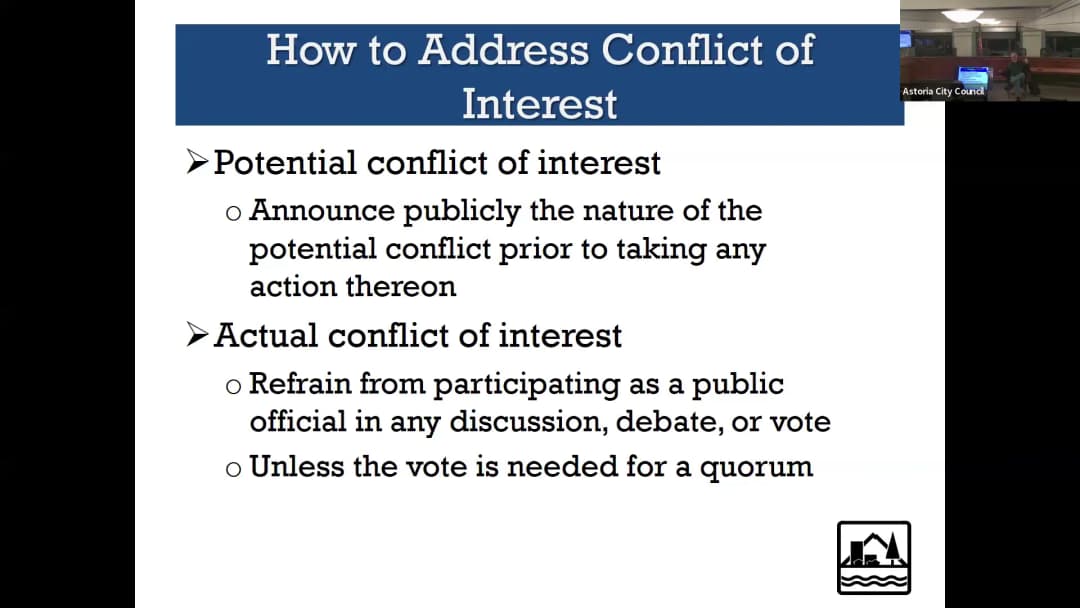
This meeting was a training session on the Oregon land use system, led by Brett Estes, North Coast Regional Representative for the Department of Land Conservation and Development (DLCD). City Attorney Blair Henningsgaard was present to answer legal questions. The session covered the history of Oregon land use planning, statewide planning goals, comprehensive plans, zoning ordinances, types of land use decisions, and ethical considerations such as ex parte contacts, conflicts of interest, and bias. The training was intended for members of the Planning Commission, Design Review Commission, Historic Landmarks Commission, and City Council. Note: The agenda provided for this meeting was for the Astoria Parks Board meeting on February 25, 2026, but the transcript corresponds to this land use training session on February 26, 2026. The agenda and transcript are inconsistent; the summary below is based solely on the transcript. Training Presentation - Oregon Land Use System History: Estes outlined the development of zoning in Oregon from 1919 (city zoning) through the 1940s (county zoning), the 1963 Exclusive Farm Use zone, and the landmark 1973 Senate Bill 100 that created the statewide planning system and the Land Conservation and Development Commission (LCDC). The first 14 statewide planning goals were adopted by 1975, with coastal goals added by 1976. Cities and counties had roughly a decade to adopt comprehensive plans consistent with these goals. - Statewide Planning Goals: The 19 goals include citizen involvement (Goal 1), land use planning, natural resources, housing (Goal 10), public facilities, transportation, and coastal goals for estuaries, shorelands, beaches and dunes, and ocean resources. Goal 1 has recently emphasized diversity, equity, and inclusion. - Hierarchy of Land Use Authority: Estes explained the hierarchy: Statewide Planning Goals and Oregon Revised Statutes (ORS) set the framework, followed by Oregon Administrative Rules (OAR), then local comprehensive plans, zoning ordinances, and finally land use decisions by planning commissions, design review commissions, historic landmarks commissions, and city councils on appeal. - DLCD Responsibilities: DLCD oversees state land use, acknowledges local plans, reviews plan amendments (post-acknowledgement plan amendments or PAPAs), enforces goals, provides technical assistance, and administers grants. DLCD cannot overrule local decisions but can participate in hearings and appeal decisions to the Land Use Board of Appeals (LUBA). - City/County Responsibilities: Local governments adopt codes in compliance with state rules, make land use decisions for properties within their jurisdiction, and enforce their own ordinances. - Comprehensive Plans and Zoning: Estes described comprehensive plans as guiding documents with a factual base, goals, policies, and implementation measures. Astoria uses a single-map system for land use and zoning. Plans must be consistent with adjacent county plans. The urban growth boundary in Astoria is inside the city limits, an anomaly. - Land Use Decision Types: - Legislative: Policy changes (e.g., rezoning large areas) adopted by city council; planning commission makes a recommendation. No action required; can be stopped. At least two hearings required. - Quasi-Judicial: Permit decisions applying pre-existing criteria with discretion (e.g., variances, conditional uses, design review). Decision required within 120 days; appeals go to city council. Used by planning commission, design review commission, historic landmarks commission. - Ministerial: Staff decisions with no discretion (e.g., checking setbacks). No appeal or hearing. - Limited Land Use: Staff decisions with some discretion, notice, and opportunity for appeal (e.g., design review). - Notice Requirements: Legislative code amendments require newspaper notice and Ballot Measure 56 notices for zone changes. Quasi-judicial permits require mailed notice to nearby property owners. Ministerial decisions require no notice. - Hearing Procedures: Steps include opening statement (raise issue or waive), declaration of ex parte contacts/bias/conflicts, staff report, testimony, applicant rebuttal (always last), deliberation, and decision. If the first evidentiary hearing is held, a request to keep the record open must be granted. - Findings: Written reasons for a decision, showing criteria were met and decision was not arbitrary. If a commission disagrees with staff recommendations, it must provide direction to staff on revised findings. Common pitfalls include failing to address each criterion, using generalizations, and not connecting facts to conclusions. - Land Use Board of Appeals (LUBA): State-level appeals body for land use decisions. Appointed by governor, decisions typically within six months. Can remand or affirm local decisions. Fairness Issues: Ex Parte Contacts, Conflicts of Interest, and Bias - Ex Parte Contacts: Communications outside the hearing about a quasi-judicial permit. Must be disclosed at the hearing. Site visits are ex parte contacts; commissioners should describe what they saw. Staff contact is not ex parte. Best practice is to direct public to the hearing. Failure to disclose can lead to claims of bias. - Conflict of Interest: Actual conflict (private pecuniary benefit/detriment to the commissioner, relative, or associated business) requires recusal unless needed for a quorum. Potential conflict (e.g., distant relationship) must be publicly disclosed, and the commissioner may remain if they can be impartial. - Bias: Prejudice or prejudgment that prevents objective decision-making. Does not automatically require recusal if the commissioner can remain open-minded. Commissioners should avoid making statements that suggest pre-judgment. Elected officials may have stated positions but must still decide based on facts and law. - Open Meetings Law: All decision-making must occur in public hearings. Commissioners should not discuss cases with each other outside the hearing to avoid violations. Spontaneous contacts (e.g., driving by a site) are not necessarily ex parte but should be disclosed if relied upon. Key Outcomes - No formal decisions were made; this was a training session. - Attendees were reminded to consult staff with any ethics questions and to avoid discussing cases outside hearings. - The session concluded with a Q&A and thanks to attendees.
The Astoria Planning Commission met in the Second Floor Council Chambers at 1095 Duane Street, Astoria, Oregon, to conduct three public hearings: a conditional use request for home stay lodging, a temporary conditional use request for a food and beverage establishment, and a development code amendment for health care zone signage and administrative/technical updates. According to the minutes, the meeting ran from 5:30 p.m. to 7:52 p.m. Note on discrepancies: the supplied metadata states February 26, 2026, 13:30 UTC, while the agenda and minutes identify the meeting as February 24, 2026, at 5:30 p.m. The raw transcript appears to be from a different meeting (an Astoria City Council special meeting dated October 22, 2025) and was not used for this summary. The minutes also credit President Corcoran with calling the meeting to order while the roll call lists him as excused; Vice President Brookley Henri presided over the hearing portions. Roll Call & Minutes - Present: Vice President Brookley Henri and Commissioners Mike Francis, Cindy Magie, and Chris Womack. Excused: President Patrick Corcoran and Commissioners Kris Haefker and David Kroening. Staff present: Associate Planner Samuel Peterson, City Planner Tiffany Taylor, and Community Development Director John Roberts. - The Commission added review of the January 27, 2026 draft minutes and approved them as corrected by a 4-0 vote. The correction added the word "lighting" to the phrase "parking lot lighting plan." Motion by Vice President Henri, seconded by Commissioner Magie. Public Comments & Testimony - No public testimony was offered during any of the three public hearings, and no non-agenda public comment was made. Public Hearing 1 – CU25-08 Sundquist Home Stay - Staff report: Associate Planner Sam Peterson presented, noted that no public comments were received, and recommended approval with the conditions listed in the staff report. - The applicant did not present. - Commissioners discussed the application and expressed support. Commissioner Francis moved to adopt the findings and conclusions in the staff report and approve Conditional Use Permit Request CU25-08 by David and Stacy Sundquist. Commissioner Magie seconded the motion, which passed 4-0. The rules of appeal were read into the record. Public Hearing 2 – TCUP26-01 Barran Temporary Eating/Drinking Establishment - Staff report: Associate Planner Sam Peterson presented and recommended approval with conditions. He answered commissioner questions about restrooms, site layout, and utilities, clarifying that the proposal does not include permanent fixtures. Commissioner Francis asked about compatibility with the nearby Fisherman’s Co-Op; Peterson explained both would be on Port property but unrelated, and the Fisherman’s Co-Op is an outright permitted use that does not require APC approval. Peterson also confirmed that everything would be removed annually by the end of the season. - Applicant Antony Barran of Ocean Park, WA, described a vision for a food and beverage destination called the Pacific Northwest Culinary Experience inside the cruise terminal area. He stated that the long-term goal is to develop the West Marina and that the pop-up would create basic marketing fundamentals to bring more tourists into the area and encourage them to stay longer. - No public testimony was offered. Commissioners agreed that the conditions of approval were sufficient for temporary use. Commissioner Magie moved to approve TCUP26-01, seconded by Commissioner Womack, and the motion passed 4-0. The rules of appeal were read into the record. - The Commission recessed from 6:04 p.m. to 6:09 p.m. Public Hearing 3 – A26-01 Signage and Development Code Amendments - Community Development Director John Roberts provided a brief overview before a presentation by Jesse Winterowd of Winterbrook Planning, Portland, Oregon. Winterowd explained that feedback from the prior meeting was used to reduce the overall signage. - Commissioner Womack asked whether the reduction in signage was optimal for the hospital campus’s current and future needs. Winterowd said the sign plan would work for the foreseeable future. - Vice President Henri asked a clarifying question about Provision J; Winterowd explained that it would allow submission of a comprehensive sign plan instead of processing one sign or variance at a time. - No public testimony was offered. Commissioner Magie moved to adopt the findings and conclusions in the staff report, approve Amendment Request A26-01 Exhibit A, and recommend it to City Council. Commissioner Womack seconded the motion, which passed 4-0. - The Commission recessed from 6:43 p.m. to 6:49 p.m., then reopened public testimony for Exhibits B, C, and D. Following discussion between staff and commissioners, public testimony closed at 7:42 p.m. Commissioner Magie moved to approve Exhibits B, C, and D and recommend them to City Council; Vice President Henri seconded the motion, which passed 4-0. Staff/Status Reports & Announcements - DLCD annual training slides are available for commissioners. - Save the date: the next APC meeting is Tuesday, March 24, 2026, at 5:30 p.m. - There were no officer reports. The meeting adjourned at 7:52 p.m. Key Outcomes - Approved the January 27, 2026 minutes as corrected, 4-0. - Approved CU25-08, the Sundquist two-bedroom home stay conditional use request, 4-0. - Approved TCUP26-01, Antony Barran’s temporary eating and drinking establishment, 4-0. - Approved A26-01 in two separate 4-0 votes: Exhibit A, then Exhibits B, C, and D, and recommended both to the City Council. - No public testimony was offered during any hearing, and no non-agenda public comment was received.
On February 26, 2026, the Astoria City Council and city commissioners participated in a joint training session on Oregon’s land use system, led by Brett Estes, North Coast Regional Representative for the Department of Land Conservation and Development (DLCD). City Attorney Blair Henningsgaard was also present to address legal questions. The training covered the history, legal framework, and practical application of land use planning in Oregon, with a focus on the roles of local boards and councils. Overview of Oregon Land Use System - History: Zoning authority was granted to cities in 1919, to counties in the 1940s, and the exclusive farm use zone was created in 1963. Senate Bill 100 in 1973 created the statewide land use system, the Land Conservation and Development Commission (LCDC), and the first 14 statewide planning goals by 1975 (coastal goals added in 1976). - Goals: The 19 statewide planning goals include citizen involvement, land use planning, natural resources (air, water, hazards), housing (Goal 10), transportation, and coastal goals (estuarine resources, shorelands, beaches/dunes, ocean resources). Astoria is subject to shorelands and estuarine goals but not beaches/dunes or ocean resources. - Hierarchy: Statewide goals are enforced through Oregon Revised Statutes and Oregon Administrative Rules. Local comprehensive plans and zoning ordinances must be consistent with these higher levels. Cities and counties adopt and enforce their own codes, making land use decisions for properties within their jurisdiction. - Comprehensive Plans: Astoria uses a “one‑map” system (combined land use and zoning map). Its urban growth boundary is inside the city limits – an anomaly. Plans can be amended through a post-acknowledgement plan amendment (PAPA) process, requiring 35 days’ notice to DLCD before a planning commission hearing and a 21-day appeal period after adoption. - Federal Consistency: Due to the Coastal Zone Management Act, federal activities (e.g., Corps of Engineers dredge permits) require a state review for consistency with local and state rules. DLCD’s coastal staff are funded by NOAA. Types of Land Use Decisions - Legislative: Changes to policy or code (e.g., rezoning an area). Initiated by the city, goes to planning commission for recommendation and then to city council for adoption. At least two hearings are required. No decision is required – the process can stop at any time. - Quasi‑Judicial: Applies pre-existing criteria to specific applications (e.g., variances, conditional use permits, HLC/design review permits). Requires notice to adjacent property owners, a public hearing, and a decision within 120 days (including appeals). The initial decision is made by staff, a hearings officer, or a commission; appeals go to city council. Commissioners must declare ex parte contacts and any conflicts of interest or bias. - Ministerial: Staff decision with no discretion (e.g., five-foot setback met). No notice, no appeal. - Limited Land Use: Staff decision with discretion but with notice and opportunity for appeal (e.g., design review in Astoria). Hearing Procedures and Findings - Hearing Process: Chair opens, criteria announced, commissioners declare ex parte contacts/bias/conflicts. Staff presents report and recommendation. Testimony from public (applicant gets final rebuttal). If the hearing is reopened, all steps must be repeated. - Findings: Written documents explaining the decision, including facts, evidence, and conclusions. Must address each criterion; failure to do so can be grounds for appeal to the Land Use Board of Appeals (LUBA). If a commission disagrees with staff’s findings, it must direct staff on how to revise them. - LUBA: A specialized appeals board appointed by the governor. Decisions typically occur within six months. Appeals go to LUBA, not circuit court (except for untimely decisions). Ex Parte Contacts, Conflicts of Interest, and Bias - Ex Parte Contacts: Any communication outside the public hearing about a quasi‑judicial matter must be disclosed at the hearing. Site visits are considered ex parte contacts; the commissioner must describe what was seen. Staff contact is not ex parte. Commissioners should encourage members of the public to testify at the hearing rather than sharing opinions privately. - Actual Conflict of Interest: When the decision would result in a direct private pecuniary benefit or detriment to the commissioner, their relative, or associated business. The commissioner must step down unless their presence is needed for a quorum. - Potential Conflict of Interest: When there could be a benefit (e.g., cousin is applicant, or employer is a competitor). The commissioner must publicly announce the nature of the potential conflict and state they can still be impartial. - Bias: Prejudgment of the facts that prevents an open‑minded decision. Commissioners should base decisions solely on the record and the law. Making statements like “I wouldn’t have voted for this” can indicate bias. - Examples Discussed: - The “Bond Street parking” example: a commissioner who went to the site at 7 a.m. and saw no cars – this was considered an ex parte contact because the observation was not in the record. - The LNG case: a county commissioner elected on an anti‑LNG platform was challenged for bias but the court found no bias because the commissioner affirmed willingness to listen to facts and law. - The co‑op appeal: city council members who read newspaper articles about the project were asked about it; the attorney for the appellant argued that reading news articles could be an ex parte contact. - The “first fairway” development: a developer hosted a cocktail party for commissioners; open meetings concerns were raised. Commissioner Questions and Discussion - On Site Visits: A commissioner noted that in a small town, everyday observations (e.g., parking patterns) can become knowledge. Blair Henningsgaard advised that if such information is relevant, it should be disclosed and the record reopened to allow parties to respond. - On Research Outside Hearings: Another commissioner asked about doing independent research (e.g., looking up property histories). The presenters cautioned that any research must be disclosed and discussed during the hearing to maintain a fair record. - On Open Meetings: Commissioners were reminded not to discuss pending cases among themselves outside of hearings, as that could constitute a public meeting violation. - On Remedying Ex Parte or Bias Issues: The recommended approach is to reopen the record, disclose the information, and allow parties to address it. Key Outcomes - This was a training session only; no votes or formal decisions were taken. The information is intended to guide future land use proceedings by the council, planning commission, design review commission, and historic landmarks commission. Attendees were encouraged to contact staff or the city attorney with any questions about conflicts, bias, or procedural issues. - Note: The agenda for this meeting lists the date as February 12, 2026, but the summary uses the date provided (February 26, 2026) per the instruction.
Note: The agenda and minutes list the date as February 23, 2026, but the provided source indicates February 24, 2026. This summary uses the given date per instruction. The City Council held a work session to discuss two main agenda items: agenda setting (including a parking framework and executive session scheduling) and homeless response. No formal votes were taken; council provided direction for further exploration. Agenda Setting Parking Master Plan - Councilor Davis presented a proposed parking framework, advocating for an internally developed strategy rather than a consultant-led study. Key goals included prioritizing on-street parking for customers, targeting 85% occupancy, improving turnover, and using off-street parking for long-term use. A 50-50 split of parking revenue was suggested for enforcement and a future garage. - Councilors Adams and Conklin expressed support, noting the need for better employee parking data, enforcement consistency, and community engagement. Council agreed to form a working group with staff and stakeholders to refine the plan. Executive Session - Council agreed to schedule an executive session under ORS 192.660(2)(i) to review the City Manager's performance. It will be held after a regular meeting on March 2, 2026, pending availability. Other Items - Council requested a CEDR annual report presentation and updates from partner organizations (e.g., Downtown Association) before budget planning, likely at the March 2 regular meeting. Homeless Response Staff Presentation - City Manager Spence outlined three service options: 1. Community-based shelter program (small pod sites on church/nonprofit properties, cost $49,000–$58,000, 1–2 months). 2. Permitted camping areas (designated sites with restrooms/garbage, may affect Colblower shelter, cost $49,000–$58,000, 2–3 months). 3. Designated campsite (similar to Seaside's Stepping Stones, cost $180,000–$290,000 capital plus ongoing, 3–6 months). - Compliance options included: municipal court (cost $125,000–$215,000, 6+ months), state law trespassing (1–2 months), or enhanced enforcement using existing tools. Council Discussion - Councilor Davis supported a designated campsite, revisiting the camping ordinance's place and time restrictions, and prioritizing funds for camps over court. He advocated for multiple sites to accommodate different needs. - Councilor Adams supported repealing the current camping ordinance and starting fresh, with a designated site or multiple sites, emphasizing safety and financial constraints. - Councilor Conklin favored a Stepping Stones model, citing the need for a maintained space with services and enforcement. - Councilor Mazzarella's written memo (read aloud) opposed criminalization, supported housing first, and called for effective enforcement of existing laws against violence, arson, and drug use. - Police Chief Kelly noted that Seaside is now at capacity and facing similar enforcement challenges, and that a designated camping area with clear boundaries would aid compliance. Key Outcomes - Council reached consensus to explore a designated campsite model. Staff will prepare a proposal including: - Potential sites and capital/operating costs. - Support services contract with a nonprofit (e.g., CCA). - Compliance mechanisms (e.g., trespassing after notice). - A follow-up work session will be scheduled in early March (likely week of March 2) with representatives from CCA (Kenny Hansen) and legal counsel to discuss operations and ordinance revisions. - Staff will notify community organizations that have applied for grants about potential funding reallocation to support the campsite. - No formal action was taken; council will continue deliberations at the next session.
The Astoria City Council met for a brief regular meeting. The Council dispensed with the pledge and reports, had no consent calendar items, and considered one regular agenda item: reconsideration of the previously approved request for proposals (RFP) for a technical update of the 2019 Downtown Parking Study. After staff explanation and public comment, the Council voted 4-0 to withdraw the RFP. The meeting adjourned at 6:10 p.m., followed by a planned work session. Note: The agenda, minutes, and transcript identify the meeting as Monday, February 23, 2026, 6:00 PM; the supplied timestamp of February 24, 2026 14:00 UTC is used for this summary. Attendance - Present: Mayor Sean Fitzpatrick; Councilors Andy Davis, Elisabeth Adams, Joshua Conklin. - Absent: Councilor Andrea Mazzarella. - Staff present: City Manager Scott Spence, Public Works Director Jeff Harrington, Finance & Administrative Services Director Hilary Norton, Police Chief Stacy Kelly, Fire Chief Dan Crutchfield, Parks & Recreation Director Jonah Dart-McLean, Assistant to the City Manager Ryan Quigley, City Attorney Blair Henningsgaard. Consent Calendar - No items were on the consent calendar. Public Comments & Testimony - Lisa Morley (4908 Cedar Street) expressed concern about reconsidering the previously approved RFP. She said the Council had already fully discussed and voted on the item at the prior meeting, described the reconsideration as confusing and unusual from a public perspective, and suggested it appeared some members were pressured into revisiting the decision. - Mary Eng / Mary Ng (PO Box 12; the minutes list the surname as Eng, while the transcript says Ng) gave a personal tribute to her late mother, a veterans' nurse, and reflected on her family's history of helping people experiencing homelessness. She encouraged the Council to prioritize compassion, accessibility, and disability awareness, and urged the city to ensure sidewalks, shelters, facilities, and libraries are disability-friendly. Discussion Items - City Manager Scott Spence explained that the Council had approved issuing an RFP for a technical update to the 2019 downtown parking study at the February 17, 2026 Council meeting. He noted that after further discussion during a work session, Council members expressed interest in a broader approach to parking, including development of a more comprehensive citywide parking master plan. Staff recommended withdrawing the approved RFP to allow time for a more holistic discussion and direction on long-term parking strategy before proceeding with consultant work. - The Council had no questions or discussion after the staff presentation. - Councilor Joshua Conklin, after noting he had voted against the item previously, moved to withdraw the RFP related to the technical analysis and update of the 2019 Downtown Parking Study. Councilor Andy Davis seconded the motion. Key Outcomes - Motion to withdraw the RFP for the technical update of the 2019 Downtown Parking Study passed 4-0. - Voting for: Mayor Sean Fitzpatrick, Councilor Elisabeth Adams, Councilor Andy Davis, Councilor Joshua Conklin. - Voting against: None. - No other business was conducted. - The meeting adjourned at 6:10 p.m.; the Mayor stated the Council would take a seven-minute break, then begin a work session, with another break at 7 p.m., aiming to finish by 8 p.m.