01
NEWOCT 28, 2026 · AUBURN, CALIFORNIA · CITY COUNCIL & COMMISSIONS
City Council Special Session - Oct 29, 2026
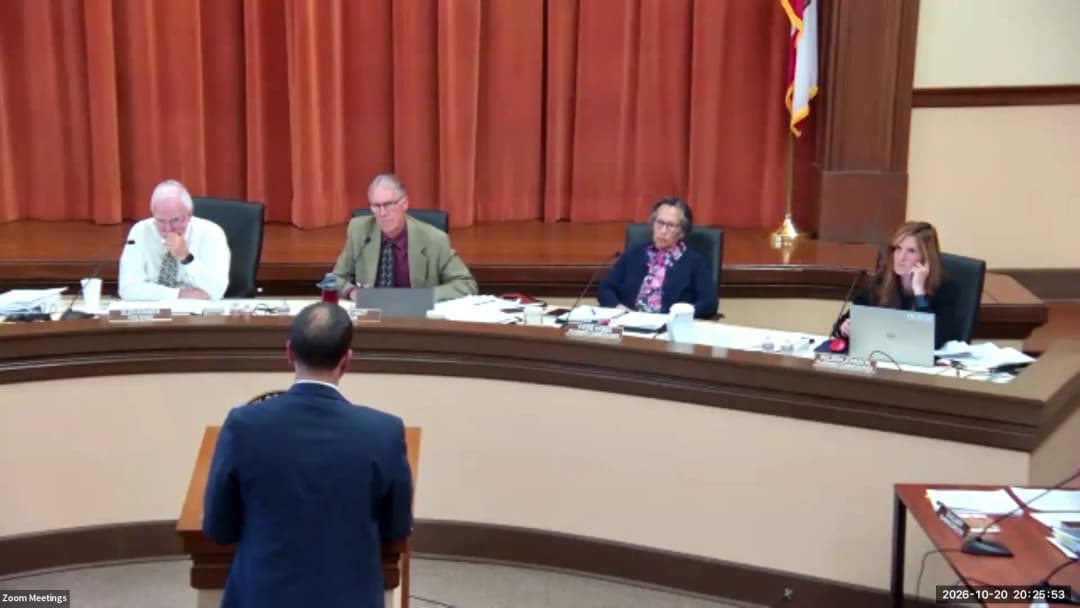
The Auburn Planning Commission met for a regular session. The agenda, staff reports, and transcript identify the meeting date as October 20, 2026, but the instructed meeting date for this summary is October 22, 2026, so that date is used in the title. Present: Chair Steve Hiatt, Vice Chair Glen Kramer, Commissioner Hobbs, and Commissioner Johnson. Commissioner Lehmberg was absent. The commission considered three major items and made recommendations to the City Council on all three by unanimous 4-0 votes, except where noted. Approval of Minutes - Approved the August 18, 2026 study session minutes by a 4-0 vote. - Approved the October 6, 2026 minutes with Vice Chair Kramer and Commissioner Hobbs voting aye; Chair Hiatt and Commissioner Johnson abstained because they were not present in person / attended via Zoom; Commissioner Lehmberg was absent. Public Comments & Testimony Auburn Station Infill Plan - Susie DeFawcett expressed concern about the proposed density, traffic, noise, tree removal, and air quality, and suggested reducing the unit count and preserving more open space. - Kelly Lardner asked whether Fulweiler Avenue traffic and on-street parking had been studied; staff responded that project traffic was analyzed and would not trigger removal of on-street parking, and that future project review could revisit it. - Jackie House noted that public hearing comments are part of the administrative record and referenced her written EIR comment about state parking-reduction rules. Auburn 2045 General Plan / Blocker Drive Parcel - Stephen Mead, the Blocker Drive property owner, asked the commission to recommend Alternative 2, which would designate the property for industrial use, saying the city had directed him toward light industrial and that he was seeking consistency with the zoning under which he purchased the property. - Wayne Nader, a former Placer County planning commissioner, supported the industrial alternative, citing economic benefits and stating the property is well suited for it. - Many residents, including Jackie House, Gary Mappa, Jeff Wharton, Jerzy and Claudia Spikowski, Craig Buxton, Linda Newhouser, Bill Pennington, Caroline Meinhold, David Agar, and Rhonda Wharton, urged the commission to retain the Medium Density Residential designation and reject industrial use, citing neighborhood compatibility, traffic, environmental, and housing concerns. - Sherry Perkins presented a petition with 211 verified signatures supporting the residential designation for Blocker Drive. - Tyler Friesen, a business owner and environmental consultant, said the General Plan EIR was very solid and supported it. - One speaker supported industrial use at the site, saying it might create less traffic and noise than housing. Cannabis Retail Ordinance - Dr. Mark Vaughn, medical director of Auburn Medical Group, raised concerns about cannabis use disorder, emergency-department visits, and adolescent brain-development effects, and asked whether the city had consulted the medical community in Grass Valley/Nevada City. - Adam Torella opposed the ordinance, citing a Northern California adolescent health study, the proposed reduction of the school buffer from the 600-foot state default to 200 feet, and community-character concerns; he asked the commission to continue the item or recommend denial. - Jason Wedge, speaking on his own behalf as an Auburn Union School District trustee, raised public-safety and school-proximity concerns and asked for more studies on police resource impacts. - Jim Dion and Tim Dion, associated with Golden State Patient Care in Colfax, supported the ordinance, describing their record since 2003 and medical-cannabis benefits. - Crystal Schmidt, Judy Rhody, and Tom Crandall supported regulated access, with Rhody advocating meaningful consideration of local ownership. - Robert Lesbridge opposed the ordinance, calling cannabis retail a blight and saying people moved to Auburn to avoid such uses. - Kelly Lardner asked that the Chana Drive candidate area be removed from the map, citing a residential pocket, safety, and lack of nearby retail history. Discussion Items Auburn Station Infill Plan and Final EIR - Staff from AECOM presented the plan for a 10.5-acre portion of an approximately 17-acre Placer County-owned property adjacent to the Auburn Transit Station. The plan includes two concept options: Option 1 would preserve The Domes and allow 238 multi-family units, 3,375 square feet of retail/commercial space, and 295 residential parking spaces; Option 2 would redevelop the entire Plan Area and allow 315 units, 3,375 square feet of retail/commercial space, and 390 residential parking spaces. Both options are planned at 30.1 dwelling units per acre. - The Final EIR identifies five significant and unavoidable impacts related to aesthetics, historical resources, and noise/vibration. Mitigation would reduce other impacts to less-than-significant levels. - Commissioners noted the site's proximity to transit, school, shopping, and Old Town and the potential for transit-oriented housing. No commissioner expressed opposition. - The commission adopted a motion recommending Council certification of the FEIR, adoption of CEQA findings, a Statement of Overriding Considerations, and a Mitigation Monitoring and Reporting Program, and acceptance of the Auburn Station Infill Plan. Auburn 2045 General Plan and Final EIR - The General Plan update is the culmination of a roughly three-year process. It covers the 7.2-square-mile city and a larger planning area of about 29 square miles, with a projected buildout of approximately 2,570 housing units and 4,400 jobs by 2045. - The Draft EIR had a 52-day public comment period ending September 21, 2026. Staff reported 58 written comment letters and 12 oral comments. The Final EIR was published October 13, 2026. Significant and unavoidable impacts remain in cultural resources, noise, and transportation. - The proposed General Plan as drafted designates the 14.3-acre Blocker Drive parcel as Medium Density Residential. The EIR alternatives include Alternative 2, which would designate it for industrial use. - During discussion, Chair Hiatt said Auburn needs nonresidential jobs, noted the site's proximity to rail and existing industrial/utility uses, and moved to amend the General Plan recommendation to change the Blocker Drive designation to industrial. Commissioner Hobbs said industrial use could be acceptable with proper buffering. Commissioner Johnson said both uses would change the area but viewed light industrial as a net benefit. The motion carried 4-0. Draft Cannabis Ordinance - Staff presented an ordinance that would repeal Section 159.019 and add sections creating a retail cannabis licensing and zoning framework. It would establish C-2-RC, C-3-RC, and OB-RC zoning designations in four commercial areas: portions of Downtown High Street, two Highway 49/near-highway areas, and the Nevada Street corridor. - The ordinance would cap retail cannabis permits at one per 8,500 residents and no more than two citywide. A permit holder would need a city retail cannabis permit, a conditional use permit, and a state Type 10 license. - A staff survey of 188 responses found approximately 86 percent support for allowing cannabis retail, roughly 60 percent support for multiple licenses, 54 percent preferring Highway 49 locations, and 36 percent preferring Downtown. - Staff estimated a full year of operation could generate $200,000 to $300,000 in additional city revenue and noted Prop. 64 Public Health and Safety grants available to cities that allow retail cannabis, including $3 million grants to Grass Valley and Nevada City. - Commissioners asked about site selection, school setbacks, law-enforcement input, and revenue estimates. Chair Hiatt initially suggested expanding the definition of youth center to include private youth instruction, but withdrew the suggestion after staff explained the intended definition. - The commission adopted a motion recommending Council adoption of the ordinance and zoning map amendments. Key Outcomes - Approved the August 18, 2026 minutes (4-0). - Approved the October 6, 2026 minutes with two abstentions and one absence. - Adopted Resolution 2026-08 recommending City Council certification of the Auburn Station Infill Plan FEIR, CEQA findings, Statement of Overriding Considerations, MMRP, and acceptance of the Plan (4-0). - Adopted Resolution 2026-09 recommending City Council certification of the Auburn 2045 General Plan FEIR, CEQA findings, Statement of Overriding Considerations, and MMRP (4-0). - Adopted Resolution 2026-10 recommending City Council adoption of the Auburn 2045 General Plan, amended to change the Blocker Drive parcel designation from Medium Density Residential to industrial/Alternative 2 (4-0). - Adopted Resolution 2026-11 recommending City Council adoption of the cannabis retail ordinance and zoning map amendments (4-0). - Next steps: The City Council is scheduled to consider the Auburn Station Infill Plan and the Auburn 2045 General Plan/EIR recommendations on November 9, 2026. The cannabis ordinance will proceed to the City Council, with a possible second reading in November or December. Staff also reminded the commission of a November 17, 2026 HDRC meeting. - The meeting adjourned by unanimous consent after the final action.
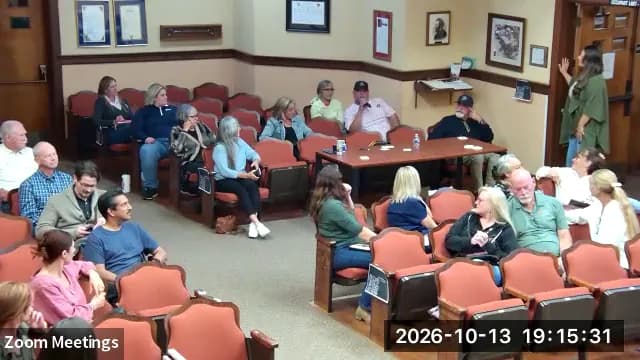
The third in a series of community town halls hosted by the Auburn Economic Development Commission on October 14, 2026, focused on what creates community beyond financial transactions. Catherine Gonzalez (EDC member) opened with personal reflections on community investment, followed by facilitation by Jay Ross with a panel of five community leaders. The event included real-time audience polling via QR code and open microphone Q&A. Panel Discussion: Giving Back, Purpose, and Volunteering Panelists included Tammy (Gold Country Food Hub/Thursday evening Real Food Farmers Market), Colleen Sands (Auburn State Theater, Friends of Auburn Faith), Sue Thompson (Placer Community Foundation), and Lisa Herrera (Latino Leadership Council). They discussed the many forms of giving back—time, money, mentorship, simply showing up—and how to turn passion into purpose-driven work. - Sue Thompson emphasized that everything she has came from the community, and she feels a responsibility to give back. She highlighted the importance of organized philanthropy through the Placer Community Foundation and noted that the foundation has programs to train nonprofit boards and executive directors. - Tammy described her pivot from corporate to farming and starting the Thursday evening Real Food Farmers Market and Gold Country Food Hub to support local agriculture, emphasizing purpose-driven work over retirement savings. - Colleen Sands shared how saying "yes" to requests led her to leadership roles at Sutter Auburn Faith (Chair of the Faith and Fantasy Ball for 16 years) and as Executive Director of the Auburn State Theater. She stressed the value of acknowledging volunteers and making service fun, and noted that the theater project has been scaled back to $8 million to open sooner, aiming for 16 months if funding is secured. - Lisa Herrera recounted how the Latino Leadership Council started by listening to families and now employs 12 paid promotores (community navigators). She observed a decline in volunteer hours due to economic pressures, the challenge of running volunteer programs with background checks, and the importance of policies that create barriers—such as requiring utility bills for food assistance—which they worked to change. Panelists also touched on self-care: gardening, fostering dogs, supporting other local businesses, and asking for help. They noted that giving can be selfish because it feels good, but discernment is needed. Audience Engagement and Suggestions Attendees used QR codes to submit answers to prompts like "What does giving back look like?" and "What is a small first step?" Responses were displayed live. Common themes included listening, seeing needs, and starting small. Mayor Davis encouraged support for local sponsors and emphasized succession planning for nonprofit boards to retain institutional knowledge. Parry mounted a plug for the Placer Community Foundation as a hub for philanthropic training and granting. City Council candidate Eric Robb proposed attracting the video game industry to Auburn, citing the high-speed fiber at the airport and the industry's size (larger than Hollywood and Bollywood). He noted that the industry has suffered layoffs nationally, presenting an opportunity to bring talented, high-earning professionals to Auburn without altering its character. Small business owner Don Sterling (Old Town Pizza) called for a coordinated tourism effort, noting that past efforts have been fragmented and that a unified approach could drive more visitor dollars. Other audience suggestions for future town halls and community action included: - Organizing business site visits by EDC members - Providing educational sessions on LLCs and trusts for asset protection - Holding a town hall on the General Plan and annexation - Encouraging youth volunteerism and service opportunities - Better leveraging the "Big Day of Giving" (first Thursday in May) with a central, in-person location for non–computer-literate donors - Using geofencing technology to pop up promotions for travelers - Highlighting home building and renovation businesses to keep spending local Key Outcomes and Next Steps No formal votes were taken, but several actionable ideas and commitments emerged: - Councilmember Bridget Powers proposed an "Industry 2027" event to showcase all business corridors, following the successful 2012 model that revitalized the airport. - EDC member Jonathan White noted the EDC is currently at capacity, but encouraged participation on other city commissions (planning, arts, etc.). - Panelists and city officials promoted numerous upcoming events: Gold Rush Auburn citywide treasure hunt (clue drops in May, concluding in July, with real gold prizes), Faith and Fantasy Ball (November 7), Auburn State Theater chili cook-off/air show (same weekend), Auburn Symphony concerts, Coco in the Cemetery (October 23), Porch Fest, Alt Fest, and the Greater Auburn Collective’s business speed dating (November 5) and six-month entrepreneurship program. - Multiple calls were made for businesses to proactively reach out to nonprofits with donations rather than wait to be asked, reducing the burden on nonprofit staff. - The importance of arts and culture for economic development was underscored: Mayor Davis cited that $26 million is brought into Placer County through the creative economy. The town hall concluded with a plea for attendees to get involved as volunteers, board members, and financial supporters to keep Auburn’s community fabric strong.
The Auburn City Council convened on October 12, 2026, at 1225 Lincoln Way, Auburn, CA. The agenda included a Mayor’s Commendation, a consent calendar item, two council business items, and several reports. No transcript or minutes were provided, so specific discussion points, public comments, and official actions cannot be confirmed from the source material. Consent Calendar - Approval of Warrants Paid (April–September 2026): The consent calendar included a resolution to approve accounts payable warrants paid from April 2026 through September 2026. No vote or action is recorded due to the missing transcript. Council Business - Pacific Avenue Bike Lanes Update: Staff presented an update and requested council direction on future bicycle lane closures along Pacific Avenue, if any. The item was agendized as a motion. - Automatic License Plate Reader (ALPR) System Report: Staff requested that the City Council receive a report on the city’s use of the ALPR system and provide direction on creating a city policy to guide its use. Reports - City Manager Report: Scheduled for the City Manager to provide updates and information on relevant matters. - Future Agenda Items: Council members could propose new ideas, unresolved issues, or projects for upcoming meetings. - City Council Committee Reports: Council members had the opportunity to inform the Council and public about committee and commission discussions. Key Outcomes - No decisions, votes, or directives can be confirmed from the provided materials because the raw transcript is empty and no minutes are available. Any outcomes reported elsewhere should be treated as unverified.
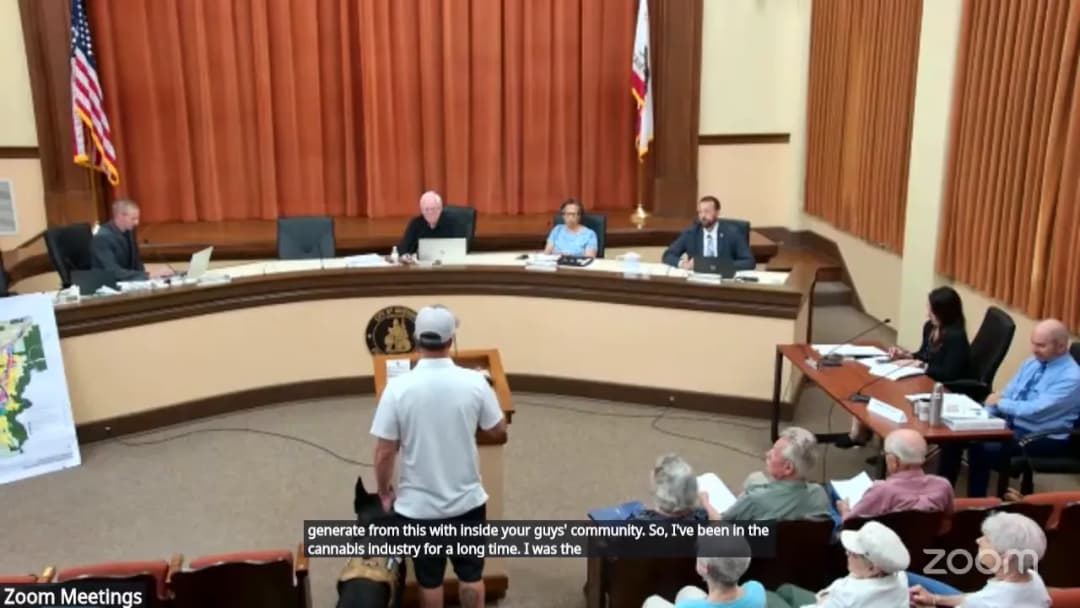
The Auburn Planning Commission met on the recorded date of October 7, 2026; the agenda and transcript identify this as the October 6, 2026 regular evening session at 6:00 p.m. Vice Chair Kramer presided with Commissioner Hobbs; Chair Hiatt, Commissioner Johnson, and Commissioner Lehmberg were absent. Because no quorum was present, the Commission did not conduct formal business or approve the August 18, 2026 minutes, and instead held the three scheduled study sessions as an informal informational session. All presentations and public comments will be part of the official record. The Commission is next scheduled to consider formal recommendations on all three items on October 20, 2026, with City Council consideration currently set for November 9, 2026. Public Comments & Testimony - Auburn Station Infill Plan: Judy Alberts (226 Live Oak Street, Prospect Hill) voiced concerns about increased traffic, noise, parking, and impacts on narrow streets, noting that Old Auburn Cemetery prevents street widening. Craig Buxton (Hidden Creek) questioned the density and scale of the proposal, and expressed skepticism that bicycle lanes would improve safety on narrow, geologically constrained roads, suggesting a greater need for service buildings. - Cannabis Ordinance: One community member opposed recreational cannabis, describing it as a gateway drug and objecting to city's motivation for tax revenue. Robert Ingall, a lifelong Placer County resident and former licensed indoor cannabis cultivator in Nevada County, supported the ordinance and urged the city to prioritize local applicants and consider multiple licenses for competitive pricing; he noted delivery services and a North Auburn smoke shop already supply cannabis. - Auburn 2045 General Plan: Multiple speakers supported the proposed Medium Density Residential designation for the Blocker Drive site and opposed the industrial alternatives (EIR Alternatives 2 and 3). Kyle Santuccio cited a petition with over 120 signatures; Caroline Meinhold argued residential use would boost local economic multipliers and property tax revenue; Jackie House, Sherry Perkins, and David Agar voiced agreement. Joe Madeuris, president of Save Auburn Ravine Salmon and Steelhead (SARS), urged stronger restoration and enhancement language for riparian habitat, stream setbacks, and groundwater recharge. Robert Hain (SARS) also emphasized groundwater recharge. Harry White (Placer Group Sierra Club / CNPS) supported infill development, native plant use, and residential designation at Blocker Drive. Linda Newhauser asked how decision-makers would balance General Plan principles against conflicting EIR alternatives. Discussion Items Study Session on the Auburn Station Infill Plan ("The Domes") - Matthew Gerken (AECOM), consulting project manager, presented the Draft Auburn Station Infill Plan, prepared under a SACOG Green Means Go grant in collaboration with Placer County. - The 10.5-acre Plan Area is part of a 17-acre County-owned property adjacent to the Auburn Transit Station, including the Placer County Administrative Center ("The Domes"), a World War I Veteran's Memorial (preserved under both options), former County library offices, parking, and landscaping. - Option 1 preserves The Domes and would allow 238 multi-family units (245,410 sq ft of residential space) in four 4-story and two 3-story buildings, 3,375 sq ft of retail/commercial space, and 295 residential parking spaces. - Option 2 would demolish The Domes and would allow 315 multi-family units (361,318 sq ft of residential space) in six 3-story and four 4-story buildings, 3,375 sq ft of retail/commercial space, and 390 residential parking spaces. Both options achieve 30.1 dwelling units per acre. - The Domes was added to the National Register of Historic Places in July 2025. The Final EIR identified five significant and unavoidable impacts: visual character degradation and loss of a historical resource under Option 2; short-term construction noise and vibration exposure under both options; and long-term stationary-source operational noise under both options. Thirteen comment letters were received on the Draft EIR; responses did not identify new significant impacts. - No formal action was taken. The Plan and Final EIR are scheduled for Planning Commission hearing on October 20, 2026, and City Council consideration on November 9, 2026. Study Session on the Draft Cannabis Ordinance - Economic Development Director Jonathan Wright presented a draft ordinance that would authorize cannabis retail sales and delivery and prohibit cultivation, manufacturing, distribution, testing laboratories, and cannabis events. - The draft identifies four potential areas, generally portions of Downtown and the Highway 49 corridor. It would require a discretionary Use Permit, objective standards, separation from sensitive uses, exterior design and signage criteria, a Community Benefit Agreement, and an annual review mechanism similar to business license renewal. - Licensing would be population-triggered: the first license is available now (city population about 13,000; trigger 8,500 residents), and a second license would only become available if the city reaches 17,000 residents. A competitive applicant selection process is still to be determined. - Public outreach included two town halls and a survey: 188 survey responses and 221 participants; 81% of respondents identified as residents, 86% supported retail cannabis, 59% supported two licenses, and 22% supported two or more. Potential state Measure 64 grants were described, with awards reaching up to $6 million. - No formal action was taken. The Planning Commission public hearing on the ordinance is October 20, 2026; City Council first and second readings are anticipated November 9 and November 23, 2026, with application fees/criteria in January 2027 and a possible application solicitation around February/March 2027. Study Session on the Auburn 2045 General Plan - Barry Miller, General Plan Consulting Project Manager, presented the Draft Auburn 2045 General Plan and the environmental review process. The current General Plan was adopted in 1993; the update began in September 2023 and the Draft Plan, covering a 7.2-square-mile city and a 29-square-mile planning area, has a horizon year of 2045. - The Draft General Plan and Draft EIR were published July 31, 2026. The EIR comment period closed September 21, 2026 after an extension; the General Plan comment period remains open. - As of September 30, 2026, the city received 36 transmittals opposing industrial development on the Blocker Drive site; 3 transmittals supporting industrial development plus 10 copies of a support letter; 10 transmittals on broader Draft EIR issues; and 10 transmittals on broader Draft General Plan issues. About 12 individuals provided oral testimony at the August 18, 2026 study session, mostly opposing an industrial designation. - The Draft General Plan designates the approximately 14-acre Blocker Drive property as Medium Density Residential, with Resource Conservation (Open Space) along Spanish Ravine. EIR Alternatives 2 and 3 include Industrial designation in lieu of the residential designation; most public comments relate to those alternatives. - Proposed General Plan Revisions (Attachment 1) include line-by-line edits in response to comments from the public, Placer County, Friends of Auburn Ravine, Save Auburn Ravine Salmon and Steelhead, Placer Sierra Club, individual commissioners, the Sustainability Committee, and city staff. Examples include a corrected Blocker Drive land use map boundary away from Spanish Ravine, retention of Urban Reserve in the Baltimore Ravine Specific Plan area, a new Policy CD-3.11 on industrial design, updated stream protection actions, and tree preservation ordinance revisions. - Appendix A, the Draft Implementation Matrix, lists more than 200 actions; about two-thirds are described as ongoing. The Matrix is a non-adopted reference intended to support the city's Annual General Plan Progress Report. - No formal action was taken. The Final EIR is expected late next week, and the Commission will consider two resolutions (EIR certification and General Plan adoption) on October 20, 2026; City Council is scheduled for November 9, 2026. Key Outcomes - No official actions were taken because the Planning Commission lacked a quorum; the August 18, 2026 minutes were not approved. - All three items were informational study sessions, with presentations and public comments entered into the record. - The Planning Commission will hold public hearings and consider recommendations on the Auburn Station Infill Plan/Final EIR, the Draft Cannabis Ordinance, and the Auburn 2045 General Plan/Final EIR on October 20, 2026. - The City Council is currently scheduled to consider the Commission's recommendations on November 9, 2026, with a potential second reading of the cannabis ordinance on November 23, 2026. - Written comments on the General Plan will continue to be accepted, and additional revisions to the Plan may be considered before October 20, 2026.
The Auburn City Council held a special session on October 1, 2026, at City Hall, primarily to address a closed session item regarding the City Manager's employment. Note: The published agenda listed the meeting date as October 7, 2026, conflicting with the provided meeting date of October 1, 2026. The agenda was posted on October 1, 2026. No minutes or transcript were available. Public Comments - The agenda included a period for public comment on non-agenda items, but no comments are recorded in available materials. Closed Session - The Council adjourned to closed session under Public Employment (Gov. Code §54957) to discuss the position of City Manager. No public discussion occurred. Key Outcomes - No report out of closed session or other actions were documented.
The Auburn City Council held a special session on October 1, 2026, although the posted agenda listed the meeting date as September 29, 2026. The only agenda item was a closed session to discuss the appointment of the City Manager. Public Comments & Testimony The agenda included a public comment period for items not on the agenda. No comments were recorded in the available materials. Closed Session The council unanimously adjourned to closed session under the authority of California Government Code Section 54957 for a public employment discussion regarding the City Manager position. No report out of closed session was included in the provided records. Key Outcomes No decisions or votes were documented. The meeting adjourned following the closed session without any announced action.
The Auburn City Council held a special session on October 1, 2026, at 1:00 p.m. (Note: The provided agenda lists the meeting date as October 16, 2026, which conflicts with the supplied meeting timestamp of October 1, 2026. The remainder of this summary follows the instruction to use October 1, 2026.) The meeting was called to order, followed by roll call and the pledge of allegiance. The agenda included a public comment period for items not on the agenda and a closed session to discuss the employment of the City Manager. No minutes or transcript were available, so no public comments, discussions, or formal actions are recorded. Public Comments & Testimony - The agenda provided a public comment period allowing speakers up to three minutes for items not on the agenda. No public comments are included in the available materials. Closed Session - By consensus without objection, the Council adjourned to a closed session under Government Code § 54957 for public employment: City Manager. - No report out of closed session is documented due to the absence of minutes or transcript. Key Outcomes - No formal decisions, votes, or directives are recorded. The only agenda item following the closed session was adjournment. - The agenda was certified as posted on October 13, 2026, by City Clerk Amy Lind at the entrance of City Hall.
The Auburn City Council held its regular meeting on September 28, 2026, at City Hall in Auburn, California. The meeting included a proclamation for Fire Prevention Week, approval of consent calendar items and several council business items, including reports from community organizations, infrastructure projects, and financial agreements. Councilmember Rodel Harris was absent; all votes were unanimous among the four present members. Mayor's Proclamation: Fire Prevention Week Mayor Davis read a proclamation declaring October 4–10, 2026, as Fire Prevention Week in Auburn, with the theme "Charge into Fire Safety: Safe Charging is a Superpower." The proclamation highlighted the risks of lithium-ion batteries and urged safe charging practices. Fire Chief Rogers and department personnel accepted the proclamation. Chief Rogers also reminded the public to check smoke detector batteries when clocks change on November 1st. Consent Calendar Three consent calendar items were approved by a single motion (4-0): 1. Approval of minutes from July 13, August 10, August 19, and August 24, 2026. 2. Item 4: Resolution declaring certain city-owned properties as "exempt surplus land" under the Surplus Land Act. 3. Item 5: Receive and file the August 2026 report of investment transactions. Items 2 and 3 (agreements with Placer Resource Conservation District for habitat restoration at City Hall/APD and at 55 College Way) were removed from consent for discussion. Both were subsequently approved separately (4-0 each). Councilmembers expressed appreciation for the public-private partnerships, highlighting contributions from Rotary, the Sustainability Committee, Joe Looney, Glenn Kramer, and others. The grants total $28,000 for City Hall/APD and $13,000 for the College Way site. During public comment, Monica Finn of the California Native Plant Society noted that the grant for her project was reduced from $25,000 to $13,000 and that path costs are not covered. Council Business: Discussion Items 1. AlmostFreeToAll, Inc. – Annual Report for Branches at the Carnegie April Maynard, board president, presented the 2025 annual report. Key points included: - Total volunteer service donations valued at $94,502. - Major improvements completed in 2025: HVAC mini-splits (partially funded by a $23,000 city contribution), window repairs by Mother Lode, lighting in the Sunshine Room, floor tiles, cabinets, and outdoor garden. - Rental operations began in January 2025 at $20/hour; events included classes, parties, and a five-day workshop. - In 2026, an artist-in-residence program started, and a kitchen installation is the next major goal. - A lift project for ADA access is moving forward with community donations. Councilmembers praised the community effort and the transformation of the former library building. The report was received. 2. 1226 Lincoln Way Sewer Lateral Replacement Public Works Director Mengel requested authorization to advertise the project and to explore cost reimbursement options for the privately owned sewer lateral serving a restaurant and venue on Lincoln Way. The line has failed and is under a recently paved roadway. Estimated project cost is $170,000, to be funded from the sewer fund and reimbursed by the property owner (a nonprofit). Councilmembers supported the unusual city intervention due to the urgent public health and business implications, and asked about developing future criteria for such cases. Staff noted the city has done similar projects (e.g., the AOL sewer line). The motion passed 4-0. 3. Wastewater Treatment Plant Power Purchase Agreement Amendment Mengel presented a resolution to amend the professional services agreement with Pacific Power Management, LLC (Nella Holdings) to purchase the existing solar photovoltaic system at the wastewater treatment plant for an amount not to exceed $200,000. The buyout ($200,000 on top of previous credits) will allow the city to own the system and plan for modernization, including potential battery storage. The sewer fund has sufficient balance ($6 million). Councilmembers supported the purchase, noting the aging fixed-mount system and opportunities for future upgrades. The motion passed 4-0. Public Comments (Non-Agenda) Councilmember Down Calvio congratulated Dallas and Bree Drake for The Vault receiving a Sacramento Business Journal award. Jared Lovell thanked the city for the recent Flock town hall and noted that Flock CEO Garrett Langley did not attend a Senate Judiciary Committee hearing on the topic. Reports City Manager Report (by City Manager): - October 6th planning commission study session on General Plan update and cannabis ordinance; council consideration expected November 9th. - Baltimore Ravine Shaded Fuel Project Phase 2 (30+ acres) completed September 16th. - Police department community activities and service awards for several officers and dispatchers. - Public works and permit center service awards. Future Agenda Items: None requested. City Council Committee Reports: - Councilmember Down Calvio announced an economic development town hall on October 13th on nonprofits. - Councilmember Powers reported attending the Cal Cities conference; noted a unanimously adopted resolution on local land use control. - Councilmember Amara reported that SACOG allocated $1.1 million to Auburn for the High Street paving project, secured through a competitive grant. - Councilmember Down Calvio also mentioned progress on a kiosk design for the SHAT committee. Key Outcomes - Fire Prevention Week proclaimed October 4–10, 2026. - Consent calendar items 1, 4, 5 approved. Items 2 and 3 approved separately (4-0 each). - Annual report from AlmostFreeToAll received. - Motion to advertise 1226 Lincoln Way sewer lateral project and explore reimbursement passed (4-0). - Resolution to authorize PPA amendment ($200,000) for purchase of solar system passed (4-0). - Written public comment deadline extended to Monday 10 a.m. prior to meetings. - $1.1 million SACOG grant secured for High Street paving.