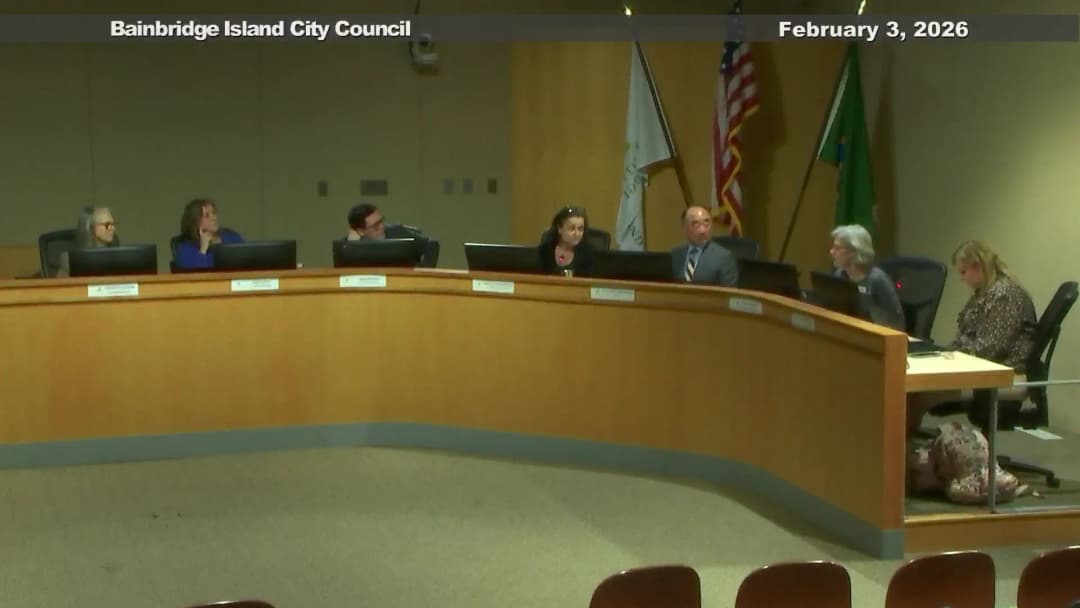
The Bainbridge Island City Council held a special meeting on Tuesday, February 3, 2026, at 7:50 p.m. (the agenda listed 7:30 p.m., but the meeting was called to order at 7:50 p.m. per the minutes). The meeting was held in Council Chambers and via Zoom. Mayor Moriwaki called the meeting to order, led the Pledge of Allegiance, and read the Land Acknowledgment. The agenda was approved unanimously (6-0) with no conflicts of interest disclosed. The sole regular business item was a motion to authorize the Acting City Manager to sign a professional services agreement with Haskoning for a design workshop related to the Washington State Department of Transportation (WSDOT) project at High School Road and Highway 305. The motion failed 2-4. Public Comments & Testimony - Kim McCormick (representing Town & Country Market) read a statement from Chairman Larry Nakata opposing reduction of required parking ratios in downtown and at the proposed 625 Winslow site, citing lack of downtown parking as a major challenge. - Lisa Neal urged the council to take the 625 Winslow Way project "back under its wing" and consider a smaller, more creative alternative, noting that funding did not come through and that a SEPA appeal was ongoing. She suggested that doing so would terminate the appeal and save tens of thousands of dollars in legal costs. - Alan Phillips spoke about growth management, stating that Bainbridge Island could reach 75,000–100,000 people in 30–40 years if the Growth Management Act is followed. He suggested seeking an exemption from the GMA, similar to Vashon and San Juan Islands, and shared ideas for affordable housing construction at lower costs. - Mary Clare Kersten expressed concern that the council had disbanded citizen committees (ETEC, design review, ethics, historic preservation, sub-area committees), eliminating citizen input. She called for reinstatement of ward meetings and listed citizen positions: no four-story development downtown, affordable housing that blends with community, each development to handle its own parking, no extreme upzones for market-rate housing, and protection of the aquifer and wastewater capacity. - Ron Peltier discussed capital facilities, the Comprehensive Plan, and limited resources. He emphasized that upzoning requires planning for additional capital facilities, noted that property taxes may rise with upzoning, and supported focusing on affordable housing through deed-restricted subsidies and incentives. He referenced a plan by councilmember Mike to prioritize affordable housing subsidies. - Nora Masters observed an erosion of public trust in city government, citing major policy decisions that did not make sense, a biased planning commission (dominated by planners/developers), opaque communications (e.g., a leading transportation survey), and a city manager statement that "critics should be ignored." She urged the council to hire a new city manager with experience in transparency and respect for dissident voices. - Priscilla Zimmerman Hagger (Managing Partner of Hager Scribner Properties) opposed reducing parking ratios in downtown Winslow and at the 625 site, stating that private property owners have become public parking lots and that further reductions would harm downtown businesses. - Robert Drury praised the council's consideration of the precautionary principle ("do no harm") and noted that growth planning could include limiting growth if negative consequences arise. He cited a conversation with former councilmember Quitsland. - David Schutz spoke about the SEPA appeal for the 625 Winslow project, stating that listening to testimony was disheartening due to staff emails and discourse. He read guiding principle 1 from the city's website: "Preserve the special character of the island, which includes downtown Winslow's small town atmosphere and functions, and its historic buildings." He urged the council to enter settlement discussions to end the legal battle. - Henry Zimmerman (architect working with Hager Scribner Properties) advocated for a comprehensive plan amendment application to create goals and policies for a civic and cultural connection overlay in the central core. He noted that the city had previously told him to wait for the Comp Plan update, but then the city itself skirted process for its 625 project. He asked for fair treatment and serious consideration. - Malcolm Gander (hydrogeologist) thanked the council for funding peer review of the Groundwater Management Plan but urged that the plan be finished, a public meeting held, and findings incorporated into the Comp Plan. He noted that the Growth Management Act requires a capital facilities plan, and that any downtown expansion would require a new wastewater treatment plant and additional water supply, with no plans disclosed to the public. - Mary Rain expressed shock that councilmembers had adopted "housing trickle down economics." She stated that housing units are growing but population is shrinking, and that inventory management (second homes, VRBO, vacancies) is the real problem. She proposed offering property tax relief to qualified new buyers who work on Bainbridge Island instead of funding the 625 project. She accused the council of ignoring studies and presenting flawed data, and urged focus on completing the Comp Plan in compliance with HB 1220. - Bevin Taylor expressed support for the 625 Winslow project. Discussion Items - Authorize Acting City Manager to Sign Agreement for Professional Services with Haskoning Acting City Manager Schroer introduced the item, explaining that the council authorized staff in December to negotiate a contract with Haskoning, a Dutch firm, for a design workshop related to the WSDOT project at High School Road and Highway 305. The draft contract was for $25,000 (down from an initial $35,000, with the balance funded by community groups including Sustainable Bainbridge and Bainbridge Parks and Trails Foundation). The workshop would involve 12 participants (split among city staff, WSDOT, and community stakeholders) and would take place the following week. Council discussion focused on several concerns: - The contract's intellectual property clause (Section 7) grants the city a non-exclusive, non-revocable, non-transferable license without the right to sublicense, raising questions about how the workshop's output would be provided to WSDOT. - The indemnification clause gives the consultant sole control of defense and settlement. - The workshop is limited to a small, invited group—not open to the general public—and WSDOT is not required to act on the outcomes. - The $25,000 cost came from council contingency funds and was not subject to a competitive process; no U.S.-based firms were solicited. - Several councilmembers noted that the 305/High School Road project lacks broad community support. - Councilmember Lant compared the expenditure to unfunded human services requests (e.g., Bainbridge Prepares received $62,000 of $160,000 requested; Boys & Girls Club got $10,000 of $75,000). - Councilmember Schneider argued that the workshop was the city's best chance to influence the WSDOT project and that community groups contributed to cover the remainder. She noted urgency due to the WSDOT public comment deadline of February 20. - Councilmember Matthews supported robust public engagement but acknowledged the circumstances prevented moving forward. Key Outcomes - Motion to authorize the Acting City Manager to sign the agreement with Haskoning (made by Councilmember Schneider, seconded by Councilmember Matthews) failed 2-4. - In favor: Schneider, Mathews. - Opposed: Moriwaki, Hytopoulos, Nelson, Lant. - The meeting was adjourned at 9:00 p.m.
Public Meetings - Bainbridge Island, Washington
Public Meetings - Bainbridge Island, WashingtonThe City Council held a study session on February 3, 2026, from 6:00 PM to 7:48 PM to discuss the Planning Commission's recommendations for the Winslow Subarea Plan as part of the comprehensive plan periodic update. Five council members were present; two were excused. The council debated whether certain Planning Commission motions exceeded the scope of Resolution 2025-18, which directs the commission to focus on state law compliance and essential updates. After extensive discussion, the council agreed to place an agenda item on the February 10, 2026 business meeting to allow all seven members to consider specific motions, with councilmembers asked to submit proposed motions by Thursday at 5 PM for inclusion in the packet. Discussion Items - Scope of Planning Commission Recommendations: Councilmember Nelson expressed concern that several Planning Commission motions, particularly an upzone of the Ferncliffe area to R8 without an affordable housing requirement, went beyond Resolution 2025-18 and would not help meet HB 1220 requirements for households earning 80% AMI and below. He argued that market-rate upzoning does not advance affordable housing goals. - Councilmember Schneider countered that the Planning Commission was following prior council direction and that the Ferncliffe upzone was modest (a net increase of about 12 units) and consistent with existing comp plan policies. She urged caution in limiting the commission's creativity. - Councilmember Lant questioned the Planning Commission's attendance record (some votes with only 4–5 members present) and whether the recommendations reflect the full commission. She also asked for clarification on growth targets, infrastructure impacts, and what constitutes “essential” under Resolution 2025-18. - Deputy Mayor Hytopoulos supported Councilmember Nelson’s view, emphasizing that upzoning should be tied to affordable housing production and that market-rate development consumes limited sewer and water capacity without serving low-income households. She read from a peer review of the groundwater management plan to argue for a precautionary approach. - Mayor Moriwaki defended the Planning Commission's work, noting that many motions were unanimous and that developers do build affordable housing (citing the Oliver and Wintergreen projects). He warned against using fear of growth, stating that current zoning has not led to rapid population increase. He also reminded the council that February’s topic was supposed to be housing and transportation, not water utilities. - Councilmember Land urged refocusing on essential compliance, noting the state’s involvement and the need to avoid delays. She suggested that some items could be taken up after the comp plan is finished. - Procedural Discussion: Acting City Manager Schroer and the acting city attorney clarified that the council cannot directly dictate Planning Commission decisions but can provide guidance. The council agreed not to make formal motions that night but to forward the discussion to a business meeting. Key Outcomes - Motion (Hytopoulos) – Withdrawn: A motion to direct the city manager to pass on to the Planning Commission that the council’s goal is to maximize affordable housing production with minimal increase in market-rate housing, and only in conjunction with infrastructure improvements. The motion lacked a second and was withdrawn. - Motion (Nelson/Schneider) – Passed 5-0: The council voted to place an agenda item titled “Provide Feedback on Planning Commission’s Recommendations for the Winslow Subarea Plan” on the February 10, 2026 business meeting agenda. Councilmembers who wish to have a specific motion considered in advance must submit the item to the Mayor, Deputy Mayor, and City Manager by Thursday, February 5, 2026 at 5 PM. This does not preclude councilmembers from making other motions during that session.
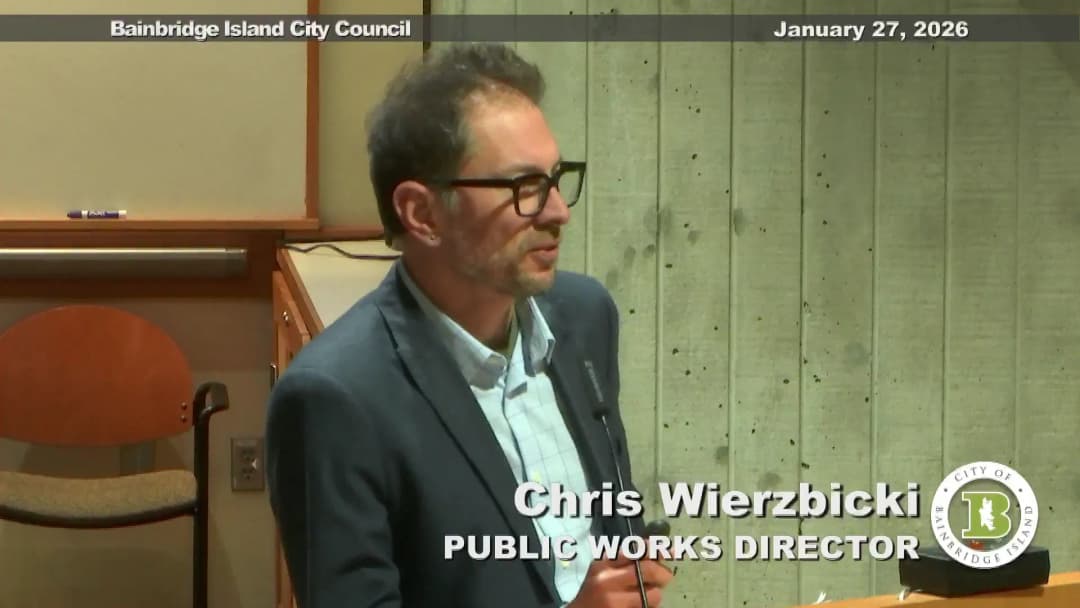
The Bainbridge Island City Council met in regular session on Tuesday, January 27, 2026, at 6:00 pm in Council Chambers and via Zoom. Mayor Moriwaki presided, with all seven councilmembers present. The meeting included a proclamation honoring retiring City Manager Blair King, public comment on housing and transparency, and action on a range of regular business items. The meeting adjourned at 8:11 pm. Proclamation - Proclamation Recognizing City Manager King upon his Retirement: Mayor Moriwaki read the proclamation, highlighting King's service from 2021 to 2026, his 45-year public sector career, and achievements including completion of the Ted Spearman Justice Center and the Bundled Madison Avenue project. City Manager King accepted and gave emotional remarks, thanking the council and staff, and emphasizing the importance of local government and public service. Consent Calendar - Approved Accounts Payable and Payroll. - Approved Meeting Minutes. - Authorized City Manager to Execute Intergovernmental Agreement with Washington State Parks and Recreation Commission for Recreational Boating Safety Program. - Item 5.D (Adopt Ordinance No. 2026-01): Unanimously adopted (7-0) after City Manager King explained it requires telecom conduit in new city roadways to facilitate fiber installation, a request from Kitsap PUD. - Item 5.E (Authorize City Manager to Approve Individual Purchases up to $200,000 for 2026 Fleet and Equipment CIP): Unanimously approved (7-0) after City Manager King clarified that post-COVID supply chain disruptions necessitate higher purchase limits for pre-approved vehicles (e.g., police cars, heavy-duty pickup, asphalt patch machine). The authority lasts through 2026. - Item 5.G (Authorize City Manager to Execute Data Sharing Agreement with Washington State Patrol for TRACS system): Unanimously approved (7-0) after Police Chief Clark explained the new Traffic and Criminal Software Application replaces the current electronic collision and ticketing system; data sharing is standard for law enforcement in Washington. Public Comments & Testimony - Steven Hoskins (Winslow resident, affordable housing supporter) argued that Resolution 2025-18 does not limit the Winslow Subarea Plan to baseline compliance with HB 1220, as suggested by Councilmember Nelson, and that the resolution is forward-looking and not intended to discard planning commission work nearly complete. - Bevin Taylor (Bainbridge resident, service worker) urged the council to go beyond the bare minimum in addressing housing affordability, stating that zoning has historically excluded working-class people and that the community has a reputation for "progressive posturing" with poor follow-through. - Ron Peltier questioned the removal of Guiding Principles from meeting agendas and praised City Manager King for setting a new standard of professionalism and humor, noting that policy direction comes from the council, not the manager. - Robert Drury expressed concerns about city transparency and accountability, citing unanswered emails and potential legal issues; he warned that organizations like ProPublica might investigate. - Dennis Gawlik called for the return of a land acknowledgment at the start of meetings, noting it was omitted since the new council took office, and emphasized it should be more than performative. Discussion Items - City Manager's Report: City Manager King provided updates: the agenda software is migrating from Granicus to Civic Plus (the guiding principles will be added once the Planning Commission finalizes language); the groundwater master plan is expected in Q2 2026; the Winslow Way/SR 305 intersection improvements to address ferry line-cutting are awaiting WSDOT approval; legislative requests include $50,000 for in-person enforcement at the ferry terminal, especially for upcoming World Cup and 250 USA celebrations. - Council Appointments to Regional and Local Committees and Boards (Item 7.A): Council discussed and appointed members to numerous bodies. Notable: for the Winslow Subarea and Comprehensive Plan Steering Committee, after debate, a motion to bring the charter back for consideration (including whether to add citizen participation) was amended to remove the citizen participation clause and passed unanimously (7-0). Appointments were finalized for all committees and boards listed in the agenda (see minutes for full list). - South Island Sewer Connection Requests (Item 7.B): Public Works Director Wierzbicki presented that eight connection requests were received; none met the criteria in Policy 2.14A. All were recommended for rejection. The council discussed that KPUD indicated the treatment plant has capacity for up to 200 additional connections, but the current policy limits connections. A motion to authorize the City Manager to reject all requests passed 6-1, with Councilmember Mathews voting against. - Purchase Order for Radio-Read Water Meters (Item 7.C): Public Works Director Wierzbicki explained that the $95,356.17 purchase (from water utility fund) will replace about 20% of the system's meters with radio-read technology, allowing one staff member half a day to read all meters (currently two staff take a week). The meters are sole-source from one vendor. The motion passed unanimously (7-0). - City Manager Executive Search (Item 7.D): Deputy Mayor Hytopoulos recommended that the full council interview two firms: Raftelis and Bob Murray. The motion passed unanimously (7-0). Interviews are scheduled for February 10, 2026. - Communications (Item 8): Councilmember Mathews' request to add a discussion on youth participation to a future meeting passed unanimously (7-0). Councilmember Nelson's request to invite Department of Commerce representatives for technical assistance on the Housing Accountability Act selected review passed unanimously (7-0). Key Outcomes - Votes: - Adoption of Ordinance No. 2026-01 (telecom conduit) – Unanimous (7-0). - Approval of fleet/equipment purchase authority up to $200,000 – Unanimous (7-0). - Approval of data sharing agreement with WSP – Unanimous (7-0). - Rejection of all South Island sewer connection requests – 6-1 (Mathews opposed). - Approval of purchase order for radio-read water meters – Unanimous (7-0). - Approval of Raftelis and Bob Murray for city manager search interviews – Unanimous (7-0). - Motion to bring Winslow Subarea/Comp Plan steering committee charter back for consideration – Unanimous (7-0) after amendment removing citizen participation clause. - Both communications requests to add future discussions – Unanimous (7-0). - Directives: City Manager authorized to reject sewer connections and to execute purchase order for water meters. Council will hold a study session on youth participation and another with Dept. of Commerce on Housing Accountability Act. - Next Steps: The steering committee charter will be brought back to council. The city manager search interviews on February 10. The next annual call for South Island sewer connections will be in June 2026.
The Bainbridge Island City Council held a special meeting on January 27, 2026, convening at 3:30 PM in Council Chambers and via Zoom. The meeting consisted entirely of two closed executive sessions, with no public comment, discussion, or voting on any agenda items. The council returned to open session at 6:00 PM and adjourned at 6:02 PM. Roll Call Mayor Moriwaki called the meeting to order at 3:30 PM. Councilmembers Fantroy-Johnson, Lant, Mathews, Nelson, and Schneider were present. Deputy Mayor Hytopoulos arrived during the executive session. Executive Sessions - (3:30 PM – 5:30 PM) – Personnel Evaluation Pursuant to RCW 42.30.110(1)(g), the council entered executive session for two hours to evaluate the qualifications of an applicant for public employment. No action was taken in open session. - (5:30 PM – 6:00 PM) – Legal Consultation Pursuant to RCW 42.30.110(1)(i), the council entered a second executive session for 30 minutes to discuss with legal counsel matters relating to agency enforcement action or potential litigation. No action was taken in open session. Adjournment At 6:00 PM, the council returned from executive session. Mayor Moriwaki adjourned the meeting at 6:02 PM.
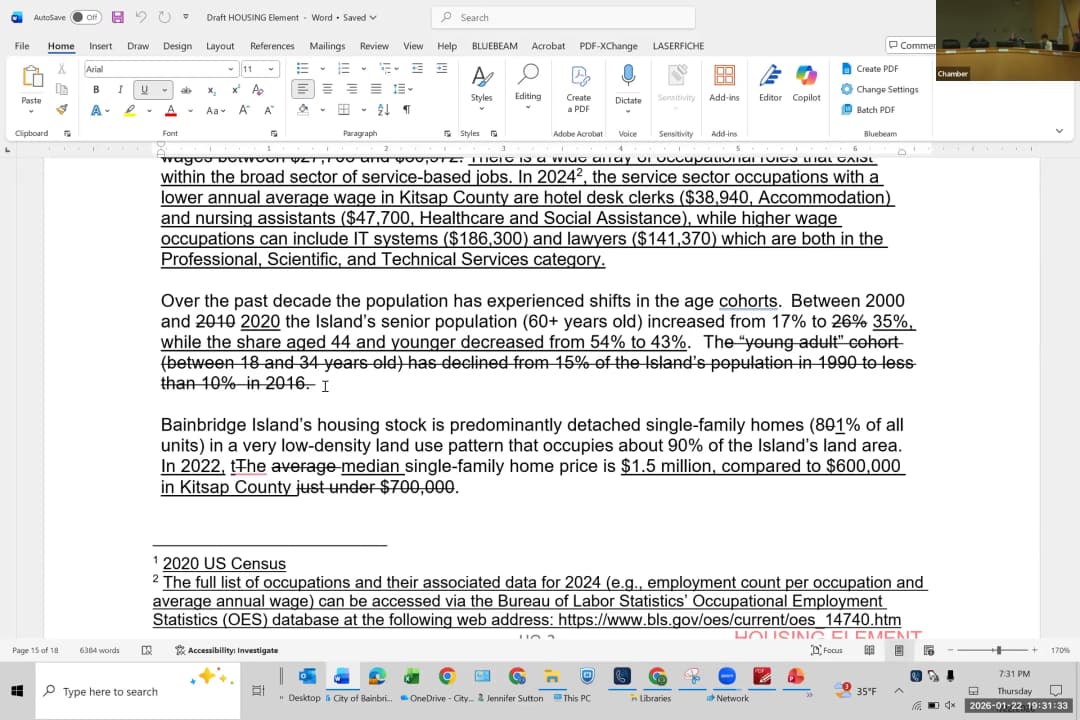
The Bainbridge Island Planning Commission met on Thursday, January 22, 2026, from 6:05 PM to 9:30 PM. Commissioners Blossom, Garcia, Schaab, and Preudhomme were present (Commissioners Birtley, Deines, and Sullivan were absent). The meeting focused on reviewing and making recommendations on the Transportation Element (including the new Island-Wide Mobility Plan) and the Housing Element of the Comprehensive Plan Update. Numerous motions were passed unanimously (4-0) on specific policies, with several motions withdrawn. Public comment raised concerns about process, parking, ferry commuting, and a proposed housing project at the ferry terminal. Consent Calendar - Approval of Agenda: Motion carried 4-0. - Minutes from January 8, 2026: Approved as presented, motion carried 4-0. Public Comments & Testimony - Nora Masters (resident since 1994): Opposed the city's planning process, noting that the Winslow Sub-area Plan was removed from code requiring citizen participation. Cited personal commuting experience (23 years by ferry) and stated policies would harm families who rely on parking and ferry access. Asked for data on off-island commuters. Said she would not support levies or bonds unless residents are included. - Nina Pelton (5-year resident, EBS Drive): Urged the commission not to approve staff-written transportation and housing policies before city council sets goals. Opposed the proposed housing development at the ferry terminal, citing reduced parking, lack of public input, no developer qualifications, a 99-year lease, and potential loss of community character. Asked for meaningful public involvement. - Priscilla Zimmerman (45-year resident, 16-year Winslow business owner): Called the proposed 625 Winslow Way project at a “premier civic corner” inappropriate, unsustainable, and destructive to downtown infrastructure. Requested a larger conversation. - Leland Parker (6-year resident, Agate Pass): Criticized lack of communication from the city, stating “nobody knows what the hell is going on,” creating distrust. Opposed the 625 project. Questioned the land acknowledgement practice and asked who decided to include it. - John Quitsland: Urged the commission to consider housing and transportation together holistically, noting asymmetrical public/private funding and the need to address inequity. Emphasized that for-profit market cannot supply all needed housing. - Mary Rain (south end resident): Stated that the city had put project planning (e.g., 625 upzoning) ahead of comprehensive planning, leading to a “babysitter” from the Commerce Department. Claimed public feedback on traffic, parking, and location was ignored. Cited parking spillover from Wintergreen development affecting Virginia Mason patients. Urged planning for residents over 65 (40% of island population) and not to put levies before a plan. - Chair Blossom responded to public comments, clarifying that the commission does not control leases, developer agreements, or levies, and encouraged residents to share concerns with city council. She also noted that Wintergreen is not underparked and that Virginia Mason underparked its own lot. Agreed with Mr. Parker that city communication has been poor. Discussion Items Transportation Element & Island-Wide Mobility Plan - Senior Planner Jennifer Sutton introduced Public Works Director Chris Wierzbicki and Sustainable Transportation Coordinator Hannah Boettcher (via Zoom). - Boettcher presented recommended updates: mostly semantic changes to emphasize multimodal transportation; adoption of a Safe Systems Approach policy; removal of a policy minimizing street lighting; updating the plan of reference from the Island-Wide Transportation Plan (2017) to the Island-Wide Mobility Plan (merging the Sustainable Transportation Plan). - New multimodal level of service standards for pedestrians and cyclists were discussed, along with concurrency: the city would only issue permits for growth proportionate to transportation investments. Commissioners questioned the concurrency mechanism; Public Works Director Wierzbicki clarified that the city aims never to reach a point where permits are denied, and that traffic impact fees help fund growth-related projects. The total capital investment for prioritized projects was estimated at roughly $30 million, with $2–5 million spent per biennium. - Commissioner Garcia advised against converting two-way streets to one-way, citing safety concerns. The commission generally agreed the transportation changes were incremental. Housing Element - Senior Planner Sutton presented recommended updates to the Housing Element, integrating the Housing Action Plan and addressing state laws (HB 1220) on housing needs, displacement prevention, and racially disparate impacts. - The commission reviewed goals and policies line-by-line, making numerous motions (all passed 4-0). - Key debates included the aspirational target of 35% multifamily (5+ units) in Policy HO 1.4. Commissioner Blossom calculated that 35% would require 4,632 units, far exceeding the city's growth allocation of 1,977 units. The commission voted to strike “5+ unit” and to study a breakdown of 2-4 unit and 5+ unit multifamily housing. - Goal HO-2 (biennial housing report) was removed; a new policy (HO 1.8) was added to continuously monitor affordable housing creation. The existing HO 2.2 language was revised to be more directive about finding a partner or establishing a fund. - Policy HO 3.2 was amended to strike “Consider how to” and add “administrative” before “permitting.” - HO 3.1 was adopted as presented on the screen. The commission also passed a motion to study and update the housing types illustrated in HO 3.1 to include the full array of middle housing types. - HO 3.8 was adopted as presented at 9:00 PM (language: “Consider adopting a specific middle housing code to encourage such small to mid-sized housing types”). A separate motion was passed to have staff look at a goal or policy on predictable development, including form-based codes. - The implementation section was reorganized into a matrix format via a passed motion. - Commissioner Blossom expressed discomfort voting on the Housing Element that evening due to having only 4 commissioners and limited review time, but the discussion proceeded with all motions passed unanimously. Key Outcomes - Transportation Element: Motion to recommend updates (including replacement of Island-Wide Transportation Plan with Island-Wide Mobility Plan) carried 4-0. - Housing Element Motions (all passed 4-0 unless noted): - Strike “5+ unit” from Policy HO 1.4. - Direct staff to study a breakdown of 2-4 unit and 5+ unit multifamily housing for future presentation. - Direct staff to revisit policies HO 2.1 through 2.4 and bring back options for better placement. - Rewrite Policy HO 2.2 to be more directive (“find a partner or establish a fund”). - Establish Policy HO 1.8: “Continuously monitor the planning and creation of affordable housing units, supportive housing, and emergency shelter in order to reevaluate existing City housing tools and development standards.” - Officially remove struck portions of Goal HO-2 and its related policies. - Strike “Consider how to” from Policy HO 3.2 and add “administrative” before “permitting.” - Adopt Policy HO 3.1 as presented on the screen. - Direct staff to study and update the housing types illustrated in Policy HO 3.1 to expand to the full array of middle housing types and revisit arbitrary types like garden apartments or micro-units. - Adopt Policy HO 3.8 as presented at 9:00 PM. - Direct staff to look at a goal or policy to make future development more predictable and aligned with island values, with one such policy being implementation of a form-based code. - Reorganize the housing implementation section as a matrix with supported goals under each action. - Several motions were withdrawn (relocation of policies under HO-3; changes to HO 3.2 preamble; adoption of HO 3.1 with different wording; changes to HO 3.8 with form-based code language). - No action was taken on the Housing Element as a whole; it will be revisited at a future meeting. The commission agreed to request earlier distribution of draft elements to allow more review time.
The Bainbridge Island City Council held a special meeting on January 20, 2026, to consider modifying the contract with Prothman Company for city manager recruitment. The meeting was called to order at 7:38 p.m. with all seven council members present. The council approved the agenda unanimously and heard public comments before taking action. Public Comments & Testimony - Charlie Kratzer (South End resident) expressed concerns about a lack of transparency in recent years. He proposed earlier public involvement in reviewing city manager candidates, noting that the previous search had narrowed from 60 candidates to three, leaving the public unaware of the other 57. He also urged restarting ward meetings and highlighted the downgrading of advisory committees like eTAC, suggesting the city should utilize volunteer expertise rather than hiring consultants. - Dennis Gawlik (North End resident) requested better communication from the council regarding the proposed high school road roundabout. He noted 29 intersection-related crashes (2015–2021), including one fatality and multiple pedestrian incidents, and warned that without proactive communication, misinformation could create controversy similar to the "625" project. Discussion Items - Contract Termination with Prothman Company: Deputy Mayor Hytopoulos moved to terminate the contract with Prothman Company. The motion was seconded and passed unanimously (7–0). - Selection of Successor Firm: Councilmember Nelson moved to reconvene the subcommittee (Deputy Mayor Hytopoulos, Councilmembers Nelson, and Fantroy-Johnson) to create a recommendation for the full council regarding a successor executive recruiting firm. Councilmember Schneider seconded. Discussion included the desire to move quickly, with the subcommittee planning to bring a recommendation to the next council meeting on January 27. Councilmember Schneider noted that the process would set the timeline back but that public presentations by two firms could be part of the recommendation. The motion passed unanimously (7–0). Key Outcomes 1. The city council voted 7–0 to terminate the contract with Prothman Company. 2. The council voted 7–0 to reconvene the subcommittee to recommend a successor firm; a recommendation is expected at the January 27 council meeting. 3. The meeting adjourned at 7:51 p.m.
The Bainbridge Island City Council held a study session on Tuesday, January 20, 2026, at 6:00 PM in Council Chambers and via Zoom. All seven council members were present. The meeting included two main agenda items: an update on the city's Emergency Management Program and National Incident Management System (NIMS), and a discussion on Road Maintenance and Pavement Management. No formal votes were taken; the session was informational. Discussion Items 3A. Receive Update on the City's Emergency Management Program and NIMS Emergency Manager Ann LeSage presented an overview of the program. Key points included: - Bainbridge Island became its own emergency management organization in 2018, responsible for the comprehensive emergency management plan, the Emergency Operations Center (EOC), and the Nixle mass notification system. - The annual budget is modest but supports supplies, training, and professional services. The city allocates approximately $11,000–$12,000 annually from federal grant funding. - The partnership with Bainbridge Prepares and the Fire Department involves over 700 volunteers, Map Your Neighborhood program (54% participation), and 14 disaster hubs (with 10 currently supplied). Most islanders live within 1.5 to 2 miles of a hub. - The city activated its EOC at the Ted Spearman Justice Center (primary) with a secondary location available. - Council's role during emergencies: provide strategic direction, designate one representative to the EOC, help declare a local proclamation of emergency, authorize expenditures above $50,000, approve large assistance requests, host VIPs, and provide visible leadership. - Upcoming priorities: a three-year strategic plan (final draft due February 2026), interoperable communications via a radio tower at Strawberry Hill, and a disaster medical center partnership with Virginia Mason. - The La Niña winter may still bring ice/snow; severe weather shelter activation occurs after two consecutive nights below freezing (none so far in 2025–2026). - FIFA World Cup matches in June–July 2026 (July 1 and July 6) may increase island visitors, especially around the Fourth of July; a working group is forming. Council questions and discussion: - Councilmember Fantroy-Johnson asked about including a council representative in tabletop exercises; LeSage agreed it could be arranged. - Councilmember Fantroy-Johnson also asked about the top issues in the strategic plan; LeSage identified interoperable communications and the disaster medical center. - Councilmember Schneider praised the program and asked about supply spending (70% new purchases, 30% resupply) and professional services used for training. - Councilmember Lant inquired about Nixle usage (multiple authorized senders, training annually) and integration with other agencies (school district, fire, etc.); LeSage described the Emergency Management Advisory Committee that meets twice a year. - Councilmember Nelson asked about Map Your Neighborhood gaps; 46% of the island remains unmapped. She also requested more disaster hubs on the south end; LeSage noted that additional hubs require funding and volunteer support. - Councilmember Schneider suggested pre-designating a council representative for emergency response. City Manager King added that recovery planning is crucial, including the city's reserve policy (3 months of revenue) and NIMS training requirements for FEMA reimbursement. He emphasized that Bainbridge Island is “best in class” for emergency preparedness. 3B. Discuss Road Maintenance and Pavement Management Public Works Director Chris Wierzbicki presented an update. Key points included: - The city maintains 282 lane miles of paved roads and 5 miles of gravel roads. - Pavement Condition Index (PCI) average is 70 (scale 0–100), above the national average of 65. The backlog (roads needing rehabilitation) grew from 8% in 2019 to 12% in 2024. - About one-third of roads are in fair to poor condition; two-thirds are in good to very good condition. - Cost comparison: Surface treatment costs $5,000 per block; reconstruction costs $250,000+ per block. Recent examples: Madison Avenue reconstruction ($1 million, 3 months) vs. Sportsman Club Road overlay ($300,000, 1 week). - To maintain PCI at 70, the city would need $2.5–$3 million annually; to reduce backlog, $5 million per year. Current investment is $1 million (increased from $500,000 average in 2014–2022, raised to $1 million in 2023 plus inflation). - At current funding, PCI is projected to drop to 65 in 10–12 years, and backlog to 18%. - The streets budget for 2025 was $4.3 million, including personnel, equipment, and $1 million for pavement preservation. - A shoreline roadway assessment identified 10 segments at risk; top three: Rockaway Beach Road (vertical cracking), Crystal Springs South Road (failing revetment), and Manitou Beach Drive (recurring king tide flooding). These will be considered in the 2027–2028 Capital Improvement Plan. - A scientific survey is underway (January 2026) to gauge community support for a voter-approved property tax levy for roads. Results expected later in Q1 2026. Potential levy could raise $2–$3 million annually, with an average cost of $100–$200 per household. - Other funding options discussed: car tab increase, sales tax increase, bonds, or redirecting existing funds. Council discussion: - Councilmember Schneider questioned why PCI stayed at 70 despite increased funding; Wierzbicki explained that better data (subsurface investigations) revealed more roads needing reconstruction, and money is now prioritized for high‑volume roads. - On sea‑level rise: King tides already impact some roads; a FEMA grant for a sea‑level rise planning pilot was canceled. Councilmember Schneider asked for tracking climate‑related costs; Wierzbicki said that could be done. - Councilmember Lant asked about one‑way conversions, traffic calming, and use of city staff vs. contractors. Wierzbicki noted that one‑way conversions are possible and were explored in a cancelled pilot project. Traffic calming could be funded by a levy, as in Kirkland. City staff handle patching; major paving is contracted. - Councilmember Nelson expressed concern about four tax increases in the past year (library, fire, school, city property tax) and wanted to explore budget cuts before new taxes. City Manager King responded that the council previously directed staff to explore a levy, and that cutting other programs (e.g., arts funding) would not fully cover road needs. - Deputy Mayor Hytopoulos noted the city has historically underfunded roads and that the current condition reflects long‑term underinvestment. He emphasized the need for action. - Mayor Moriwaki highlighted the shoreline roads as critical access points and stressed the importance of proactive maintenance. - Councilmember Fantroy‑Johnson reiterated that many roads are aging and that reconstruction is far more expensive than preservation. Key Outcomes - No formal actions or votes were taken on either agenda item; both were informational. - Staff will present survey results on community support for a road levy later in Q1 2026. - If council decides to proceed, a levy question could be placed on the November 2026 general election ballot. - The council may consider pre‑designating a council representative for emergency operations and including that representative in tabletop exercises. - The emergency management strategic plan will be shared in February 2026. - Staff will continue to monitor shoreline roads and include needed projects in the 2027–2028 budget cycle.
January 20, 2026 – 5:30 p.m. The Bainbridge Island City Council convened a special meeting in executive session pursuant to RCW 42.30.110(1)(g) to evaluate the qualifications of an applicant for public employment. No public comments, discussion items, or votes occurred during the open portion of the meeting. The council entered executive session at 5:30 p.m., returned at 5:56 p.m., and the meeting was adjourned. Key Outcomes - The council met in executive session for approximately 26 minutes to discuss a personnel matter. No action was taken in open session.
The Bainbridge Island City Council held a regular business meeting on January 13, 2026, at 6:00 PM in Council Chambers and via Zoom. The meeting included the administration of oaths of office for new and returning council members, the appointment of a new mayor and deputy mayor, a proclamation for Martin Luther King Jr. Day, public comments, consent agenda approval, a city manager’s report on a sewer spill, and two communications items regarding future discussions on land capacity analysis and Winslow Subarea Plan consistency. The council also entered executive session for 30 minutes (with extensions) to discuss legal matters. All votes were unanimous (7-0) where recorded. Consent Calendar - Approved Accounts Payable and Payroll. - Approved Meeting Minutes. - Approved nomination of a high school senior as the City's 2026 nominee for the Association of Washington Cities' Center for Quality Communities Scholarship. Public Comments & Testimony - Angela Sandry (47-year resident) spoke against the Low Income Housing Institute (LIHI) and the 625 Winslow affordable housing project, calling it a "six-story monstrosity" that would create congestion and violate the comprehensive plan. She urged the council to vote no. - Dennis Gawlik praised the Planning Commission's professional approach to land capacity analysis and supported allowing local variations in methodology. He commended the commission's use of multiple methodologies appropriate for Bainbridge Island’s unique situation. - Richard Velasquez (Chair, Bainbridge Island Ferry Advisory Committee) announced a Washington State Ferries application process for schedule updates (deadline February 2, 2026); noted the committee’s volunteer role; and gently encouraged civility in online discourse. - Pascal Schuback (emergency manager and Bainbridge Repairs supporter) thanked City Manager Blair King for advancing emergency management, highlighted the establishment of the Emergency Operations Center (EOC), and reported volunteer efforts to build a hub shed for the Fort Ward community. He expressed appreciation for council support. - Jim Halbrook criticized the city’s Climate Action Plan, alleging corruption and stating 2025 emission reduction goals were not met. He accused the city of self-dealing and questioned the integrity of the climate advisory committee, ethics board, planning commission, city manager, and city council. Discussion Items - Oath of Office: Judge Alpaugh administered oaths to new council members Lara Lant (District 7) and Mike Nelson (District 3, South Ward), and returning council member Clarence Moriwaki (District 5, Central Ward). Each gave brief remarks. - Appoint Mayor: Councilmember Schneider nominated Clarence Moriwaki; the appointment was approved unanimously (7-0). Outgoing Mayor Ashley Mathews delivered a farewell speech emphasizing gratitude and love for the community. - Appoint Deputy Mayor: Councilmember Fantroy-Johnson initially nominated Councilmember Schneider, who declined. Councilmember Schneider then nominated Councilmember Hytopoulos; the appointment was approved unanimously (7-0). - Proclamation – Dr. Martin Luther King Jr. Day: Councilmember Fantroy-Johnson read the proclamation recognizing January 19, 2026, as MLK Day. Akuya Vargas accepted on behalf of the community. The proclamation honored Dr. King’s legacy and encouraged service. - City Manager’s Report: Blair King reported a January 8 sewer spill on Fort Ward Road (1,000 gallons, contained and cleaned up same day, pipe repaired) and a Department of Ecology performance audit of the NPDES program with recommendations. The audit report will be presented to council on February 10, 2026. - Communication 12A – Land Capacity Analysis Methodologies: Councilmember Nelson moved to add this discussion to the January 27 business meeting. After amendment (by Hytopoulos, seconded by Nelson), the council approved (7-0) scheduling it for the February 3, 2026 study session instead. - Communication 12B – Winslow Subarea Plan Consistency with Resolution No. 2025-18: Councilmember Nelson moved to add this discussion to the February 3 study session. The motion was seconded and passed unanimously (7-0). Key Outcomes - Mayor and Deputy Mayor Appointed: Clarence Moriwaki appointed Mayor and Councilmember Hytopoulos appointed Deputy Mayor, both by unanimous votes (7-0). - Consent Agenda Approved: Unanimously (7-0). - Future Discussion Items Scheduled: Both land capacity analysis methodologies and Winslow Subarea Plan consistency were moved to the February 3, 2026 City Council study session, each approved 7-0. - Executive Session: Council adjourned at 7:17 PM for a 30-minute executive session (extended twice by 10 minutes each) under RCW 42.30.110(1)(i) to discuss enforcement actions and potential litigation. Council returned at 8:12 PM. - Adjournment: Meeting adjourned at 8:13 PM.
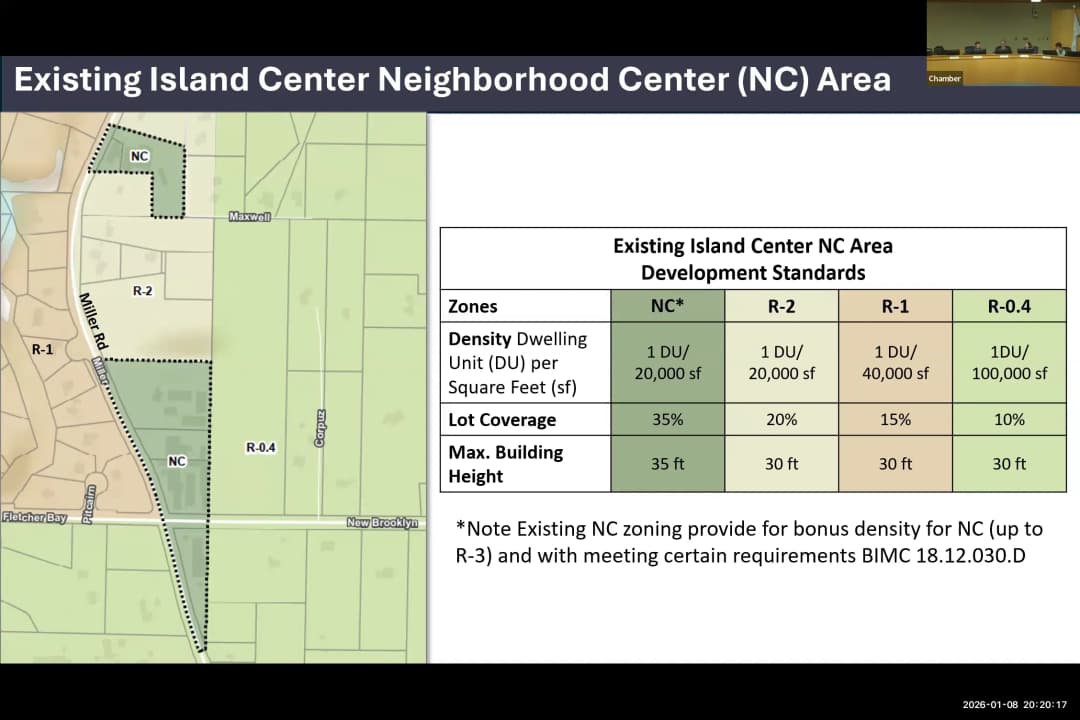
Chair Sarah Blossom called the meeting to order at 6:04 PM with a land acknowledgement. Commissioners present: Sarah Blossom, Criss Garcia, Alex Preudhomme, Ben Deines, Sean Sullivan, and Ariel Birtley (via Zoom). Commissioner Schaab was excused. Staff present: PCD Director Charnas, Planning Manager Darron Buchanan, Senior Planner Jennifer Sutton, and Council Liaison Ashley Matthews. The meeting adjourned at 9:00 PM. Consent Calendar - Agenda: Approved unanimously (6‑0). - Minutes: Minutes from November 13, 2025 and December 11, 2025 approved unanimously (6‑0). Public Comments & Testimony - John Quitsland (private citizen, Crystal Springs) expressed concern that the land‑use strategy assumes conservation and development are in opposition, which he called an inequitable status quo. He urged the commission to look closely at pages 71‑74 of the agenda packet. - Ron Peltier reminded commissioners of the pending groundwater management plan (expected in 3‑4 months) and asked that it be considered before major up‑zoning decisions. - Akuye Karen Vargas (resident) read a series of guiding principles forwarded by the Race Equity Advisory Council (REAC), emphasizing environmental stewardship, economic equity, inclusion, and rectifying past exclusionary policies. Planning Director’s Report Director Charnas noted that 2026 brings a new city council and city manager. She highlighted Resolution 2025‑18 regarding the Steering Committee and invited commissioners to consider representation. She also shared information about Poulsbo’s Housing Affordability Workshop Series. Discussion Items Steering Committee Membership Commissioner Sullivan resigned from the Steering Committee due to scheduling conflicts. Commissioner Deines expressed interest. The commission unanimously approved a motion to add this to regular business, then appointed Commissioner Deines to the Steering Committee (6‑0). Planning Commission Meeting Attendance Discussion focused on the need for reliable attendance. Commissioners agreed that for regular meetings the default should be attendance unless advance notice is given (24 hours preferred), but unforeseen circumstances (illness, family needs) should be accommodated. The staff was asked to track absences per the existing policy (three consecutive unexcused absences can lead to removal). Comprehensive Plan Update: Introduction Chapter and Land Use Element Senior Planner Sutton presented the proposed updates. Caitlin Lombardi (REAC) was available for Q&A. The commission discussed the following items, each resulting in a unanimous motion except where noted: - Guiding Principles (REAC): The commission referred the REAC‑suggested guiding principles to the Steering Committee for recommended updates to the Introduction chapter (6‑0). - Introduction Chapter: Retain the sections but update to reflect changing conditions, updated data, and broaden the affordable housing discussion to emphasize need for greater affordability and flexibility for a vibrant community (6‑0). - New Park Zone: Add a new park zone to the future land use map, goals, and policies; direct staff to draft implementing regulations (6‑0). - Park Classifications: Request at least two park classifications within the development regulations (6‑0). - Business Industrial (BI) Zone Lot Coverage: Increase from 35% to 50% (5‑0, Commissioner Birtley abstained). - Small‑Business Regulations: Direct staff to develop regulations reflecting support for small and medium‑sized businesses, possibly including a maximum size limitation (6‑0). - BI Zone Boundaries: Recommend boundaries remain unchanged (5‑0, Commissioner Sullivan absent). - Lynwood Center NC Zone: Recommend boundaries and development standards remain unchanged (5‑0, Commissioner Sullivan absent). - Island Center NC Zone: Motion initially made to keep unchanged, then withdrawn to address Bainbridge Gardens. A subsequent motion directed staff to return with recommendations to address the non‑conforming use of Bainbridge Gardens, possibly by including it in the NC zone (5‑0, Commissioner Sullivan absent). - Rolling Bay NC Zone: Recommend boundaries and development standards remain unchanged (5‑0, Commissioner Sullivan absent). - Transfer of Development Rights (TDR) and Groundwater: Add a policy under Goal LU16 recognizing the role of TDRs in conserving groundwater (5‑0, Commissioner Sullivan absent). - Agricultural Resource Land Designation: Request staff to study creating a new ARL designation and consider designating city‑owned farmland as ARL (4‑0, Commissioners Sullivan and Birtley absent). - Policy LU 5.11: Remove the strikethrough on transfer of residential density within MUTC, High School Road districts, and neighborhood centers (4‑0, Commissioners Sullivan and Birtley absent). - Policy LU 9.18: Remove the strikethrough so the policy remains (5‑0, Commissioner Sullivan absent). - Amend Policy LU 9.18: Add “may” to allow infill through TDRs or affordable housing density bonus (5‑0, Commissioner Sullivan absent). - Policy LU 15.2: Remove the strikethrough and add “potentially establish” after “and” (5‑0, Commissioner Sullivan absent). - Safe Routes to Neighborhood Centers: Request staff draft a policy for safe pedestrian and bicycle routes to neighborhood centers (5‑0, Commissioner Sullivan absent). Key Outcomes - Steering Committee: Commissioner Deines appointed (6‑0). - All Comprehensive Plan motions passed unanimously with the tallies noted above. The lot coverage increase had one abstention. - Next steps: Staff will draft regulations for the park zone, park classifications, BI zone small‑business regulations, and Bainbridge Gardens recommendation. The Steering Committee will review the REAC guiding principles and return with recommended updates. Staff will study a potential ARL designation. - Attendance protocol: Commissioners will strive to provide advance notice for absences; the existing policy on unexcused absences remains.