The Beaverton Planning Commission met on August 5, 2026, at 7:00 PM and adjourned at 9:08 PM. The meeting included two public hearings: the first for a boundary modification of two planned unit developments (PUDs) in the Shoals Heights and Shoals Valley Heights neighborhoods, and the second for an appeal of a director's decision approving a tree removal plan for the Williams Court Subdivision. Both items resulted in unanimous votes. Staff Communications - Planning Division Manager Anna Latinsky announced that the City of Beaverton's Night Market would occur on Saturday from 5 to 10 p.m. at The Round, weather permitting. - Extra staff were present for training, and patience was requested for potential procedural delays. Hearing 1: LU 32026-00094 – Shoals Heights and SVH PUD Boundary Modifications This proposal involved adjusting the boundaries of two existing PUDs to reconfigure lots, creating two additional buildable lots from a previously non-buildable tract. The applicant, representing the developer, stated the goal was to create better-shaped lots for homes. No public testimony was offered. The commission unanimously approved the application subject to staff's recommended conditions of approval. Hearing 2: APP 2026-00583 – Appeal of Williams Court Subdivision Tree Plan This appeal challenged the director's approval of a Tree Plan 2 application to remove 12 community trees (out of 55 on the site) to facilitate construction of duplexes on a previously approved 9-lot subdivision. The appellant (neighbors) argued that the decision erred because the city code's stated purpose is to protect the aesthetic benefits of trees, and that alternatives existed (e.g., the original single-family plan). The applicant engineer explained that the lot configurations and grading constraints left no reasonable alternative for preserving the trees. Staff recommended denying the appeal and adding two conditions: (1) requiring the applicant to obtain written consent from neighboring property owners before removing any tree found straddling a property line, and (2) requiring tree protection fencing for any such retained tree. During deliberation, commissioners expressed concerns about other trees potentially straddling property lines, prompting staff to draft a third condition: requiring a stamped survey to verify that all 12 trees are fully on the subject property, with any straddling tree requiring neighbor consent or preservation with fencing. Public Testimony - Robert Taylor, a neighbor, testified about a large English walnut tree on his property (not among the 12 to be removed). He argued that development activities would damage its root system, potentially harming the tree. He asked for meaningful root protection. - Ariana Mahmoodi, also a neighbor, emphasized the tree's aesthetic and ecological value and urged consideration of long-term impacts. - William Baum, another neighbor, stated that removing the final 12 mature trees would be a clearcut, contradicting city goals for tree canopy and climate mitigation. Key Outcomes - First Hearing (PUD Boundary Mods): Approved unanimously with staff conditions. - Second Hearing (Tree Plan Appeal): The commission vote was 4-0 to deny the appeal (i.e., uphold the director's decision), subject to the three conditions articulated by staff: 1. Prior to removal of any of the 12 community trees, the applicant shall provide a stamped survey confirming trees are fully on the subject property. Trees straddling a property line may only be removed with written neighbor consent. 2. For any straddling tree that is retained, tree protection fencing per BDC 60.20 shall be installed, with alternative plans allowed if approved by the city arborist. 3. The conditions apply to all 12 community trees and any adjoining parcel. - The decision will be memorialized in land use orders; appeals must follow LUBA rules. - Staff announced the August 19 meeting will include a presentation on the Beaverton Climate Action Plan and a training on tree regulations.
Public Meetings - Beaverton, Oregon
Public Meetings - Beaverton, OregonThe Beaverton City Council met on July 7, 2026, for a lengthy evening covering a range of fiscal, policy, and planning matters. Key actions included adoption of water and sewer/stormwater rate increases, creation of a new general services fee and a street maintenance fee, approval of a sanctuary city resolution, and work sessions on the Transportation System Plan (TSP) and the Urban Services Framework Project. The meeting also featured public comments on several topics. Consent Calendar - The council approved the consent agenda (agenda bills 26122 and 26128 were pulled) unanimously (7-0). - Agenda Bill 26122: Boards and Commissions work plans. Councilor Huston pulled the item, expressing concern about the pending fate of the Diversity Advisory Board (DAB) and Human Rights Advisory Commission (HRAC). After discussion, the council voted 7-0 to approve, with the understanding that a fall work session would address the future of DAB/HRAC and equity integration. - Agenda Bill 26128: Service agreements. Councilor Kimmy pulled the item to clarify budget reduction provisions. The council voted 7-0 to approve. Public Comments & Testimony - Peter Finley Fry (land use planner, speaking also for Car Subaru and Brad Preppel) requested an area plan for the 115th–117th Canyon Road area, arguing that current right-of-way expansion in urban settings is ineffective and has negative consequences (e.g., Millikan example). He urged the city to adopt a planning-first approach. - Barry Duff Smith (Beaverton resident) expressed strong support for Resolution 4967 (sanctuary city policy), thanking council members and staff for collaboration. He suggested a public reporting dashboard for immigration enforcement interactions. - David Witter (resident) announced a public reading of the Declaration of Independence on July 8 at the Veterans Memorial Park, part of the 250th anniversary celebration. - Susan Rosenthal (unincorporated Washington County resident, bicyclist) commented on the TSP update, praising the emphasis on biking/walking safety. She advocated adopting NACTO standards over AASHTO (e.g., smaller turn radii) and highlighted safety concerns on roads near Cooper Mountain. - Zaria Dukes (Beaverton resident, first time speaking) criticized the elimination of the equity officer position, calling for a strategic plan with timelines, named owners, and measurable outcomes instead of just monthly updates. She urged the council to provide a real plan to maintain connection and belonging for communities of color. - Blaine Solomon Pearson (Beaverton resident) thanked the council for advancing the sanctuary resolution, noting that nearly all recommendations from his team were included or referenced. He echoed the request for a public reporting dashboard. - Buff Brown did not appear online. Discussion Items - Bicycle Advisory Committee Annual Report (Item 26118): Chair Lillian Mark presented the 2025–2026 activities, including feedback on TSP, traffic calming, bike parking maps, and the May 2026 Bike Beaverton event (550 attendees, 250 riders despite 94°F heat). The committee plans to continue advising on projects, collect data for Southwest Allen Boulevard, and launch community bike rides (e.g., bike bus to 10 Tiny Dances). Council members praised the committee’s growing technical sophistication and impact. - Public Hearing: Water Rates (Resolution 4958): Assistant Finance Director Susan Cole presented the proposed rate increase (monthly meter charge and consumption rate). The increase is driven by debt obligations for $378 million in water infrastructure investments (Wi-Fi loan, state loan, bonds). Example: A household using 8 units would see a $7.30/month increase. One public speaker (Dave Savage, HOA president) noted the disproportionate impact on his community due to large water mains and irrigation needs. After a required conflict-of-interest declaration (all but one councilor are ratepayers), the council voted 6-1 (Councilor Hassan dissenting) to adopt the resolution. - Public Hearing: Sewer and Stormwater Rates (Resolution 4959): Staff summarized that cost pressures from maintenance crews and pipe replacements drive the increase. A rate study is underway and will return in fall. No public testimony. The council voted 7-0 to adopt. - Public Hearing: General Services Fee (Ordinance 4881 and Resolution 4965): Interim City Manager Elizabeth Coffey presented the fee ($9.50/EDU/month with annual escalator, generating $5.3 million in FY26-27) to address the structural deficit. The council discussed the necessity after $11 million in expense reductions and 40+ FTE cuts over recent years. Councilor Hassan expressed concerns about affordability and voted no; others reluctantly supported it. The vote was 6-1 (Councilor Hassan dissenting). - Public Hearing: Street Maintenance Fee (Ordinance 4882 and Resolution): Public Works Director Tim Elsey presented the fee (phased in: $5/month year 1, $10 year 2, $15 year 3, then annual escalator). The fee would fund pavement preservation (slurry seal, grind/inlay/overlay) to raise the citywide PCI to 70, preventing costly reconstruction. Council discussed the need for prioritization and the impact of vehicle weight. No public testimony. The council voted 7-0 to adopt. - Action Item: Sanctuary City Resolution (Resolution 4967): Council discussed the policy, which codifies existing police and city policies regarding interactions with federal immigration enforcement. Councilor Hassan shared a personal story and thanked the community and staff. Several council members noted the importance of clarity and transparency. The council voted 7-0 to approve. - First Reading: Ordinance 4883 (parking permit fees and eligibility criteria) was introduced for a future public hearing on August 18, 2026. - Work Session: Transportation System Plan (TSP) Update: Senior Planner Jessica Engelman and Planning Manager Brian Martin presented draft network policies and maps emphasizing safety, adaptation, and complete networks (pedestrian, bicycle, transit, motor vehicle). The policies aim to reduce target speeds, create pedestrian districts, and develop all-ages-and-abilities bike routes. Council members provided feedback on specific corridors, the need for reliable bike infrastructure, and focus on pilot areas. Staff received support to proceed to the next phase (project list and investment scenarios). - Work Session: Urban Services Framework Project: Consultant Tom Reinhardt and CDD Director Annie Varner presented findings from the county-led study on providing urban services to unincorporated areas (UUAs). Key finding: Hypothetical boundary changes to bring some UUAs into Beaverton could generate net revenue for the city due to economies of scale and tax rates, but costs for bringing infrastructure up to city standards were not fully accounted. Council questioned the need for further exploration given existing resource constraints and the political difficulty of annexation. Council President noted the importance of tax equity and subsidy issues. Key Outcomes - Approved: Water rates (Resolution 4958) – 6-1 (Councilor Hassan dissenting) - Approved: Sewer and stormwater rates (Resolution 4959) – 7-0 - Approved: General services fee (Ordinance 4881 and Resolution 4965) – 6-1 (Councilor Hassan dissenting) - Approved: Street maintenance fee (Ordinance 4882 and Resolution) – 7-0 - Approved: Sanctuary city resolution (Resolution 4967) – 7-0 - Approved: Consent agenda items (except pulled items 26122 and 26128) – 7-0 - Approved: Boards and commissions work plans (Agenda Bill 26122) – 7-0, with commitment to fall work session on DAB/HRAC - Approved: Service agreements (Agenda Bill 26128) – 7-0 - Directed: Staff to proceed with next phase of the TSP update (project list and investment scenarios) - Noted: The Urban Services Framework report will be finalized; further council discussion contingent on county next steps and resource capacity. - Council New Business: Councilor Teeter acknowledged recent pedestrian and cyclist fatalities; Councilor Hartmeyer Prig highlighted Pride in the Park; Councilor Kimmy thanked public works for prompt replacement of ballot drop boxes.
The Beaverton Traffic Commission held a public hearing on TC 873, a traffic management plan for the Dover Lane and Dover Street area, required as a condition of a nearby development. After hearing testimony from neighbors and staff, the commission voted 7-0 to approve a revised plan that includes additional speed cushions and curb extensions developed collaboratively with the community. Consent Calendar - The commission unanimously approved the minutes from the June 2, 2026 meeting by a 7-0 roll call vote. Public Comments & Testimony - Francine Grew (Dover Street resident) spoke in favor of the revised plan, stating she had raised concerns over five years ago and expressed relief that the process had reached this point. - Jennifer Madsen (Dover Lane resident) spoke in favor of the revised plan, noting that the initial survey gave residents the impression it was "accept the first plan or nothing." She also raised a concern that the new road connection (Dover Terrace) lies partly in Beaverton’s jurisdiction and was not included in the original traffic calming approval. - Ken Zatterin (Dover Loop resident) asked the commission to approve the plan, calling it "the minimum we need to protect our neighborhood's livability." He acknowledged the work of city staff and requested continued monitoring after development. - Kirk Edwards and Kelly Edwards (both Dover Lane residents) expressed support for the revised plan. Discussion Items - Staff Report (Mr. Casho): The city traffic engineer explained that the development was required to submit a traffic management plan due to projected traffic increases. An initial plan (with four speed cushions and an all-way stop at a new intersection) was surveyed; 52% of neighbors agreed, but many opposed. On April 16, 2026, city staff met with residents to develop a revised plan featuring six speed cushions (four on Dover Lane, two on Dover Street), curb extensions at the Dover Lane/Dover Street intersection, and a mid-block curb extension on Dover Loop. A second survey showed 64% approval. Staff recommended approval of the revised plan. - Commissioner Questions: - Commissioner McLean clarified the timeline: first survey in January 2026, second survey on April 24, 2026, with 672 cards returned. - Commissioner Moore asked about cost responsibility; staff confirmed the developer (Holt) is expected to bear the cost of the traffic calming measures, which is unusual because the city typically funds such projects, but the development code requires the developer to provide a traffic management plan if traffic increases by 20 vehicles per hour. - Commissioner Biansky noted that the developer objects to the additional costs for the two extra speed cushions and curb extensions, but the commission’s role is only to approve or disapprove the plan, not resolve funding disputes. - Vice Chair Bobadia asked whether the city took additional steps due to many phone calls; staff confirmed that because of numerous complaints, they held a second meeting and developed a revised plan. He also noted that the developer argues the revised plan is a new plan, but staff explained the city was responding to neighborhood concerns. - Commissioner Biansky suggested approving the original plan and re-evaluating after development, but staff noted that the neighborhood would not accept that because they felt the first plan was insufficient. - Commissioner Deliberation: - Commissioner McLean expressed support for the revised plan, citing overwhelming public support and the need for traffic calming before the subdivision opens. - Chair Conway applauded the city’s work with the neighborhood, noting the increase from 52% to 64% approval showed effective collaboration. - Vice Chair Bobadia acknowledged that growth is inevitable and commended community involvement. - Commissioner Biansky voiced a concern that future residents of the new development have no voice in the current vote, but noted they would know the traffic calming measures when purchasing homes. He ultimately supported the plan. - Key Clarifications: - The plan is under the city’s previous traffic calming program, not the newer program adopted after the development was approved. - Construction access will not use the neighborhood streets; the new street will remain closed until construction is complete. - The traffic calming devices will be installed before the road is opened. - The commission’s decision is a recommendation to the City Council, which typically approves it on the consent agenda unless appealed. Key Outcomes - Motion: Commissioner McLean moved to approve TC 873 as written (the revised plan). Commissioner Biansky seconded. - Vote: The motion passed 7-0 (Commissioners Miranda, Friedler, Moore, Vice Chair Bobadia, Biansky, McLean, and Chair Conway all voting aye). - Next Steps: The recommendation will be forwarded to the City Council for final approval. If the developer disputes the cost, the matter may be resolved between the city and developer’s attorneys. The street will not open until the traffic calming measures are constructed and approved.
The Beaverton Urban Renewal Agency (Bureau) Board and the Beaverton City Council held a joint meeting on June 16, 2026, to adopt the Bureau and City budgets for fiscal year 2026-27, discuss water and sewer rates, adopt a downtown parking plan, and pass a resolution opposing standalone data centers. The meeting included public testimony, debate on structural deficits, and direction for future policy work. Consent Calendar - The City Council approved the consent agenda (including contracts and grants) unanimously (7-0). Public Comments & Testimony - Fletcher Nash (Beaverton Area Chamber) thanked the city for supporting the 'Concerts in the Round' summer series and invited councilors to attend. - Angie True (Mayor's Youth Advisory Board co-chair) reported on the board's work over the past year, including youth input on city projects, and requested continued support for youth programs. - Pam Pham (Unite Oregon executive director) urged the council to preserve the Office of Equity and its staffing, emphasizing the need for direct community engagement with immigrant and refugee communities. - Blaine Solimani Pearson (Beaverton resident) opposed cuts to the equity officer position and library positions, arguing that equity work must remain independent and not be subsumed by another office. - Cayman Minor (Black in Beaverton, Beaverton Black People's Union) criticized the elimination of the Chief Equity Officer role, stating it reflects a shift in city values and a lack of engagement with Black communities. - Evelyn Cocher (lifelong Beavertonian) opposed moving the equity office under another department and noted cuts to equity, library, and police support staff while sworn officer positions increase, calling budgets a moral document. - Sgt. Sean Hinkley (Beaverton Police Association president) expressed concern over continued reductions in police resources (six officers, nine photo enforcement, three professional staff lost in recent years) and urged the council to prioritize public safety funding. Discussion Items - Bureau Budget (FY26-27): Interim Treasurer Susan Cole presented a $74 million budget funded by debt and tax increment. Discussion focused on an 'underlevy' (revenue share) of $1.5 million, returning tax increment to overlapping districts. Mayor Lacey Beatty argued this is a policy decision that should come to the board, not be set by staff, and requested an RFQ for the BC2 development site within six months. Others noted capacity constraints and the need for a broader work session on underlevying policy. - City Budget (FY26-27): The city faces a structural deficit; the budget relies on $2.5 million in one-time resources. Mayor Beatty called for a concrete plan to reduce ongoing costs. Staff explained the restructuring of the equity office into the community engagement division. Councilors and speakers debated the impact of cuts to equity, libraries, and police. Councilor Hussen introduced amendments to budget guiding principles adding language on diversity/equity/inclusion, climate sustainability, and human rights, which were adopted unanimously (7-0). - Water and Sewer Rates (Work Session): Due to a new state conflict-of-interest law, the council heard a presentation but did not vote. Water rates would increase 9% (driven by debt service for infrastructure investments), sewer rates 7%, and stormwater rates 5%. Councilors questioned cost containment and the city's role in billing for Clean Water Services without cost recovery. - Downtown Parking Plan: The council adopted a resolution adopting the plan, which includes nine strategies for managing downtown parking (curb management, branding, enforcement, etc.). Councilors emphasized the need for urgent implementation and community communication. - Data Center Resolution: Mayor Beatty introduced a walk-on resolution affirming the city's prohibition on utility-scale standalone data centers, citing land use and infrastructure concerns. The resolution was adopted unanimously (7-0). - Council New Business: Councilor Duggar proposed directing staff to develop policy banning ICE detention facilities within city limits (supported with time-boxed legal research) and requiring grant recipients to attest they do not contract with ICE. The latter received mixed support; further analysis was requested. Key Outcomes - Bureau Budget Adoption: Resolution 2026-074 adopting the Bureau FY26-27 budget passed 10-0-1 (one absent). - Bureau RFQ for BC2: A motion to direct the executive director to issue an RFQ/RFP for the BC2 site within six months passed 10-0-1. - Bureau Work Session on Underlevying: A motion to hold a work session on underlevying policy passed 10-0-1. - City Supplemental Budget: Resolution 4955 adopting the supplemental budget for FY25-26 passed 7-0. - City Budget Adoption: Resolution 4957 adopting the FY26-27 budget, as amended by Councilor Hussen's guiding principles, passed 7-0. - State Shared Revenue: Resolution 4956 declaring the city's election to receive state shared revenue passed 7-0. - Downtown Parking Plan: Resolution 4960 adopting the downtown parking plan passed 7-0. - Data Center Resolution: Resolution 4961 affirming prohibition of standalone data centers passed 7-0. - Future Budget Direction: Council directed staff to return in early fall with a package of structural reductions ($2.5-5 million) to reduce reliance on one-time funds. - Water/Sewer Rates: A public hearing and vote will occur on July 7, 2026. - ICE Policy Research: Staff will conduct time-boxed legal research on banning ICE detention facilities. - Grant Recipient Attestation: Further analysis requested; no immediate action.
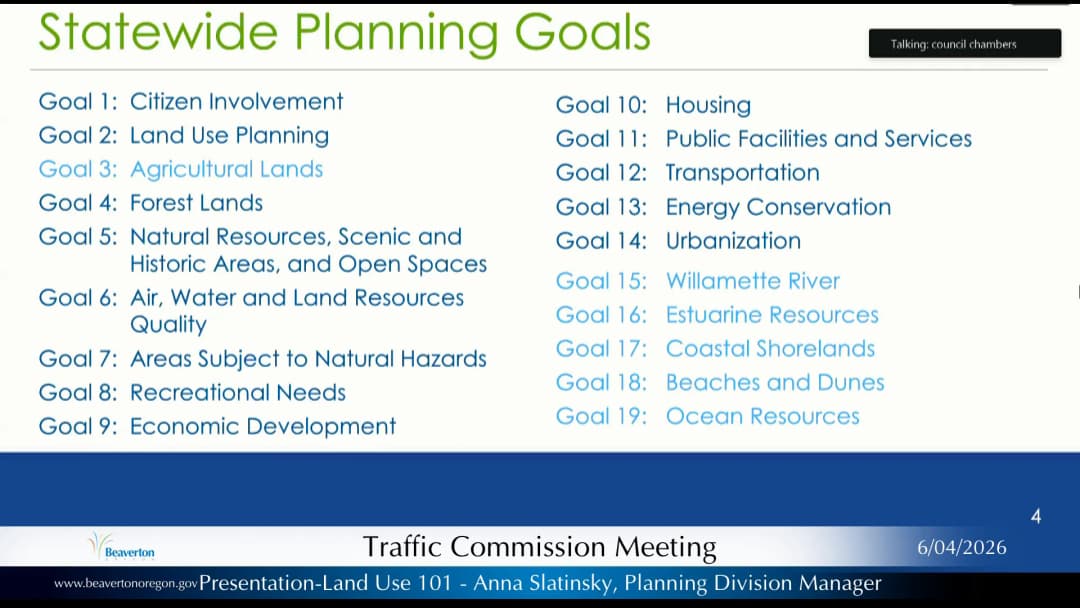
The Beaverton Traffic Commission met on Thursday, June 4, 2026, at 7:00 PM. The meeting included a public hearing on a parking restriction request from TriMet, approval of previous meeting minutes, and an informational presentation from the Planning Division Manager on land use and development processes. The commission also discussed ongoing challenges related to parking, school safety, and the commission's limited authority. Consent Calendar - The minutes from the April 2, 2026 meeting were approved unanimously (5-0, with one abstention). Public Comments & Testimony - Alex, a resident at 13305 SW 2nd Street, expressed concern about permanent no parking signs recently posted on 2nd Street near the baseball field. He stated the change was a surprise and an inconvenience for himself and neighbors. Staff responded that they would follow up with him via email. Discussion Items - Public Hearing TC 872 – Parking Restrictions on SW Watson Avenue at 5th Street - The hearing was opened to consider a request from TriMet to extend the existing no parking zone on the west side of SW Watson Avenue at 5th Street from 15 feet to 45 feet. The purpose is to improve ADA access and bus stop safety by allowing buses to fully pull to the curb. - Staff reported that the extension would remove two parking stalls but have little impact on average day parking, though Saturday farmers market parking is at 100%. The bus stop has 39 ramp deployments per month for mobility devices. - No public testimony was offered. Commissioners expressed support, noting safety and accessibility benefits. A commissioner asked about impacts on the bike lane; staff clarified that with parking removed, buses will not block the bike lane. - The commission voted unanimously (6-0) to approve TC 872 as written. - Presentation by Anna Slatinski, Planning Division Manager - Ms. Slatinski provided an overview of Oregon’s land use system, including state planning goals, the role of Metro and Washington County, and the city’s development permitting process. She explained the three phases of development permits (land use, site development, building) and the four types of land use applications (Type I through IV). - Key topics included: - State law limits on permit processing time (up to approximately one year). - Approval criteria are based on consistency with the development code, not personal opinion. - Traffic impact analysis is required for developments generating 300 or more trips. - Off-street parking requirements were removed by the city council following state mandates (CFEC executive order), which has led to increased on-street parking demand. - Commissioners discussed specific examples, including a school development that generated safety concerns, the difficulty of initiating code changes, and the tension between state preemption and local needs. - No formal action was taken on the presentation; it was informational. Key Outcomes - Approval of April 2, 2026 meeting minutes: Motion carried 5-0, with one abstention. - Approval of TC 872 – Parking restrictions on SW Watson Avenue at 5th Street: Motion carried 6-0. The final written order will be signed by the chair, and the recommendation will be forwarded to the City Council for consent agenda consideration. - The next meeting is scheduled for July 2, 2026 (the second Thursday of the month, as the regular fourth Thursday fell on a holiday).
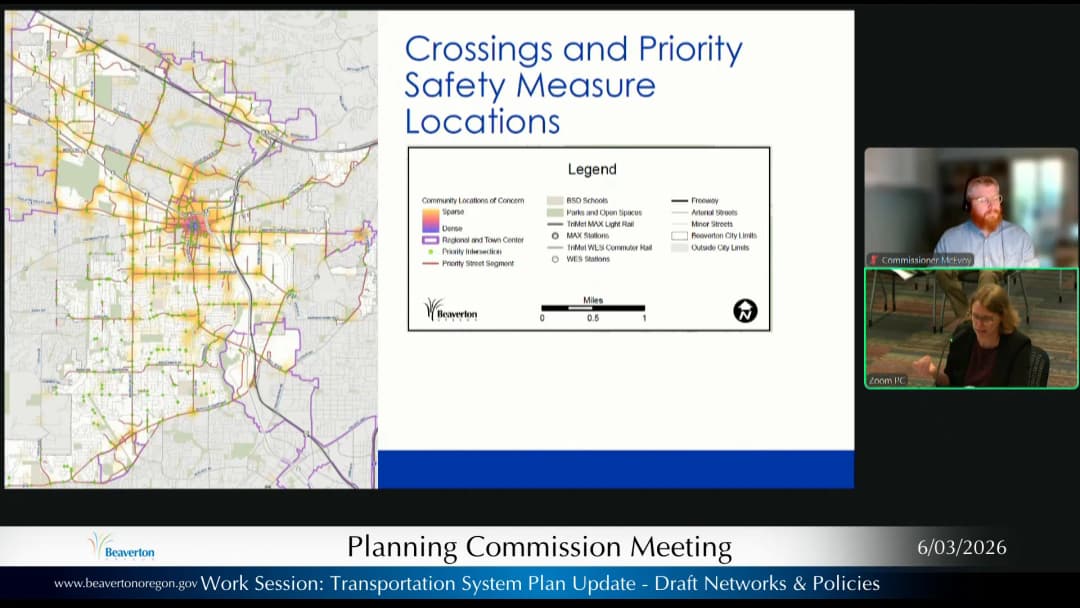
The Beaverton Planning Commission held a work session on June 3, 2026, to review the draft policies and network maps for the Transportation System Plan (TSP) update. Staff presented a comprehensive overview of the proposed shift from a motor-vehicle-centered system to a multimodal, safety-focused approach. Commissioners discussed implementation challenges, speed targets, and prioritization. No public testimony was offered. The meeting concluded with unanimous approval of the minutes from May 6 and May 20, 2026. Consent Calendar - None separate from the minutes approval. Public Comments & Testimony - No public testimony was provided in person or via Zoom. Discussion Items - Staff Presentation: Anna Slatinski, planning division manager, led the presentation. Key points included: - The TSP update is a 20-year plan with adoption anticipated by end of 2027. - Draft policies are organized into six sections: Safe Travel for All, Pedestrian Network, Public Transportation, Bicycle Network, Motor Vehicle, and Intersections & Crossings. - Notable policy shifts: adoption of Vision Zero (goal of zero traffic fatalities), emphasis on all ages and abilities networks, and a target speed of 20–30 mph on city streets. - The draft network maps include pedestrian districts, priority transit routes, a complete crosstown bike network (using trails, neighborhood bikeways, and protected bike lanes), and a target speed map. - Staff highlighted that 125th Avenue was changed from a planned arterial to a multi-use trail, and that implementation will prioritize quick-build, low-cost projects (e.g., traffic calming, curb-to-curb reallocations) over large capital projects. - Commissioner Questions and Comments: - Commissioner McAvoy praised the document's clarity and asked how policies will be used in implementation. Staff responded that policies will inform comprehensive plan changes, development code, and engineering design manual updates. - McAvoy also asked about the shift toward safety; staff cited improved crash data availability, state-level climate-friendly equitable communities rules, and innovations in street design. - Discussion on speed limits: Staff explained that changing speeds requires aligning design speeds, posted speeds, and street geometry—not just signing. Commissioner Speck expressed concern that a blanket 30 mph target on all surface streets is too broad, especially on arterial roads like Murray Boulevard. Staff noted that target speeds represent a long-term vision and that many streets are not city-owned (e.g., ODOT, county). - Commissioner Winter asked about data metrics for safety; staff mentioned using crash data (five-year analysis), traffic volumes, Strava data, and qualitative community feedback. - Commissioner Speck also noted that Washington Square is designated as a pedestrian district despite being car-oriented today; staff explained it is a regional center tied to state and regional planning rules. - Commissioner Winter's observations: He commended the paradigm shift from moving cars to moving people, noted the 125th Avenue change as a good idea, but expressed concern that 30 mph is unrealistic and may turn many drivers into lawbreakers. Staff (Brian) shared a personal example of changed driver behavior on Portland's 82nd Avenue after similar design interventions. - Next Steps: Draft policies and maps will be posted for public comment in June 2026. A city council work session is scheduled for July 7, 2026. Staff will return to the commission later in 2026 for project lists and prioritization. Key Outcomes - No formal votes were taken on the TSP update; the work session was informational. - The commission unanimously approved the meeting minutes from May 6, 2026, and May 20, 2026 (motion by Commissioner Holmes, seconded by Commissioner Speck; vote: 4-0). - Staff will incorporate any additional written comments from commissioners and proceed with public outreach.
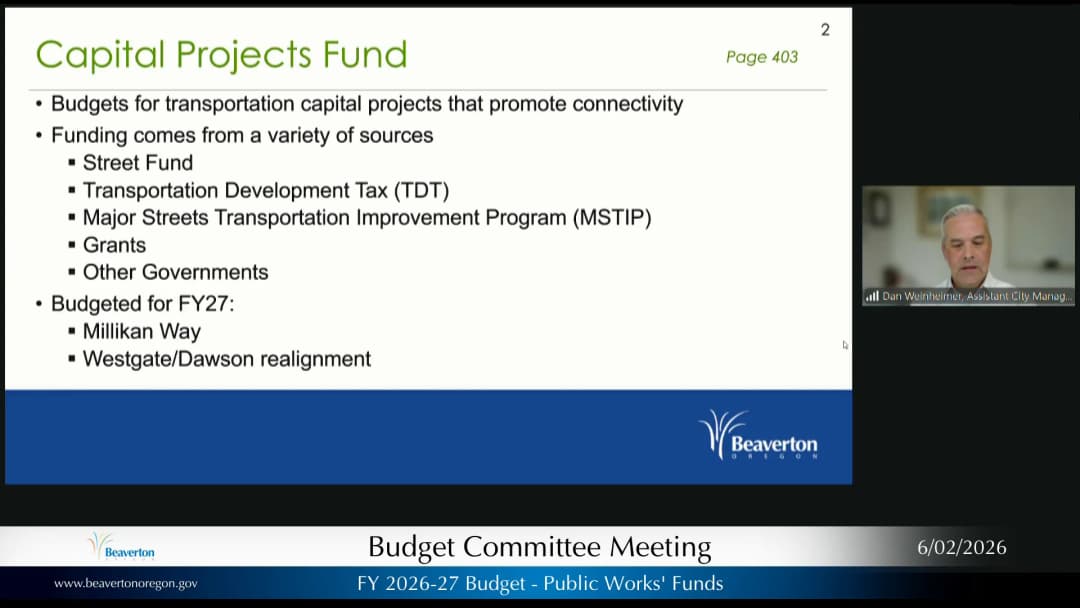
The Beaverton Budget Committee reconvened on June 2, 2026, to hold a public hearing on the proposed City of Beaverton Fiscal Year 2026-27 budget. The meeting included presentations on the Public Works Funds (Capital Development, Capital Projects, Street Fund, and Utility Funds) and the Capital Improvement Program. After deliberation, the committee voted to approve the budget as amended, setting the ad valorem tax rate for operations at $4.6180 per $1,000 of assessed valuation and a property tax levy for general obligation debt of $2,500,000. Public Comments & Testimony - Blaine Solimani Pearson (Beaverton resident) testified that the city budget is a “moral document” and urged the committee to shift resources away from corporate tax breaks and data centers, to ensure city funds are never used for civil immigration enforcement, and to adopt ethical screening criteria for vendors. He expressed support for the city’s sanctuary promise and called for “structural boundaries” to prevent local dollars from supporting mass detention and deportation. He also urged the city to restrict contracts with corporations complicit in human rights abuses. Discussion Items - Conflict of Interest Declarations: Several council members and the mayor declared potential conflicts of interest because the budget includes council compensation. The mayor noted that the city charter prohibits council members from taking the salary increase, calling the declaration “unnecessary.” Councilors Hartmeyer Prigg, Tivnon, Kimmy, and Beatty each made a statement. The city attorney advised that the declarations were prudent. - Public Works and Capital Fund Presentations (Dan Weinheimer, Assistant City Manager): - Capital Development Fund: Focuses on civic capital projects. Recent projects include the Beaverton shelter, City Park playground replacement, and EV charging stations. Activity is ramping down as the shelter project wraps up. - Capital Projects Fund: Focuses on transportation capital projects, funded by the Street Fund, Transportation Development Tax (TDT), and Major Streets Transportation Improvement Program (MSTIP). Key projects: Millikan Way realignment (design finalizing, construction beginning in FY2026-27) and Westgate-Dawson realignment. - Street Fund: Has a structural deficit. Revenues from gas tax, vehicle registration fees, and right-of-way fees have stagnated. The city is limited to crack sealing and overlays; large-scale road rehabilitation is not funded. An interfund transfer methodology adjustment is included. - Water Fund: Funded by rates. A 10-year rate plan began in FY2021. The FY2026-27 increase is approximately 9% ($7.30/month for an average household using 8 CCF). Funds major projects: Willamette Water Supply System (5% partner), aquifer storage and recovery well (ASR 3), Cooper Mountain booster pump station, and advanced metering infrastructure (smart meters). One additional FTE is added for the purple pipe (reclaimed stormwater) system, which is now fully operational. - Question from Board Member Benish: How do Beaverton’s water rates compare to neighboring cities? Susan (finance staff) replied that Beaverton ranks about fourth when combining fixed monthly and consumption charges; Tualatin Valley Water District and Tigard tend to have higher combined bills. Updated statistics will be provided at the June 16th public hearing. - Sewer Fund: Uses a fixed connection point charge and consumption based on winter water average (8 units). A new Sewer SDC Fund is created to better track capital projects. The current year budget was too low; a rate study (first external review) is underway but delayed by about three months due to staffing turnover. The study will evaluate rates for sewer and stormwater. - Storm Drain Fund: Fixed monthly charge per equivalent service unit (ESU). Also subject to the rate study. A new SDC fund is created. Notable projects: Cedar Mill watershed rehab, Progress Ridge treatment vault, and decant facility expansion at the public works yard. - Capital Improvement Program (CIP): Projects are prioritized using eight scoring criteria (maintenance, health/safety, economic vitality, climate impact, equity, etc.). Funding sources include rates, gas tax, system development charges, urban renewal, and federal earmarks. Significant projects: WIFIA program (18 water-related projects, $165.5 million, nearing completion), Willamette Water Supply, Downtown Loop (demonstration project on Hall between 1st and 3rd), Millikan Way, and Cooper Mountain Reservoir 3. Staff noted that the city has not yet been able to access federal grant funds for the Loop project due to changes in grant terms. - Budget Guiding Principles: Councilor Hassan proposed a discussion on updating the budget guiding principles, suggesting that the language should be refined to better reflect values (e.g., diversity, equity, inclusion, and climate sustainability). She deferred formal amendments to a future council meeting. Committee members Kia and Langford offered feedback: Kia cautioned about wording to ensure continued eligibility for federal grants under the current administration, and suggested careful phrasing around “human rights” to avoid political stances. Langford emphasized considering downstream impacts on low-income households and subsidy programs. Key Outcomes - Amendment Package One: The committee approved a motion (10 yes, 0 no, 4 absent) to adopt Amendment Package One, which contained seven technical and clerical modifications to the proposed budget. Councilor Teeter clarified that these were not substantive changes. - Budget Approval: The committee approved a motion (11 yes, 0 no, 3 absent) to approve the proposed FY2026-27 budget as amended, setting the ad valorem tax rate for operations at $4.6180 per $1,000 of assessed valuation and a property tax levy for general obligation debt at $2,500,000. - Next Steps: The approved budget will be forwarded to the City Council for a public hearing on June 16, 2026. The committee also discussed the need for ongoing fiscal sustainability work, including potential structural changes, consolidation of departments, and continued advocacy for state-level reform of Measure 5 (property tax limitations). - Note on Absences: Nelson Banyus, Chris Campbell, and Teresa Payne were absent. Councilor Tivnon left the meeting before the final vote but was marked present for the roll call.
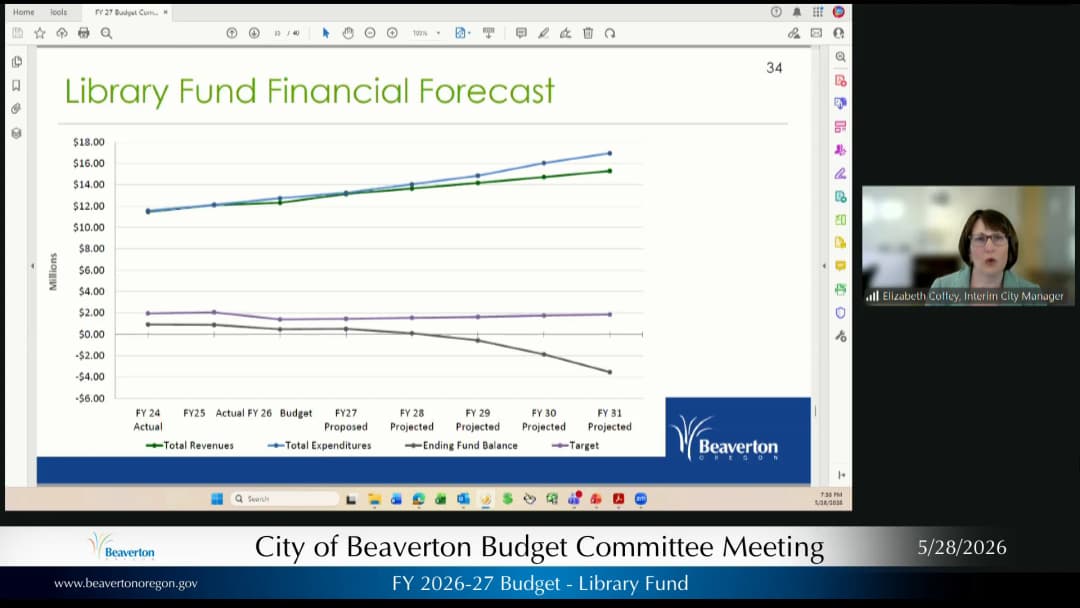
The first of two budget committee meetings was called to order at 7:00 PM to review the proposed FY26-27 budget. The committee elected a chair and vice chair, approved prior meeting minutes, and received detailed presentations from the interim city manager and finance director. The budget addresses a $16.2 million structural deficit through a combination of revenue measures (including a proposed $9.50 monthly general services fee) and expense reductions, including the elimination of 10 positions (6 vacant, 4 filled). No public testimony was offered. Consent Calendar - Approval of Minutes (May 5 and May 19, 2025): Motion carried with 10 yes, 1 abstain (Sundberg), and 3 absent (Hassan, Payne, Campbell). New committee members abstained per custom. Public Comments & Testimony - No members of the public addressed the committee. Discussion Items - Election of Chair and Vice Chair: Councilor Teter nominated Councilor Duggar for chair; Duggar accepted. The roll call vote was 11 yes, 0 no, 3 absent. Councilor Hartmeyer Prigg nominated community member Kia Sundberg for vice chair; Sundberg accepted. The vote was 11 yes, 0 no, 3 absent. - Mayor’s Opening Remarks: Mayor Beatty thanked staff and highlighted the $16.2 million structural deficit, emphasizing the need to protect vulnerable residents, reduce reliance on outside consultants, and ensure the budget reflects council priorities. She noted a proposed $9.50 monthly fee, rising utility rates, and cuts to services such as Library on Wheels, DUII enforcement, and the police wellness officer. - City Manager’s Budget Message (Elizabeth Coffee): Presented the citywide budget of approximately $384 million. Key points: - The city faces a persistent gap due to Oregon property tax restrictions (3% annual growth limit) and rising expenses (8% healthcare, 7% retirement, 6% materials/services). - Since FY22-23, the city has exceeded its initial $9.6 million expense reduction goal, achieving $11 million in cuts through materials/services reductions and personnel eliminations. - Proposed FY26-27 budget uses $2.5 million in one-time reserves while maintaining reserve policy targets (11% at budget adoption, 17% year-end). - Revenue includes a proposed general services fee ($5.3 million assumed), increased photo radar fines, and updated cost allocation methodology. - Expense reductions: 10 positions eliminated (6 vacant, 4 filled), including two police officer positions (DUII enforcement reduced to 4 days/week; police wellness officer coordination eliminated), a police support specialist, an associate planner, an affordable housing program coordinator, a senior program manager, and the chief equity officer. The Office of Equity will be integrated into the community engagement team. - Other cuts: 10% reduction to business support partnerships, minor reductions to arts grants, 50% reduction to down payment assistance, elimination of Allen Boulevard building improvement program, and reduction in library collections and outreach (part-time outreach specialist eliminated). - Library fund: 54% funded by Washington County Cooperative Library Service; reserves are being drawn down, requiring a long-term funding plan. - Transient lodging tax (TLT): Revenue is falling short of covering debt service, building envelope, and PRCA operating contribution. The city proposes a mid-year TLT increase (estimated $460,000 in FY27) to help fund the arts program, reducing the general fund transfer. The PRCA operating contribution is reduced from $1.6 million to $1.4 million. - General Fund Overview (Susan Cole, Assistant Finance Director): Total general fund resources of $124.2 million (including $17.8 million beginning fund balance). Operating expenditures of $106 million, with a $1.8 million gap filled by one-time resources. Police department comprises 44% of general fund ($54.7 million). Personnel costs are 72% of the general fund. The city’s assessed valuation is $13.3 billion, with 3.7% growth assumed. - Committee Questions and Discussion: - Kia Sundberg asked about the projected gap over five years (approaching $15-16 million in FY28, over $20 million by FY30). Also asked about one-time revenues and reserve policy. - Councilor Beatty inquired about moving water utility staff to the Griffith Building (temporary band-aid to relieve overcrowding at operations yard; water fund will pay its share, freeing general fund). - Councilor Teter raised concerns about the impact of eliminating the associate planner on long-range planning capacity (staff acknowledged it will slow work and force prioritization). Also noted the DUII enforcement cut will reduce service coverage. - Kia Sundberg questioned the general services fee and affordability, asking whether a core services assessment had been done. City manager responded that further cuts would impact core services like public safety, and the utility assistance program will be evaluated. - Councilor Kimmy requested detailed information on arts program spending before the next meeting. - Councilor Hartmeyer Prigg referenced the April special meeting on service evaluations as a useful resource. Key Outcomes - Elected Chair and Vice Chair: Councilor Duggar (chair), Kia Sundberg (vice chair). - Approved Minutes from May 5 and May 19, 2025. - Next Steps: - Second budget committee meeting on June 2, 2026 will cover public works funds and capital improvement plan. Budget committee will consider amendments and make a recommendation to city council. - City council will consider adoption on June 16, 2026 (public hearing on general services fee on July 7, 2026). - Committee members are encouraged to submit potential amendments to staff (Susan Cole or Elizabeth Coffee) for legal compliance. - The new fiscal year begins July 1, 2026.
The Beaverton Urban Redevelopment Agency (Bureau) Budget Committee met on May 28, 2026, at 5:00 PM to elect a chair for the meeting and to consider the proposed Bureau budget for fiscal year 2026-27. The committee approved the previous year's minutes, heard a presentation from staff, discussed budget details, and voted on the proposed budget. Consent Calendar - Approval of May 19, 2025 Bureau Budget Committee Minutes: The minutes were approved by a roll call vote with 20 "yes" votes and 1 abstention (new members abstained as per practice). Public Comments & Testimony - No members of the public spoke during the public hearing. Written testimony was received from Antonio Perog on May 27, 2026, and was made available on the website. Additionally, written questions from budget committee members (including a formal letter from Ms. Reister) were answered by staff. Discussion Items - Election of Budget Committee Chair: The committee elected Eric Lair as chair for this meeting. Mayor Lacey Beatty nominated Lair, citing his experience running a tight ship. Lair accepted, and the nomination was approved by a roll call vote of 20 yes, 2 absent. - Budget Presentation: Executive Director Andy Barner and Interim Treasurer Susan Cole presented the proposed FY 2026-27 budget. Key points included: - The Central Beaverton Urban Renewal Plan (approved in 2011) guides the district's work, with seven long-term goals: arts/culture, transportation, business support, housing, community engagement, redevelopment, and adding value. - Tax increment financing (TIF) funds the agency. The district's assessed value has grown 85% since FY 2013. - The proposed budget includes an "under levy" to avoid stranding funds, returning a share of growth to partner districts. - Major spending priorities: infrastructure/placemaking projects (including the downtown loop), redevelopment of Lombard West and Hall/Center sites, and ongoing programs (building improvement grants, critical home repair, pre-development grants). - The budget includes $35 million in proposed bond proceeds and a $7 million overnight loan from the city's general fund to manage cash flow. - Staff noted that the bond is needed to group major projects and would be issued after detailed planning in 9-10 months. The large contingency ($22 million) reflects unused bond proceeds to be carried forward. - Committee Questions and Discussion: - Committee member Walker asked when the $35 million proposed bond would go to voters. Staff clarified that the bond is part of the $150 million maximum indebtedness already approved by voters in 2011; no further voter approval is needed. - Committee member Marion expressed concern about the large contingency and lack of a drawdown schedule. Staff responded that detailed drawdown plans depend on partner funding (federal, ODOT) and project planning, which will be developed over the next 8-9 months. - Mayor Beattie urged using Bureau funds to build rather than returning money to districts. She asked about the timeline for an RFP for the Beaver Dam West site. Staff indicated the goal is to issue a solicitation within the next budget year, focusing on economic development strategies and pre-leasing opportunities. Mayor Beattie emphasized the need to create real value in the district. - Committee member Marion questioned the $1 million allocation for property acquisition given economic downturns. Staff explained that active negotiations are underway for the Lombard West and Hall/Center sites, with public solicitation processes taking longer than private transactions due to required fairness and impact considerations. Key Outcomes - Election of Chair: Eric Lair elected as Budget Committee Chair for the meeting. - Budget Approval: The proposed FY 2026-27 Bureau budget was approved by a vote of 19 in favor, 2 opposed (Marion and Walker), with 1 absent. The approved budget will be forwarded to the Bureau Board for a public hearing on June 16, 2026. - No amendments were made to the proposed budget.
The Urban Beavers and Urban Redevelopment Agency board met on May 26, 2026, at 7:00 PM. The meeting covered the consent agenda approval and a significant work session on the Downtown Parking Plan, where staff presented nine draft strategies for managing parking in three downtown districts: Beaverton Central, Broadway, and Old Town. Board members provided feedback on priorities, including curb management, wayfinding, enforcement timing, and shared parking partnerships. Consent Calendar - The consent agenda, including minutes from February 24, March 17, and April 28, 2026, was approved unanimously with 8 yes votes. Three board members were absent (two excused, one unexcused). Discussion Items - Downtown Parking Plan Work Session (Bureauville 2026-014): Molly from the parking team presented nine draft strategies, including: permanent downtown compliance enforcement, parking branding, paid parking, residential permits, employee permits, curb space management, public-private off-street parking optimization, potential future supply, and managing temporary curb use for construction. The plan is based on data collection, community engagement since 2021, and financial feasibility. - Community Feedback to Date: The highest community priorities were curb management (time regulations, loading/unloading), parking branding/wayfinding, continued enforcement, and expanded permit options. - Board Members' Priorities and Questions: - Board Member Hartmeyer Priggs emphasized adjusting enforcement times to match peak demand, increasing residential permit fees to market rates, shared employee parking, and creating flex parking zones for pickups and deliveries. She asked about financial break-even projections; Molly noted the garage is nearing break-even in year four of a three-to-five-year timeline, and other strategies like paid parking could generate returns after initial investment. - Board Member Decker (Duggar) prioritized smart parking investments (e.g., real-time availability signs), lighting improvements at the Third and Washington lot, covered walkways, public-private shared parking, bike parking, and micro-mobility connections to bridge gaps between the garage and Old Town. He supported the removal of oversized parking space tick marks. - Board Member Tibnon requested a graphical timeline of strategy implementation to aid public communication and supported curb management, branding, and temporary A-frame signage at high-frustration intersections. He expressed confusion about barriers to private lot sharing and urged clarity. - Board Member Kimmy stressed making the Third and Washington lot clearly public, expediting the land use change (currently before the planning commission with a neighborhood review meeting next week), and addressing double-parking on Watson Street for loading/unloading. - Board Member Teeter supported smart wayfinding signage and paid parking infrastructure, noted businesses are open to paid parking, and emphasized bike parking as part of curb space management. She asked for cost estimates for a parking app like "Parking Kitty"; Molly said software costs could be provided, but infrastructure costs are variable. - Executive Director's Report (Andy): Updates included the Building Improvement Program (11 projects totaling $182,000), the Metallock project entering construction after demolition, the Loop and Millikan Way projects holding constructability meetings (construction starting next spring), a Metro grant application for community connections, and Beaverton High School's next phase (no on-site parking starting next school year), requiring coordination to minimize downtown parking impacts. Key Outcomes - Board members provided verbal feedback and priorities for the Downtown Parking Plan, which will inform a presentation to council on June 16, 2026, for resolution adoption. - The board directed staff to expedite the land use change for the Third and Washington lot to public parking; staff will check the planning commission schedule to align with enforcement ramp-up (45–60 days starting early June). - Staff will provide cost estimates for parking app software at a future meeting. - The next Bureau Board meeting is June 16, 2026; the Budget Committee meeting is May 28, 2026.