Browse by city
Date range
Search help

Search titles, summaries, topics and stored transcripts together. Keywords may match separately; put the whole query in double quotes for a phrase. Matching follows word analysis, so punctuation is not exact. Both dates are included. Documents are not searched.

SHOWING 1–10 ENTRIES
01
OCT 27, 2026 · BEAVERTON, OREGON · CITY COUNCIL
Beaverton Urban Redevelopment Agency Bureau Board Meeting – October 27, 2026

The Beaverton Urban Redevelopment Agency (Bureau/BURA) Board met on October 27, 2026, to review the agency's financial position, receive the completed design for the Downtown Loop Phase 1 project, hear the latest on the Beaverdam sites redevelopment solicitation, and receive the executive director's report. The board approved the consent calendar on a 10-0 vote with one absence. No other formal votes were taken, but board members gave direction on staffing, visioning, and next-step work sessions. Consent Calendar - Approved the October 25, 2026 meeting minutes. - Approved Bureau Bill 2026-21 / Resolution 2026-075, adopting budget adjustments for the fiscal year beginning July 1, 2026, and making budget appropriations. - Approved Bureau Bill 2026-22, the master intergovernmental agreement with the city. - Vote: 10 yes, 0 no, 1 absent. Public Comments & Testimony - Mick Orloskey, speaking as a private citizen though noting he serves as vice chair of the city's Bicycle Advisory Committee and on the Beaverton Downtown Association, expressed strong support for the Beaverton Loop Project. - He described recent Booverton event crossing guards, said friends who are strong cyclists avoid crossing Farmington and Canyon with children, and urged the board to prioritize the project. - Orloskey stated concern that the change from a raised cycle track to a street-level bike lane makes sense only if the lanes are fully protected; he asked for clarity about the actual physical protection in the plan. Discussion Items Bureau Bill 2026-23 – Financial Status Update - Assistant Finance Director Susan Cole explained tax increment financing: assessed value in the district is frozen at formation, growth above the base is captured as increment, and property taxes on the increment repay district debt. - Assessed value in the district has grown 70% since inception. In FY2020, increment revenue was $4.1 million, and the city issued $55 million in bonds for the parking garage. In FY2025, increment grew to $7.3 million; in FY2026, Bureau received just under $6.5 million and revenue-shared just over $1 million back to overlapping districts, including about $335,000 to the city. - The $55 million bond has annual debt service of about $2.8 million and is scheduled to be paid off by 2050. Future plans include a $35 million bond in FY2027 and a $28 million bond in FY2033, reaching the district's $150 million maximum indebtedness. If the plan holds, Bureau would issue $118 million in bonds and $32 million in daylight loans over its life. FY2027 is the 15th of the district's 30 years, which ends in 2042. - About 50% of the maximum indebtedness has been expended through June 30, 2026. The First Street Dining Commons is being funded through program income, not through the maximum-indebtedness category matrix. - Board members praised the presentation. Mayor Beatty proposed considering whether to stop revenue-sharing and instead use resources for a full-time executive director dedicated to Bureau, saying this is one of the few areas where the city could increase the pie instead of cutting. Board Members Duggar, Nye, Kimmy, and Hassan expressed support for more staffing, a renewed vision, or a master plan for the downtown area. - City staff said hiring an executive director is normally the city manager's purview, but Mayor Beatty pushed back, saying the board has a policy role and was asking for a conversation, not a hire. Board Member Nye also reminded staff that the Bureau Board is independent of the city council and said the work should not wait until the next budget season. Staff committed to discussing how to bring a work session forward. Bureau Bill 2026-24 – Downtown Loop Phase 1 Project Update - Transportation Project Manager Dan Turk presented the completed design for the Beaverton Downtown Loop Phase 1, located on Hall Boulevard between 1st and 3rd Streets. - The project is federally funded through House Earmark Community Project Funding, with a local Bureau match, and delivered in partnership with the Oregon Department of Transportation. Construction is planned for 2027 and 2028, with high-activity periods from March through October in both years. - Design features include complete roadway reconstruction in the existing right-of-way, raised sidewalk-level concrete intersections, extended corners, a pedestrian-activated flashing warning system at Hall/2nd Street, protected street-level concrete bike lanes with a raised curb and buffer, colored concrete sidewalk furnishing zones, street trees, lighting with banner arms, benches, and bike racks. - No right-of-way purchases are needed; staff negotiated temporary easements for construction. Staff held a constructability workshop in April with adjacent business and property owners and will continue engagement during construction. - Board Member Prigg expressed excitement and support, noting the existing crossing environment is dangerous. Mayor Beatty supported the street-level protected lane, explaining her experiences with raised cycle tracks and sidewalk conflicts shaped her view. Board Member Duggar asked about parking-separated lanes and transit loading conflicts; staff said it was a tradeoff and would be evaluated in the demonstration project. - Board Member Hassan asked detailed questions about flex-zone parking, physical bike-lane protection, maintenance and street sweeping, bike boxes, and driveway closures. He supported moving forward but said he would probably be less compromising on driveway access as the rest of the loop is designed. Staff said three driveways remain open on the east side because of multi-parcel lots, a residential garage, and a narrow parking lot, and these could be revisited during redevelopment. Bureau Bill 2026-25 – Beaverdam Sites Development Solicitation Update - Senior Development Project Manager Janine Lambert reported that since August, the agency closed escrow on 12775 SW Beaverdam Road, started moving assistance for four tenants, obtained in-house aerial photography, and issued an informal consultant solicitation. - The informal solicitation produced three proposals, all above the direct appointment threshold, and informed a formal brokerage firm RFP. Staff plan to issue the formal RFP with a three-week response period, then return for board approval at the January Bureau meeting. - Board Member Tivnon questioned whether three weeks was enough; Lambert said it was the purchasing minimum and that substantial pre-work had been done. Lambert clarified that this RFP is for the consultant brokerage firm, not the developer solicitation; the developer solicitation would likely allow at least 120 days. Executive Director's Report - Executive Director Andy Varner reported on a Beaverton tax increment financing presentation at an ICMA conference, recognition of Beaverton's downtown work at an Urban Land Institute conference, and preparation of 17 building-improvement grants for businesses and property owners. - He noted a future work session on Bureau grant programs in the first quarter of the year. - He also updated the board on the Westgate Drive/Cedar Hills Boulevard/Dawson Way intersection realignment, including design charrettes and coordination with Tualatin Hills Park & Recreation District; downtown parking policy work paused into 2027; school construction parking coordination; ambassadors' new body cameras; and event coordination with the Beaverton Downtown Association. Key Outcomes - Approved the consent calendar 10-0-1. - No formal votes were taken on Bureau Bills 2026-23, 2026-24, or 2026-25; they were received as reports and discussion items. - Staff will explore bringing back a work session on Bureau staffing, vision, and/or master planning in response to board comments. - Downtown Loop Phase 1 next steps: share the completed design with stakeholders and the public; construction remains scheduled for 2027–2028. - Beaverdam next steps: issue the formal brokerage firm RFP, review proposals, and return for approval at the January Bureau meeting. - The next Bureau Board meeting is November 17, 2026, scheduled for 30 minutes before city council; the December meeting date will be moved to avoid holiday conflicts.
ACTIVE TRANSPORTATION 37% · ECONOMIC DEVELOPMENT 24% · FISCAL SUSTAINABILITY 17% · PROCEDURAL 8%
02
OCT 6, 2026 · BEAVERTON, OREGON · CITY COUNCIL
Beaverton City Council Regular Meeting - October 6, 2026

The Beaverton City Council held a regular meeting on October 6, 2026, beginning at 7:00 PM. The meeting covered a proclamation, public comments, consent agenda, two public hearings, an action item on council new project requests, a work session on the transient lodging tax, and council items. Key decisions included approval of a supplemental budget, annexation of a parcel, direction on several policy projects, and consensus to increase the transient lodging tax to 8%. Consent Calendar - Unanimously approved the consent agenda (6-0, with one absent), including items from the city council and contract review board consent agendas. Public Comments & Testimony - Sandra Elliott (Beaverton resident, business owner) expressed strong support for Agenda Bill 26162, urging protection of relationship and family structures from discrimination, citing successful similar policies in Portland and Seattle. She noted the existence of non-traditional families in Beaverton and called for action. - Evelyn Coacher (lifelong Beaverton resident) criticized the lack of advanced public notice for council items, noting that over half of a recent meeting was taken up by council items not on the public agenda. She urged a structural change to allow public input and expressed support for studying a rideshare fee and a fee on home delivery purchases. - David Carlson (campaign director for OPEN, grew up in Aloha) supported Agenda Bill 26162, stating it passed in six cities already this year. He emphasized the bill is a simple amendment to civil rights protections and that approximately 5% of Beaverton's population (conservatively 4,000 people) has some form of non-monogamous relationship. Discussion Items - Proclamation for Support Your Local Chamber of Commerce Day: Councilor Hartmeyer Prigg read a proclamation declaring October 21, 2026 as Support Your Local Chamber of Commerce Day in Beaverton, recognizing the Beaverton Area Chamber of Commerce's contributions. - Supplemental Budget (Resolution 4972): Assistant Finance Director Susan Cole and Budget Analyst Viet Lynn Fam presented the fall supplemental budget for fiscal year 2026-27, including $24.6 million in capital improvement carryovers, $202,000 in non-CIP carryovers, revenue from the new street maintenance fee, and $750,000 in general fund reductions to align with the city's fiscal sustainability plan. Council discussed the impacts, including a reduction in the neighborhood program full-time equivalent position, and expressed concerns about transparency in hiring holds. The resolution was adopted 6-0. - Annexation at 5200 SW Scholls Ferry Road (Ordinances 4886 & 4887): Associate Planner Lauren Russell presented the annexation of a 0.39-acre parcel and associated comprehensive plan and zoning map amendments (to low-density neighborhoods/RMC). No public testimony was given. Council adopted both ordinances 6-0. - Council New Project Requests: Interim City Manager Elizabeth Coffey presented staff hour estimates for five projects from the September 15 council meeting. Council voted on each: 1. AI External Policy: Approved Option 2 (develop language for city grant agreements only) unanimously. 2. Wage Transparency Ordinance: Moved to the city's legislative priorities for the next state session, rather than undertaking a full staff project, due to complexity and existing state-level conversations. Motion carried 6-0. 3. Anti-Discrimination for Non-Traditional Families: Approved unanimously to update the city's anti-discrimination ordinance to protect non-traditional household structures from housing discrimination. 4. Transportation Network Charge (Rideshare Fee): Approved to move forward, with staff to research examples and bring back a work session. Projected start in January 2027, requiring 60-80 hours. Motion carried 6-0. 5. Business Gross Receipts Surcharge: Proposer Councilor Duggar withdrew the project due to the high estimated staff time (500-700 hours) and complexity. No vote taken; council supported the withdrawal. - Transient Lodging Tax Work Session: CFO Carolyn Sullivan presented options to increase the city's transient lodging tax from the current 4% to 6% or 8%. Staff recommended 8% to stabilize funding for the Patricia Reser Center for the Arts (PRCA), build reserves, and fund the arts program. Council members expressed strong support for 8%, citing the need for sustainable revenue from visitors and the importance of the PRCA. Council directed staff to return in November for a first reading of an ordinance increasing the rate to 8% effective January 1, 2027. - Council Items – Private Detention Centers: Councilor Duggar introduced a resolution banning private detention facilities in Beaverton. Discussion included an amendment to update the state of emergency end date (Section F) from October 10 to December 9, 2026, consistent with the city manager's recent extension. The resolution, as amended, was adopted 6-0. Key Outcomes - Consent agenda approved unanimously. - Resolution 4972 (supplemental budget) adopted 6-0. - Annexation ordinances 4886 and 4887 adopted 6-0. - Council approved moving forward with AI policy (option 2), family structure anti-discrimination protections, and rideshare fee study; directed wage transparency to legislative priorities; business surcharge withdrawn. - Council directed staff to prepare a first reading of a transient lodging tax increase to 8% for November. - Resolution banning private detention centers adopted 6-0 with amended date. - Police chief will provide council with detailed information on U visa certifications, as requested by the mayor and councilor Hassan.

PROCEDURAL 22% · FISCAL SUSTAINABILITY 20% · PUBLIC ENGAGEMENT 8% · LEGISLATIVE AFFAIRS 7%
03
SEP 22, 2026 · BEAVERTON, OREGON · CITY COUNCIL
Second 2026 Beaverton Urban Redevelopment Agency Meeting: Building Improvement Program 20th Anniversary and Executive Session (September 22, 2026)

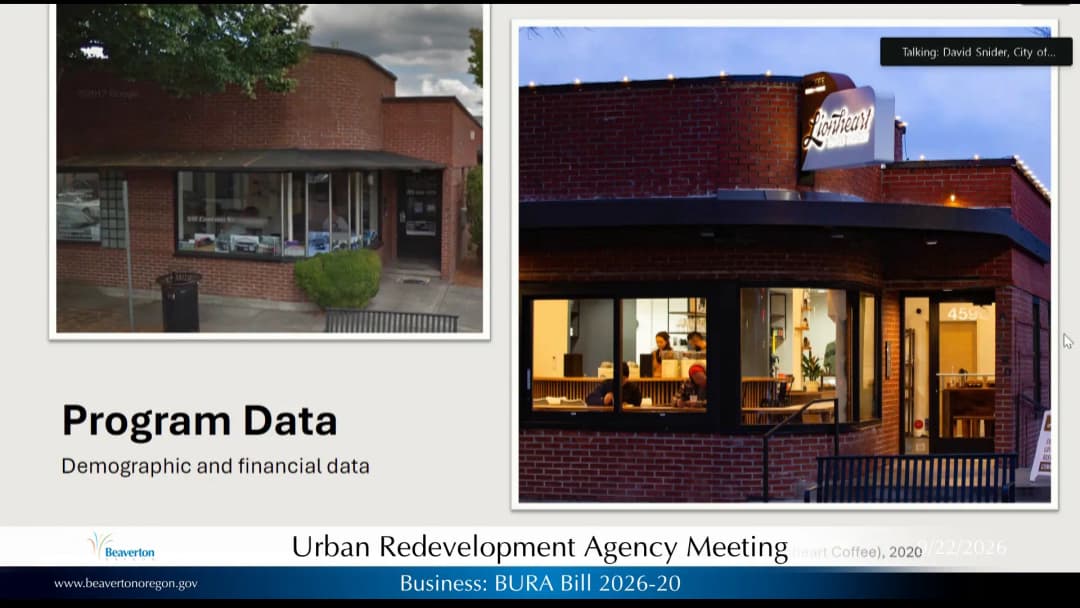
The Beaverton, Oregon Urban Redevelopment Agency (Bureau Board) met on September 22, 2026, for its second 2026 meeting. The board approved a consent agenda authorizing an extension of the Lombard West exclusive negotiations agreement, received an informational presentation on the 20th anniversary of the Building Improvement Program, heard the executive director’s report, and entered executive session for real property transaction deliberations. No agenda or minutes were available; this summary is drawn from the meeting transcript. Consent Calendar - Bureau Bill 2026-19: authorize the executive director to consent to an extension of the Lombard West exclusive negotiations agreement between the Bureau, CEPA, and UDP. Motion by Board Member Tivanon, second by Board Member Duggar. Approved by roll call: 10 yes, 0 no, 1 absent. Public Comments & Testimony - No visitors addressed the board in person or online on non-agenda matters. - A written comment from Antonio Pierrog was received and made available on the agenda page. Discussion Items Board Communications - Chair Teeter said she would begin calling for votes more often so staff receive clear direction instead of vague informal guidance. Business Item: Building Improvement Program 20th Anniversary (Bureau Bill 2026-20) David Snyder, project development coordinator, presented an informational report marking 20 years since the program’s 2006 launch. - Program history: launched in 2006 as the Storefront Improvement Program using CDBG and general fund funding; federal Davis-Bacon requirements added costs; the 2008 economic downturn reduced activity. After a 2015 consultant recommendation, the program was relaunched with a tenant improvement program and a restaurant recruitment strategy focused on Old Town. Projects grew from 1 in 2015 to 24 in 2016 and 21 in 2017. - Later changes: the maximum grant was increased from $35,000 to $50,000 in 2020, then raised to $75,000 in 2023 and lowered back to $50,000 in 2024 due to budget concerns; storefront and tenant improvement programs were consolidated into the Building Improvement Program in 2023; maintenance grants and match tiers of 50% for project owners/large businesses and 75% for small businesses were created; a dedicated grant manager was hired; two application periods per year replaced rolling applications; the program manager FTE was reduced from 80% to 50%; and operations in the Allen Boulevard area outside the urban renewal district were suspended in 2025 due to general fund limits. - Program data: 266 grant projects completed; about $6 million in grants leveraged more than $12.5 million in private investment, for more than $18.5 million total investment in downtown; about one-third were design grants and two-thirds construction projects. Small businesses have been the majority of grantees, with recent proportions of roughly 70% small businesses, 10–15% large businesses, and 20–25% commercial property owners. - Restaurants: more than 130 restaurant projects have been completed; restaurants were 32% of projects before 2016, about 56% from 2016 to 2023, and 40% in the two most recent completed years after industry-specific expenses were removed from the program. - Equity: BIPOC applicant share has trended upward since standardized data collection began; 18 of 23 approved applications (more than 78%) in 2026 were from BIPOC applicants. Outreach includes Spanish, Korean, Arabic, and newly added Vietnamese materials, interpretation services, in-person walkabouts, and partnerships with Impact Beaverton and the Downtown Beaverton Association. - Dashboard: the Bureau Grants Dashboard is live on the city website, with an interactive map and filters; a future upgrade will add before-and-after images. Board members responded with support and questions: - Vice Chair Lair asked how many grant recipients remain in business five years later and whether de-emphasizing restaurants would improve retention. David Snyder said more than half are likely still operating and that compiling turnover data would be relatively easy. - Board Member Nadia asked how businesses that receive funding but do not stay are tracked, and urged continued support to help critical small-business investments endure. - Board Member Kimmy asked about per-building grant limits; staff stated each tenant space or building can receive a maximum of $75,000 in grant funding over five years, and property owners may apply for multiple buildings. - Board Member Duggar said her question was answered. - Mayor Baity, who arrived during the meeting, commented that building-attached investments such as HVAC and storefronts remain valuable even if a business turns over, and asked that future program retooling distinguish building investment from business turnover. - Chair Teeter thanked current and former staff, including former program manager Megan Bronson, and expressed support for continued business assistance through partnerships. Executive Director’s Report - Executive Director Andy reported on Loop Phase One/demonstration project briefings, with a full board and public update expected in October. - A Lombard West presentation with the development team is expected later in the fall, likely November. - Andy, Dan, and Tyler will attend the ICMA annual meeting next month to present on tax agreement financing districts and Beaverton programs. - Two new storm drain murals were installed at Lombard and Broadway in partnership with organizations identified in the transcript as Twelve and Valley, Twelve and River Keepers, funded through city public art grants and supported by the Beaverton Arts Commission. Executive Session - The board moved into executive session under ORS 192.660(2)(e) to deliberate with persons designated by the governing body to negotiate real property transactions. Media were allowed to attend, but items discussed could not be disclosed. No discussion or action followed in open session. Key Outcomes - Consent agenda approved: 10 yes, 0 no, 1 absent. - Bureau Bill 2026-20 was received as an informational presentation; no formal vote was taken. - Board members requested tracking of grant recipient longevity and building-attached investment durability; staff indicated the data could be compiled relatively quickly. - A work session on the future of incentive programs is planned for the first quarter of 2027. - The Bureau Grants Dashboard is now publicly available, with a before-and-after image upgrade expected in coming months. - The board entered executive session; no open-session action was taken afterward.

ECONOMIC DEVELOPMENT 57% · PROCEDURAL 19% · PUBLIC ENGAGEMENT 8% · ARTS AND CULTURE 5%
04
SEP 15, 2026 · BEAVERTON, OREGON · CITY COUNCIL
Beaverton City Council Meeting – September 15, 2026

The Beaverton City Council met on September 15, 2026, at 7:00 PM. The meeting included two proclamations, visitor comments, a city manager report, approval of a consent agenda, a public hearing on a zoning map amendment, a work session on the city manager hiring process, first readings of two ordinances, and multiple council discussion items. Proclamations - Hispanic Heritage Month: Councilor Hussan read a proclamation recognizing September 15–October 15, 2026 as Hispanic Heritage Month in Beaverton. - B City USA: Councilor Tivnon read a proclamation recognizing Beaverton's commitment to pollinator conservation and B City USA designation. Consent Calendar - The council approved the consent agenda (including the contract review board consent agenda) with a 6-0-1 vote (Councilor Kimmy absent). Public Comments & Testimony - Jacqueline Leedy: Criticized the Downtown Association (BDA) for blocking community members who spoke out against its use of AI, estimating over 30 accounts blocked. Called for city to denounce BDA's practices and for a social media policy. - Evelyn Cocher: Echoed concerns about BDA blocking, noted that new AI policy would not apply until 2027 contract renewal, and raised concerns about annexation across from Raleigh Hills Elementary lacking sidewalks. - Tyler (last name not given): Criticized BDA for not listening to artists and small businesses, blocking community members, and using AI; called for change in leadership. - Alicia Bermies: Praised Beaverton Police Department for compassionate handling of her daughter's accident, highlighting Officer Ruby Estrada-Vega. - Written comments from Mr. Reese and Mr. Perog were acknowledged. City Manager Report - Building Improvement Program: 20th anniversary, applications open through September 29 for downtown and Island Boulevard businesses. - Night Out Celebration: Rescheduled to September 22 at Evelyn Schiffler Park. - Library Book & Media Sale: September 24–October 4 at Main Library. - Library Card Sign-Up Month: September. - Boards & Commissions Recruitment: Applications due October 5, terms begin January 2027. Public Hearing – Zoning Map Amendment (Ordinance 4885) - Proposal to rezone five parcels in Shoals Heights/Valley Heights PUDs to reflect lot reconfiguration. Staff (Elena Sassin) presented, noting planning commission recommended approval. No public testimony. Council approved the motion (6-0-1) to adopt Ordinance 4885 and approve application ZMA32026-00081. City Manager Hiring Process - Assistant City Attorney Kirsten Rush presented a resolution to amend the hiring process (Resolution 4971) based on lessons learned from previous hires. Key change: the subcommittee (Councilors Duggar, Hartmeyer-Prigg, Teeter) will conduct initial interviews and report back to council. Council adopted the resolution (6-0-1). First Readings - Ordinance 4886: Annexation of 5200 SW Scholls Ferry Road and portion of SW Montclair Drive. Public hearing set for October 6, 2026. - Ordinance 4887: Comprehensive plan and zoning map amendment for the same parcel. Public hearing set for October 6, 2026. Council Discussion Items - Mayor Beatty – AI Policy for Contractors: Proposed directing the city manager to add AI policy requirements to future contracts. Council discussed workload; city attorney noted this would require substantial work. Mayor requested a workload estimate from the city attorney for the next meeting. Consensus: city attorney to report back. - Mayor Beatty – Religious/Cultural Observance Policy: Proposed developing a policy to avoid scheduling meetings during significant observances. Council expressed support, citing successful models from schools. Consensus to direct staff to develop a policy. - Mayor Beatty – Ride-Share Fee Evaluation: Requested further evaluation of a fee on ride-share trips. City manager agreed to report back on staff hours needed for a deeper dive. Consensus to proceed. - Councilor Hartmeyer-Prigg – Labor Compliance Ordinance: Proposed an ordinance requiring contractors/subcontractors to disclose wage theft and safety violations. Council requested a workload estimate from staff on enforcement implications. Consensus: staff to report back. - Councilor Duggar – Anti-Discrimination Ordinance (Relationship Status): Proposed adding relationship status and multi-generational households to the housing non-discrimination ordinance. Council discussed enforcement and court capacity. Councilor Duggar will consult with the municipal judge before proceeding. Consensus to move forward with due diligence. - Councilor Duggar – Gross Receipts Tax Evaluation: Proposed evaluating a gross receipts tax for the fiscal sustainability plan. Mayor and city manager noted legal and data challenges, suggested a more limited lift evaluation. Council agreed to have staff report back on the effort required. Key Outcomes - Proclamations for Hispanic Heritage Month and B City USA were read and approved. - Consent agenda approved (6-0-1). - Ordinance 4885 and associated zoning map amendment approved (6-0-1). - Resolution 4971 (city manager hiring process) adopted (6-0-1). - First readings of Ordinances 4886 and 4887 were presented; public hearings scheduled for October 6, 2026. - Council directed staff to: provide workload estimates for AI policy, ride-share fee evaluation, labor compliance ordinance, and gross receipts tax; develop a religious/cultural observance policy; and consult with the municipal court on the anti-discrimination ordinance. - Council agreed to a prioritization exercise to sequence multiple new work requests.

PROCEDURAL 19% · COMMUNITY ENGAGEMENT 15% · FISCAL SUSTAINABILITY 11% · URBAN PLANNING 10%
05
SEP 8, 2026 · BEAVERTON, OREGON · CITY COUNCIL
Special Meeting of Beaverton City Council: Fiscal Sustainability Work Session - September 8, 2026

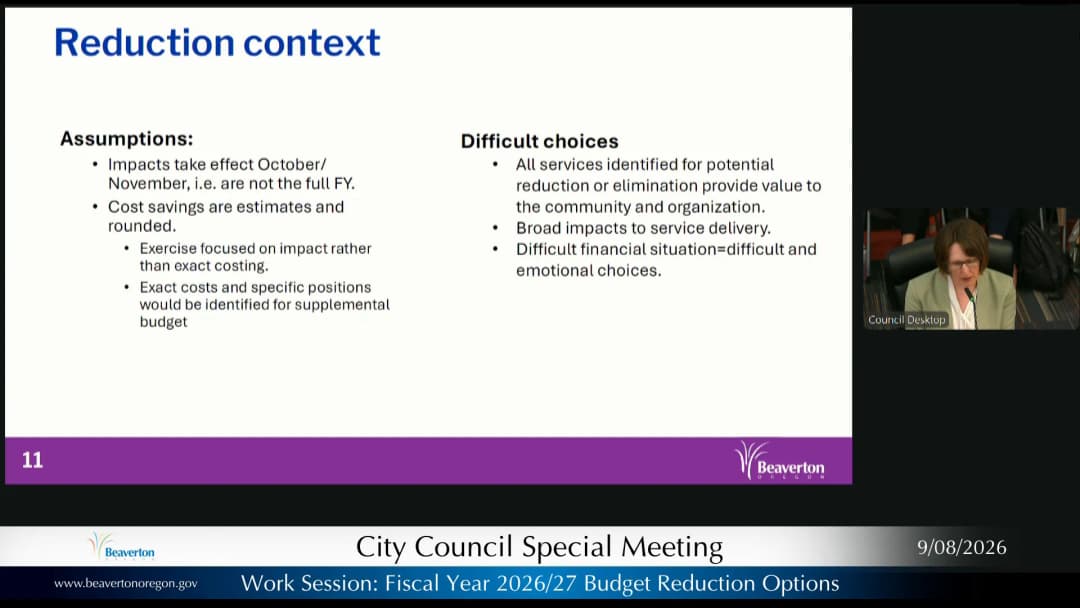
On September 8, 2026, the Beaverton City Council held a special meeting that included an executive session, a first reading of an ordinance (Ordinance 4884 regarding a zoning map amendment for Shoals Heights and Shoal Valley Heights), and a work session on fiscal sustainability. The work session focused on addressing the city's $2.5 million in one-time general fund reliance for fiscal year 26-27 and previewing larger budget challenges for fiscal year 27-28. Consent Calendar - No consent calendar items were noted. Public Comments & Testimony - No public comments or testimony were presented during the public portion of the meeting. Discussion Items - Interim City Manager Presentation: Elizabeth Coffey, interim city manager, presented budget reduction options to address the $2.5 million one-time funding gap. She outlined a $750,000 package of immediate reductions (e.g., underspend adjustments, facility study savings, temporary staff reductions) with minimal community impact. Two larger policy-impact packages (each $1.8 million) were presented: - Option 1: Deeper cuts in fewer areas: eliminate the Center for Mediation and Dialogue ($538,000 subsidy), down payment assistance program (2 families/year), smaller events (Bike Beaverton, volunteer fair), suspend one major event (Night Market, tree lighting, or parade). Also reduce emergency planning, recycling/sustainability, abatement program (from 2 to 1 per year), police records, city recorder services, and arts program. - Option 2: Spread cuts more evenly: reduce patrol officers (longer response times), reduce Center for Mediation (scale back workshops/training), reduce sustainability outreach, eliminate police victim services program (rely on Washington County), reduce events (only smaller ones eliminated), down payment assistance eliminated, additional police records reductions, and reduce police leadership capacity. - Fiscal Year 27-28 Preview: Coffey projected a $6–9 million deficit (excluding the $750k supplemental). Scenarios included a potential operating levy (May 2027), photo radar revenue expansion, and full-year transient lodging tax (TLT) increase to cover arts. Without a levy, additional cuts of $2.8 million would be needed, possibly including eliminating 24/7 police records, proactive policing (bike/traffic teams), graffiti cleanup, permit counter hours, and events. - Council Feedback: - All council members expressed support for the $750,000 in supplemental reductions. - Broad agreement to hold off on further policy-impact reductions until fiscal year 27-28 and to use the November council retreat for deeper discussion on priorities, community impact definitions, and service-level trade-offs. - Councillors shared concerns: Council President Duggar questioned the framing and urged more internal cuts (e.g., consultants) and development-driven revenue (Cooper Mountain, BURA). Mayor Beatty emphasized the need for better communication to build community understanding before any levy, and noted PERS and health care costs as long-term issues. Councillor Kimmy stressed the need for data and time to prepare for decisions. Councillor Hartmeyer Prigg defended staff and urged council unity. Councillor Teter appreciated the framework but wanted clearer direction on priorities. Councillor Tibnon called for defining core services and affordability context. Councillor Hussen supported Option 2’s approach but was hesitant on cuts to mediation and police; she asked that equity considerations from the multicultural gap analysis be factored in. Key Outcomes - Consensus on Immediate Reductions: Council unanimously supported moving forward with the $750,000 in supplemental budget reductions (to be included in the fall supplemental budget scheduled for October 6, 2026). - Hold on Further Cuts: Council agreed to delay additional policy-impact reductions (Options 1 and 2) until fiscal year 27-28, focusing instead on comprehensive solutions for the next budget cycle. - November Retreat: Council agreed to use the November council retreat to conduct strategy sessions on fiscal sustainability, including defining community impact, prioritizing services, exploring a potential operating levy, and improving communication to build voter trust. Staff will prepare additional data and analysis for that retreat. - No Formal Vote on Levy: Council did not commit to a May 2027 levy; further polling and community engagement were deemed necessary. The mayor expressed reluctance to pursue a levy without improved public understanding of city services. - Further Exploration: Staff will continue evaluating cost recovery for the Center for Mediation and Dialogue, partnership opportunities with Tualatin Hills Park & Recreation District, and other efficiency measures. A work session on a transient lodging tax increase is scheduled for October 6, 2026.

FISCAL SUSTAINABILITY 40% · BUDGET EQUITY ANALYSIS 28% · PUBLIC ENGAGEMENT 14% · PUBLIC SAFETY 9%
06
SEP 3, 2026 · BEAVERTON, OREGON · CITY COUNCIL
Beaverton Traffic Commission Meeting Summary – September 3, 2026

On September 3, 2026, the Beaverton Traffic Commission met to consider two public hearings: a left-turn restriction on Southwest 117th Avenue at Barnes Road (TC 875) and revisions to downtown on-street parking regulation hours (TC 876). The commission also approved consent agenda items and received an update on a pedestrian path improvement project. The meeting included staff reports, public testimony, and commission deliberations. Consent Calendar - Approved 7-0: Meeting minutes from July 2026 and the final order for TC 874 (stop control at Southwest Angel Avenue and Southwest 6th Street). Public Hearings TC 875: Left-Turn Restriction on SW 117th Avenue at Barnes Road - Staff Report (Mr. Cashell, City Traffic Engineer): Washington County safety analysis identified six crashes (four minor injury) between 2023 and 2025 at the T-intersection, primarily involving northbound left turns conflicting with eastbound through traffic. Staff proposed restricting left turns from 117th Avenue onto Barnes Road, noting that drivers can instead use a new signalized intersection at 116th Avenue (300 feet east) to make a safer left turn. The change would not affect the neighborhood on Shobi Drive/Shauben Lane, as they can use the signalized intersection. - Commission Questions: Commissioner Moore asked about crash types (no rear-ends reported). Commissioner Bansky clarified the vote was only on the turn restriction, not Washington County's broader concepts. Commissioner Miranda asked about U-turn possibilities at 116th; staff explained U-turns are not allowed at signalized intersections unless posted, and they do not encourage them. - Public Testimony: No members of the public testified in person or via Zoom. - Commission Deliberation and Vote: Commissioners expressed support based on crash data and safety. Chair Conway motioned to approve as written; seconded by Commissioner Friedler. Approved 7-0. TC 876: Revisions to Downtown On-Street Parking Regulation Hours - Staff Report (Mr. Cashell and Molly Rubinovitz, Parking Manager): The downtown parking plan, adopted by City Council on June 16, 2026 (Resolution 4960), calls for changing parking time limit restrictions from 7 a.m.–6 p.m. Monday–Friday to 8 a.m.–9 p.m. Monday–Saturday (matching the Broadway district). The change is based on parking occupancy data (collected Thurs–Sat, 5–10 p.m., July–Aug and Nov–Dec 2025) showing that most time-limit areas exceed the 85% occupancy threshold, the industry benchmark for considering policy changes. Staff emphasized this is the first step in a longer process, with future changes to time limits, permits, and other code updates planned. - Commission Questions: Commissioner McLean asked about eliminating the 7–8 a.m. hour; staff replied it has very low utilization. Commissioner Miranda queried whether time limits (e.g., 2-hour) would change; staff said no, only the enforcement hours. Commissioner Moore raised concerns about overnight parking of caravan vehicles; staff noted the data does not cover overnight. Commissioner Bansky noted a discrepancy in map data (one map showed 919 parking spots vs. 1,166 in others); staff explained construction on Broadway affected earlier data collection. - Public Testimony: Three speakers testified in person, all opposed to the change: - John Matilla (resident, 12325 SW 2nd St.): Supported extending parking time limits but opposed the hourly change due to difficulty finding parking as a resident. Suggested increasing resident permits from 2 to 3 and reevaluating permitted parking areas. Also raised concerns about data collection via roving cameras (Fourth Amendment), which the chair deemed outside the scope of the hearing. - Ben Johns (resident, Caddy building): Opposed the change because he arrives home around 3–4 p.m. and would have to move his car until 9 p.m. He has two resident permits and asked about parking on Lombard (not part of this proposal). - Caitlin Smith (owner, Her Salon on SW Farmington Rd.): Opposed the change, especially the addition of Saturday and later evening hours. Her salon clients need longer parking for services; Saturdays previously allowed parking without time limits. She also noted that employee permits on 2nd Street are unnecessary because that street has no time limits. - Written testimony: Approximately nine written comments were received; three from the same source, all opposed. Staff had sent over 500 hearing notices and posted signs. - Commission Deliberation: - Commissioner McLean argued public streets are not owned by any party; expanding restricted hours promotes equality and turnover, even if it doesn't please everyone. - Commissioner Bansky suggested that if consistency were the goal, making all restrictions end at 6 p.m. (instead of extending to 9 p.m.) would be simpler. He noted that parking occupancy data may not justify extending hours when many businesses are closed after 6 p.m. - Commissioner Moore expressed concern that the change appears to prioritize businesses over residents and that residents and businesses are already constrained. She noted that 20,000 visitors to the Saturday market manage to park, so the need for more enforcement on less busy days seems questionable. - Vice Chair Bobadia felt the timing is premature; the commission should first address time limits and permits before expanding hours. She commended businesses and residents for working together. - Commissioner Miranda made a motion to approve as written, but it failed due to lack of a second. - Commissioner Friedler noted that all written and in-person testimony was opposed. He wanted a timeline for future parking changes (permits, time limits) before supporting this step. - Commissioner Bansky requested data on the percentage of businesses open after 6 p.m. and the number of residential units downtown to better balance competing needs. - Key Outcome: Commissioner Miranda moved to table the item and request additional data: the number of businesses open after 6 p.m. and the number of residential units in the affected area. The motion was seconded by Commissioner Friedler and passed 7-0. The item will be brought back to a future Traffic Commission meeting once the information is gathered (staff indicated it would not be available by the next meeting). Other Business Old Business: Pedestrian Path between Corby Drive and Barnes Road - Update from Mr. Cashell: In February 2023, the Traffic Commission denied a request to close the path; City Council concurred. City operations now have a project to improve the path: clear vegetation, fix the bridge, and clear the surface. Concrete blocks have been added to prevent obstruction. The storm engineer (Conley) hopes this will reduce flooding. Commissioners noted the project was long pending (since 2023). - No new business was raised. Key Outcomes - Consent Calendar: Approved 7-0 (minutes and TC 874). - TC 875: Approved 7-0. Left-turn restriction on SW 117th Avenue at Barnes Road. - TC 876: Tabled 7-0 pending additional information on business hours and residential unit counts in the affected downtown area. No meeting scheduled for October 2026; the item will return when data is ready. - Pedestrian Path: Update noted; improvements underway. - No new business or other old business.

PARKING MANAGEMENT 44% · PARKING AND ENFORCEMENT 17% · PROCEDURAL 11% · PUBLIC TRANSPORTATION 8%
07
SEP 2, 2026 · BEAVERTON, OREGON · PLANNING COMMISSION
Beaverton Planning Commission Meeting: Third and Washington Public Parking Designation Change – September 2, 2026

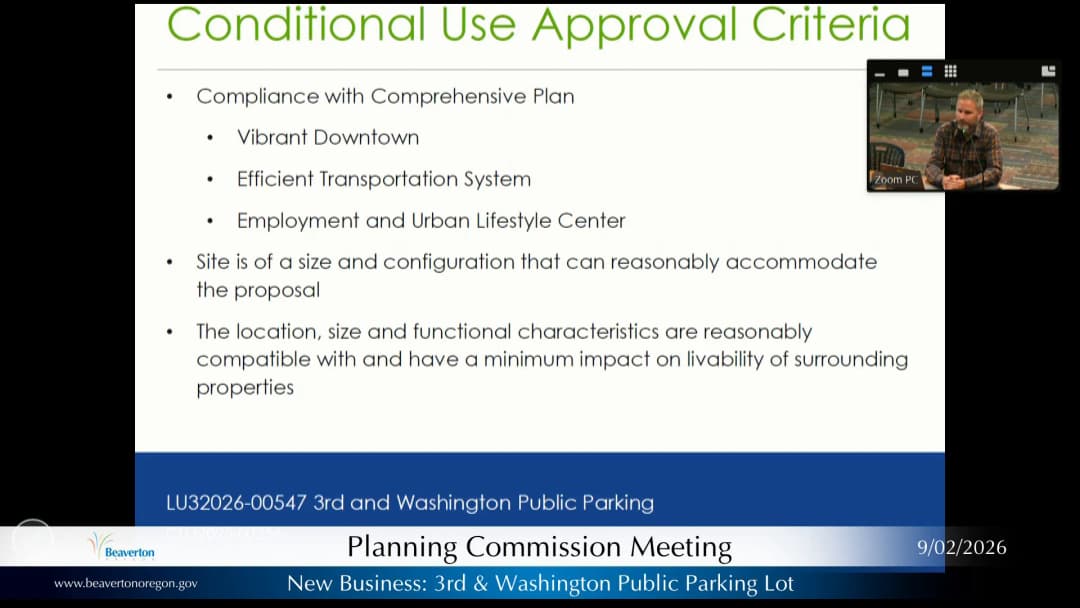
The Beaverton Planning Commission met on September 2, 2026, at 7:00 PM to conduct a public hearing on a single agenda item: a new conditional use application (LU 32026-00547 / CUN 32026-00546) to re-designate the existing parking lot at Third and Washington from library-only to public parking. Commissioners Holmes, McAvoy, McCann, Winter, and Chair Adams participated; Commissioners Speck and Mettler were excused. After presentations, no public testimony, and deliberation, the commission unanimously approved the application subject to the conditions in the staff report. Public Comments & Testimony - No members of the public testified in favor, opposition, or neither in favor nor opposed, either in person or via Zoom. Discussion Items - Staff Presentation: Senior Planner Steve Regner explained that the application seeks to convert the existing library-auxiliary parking lot (119–121 spaces) into a standalone public parking lot serving Old Town. No physical changes are proposed; only signage will be updated. The lot has an average daily occupancy of about 25%. The change aligns with the city’s downtown parking plan (Strategy 7: Optimize Existing Assets) and the 2023 elimination of parking minimums. Staff found compliance with Comprehensive Plan goals (vibrant downtown, efficient transportation, urban lifestyle center) and compatibility with the neighborhood based on 25 years of operational history. Staff recommended approval. - Applicant Presentation: Parking Manager Molly Rabinovitz elaborated that the lot is one of three library lots; the East Library lot (≈190 spaces) and a small staff lot remain unchanged. The West Library lot currently averages 25% usage. The farmers market will continue as scheduled, and existing EV charging stations (six plugs) remain. The request is to change the land use designation to “parking as a principal use” (Type III conditional use) to allow broader public use, including visitors to City Park and nearby businesses. - Commissioner Questions: Clarifications included that the lot would remain free (deferred to applicant for policy), that ownership stays with the city, and that the farmers market agreement is unaffected. Commissioners also noted that while parking minimums are eliminated, the city could voluntarily reserve spaces for the library, but that is not required for this approval. Key Outcomes - Motion: Commissioner Holmes moved to approve application LU 32026-00547 / CUN 32026-00546, subject to the conditions in the staff report and supplemental memo from September 2, 2026. Commissioner McCann seconded. - Vote: Unanimous approval (5-0). Commissioners Holmes, McCann, McAvoy, Winter, and Chair Adams voted aye. - Next Steps: The commission's decision will be memorialized in land use orders. Appeals must be filed per the Beaverton Development Code and LUBA rules. The city will proceed with signage changes and officially advertise the lot as public parking. Adjourned at 6:51 PM.

PARKING MANAGEMENT 61% · PROCEDURAL 28% · PUBLIC TRANSPORTATION 11%
08
AUG 25, 2026 · BEAVERTON, OREGON · CITY COUNCIL
Beaverton Urban Redevelopment Agency Meeting - August 25, 2026

The Beaverton Urban Redevelopment Agency (BURA) Board met on August 25, 2026, to discuss and take action on several items including the grants program, parking enforcement, contract extensions for the First Street Dining Commons, and an update on the Beaver Dam sites development solicitation. The meeting included board communications, a consent agenda, and a business item. Consent Calendar - The board approved the minutes from May 26, 2026, and June 16, 2026, by a vote of 8-0-3 (three absent). Public Comments & Testimony - No visitors spoke during the visitor comments portion. Discussion Items - Grants Program Work Session: Mayor Beatty requested a future work session to reconsider the Bureau's grant program, including changing from annual to quarterly cycles and focusing on business incubation and retail, not just restaurants. Board members expressed support. A motion to direct the executive director to bring a work session in Q1 2027, and to have URAC hold a similar conversation, passed 9-0-3 (with three absent). - Downtown Activations & Small Business Concerns: Board member Hussen raised concerns from small businesses about downtown activations potentially taking away business. The board agreed to fold this into the upcoming grant program discussion and refer to URAC. No formal motion. - Parking Enforcement: Board member Duggar reported complaints from businesses about aggressive parking enforcement tactics, including ticketing for unloading and multiple tickets in one day. Executive Director Andy confirmed no change in strategy, only that warnings have ended and enforcement has begun. He encouraged businesses to report specific issues for coaching. - First Street Dining Commons Contract Extensions: Mayor Beatty pulled items 4.2 and 4.3 (property management and events production contract extensions) from the consent agenda for discussion. She expressed frustrations with high costs, slow vendor response, and lack of a permanent structure plan. Board member Duggar moved to extend the contracts for eight months (instead of a year) to allow time for planning and an RFP. The motion passed 8-0-3. Staff will develop a plan for a more permanent solution. - Beaver Dam Sites Development Solicitation Update: Senior Development Project Manager Janine Lambert and Economic Development Manager Mike Williams presented an update on the 5.38-acre site. Market conditions showed strong retail (2.2% vacancy), low office vacancy (3.9% but with development challenges), and a recovering hotel market. The board discussed solicitation goals: prioritizing tax revenue, living-wage employment, density, connectivity, and gateway reinforcement. Board members supported a flexible approach, potentially using an RFEI or RFQ instead of a full RFP, and emphasized the need for innovative housing, arts district integration, and long-term developer commitment. No vote was taken; staff will refine the solicitation. Key Outcomes - Motion passed (9-0-3): Direct executive director to schedule a work session in Q1 2027 on grants program, and to engage URAC. - Motion passed (8-0-3): Extend the property management and events production contracts for the First Street Dining Commons for eight months (retroactive to July 1, 2026), with a directive to develop a plan for a permanent structure. - Consent agenda minutes approved (8-0-3). - The board will hold future work sessions on the loop project, tax increment funding, and the dining commons. - The Beaver Dam sites solicitation will be refined with board feedback and released by the end of the calendar year. Note: An executive session followed the public meeting to discuss real property transactions.

URBAN PLANNING 33% · ECONOMIC DEVELOPMENT 24% · PROCEDURAL 10% · PUBLIC WORKS 8%
09
AUG 19, 2026 · BEAVERTON, OREGON · PLANNING COMMISSION
Beaverton Planning Commission Work Session – August 19, 2026

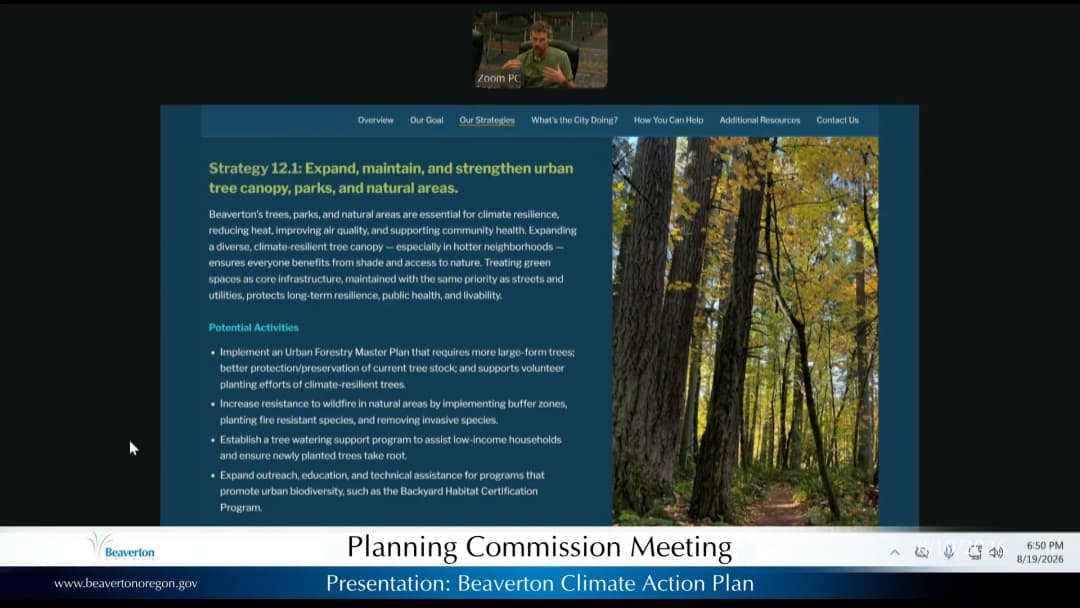
The Beaverton Planning Commission met on August 19, 2026, for a work session that included a presentation on the updated Beaverton Climate Action Plan, a training on the city's Trees and Natural Area Regulations, and the adoption of a land use order for the Williams Court Tree Plan 2 appeal. Chair Adams presided, with Commissioners Mettler, McCann, McAvoy, Speck, and Winter present; Commissioner Holmes was absent and excused. Discussion Items Presentation on the Beaverton Climate Action Plan (BCAP) – Kevin Boylan of the city's sustainability program presented the 2035 update. The plan is structured around measurable objectives and co‑benefits, includes a new chapter on organizational capacity, and quantifies the cost of inaction. Nearly half of Beaverton’s emissions come from building energy and another half from transportation. A new series of eight story maps (the “BCAP Navigator”) helps users explore emissions sources, climate impacts (heat, wildfire smoke, drought), and focus areas such as natural infrastructure. Commissioners asked about integrating the plan into city decision‑making and about real‑time modeling; staff noted that static modeling was used during development and that a dashboard is being created for annual reporting to the City Council. Training on Trees and Natural Area Regulations – Planning Division Manager Anna Slatinsky provided an overview of the regulatory landscape: federal (Endangered Species Act, Clean Water Act), state (Goal 5 natural resources, Goal 10 housing, Oregon revenue constraints), regional (Metro Title 13, Clean Water Services), and local (Beaverton Development Code, Cooper Mountain Community Plan, Significant Natural Resource Areas). She highlighted weaknesses in the current tree code, including limited limits on removal of significant trees and lack of a mechanism to add trees to the inventory. Commissioners discussed potential small‑scale improvements (e.g., size‑based mitigation, voluntary tree designation) and the resource constraints (staffing, funding for consultants) that have delayed a comprehensive update. Slatinsky noted that the city’s code is more permissive than many other Oregon cities and that a political context more favorable to protection may now exist, but capacity remains the primary barrier. Key Outcomes - The Commission voted unanimously (5–0) to approve Order No. 3055, adopting the final land use order for APP 2026-00583, Williams Court Tree Plan 2 appeal, confirming that the order reflects the Commission’s earlier decision. The meeting adjourned at 7:36 PM.

MISCELLANEOUS 46% · ENVIRONMENTAL PROTECTION 31% · PROCEDURAL 7% · PARKS AND RECREATION 6%
10
AUG 18, 2026 · BEAVERTON, OREGON · CITY COUNCIL
Beaverton City Council Meeting - August 18, 2026

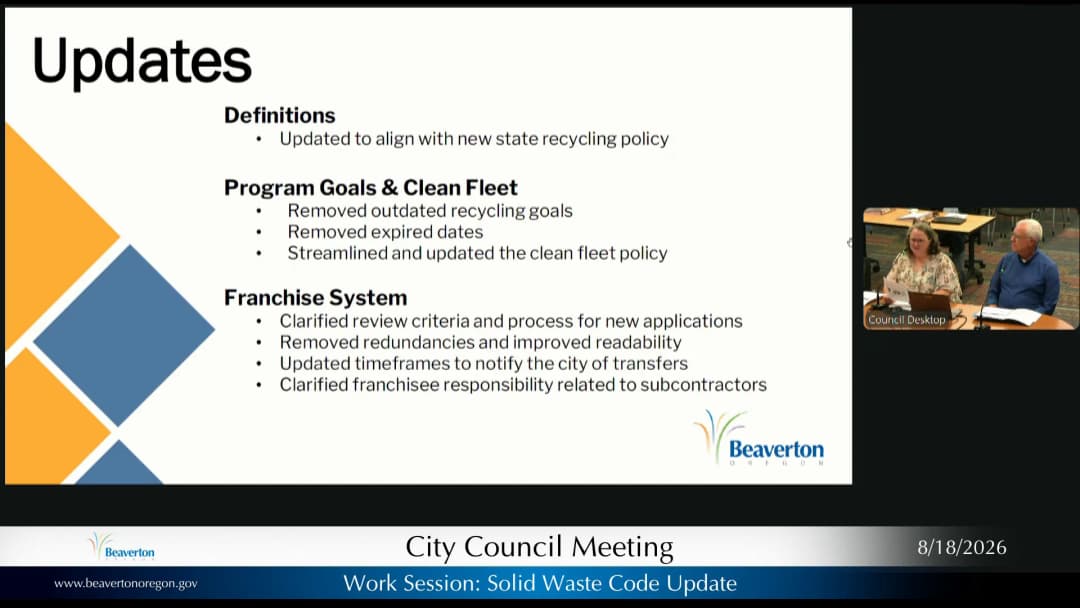
The Beaverton City Council met on August 18, 2026, at 7:00 PM for a regular meeting that included a proclamation, consent agenda, a public hearing on parking permits, and two work sessions on solid waste code and rates. The meeting was called to order by Mayor Lacey Beatty, and all seven councilors were present. Consent Calendar - Motion to approve the council consent agenda and the contract review board consent agenda passed unanimously (7-0). Public Comments & Testimony - Two individuals registered to speak during visitor comments but were not present (either online or in person). Discussion Items - Hip Hop Week Proclamation: Mayor Beatty issued a proclamation declaring August 20–26 as Hip Hop Week in Beaverton. The proclamation highlighted hip hop's origins, cultural impact, and local contributions. Chris Azukian (Executive Director of the RECER) and David Jackson (DJ OG1) spoke in support, emphasizing community togetherness and youth development. A free Hip Hop Star Awards event was announced for Sunday at 3 PM. - City Manager’s Report: The city manager reported on the launch of the Beaverton Streets Initiative (Better Roads Begin Here) website, the development of an Equity Atlas data tool, Boards and Commissions recruitment (36 positions, applications due October 5), and summer events (Harmony Park event drew 500 guests; National Night Out rescheduled to September 22). The Beaverton Celebration Parade is set for September 12. - Public Hearing – Parking Permit Code Amendments (Ordinance 4883 and Resolution 4969): Casey Graziano (Parking Operations Manager) presented proposed amendments to parking permit eligibility criteria and the downtown permit map. The changes allow council adoption of a map by resolution, add employee-specific parking areas, require valid vehicle registration, and clarify permit misuse. No public testimony was given. Councilors discussed enforcement concerns; several noted constituent complaints about ticketing but stressed the need for a more nimble program. The ordinance passed 7-0, and the resolution adopting the map passed 7-0. - Work Session – Solid Waste Code Update (BC Code 4.08): Scott Keller and Elizabeth Cole presented proposed updates to align definitions with the state’s Recycling Modernization Act (RMA), streamline franchise application criteria, and extend notification timelines for franchise transfers from 60 to 90 days. Council feedback included support for clarity, questions about fleet replacement requirements (Councilor Duggar suggested removing arbitrary replacement dates to extend vehicle life), and a discussion on resource prioritization (Mayor Beatty noted a preference for working on a tree code over this omnibus package). Staff will return for first reading in October. - Work Session – Solid Waste and Recycling Rates and Services: Scott Keller presented the annual rate review. No rate increase is recommended for 2026 due to a projected operating margin of 9.7% (within the 7–11% target). Rising costs (tipping fee up 9%, labor, health insurance) are offset by the RMA (recycling processing costs reduced 90%). Key updates: the temporary cleanup container program launched (limited data so far), a multifamily composting pilot is underway, glass collection frequency may shift to every other week in 2027, and the reduced rate program has 546 participants (target 750). Councilors discussed the need for better communication, outreach to culturally specific communities, concerns about Metro’s tip fee increases (doubled since 2020), and the loss of Metro funding that eliminated a staff position. Mayor Beatty urged councilors to directly contact Metro elected officials to oppose fee hikes. Councilor Kimmy offered to help build a list of community organizations for outreach. Key Outcomes - Approved: Consent agenda (7-0). - Approved: Ordinance amending Beaverton Code Sections 6.02.020 and 6.02.390 (parking permits) – 7-0. - Approved: Resolution adopting downtown Beaverton parking permit map and areas – 7-0. - No rate increase for 2026 for solid waste and recycling services. - Directives: Staff to review fleet replacement language in solid waste code; continue outreach for reduced rate program and community partner list; return with ordinance first reading and rate-related work sessions in fall/winter 2026–2027.

WASTE MANAGEMENT 41% · PUBLIC ENGAGEMENT 24% · ARTS AND CULTURE 8% · PARKING MANAGEMENT 7%
0102
NEXT →
OPENPUBLICA · PUBLIC MEETING INDEXUPDATED DAILY · openpublica.com